



Abstract
Lack of coordination among donors poses several problems: it results in higher administrative costs for both donors and partner countries and weakens aid effectiveness. This rationale is the basis for the OECD and EU political agendas on harmonization and coordination, which has resulted in different coordination initiatives at both headquarters and field levels. However, despite the political agenda, recent studies show that for many donors and partner countries aid fragmentation has prevailed or even increased.
By means of a country case study in Morocco, this document explores the obstacles to aid coordination in a specific EU development partner country. Coordination initiatives may have proliferated but not necessarily triggered results in terms of joint work or donors’ specialization. The main obstacles to coordination include varied administrative procedures; diverse administrative architectures; resistance from local authorities and also from leading donors (to abandon or share flagship aid programmes).
Introduction
The current status of European Union’s (EU) development policies is a rare one, in the sense that this could be seen as a ‘half-integrated’ policy. There is, actually, a common development policy implemented by European institutions—for instance, both the European Commission and the European Parliament are involved—and financed by the member states—through mandatory contributions to the EU official development assistance (ODA) budget. However, on the other hand, individual states maintain bilateral development policies with varied strategic, political, geographic and sector orientations.
This specific institutionalization of European aid is posing a challenge for the definition of the EU as a single, consistent and coherent development actor in the global community. This is why, for decades now, the EU has set up an agenda of aid coordination. Moreover, this agenda is aligned with a wider global agenda that calls for the coordination of the whole donor community—or, at least, for that of the Organisation for Economic Co-operation and Development (OECD) members. The political agenda of aid coordination was introduced decades ago in the Maastricht Treaty. But in the last few years, we have witnessed a proliferation of summits, reports and analyses thanks to the impulse of different institutions, but particularly due to the leading role of the OECD and the EU. Actually, the Lisbon Treaty (TFEU, Article 210) includes a reference to the need for coordinated collective action in global development.
The initiatives taken after the OECD-led Paris Declaration on Aid Effectiveness (2005)— a major milestone in the aid coordination/effectiveness agenda—are almost countless.
However, a gap has been growing between rhetoric and deeds (Aldasoro et al., 2009; Bürcky, 2011; Dearden, 2008: 188; Easterly and Williamson, 2011; Fuchs et al., 2015; Karamakalov, 2011). Despite the political agenda, lack of coordination has not changed dramatically. Problems of aid proliferation and fragmentation at the EU level remain.
In this article, we intend to identify the major obstacles to greater EU donors’ coordination in Morocco, a country where international aid is notably fragmented, according to OECD’s assessments (OECD, 2009, 2011), and, therefore, coordination should be particularly cost-effective for both donors and recipients.
More specifically, we explore the obstacles confronted when dealing with coordination initiatives that have taken place in Morocco. To do this, we have surveyed aid stakeholders in Morocco – EU donors, non-EU donors and local counterparts – between March and May of 2013 about their coordination initiatives, costs and results, and main obstacles to greater levels of coordination.
The first section goes through previous studies on aid coordination and criteria for the geographical allocation of international assistance. The second section explains the methodology of our study and the third section presents the results on the main obstacles for greater results. The last section concludes.
Academic approaches to aid coordination and aid allocation
Academic literature on aid coordination has focused on the implications – this is, the costs – of lack of coordination. In this sense, scientific research is aligned with institutional documents; both underlying the administrative (augmenting the administrative burden for recipients and donors), opportunity (deteriorating the absorptive capacities and quality of bureaucracies crowded out by aid bombardment) and indirect costs (weakening the accountability and predictability of aid flows) of lack of coordination among donors. The result is a waste of scarce financial resources and a reduction in aid effectiveness, that is, less economic growth (Acharya et al., 2006; Anderson, 2011; Arimoto and Kono, 2009; Bigsten, 2015; Frot and Santiso, 2008; Grimm et al., 2009; Kimura et al., 2012; Knack and Rahman, 2007; Roodman, 2006). In addition, uncoordinated activities could lead to inefficient aid supply, generating aid orphans and aid darlings at the international level and across sectors (Annen and Moers, 2012; Bigsten, 2006; Frot and Santiso, 2011; Rachman and Sawada, 2010; Svensson, 2006).
Despite the fact that most literature on aid coordination deals with the costs of non-coordinated aid, a second body of literature within this field focuses on the obstacles to greater levels of coordination. Works in this specific field point out to the fact that coordination is expensive, not cost-free in economic and political terms, and difficult due to the diversity of donors’ motivations, whatever they may be (Barder, 2009; Barry and Bodin, 2012; Bigsten, 2006; Delputte and Orbie, 2014; Fengler and Kharas, 2010; Hartmann, 2011; Karamakalov, 2011; Svensson, 2006; Winters, 2012). Besides recipient needs or merits, in development cooperation donors’ features, values and interests are also at play (Annen and Moers, 2012; Bourguignon and Platteau, 2015; Broberg, 2011; Fuchs et al., 2015; Schulz, 2007; Steinwand, 2015). This political economy problem is obviously transferred to aid mechanics in the field. ‘All donors want to co-ordinate, but no one wants to be co-ordinated’ (Whittington and Calhoun, 1988) and, therefore, aid fragmentation does persist (Nunnenkamp et al., 2013).
In this sense, when referring to donors’ motivations as a major obstacle to aid coordination, these studies connect with another major topic of research within the specific field of development cooperation policy, which is that on the motives behind donors’ assistance.
Positive studies on the motives of international assistance approach the reasons behind international aid from the viewpoint of the donor, according to its own self-interests (self-centred motives) and to the characteristics of the recipient, specifically the latter’s needs or merits (altruistic motives). 1 This literature follows seminal work by Dudley and Montmarquette (1976), who designed a model for econometric analysis of the causes of international assistance, and by McKinley and Little (1978a, 1978b, 1979), who analyzed whether German, British and American aid during the 1960s was given out of self-interest or to meet recipients’ needs. Their conclusion was that motives of self-interest clearly prevailed over recipient needs, opening the door to a series of studies that analyze the relative weights of these two factors and their evolution over time. These studies can be classified into several groups: (i) works on the general behaviour of groups of donors vis-à-vis either all developing countries or one region in particular; (ii) studies on the differences in the allocation pattern by institutions or channels and (iii) analyses of the motives for co-operation of one particular donor vis-à-vis all recipients. 2
The bulk of these empirical papers analyze the behaviour of the whole set of donors in relation to all recipients; and a great deal of it comes to the conclusion that national interests of donors prevail when it comes to the international allocation of aid. Donors’ interests may be of a different nature: nations’ colonial pasts (Alesina and Dollar, 2000), geographical proximity (Szent-Ivanyi, 2012); political, security, investment and/or trade interest including, for instance, voting patterns at the United Nations (Alesina and Dollar, 2000; Berthélemy, 2006; Lundsgaarde et al., 2010; Maizels and Nissanke, 1984; Schraeder et al., 1998; Szent-Ivanyi, 2012). Moreover, bilateral interests seem to dilute when aid goes via multilateral channels, according to various authors (see, for instance, Berthélemy, 2006). Other studies focus on the lack of relevance of recipients needs and/or merits as a criterion for allocating international assistance (Alesina and Weder, 2002; Birdsall et al., 2003; Hoeffler and Outram, 2011; Neumayer, 2003).
Other studies are not so conclusive about the prevalence of donors’ interests (or the non-prevalence of recipient needs or good governance) in the allocation of international bilateral assistance. This is the case of Mosley (2006) and also of Dreher et al. (2011) when analyzing emerging donors. Similarly, Isopi and Mavrotas (2006), Claessens et al. (2007) and Clist (2011) claim that there is no uniform behaviour among donors.
Recently, a second group of literature seems to have emerged. These works introduce a more complex—and therefore a more accurate and/or nuanced—view on the dynamics behind geographical distribution. It assumes that a single donor (or, more precisely, various institutions or channels within that single donor) might be allocating ODA, for different reasons, to different recipients (Buthe et al., 2012; Dollar and Levin, 2006; Dreher et al., 2010; Dreher et al., 2012; Loman et al., 2011; Metzger et al., 2009; Nunnenkamp and Öhler, 2011).
The third group of empirical studies on the assignment of aid by wealthy nations includes analyses of the behaviour of one particular donor, but such studies are far more rare. Although the aforementioned seminal works by McKinley and Little (1978a, 1978b, 1979) each focuses precisely on one particular donor (Germany, the UK and the US), subsequent works have approached this issue from a broader perspective and on the basis of cross-country empirical methods.
Nevertheless, a few (more recent) works escape this trend. For instance, Macdonald and Hoddinott (2004) approach the criteria behind Canadian international assistance for the period 1984–2000 and find evidence of recipient need as a motive for aid allocation. Other criteria include recipient countries’ human rights record and membership in the Commonwealth or la Francophonie. Moreover, there seems to be an evolution in the relative weight of different motives: altruistic factors are losing strength while commercial interests are gaining. More recently, Reynaert (2011) has analyzed the motive behind EU assistance to Mediterranean countries. The implementation of economic reforms in partner countries seems to be a stronger pull factor of European assistance than their needs, or than donor’s interests. Actually, this might explain EU’s aid allocation to Vietnam (Hoang, 2014). Unlike the EU, the United States’ allocation of international assistance might be more influenced by self-interest (geopolitical and terrorist threats or commercial factors), despite the fact that countries with lower GDP per capita receive more American aid (Boutton and Carter, 2014; Harrigan and Wang, 2011). According to Jin Kang et al. (2011), South Korea’s external aid is an important catalyst for FDI flows – and this is also a feature of Japanese assistance. However, Lee’s (2012) results show that KOICA’s aid allocations are not aligned with socio-economic development and poverty-reduction objectives, nor with strategic and commercial interests. For this same donor, Kim and Oh (2012) come to the conclusion that development policy might have a dual-track structure as, on the one hand, the Asian country favours high-income developing countries – possibly a signal of national interests in aid allocation – while, on the other, the correlation between aid inflows and per capita income is negative for middle-to-low to middle-income partner countries. Regarding China’s foreign assistance, it may not be so ‘rogue’ after all, as resource endowments in recipient countries are not its main pull, according to Dreher and Fuchs (2011). As for Japan, according to Strand and Tuman’s (2012) results, foreign aid might be partly driven by recipient countries’ alignment with Japan in the International Whaling Commission. Finally, regarding Spain, effectiveness might not be playing a major role in the decisions behind geographical allocation of Spanish aid, whereas donor’s interests clearly prevail over the recipients’ needs (Tezanos and Gutiérrez Sobrao, 2011).
Although academic literature on the criteria for allocating assistance is empirically biased, some of those criteria are connected to theoretical (and more ample) visions on international relations as a whole. Selfish motivations of aid may respond to realistic views while international allocation of development assistance based on needs or merits of recipients correspond to a constructivist approach to the world. This idea is further developed in Pauselli (2013) who also reviews liberal and Marxist postulates and identifies the links between theoretical inputs to international relations and empirical studies on the criteria for international allocation of aid.
Why is donor coordination so difficult in reality? A methodology
Our research question is why donors’ evidence-based discourse about aid coordination has so little influence on their own practice. We presume that the official discourse is missing other factors posing an obstacle to aid coordination.
For doing so, we selected a ‘most-likely case’. 3 Morocco is a recipient country where the official discourse on donor coordination should have a greatest influence on EU aid programmes for several reasons. First, Morocco receives a relevant volume but very fragmented international aid, which may entail enormous transaction costs, unless donor countries coordinate their programmes. Second, EU donors might be especially interested in producing a significant impact on their neighbour countries, and specifically in the poorest countries of their neighbourhood.
In other words, if the official discourse on donor coordination has no impact on EU donors’ practice in Morocco, it will probably have very little impact in elsewhere. Therefore, understanding why donor coordination fails in Morocco may help to understand donor coordination in a broader context. For those same reasons, successful coordination initiatives in Morocco will probably not be replicable in other countries for other groups of donors.
Assessing the costs and results of coordination efforts by EU donors in Morocco requires different research techniques. First, ODA flows and commitments published by the OECD 4 were explored and analyzed. This was the basis for a cooperation map that let us identify the donor countries channelling assistance to Morocco and was also the guide for contacting both EU and non-EU delegates in the field in order to conduct the survey on coordination costs and results.
An agenda of interviews was set and accomplished in Rabat in March and April of 2013. This series of structured interviews was guided by specific questionnaires. EU donors and non-EU donors answered and/or filled different questionnaires, as the type of information required of each of them was slightly different.
Given that this specific research question was framed in a wider research project, in the case of EU donors, qualitative and quantitative data responding to over 60 questions were grouped into five blocks covering other issues on aid coordination, besides the obstacles: (i) features of the donor (ODA evolution and sector distribution); (ii) costs of coordination (participation in coordination initiatives and assessment of human and financial resources devoted to coordination processes); (iii) results of coordination (common diagnosis, planning, implementation, monitoring and evaluation, as well as perception of donors’ added value); (iv) costs of opportunity of improved coordination (both political costs in terms of the EU as a global player and perception of costs in terms of development impact) and (v) obstacles (both political and administrative) and opportunities for better EU coordination results.
In order to understand which are the major obstacles posed to aid coordination, according, mostly, to donors themselves, this article relies on the answers provided in the fifth block composed of three open questions on political and administrative obstacles to aid coordination and on windows of opportunity for greater levels of aid coordination.
As for non-EU donors, the research team conducted interviews with a similar questionnaire (with the exception of coordination costs). Interviews included a third type of stakeholder, which were the local, Moroccan, counterparts for international assistance. This questionnaire was also adapted to the features of the interviewees. However, both these groups were asked about the obstacles and potentialities for better coordination results. In almost all cases, interviewees had a very open attitude, something that let us complement the structured questionnaires with dditional, relevant and qualitative information collected in a semi-structured format, following the Dexter (2006) definition.
As previously mentioned, the sample of donors was designed on the basis of the map of international aid. Over 90 per cent of total aid commitments to Morocco come from seven donors. That is, each of these seven donors holds financially significant aid relations with the Arab country (Table 1).
Donors’ ranking in Morocco (average annual commitments 2007–2011; current USD millions)
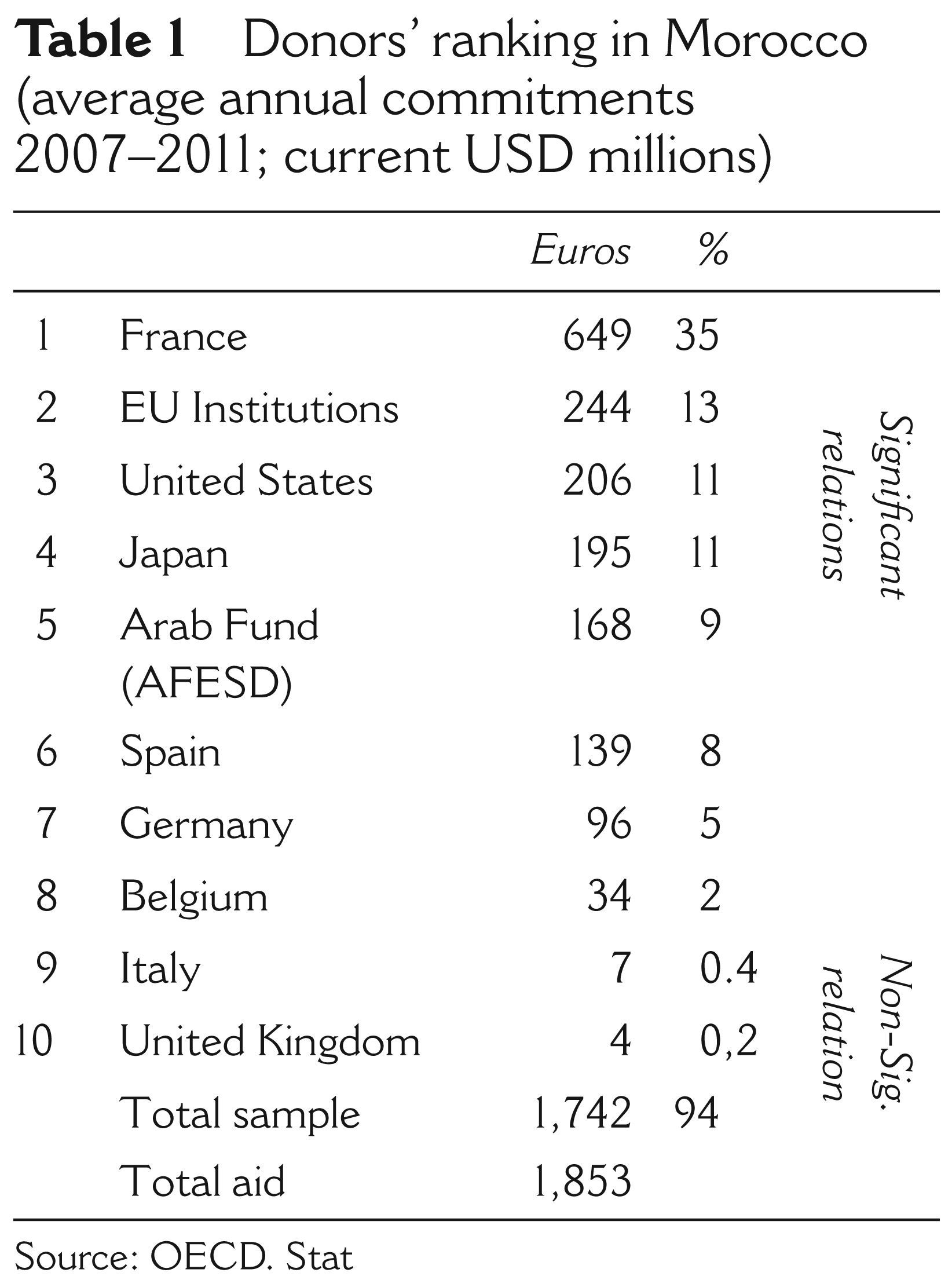
By enlarging this sample to three other European donors, we also took into account donor coordination with relatively smaller EU donors – something that better captures aid fragmentation and its implications in terms of coordination results. By adding these small donors, the representation of EU donors in the sample increases to 7 out of 10 states, or 94 per cent of total EU ODA to Morocco.
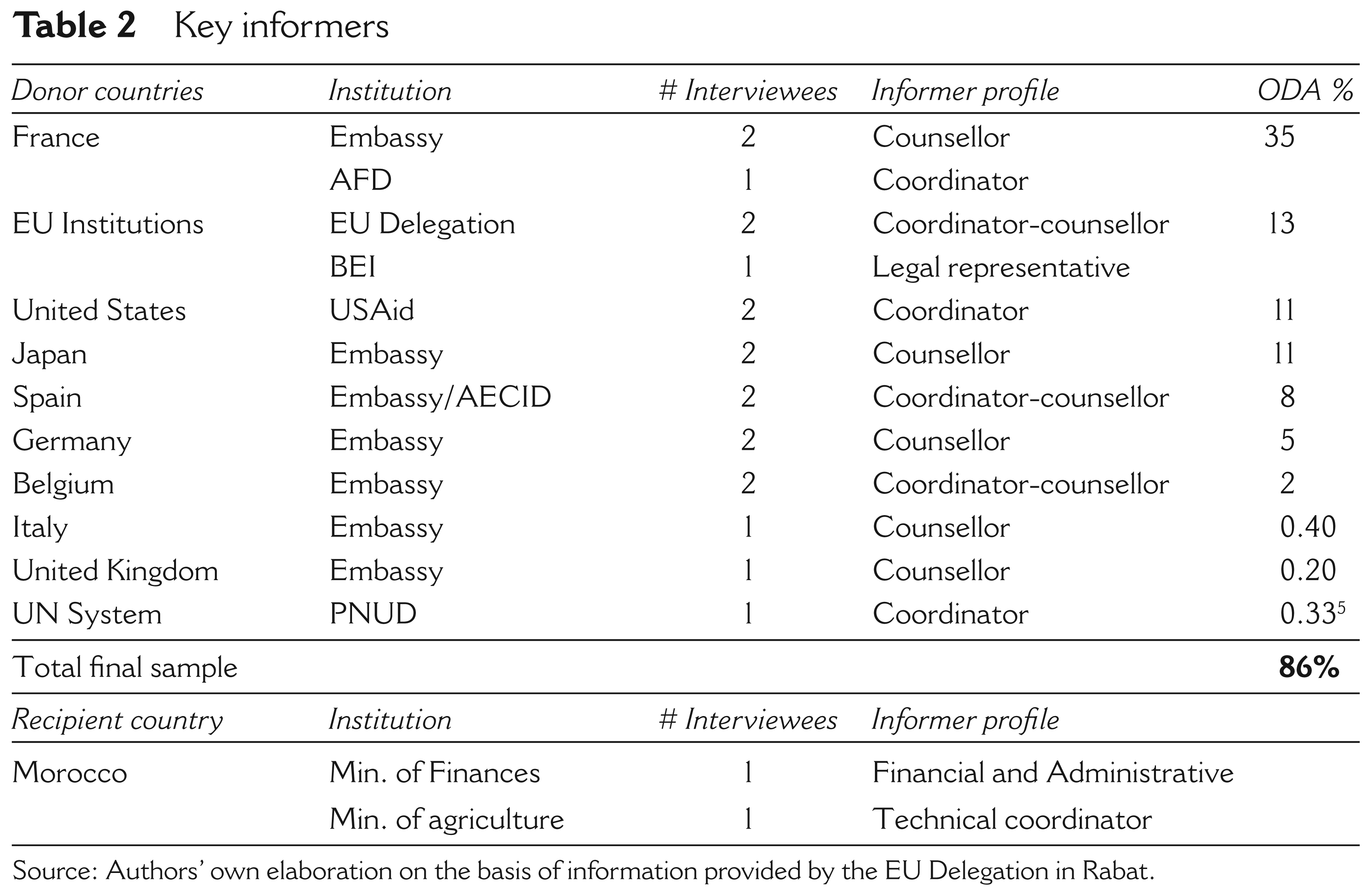
Based on this list, key informers were identified by contacting the EU Delegation and accessing the database shared by most donors in the field that contains contact details of the donor representatives in different coordination initiatives (Table 2). Most of them were embassy counsellors and only a few had operational responsibilities, but all of them had a common trait: they are officially appointed by their countries to participate in aid coordination initiatives. All European donors, as well as Japan and the United States, were accessible, agreed to be interviewed, and provided additional written information when needed. Only the Arab Fund had to be dropped from the list, as no informer was identified in the field or headquarter levels. Finally, although its aid volume in Morocco is not significant, the UNDP Country Director was included in the interviewees list as the coordinator of the UN system in Morocco and a key player in overall coordination initiatives.
Key informers
Results
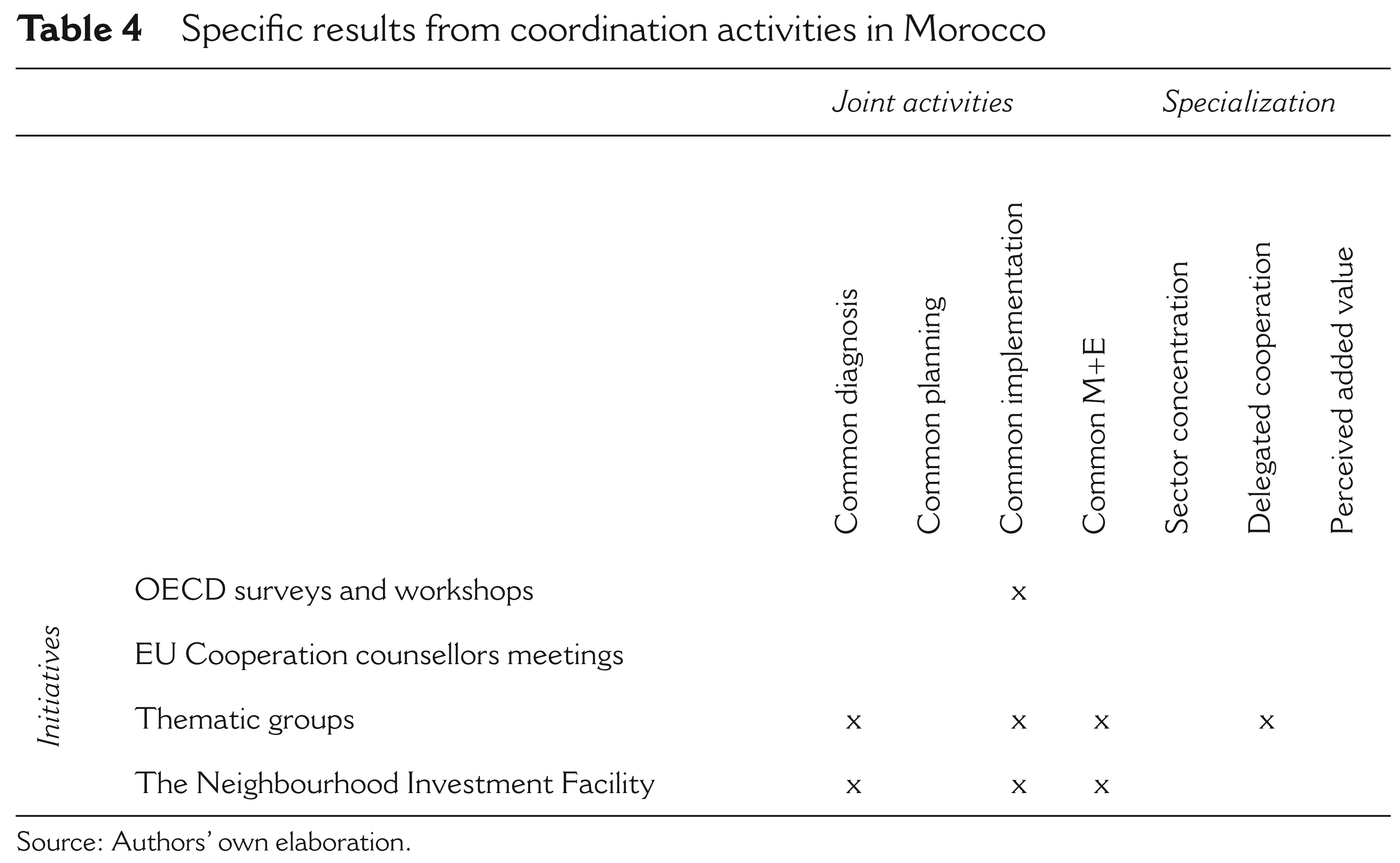
We consider a ‘coordination initiative’ to be any action on the part of a given donor, a group of donors, or the partner country that aims to obtain one or several coordination results. In the particular case of Morocco, coordination initiatives include regular counsellors meetings or thematic surveys, for example. We considered initiatives to be effective only if they result in ‘coordination results’; that is, joint activities (referring to common diagnosis by EU donors of Morocco’s development and development cooperation activities, and/or common system of monitoring and evaluation) and/or specialization (referring to delegated cooperation, namely division of labour on the basis of comparative advantage).
Following the differentiation between coordination initiatives and results, we were able to identify up to four main coordination initiatives, which yielded coordination results both in terms of joint activities and specialization (Table 3). 6
The results of coordination are obviously conditioned by the features of coordination initiatives. In general terms, those that have led to deeper coordination of donors are limited to specific sectors – for instance, education and health – and may be conditioned by the instruments in use: budgetary support and blended finance of infrastructure projects. In these cases, coordination results in common diagnosis, implementation and even monitoring and evaluation. Nonetheless, when it comes to coordination of cooperation activities by the entire community of EU donors, results appear to be very poor. There is only one coordination activity specific to EU donors and distinct from coordination processes that includes the entire donor community. This is the half-yearly coordination meeting of EU donors that has yielded no direct tangible results. So, coordination results are poor, an evidence which is consistent with that highlighted in previous studies on aid coordination (OECD, 2012).
Coordination initiatives and results in Morocco

In fact, most interviewees acknowledged the fact that there is great room for improvement when it comes to EU donors’ coordination. However, most of them insisted that coordination initiatives – again, little more than regular meetings – have yielded at least two results. First, there is information sharing. Now, at least, the EU delegation in Morocco is aware and informed of the cooperation activities conducted by other member states. Moreover, this information sharing highlights the weaknesses and lack of procedural coordination of EU development cooperation policy in the field. This might provoke a certain change of political culture, in terms of the need to transform activity-based development cooperation into result-based development policies (Table 4).
Specific results from coordination activities in Morocco
So, despite the existence of several coordination activities, results are poor and there is room for improvement. Why is that so? Which are the main obstacles for coordinating aid in Morocco, a key strategic partner for the EU and some of its member states? According to academic literature reviewed in the first section of this article, disincentives can be of a political and/or an administrative nature. Is this also true for the particular case of EU donors in Morocco?
As mentioned above, the questionnaires include questions about the main administrative and political barriers to greater result in terms of aid coordination. All donors interviewed for this research (Table 1), as well as a representative from the local Ministry of Finance, answered this block of questions on obstacles to and opportunities for greater coordination. 7
Firstly, one major obstacle to aid coordination seems to be leading donors’ bilateral political agenda – consistently with previous academic literature, reviewed previously, on aid coordination and with a great deal of empirical studies on the motives behind geographical allocation of ODA. All interviewees but one pointed out to that factor (Table 5). Morocco is not only a developing-partner country, but also a strategic geopolitical and geo-economic spot for Western countries – something which affects the entire map of international relations and development cooperation. In this context, leading donors might be more interested in emphasizing their role as bilateral counterparts at the expense of the EU role as a global development player. Most respondents who pointed out this obstacle were referring to France and Spain but also, quite surprisingly, one donor underlined the fact that the EU delegation – the body that should be propelling ‘one EU’ – might also be behaving like a bilateral donor with a national agenda.
Political and administrative obstacles to donors’ coordination (in parentheses, number of times mentioned)
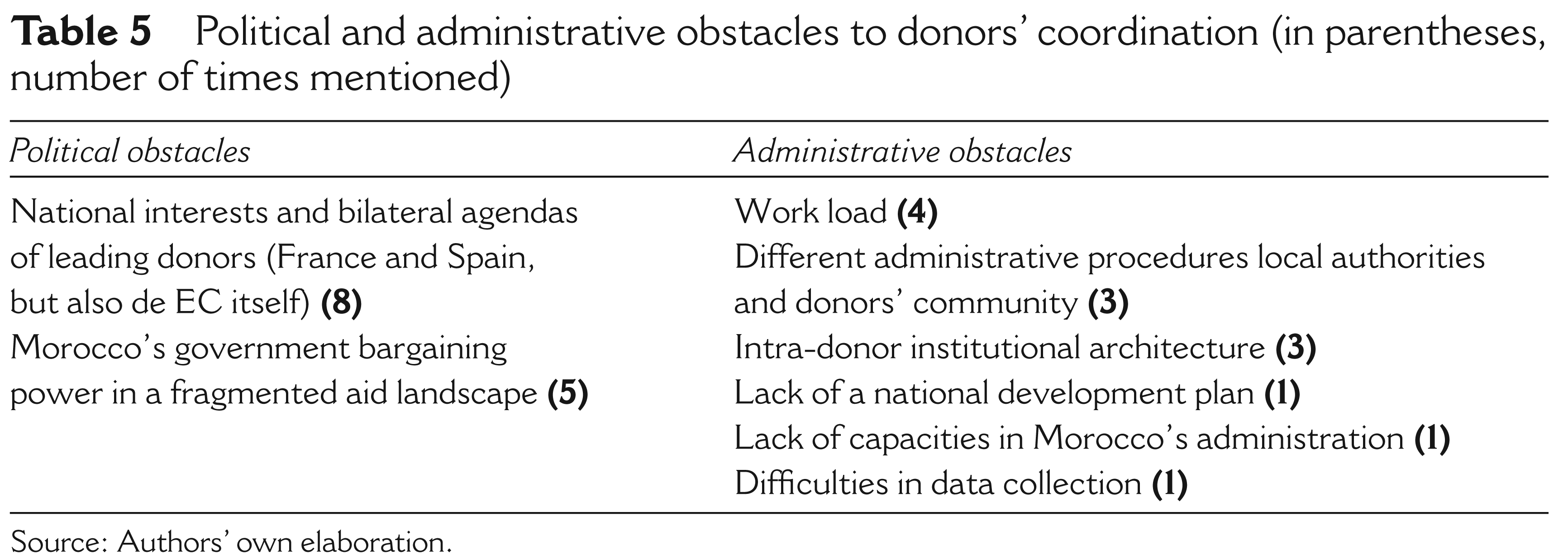
Secondly, the political interests and institutional architecture of the Moroccan government seem to play a role. Many respondents (5) mentioned the ‘divide and rule’ approach by the local government. If this is so, the Moroccan elites might be more interested in both a fragmented community of donors, and a local institutional design of fragmented counterparts. In fact, as already mentioned, there is neither a national development plan – something that was also mentioned as an administrative obstacle to coordination – nor one single counterpart with a say about development and/or the development cooperation strategy. The Ministry of Finance has been identified by donors as the strategic counterpart, but the truth is that its role is somehow limited to the financial control of ODA flows – still an important role given the high proportion of refundable assistance. Therefore, institutional obstacles of this sort might actually be the result of the lack of political will for greater levels of coordination.
In addition, the very different procedures of each EU donor – and the EU Delegation, for that matter – were mentioned in many of the interviews. EU member states and Delegation have very diverse, and sometimes complex, administrative procedures when it comes to sub-contracting, transferring funds to partner countries, or signing agreements with other member states. Differences in programming methods are a good example of this. While the EU Delegation’s aid is programmed in 4-year cycles, Germany negotiates bilateral agreements with Morocco every 2 years and runs complementary 5-year programmes at a regional scale.
Fourthly, there is intra-donor lack of coordination. The institutional designs of development cooperation policies of several EU donors are quite fragmented. German cooperation is divided into several agencies with different roles – grants versus credits, for instance. The person in charge at the German Embassy in Rabat is fairly informed about the activities in Morocco of the cooperation agencies and offices that do not depend on the Foreign Affairs Ministry, but she does not have the political power to plan, implement, or monitor and evaluate those funds. Something similar happens with the United States, where USAID and the MCC operate as separate agencies; France, where the cooperation aggregate at the embassy and the delegate of the AFD do not coordinate their activities; and even the EU Delegation, which works as an additional member state, but independently from the EIB. 8
Finally, the lack of capacities on the part of the Moroccan administration as well as the difficulties in collecting all the information needed for a proper process of coordination were also mentioned during the interviews. All these obstacles result in the perception of an extraordinary work load for cooperation institutions in the field (a factor mentioned four times).
Conclusions
The academic literature on aid coordination has strongly focused on estimating the financial and development costs of donor countries not coordinating their international assistance. A few studies that go through the motives of this lack of coordination point out to national interests of bilateral donors. A connection can be established between this body of literature and the extended field of research on the criteria for the geographical allocation of international assistance. The latter divides these criteria into two groups that relate to the national interests of donors and the need and/or merits of partner countries. Therefore, if (and despite the international and European agenda and the estimations on the costs of the lack of coordination) EU donors still do not coordinate their aid strategies and projects and, meanwhile, aid assignments can be motivated by national interests of donors, then lack of coordination might be the result of EU donors hanging on to their bilateral agenda as the result of the perception that a more European and multilateral approach to development might hinder the pursuit of such national interests.
This article has shown why, despite the international agenda and specific commitments by EU donors, aid is still fragmented in a key neighbouring developing country like Morocco. According to our qualitative survey, the main obstacles to greater levels of coordination are both of a political and of an administrative nature. On the political side, both the national interest of the Moroccan government (empowered in a fragmented aid landscape) and that of leading donors in the country (like France and Spain, which are also EU members) play a major role. In this sense, these results are consistent both with literature on the motives behind lack of coordination and on those studies on geographical allocation of international assistance that underline the interests of donor countries as a major factor for allocating aid to some countries instead of others. Therefore, our results are consistent with those found by Delputte and Orbie (2014) on the limitations to EU aid coordination in Tanzania and Zambia.
However, besides the political argument, there are other reasons, of an administrative or institutional nature such as different administrative procedures among EU members and a messy institutional aid architecture in some member states. Morocco’s administration design is not prepared for aid coordination – maybe the result of the lack of political will for coordination. Nor is the institutional architecture of donors and, specifically, of EU member states. In short, institutions do matter.
Footnotes
Acknowledgements
This research was conducted in the framework of a European Parliament’s initiative on the Cost of Non-Europe in Development Policy. The authors are grateful for financial and technical support on the part of the European Parliament. A preliminary version of this article was presented at the 14th EADI Conference ‘Responsible Development in a Polycentric World. Inequality, Citizenship and the Middle Classes’ held in Bonn, 23–26 June 2014. They are also grateful for useful comments by other speakers and discussants. Specifically, the authors want to thank Paul Hoebink for his suggestions. They also thank referees and editors involved in the reviewing process of this version for its publication. Their comments and suggestions have very positively contributed to the quality of this article.