



Abstract
This article discusses migrants’ experiences of European migration-labour. It shows how precariousness is materialized in migrants’ work and lives. I show how the subordination of migrants to the demands of the (global) market shapes the work of ‘third country migrants’ as precarious in European economies. Specific migration policies as well as labour processes and their regulation construct migrants as ‘wasted precariat’, in line with Bauman’s (2004) notion of ‘wasted humans’. This process occurs at the intersection of migrant workers’ immigration status, the governance of immigration and labour relations as well as features of the industries that employ migrant workers.
Introduction
Contemporary economies favour flexibility in employment relationships. This is rooted in neoliberal ideology, demanding deregulation and privatization globally, and dismissing state intervention as political interference in the market, and as an obstacle to growth and development. Such market-oriented policies have been flanked by provisions that marginalize worker’s rights, together with the decline of the public sphere. Hence, flexibilization goes hand in hand with the shrinking of the welfare state, meaning that the composition of welfare expenditure has become more individualized, bringing less collective public provision, greater reliance on the market for delivery and conditionality in access.
As a result, sectors such as construction, agriculture and services where production has not been outsourced to the global South–East have witnessed deregulation. These sectors engage the majority of migrant populations in Europe (Pajnik and Anthias, 2014; Toksöz and Akpinar, 2009: 143). The decline of the welfare state and increased deregulation provided opportunities for capital to reduce wages and increasingly shape exploitative work relations. The effects of these processes are thus concentrated in specific sectors and with specific groups of (migrant) workers.
European labour market statistics reflect the trend of flexibilization well. Eurostat data (based on 28 European Union [EU] member states) show a rise in part-time employment as share of the total employment from 18.8 per cent in 2011 to 19.7 per cent in 2013. Historically, women have been more affected than men by employment of shorter duration and also by unemployment. Restructuring has produced atypical work arrangements where workers are employed on short-term contracts for low salaries, mirrored in the significant share of temporary employment that amounted to 13.2 per cent in 2013 Pajnik and Anthias, 2014; Toksöz and Akpinar, 2009: 143). This has hit various groups of workers such as the young and older workers, besides migrant workers. Yet, many migrant workers are severely disadvantaged when it comes to access to welfare benefits. This comes as no surprise as in debates and policies related to migration and the labour market at the level of the EU, 1 we witness strong Eurocentrism where migrants are merely viewed as a commodity. As highly skilled workers, they represent an opportunity for European economic development; as low-skilled workers, they are instrumental in filling in labour market shortages for so-called ‘3D’ (i.e., dangerous, demanding and dirty) jobs that are unattractive to nationals.
Based on migrants’ own perspectives, in this article, I have shown how these developments shape the work of ‘third country migrants’ 2 as precarious in globalizing European economies. The article contributes to the discussions about precariousness by showing how specific migration policies as well as labour processes and their regulation construct migrants as ‘wasted precariat’, in line with Bauman’s (2004) ‘wasted humans’. This process occurs at the intersection of migrant workers’ immigration status, the governance of immigration and labour relations as well as features of the industries that employ migrant workers.
Precariousness: A distorted work norm
‘Industrial citizenship’ ideals that increased in importance in the European context after World War II cherished, at the normative level at least, labour and social security. After the 1970s, though, intensification of globalization brought a steep rise of flexible labour markets that operate transnationally and engage fragmented and precarious class structures globally (cf. Sassen, 1998). The rising commodification, also informalization of work and employment relations, shapes precarious work as non-standard or atypical work if compared with ‘older’ European employment patterns (Hilgers, 2008; Standing, 1999). The abovementioned trends in organizing the labour process, in general, and migrant work in precarious sectors such as cleaning, construction, agriculture and domestic work specifically are a radical proof of how the atypical employment relations are actually becoming the new typical employment relations (Pajnik and Anthias, 2014).
Precarious work refers to short-term work relations rather than long-term work relations, characterized by a high degree of flexibility, poor levels of social protection or no social protection at all (Munck, 2012; Pajnik and Campani, 2011; Rodgers, 1989; Standing, 1999). Defining precarious work, Rodgers (1989: 3) speaks of four dimensions: (i) Precarious work breaches norms of certainty and continuation, are often of short duration and represents jobs for which risk of loss is high, even more so if jobs are performed irregularly. (ii) Precarious work is characterized by a high degree of employers’ control over work. This implies that the more the work is insecure, the less the worker has a say on working conditions, wages, etc. (iii) The level of worker’s (social) protection, understood broadly, is low. Protection here includes legal protection or protection achieved through collective organization. It covers social rights and protection against discrimination or against unacceptable working conditions. (iv) Income is generally low, and low-income jobs are treated as precarious if they are associated with poverty and social insecurity. ‘The elements involved are thus multiple: the concept of precariousness involves instability, lack of protection, insecurity and social or economic vulnerability’ (ibid.). Rodgers adds that this does not eliminate ambiguity; an unstable job is not precarious by definition. He argues that a specific combination of these circumstances shapes precariousness while the boundaries around the circumstances are always to some extent arbitrary (ibid.).
Rodgers’ characterization of precariousness is closely related to social rights that are dependent on employment status. Yet, in the case of migrant workers, the precariousness of their work also depends on their residence status, nationality and work permit. Hence, welfare and migration policies intersect to produce migrant precariousness. We lean on Sainsbury (2012) who has shown that more comprehensive welfare systems favour to a greater extent migrant entitlements, and vice versa, tight welfare regimes are linked to restrictive migration regimes, a combination that has the exclusionary effect of curtailing migrant access to social rights. Consequently, labour precariousness is more pronounced for those groups of workers with weaker citizenship rights. Cohen (2006: 150) argues that ‘helots’, the category that includes irregular migrants 3 and asylum seekers suffer the most, and even more so when their work is unskilled and tied to specific projects. Compared to the groups of citizens that include nationals as well as regular and established migrants, recognized asylum applicants and special entrants, helots as the lower ‘subgroup’ of citizens are the worst off. The guarantee of their labour and wider human rights is a practical impossibility for them.
When we discuss migrant precariousness, it does not suffice to acknowledge the changed work relations of post-Fordist societies. Other aspects that are specific of migrants’ work also need to be taken into account. When analyzing migrant precariousness as a form of non-secure work and life options in contemporary Europe, we therefore suggest supplementing the features that Rodgers highlights with characteristics typical of migrant work. Bauman (2004) writes that modernity produced ‘human waste’ or ‘wasted lives’ as an unavoidable effect of economic progress and the inclination of modernity to control and order life. Human waste is for Bauman (2004: 57–60) best viewed in categories of economic migrants as ‘traditional industrial waste’ performing all kinds of dirty and ‘no-fun’ jobs in consumerist societies. Such ‘wasted precariousness’ as ‘migrant precariousness’, we argue, is a characteristic of migration and labour market order adopted across Europe.
If the first factor shaping migrant precariousness refers to immigration status, the second aspect refers to the related migration and labour market policies, such as permit and entry policies, that are found to substantially affect migrants. The third aspect refers to the labour process of specific industries, such as construction, agriculture, cleaning and care work, that employ the largest shares of precarious migrant workers (see Figure 1). An important attribution of the migrant precariat is also the restructuring of work relations in racialized, ethnicized and gendered terms. Acknowledging the notion of inter-sectionality (Yuval-Davis, 2007), precariousness increases not only with the intensity of non-standard relations for a specific job but also with intersections of systems of marginalization, that is, precariousness increases when work is performed by a migrant, female, ‘black’, young, less-educated person.
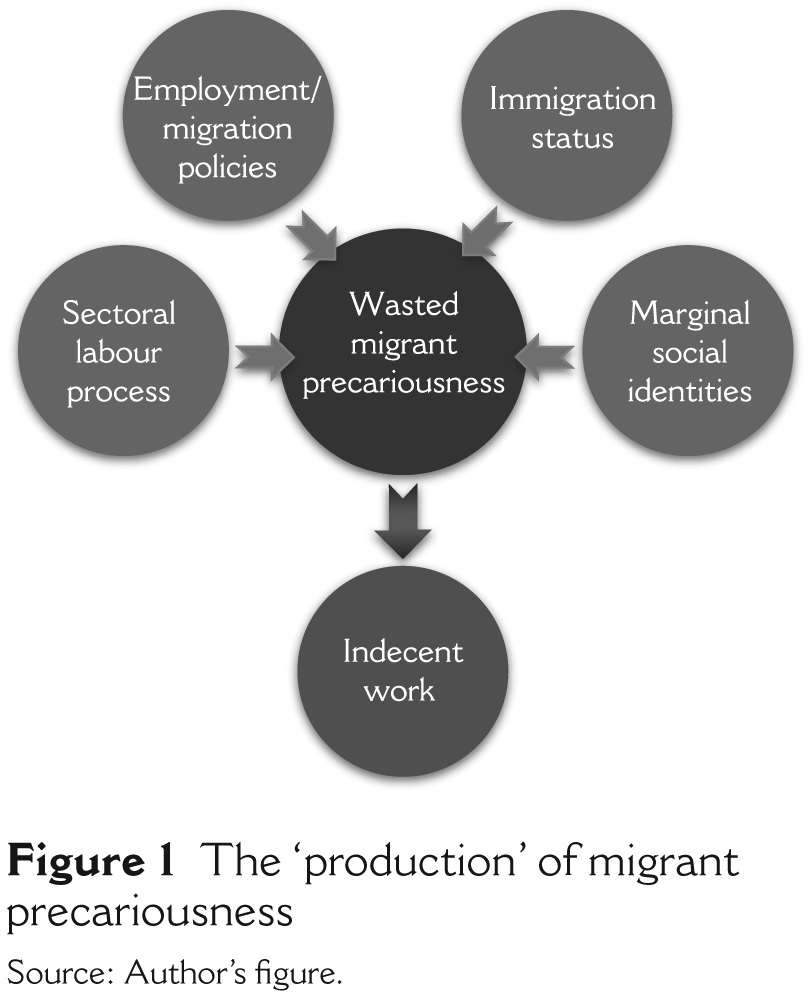
Source: Author’s figure.
In order to understand migrant precariousness, we therefore need to consider migration/labour market order of workfare societies and analyze—intersectionally—migrant statuses, policies and industries of migrant work (see Figure 1). Adopting such an approach helps us coin migrant precariousness as ‘wasted precariousness’. In the European workfare model, this denies migrants’ agency and breaches dignity-related aspects of work, such as those encapsulated in the International Labour Organization (ILO) concept of ‘decent work’ (ILO, 2012). ‘Wasted precariousness’ in the case of migrants points to a distinct migration/labour market order that has proven to over-determine migrants’ lives (Brubaker, 1989; Devitt, 2011; Rodgers and Rodgers, 1989). Largely, the concept describes processes of marketization of migrants where they are reduced to disposable agents for the (global) market.
In the sections that follow, I discuss in a critical comparative perspective the precarious positions of third country migrants in six EU member states—Cyprus, Finland, Germany, Hungary, Italy and Slovenia. Their work is concentrated in specific sectors of the economy, such as construction, manufacturing, agriculture and care work, that shape these migrants’ lives as economically and socially insecure. 4 These countries capture some of the North/South differences as well as the diversity between ‘old’ and ‘new’ immigration countries in the EU.
Our research participants presented different reasons for migration that include their own and their family’s poverty and lack of economic perspective, study opportunities or the wish to reunite with their family as well as political motives, such as escaping from (menace of) war or from the risk of persecution. We could broadly distinguish two spatial patterns of migration. One is immigration predominantly from neighbouring countries or countries in the same region, which is typical of Hungary, Finland and Slovenia. In Germany and Italy, where the tradition of migration has been the longest, as well as in Cyprus, on the other hand, immigration also takes place from more distant countries. Exact numbers of third country migrants are difficult to establish, though. Figures vary among different statistical sources and cannot be compared easily, also because of dissimilar methods of gathering the data. In addition to consulting existing studies, reports and analyses, we therefore focused particularly on gaining access to unprocessed statistical data on migrants, particularly in relation to their positions on the labour market. Various recent reports on social, economic and demographic development of destination countries served as complementary sources to these official statistics.
The data compiled in the PRIMTS project show that most migrants in Hungary are ethnic Hungarians from Romania, Ukraine and Serbia. Romanian citizens constitute approximately half of all migrants, whereas nationals of Ukraine and Serbia jointly represent around 20 per cent of third country migrants. Among non-European migrants in Hungary, the most numerous group are Asians from China and Vietnam. Occasionally, asylum seekers from conflict areas, such as Afghanistan or Iraq, also migrate to Hungary. Similarly, Finland recently started attracting many migrants from the countries in the region. This particularly concerns migrants from the former Soviet Union, especially Estonia, a significant portion of which are ethnic Finns. Another important group are refugees, initially coming from Chile and Vietnam, lately also from various African countries, especially Somalia, as well as from the Middle East and other parts of Asia. General shares of foreign nationals are low in both countries, that is, less than 2 per cent in Hungary and 2.5 per cent in Finland. Migration from countries in the region is also quite typical of Slovenia. Immigrants originate predominately from Yugoslavia’s successor states. These migrants represent more than 85 per cent of all third country migrants, while foreign population amounts to 4 per cent. Much like in other countries, increased migration from Asia (China and Thailand) can also be observed in Slovenia.
In Germany, the biggest migrant group comes from Turkey, followed by Russia and the countries of the former Yugoslavia. The neighbouring Poles also make a significant group. In Italy, Romanians are the biggest migrant group, followed by Albanians, Moroccans, Chinese and Ukrainians. In recent years, the number of people from African countries arriving in Italy has also increased, and a high presence of people from Asia has also been noted. The population of ‘foreign’ origin represents 6.7 per cent of residents in Italy and 5.3 per cent in Germany. Cyprus is one of only five EU member states where the majority of non-nationals are from other EU countries and third country migrants only represent 5.7 per cent of non-nationals, while the foreign population in general is about 6 per cent. Another peculiarity is that asylum seekers and international students make up a large part of the migration flows. Besides, Cyprus also experiences labour migration, with most migrants coming from Eastern Europe, Southeast Asia, China and the Middle East. It is important to note that our research confirmed that the official number of foreigners in the country is usually much lower than the actual number of working migrants. For instance, unofficial estimates for Slovenia show a share of migrant workers on the market that is twice as big as is the official number of employed foreigners (Pajnik and Bajt, 2011). Data for Cyprus point even to a four times bigger estimate (Trimikliniotis and Demetriou, 2011).
As migrants’ precariousness may involve different degrees of economic and social insecurity, an effort was made to incorporate research participants with a great variety of experiences related to different labour markets. We conducted 145 biographical narrative interviews and six focus groups, each engaging from five to nine migrants. Even though the focus was on third country documented labour migrants, we also included asylum seekers, refugees and irregular migrants. In addition, citizens of new EU member states, which were considered third country migrants before 2004 and 2007, were also included in the research to a minor extent. We did so especially in the countries where these populations make up a significant share of labour migrants, such as in Germany (Poles), Italy (Romanians), Hungary (ethnic Hungarians from Romania) and Finland (Estonians), whose labour market experiences were often found similar to those of migrants from third countries.
Making migrant labour precarious: Effects of the European migration–labour order
Reflecting the EU policy framework on migration, all six EU countries have a similar general orientation of their labour market policies regarding third country migrants. EU nationals have the right to free movement and are entitled to social and other rights comparable to those of nationals. In contrast, third country migrants are generally required to obtain residence permits and, in case of employment, work permits as well, in order to enter and legally reside in the state. However, the rules regarding entry, the types of permits third country migrants can obtain and the rights attached to their status differ among countries (Pajnik and Campani, 2011).
Three of the selected countries, namely, Germany, Italy and Slovenia, adopt a so-called ‘priority principle’ according to which nationals are prioritized in the labour market. A migrant is granted a job in Germany and consequently a work and a residence permit only if no native workers, EU citizens or long-term resident migrants are available for the job (Kontos, 2011: 32). Interestingly, all countries also give preferential treatment to ethnic ‘repats’ and to migrants who are recognized as important for country’s reputation (such as sportsmen and businessmen).
Countries employ other mechanisms for limiting employment like quota systems, the restriction to temporary work permits only for some jobs, banning or restricting migrant employment to some industries, as well as restricting legal employment possibilities. A common mechanism that was found to severely limit employment possibilities is to tie work permits to specific employers in Italy, Cyprus and Slovenia (Campani et al., 2011: 58; Pajnik and Bajt, 2011: 105–06; Trimikliniotis and Demetriou, 2011: 89). Mechanisms meant to formalize informal work also show negative effects for migrants. Minor employment, that is, so-called ‘mini-jobs’ in Germany adopted as an instrument for the formalization of informal work at the same time functions as an instrument of deregularization and flexibilization of the labour market. It affects migrants in particular, lowering their chances for obtaining work (Kontos, 2011: 33–34). Furthermore, in Italy, the policy to regularize irregular migrants adopted the so-called ‘sponsor mechanism’ by which migrants are granted entry authorization only in those cases in which an employer explicitly needs the worker, thus leaving aside many others who do not comply with employers’ needs. Our research (Campani et al., 2011: 58, 61) reveals that such approaches actually stimulate irregular migration, informal labour and migrant workers’ vulnerability, placing them in a weaker position in the labour market and society more generally.
In terms of residence permit requirements, each country has its own specific regulations, usually further dependent on third country migrants’ employment status. In the case of Cyprus (Trimikliniotis and Demetriou, 2011: 81), work permits that are granted for shorter duration exclude the possibility of having to grant to third country migrants the status of a long-term resident migrant, which is structurally producing precariousness. Several cases from all countries that we have studied point to a peculiarity of migration–labour order that ties work permit to residence permit. The permit system is often a push factor into both irregular status and informal work if migrants do not meet the stipulated conditions. Only in rare cases, visas are renewed. Hence, migrants who want to prolong their stay are forced to work irregularly with the danger of being deported if caught.
It comes as a no surprise that the policies relegate, through mechanisms such as the quota, residence and work permits, migrants to those sectors that are especially prone to poor working conditions where exploitation of workers (e.g., in the form of non-payment of wages and social benefits or overtime work, denial of sick leave and holidays) is not uncommon. In the ‘traditional migrant’ sectors, migrants are burdened by a high level of job insecurity, low payment, a low level of social benefits, facing deskilling and discrimination at workplace. These sectors are also largely unregulated, informal economies which additionally aggravates migrant precariousness.
Anti-immigration policies aimed at discouraging or barring immigration are also among those contributing to precariousness of migrants. The criminal prosecution of migrants who enter the country unlawfully in Italy and Cyprus has devastating consequences for migrants (Trimikliniotis and Demetriou, 2011). These policies make irregular migrants additionally precarious—in cases when they reside unlawfully in the country, if their undeclared work is discovered by the authorities they face detention, fines, imprisonment and deportation (ibid., 2011: 87). In addition, anti-immigration policies that affect irregular migrants in particular include authorized patrols or spot checks that may eventually lead to deportation (Campani et al., 2011: 61; Kontos, 2011: 27).
Systems of work permits generally differ in the details about how they diversify various kinds of permits and in the rights that are recognized in relation to a specific permit. Differences are noted, for example, in the duration of permits, the possibilities of their prolongation and in their attachment to labour market demands. Apart from the system of work permits, policies regulating residence, as noted above, are a second potent mechanism to control immigration. Residence permit possibilities, temporary or permanent, are highly dependent on migrants’ employment. Despite these differences, work permits and the related residence permit requirements, together with policies aimed at preventing migration form the basis of the European migration-labour market order that determines greatly migrants’ work and living possibilities. These policies result in migrants’ dominant experience of short-term, insecure labour relations that come with low incomes, poor labour conditions and hardly any or no entitlements to social security, characterized as precarious by Rodgers (1989).
Experiences of migrant precarious workers
In this section, I highlight and discuss some of the ways in which precariousness is manifested in migrant workers’ lives. In line with our conceptualization of the ‘wasted precariat’, I discuss the characteristics and implications of the European migration-labour order in relation to (i) migrant statuses, (ii) immigration/labour policies and (iii) industries of migrant work. The three-level analysis helps us to supplement Rodgers’ (1989) four-dimensional characterization of precariousness. In addition, it provides us both with valuable insights into migrants’ exercise of agency and their reflection on the work norms and conditions.
Irregularity and typicality of construction industry
Among the types of precarious undocumented work, that is, work without valid immigration papers or work on the black market is very common among migrants across Europe. For some migrants, intersection of irregular work and irregular immigration status proved the worst possible situation which turns irregulars into Cohen’s helots, the most vulnerable category of the wasted precariat. Some of our respondents had to accept irregular work because they did not get work permits and lacked legal residence status. Others did it to increase their income, since many jobs are paid more in cash if employers do not pay social security contributions. Generally, working as irregular workers proves to be a hard, often even traumatic experience for migrants. Many say they would not opt for this kind of work if they had the choice.
Migrant stories in several countries (Hungary, Cyprus and Italy) confirm that migrants have no other option than to work irregularly and this pattern is even more pronounced with first employments. Stories from both Hungary and Italy show that it is almost impossible to get a job other than an irregular one, and often this comes as a result of recruitment through ethnic networks (Pető et al., 2010).
Migrants in all countries studied report about the hardship experienced as irregular workers: Mabel 5 (India, 26 years, CY), 6 similar to Fatima (Bosnia, 47 years, SL), who works irregularly as domestic worker say they are in constant fear of getting caught by the immigration police; Caterina (Georgia, 34 years, IT) reports she never gets out of the house for fear of being deported; and Pavel (Ukraine, 32 years, IT) speaks of great anxiety for not having the right type of immigration papers. Karlos (Brazil, 25 years, DE) describes the ‘plight of being irregular’, the fear when getting closer to the police, fear of control resulting in anxiety and trauma.
Migrants’ narratives highlight that the system of permits reproduces irregularity. This pattern is visibly present in all countries selected for our research. It is more pronounced for some sectors such as construction in those countries (Slovenia, Hungary and Germany) where these sectors are fairly big, while same patterns of migrant work management are notable in other countries as well (Cyprus, Finland and Italy; Pajnik and Campani, 2011). In the construction sector, migrants are usually recruited on short-term contracts for a few months, depending on the duration of projects. Very often, they do subcontracted work that brings most profit for project owners where they refrain from ‘constraints’ of the formal economy, and deny worker’s rights. Construction and agriculture sectors typically view migrant workers as a ‘reserve army of labour’ (Toksöz and Akpinar, 2009: 144) they can engage whenever they want, under whichever conditions for lowest salaries and worst work conditions. This forces migrants to live, as Argo (Estonia, 28 years, FI) put it, ‘day by day’. While Rodgers’ (1989) characterization of precariousness is limited to features of work relations, Argo’s experience highlights that as a result of the insecurity of these work relations, precariousness spills over from the workplace and becomes a more general feature of their lives. Migrant workers’ insecurity is pronounced where restrictive labour market and migration policies are combined with the peculiarities of sectors of work (Rodgers and Rodgers, 1989; Sassen, 1998). As reported by the European Agency for Safety and Health at Work (EU-OSHA, n.d.), very low salaries and poor work conditions give the construction sector one of the worst occupational safety and health records in Europe. Many of our interviewees suffered from severe health problems. For instance, Tomislav (Bosnia, 41 years, SL) notes that 80 per cent of workers have experienced some sort of injury. He explains that several of his co-workers injured their head, fingers, arms or legs. One of them—suffering from a severe leg injury—has no other option but to continue to work without any sick leave.
The construction sector that absorbs major groups of migrants in our research locations tends to be overly ethnically stratified: knowing both the country of migrants’ origin and destination, recruiters use their own social networks to recruit cheap and flexible workers. In Germany, construction traditionally employs migrants from Turkey and former Yugoslav states. The latter are overrepresented in the construction sector in Slovenia as well, while construction in Finland is mostly controlled by migrants from Russia. Many migrant construction workers in Finland are employed by entrepreneurs from Estonia or Russia. Similarly, in Slovenia, many migrants are recruited for construction work via companies in Bosnia–Herzegovina, Serbia or Macedonia or via Slovenian companies that are run based on Serbian or Bosnian ethnic affiliation (Jäppinen, 2010: 26–29; Kontos, 2011: 24; Pajnik and Bajt, 2011: 22). Abdič (Bosnia, 29 years, SL) was disappointed by his fellow Bosnians who provided his first employment in Slovenia for extremely low salaries, below the minimum wage level, with no insurance and no leave time. Similarly, Zorro (Estonia, 30 years, FI) worked in a company in Finland in which the majority of workers were working irregularly, on a black market, and many travelled for short-term jobs from Russia on a visa. Zorro’s narrative reveals hardship in the labour market also for EU citizens. He reports being treated by his boss as a ‘second-class person’, forced to work overtime, threatened of being fired if refusing to obey and if joining a union.
Asylum, work (im)possibilities and seasonal agricultural work
Once a matter of ‘civil pride’, the idea of asylum has been reclassified to produce categories of ‘human waste’ and to maintain distinctions between those who belong to the inside and those who belong to the outside of societies (Bauman, 2004: 57–58). For example, in various EU states, migrants who seek asylum for fear of persecution are not allowed to work. In case when they receive some financial transfers during the period when their application is being processed, these are usually far from enough to satisfy basic needs. This forces asylum seekers to look for jobs in unregulated sectors and occupations. We can see here how migration policies that separate ‘economic migrants’ from ‘political refugees’—a misleading dichotomy that does not consider the complexity of real-life situations—condition work (im)possibilities that in this example result in numbers of asylum seekers working irregularly. Data for Cyprus (Trimikliniotis and Fulias-Souroulla, 2010: 22) show that asylum seekers as Cohen’s helots or Bauman’s wasted humans can only find short-term, poorly paid and hard manual jobs in agriculture. While in Slovenia, until recently, asylum seekers were not granted the right to work legally—this is still the case in Germany—in Cyprus they can only find manual jobs in sectors such as farmwork and cleaning (Kontos, 2010; Pajnik and Bajt, 2011; Trimikliniotis and Fulias-Souroulla, 2010). The insecurity in access to and irregularity in employment translates into foregone opportunities to improve employability, further fuelling a vicious circle of precariousness.
Experiences shared by respondents from Cyprus reflect that asylum seekers, due to these restrictions, are among those migrants who change employers and jobs most often. Here, even irregular migrants, who are usually most vulnerable due to the irregularity of stay, have better chances of finding a job as they can work in various sectors (Trimikliniotis and Fulias-Souroulla, 2010: 13, 15). Yet, not only are asylum seekers’ work possibilities confined to specific industries. As mentioned by Jadu (Nepal, 41 years, CY), they are also never provided with an employment contract. In addition, it is very risky for asylum seekers to work in sectors such as construction. In Cyprus, the majority of construction workers in Cyprus are Africans. Working on construction sites, where work is carried out in full view of the public, makes them very vulnerable to being caught by squads from the labour inspection that targets construction sites more frequently than other workplaces.
Racism was found to be one of the factors shaping how employers treat migrant workers. After coming to Italy, Anta (Senegal, 35 years, IT) who now works in manufacturing industry says she hardly ever left the house, feeling discriminated against for the colour of her skin. Nassira (Mali, 25 years, IT) faced discrimination when the hotel manager did not want to employ her for the colour of her skin, despite having better references than the person who was ultimately hired. Respondents from all country cases also report underpayment of migrant workers when compared with the nationals: Gomul (Bangladesh, 32 years, CY) states he is paid less for the same job, in comparison to Cypriots and if he complains, he is told to leave if he does not like the working conditions. For racist reasons also, refugees who officially have the same rights as citizens to work in Slovenia are dismissed by employers: Ali (Iran, 42 years, SL) explains how he had to resort to work in unregulated occupations because of not being able to find a job legally, for reasons of his ethnicity and country of birth.
Similar to temporary work in construction, migrant farm workers performing short-term seasonal work face precariousness. Migrants from Russia, for example, find employment on Finnish farms during summer time. Their work includes planting and berry picking for low pay. The fact that their employment is highly dependent on changes of weather implies that, many times, they are left with no work and earnings. Migrants working on farms in Italy and in Slovenia picking fruits and vegetables face a similar situation. Respondents in Finland reported about contracts that were only made orally which made it easy for employers to exploit workers who did not speak the national language. In Hungary, seasonal and casual work contracts are often found to be replaced by ‘temporary work books’ that are used to register working days and hours (Pető et al., 2011: 133). Here, too, most exploitation occurs when only oral employment agreements are made, sometimes for not having other options and others on the basis of initial trust in the employer.
Short-term jobs in farming in Finland too are largely controlled by (Russian) ethnic networks that are well organized to exploit migrants. A similar situation of circular migration when migrants are recruited by agencies or ethnically controlled companies for short-term periods was also observed in Slovenia. These observations point to the ambiguous role of social capital that mediates access to employment on the one hand and exploitation on the other hand. Migrants recruited for the duration of a visa or short-term work permits are sent back home after expiry of the permit and recruited again subsequently, often by their co-citizens from Bosnia or Macedonia. As disposable workers in Baumann’s categories, migration–labour market regimes produce conditions where migrants are exempt from any social protection schemes, a situation enabled by circular migration patterns. A good proof of the extent of disposability are ‘open contracts’ with no dates, or so-called ‘zero contracts’ that are becoming common across the EU countries where migrants are on a ‘standby’ waiting if and when the company has work for them. Not only are migrants unable to make any plans in such conditions, it is also impossible to refuse work as employers make it clear that ‘[…] if a worker refuses to come to work on a Saturday, he won’t be needed on Monday either’ (Jäppinen, 2010: 38).
Gendered industries of cleaning and care work
Consumerist societies produce all sorts of rubbish and they are in desperate need of ‘rubbish collectors’ (Bauman, 2004) and hire migrants to do the work. This makes cleaning a migrants’ profession (e.g., in Finland, Germany and Slovenia). Outsourcing when migrants are not employed directly, but hired from agencies for short-term contracts, has deepened their precariousness in big cleaning companies. Additionally, the cleaning sector often engages migrants to work without a contract, hire them sporadically and provide cash payments. If construction is recognized as an industry that perpetuates precariousness for migrant males, then cleaning, domestic and care work are defined as industries offering most precarious jobs for women migrants. In terms of gender, household work is very visibly a female migrant-dominated sector (Lutz, 2011), yet, commonly invisible in statistics and in trade unions’ work.
In our sample, cleaning was also found to be using subcontracting as a way to recruit migrant workers: working as an outsourced cleaner for a company. Alla (Russia, 49 years, FI) reports working under bad conditions with poor equipment and under a boss who continuously shouted at workers. In order to reach the absurd timelines defined by the subcontracting firm, Alla who was instructed to clean badly, to ‘just mop in the middle of the room’, used her own free time to do the job properly. Eventually, she left the firm that did not want to hear about the quality of her work. Thus, the precariousness she experienced at work crucially included the loss of a sense of control over her work. For leaving ‘on her own will’, she was left without earnings and unemployment benefits. Katya (Russia, 47 years, FI) who too works as an outsourced worker and stresses she wants to work and be independent explains how her working day consists of two-hour and even one-hour-15-minute slots of work in parts of the city that are far apart. Her working days are long; yet, the earnings do not go beyond the amount of the subsistence subsidy that Finnish legislation provides to residents. The expanding industrial cleaning sector in Germany has similar working conditions. Work is scheduled before and after regular work hours, which makes it difficult to organize everyday life. Migrants are given short-term contracts for a limited number of hours, and report working on extremely tight schedules, with no pauses and with a demand to be always there if needed (Kontos, 2010: 11–12). Conditions experienced in the cleaning sector hence reflect Rodgers’ (1989) key features of precariousness, especially regarding lack of control over working conditions. Workers’ irregularity and insecurity of work, associated with low incomes, are the flipside of their employers’ power to unilaterally dictate work schedules.
Cleaning too often offers unstable jobs to migrants with unstable legal statuses. As mentioned for construction, also cleaning frequently engages migrants via agencies operating either in migrants’ country of birth or in their country of immigration. Ellen (The Philippines, 30 years, FI) found a job in Finland’s cleaning sector via an agency from the Philippines that, once the contract was signed, never paid Ellen her full work hours. The situation of many migrants in Slovenia is similar. They report agencies taking high provisions for providing a job and earn extra at migrants’ expense in addition: migrant workers are often being paid less than agreed with the difference going to the agency. In all countries included in our analysis, cleaning, to some extent also care work, 7 was largely perceived as a ‘migrants’ profession’. It was largely found to be an entrance job to European labour markets. Hence, despite high levels of education and previous work experiences, migrant women in Finland and Slovenia were only able to find jobs as cleaners, often in unregulated sectors (Jäppinen, 2010; Pajnik and Bajt, 2011).
A peculiarity of policies that increase the precariousness of migrants is the granting of work permits (only) in relation to the need of the employer. This strongly aggravates the dependency of migrants on the whims of their employers and pushes them into situations where they have to endure extremely hard working and living conditions in order not to lose a permit. In Sabana’s (Philippines, 31 years, FI) case, her work permit and the loan she had obtained from her employer’s family led to a situation where the family controlled every step she made, her networks, her communication and threatened to go to the police to cancel her work permit. Migrants’ experiences in Italy, in particular, confirm that migrant women who work as live-in domestic workers, taking care of children or the elderly and doing household work, are often found with serious limitations of their freedom or personal autonomy. Michelle (Cameroon, 49 years, IT) classified this type of work as ‘paid modern day slavery’, a 24 h commitment of back-to-back shifts with no private space and even no opportunity to rest. Bondage is also reported in cases, most notably in Italy and Cyprus, when migrants are indebted to smugglers who had organized their migration. Yet, we also identified cases of more settled work relations when migrant women do care work as live-outs. This enables them a better planning of their own lives.
Towards migration–labour policies that take migrants’ needs into account
European migration and integration agendas stress the enjoyment by migrants of opportunities in law and practice that are comparable to those of nationals (European Commission, 2011). However, research on policies and employment trends, combined with migrants’ own accounts that were presented in this article, points to migrant’s ‘conditioned lives’ (Pajnik, 2011) where one’s integration prospects are highly dependent on one’s formally recognized status; one permit is tied to another that hardly makes integration possible. Without a work permit, it is not possible to obtain residence permit; without permanent residence permit, it is not possible to obtain citizenship; without personal work permit, it is not possible to register with the employment service; without permanent residence permit, it is not possible to join the medical insurance scheme; without citizenship, it is not possible to apply for non-profit rents and so on (Pajnik, 2011: 246). The notion of conditioned lives that shows the circularity of conditioning one permit is tied to another one—aggravates additionally the precarious status of migrants. The term points to ‘durability of precariousness’ when it becomes very unlikely for migrants to ever get out of the circle.
It can be argued that the logic of constant conditioning keeps migrants at the outskirts of integration (Balibar, 2004). The research in the six countries shows that current migration management at the European level is still predominately oriented towards promoting strategies of prevention of migration (Guiraudon and Joppke, 2001) and that it hinders the possibilities of treating migrants as political equals. Hence, the present migration–labour order with its legislative and institutional framework reproduces migrant’s precariousness, and it reinforces the ‘the foreigner– the national’ divide. Migrants’ labour market policies are tied closely to nationalization processes of national states whereby the logic persist that the domestic or the national labour market should prioritize the nationals and prevent migrants’ unwanted entry. Migrants are welcome on national labour markets always to a limited extent: they are welcome to perform ‘3D’ jobs, they are welcome to come only if domestic labour force does not suffice for economic growth and they are welcome only if prepared to renounce their citizenship and accept a new one.
Theoretically, the concept of precariousness grasps well the situations of ‘helots’ in Europe. Empirically, the research presented here has shown how migration–labour order sustains many migrant workers in precarious, lower sectors of the labour market, chiefly in unskilled or semi-skilled work. Based on materials presented, we found that migrant’s insecurity stems from social, economic and political sources (often simultaneously), as many are subjected to inequalities and exclusion with regard to their immigrant status and possibility of stay, be it legal, irregular, temporary or visa-based. Our findings show differences in work and life options between, for example, an irregular migrant and a migrant with permanent residency or citizenship. I have therefore suggested to include immigration status as one aspect leading to migrant precariousness. Furthermore, I have argued that the concept of ‘wasted precariat’ also reflects current migration and the related labour market policies as well as operation of industries of predominantly migrant employment.
The relevant questions relate to the imperative of equal treatment of migrants. In interviews and focus groups, migrants themselves have stressed several mechanisms that could potentially lead to equality politics. Among them is the condition of equalizing migrants’ access to labour market and consequently to social services on an equal footing, regardless of the variety of statuses. One concrete recommendation to reduce migrant worker’s precariousness is to untie the residency/work permit from employers where this still exists. The system of service cheques in the Swiss canton of Geneva that provides social security entitlements to irregular migrant domestic workers is an example for such delinking (Tomei, 2011). Rethinking regularization policies and their possible positive effects on reducing precariousness are also recommended. In addition, it was strongly emphasized in our empirical material that regimes should more substantially reflect the actual practice, that is, the policies should be informed by migrant’s own experiences with them, and seek solutions accordingly. For example, the fact that migrants mostly reside in populated and industrial areas should be reflected in specific local politics, or the fact that construction and cleaning sectors are recognized as severe sources of migrants’ insecurity should lead to regulations oriented towards migrants’ greater security, in employment, social security, job safety, etc. It is also expressed in the empirical material that more should be done to ensure the actual implementation of non-discrimination in employment that requires a delinking of the enforcement of labour market and immigration-related regulation. Furthermore, policies that aim at preventing (irregular) migration, that is, border controls and security checks, should be rethought for their exclusionary character. This said, I can conclude by arguing that an improvement of current policies at the national and European level is needed as are the imagination and political will to think and act beyond their limits, towards the direction to surpass migrant precariousness.