



Abstract
Politics in the Council is Janus-faced. There is bargaining with identifiable winners and losers, yet the voting records show high levels of agreement. These two sides have almost exclusively been studied in isolation even though standard theoretical models of voting typically assume that actors’ behaviour is guided by their positions relative to the proposal and the status quo. By combining positional data and voting data, we evaluate to what extent voting is driven by salience-weighted issue-specific positions. Our results show that governments’ voting behaviour is guided by their issue-specific positions. The relationship between preference-based positions and votes is stronger when we impute values for the missing positions in the positional data. This illustrates the importance of cautious treatment of missing data in EU decision-making.
Introduction
Voting in the Council is often described as consensual (Hayes-Renshaw and Wallace, 2006; Heisenberg, 2005; Lewis, 2000). Voting records were first released in the 1990s and revealed high levels of unanimous votes even in policy areas where a qualified majority of the weighted votes would have sufficed (Mattila and Lane, 2001). The low level of public contestation led Heisenberg (2005) to argue that the Council is ‘the institution of “consensus” in the European Union’, a result of more than 40 years of negotiations among the same partners. New Council members are immediately introduced to the norms governing this culture of consensus. Because of the high frequency of meetings and negotiations, the trust among partners is high and reputation matters a lot. This allows for a diffuse form of reciprocity where the different actors do not expect their needs to be immediately accommodated (Lewis, 2000, 2003). Instead, the actors engage in repeated interactions that facilitate a stable norm of consensus.
Bargaining in the Council is, on the other hand, characterized by diverging interests and continuous disagreements (Thomson, 2011; Thomson et al., 2006). There are winners and losers in EU decision-making. Analyses employing positional data show that some governments manage to secure a policy outcome closer to their own positions than others (Arregui and Thomson, 2009; Bailer, 2004; Cross, 2013; Golub, 2012).
Hence, accounts of decision-making in the Council may at first sight seem contradictory. Studies that rely on positional data emphasize bargaining (e.g. Thomson et al., 2006), while studies that rely on voting records emphasize the consensual nature of Council decision-making (e.g. Heisenberg, 2005). The description of politics in the Council is thus dependent on which part of the decision-making process we wish to investigate as well as the available data sources. However, the different strands of the literature are compatible with each other. To account for both the bargaining stage and the voting stage, we combine voting data and positional data in order to test to what extent governments act in a utility maximizing manner when voting in the Council. Although the Council has a preference for deciding by unanimity, opposing votes are tabled. Governmental preferences on EU policies also differ from each other as revealed by positional data based on expert interviews (Thomson et al., 2006). Linking the bargaining stage with the voting stage can thus tell us whether the governments are on the losing side of the bargain follow up by voting against the proposal. If such a relationship between preference-based positions and voting behaviour is established, this puts into question the notion that the Council is ‘the institution of “consensus” in the European Union’ (Heisenberg, 2005; Lewis, 2000). Instead, such a relationship would support the notion that we need to treat consensus as a variable rather than a constant in our analysis of Council decision-making (Schneider, 2008).
Our contribution to the literature is twofold. First, we evaluate to what extent governments base their voting decisions on a comparison between the old policy and the new, in line with the logic of a simple spatial model. In order to do this, we combine positional data (Thomson et al., 2006) with voting records from the official minutes (Hagemann and Høyland, 2008) and employ a hierarchical probit model of voting in the statistical analysis. The results show that there is a relationship between preference-based positions and voting behaviour. A government that prefers the old policy over the new is more likely to vote against the new policy than a government that prefers the new over the old. Second, we show that different treatments of missing data in the positional data set have an effect on the main results. The relationship between positions and votes is stronger when we account for the missing values in the positional data set. Appropriate treatment of missing data is important for this type of analysis. We note that only successful legislation is recorded in the Council minutes concerning the (final) adoption of legal acts. 1 Cases where opposition actually has blocked the legislation at earlier stages in the decision-making are not a part of our data set. Official voting records of adopted legislation thus under-report the actual aggregate level of disagreement in the Council.
Research on Council decision-making
Research on voting in the Council has made substantive progress over the last decade. This is partly due to increased data availability. While earlier research had to rely on insiders’ accounts and more indirect measures, the push towards transparency in EU affairs following the Amsterdam treaty has dramatically increased the accessibility of data on Council decision-making (which can be illustrated by the difference in the amount of data reported in Hayes-Renshaw and Wallace (1997, 2006)).
There are two sets of studies in the quantitative literature on Council decision-making that focus on the relationship between the Council members, i.e. the representatives of the member state governments. The first approach uses voting data, while the second uses positional data. Both seek to determine the spatial distances between the different Council members and to map which members have similar interests in the Council policy space. Both sets also share the same underlying theoretical assumption; Council members act in line with instrumental rationality and thus are assumed to behave in accordance with their preferences and beliefs. Actor alignment in the Council is a product of preferences and voting behaviour (e.g. Mattila, 2004, 2009; Thomson, 2009; Zimmer et al., 2005). Bargaining success is more likely if an actor has less extreme positions on issues they consider salient (e.g. Cross, 2013; Golub, 2012).
The two strands employ splits in positions or votes to uncover the shape of the political space in Council decision-making. A left–right alignment, a pro-anti-integration cleavage, a small versus big countries dimension, a north–south division and an old versus new member states alignment are the most commonly detected dimensions (Hagemann, 2007; Hagemann and Høyland, 2008; Hayes-Renshaw and Wallace, 2006; Heisenberg, 2005; Mattila, 2004, 2009; Thomson, 2009; Zimmer et al., 2005).
Even so, there are disagreements between the two different strands on the strength of the findings and whether the identified structural dimensions are stable over time. Thomson et al. (2004) emphasize the lack of structure in the positions of the actors. In their analysis of the EU15, they only find weak evidence of a north–south alignment and a configuration of the EP and the Commission preferring larger policy changes than the member states. Based on the same positional data source, Zimmer et al. (2005) find stronger evidence for a north–south dimension than Thomson et al. (2004). Zimmer et al. (2005) re-label this dimension as re-distributive, a conflict between the net-contributors and the net-beneficiaries of the EU budget. The left–right dimension is, however, only weakly supported by this study. The two studies differ in the choice of statistical model and somewhat in their treatment of missing data. Thomson et al. (2004) use multidimensional scaling while Zimmer et al. (2005) employ correspondence analysis. Both studies use some sort of mean-replacement of missing values, but Zimmer et al. (2005) also delete issues with more than four missing positions.
Studies based on voting records (Hagemann and Høyland, 2008; Mattila, 2004) find more support for the left–right alignment and the pro-anti-integration cleavage than studies based on positional data. The importance of the ideological left–right alignment in the Council is illustrated by the fact that new governments seem to prefer different coalition partners to their predecessors (Hagemann and Høyland, 2008). After the eastern enlargement in 2004, a new–old alignment has been detected in both positions and voting behaviour (Mattila, 2009; Thomson, 2009). Although this type of dimension is identified in both strands of the literature, the differences between the new and old member states are not strongly supported by the available data.
The existing literature thus exploits the observable disagreements in Council decision-making. However, these studies do not test whether the sources of disagreement in the two different data sources are interlinked. Similarities in the findings suggest that they are. However, a government may choose to vote yes despite preferring the status quo to the new policy. There are several possible explanations for such voting behaviour. Knowing that it will be outvoted, a government may simply accept its loss quietly and hope that it will be compensated for in future negotiations. König and Junge (2009) show that compensations in the sense of logrolling are a plausible explanation for the observed consensus in the Council. Governments can trade off utility across proposals that belong to the same policy area or proposals that are negotiated during the same time period. Choosing to be on the winning side of a vote may also be a government strategy in order to avoid unwanted attention from the media or the opposition at home.
Furthermore, the Commission preselects the proposals that the current configuration of Council members is most likely to adopt. Proposals that are likely to be contested by a majority of the Council members or by a majority of the members of the European Parliament (EP) are less likely to be initiated by the Commission. However, it does not have perfect information with regard to the distribution of preferences in the Council and the EP. The Commission thus has to withdraw proposals that fail to find sufficient support in the Council and the EP (Kreppel, 1999; Kreppel and Tsebelis, 1999). The Commission may of course also withdraw proposals due to other reasons than disagreement in the Council and the EP. The percentage of withdrawals is around 8% for the time span between 1976 and 2007 (Hage, 2011). Member states’ voting behaviour on adopted legislation is different from their behaviour on non-adopted legislation. In fact, legislation only reaches the final stage if most of the conflict has already been solved (Mühlböck, 2011). Only final voting on adopted legislation is fully recorded in the minutes and the monthly summaries for the time frame considered in this article. 2 Data on implicit voting at earlier stages in the process (at the working group level or the ministerial level) are not usually publicly available (Hayes-Renshaw and Wallace, 2006: 286). At the ministerial level, the Council presidency keeps track of the Council members’ positions and tries to strike a compromise. If a compromise is not reached, the proposal is referred back to the working group level, and the informal voting result will not be recorded in the minutes (Mühlböck, 2011). Hence, our findings cannot say anything about the overall level of disagreement in the Council. However, the data may tell us whether the Council members are utility-maximizing agents that act in line with their positions on adopted legislation. Our study departs from the previous ones in four explicit ways. First, we investigate whether there is a relationship between preference-based positions and voting behaviour. Second, we test whether the importance that a Council member attaches to the different issues of a proposal strengthens the relationship between (issue-specific) positions and votes. Third, we address whether different treatments of missing values in the positional data have an effect on the relationship between positions and votes. Fourth, by including negative statements in the no-vote category, we have more variation in our dependent variable (Council member vote choice) than König and Junge (2008, 2009) have when they compare predicted voting behaviour with observed voting behaviour. Coding negative statements as negative votes is not an uncommon choice in the Council voting literature (see Hagemann and De Clerck-Sachsse, 2007; Hagemann and Høyland, 2008). Issuing a negative statement is also a type of behaviour that signals a government’s opposition towards the adopted policy. As a robustness check, we run the models without statements as a part of the dependent variable. The results are robust across all models.
A simple theory of voting in the Council
The underlying premise of the rational choice-based literature on decision-making in the Council is that governments have preferences over policies and act with the aim of moving policies closer to their most preferred policy outcome (ideal-point) or to prevent policies that are further away from their ideal-point than the current policy (the status quo) from being adopted. Non-cooperative game theoretic models of decision-making in the EU have established the benefits of being agenda setters and veto players and the location of the decision outcome vis-à-vis the different actors under the different legislative procedures (Crombez, 1996; Moser, 1996; Scully, 1997; Steunenberg, 1994; Tsebelis and Garrett, 1996, 2000). Our theoretical approach builds upon this literature. However, rather than determining where on a dimension between the status quo and the Commission proposal a decision outcome is located under a given legislative procedure, we elaborate on when government i is more likely than not to record its opposition when voting on a legislative proposal.
If we assume that governments are sincere in their voting behaviour and their utility-function is a symmetric loss-function around their ideal-point, we would then expect government i to support a new proposal if the utility of the new proposal is higher than the utility of the status quo.
3
Assuming that the new proposal lies to the right (left) of government i and the status quo to the left (right), government i will only support the new proposal if the distance between its ideal-point and the new proposal is smaller than the distance between its ideal-point and the status quo. In other words, the midpoint between the new proposal and the status quo must be to the left (right) of the ideal point of government i. Assume that the Council has X governments and the voting rule requires that Cut-point figure. Any proposal whose midpoint is between 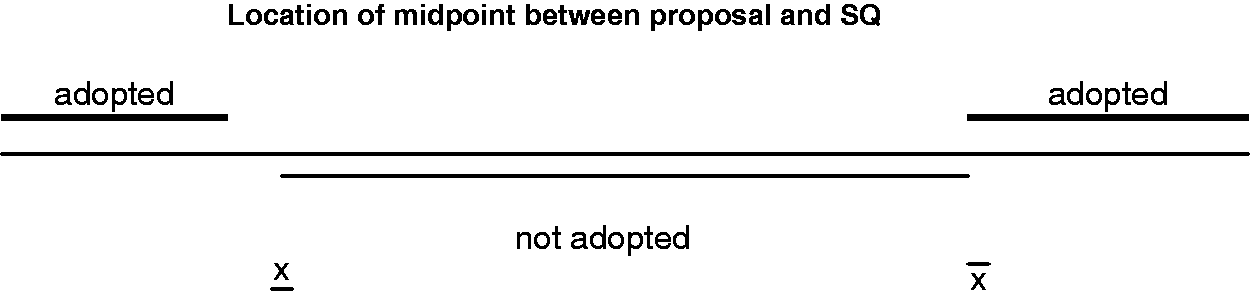
Furthermore, we will not observe any successful vote on proposals whose midpoint is located inside the interval between government
If positions and the salience that governments attach to the different dimensions are known, proposals that lack sufficient support will not be adopted, and any opposition recorded in the final minutes will not be able to prevent the adoption of a proposal. This may lead us to question why governments bother to record their opposition. By doing so, their only achievement is to demonstrate that they failed to prevent a proposal that they were initially against from being adopted. However, as voting in this case is inconsequential, there are no strong theoretical reasons to expect governments opposed to the new proposal to refrain from opposing either. Furthermore, if there is some uncertainty regarding the stance of other governments and/or the salience these governments attach to their ideal-points, voting in line with their own preferences can never be worse, and may sometimes be better, than always supporting the majority position. One reason for such behaviour may be to signal their position to outside actors, e.g. the EP or the Commission, or to domestic constituencies and political opponents. Uncertainty about the voting decisions of other ministers may lead indifferent governments to prefer the status quo to the new proposal. They may thus realize that there is actually a chance of blocking the legislation and thereby risk a potential loss by not voting against it.
Hence, member states vote in line with their (salience-weighted) issue-specific positions as they can never be worse off and will sometimes be better off by voting in such a manner: H1: Governments vote in line with their (salience-weighted) positions.
In the statistical analysis, we thus expect to see that the positive utility of a proposal correlates with a positive vote while the negative utility of a proposal correlates with a negative vote. In other words, negative utility of a proposal should decrease the probability of voting in favour of this particular proposal.
Method and data
We combine positional data with corresponding voting data from the minutes of meetings in the Council in order to investigate whether issue-specific positions guide voting behaviour. We adopt a simple approach to exploring this relationship and do not control for other variables that may affect voting behaviour and thus remedy the effect of issue-specific positions. Including other independent variables in our model may distort the simplicity of our argument and can open up a range of additional selection issues. For example, controlling for the presidency would distort the effect of issue-specific positions if such positions also influenced which proposals the presidency put on the agenda. Also, whether an issue is decided as an A or B item may also be a function of the issue-specific positions of the governments. By keeping the statistical model as simple as possible, it is also applicable to similar contexts beyond the EU. Omitting EU-specific variables ensures that our findings also can be relevant for other consensual decision-making settings, for instance the World Trade Organization, the United Nations Security Council and the World Bank.
The first data set, ‘Decision Making in the European Union’ (DEU), consists of member states’ policy positions on 174 controversial issues raised in 70 legislative proposals initiated by the Commission (Thomson et al., 2006). The information was collected through interviews with 125 experts. The legislative dossiers were subjected to either the consultation procedure or the co-decision procedure. The legislation were introduced either during or before December 2000 and were on the agenda in 1999 or 2000. The Commission, the EP and the 15-member states were assigned positions. The ideal points on each issue were estimated along a standardized policy scale with values between 0 and 100. The numerical differences between the actors reflect the political distance between them (Thomson and Stokman, 2003). The reference point (similar to the concept of status quo), the decision outcome of each issue and the level of salience that each actor attached to each issue were all also defined along this continuum. With regard to salience, a score of 0 indicates that the issue was of no importance while a score of 100 indicates that the issue could hardly be more important. If governments vary in the salience they attach to the different issues, failure to take this into account may bias the results (Aksoy, 2012; Cross, 2013; Golub, 2012). Warntjen (2012) compares salience measures provided by text analysis and media coverage with expert interviews and argues that the latter may provide a more fine-grained and less ambiguous measure of salience.
The second data set contains the formal voting decisions and formal statements recorded in the Council minutes. The voting data are coded as binary decisions, and under qualified majority voting (QMV) both abstentions, negative votes and formal statements are coded as no votes in line with Hagemann and Høyland (2008). In practice, abstentions have the same effect as no-votes under QMV. Statements are included in the no-votes group because these statements often consist of direct disagreement or serious concerns with regard to a proposal and may be used to signal that the representative has stressed her position on a piece of legislation but was reluctant to take a more drastic step and prevent consensus (Hagemann, 2008; Hagemann and De Clerck-Sachsse, 2007). Formal statements are made following the adoption of a proposal and are included in the Council minutes or posted on the Council website. In the data set, no-votes are coded as 0 and yes-votes as 1.
Negative votes and negative votes and statements for the 46 proposals in the Council minutes with and without any additional non-final votes.

Opposition in published Council votes is rare. There are 38 cases of final voting stage opposition in our data set (numbers from column 3 that include negative statements). The amount of negative votes on any particular legislation ranged from 0 to 5. From these votes, Portugal opposed five times while Ireland always voted in favour of the legislation. The choice of including negative statements increases the mean of negative votes from 0.5 to 0.8 (columns 1 and 3) or from 0.57 to 0.89 if we take all possible opposition into account (columns 2 and 4).
In the positional data set, the locations of the reference points (the policy that will prevail if no agreement can be reached) and the decision outcomes (the new policies) are used to determine member state loss and gain with respect to their position on each issue. The reference point bears a close resemblance to the status quo concept, although differs from the normal usage in the sense that for some proposals, a no-agreement situation will lead to a breakdown of the existing arrangement (status quo) rather than the continuation of this arrangement (Thomson et al., 2006). 46 out of 70 policy proposals are listed in the Council minutes as concerning the final adoption of legal acts. These 46 proposals had 118 issues. Information in the Council minutes on the adoption of legal acts is missing for the remaining 56 issues nested in 24 policy proposals. Some information on these 24 proposals can be retrieved from the monthly summaries of Council acts (i.e. adoption date, voting rule and whether the proposals were adopted with or without EP amendments in any second reading under co-decision). However, for reasons of data consistency, we only employ the proposals listed in the Council minutes in our analysis.
Missing data on 118 issues in the DEU data: Positions and salience.

Treatment of missing values in positional data across studies.

The other alternatives to handling missing data are list-wise deletion or some multiple imputation technique. König et al. (2005) advocate the use of multiple imputation as being far better than list-wise deletion when handling missing positions and subsequently test different ways of imputing missing actor positions. This study employs collected information on the positions of the actors involved in EU constitution building (DOSEI project) and includes several data sources including the DEU data set. The analysis identifies a selection bias. Actors strategically hide their positions when they expect to receive more concessions. This finding indicates that missing values are more extreme than the observed values. Actors without positions hide their positions for strategic purposes (König et al., 2005). It is therefore debatable whether missing positions are extreme or neutral.
Arregui and Thomson (2009) show that large member states have fewer missing positions than small member states in the DEU data set. They argue that this is due to the small member states being indifferent to more issues than large member states, as they are affected by fewer issues. Furthermore, some missing values can be explained by the lack of relevance of a particular issue for the actors in question (Thomson, 2011). While there are good reasons for considering missing positions as neutral stances, we can never be sure that actors with missing positions are in fact indifferent to these issues. Missing positions in the DEU data can also be due to policy experts not remembering the actual ideal points of certain actors (Thomson et al., 2006). Hence, multiple imputation, which takes the uncertainty of missing data into account, may be a better alternative than replacing missing values with the mean or some other fixed value (i.e. the position of the Commission). However, Thomson (2011: 42) argues that multiple imputation is inappropriate due to the large variation in actors’ negotiation stances across issues and resorts to mean-replacement or list-wise deletion in his study. This criticism would hold if we impute one actor’s missing positions on the basis of this actor’s positions on other issues. Our approach to missing data is similar to that of König et al. (2005); in that, unlike mean–replacement, it takes the associated uncertainty into account. However, it differs with regards to how it is implemented. The standard multiple imputation approach uses the variables in the data set. In the case of König et al. (2005), it is augmented by additional information from extant data. The method fills in estimated values for missing data in multiple data sets prior to the analysis stage and assumes that the data is distributed multivariate normal. If the data is categorical, it is recoded into appropriate categories (for a critique and an alternative approach, see Cranmer and Gill, 2013). It then runs an analysis on each individual data set and reports the average effect and standard error. In contrast, the Bayesian approach treats missing data as parameters to be estimated alongside the other parameters in the model. The only assumption we make is that missing positions and salience data are uniformly distributed between 0 and 1. 5 Following this, for each iteration of the Monte Carlo Markov chain (MCMC), the values of all parameters are updated conditional on the existing data, the parameter estimate of the missing data and on other parameters of the model (for an introduction to missing data imputation in the Bayesian framework, see Gelman and Hill, 2007: 529–543).
Only if data are missing completely at random, it is safe to use list-wise deletion. Missing completely at random means that ‘none of the data collected or missing are relevant for explaining the chance of missingness’ (Congdon, 2005: 380). In most cases, that is a fairly strong assumption. List-wise deletion, the default in most statistical software, implies that all rows with missing data are deleted from the data set. The best indication that this approach is taken is a varying number of cases across different model specifications. 6 One can also critique the other popular method of replacing missing data with the mean or some other typical value. This approach is motivated by the interest of preserving all the cells in the data set. Proponents of this approach argue that it is conservative as it should increase the likelihood of finding insignificant results. However, by replacing the missing value with a single value, which is unlikely to be correct, the level of uncertainty regarding the actual value is underestimated. Biased results may thus follow. Multiple imputation (i.e. as implemented by the Amelia missing data program) is, in contrast, an appropriate approach that does not underestimate the uncertainty, given that missing values on one variable can be inferred from the values on the other variables, i.e. that data is missing at random (MAR) (Honaker and King, 2010; King et al., 2001; König et al., 2005). In a full Bayesian framework, missing values are predicted from the other variables and the prior distributions on an iteration by iteration basis. If some of the variables have missing data, it is sufficient to assume a prior distribution in order to impute values.
The requirement is that the MAR assumption holds. However, if missing data are not ignorable and are not missing at random (NMAR), it is necessary to model the process that generates missingness in order for data to become MAR. The key is to model the process that governs whether data are observed or missing. There are two main approaches, either by using auxiliary variables to model the missing-generating process or by relying on a simplified selection model (Little and Rubin, 2002). It may, however, be difficult to justify the model for missingness or collect the auxiliary variables needed to model it properly. Consequently, we do not attempt to model the latter process (NMAR) in this article. Instead, we investigate whether the choice of missing data treatment has an effect on the main results. We thus compare models where issues with more than four missing member state positions are deleted, and the remaining missing positions are assigned a neutral position with models employing the Bayesian imputation of missing values. The underlying assumption of the latter framework is that data are (MAR), i.e. random after controlling for the covariate. By estimating the value multiple times, a random element ensures that the values vary across the data set, thereby ensuring that imputed observations have more uncertainty than the observed observations. We use the Bayesian approach, assuming that missing data are drawn from a known distribution or explicitly modelled. Missing values on the dependent variable are imputed iteratively on the basis of the predictors in the model, while missing data in the predictors must be modelled explicitly. The latter is commonly achieved by simply assuming a prior distribution of the predictor. The main advantage of the Bayesian approach for our problem is the flexibility it allows in the modelling of missing data. Furthermore, it is also easier to handle multiple and a varying number of issues per vote in this framework. Next, we elaborate on our choice of statistical model and our treatment of missing values in the positional data.
Statistical models
We model vote choice as an absolute loss function of the salience-weighted issue-specific utility of the outcome compared to the reference point (rp):


We run two series of models:
The baseline model replaces missing positions with the mean score between the Commission and the reference point if less than five positions are missing, list-wise deletion otherwise. No imputation of missing reference points. The full imputation model imputes missing positions and missing reference points.
Both types of models are run with and without salience-weights and with and without formal statements as a part of our dependent variable (vote choice). The relationship that we are interested in testing is the one between salience-weighted issue-positions and voting behaviour. As there may be multiple contested issues on a given piece of legislation, but only the opportunity to support or oppose the legislation as a whole, we use the mean of the salience-weighted change in utility across the issues mentioned on each piece of legislation. The change in utility is calculated by subtracting the absolute difference between the position of government i and the new policy from the absolute difference between the position of government i and the reference point. 7 This is then multiplied by the salience government i attached to the issue. For each piece of legislation, we calculate the mean of these salience-weighted differences. Both the positions, including the reference point and the new policy, and the salience estimates are divided by 100, thereby making the values range from 0 to 1.
Failure to properly account for the missingness in the positional data may seriously bias the results. 8 We contrast the standard approach to modelling missing values in the DEU data (Selck and Steunenberg, 2004; Zimmer et al., 2005), i.e. a combination of list-wise deletion and mean-replacement, with a multiple imputation approach. Issues where the reference point is missing are usually deleted in the previous studies. The reason for doing this is that one cannot assume that the reference point location of one proposal is determined by that of other proposals (König and Junge, 2008, 2009). However, it is possible to impute the reference point on the basis of the possible distribution of positions (0–100) within an issue. The full imputation model implements such an approach while the baseline model deletes issues where the reference point is missing. Several objections to assigning values to the missing reference points can be raised. Missing reference points may, for instance, be due to the fact that existing national policies vary across member states. Hence, it is difficult to determine what the actual reference point will be if the legislation fails. This uncertainty is, however, partly accounted for by the multiple imputation framework. Achen (2006) shows that the reference point is less influential than the procedural modelling tradition implies that it is. The reference point plays only a minor role in the negotiations if the decision outcome is far away from the reference point. The location of the decision outcome can thus be said to be more important when determining the utility loss of a government than the location of the position that will prevail if no agreement can be reached. Hence, we will argue that imputing reference points are acceptable as long as we have the location of the decision outcome on each issue. Note that our baseline model does not assign values to any missing reference points and thus serves as a robustness check. All models are estimated using the MCMC simulation. We ran 150,000 iterations, discarding the first 50,000. Standard convergence statistics indicate that all models had converged on the target distribution.
Results
The results need to be interpreted in light of the case selection. Only controversial proposals are included in the DEU data sample (Thomson et al., 2006); thus, the case selection could potentially bias the results. However, since the variation in preference distribution is likely to be greater when bargaining on a controversial proposal and such a proposal cannot be adopted without the support of most (or all) of the governments, this bias is likely to be a conservative one. An analysis using less controversial proposals may find a stronger relationship between positions and votes. Accordingly, negotiations on uncontroversial proposals may result in fewer policy losers and thus more policy winners than the negotiations on controversial proposals.
Baseline and full imputation models: Effect of positions on voting. The numbers in parentheses indicate standard deviations of the estimates.

Baseline and full imputation models: Effect of salience-weighted positions on voting. The numbers in parentheses indicate standard deviations of the estimates.

The effect of issue-specific positions is substantively larger in the models that impute all missing values than in the baseline models. This suggests that standard approaches to studying decision-making in the Council may not capture the full effect of preference-based positions, in particular if the problem of missing data is ignored. When the baseline approach to modelling missing data is employed, only 68%of the data set remains after deleting issues with missing reference points and/or more than four missing member state positions. Hence, the full imputation approach ensures more data while at the same time taking the uncertainty of the distribution of missing values into account. This results in a stronger relationship between positions and votes.
We now discuss the estimates in more detail before moving on to the substantive effects. Tables 4 and 5 compare the results from four different model specifications with (salience-weighted) issue-specific positions as a predictor for voting decisions under two alternative approaches to treatment of missing data; the baseline model (a combination of list-wise deletion and mean/fixed value replacement) and a full imputation model. The effect of positions is positive across all models. However, the effect is stronger in the full imputation models where missing values are imputed on an iteration by iteration basis (which preserves the uncertainty) than in the baseline models where observations with missing data are either excluded or replaced with the mean value between the reference point and the Commission (governments with missing positions are hence assigned a neutral position). This shows that disregarding missing positions may bias results (cf. König et al., 2005). In this case, the choice of non-imputation may underestimate the existence of preference-based voting in the Council. The effect of positions on voting is almost consistently stronger when full imputation is applied.
The only exception is when the positions are not salience-weighted and the no-vote category of the dependent variable includes final votes and statements (see the third row in Table 4). When this coding scheme is applied, the choice of missing treatment is almost inconsequential.
While the choice of missing treatment has a substantial effect on the results, the different coding schemes for the dependent variable vote choice matter less. For the baseline models, the effect of positions is almost the same across all model specifications except when all possible opposition is included in the no category of the dependent variable (all votes, including first round of co-decision and statements). In the full imputation models, the effect of utility on voting is somewhat greater when negative statements are not included in the no-vote category of the dependent variable. Even so, the effect is still stronger in the full imputation models than in the baseline models (apart from the exception already mentioned earlier). Compared to the baseline model, the effect doubles when positions are salience-weighted, and all possible variation is included the dependent variable (see the fourth row in Table 5). In the full imputation models, the finding that the effect of positions on voting is stronger when statements are not included in the dependent variable is interesting. A plausible explanation for this finding may be that while government i votes down a proposal as a whole, it may issue a negative statement directed toward a specific issue within a proposal. If the latter is the case, government i’s mean position on all issues within a proposal can be positive, while the vote choice under this particular coding scheme will be negative if it is issuing a negative statement on a particular issue in a multi-issue proposal. Our results indicate that such a scenario occurs but that it does not happen often enough to significantly affect the results.
There is a substantial difference between the baseline models and the full imputation models when we calculate the predicted probabilities to vote against or in favour of a proposal under a given scenario. In the model where we only consider final round votes (not statements), a government that gains 75 points on the original 0–100 scale (0.75 on our scale) by the new proposal will have a predicted probability of voting in favour of 0.99 in the baseline model and 0.994 in the imputed model. However, if the government stands to lose 75 points (0.75 on our scale), the predicted probability of voting in favour only drops to 0.91 in the baseline model, while it drops to 0.854 in the imputed model. The effects and the differences in effects are even larger when salience is taken into account. Again, considering only final round votes, the predicted probability of voting in favour if the new proposal offered an improvement of 75 points (0.75 on our scale) is 0.996 in the baseline model and 0.999 in the imputed model. By contrast, if the new proposal makes a government 75 points worse off (0.75 on our scale), the baseline model has a predicted probability of 0.847 of voting in favour, while the imputed model has a predicted probability of only 0.66. This shows that the failure to account for the generation of missing positional data may lead to erroneous conclusions regarding the effect of issue positions on voting behaviour. In this case, it seems like mean-replacement actually underestimates the effect of positions on behaviour.
Figure 2 plots the effect of relative position on the probability of supporting the proposal. The left side of the figure shows these effects when the baseline model applies. The right side of the figure shows these effects when positions are imputed on an iteration by iteration basis. The upper row shows results for salience-weighted positions, while the lower row shows the results in the case where the positions are not weighted by salience. There are three key insights. First, relative positions matter for observed voting in the Council. Second, the effect is stronger when the models include salience. Third, the estimated effects are larger when missing data are imputed. Nevertheless, a key feature of the figure is also the high-predicted probability of voting in favour of the proposal, regardless of the relative position, which serves as a reminder that we only observe disagreement on adopted legislation. It is clear that the governments, regardless of their issue-specific policy positions, have a higher probability of voting yes than no. However, as already alluded to, our data set does not include any votes on proposals where the Council fails to find a qualified majority. In other words, the models are only able to provide estimated probabilities that are conditional on the legislation actually being adopted. Our research design thus limits the scope of research to the link between stated positions and actual-observed voting. In order to understand the full effect of positions on voting, we need verifiable information about the location of any alternative proposals that are considered during the legislative process.
The graphs compare the predicted effect of relative position under mean-replacement (left) and imputation (right) for salience weighted (upper) and unweighted (lower) policy positions. The calculations are based on the models where the dependent variable is final stage voting (not statements).
Conclusion
We have investigated whether members of the Council vote in line with their salience-weighted issue positions. Our results show that rational utility-maximizing behaviour can account for the voting behaviour of the governments. In other words, positions and voting behaviour are connected to each other. Hence, rational choice explanations of Council decision-making are just as valid as consensus explanations. Although the outcome of bargaining tends to be consensual, such an observation does not equal that governments vote against their positions. This is an interesting finding in itself that also may be applicable to other consensual decision-making bodies like the World Trade Organization, the United Nations Security Council and the World Bank.
Preference-related voting behaviour may also be said to increase the democratic legitimacy of EU decision-making. It shows that bargaining does not fully erase the preferences of the governments and that governments seek to pursue the interests of their domestic constituencies throughout the decision-making process. Showing that positions are associated with the voting stage is the first contribution that our analysis makes to the existing literature. The similarities in the findings between studies that employ voting data and studies that employ preference-based data are thus validated by our analysis. The second contribution is that different treatments of missing data have an effect on the main findings. The relationship between positions and votes is stronger when missing values in the positional data are imputed in an iterated fashion. Furthermore, our findings also indicate that the salience attached to the proposal by the individual governments matters for their voting behaviour. The relationship between positions and voting behaviour is stronger when we control for salience.
Recorded Council votes are neither in any meaningful sense a random sample nor do they represent the universe of all decisions taken in the Council within the time-frame of the study. Instead, they represent a biased selection, as only votes on legislation that are adopted enter into the data set. This means that the observed consensus culture in the Council may be a product of this selection bias. When opposition is successful, legislation will not be adopted. The high level of consensus in the Council may also be a combination of the following: (a) mainly uncontroversial legislation is adopted and (b) governments put forward a show of unity rather than voting sincerely. A model that incorporates the selection bias may capture whether this is actually the case.
While observers of voting in the Council are surely aware of the selection bias in the reported votes, no one has explicitly modelled voting in the Council in a selection model framework. We believe that future research can benefit from incorporating selection aspects explicitly into the analysis. This can be done by modelling the processes that determine whether data are observed or missing (NMAR). Incorporating a simplified selection model into the statistical analyses is an example of how this approach can be implemented (Little and Rubin, 2002). Such an approach requires that we have information on votes that were not taken because of the majority requirement, or if taken, failed to meet this requirement. It would also be useful to supplement voting data with indicators of dissent that are less prone to the same selection bias, for example data on implementation of EU legislation (König and Luetgert, 2009; Luetgert and Dannwolf, 2009; Zhelyazkova and Torenvlied, 2009).
Selection bias is not confined to Council voting; it may also affect research on roll call voting in the EP (Carrubba et al., 2006, 2008, 2009). Selection models could be incorporated into a general framework in order to investigate the extent of the potential selection bias in EP roll call votes.
Footnotes
Notes
References
Supplementary Material
Please find the following supplemental material available below.
For Open Access articles published under a Creative Commons License, all supplemental material carries the same license as the article it is associated with.
For non-Open Access articles published, all supplemental material carries a non-exclusive license, and permission requests for re-use of supplemental material or any part of supplemental material shall be sent directly to the copyright owner as specified in the copyright notice associated with the article.
