



Abstract
This study argues that the adoption of a policy by the European Union increases popular support for that policy. Elite cue theory implies that this effect only materializes among those members of the public who trust European Union institutions. Moreover, European Union member states’ unanimous policy support conveys a stronger cue than the Union’s policy endorsement despite vocal dissent. The argument is tested through original survey experiments and the quasi-experimental analysis of a survey that was fielded while the European Council endorsed a salient policy proposal. Support of the policy surged immediately after this decision—but only among Europeans who trust the Union. Experiments in original national surveys confirm that citizens who trust the European Union respond to signals from Brussels. Unanimity in the Council of the European Union augments the impact of these cues.
Do European Union (EU) decisions affect public opinion about electorally salient policies? Recent studies show that the Union’s policy choices have become politicized (Hagemann et al., 2017). Eager to avoid being punished by voters for taking unpopular decisions, European governments signal responsiveness to domestic electorates during negotiations in Brussels (Schneider, 2019). In contrast to the existing literature, this article argues that EU decisions do not merely respond to public opinion. Instead, they also shape how European publics think about electorally salient policies. Specifically, the adoption of a policy by the EU increases popular support for that policy, but only among those Europeans who trust EU decision-makers. Policy decisions by a united Union have a bigger impact on public opinion than those taken by a divided one.
Public opinion scholarship indicates that most Europeans tend to be rationally ignorant about European integration and form their political attitudes based on cues from trusted elites (De Vries and Edwards, 2009; Gabel and Scheve, 2007). Empirical tests of elite cue theory focus on political parties’ communications about the EU (Franklin et al., 1994; Ray, 2003). We know much less about the impact of cues conveyed by another set of elites whose policy positions are widely reported by the mass media: the Council of the EU and the European Council. I argue that the approval of an electorally salient policy by the Union’s main legislative body or its supreme agenda-setter increases public support for that policy. Elite cue theory leads me to expect that this effect only materializes among citizens who trust EU institutions. Moreover, the adoption of a policy by a unanimous Council of the EU signals unity among European government elites while the Council’s endorsement of the same policy despite vocal dissent indicates divisions between member states, and the latter should trigger a smaller rally in public support of the policy than the former.
A two-pronged empirical strategy tests this argument. It combines original survey experiments with the quasi-experimental analysis of Eurobarometer survey data. Large nationally representative samples in Austria and Germany participated in experiments on two salient policies: EU coronavirus economic recovery aid and refugee redistribution between member states. Respondents were randomly assigned to different cues about policy endorsement or disapproval by a united or divided Council of the EU and asked to express their own opinion about these policies. Quasi-experimental analyses of 2020 Eurobarometer data complement these experiments. They leverage the fact that the European Council took a key decision on pandemic recovery relief while the survey was in the field. Whether a given Eurobarometer respondent was interviewed before or after this decision was exogenously determined. Therefore, I can estimate the decision’s impact on public attitudes toward pandemic-era economic aid by comparing survey responses obtained before this event to those gathered soon thereafter.
The quasi-experiment and the survey experiments indicate that European publics respond to signals from Brussels. Cues about EU endorsement of fiscal transfers to member states hit hardest by the pandemic and of refugee redistribution from Europe’s South to its North increased popular support of these policies by two to five percentage points. As expected, this average effect was driven by the subset of respondents who viewed EU elites as trustworthy; their response to EU cues was more than twice as strong as it was in the full sample. Unanimous decisions tended to trigger an even larger public opinion rally than policy choices made by a divided Council.
This study makes several contributions to the literature on European integration. First, it presents the argument that European publics take cues from the EU when they form opinions about salient policies. Thus, it extends elite cue theory and sheds new light on signals conveyed by European elites other than political parties. Second, the additional signaling effect of unanimity in the Council of the EU gives European governments an incentive to pursue consensus on salient policies to rally publics in support of their decisions. In turn, this added value of consensus may help us understand why unanimous Council decisions are ubiquitous even in issue areas where the formal rules prescribe qualified majority voting. Third, this study leverages survey experiments and a quasi-experiment to avoid bias from endogeneity (e.g. between unanimity among EU elites and public opinion). This research design combines the strong internal validity of design-based causal inference with the external validity of pan-European surveys to attain more solid evidence on public attitudes toward European integration.
The findings also enhance our understanding of public opinion about international redistribution. To date, the literature has not examined how international elite cues affect mass attitudes about redistribution between countries. 1 We cannot extrapolate from previously studied topics to international redistribution, because the effect of elite cues varies by issue (Dragojlovic, 2013). This study shows that citizens respond to signals from foreign elites when they form opinions about international redistribution.
How public opinion affects European integration
The “permissive consensus” that allowed European governments to pursue regional integration without taking into account public opinion (Lindberg and Scheingold, 1970) has given way to a ‘‘constraining dissensus’’ (Hooghe and Marks, 2009) marked by close referenda and divisive partisan debates on European cooperation. Public opinion in member states shapes contemporary European integration (De Vries, 2018; Hobolt, 2009) and aggregate EU policy outputs respond to public attitudes (Bølstad, 2015). Specific EU policies also enter the arena of political contestation (Schneider, 2019). The politicization of EU decisions explains why policymakers are eager to signal responsiveness to public opinion. In the Council of the EU, public opinion affects member states’ negotiation positions (Wratil, 2018) and voting behavior (Hagemann et al., 2017; Hobolt and Wratil, 2020).
What motivates governments to respond to domestic public opinion when they adopt legislation in the Council of the EU? Doing so improves their chance to remain in office because EU issues increasingly impact constituents’ vote choice. Thus, politicians have higher approval ratings when they signal responsiveness to voters’ concerns during negotiations in Brussels (Schneider, 2019). Moreover, citizens' attitudes toward European integration influence their vote choice in national and European Parliament elections (De Vries, 2007; De Vries et al., 2011). In short, the increasing electoral salience of EU issues incentivizes politicians to pay close attention to public opinion when they participate in the Union’s policymaking.
Explanations of public attitudes on issues on the EU’s agenda
What determines public opinion on European integration and EU policies? The extant literature offers three answers: material cost–benefit calculations, identity considerations, and heuristics. According to economic self-interest accounts, highly educated Europeans are better able to compete in an integrated labor market and are thus more supportive of international economic integration (Gabel, 1998; Hobolt, 2014). Affluent Europeans benefit from EU policies that lower inflation, public sector spending, and financial market restrictions, and they also tend to favor European integration (Gabel and Palmer, 1995). Low-income voters oppose EU fiscal transfers when they fear loosing welfare benefits (Kleider and Stoeckel, 2019).
Recent studies point to cultural identity and political values as predictors of EU support. Persons who conceive of national identities as inclusive of other territorial identities are more likely to support European integration than those who hold exclusive national identities (Carey, 2002; Hooghe and Marks, 2005). Negative attitudes toward the EU correlate with hostility to immigration (De Vreese and Boomgaarden, 2005; McLaren, 2002). In turn, exclusive national identities and anti-immigration sentiments shape public opinion on refugee redistribution between EU members (Gerhards et al., 2020). Cosmopolitan values (Bechtel et al., 2014; Kuhn et al., 2018), cultural openness (Kleider and Stoeckel, 2019), altruism, and leftist ideology (Daniele and Geys, 2015) help explain support of EU fiscal transfers in rich member states.
A third strand of the literature focuses on citizens’ reliance on heuristics in the process of opinion formation. First, Europeans use national governance as a benchmark when they evaluate European integration and EU policies (Armingeon and Ceka, 2014; Sánchez-Cuenca, 2000). Second, citizens’ EU attitudes are influenced by cues from their preferred political party and news source. Specifically, party elite cues inform partisans’ views on European integration (Gabel and Scheve, 2007; Steenbergen et al., 2007) and on specific EU policies (Pannico, 2017; Stoeckel and Kuhn, 2018). Party cues also influence party sympathizers’ vote choice in EU referenda (Hobolt, 2007). Elite cues from news media sources also shape EU attitudes (Azrout et al., 2012; Maier and Rittberger, 2008).
Theory
Elite cue theory posits that most members of the public form their opinion about foreign affairs on the basis of signals conveyed by knowledgeable and trusted elites (Zaller, 1992). Elites are “individuals—often but not exclusively government officials—who by role, experience, or expertise are in a position to comment on matters of public concern and are seen to be in that position by those who would contribute to public understanding” (Brody, 1991: 65). The United States (US) public takes political cues from various domestic elites, including government officials, party leaders, generals, journalists, experts, and even celebrities (Berinsky, 2007; Gelpi, 2010; Golby et al., 2018; Guisinger and Saunders, 2017; Pease and Brewer, 2008). Americans also rely on cues from foreign elites when forming their attitudes on international affairs (Hayes and Guardino, 2011; Thompson, 2009). International organizations in particular convey signals about elite opinion abroad and shape the US public’s views on foreign policy (Bearce and Cook, 2018; Greenhill, 2020; Grieco et al., 2011). International organizations and other foreign elites also influence public opinion in China (Fang and Sun, 2019), Japan (Ikeda and Tago, 2014), and the UK (Johns and Davies, 2014).
What do these findings regarding international elite cues tell us about how European publics form EU attitudes? Existing scholarship cannot answer this question. The large literature on public opinion about European integration and EU policies has examined elite cues conveyed by domestic parties and mass media, but it has neglected signals from other elite sources (see Hobolt and De Vries, 2016 for a literature review). 2 Walter et al. (2018) convincingly show that near-simultaneous decisions by the European Central Bank and the Greek government on banking jointly influenced Greek public attitudes about a different policy (EU bailout) but cannot isolate the effect of each event. Other studies argue that EU decisions—and member states’ votes in the Council of the EU—affect government approval ratings (Schneider, 2019). At the same time, this literature leaves open the question whether and how EU decisions on a given policy (e.g. refugee relocation between EU members) affect public attitudes about that policy.
In contrast to the literature on EU responsiveness, this study argues that EU decisions do not merely respond to mass opinion; instead, EU decisions on salient policies also shape public attitudes about these policies. Most voters are rationally ignorant about international affairs, but limited information does not prevent them from developing reasoned policy preferences (Zaller, 1992). This is because citizens rely on elite cues as substitutes for detailed policy information when they form political attitudes (Gabel and Scheve, 2007; Ray, 2003; Steenbergen et al., 2007). If European citizens form their policy preferences (at least partly) in response to signals from trusted elites, they should not only heed the advice of their preferred party and news source but also incorporate cues from other elites. EU institutions are elite bodies that convey cues about the policies they endorse or oppose. The Council of the EU is the “single most powerful decision-making body in the EU” (Hobolt and De Vries, 2016: 424), where member states’ government ministers negotiate and adopt legislative proposals and the Union’s budget, coordinate economic and fiscal policies, and handle external affairs. In the European Council, EU members’ heads of state or government meet to define the Union’s overall direction and priorities. Their broad mandates and authority enable both councils to send cues about many salient issues.
Cues from the Council of the EU and the European Council are readily available to European publics through the mass media. These signals receive relatively intense coverage, because journalists tend to focus on reporting the opinions of authoritative elites who can influence policy outcomes (see news media content analysis below and Baum and Groeling, 2010). News reporting on international affairs extensively covers decisions of international organizations and foreign governments (Hayes and Guardino, 2010). For instance, BBC coverage of refugee arrivals in the UK and Southern Europe featured foreign elites more prominently than domestic ones, and the Council of the EU was the most frequently referenced international elite source (Berry et al., 2015). European Council summits receive relatively intense television coverage (De Vreese, 2003) and popular news outlets cover important decisions of the Council of the EU (Hagemann et al., 2017). In short, it is increasingly likely that the mass media conveys cues about salient policies from these EU bodies to European citizens. I expect that the endorsement of a policy by the Council of the EU or the European Council systematically affects support of the policy among members of the public (hypothesis 1).
The fact that mass media coverage is the primary transmission channel for these signals implies a scope condition for my argument: cues from Brussels should only sway public attitudes when the mass media finds EU decisions newsworthy. Electorally salient decisions (e.g. on large new fiscal transfers between EU members) satisfy this scope condition. In contrast, inconsequential decisions on arcane issues are unlikely to be covered by the mass media, and, therefore, the public will not take into account EU policy choices when it forms attitudes on non-salient topics.
Elite cue theory indicates that members of the public take cues from trusted elites (Zaller, 1992). Thus, cues from political parties primarily affect their partisans’ EU attitudes (Maier et al., 2017; Stoeckel and Kuhn, 2018), and cues from parties that lack popular trust have little mobilizing force (Guerra and McLaren, 2016; Klingemann et al., 2007). Analogously, I expect that cues from Brussels only impact the attitudes of citizens who place at least a modicum of trust in EU elites. These citizens rely on a policy’s approval by trusted EU elites as a cognitive shortcut (heuristic) to form their own policy attitude without having to work through the details of the issue. In contrast, Europeans who do not trust EU elites should not take cues from them. In 2019, 40% and 36% of Eurobarometer respondents expressed trust in the European Council and the Council of the EU, respectively, whereas 36% and 36% voiced distrust (European Commission, 2019). I expect that the approval of a policy by the Council of the EU or the European Council increases support of the policy among citizens who trust these institutions and that it does not affect the policy attitudes of those who distrust them (hypothesis 2).
This argument is different from (but compatible with) previous scholarship on trust in the EU. While Armingeon and Ceka (2014) and Kuhn and Stoeckel (2014) show that trust in the EU increases support of European integration and EU bailouts, this study argues that trust in EU institutions increases the Union’s ability to shape public support of policies by endorsing or opposing them.
When citizens form policy attitudes, they consider whether elites agree or disagree about the policy: “when elites uphold a clear picture of what should be done, the public tends to see events from that point of view” (Zaller, 1992: 9). In contrast, some elites’ vocal dissent from the majority view confronts the public with a second signal that contradicts the majority’s cue and thereby reduces its heuristic value. For instance, a scholarly consensus shapes the public’s policy preferences, but dissent by a small minority of experts undermines the scientific community’s impact on mass opinion (Aklin and Urpelainen, 2014; Maliniak et al., 2021). Similarly, citizens are more likely to agree with unanimous court decisions than with rulings accompanied by dissenting opinions (Zink et al., 2009). Pro-EU consensus across political parties is associated with higher public support for European integration than disagreements between parties (Guerra and McLaren, 2016; Stoeckel, 2013), and elite conflict transformed publics’ “permissive consensus” into “constraining dissensus” on European integration (Hooghe and Marks, 2005: 425–6). If the leaders of the same party are divided, they convey contradictory cues to the public, muddy the party’s message, and weaken its influence on partisans’ views (Franklin et al., 1994; Ray, 2003; Steenbergen et al., 2007). Similarly, I expect that a united Council of the EU conveys a different signal to the public than a divided Council. Unanimous Council approval of a policy signals consensus among EU member states in favor of the policy. This cue should rally public opinion in support of that policy. In contrast, the policy’s endorsement by a divided Council signals that governments are split over the policy, which complicates citizens’ reliance on this cue as a cognitive shortcut. EU elite divisions therefore reduce the EU elite cue’s impact on mass opinion. I expect that the unanimous approval of a policy by the Council of the EU causes a larger increase in public support of that policy than the endorsement of the same policy despite the vocal dissent of some Council members (hypothesis 3).
Survey experiments
Research design
To test the argument, I rely on a two-pronged empirical strategy that combines a quasi-experiment (see below) and survey experiments embedded in two large original surveys. This research design accounts for the endogeneity between public opinion and signals from Brussels: a proposal is more likely to be adopted in the Council of the EU—and dissenting votes are less probable—when Council members expect popular support for that legislation (Hagemann et al., 2017; Schneider, 2019). Therefore, correlational analyses of Council decisions and survey data risk overestimating the impact of cues from Brussels on public attitudes. Survey experiments avoid this bias by randomly assigning respondents to different cues from the Council of the EU to causally identify the effect of these signals.
Two original surveys confronted respondents with experimental vignettes about fiscal transfers between EU member states and the Union’s response to the influx of refugees across the Mediterranean. 3 These issues were selected to satisfy the scope condition of the argument, which only applies to electorally salient issues. In both countries where the surveys were conducted (Austria and Germany), the public viewed immigration and the state of EU members’ finances as two of the three most pressing issues facing the Union (European Commission, 2019). Immigration and fiscal transfers to Southern Europe are electorally salient in these countries and have been identified as key motivations for support of far-right parties (Hobolt, 2015), which politicize EU actions on both issues.
I test the argument with survey experiments on two topics and in two countries to ensure that the findings generalize beyond one specific vignette and a single idiosyncratic national context. Austria and Germany represent good test cases for several reasons. While both are large net contributors to the EU budget and accommodate more refugees per capita than most other EU member states, stark differences exist between their governments’ policy positions: while German governments have consistently favored the relocation of refugees from Greece and Italy to other EU members, Austria’s governments have voiced opposition to that policy. Moreover, the German government was a key proponent of the 2020 Coronavirus economic recovery fund while Austria joined the fiscally conservative “Frugal Four” countries that initially rejected this initiative and remained skeptical. If I find that cues from the Council of the EU have an impact in both countries, I can rule out that their effect hinges on prior real-world exposure to congruent or incongruent cues from national government elites. Similar results in both countries thus increase my confidence that the findings generalize to other rich EU member states with pro-EU or more Euroskeptic governments.
Each respondent participated in both survey experiments, which were administered in random order to avoid context effects. The respondents were confronted with the following two hypothetical scenarios: 4
The Coronavirus inflicted severe damage to the economy. Unemployment increased strongly, especially in Southern Europe. An economic crisis in Southern Europe would also hurt [Austria/Germany]. Germany and France want the European Union to take out loans in the amount of 500 billion Euro and to give the money to those member states that were hit the hardest by the crisis.
Over the course of the past few months, more than 70,000 persons crossed the Mediterranean and applied for asylum in Greece, Italy, and Spain. Many of these refugees want to move to [Austria/Germany]. Greece, Italy, and Spain want the other members of the European Union to help with the influx of refugees. Germany proposed to relocate 40,000 of these refugees to other members of the European Union; [800/11,000] of them would be relocated to [Austria/Germany].
The wording of the vignettes mirrored coverage of refugee and economic policy in widely read newspapers (e.g. Bild and Kronenzeitung). The description of coronavirus economic recovery aid was based on the proposal France and Germany made in May 2020, which was endorsed by the Council of the EU (after the surveys) in October, and formally adopted in February 2021. The number of refugees who crossed the Mediterranean is based on data on asylum applications in Greece, Italy, and Spain during the six months before the survey (European Union, 2020). Austrian and German resettlement quotas were modeled after the 2015-2017 refugee relocation plan (Trimborn, 2015).
Immediately after reading the vignette of either experiment, respondents were asked to express their own opinion about the proposed policies: “Would you favor or oppose the European Union taking out loans in the amount of 500 billion Euro and giving the money to those member states that were hit the hardest by the crisis?”, “Would you favor or oppose relocating 40,000 refugees to other members of the European Union and relocating [800/11,000] of them to [Austria/Germany]?”. Respondents could choose between five options (strongly favor, somewhat favor, neither favor nor oppose, somewhat oppose, and strongly oppose), rescaled from 0 (oppose) to 1 (favor).
Each experiment manipulated respondents’ perception of the Council of the EU’s position on the proposal. Some respondents were randomly assigned to a sentence at the end of the vignette displayed above that informed them that the Council of the EU unanimously accepted the proposal. Others learned that the Council accepted it despite dissenting votes of a few small states. Two additional treatment conditions informed respondents that the Council opposed the policy due to vetoes cast by some EU members or broad opposition among EU member states. The Online appendix presents the full wording of each treatment condition.
A second treatment manipulated respondents’ perception of domestic elites’ position (see below). Since domestic and EU elite cue treatments were independently randomized, the value of each domestic elite treatment is equal in expectation across all EU treatment conditions. Therefore, pooling respondents across domestic elite treatment condition does not bias estimates of the effect of EU elite cues. Moreover, robustness checks described below indicate that all results from the main models are robust to controlling for domestic elites’ views.
Pretreatment attitudes towards the Council of the EU were assessed on a five-point scale that captures respondents’ trust in the institution’s judgment on economic and fiscal policy or refugee policy, respectively. In addition to pairwise t-tests (with Bonferroni adjustments for multiple EU treatment conditions), I rely on ordinary least-squares (OLS) models and univariate analysis of variance. Randomized treatment assignment makes it unnecessary to add controls to the models for the purpose of causal identification, but the results are robust to including sociodemographic covariates: respondents’ age, gender, education, income level, political orientation, and interest in politics and foreign affairs. 5 The results are also robust to adding region (Bundesland) fixed effects to the model (see the Online appendix).
The surveys were administered in August and September 2020 to samples that were nationally representative of Austrian and German adult populations in terms of age, gender, and region. 6 The sample sizes were 2556 in Austria and 2542 in Germany. The survey company Respondi recruited these respondents using an opt-in methodology and administered the experiments online.
Results
Evidence from both surveys strongly supports the proposition that signals from Brussels affect public attitudes about policies on the Union’s agenda. When the Council approves (rather than rejects) a policy proposal, support of that policy increases by two to five percentage points, on average (see Figure 1). 7 This estimate is based on the comparison of respondents who were assigned to cues of unanimous approval or endorsement despite dissent, on the one hand, and those who learned that the Council rejected the proposal due to vetoes or broad opposition among member states, on the other hand. OLS models 1 to 12 in the Online appendix confirm that the average effect of cues from the Council of the EU is statistically significant in both experiments in the full sample of Austrian and German respondents and in the German subsample. In Austria, the effect is significant for the coronavirus recovery aid experiment but insignificant in the refugee experiment, because trust in the EU Council’s judgment on refugee policy is so low that the average Austrian does not respond to the body’s cues on this issue. As I will show below, the effect in the refugee experiment is significant among Austrian respondents who trust the Council’s judgment on refugee policy.
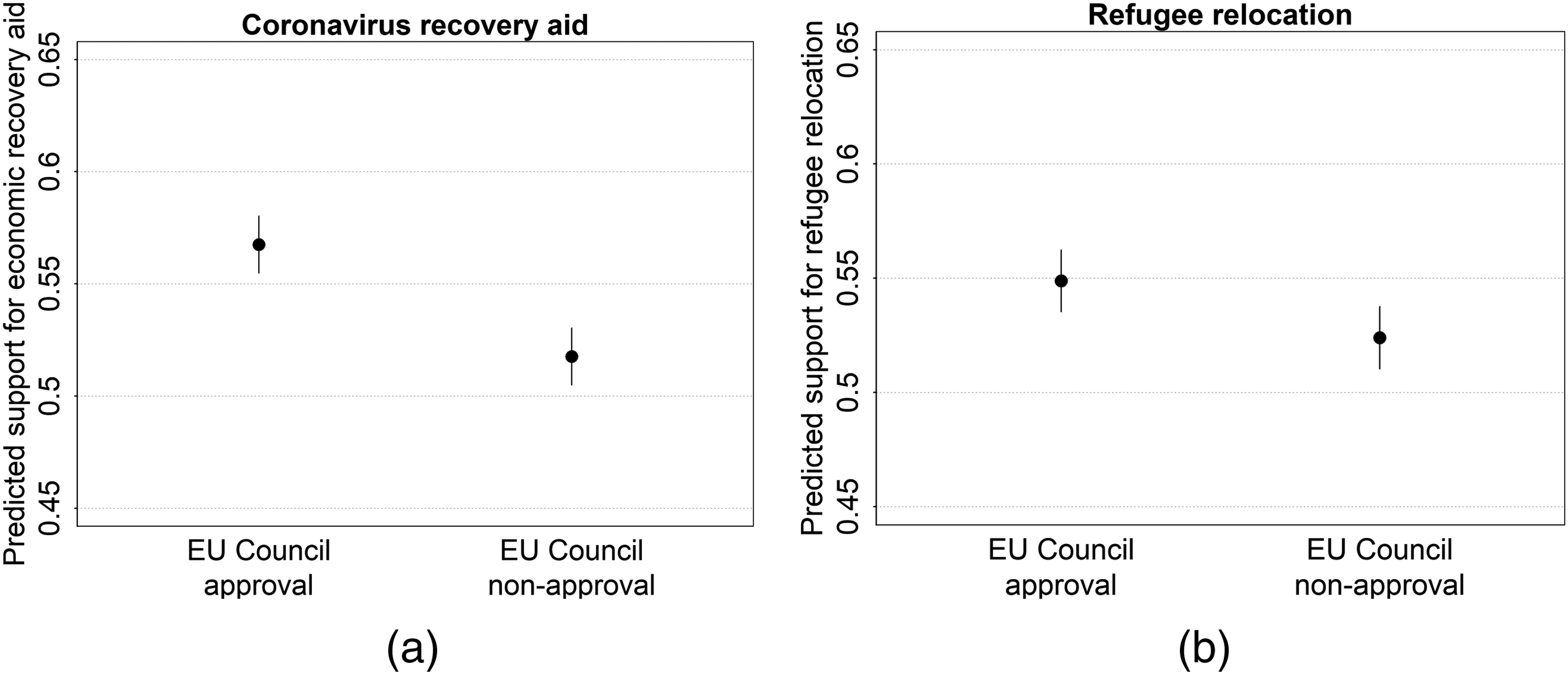
Predicted probabilities of support of coronavirus economic recovery aid and refugee resettlement: effect of approval and non-approval of these policies by the Council of the EU.
Univariate analysis of variance similarly indicates that the public’s policy preferences vary as a function of EU elite cues in both experiments in the full sample and in the two national subsamples (see the Online appendix). Pairwise comparisons of the four treatment conditions (with p-values adjusted for multiple comparisons) in the Online appendix show that the starkest differences between EU cues translate into the largest divergences in public attitudes. In both experiments, the difference between respondents’ support of policies that EU elites unanimously endorsed or broadly opposed is significant in the full sample and in the smaller German subsample. In Austria, it is weakly significant (p < 0.08) in the aid experiment. Comparisons between respondents assigned to EU approval despite dissent and broad EU opposition yield similar results. More subtle differences in EU elite cues have lesser effects. The difference between multiple vetoes and majority opposition in the EU Council only translates into a perceptible divergence in public attitudes in the refugee experiment, but statistical significance in the full sample is attenuated in the smaller national subsamples. The difference between approval with dissent and non-approval due to vetoes is insignificant in both experiments and in each country; this null result is consistent with hypothesis 3 because both treatments convey similar cues of divisions between EU members, whose effects on respondents’ policy preferences are indistinguishable.
To test the argument that citizens who trust the Council’s judgment respond more strongly to its signals than others, I include respondents’ pretreatment trust in the Council and its interaction with the Council’s policy approval in models 19 to 24 in the Online appendix. 8 In those models, the coefficient of Council approval indicates the cue’s impact on respondents in the baseline category, who fully trust this institution. As expected, the signaling effect is more than twice as large among these respondents as it is in the whole sample. The coefficient of the interaction between Council approval and trust in the institution shows that low confidence in the Council’s judgment reduces the effect of cues from that body on respondents’ policy views. In both experiments, this interaction is significant in the full sample. In each national subsample, it is also significant in the aid experiment, but significance is attenuated in the refugee experiment. Further tests confirm that trust in the Council of the EU moderates the signaling effect of the institution’s decisions in both experiments in the full sample as well as in the aid experiment in both national subsamples (see models 25 to 30 in the Online appendix).
Overall, the Council’s endorsement of a policy increases support of that policy by five to eight percentage points (or 13% to 26% of a standard deviation of the outcome) among respondents who completely or largely trust this institution (see Figure 2). In contrast, these signals do not affect the attitudes of respondents who distrust the Council. Overall, the results corroborate the argument that respondents who view the Council as a trustworthy elite body take cues from it while others do not form their policy opinions based on signals from that body.
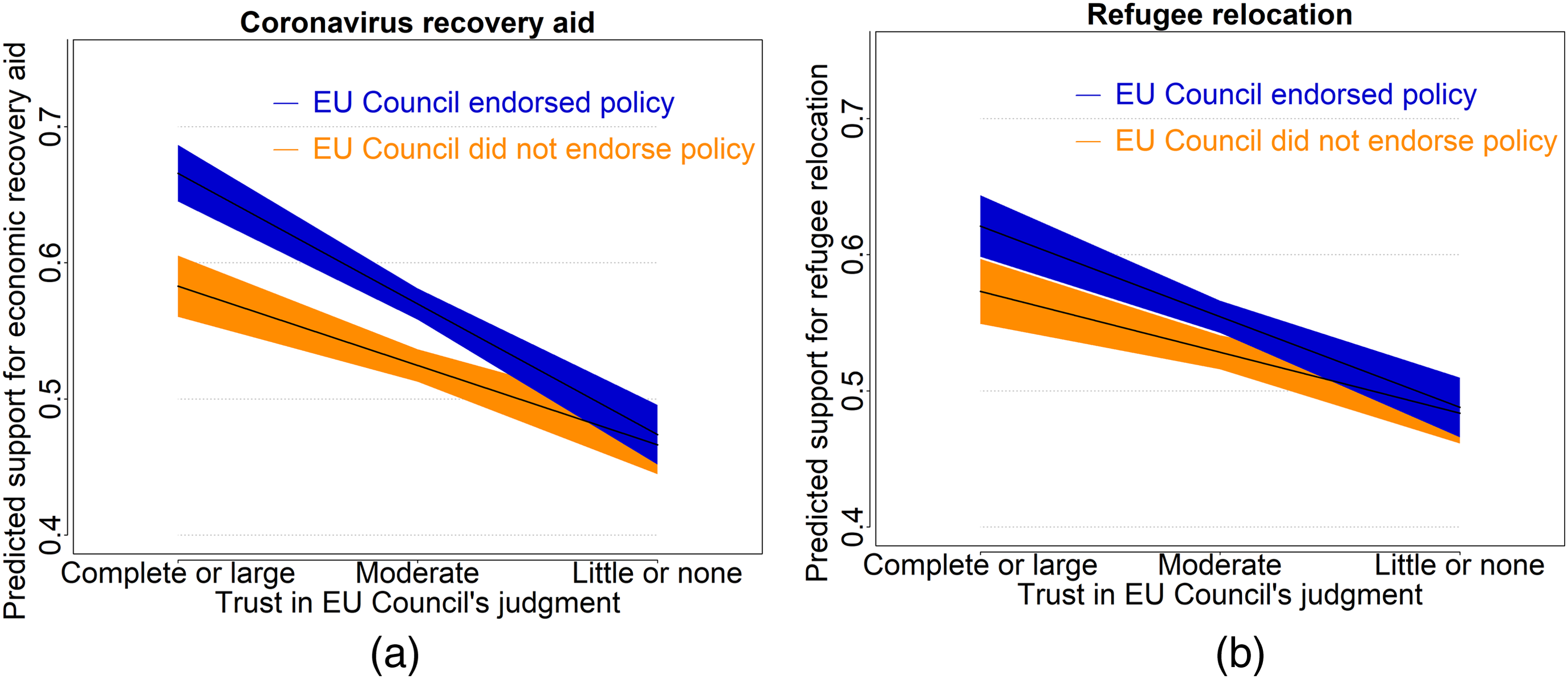
Predicted probabilities of support of Coronavirus economic recovery aid and refugee resettlement by level of trust in Council of the European Union.
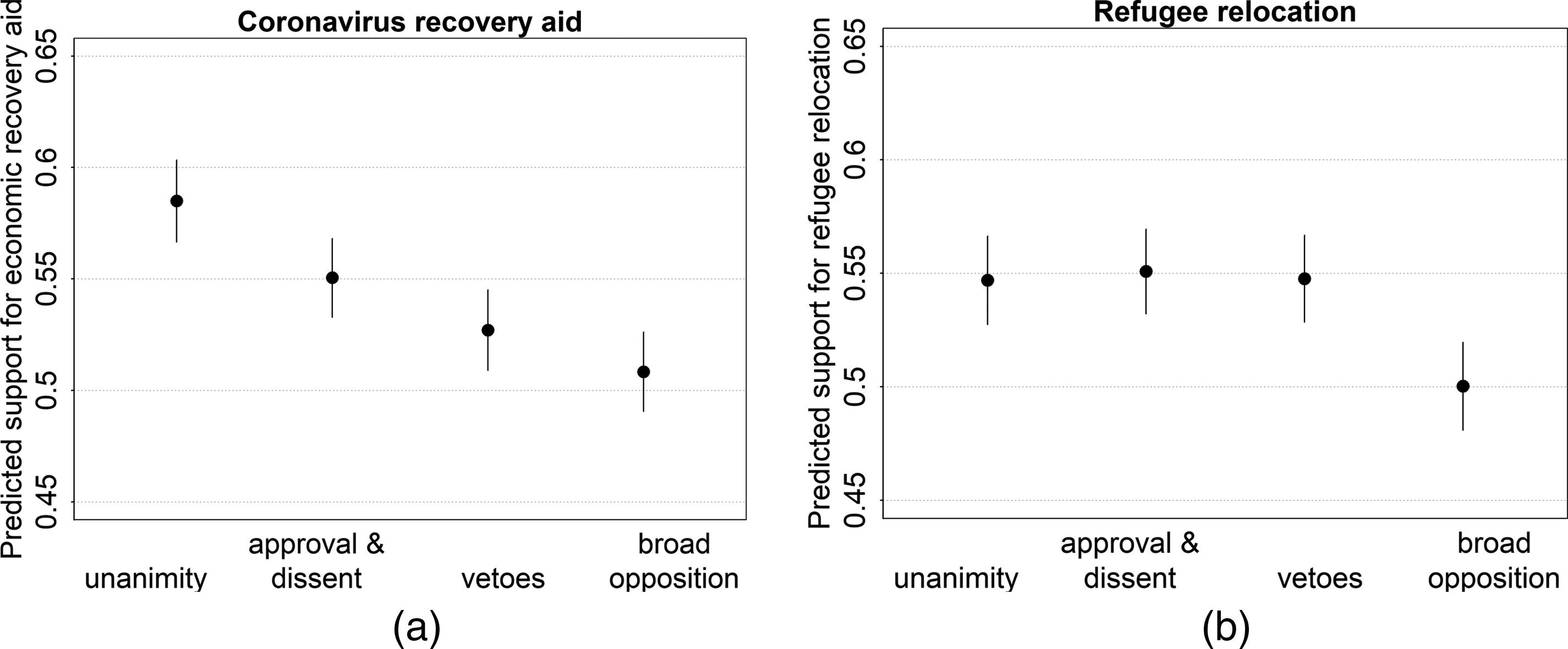
Predicted probabilities of support of coronavirus economic recovery aid and refugee resettlement: effect of unity and divisions in the Council of the EU.
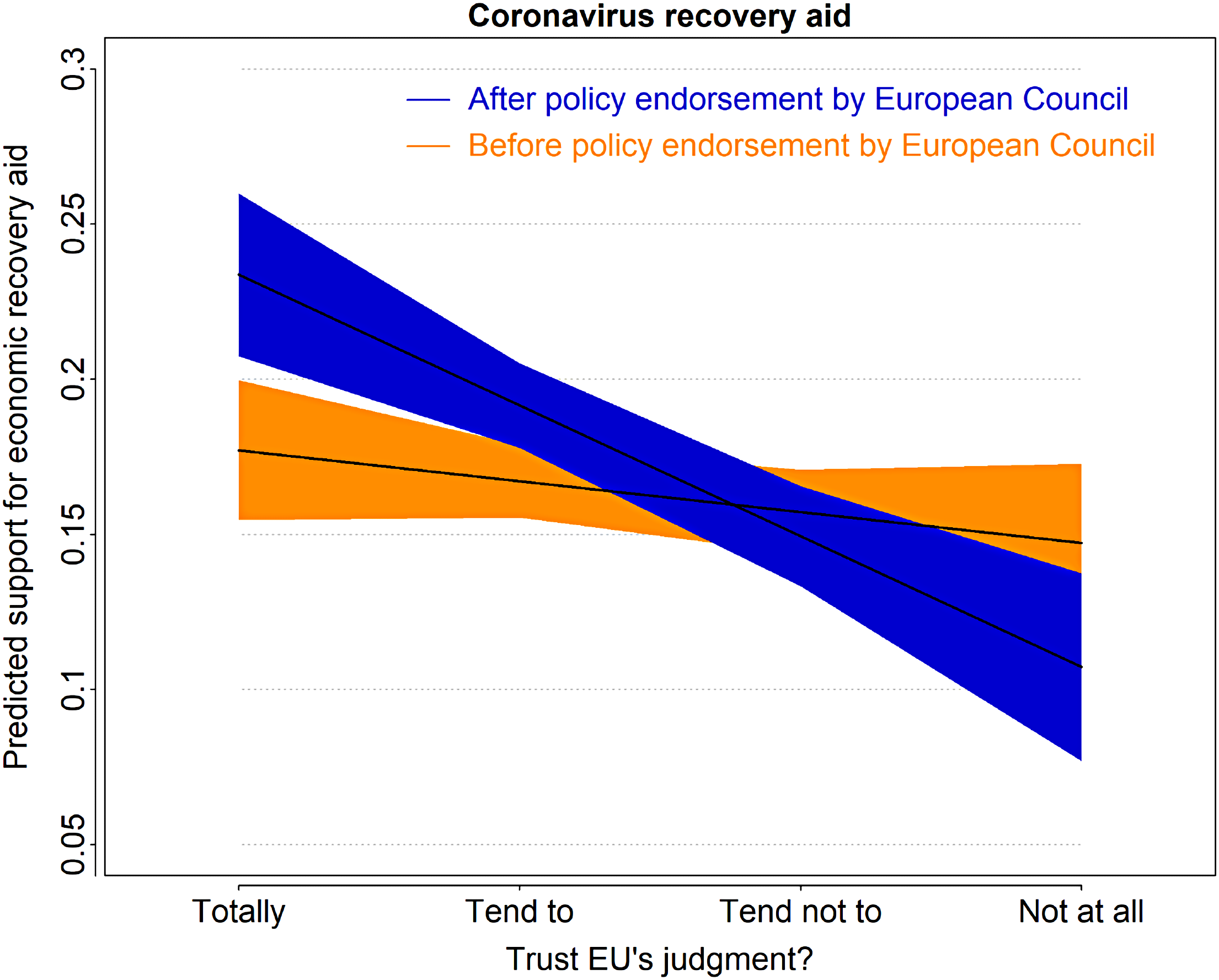
Predicted probabilities of support of coronavirus economic recovery aid before and after European Council decision by level of trust in EU judgment.
Results from the coronavirus recovery aid experiment support hypothesis 3, which posits that the signaling effect of cues from the Council varies based on whether the institution is united or divided. The unanimous adoption of the proposed policy causes higher popular support of the policy than the endorsement of the same motion despite the dissent of a few EU members. In models 31 to 36 reported in the Online appendix, the coefficient of approval with dissent causally identifies this quantity. It compares the attitudes of respondents who were assigned to the baseline condition (i.e. unanimous Council approval) to the views of others who read that the Council endorsed these policies despite dissent. This coefficient is statistically significant in the full sample and in the German subsample and weakly significant in the Austrian subsample (p < 0.1) due to lower statistical power. The effect is statistically insignificant in the refugee relocation experiment.
Alternative explanations
Further analyses rule out an alternative explanation of the results based on domestic elites. In the absence of any information about domestic elites in the experimental vignettes, respondents might use the position of the Council of the EU as a rough proxy for the views of national elites. If so, they might respond to cues about the Council of the EU even if they were indifferent about that institution’s policy position. If this alternative explanation was accurate, the signaling effect of cues from the Council of the EU would change in the presence of a second cue about the domestic elites’ stance. To test this proposition, half of the respondents in each experiment were assigned to cues about domestic elites. The domestic and EU elite treatments were independently randomized. In Germany, this second treatment provided the information that “most parties in the German Bundestag support this proposal” while Austrians learned that “the majority of the Austrian Nationalrat opposes this proposal”. This information was displayed immediately after the EU cue. It reflects the real-world positions of Austrian and German political parties. By cueing majority support and opposition from domestic political elites, I verify whether the hypothesized effect of cues from Brussels is independent of congruent (or incongruent) signals from national elites. In both countries and in both experiments, cues about domestic elites do not diminish the effect of EU elite cues (see the Online appendix). Thus, respondents assign an intrinsic value to cues from Brussels and respond to them even if they also receive signals about domestic elites.
Quasi-experimental analysis of Eurobarometer data
Research design
Quasi-experimental analyses of Eurobarometer survey data show that the hypothesized effects also materialize in the real world outside the controlled yet artificial environment of survey-based experiments. They leverage the research design opportunity that stems from the European Council’s endorsement of coronavirus economic recovery aid while a Eurobarometer survey was in the field across Europe. I can estimate the impact of that seminal Council decision on public opinion by comparing the attitudes of respondents who were interviewed just before the Council’s decision to the views of interviewees who took the survey soon thereafter. If the argument that citizens take cues about policies from trusted EU elites is right, support for coronavirus recovery aid should increase in the wake of the European Council’s summit—but only among citizens who trust the EU.
On 21 July 2020, the European Council reached political agreement on a coronavirus economic recovery fund. It delineated the rough contours of the aid package, which was formally adopted in February 2021. The Council’s July 2020 summit thus laid the groundwork for a historic 70% increase in the EU’s budget for the next seven years. The Council met while the Eurobarometer 93.1 survey was in the field from 2 July to 31 August 2020 (European Commission, 2020). To assess citizens’ willingness to pay for international redistribution, the analyses focus on responses from all countries that are net contributors to the EU budget: Austria, Denmark, Finland, France, Germany, Ireland, Italy, Netherlands, and Sweden (Buchholz, 2023). All in all, 5418 Eurobarometer responses gathered in these countries before the Council’s decision form the control group. A total of 4220 interviews that were conducted there later represent the treatment group. The binary treatment consists in potential exposure to the news about the Council’s decision on coronavirus recovery aid.
The following survey question captures attitudes toward coronavirus economic recovery aid: “And what should the European Union now prioritize in its response to the Coronavirus outbreak? …Provide more financial support to the most affected regions in the EU”. Respondents could select zero to three items from a list of 13 options or volunteer a different priority. The dependent variable takes a positive value for respondents who chose the financial support option and zero for others. Trust in the EU’s judgment on coronavirus recovery is measured based on responses to the following question: “Thinking about EU’s response to the Coronavirus outbreak, to what extent do you trust or not the EU to make the right decisions in the future?”. The answer options were “totally trust”, “tend to trust”, “tend not to trust”, “do not trust at all”, and “don’t know”.
The models include the same standard demographic covariates as the models of the survey experiments discussed above: age, gender, education, income, political orientation, as well as interest in politics and in international affairs. Controls are not strictly necessary to causally identify the effect of the Council’s policy endorsement, because the treatment (interview before or after the Council’s decision) was exogenously assigned. However, their addition increases efficiency.
The European Council’s endorsement of coronavirus economic recovery aid can only influence mass attitudes if mass or social media transmit the cue from Brussels to European publics. News media typically cover European Council summits (De Vreese, 2003) such as the historic one held in July 2020. Television remains the most popular news source in Europe (European Commission, 2019). News media content analyses in the Online appendix confirm that the most highly rated television news programs extensively covered the Council’s decision on 21 July 2020. Therefore, the most plausible explanation of a change in mass opinion about coronavirus recovery aid after July 21 would be that Europeans received—and responded to—the European Council’s cue about this policy. The next subsection analyzes this change in public attitudes.
Results
The results of the quasi-experimental analyses of Eurobarometer data are consistent with those obtained from the survey experiments. Respondents who were interviewed soon after the European Council endorsed coronavirus recovery aid (i.e. those who were exposed to EU elite cues that were transmitted through the mass media) were significantly more likely to express the view that the EU should prioritize financially supporting hard-hit regions than those who were interviewed just before the Council summit. Support for this proposition increased by nine percent, or two percentage points, after the Council endorsed economic relief (see model 83 in the Online appendix). This result supports hypothesis 1.
In line with hypothesis 2, the Council’s endorsement of pandemic recovery relief did not affect attitudes toward that policy among respondents who distrusted EU institutions. In contrast, citizens who viewed EU elites as trustworthy became more supportive of prioritizing EU financial support to hard-hit areas after the Council’s decision. Overall, 65% of respondents in the sample expressed trust in EU institutions. Among those who trusted the Union completely—that is, the baseline group in model 84 in the Online appendix—average support for prioritizing EU recovery aid surged by 33% (or six percentage points) after the European Council’s endorsed that policy. 9 Moderation analyses in the Online appendix confirm that the effect of the EU’s cue depends on citizens’ trust in EU elites.
Covariate balance and placebo test
Causal identification of the effect of the Council’s policy endorsement is based on the assumption that the timing of each interview—before or after the Council’s decision—was exogenously determined. Survey administration did not influence the date of the Council’s summit, and the order in which the survey was administered was determined before anyone knew whether and when the Council would approve coronavirus recovery aid. Therefore, respondents who fell on either side of the date of the Council’s summit were not systematically different, in expectation, and covariate balance analyses do not detect major differences in their socioeconomic characteristics (see the Online appendix). Additional covariate balance tests reported in the Online appendix verify that respondents’ average trust in the EU did not change after the European Council summit. In conclusion, covariate balance lends support to the identifying assumption that the treatment and control groups were not systematically different from each other. Divergences in their attitudes toward coronavirus recovery aid can therefore be ascribed to the European Council’s cue about this policy, to which only the treatment group was exposed.
A placebo test reported in the Online appendix also corroborates the claim that the Council’s policy approval changed the public’s policy preferences. It examines respondents’ opinion about a policy that was not discussed at the European Council summit: free movement between EU countries. As expected, public attitudes toward that policy remained the same after the Council’s meeting. This indicates that the change in public attitudes toward coronavirus economic aid was not part of a broad shift in EU attitudes that merely coincided with the European Council’s summit; instead, it was caused by the body’s decision on pandemic relief.
Conclusion
While the recent literature argues that the EU signals responsiveness to public opinion, this study shows that the Union’s policy choices do not merely react to public opinion but also shape it. Survey experiments fielded to large national samples in Austria and Germany and quasi-experimental analyses of an EU decision taken during a Eurobarometer survey indicate that the endorsement of electorally salient policies by the Council of the EU or the European Council increase popular support for these policies—but only among members of the public who trust the Councils’ judgment. On average, cues of EU approval of Coronavirus economic recovery aid and refugee relocation increase EU citizens’ approval of these policies by two to five percentage points. The effect is more than twice as strong among citizens who trust EU elites.
Trust in EU elites varies greatly between EU member states. Eurobarometer data indicates that the share of citizens who tend to trust the Council of the EU ranges from 26% in France to 57% in Romania (European Commission, 2019). The findings from this study imply that the Council finds it more difficult to influence policy preferences in member states with Eurosceptic publics than in countries where most citizens consider the Council a trustworthy elite actor. In the survey experiments, EU cues affected Austrian and German respondents’ views on pandemic economic relief. At the same time, trust in EU elites’ judgment on refugee policy was higher in Germany than in Austria. Consequently, EU cues only affected the former country’s average respondent’s views on relocating refugees from Southern to Northern Europe, even though they shaped the views of those Germans and Austrians who regard EU elites as trustworthy.
The study suggests that signals from Brussels may contribute to the polarization of public attitudes toward European integration. If Europeans who trust EU elites become more supportive of EU-approved policies while other EU citizens do not, then the public’s policy preferences diverge. In the long run, these views about EU policies may inform popular assessments of the Union’s performance legitimacy and trust in EU elites, which will become more polarized. Examining this feedback loop could be a promising avenue for future research.
This study lends qualified support to the notion that a united Council of the EU has a larger signaling effect on public attitudes than a divided one. The impact of unanimity in the Council of the EU on public opinion may help us understand why EU members often make cumbersome compromises and costly side payments to secure all EU member states’ approval even in issue areas where they could pass their preferred policy with a qualified majority vote. Complementing other explanations of consensus decision-making in the Council (Häge, 2013; Novak, 2013), this study points to an additional incentive to pursue unanimity: to influence EU citizens’ policy preferences by signaling unity (instead of divisions) among EU governments.
Future research could examine how signals conveyed by EU elites affect the attitudes and behavior of audiences other than domestic publics. Studies show that Council members’ vote choices send signals to domestic legislators and special interest groups (Bailer et al., 2015; Hagemann et al., 2019). Plausibly, these audiences do not just react to their own government’s voting behavior. Instead, they may also pay attention to signals of unity and divisions in the Council of the EU. Financial markets also respond to decisions taken by EU elites (Bechtel and Schneider, 2010). Possibly, they do not just react to whether a decision was adopted or not but also to unity and divisions among EU members. Future research of the response of these other audiences to signals from Brussels can complement public opinion research.
Supplemental Material
sj-pdf-1-eup-10.1177_14651165231190322 - Supplemental material for The responsive public: How European Union decisions shape public opinion on salient policies
Supplemental material, sj-pdf-1-eup-10.1177_14651165231190322 for The responsive public: How European Union decisions shape public opinion on salient policies by Christoph Mikulaschek in European Union Politics
Supplemental Material
sj-csv-2-eup-10.1177_14651165231190322 - Supplemental material for The responsive public: How European Union decisions shape public opinion on salient policies
Supplemental material, sj-csv-2-eup-10.1177_14651165231190322 for The responsive public: How European Union decisions shape public opinion on salient policies by Christoph Mikulaschek in European Union Politics
Supplemental Material
sj-csv-3-eup-10.1177_14651165231190322 - Supplemental material for The responsive public: How European Union decisions shape public opinion on salient policies
Supplemental material, sj-csv-3-eup-10.1177_14651165231190322 for The responsive public: How European Union decisions shape public opinion on salient policies by Christoph Mikulaschek in European Union Politics
Supplemental Material
sj-csv-4-eup-10.1177_14651165231190322 - Supplemental material for The responsive public: How European Union decisions shape public opinion on salient policies
Supplemental material, sj-csv-4-eup-10.1177_14651165231190322 for The responsive public: How European Union decisions shape public opinion on salient policies by Christoph Mikulaschek in European Union Politics
Supplemental Material
sj-csv-5-eup-10.1177_14651165231190322 - Supplemental material for The responsive public: How European Union decisions shape public opinion on salient policies
Supplemental material, sj-csv-5-eup-10.1177_14651165231190322 for The responsive public: How European Union decisions shape public opinion on salient policies by Christoph Mikulaschek in European Union Politics
Supplemental Material
sj-csv-6-eup-10.1177_14651165231190322 - Supplemental material for The responsive public: How European Union decisions shape public opinion on salient policies
Supplemental material, sj-csv-6-eup-10.1177_14651165231190322 for The responsive public: How European Union decisions shape public opinion on salient policies by Christoph Mikulaschek in European Union Politics
Supplemental Material
sj-csv-7-eup-10.1177_14651165231190322 - Supplemental material for The responsive public: How European Union decisions shape public opinion on salient policies
Supplemental material, sj-csv-7-eup-10.1177_14651165231190322 for The responsive public: How European Union decisions shape public opinion on salient policies by Christoph Mikulaschek in European Union Politics
Supplemental Material
sj-csv-8-eup-10.1177_14651165231190322 - Supplemental material for The responsive public: How European Union decisions shape public opinion on salient policies
Supplemental material, sj-csv-8-eup-10.1177_14651165231190322 for The responsive public: How European Union decisions shape public opinion on salient policies by Christoph Mikulaschek in European Union Politics
Supplemental Material
sj-r-9-eup-10.1177_14651165231190322 - Supplemental material for The responsive public: How European Union decisions shape public opinion on salient policies
Supplemental material, sj-r-9-eup-10.1177_14651165231190322 for The responsive public: How European Union decisions shape public opinion on salient policies by Christoph Mikulaschek in European Union Politics
Supplemental Material
sj-csv-10-eup-10.1177_14651165231190322 - Supplemental material for The responsive public: How European Union decisions shape public opinion on salient policies
Supplemental material, sj-csv-10-eup-10.1177_14651165231190322 for The responsive public: How European Union decisions shape public opinion on salient policies by Christoph Mikulaschek in European Union Politics
Supplemental Material
sj-r-11-eup-10.1177_14651165231190322 - Supplemental material for The responsive public: How European Union decisions shape public opinion on salient policies
Supplemental material, sj-r-11-eup-10.1177_14651165231190322 for The responsive public: How European Union decisions shape public opinion on salient policies by Christoph Mikulaschek in European Union Politics
Supplemental Material
sj-do-12-eup-10.1177_14651165231190322 - Supplemental material for The responsive public: How European Union decisions shape public opinion on salient policies
Supplemental material, sj-do-12-eup-10.1177_14651165231190322 for The responsive public: How European Union decisions shape public opinion on salient policies by Christoph Mikulaschek in European Union Politics
Supplemental Material
sj-pdf-13-eup-10.1177_14651165231190322 - Supplemental material for The responsive public: How European Union decisions shape public opinion on salient policies
Supplemental material, sj-pdf-13-eup-10.1177_14651165231190322 for The responsive public: How European Union decisions shape public opinion on salient policies by Christoph Mikulaschek in European Union Politics
Supplemental Material
sj-csv-14-eup-10.1177_14651165231190322 - Supplemental material for The responsive public: How European Union decisions shape public opinion on salient policies
Supplemental material, sj-csv-14-eup-10.1177_14651165231190322 for The responsive public: How European Union decisions shape public opinion on salient policies by Christoph Mikulaschek in European Union Politics
Supplemental Material
sj-csv-15-eup-10.1177_14651165231190322 - Supplemental material for The responsive public: How European Union decisions shape public opinion on salient policies
Supplemental material, sj-csv-15-eup-10.1177_14651165231190322 for The responsive public: How European Union decisions shape public opinion on salient policies by Christoph Mikulaschek in European Union Politics
Supplemental Material
sj-csv-16-eup-10.1177_14651165231190322 - Supplemental material for The responsive public: How European Union decisions shape public opinion on salient policies
Supplemental material, sj-csv-16-eup-10.1177_14651165231190322 for The responsive public: How European Union decisions shape public opinion on salient policies by Christoph Mikulaschek in European Union Politics
Footnotes
Acknowledgements
I thank Jeffry Frieden, Roman Hlatki, Tobias Hofmann, Valentin Lang, Michal Parízek, Miles Williams, two anonymous reviewers, and audience members at annual meetings of APSA and IPES in 2021 and ISA and PEIO in 2022 for helpful comments. All errors are mine.
Funding
The author(s) disclosed receipt of the following financial support for the research, authorship, and/or publication of this article: a research grant from the Dean of the Faculty of Arts and Sciences at Harvard University.

Supplemental material
Notes
References
Supplementary Material
Please find the following supplemental material available below.
For Open Access articles published under a Creative Commons License, all supplemental material carries the same license as the article it is associated with.
For non-Open Access articles published, all supplemental material carries a non-exclusive license, and permission requests for re-use of supplemental material or any part of supplemental material shall be sent directly to the copyright owner as specified in the copyright notice associated with the article.
