



Abstract
The marginal involvement of the European Union (EU) in redistributive policies and its limited fiscal resources have led to a notable lack of attention by EU scholars towards the EU budget and its dynamics. Yet the nature of the budgetary data and their high usability for statistical analysis make them an excellent tool for studying and measuring policy change in the EU. In this article, I analyse an original dataset containing yearly data for the main categories of expenditure and how they have changed over the last three decades (1979–2013). Using time-series analysis, I find that the ability to form winning coalitions in the Council, the ideological positioning of the co-legislators and the inclusion of the cohesion countries have played a significant role in driving budget change.
Introduction
The general budget of the European Union (EU) establishes on a yearly basis how the fiscal resources controlled by the EU are allocated to a range of policies and programmes that are directly financed and generally managed by the European Commission. To date, the EU budget has not attracted much scholarly attention, perhaps because the fiscal resources administered by the EU are only a fraction of the resources controlled by the member states. The vast majority of studies in this field have thus focused on national budgets: on their changing composition, on the factors explaining budget deficits and on the process of reform. There is less theoretical and empirical research on the EU budget, and this has mainly focused on distributional issues and conflicts: how the EU presidency affects the distribution of resources across member states (Aksoy, 2010), the formation of interest coalitions in the adoption of multiannual financial frameworks (MFFs) (Blavoukos and Pagoulatos, 2011) and the distribution of EU funds at sub-national level (Dellmuth and Stoffel, 2012). Other studies have analysed the general pattern of stability and change in budget reform (Citi, 2013) and the likely effects of the Lisbon Treaty on budgetary policymaking (Crombez and Høyland, 2015). However, much less is known about the determinants of budget change, i.e. the factors driving stability and change in the allocation of resources across budget functions.
This article addresses this question and contributes to the existing literature in three ways. First, it analyses whether the re-definition of voting rules and weights in the Council, determined by successive rounds of treaty reforms, have made budget change more (or less) viable. Second, it estimates how the changing ideological composition of the EU's legislative bodies and how a number of other theoretically relevant variables have driven stability and change in the EU budget. Third, by contrasting and comparing the findings with an earlier empirical analysis of the determinants of policy reform in EU regulatory policies (Citi and Justesen, 2014), this article argues that the variables predicting budgetary and regulatory change only partially overlap and that ideological variables play a much more prominent role in budget change than in regulatory policy change.
The empirical analysis is based on a new dataset tracking the evolution of macro areas of expenditure throughout 1979–2013. The original budgetary figures are published on a yearly basis in the official journal of the EU. These figures, however, are affected to a considerable degree by the problem of ‘repackaging’, i.e. the shifting of chapters or other lower-level programmes to new or different titles or the creation of new chapters and titles, which can make data collection and analysis highly unreliable. To tackle this problem, the dataset was developed by applying a specifically devised codebook that maintains constant codes across the whole timeframe, ensuring data consistency and reliability.
In the remainder of the article, I show how partisan politics and the decision-making rules affect EU spending decisions. In particular, I demonstrate that the changing ideological positions of the Council and the Parliament have a significant effect on budget change. This effect, however, is mediated by the EU legislative procedure and can be heavily constrained by it. More specifically, the ability to form winning coalitions in the Council plays an important role in making policy change possible, and becomes fundamental for the adoption of larger-scale policy changes. In addition, the enlargement of the EU to lower-income countries has contributed significantly to the reallocation of EU-level expenditure. As the empirical evidence shows, the accession of the so-called cohesion countries has produced some of the most extensive budgetary changes in the last three decades.
Explaining budget change: Theory and hypotheses
Most of the literature on public budgets has focused on two different but deeply interconnected themes: assessing how budgets evolve in both the short and long run and finding the determinants of stability and change in the composition of public budgets.
The first theme was initially explored by the early incrementalists, who theorised that budgets and public policies in general are reformed in small steps and through a process of ‘muddling through’. This phenomenon of gradual policy change happens – they argued – because policymakers operate under extensive time and information constraints, which impose severe limits on their ability to design large-scale reforms (Davis et al., 1966; Lindblom, 1959; Wildavsky, 1964). Several years later, another group of scholars started with the same set of assumptions to develop a new model of budget and policy reform, which is nowadays widely known as the punctuated-equilibrium (P-E) model (Baumgartner and Jones, 1993, 2002; Jones and Baumgartner, 2005). The central claim of this model is that public policies generally evolve through small-scale policy adjustments. However, the same forces that produce incremental changes (i.e. the bounded rationality of decision-makers, time constraints and information constraints) are also responsible for major departures from the status quo (Jones and Baumgartner, 2005). The mechanism is the following: governments are assumed to have limited time, attention and information. Because of these constraints, they tend to focus their efforts on the few items that are salient on the political agendas, and overlook a number of other socio-economic issues. Yet, if some of the neglected issues reach a threshold of severity that ‘forces’ policymakers to give them attention, the general pattern of incremental adjustments is likely to be interrupted or ‘punctuated’ by a more discontinuous type of change. This model has been successfully tested on a massive dataset tracking the evolution of US federal legislation and the US budget in the long run (Jones and Baumgartner, 2005) and on other large-n cross-national datasets (Baumgartner et al., 2009; Jones et al., 2009). As such, the P-E model is nowadays widely accepted as the state of the art in the analysis of budget stability and change.
The second theme concerns the determinants of budget change. Here the literature is divided between studies focusing on the agenda-setting process, and studies focusing on veto player variables and partisan/ideological variables. The agenda-setting approach, which is the chief component of the P-E model explained above, is a behavioural model of policy choice that is based on the concept of disproportionate information processing (Jones and Baumgartner, 2005: 115–136). Essentially, its central point is that the expansion and contraction of policy issues on the agenda are non-incremental dynamics that predict (or anticipate) policy change. The partisan and veto-player approaches, on the other hand, predict policy stability and change based on the ideological positioning of legislative bodies and on the configuration of formal and de facto veto players participating in the legislative process. For scholars advocating the second approach, agenda setting is not a fundamental factor in explaining policy change, unless agenda dynamics reshape the policy preferences of veto players.
In the specific EU context, predicting budget reform through the lens of the agenda-setting perspective is quite problematic for a number of reasons. One of these is that the EU agenda cannot be tracked easily: the Parliament and the Council, as the two legislative branches, have their own agendas, but neither can initiate legislation. The legislative initiative is left to the Commission, which controls its own agenda and, in part, the global EU agenda. The European Council provides an additional layer of complexity: it has no legislative power at all but defines the general political priorities of the EU, and as such, it contributes substantially to shaping the EU agenda, though in a very indirect way. Moreover, the current scarcity of data on the dynamics of the EU agenda does not allow a full-blown investigation of its impact on policy (and budget) change. 1 In this article, I will therefore take the second perspective by analysing the impact of partisan and veto player variables on budget change.
Several contributions have relied on veto player theory to analyse the reform of national budgets. Most have examined the impact of partisan politics on the budgets of specific states: Germany (Bawn, 1999; König and Troeger, 2005), Denmark, the United Kingdom and the United States (Breunig, 2006) and on a larger panel of 19 the Organisation for Economic Co-operation and Development (OECD) countries (Bräuninger, 2005). In all these cases, the key dimension being investigated was the distance in policy preferences between the parties of the government coalition or the distance in policy preferences between two successive governments. This distance, which is generally estimated on the basis of party manifesto data or expert survey data, was found to have a significant impact on national budgets in all cases. Nevertheless, we know from veto player theory that the ideological position and distance between veto players are not the only factor affecting policy stability and change. The number of institutional veto players, defined as the constitutional configuration of individual or collective actors whose consent is necessary to change the status quo, is at least as important as the distance in policy preferences (Tsebelis, 2002). Thus, in a larger comparative study, Tsebelis and Chang (2004) estimated the impact of institutional and partisan veto players on the national budgets of 19 OECD countries, finding that both have a significant impact in determining budget stability and change. In this article, I follow this line of investigation to study how these two types of veto player variables drive stability and change in the composition of the EU budget.
The vast majority of empirical analyses on budget reform are focused on the national level. Few studies exist on the reform of the EU-level budget, and these are mainly concerned with distributional conflicts between member states, emphasising either the bargaining behaviour of member states during budget negotiations (Aksoy, 2010; Schneider, 2013) or the patterns of coalition building in the negotiations for the MFF (Blavoukos and Pagoulatos, 2011). Taking a different perspective, Citi (2013) showed that the EU budget is reformed following a pattern that closely approximates the P-E dynamic. However, none of these contributions has identified the factors that explain policy reform and inertia in the EU budget.
Not much is known about the extent to which different configurations of institutional veto players, created or reshaped by successive treaty reforms, have driven the EU budget towards more or less stability. Likewise, it is not entirely clear whether the ideological composition of the EU legislative branches and their distances on the left-right policy space have prompted larger or smaller budget reforms. These questions are particularly relevant, especially in light of the well-known claim that the EU is a political system whose policies are increasingly driven by partisan control in the Council and the Parliament (Hix, 2008: 110–136). If this was the case, we should find that the changing ideological composition of EU legislative bodies affects changes of the EU budget or lack thereof. Moreover, another question that is extremely relevant, both for research and for European citizens in general, is whether the changing political landscape determined by new elections is a sufficient condition to determine a reallocation of expenditure, or whether the EU institutional constraints can severely limit, or even block, budget change driven by partisan politics.
Determinants of budget stability and change
The EU budget is adopted following a process laid out in the budgetary treaties of 1970 and 1975, which closely resembles the ordinary legislative procedure. More specifically, the Commission starts the process by drafting a preliminary budget, and then forwards it to the two legislative branches. At this point, the Council and the Parliament have at their disposal up to two readings each and a final round of conciliation committee meetings to agree on a joint document. 2 Before the Lisbon Treaty, the legal provisions were such that the Council had the last word on compulsory expenditures (essentially the common agricultural policy), whereas the Parliament had the last word on non-compulsory expenditures (all other expenditures). However, considering the Parliament's power to reject draft budgets to extract more concessions (which happened with the 1980 and 1985 budgets) and the practice developed since 1988 of agreeing on common and binding MFFs, both branches of the legislature have a de facto veto power on all the constituent parts of the budget.
Nevertheless, from the perspective of veto player theory, both the Council and the Parliament are not individual veto players but collective veto players. This means that their ability to change the status quo hinges on their capacity to build pro-reform coalitions. In the Parliament, coalition building is largely based on loose agreements between the main party groups, which tend to align along the classical left–right dimension (Hix et al., 2005). Therefore, the changing ideological composition of the Parliament may change the weight or composition of these coalitions, which in turn may produce a different positioning of the Parliament vis-à-vis the status quo.
Analysing the Council as a collective veto player is more complex, as coalitions that form during the budgetary negotiations tend to be more unstable and volatile. According to recent evidence collected by Blavoukos and Pagoulatos (2011: 574), these coalitions are generally ad hoc and based on national interests, ideological proximity or a combination of the two. Hence, the ability to form winning coalitions should be a key factor in budget change.
H1: The higher the ability to form winning coalitions in the Council, the greater the budget deviation from the status quo.
Another potentially key factor in explaining budget change is the political positioning of the EU legislative bodies on the left–right dimension. Political parties have traditionally been characterised by different preferences with regard to fiscal policy and spending priorities. For instance, several studies have established a clear link between the ideological attributes of parties in government and budget deficits (Blais et al., 1993; Roubini and Sachs, 1989). Other contributions have found that the swing of the political pendulum from the left to the right and vice versa has an impact on the spending priorities of the government (Bawn, 1999; Bräuninger, 2005; Tsebelis and Chang, 2004), whereas an increasing ideological distance between institutional veto players tends to produce a high level of budget stability (Tsebelis and Chang, 2004). In all these cases, partisan politics have been proven to matter in budgetary reform. However, all the analyses mentioned above focused on the national level. No study, to the best of my knowledge, has as yet investigated in a systematic way the effect of the ideological position of the EU legislative bodies – and their changing distance – on the annual spending allocations. Hence, two hypotheses test these relationships.
H2: The changing ideological position of the EU legislative bodies on the left–right dimension is related to a reallocation of resources across budgetary functions. H3: The wider the ideological distance between the EU legislative bodies, the higher the budget stability.
Apart from the ideological positioning, the literature has identified another dimension that is extremely relevant in the EU political arena: the pro-anti EU dimension (Gabel and Hix, 2002; Hix and Lord, 1997). Admittedly, empirical analysis of this dimension has revealed that it is considerably less salient than the left–right dimension (Hix et al., 2007: 181), and its variation is very small compared to the ideological variation (Warntjen et al., 2008). In addition, this dimension is likely to affect the overall ‘size’ of the EU budget (i.e. whether the EU should have a larger or smaller budget), not the allocation of resources across categories of expenditure. Nevertheless, this dimension constitutes one of the most recurrent elements of the past and current EU-level political debate. Thus, the empirical analysis includes a robustness check on the impact of this dimension on the EU budget.
Beyond the ideological domain, there is another factor that is likely to trigger a significant change in the budget: the inclusion of the cohesion countries, i.e. countries characterised by a gross domestic product (GDP) per capita significantly lower than the EU average (75% or lower) and in need of substantial investment in structural and cohesion funds.
H4: The accession of a cohesion country to the EU is related to a significant reallocation of resources across budgetary functions.
In more specific terms, with this hypothesis I check whether the inclusion of the Southern European countries (1981 and 1986) and the Eastern European countries (2004 and 2007) had a significant impact on the existing allocations of the EU budget.
Research design
Measuring budget change
Following an approach developed by Tsebelis and Chang (2004) for measuring budget reform in 19 OECD countries, I conceptualise the EU budget as a vector in an n-dimensional policy space, with each dimension representing the allocation of funds to a specific jurisdiction. Considering that each jurisdiction is allotted a percentage of the general budget, the annual budget can then be expressed as a sequence of percentages (a1, a2, …, a
n
). Under these assumptions, it is possible to calculate the ‘extensiveness’ of budget reform by summing the squared deviations from the previous year's appropriations to the same jurisdictions and then taking the square root of the resulting number. The output variable, called budget distance (BD), can be formalised as follows:
The time series of budget distance, by year (1979–2013).

The data were collected through an in-depth analysis of the general budget of the EU from 1979 to 2013. The base year 1979 was chosen because it was the year of the first direct elections to the European Parliament. Given the lack of data on the party affiliation of members of Parliament (MEPs) before this date, it would have been virtually impossible to estimate the Parliament's ideological positioning before that year, as well as its impact on the EU budget.
Codes used for coding the EU's macro areas of expenditure.
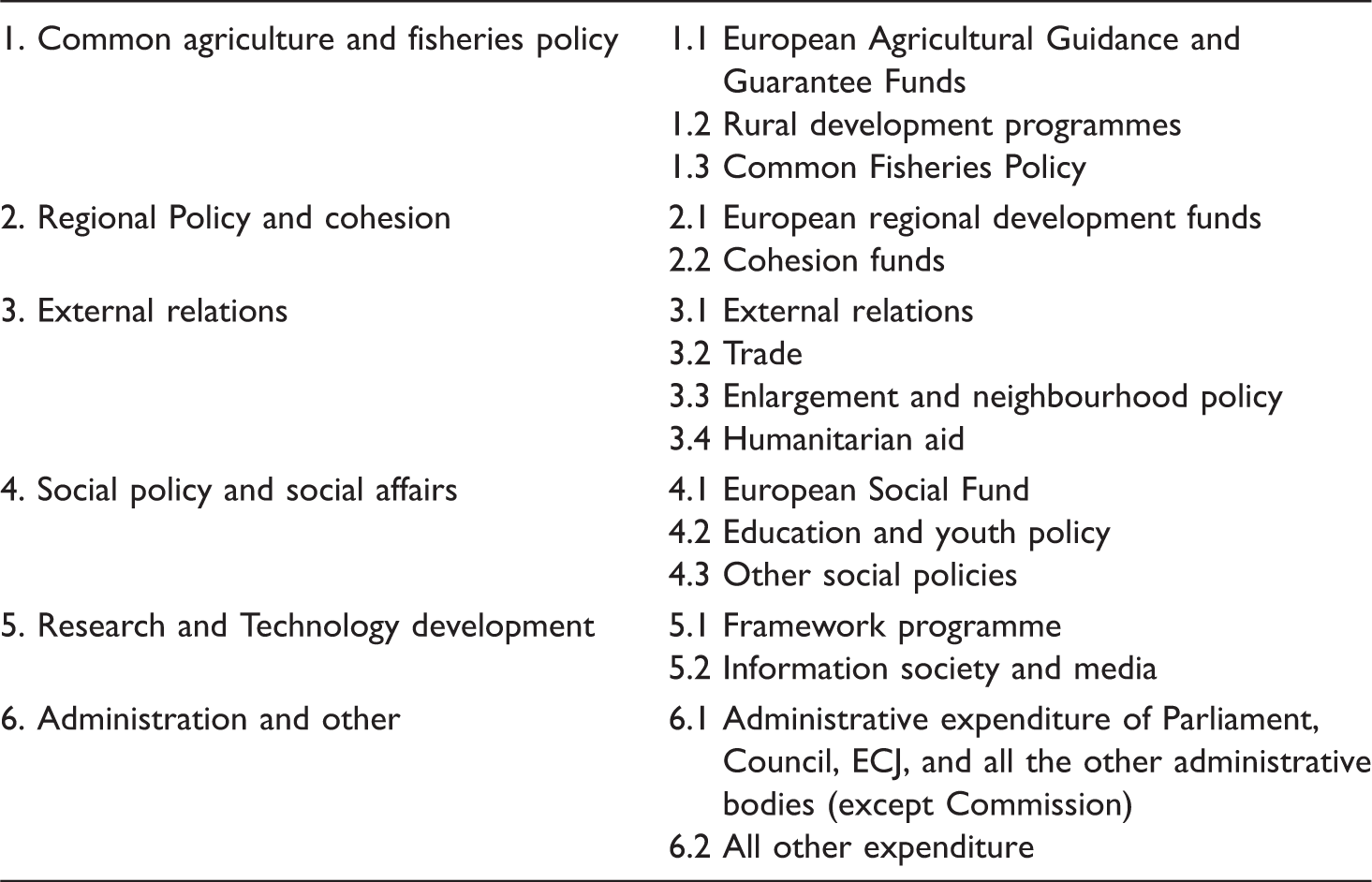
There is another important reason for using this codebook: over the last 30 years, the EU's competences evolved considerably as it acquired new roles and developed new programmes almost every year. To capture the evolution of expenditure in a time-consistent fashion across this long timeframe, the categories in the codebook are fully backwards compatible, i.e. they are as applicable to the earlier years of the dataset as to the most recent years. The macro-categories of expenditure shown in Table 1 are exactly designed for this type of analysis. Finally, the macro-categories allow us to focus on the general trends of stability and change in expenditure policies, disregarding the ‘noise’ generated by a number of smaller-scale programmes that the EU created over the years. 3
Explanatory variables
The first hypothesis suggests that the ability of Council members to form ‘winning coalitions’ to change status quo policies holds a high potential for predicting budget reform. This variable is determined by two parameters: the height of the threshold for a qualified majority and the distribution of voting weights between member states. Both have been subject to change in the last three decades, mostly because of treaty changes that were adopted to accommodate new member states and to adjust the efficiency of decision-making. These institutional reforms have altered the unanimity core and the status quo win-set of the Council, affecting its ability to change status quo policies. For example, the triple qualified majority vote (QMV) introduced with the the Treaty of Nice increased the Council's QMV core (Tsebelis, 2002: 270–71), making it harder to agree on a policy change. In contrast, the Lisbon Treaty's abolition of the triple qualified majority made QMV easier to reach, and pro-reform coalitions easier to build (Tsebelis, 2012).
The literature on power indices has developed a reliable method for measuring the ability to form winning coalitions: a system that makes use of the threshold (one or multiple) for reaching QMV and the voting weight attributed to each member state to calculate the percentage of winning coalitions against the total number of possible coalitions. Given the considerable computational task implied in this calculation, the software Indices of Power (IOP) 2.0 developed by Thomas Bräuninger was used to calculate how the percentage of winning coalitions in the Council changed as a result of all the treaty reforms in the last three decades. 4 Essentially, a higher score signifies an easier possibility to form pro-reform coalitions, making policy change more likely.
H2 focuses on the impact of the ideological composition of the EU legislative bodies on the EU budget, whereas H3 focuses on the impact of their ideological distance. To test these hypotheses, I rely on a dataset that tracks the changing ideological composition of the EU legislative bodies from 1979 to 2010. 5 The latter, developed by Klüver and Sagarzazu (2013), estimates the position of the EU legislative branches with a multiple-stage procedure: in the first step, all the parties represented in the Parliament and in the Council are located on a left–right scale on the basis of a textual analysis of their manifestos. In the second step, the ideological position of the two legislative branches is estimated by computing the weighted average position of all the parties represented in the Parliament and the Council. Following the coding of this data, a negative score signifies a left-leaning position, whereas a positive score stands for a right-leaning position. Since the Parliament's composition changes every five years and the Council's composition changes every time a member state elects a new government, the Parliament's ideological position is recalculated every five years, whereas the Council's position is recalculated every time there is a change in government in one of the member states. These data are then transformed into yearly time series. The measure of the ideological position of the Commission is also included in the model estimation since the Commission plays an important role in drafting the preliminary budget. In addition, two supplementary variables from the Klüver and Sagarzazu dataset have been included in the empirical analysis: the Council's position on the pro-anti EU scale and the Parliament-Council distance on the same dimension. These variables are included because, as explained in the theoretical section, the pro-anti EU dimension could have a sizable impact on the budgetary process.
Finally, H4 concerns the accession of the cohesion countries to the EU and its possible impact on the budget. I test this hypothesis using a dummy variable that takes the value of 1 for the years when one (or more) of the cohesion countries entered the EU and 0 for all the others. 6
Control variables
Previous analyses control for a number of ‘non-deliberate’ changes, i.e. budgetary mechanisms that respond, either automatically or quasi-automatically, to changing conditions in the policy environment. For instance, a sharp decline in the growth rate of a country, an increase in unemployment or the changing costs of servicing the public debt will normally trigger some budgetary responses (Bawn, 1999; Bräuninger, 2005; Tsebelis and Chang, 2004). However, the EU does not pay unemployment benefits, it does not have specific sources of expenditures for countercyclical measures and it does not have to pay the costs of servicing a debt. In this sense, most EU budget changes can be considered deliberate. Notwithstanding, there might be an EU-level political budget cycle that affects its spending decisions. The literature on public budgets has shown that an expansionary fiscal policy during electoral or pre-electoral years is quite common in a number of democracies (Drazen, 2000; Franzese, 2002; Rogoff, 1990): this is a dynamic that could, at least theoretically, affect the EU as well. Hence, one control variable checks the possibility of a ‘political budget cycle’ affecting the EU budget. This variable is specified as a dummy variable that takes the value of 1 for all the years directly preceding a EU election, and the value of 0 for all the other years.
The last control variable checks the possible impact of the MFF on the EU's budget. The MFF is an inter-institutional agreement between the Council and the Parliament that sets the maximum expenditure ceiling for the following seven years, and establishes some very general spending priorities. Historically, the creation of the MFF in 1988 was driven by the Parliament, which wanted to have more incisive power in the process of appropriation. This development gave the Parliament a de facto veto power on all the main categories of budget, and the power to influence the general fiscal priorities of the EU. Since the Council adopts the MFF by unanimity and since each member state pushes for its own priorities, the process leading to the adoption of the MFF tends to mobilise a number of intra-EU cleavages and coalitions (Blavoukos and Pagoulatos, 2011), leading to ‘grand bargains’ (Laffan, 2000) that can have a knock-on effect on the budgetary choices of subsequent years. A dummy variable for each MFF therefore controls for the possible impact of these grand-bargaining rounds on the yearly budgets. 7
Estimation and results
Before testing the models through ordinary least squares (OLS) regressions, the time series properties of the data were carefully examined. In particular, to check for stationarity of the time series and hence its suitability for OLS regression, I run the augmented Dickey–Fuller (ADF) test for a unit root in the variable BD. The test rejected, by an ample margin, the null hypothesis for a unit root in the series. Moreover, the residuals of all the regressions were inspected for serial correlation by running the portmanteau (Q) statistic for all the models. In all cases, the test failed to reject the null hypothesis of no serial correlation.
Explaining budget change in the EU (1979–2013).
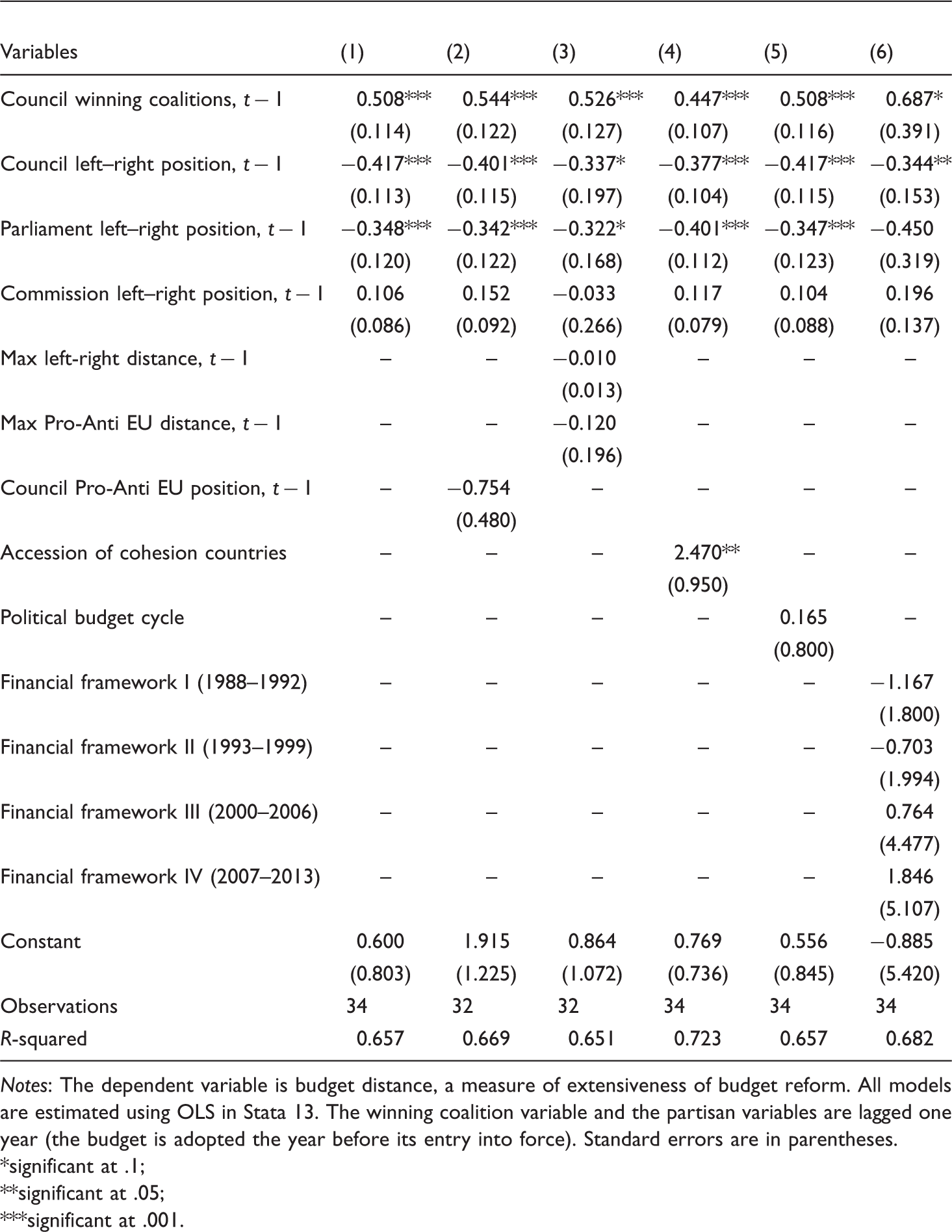
Notes: The dependent variable is budget distance, a measure of extensiveness of budget reform. All models are estimated using OLS in Stata 13. The winning coalition variable and the partisan variables are lagged one year (the budget is adopted the year before its entry into force). Standard errors are in parentheses.
significant at .1;
significant at .05;
significant at .001.
As the regression table shows, if we control for the effect of the winning coalition variable, a one-point increase in the left–right scale (that is, a one-point movement towards the right) produces a highly significant negative score on the output variable. This means that a shift to the right in the ideological composition of the two legislative bodies determines budgetary choices that are more oriented to the status quo. This finding is particularly interesting in light of some earlier research on regulatory policy change in the EU, which found that the same partisan variables had no significant impact on regulatory expansion and dismantling (Citi and Justesen, 2014). The implication is that the factors at play in budgetary and regulatory change only partially overlap and that partisanship plays a more important role in budget reforms than in regulatory reform.
Model 2 includes the same variables as model 1, but in addition tests the impact of the Council's position on the pro-anti EU dimension. As shown in Table 2, the effect is not significant. This finding, however, is not particularly surprising: although it is well known that the pro-anti EU dimension gains salience during negotiations over the general size of the EU budget (i.e. when the member states have to decide whether to pay more or less towards the supranational budget), the same dimension tends to lose relevance in the reallocation of budgetary resources across expenditure areas. In other words, the correlation between member states' position on the pro-anti EU scale and their preferences for reallocation of spending is very low.
Model 3 focuses on the distance of policy preferences between the Council and the Parliament, both on the left–right dimension and on the pro-anti EU dimension. The effects of the two variables are not significant, and this is a finding that might require some interpretation. Leaving aside the pro-anti EU variable, which exhibits very little variation to yield a significant effect (see also Warntjen et al., 2008), the non-significance of the ideological distance might be explained in light of the Council's range of policy preferences, which are likely to be similar to the preferences expressed by the main political parties of the Parliament. This intuition is supported by the findings of a very recent study on the EU budget process after the Lisbon Treaty (Crombez and Høyland, 2015), which demonstrated that the budgetary preferences of member states commanding a qualified majority in the Council overlap extensively with the preferences expressed by the three main political groups in the Parliament.
Model 4 estimates the impact of the enlargement of the EU to include the cohesion countries. The literature has presented considerable qualitative evidence showing that the accession of these countries has historically sparked extensive budgetary bargains, which in turn have resulted in the re-balancing of expenditure priorities (see, for instance, Blavoukos and Pagoulatos, 2011). However, model 4 tests on a larger-n dataset whether there is a systematic relationship between the two variables while controlling for the ideological and veto-player variables. The coefficient of model 4 shows that this is indeed the case: the accession of these countries led to a statistically significant change in the allocation of resources across the main areas of expenditure. Looking more closely at the raw data, one can observe a substantial movement of resources from areas such as the common agricultural policy to regional policy and the European social fund corresponding with these enlargement rounds.
Model 5 controls for the possible impact of an EU-level political budget cycle. There is no specific theoretical and empirical literature on this aspect of the EU political system, and it is not entirely clear whether EU budget appropriations are affected by the prospect of upcoming EU-level elections. Yet there is an extensive body of comparative literature on this phenomenon at the country level (Alt and Lassen, 2006; Goldbach and Fahrholz, 2011; Mink and de Haan, 2006; Shi and Svensson, 2006), and this is indeed a possibility even at the EU level, considering that MEPs control a sizeable amount of fiscal resources and that these can be strategically deployed in ways that increase the MEPs' chances of being re-elected. In this model, I therefore control for the reallocation of expenditures in comparison with the year preceding an EU election year. The regression estimates, however, report a non-significant coefficient for this model, implying that there is no clear evidence of such a cycle at the EU level. This result is coherent with some recent findings in the literature, which have shown that political budget cycles are likely to occur in cohesive, single-party political systems, not in policies characterised by a higher number of veto players (Bojar, 2014).
Finally, model 6 tests the impact of MFFs on the stability and change of the EU budget. MFFs are inter-institutional agreements between the Parliament and the Council that set the maximum level of aggregate expenditure for the following seven years. For this reason, they can be a constraining factor on the development of annual budgets. Hence, their effect is tested by a set of dummy variables in the regression (one for each MFF), while controlling for the effect of winning coalitions and the ideological position of the Council, Parliament and Commission. The coefficients of model 6 show that MFFs have no significant impact on yearly budgets. Interestingly, however, the effect representing the Council's ideological composition remains significant in this model, while the corresponding Parliament variable becomes insignificant, as a substantial part of the variability is now captured by the MFF dummy variables. Theoretically, this can be interpreted by taking into account that it is exactly during the MFF negotiations that the Parliament tends to act as a non-partisan and unitary veto player, typically deploying its full bargaining power to gain larger expenditures in at least some key areas of the budget (social policy, regional policy and research and technology policies are typically the most favoured areas).
The main findings of the analysis are visually represented in Figure 2. The chart compares the coefficients of model 2 and model 4, and shows how model 4 and in particular the variable ‘accession of cohesion countries’ helps to improve the second baseline model. In both models, the winning coalition variable and the ideological position of the Council and the Parliament on the left–right dimension are highly significant. However, model 4 clearly shows that the inclusion of new member states with a lower per-capita income has a strong and highly significant impact on EU budget allocations. The implication is that the process of enlargement to countries with a substantially lower level of economic performance has a direct impact on the EU budget, producing an effect that remains significant even when we control for the Council's voting rules and for the ideological composition of the two co-legislators.
Explaining budget change in the EU: comparison of model 2 and 4.
Conclusion
This article has analysed how institutional veto players and partisan politics drive stability and change in the EU budget. The analysis, based on an original dataset tracking the evolution of all the macro areas of expenditure in the long run, found evidence that different types of variables drive the EU budget dynamics. Among the veto player variables, the percentage of winning coalitions (a measure of member states' ability to form coalitions in the Council) was found to affect budget change significantly: the higher the percentage of winning coalitions, the more extensive the budget changes. This finding, which confirms what was hypothesised, implies that voting rules in the Council, as well as the distribution of voting weights to member states, plays a fundamental role in determining the viability of budget changes and, in general, the viability of policy reforms in the EU.
Among the variables tracking the political orientation of policymakers, the Commission's ideological position was not found to have an effect on budget change, whereas the Parliament's and the Council's positions were found to have a significant impact on the extensiveness of budget reform when the institutional variables were controlled for. More specifically, a positive one-point movement on the left–right scale (i.e. a movement towards the right of the two legislative bodies) produced a significantly smaller budget change, whereas a one-point movement towards the left determined a significantly wider budget change. This finding is particularly interesting if we consider that a previous large-n analysis of regulatory reform in the EU found no evidence that the same partisan variables have a significant influence on the dynamics of regulatory expansion and dismantling (Citi and Justesen, 2014). We can, therefore, conclude that the variables at play in budgetary and regulatory reform in the EU only partially overlap and that partisan variables play a much more significant role in budget reform than in regulatory reform. A second dimension that is generally considered salient in the EU policymaking process, i.e. the pro-anti EU dimension, was not found to affect the budget significantly.
Another important component of this analysis is the role of policy distance between the Parliament and the Council, with regard to both the left–right dimension and to the pro-anti EU dimension. The empirical analysis did not find any significant effect of these two variables when their ideological and institutional variables were controlled for. This result can be interpreted in light of veto player theory as a lack of sufficient heterogeneity in policy preferences between the Council and the Parliament with regard to the (re)allocation of budgetary resources. To be sure, we know that the policy distance between the Parliament and the Council tends to reach its apex in negotiations concerning the overall size of the EU budget. However, during negotiations on the allocation of resources to specific categories of expenditure, there seems to be much less heterogeneity of preferences.
Finally, an exogenous factor, the enlargement of the EU to the cohesion countries, was found to be responsible for some of the most extensive budgetary reallocations in the last three decades. Other possibly relevant factors, such as an EU-level political budget cycle and the big negotiation rounds leading to the adoption of the MFFs, were not found to have a significant influence once the aforementioned institutional and ideological variables were controlled for.
The main finding of this article is that partisan politics matters in EU budget policymaking in a way that is much more significant and consistent than in EU regulatory policymaking. The influence of partisan politics, however, is mediated by the institutional setting and can be heavily constrained by it. The ability to form winning coalitions, in particular, plays an important role in making policy change possible, and it is fundamental for the adoption of larger-scale policy changes.
Footnotes
Acknowledgements
I would like to thank Mogens K Justesen and Nicholas Charron for their extensive comments on previous versions of this article and for their precious advice. I am also very grateful to Susana Borrás, Carsten Greve, Janine Leschke, Luigi Manzetti, Lene Holm Pedersen and two anonymous referees for their helpful and constructive feedback. All remaining errors are mine alone.
Notes
References
Supplementary Material
Please find the following supplemental material available below.
For Open Access articles published under a Creative Commons License, all supplemental material carries the same license as the article it is associated with.
For non-Open Access articles published, all supplemental material carries a non-exclusive license, and permission requests for re-use of supplemental material or any part of supplemental material shall be sent directly to the copyright owner as specified in the copyright notice associated with the article.
