



Abstract
While many contributions on legislative politics in the European Parliament rely on recorded votes, the motivations behind the decision to record a vote remain somewhat arcane. This article frames roll-call vote requests as a minority right which offers party groups an opportunity to shape the voting agenda and signal commitment to a policy proposal. The analysis adds to our understanding of legislative behavior by linking the committee stage to the plenary stage. Party groups which do not support a floor proposal drafted by the lead committee are found to be more likely to request a roll-call vote in plenary. The quantitative evidence is supplemented by interview data which shed light both on the actors’ motivations and the internal decision-making processes preceding the decision to go on record.
Introduction
Published voting records are key to our knowledge about individual voting behavior (Faas, 2003; Hix, 2002; Lindstädt et al., 2012), group cohesion (Hix et al., 2007; Hix and Noury, 2009), and coalition formation (Kreppel, 2002; Kreppel and Hix, 2003) in the European Parliament (EP). However, with few exceptions, the standard voting procedure in the EP is not by roll-call, but by show of hands (Rule 178, EP Rules of Procedure 2014). In the long-run, only between one-fifth and one-third of all plenary votes have occured by roll-call (Carrubba et al., 2006: 692; Finke, 2015: 754; Hix et al., 2007: 114). Where visible voting is not the standard voting procedure, recorded votes constitute a non-random sample of all votes scheduled in plenary (Hug, 2009). Hence, it is all but impossible to ignore the strategic considerations driving the selection mechanism.
Following a rule change in the seventh EP (2009–2014), roll-call votes (RCVs) are now the mandatory voting procedure for single votes or votes on the final text of legislative acts (Rule 179, EP Rules of Procedure 2014). Indeed, there have been some notable interventions to the debate which have capitalized on this procedural reform to trace the selection mechanism (Hug, 2016; Yordanova and Mühlböck, 2014). Therefore, one might argue that part of the theoretical puzzle of what is driving RCV requests is solved. Still, further investigating RCV requests may have its merits for two reasons: First, existing studies make claims about what motivates RCV requests by relying on quantitative data alone, usually focusing on revealed voting cohesion (Finke, 2015; Yordanova and Mühlböck, 2014). Second, previous research has not taken into account the decision-making process at the committee stage. This is a shortcoming given that committees are the sites where the bulk of the legislative work takes place and where European party groups (EPGs) develop a common party line (Ringe, 2010). Furthermore, the likelihood of success for particular amendments which may become subject to a RCV is to a large extent determined at the committee stage.
What explains the demand for recorded votes? And how can we account for the variation between EPGs in terms of their activity to demand disclosing the exact voting behavior? The major claim of this article is that RCV requests in the EP are best understood as instruments of position-taking rather than a device to enforce party discipline. While this argument has been advanced before (Finke, 2015; Thiem, 2009), the study presented here will take issue with the existing findings and make a twofold contribution: First, it marshals evidence from qualitative data derived from a total of 23 interviews with Members of the European Parliament (MEPs), group advisors, and parliamentary assistants from five EPGs. The interview data provide insight not only into the motivations behind RCV requests but also allow for probing into the group-internal decision-making processes which precede the decision to go on record. Second, by incorparating the agenda-setting stage in an explanation of RCV requests, this article analyzes previously unexplored antecedent factors that may help to better adjudicate between the competing theoretical logics of RCV requests. By linking the decision-making dynamics at the proposal stage with the interaction patterns at the plenary stage, I address a remaining research desideratum in the by now abundant literature on European Union (EU) legislative politics (Hurka, 2013).
Evidence from expert interviews suggests that RCVs are primarily motivated by revealing a distinct position to outside audiences and to force competitors to go on record in votes on specific policy proposals. This finding is substantiated by a quantitative analysis of approximately 6000 legislative votes scheduled in the EP 6 (2004–2009). EPGs which cohesively reject the draft report voted on in the lead committee are most likely to request RCVs in plenary. However, the overall degree of political conflict in committee does not have a measurable effect on the likelihood of RCV requests.
Theoretical explanations and implications of recorded voting
Studies of recorded voting in the EP typically hark back to two theoretical explanations: One side of the story points to RCVs as instruments of enforcing party discipline (Carrubba et al., 2008; Saalfeld, 1995). Since it is only under this voting procedure that individual voting behavior is recorded and documented, it is easy for the party leadership to identify and sanction defectors. A second explanation regards RCV requests as instruments in the hands of EPGs to stake out a publicly recorded position, be it to differentiate itself from competitors or to reveal the behavior amongst competitors (Carrubba et al., 2006: 694; Crisp and Driscoll, 2012; Kreppel, 2002: 128; Thiem, 2009: 136). In other words, while the first perspective focuses on the group-internal incentives, the second shifts attention to the aspect of party political competition. As Yordanova and Mühlböck (2014: 15) rightly point out, the theories are not necessarily mutually exclusive. The predicted effects of the theories may occur simultaneously rather than in isolation. After a brief review of the basic theoretical perspectives, I will discuss the underlying causal mechanism, the observable implications, and the feasibility in the context of the EP.
RCVs as monitoring and disciplining instruments
Principal-agent theory is the mainstay of the theoretical perspective that considers RCV requests as monitoring and disciplining instruments. From this standpoint, the party leadership assumes the status of a principal who can monitor and regulate the behavior of its agents (i.e. the rank and file) by means of a recorded vote. Party members who are disclosed as defecting from the party line can be denied access to desirable resources, most important of which are reselection (i.e. renomination) and reelection (e.g. securing a favorable slot on the party list). Furthermore, revealed loyalty is also considered important to be assigned prestigious office within the party and the legislative hierarchy. Unlike the position-taking logic, the disciplining logic rests on the assumption that principals can influence the voting behavior of their agents by forcing a recorded vote. Specifically, if RCV requests serve as a disciplining device, one should expect to observe them as a response to a priori internal division within the requesting EPG.
How plausible is the disciplining logic with regard to the EP? While it is true that EP party groups are dominant actors in organizing and regulating legislators’ behavior, the delegation mechanisms in the EP are more complex: The EP is a case of competing principals (Carey, 2009: 18–19; Hix, 2002). This is to say that MEPs need to satisfy the needs and interests of both their national party delegations and the transnational party group leadership. The EPG leadership is a relevant principal in the legislative arena. Parliamentary resources such as committee memberships, legislative tasks (rapporteurships), office space, staff, or speaking time in plenary are allocated proportionally according to group size. Hence, party group leaderships constitute a ‘regulatory link’ (Rasmussen, 2008: 1165) for MEPs since they coordinate and determine a common position between member parties, negotiate with other groups, and dominate the issuing of voting instructions. By contrast, the national party delegation is the predominant principal in the electoral arena, as it is linked closely to the national party which controls the electoral fortunes of MEPs. Since it is national parties that compete in elections to the EP, they are the ones that could suffer from defeats at the ballot poll if their members support policies in the EP that are incongruent with the national party platform (Lindstädt et al., 2011: 45).
It is by now a well-established finding that where the positions of the EPG and the constitutive national party delegation are at odds, MEPs are more likely to side with their national party (Faas, 2003; Ringe, 2010). Even though this situation seems to be more of an exception than the rule, the EPG group leadership cannot enforce group discipline in recorded votes. The EPG leadership lacks effective means to sanction voting rebels because it possesses no control over office allocation independent of national delegations (Kreppel, 2002: 202–205). Analyzing an almost complete sample of votes in the EP 6, Finke (2015: 757) concludes that RCVs indeed strengthen the disciplining capacity of the national party delegations at the expense of the EPG leadership. This is because recorded votes disclose MEPs’ voting behavior not only to the EPG leadership but also to external principals such as national parties, voters, or the media. Similarly, Thiem (2009: 136) argues that it is not the EPG leadership, but the national party delegations which constitute the principals for MEPs. Since the EPG leadership is not in a position to induce the desired voting behavior, she concludes that cohesion is not the outcome but a precondition of a RCV request.
Still, one question remains: Who is effectively in charge of requesting a recorded vote? Previous studies imprecisely ascribe this decision to the ‘group leadership’ (Finke, 2015: 752; Thiem, 2009: 132). Yet this fails to acknowledge that the EPG leadership structure is highly committee-based (Ringe, 2010; Whitaker, 2001). The informal group leadership in committee, i.e. the rapporteur and/or the group coordinator, does not constitute principals in the strict sense of the definition, as they are not able to withhold privileged positions from MEPs who defect from the group line. The group-internal decision-making processes preceding a RCV request will be expounded subsequently.
RCV requests and position-taking
Unlike the disciplining logic, the notion of RCV requests as signaling devices does not rest on the assumption that recorded voting alters the voting behavior. However, the theory implies that the sponsor of a RCV request should itself be able to display cohesive voting behavior in plenary. After all, RCVs reveal the exact voting behavior of individual legislators to other EU institutions and legislative outsiders such as voters, journalists, and interest groups, and they appeal to the personal accountability of political representatives (Stecker, 2011). Emitting a strong signal, i.e. demonstrating comprehensible support for a specific policy proposal to extra-parliamentary audiences, requires a coherent position (positive position-taking).
The rationale is somewhat different with regard to groups other than the one demanding a RCV. By definition, a RCV request always forces all legislators to go on record, facilitating negative position-taking. Negative position-taking may involve disclosing that another party group has failed to adopt a coherent and consistent position (Yordanova and Mühlböck, 2014: 12). On the other hand, an EPG can also be named and shamed for cohesively supporting a policy position that contradicts the official position of some of its constitutive national parties, is at odds with a majority in the EP or appears as out of touch with popular opinion. To reiterate, the position-taking logic implies that an RCV request is more likely when the requesting party group can anticipate cohesive voting behavior in plenary.
How plausible is the signaling logic? More or less implicitly, the theory posits that external actors take an interest in the politics within the EP. For a long time, conventional wisdom had it that the EP was basically off the public radar due to the second-order nature of EP elections and a permissive consensus among the electorates in the Member States (Hix and Lord, 1997: 109). This is no longer the case. Although the scrutiny of voters does not seem a grave concern for most MEPs, they can hardly ignore their accountability and the pressure to justify and defend their vote choice if it is publicly recorded. Recent research suggests that MEPs do factor in the electoral consequences of their voting behavior and try to avoid projecting an image of incongruence (Lindstädt et al., 2011: 44). Related to this aspect, Slapin and Proksch (2010) show that MEPs which defect from their group’s majority position are more likely to be allocated speaking time in plenary, allowing them to create a public record for support of the national party position while qualifying their voting defection vis-a-vis the EPG leadership.
Besides recalling political accountability, RCV requests offer their sponsors an opportunity to differentiate themselves from competitors. This factor is not to be neglected in an institution that is often perceived as nothing more than a monolithic ‘voting machine’ (Neunreither, 2003: 41). This motivation is particularly compelling for small EPGs. First of all, they consist of parties who are located at the poles of the ideological space and/or can be characterized as niche parties (Jensen and Spoon, 2010; Meguid, 2008). By and large, they not only espouse more extreme policy positions than their competitors (Wagner, 2012: 859) but also attach a higher salience to key issues (Meguid, 2008: 24–27). One can also suspect position-taking to be easier for small EPGs on account of their relatively small membership and greater preference homogeneity in their core issues. What is more, these groups typically bear less weight of responsibility for crafting and negotiating legislation, as they hold much fewer rapporteurships in absolute terms (Bressanelli et al., 2015). Consequently, they are freer to ‘amend reports in committee or from the plenary backbenches’ (Hausemer, 2006: 513). Indeed, there is empirical evidence that small EPGs use RCVs in combination with ‘radical amendments’ in order to signal their opposition to a floor proposal endorsed by a majority of MEPs (Finke, 2015: 751).
RCVs, agenda control, and minority rights
Theoretically, it is important to understand the relationship between RCV requests and the voting items to which they refer. MEPs routinely cast their votes on items which vary according to the degree of agenda control, i.e. ‘the ability to influence what gets voted on, when, and how’ (Cox and McCubbins, 2005: 37). Agenda control encompasses restrictions on the voting agenda, i.e. by limiting the amending activity, prescribing a voting order, or defining a voting procedure, and the timetable for voting (Döring, 2003: 147–148). The EP resembles the multiparty setting of many continental EPs much more closely than the US Congress in that minority access to the voting and timetable agenda is rather generous. Specifically, no single party group enjoys negative agenda control, i.e. is able to block specific votes on the floor or prescribe a certain voting procedure.
1
This implies that […] a political party in the European Parliament can decide which issues it would like to see held by a roll-call vote. But a party cannot prevent other parties calling roll-call votes on issues it would prefer to be decided by secret ballot, for example, because its members are divided on the issue. (Hix et al., 2007: 114)
Whereas positive agenda control varies for the substantive voting item, this is not true for the voting procedure. RCV requests alter the voting method, regardless of the substance at stake or the reading stage. They are thus immediately relevant in terms of the voting agenda because they establish how a topic gets voted on: Not only is the individual voting behavior publicly recorded but, where referring to an amendment, a RCV request also entails a separate vote (Rule 173 (5) EP Rules of Procedure 2014). Importantly, RCV requests constitute a minority right: Since the second half of the EP 6, a motion by a EPG or a group of 40 MEPs is required to record a vote. However, similar to most parliaments in the EU Member States, party groups account for the bulk of RCV requests in the EP (see Table 1). RCV requests can therefore be conceived of as ‘partisan minority rights’ (Binder, 1996: 18). Exactly what constitutes the minority position is implied by the voting item over which the roll is called. As Finke (2015: 754) argues, small, reform-minded EPGs such as the Greens or the Radical Left offer amendments that are likely to be rejected in combination with a recorded vote, thereby forcing the ‘working coalition’ (Yordanova, 2013: 120) of more centrist EPGs to take a publicly recorded stance vis-a-vis alternative policy proposals. By contrast, small, reform-averse groups such as the Eurosceptics frequently call the roll over votes on the final text which pits the status quo ante against a moderate reform endorsed by a broad cross-partisan coalition.
Hypotheses
Concurring with Yordanova and Mühlböck (2014: 13), ‘requested RCVs are necessarily associated with some kind of a priori conflict. For issues that are not disputed at all […], there is not much reason why any party group should bother to record the outcome’. The main difficulty with understanding the driving forces behind RCV requests lies in neatly disentangling the effects of the respective logics. Nevertheless, one crucial distinction between the competing logics of RCV requests can be made: The expectation the RCV sponsor has with regard to its own observable voting cohesion absent a recorded vote. Only the disciplining logic assumes that voting behavior is different for recorded votes as opposed to non-visible votes (Yordanova and Mühlböck, 2014: 12). What information does the group leadership have with regard to the anticipated group cohesion? I argue that the voting behavior of its committee delegation serves as an indicator of a priori group cohesion. Since the committee is where the plenary agenda is to a large extent determined, the majority constellation adopting the draft report can serve as a convenient predictor for the decision to invoke a recorded vote in plenary. To this end, the subsequent empirical analysis assesses two previously untested indicators derived from decision-making at the committee stage: The overall degree of contestation in the vote on the draft report and the percentage of an EPG committee delegation in support of the draft report.
RCV requests and anticipated cohesion
Further, if RCV requests are a signaling device, the sponsor should consider the ‘position-taking value’ (Crisp and Driscoll, 2012: 69) of a particular voting item. Arguably, not all issues voted on the floor are perceived to be equally important, and many bills are rather uncontroversial in substance. Where committees fail to achieve a broad inter-party consensus, the position-taking value of a RCV is arguably higher. This is the case especially when there is a clear division between winners and losers. A majoritarian voting outcome indicates that certain committee members have not supported the draft report which, after all, constitutes the basis for the plenary vote. In turn, not supporting draft legislation indicates that the committee contingent of an EPG has not been successful in incorporating its key objectives and amendments into the draft report. Consequently, this makes an EPG freer to express dissent to the committee position. An EPG may well be aware that its proposals do not stand a realistic chance of being adopted if they have been voted down in committee. If this leads a group to withhold support for a committee report, RCV requests are a useful device to signal steadfastness and commitment to proposals that are sometimes dubbed ‘propagandistic’ (Maurer, 2003: 242). Following the argument advanced by Finke (2015: 754), ‘the agenda-setter can safely ignore the likelihood of success and maximize the strength of his proposal’s signal instead’. However, signaling dissent is only effective if the party group can anticipate cohesive behavior in plenary. Thus, I hypothesize: H1: EPGs which have lost out cohesively in committee are more likely to sponsor RCV requests.
The discipling logic offers an alternative observable implication. If RCV requests are employed to toe the party line, they are likely to be a response to incomplete voting cohesion in committee. In the words of Carrubba et al. (2008: 549), the voting behavior of an EPG’s committee delegation provides the leadership with information on the ‘pre-disciplining split’ and thus on the extent to which voting unity needs to be induced by means of a RCV. This leads to the following hypothesis: H2: EPGs which have been incohesive in the committee vote are more likely to sponsor RCV requests.
RCV requests and contentious issues
If RCV requests are generally associated with some degree of contention, files which have sparked controversy in the run-up to a plenary vote are likely candidates for RCV requests. A suitable indicator for the degree of contestation before a plenary vote is the voting outcome in committee. Although most committee votes are consensual, instances of close voting outcomes do occur (Settembri and Neuhold, 2009: 139). Whereas H1 assumed conflict to pit at least some EPGs against each other in the sense of an inter-party mode (King, 1976), the EP offers ample evidence of issues that prove divisive within EPGs, resembling an intra-party mode.
Why should contentious issues be most susceptible to RCV requests? From a disciplining logic, monitoring adherence to the party group line is only necessary if the group leadership has to anticipate dissenting voting behavior among its rank and file (Carrubba et al., 2008: 544). Contentious issues are arguably the ones where votes matter most at the margins to influence a policy outcome. From a position-taking logic, contentious issues lend themselves to recorded voting for several reasons. First, they are often associated with high-profile legislation in which external actors such as non-governmental organizations (NGOs), interest groups, and private stakeholders have a heightened interest.
2
Second, contentious issues raise the chances that an EPG can document a unique selling point, i.e. a position that sets it apart from the rest of the chamber. Third, a RCV request can be exploited to embarrass a party group for its (anticipated) incohesive and inconsistent behavior (Kreppel, 2002: 128–129). Unlike the disciplining logic, the implicit assumption here is that voting behavior does not change under a RCV. Therefore, if conflict in an overall consensus-driven arena cannot be resolved by the time the committee takes a formal vote, one can assume that it will also be transmitted into plenary: H3: RCV requests are more likely the less consensual the outcome of the preceding vote in the committee responsible for drafting legislation.
Motivations and mechanisms behind recorded votes – A qualitative account
To gain insight into what motivates a group to invoke a RCV and how this decision is coordinated within the group, I draw on data gathered from semi-structured interviews with 20 MEPs, two group advisors and one parliamentary assistant from five of seven EPGs represented in the EP 6: The European People’s Party/European Democrats (EPP-ED), the European Socialists (PES), the Alliance of Liberals and Democrats for Europe (ALDE), the Greens/European Free Alliance (Greens/EFA), and the United European Left/Nordic Green Left (GUE/NGL). The interviews were conducted between November 2010 and June 2012 and lasted 45 minutes on average.
Turning first to the question of who is responsible for requesting RCVs, the interview data are by and large supportive of the notion that the EPGs rely on their committee members to develop policy positions and determine a strategy for the plenary stage. Typically – according to one respondent in ‘90% of all cases’ – the initial impetus for a RCV request comes from the informal group leadership in committee, i.e. the (shadow) rapporteurs and/or group coordinators who are in charge of monitoring the voting behavior and presence in plenary (Respondents 8, 18, 19, 20, 21, 22, 2011, and 2012; personal communication). This decision is debated within the so-called working groups where the committee members of a EPG are assembled. If controversial, the decision may be referred to the group plenary. Only in politically sensitive and salient issues does the formal leadership, i.e. the group chair or the group bureau, become involved in initiating RCV requests (Respondent 6, 2011; personal communication). Thus, in most cases the decision to call for a RCV is independent of the actual principals in the EP.
As regards the motivations behind RCVs, most respondents called into question the notion of RCV requests as a disciplining device at the dispense of the EPG leadership (Respondents 20, 22, 23, 2012; personal communication). To quote one MEP, ‘the foremost disciplinary motive is not to provide evidence of party group unity, but to furnish proof of party group presence. […] Because if you miss a certain number of roll-call votes, there is a fine’ (Respondent 5, 2011; personal communication). Nevertheless, it is telling that a number of respondents independently of each other assumed other party groups to call the roll precisely to force their members to obey voting instructions. For instance, a Green MEP maintained that ‘we do not use roll-call votes to keep our flock together. I think [in] bigger parties, particularly the European People’s Party (EPP; S.T.), it is really also to force your people to vote within decisive lines’ (Respondent 23, 2012; personal communication). By contrast, a member from the EPP asserted that it was impossible within her group to employ RCVs as a means of putting pressure on MEPs to follow the party line. Nevertheless, she regarded RCV requests as a disciplining instrument among both smaller groups and the Social Democrats (Respondent 22, 2012; personal communication). This finding is interesting in its own right and should raise caution not to discard the disciplining motivation prematurely. Some respondents even pointed out that RCV requests were sometimes employed to raise the stakes for potential defectors where several party groups had agreed to a difficult compromise (Respondents 18, 20, 2012; personal communication). 3 Based on the assumption that voting behavior in visible votes is different from votes by show of hands, a policy-seeking motivation of RCV requests has been suggested in the literature (Finke, 2015). According to the respondents, the motivation of altering majorities in favor of a certain proposal is not so much associated with RCV requests than with the introduction of amendments in plenary. Often, groups will make their ultimate consent on the entire legislative text dependent on the vote result of certain key amendments that they have tabled (Respondents 15, 18, 20, 2012; personal communication).
According to the interviewed MEPs, the motivations behind RCV requests can be summarized as follows: documentation of the voting behavior of its own members and those of other groups, differentiation from political competitors, and finally denunciation. While the documentation or monitoring motive is compatible with both the disciplining and the signaling logic, the latter two motives are clearly linked to the position-taking logic. One respondent referred to RCV requests as ‘small harrasing fires against compromises made between the EPP and PES. It is not as important on the right, on the left it is more important’ (Respondent 9, 2011; personal communication). Ultimately, RCV requests can be deployed to embarrass EPGs or certain members for supporting policy positions that are (seemingly) out of tune with the domestic party platform or unpopular among the electorate. MEPs are well aware of platforms such as votewatch.eu and even use the voting records to confront their national colleagues in electoral campaigns at the national and/or EU level (Respondents 12, 18, 20, 2011 and 2012; personal communication). One respondent very illustratively described her strategic use of RCV requests: ‘I check particularly my [national] colleagues from the other political parties. On crucial votes I check the roll-call vote list and then I’ll try and whisper to a journalist “Did you see what happened?” […] So I’ll use it in next elections […]’ (Respondent 23, 2012; personal communication).
What determines RCV requests? A quantitative analysis
Data
To explore the determinants of RCV requests, I assembled a unique data set which merges data on RCVs provided by Hix and Noury (2009) with information I collected from the plenary minutes available on the EP homepage. My data set covers 6001 voting items pertinent to a total of 279 acts subject to the codecision procedure handled in the EP6. This was the last legislative term to require an explicit request for a RCV on final passage votes, facilitating a comparison between votes on amendments and votes on the entire legislative text (Hug, 2016); 43 of the legislative acts included underwent a second reading. The sample covers all standing committees which have dealt with codecision files in the EP 6. Legislative bills are interesting to study for at least two reasons: First, and referring to Høyland (2010: 610), votes on legislative proposals are more about decision-making, whereas non-legislative resolutions are primarily about position-taking. In line with this argument, it is well known that non-legislative resolutions account for a disproportionate share of RCVs (Carrubba et al., 2006: 700). Second, agenda control is limited and majority requirements are more demanding under legislative than non-legislative procedures (Høyland, 2010: 598). This implies that there is a greater need to maintain discipline on the floor. Hence, legislative proposals constitute a least-likely case for position-taking.
Information about the author of a plenary amendment and the sponsor of a RCV request were retrieved from the plenary minutes provided on the EP website. I gathered information about the voting outcome in committee from the draft legislative reports also available on the EP website. I employed the Positions and Salience in European Union Politics data set compiled by Veen (2011) to obtain position and salience estimates of the EPGs on the respective policy areas that the standing committees predominantly deal with. The estimates of party positions and salience on the relevant conflict and policy dimensions are deduced from electoral manifesto data and hence do not suffer endogeneity problems characteristical of measures based on observed voting behavior (Hug, 2009: 230). A closer inspection of the data structure reveals that EPGs are cross-classified by voting items: An EPG is observed in multiple votes, and votes can be observed with more than one EPG. Therefore, I specified a logistic regression model with crossed random effects (Rabe-Hesketh and Skrondal, 2008: 495–500). 4
Operationalization
The dependent variable in the following analysis is a dummy assuming the value of 1 if an EPG has requested a RCV on one of the 6001 voting items. To test H1 and H2, I calculated the percentage of an EPG’s committee delegation which was on the winning side in the committee vote (EPG committee vote). The operationalization of this variable merits a more detailed explanation. Since committee votes are rarely conducted by RCV, 5 we only possess information about the voting outcome broken down by Yes-votes, No-votes, and abstentions. Nevertheless, the minutes attached to the report for plenary include a list of all committee full members and substitutes present for the vote in committee. This makes it at least possible to treat the vote choice of the committee members of an EPG in plenary as an approximation of their voting behavior in committee. 6 Without ignoring the pitfalls of measurement error – which can only be ruled out in the case of a (nearly) unanimous committee vote – there is no alternative measure to assess voting behavior at the committee stage. 7
For H3, I use the index of political perturbation (IPP) proposed by Settembri and Neuhold (2009: 133) as a measure of political conflict in the committee vote. The measure is defined as follows:

At the level of votes, I control for whether or not RCV request refers to a single-authored amendment sponsored by the requesting EPG. Single-authored amendments afford an EPG, the highest degree of positive agenda control. This matters both from a disciplining and signaling perspective: Whether or not an EPG can control the content of a proposal makes a difference in terms of how many MEPs need to be disciplined to achieve a desired outcome (Carrubba et al., 2008: 546–547). Furthermore, the ability to control the content of the proposal raises the likelihood of a cohesive vote and, in turn, increases the incentives to claim rightful ownership and credit for its authorship. Single-authored amendments are contrasted with compromise amendments tabled jointly by the respective EPGs and additional sponsors (Joint Amendment), committee amendments, and votes on the entire text (Final Vote). To allow for easier comparison of the substantive effects, all metric variables have been standardized to range from 0 to 1.
Analysis
Table 1 provides an overview of the distribution of RCV requests by sponsor and voting item included in my sample. Evidently, EPGs differ notably in their activism to request RCVs. Larger and more moderate EPGs such as the PES or the ALDE are generally not very active proponents of recorded votes. The Greens/EFA rank first with 540 RCVs in the sample, followed by the Independence/Democracy Group in the European Parliament (IND/DEM) with 363 RCV requests. There are also stark differences between the political groups in terms of the voting item which becomes subject to a RCV request. While most groups predominantly demand visible voting on amendments, almost one half of all RCV requests by the Eurosceptic IND/DEM refer to votes on the final text and 63% of all RCVs on final votes were requested by that group. Although a minority right, groups of MEPs account for only a marginal proportion of all RCVs in the sample.
RCV requests by sponsor.
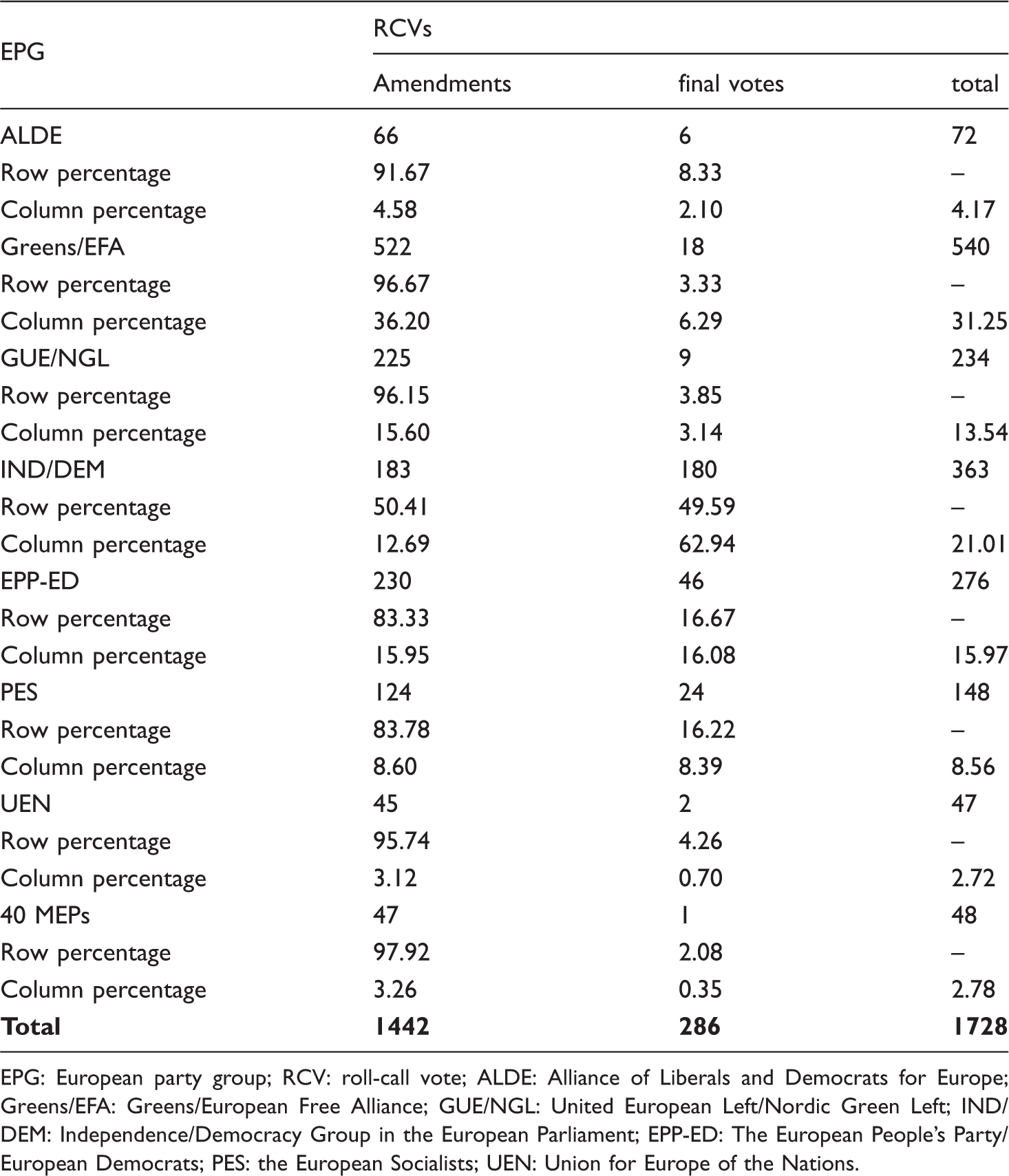
EPG: European party group; RCV: roll-call vote; ALDE: Alliance of Liberals and Democrats for Europe; Greens/EFA: Greens/European Free Alliance; GUE/NGL: United European Left/Nordic Green Left; IND/DEM: Independence/Democracy Group in the European Parliament; EPP-ED: The European People’s Party/European Democrats; PES: the European Socialists; UEN: Union for Europe of the Nations.
Determinants of RCV requests.

RCV: roll-call vote; PES: the European Socialists; ALDE: Alliance of Liberals and Democrats for Europe; GUE/NGL: United European Left/Nordic Green Left; UEN: Union for Europe of the Nations; IND/DEM: Independence/Democracy; EPG: European party group; IPP: index of political perturbation.
Note: Logistic regression analysis with crossed random effects. Maximum-likelihood parameter estimates obtained using adaptive quadrature with two integration points. Model 1 estimated using three integration points. Standard errors in parentheses. Dependent variable: RCV request: 1 = yes; 0 = no. Reference category: RCV request by EPP-ED. All metric variables standardized to range from 0 to 1. Significance levels: *p < 0.05, **p < 0.01, ***p < 0.001.
Model 3 adds indicators for the respective voting item, while model 4 includes the full set of covariates. The data are supportive of H1. The sign of the coefficient of the variable EPG committee vote is negative and the effect attains statistical significance: An EPG is less likely to request a RCV the higher its share of the winning coalition in committee. By contrast, H3 must clearly be rejected. The overall contestation in the committee vote seems to have a negative effect on the likelihood of a RCV request. This finding is somewhat at odds with the observation that lack of (unanimous) support for the committee report is positively associated with the propensity of an EPG to call the roll. Obviously, the notion of RCVs as instruments of political contestation must be qualified.
One could raise concerns that the two predictors introduce collinearity since a cohesive rejection of a committee delegation implies by definition that the committee vote was not unanimous. It should be borne in mind, however, that the measures of the contestation in committee and the voting cohesion of an EPG committee delegation rely on different data. The variable IPP can be computed exactly from the committee vote, while an EPGs’ voting behavior can only be inferred from the subsequent plenary vote. To address potential collinearity, I first inspected a correlation matrix which showed only a weak correlation. 8 In addition, I ran model 4, alternately excluding the variables IPP and EPG committee vote. Dropping the IPP variable leaves all key explanatory variables unaffected, both with regard to effect sizes and significance levels. Excluding the EPG committee vote variable renders the IPP variable insignificant, although the effect remains negative. Furthermore, the results are by and large robust to the exclusion of second reading votes which, as indicated, trouble the estimation of the voting behavior at the committee stage. 9
For easier interpretation, Figure 1 offers a graphical illustration and plots the predicted probabilities against the percentage of an EPG’s committee delegation that has supported the draft report for different voting items. As the theory of agenda control would predict, RCV requests are shown to be most likely for single-authored amendments tabled by the RCV sponsor. Substantively, the probability of a RCV request is estimated at 28% in case the requesting EPG has cohesively rejected the draft report in committee, and it is still 14% even if that EPG has unanimously supported the draft report. However, final votes, which constitute an exogenous agenda, are also likely candidates for a RCV request: All else equal, there is a 21% chance that an EPG will demand a RCV on a final passage vote if it has cohesively rejected the committee report, as opposed to a 10% chance if it has cohesively endorsed it. By contrast, committee amendments are not only significantly less likely to be decided by roll-call but the effect of the variable EPG committee vote is also much weaker. The relationship depicted in Figure 1 suggests that party groups which are either split or perfectly cohesive in supporting the committee draft report are less likely to demand recorded votes. This result disconfirms H2 and can be interpreted as evidence in favor of the position-taking logic: RCV requests seem to be demanded mainly by a cohesive minority in committee.
Marginal effect of the percentage of EPG delegation supporting draft report on the predicted probability of a RCV request. EPG: European party group; RCV: roll-call vote.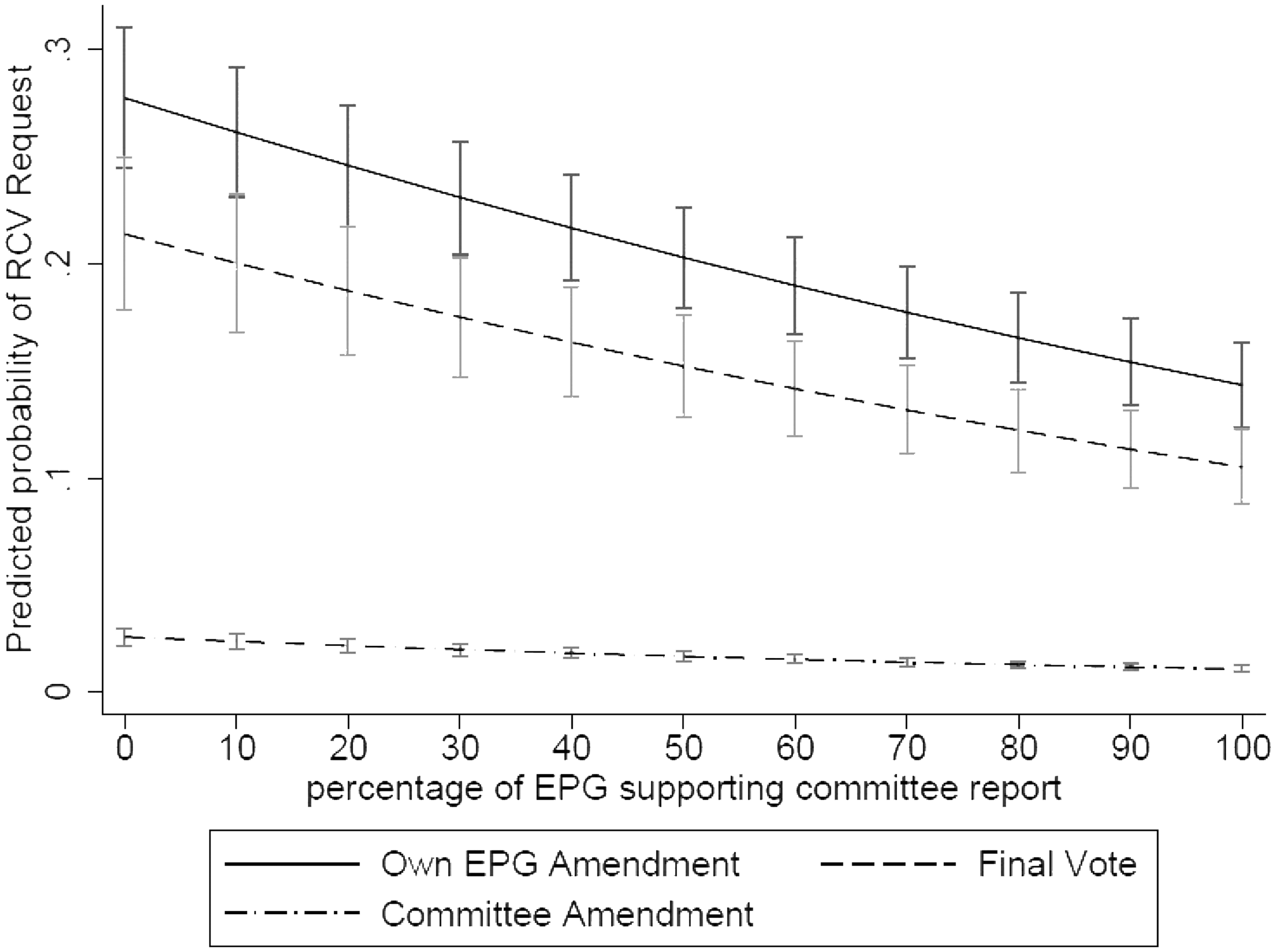
Most control measures have the expected effect and are statistically significant. RCV requests are indeed more likely where a legislative file undergoes a second reading. If the requesting EPG holds the rapporteurship, it is also more likely to demand recorded voting. While this finding is compatible with both the signaling and disciplining logic, it underscores the importance of committee leadership posts for the demand of visible votes. Media awareness of a file has a positive effect on the likelihood of recorded votes, as does the salience an EPG attaches to the respective policy field. Interestingly, the policy position of an EPG has only a weak and non-significant effect on the likelihood of a RCV request.
Discussion and outlook
Where voting by roll-call is not the standard voting procedure in the EP, it is imperative to understand the strategic motivations which guide the demand for visible voting. This article has contended that RCV requests are mainly driven by the desire to take a publicly recorded stance, not to enforce party discipline. It adopts a new conceptual perspective on RCV requests as minority rights. Much more than amendment rights, RCV requests are nowadays effectively monopolized by EPGs (McElroy, 2007: 443; Williams, 1995: 399–400). This justifies their conceptualization as an instrument of party politics within the EP. A central characteristic of RCV requests is the fact that they cannot be blocked. Therefore, where RCVs are subject to an explicit request, they offer a minority the opportunity to stake out a position and to coerce a majority into taking a publicly recorded stance towards particular proposals on the floor.
To substantiate this claim, I have engaged both qualitative and quantitative data. The interview data shed light both on the group-internal procedures and motivations preceding the decision to go on record. The findings can be summarized as follows: RCV requests typically originate at the committee stage. Although the motion is formally offered by a member of the official group leadership, it is usually the (shadow) rapporteur and/or group coordinator who initiate a RCV request within the respective working group. This finding lends support to the notion that the leadership of EPGs is intricately linked to the committee system (Whitaker, 2011; Ringe, 2010) and relies on an informational division-of-labor logic instead of hierarchy. In line with this, the respondents did not primarily regard RCV requests as an instrument to enforce discipline among their group. Nonetheless, it is interesting to note that the respondents ascribed a disciplining motivation to other groups, whereas they rejected this motivation for their own group. In addition, there is some tentative evidence that RCVs are called to ascertain compliance in inter-group amendments. These findings deserve further inquiry.
This article contributes to the extant literature on visible voting in the EP by tracing the decision-making from the committee stage to the plenary. Our understanding of observed legislative behavior has thus far predominantly focused on the proceedings on the floor alone. Bringing in the decision-making dynamics in committee, where decisions are pre-structured, adds a more dynamic and process-oriented component. It illuminates the strategic considerations of RCV requests as a means of impacting the voting agenda. The empirical analysis has focused on two potential previously unexplored predictors of RCV requests: The overall conflict level in the committee vote as well as the support which EPG committee delegations lend to draft legislation. On the one hand, the demand for recorded votes does not depend on the overall degree of political contestation at the committee stage. Stated differently, contention in committee is a poor predictor of RCV requests. While previous studies (Finke, 2015; Yordanova and Mühlböck, 2014) have suggested that RCV requests are biased towards contentious issues in plenary, this does not seem to be the case with committee decisions. This finding suggests that the nexus between decision-making in committee and voting in plenary may be imperfect (Yordanova, 2011: 609). On the other hand, EPGs are found to be significantly more likely to demand a recorded vote if they have cohesively rejected the committee draft report. This result underlines the centrality of a unified party group line established in committee for the behavior in the subsequent plenary vote (Ringe, 2010: 40–41). At any rate, both the qualitative and quantitative empirical evidence cast some doubt on the idea of RCV requests as instruments of enforcing party discipline amongst the rank and file. If they were used to this end, one should expect the leadership of EPGs to force a recorded vote when an internal split has become obvious among its committee delegation. However, this does not seem to be the case. Part of the explanation is that the EPG leadership is committee-based, but does not normally possess the means to induce the desired voting behavior within the entire group. The findings are overall supportive of the position-taking logic and congruent with earlier contributions on roll-call voting in the EP (Finke, 2015; Thiem, 2009). First, RCV requests are generally most likely for single-authored amendments which aim at modifying the draft report in plenary and offer positive agenda control. Second, the most active proponents of visible voting in the EP are small EPGs located at the ideological poles of the EP party system. Third, these are more likely to find themselves in a minority position in committee than the larger, more moderate EPGs which occupy a strategic position in terms of coalition formation and agenda setting in the EP (McElroy, 2007; Rasmussen, 2011; Yordanova, 2013).
Further research would benefit from better and more accurate data to capture the internal cohesion of EPGs before a vote in plenary. In an ideal world, one would record the individual voting behavior in committee. Admittedly, inferring the voting behavior in committee from the revealed voting behavior on the final text is not without problems. After all, committee votes are not a binding decision but merely a recommendation for legislators; influence from outside actors or group leadership arrangements in the run-up to a plenary vote may alter an MEP’s voting behavior (Yordanova, 2013: 142). Furthermore, final votes are often more contested within individual EPGs, precisely because they aim at maximizing inter-group support (Hix and Lord, 1997: 136). This can lead to underestimating the share of an EPG committee delegation which was on the winning side in passing the committee report.
Another route worth pursuing would be a process-oriented approach to the fate of voting items tabled for the plenary agenda. The ultimate test for demonstrating that RCV requests are really about signaling commitment to original policy proposals is to uncover that EPGs systemically call the roll over amendments that have been voted down in committee and are reintroduced in plenary. As it is almost impossible to know why a particular RCV has been requested without detailed knowledge of the particular circumstances (Kreppel, 2002: 129), a more context-sensitive approach could prove a rewarding strategy to adjudicate between the competing logics of RCV requests.
Footnotes
Acknowledgements
I would like to thank Nils Ringe, Achim Goerres, Florian Rabuza, Markus Tepe, William Heller, Michael Kaeding, Bjørn Høyland, Jared Sonnicksen, Sanja Badanjak, as well as three anonymous reviewers and the journal editor for numerous constructive comments and suggestions on earlier versions of this paper. My special thanks go to Simon Hix for giving me access to his data set on RCVs in the EP 6. Earlier drafts of this paper were presented at the 70th Annual Midwest Political Science Association, the 2012 Annual Meeting of the Young Scholars of Political Science, Public Policy and Administration (FoJuS) at the University of Hanover, the 2015 ECPR General Conference in Montreal and at the University of Duisburg-Essen. The feedback of all participants is gratefully acknowledged. All remaining errors are mine.
Funding
The author(s) disclosed receipt of the following financial support for the research, authorship, and/or publication of this article: Research for this article has been generously supported by a doctoral scholarship awarded by the Studienstiftung des deutschen Volkes.
Notes
References
Supplementary Material
Please find the following supplemental material available below.
For Open Access articles published under a Creative Commons License, all supplemental material carries the same license as the article it is associated with.
For non-Open Access articles published, all supplemental material carries a non-exclusive license, and permission requests for re-use of supplemental material or any part of supplemental material shall be sent directly to the copyright owner as specified in the copyright notice associated with the article.
