



Abstract
We test two of the main explanations of the formation of political ties. The first states that political actors are more likely to form a relationship if they have similar policy preferences. The second explanation, from network theory, predicts that the likelihood of a tie between two actors depends on the presence of certain relationships with other actors. Our data consist of a unique combination of actors' policy positions and their network relations over time in the Council of the European Union. We find evidence that both types of explanations matter, although there seems to be variation in the extent to which preference similarity affects network evolution. We consider the implications of these findings for understanding the decision-making in the Council.
Why are some political actors more likely to form cooperative relations than others? This question is central to understanding the workings of political systems in which actors both vie for influence over policy outcomes and attempt to solve collective action problems (Bardach, 1998; Feiock and Scholz, 2010; Heclo, 1978; Knoke et al., 1996; Laumann and Knoke, 1987). Two broad types of explanations of political actors' network relations have been advanced (Berardo and Scholz, 2010; Carpenter et al., 2004; Henry et al., 2011; König and Bräuninger, 1998; Leifeld and Schneider, 2012; Thurner and Binder, 2009). First, homophily refers to the tendency of actors to seek ties with others who hold similar individual social, cultural or political characteristics (McPherson et al., 2001). In policy networks, similar policy preferences are likely to induce cooperation as they signal the existence of congruent cognitive frameworks regarding relevant policy problems (Carpenter et al., 2004; Gerber et al., 2013). Moreover, forming coalitions with like-minded actors may increase one's bargaining leverage (Leifeld and Schneider, 2012; Sabatier and Weible, 2007).
Second, network theory holds that characteristics of the larger network in which actors are embedded affect the likelihood that actors form ties with each other (Burt, 2005; Coleman, 1988; Putnam, 1993; Schneider et al., 1997). For instance, some network models posit that the presence of many transitive and facilitating links between two actors, based on shared relations with third parties, strengthen the social trust they have in each other. This in turn increases the likelihood that a cooperative relation will develop between them. Other characteristics of the network, such as the presence of facilitating and reciprocal links, also feature in network-based explanations of political ties (Henry et al., 2011; Lubell, 2013; Lubell et al. 2012).
The size and direction of the effect of policy preferences compared to network characteristics have strong implications for the impact of cooperation ties on decision-making processes and outcomes. If, for instance, actors tend to cooperate with others who hold similar preferences, then the effects of network ties may strengthen existing preferences. The network will then have little effect on changing policy preferences, but may instead increase polarization within the network. Strong ties between likeminded actors mean that networks reinforce differences among clusters and mobilize bias within the system. A downside of homophily, therefore, is group polarization and extremism, and a generally weakened potential for networks to solve collective action problems (Freeman, 1978; Jackson, 2010). By contrast, if actors frequently have ties with others with whom they disagree, network relations may be channels through which disagreements are played out and eventually resolved. If the network structure creates cross-cutting ties, homophilous clusters and polarization may be mitigated.
The potential of networks to generate trust and solve collective action problems is particularly salient when it comes to international cooperation between states, where majoritarian decision-making is less relevant and legitimate. For example, the European Union (EU) is a political system that has historically been able to overcome differences and resolve controversies without leaving disappointed minorities behind. EU member states are diverse in terms of wealth, population sizes, domestic regulatory regimes, and administrative cultures. Finding agreement on controversial issues therefore often requires protracted discussions in which state representatives communicate their policy demands and listen to those of others. How the relevant policy networks operate is likely to have important implications for decision-making in such a system.
We examine network relations in the Council of the EU, which is the most powerful body in the everyday decision-making of the EU. Most important EU legislation has to pass the approval of the Council, which also has important executive functions within foreign and security policy. The committee system of the Council, where representatives from the member states negotiate and prepare the meetings of the ministers, is at the core of the EU decision-making machinery (Hayes-Renshaw and Wallace, 2006). Compared to other international organizations, the Council is a highly institutionalized negotiation environment, where interactions are frequent, routinized and take place under a long shadow of the future. This makes it an ideal environment for network effects based on socialization and trust. It is surprising therefore, that previous research on coalition building in the Council has focused almost exclusively on similarity in terms of initial policy preferences when explaining patterns of alignments in the Council.
Previous research on conflict patterns and coalition building in the Council has used different types of data to evaluate the sources of preferences that state representatives pursue and the alignments that are formed. Overall, there is little evidence that party ideology plays a major role in the intergovernmental negotiations, although the picture is somewhat mixed. Several studies have made use of the voting records to gain information on cooperation patterns. The findings are inconclusive when it comes to the role of party ideology (Bailer et al., 2015; Hagemann, 2008; Hagemann et al., 2017; Hagemann and Höyland, 2008; Hosli et al., 2011; Mattila, 2009). For example, two more recent studies with similar research designs reach different conclusions regarding the effect of governments' party ideology (left-right or pro/anti-European integration), or of having a more Eurosceptic public opinion, on the likelihood of recording an opposing vote (Bailer et al., 2015; Hagemann et al., 2017).
Another set of studies base their analyses on large-scale interview projects, where participants in the Council negotiations are asked about their policy positions, or tendency to seek cooperation with other state representatives. The latter tend to find that member state representatives cooperate with like-minded neighboring countries, regardless of which parties that are in government (Elgström et al., 2001; Naurin and Lindahl, 2008, 2010). Thomson (2011), based on information on the positions taken in 331 policy issues over a 10-year period (1999–2008), shows no evidence that party preferences—whether Left–Right or pro/anti-European integration—significantly affect the positions taken by states in the Council negotiations. 1 Instead, the positions are best explained by specific national interests in the issues at hand. Furthermore, when it comes to alignments between states, the most striking pattern in the data is precisely the lack of clear patterns (Thomson, 2011: 76). Alignments change frequently, depending on the issues at hand.
The previous approaches have both advantages and disadvantages. The voting records are easy to use, but reflect only the tip of the iceberg with regard to Council negotiations. Both the voting records and the positional data lack information on interactions between state representatives. The cooperation data, on the other hand, reflect general patterns, but tend to lack content from concrete policy issues. The research design of the present study strives to overcome some of these problems by bringing together the datasets from two major studies of decision-making in the EU. The first study has examined the network relations between each pair of member states in the main subcommittees of the Council at five time-points: 2003, 2006, 2009, 2012, and 2015 (Naurin, 2015; Naurin and Lindahl, 2010). The second study focused on decision-making on controversial legislative proposals in the period 1998–2008, and includes information on the policy positions of each of the member states on the issues raised by selected proposals (Thomson, 2011; Thomson et al., 2006).
Using the stochastic actor-oriented model (SAOM) (Snijders et al., 2010), we analyze the network evolution of cooperative ties among EU member states in several Council committees: the high-level coordinating committee Coreper I and five policy-oriented working-group committees (dealing with agriculture, environment, taxation, justice, and competition). We examine whether the networks change over time in line with theoretical propositions concerning preference similarity and network structures. Rather than focusing on dyadic ties, SAOM explicitly specifies and models actors' utilities in a network setting, and thus deals appropriately with the interdependencies among our observations. Moreover, the actor-oriented approach of SAOM allows us to combine analyses of multiple policy-oriented committees and compare them with Coreper I.
We find that both preference similarity and the existence of shared partners increase the chances of cooperation. The evidence suggests that to some extent the strength of these effects depend on the political-strategic context. Homophily in terms of preference similarity affects the evolution of the network relations both in the high-level committee of Coreper I and in some of the policy-specific working groups. Social network relations based on transitive and facilitating links are also important in explaining network evolution at all levels of the Council.
Policy preferences as explanations of network ties
Policy preferences feature prominently in some explanations of network ties (Berardo and Scholz, 2010; Carpenter et al., 2004; König and Bräuninger, 1998; Leifeld and Schneider, 2012). Contacts among decision makers also place in settings with imperfect information, where the actors hold different levels of information regarding the consequences of different policies in response to a policy problem. One important signal regarding the trustworthiness of information from other committee members is the extent to which those members had congruent preferences on similar issues in the past.
Existing studies also suggest that the impact of preference similarity on cooperative ties can vary across different settings. Leifeld and Schneider (2012) argue that the effect of having similar preferences may be qualified by the type of information exchange that takes place. Preference similarity is likely to be important when actors coordinate on political-strategic issues, such as forming instrumental alliances in order to influence policy outcomes. In such situations, coordination is more likely to be beneficial when the actors share similar policy goals. This is also a key proposition of the advocacy coalition framework (Sabatier and Weible, 2007).
For actors who are in a more deliberative mode, by contrast, exchanging technical and scientific information to reduce complexity and increase their understanding of the issues that are on the table, a different dynamic may arise. When the network relations concern exchange of technical information, actors are more likely to turn to well informed others, who may not necessarily be allies with respect to policy goals. For that reason, Leifeld and Schneider (2012: 735) find that the effect of preference similarity is not pronounced in networks in which the actors are focused on exchanging technical information.
The existing literature suggests that preference similarity strongly predicts the emergence of cooperative ties in settings where the political stakes are high, but less so on technical matters. The hierarchical committee system of the Council of the EU arguably contains variation in this regard, which allows us to explore this expectation. It is commonly thought that lower-level working groups tend to engage more technical questions, while the higher-level committees handle more politically sensitive issues. This leads us to expect to find stronger effects in the high-level Coreper committee than in the policy-specific committees. However, it is also the case that the distinction between the political and the technical is problematic, and that previous research has uncovered substantial numbers of controversies that are played out mainly in the working groups (Thomson, 2011; Thomson et al., 2006). Moreover, for technical reasons, there is a considerable amount of uncertainty surrounding the comparison of effects in different samples (Mood, 2010), particularly for the method we employ here. We, therefore, tread cautiously when examining the applicability of the following hypotheses on policy preferences to different levels of the Council. H1 (Preference similarity hypothesis): Member states with similar policy preferences tend to form collaborative ties in the Council.
Network characteristics as explanations of ties
Social capital theory holds that actors are embedded in complex social relations, which connect actors to each other via multiple paths, and that these social structures condition trust (Coleman, 1988; Putnam, 1993; Schneider et al., 1997). These links are more than just channels through which actors send information; they also support mechanisms through which actors monitor and sanction each other in the event of behavior that violates social norms and creates collectively sub-optimal outcomes. Burt (2005) refined and formalized concepts from social capital theory with a view to identifying measurable aspects of social capital, notably the concepts of bridging and bonding social capital. Bridging ties are ties that connect otherwise unconnected sets of actors, even filling structural holes. Bonding ties connect otherwise connected sets of actors with new reinforcing links. Berardo and Scholz (2010) argue that such bonding ties help provide credible commitments in high-risk cooperation dilemmas.
In light of this, social capital theory suggests that existing ties and their patterns (i.e. network characteristics) predict future ties. Unlike preference similarity, which focuses on dependencies between a pair of actors, social capital theory highlights the dependencies between ties in the evolution of cooperative networks. In this study, we explore three types of network characteristics: reciprocity, triad, and hub.
Reciprocity
Reciprocity is perhaps the most basic and well-studied network attribute. Reciprocity simply implies that actor i is more likely to report a tie with actor j if j reports a tie with i. For many, reciprocity is a key to promote and sustain the norms of coordination and cooperation among network members (e.g. Coleman, 1988; Putnam, 1993). Ostrom (1998) argues that when reciprocity prevails, network members are motivated to acquire a reputation for keeping promises and performing actions with short-term costs but long-term net benefits. Reciprocal ties, therefore, are regarded as a salient characteristic of networks with high levels of social capital.
The importance of reciprocity in international settings has often been emphasized. Neoliberal institutionalists argue that reciprocity is the main organizing principle that enables states to overcome collective action problems (Axelrod and Keohane, 1985). Since states enter games of cooperation repeatedly, reciprocity and the strategies associated with reciprocity, such as tit-for-tat, introduce effective sanctions and foster international cooperation under anarchy (Axelrod, 1984). Moreover, reciprocal linkages build mutually beneficial dependencies and obligations between the actors involved. Reciprocally connected actors become, at least to some extent, mutually dependent on each other for the supply of information and other forms of cooperation. In our following analysis, we then test the reciprocity hypothesis as follows. H2 (Reciprocity hypothesis): EU members tend to establish reciprocal cooperative ties over time.
Triad
Another important class of network characteristics is triadic relations. Research has revealed that local reciprocity alone is insufficient to maintain cooperation in large groups. Social pressure in the form of a common friend (i.e. a triadic relation) can effectively overcome this problem and make cooperation enforceable and renegotiation-proof (Jackson et al., 2012). We base our expectations on Carpenter et al.'s (2004: 227; also see Holland and Leinhard, 1971) point of departure: ‘Following a long tradition in network analysis, the key social structural unit we use to measure the impact of the social structure on the ties between two actors is the triad’. Berardo and Scholz (2010) also note that the triad is the simplest structure with which to model bridging and bonding elements of social capital.
More formally, triadic relations involve at least three actors. When considering the likelihood of a link between actors i and j, we examine all possible third actors (each referred to as ‘actor h’). We examine whether the presence of certain links between these third actors and actors i and j affect the likelihood of a link from i to j. Since international cooperation can be directional, we distinguish between facilitating links and transitive links as depicted in Figure 1.
Facilitating and transitive links between member state i and j.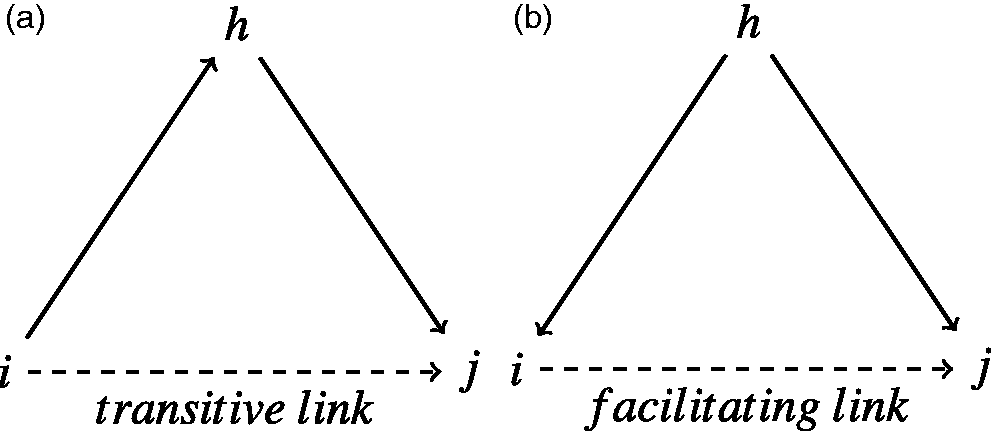
Facilitating links
We expect to observe that actor i is more likely to cooperate with actor j if i and j are in similar structural positions with respect to third actors. For instance, there may be many third actors that cooperate with both i and j. Facilitating links may reduce the costs of cooperation between i and j. Facilitators may also provide a ‘common frame of reference’ to i and j on policy matters (Carpenter et al., 2004: 228). Likewise, if there are many actors in the network with which both i and j are not linked, this may also promote a common frame of reference, since both will be insulated from the influence of the same third actors.
Transitive links
Our expectation is that actor i is more likely to cooperate with actor j if there are more third actors with transitive links that connect i to j. Actor h provides a transitive link from i to j if i cooperates with h and h cooperate with j (Figure 2). The importance of transitivity has long been observed in friendships at the individual level (Holland and Leinhard, 1971), which formalizes the common wisdom that ‘friends of friends are friends’. Ties that are embedded within transitive links increase the dependencies between the actors involved. This dependency increases the possibility of sanctioning non-cooperative behavior. For instance, actor i can cooperate with actor j in the knowledge that it (i) could report misbehavior on the part of j to h. Since h also cooperates with j, it is likely that j wishes to avoid such sanctioning behavior. A related argument concerns the trustworthiness of information flowing from j to i, which presumably conditions actor i's decision to cooperate with j (Berardo and Scholz, 2010: 636; Carpenter et al., 2004: 230). If actor i cooperates with h, this implies that i is satisfied with the information it receives from h. If, as is the case in a transitive link, h also cooperates with j, this implies that h is also satisfied with the information it receives from j. This positive evaluation by h of j may increase the trust that i has in the information provided by j, thereby increasing the likelihood of cooperation. This leads to our hypothesis of triadic formation: H3 (Triad hypothesis): Cooperative ties in the Council are more likely to emerge in facilitating and transitive triads.
Cooperative networks in Coreper I (2003, 2006, and 2009).
Hub
Finally, research on the development of network ties in other contexts has consistently found evidence of a ‘Matthew effect’, whereby the rich get richer, which is also referred to as preferential attachment in network analysis (Barabási and Albert, 1999). The ‘hubs’ in a network, which have many incoming network ties, tend to enjoy a cumulative advantage, in which these popular actors are more likely to be selected than unpopular ones. In international cooperation, such as that which takes place in the Council of the EU, a popular state with many partners is expected to attract more new partners than less popular states with fewer existing partners. We thus develop the following hypothesis. H4 (Hub hypothesis): Hub actors encourage formation of both incoming and outgoing cooperative ties in the Council.
Research design
We integrate two major datasets on network relations (Naurin, 2015; Naurin and Lindahl, 2010) and policy positions (Thomson, 2011; Thomson et al., 2006) in the EU. This gives us a unique opportunity to test both preference- and network-based explanations of network ties. More details of the procedures followed and measures developed in these two studies can be found in the publications cited above. Here, we give a summary of the main points that are relevant to the present study.
Measuring cooperation networks
Descriptive statistics.

In all three surveys, the following question was asked: ‘Which member states do you most often cooperate with within your working group, in order to develop a common position?’ On the basis of the respondents' answers to this question, we identify the network relations between member states. The question posed focuses respondents' attention on direct contacts with people from other member states in their working groups. Respondents were free to list other member states with which they cooperated, and typically mentioned between three and five others. Their answers revealed interesting patterns of cooperation evolution for each surveyed committee.
Figure 2 depicts how the cooperation network in Coreper I evolved from 2003 to 2009. The arrow from a first member state to a second one indicates that a representative of the first state said that he or she cooperates with the second state. The figures show that while in 2003 the cooperation network was relatively sparse, the network density increased in 2006 after 10 new members joined and appeared to stabilize at that level. The cooperation networks indicate that reciprocal ties are perhaps not as prevalent as argued in the earlier literature. We can find examples to suggest that triadic relations contribute to cooperation diffusion. For example, Portugal and Greece are isolated from the cooperative network in 2003, but they are included in multiple triadic relations in 2006. Finally, we can also observe some cooperation ‘hubs’. France, Germany, and UK consistently receive and send many cooperative ties, suggesting strong popularity effects.
Table 1 presents detailed network statistics for each cooperation network across three waves of the survey. We identify the ratio of triads closed by facilitating and transitive links respectively. Since the outcomes of both types of network closure are structurally equivalent, we divide the number of such closed triads by the number of triads where facilitators are present to arrive at the facilitation index, and by the number of triads where an indirect relation exists to arrive at the transitivity index. These indices range from a low of 0.25 in 2009 for Coreper I to a high of 0.60 in 2003 also for Coreper I. These conditional tie probability indices are larger than the density of the network, which is the unconditional tie probability between two randomly sampled countries in the network. As such, the indices indicate that facilitators and indirect relations make ties more likely.
Member states' policy positions
We construct measures of the preference similarity between each pair of member states' policy positions based on a study of decision-making on controversial legislative proposals in the period 1998–2008 (Thomson, 2011; Thomson et al., 2006). For a selected 125 legislative proposals, a team of researchers held face-to-face semi-structured interviews with key informants to obtain information on the controversies raised by these proposals and EU actors' policy positions on these controversies. Key informants were asked to ‘indicate the policy alternative initially favoured by each stakeholder after the introduction of the proposal and before the Council formulated its common position’.
Member states' policy positions on the sugar sector reform.
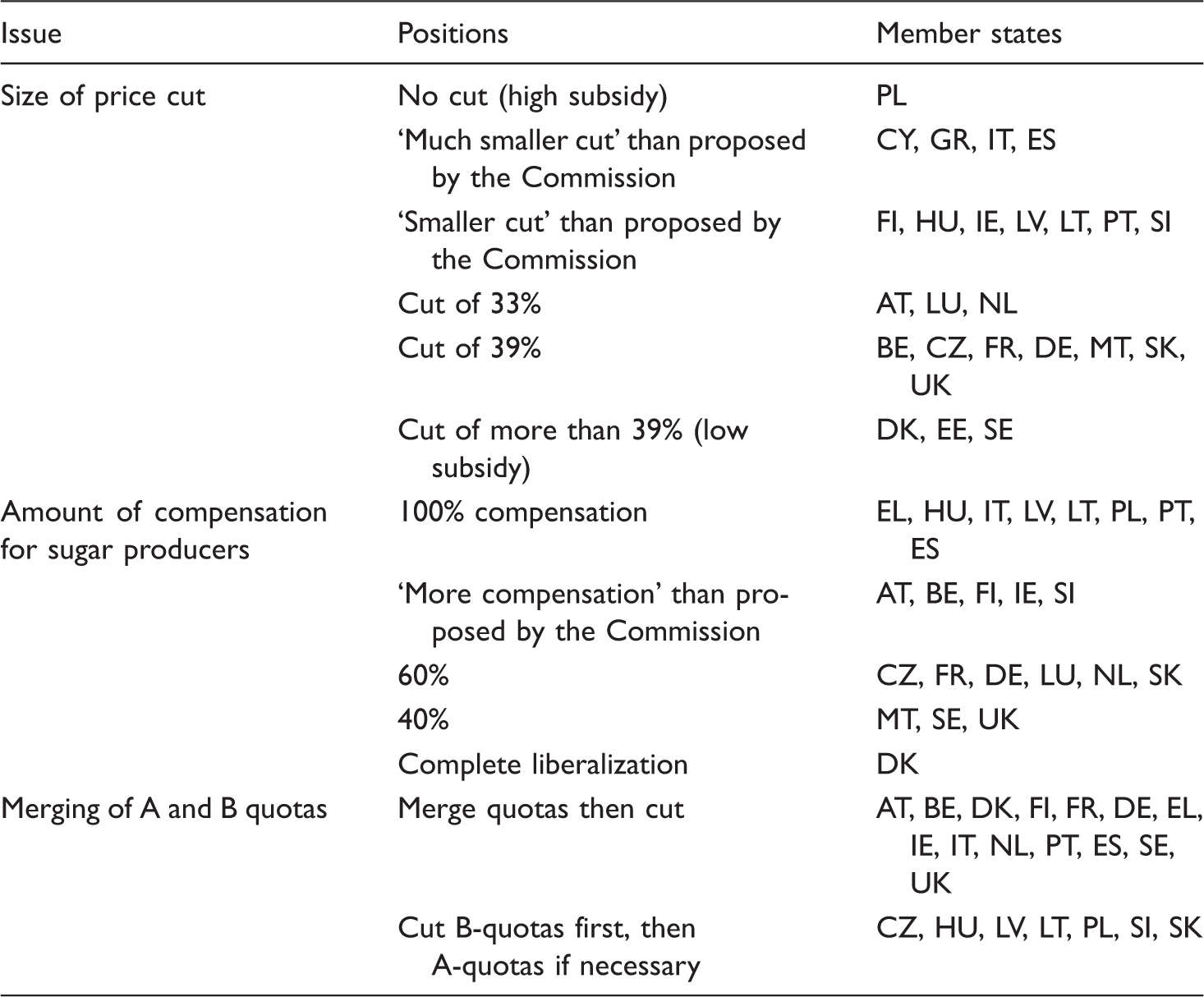
Note: Abbreviations for this table and figures. AT: Austria; BE: Belgium; BG: Bulgaria; CY: Cyprus; CZ: Czech Republic; DK: Denmark; EE: Estonia; FI: Finland; FR: France; DE: Germany; GR: Greece; HU: Hungary; IE: Ireland; IT: Italy; LV: Latvia; LT: Lithuania; LU: Luxembourg; MT: Malta; NL: Netherlands; PL: Poland; PT: Portugal; RO: Romania; SI: Slovenia; SK: Slovakia; ES: Spain; SE: Sweden; UK: United Kingdom.
The dataset contains detailed information on member states' policy positions on each of the 125 selected legislative proposals, like that summarized in Table 2. These 125 proposals raised 331 controversial issues, which were described in detail by key informants. Legislative proposals were selected according to three criteria: the time period, the type of legislative procedure and the level of political importance. Regarding the time period, legislative proposals were included if they were on the Council's agenda in the years 1999 and/or 2000, or were discussed for the first time in the Council after the 2004 enlargement. Legislative proposals introduced up to June 2008 were included in the post-2004 study. The policy areas represented most prominently in the selection are agriculture (26 proposals), internal market (18), Justice and Home Affairs (11), and fisheries (14). However, many other policy areas are present too.
Merging the two datasets
We identified six committees from the network study with which we could match the positional data from the decision-making study. First, Coreper I was included in all three waves of the network study, 2003, 2006, and 2009. Coreper I is a high-level coordinating committee, composed of the deputy ambassadors of the member states EU representations, which deals with legislative proposals from all policy areas included in the decision-making study. Therefore, we matched the network relations in a given year with measures of policy agreement based on legislative proposals that were introduced in previous years. Specifically, we matched the 2003 network data with legislative proposals that were on the Council's agenda in 1999 and/or 2000. We matched the 2006 network data with legislative proposals introduced in the period 2003–2005. This timing obviously precludes the possibility that our positional data are influenced by the network data. The dyadic policy agreement measure is the proportion of controversial issues raised by the relevant set of legislative proposals on which each pair of member states in question took the same policy position. Our dyadic scores of preference similarity in Coreper I are presented in Figure 3, with the shaded shares of pies indicating the degree of preference similarity.
2
Dyadic preference similarity in Coreper I, 2009 (all proposals included).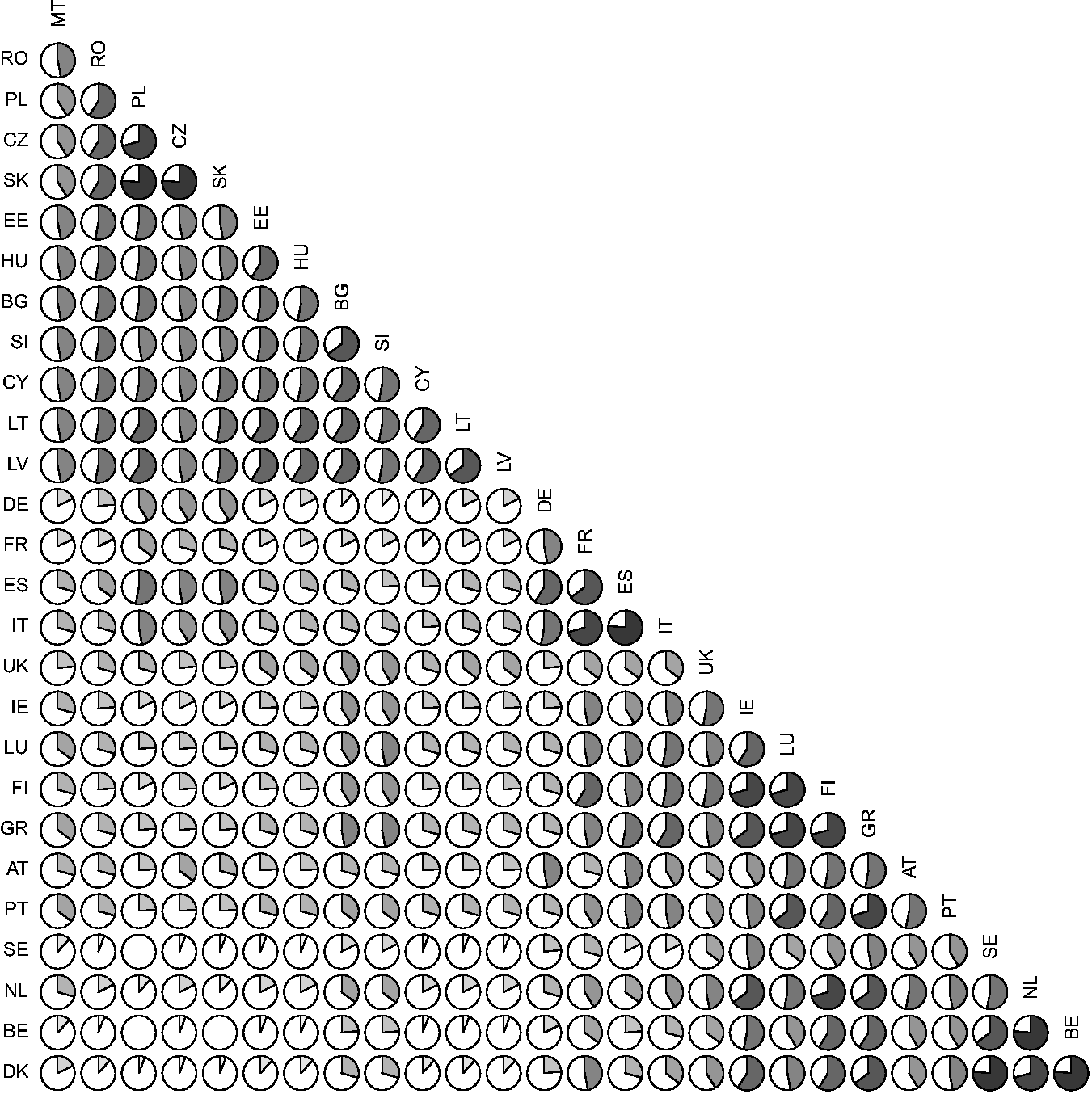
The other five Council committees we include in this study are policy-specific working groups that deal with more technical issues and prepare the ground for the meetings of the Coreper and the ministers. Network data from each committee in a given year were matched with legislative proposals from the relevant policy area in previous years. We included as many committees and years as possible, but were limited by the exclusion of some committees from some years of the network study and by the exclusion of some policy areas from some years of the decision-making study. As well as Coreper I, the following five committees are included with network data on at least some years: (1) the Working party on Agricultural questions in 2003, 2006, and 2009 3 ; (2) the Working party on the Environment in 2006 and 2009; (3) the Working party on Tax Questions in 2003, 2006, and 2009; (4) the Article 36 committee (justice and home affairs) in 2006 and 2009; and (5) the Working party on Competitiveness and Growth from 2006 and 2009. 4 The merged dataset contains 5694 observations (ordered dyads of member states) for which we have information on all relevant explanatory variables.
The network model
This study employs SAOM to model the dynamic evolution of cooperation networks (Snijders, 2005; Snijders et al., 2010). Compared to other longitudinal network models (e.g. Desmarais and Cranmer, 2012) SAOM is explicitly actor oriented, and assumes that actors change their ties as a consequence of optimizing an objective function. Based on their perceived interests (i.e. objective functions), each actor decides whether or not to change an outgoing relationship by creating or dropping a tie.
The odds that an actor will change its outgoing ties are modeled by the objective function. Actors optimize their objective functions in the sense that they have a higher probability of forming ties that increase the value of their objective functions. Actors perform this optimization while being constrained by the network structure in which they find themselves. Because of the dynamic nature of the model, this constraining network structure encompasses the changes made earlier by other actors, such that actors constrain each other in a dynamic feedback process. The addition of random effects to the objective function allows us to account for residual preferences. The dynamic feedback between actors' decisions is incorporated into the simulation procedure discussed below. The objective function for actor i is defined as a weighted sum of effects:

To test both preference- and network-based explanations, we examine the impacts of various dyadic and network factors. The effect of policy agreement on tie formation is included as a dyadic explanatory variable. If p
ij
stands for the agreement of countries i and j in policy and p for the mean of p
ij
, then the effect

To capture the impact of reciprocity, we include the following effect

We operationalize states' tendency to form transitive links by including:


To account for the distributions of incoming and outgoing ties, we include two further effects. First, the indegree popularity effect is defined as

This effect is also referred to as the popularity of alter effect. It is the sum of the indegrees of the other actors with which i is or could be tied. A positive estimate represents the tendency for actors to choose other actors that are already popular cooperation partners in the network. The descriptive analysis summarized above suggests that these popular actors tend to be countries with larger economies and populations. Second, the outdegree activity effect is defined as

This effect expresses the variability in countries' tendency to send ties to few or many other countries. A positive estimate would indicate that those who already send many ties have an increased tendency to send even more ties.
Finally, to control for the overall density of the cooperation networks, we include the outdegree effect,

With the various dyadic and network effects specified above, we are able to specify actors' objective function (i.e. equation (1)). To estimate the corresponding estimates β k , SAOM assumes that the process of network evolution unfolds in continuous time, and that the observed moments are snapshots of this process. SAOM then treats the changing network as the result of a Markov process in which the current state of the network is a dynamic constraint on its development. This enables SAOM to estimate the set of coefficients that best fit the observed changes in the network over time. Basically, β k is estimated by minimizing the difference between the observed and the expected values. Since SAOM shares key characteristics with logistic regression, we can calculate t-statistics from estimated coefficients and standard errors.
Results
We begin by testing the preference and network-based explanations in the higher-level coordinating committee, Coreper I. We then turn to the policy-oriented committees that were surveyed in all three waves (agriculture, environment, and taxation) and conduct multilevel network analysis on these three committees. Finally, we extend our analysis to two other policy-oriented committees (justice and competition) that were surveyed only in the last two waves. For each set of analyses, we measure policy preference similarity with data on legislative proposals from the relevant policy domain of each committee. 5
SAOM analysis of Coreper I.
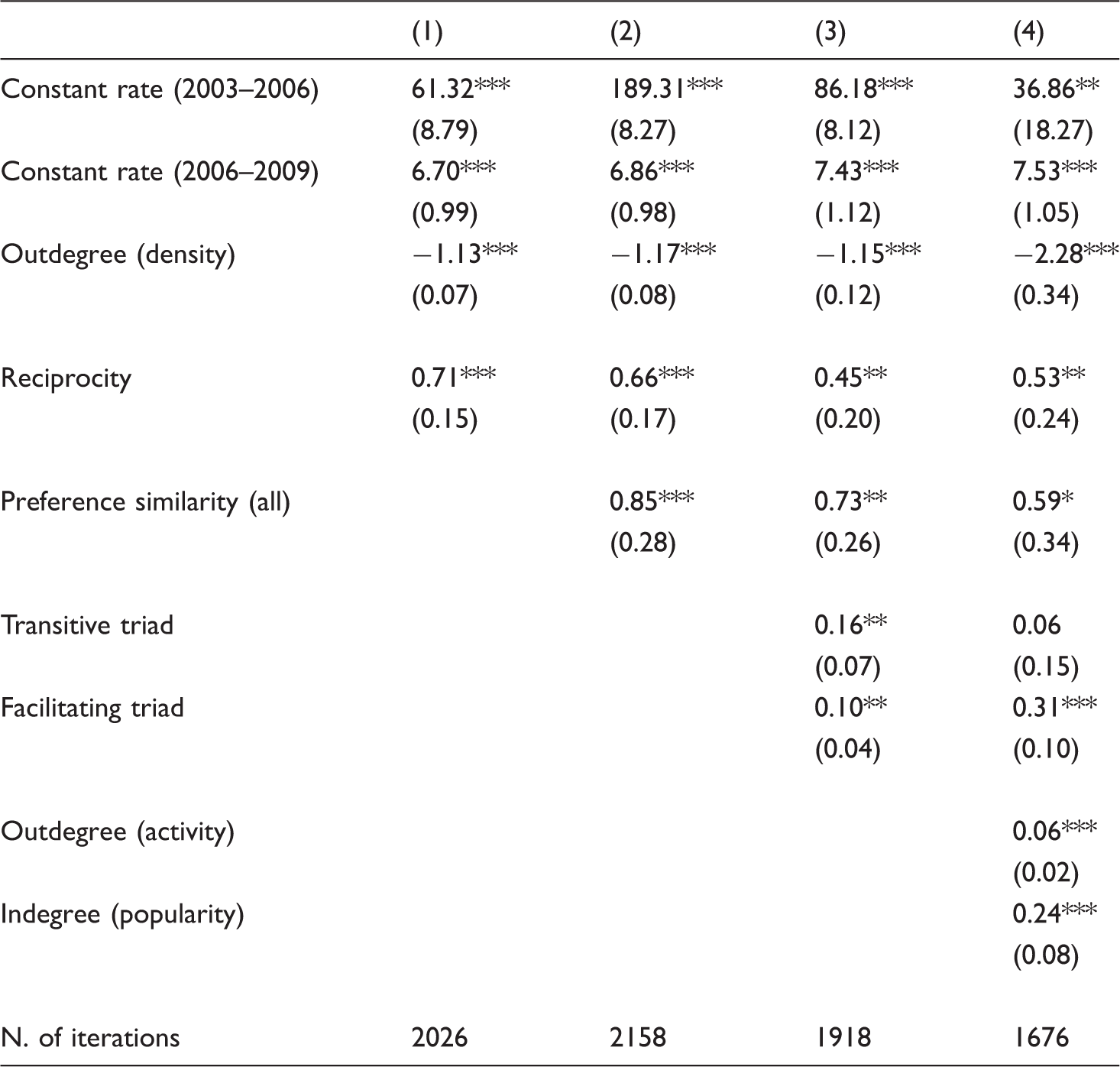
***p < 0.01; **p < 0.05; *p < 0.10.
Both the policy preference and network characteristics contribute to cooperation in Coreper I. First, the preference similarity is consistently significant and positive in Models 2 to 4. Second, our analysis confirms the earlier literature on the importance of reciprocity in cooperation emergence (e.g. Coleman, 1988; Ostrom, 1998; Putnam, 1993). Third, we find mixed evidence for the two triadic effects. While the effects of transitive links become statistically insignificant as more effects are included, the impact of facilitating links turn out to be even stronger. Specifically, in Model 4 the SAOM estimate of facilitating links is 0.313. This means that when two states share five common friends (i.e. facilitators) rather than none, their probability of forming a tie is greater by a factor of 4.78 (i.e. e0.313 × 5). Finally, it can be seen that both forms of hub effects (outdegree activity and indegree popularity) are statistically significant in Model 4. However, we should be cautious in assessing the substantive importance of outdegree activity. A very active state which initiated five cooperative ties in the past compared to none, for example, has a greater probability of forming another tie, but only by a factor of 1.32. By contrast, a popular state, which received five ties rather than none enjoys considerable cumulative advantage in future cooperation, by a factor of 3.34.
As an agent-oriented approach, SAOM uses simulation intensively, and the simulated networks generated in the estimation process provide a convenient way to compare the relative goodness of fit of different models. Based on 10,000 simulated networks for each of the four stepwise models in Table 3, Figure 4 plots how well they fare against our observed cooperation networks in Coreper I. Specifically, we use the distribution of outdegree (i.e. proposed cooperative ties), indegree (i.e. received cooperative ties), and triad census as the benchmark statistics. The dots denote the corresponding statistics for different outdegrees and indegrees, and the solid lines help reveal the general shapes of indegree and outdegree distributions. For simulated networks, we plot the upper and lower bounds in dashed lines and their 90% intervals in shadowed regions. The complete model (i.e. Model 4) performs best across indegree, outdegree, and various triad configurations, with the solid line both mostly covered by the shadowed regions and completely enclosed by the dashed lines. In our following analyses, therefore, we present the results of a basic model and the complete model only.
Goodness of Fit of the Coreper I SAOM model 4 in Table 1.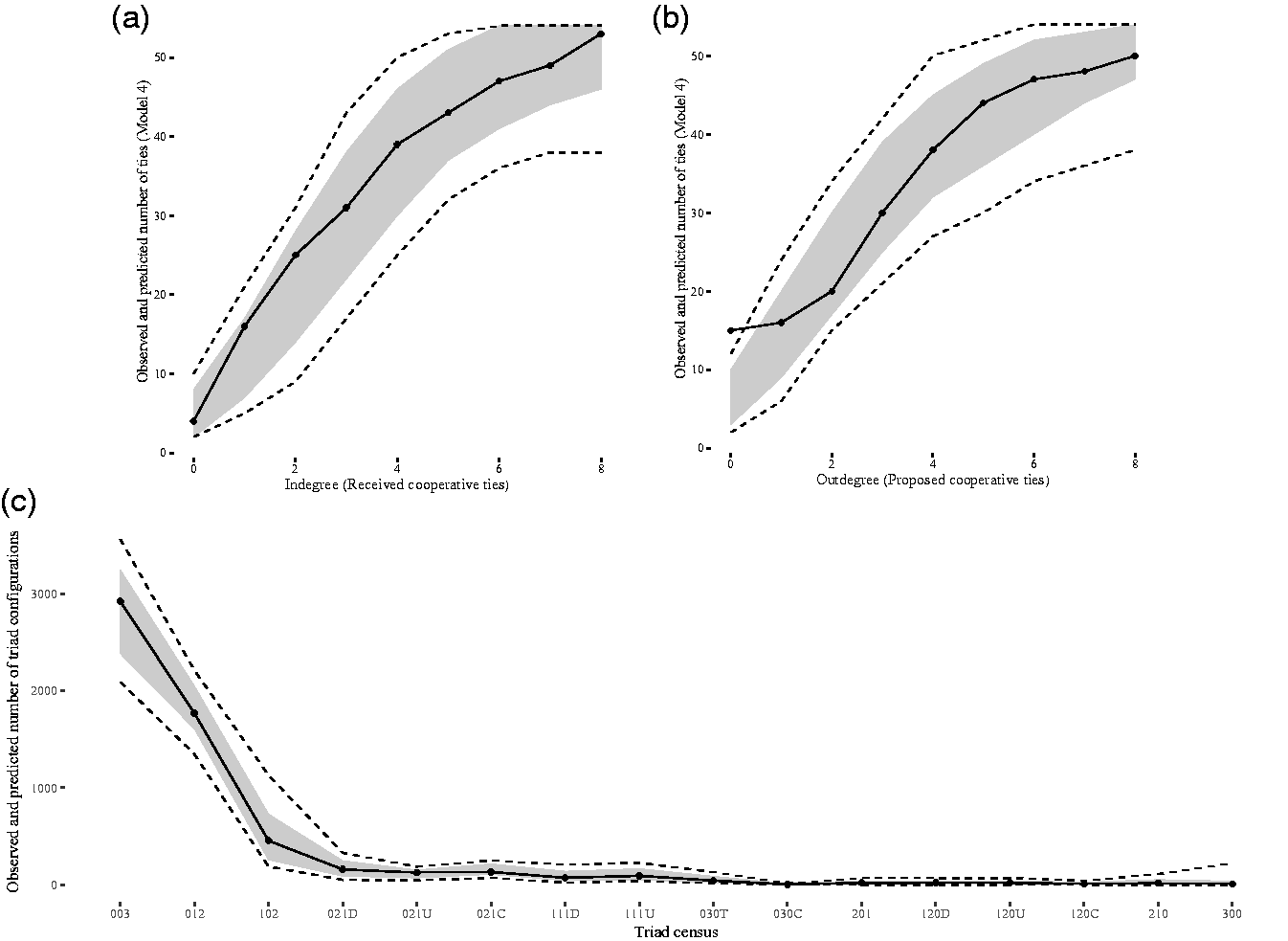
SAOM analysis of three committees (three waves).

***p < 0.01, **p < 0.05, *p < 0.10.
For detailed information about constant rates, see the Online appendix.
We combine the analysis of these three committees in multilevel network models as discussed above (Models 11 and 12), and the estimates of these models can be interpreted as the ‘true parameters’ of a generic policy-oriented network. To aid our interpretation, Figure 5 presents the expected impacts of preference similarity on the formation of ties in Coreper I and the generic policy-oriented committee, and we can find consistent and significant impacts of preference similarity on delegates' cooperative behavior. However, it should be noted that the steeper slope in Figure 5b does not necessarily indicate that preference similarity has a much greater impact on the formation of ties in policy-oriented committees than in Coreper.
6
Expected impacts of policy congruence on cooperation initiation.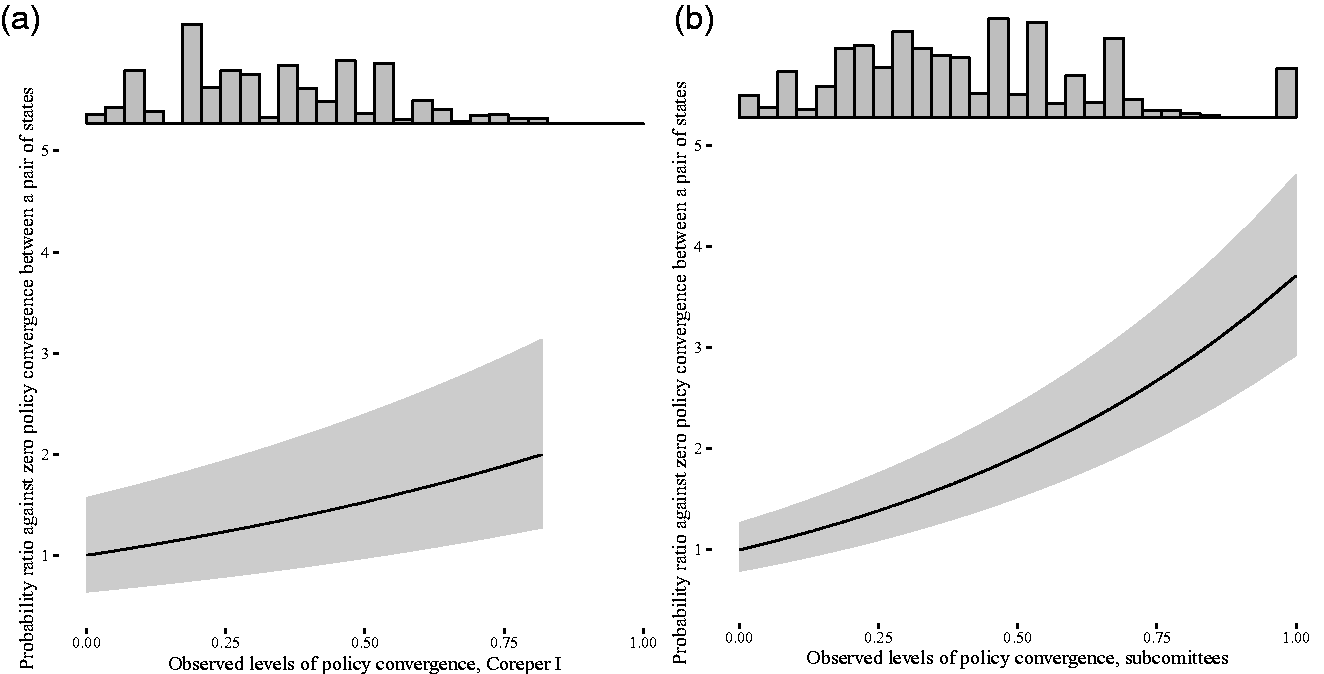
Additional SAOM analysis of two committees (two wave).
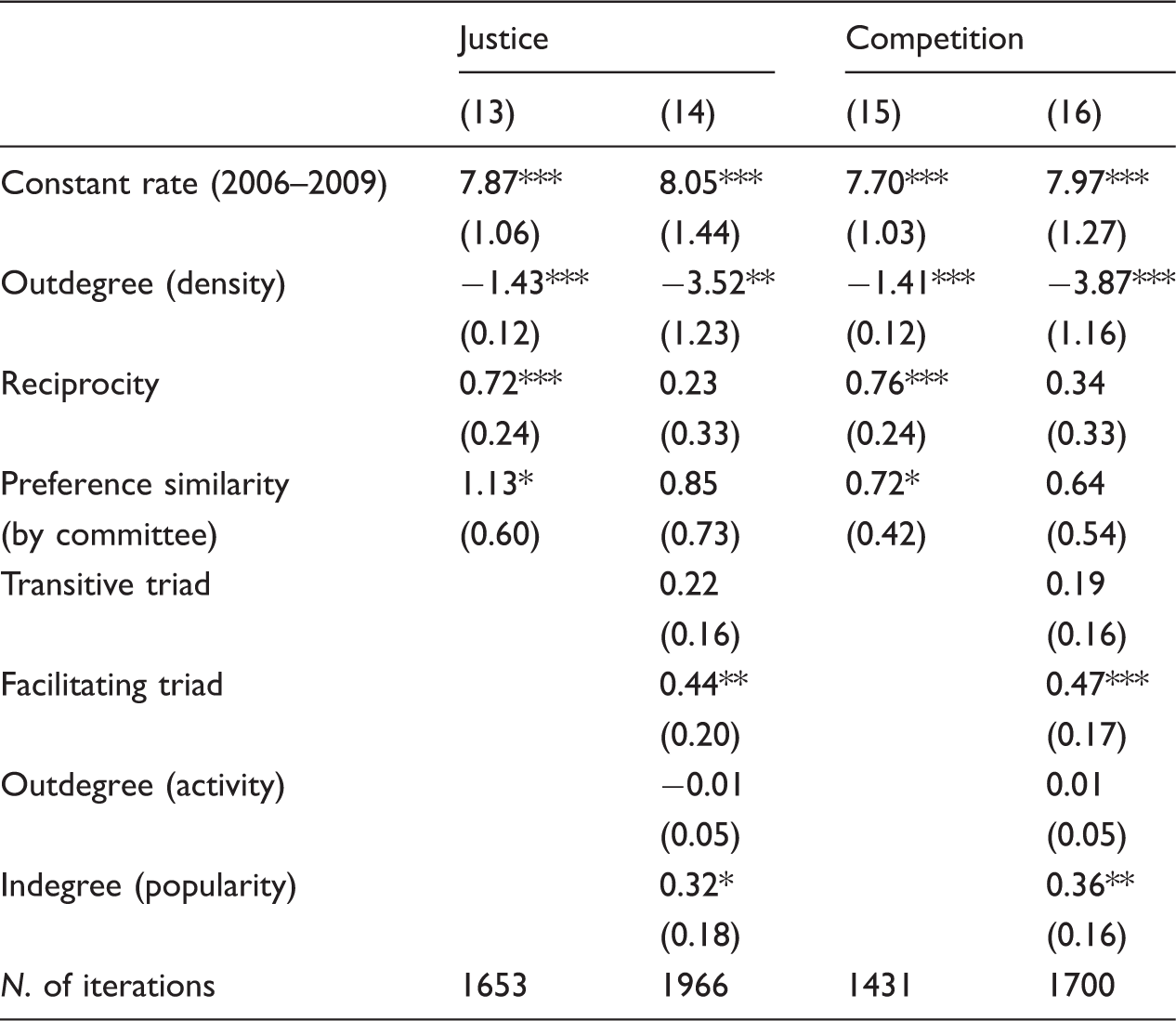
***p < 0.01, **p < 0.01, *p < 0.10.
Discussion
Our findings demonstrate that both network characteristics and preference similarity affect cooperative relations between political actors. We examined several mechanisms through which the networks in which actors are embedded affect their propensity to cooperate with others. The evidence indicated that in the Council of the EU, transitive and facilitating links have significant positive effects on the likelihood of a tie being established and maintained. This means that actor i is more likely to cooperate with j if (1) there are many third actors with whom i cooperates and who also cooperate with j (transitivity), and (2) if i and j are in a similar structural position regarding their incoming ties, such that there are many third actors who say they cooperate with both i and j (facilitators).
Social capital theory provides the insight that network relations bring significant benefits to the social system as a whole and its members. Social systems held together with dense networks of transitive and facilitating ties have social capital that enables them to overcome collective action problems (Coleman, 1990; Putnam, 1993). Similarly, in neoliberal institutionalist theory, reciprocal ties create interdependencies that help states overcome collective action problems (Axelrod, 1984). Actors who are embedded in network relations have opportunities to monitor and sanction their cooperation partners for dissembling. In systems with high levels of social capital, recalcitrant actors face retaliation by the severing of reciprocal links and/or links from third actors. Our results indicate that these relationships also hold for international decision makers in the most powerful legislative body of the EU.
Policy agreement between two actors positively affects the likelihood of a tie between them even after controlling for network characteristics. Like our findings on network characteristics, several previous studies also found this pattern in other contexts, with respect to interactions among interest groups and between interest groups and public agencies (e.g. Carpenter et al., 2004; König and Bräuninger, 1998; Laumann and Knoke, 1987). The positive effect of preference similarity varies somewhat across the committees we examined. We found the strongest effect of preference similarity in three policy-oriented subcommittees (agriculture, environment, and taxation), what appears to be a weaker but still significant effect in the high-level Coreper committee, but no robust and significant effect in two policy-oriented subcommittees for which we have more limited data. Leifeld and Schneider (2012) suggest that preference similarity is more important in politically charged settings where actors are concerned primarily with influencing policy outcomes and less relevant in settings in which actors exchange technical information. Our mixed results with respect to the effect of preference similarity may indicate that the distinction between the political and the technical is blurred, particularly in the regulatory intense environment of EU decision-making. We would welcome further research that refines our understanding of the relative impact of preferences on network relations at different levels of the Council. Doing so requires further development of the application of the SAOM, which is beyond the scope of our work here.
Our findings have implications for understanding the “culture of consensus” in the Council in which member states representatives attempt to accommodate other states' interests, even when the voting rules do not compel them to do so (Naurin, 2015). While this general observation is accurate and informative, our findings move beyond this general insight. In particular, the mixed findings regarding the effects of preference similarity imply that states' representatives often cooperate with others who hold dissimilar policy positions on controversial issues. Therefore, cooperation networks do not strongly reinforce existing policy differences. This enables the state representatives who participate in cooperative relations to focus on ways of reconciling their policy differences rather than reinforcing divisions between themselves and states with which they are not directly linked. Moreover, the fact that member states are bound together by reciprocal, transitive and facilitating network relations implies that the Council's political system has social capital that supports trust among its members.
The research presented here also highlights the political reasons why the prospect of the United Kingdom leaving the EU poses an enormous challenge for both the UK and the remaining EU members. The UK is deeply embedded in the political system of the EU, and nowhere is this more evident than in the preference alignments and cooperation networks in the Council. Contrary to what some campaigners in the Leave side of the referendum campaign claimed, the best evidence we have on preference similarity among member states shows clearly that the UK has not been a preference outlier. On the contrary, the UK's policy positions on controversial issues show high levels of agreement with the positions of a broad range of other EU member states. Moreover, the UK occupies some of the most central positions in the cooperation networks we examined. The strength of these political ties, in addition to the economic, legal, and cultural connections, means that extracting the UK from the EU will be a wrench for both the UK and the other member states. The analyses also revealed the significance of indirect ties between actors for the maintenance and development of cooperative relations. This implies that the departure of the UK will also affect the cooperative relations between the remaining states. As a large state with many incoming and outgoing ties, the UK connects many other pairs of states that are either weakly connected or unconnected to each other. The departure of the UK will therefore be a test of the strength of the social capital among the remaining members in years to come.
Footnotes
Funding
The author(s) disclosed receipt of the following financial support for the research, authorship, and/or publication of this article: Financial support for Naurin's research and for gathering some of the networks data was given by Riksbankens Jubileumsfond (RJ) and the Research Council of Norway through its Centres of Excellence funding scheme, project number 223274 (PluriCourts). Financial support for assembling the DEU dataset was provided mainly by the Dutch Science Foundation (NWO), the German Science Foundation (DFG), the Finnish Yrjö Jahnsson Foundation, Trinity College Dublin, the Spanish Ministry of Education and the Swiss Science Foundation.
Supplementary material
Supplementary material is available for this article online.
Notes
References
Supplementary Material
Please find the following supplemental material available below.
For Open Access articles published under a Creative Commons License, all supplemental material carries the same license as the article it is associated with.
For non-Open Access articles published, all supplemental material carries a non-exclusive license, and permission requests for re-use of supplemental material or any part of supplemental material shall be sent directly to the copyright owner as specified in the copyright notice associated with the article.
