



Abstract
Although many interest groups work together perpetually, most academic studies agree that coalition formation does not lead to more influence. In this article, we try to explain these puzzling findings. While former research generally tends to frame the decision of forming an interest group coalition as a strength, in this paper, we argue that coalition building should be considered as a ‘weapon of the weak’. Interest groups fearing that they are insufficiently influential, and whose very existence as an organisation is at risk, are more likely to coalesce. This theoretical framework is tested on a sample of around 3000 interest groups in six European countries – Belgium, Italy, Lithuania, the Netherlands, Slovenia and Sweden – and the European Union. Empirical findings clearly demonstrate that perceived fears – oriented towards both organisational survival and policy influence – have an effect on how likely it is that an interest group will decide to build a coalition.
Introduction
Interest groups in Western democracies are generally considered to be crucial political actors: they socialise their members in democratic practices (Truman, 1951) and – very often – play a relevant role in policymaking (Schmitter, 1974). Groups are important mediators between constituents and politicians (Dahl, 1961). On the one hand, groups monitor political decision-making between elections to make sure the interests of their constituents are dealt with adequately. On the other hand, they channel the demands of citizens and of the business community to the political arena in addition to more formal conduits, such as elections.
Perhaps the most widespread tactic interest groups use to channel constituent demands to the political arena is working together in coalitions (Beyers and De Bruycker, 2017; Heaney and Lorenz, 2013; Hojnacki, 1997, 1998; Salisbury et al., 1987; Schlozman and Tierney, 1986). By recurring to coalition formation, groups are understood to pool (and, in turn, broaden) organisational resources (Hula, 1999) and political intelligence (Heaney, 2006), as well as to signal to policymakers that a policy position has the support of a large and varied group of interests (Mahoney, 2007, 2008; Nelson and Yackee, 2012). This should lead organisations to increase their impact on political decision-making. Surprisingly, however, there is hardly any evidence that lobbying coalitions actually help groups to exert influence on the policy process. Rather, most studies focusing on the effects of lobbying coalitions on policy success find no effect, or even a negative effect, of coalition formation on policy influence (Bunea, 2013; Haider-Markel, 2006; Mahoney and Baumgartner, 2004).
This leads to a puzzling question: why is it that interest groups seek alliances, if groups that work together do not have more impact on decision-making? Our answer is that coalition building is a sign of weakness, not of strength. More precisely, we contend that the decision to form an interest group coalition is a response to external pressures: groups which perceive themselves as weaker than other organisations, both in the political arena and in acquiring financial resources, will increase cooperation. In reverse, groups which perceive themselves as stronger than their allies or which have little fear for the survival of the organisation, have fewer incentives to cooperate and therefore will be less inclined to actually cooperate with others. In this way, we innovatively conceive coalition formation as a fall-back option for less powerful and more vulnerable interest groups to compensate for their weak starting position; hence, it is not surprising that their impact on policymaking remains slim. We thus conceptualise interest group coalition formation as a defensive rather than an offensive strategic option.
Next to our theoretical innovation, our analyses are also based on a new and extensive dataset covering a broad range of interest group strategies, and coalition formation in particular. We analyse a sample of around 3000 interest groups in six European countries (Belgium, Italy, Lithuania, the Netherlands, Slovenia and Sweden) and the European Union (EU) (Beyers et al., 2016), which is easily the most comprehensive dataset on lobbying coalitions to date. This allows for a rigorous test of why interest groups form coalitions. More broadly, we contribute to the scholarship on EU and comparative politics as the data highlight how coalitions vary across countries and governance levels: in corporatist countries, coalition building is more common than in pluralist countries, whereas the multi-layered nature of political systems has little impact on these dynamics.
Coalition formation and influence
Politics is always about competition and compromises: all political actors and organisations – political parties and their leaders, interest groups, social movements, and also countries and international organisations in international relations – either compete by advocating different political views or reach compromises between more or less common policy preferences. In doing so, political actors often recur to coalitions: indeed, it is quite uncommon that the two sides of any potential political issue are advocated by one lone political actor.
The literature concerning why interest groups form alliances is relatively under-developed, but a substantial literature has emerged during the past decades (Heaney, 2006; Heaney and Lorenz, 2013; Hojnacki, 1997, 1998; Holyoke, 2009; Mahoney, 2007, 2008). Most of these studies set out to analyse how cooperation is used as a political strategy in order to increase the impact groups might have in the political arena. Nelson and Yackee (2012: 339), for example, argue that ‘[…] interest groups rank coalition participation among their top influence tactics’; similarly, Heaney (2004: 258) states that ‘[…] lobbying in coalitions […] is perceived to help determine the shape of public policy’ and ‘[…] working together in coalition is one of the most common tactics that groups use in attempting to influence policy’ (Heany and Lorenz, 2013: 252).
It is therefore no surprise that studies on coalition formation try to find out whether, and how, coalition formation is related to influence. This comes in two flavours. First, as influence is notoriously hard to measure, some have analysed whether traditionally ‘stronger’ interest organisations engage more in coalition lobbying as a proxy for influence. The results, however, surprisingly suggest that traditionally ‘weaker organisations’ coalesce more than groups which we tend to perceive as ‘stronger’. For instance, several studies have analysed whether business groups – as the more powerful political actors – or nongovernmental organisations (NGOs) are more likely to form coalitions. The majority of these studies find that NGOs coalesce more often (Beyers and De Bruycker, 2017: 6; Clark and Wilson, 1961: 162; Jenkins-Smith et al., 1991; Klüver, 2013; Salisbury, 1990), while only one study finds that business groups form coalitions more often (Hojnacki, 1997: 70). In line with this, coalitions are more often found to be used by resource-poor organisations (Beyers and De Bruycker, 2017; Holyoke, 2009; Junk, 2017) than by more resource-rich groups (Sorurbakhsh, 2016). In short, while these studies do not use a direct measure for influence, there is a strong suggestion in this literature that coalition formation is not used by the most powerful actors.
Group characteristics are not always very accurate proxies for influence. For this reason, other studies have linked coalition strategies to actual policy influence. The results are, nonetheless, quite consistent with those presented above. That is, few studies see some positive effects of coalition formation, yet most see no effect, or a negative effect, of coalition formation on policy success (Junk, 2017). On the ‘positive side’, Nelson and Yackee (2012) show that coalition participants have more success when there is consensus across the messages sent from the coalition and where coalitions are larger. However, Heinz et al. (1993: 346) find no relationship between the size of interest coalitions and the success of influencing policy proposals in the United States, and similar (null) results have been presented by Bunea (2013), Haider-Markel (2006), Junk (2017) and Mahoney and Baumgartner (2004).
All this leads to a puzzling question: why do so many interest groups still work together, if doing so does not seem to increase their political influence (Gray and Lowery, 1998: 11)? We suspect that cooperation to influence public policy is not initiated out of strength, but out of weakness. Moreover, we argue that a crucial motivation for coalition building is not only policy influence, but also interest group survival: organisations which perceive themselves as weaker – both politically and financially – have a greater incentive to work together to face those external threats, while organisations which (think they) are politically more dominant and financially more stable, have fewer incentives to cooperate. The paradoxical effect is that coalitions do not produce positive political results, because they consist mostly of the less dominant actors, not those which are powerful and central in interest group communities.
The argument: Coalition formation as a fall-back option
Our starting assumption is straightforward: interest groups prefer to lobby alone and only look at potential coalitional partners as a fall-back option for their political activity. One only has to look at different political organisations – for example, political parties in domestic (or European) politics, or states in international relations – to understand the plausibility of this assumption. Most parties would form a single-party government, if they had the majority of seats in parliament. Single-party governments are in fact more likely to control the parliament (Döring, 1995), to last in office (Laver, 2003) and to legislate effectively (Louwerse, 2012; Pritoni, 2017) than coalition governments. Very similar arguments have been proposed in the study of international relations by scholars following the so-called ‘neo-realist approach’ (Waltz, 1979). Neo-realists, in fact, argue that secondary states tend to coalesce among themselves in order to counterbalance the supremacy of a hegemonic power (Grieco, 1996; Waltz, 1979: 126–127), who, on the contrary, has no incentive to look for allies.
While there have certainly been exceptions to these general ideas, our argument follows the same basic logic: (self-perceived) weakness, not strength, is the driving force behind coalition formation. 1 Moreover, we argue that weakness is framed not only in terms of political power (Junk, 2017), but also in terms of the survival prospects of an interest group (Beyers and De Bruycker, 2017: 3). In other words, coalition formation is not only driven by a (perceived) weak political position, but also by a (perceived) weak financial position.
First, we analyse how the fear of not being politically influential affects the decision to form an interest group coalition. We assume here that the groups which fear that they will have more limited impact on decision-making procedures will mainly resort to coalition lobbying, while groups which expect to have an impact will more often opt to lobby alone. As for any other political actors, our reasoning is based on the cost-benefit analysis groups make. Organisations that perceive themselves as being particularly strong in policymaking are less likely to look for partners, because each new addition to the network implies more costs (above all, with regard to the necessity to reach compromises with different groups) than benefits. Strong groups will assume that they are likely to see some of their demands reflected in policymaking, and that their chances will not increase when they decide to form an alliance. However, the costs of working together are substantial, as they have to coordinate a network, must compromise on their demands, and cannot individually claim the credit for success to their members (Browne, 1990; Hojnacki, 1998: 62). Hence, the costs associated with coalition building are perceived to be higher than the potential gains. Other things being equal, these groups are thus likely to prefer to work alone.
This is entirely different for groups which perceive themselves as less politically influential than other organisations. For these groups, the potential gains of working together with another organisation are more substantial. That is, if nothing changes, they are likely to lose out. Yet, if groups work together this might strengthen their position (Junk, 2017). As a consequence, coalition lobbying can be seen as a ‘weapon of the weak’. The potential gains, we expect, make groups willing to pay the price of coalition building. However, as the strongest organisations are less inclined to cooperate, coalitions will likely emerge that contain mostly weaker actors. This would explain why overall coalition lobbying tends not to produce many positive political outcomes. H1: Organisations that perceive themselves as less politically influential than their potential allies are more likely to form coalitions.
Interestingly, applied to coalition formation, former studies have argued that increased competition for resources, should lead to less coalition formation because groups want to secure their own identity in a competitive environment (Beyers and De Bruycker, 2017; Hojancki, 1998). We, instead, expect that, if organisations fear that their funding sources are at risk, they have a stronger incentive to cooperate. First of all, the studies that claimed that competition should lead to less cooperation are not empirically confirmed. Both Hojnacki (1998) and Beyers and De Bruycker (2017) find that groups which face more competition actually coalesce more often and are subsequently puzzled by these findings. The findings do, however, fit our reasoning. That is, we fully agree that groups aim to create a unique identity towards members and are therefore not inclined to form coalitions. Yet, and this is our contribution, not all groups are successful in doing this. We contend that groups that are successful in claiming a unique identity face fewer risks to their survival. In contrast, those that have not been successful in claiming a unique position are at risk of ceasing to exist. The solution for these organisations is to search for alternative resource pools and attract new types of donors. One way of gaining the attention of a new membership base is through coalition building. In this way, they show to potential new members that they are active on different issues and ‘open’ for new membership. However, as in the case of influence, financially stronger groups are less likely to agree to such requests for cooperation, as they are expected to be protective of their membership base. In short, groups that believe that crucial resources for their long-term survival – namely funding – are not likely to decrease in the near future should be more inclined to defend their ‘stable claim to resources’, while groups that perceive themselves as more threatened by this kind of challenge seek to expand their resource base through cooperation.
To substantiate this claim, and to be sure of our causal reasoning, we rely on a more direct measure of survival prospects than competition for resources, used by previous studies. That is, we rely on an indicator measuring directly the survival prospects of interest groups due to the more limited opportunities for funding. In this way, we can analyse, for the first time, how actual survival prospects of interest groups affect their decision to form alliances. H2: Organisations that perceive their existence to be threatened by decreasing funding opportunities are more likely to form coalitions.
Research design
For this article, we make use of data gathered in the Comparative Interest Group Survey (CIGS) (Beyers et al., 2016). This survey addresses the organisational characteristics, political activities and strategies of interest groups. At the moment, it has been set out and completed in Belgium, Italy, Lithuania, the Netherlands, Slovenia and Sweden, while it is planned to be conducted in the United Kingdom, Germany, Spain, the Czech Republic and Poland 2 in the near future. Therefore, the countries we take into account in this study – together with the EU – represent all the polities for which data are currently available.
As for our unit of analysis – individual interest groups – a key distinction can be made in the literature between the ‘behavioural definition’ (Baumgartner et al., 2009) and the ‘organisational definition’ (Jordan and Greenan, 2012) of interest groups. In the first case, groups are defined based on their observable, policy-related activities; in the second case, the ‘interest group’ term is reserved only for membership associations. As for the CIGS, the latter definition is preferred, and only non-profit organisations have been included in the survey. Overall, the response rate of the survey was 38%, which is relatively high, compared with other online surveys (Marchetti, 2015). Moreover, the response rate is quite evenly distributed across countries. More precisely, response rates were as follows, from lowest to highest: Italy (32%); Slovenia (36%); the EU (36%); the Netherlands (38%); Lithuania (40%); Belgium (41%); Sweden (42%).
The statistical models are operationalised as follows (see also Table 1). Our dependent variable is based on a question: ‘During the last 12 months, how often has your organisation been involved in establishing coalitions with like-minded organisations?’. Respondents could choose from five options, ranging between ‘not at all’ (= 1), ‘once a year’ (= 2), ‘once every three months’ (= 3), ‘once a month’ (= 4), and ‘once a week’ (= 5). Given the ordinal nature of this data, we rely on ordered logistic regressions in the analyses and ordinary least squares (OLS) regressions as robustness checks (see the Online appendix).
Summary statistics.

We pick two key indicators for our independent variables. For our first hypothesis, i.e. the fear of not being policy influential, we rely on the following question: ‘How would you rate your organisation’s influence on public policy compared to that of your (potential) allies?’. Respondents could indicate whether they thought they were more influential (= 1); had roughly the same influence (= 2); or saw themselves as less influential than their (potential) allies (= 3). We use ‘more influential’ as the reference category. For hypothesis 2, we rely on a question directly tapping into the fear organisations have of ceasing to exist due to lack of funding opportunities. We asked: ‘How severe are decreasing funding opportunities challenging the survival of your organisation?’. Respondents could indicate: ‘not at all’ (= 1) to ‘very much’ (= 5). This variable allows us to directly link the financial vulnerability of groups to their coalition strategies. As a robustness check, we also include competition for resources (see the Online appendix).
Furthermore, we retest some earlier hypotheses and include them as control variables. First, we include ‘group type’ and make a distinction between business groups, which we chose as the reference category, citizen groups and other groups. The second control variable is ‘budget’. On this, we asked about the annual operating budget of the organisation in 2016 in Euros; we log-transformed the values given the skewed distribution of this variable. For the third control variable, ‘professionalisation’, we rely on several related indicators: decision-making, hiring policy, staff training and employees’ career prospects. Our variable is an average score based on each of these indicators. The next control variable is ‘representation’ (Gray and Lowery, 1998). This variable captures the lobbying intent of an organisation, which can be either a group that particularly aims to represent its members to politicians or a group that does not see lobbying as one of its core tasks (despite occasionally doing so). Here, we rely on a question in which we ask whether or not the organisation was ‘very involved in representing members towards political actors’ as one of their key objectives. Finally, we add dummy variables to account for (potential) country differences.
Empirical analyses
Descriptive statistics
Given the extensive nature of our data, descriptive statistics can already reveal a lot regarding our main message. We present three types of descriptive data. First, to gain some general knowledge on the data, we provide insights on the differences across countries. Second, directly focused on our research question, we analyse whether coalition building can be meaningfully linked to a logic of influence and survival, one of the main premises of our theoretical framework. Third, we analyse some bivariate analyses to test the plausibility of our main hypotheses.
To start, Table 2 summarises coalition formation across our six countries and in the EU. When observing this table, one main aspect jumps out: country-specific differences matter. Indeed, Cramèr’s V is equal to 0.21. 3 Sweden is the country where interest groups recur to coalition formation the most, showing the highest results for both the ‘once a week’ and ‘once a month’ categories; on the contrary, interest organisations in Slovenia and in Lithuania are less likely to build coalitions with like-minded groups. Mahoney (2007) suggested that the difference in democratic accountability of policymakers would be the key causal mechanism underlying differences across countries. We do not really see this in our analysis. This would mean, for instance, that coalition building would be least common in the EU, yet it ranks second in terms of propensity for coalition-building (with only Sweden ahead of it). Another explanation is that the multi-layered nature of political systems would enhance cooperation. This seems like a more viable option. Both the EU and Belgium have distinct levels of governance, and they both rank quite high in terms of coalition formation. However, more research should be carried out to shed light on this issue, because Sweden and the Netherlands score equally high or even higher, which is not in line with this hypothesis.
Dependent variable: ‘During the last 12 months, how often has your organisation been involved in establishing coalitions with like-minded organisations?’

Bel: Belgium; EU: European Union; Ita: Italy; Lit: Lithuania; Neth: the Netherlands; Slo: Slovenia; Swe: Sweden.
Note: χ2 = 617.98; V (Cramèr) = 0.21; Year of reference: 2016.
We therefore see as the most likely explanation for variation across countries, the corporatist structure of the political system. With corporatist countries like Sweden, the Netherlands and Belgium (Jahn, 2014), as well as the EU, which is seen as a case of elite pluralism (Eising, 2007), scoring higher than Lithuania, Slovenia and Italy, which are all less corporatist countries. This could be explained by the fact that in corporatist systems, interest groups are forced by the government to coalesce as the latter tends to provide access only to a selective set of interest organisations. As a consequence, groups which lack access seek alliances with groups that do have access. This mechanism would align neatly with the basic premise of this article, namely that interest groups form coalitions out of weakness and not out of strength.
Going further, our examination rests on the assumption that interest groups use coalition formation not only as a defensive strategic option to increase their policy influence, but also to overcome challenges linked with declining resources, in a logic of organisational survival. To see whether this is indeed a plausible assumption, we present an overview of the different goals groups indicate they have when seeking coalitions. Table 3 samples groups on the basis of whether they ever collaborate with other organisations in conducting relevant activities (i.e. funding research, fundraising, sharing staff, coordinating lobbying, etc.).
‘Has your organisation collaborated with other organisations in any of the following activities?’ (in percentages indicating ‘yes’).

Bel: Belgium; EU: European Union; Ita: Italy; Lit: Lithuania; Neth: the Netherlands; Slo: Slovenia; Swe: Sweden.
Note: Year of reference: 2016.
Overall, the variance among different activities is rather high: on the one hand, interest organisations appear to collaborate frequently among themselves in representing stakeholders in committees (64.4%), in producing joint statements and/or position papers (71.2%), and in coordinating political strategies (52.8%); on the other hand, they are less likely to join forces in swapping supporter lists (20.2%), sharing staff and personnel (23.0%), fundraising (21.7%) and funding research (27.3%). It appears that the main incentive for coalition building is signalling that a position on a particular issue is supported by a broad consensus (Mahoney, 2007, 2008; Nelson and Yackee, 2012), whereas pooling resources and political intelligence is less appealing (Heaney, 2006; Hula, 1999).
However, these data also show that interest groups do not form coalitions exclusively with the aim of being influential in the policymaking. Swapping supporter lists, sharing staff and personnel, jointly fundraising and funding research are not primarily oriented towards policy influence, while this kind of action is very much relevant for organisation survival. This confirms that our decision to focus also on the question of survival as a reason for interest group coalition formation is a reasonable one.
Finally, we provide some bivariate statistics to highlight the plausibility of our argument. First, what is the relationship between influence vulnerability and the propensity to form alliances? The bivariate correlation indeed indicates a significant positive relation (p = 0.00) between being ‘influence vulnerable’ and the frequency of cooperation (r = 0.11). Of the respondents who indicate that they see themselves as stronger than their allies, 15% indicate that they form coalitions more than once every three months; for groups which see themselves as weaker than their allies, 30% indicate that they form coalitions more than once every three months. This is a substantial difference, and in line with our expectation.
For ‘financial vulnerability’, we again find a significant relationship (p = 0.00) in the direction we expected. That is, groups that experience more financial vulnerability are more likely to form coalitions (r = 0.12): 38% of groups indicating that they are very much afraid of becoming extinct due to a lack of funding opportunities, indicate that they form coalitions at least once every three months. For groups which are less worried about their survival, only 24% indicate that they form coalitions at least once every three months. Hence, this confirms our assertion that not the strongest organisations work together more frequently, but rather the weakest organisations that seek alliances more often. The question is now: how does this hold in a multivariate analysis?
Multivariate analyses
We now turn to the multivariate analysis (see Table 4). Our dependent variable is the inclination of groups to form coalitions with allies. As this is an ordinal variable, we rely on an ordered logit regression with robust standard errors to correct for the potential presence of heteroskedasticity in the regression’s error term. To make sure our findings are robust, we provide several alternative models in the Online appendix: first, we provide an alternative test of the dependent variable (an OLS regression as the dependent variable contains five values which are normally distributed). Second, we also include a robustness check that accounts for the various levels in which the data is collected. Third, while in the original model we rely on fixed effects (country dummies), we also provide a multilevel model. Finally, we test the potential impact of the level of corporatism on our findings and add a robustness check for one of our key independent variables, financial vulnerability. All analyses produce the same results highlighting the robustness of the findings. In Table 4, we provide four models: in Model 1, we test the model without the new variables presented in this paper. In other words, we retest the ‘state-of-the-art’ with respect to our new database. In Model 2, we add the influence vulnerability indicator; in Model 3, we add the financial vulnerability indicator. In Model 4, we summarise the full model. We present the results by discussing first the hypotheses and then some of the outcomes concerning the control variables.
Predicting the level of cooperation among interest groups.

Note: The model is an ordered logistic regression with robust standard errors.
Significance: *p < 0.05; **p < 0.01; ***p < 0.001.
The influence vulnerability hypothesis stated that groups who consider themselves to be less influential than their allies are more inclined to cooperate, whereas the opposite holds true for groups perceiving themselves to be more influential than their potential allies. The results are portrayed in Models 2 and 4 of Table 4. Both analyses show that the difference in allying is significantly correlated with the potential influence groups ascribe to their own organisation. This means that, whether or not groups frequently form coalitions, once they perceive themselves as weaker than their potential allies, their propensity to ally increases. To visualise the substantial effects of this mechanism, we plotted the predicted probabilities for this relationship (see Figure 1). 4 Here, one can see that groups which see themselves as stronger than their allies are predicted to rely 15% less on coalition formation than groups which see themselves as weaker than their allies (predicted score of 2.3 and 2.6). Overall, this thus confirms H1: groups which (think they) are weaker in influencing policymakers are more inclined to cooperate.
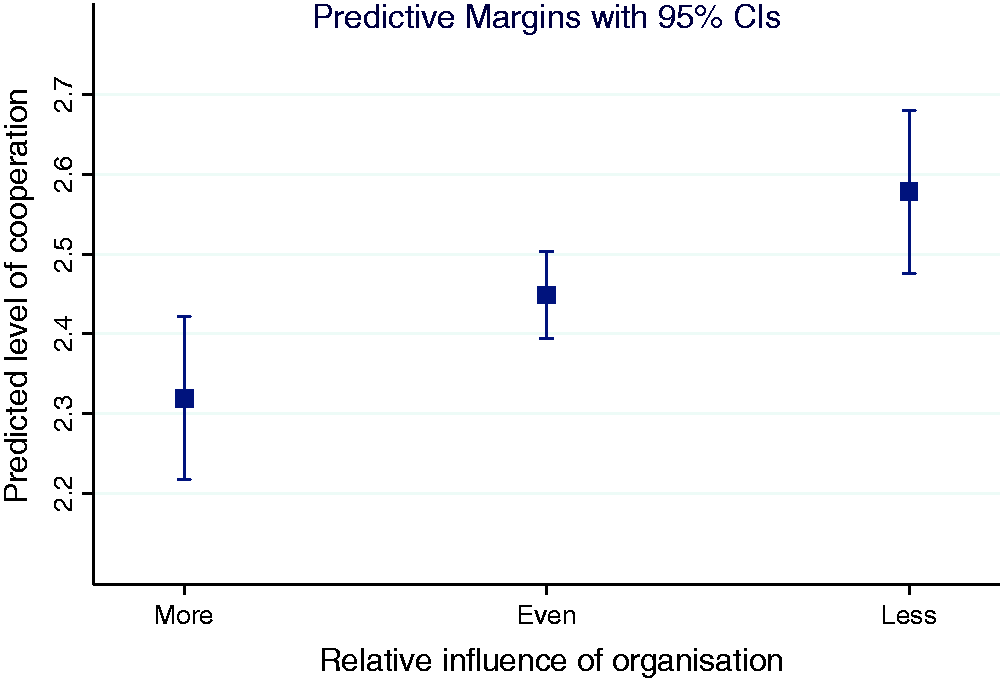
Predicted probabilities for forming coalitions by varying levels of perceived influence compared to allies.
More broadly, it confirms our assumption that weaker groups – precisely like weaker parties in domestic and European politics and weaker states in international relations – need to form coalitions to face a common threat: they are more united in fear than united in interests. Their decision to recur to coalition formation represents a defensive strategic option they employ to counterbalance the risk that another group is predominant in policymaking (see also Junk, 2017). The very fact that groups which are politically weaker than their peers flock together more frequently is, we believe, the main reason that coalition formation is a poor predictor of policy success (Bunea, 2013; Haider-Markel, 2006).
Second, we consider the effect of financial vulnerability on the propensity to form coalitions. We hypothesised that groups whose survival is at risk due to decreasing funding opportunities are more likely to form coalitions. The results are presented in Models 3 and 4, Table 4, and the outcomes confirm this expectation: the more groups fear that their financial resources are going to decline in the close future, the more they are inclined to form alliances. To visualise the substantial effects of this mechanism, we again plotted the predicted probabilities for this relationship (see Figure 2). The results show a clear positive relationship between financial vulnerability and the inclination to form coalitions. If a group fears it may cease to exist, it tends to increase its coalition activities. Groups with no fear have a predicted coalescing score of 2.05; this increases to nearly 2.33 for groups with much or very much fear. This corresponds with a predicted increase of more than 10% in coalition building.

Predicted probabilities for forming coalitions by varying levels of fear to seize to exist due to lack of funding.
Previous studies have relied on a different measure of survival prospects, namely competition for resources (Beyers and De Bruycker, 2017). While this is a somewhat crude indicator to measure organisations’ fear for their survival, it is a commonly used proxy. To make sure our findings speak to these studies, we also used competition for resources as an indicator. 5 The results are exactly in line with our more direct measure of survival prospects (see the Online appendix): greater competition for resources, just as greater fear for survival, leads to more coalition formation. Overall, we can thus clearly confirm H2: groups which see themselves as weaker than their allies in terms of their long-term survival prospects are more inclined to cooperate.
Looking back to the previous literature, this latter finding is particularly interesting. While previous research highlighted the fact that groups facing more competition should be less inclined to work together to maintain a unique position (Gray and Lowery, 1998; Hojnacki, 1997; Holyoke, 2009), we provide a different view. That is, it is plausible that groups which face high competition are more concerned about maintaining a unique identity towards their members and are, therefore, less likely to join coalitions. However, if survival is threatened, they might come to the conclusion that this does not work. For some groups – namely, the weakest in the policy community – isolation has apparently not worked, as their own survival is now threatened. In cost-benefit terms: when the benefit of maintaining ‘uniqueness’ is lower than the potential cost of ‘passing away’ as an organisation, working together in coalition is better than isolation. More precisely, weaker groups have an incentive to widen up and search for alternative funding, and coalition building, our results suggest, provides them with this opportunity.
This brings us to the control variables, which are important to indicate whether our arguments speak to the previous literature and, therefore, whether results change once we include controls for perceived fears of interest groups. A first interesting finding relates to group type. Most former studies found that NGOs are more likely to form coalitions than other kinds of groups (Beyers and De Bruycker, 2017: 6; Mahoney, 2007; but see Hojnacki, 1997: 70) and ascribe this to their appeal to public opinion. Our results challenge this causal mechanism. That is, if we do not control for financial and influence vulnerability, we actually do find that NGOs more often seek coalitions with others. Importantly, however, if we include influence and financial vulnerability in the analyses, this effect disappears. In other words, the effect of group type seems to be driven by the fact that NGOs are more often faced with financial and influence vulnerability, hence not (mostly) because of the type of issues they tend to represent. This finding emphasises the importance of including influence and financial vulnerability in the analysis. Not only does it have a substantial direct effect, but it also affects the interpretation of other variables and, notably, sheds new light on regularities which have been stressed at length in the literature so far.
Another notable observation pertains to financial resources. Budget has a positive effect on groups’ propensity to form coalitions: richer groups are more likely to form coalitions than poorer organisations. At first sight, this may seem to contradict what we hypothesised (and empirically confirmed) before: namely, that the more a group perceives itself as weaker than their potential allies, the more it recurs to coalition formation. Yet, the inclusion of influence and financial vulnerability does have a strong mitigating effect on economic and financial resources. That is, the strength of resources bisects once the controls for relative strength are included. Moreover, resources of individual organisations have shown to be a poor predictor of influence (Dür et al., 2015; Klüver, 2013). The reason is that richer groups tend to compete politically and financially with richer groups (and vice versa for poorer groups: see Lowery, 2013). Hence, it is not substantial measures of resources that affect influence and survival prospects, but rather a groups’ relative (and, above all, perceived) strength compared to groups with which they compete. Our results are in line with these findings. This means that groups that have more resources might coalesce more frequently, but not because they see themselves – correctly – as politically stronger or more financially stable than their peers (Junk, 2017).
Furthermore, among the control variables, in Model 4, also the relationship between professionalisation and representation, on the one hand, and the likelihood to form coalitions, on the other, is statistically significant. This means that interest groups that are more involved in professional lobbying activities are also more likely to look for allies to advocate their policy positions than groups that are mainly focused on organising events, coordinating tasks for the community, and so on, which is perfectly plausible: the latter do not need any help for following their aims.
Finally, as already claimed in the section on descriptive statistics, there are substantial country differences and in the direction we anticipated: in corporatist countries, coalition building is more common than in pluralist countries. This is even more clearly portrayed in the Online appendix, in which we included Jahn’s (2014) corporatist scale as a control variable in the analysis (instead of country dummies) and find a substantial and significant relationship. The fact that interest groups in corporatist settings more frequently cooperate nicely aligns with our main findings: i.e. that interest groups form alliances out of a position of weakness and not strength. While it is certainly encouraging that the results are in line with our reasoning, it is important to note that we should be careful drawing too strong conclusions about systematic mechanisms in countries as we rely on data collected at the individual level. Therefore, more research is needed which explicitly takes into account a broader view on corporatism and its potential effects. More broadly, the differences we observe across countries highlight the value of comparative research designs in the field of interest group politics. We therefore urge future scholars to further flesh out the effect of various interest mediation systems on interest group strategies and their outcomes.
Conclusion
Napoleon once famously said: ‘there are only two forces that unite men – fear and interest’ (quoted in Law and Lincoln Rhodes, 1916). Most scholars working on interest group coalitions have focused on the latter motivation, the political interests that unite them. In this paper, instead, we have focused on the other motive for forging alliances: fear. Fear, either of a lack of influence or a lack of funding, is a substantial driver for groups to form alliances. Our main findings confirm this suspicion. First, groups assess their own power compared with (potential) allies and seek cooperation more often if they think they are less powerful. Second, groups which face more threats to their survival due to a lack of funding opportunities form coalitions more often than groups that do not face these obstacles. Therefore, we should treat coalition formation not as a sign of strength, but primarily as a sign of weakness: other things being equal, groups prefer to work alone, whereas coalition formation represents a defensive strategic option employed by groups perceiving that they are not able to lobby on their own.
Moreover, when replicating the findings of former studies by including our new independent variables in the statistical models used, we find clear and important differences compared to previous results. This is a further indication of the plausibility of our reasoning. That is, we did not find any difference between group types, yet only if we control for influence and financial vulnerability. This emphasises the importance of these variables when seeking to explain interest group coalition building. More broadly, it indicates that NGOs do not seek coalitions more often than business groups because of their claim to public opinion; rather, it relates to their weaker overall position in politics, in terms of both influence and funding.
We believe these results have broader relevance as they reflect on which interest groups lobby, and why. Often, we reflect on the power of interest groups by analysing how influential (or not) they have been in the political arena. But perhaps, as Lowery (2013: 18) suggests, we should interpret lobbying activities more as a sign of ‘the very weaknesses of the organised interests. […] Had organised interests been truly influential, there should have been no policy disturbance to begin with’. We interpret coalition formation along similar lines: the more powerful a group perceives itself to be, the fewer incentives it has to actively engage in forming alliance with others. Hence, more lobbying activity, in this case through coalition formation, logically leads to less influence. We believe the literature can benefit from taking such an approach when explaining why interest groups lobby in the way they do (Lowery, 2007).
Still, some caution is warranted. First, our assumption rests on the ‘other things being equal’ prefix. Yet, as we know, in many cases, not all things are equal. For instance, different policymakers have different preferences. This means that interest groups might behave differently when they target politicians from when they target bureaucrats. It might be that the former are more inclined to push groups to work together (Mahoney, 2007, 2008). In these circumstances, working together might be a sensible option for strong organisations (too). One could think of many more exceptions to our findings. Yet, what we hope to have achieved is showing that lobbying in coalitions is the anomaly that needs explanation, not the lack of coalition formation. This is an important difference, and much closer aligned to findings on a lack of correspondence between coalition formation and policy success.
Another point is the generalisability of our findings. While we have presented data based on the largest comparative survey on interest group strategies to date, most of the countries are more corporatist than pluralist. This could affect the results as access is skewed towards more powerful actors in corporatist countries. Hence, this could mean that in such systems weaker organisations must cooperate. This might function somewhat differently in pluralist countries, where access is quite easier to gain, even for weaker organisations. We therefore welcome studies focusing on more pluralist countries.
Our findings also warrant more in-depth analyses, which would aim to understand the specific variations we observed among countries. For instance, why do we see so much more coalition lobbying in Sweden than in other corporatist welfare states such as the Netherlands and Belgium? What explains the similar levels of cooperation between interest groups in Italy, Slovenia, and Lithuania? And more broadly, what country factors affect the propensity of interest groups to work together? All these questions fall beyond the scope of this paper but are important questions we should explore further.
To summarise, in a recent article, Mahoney and Baumgartner (2014: 214) argued that ‘lobbyists are like wolves’, and ‘lobby in packs’. In our view, this is only partially true. We contend that wolves hunt in packs because they are rather weak individually. Stronger animals, such as lions, hunt alone. They do not need partners to catch their prey, and therefore do not have to share the prize. We see weaker interest organisations as wolves: they cannot survive on their own and therefore seek allies. Strong organisations prefer to lobby alone, allowing them to keep all the gains to themselves. This, we believe, is the reason why lobbying coalitions tend to be unsuccessful.
Supplemental Material
Supplemental material for United in fear: Interest group coalition formation as a weapon of the weak?
Supplemental Material for United in fear: Interest group coalition formation as a weapon of the weak? by Marcel Hanegraaff and Andrea Pritoni in European Union Politics
Footnotes
Funding
The author(s) received no financial support for the research, authorship, and/or publication of this article.
Supplemental Material
Supplementary material for this article is available online.
Notes
References
Supplementary Material
Please find the following supplemental material available below.
For Open Access articles published under a Creative Commons License, all supplemental material carries the same license as the article it is associated with.
For non-Open Access articles published, all supplemental material carries a non-exclusive license, and permission requests for re-use of supplemental material or any part of supplemental material shall be sent directly to the copyright owner as specified in the copyright notice associated with the article.
