



Abstract
Which types of civil society organizations are politicized as indicated by regular political engagement and why? If they are, how wide-ranging are their political action repertoires? This article proposes an ‘organizational governance perspective’ on civil society organizations’ political engagement by arguing that organizations resembling traditional ‘voluntary associations’ are less likely to be politicized and to employ a broad political action repertoire than those resembling highly professionalized ‘voluntary agencies’. Applying event count regressions to new data from four recent population surveys widely substantiates the proposed perspective, thereby challenging prominent arguments about the detrimental effects of professionalization and state dependency on organizations’ ability to contribute to democratic representation.
Keywords
Introduction
Although individualization increasingly weakens group affiliations in European democracies (e.g., van Deth and Maloney, 2012), membership-based civil society organizations (CSOs) still play a crucial role in contemporary democracy by mobilizing, aggregating and channelling collective interests into the democratic process (e.g., Beyers et al., 2008; Grömping and Halpin, 2019; Saurugger, 2012). That said, ‘civil society’ and ‘political society’ remain distinct phenomena, even if we define ‘political engagement’ broadly – transcending classical lobbying including awareness raising or educational activities, protest, the provision of expertise or the financial support of central political actors (e.g., Berry and Wilcox, 2009; Beyers et al., 2008; Chaves et al., 2004; Cinalli and Giugni, 2014). CSOs can be inwards- or service-oriented. Consequently, the extent to which CSOs or – to use a different terminology – the ‘third sector’ functions as ‘an essential democratic infrastructure’ and, more specifically, as a ‘transmission belt’ for the representation of societal interests (Albareda, 2018: 1219; Enjolras and Sivesind, 2018: 96; Salisbury, 1984: 64–65) is fundamentally affected by answers to the following questions: Which types of CSOs are politicized as indicated by regular political engagement and why? If they are, how wide-ranging are their political action repertoires?
To answer these questions, I propose an ‘organizational governance perspective’ (Cornforth, 2012: 1121) building on on-going debates around membership associations’ increasing replacement by professionally run and state funded CSOs, a trend fundamentally shaping civil society’s ability to contribute to democracy (Skocpol, 2003: 204, 265; see also Maloney, 2012; Saurugger, 2012). Taking the diversity of organizational forms adopted by CSOs as its starting point (e.g., Halpin, 2014), this perspective rests on two central arguments.
First, hypotheses on CSOs’ political engagement patterns can be derived starting out from the distinction between ‘voluntary association’ versus ‘voluntary agency’ (Billis, 1991). These two ‘governance templates’ that have long co-existed (though not necessarily under these labels) in the literatures on CSOs, interest groups as well as non-profits (e.g., Billis, 2010; Bosso, 2003; Knoke, 1990; Lipsky and Smith, 1989; Schmitter and Streeck, 1999) are not ‘counter images’ in an empirical sense whose characteristics are mutually exclusive; neither do each template’s central characteristics necessarily cluster. Nevertheless, as analytical tools they allow us to formulate contrasting expectations about how the organizational features associated with each template feed into CSOs’ patterns of political engagement. Echoing the fundamental distinction between a democratic governance logic to which members are central and a bureaucratic logic with professionals at its core (e.g., Jordan and Maloney, 2007; Knoke, 1990; Lipsky and Smith, 1989; Lu and Park, 2018), the templates differ in whose interest and by whom a CSO is run, i.e., who ensures the overall direction, control and accountability of the organization (Cornforth, 2012: 1121), which shapes organizations’ core activities including political ones. Linking this distinction to Olson’s ‘by-product’ theory (1965) and the tension between a ‘logic of membership’ and ‘of influence’ within groups (Schmitter and Streeck, 1999), CSOs resembling member-oriented ‘voluntary associations’ are expected to be less politically active than those resembling staff-driven ‘voluntary agencies’.
Second, organizations’ political engagement is theorized in two stages, distinguishing organizations’ basic orientation towards political engagement (politicization) from the repertoire of strategies employed to pursue political goals (e.g., Binderkrantz, 2005, Beyers et al., 2008; De Bruycker, 2017; Lowery and Gray, 2004; Olsen, 1965). Echoing this qualitative difference, the resources state funding and membership fees closely associated with the two governance templates ‘voluntary association’ and ‘agency’ respectively are expected to feed into intra-organizational accountability structures and, with it, CSO priorities (Froelich, 1999: 256; Schmitter and Streeck, 1999: 53–55; Weisbrod, 1998: 171) including the decision in favour of (or against) regular political engagement to start with. In contrast, merely capacity-enhancing ‘unconstrained’ sources of revenue such as donations and economic activities are expected to only affect the repertoire of (already) politically active CSOs.
The framework is examined using new data from four recent population surveys conducted in four long-lived democracies. Applying zero-inflated count data regression models substantiates the theoretical approach proposed. The findings contribute to civil society, interest groups and non-profit research in a number of important ways.
Most fundamentally, exploring the drivers of CSOs’ political activities is important as we find surprisingly little cross-national research on the organizational characteristics that explain CSOs’ engagement in political activities (Child and Grønbjerg, 2007: 260; see for studies on the United States, for instance, Chaves et al., 2004; LeRoux and Goerdel, 2009; Salamon and Lessans-Geller, 2008; see for a study on German and Swiss groups, Bolleyer and Weiler, 2018). While it is widely recognized that organizations can engage in political activities ‘as a secondary activity supporting a mission of direct service’ (Kimberlin, 2010: 165), dominant approaches in non-profit research tend to ‘exclude a substantial number of nonprofits […] that also participate in advocacy, although not […] as one of their most important activities’ (Child and Grønbjerg, 2007: 260). Meanwhile, interest group populations are commonly defined by their political activity (e.g., Baroni et al., 2014). Hence, assuming political activity of their object of study to start with, group researchers tend to focus on influence strategies employed by politically active actors (e.g., Beyers, 2004; Binderkrantz, 2008; Dür and Mateo, 2016).
More specifically, the finding that voluntary association features are negatively, while voluntary agency features are positively associated with CSO political engagement challenges influential arguments that present associations as central vehicles for democratic representation, while considering the increasingly staff-driven nature of membership organizations as detrimental, portraying such organizations as providing political engagement that is ‘ephemeral, thin, sporadic’ (Hay and Stoker, 2009: 231; see also Ahrne, 1996; Olsen, 2017; Skocpol, 2003; van Deth and Maloney, 2012; Warren, 2001). Relatedly, the negative relationship between association features and political engagement reveals an interesting paradox when tied to research on the success of such engagement: as Grömping and Halpin have recently argued, groups that approximate traditional associational forms enjoy (if they decide to be politically active) greater policy access, being able to legitimate policy decisions (2019: 511–512) as policy-makers prefer to listen to ‘talking representatives’ rather than ‘talking heads’ (Skocpol, 2003: 273–274).
Finally, the finding that state funding associated with the ‘agency template’ is – unlike reliance on donations or economic activities – positively related to both organizational politicization and CSOs’ action repertoires not only substantiates prominent claims in non-profit and organization research about the qualitatively different implications for organizational governance of ‘constrained’ as compared to ‘unconstrained’ revenue (e.g., Froelich, 1999; Weisbrod, 1998). It also supports long-standing arguments about the particular pervasiveness of state funding dependency for organizational behaviour as compared to dependencies on private income sources (e.g., Billis, 2010; Salgado, 2010; Walker, 1983), while simultaneously challenging claims that state dependency invites CSO de-politicization (e.g., Bloodgood and Tremblay-Boire, 2017; Choudry and Kapoor, 2013).
A governance perspective on civil society politicization and political action repertoires
Definitions
I specify CSOs in line with the proposed theoretical approach. This approach theorizes patterns of political engagement as shaped by organizations’ relative exposure to collective action problems (Dür and Mateo, 2014; Olson, 1965), which closely aligns with its focus on CSOs’ representative function, i.e., the channelling of collective interests into the political process (e.g., Beyers et al., 2008; Salisbury, 1984). Akin to Knoke’s notion of ‘collective action organization’ (1990), the relevant class of organizations encompasses membership-based voluntary organizations, i.e., organizations with a formalized infrastructure, that are private (separate from government), non-profit-distributing and self-governing (Salamon and Anheier, 1998), with members being either individuals or corporate actors including firms, institutions or associations (Baroni et al., 2014; Heylen et al., 2020).
Furthermore, I conceptualize organizational political engagement in two stages. Though the concept of politicization has to date been mainly applied to the micro level, whether a CSO can be considered as ‘politicized’ is indicated by its regular recourse to (whatever form of) political activity that transition issues from the private to the public sphere (Cinalli and Giugni, 2014: 85; De Bruycker, 2017: 607; Salisbury, 1984: 64–65). Once an organization is politicized, the intensity thereof is captured through a CSO’s political action repertoire, i.e., the range of strategies it regularly engages in (Binderkrantz, 2005: 694). Although these two elements are closely connected empirically, they are conceptually distinct: when a CSO is politicized – which cannot be taken as a given (e.g. Lowery and Gray, 2004: 10–11; see also Olsen, 1965; Beyers et al., 2008) – this grants insights into its basic priorities, in ‘what and who it is for’ (Halpin, 2014: 46). Once a CSO pursues political goals, the range of methods chosen to achieve them is strongly resource-driven. This is because to combine a diversity of strategies across different arenas generally enhances the chances of exercising influence (Binderkrantz, 2005: 694; 2008: 177–178; Eising, 2007; Halpin and Fraussen, 2017), hence tends to be desirable to politicized CSOs, if they can afford it.
Finally, organizational activities are considered political when they attempt to influence public policy, directly or indirectly (Pekkanen and Smith, 2014: 2–3) a notion encompassing a wide range of activities covering (legal and illegal) protest, attending press conferences, publishing reports, educating the public, financing other policy actors or classical lobbying of politicians or civil servants (see also, for instance, Beyers et al., 2008; Bloodgood and Tremblay-Boire, 2017; Chaves et al., 2004; Cinalli and Giugni, 2014). Such inclusive definition of political activity covering ‘insider strategies’ (e.g., lobbying decision-makers) and ‘outsider strategies’ (e.g., influencing public opinion) (Beyers, 2004) has been used in a range of earlier studies (e.g., Binderkrantz, 2008; Dür and Mateo, 2014, 2016) as it avoids denoting organizations as not or less politically active due to investments in the ‘wrong’ type of activity (Binderkrantz, 2008: 176).
Theoretical foundation and hypotheses
Political activity constitutes a collective, non-exclusive incentive (Olson, 1965: 51, 132; Moe, 1980: 6). This is crucial when theorizing how organizational leaders – those intra-organizational actors in charge of the day-to-day running of an organization – maintain voluntary organizations through different strategies of incentive provision whose members are able to leave the organization at any point (e.g., Barakso and Schaffner, 2007; Wilson, 1973). Essentially, political activities generate a free-rider problem: even if ‘policy change’ can be achieved and/or an organization can effectively claim credit for it, membership of the organization is no prerequisite for benefitting from this. Non-members with similar interests can equally enjoy its advantages. This problem of non-exclusivity makes selective incentives (material or other) restricted to members ceteris paribus more effective to assure organizational maintenance (Clark and Wilson, 1961; Olson, 1965: 51, 132). If so, when members are at the heart of an organization’s governance system giving direction to organizational activities (Cornforth, 2012: 1121) and resources are limited (as usually the case), political engagement as a form of collective good provision becomes less likely (see for a similar perspective on whether organizations invest in political activities on the European Union level, Dür and Mateo, 2014: 5).
The connection between intra-organizational properties and political engagement as non-exclusive incentive can be theorized using the distinction between the ‘voluntary association’ (run by individual members and volunteers) and the ‘voluntary agency’ (run by professional staff) as two systems of governance (Billis, 1991: 62, 65; 2010). More specifically, this distinction – discussed under different labels in the literatures on CSOs, interest groups and non-profits alike (e.g., Bosso, 2003; Knoke, 1990; Schmitter and Streeck, 1999) – can be used to integrate these works to formulate contrasting expectations about CSO political engagement.
The political engagement of ‘voluntary associations’
Four elements of voluntary associations’ governance structure suggest negative implications for organizations’ political engagement: voluntary associations are composed of individuals, oriented towards representing member interests, members have a direct impact on organizational decision-making and associations are run by volunteers (Billis, 2010: 53–54; see also Knoke, 1990; Paine et al., 2010).
Group research has long stressed that differences in membership composition are likely to affect tactics groups employ to pursue their goals (e.g., Foley and Edwards, 2002). While we can expect selective material incentives exclusively available to members (e.g., access to specific resources or services) to be equally relevant to sustain membership irrespective of the type of member, this is not the case for solidary incentives. They can be assumed to be an important driver of at least some individual members in groups who predominantly enjoy group life, rather than being interested in selective material incentives (e.g., access to member services) or collective incentives (e.g., the implementation of the organization’s political agenda) (Clark and Wilson, 1961: 134–135). Members that are organizations or institutions themselves are unlikely to care much for activities strengthening group solidarity. Thus, selective solidary incentives are unlikely to be useful investments for leaders to prevent corporate members from free-riding (Schmitter and Streeck, 1999: 14–15). As organizations composed of individual members (unlike corporate membership organizations) face pressure to sustain member support not only through the provision of selective material, but also through (selective) solidary incentives, they face more diverse (and more costly) demands for intra-organizational selective incentives from members, thereby reducing resources for externally oriented political activities (Bolleyer and Weiler, 2018: 1633–1634). Furthermore, groups can pursue the interests of their members – as typical for ‘member-serving’ voluntary associations (Billis, 2010: 54) – or the interests of wider societal constituencies transcending their membership – as typical for ‘public-serving’ organizations (Harris, 1998: 149). Linking this distinction to Olson’s ‘by product theory’ (1965), I expect political engagement as one form of collective good provision to be less likely and wide-ranging in more inwards-oriented, member-serving organizations that are more strongly incentivized to invest in activities exclusively benefitting members, who per se cannot be assumed to be interested in political activities (Jordan and Maloney, 2007: 25, 33). This contrasts with public-serving organizations, an orientation which makes investments in collective incentives from which also outside actors can profit more worthwhile. Finally, if member support can indeed be more effectively maintained through selective incentives than (non-exclusive) political activities (Jordan and Maloney, 2007; Olson, 1965), the more say members have over organizational priorities, the stronger the pressure to prioritize selective incentives. In the reverse, intra-organizational structures granting members control over decisions should therefore lead to a de-prioritization of collective incentive provision, thereby making investments in political activities less likely and, in politicized organizations, less intense. A final element crucial to association’s governance structure is this CSO type’s reliance on volunteer staff as the core of its workforce (Billis, 2010: 54; Harris, 1998: 151; Paine et al., 2010: 108). When central managerial roles in an organization are held by unpaid volunteers, member interests shape the day-to-day running of an organization including its involvement in various internally and externally oriented activities. Manpower in terms of volunteers can be crucial to help an organization (especially those with limited financial resources) to simultaneously sustain a broader range of activities, including political ones. However, if indeed members are more responsive to selective incentives and volunteers are effectively a subset of members, the centrality of volunteers should disincentivize political in favour of other activities.
A similar rationale can be linked to voluntary associations’ reliance on membership fees as central financial resource, expected to further consolidate the prioritization of member interests (‘the logic of membership’) and to be detrimental to its involvement in political activities (‘the logic of influence’) (Schmitter and Streeck, 1999: 53–55).
H1.1 (Member Governance Hypothesis): In organizations governed by members and member interests politicization is less likely and political action repertoires are narrower than in organizations that are not.
H1.2 (Membership Fee Hypothesis): In organizations that rely on membership fees as a central income source politicization is less likely and political action repertoires are narrower than in organizations that do not.
The political engagement of ‘voluntary agencies’
The implications for organizational political engagement of the ‘voluntary agency’ as ‘governance system’ contrast strikingly with those of the ‘voluntary association’. With the hiring of staff being the ‘most critical of all moves’ in the development towards voluntary agency status (Billis, 2010: 61–62), voluntary agencies are crucially defined by their workforce. This echoes the broader literature on interest groups and non-profit organizations which have long stressed the pressures towards professionalization and their fundamental implications for organizational governance (e.g., Hwang and Powell, 2009; van Deth and Maloney, 2012). Building on these works, professionalization can be defined as the increasing reliance on professional skills and competences. This becomes manifest on the organizational level not only in reliance on paid staff and their increasing specialization (i.e., the nature of an organization’s human resource base). It also finds expression in an organization’s governance structures, namely the strengthening of managerialism ‘as a specific form of organizational structure’ in which efficiency and effectiveness are central norms (Kreutzer and Jäger, 2011: 638), for instance through measures enhancing decision-making efficiency, investments in training or professional volunteer management, features closely associated with the ‘voluntary agency’ template (Paine et al., 2010: 108).
The professionalization of an organization’s workforce and its infrastructure enhance CSOs’ ability to deal with conflicting internal and external demands (Maloney and Rossteutscher, 2005: 97–98). This, in turn, should enhance the capacity of an organization to engage in different types of activities, including political ones, suggesting a positive effect on organizations’ political action repertoire. Simultaneously, as the capacity and specialization of staff increases, the centrality of member interests and the latter’s weight in intra-organizational decisions should decrease as compared to strategic considerations of paid staff (Paine et al., 2010: 106). The latter are particularly concerned about organizational survival and thus particularly responsive to external audiences providing core resources. Even in CSOs that are predominantly service-orientated, some forms of political activity are likely to be central to such endeavours, suggesting a positive impact on politicization as well. Media campaigns to maintain the salience of core issues as part of organizations’ fundraising strategy or the lobbying of political elites to maintain central funding streams are two prominent examples.
H2.1 (Professionalization Hypothesis): The more professionalized an organization’s workforce and infrastructure, the more likely it is politicized and the broader its political action repertoire.
Moving to finances, dependency on state funding is closely associated with the ‘voluntary agency’ template as staff tend to be strongly orientated towards maintaining this income source considered as more reliable than private income such as donations (Billis, 2010: 60; Fraussen, 2014: 406; Lu, 2018: 205–206). While some have associated such dependence with restrictions on organizations’ political activities (e.g., Bloodgood and Tremblay-Boire, 2017), others have considered state resources as capacity-enhancing (see for recent overviews Ali and Gull, 2016; Lu, 2018). Furthermore, state funding access creates direct incentives to lobby for more funding (Chaves et al., 2004; Salamon and Lessans-Geller, 2008: 13–14), while state funding access increases the chances – due to regular contact with state officials – for efforts to exercize political influence to be successful (LeRoux and Goerdel, 2009: 517–518). Therefore, state funding reliance can be expected to make both organizational politicization and broader political action repertoires more likely, substantiating Schmitter’s and Streeck’s (1999: 53–55) argument that access to state resources helps organizations to gain autonomy from members and to focus on influence seeking instead.
H2.2 (State Funding Hypothesis): In organizations that rely on state funding as a central income source politicization is more likely and political action repertoires broader than in organizations that do not.
‘Unconstrained’ revenue and CSO political engagement
In the literatures on CSOs, interest groups and non-profits alike, membership fees and state funding are associated with fundamental implications for intra-organizational accountability structures (Froelich, 1999: 256; Schmitter and Streeck, 1999: 53–55; see also Billis, 2010). These arguments closely align with Weisbrod’s notion of ‘constrained revenue’ (1998: 171), sources of income expected to impact on CSO priorities expected to affect not only CSOs’ action repertoires but also their basic orientation towards political engagement (see H1.3/2.3 above). These resources contrast with ‘unconstrained revenue’ such as donations and revenue from economic activities associated with fewer intra-organizational repercussions (Froelich, 1999: 247–249; Weisbrod, 1998: 168) unrelated to either governance template. They are expected to enhance CSO capacity to simultaneously engage in different influence strategies (Binderkrantz et al., 2015: 95–96; Dür and Mateo, 2014: 5–6), while leaving basic organizational priorities unaffected. While economic activities (e.g., sales and services) are highly dependent on existing demands of potential buyers, the profits generated can be used freely to advance an organization’s mission (Weisbrod, 1998: 171), political or not. Similarly, organizations dependent entirely on donations are ascribed the ability to use resources at their own discretion (Weisbrod, 1998: 168). Though Froelich (1999: 250) points out that major donors might be able to demand the reorientation of a recipient organization, if donors want to see specific political interests represented through providing financial support, they are unlikely to choose an organization with little or no interest in political engagement for their investments. Hence, donor pressure is an unlikely trigger for organizational politicization. Furthermore, while government regulation defines – for instance – which economic activities are compatible with non-profit status and specifies donor tax benefits, thereby creating a vested interest of CSOs depending on these sources in what the government is doing, unlike state funding, tax benefits do not establish a direct financial dependency, hence, are unlikely to incentivize CSO politicization.
H3 (Unconstrained Revenue Hypothesis): In organizations that rely on private donations or on economic activities as a central income source political action repertoires are broader than in organizations that do not.
Table 1 summarizes the basic analytical categories and theoretical expectations.
Country selection
To test the above framework, recent data from four population surveys of CSOs in Norway, UK, Germany and Switzerland are analyzed. These four democracies are most different regarding central macro characteristics considered relevant for CSO resources and government relations. First, central types of third sector regimes relevant in long-lived Western democracies are covered. The UK is a liberal regime, Germany a corporatist, Norway a social democratic and Switzerland a mix between the liberal and the social democratic regime. Public resources made available to voluntary sector organizations and linkages to state institutions are particularly extensive in corporatist regimes, while competition for policy access is considered particularly intense in pluralist systems (Salamon and Anheier, 1998). Second, the selection varies country size, the type of government structure and the level of societal heterogeneity as factors identified as relevant for group activities and behaviour (e.g., Dür and Mateo, 2016). If findings on the organization-level drivers of political investments hold across these four distinct polities, they can be reasonably considered robust and generalizable to long-lived democracies (see the Online appendix for more details on the country selection).
Data
The following analysis uses the ‘Civil Society Regulation Dataset’. 1 To compile these data, the population of nationally and regionally active CSOs was specified using a bottom-up strategy based on the most inclusive sources documenting active voluntary membership organizations available (Berkhout et al., 2018). This assured the inclusion of a wide variety of organizations ranging from classical interest groups (e.g., business associations) to (‘non-political’) service-oriented membership organizations. The organization lists were based on the Directory of British Associations (DBA), the Enhetsregisteret (The Central Co-ordinating Register of Legal Entities) in Norway, the German directory ‘Taschenbuch des öffentlichen Lebens’ and the Swiss ‘Publicus’ (Schweizer Jahrbuch des öffentlichen Lebens) as main sources. The surveys targeted those in charge of the day-to-day running of the organization (e.g., chief executives, chairmen, leaders, organizational secretaries).
The four surveys were launched between April and October 2016. The questionnaire consisted of 36 questions that covered aspects about the organizations, their resources, their core activities and challenges. The response rates were the following: in the UK 20.55%; in Norway 27.53%, in Germany 30.25% and in Switzerland 41.12%. The resulting dataset covers 803 organizations in the UK, 334 in Norway, 1398 in Germany and 640 in Switzerland. This leads to a dataset of 3175 organizations, which is widely representative in terms of issue area for the four country samples. The respective coefficients of the R-indicator (a measure capturing the discrepancy between the distribution of responses in a sample as compared to the surveyed population) are: 0.94 for UK, 0.87 for Norway, 0.92 for Germany and 0.92 for Switzerland (the closer to 1, the more representative the sample) (Schouten et al., 2009).
Dependent variables
In line with the theoretical framework, an organization’s political engagement is captured through two variables Politicization and Political Action Repertoire, both of which are based on the following survey item: ‘The table below lists a range of activities organizations can engage in to exercize political influence. Please indicate which activities your organization engages in nowadays’. For each option organizations were asked to indicate whether they engage in the respective activity never, rarely, sometimes, often or very often. 2 The activities listed were the following: (a) contact reporters, write letters to the editor, issue press releases; (b) paid advertisements in media outlets; (c) arrange debates/hold press conferences; (d) encourage members and others to contact decision-makers; (e) participate in public consultations; (f) contact government officials (e.g., ministers, members of parliament, civil servants); (g) publish analyses and research reports; (h) legal direct action (e.g., authorized strikes) and public demonstrations; (i) civil disobedience and illegal direct action; (j) electoral and/or referenda campaigns; (k) donations to political parties; (l) cooperation with specific interest or advocacy group(s); (m) cooperation with a political party/parties.
In line with the chosen conceptualization of political engagement as well as earlier work on CSO political activities (Chaves et al., 2004: 312; Kimberlin, 2010: 165–166; Dür and Mateo, 2016), the 13 activities deliberately cover a wide spectrum including political and partisan activities, conventional and unconventional forms of political participation, educational activities, activities directed towards government institutions as well as those targeting the public.
Importantly, I consider an organization as politically active – i.e., as politicized – if it engages in one or more of these 13 activities either often or very often. In contrast to occasional or rare engagement, this indicates the prioritization of political activity. If resources are regularly invested in the latter, this usually goes at the cost of other activities. Among the organizations covered, 66.4% engage at least in one or more political activities often or very often, 33.6% do not. Political action repertoire captures the intensity of such engagement based on the number of political activities an organization engages in often or very often, captured through an index ranging from 0 to 13. The organizations covered engage into 0 to 11 activities (see the Online appendix for more details). 3
Explanatory variables
Starting with variables associated with the ‘voluntary association’ template, the elements underpinning the Member Governance Hypothesis (H1.1) are captured through four measures. First, a dummy variable that takes the value 1 if the organization indicates that ‘it pursues goals that primarily benefit the members’ and 0 if not measures an organization’s orientation towards member interests. Second, an index based on three indicators from a question in which participants had to indicate how their organizations primarily make decisions in different areas captures member control over core areas of decision-making. The index is constructed by adding up (with equal weight) the following dimensions representing core areas of decision-making in advocacy- and service-oriented organizations alike: ‘Appointing board members or the executive’, ‘Appointing the chairperson or the leader’ and ‘Changing the statutory rules or the constitution’. Each component indicator has been coded as 1 when decisions in an organization were taken by consensus or by voting among members (indicating members’ direct control over decisions) and 0 when decisions were made otherwise (i.e., by the board, by the chairperson, by staff). The index ranges from 0 to 3 indicating growing degrees of member control. Third, whether an organization is dominated by individual members’ interests is based on a survey item asking about the type of members that constitutes an organization. It takes the value 1 if the membership is ‘predominantly composed of individual citizens’ and 0 otherwise. Fourth, in line with earlier work (e.g., Bolleyer and Correa, 2020), the survey asked about different types of staff working for the organization, including the number of volunteers an organization relies on. The variable has a right-skewed distribution, which is why I include the log. Dependence on Membership Fees (H1.2) is based on a survey question using a five-point Likert scale (ranging from not at all important to very important) capturing this income source’s relevance for the organization’s budget (coded 1 if membership fees were important or very important and 0 if not).
Moving the ‘voluntary agency’ template, the Professionalization Hypothesis (H2.1) is tested using two indicators capturing the overall capacity and enhanced specialization of the organization’s human resource base: first, the overall number of paid staff working for an organization, a variable with a right-skewed distribution, which is why the log is used in the below models; second, I measure the organization experienced a growing dependency on staff with a policy orientated or political function over the past five years (coded 1 if yes, 0 if no). Structural professionalization is captured by two variables, both based on an item asking CSOs about changes they made in the last five years to enhance survival prospects. The management of an organization’s volunteer base directing members towards organizational work is measured by an item that captured where or not an organization enhanced the opportunities for members to engage in organizational work, coded 1 if yes, and 0 if not. To capture the strengthening of a managerial culture is measured by an index ranging from 0 to 2 using two dummy variables based on the questions whether the CSO reinforced investments in managerial competences and skills and whether it streamlined decision-making to enhance efficiency. Similar to dependence on membership fees, an organization’s dependence on State Funding (H2.2) is captured by a question about the relevance of different types of financial support for the organization’s budget (Jordan and Maloney, 1997). I have constructed an index ranging from 0 to 2 adding two items about the relevance of public funding from national government and from other levels of government, respectively distinguishing those organizations for whom these sources of income were important or very important from those for whom they were not.
To examine the Unconstrained Revenue Hypothesis (H3), also the importance of economic activities as well as private donations (H3.1) is captured with a survey question about different income sources’ relevance for an organization’s budget. CSOs were coded 1 when ‘income generating activities including service/sales to members, savings/investments etc.’ were important or very important and 0 if not. For private donation dependency two items on donations and gifts from individuals and from donors other than individuals were combined into an index ranging from 0 to 2 indicating the growing relevance of this income source.
Controls
To assure the robustness of the findings, I have added various controls. Organizations for whom service is central are less likely to be politically active than organizations with a primary mission of advocacy. I therefore control for Organizational Mission based on a question in the survey in which organizations classified themselves as either a service-oriented organization (coded 1) or interest/advocacy group (coded 0). This avoids mischaracterizations as groups can possess characteristics of both interest and service-oriented organizations. I further control for Organizational Size (based on the number of members) and Age since foundation, important factors shaping organizational strength and capacity (e.g., Jordan and Maloney, 2007). Both have right-skewed distributions, thus, I use the logarithmic versions. I further control for Competitor, a dichotomous variable based on a survey item that asks whether organizations face similar organizations with whom they compete for new members, funds, government contracts or other key resources or not (e.g., Bolleyer and Correa, 2020). Organizations exposed to Resource Competition are coded 1, those which are not 0. To account for the systematic differences across the four countries covered in this study, I also included a country variable that was represented by three dummy variables with Norway as the reference category. Finally, in line with earlier work (Beyers et al., 2008), I also control for the Issue Area an organization is focused on as important determinants for organizations’ political activities. Issue Area has been hand-coded based on organizations’ main areas of activity, categorizing organizations into eight categories (economic, social policy, health, recreational, education and culture, political, environmental and religious).
The Online appendix provides details on the survey items used for all variables in the model.
Model choice
Dealing with count data with excess zeros and over-dispersion (the variance of the dependent variable is more than twice the mean) as well as a skewed positive count (a long right tail) (see also the Online appendix), a zero-inflated count data regression model with Poisson distribution is most suitable to test my hypotheses (Hu et al., 2011: 367–369). 4 Reflecting the two-stage logic of the theoretical framework, the model is composed of two distinct parts: first, a ‘zero model’ that operates as a binary logistic regression modelling politicization (the dependent variable) as binary outcome (non-zero versus zero) and second, a ‘count model’ that uses a truncated Poisson distribution to model the range of political activities regularly engaged in, considering the values that are non-zeros (ranging from 1 to 11). Importantly, unlike a hurdle model (that assumes all zeros to come from one ‘structural’ source), a zero-inflated model assumes that the zero observations have two different origins: ‘structural’ and ‘sampling’. This assumption is suitable as regular engagement in political activity imposes costs on an organization. Hence, while some CSOs will lack the basic capacity to be politically active to start with (‘structural’ zeros), others that have the necessary capacity will prioritize other (e.g., service- or member-orientated) activities (‘sampling’ zeros) (Hu et al., 2011: 367–369).
As I work with survey data typically characterized by a high number of missing values, I further used multiple imputation techniques via the Amelia package in R (King et al., 2001). Doing so decreases the risk of losing valuable information or having a selection bias (King et al., 2001: 49–50), while increasing the number of observations from 1768 to 3175. 5
Findings
Table 2 shows the results of three model specifications accounting for CSO politicization and CSOs’ political action repertoires, respectively. 6 The ‘voluntary association model’ and ‘voluntary agency model’ contain only the characteristics associated with one of the two theorized governance templates (plus control variables), while the full model contains both sets of characteristics. The main findings are widely consistent across the three specifications. Hence, the following discussion (if not otherwise indicated) focuses on the full model. Effect sizes are reported as marginal effects, i.e., the estimated change in the probability of politicization and the proportion of political activities undertaken by a typical organization associated with a change in the covariates. 7 Most importantly, the majority of organizational characteristics associated with the two ‘governance templates’ are significant and affect CSO politicization and action repertoires in the theoretically expected direction.
Zero-inflated count regressions with Poisson distribution with multiple imputations.
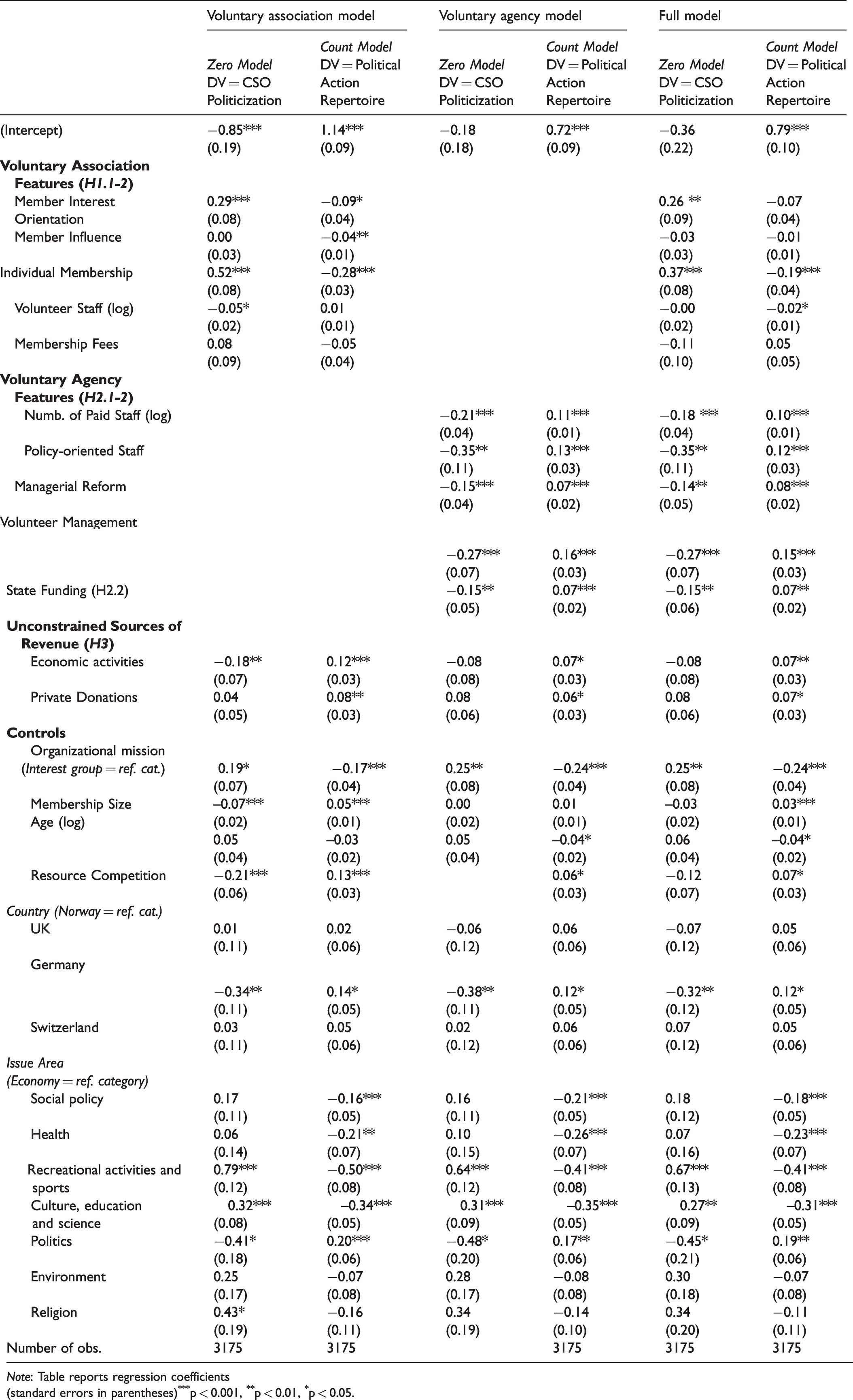
Note: Table reports regression coefficients(standard errors in parentheses)***p < 0.001, **p < 0.01, *p < 0.05.
Starting with the ‘voluntary association template’, two of its five characteristics have a significant and robust positive effect on the probability of a zero count across all specifications, i.e., on CSOs not being politicized. In line with H1.1. and underlining research stressing the dynamics generated by different types of members (e.g., Foley and Edwards, 2002), being composed of individual members increases the probability of being politically inactive of a normal organization by 7.5%. It also decreases the range of political activities by 14.5% (H1.1). Being a member-serving organization has similar implications though it only significantly affects the odds of CSO politicization. This negative effect on CSO politicization holds across all specifications, while it negatively affects the range of activities only in the (partial) ‘Association Model’. In line with the theory, also the number of volunteer staff has a significant negative effect on an organization’s action repertoire in the full model, but this effect does not hold in the relevant partial model (see Table 2, the two left-hand and right-hand columns). Neither member influence on central decisions nor membership fees has a significant effect on CSO political engagement.
While voluntary association features are overall less pervasive than agency features detailed below, their consistently negative effects on CSO political engagement is still striking. They challenge a long-standing and influential tradition that perceives associations of individual citizens as cornerstone of a democratic civil society and that (unlike interest groups research) usually does not look at associations not composed of individuals as vehicles for democratic representation to start with (e.g., Guo and Saxton, 2010; Jordan and Maloney, 2007; Skocpol, 2003; Warren, 2001).
Strikingly, all five features associated with the ‘voluntary agency template’ have a negative effect on the probability of a zero count (i.e., on not being politicized) and a positive effect on political action repertoires in the relevant partial and the full model (Table 2, the two middle and right-hand columns). Regarding the professionalization of human resources (H2.1), the coefficient of the number of paid staff is negatively significant in the zero model. So is the coefficient of the enhanced dependence on policy-oriented staff indicating that not only the overall staff capacity but also growing specialization is conducive to CSO politicization (Table 2, the two middle and right-hand columns). Similarly, both characteristics contribute to a more wide-ranging political action repertoire. More specifically, a standard deviation increase in the number of paid staff is associated with an 82% increase in the number of activities undertaken by the typical organization, enhanced dependence on policy staff with an 11% increase, a contrast that highlights the centrality of the overall capacity of human resources available to an organization to regularly engage in a variety of different influence strategies (Binderkrantz et al., 2015: 95–96; Dür and Mateo, 2014: 5–6). Also, managerial reform (enhancing competences, skills and efficiency) and volunteer management – two indications of structural professionalization – have significant and positive effects on politicization (i.e., a negative effect on the zero count), while increasing an organization’s action repertoire. Managerial reform is associated with a 13.5%, volunteer management with a 13% increase in the number of activities undertaken by a typical organization. While the trend towards CSO professionalization is often problematized as weakening CSOs’ democratic potential (e.g., Skocpol, 2003; van Deth and Maloney, 2012) these findings suggest a positive contribution to the role CSOs can play in the democratic process instead. Furthermore, the relevance of a managerial culture and volunteer management highlights the need to transcend notions of professionalization solely based on human resources to gain a more encompassing understanding of the consequences of this important development for CSO behaviour (Meyer and Maier, 2015).
Also state funding – the income source central to voluntary agencies (Billis, 2010) – is – in line with theoretical expectations – the only income source of the four considered in the analyses that is positively associated with both CSO politicization and its intensity (H2.2). The importance of state funding for an organization’s budget is associated with a 13% increase in the range of activities undertaken by a typical organization, challenging claims that associate the dependency of CSOs, NGOs and groups on state funding with de-politicization (e.g., Bloodgood and Tremblay-Boire, 2017; Choudry and Kapoor, 2013).
Concluding with H3, different from characteristics defining the two governance templates, unconstrained sources of revenue play – as theoretically expected – only a role for CSOs’ political action repertoires, not for CSO politicization, substantiating the decision to theorize organizational political engagement as a two-stage process. The importance of private donations as income source is associated with a 13.5% increase in the range of activities undertaken by a typical organization, the importance of economic activities with a 6% increase. This pattern found in the full model is confirmed by two partial models, with one exception: in the ‘Association Model’ dependence on economically generated income has also a significant negative effect on CSOs’ probability to be politicized, which – however – does not hold in any other specification. The contrast with state funding central to the ‘voluntary agency template’ (that also affects organizational priorities) substantiates broader claims on the pervasiveness of voluntary-state dependencies as compared to dependency on private sources as well as donations’ and economic activities’ weaker implications for CSO governance in particular (e.g., Fraussen, 2014; Froelich, 1999; Weisbrod, 1998).
Importantly, the qualitative difference between the two dimensions of CSO political engagement is underlined by other factors that have robust effects only on one stage: only a CSOs’ orientation towards member interests – a ‘voluntary association feature’ (with limited implications for organizational capacity) – affects organizational priorities, i.e., politicization, not political action repertoires. In contrast, factors solely impacting on CSO action repertoires – like ‘unconstrained’ sources of revenue – have implications for resources and thus organizational capacity: organizations active in the health and social sectors (that tend to be poorer than economic organizations) engage in a narrower political action repertoires (with no effect on the prioritization of political activities). Similarly, exposure to resource competition pushes organizations to broaden their action repertoire, while again leaving their initial politicization unaffected.
The findings hold despite controlling for a range of additional variables, most importantly an organization’s mission which has the expected effect on both dependent variables: being a service-oriented group as compared to an interest group significantly increases the probability of a CSO to be politically inactive, while decreasing its political action repertoire.
Conclusions
Building on prominent debates around the transformation of CSOs from member-driven associations to increasingly staff-driven and state-dependent organizations (e.g., Bosso, 2003; Grömping and Halpin, 2019; Hwang and Powell, 2009; Saurugger, 2012; Skocpol, 2003), this article has theorized how organization-level characteristics incentivize CSO political engagement, an activity central to CSOs’ contribution to democratic representation. It did so by conceptualizing and applying two ‘governance templates’ – the traditional voluntary association and voluntary agency – as analytical tools to formulate contrasting expectations regarding CSOs’ politicization and their political action repertoires.
Most importantly the analysis suggests that CSOs resembling ‘voluntary associations’ are less likely to be politicized and – if they are – tend to engage in fewer political activities regularly than CSOs resembling staff-driven ‘voluntary agencies’. While highlighting the importance of organizational-level features for CSO behaviour stressed in civil society, interest group and non-profit research alike, this finding challenges influential arguments presenting associations as central vehicles for democratic representation, while portraying staff-driven organizations as providing political engagement that is ephemeral and sporadic (Hay and Stoker, 2009: 231; see also Olsen, 2017; Skocpol, 2003; van Deth and Maloney, 2012; Warren, 2001).
This finding has important normative implications even though regular political engagement does not necessarily mean that an organization establishes an effective linkage between society and the state from the perspective of CSO members or societal constituencies (Beyers et al., 2008: 1117). This is because such activities are a necessary precondition for such a connection to materialize (Albareda, 2018: 1219). Whoever they mobilize, CSOs that do not engage in any political activity regularly are less likely to give ‘voice’ to societal demands than those that do, especially as a wide-ranging action repertoire is central to the likely success of such activities (Binderkrantz, 2008: 177–178; Eising, 2007; Halpin and Fraussen, 2017).
Does this suggest that when focusing on CSOs’ representative contribution to democracy (rather than their participatory function) the traditional ‘voluntary association’ turns out to be the ‘inferior’ governance template? Organizations that are not member-orientated are not necessarily detached from societal constituencies as they might be ‘public’ rather than ‘member-serving’ (Harris, 1998: 148). This raises the question whether putting members centre-stage is necessarily most suitable, not only in terms of efficiency but also democratic performance central to whether organizational properties enable CSOs to function as ‘an essential democratic infrastructures’ (Enjolras and Sivesind, 2018: 96). As Kreutzer (2009: 128) queried regarding member assemblies as governance organ: ‘Is it legitimate for the members, who are no longer the centre of attention, to continue to decide so much?’. That said, professionalized CSOs might be more instrumental in who they try to represent, thereby reinforcing biases in an already ‘dysfunctional democratic market’ towards popular, sympathetic causes and the interests of resource-rich citizens who are easier to mobilize (Maloney, 2012: 108–112). This important critique refers to whose interest political activity is directed towards, a theme not dealt with in this article that has focused on the ‘whether’ and ‘how’ of political engagement, not on the ‘who for’ (Saurugger, 2012: 69).
Future research needs to explore more closely how these two dimensions – the diversity of representation activities and their contents – relate to each other in different organizational contexts. This might reveal that both CSO professionalization and an orientation towards members are ‘double-edged swords’ leading us back to a fundamental tension between the ‘societal’ and ‘political’: associations serving an individual membership might be less politicized but more responsive to actual societal needs, while professionalized voluntary agencies might be more politicized, yet mainly benefitting those already overrepresented.
Supplemental Material
sj-zip-1-eup-10.1177_14651165211000439 - Supplemental material for Civil society – Politically engaged or member-serving? A governance perspective
Supplemental material, sj-zip-1-eup-10.1177_14651165211000439 for Civil society – Politically engaged or member-serving? A governance perspective by Nicole Bolleyer in European Union Politics
Supplemental Material
sj-pdf-2-eup-10.1177_14651165211000439 - Supplemental material for Civil society – Politically engaged or member-serving? A governance perspective
Supplemental material, sj-pdf-2-eup-10.1177_14651165211000439 for Civil society – Politically engaged or member-serving? A governance perspective by Nicole Bolleyer in European Union Politics
Footnotes
Acknowledgements
Many thanks go to the two EUP referees and the editor of the journal as well as Patricia Correa and Gabriel Katz for their helpful input on how to improve the manuscript. The usual disclaimer applies.
Funding
The author(s) disclosed receipt of the following financial support for the research, authorship, and/or publication of this article: This research has received funding from the European Research Council under the European Union’s Seventh Framework Programme (FP7/2007–13)/ERC grant agreement 335890 STATORG). This support is gratefully acknowledged.

Notes
References
Supplementary Material
Please find the following supplemental material available below.
For Open Access articles published under a Creative Commons License, all supplemental material carries the same license as the article it is associated with.
For non-Open Access articles published, all supplemental material carries a non-exclusive license, and permission requests for re-use of supplemental material or any part of supplemental material shall be sent directly to the copyright owner as specified in the copyright notice associated with the article.
