



Abstract
One of the phenomena involving social exclusion is the barriers to confronting senior entrepreneurs, silver entrepreneurs or older entrepreneurs. Often forced into retirement prematurely, they still have a long and potentially productive career ahead of them via self-employment. They can do whatever they dreamed of doing but never had the chance. This study examines demographic changes in society and the alternative career paths that influence retired individuals via social capital. Conceptually, it is held that many social ties are positively related to founding behaviour. Potential founders often require a variety of executive resources before and during the founding process. We found that older entrepreneurs arrange their social capital, which they have nurtured along their previous career, with specific resources needed at each stage of the business cycle.
Introduction
The field of entrepreneurship is changing rapidly around the world. Although starting a new business venture was once thought to be a young person’s prerogative (Minola et al., 2015), individuals over 50 are now starting new businesses more than ever before. Entrepreneurs are often characterized as ‘twenty-something, tech-savvy individuals working out of Silicon Valley’ (The American Association of Retired Persons (AARP), 2016: 24). However, older entrepreneurs, owing to their greater experience and knowledge compared with younger generations, are choosing to postpone their retirement plans using their professional skills to take advantage of untapped markets. The Bank of England found that ‘silver entrepreneurs’ have led the rise in self-employment since 2009 and that businesses started by individuals over the age of 50 had a 5-year survival rate of 70% compared with 28% for younger entrepreneurs (Spence, 2015). Indeed, in a study of the predictors of business start-up intentions among 18–64-year-olds, age is shown to have no statistically significant effect as a predictor (Kolvereid, 2016). Older entrepreneurs have been characterized as ‘often isolated, and rather excluded from the conceptual models and analysis even though their contribution can represent a real opportunity from economic and social perspective in many countries’ (Maalaoui et al., 2012: 2). The failure to access and fully leverage the talent of older entrepreneurs represents a waste of talent.
Scholarly investigation of older entrepreneurs is lagging behind the reality of older entrepreneurs in terms of scholarly attention. There is a dearth of literature on older entrepreneurs (Maritz, 2015). Furthermore, far more studies have investigated younger rather than older entrepreneurs (Velilla et al., 2018). This scholarly gap is not limited to the scarcity of studies of older entrepreneurs and a bias towards younger entrepreneurs but a dearth of entrepreneurial research focusing on contextual factors in contrast to individual factors (Welter et al., 2017). Moreover, there is limited research on social exclusion among older entrepreneurs (Kibler et al., 2015). As such, calls for future research emphasize the need for studies which focus upon the social context regarding older entrepreneurs (Perenyi et al., 2018). This article seeks to close this gap. Specifically, this article addresses this knowledge gap by examining older entrepreneurs and by attending to the less-positive and unintended negative effects of the marginalization of older entrepreneurs.
This article embodies a critical foray into evolving the understanding of older entrepreneurs from a perspective that includes both macro (contextual factors) and micro (individual factors). There has been little comprehensive attention among researchers, educators and policymakers to older entrepreneurship in general and marginalization among older entrepreneurs. Our proposed conceptual model aims to shed a light on a previously underrecognized area of research, education and policy. Due to the lack of knowledge synthesis and the potential value of an exclusionary perspective, this article seeks to advance debates on old-age exclusion from the entrepreneurial ecosystem.
There are not only research gaps focusing upon senior entrepreneurship but also entrepreneurial educational and policy gaps. Specifically, there is scant research on entrepreneurial education targeted at older entrepreneurs and intergenerational entrepreneurship education (Baschiera et al., 2018). Policymakers often fail to recognize the diverse ways in which groups of entrepreneurs are socially excluded, and governments lack precision and specificity when developing coherent and tailored agendas, making it difficult to adapt to the dominant enterprise culture that often praises the ‘youthful image of the entrepreneur’ (Kibler et al., 2015: 195).
In view of these scholarly, entrepreneurship education and policy research gaps, this article contributes to the literature in five ways. First, it documents evidence of the ‘greying’ of society but from the perspective of highlighting the demographic mismatch between the number of older entrepreneurs and the lack of focus on older entrepreneurs among key actors in the entrepreneurial ecosystem, such as financiers, educators, researchers and other practitioners. This documentation seeks to make the case for the need to study older entrepreneurs. Second, we identify the barriers and obstacles confronting older entrepreneurs and – based on our conceptual model – we propose ways to create more inclusivity among older entrepreneurs. This conceptual model is designed to be generalizable to other marginalized entrepreneurial groups such as women and immigrants. Third, recognizing the entrepreneurial ecosystem as contextual, this study echoes previous calls for further entrepreneurship research grounded in contextualization (Autio et al., 2014; Zahra, 2007). This contribution advances the theory of entrepreneurship. Fourth, based on our conceptual model, we formulate recommendations to address some of the exclusionary forces. More specifically, our recommendations aim to increase inclusion among older entrepreneurs through an emphasis on social capital (Hantman and Gimmon, 2014; Isele and Rogoff, 2014). Fifth, given the greying of society globally – a change that is exemplified by Japan, which has the world’s most rapidly ageing society (Tokudome et al., 2016). Kibler et al. (2015: 203) – ‘the issues of age and ageing are becoming increasingly important as populations in developed industrial economies become older’. As such, this article draws attention to the problems created by this demographic reality and discusses how governments may respond within the entrepreneurial ecosystem to alleviate challenges such as pension obligations. Finally, it is our hope that this article will lead to some promising future research avenues in the study of older entrepreneurship in general and from an exclusionary point of view.
Causes and consequences of social exclusion among older entrepreneurs
This article explores the causes and consequences of excluding individuals over age 50 from entrepreneurship. For the sake of definitional clarity, older entrepreneurs are here defined as those who are at least 50 years of age, a cut-off also used by other studies (Halvorsen and Morrow-Howell, 2017; Harms et al., 2014; Stirzaker and Galloway, 2017; Weber and Schaper, 2004). Moreover, to link the multiple factors related to such causes and consequences, we offer a conceptual model informed by social capital theory. We rely upon Bourdieu’s (1980: 2) definition of social capital as ‘the aggregate of the actual or potential resources which are linked to possession of a durable network of more or less institutionalized relationships of mutual acquaintance or recognition’. Other terms used to define exclusion include but are not limited to marginalization, nominalization and web of disadvantage (Peace, 2001). Finally, we propose recommendations for policymakers, venture capitalists, entrepreneurship educators and others within the entrepreneurial ecosystem (Suresh and Ramraj, 2012). It is our hope that these recommendations will help to build more inclusive structures, programmes and climates for current and future entrepreneurs over the age of 50.
Despite the positive outlook and performance of older entrepreneurs, they face barriers including discrimination and/or social exclusion (Maritz et al., 2015). There is no agreed-upon definition of social exclusion. Marlier and Atkinson (2010: 285) define social exclusion as ‘…the involuntary exclusion of individuals and groups from political, economic, and social processes, preventing their full participation in the society in which they live’. While we rely on this definition because of its multidimensionality, we acknowledge the interplay between social exclusion and individual factors, such as individual choice (LeGrand, 2003). Beyond social exclusion, older entrepreneurs face other barriers, including the following: limited access to programmes targeting this group of entrepreneurs, inadequate networks, prejudice towards seniors, the limited use of new communication channels, a lack of understanding of the value of mentoring and a dearth of research on senior entrepreneurship (European Commission, 2016). Advancing age in general can be perceived as a liability or as an asset (Weber and Schaper, 2004). Viewing ageing as a liability, Kautonen et al. (2008) contend that older entrepreneurs may be subject to bias on the part of financiers and consumers, even though older individuals offer a wealth of skills, knowledge, wisdom and mentorship (Maritz, 2015).
Older entrepreneurship: Our conceptual model of exclusion
Our proposed conceptual model in Figure 1 focuses on older entrepreneurs; however, the model is sufficiently inclusive to be applied to other entrepreneurs who face social exclusion (e.g. people with disabilities; women). Our model builds upon the work of Halvorsen and Morrow-Howell (2017), who posit that the decision to pursue self-employment in later life is the result of both individual and contextual factors. The contextual factors identified in their conceptual model include family, community, societal and economic factors. Our model focuses on the contextual factors but describes them from the perspective of the entrepreneurial ecosystem. Further, it assumes that entrepreneurship is uneven across social groups (Southern, 2011), with the following groups being under-represented or disadvantaged in entrepreneurial networks: women, youth, seniors, the unemployed, ethnic minority/migrant groups and people with disabilities (OECD, 2015).

Conceptual model of exclusionary entrepreneurship.
Our model posits that the larger social context, namely ‘when, how, and why entrepreneurship happens and who becomes involved’ (Welter, 2011: 65), must be understood before we can explore the other elements of the model. Our model recognizes the demographic shifts occurring worldwide, such as the ageing of the population overall (Pew Research Center, 2014) and in the workplace (AARP/Oxford Economics, 2016). Further, the 2015 Kaufmann Index shows a growing rate of new entrepreneurs among individuals aged 55–64, accounting for a quarter of all new entrepreneurs (25.8%). Finally, the foundation upon which exclusion, social capital and inclusion become operative occurs within the entrepreneurial ecosystem. This ecosystem influences both entrepreneurship start-up and success (Suresh and Ramraj, 2012). Isele (2014: 3) gave the following testimony before the US Senate regarding entrepreneurial ecosystems: ‘We succeeded because we had cross-sector ecosystem-programs, capitalization, policy and research. Each of us here today are part of that ecosystem, as stakeholders in the social and economic well-being of our seniors’. This statement echoes the organizing principle of the entrepreneurial ecosystem.
Our model is based upon the saying, ‘Demography is destiny’ to some degree. Specifically, in our model, the demographic shifts begin to create a changing demographic reality. In this case, that demographic reality is an aging population and higher proportion of older entrepreneurs than most educators, policymakers and researchers would predict based upon age stereotypes about entrepreneurs. These stereotypes result in older entrepreneurs being excluded from the entrepreneurial ecosystem or at a minimum interacting with an entrepreneurial ecosystem which does not include the unique aspects of being an older entrepreneur. Most of the exclusion of older entrepreneurs could be countered by focusing upon social capital and creating ways for older entrepreneurs to be included in current entrepreneurial ecosystems or reimagined entrepreneurial ecosystems.
Our model recognizes the intersectionality of older entrepreneurs with other groups also excluded from entrepreneurship: women (Carter et al., 2015), immigrants (Vinogradov and Jorgensen, 2017), people of colour (Freeland and Keister, 2016), Lesbian Gay Bisexual Transgender (LGBT) individuals (Redien-Collot, 2012) and the disabled (Renko et al., 2016). These groups will also age, putting them at risk of being excluded based on more than one demographic factor. Furthermore, the inevitable ageing of these excluded groups means that our conceptual model has applicability beyond older entrepreneurs, although they are our focus. Additionally, although older entrepreneurs may play different roles ranging from entrepreneur to investor (European Commission, 2016), our emphasis is on the entrepreneurial role.
Social context: The frame for our conceptual model
Truxillo et al. (2015: 359) argue that ‘…older people can be affected by the social context of aging’. This context may include age stereotyping, age climate, age discrimination and family relationships. First, regarding age stereotyping, Ng and Feldman (2012), in a meta-analytic review of 418 studies, identify six common age stereotypes. Only one was empirically supported: reduced willingness to take advantage of career development and training opportunities. The other age stereotypes were that older people were less motivated, more resistant to change, less trusting of others, less healthy and more vulnerable to work/family imbalance. However, not all stereotypes about older workers are negative. In fact, some – such as reliability – are positive (Bal et al., 2011).
Another consideration discussed elsewhere is how different regions, such as Asia and the Mediterranean, have a higher regard for ageing than does the United States (Minola et al., 2015). According to Lee (2017: 7), In an innovation district as elsewhere, greater age diversity and efforts to foster an inclusive culture can lead to cross-generational friendships, networks, and collaborations.
Second, with respect to the age climate (Boehm et al., 2014), age stereotyping, discrimination and the diversity climate may contribute to some social groups – including seniors – facing barriers in seeking employment (Pilková et al., 2016). Older individuals also face discrimination even if they are employed (Weber and Schaper, 2004).
Yet, it is recognized that entrepreneurs can also face discrimination (Kibler et al., 2015), and this discrimination extends to older entrepreneurs (Ainsworth and Hardy, 2008; Mallet and Wapshott, 2015). Nonetheless, entrepreneurship for older groups is not a panacea (Pilková et al., 2016), as prior research has shown that societal norms about age appropriateness influence the entrepreneurial inclinations of the over-50 age group (Kautonen et al., 2011). Entrepreneurial inclinations also differ based on the prevailing culture. In nations with individualistic cultures, such as the United States, entrepreneurship is more accepted than in collectivist cultures such as Japan (Deshpande et al., 2013). Deshpande et al. (2013: 244) write that, ‘…successful Japanese founders of entrepreneurial firms that adopt a customer orientation appear to have more in common with successful American entrepreneurs than with other Japanese executives’. This statement demonstrates a convergence of cultures across nations with regard to some aspects of entrepreneurship.
Third, entrepreneurs’ resources tend to flow from family ties (Hite and Hesterly, 2001). However, such ties can have both positive and negative effects on entrepreneurship (Arregle et al., 2013). Older entrepreneurs may be the target of negative judgments by relatives and may receive mixed messages from potential customers (Kibler et al., 2015). There is a relationship between the age of the entrepreneur and the lower degree of support provided by older relatives (Kibler et al., 2015). As noted, the consequences of the social context as it relates to older entrepreneurs are mixed at best, even amidst a boom in the size of the ageing population.
Demographic shifts
Population ageing has been continuously increasing in recent decades and is predicted to increase even more in the future (Irmen, 2017). The United Nations (2015) projects that the world’s population aged 60 years and older will increase from 901 million in 2015 to 1.4 billion in 2050, an increase of 56%. In the United States, the proportion of the nation’s population aged 65 and older is expected to increase from 15% in 2017 to 30% by 2030 (Vandenbroucke and Zhu, 2017). According to the Joint Center for Housing Studies of Harvard University (2014), slightly more than one-third of US residents are aged 50 or older. In Japan, the size of the 65-plus population is expected to account for 40% of the country’s population by 2050, up from 17.3% in 2000 (Fujimura, 2016).
Rapid ageing will create unique challenges and opportunities for all types of businesses (Chand and Tung, 2014). This increase in the percentage of the ageing population demands that we identify ways to keep this population economically active (Fujimura, 2016), including through entrepreneurship (Kurek and Rachwal, 2011).
Furthermore, from the perspective of different ethnic groups, the 50-plus age cohort consisting of African Americans, Hispanics, Asians and non-White groups is expected to increase from 26% in 2015 to 45% by 2050 among the US population (AARP/Oxford Economics, 2016). This increase in the proportion of older ethnic/racial minorities may pose unique challenges for these demographic groups in terms of exclusion from the entrepreneurial ecosystem. Hence, our conceptual model was designed with this trend in mind.
Demographic shifts: The importance of older entrepreneurs
According to a study by the Global Entrepreneurship Monitor, ‘seniors own businesses at a higher rate than any other demographic cohort’ (Isele and Rogoff, 2014: 141). This study also reports the following: a study by the MetLife Foundation (cited in Isele and Rogoff, 2014) found that 34 million baby-boomers want to start their own businesses. Moreover, the proportion of businesses owned by people over 50 increased from 46% in 2007 to 50.9% in 2012 (Lichtenstein, 2014). Indeed, between 1989 and 2013, entrepreneurship increased among older households compared with younger households (Weller and Wenger, 2017), even though entrepreneurship has been declining overall in the United States over the past two decades (Morelix et al., 2015). In absolute values, there was an increase in older entrepreneurs from 3.8 million in 1998 to 5.4 million in 2013 (Weller and Wegner, 2017). Surprisingly, in 1989, there were 2.5 million more younger entrepreneurs than older ones; by contrast, in 2013, there were 900,000 more older than younger entrepreneurs (Weller and Wegner, 2017). These entrepreneurial trends are aligned with the ageing of the workforce in industrialized nations (Truxillo et al., 2015).
Demographics and capital: A dynamic relationship
The Oxford Dictionary (2018) defines capital as ‘a valuable resource of a particular kind’. Roland (2011) identifies eight forms of capital: intellectual, spiritual, social, material, financial, living, cultural and experiential. Financial capital is especially important for entrepreneurship (Leyden et al., 2014). Urbano and Aparicio (2016: 34) argue that ‘entrepreneurship capital is the social capital that drives economic development’. Yet, social capital appears to be a form of capital that is uniquely related to entrepreneurial success (Leyden et al., 2014).
Entrepreneurs leverage different types of capital to launch and sustain new ventures. These types include financial capital (Bygrave and Timmons, 1992), physical capital (Dollinger, 1995), organizational capital (Tomer, 1987), human capital (Becker, 1964) and social capital (Bourdieu, 1983; Glade, 1967). Greene et al. (2015) describe these types of capital as resource categories, as do Kellermanns et al. (2016), who prefer the term ‘relationship capital’. Moreover, Greene et al. (2015: 26) note that ‘resources are essential to the creation of new ventures and the growth of small firms’. However, these resources are often scarce (Greene et al., 2015).
Education and experience define human capital (Baron and Ensley, 2006). One of the main reasons why older entrepreneurs have such an advantage over younger entrepreneurs is that they are more likely to have more knowledge, experience and connections in the business world. Additionally, the owners/founders of new and small firms value physical and social capital to a greater degree than they value human capital (Greene et al., 2015). Similarly, Kellermanns et al. (2016) find that entrepreneurs place less emphasis on human, organizational and physical capital but more emphasis on relationship capital. These findings thus align with the view that ‘firms essentially use alliances to gain access to other firms’ valuable resources’ (Das and Teng, 2000: 33).
Older entrepreneurs are particularly susceptible to the problem of social exclusion. Again, social exclusion is the separation of individuals and groups from mainstream society (Commins, 2004; Moffatt and Glasgow, 2009; Sajuyigbe, 2017). Historically, exclusion has been an expression of discrimination and of built-in structural processes (Kummitha, 2016). We recognize the multidimensionality of the construct of social exclusion proposed by Peace (2001). In a more recent study, Walsh et al. (2017) argue that social exclusion is increasingly being examined in the context of gerontology.
Exclusion among older entrepreneurs
Peace (2001: 19, 32) lists age as one dimension of exclusion; it can be both a single and multidimensional variable when coupled with a disability (‘aged invalids’) and employment status (‘older workers’). Older entrepreneurs are heterogeneous, reflecting the heterogeneity of entrepreneurship more generally (Amaral et al., 2009). Some entrepreneurs continue to work in the same business in which they already established; others decide to grow their existing business; some decide to shift industries, markets or products; some decide to re-enter self-employment after exiting and others launch a business for the first time. One study of high-tech entrepreneurs found that their average age was 47.8 and that they launched their ventures at an average age of 29.3, but they founded their first company at an average age of 24 (Giannantonio and Hurley-Hanson, 2016). Table 1 illustrates the types of exclusion that have consequences for older entrepreneurs.
Exclusion from and by whom.
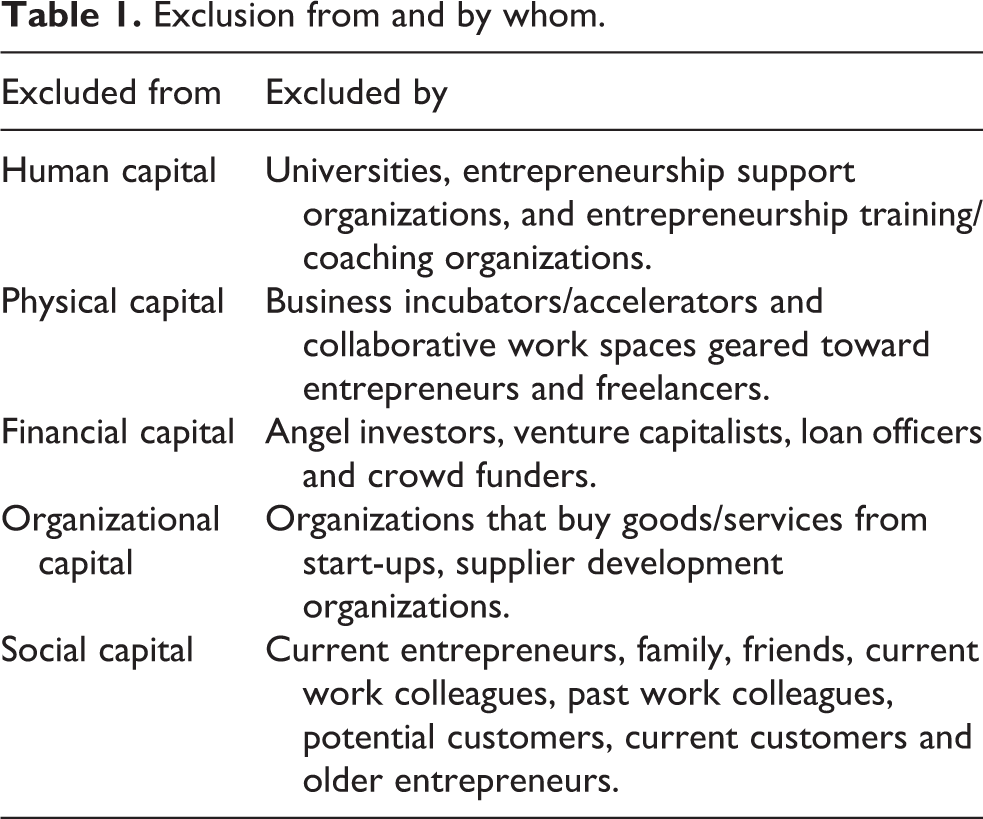
This table seeks to describe how older entrepreneurs are excluded from accessing the various types of capital regarded as necessary for success in starting up an entrepreneurial enterprise. It must be noted that social exclusion does not always focus on others. Percy-Smith (2000) notes the reality of voluntary self-exclusion. However, this type of exclusion is beyond the scope of our work. These types of capital – in combination – are elements of the entrepreneurial ecosystem.
Exclusion from the entrepreneurial ecosystem
Spigel (2015: 1) defines entrepreneurial ecosystems as ‘…the union of localized cultural outlooks, social networks, investment capital, universities, and active economic policies that create environments supportive of innovation-based ventures’. Spigel (2015) highlights 11 attributes of an entrepreneurial ecosystem organized by three types of capital: cultural, social and material. Older entrepreneurs are more likely to have access to cultural and social attributes given that cultural attributes include a supportive culture and social capital. As for financial capital, seniors experience greater discrimination when trying to obtain bank loans (European Commission, 2016).
Universities do not focus on older entrepreneurs. For example, there is a paucity of research on older entrepreneurship (Lewis and Walker, 2013), despite age being a key determinant of entrepreneurial activity (Levesque and Minniti, 2006; Parker, 2009). To further provide evidence for this gap in the literature, we reviewed the relevant literature from 2007 to 2017, focusing on five peer-reviewed journals: International Journal of Entrepreneurship and Innovation, Entrepreneurship Theory and Practice, Journal of Business Venturing, Journal of Enterprising Culture and Strategic Entrepreneurship Journal. Specifically, we used the terms ‘senior’, ‘older’, ‘silver’, ‘encore’, ‘grey’, ‘second act’ and ‘next act’ when searching the websites of these journals as of September 15, 2017. Table 2 shows the percentages of articles covering topics related to older entrepreneurship.
Dearth of entrepreneurship research on older entrepreneurs.
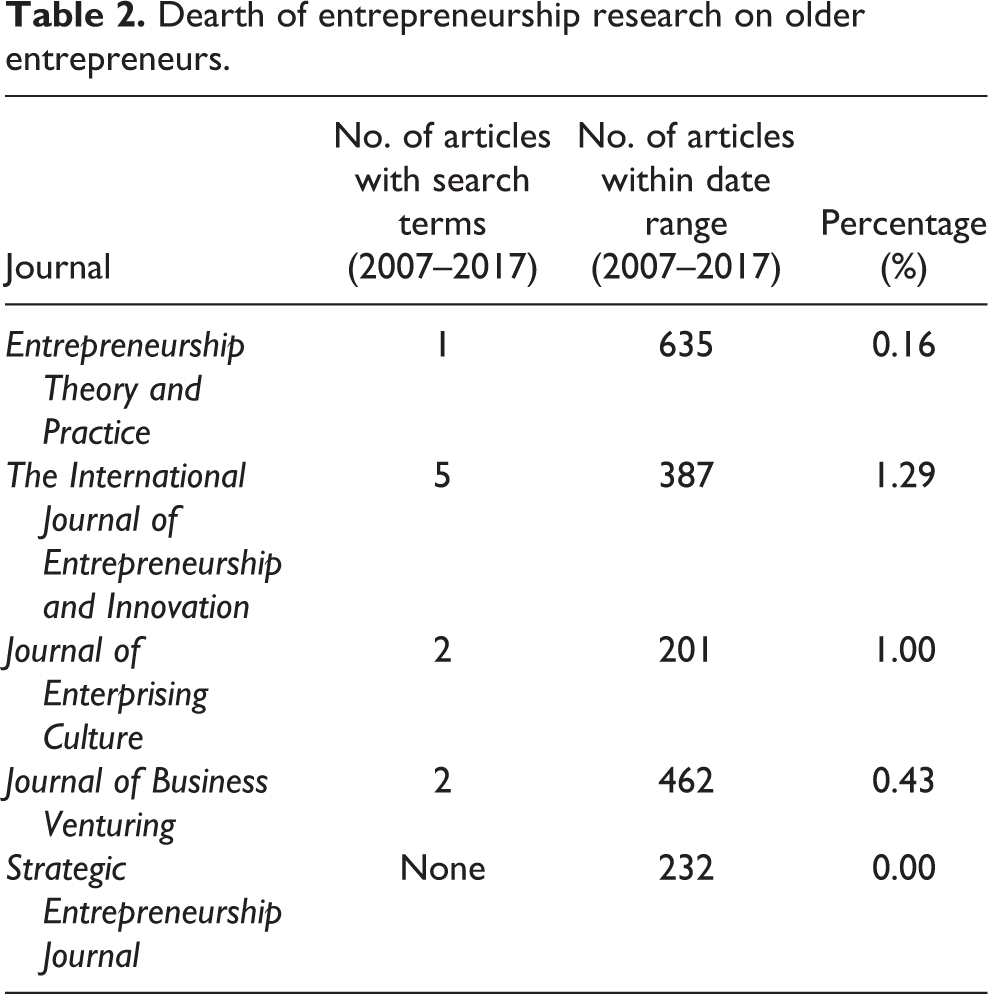
Across all 10 articles containing our search terms, the themes that related to our conceptual model included the following: increase in the size of the ageing population, the capital that older individuals can leverage to start a business and the unique challenges and needs of older entrepreneurs. Our focus here is primarily on the exclusionary forces related to social capital; we build upon the work of Kautonen (2012), who recognized the influence of sociocultural perceptions and the entrepreneurial propensities of older entrepreneurs.
Social capital theory: Relevance to entrepreneurial exclusion
Stam et al. (2013) empirically found that social capital is positively related to small-firm performance. Adler and Kwon (2002) suggest additional associations with social capital, including career success, inter-unit exchange and product innovation and the strengthening of supplier relationships.
De Clercq et al. (2013) suggest that the social capital concept has been catapulted to prominence as a means of understanding firms’ entrepreneurial behaviours. Their research focuses on how the knowledge benefits resulting from social capital carry over under different structural conditions. They further posit that strong social relationships facilitate knowledge exchanges by reducing uncertainty. As the usefulness of internal knowledge sharing can be applied to entrepreneurial endeavours and activities, social capital can ease the transition to entrepreneurial careers. Furthermore, social capital has been associated with numerous phenomena of interest to entrepreneurship scholars, including entrepreneurial intent (Liao and Welsch, 2005). The value of social capital has been found to relate to creativity, growth and performance, innovation, family enterprises and new venture financing (Gedajlovic et al., 2013).
A more nuanced approach to social capital is related to ‘bonding and bridging’. Coleman (1988) views bonding as arising from solid, repeated social connections that allow for greater trust and increased sharing. This bonding may result in new market prospects, innovative discoveries and financing ventures. From the bridging perspective, Burt (2000) suggests that such positive outcomes result from the bridging of structural holes (e.g. information asymmetries). If older entrepreneurs are excluded from entrepreneurial ecosystems, then they may be unable to fully leverage the benefits of bonding and bridging.
However, Light and Dana (2013: 1, 2) observe that ‘…social capital can suppress entrepreneurship…’. Furthermore, the social capital of dominant groups can suppress the social capital of less dominant ones (Adler and Kwon, 2002: 32; Crow, 2004: 12). In one qualitative study, dissatisfaction with advancement opportunities was cited as a reason for starting up a business after the age of 50 (Lewis and Walker, 2013). Although age bias was not specifically mentioned, it is a tenable explanation. Levesque and Minniti (2006) posit that for the over-50 age cohort, dissatisfaction triggered by contextual factors drives the decision to start a business. Both age bias and discrimination are interpersonal in nature and can be associated with being excluded and thereby having reduced social capital. Older knowledge workers have unique advantages in terms of their professional skills, accumulation of experience and social capital (Platman, 2003).
Moreover, Petrova (2012) states that 8 of 10 new entrepreneurs launch their businesses while still working. Indeed, it was found that part-time entrepreneurs are not constrained by financial or cultural capital but rather by human capital given their lack of knowledge about entrepreneurship (Petrova, 2012). This notion of being a part-time entrepreneur was popularized with the publication of the work by McGinnis (2016). The notion of hybrid entrepreneurship is defined as ‘…individuals who engage in self-employment activity while simultaneously holding a primary job in wage work (Folta et al., 2010: 254)’. Both younger and older individuals are more likely to transition from hybrid entrepreneurship to full-time entrepreneurship than they are to immediately enter full-time entrepreneurship (Thorgren et al., 2016).
Kreiser et al. (2012) found that an increase in the number of social capital ties is positively related to founding activities. They further suggest that founders must dynamically configure their social capital, particularly their network of relationships, to align with the specific resources needed at each stage of the business life cycle. As such, inclusion is a critical success factor for older entrepreneurs.
Inclusion: The meaning of the concept within entrepreneurship
Pilková et al. (2014: 524) define inclusive entrepreneurship as support that is ‘…aimed at underprivileged groups of the population, such as women, youth, ethnic minorities, people with disabilities, and seniors, thus aiding them to participate in entrepreneurial activities’. The OECD/European Commission (2013: 3) articulates that the common goal of inclusive entrepreneurship is to create an environment in which all people, regardless of their background, have an equal opportunity to launch and manage their own business; inclusive entrepreneurial policies are defined as those designed to ‘…give everybody the opportunity to start up in business or self-employment regardless of their social background…’. Furthermore, the OECD/European Commission (2013) mentions seniors as one of the target groups of inclusive entrepreneurial policies.
Although we focus on the intersection of social exclusion and older entrepreneurship, a larger context is represented by the notion of ‘productive ageing’, which is ‘…an entrepreneurial approach to life in which one works towards a self-made future’ (Rudman and Molke, 2009: 385). For the entrepreneurial ecosystem, there are positive consequences of promoting inclusivity among older entrepreneurs. These positive consequences are spread across the five dimensions of inclusion identified by Percy-Smith (2000: 8): (1) consumption activity, (2) savings activities, (3) production activity, (4) political activity and (5) social capital. All five of these dimensions enhance individual and collective well-being. Another relevant dimension is family capital in general and family social capital in particular. Bubolz (2001: 3) posits that the ‘family is a source, builder and user of social capital’. Although not the focus here, a related concept is transgenerational entrepreneurship and the imprinting behaviour of older family members upon younger family members in the business (Jaskiewicz et al., 2015). Table 3 illustrates how these five dimensions of inclusion are translated into possible benefits of including individuals over 50 in the entrepreneurial ecosystem.
Benefits of inclusion for individuals over 50.

The recommendations that follow are designed not only to address the barriers and negative consequences facing older entrepreneurs but also to recognize six areas where older entrepreneurs have articulated a need for support (European Commission, 2016): new technologies, entrepreneurship education, identification of business opportunities, funding, mentoring and employment transition. For example, mentoring may help seniors modify their mindset about starting a business or even being an entrepreneur. Interestingly, entrepreneurs over 50 are less likely to write a business plan (Brinckmann and Kim, 2015). Hence, a more inclusive approach would be to tailor business plan writing to this disadvantaged group. Highlighting the exclusionary forces marginalizing older entrepreneurs as well as formulating recommendations for greater inclusion should aid the shift towards realizing a more inclusive society that ‘…overrides differences in race, gender, class, generation, and geography. It ensures equality of opportunity, regardless of origin’ (Marlier and Atkinson, 2010: 286).
Approaches to enhancing inclusion by leveraging social capital
There are numerous ways in which to increase the inclusion of older entrepreneurs. Our approach seeks to recognize the social context and then focus on the variety of actors within the entrepreneurial ecosystem. Such an ecosystem is indeed emerging, as captured by some of the 24 best practices profiled by the European Commission (2016). One of the actors is the government, as in the cases of the US Small Business Administration (SBA) and PRIME. Motoyama and Knowlton (2014) found that government often serves as a catalyst for building social capital, which may later attract other types of capital. Beyond the government, entrepreneurship education programmes help develop intergenerational partnerships (Gimmon, 2014). An illustrative example is Sooretual in Senegal, where young Senegalese entrepreneurs teach older Senegalese female farmers how to sell their products online (Isele, 2016).
This approach to creating a more inclusive ecosystem must build upon the work of Feldman (2003), who posits that entrepreneurship is local (e.g. in a province, city or community). As an example, the Kaufmann Foundation sponsors the annual Mayors’ Conference across the United States. In 2016, the conference was held in St Petersburg, Florida and titled ‘Why an inclusive ecosystem matters and how to make it happen’. Additionally, other sectors are creating online intergenerational entrepreneurship platforms interlaced with face-to-face meetings. One example is 4GenNow, whose mission is as follows: We match and advise four generations of entrepreneurs: Millennial, Baby Boomer, Gen X and Gen Z on how to launch and grow intergenerational startups. By helping to make connections, we intend to unleash an Entrepreneurial Renaissance to fuel economic growth in both urban and rural areas throughout the US and Europe.
Recommendations for enhancing inclusion by leveraging social capital
Our recommendations extend beyond a focus on older entrepreneurs to include other entrepreneurs who face social exclusion, such as and racial/ethnic minorities and people with disabilities. The underlying premise of the recommendations that follow is that the entrepreneurial ecosystem is the soil in which entrepreneurial plants will or will not blossom. Suresh and Ramraj (2012) argue that the entrepreneurial ecosystem influences both start-up and success. Yet, our conceptual model (see Figure 1) extends the work of Spigel (2017), who identified four contextual factors in the entrepreneurial ecosystem: family, community, societal and economic. Accordingly, our recommendations include areas where there are gaps in the entrepreneurial literature, namely, exclusion based upon current demographic realities and future demographic shifts.
Yet, entrepreneurial ecosystems do not develop naturally; they must be created. Leadership is therefore essential. It is a core requirement that an ensemble of leaders and champions ignite the co-creation or redesign of an existing entrepreneurial ecosystem that includes all and excludes none. No one should be excluded based upon demographic and other characteristics that policies, programs, leaders and champions have historically used to marginalize others. The role of the older entrepreneur as a key actor in the creation and sustainability of the entrepreneurial ecosystem must not be minimized.
Based upon our conceptual model, social capital – if designed and deployed strategically and skilfully – can serve to mitigate exclusionary barriers and facilitate inclusive drivers to support greater engagement and success of older entrepreneurs. To achieve a healthy, inclusive entrepreneurial ecosystem – not only for older entrepreneurs but also for all marginalized entrepreneurs more generally – we propose the following recommendations.
Our overall recommendation is to deconstruct the explicit and implicit biases that exist among the various players within the entrepreneurial ecosystem (i.e. universities, investors, entrepreneurship support organizations, policymakers, ageing advocacy organizations and individual/marriage/family counsellors). Isele (2014), in her testimony before the US Senate Special Committee on Aging and the Small Business and Entrepreneurship Committee, remarked that to foster inclusive entrepreneurship among seniors, entrepreneurial communities needed to be energized. Similarly, the European Commission (2016: 14) advocates for a platform upon which best practices can be shared. At a practical level, this would facilitate the exchange of views and information between seniors and intermediaries, and encourage collaboration between mentors, investors, and entrepreneurs.
All these institutional actors are part of the entrepreneurial ecosystem in which social capital, viewed by Westlund and Bolton (2003) as a characteristic of a community, is a critical resource. Coleman (1988) argues that networks are a cornerstone of social capital. Furthermore, Stirzaker and Galloway (2017: 112) regard older entrepreneurs as a ‘…social/economic asset’. Our recommendations are driven by the view of older entrepreneurs as an asset not a liability; hence, inclusion and investment are required, while marginalization or exclusion should be avoided.
Universities
College and universities have a clear role to play in developing curricula and designing courses, as well as conducting research on older entrepreneurship. Their roles can range from offering educational degrees/certificates to leading non-credit training programs. Additionally, colleges and universities can sponsor business plan competitions, idea pitches and other types of entrepreneurial competitions with a focus on older entrepreneurship. For instance, the Institute of Public Health at Washington University in St Louis (part of the Brown School of Social Work) conducts research on older entrepreneurship. Similarly, in the fall of 2017, the University of Miami in Ohio launched a graduate certificate in Social Entrepreneurship and Aging, which represents a collaboration among the Department of Sociology and Gerontology, the Scripps Gerontology Center and the Institute for Entrepreneurship at the Farmer School of Business.
Government
Globally, governments are increasingly putting older entrepreneurship on their policy agendas for a variety of reasons, including the ageing of the population and concerns about financially supporting an ageing population who may rely upon the government as pensioners. For example, the UK government launched the Prince’s Initiative for Mature Enterprises. As a cross-sector initiative, the US SBA partnered with AARP to train mentors to guide older entrepreneurs and facilitate workshops on older entrepreneurship. Another way for government to support older entrepreneurs is to consider offering tax incentives (Isele and Rogoff, 2014).
Foundations
Foundations such as the Kaufmann Institute (2015) in the United States and the Canada West Foundation (2017) in Canada are seeking to catalyse older entrepreneurship on in the areas of policy, research, education/training and entrepreneurship support. For example, the Canada West Foundation organized a series of roundtable discussions in Calgary and created a four-step action plan (Canada West, 2017).
Investors
Investors range from angel investors to investment syndicates. A challenge for many entrepreneurs – regardless of age – is financing their business and remaining financially sustainable. The European Commission (2016) recognized the unique challenges facing older entrepreneurs and proposed micro-financing as a possible alternative to other forms of financing. For example, Credal, a Belgian cooperative, has a microfinance programme targeting the 65-plus population (European Commission, 2016).
Beyond government actions to reduce bias against investing in start-ups, both investors and investment firms ought to embrace evidence-based decisions with regard to the percentage and performance of start-ups in which the entrepreneurs are 50-plus. The other recommendation for investors is to challenge the over-weighting of the entrepreneur as an individual or the over-weighting of the management team, especially if the entrepreneur and members of the management team are historically marginalized and discriminated against in regard to financing new ventures and growth. Finally, crowdfunding may represent a source of financing for older entrepreneurs, and some financing firms may prefer older entrepreneurs as a way of realizing their goals of impact investing and social responsibility.
Entrepreneurship support organizations
Numerous not-for-profit organizations support entrepreneurship and entrepreneurs. The Global Institute for Experienced Entrepreneurship is one example where intergenerational programmes are emphasized, as seen in the Experience IncubatorTM. Another example is the 50-plus entrepreneurship platform, whose goal is ‘…to help Europe grow a new generation of entrepreneurs, specifically from the 50+ demographic group’ (http://www.50plus-europe.eu/about/).
Policymakers
Policymakers need to evaluate the existing policies across employment, education funding, retirement and ageing. After evaluating these policies and their associated budgets, the challenge should be to overcome any policy/budgetary barriers and erect policy/budget drivers to increase entrepreneurship among seniors in order to benefit the government and society at large. Benefits may include reducing the budget for government pensions as well as generating more tax revenue and possibly higher employment.
Ageing advocacy organizations
AARP has a host of resources for older entrepreneurs (http://www.aarp.org/work/on-the-job/info-08-2012/become-an-encore-entrepreneur.html). Ageing advocacy organizations have a unique role to play by interacting with government and policymakers to generate greater government/policy support for older entrepreneurs; at the same time, such organizations can either enforce laws that forbid age discrimination or advocate for new laws.
Individual and marriage/family therapists/counsellors
Therapists have several roles to play in this respect. First, individual therapists can offer services to encourage struggling seniors to see themselves as entrepreneurs. Second, marriage-family therapists can assist older entrepreneurs who are receiving either mixed or negative messages from family members. Finally, therapists can offer psycho-educational programmes to provide emotional/social support for older entrepreneurs.
Limitations
There is a risk of viewing all potential older entrepreneurs as one type or category (e.g. all have suffered from age discrimination, have been rejected by their former employer or are willing to incur substantial risk). Nevertheless, the current article attempts to provide a broad overview by identifying the prospects of older employees who are considering self-employment. Further, while a series of relevant conditions and variables are identified, only secondary data from previous studies are offered. Moreover, although the bibliography is representative of the major issues confronted, no primary data were collected. In addition, it is difficult to discern which policies have actually been adopted by countries. Hence, we are left with a mixture of apples and oranges, as is the case in any comparative study. Identifying new start-up opportunities in an evolving and dynamic economy is also challenging. Hence, a static model might quickly become outdated. Changes in technology, culture, attitudes, beliefs and government policies will therefore need to be incorporated into any future models.
Future research
When considering extensions of our model of exclusion, it appears that a strong matching process should be employed. In the ‘from where’ category, we need to identify the conditions and circumstances encountered by prospective entrepreneurs (e.g. state of mind, experience, family ties and industry). In the ‘to where’ category, we need to identify the types of opportunities encountered by prospective entrepreneurs (e.g. financial requirements, time frame and exit plan). This matching process will be affected by several environmental variables, such as government programmes, business conditions, training programmes and region of the country. Prospective entrepreneurs may consider whether to go solo, find a partner or join a consortium of likeminded individuals. Social networks often pave the way for older individuals to utilize these ‘ties’ in their next developmental career opportunity.
Directions for future research could include the following question: ‘What are the infrastructure elements of the entrepreneurial ecosystem that would appeal to the potential entrepreneur over age of 50?’ These elements may include access to manpower, senior-friendly policies, training programs, social status, governmental assistance, rich networks, social/professional friends, transportation, technical advisors, legal assistance, accountants, bankers, co-working institutions (incubators), distribution channels, tax incentives, angel networks, skilled labour, quality educational systems, seminars and workshops. Each of these elements of the entrepreneurial ecosystem could be investigated to determine the degree to which they contribute to exclusion or inclusion; investigations should focus on older entrepreneurs and other marginalized entrepreneurs.
Conclusion
Now is the time for the entrepreneurial ecosystem to embrace entrepreneurs who sit at the margins of the ecosystem. We believe that although they are not comprehensive, our brief review of the literature on older entrepreneurs and the proposed model as depicted in Figure 1 will serve as the impetus for future research. Specific recommendations for the prospective senior entrepreneur include immersing oneself in the entrepreneurial ecosystem to identify promising start-up opportunities, such as home health services, information services, individual and family services, outpatient care centres, offices of other health practitioners, medical and diagnostic laboratories and ambulatory healthcare services. Additionally, select industry opportunities that have shorter life cycles and require less time investment. Find partners with similar frames of mind and time horizons by utilizing social capital networking systems. Engage in learning by participating in mentoring systems as both a mentor and mentee. Perform a comprehensive operational audit of one’s social network links over the last 5 years and rank them by quality and quantity.
Finally, we hope this article stimulates practitioners to include individuals 50 and older in their existing programmes, services and portfolios for entrepreneurs. Inclusive entrepreneurship is a clear example of how the expansion of opportunities benefits all. Those within the entrepreneurial ecosystem (e.g. designers, funders, gatekeepers and researchers/evaluators of the system) must engage in creative destruction to generate more opportunities for diverse individuals, including those over age 50. To include a greater number and proportion of older entrepreneurs into the entrepreneurial ecosystem will mitigate the risk of wasting talent and promote leveraging the gifts and talents of all entrepreneurs regardless of age.
Footnotes
Declaration of conflicting interests
The author(s) declared no potential conflicts of interest with respect to the research, authorship, and/or publication of this article.
Funding
The author(s) received no financial support for the research, authorship, and/or publication of this article.
