



Abstract
Literature suggests that knowledge is one of the main resources of innovative activity. Even more important than the existing knowledge in a firm, is its capacity to renovate its knowledge resources in order to adapt them to changing environment, that is to say, to develop dynamic capabilities. However, empirical research on variables that support such capabilities is scarce. Likewise, very little is known regarding the influence of these dynamic capabilities on organizational performance. Furthermore, empirical studies have analysed these topics mainly in the manufacturing sector and research is particularly rare regarding the hospitality industry. In order to study these matters, this paper develops and tests a comprehensive model to analyse the multiple and simultaneous relationships among organizational knowledge, dynamic capabilities and innovation in the accommodation sector. Results show that knowledge and knowledge-based processes play an outstanding role to foster innovation in the hotel firms.
Keywords
Introduction
For many years, papers dealing with innovation have mainly studied the manufacturing sector. However, with services currently playing a major role in the economies of numerous countries, many researchers are focusing their attention on studying innovation in this sector. Particularly, innovation activities in the tourism industry are a key issue, given that no effective barriers exist to provide protection from imitation. In this context, firms must be more active and consistent in their innovative activity (Hjalager, 2010; Ottenbacher and Harrington, 2009). In addition, knowledge is a key asset that enables organizations to discover and exploit new opportunities (Wiklund and Shepherd, 2003). Nevertheless, the existing literature is still at an early stage in the development of knowledge assets that are decisive for the innovative capacity of the hotel industry (Coles and Zschiegner, 2011, Kattara and El-Said, 2013; Ordanini and Maglio, 2009). Furthermore, firms need to renew or update their resources in an effort to adjust them to changing environmental conditions. The literature points out that dynamic capabilities allow firms to reconfigure and reassign their resources and capabilities in order to exploit environmental opportunities and establish dynamic adjustments between their inner functioning and the external environment (Ambrosini and Bowman, 2009; Festing and Eidems, 2011). In this sense, different authors argue that dynamic capabilities rest on knowledge processes (Verona and Rabasi, 2003; Wang and Ahmed, 2007; Zollo and Winter, 2002), suggesting that possession of knowledge-based resources would facilitate these capabilities. Moreover, innovation in tourist services could mainly be based on capabilities for developing knowledge and learning, so that the dynamic capabilities approach is a useful framework for studying innovation in the sector (Camisón and Monfort-Mir, 2012).
Although the dynamic capabilities perspective has become an influential framework for understanding firms’ competitive advantages, few empirical studies have investigated these capabilities in the hospitality industry (Denicolai et al., 2010, Nieves and Haller, 2014). This study aims to advance the knowledge in the underdeveloped literature in the hotel industry by combining two perspectives, the knowledge-based approach and the dynamic capabilities perspective. Specifically, the purpose of the study is to empirically test the mediator role played by the dynamic capabilities in the relationship between organizational knowledge and product and processes innovation in hotel firms.
To reach this objective, the paper is structured as follows. The next section presents a theoretical review that defines the proposed relationships. The following two sections present the research methodology and the analysis and results. The last section discusses the conclusions, implications and limitations of the study.
Literature review and hypotheses
The resource-based view (RBV), the knowledge-based approach and the dynamic capabilities perspective
The RBV is a prominent theoretical framework with which to understand how firms reach positions of sustainable advantage and, consequently, higher levels of performance (Barney, 1991; Wernerfelt, 1984). This theory views a firm as a collection of idiosyncratic resources and capabilities whose value must be maximized by its management through optimal implementation (Grant, 1996a). Among a firm’s strategic assets, knowledge and the capacity to create knowledge are possibly the most distinctive ones (Grant, 1996b; Kang et al., 2007; Zander and Kogut, 1995). Furthermore, the dynamic capabilities approach arises from the RBV, which tries to explain a firm’s greater ability to adapt to requirements from the environment by altering its resource base. One fundamental idea of the dynamic capabilities approach is that firms not only compete through their ability to exploit existing resources and capabilities, but also through their ability to renew and develop them (Nielsen, 2006). The literature presents different approaches to the notion of dynamic capabilities, and there is a certain lack of clarity regarding the typologies developed (Denford, 2013). Pavlou and El Sawy (2011) identify a set of capabilities that help to reconfigure existing operational capabilities into new ones that better match the environment. Based on research by Pavlou and El Sawy (2011), this paper will distinguish between the following dynamic capabilities: (i) sensing, defined as the ability to spot, interpret and pursue opportunities in the environment; (ii) learning, which represents the ability to revamp existing operational capabilities with new knowledge; (iii) integrating, referring to the ability to introduce individual knowledge into the unit’s new operational capabilities and (iv) coordinating, or the ability to orchestrate and deploy tasks, resources and activities in the new operational capabilities.
Organizational knowledge and dynamic capabilities
Organizational knowledge refers to the amount of expertise and information accrued throughout a firm’s history that can be used in present activities (Moorman and Miner, 1997; Stein and Zwass, 1995). This study focuses on procedural-type knowledge, which is associated with routines or specific domain abilities (Tippins and Sohi, 2003). One line of research considers that organizational knowledge is a basic resource on which to build new resources and capabilities, whereas another part of the literature sustains that it can produce organizational rigidity, especially if it is of a routine, tacit and semi-automatic nature (Moorman and Miner, 1998). Nevertheless, many authors point out that organizational knowledge can perform both roles. In this line of research, Alavi and Leidner (2001) highlight that knowledge can contribute to implementing changes, but it can also lead to attempts to maintain the status quo, making an organization resistant to change. According to Feldman and Pentland (2003), even though organizational routines’ capacity to retain history can lead to inertia, these routines are also a source of change. Similarly, Kyriakopoulos (2011) has pointed out that routines can be effective when existing procedures are applied in new contexts or recombined to develop new procedures. Nevertheless, Benner and Tushman (2003) believe that routines reduce flexibility and hinder the development of the ability to adapt to change.
Some studies have suggested that the degree of dynamism of changes in the environment may influence a firm’s ability to adapt its resources to new requirements (Hanvanich et al., 2006; Romme et al., 2010). Dynamic capabilities not only happen in rapidly changing environments, but also in contexts where changes are more predictable and incremental (Eisenhardt and Martin, 2000; Pavlou and El Sawy, 2011). In these circumstances, dynamic capabilities are presumably based on an incremental and continuous improvement in existing resources (Ambrosini et al., 2009). Therefore, unlike in turbulent markets, where current knowledge is probably irrelevant or even detrimental, in moderately dynamic environments firms can use existing knowledge to build new resources and capabilities (Eisenhardt and Martin, 2000; O’Connor, 2008). Consistent with the findings discussed above, this paper supports the idea that organizational knowledge has a positive influence on the development of dynamic capabilities in hotel industry firms. Thus:
H1: Organizational knowledge positively affects the development of the (a) sensing capability, (b) learning capability, (c) integrating capability, and (d) coordinating capability.
Sequential relationship between dynamic capabilities
Pavlou and El Sawy (2011) suggest a sequential relationship between dynamic capabilities. When firms detect an opportunity in the market, they try to respond to it by creating new goods or services, which requires renovating their existing operational capabilities through learning and developing new knowledge and abilities (Teece, 2007). New knowledge created by learning is mostly owned by individuals and, therefore, should be integrated at the collective level (Pavlow and El Sawy, 2011). Literature shows that organizations committed to learning promote an atmosphere in which individuals are encouraged to learn and share new knowledge, giving rise to a greater corporative spirit (Farrell, 1999) that can facilitate knowledge integration. Finally, the capacity to integrate is positively associated with coordinating, as the ability to integrate and combine the knowledge of different individuals produces a shared language that favours the synchronization of tasks, resources and activities (Pavlou and El Sawy, 2011). These arguments suggest a sequential interconnection between these four types of dynamic capabilities; thus, the following associations are proposed:
H2a: The sensing capability is positively related to the learning capability.
H2b: The learning capability is positively related to the integrating capability.
H2c: The integrating capability is positively related to the coordinating capability.
Dynamic capabilities and innovation
Simply possessing common resources and capabilities may not be enough to produce innovation. To attain innovative performance, organizations must have the ability to mobilize their resources and capabilities in order to dynamically align them with changing environmental opportunities (Liao et al., 2009). Dynamic capabilities can be distinguished from operational or common capabilities by their relationship with change (Ambrosini and Bowman, 2009; Wang and Ahmed, 2007). Thus, whereas common capabilities focus on performing the necessary daily activities to render services, dynamic capabilities would focus on selecting the services to match the changing environment (Pavlou and El Sawy, 2011).
Agarwal and Selen (2009) stated that dynamic capabilities are of vital importance in service firms, as they provide a systematic and proactive way to explore new opportunities and anticipate threats from competitors. Verona and Rabasi (2003) also provided evidence that, in order to maintain sustained levels of innovation, firms must develop dynamic capabilities that allow the simultaneous and continuous creation, absorption and integration of knowledge. An empirical study carried out by Zheng et al. (2011) shows significant relationships between dynamic capabilities and innovation performance. Similarly, Hsu and Sabherwal (2012) found that dynamic capabilities have a positive effect on innovation. Likewise, Danneels (2010) analysed how a firm’s incapacity to alter its resource base keeps it from offering competitively viable new products. This paper tries to advance the research in this field by linking dynamic capabilities with the introduction of innovations in the hospitality sector. As product innovation is based on an external approach, this paper proposes that it requires both an environmental orientation and the ability to take advantage of the opportunities that this environment offers, that is sensing and learning capabilities. On the other hand, process innovation has a predominantly internal focus. Therefore, it can be enhanced by a firm’s ability to combine and integrate individual internal inputs into a new collective logic of interaction through integrating and coordinating capabilities. Thus,
H3: (a) Sensing capability and (b) learning capability are positively related to product innovation.
H4: (a) Integrating capability and (b) coordinating capability are positively related to process innovation.
Figure 1 summarizes the main relationships outlined in this paper.
The theoretical model.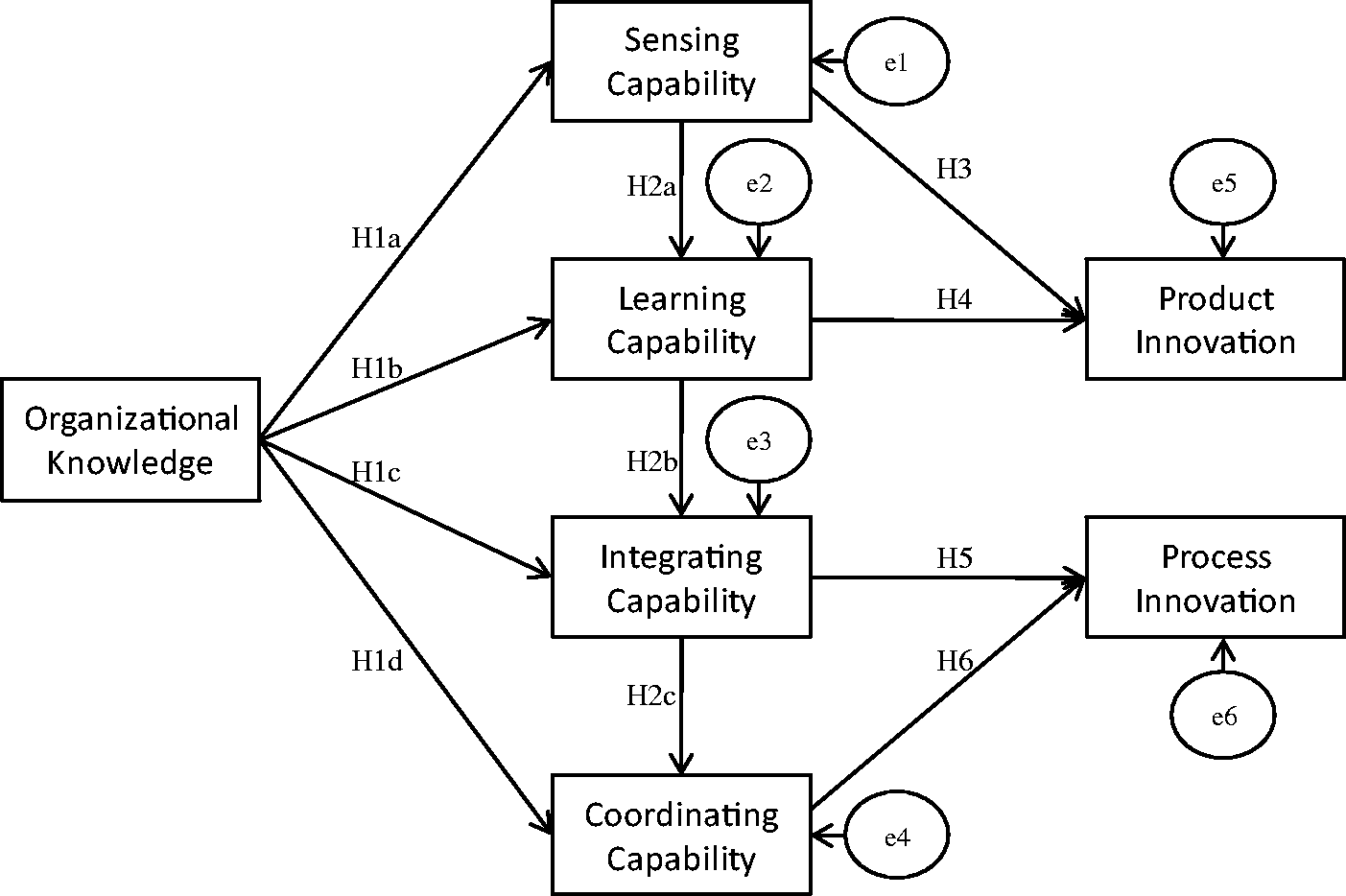
Methodology
Data collection and procedure
The methodological procedure employed is a cross-sectional survey using a self-administered questionnaire. The measures were subjected to a pre-test with five hotel firm managers, in order to ensure that the questionnaire was correctly understood by those who had to complete it. The study’s target population consists of companies that run hotel establishments in Spain with a minimum rating of three stars and at least 50 employees. Spain is the second tourist destination in Europe and the third worldwide, with 61 million visitors in 2013 (World Tourism Organization, 2014). Firms with less than 50 employees were left out to avoid including very small organizations without any formal knowledge-management processes. Only firms with three, four or five star establishments were included because they are considered the most suitable to test the proposed model. Higher category hotels are more professionalized and have a better qualified staff (Camisón, 2000). They are concerned with innovative activities as a way to maintain a certain level of quality that will allow them to retain their category (Pikkemaat and Peters, 2005). Moreover, their knowledge-management processes are more formal, as their competitiveness is fundamentally based on knowledge and innovation (Ordanini and Parasuraman, 2011; Pikkemaat and Peters, 2005).
Tourist lodging firm data were obtained from the 2011 Annual Hostelmarket Report on hotels, restaurants, tourism and leisure. After refining this database, the survey population was reduced to 525 firms. Later on, after receiving the questionnaires of two firms, we detected that one of them had less than 50 members of staff, whereas the other was below the three-star category. Therefore, their questionnaires were discarded and the firms were excluded from the survey population, which was finally established at 523 firms. For this study, we decided to submit the questionnaire to all the sample units, therefore it was subsequently sent to all the firms that made up the population. The data collection process was conducted from September 2011 to March 2012. The firms in the population were contacted up to six times during this period, by e-mail (four times) and post (twice). The process ended with a total of 112 completed questionnaires returned, of which three were rejected. As we explain above, one of the firms had less than 50 employees, a second one was below the three-star category and a third questionnaire had omitted a substantial amount of data. Therefore, 109 firms made up the final sample, representing a 20.84% of the total population. Figure 2 shows the percentage of companies that make up the population and the sample, distributed by autonomous regions. Of the 17 autonomous regions in the Spanish territory, only six contain 87 and 82.57% of the companies included in the population and the sample, respectively.
Percentage of firms in the population and the sample by Spanish Autonomous Region.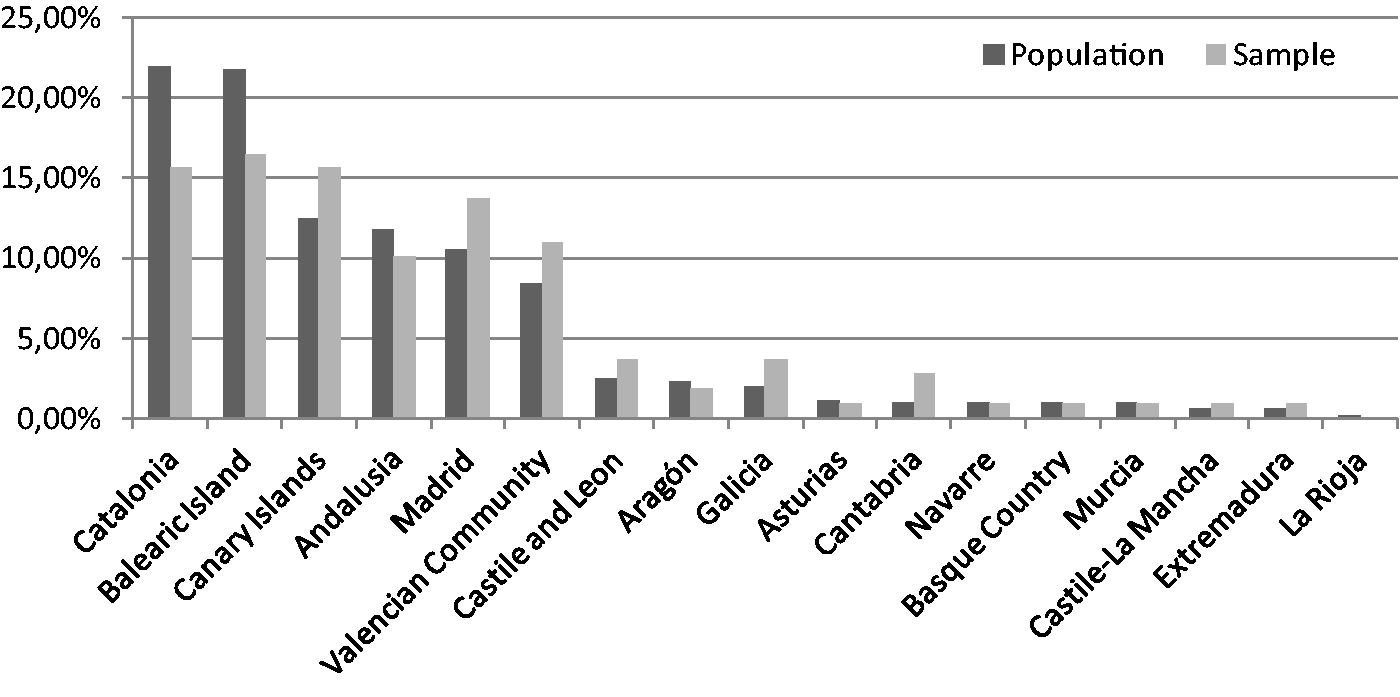
Descriptive statistics of the population and the sample.
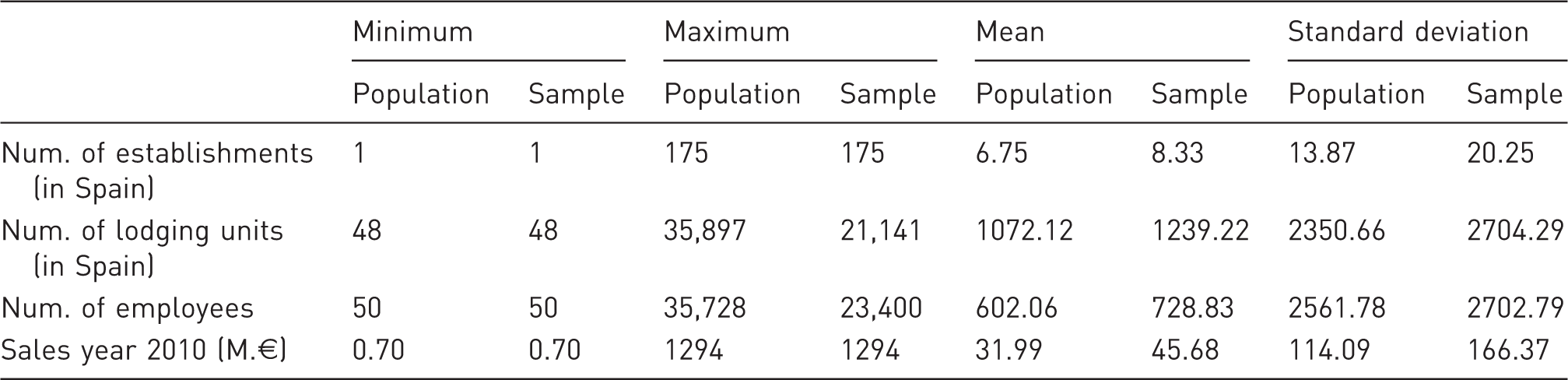
The Kolmogorov–Smirnov test was used to compare the accumulated frequencies of the number of accommodation units, the number of employees and the sales figures of the population and the sample. The results show no significant differences between the population and the sample, which indicates that the sample accurately represents the population being studied.
The professional and demographic variables contained in the questionnaire show that the majority of the respondents have worked for more than 10 years in the sector (73%); more than 5 years in their current firm (78%); have higher educational levels (87%); and perform the functions of general manager (54%), HR manager (22%) and director of policies and planning (10%).
Measurement
All variables were measured using Likert-type seven-point scales. Appendix 1 reports all the items for these constructs. The scale developed by Akgün et al. (2008) was adapted to measure organizational knowledge. It refers to the degree of knowledge and experience related to an organization’s routines, processes and activities. Dynamic capabilities were measured by adapting the scale proposed by Pavlou and El Sawy (2011), who consider them to be a second-order formative construct made up of four dimensions, referred to as the capacity for: (i) sensing, (ii) learning, (iii) integrating and (iv) coordinating. This research assessed reflective constructs (capabilities) separately, in order to evaluate the effects of each individual capability on innovation. This practice does not contradict the original approach of the scale’s authors, as formative indicators do not necessarily share a common theme. Each indicator may capture a unique aspect of the conceptual domain of the aggregated variable to which it pertains (MacKenzie et al., 2005). The product innovation scale was obtained from Nasution et al. (2010), whereas the process innovation measurement was derived from the Oslo Manual (OECD/Eurostat, 2005) and research by Nasution et al. (2010).
The effects of two variables, firm size and firm age, were statistically controlled. These variables were measured by transforming the number of staff and the years since the firm was founded into a natural logarithm. The hotel industry literature is nearly unanimous in pointing out a positive connection between firm size and innovation (Jacob and Groizard, 2007; Martínez and Orfila-Sintes, 2009; Pikkemaat and Peters, 2005). However, although in the goods industry experience with a series of organizational routines can give consolidated firms greater efficiency in carrying out routines (Sorensen and Stuard, 2000), innovations in the hospitality industry could depend to a greater extent on an entrepreneurial orientation or the degree of creativity. The literature associates these aspects more with newly created firms (Tajeddini, 2011).
Analysis and results
Measurement information: Mean, standard deviation, intercorrelations (N = 109).
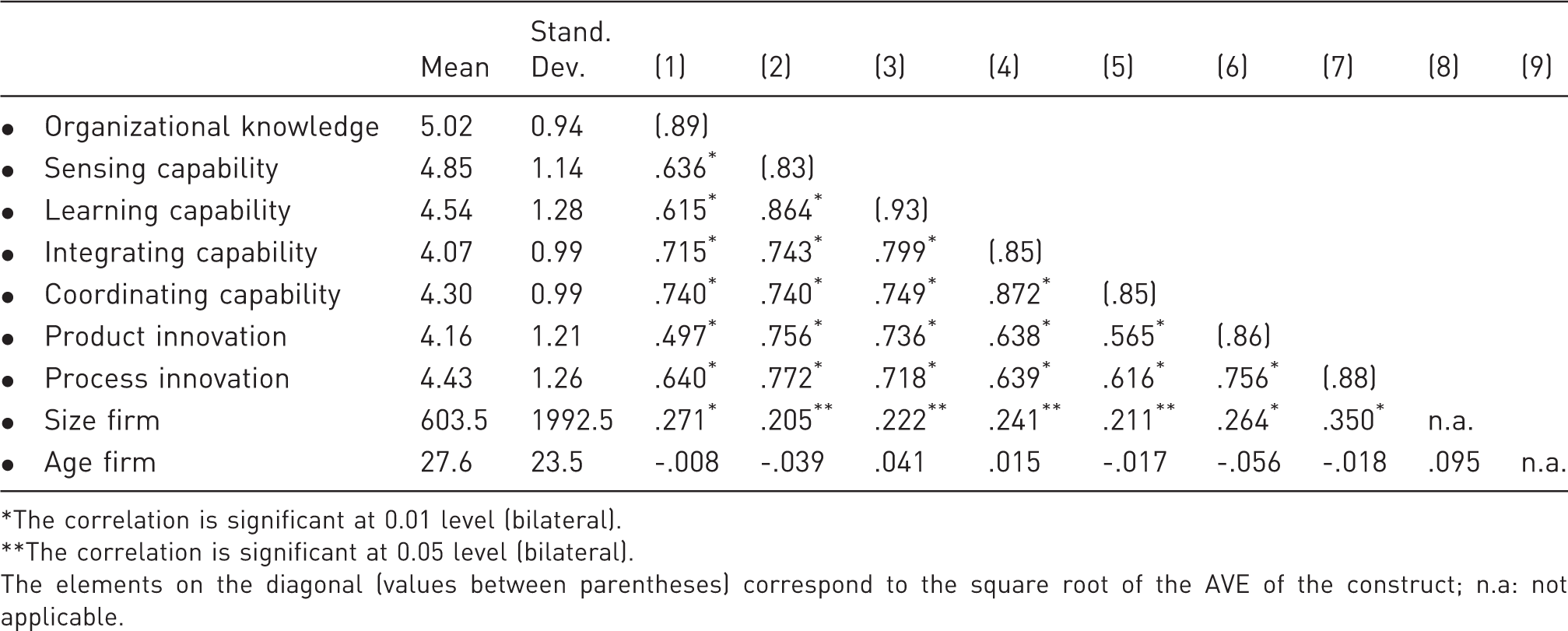
The correlation is significant at 0.01 level (bilateral).
The correlation is significant at 0.05 level (bilateral).
The elements on the diagonal (values between parentheses) correspond to the square root of the AVE of the construct; n.a: not applicable.
This study contemplates a set of multiple and simultaneous dependent relationships between organizational knowledge, dynamic capabilities and innovation. Therefore, the decision was made to contrast a structural equations model using AMOS 21. Structural models make it possible to propose a complete system of variables in such a way that the effects between them can be direct or indirect, and the variables can simultaneously play predictor and dependent roles. Various indices were used to assess the model fit. The root mean square error of approximation (RMSEA) had to be less than 0.08. The Tucker–Lewis index (TLI), Normed fit index (NFI) and Comparative fit index (CFI) are measures ranging from 0 (no fit) to 1 (perfect fit), and values greater than 0.9 are recommended. The Chi-square/degree of freedom ratio (CMIN/DF) was considered appropriate for values lower than 2. The fit index showed that the proposed model was not consistent with the observed data (CMIN: 70.299, p = 0.000, RMSEA: .236, TLI: .823, NFI: .904, IFI: .917, CFI: .916, CMINDF: 7.030), and so it was re-specified on the basis of theoretical considerations and modification indices (MIs). Non-significant relationships were discarded in order to optimize the model. This was done in a step-by-step process, as the structure of the model can alter each time a parameter is eliminated. Furthermore, and taking the MIs into account, three new relationships were added that were not included in the initial hypotheses. Figure 3 shows the final model that best fits the data. All index values are good, indicating an appropriate fit of the model to the data (CMIN: 10.132; p = 0.340; RMSEA: 0.034; TLI: 0.996; NFI: 0.986; CFI: 0.998; CMIN/DF: 1.126). Similarly, the determination coefficient values (R2) for the dependent variables of product innovation (0.60) and process innovation (0.70) indicate satisfactory explanatory power of the model.
The emergent model.
Summary results of hypothesis testing.
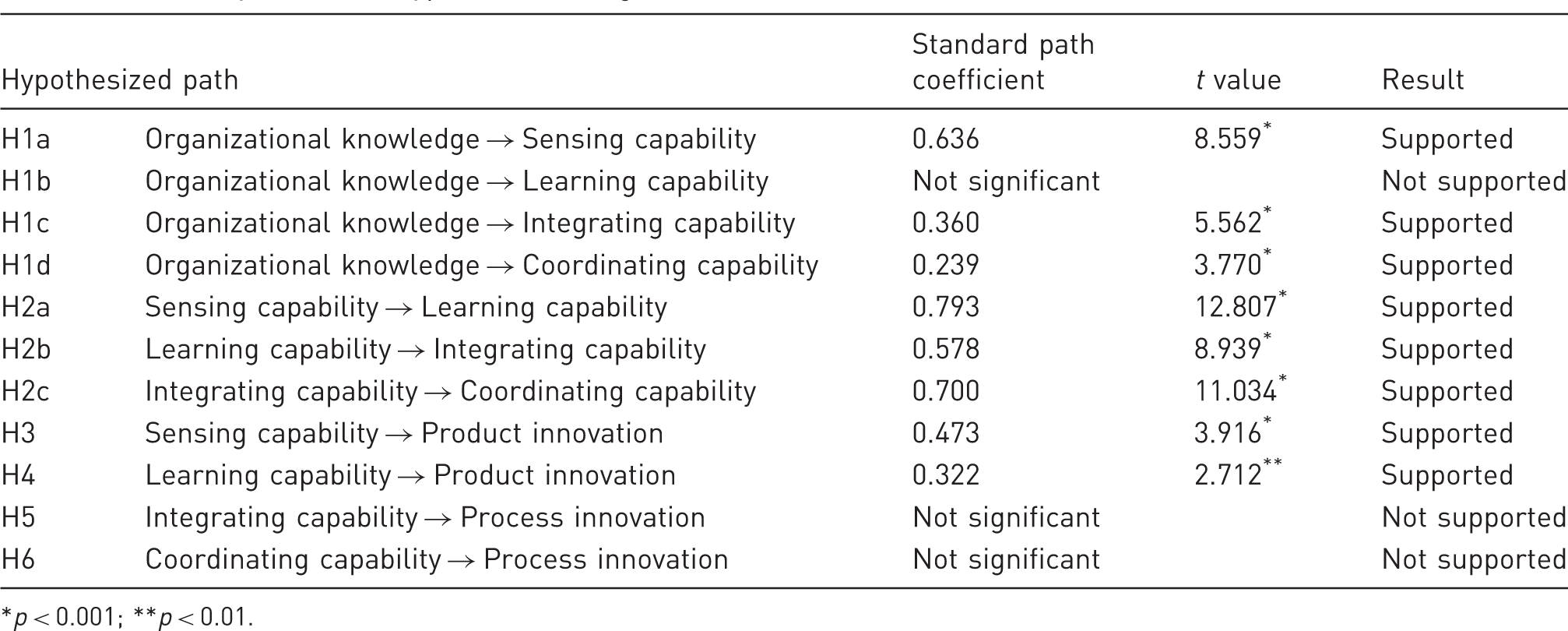
p < 0.001; **p < 0.01.
The emergent model shows three relationships that had not been considered as hypotheses but are theoretically rational. First, although this research has proposed an indirect relationship between organizational knowledge and process innovation, this relationship has been treated in diverse and sometimes contradictory ways. The discrepancy focuses mainly on the fact that knowledge can facilitate defining problems and subsequently generating, evaluating and choosing alternatives, but it can also hinder necessary actions for taking on new opportunities (Brockman and Morgan, 2003). Data show a relationship between organizational knowledge and process innovation (β: 0.240, p < 0.001). Thus, the results indicate that a high level of basic skills in performing tasks and activities is directly and positively related to introducing innovations in these processes. Consequently, organizational knowledge has a direct influence on process innovation, but also an indirect one, in this case through the sensing capability. Second, even though this paper hypothesized that a firm’s ability to detect and take advantage of environmental opportunities only favoured market-oriented innovation (product), the results have shown that it also influences process innovation (β: 0.322, p < 0.001), which has a much more internal focus. New elements that are introduced into a firm’s service or production operations must be in line with environmental requirements. Subsequently, the ability to perceive the necessary changes in this area may also encourage the introduction of innovations into it.
Finally, the data show a positive and significant relationship between product and process innovation (β: 0.393, p < 0.001). The literature has already suggested the simultaneous introduction of different types of innovation (Buzzacchi et al., 1995; Damanpour et al., 2009; OECD/Eurostat, 2005). Results are consistent with Damanpour and Gopalakrishnan (2001), who argue that the synchronic pattern of adopting product–process innovations describes innovation development in service firms more accurately than the time lag pattern, where one type of innovation leads to another, as formulated by Abernathy and Utterback (1978) and Barras (1986, 1990) for the goods and services industries, respectively.
In order to evaluate the role played by the control variables (firm size and age), they were included separately as exogenous variables that could affect the model’s dependent variables. The firm age variable does not show a significant relationship with any innovation type. Firm size has a positive influence on process innovation (β: 0.128, p < 0.05), although this influence is less than that of the other variables in the model. Moreover, the positive and significant relations shown in the model without the control variables continue to present very similar regression weight estimates and significance levels when these variables are added.
Discussion and conclusions
This paper analyses hotel firms’ innovation from two approaches that arise from the RBV: the knowledge-based perspective and the dynamic capabilities view. Innovation, existing knowledge and knowledge-based processes have been examined in depth by researchers during the past decade. However, very few studies have focused on their application to the hospitality industry. This study has attempted to fill this gap and contribute to identifying the factors that encourage innovation in the hospitality industry.
The study has shown that organizational knowledge related to basic skills needed to perform tasks and activities facilitates the development of dynamic capabilities. Therefore, a high level of organizational knowledge influences a firm’s ability to detect, interpret and take advantage of environmental opportunities. It also favours the capacity to combine different individuals’ knowledge and coordinate tasks, resources and activities. All of this indicates that a higher level of collective knowledge improves the organization’s capacity to alter its resource base in order to build new resources and capabilities. While for some authors in-depth knowledge about an organization’s processes and routines is the basis for making changes, other researchers consider it to be an element of rigidity that hinders initiatives to implement changes in an organization. The results of this study shed light on these contradictory assertions, showing that, in the hotel sector, a higher level of organizational knowledge favours developing capabilities that promote the renewal of organizational resources to adapt them to changing conditions. These results confirm the importance of knowledge resources in developing dynamic capabilities in the hospitality sector. In this sense, the findings are coherent with the empirical research by Denicolai et al. (2010), who highlight the important role played by social capital and inter-organizational learning in developing dynamic capabilities within tourism destinations, particularly in the case of small companies.
On the other hand, results show that product innovation is enhanced by sensing and learning capabilities. These results are consistent with the research carried out in the hospitality industry by Ottenbacher et al. (2006). These authors suggest that the development of new products that address markets’ needs and requirements is a determining factor in their success. Process innovation is determined by the sensing capability, organizational knowledge and product innovations. These results reinforce the importance of detecting, interpreting and taking advantage of market opportunities for innovative performance in both products and processes, the latter with a more internal focus. Thus, the results provide empirical support for the theoretical considerations of Okumus (2013), who argues that the dynamic capabilities must allow hospitality businesses to produce new and better products before their competitors do.
The direct relationship between organizational knowledge and process innovation seems to confirm that well-established processes and routines make it easier to introduce innovation. The results presented here come from a sector that fundamentally introduces incremental innovations (Lyons et al., 2007; Tether, 2005) involving progressive modifications based on reinforcing existing knowledge. The data suggest that existing knowledge can affect innovation activities in different ways. On the one hand, it can support incremental innovations; on the other, it can limit innovations that involve more radical changes, although this latter relationship should be tested in future studies. The data do not show a significant association between integrating and coordinating capabilities and innovation. Both capabilities have an internal focus, which can lead to loss of opportunities, as most of the knowledge required to innovate is found outside the organization.
The results also highlight a sequential relationship among the four analysed dynamic capabilities. This sequential process seems to suggest that firms try to attain efficiency through the combined use of their dynamic capabilities. Identifying opportunities (the sensing capability) must lead to creating new goods or services, which requires renovating existing operative capabilities with new abilities and knowledge, that is, using the learning capability. In other words, a firm’s ability to detect changes and existing opportunities in the market should favour the further development of the capacity to take advantage of them, thus creating new knowledge. Moreover, as new knowledge derived from learning is fundamentally in the hands of individuals, the next step is to integrate this individual knowledge into a collective system (integrating capability) and synchronize the whole organization’s tasks and activities (coordinating capability) in order to attain new operative capabilities that better match the changing environment.
Another noteworthy aspect of the study is the relationship found between product innovation and process innovation. Developing new services normally implies making changes in the way they are provided. Results suggest that, for service operations, it may be necessary to apply new methods in order to guarantee successful product innovations. For example, in hotel firms product innovations related to the time-share business allow clients to buy, for several years, periods of stay that they can cash in for points to opt for new destinations. After adopting this innovation, firms can introduce new processes, such as new systems to better follow clients’ tastes and preferences. Moreover, the introduction of innovations in gastronomy (product innovation), establishing, for example, certain food groups adapted to the different types of clients (vegetarians, athletes, etc.), probably require a centralized kitchen for all the hotels in the company (process innovation) in order to improve the results.
Academic and practical implications
The main priority of this paper was to analyse the role of knowledge and dynamic capabilities in the development of innovations in the hotel industry. The research shows that intangible, valuable and difficult to imitate assets, such as knowledge and knowledge-based processes, also play an important role in the way hotel companies adapt to a changing environment. Therefore, this paper makes a novel contribution to the literature because it presents a pioneer study that creates a model of multiple and simultaneous relationships between organizational knowledge, capabilities and innovation in the hospitality business. This model has made it possible to draw a series of conclusions that contribute to the academic literature and, at the same time, have practical implications.
From an academic point of view, this research has led to some original conclusions that are of interest to this sector, where firms had no references for the important role of knowledge-based resources in achieving innovation. The paper has also provided empirical evidence about a question widely discussed in the literature, the idea that existing knowledge could produce organizational rigidity. The data show that, in the studied sector, in-depth knowledge about the organization’s processes and activities fosters the introduction of innovations designed to improve their efficiency and productivity (process innovation). Furthermore, this type of knowledge influences product innovation through the mediator role of the sensing capability.
Regarding practical implications, our results indicate that hotel firms can be more innovative if they are able to detect changes in clients’ preferences and respond by reviewing and adapting their services to consumers’ new desires. At the same time, companies can develop the capacity to detect certain changes by providing the firm’s components with high levels of knowledge related to the routines, activities and processes performed. Thus, firms aiming to achieve innovation must endeavour to build up their collective knowledge. A higher level of knowledge and familiarity with the organizational routines on the part of the employees not only has an indirect influence on the innovation results through the sensing capability, but it also directly influences process innovation. Moreover, managers must keep in mind that product innovation is not just relevant in itself, but it influences the overall innovation results as well, by fostering process innovation.
Limitations and future research
Appendix A: Exploratory and confirmatory factor analysis.

Respondents were asked to indicate their level of agreement with the items. The scale for their answers ranged from 1=“strongly disagree” to 7 = “strongly agree.”
To fit the measurement model, five items were dropped. These are marked “*”.
Footnotes
Declaration of Conflicting Interests
The author(s) declared no potential conflicts of interest with respect to the research, authorship, and/or publication of this article.
Funding
The author(s) received no financial support for the research, authorship, and/or publication of this article.