



Abstract
Colombia is a country that has achieved significant tourism growth in recent years. However, there is limited empirical evidence about its tourism development. Organizational innovation in tourism enterprises is one of the keys to Colombia maintaining positive tourism development. This empirical study analyzes organizational innovation in 364 of Colombiás tourism companies. The findings show that “Directing and Management (The way of directing and managing company)” and “Commercialization and Sales (The way to directing and managing the commercialization and sales of a company)” have a significant relationship with Colombiás tourist enterprises organizational innovations.
Introduction
In the last two decades, there has been growing interest in the topic of innovation in tourism, focusing on different types of innovation in products, processes, marketing, and organizational management. Researchers have also explored potential determinants of innovation in the tourism industry (Hjalager, 2010). In particular, organizational innovation is a topic of interest to the scientific community (Armbruster et al., 2008; Damanpour and Evan, 1984; Han et al., 1998; Hull and Rothenberg, 2008). However, despite the positive development of tourism in different countries, tourism enterprises are facing challenges in productivity and growth. Consequently, innovation as a driver of growth is emerging as a popular development solution (Hjalager, 2002; Pechlaner et al., 2006).
Colombia’s tourism has experienced significant growth over the past decade (Zuñiga-Collazos, 2015), and the number of visitors has quadrupled according to the Ministry of Commerce, Industry, and Tourism, with 557,280 visitors in 2000 to 2.15 million in 2010. However, the empirical evidence on innovation in tourism enterprises remains very limited (Zuñiga-Collazos et al., 2015). Consequently, there is a gap in understanding the growth in Colombia’s tourism industry and the enterprises that provide the industry’s foundation. The purpose of this study is to analyze the relationship between Colombiás tourist enterprises organizational innovations (CTEOI) in a sample of small and medium tourism enterprises using conceptual variables: organizational innovation as the dependent variable and two factors that measure organizational innovation as the independent variable.
Organizational innovation
According to Organization for Economic Co-operation and Development (OECD) and Eurostat (2005) there exist four types of innovation: (1) product innovations, referring to significant change in the characteristics of goods and services, meaning new products and improved existing products; (2) process innovations, referring to significant changes in the methods of product and distribution; (3) organizational innovations, referring to the implementation of new methods of organizations; and (4) marketing innovations, referring to all practices of developing new marketing processes, marketing, and selling products or services. Organizational innovation is “the implementation of a new organizational method in the firm’s business practices, workplace organization or external relations. Organizational innovations can be intended to increase performance in a firm by reducing administrative costs or transaction costs, improving workplace satisfaction (and thus labor productivity), gaining access to non-tradable assets (such as non-codified external knowledge) or reducing costs of supplies” (OECD and Eurostat, 2005).
Organizational innovation activities can lead to reduced administrative costs, workplace satisfaction and access to external knowledge, and in turn, facilitate product innovation activities (Damanpour and Evan, 1984; OECD and Eurostat, 2005). These types of activities such as new management practices, processes, techniques, and new organizational structures (Birkinshaw et al., 2008) may help to improve the firm’s capability to implement various innovation activities (Ceylan, 2013). Moreover, organizational innovation may facilitate the initiation and adoption of innovation activities in processes (Armbruster et al., 2008; Damanpour and Evan, 1984). In order to develop new processes such as new production or supply methods, knowledge and skills of various functions are needed, and organizational innovation activities can help to change and apply new processes by increasing the capacity of various functions (Boer and During, 2001).
According to Hjalager (2010) Organizational Innovation is so important that it has led tourism literature to consider studies in that field. In the literature, there is evidence that suggests a positive link between organizational innovation capability and financial performance (Han et al., 1998; Hull and Rothenberg, 2008; Jansen et al., 2006). The rationale here is that a firm that has organization innovation may better understand both directing and management (the way of directing and managing a company), and the ability to have very good commercialization and sales of products and services (The way of directing and managing the commercialization and sales of the company).
Directing and management
The success of a company may depend largely on how it directs and manages the company. In this sense, the introduction of new organizational methods within the firm could be beneficial in improving its operational practices as the way of directing and managing. This is related to administrative efforts aimed at renewing the organizational routines, procedures, mechanisms or systems and promoting teamwork, information sharing, coordination, cooperation, collaboration, learning, and innovation (Gunday et al., 2011; Nicolau and Santa-María, 2013).
In addition, according to Nicolau and Santa-María, (2013), different types of innovating activities on directing and management are not only important for the enterprise’s day-to-day operations, but also especially relevant for tourism companies which may need support in order to be stronger and competitive (Hall and Williams, 2008; Ottenbacher and Gnoth, 2005).
Commercialization and sales
The success of the innovation process in an organization depends on the way of organizing the search for new ideas that have commercial potential outside the organization (Kattara and El-Said, 2013). According to Ceylan (2013), organizational innovation activities can be linked to marketing (as commercialization and sales) innovation activities (Schubert, 2010) and can facilitate responses to changes in the market (Armbruster et al., 2008). Hence, changes in marketing methods may become vital to adapt to a new market situation (Martensen and Mouritsen, 2014). Several empirical studies show that a firm’s capabilities of managing and implementing management processes or practices as inter-functional coordination, total quality management (TQM), information management, etc. affect its capabilities for commercialization and sales innovation activities (Martensen and Mouritsen, 2014; Merrilees et al., 2011; Naidoo, 2010; Nicolau and Santa-María, 2013). In other words, there is a direct relationship between organizational innovation and a companýs commercialization and sales process.
Methodology
According to Cohen and Cohen (1983) and Hair et al. (1995) regression analysis is useful because it can (1) explain the relationship between one variable with others and (2) estimate the behavior of a variable based on what is known of other variables that influence that variable’s behavior.
Therefore, this statistical technique is best suited for this study in determining the factors that explain the development level of organizational innovation in Colombian tourism enterprises. Many studies have shown the relevance of the use of linear regression in business (Frees, 1996). Of course, regression analysis is also common in tourism research (Hossain et al., 2012; Naudé and Saayman, 2005), where the technique has been used to assess different tourism contexts and determinants (Turaev, 2010).
In this study, this technique can explain the relationship between the independent variables and the Colombiás tourist enterprises organizational innovations (CTEOI), or for predicative purposes, estimate the behavior of CTEOI and determine the influence of independent variables. The suggested model has the following structure determined by the dependent variable:

The independent variables are Inn-Org1 and Inn-Org2. Inn-Org1 is directing and management (Gunday et al., 2011; Hall and Williams, 2008; Nicolau and Santa-María, 2013; Ottenbacher and Gnoth, 2005) could influence the CTEOI in the extent that Colombian tourism companies make or introduce new organizational methods within the firm to improve its operational practices as the way of directing and managing company improvements (make changes to improve the way of directing and managing a company); Inn-Org2 is commercialization and sales (Armbruster et al., 2008; Ceylan, 2013; Martensen and Mouritsen, 2014; Schubert, 2010) could influence the CTEOI in the extent that Colombian tourism companies make, improve or incorporate new ways of directing and managing the commercialization and sales of the company.
Sampling
A survey was designed and applied to a representative sample of 364 managers with tourism enterprises in the cities of Medellin, Calarca, Popayan, and Santander de Quilichao. Data collected for the study contain a sample of different tourism businesses, including 74 (20.33%) hotels, 203 (54.77%) restaurants, 14 (3.58%) travel agencies, 24 (6.59%) companies providing hosting services, and 49 (13.46%) other types of tourism businesses. The companies surveyed are small and medium enterprises (SMEs). According to the Ministry of Commerce, Industry, and Tourism of Colombia, the sample included, by firm size: 0–10 workers, called micro-enterprise (82.7% of the sample), 11–50 workers (15.39%), called small-enterprise, and 51–200 workers (1.61%), called medium enterprise; 15.43% of the companies have been established in the market between 2.1 and four years, but it is also important to note that 27% of the companies are start-ups with less than two years in the marketplace.
Analysis
Correlation matrix (N = 364).
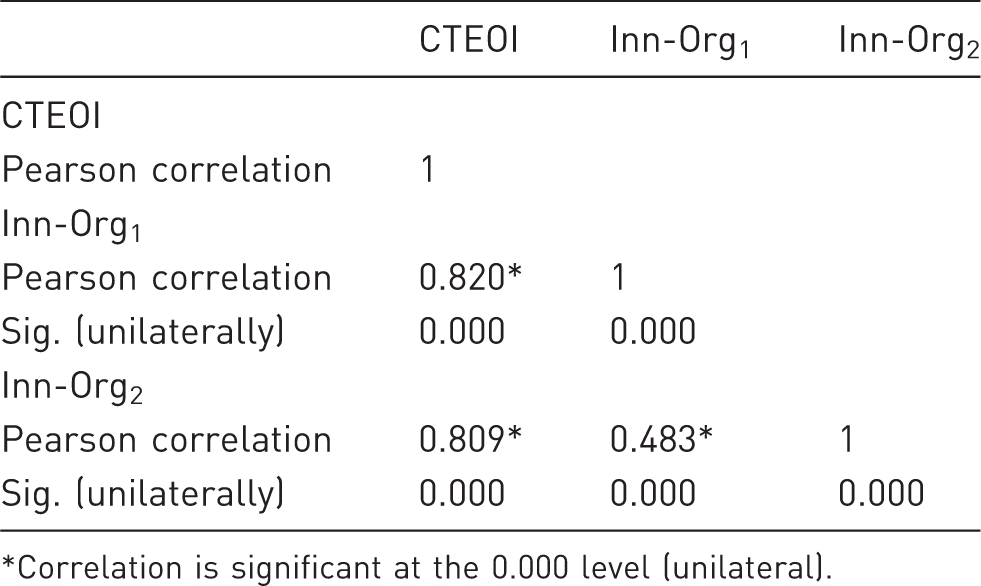
Correlation is significant at the 0.000 level (unilateral).
On the other hand, as observed in the coefficient matrix (see Table 1), there are no problems of multi-collinearity; therefore, for each of the variables, their tolerance indicator is not less than 0.10, as suggested by the theory of Menard 1995 (cited by Aldás, 2008). Finally, the detection of outliers is calculated by the Mahalanobis distance and its significance, using the method suggested by Aldás (2008). According to the analysis, none of the analyzed data shows a statistically significant Mahalanobis distance (p < 0.001) to infer the existence of an outlier.
Outputs for ANOVA analysis shows that the significance level for the F test of the regression is 0.000 that is lower than 0.05 as the minimum level of significance expected; therefore, the hypothesis, H0 is rejected, and must be at least β ≠ 0, and thus at least some of the independent variables explain the behavior of the dependent variable CTEOI. Subsequently, the significance of the parameters is evaluated individually. For this the t test is evaluated in the coefficient matrix, taking into account the hypotheses H0: βj = 0 and H1: βj ≠ 0.
Matrix of coefficients.
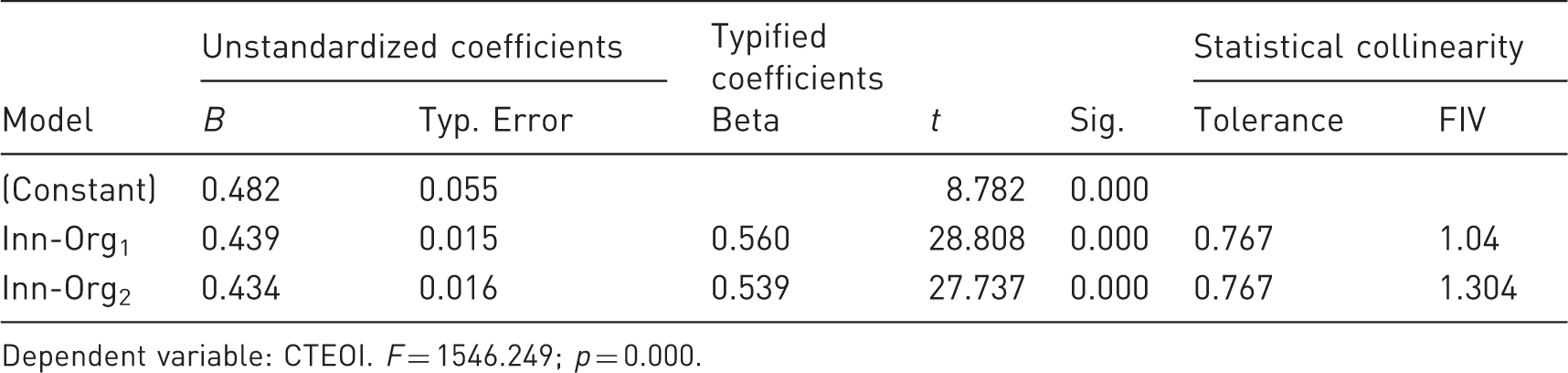
Dependent variable: CTEOI. F = 1546.249; p = 0.000.

Regression results.
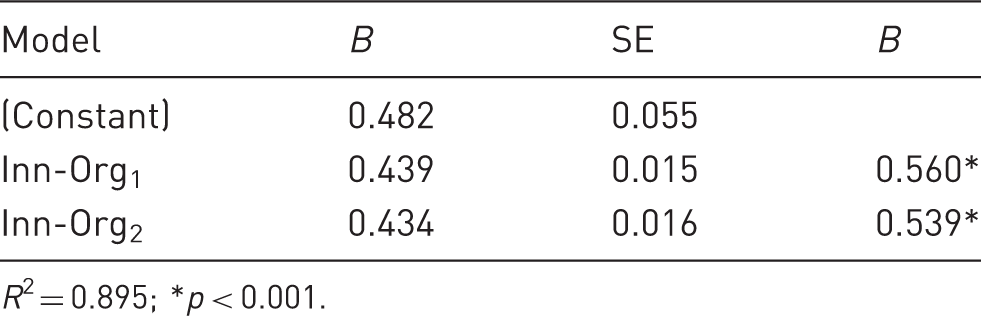
R2 = 0.895; *p < 0.001.
Results
The implementation of organizational innovation activities in Colombian tourist companies is an emerging practice, and according to the results of this study, they spend relatively little effort in achieving this type of innovation. This finding is true for each aspect of innovation. Inn-Org1, which is innovation understood as the process of directing and managing a company, had an average rating of 3.01 out of 5.0 by entrepreneurs. This indicates that the level of changes or improvements in its operational practices as the way of directing and managing a company is a priority for all companies surveyed. Likewise, reviewing the minimum and maximum of Inn-Org1obtained, it appears that there are companies that have made little effort in this direction, and others who have done their best to contribute to this task so that not all have the same level of intent to innovate from the directing and management. Inn-Org2 which is organizational innovation understood as the way to directing and managing the commercialization and sales of a company, had an average rating of 3.0 out of 5.0 on the part of employers, indicating that the level of innovation in commercialization and sales is not being carried out as a priority in all companies surveyed, and compared to the generation of improvements in this type of innovation, that task is not a priority. Likewise, reviewing the minimum and maximum rating of Inn-Org2 obtained, it appears that there are companies that have made little effort in this trend. However, others have made some effort to do so in order not to have the same level of intent to improve or obtain new forms (procedures) of commercialization and sales in a company.
In general, this study shows that research and development is given a low priority by Colombian tourism companies.
Conclusions
The results allow a better understanding of the relationship between organizational innovations in the tourism sector. They also provide important empirical evidence supporting the theoretical conceptualization described by Armbruster et al., (2008), Ceylan (2013), Gunday et al. (2011), Hall and Williams (2008), Martensen and Mouritsen (2014), Nicolau and Santa-María (2013), Ottenbacher and Gnoth (2005), and Schubert (2010), and these results increase this type of evidence for companies located in less developed destinations, where the dynamic and context is different from more established destinations. This could justify the difference in the correlation between Inn-Org1, Inn-Org2 with CTEOI. These correlations are described below. For less developed countries, organizational innovation should be addressed as a major determining factor in sustained tourism. In connection with how well the model fits, we can say that with a correlated R2 of 0.895. The model is explaining 89.5% of the information with the variables used, namely Inn-Org1 and Inn-Org2, while the remaining 10.5% of the data can be explained by other variables that have not been taken into account in the model.
The main conclusion of this study is the observation of a significant relationship regarding the CTEOI with the variables Inn-Org1 (0.439), Inn-Org2 (0.434), and that these relationships are positive, as shown by their coefficients. In sum, there exists a positive linear relationship between the dependent variable CTEOI with the independent variables Inn-Org1 and Inn-Org2, and Inn-Org1 is the variable that contributes the most to the model. In order to predict the degree of Colombiás tourist enterprises organizational innovations, the regression coefficients allow identifying the relative importance of individual variables to predict the relevance of variables In this case, it is clear that the variable Inn-Org1 is the most important (0.439), followed closely by Inn-Org2 (0.434).
Finally, this study presents some limitations. In order to expand the sample to a larger number of cities in the country, it is recommended that in future studies the sample can be extended to cities with relatively good tourist development. On the other hand, future research should identify correlations of other innovation variables as process innovation.
Footnotes
Declaration of conflicting interests
The author(s) declared no potential conflicts of interest with respect to the research, authorship, and/or publication of this article.
Funding
The author(s) received no financial support for the research, authorship, and/or publication of this article.