



Abstract
This study explores the nature of the relationship between market orientation and business performance and the mediating role of customer loyalty in this relationship. Empirical analysis was based on a sample from the Western European hotel industry. Research results indicate that market orientation has a positive direct effect on business performance and that the effects of market orientation on business performance are mediated through customer loyalty. Market orientation produces a positive effect on customer loyalty, which in turn has a positive effect on business performance, showing that market orientation has a significant and positive indirect effect on business performance. These findings suggest potential major implications for the hotel industry. For example, by developing a market-oriented organization, hotels could produce positive effects on customer loyalty and consequently on their business performance.
Introduction
The tourism industry depends on the hotels’ ability to provide accommodation and is recognized as a key factor influencing a country or region’s economic potential, employment and social and environmental variables (Eurostat, 2017). This is particularly the case of Europe which is the world’s top tourist destination and accounted for 51% of the worldwide international tourist arrivals in 2017 (World Tourism Organization, 2018). In absolute terms, the highest international travel receipts in 2015 were recorded in Spain (EUR 50.9 billion), France (EUR 41.4 billion) and the United Kingdom (EUR 41.1 billion), followed by Italy (EUR 35.6 billion) and Germany (EUR 33.3 billion), contributing towards employment and economic growth, as well as development in rural, peripherical or less-developed areas (Eurostat, 2017).
Research on market orientation experienced fast development in the 1990s when Narver and Slater (1990) and Kohli and Jaworski (1990) established the cornerstone for the subsequent studies on this subject. Despite evidence of a positive relationship between market orientation and business performance, research in the service sector was scarce (Tajeddini, 2010) and mainly directed at the industrial and consumer goods sectors (Gray et al., 2002; Quintana-Déniz et al., 2007; Sin et al., 2005). Nevertheless, in recent years, mostly from the beginning of the century to date, several studies have been developed (Barbosa and Ayala, 2014; Bazazo et al., 2017; Hinson et al., 2017; Jogaratnam, 2017; Kasim et al., 2018; Polo-Peña et al., 2012, 2015; Vega-Vázquez et al., 2016; Wang et al., 2012). Yet, these were mainly based on regional or country context.
Loyalty is widely accepted as a customer consequence of market orientation (Jaworski and Kohli, 1996; Kirca et al., 2005). Market-oriented companies are generally well prepared to satisfy customer needs and exceed their expectations, therefore providing customer satisfaction and building customer loyalty (Slater and Narver, 1994b). On the other hand, among the consequences of customer loyalty, namely word-of-mouth, the willingness to pay more and profitability (Kandampully et al., 2015), the latter plays a central role in assessing business performance.
Consequently, this work seeks to fill two key gaps in knowledge. First, from a practical standpoint, the tourism and hotel industries contribute heavily to economic growth, with Western Europe playing a major role in world tourism. Despite the extent of the market orientation literature, little research has been done to understand the relationship between market orientation and business performance in the hotel industry using data from several countries. Studies on this issue focus mainly on a regional or country context; yet, many of hotel chains are present internationally. Second, loyalty is widely accepted as a consequence of market orientation and an antecedent of business performance. However, despite the positive effect of customer loyalty as a mediator in the relationship between market orientation and business performance (Kirca et al., 2005), research on this subject in the hospitality industry remains limited.
Therefore, this study seeks to deal with two specific objectives. The first is to evaluate the relationship between market orientation and business performance and the mediating effect of customer loyalty on this relationship in the hotel industry. The second objective is to expand the knowledge on this subject in an international context by using a sample obtained in Western European countries.
To accomplish these goals, an analysis of the background literature about market orientation, business performance and customer loyalty in the hotel industry was conducted and a structural research model was developed.
To test the structural model and evaluate the relationships between variables, a survey was sent to a sample of hotel companies from France, Ireland, Italy, Portugal, Spain and the United Kingdom.
Theoretical background and hypotheses development
Market orientation, customer loyalty and business performance in the hotel industry
The advent of the 1990s brought to the market orientation literature two main contributions: Narver and Slater (1990) defined as the aspect of the organizational culture that most effectively and efficiently generates the necessary behaviours for the creation of superior value for buyers and, thus, continuous superior performance, consisting of three behavioural components: customer orientation, competitor orientation and inter-functional coordination; Conversely, Kohli and Jaworski (1990) defined market orientation as the organization’s wide generation of market intelligence pertaining to current and future customer needs, dissemination of the intelligence across departments, and organization wide responsiveness to it. As such, it consists of three activities: intelligence generation, intelligence dissemination and responsiveness, or response to market intelligence.
During this period, several market orientation measurement scales were proposed (Deshpandé et al., 1993; Deshpandé and Farley, 1998; Kohli et al., 1993; Narver and Slater, 1990; Ruekert, 1992), each being criticized for the inconsistency of the relationship between market orientation and business performance.
Despite these developments, the hospitality sector has been relatively overlooked in the development of the existing market orientation measurement models. In general, the scales used were based on former models, namely the MARKOR and MKTOR scales, or their adaptations (Campo et al., 2014; Polo-Peña et al., 2012; Wang et al., 2012). Meanwhile, evidence of a positive relationship between market orientation and business performance is fully recognized in the market orientation literature and, besides some inconsistent results on the hospitality sector (Au and Tse, 1995; Sargeant and Mohamad, 1999), empirical results show a positive relationship between market orientation and business performance in the hotel industry (Agarwal et al., 2003; Campo et al., 2014; Gray et al., 2000; Polo-Peña et al., 2012; Qu and Ennew, 2003; Sandvik and Sandvik, 2003; Sin et al., 2005). Therefore, it is commonly accepted that market orientation and business performance are positively associated in hotel companies.
Market orientation enables value creation for customers and continuous business performance improvement (Narver and Slater, 1990), further allowing for a unifying objective of customer satisfaction in individuals and departments, leading to a superior business performance. It also produces a sense of belonging among the workforce, who work on the central goal of satisfying the customer (Kohli and Jaworski, 1990), which, in turn, leads to a superior business performance.
Due to the above framework the first hypothesis was formulated: H1: Market orientation has a positive and significant direct impact on hotels’ business performance.
The hotel industry comprises a wide range of operations where production and sales are combined in the same premises and happen mostly simultaneously with the customer leaving the premises with no tangible product (Mullins, 1993). Moreover, satisfying customers’ needs is generally assumed to be a significant determinant of repeating sales, positive word-of-mouth, and consumer loyalty (Bearden and Teel, 1983). Satisfaction is also important to customers, since it represents the positive effect or the reward for satisfying needs (Day and Landon, 1977). Furthermore, consumer satisfaction levels essentially depend on two factors: expected service and perceived service (Grönroos, 1984). In other words, the customers’ expectations and the perceptions of service directly influence consumer satisfaction and the service value (Gallarza and Saura, 2006). In order to avoid the adverse effects of selecting the wrong product, hotel customers are also likely to resort to their past experience (perceived service) to guide their future purchase decisions (Pan et al., 2012). So, the more satisfied they are with the product, the more likely they are to return, or the more loyal they may become.
Moreover, market-oriented companies are able to build customer loyalty, because of the long-term commitment to understanding their customers’ expectations and how they change, in order to motivate employees, to view customer satisfaction as a primary objective, to consistently monitor customer satisfaction and to stay in touch with customers after the sale (Slater and Narver, 1994b). Furthermore, market orientation is also linked to customer loyalty. Customer loyalty depends on what a company offers and on what the market, including a company’s competition, offers. Therefore, the firm’s ability to generate intelligence about customers and their competition plays a key role in improving customer loyalty.
Consequently, the second hypothesis was proposed: H2: Market orientation has a positive and significant impact on hotels customer loyalty.
In creating and maintaining customer loyalty, a company develops a long-term mutually beneficial relationship with the customers (Pan et al., 2012), with financial and non-financial benefits (Siu et al., 2013) based on the firms’ ability to increase customer value, therefore improving business performance (Kandampully et al., 2015; Kandampully and Hu, 2007). Additionally, a prerequisite to creating knowledge relationships is to build loyalty. Knowledge of customers emerges from observing their purchase behaviour, asking them to provide information on their wants and needs, and then storing this information so that products and services can be customized to their wishes (Shoemaker and Bowen, 2003). Since it relies heavily on employees’ interactions with customers, the hospitality industry, depends on these interactions to gather information about customers so as to provide a superior perceived value, which is key to customer loyalty (Chang, 2013).
By providing superior value to customers directly links loyalty to market orientation. To possess a sufficient understanding of one’s target buyers it is a prerequisite for a firm to continuously create superior value to its customers (Narver and Slater, 1990) and to generate intelligence about customers is a key construct of market orientation (Kohli and Jaworski, 1990). So, knowing the customers’ present and latent needs and desires enables the firm to provide superior value to customers, leading to improvements in customer loyalty which, in turn, creates benefits to business performance. However, creating superior value for customers requires a balanced customer and competitor perspective (Day and Wensley, 1988).
Loyal customers repeat purchases. They purchase more hotel products and services and perform partnership activities, like positive word-of-mouth which, shared with colleagues, reduces a person’s risk when choosing an unknown hotel (Bowen and Shoemaker, 1998). This has substantial financial implications for hotels as it improves its business performance (Kandampully and Hu, 2007; Reichheld and Sasser, 1990). Besides, loyal customers display decreased sensitivity over time and the positive word-of-mouth actions on the part of those customers produces a cost reduction. Loyal customers buy almost exclusively from a hotel referring to it as ‘their hotel’, thereby improving business performance (Bowen and Shoemaker, 1998; Shoemaker and Lewis, 1999).
Thus, due to the above framework, the following hypotheses were formulated: H3: Customer loyalty has a positive and significant impact on a hotels’ business performance. H4: The relationship between market orientation and business performance in the hotel industry is mediated through customer loyalty.
As a result, the proposed model (Figure 1) sets market orientation as a predecessor of loyalty, and states that market orientation should have a positive effect on customer loyalty, as it should on business performance. Furthermore, customer loyalty should have a positive effect on business performance, while market orientation effects on business performance should be enhanced by the mediating effect of loyalty in this relationship.
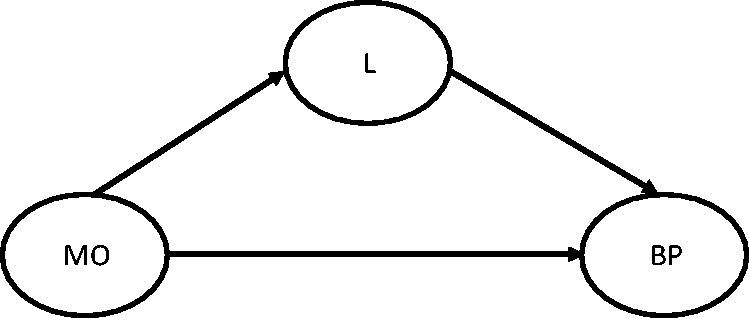
Proposed model.
Methodology
Sample
Web surveys sent by email have advantages such as low cost and speed as well as reaching a wider geographical context (Hung and Law, 2011; McPeake et al., 2014; Wright, 2005). Furthermore, the relationship between market orientation and business performance has been studied mainly using quantitative methods with solid developments (Campo et al., 2014; Jogaratnam, 2017; Kohli et al., 1993; Narver and Slater, 1990; Polo-Peña et al., 2015), so this method was deemed as the one capable of maximizing the outcomes of the study in a timely and costly manner. Therefore, a survey was sent by email to hotel managers, across six countries in Western Europe, to test the proposed model.
According to the World Tourism Organization (2018), Europe represents the highest share of world tourism and, among European countries the most relevant are Spain (295 million nights), Italy (199 million nights), France (124 million nights) and the United Kingdom (119 million nights), together account for more than half (55.7%) of the total nights spent by non-residents in the EU-28. Given the contribution of these four countries in European tourism, they were included in the sample. Two other countries were also added to the sample: Portugal, because of its cultural and language similarities with Spain, France and Italy; and Ireland because of the shared culture and language with the United Kingdom. Consequently, data used in this research were collected using an online survey sent to the top managers, owners, CEOs and presidents of 32,377 hotels from France, Ireland, Italy, Portugal, Spain and the United Kingdom.
For the purpose of this study, hotel companies were defined as tourist accommodation establishments, namely units providing a paid service (although the price might be partially or fully subsidized) and short-term or short-stay accommodation services (Eurostat, 2013).
Hotel contacts were obtained through government tourism departments and yellow pages’ services around the study context. A total of 458 responses were obtained. The survey included a mandatory question asking the respondent their role in the company. From the 458 surveys received, 11 were excluded because the respondent’s role in the organization did not fit the prerequisites. The remaining 447 responses were considered valid. 88.6% (396) surveys were answered by the hotel director, owner or CEO and the remaining 11.4% (51) surveys were answered by marketing directors or sales directors.
Descriptive statistics were computed, and the retrieved data showed that 21 (4.70%) were one-star hotels, 70 (15.66%) were two-star hotels, 162 (36.24%) were three-star hotels, 159 (35.57%) were four-star hotels, and 35 (7.83%) were five-star hotels. Regarding the industrial structure, 79 (17.67%) hotels were part of a hotel chain and 368 (82.33%) were independent hotels. Data collection was performed between October 2013 and January 2014.
Measurement scales
Survey items were measured with a 1–7 Likert-type scale in which 1 represents strongly disagree and 7 represents strongly agree and aggregated three scales to measure market orientation, customer loyalty and business performance.
While empirical studies on market orientation are prolific, they mainly use the MARKOR scale (Kohli et al., 1993) or the MKTOR scale (Slater and Narver, 2000). These scales represent the cornerstone of market orientation measurement, although they have several problems and have faced severe criticism in the past, in particular about validity and reliability issues (Farrell, 2002; Farrell and Oczkowski, 1997; Gauzente, 1999; Pelham, 1993; Siguaw et al., 1993). On the other hand, further questions were raised about its generalization to different contexts. For instance, the relationship between market orientation and business performance presents slightly different results, according to the geographical context (Ellis, 2006; Kirca et al., 2005; Langerak, 2003; Shoham et al., 2005) or according to the market orientation scale used (Cano et al., 2004; Ellis, 2006; Langerak, 2003; Vieira, 2010).
Therefore, a market orientation measurement scale was developed based on a literature analysis and following the guidelines suggested by Churchill (1979), Nunnaly and Bernstein (1994) and Webb (2002). A set of 21 items were developed and an online survey was sent by email to academic experts in marketing from universities across the studied context (France, Italy, Portugal, Spain Ireland and the United Kingdom) to assess the content validity. Experts were asked to provide their feedback about the proposed scale items and dimensions. Fourteen answers were obtained (2 from France, 2 from Italy, 3 from Portugal, 6 from Spain and 1 from United Kingdom and Ireland) showing a consensus about the proposed measurement model items and dimensions. The market orientation (MO) measurement scale was, therefore, a multidimensional construct based on three dimensions of intelligence generation, intelligence dissemination and a coordinated response about three domains: client; competition; and market structure. Additionally, literature analysis enabled the authors to identify two forms of indicators: action indicators, as frequency, quickness and use, and position indicators as level, commitment and existence. These indicators were integrated in a scale proposal with 21 items. Each one of the three dimensions (intelligence generation (IG), intelligence dissemination (ID) and a coordinated response (CR)) with seven items.
Customer’s loyalty (L): A scale with four subjective indicators of customer loyalty, measuring customer retention and customer recommendation, based on literature review on customer loyalty.
Business performance (BP): A scale with five subjective indicators was used, partially based on Powell’s (1995) total performance scale, measuring profitability, sales growth and occupancy rate.
A component-based structural equation modelling was used once the research goal is predicting key target constructs or identifying key ‘driver’ constructs (Hair et al., 2011).
Results
Since this study used component-based structural equation modelling (PLS), SmartPLS 3.0 (Ringle et al., 2015) software was chosen to compute data. Data analysis was conducted in two steps. Following Hair et al. (2013), the first step was done by evaluating the measurement models, namely indicator reliability, model purification and internal consistency reliability (using the composite reliability indicator). Convergent validity was evaluated through the average variance extracted (AVE) and the discriminant validity, by comparing the square root of the AVE of each construct with the other constructs correlations (Fornell and Larker, 1981). Indicator’s outer loadings on a construct were also evaluated and should be higher than all its cross loadings with other constructs. Furthermore, the theoretical proposed model was tested and individual hypotheses and general structural model were evaluated.
Evaluating the measurement models
The proposed model presents second order constructs, thus a two-step analysis was conducted (Wright et al., 2012), with a first-order constructs analysis being held before a second order one.
Evaluating first-order and second-order constructs
The indicators correlation matrix was evaluated. Indicators with outer loadings less than 0.55 were removed from model, those with outer loadings below 0.55 threshold share little in common and are of questionable value in defining the variable (Falk and Miller, 1992). Thus, indicators IG7 = 0.507 and CR3 = 0.285 were removed from the model (the measurement models and first- and second-order constructs and outer loadings are described in Appendix 1).
On the other hand, the average variance extracted values (AVE) and the square root of the AVE of each construct, which should be higher than their highest correlation with any other construct (Fornell and Larker, 1981), were analysed in order to assess convergent validity and discriminant validity respectively (Table 1, model 1). Discriminant validity criteria were not met. To work around this issue further analysis was performed. IG construct did not pass the AVE square root-latent constructs correlation matrix criteria: therefore, IG single indicators outer loadings were carefully analysed by means of further removing do not decrease content validity (Hair et al., 2013) and item IG3 = 0.649 was deleted from the model.
First-order model 1 and model 2, validity and reliability indicators.
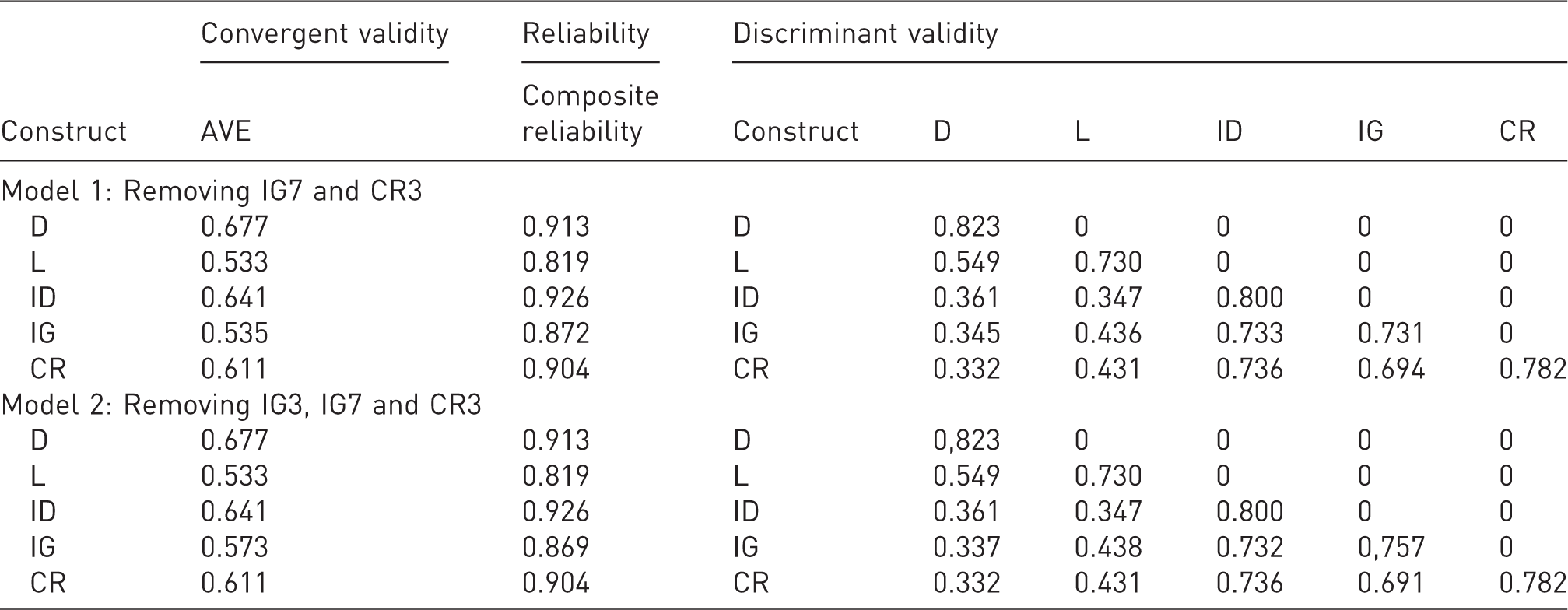
Data from the purified model were computed and validity and reliability were evaluated (Table 1, model 2). Moreover, second order constructs validity and reliability were evaluated (Table 2). Findings show that the measurement models had the appropriate convergent and discriminant validity and reliability.
Second order validity and reliability indicators.

Testing the proposed model
The proposed model was assessed with structural equation modelling, which enables the evaluation of the relationship between the model’s variables and to test proposed hypotheses. Furthermore, to assess customer loyalty mediating effects, the Preacher and Hayes (2008) approach was used. This approach was employed in empirical studies (Castro and Roldán, 2013; Vega-Vázquez et al., 2016) and guidelines applied to partial least squares studies that have been settled in recent years (Hair et al., 2013; Nitzl et al., 2016). Therefore, the first step was to evaluate the significance of the coefficient path
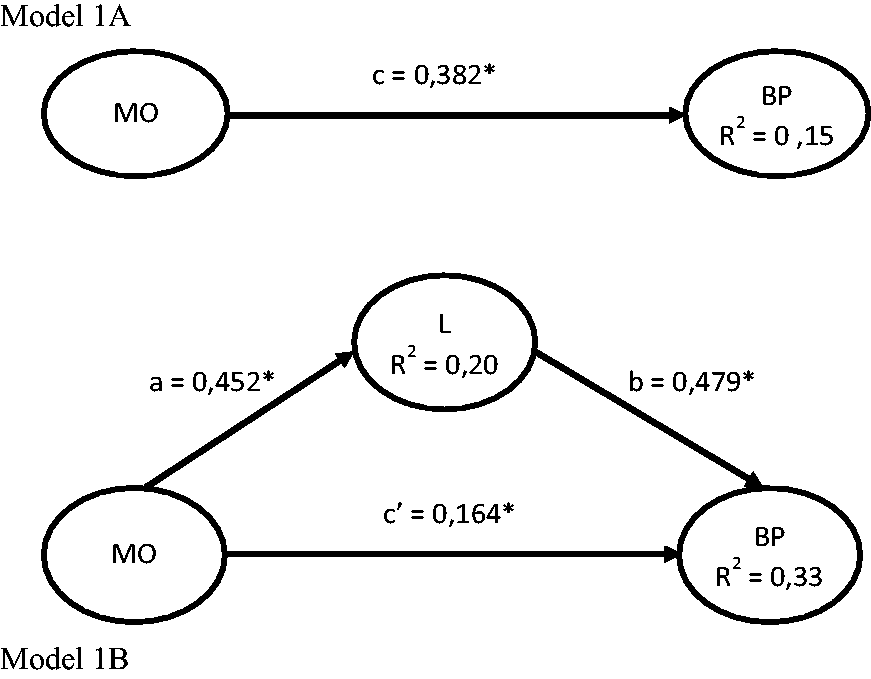
Proposed model coefficient paths.
Total effect
Results show a positive and significant total effect of market orientation on business performance, coefficient path
VAF value is represented by the indirect effect 0.216 divided by the total effect 0.381, showing a VAF value of 0.567 that is between 20% and 80%. This indicates that the mediating variable has a partial mediating effect (Hair et al., 2013).
Furthermore, predictive accuracy was computed. Coefficient of determination (R2 value) is a predictive accuracy measure. R2 of 0.67, 0.33, or 0.19 for endogenous latent variables can be respectively described as substantial, moderate, or weak (Chin, 1998). Results from the proposed model show an R2 of 0.20 for loyalty, indicating that the independent variable MO explains 20% of the explained variance of the endogenous variable L. Whilst BP variable R2 = 0.33 shows that the variables MO and L explain 33% of BP endogenous construct. Furthermore, predictive relevance for the two endogenous variables was achieved, L variable Q2 = 10.38%, and BP variable Q2 = 20.82%. Table 3 shows a summary of the hypotheses test and the obtained effects.
Summary, hypotheses and effects.
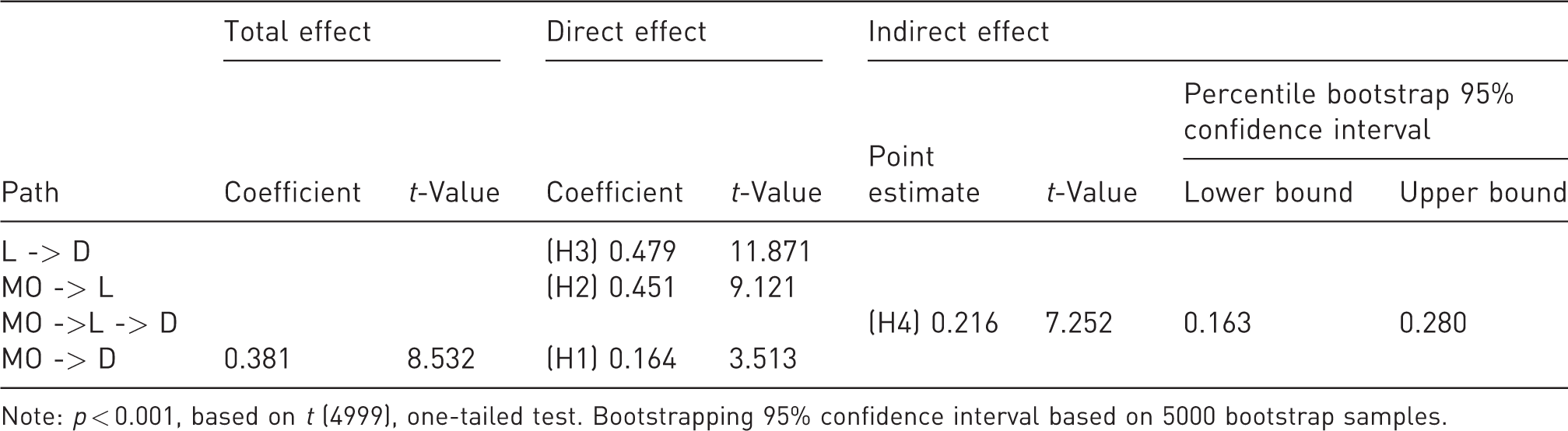
Note: p < 0.001, based on t (4999), one-tailed test. Bootstrapping 95% confidence interval based on 5000 bootstrap samples.
Discussion and conclusions
This study sought to deal with two specific objectives. The first was to evaluate the relationship between market orientation and business performance and the mediating effect of customer loyalty on this relationship in the hotel industry. The second objective was to expand the knowledge on this subject in an international context by using a sample obtained in Western European countries.
A two-step analysis was conducted to perform a second-order construct analysis. A market orientation measurement scale was developed based on a literature analysis and a survey sent to a group of academic marketing experts to assess its content validity. Furthermore, convergent and discriminant validity was found appropriate after the scale purifying process. Reliability was assessed through the composite reliability indicator and was found suitable. It was further demonstrated that customer loyalty and business performance measurement models achieved validity and reliability.
The tested hypotheses revealed, as former studies, that market orientation has a positive effect on business performance. Additionally, results show that market orientation has a positive effect on customer loyalty and that customer loyalty has a positive effect on business performance. The question whether the relationship between market orientation and business performance is mediated by customer loyalty was confirmed by the results, which is in line with former research conducted by Kirca et al. (2005).
This study makes several contributions to the hotels’ management practice. First, market orientation was found to have a positive effect on business performance. Furthermore, the positive effects on business performance are also mediated by customer loyalty. Market-oriented hotels were found to have superior customer loyalty measured through customer retention and customer recommendation, which is in line with the theoretical background settled by former studies (Kohli and Jaworski, 1990; Slater and Narver, 1994b). On the other hand, this finding also implies that improving market orientation affects customer loyalty (Jaworski and Kohli, 1996). Thus, hotel managers should improve or develop market orientation in their business to enhance customer loyalty and business performance. Market orientation produces, in the workforce, a sense of belonging and a commitment to the organization (Jaworski and Kohli, 1993). Committed employees should lead to a more coordinated and faster responsiveness to market developments (Jaworski and Kohli, 1996). Consequently, a certain degree of gathering intelligence about the customer, competition and market structure, disseminating this information throughout the organization and a coordinated response on the behalf of the organization to the generated and disseminated information improves business performance directly and produces a positive effect on customer loyalty.
Furthermore, the customer loyalty mediating effects on business performance highlight the need of putting forward a market-oriented organization to enhance a hotel’s performance. The international scope of this study should provide strong support for hotel managers in order to evolve market orientation. Thus, from a managerial perspective, hotels should focus on building and improving their market orientation. To do so, formal and informal means should be used to enhance information generation about customers, competitors and market structure. The information flow between people and the development of a coordinated response to these issues should also be improved.
Hotel companies present several organizational and staff features which are characteristics of the hospitality industry: services are supplied directly to the customer on the premises and the customer leaves with no tangible product; staff may live on the premises and many different skills are required, but there are also high numbers of unskilled staff; low pay for the majority of staff; and staff are often expected to work long hours (Mullins, 1993). Therefore, hotels heavily rely on highly motivated staff who should be focused on satisfying customer needs. On the other hand, staff also represent the main source of intelligence generated about customers’ satisfaction and needs. Consequently, hotel managers must improve the way the knowledge about customer preferences and needs is disseminated throughout the organization to develop market orientation and enhance its effects on customer loyalty and business performance.
Increasing and maintaining a certain degree of market orientation is a complex process that requires considerable expenditure of money and time (Slater and Narver, 1994a). On the other hand, to be market-oriented requires commitment of resources and is useful only if the benefits it generates exceeds the cost of those resources (Kohli and Jaworski, 1990). Therefore, from a managerial perspective, the results imply a step forward in making hotels adopt market orientation and continuously assess it to improve business performance.
From a theoretical perspective, this study contributes to develop market orientation literature in the service sector and particularly in the hospitality sector, by expanding the market orientation knowledge in the hospitality industry, which makes a considerable contribution to many countries’ economies (Eurostat, 2017). Therefore, three main contributions are made. Firstly, previous studies on the relationship between market orientation and business performance in the hospitality industry focused mainly on assessing this relationship on a regional or country context. The literature review found only two studies, by Zhou et al. (2009) and Au and Tse (1995) that used a sample obtained in several countries. Conversely, the present study has a delimited geographical scope of Western European countries, and, although the studied context is a mature market and plays a heavy role in international tourism, demand in these countries has been fluctuating in recent years due to several environmental factors. On the other hand, despite the positive link between market orientation and customer loyalty (Kirca et al., 2005; Kohli and Jaworski, 1990; Slater and Narver, 1994b) and between customer loyalty and business performance (Morgan and Rego, 2006), there is a shortage of empirical research linking these constructs and assessing the mediating effects of customer loyalty in the relationship between market orientation and business performance, particularly in the hospitality industry. Consequently, this study contributes to expand the knowledge on this issue by empirically demonstrating a positive a link between market orientation and customer loyalty, between market orientation and business performance, between customer loyalty and business performance and the mediating effect of customer loyalty on the relationship between market orientation and business performance.
Finally, despite the MARKOR and MKTOR scales’ validity and reliability problems, empirical research on market orientation in the hotel industry, in general, uses one of these scales to assess market orientation. Recently, some proposals have emerged that aim to improve these models and adapt them to the hotel sector (Campo et al., 2014; Polo-Peña et al., 2012; Wang et al., 2012) even though the theoretical background of market orientation measurement has been mainly based on the manufacturing and the consumer goods sectors. As such, the proposed scale contributes to enhance knowledge on the market orientation measurement in the hotel industry.
Limitations and future research
This work deals with several important questions related to market orientation study in the hospitality industry. Despite the findings, it carries some limitations that suggest the need for further research. Firstly, the sample was obtained in quite a large context. Accessing the hotel managers was not an easy task. To work around this problem, an online survey was used, but the low response rate may be perceived as a weakness. Low response rates are indeed pointed out by literature as a disadvantage of internet surveys (Hung and Law, 2011; Lumsden and Morgan, 2005; McPeake et al., 2014; Wright, 2005). However, given the nature of this work, this method was deemed as the one capable to maximize the outcomes of the study in a timely and costly manner. On the other hand, the survey’s mandatory questions could also have contributed to reducing the response rate.
Furthermore, despite the international scope of this study, it represents a part of Western culture which limits the study’s results and therefore generalization should be taken with caution. This drawback represents an opportunity for further research by expanding the analysed context or by testing the hypothesized model in a distinct cultural environment. Another limitation of this study is the hospitality industry context. Data were obtained in the hotel sector, thus, generalization to other sectors should be done carefully. Further research should assess if the measurement models, particularly the market orientation measurement model, as well as the structural model, behave in the same way in different sectorial and cultural contexts.
Footnotes
Declaration of Conflicting Interests
The author(s) declared no potential conflicts of interest with respect to the research, authorship, and/or publication of this article.
Funding
The author(s) received no financial support for the research, authorship, and/or publication of this article.