



Abstract
Tourist engagement has recently emerged in both academic and practitioner discussions. However, empirical inquiry on tourist engagement as a predictor of tourist citizenship behavior is scarce. The purpose of this research is to investigate the relationship between tourist engagement, relationship quality, and tourist citizenship behavior in hotels. Participation and social interaction have been considered the tourist engagement dimensions. Relationship quality as a multidimensional variable included satisfaction, trust, commitment, and intimacy, while tourist citizenship behavior is defined as a unidimensional variable. A structural equations approach was applied to the 690 data sets obtained from travelers of selected hotels. The results indicate that tourist engagement dimensions have a positive impact on the relationship quality dimensions. On the other hand, the effect of relationship quality dimensions on tourist citizenship behavior has been positive. This research can help researchers and hotel managers find ways to strengthen relationship quality between hotels and customers. Regarding hotels’ limited resources for promotional activities, the results could help managers formulate plans to persuade tourists to express citizenship behavior toward hotels, which help hotels establish competitive advantages.
Introduction
In recent decades, the focus of marketing theories has shifted from transactions to relationships (Bolton, 2016). Relationship quality (RQ) is considered one of the underlying subjects in relationship marketing, which plays an important role in building, retaining, and developing a relationship with the customers (He et al., 2012). Several researchers have had their attention drawn to RQ, its antecedents, and its consequences (He et al., 2018; Kuhn and Mostert, 2018; Taylor et al., 2018). In the hospitality and tourism industry, RQ between the hosts and tourists play a crucial role in customer engagement (CE) (Chen, 2017), hotels’ competitive advantage (Hyun and Perdue, 2017), and some extra-role behaviors such as customer citizenship behavior (CCB) (So et al. 2016a), which directly benefits the company and its customer. CCB has drawn a growing attention of academia in the recent decades (Di et al., 2010; Nguyen et al., 2014). However, the majority of previously conducted studies in the hotel industry have mainly emphasized concepts such as organizational and employees’ citizenship behavior (Chen and King, 2018).
In several studies, theoretical and practical significance of CCB have been investigated, but few empirical studies have been conducted in the realm of CCB in services (Choi and Lotz, 2018; Tung et al., 2017), tourism industry (Cheng et al., 2016b; Liu and Tsaur, 2014), and especially in relation to tourist citizenship behavior (TCB). More specifically, the present research investigates how behaviors like RQ can effectively function as the mediator between tourist engagement (TE) and TCB in the hotel industry. For this purpose, this study seeks to fill this research gap on how behaviors leading to TE can influence the customer’s behavioral tendencies such as TCB using tourist–hotel RQ. In this context, the present study’s results are expected to provide relevant insights to hotel managers regarding the factors that contribute to TCB, which in turn, will help them develop competitive strategies and achieve competitive advantages.
The present article includes a literature review on engagement and RQ, followed by an overview of the methodological steps carried out throughout the study, and the exposition of the main results. Finally, the main conclusions are summarized and avenues for future research are suggested.
Theoretical framework
Tourist engagement
TE comprises of a proactive relationship between a tourist and an object or a place (Loureiro and Sarmento, 2019). One of the main reasons why engagement studies are ubiquitous and growing, is realizing the consumers’ roles and active behaviors in a value-creation process for a brand, with which they are involved (Singh and Sonnenburg, 2012). Different studies have investigated engagement from the consumers’ standpoint. For instance, Roy et al. (2018) have noted that CE might be a process, a psychological condition (cognitive and emotional), or a behavioral depiction. However, other researchers have regarded it as a series of recurring interactions between a customer and a company (Hollebeek et al., 2014). The majority of studies on CE are based on multidimensional conceptualizations (Bowden, 2009; Hollebeek et al., 2014; Huang and Choi, 2019; So et al., 2014). Considering previous contributions, as well as the context of the present study in which tourists are regarded as customers, two dimensions of TE are adopted: interaction and participation. It is believed that tourists’ interaction and their participation can effectively measure their engagement. Interaction is the basis for TE and value sharing in practice and exchanging ideas, thoughts, and feelings about experiences with the hotel and other tourists. In turn, Zhang et al. (2017) believe that conscious participation can be defined as the intentional participation of the tourists in the hotel activities.
Relationship quality
RQ can be defined as an index of powerful and deep relationship with the customer (Smit et al., 2007). Similar to services quality, RQ can be defined as the degree by which a relationship is capable of meeting the customers’ needs (Lo and Im, 2014). Since services are intangible, paying attention to the quality of customer relationship is essential (Macintosh, 2007). Customer decision, whether to resume or end the relationship with the service provider, is dependent upon the quality of the relationship (Kuhn and Mostert, 2018). Service companies that possess appropriate mechanisms for taking care of their customers, most likely have a better customer–brand relationship (Xie and Heung, 2012). Such mechanisms are also expected for tourist–hotel relationships. As Fournier (1998) argue, RQ is a multidimensional structure consisting of relational entities, including emotional attachments, behavioral relationship (e.g., reciprocal dependency and commitment), and cognitive beliefs (e.g., trust) (Xie et al., 2017). Louis and Lombart (2010) have measured the RQ with trust, dependency, and commitment. Whereas, Lo et al. (2017) believe that this construct is composed of satisfaction, trust, and commitment. In another study, factors such as trust, commitment, intimacy, love, and satisfaction are considered the dimensions of RQ (Kim et al., 2011). In the present study, RQ is considered a four-dimensional variable consisting of trust, commitment, satisfaction, and intimacy.
Tourist citizenship behavior
Interest in the realm of CCB has increased recently. CCB can be regarded as voluntary and social efforts made by customers and are favored by service providers and other customers (Garma and Bove, 2011). Accordingly, TCB emphasizes non-purchasing behaviors of tourists. These behaviors include extra-role behaviors voluntarily expressed by customers/tourists in terms of time, information, and ideas along with physical cooperation (Echchakoui, 2016), during or after the services (Nguyen et al., 2014). Yi and Gong (2013) believe that customers can be regarded as members of the company in this respect. The studies conducted in this area indicate that citizenship behaviors can exert a positive impact on satisfaction, loyalty, and brand equity (Bove et al., 2009). Moreover, it can lead to deep commitment and loyalty toward the company and can help reduce the customers’ tendency to use the products or services of competitors (Liu et al., 2011). Therefore, due to customers’ positive feelings caused by high levels of perceived value, they endeavor to retain and enhance benefits of the company by participating in citizenship behaviors (Cheng et al. 2016a).
Numerous studies have been undertaken on CCB, nevertheless, there is little research on TCB (Cheng et al., 2016b; Liu and Tsaur, 2014). In the realm of tourism, in particular, Liu and Tsaur (2014) first mention TCB, and in a similar definition to CCB define it as recommendations to other tourists, assisting them, and sharing knowledge with them. Therefore, in our research, these two concepts are considered equal. Moreover, different dimensions and items have been defined for it (e.g., Bartikowski and Walsh, 2011; Bove et al., 2009; Yi et al., 2011). For instance, Bove et al. (2009) have defined three components that include feedback to the organization, assisting other customers, and recommendations to family/relatives and friends. In accordance with the previous studies such as those of Dang and Arndt (2017) and Kim and Choi (2016), our study considers TCB to be a uni-dimensional construct.
Tourist engagement and RQ
Previous studies have shown that CE would lead to the improvement of customer–firm relationship (Men and Tsai, 2014). Moliner et al. (2018) revealed that engagement could lead to customer connection with the brand and customer advocacy as well. Sashi (2012) have mentioned the role of engagement in the RQ between seller and buyer. Accordingly, So et al. (2016a) confirm that in the service sector, engagement can have a positive impact on RQ with customers, which includes trust and satisfaction. In the hotel industry, Wu and Cheng (2018) regarded customers’ dependence on technology as one of the effective factors influencing the relationship between hotels and customers, which will eventually lead to a tendency to share information in virtual social networks. In another study, Chen (2017) has mentioned engagement could reinforce the RQ between travelers and hotels. On the other hand, some studies have evaluated the relationship between CE and some factors including satisfaction, trust, and loyalty, individually (Rajah et al., 2008; Rasoolimanesh et al., 2019). Nevertheless, no recent study has measured the impacts of TE dimensions on RQ dimensions. Hence, it can be hypothesized that:
RQ and TCB
It has been revealed in different studies that RQ can influence issues such as the tendency for positive word of mouth (WOM) (Edelman, 2010), revisit intention (Taylor et al., 2018), and extra-role behaviors (Zhu et al., 2016). Moreover, it has been emphasized that corporate commitment to establish a relationship with customers can result in satisfaction, trust, and mutual commitment, which can eventually lead to citizenship behaviors (Lin 2007). As Cheng et al. (2016b) confirmed, customer commitment might lead to voluntary efforts and citizenship behavior. Yi et al. (2011) indicated that customers’ satisfaction and commitment would influence citizenship behavior. If customers receive an endorsement from companies or other customers, they are more likely to show more citizenship behavior (Zhu et al., 2016). In alignment with this, Bove et al. (2009) believe that both the quality of provided services and the employees’ attitudes and manners can pave the way for CCB because both can directly influence customer satisfaction. Patterson (2016) has noted that there is a positive and significant relationship between satisfaction, loyalty, and CCB. Bartikowski and Walsh (2011) found out that corporate fame and reputation, as well as commitment and loyalty, exert a positive and remarkable influence on loyalty and CCB. Since these relationships have not been examined in the hotel industry, the following hypothesizes are:
Tourists’ gender as a moderator
One of the questions addressed in the present study was whether tourists’ gender affected the relationship between their RQ with the hotels and their citizenship behavior. Several past research considered gender as a moderator in their works (Jin et al., 2013; Li and Yang, 2015). In the realm of TCB, this had not been addressed before. However, some evidence shows that the relationship between RQ and CCB might differ according to customers’ gender. For example, Balaji (2014) revealed significant differences between RQ and CCB between customers of different genders. Bhagat and Williams (2008) found that gender had a moderating role in affecting relationship strength. Fournier (1998) found that men and women feel and detect differently to service providers. Peloza and Hassay (2006) argued that in the buyer–seller relationship, extra-role behaviors might be affected by customer’s gender roles. Therefore, another hypothesis suggests:
Regarding the aforementioned points as well as the important role of tourist–hotel RQ, which is a significant factor between TE and TCB, we intend to explore the impact of TE on TCB. Moreover, the mediating role of RQ and the moderating role of tourist’s gender are taken into consideration. It is by raising our awareness about the relationships between these factors that one can execute more appropriate planning to enhance the RQ and TCB as well. Based on a review of the theoretical framework of this study, our proposed conceptual model is illustrated in Figure 1.
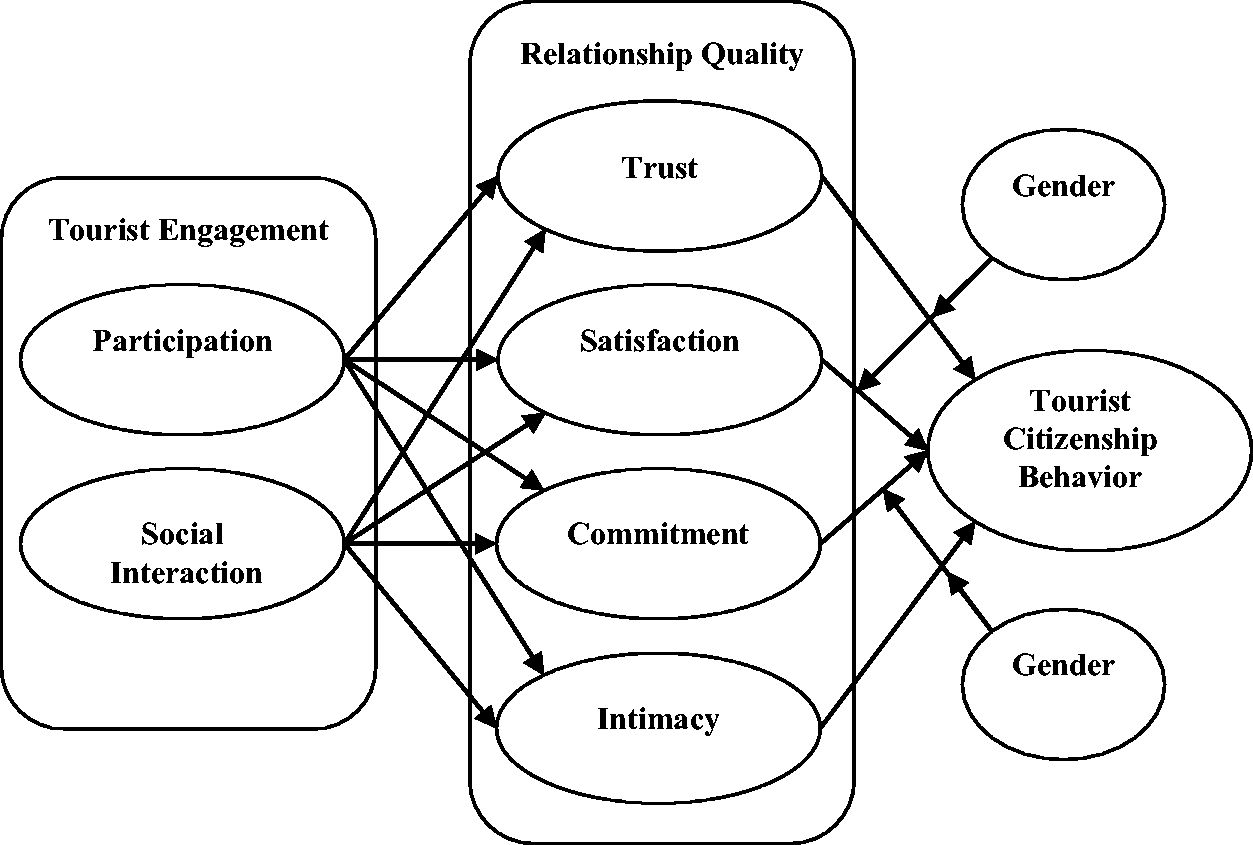
Conceptual research model.
Research methodology
Sample and data collection
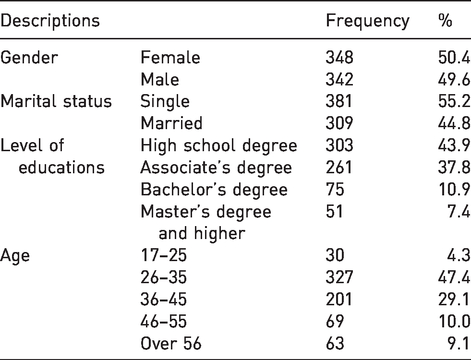
The statistical population of this study is composed of travelers across a wide range of selected hotels in Iran. Following the pretest of the questionnaire with a group of 36 tourists, the final questionnaire was administered. Then, 900 questionnaires were distributed in hotels. Some data were discarded because the questionnaires were incomplete. Some questionnaires were unanswered. Over a six-week data collection period, 690 valid questionnaires were collected, which represents a response rate of 76.7%. The sample’s demographic characteristics are summarized in Table 1.
Demographic profile (N = 690).
Measures
All measurement items for this study were adopted from previous studies, with slight modification. Based on previous studies, TE and RQ are considered multidimensional variables. In order to measure TE and its dimensions, Zhang et al. (2017) scales were adapted. The measurement of RQ and its four dimensions was based on the questions obtained from Kim et al. (2011) and Liang et al. (2011). Questions for TCB were obtained from the studies undertaken by Bartikowski and Walsh (2011) and Yi and Gong (2013). The validity of the questionnaire was confirmed using face validity. The questionnaire was verified by five experienced professors specializing in tourism, hospitality, and consumer behavior, after which, some modifications were done. The final questionnaire was prepared for distribution. Items were operationalized through a 5-point Likert-type scale varying from 1 (strongly disagree) to 5 (strongly agree). Cronbach’s alpha result (.957) indicates the scale is reliable.
Common method bias
Common method bias (CMB) was evaluated using both procedural and statistical methods. Regarding procedural methods, respondents’ confidentiality was assured. Moreover, to reduce vagueness and to improve the validity of the items, well-established measures were used. Regarding statistical approach, we used Harman’s one-factor test to address the potential concerns of CMB. The model fit statistics of the one-factor model are χ2/df = 3.34, Comparative Fit Index (CFI) = 0.706, Tucker-Lewis index (TLI) = 0.688, and The Root Mean Square Error of Approximation (RMSEA) = 0.091. These results show that the one-factor model was not acceptable, which suggests that CMB is not a problem in this research (Podsakoff et al., 2003).
Data analysis and findings
Inferential analysis of the data was carried out through structural equation modeling with partial least squares (SEM-PLS) approach using Smart PLS Software. SEM-PLS is a variance-based structural equation method (Rigdon et al., 2017), which is capable of analyzing hybrid models (Henseler, 2017) and models that encompass complicated relations such as direct and mediating variables and their dimensions (Hair et al., 2017). The conceptual model was analyzed in three steps, namely measurement, structural, and overall model.
Measurement model
When it comes to the methodology of SEM, the validity of the constructs should be examined primarily to determine if the selected indicators are accurate enough to measure their constructs. The reliability of the construct was measured using two common criteria, namely Cronbach’s alpha and composite reliability (CR). Cronbach (1951) has considered a high standard of 0.7 for α, while Bagozzi and Yi (1988) have considered a high standard of 0.6 for CR. After the reliability test, convergent validity needs to be evaluated by average variance extracted (AVE) (Hair et al., 2016). Fornell and Larcker (1981) have considered a high standard of 0.5 for AVE. All the studied constructs have AVE of higher than 0.5. Regarding the aforementioned standards, both validity and reliability of the constructs are higher than the above numbers. In examining the measurement model, values such as factor loadings, CR, AVE, and Cronbach’s α suggest appropriate fitting of the measurement model in Tables 2 and 3.
Results of validity and reliability of themeasurement models.

AVE: average variance extracted; CR: composite reliability.
Constructs, items, and factor loadings.

A model’s discriminant validity is the degree to which a construct in a model has more interaction with its indicators in comparison with other constructs. The model discriminant validity was assessed through Fornell and Larcker’s (1981) method, according to which, the square root of each construct’s AVE must be larger than its correlations between that construct and other constructs. The results in Table 4 confirm adequate discriminant validity.
Results of the Fornell and Larcker criterion.

TCB: tourist citizenship behavior.
Structural and overall model
The effect exerted by an exogenous variable over an indogenous one is expressed by R2 and Q2. The former represents coefficient of determination, while the latter represents predictability (Hair et al., 2016). R2 criterion is used to assess the intensity of the relationships. Chin (2010) introduced R2 values of 0.25, 0.50, and 0.75 for target constructs, which are interpreted as weak, average, and considerable, respectively. The Q2 criterion determines the predictive power of the model. Henseler et al. (2009) identified three values of 0.02, 0.15, and 0.35 to act as the amount of weak, medium, and strong. All these values are shown in Table 5. The results point to an average model fit and suggest that the model has a high degree of predictability.
R2 and Q2.

Finally, in order to examine the overall model, the goodness-of-fit (GOF) index was adopted (Hair et al., 2016). Wetzels et al. (2009) assert that results of 0.1, 0.25, and 0.36 are considered as minor, moderate, and great GOF, respectively. With respect to the value of 0.413 for the criterion, our model meets large GOF value.
Finally, hypotheses were examined in the form of SEM and the structural model paths were evaluated as well. Each path corresponds to one of the hypotheses. Testing each hypothesis through examination of the direction, size, and statistical significance of the path coefficient between the latent variables is achieved. The higher the coefficient of a path, the more effective the predictability of the latent variable toward the independent variable. By considering the findings of relationship between dependent and independent variables by means of corresponding coefficient, significant impacts between the constructs can be undertaken. In order to examine the significance of the path coefficient, the significance of t-value needs to be considered for each path coefficient. If t-value is above 1.96 or if p value is less than 0.05, the relationship between the constructs is confirmed and research hypotheses are supported at the confidence interval of 95%. Regarding the results, t-values are above 1.96 for all the hypotheses. Overall model fit results are summarized in Table 6.
Results of hypothesis testing.

***P < 0.001.
Moderating effect of tourist’s gender
To analyze the moderating effect of tourists’ gender on the relationship between RQ dimensions (satisfaction, commitment, trust, and intimacy) and TCB, Hayes and Matthes (2009) approach was adopted. Results show that travelers’ gender strongly moderates the relationship between trust and TCB at the confidence interval of 95% (t-value = 3.63). The effect of trust on TCB was more significant for female tourists (β = 0.511; p = 0.02) as opposed to males tourists (β = 0.393; p = 0.04). This is also the case of the relationship between intimacy and TCB (t-value = 4.14), which was more noticeable with females tourists (β = 0.544; p = 0.01) compared to male tourists (β = 0.307; p = 0.06). On the other hand, results show that gender does not moderate the effects of satisfaction (t-value = 1.62; p = 0.09) and commitment (t-value = 1.17; p = 0.12) on TCB. More detailed results on the moderating role of gender are presented in Table 7. Such results provide partial support to H13 (which proposed that the linkage between RQ dimensions and TCB will vary as a function tourists’ gender).
Results of moderation analysis.

F: Female; M: Male; N.S.: not significant.
Discussion and implications
It is highly important to establish appropriate relationship with customers, especially in tourism and hotel industries. CE can play a significant role in enhancing RQ, which in turn leads to long-term relationships with customers and consequently, enhances satisfaction and loyalty. This study aimed to find out how TE with hotels can help improve their relationships, as well as whether such relationships, influence TCB toward the hotel. As results have indicated, both dimensions of TE (participation and interaction) exert a positive influence over all the dimensions of RQ (trust, satisfaction, intimacy, and commitment). Likewise, all the dimensions of RQ influence TCB. The results obtained from moderating variable indicated that gender does not exert any impact on the relationship between satisfaction and TCB nor does it affect the relationship between commitment and TCB. On the other hand, gender showed to moderate the relationship between trust and TCB, as well as that between intimacy and TCB.
Results have also indicated that tourists’ participation can exert an influence over their sense of trust toward hotels. Engaging tourists in hotel-related positive activities such as services improvement, providing feedback to their requests and expectations, and staying committed to consider their opinions, will lead tourists to develop a sense of reliance on hotel services, as well as on its staff and managers. In addition, this study showed that conscious and tactful participation could have a positive impact on tourist satisfaction in hotels. On the other hand, paying attention to tourists’ needs and wants will result in tourists’ high assessments of hotel’s overall quality, particularly of hotel staff. It will also reinforce positive feelings toward hotels thus improving hotels’ performance and enhancing tourists’ satisfaction. These results are compatible with those of Rajah et al. (2008) and So et al. (2016a). So et al. (2016a) investigated the role of brand familiarity, satisfaction, and loyalty in hotels, and regarded service experience as one of the influential factors in familiarity with brand, loyalty, and satisfaction. Moreover, Rajah et al. (2008) noted that cooperative collaboration with marketers via value co-creation could lead to further customer satisfaction as well as enhancement of RQ. Another finding from this study was that tourists’ participation would positively influence their commitment toward hotels. Participation of tourists in hotel-related activities will result in a bilateral and unwritten pact between tourists and hotels, and will help reinforce their responsibility toward hotels. This results in compliance with those of Liu et al. (2011). Likewise, participation influences intimacy with hotels, which means equipment provisions that can encourage participation and persuade tourists to take part in hotel-related activities. In addition, their feedback can lead tourists to develop a sense of intimacy and friendliness with hotels. Other studies such as Men and Tsai (2014) and Moliner et al. (2018) have confirmed this.
As our study has indicated, the above-mentioned dimensions in RQ can lead to the emergence of positive citizenship behavior in tourists. In particular, tourist trust in the hotel’s services and promises will lead them to advocate and promote more confidently and make sure their opinions will be considered for improving activities in the future. This is also in accordance with He et al. (2018) results. On the other hand, tourists’ satisfaction will pave the way for voluntary activities that are in alignment with progress and hotel promotion expressed by the satisfied tourists. By tourist satisfaction, we mean tourists’ assessment of the provided services promised to them. This finding complies with those of Rasoolimanesh et al. (2019), Patterson (2016), and Yi et al. (2011). Moreover, tourist commitment and responsibility toward hotels will result in a sense of attachment among the tourists in such a way that they take steps to improve hotel conditions and promote them to other tourists. This finding is compatible with those of Yi et al. (2011). Additionally, tourist intimacy will reinforce TCB, and consequently, lead to positive and voluntary behaviors in alignment with improving hotel conditions and WOM by tourists. This result complies with those of Taylor et al. (2018).
Finally, the analysis for gender as the moderating variable and its impact over the relationship between RQ dimensions and TCB, may suggest that two of the four RQ dimensions were significantly moderated by gender, i.e. trust and intimacy. Female tourists have stronger tendency for TCB, regarding these two dimensions. However, no significant difference was observed between male and female tourists concerning the relationship between satisfaction and TCB and between commitment and TCB.
Theoretical implications
This study encompasses some valuable results. First, it is the only study, to date, to investigate the relationship between TE, RQ, and TCB in the hotel industry. Secondly, this study has adapted the items for TE, RQ, and TCB to the hotel industry. Thirdly, the impact of gender as a moderating variable was shown in either reinforcing or weakening the relationship between dimensions of RQ and TCB. While prior research indicates that individual differences influence customer behaviors, our study finds that the influence of RQ on TCB is slightly greater for females than males. This could be explained by females’ greater concern with the RQ (Costa et al., 2001). Hence, at higher levels of RQ, especially in trust and intimacy, females perform greater citizenship behavior than males.
Practical implications
Hotel owners and managers do not like their hotels and services to be monotonous and repetitive. They are aware that hotels can have a high ROI through maintaining, retaining, and growing their customers. However, customers are less willing to make repeated purchases due to constant changes in their wants and needs. The major challenge that hotels face is that they need to attract customers amid their daily tasks. Therefore, due to hotels’ limited budget for promotional efforts, managers are advised to persuade customers to express citizenship behavior, which help hotels achieve their goals and establish competitive advantages.
In addition to emphasis on engagement and participation of tourists, this study shows that one of the key factors of TCB in tourism and hotel management is engaging them, along with establishing long-term relationships. Managers’ main goal is the satisfaction of customers; satisfied customers will mention hotels and their services. Therefore, hotels need to adopt appropriate mechanisms and policies. CRM, as a mechanism to classify different tourists’ information to inform them about hotel activities and schedules, can help managers engage tourists with their hotels. Thus, we recommend that managers lay the basis for retaining their customers through creating CRM tools. Other mechanisms and policies involve:
Use of suggestion and complaint systems. Assessment of service quality during customers’ accommodations. Continued education of hotel staff for better customer relation. Expressing customers’ appreciation through staff and hotel actions. Assurance that the hotel listens to customers’ feedback and compliance.
These policies should lead tourists to feel more intimate and friendly toward hotels, thus paving the way for them to recommend hotels to other tourists through WOM. Managers can identify their highly engaged customers and offer incentives, like accommodation discounts, free meals, and spa visits to make the most of the potential of those tourists. They can also allocate higher and better facilities for their customers. Tourists should be encouraged to take different surveys regarding hotel services. Their feedback and opinions must be taken into consideration for further planning of hotel activities. Hotel customers should be kept abreast of changes. By providing innovative services to the customers and surveying their opinions about necessary changes in the hotel, they can be retained in a long-term relationship. Improving a relationship with existing customers will be much more effective than attracting new ones.
Managers should also bear in mind that reputation of the hotel is not only improved by customer service but also by activities offered on-site as well as off-site. Hotels can be represented during social and cultural community events, which are usually very popular with tourists, thus improving customer relation.
Moreover, attention to gender role is highly advisable. In order to boost the RQ with tourists, hotels should consider the tourists’ gender in their policies. This consideration can strengthen the effectiveness of their plans and may increase tourist tendency to engage more in citizenship behavior. Enough care should be given in implementing the plans that gain both male and female attention.
Limitations and future research directions
Iranian hotels have formed the main research area of this study. A generalization to hotels in other countries should be considered cautiously, since Iran is comparatively little studied in terms of tourism, even though being rich in cultural places, ecotourism sites, and historical monuments. We encourage researchers to focus more on Iran and other Middle Eastern countries as cases of interest to investigate. Moreover, this study is cross-sectional, and is confined to a particular period. Other variables of this study were beyond the control of the researchers. Deeper studies of major factors influencing TCB are suggested for future studies. We also were under restriction about the number of items, because we were forced to make a trade-off between having more items and attracting individuals for better participation. Thus, for future works, the main indicators existing in RQ can be extracted more specifically, and fuzzy logic pattern can be used for prioritizing key items. With respect to different indicators considering different natures of businesses, it is recommended that this model be tested in other industries. By expanding the statistical population, this study can also be generalized to other sectors as well.
Footnotes
Acknowledgements
We would like to thank all the reviewers and the editor who have provided valuable feedback on this paper.A special thanks to Ms Christine Miller who helped us in editing and improving the paper.
Declaration of Conflicting Interests
The author(s) declared no potential conflicts of interest with respect to the research, authorship, and/or publication of this article.
Funding
The author(s) received no financial support for the research, authorship, and/or publication of this article.
