



Abstract
The COVID-19 outbreak has challenged the global tourism economy. It has particularly threatened the survival of tourism firms in developing countries especially those with the greatest growth of international visitors, such as Vietnam. This study aims to highlight the impact of COVID-19 on tour operators in Vietnam and explore their strategic responses to the crisis. Data were obtained from a recent survey initiated by the National Tourism Advisory Board and 32 in-depth interviews with managers of selected firms. The survey results demonstrate that the key influences of COVID-19 include plummeting revenue, increased costs, and employee redundancy. Furthermore, the majority of tour operators are aware of the need for restructuring and expect financial support from the government to overcome the crisis. The findings from the interviews reveal that tour operators focus more on short and medium-term strategies (i.e., retrenchment, persevering, and exiting) rather than long-term planning (i.e., innovating) in response to COVID-19. This study advances the knowledge and application of response-to-crisis strategies in tourism research, and its findings have practical implications for managers and policymakers in times of exceptional crisis like the COVID-19 pandemic.
Introduction
Coronavirus (COVID-19), which was declared as a global pandemic by World Health Organisation (WHO), has swept across 215 countries and territories with 4,08,90,712 confirmed cases and 1,126,351 deaths, as of 22 October 2020 (WHO, 2020). These numbers are likely to multiply rapidly, as the new variant of the virus emerges, thus causing renewed interest for health practitioners, institutions, governments, and private enterprises. The severity of its impact on economies is still being measured. Countries and regions have implemented different measures and restrictions to slow down this pandemic. Many of these measures (e.g. community lockdown, international travel ban, domestic movement restriction, and quarantine) together with changing tourist perceptions of security, destinations and travel modes have severely impacted the global tourism industry (Gössling et al., 2020; Jarratt, 2020; Yang et al., 2020). The tourism sector is currently one of the worse impacted by the COVID-19 outbreak. The World Tourism Organisation estimates that the COVID-19 pandemic can put up to 120 million direct tourism jobs at risk in 2020 and it could lead to a decrease of 58% to 78% in international tourist arrivals (UNWTO, 2020). In the worst-case scenario, the global tourism sector could lose $3.3 trillion or 4.2% of the world’s gross domestic product if the downturn in international tourism lasts for 12 months (UNCTAD, 2020). Even though it is too early to evaluate the full estimated impact of the COVID-19 situation, it preliminary calls for an opportunistic role both for governments and businesses to provide contingent long and short-term goals and open lines of investigation within this area that could sustain economies and businesses.
In the past, tourism has been impacted by different disaster and crises, such as the foot and mouth disease (Blake et al., 2003), the September 11 terrorist attack (Blake and Sinclair, 2003), hurricane Katrina (Chacko and Marcell, 2008), SARS and Avian Flu (Kuo et al., 2008), the global economic crisis and swine flu pandemic (Page et al., 2012), and COVID-19 (Yang et al., 2020). These past impositions and economic stagnation during this critical period called for more proactive measures and the srevitalisation of resources had contributed to further progress within the tourism industry. Previous research into the response to tourism crises has primarily focused on efforts from sectors, the whole industry, and local and national governments (Ritchie and Jiang, 2019). While tourism firms need to effectively address the uncertainties and potential opportunities associated with crises and pandemics (Hall et al., 2020; Liu-Lastres et al., 2020), scant research attention has been paid to examining their specific strategic responses, more particularly in the case of a pandemic. Notably, some tourism firms lack initiatives and support in formulating strategic plans or activities for dealing with crisis events (Hystad and Keller, 2008; Okumus and Karamustafa, 2005). Hence, there is an urgent need for studies that shed light on how tourism firms strategically respond to a pandemic crisis like COVID-19. Findings from such studies would support efficient planning of the tourism sector transformation and develop the resistance of the sector to future epidemics or pandemics, even after COVID-19 loses its relevance. These studies should prioritise developing countries that have the greatest growth of international visitors (e.g., Vietnam) since tourism in these countries is most vulnerable to COVID-19 (Gössling et al., 2020; UNCTAD, 2020).
Given that Vietnam is an important emerging market in the Southeast Asia region, with a doubling of international visitors in the past three years (GSO, 2020a), it has also been subjected to a decrease in the number of international visitors as a result of the COVID19 pandemic with the first half of this year witnessing a decrease of 57% (Nhandan, 2020). Besides, the number of domestic tourists declined at a similar rate (50%) due to lockdown measures, social distancing, concerns over health and safety, and cancellation of important events (e.g., Formula 1 Grand Prix). Despite a potential recovery facilitated by the country’s success in containing COVID-19, the impact of this pandemic remains significant and unpredictable. This has raised important questions about how COVID-19 affects Vietnam’s tourism firms, and how these firms strategically respond to the sudden and unexpected changes in their external environment. These impositions impact the overall viability of the tourism industry in Vietnam, more particularly from a firm-level perspective. A deeper level of understanding from tourism firms in Vietnam (e.g. tour operators) is likely to open wider contributions not only to understanding the firm-level strategies and institutional support processes but also provide directions and complement governance at the government level.
This study, therefore, aims to highlight the impact of COVID-19 on tour operators in Vietnam as well as explore their strategic responses to the pandemic. It intentionally focuses on tour operators because these firms play an important role in tourism development and poverty alleviation in the country (Truong, 2013). The firms are expected to make a major contribution to the recovery of the domestic and international tourist markets. The present study will contribute to the current understanding of the effects of the COVID-19 pandemic, which is essential not only for the adaptation of firms’ strategies and the transformation of sustainable tourism (Gössling et al., 2020; Hall et al., 2020) but also provides insights into best practices that can be adopted and provides unique evidence of within-industry heterogeneity in how firms respond to crises. Hence, the findings of this study have important implications for tourism policymakers and firms’ managers, especially for those in emerging markets.
The paper is organised as follows. Following the introduction, the next section presents a background of Vietnam’s tourism industry in some global crises in the past. The theoretical background section summarises the core strategic responses that firms often implement in times of crisis. This is followed by an explanation of research design and data collection. Following that, the findings of the impact of COVID-19 and strategic responses to the pandemic are discussed. The final section provides implications of the findings and concluding remarks.
Vietnam’s tourism industry in past crises
Vietnam tourism industry has experienced several global crises in the past as illustrated in Figure 1. In 1998, the Asian financial crisis caused a negative growth of 11% in international arrivals to Vietnam. However, the sector recovered quickly with an increase of 17% and 20% in international arrivals in 1999 and 2000, respectively (GSO, 2020b). The majority of foreign tourists at that time were from Europe and the United States and the number of domestic tourists was limited.
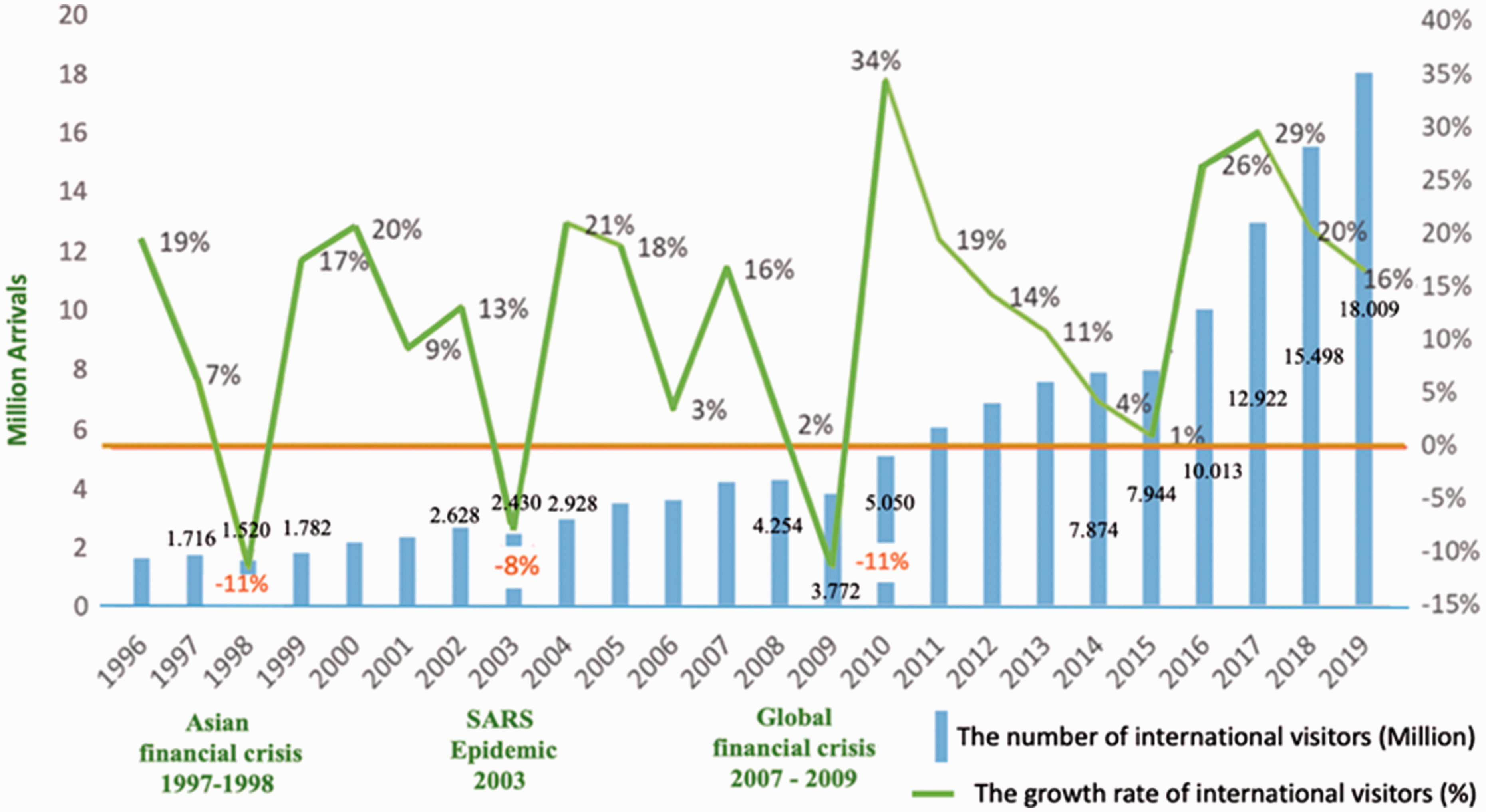
Recovery growth of international arrivals in Vietnam after the times of crisis.
Vietnam tourism experienced the next crisis in 2003, due to the impact of the SARS epidemic. The industry growth again declined to negative growth of 8% and rapidly recovered up to 21% with nearly 3 million arrivals in 2004 (GSO, 2020 b). At that time, Vietnam tourism attracted more diversified foreign customers, with an influx from Northeast Asia, which included Chinese, Japanese, and Korean tourists. The industry was once again hit by the global financial crisis in 2007–2009, causing the growth to drop to negative 11%. However, it surprisingly recovered stronger than previous times, up by 34%, reaching 5 million internal arrivals in 2010 (GSO, 2020 b). The profile of foreign tourists in this period was more diverse, but the majority still came from Northeast Asia.
Tour operators have made an important contribution to the strong recovery growth of Vietnam tourism in terms of international arrivals after the previous crises, which have created optimistic expectations for resilience after the COVID-19 pandemic. However, the recent crisis of COVID-19 with more complicated and unpredictable movements on a global scale has put Vietnam tourism firms in a very challenging situation. Therefore, it is essential for firms in the tourism industry, especially for tour operators to formulate suitable response-to-crisis strategies.
Theoretical background to response-to-crisis strategies
A crisis is described as an “unexpected, publicly known, and harmful event that has high levels of initial uncertainty interferes with the normal operations of an sorganisation and generates widespread, intuitive, and negative perceptions among evaluators” (Bundy and Pfarrer, 2015: 3). Even though different crises differ in their origins and scale, their outcomes are quite similar in ruining firm, societal and economic consequences. In the tourism context, the notion of a crisis has been used together with the impact of several events on tourism activities at a destination, sector, or global level. Prior research into tourism crisis management has focused on the recovery phase (Ritchie and Jiang, 2019). Accordingly, there are 5 critical success factors for tourism recovery, which include crisis management plan, market segmentation and selection, recovery marketing and communication, collaboration and personnel management (Campiranon and Scott, 2014; Mansfeld, 1999). However, it is still unclear how these components can be combined into a firm’s response strategies. Therefore, it is essential to formulate possible strategies that guide tourism firms to strategically respond to the crisis.
The current study uses Wenzel et al.’s (2020) taxonomy of strategic responses to crisis (i.e., retrenchment, persevering, innovating, and exit) as the theoretical basis. These strategies are generated as a result of a comprehensive review of numerous papers relating to crises/shocks and firms’ strategic responses. Importantly, they provide key principles for managers and employees to respond to an unexpected crisis in different time horizons: short term, medium term, long term, or any time. Hence the strategies are expectedly applicable to tourism firms (e.g., tour operators) in the context of COVID-19, which appears to have both short-term and longer-term impacts on the tourism sectors (UNCTAD, 2020).
Retrenchment strategy
This strategy refers to a narrowed scope of a firm’s activities by decreasing costs, assets, product lines, number of staffs and concentrating on core activities (Pearce and Robbins, 1994; Schoenberg et al., 2013), and is the most common strategic response to the business turnaround (Bruton et al., 2003). Retrenchment contributes to firm recovery as it concentrates on the existing firm’s operation by cutting out complexity and improving transparency (Benner and Zenger, 2015), increases firm performance over competitors (DeDee and Vorhies, 1998), stabilises the decline of firm performance (Pearce and Robbins, 1994). It is therefore a desirable initial response for strategic renewal. Some scholars (Barker III and Duhaime, 1997; Castrogiovanni and Bruton, 2000), however, raise doubts about the effectiveness of this strategy as firms would underperform as compared to those firms which do not practice retrenchment. Nevertheless, retrenchment is not the only strategic response to a crisis, and it might partly be a viable response to the crisis in the short-run (Wenzel et al., 2020).
Persevering strategy
In times of crisis, some firms preserve the status quo of their activities in response to the business turnaround. In other words, they adopt a persevering strategy that aims at “sustaining a firm’s business activities in response to crisis” (Wenzel et al., 2020: 9). Many scholars have proved that preserving strategy may better contribute to firms than innovating strategy in uncertain circumstances when firms cope with sudden changes. For example, Chakrabarti (2015) suggests that persevering helped Asian manufacturing firms a better survival rate than those using limited resources for strategy restructure during the economic crisis of 1997. Following the 9/11 terrorist attacks some multinational firms, instead of quickly responding to the market followed a perseverance strategy in order to reap better performance afterward (Li and Tallman, 2011). This finding suggests that firms facing crisis events might forgo possible benefits when leaving prior paths immediately (Wenzel et al., 2020). Consequently, preserving strategy minimised the adverse impacts and might be an effective strategic response to the economic shock during a crisis in the medium run (Stieglitz et al., 2016; Wenzel et al., 2020).
Renewal strategy by innovating
A crisis, on the one hand, can threaten firms’ growth, but on the other hand, can also create opportunities for firms’ strategic renewal. According to Schmitt et al. (2016: 1), renewal strategy by innovating can be defined as “firms’ adaptation to changing environments and relate it to their ability to exploit existing competencies and build new capabilities”. This strategy, therefore, disrupts the firms’ inertia by adjusting or changing their core competencies to reach long-term performance (Archibugi et al., 2013). In the sense of taking advantage of different opportunity spaces created by a crisis (Martin-Rios and Parga-Dans, 2016), renewal strategy by innovating marketing programs and collaboration can be a great strategic response if the crisis persists for a longer duration and firms need to explore other sources of revenue (Wenzel et al., 2020).
Archibugi et al. (2013) assert that firms with a medium or long-term commitment to innovation during the crisis, especially firms in pursuit of long-term renewal strategies focusing on new products and markets, deal more effectively with the 2008 economic crisis. It should be noted that firms’ strategic renewal varies with the type of environmental scarcity they have to cope with (Schmitt et al., 2016). Therefore, the opportunity space for conducting successful strategic renewal depends on the CEO’s perceptions (Schmitt et al., 2016), the role of organisational innovation (Martin-Rios and Parga-Dans, 2016), strong corporate governance (Gartenberg and Pierce, 2017), or exploitation of mutually interchangeable of firms’ resources (Danneels, 2011). Given that prolonged crises often make firms coping with difficulties to return to the previous state, strategic renewal is essential for firms’ survival in the long run (Wenzel et al., 2020).
Exit strategy
In strategic management, exit strategy relates to portfolio reorganising, business restructuring, divestment, product/market positioning in declining industries (Burgelman, 1996), or business activities discontinuing (Wenzel et al., 2020). Previous studies indicate that as business exits help firms release committed resources, it can be beneficial for strategic renewal (Ren et al., 2019) and create opportunities for setting up new ventures (Carnahan, 2017). Furthermore, an exit strategy is essential in evolutionary processes such as the substitution of old products, markets, or firms ‘competencies for new ones (Burgelman, 1996). Thus, unlike bankruptcy, exit strategy neither represents business failure nor it is the last choice when the other response-to-crisis strategies fail. Instead, in the time of economic shocks, an exit strategy may be inevitable and may even be an effective way to confront the crisis at any time (Dai et al., 2017; Wenzel et al., 2020).
Research design
An exploratory study is a starting point to maximise the discovery of new research themes or to understand an existing issue from a new perspective (Mason et al., 2010). Therefore, it is an appropriate research method to discover the impacts of COVID-19 on Vietnam’s tour operators as well as their strategies in response to the unpredictable and complicated pandemic of COVID-19. Following the suggestions of Mason et al. (2010), three phases of preparation, development, and data analysis were applied in this exploratory qualitative research.
Preparation phase
In the first phase of preparation, the researchers determined that both secondary data and primary data were necessary to obtain the research objectives. Secondary quantitative data was utilised to explore the impact of the pandemic on tour operators in Vietnam. Primary data through in-depth interviews enabled purposeful sampling of executive managers from tour operators to deeper to understand the impact and tour operators’ strategic response to the economic shock of COVID-19. A list of suitable questions for face to face interviews was also formulated.
Development phase
In the development phase, detailed sources of secondary data were designed, a pre-test for interview questions was conducted, and in-depth face-to-face interview procedures was established.
A survey of COVID-19 on Vietnam’s travel, which was done by the National Tourism Advisory Council (TAB), Private Sector Development (PSD) Committee, Grant Thornton Vietnam, and VnExpress – the largest online newspaper of Vietnam (TAB, PSD Commitee, Grant Thomton, VietnamExpress, 2020) from April 13 to May 19, 2020, was used as the main source of secondary quantitative data. The sample of this survey consisted of 394 tour operators, hotels, and tourism transportations firms. Data related to 145 Vietnam tour operators were extracted to explore the impact of the pandemic on these firms. These firms are located in different provinces across the country (Appendix 1).
Interview questions were formulated based on the research objectives and the four types of response-to-crisis strategies. These questions were designed in an open-ended format to elicit interviewees’ responses regarding (1) impact of COVID-19, (2) expectations of recovery time and support from the government, (3) need for restructuring and (4) strategic responses to the crisis. A pre-test for the questions was conducted with three tourism experts and one strategic management expert in Hanoi. After receiving meaningful feedback, the research team articulated the final interview questions as shown in Appendix 2. In-depth interview procedures were then established. The interviewees were representatives of Vietnam’s tour operators, which were randomly selected from firms that participated in two national conferences on COVID-19 in Hanoi and Danang on May 21, 2020. It should be mentioned that participants of these two conferences were chosen by TAB to represent tourism firms in Vietnam. Out of 40 tour operators selected by the researchers, 32 firms agreed to participate in the study (Appendix 3). This sample size was deemed sufficient for the qualitative analysis in this study since it well exceeded the minimum number of 12 required to reach data saturation in qualitative research (Braun and Clarke, 2013; Vasileiou et al., 2018). Geographically, sixteen of the interviewed firms were located in Northern (i.e. Hanoi), eight in Central (i.e., Da Nang), and eight in Southern Vietnam (i.e., Ho Chi Minh city). They consisted of both state-owned and private firms, which included limited companies and joint-stock companies. Hence the sample reflected various types of tour operators across the country.
The firms’ managers were interviewed from May 21 to June 25, 2020. Their participation was voluntary and completion of the interview was taken as informed consent. Face to face interviews, which averaged one hour in duration, was based on an interview schedule intended to gather information on company history, the background of the interviewee, current impacts of COVID-19 on the firm’s activities, and the firm’s strategic response to the pandemic. During discussions of a strategic response to the economic shock of COVID-19, particular emphasis was placed on the manager’s perception of crisis-response-strategies including retrenchment, persevering, innovating, and exit. In this part, respondents were asked to choose the most appropriate descriptions for their firm’s crisis-response-strategies (following the research team’s description in Table 1) and then explain the reasons that had led them to pursue that particular response.
Descriptions of crisis-response-strategies.
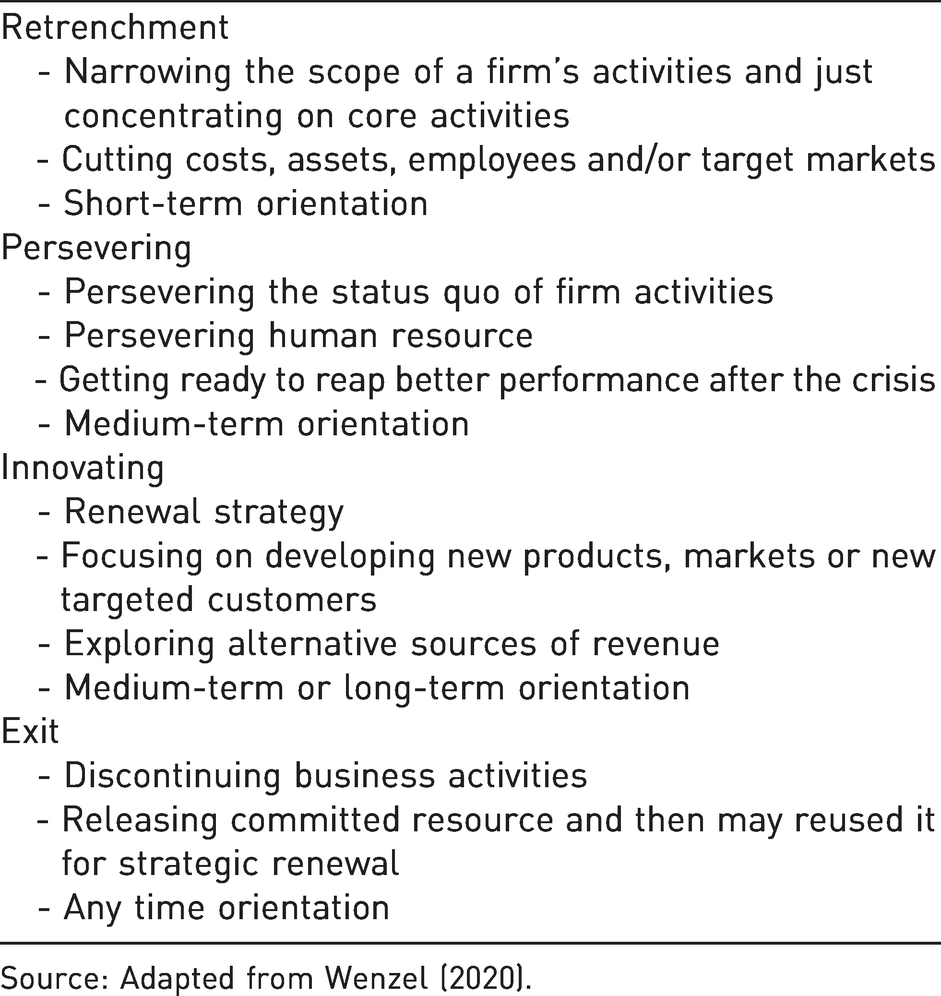
Source: Adapted from Wenzel (2020).
Data analysis phase
The data analysis proceeded in several stages. Initially, extracted secondary data were used to calculate descriptive statistics to describe the impact of COVID-19 to tour operators regarding revenue, cost, employee changes, the company expectations from government, recovery time expectation, and need for restructuring. After that, three concurrent flows of activity: (1) data condensation, (2) data display, and (3) conclusion drawing/verification, which was rooted in Miles and Huberman (2014)’s view of qualitative data analysis was applied.
A coding list was created before considering the meaningful data into units that fit together into categories of the scope of firm activities, costs/assets, human resources, strategic orientation, and others. These categories emerged from the research questions and reflected the interviewees’ responses to the firm’s response-to-crisis strategy. Codes were assigned to categories and memos were used to form the initial codes to match respondents’ stories.
For data display, the checklist matrix for response-to-crisis strategy was adopted using a conceptually clustered matrix of categories relating to response-to-crisis strategies and interviewed firms for building display and drawing conclusions via reading across the rows and down the columns. We entered the data by going back to the coded segments keyed to the categories, including the scope of the firm’s activities, costs/assets, human resource, strategic orientation, and others, by using the cutting and pasting technique (Grinnell and Unrau, 2010).
Finally, through scanning across the rows and down the columns of the checklist matrix, we created summaries on the type of response-to-crisis strategy that interviewed firms adopted. The conclusions were decided with the confirmation of each respondent.
Research findings and discussion
The impact of COVID-19 and tourism firms’ expectations
The results of descriptive statistics from extracted secondary data and interviews revealed the major influences of COVID-19 on Vietnam’s tour operators as follows:
Apparently, the COVID-19 pandemic has a great impact on the demand for inbound and outbound tours (UNCTAD, 2020), leading to plummeted revenue as stated by an interviewed manager: All of our inbound and outbound tours have been cancelled because of lockdown in many countries and concerns about diseases and safety. Thus, our revenue has declined sharply. (C1) We must pay great attention to safety issues for customers and employees and need to spend more on items such as, soap, alcohol-based hand rub, office cleaning and decontamination. Our firm’s cost has therefore increased. (B4)
Interviewed managers contended that laying off employees was unavoidable because ‘the COVID-19 left our company almost motionless … we currently have no revenue’ (A8), and ‘we are confronted with the cancellation or delay of tours for international tourists’ (B11). This consequence is predictable because dependence on international tourists is one of the key reasons forced to reduce employees in tourism firms during COVID-19 (OECD, 2020; Sigala, 2020).
An interviewed manager stated that the government’s financial support is necessary because his firm ‘currently has almost no revenue coming in’ and will run out of business capital ‘if the pandemic lasts for a year’ (C7). The expectation of financial assistance from the government for survival was further explained by another manager of an inbound tour operator as follows: The core operational requirements for an inbound tour company like us are reopening the country’s border and international flights. These things are obscure and we have been struggling to survive. The supports from the government such as deferred payment of taxes and government-guaranteed loans with low-interest rate are essential for us. (B8)
Notably, tourism firms that target both domestic and international tourism (e.g., A3) were the ones who felt more optimistic than those focusing on international tourists (e.g., A7). Two quotes explain this: Ever since the WHO announced the COVID-19 pandemic, we have determined the inbound and outbound tourism market will certainly be gloomy… If we focus on the domestic tourism market, the fourth quarter of 2020 might be the time of recovery for us. (A3) We need more time to recover, may be in the second quarter of 2021, since our main target customers are international tourists. (A7) The tourism industry has never thought of such a difficult scenario as it is now. We have experienced the SARS epidemic, the 2008 economic crisis, and we understand that COVID-19 is the time for us to restructure our strategy. (A3)
Strategic responses to COVID-19
Table 2 summarises the findings based on face-to-face interviews with 32 managers on strategic response to COVID-19 of Vietnam’s tour operators.
Checklist matrix for response-to-crisis strategy.

Note: Short-run (less than 1 year); medium-run (1–3 years); long-run (more than 3 years).
The conclusion from the checklist matrix for response-to-crisis strategy revealed that retrenchment strategy was adopted most (50%) by tour operators in response to COVID-19, following by persevering (25%), exit (15.6%), and innovating (9.4%), respectively. These results are also illustrated in Figure 2.
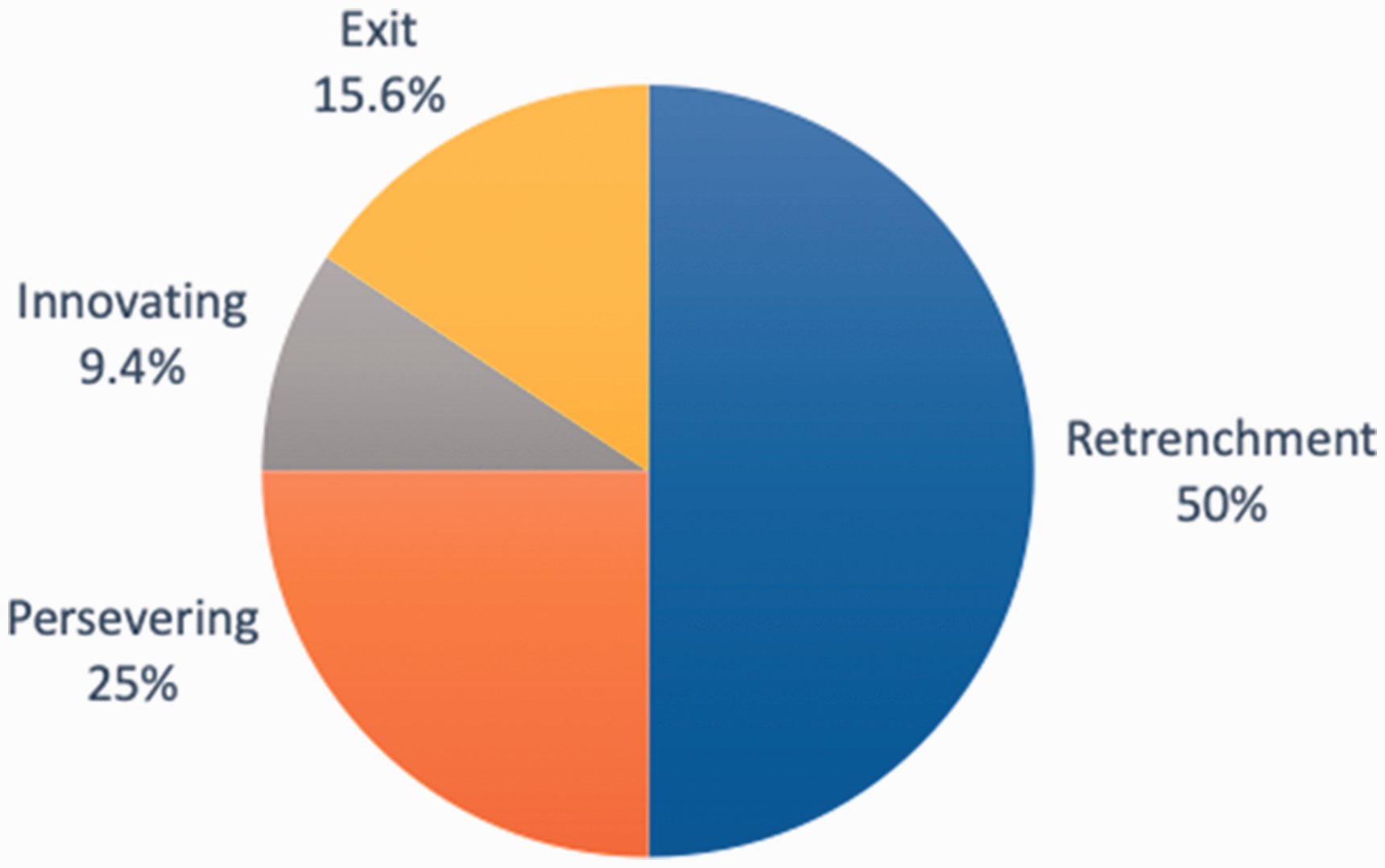
Strategic responses to COVID-19.
The most popular strategic response was the retrenchment strategy adopted by 16 firms, which concentrates on domestic tourism and postpones inbound and outbound tours. The key objective of this strategy is to reduce costs and/or product lines in the short run by narrowing the scope of business activities. The explanation of this strategy was summarised by a manager of a tour operator: In the context that the COVID-19 pandemic is still complicated in many countries and international routes are closed, we have no choice but to reduce our scope of activities and staff, focus on domestic tourism, and postpone inbound and outbound tours. (B7)
Choosing the retrenchment response to the pandemic, many tour operators reduced their staffs or rotated employees in each department to keep human resources intact. In this regard, the following was the explanation of a manager: In response to the pandemic, we have adjusted human resource policy towards retrenchment strategy. Around 30% of staffs are directly working in the office with rotated and collaborated positions among different departments. The rest of staffs are temporally staying at home unpaid or get 20% of their original salary. (B13) Given the low number of infected people and good disease control, we should take advantage of our safe destinations… it is predicted that the number of outbound and inbound visitors in Vietnam will accelerate in the post COVID-19. Therefore, persevering is a great strategic response for us. (B4) Our persevering strategy focuses on retraining human resources to better understand customers and improve service quality to reap higher performance as soon as the pandemic is over. (B2)
Thinking that innovating strategy can create value in the long-term, a manager contended that their firm would ‘restrict dependence on unsustainable foreign markets’ and ‘collaborate with partners that share the same values and standards to aim for sustainable development’ (A3). Another manager emphasised the role of innovating services and improving consumer values: Stimulating tourists with new services and addressing health and safety concerns will be essential. We decided to collaborate with other firms in the tourism value chain to create safer and cheaper travel combos. It is our strategic innovation in response to COVID-19. (B1)
Exit was chosen by five interviewed tour operators in response to COVID-19. Facing many pressures from the pandemic, they discontinued their operations. Some of them even had no idea about their return time to market. A manager stated: We have no choice but exit in response to the unpredicted and complicated COVID-19. The prospect of returning to the market is gloomy for us since there is no sign of international tourism’s recovery. (B14) As a merely inbound tour operator, my firm is no longer operating because of global lockdowns and no international flights. All of our employees are laid off but we hope we can return to the market soon. This exit time might be an opportunity for our strategic renewal in near future. (A5)
Conclusion and implications
This study is the first of its kind that explores the impact of COVID-19 on Vietnam’s tour operators and their strategic responses to this pandemic. Since tourism is one of the most sensitive economic sectors in times of instability, and the tourism industry in developing countries is more vulnerable to crises (Gössling et al., 2020), this research provides some useful insights. On the one hand, the COVID-19 pandemic has placed Vietnam’s tour operators in a new crisis. On the other hand, this outbreak may facilitate a restructure in the tourism market as well as encourage a transformation of the tourism value chain towards a more sustainable direction (Hall et al., 2020).
There are major themes that are attributed to this study’s findings. A key finding is that the major influences of the COVID-19 pandemic include decreased revenue, increased costs and employee redundancy. This echoes previous studies on tourism and crisis (e.g., Gu and Wall, 2006; Okumus and Karamustafa, 2005) and supports earlier arguments regarding the severe impact of COVID-19 on tourism firms (Gössling et al., 2020; Sigala, 2020). Besides, Vietnam’s tour operators are aware of the need for restructuring and expect to receive financial support from the government to overcome the crisis. This finding generally highlights the important role of the government in supporting tourism firms affected by crises like COVID-19 (Ritchie and Jiang, 2019).
Another important finding concerns the four strategies chosen by Vietnam’s tour operators to respond to the economic shock of COVID-19, which include retrenchment, persevering, innovating and exiting. Out of these, retrenchment was the most adopted strategic direction by these tourism firms, followed by persevering, exiting, and innovating, respectively. This suggests that the majority of tour operators in Vietnam concentrate on developing crisis-response strategies for the short and medium run rather than those for the long-term. In addition, the unpredictable and complicated nature of COVID-19 has caused some firms focusing on inbound tours to exit the market.
Theoretical implications
The present study makes important contributions to the literature relating to tourism risk and crisis management (Ritchie and Jiang, 2019). Essentially, it advances the knowledge and application of response-to-crisis strategies in tourism research by exploring why and how firms adopt different strategies in response to pandemics and crises like COVID-19. Methodologically, this study is unique in its use of both quantitative survey data and qualitative in-depth interview data. It, therefore, gets beyond simply describing the characteristics of tourism firms’ strategies to exploring their justifications for selecting the strategic responses. This study also puts forward a checklist matrix (Table 2) that can facilitate the investigation of crisis-response strategies in tourism (and hospitality) settings. The checklist outlines key strategic decision areas including the scope of firm activities (target markets and services), costs/assets, human resources, and strategic orientation. These areas can be utilised and extended in empirical future research.
Although this study focuses on response strategies at a firm-level during a crisis, its findings have wider implications for research on the support schemes and governance at the industry and government levels. While prior research studies reveal different types of industrial and governmental support such as investment in tourism infrastructure, provision of financial and human resources assistance, and development of communication and promotion campaigns (Blake and Sinclair, 2003; Cooper, 2005; Gu and Wall, 2006; Ritchie and Jiang, 2019), Vietnam’s tour operators, especially those concentrating on inbound tours, primarily expect financial assistance. This finding can be explained by the severe impact of COVID-19 on their revenues and the short-term orientation adopted by many firms. It also suggests further investigation of the development and applicability of government support policies for firms that provide different services (e.g., inbound and outbound tours) and has a different strategic orientation (e.g., short-term, medium-term and long-term), or those located in countries with different levels of international tourist arrivals and economic conditions (e.g., developed and developing countries).
Practical implications
The findings of this study have some implications for key stakeholders in the tourism industry including tourism firms, government, and policymakers. Considering the finding that the majority of the interviewed firms focused on cost-cutting activities and sustaining firms’ scope of business activities to generate immediate impact, it is recommended that tourism firms should seek to renew or innovate their strategy to obtain long-term value and pursue sustainable development. This is important because COVID-19 has the potential to cause the greatest economic shock and trigger structural changes in tourism (Dolnicar and Zare, 2020). Specifically, a firm can diversify targeted markets, innovate types of services, and the way of operating or restructuring itself. The need for restructuring has been already highlighted in the findings. Given Vietnam’s population of over 96 million and almost no restrictions within the country, it would be desirable to diversify domestic tourism groups. In addition, tourism firms can redesign their tours targeting smaller groups featuring activities and experiences that comply with health and safety measures. Furthermore, collaborating with other businesses in the tourism value chain to develop cheaper travel combos/packages and create a safer experience for customers is also a good strategic renewal as a response to COVID-19. In order to develop successful renewal and innovating strategies, firms need to closely monitor the external environment, such as changes in customers' attitudes and behaviours as well as governmental regulations and policies. This is reassuring in that it entails that the situation is not beyond redress, but there is an urgent need to handle these challenges to ensure the continued success of the tourism industry in Vietnam. Importantly, tourism firms may wish to strategically develop different plans for different scenarios of COVID-19 impact.
Given the finding regarding tour operators’ expectations for support packages, the government and tourism policymakers should make every effort to support these tourism firms. In general, the government needs to timely and accurately assessing the effects of COVID-19 on these firms and their needs during different phases of the pandemic. This can be done by surveys, focus groups, and in-depth interviews with firms’ managers. Given the firms’ strong desire for financial assistance, the government needs to provide them with financial packages such as low-interest loans and waiving taxes, which should prioritise small- and medium-sized firms that tend to be affected the most by the crisis (Ritchie and Jiang, 2019). The government should also develop a relevant framework for protecting the tourism workforce, many of them are lowly-paid employees and depend on international tourists (Adongo et al., 2017; Ioannides and Gyimóthy, 2020). It is also important to have communication and promotion programs that deliver a consistent and compelling message about a safe destination of Vietnam, which is inspired by its success in containing COVID-19. Moreover, it should not be assumed that this is resistant to similar occurrences, and even though vaccines can be found in due course of time, these serious implications could be partially supported by good strategic thinking while support from other stakeholders, mainly the government is also essential. There are bound to be sporadic declining patterns within this industry, and will be mirrored sooner, rather than later as countries keep fluctuating but strategic planning to keep Vietnam as an attractive destination for travel should be encouraged.
Limitations and future research
This study is exploratory in nature, providing a starting point for further studies. Since generalisability is likely from employing qualitative and mixed research methods, future studies should collect quantitative data at later stages to investigate the appropriateness and effectiveness of the strategic responses to COVID-19. Given the lack of framework testing in the literature, future research should develop and validate models explaining drivers, processes, and consequences of strategic responses to COVID-19 of Vietnam’s tour operators can be investigated. Third, the sample can be extended to companies in other tourism sectors or even those in different service industries. Last but not least, a longitudinal study to determine the impact of each strategic response to the company’s performance should also be investigated in the future.
Supplemental Material
sj-pdf-1-thr-10.1177_1467358421993902 - Supplemental material for Strategic responses to COVID-19: The case of tour operators in Vietnam
Supplemental material, sj-pdf-1-thr-10.1177_1467358421993902 for Strategic responses to COVID-19: The case of tour operators in Vietnam by Binh Do, Ninh Nguyen, Clare D’Souza, Huu Duc Bui and Thi Nguyen Hong Nguyen in Tourism and Hospitality Research
Footnotes
Declaration of Conflicting Interests
The author(s) declared no potential conflicts of interest with respect to the research, authorship, and/or publication of this article.
Funding
The author(s) received no financial support for the research, authorship, and/or publication of this article.

Supplemental Material
Supplemental material for this article is available online.
Author Biographies
References
Supplementary Material
Please find the following supplemental material available below.
For Open Access articles published under a Creative Commons License, all supplemental material carries the same license as the article it is associated with.
For non-Open Access articles published, all supplemental material carries a non-exclusive license, and permission requests for re-use of supplemental material or any part of supplemental material shall be sent directly to the copyright owner as specified in the copyright notice associated with the article.
