




Abstract
Summary
The academia and the profession have long overlooked the importance of material interest in the profession of social work. In order to address this research gap, we first reviewed the historical role that material interest has played in differentiating professions from nonprofessions and analyzed its decreasing status along the development of professions due to the two competing discourses of professionalization and de-professionalization. We concluded with the fundamental question, “does material interest still matter for the professions under the current professional environments,” and answered this question by purposively selecting one of the most important organizational outcomes of the social work workplace—turnover intentions—as our dependent variable. We then conducted a meta-analysis to investigate the relationship between salary and turnover on 24 studies with a combined sample of 9343 social workers.
Findings
The results showed that salary was negatively related to social workers’ intentions to leave organizations (r = −.18, ρ = −.21). Specifically, both social workers’ actual salary and their satisfaction with pay and benefits were negatively associated with individual employees’ turnover intentions.
Applications
This research also supported Barth’s argument that despite social workers’ earnings are “unresponsive” to the labor market, they are not so different from other professions in the workforce market. Research implications both for the third model of the profession—institutionalist professionalism—in contemporary society and for salary raises were discussed.
Introduction
In a commissioned study to take a “first look” at the social work labor market in the USA, Barth (2003) maintained that he found virtually no literature on the social work labor market as a whole. After analyzing multiple databases, he summarized that the salary of social workers was not very “responsive” to the labor market. That is to say, even in a tight labor market, social workers’ salaries were not often associated with expected increases in salary. Meanwhile, after controlling for other important variables (e.g., age, education, race, etc.), he found that social workers earned approximately 11% less than individuals in other occupations did (e.g., counselors, case managers, registered nurses, etc.). Under the analytical framework of standard Supply and Demand theory in economics, he attributed the “unresponsive salaries” to several factors that involved such factors as time and taste, labor unions, ease of market entry and exit, the number of readily available substitutes for social workers, and the social and public climate (Barth, 2001, 2003). This study focuses on the factor of taste because its role is so distinct from that in the standard economic theory that “a few more sentences seem warranted” (Barth, 2001, p. 30) and because researchers’ strong call for the particular attention paid to pay and earnings (Ng, 2010; Wermeling, 2013; Wermeling & Smith, 2009). “Taste in social work,” which refers to social workers, who usually are employed in agencies, often have a strong taste for and preference in providing social services, even if doing so conveys lower pay. That particular taste leads to the decreasing effect of salary differentials in drawing people into and out of the profession (Barth, 2003).
Employee turnover is a critical organizational phenomenon that has drawn considerable attention from organizations and academicians alike. Whereas turnover to some degree is healthy for organizations because it can invigorate them by bringing in fresh thoughts and skills, a high turnover rate in an organization indicates the existence of hidden problems that, in the end, could pose great challenges to the growth and development of that organization. According to Hom and Griffeth (1995), the costs incurred by high turnover rates involve three parts: direct loss (e.g., unemployment compensation), replacement cost (e.g., recruitment), and training cost (e.g., formal orientation and training).
In particular, recruitment and retention have long been two of the most challenging issues in the social work labor market. Compared with the labor market of other occupations, the cost incurred by the high turnover in social work is more severe because service quality largely depends on the abilities of individual professionals (Balfour & Neff, 1993; Drake & Yadama, 1996). Specifically, a high turnover may affect the quality, continuity, and stability of services (Powell & York, 1992). In addition, a high turnover can damage other employees’ morale, thereby posing a potential threat to the long-term development of affected organizations. Finally, the negative image shaped by high turnover makes it difficult for organizations to recruit and retain social workers into the profession (Ellett, Ellis, Westbrook, & Dews, 2007).
Empirical studies often ignore salary as a central concern in social work. Studies that have included salary often regarded it as a control or an independent variable in explaining several organizational outcomes, such as job satisfaction, organizational burnout, and turnover intentions. Empirical results on the effects of salary are mixed: Some studies have found a significant relationship between salary and employees’ intentions to leave organizations (Dickinson & Perry, 2002; Fakunmoju, Woodruff, Kim, LeFevre, & Hong, 2010; Kim & Stoner, 2008), whereas other studies have failed to reach the same result (Cohen-Callow, Hopkins, & Kim, 2009; Hopkins, Cohen-Callow, Kim & Hwang, 2010).
These kinds of contradictory results, which rely heavily on statistical significance tests, make research findings more conflicting. Therefore, it is necessary to review systematically the relationship between salary and turnover among social workers. Meta-analysis is one method of conducting systematic syntheses, and it is “a methodological and statistical approach to drawing conclusions from empirical literature” (Card, 2015, p. 4). It has the advantage of integrating conflicting research results across studies and thus providing a basis for theory development (Schmidt & Hunter, 2014). In the following section, we present the debates related to the role that material interest plays during the development of professions.
Literature review
We review three topics in this section. We first lay the foundations by discussing the historically positive role that material interest played in the early stages of professionalization for aspiring occupations. Then, we present the contradictory fact that there appears to be a trend to downplay the role of material interest during the development of professions, and we discuss the dynamics of that change. Specifically, we analyze how this “downplaying” process has evolved, by reviewing the two competing discourses of professionalization and de-professionalization. We conclude this section with a discussion of the ambiguous role of material interest in the current situation.
The distinction between professions and nonprofessions: The role of material interest
At the beginning stage of professionalization, for the general occupations, material interest does play a major role in differentiating practitioners from other people. Previous scholars have already noted the importance of material rewards in the establishment of professions. Carr-Saunders was one of the first social scientists to analyze systematically the process of professionalization. He defined profession as an occupation that is “based on intellectual study and training, the purpose of which is to provide service for a definite fee or salary” (Carr-Saunders & Wilson, 1933; as cited in Vollmer & Mills, 1966, pp.1–3). Carr-Saunders referred to “fee or salary” in order to differentiate old professions from newly emerging professions. Practitioners from the old professions, such as medicine, were generally freelance workers (self-employed) and were remunerated by a fee, whereas those from the newly emerging professions, such as administration and business, were salaried from the outset. The fact that both types of professions were just as professional and continued to thrive in society led Carr-Saunders to conclude that, in addition to specialized training, definite remuneration was another core criterion for the evolution of a profession (Carr-Saunders & Wilson, 1933; Vollmer & Mills, 1966). Therefore, we can conjecture that early scholars had already taken note of the importance of material rewards in the establishment of professions.
The role of material interest has been noticed in such professions as nursing, medicine, and education (Cherniss, 2016; Duffy, Douglass, Autin, England, & Dik, 2016; Khamisa, Peltzer, Ilic, & Oldenburg, 2016; Rasmussen et al., 2016; Rudman, Gustavsson, & Hultell, 2014; Stronge, 2018; West, Dyrbye, & Shanafelt, 2018), and it is no exception for the social work profession (Choi, Urbanski, Fortune, & Rogers, 2015; Ng, 2010; Ng & Sim, 2012; Schweitzer, Chianello, & Kothari, 2013; Wermeling, 2013; Wermeling & Smith, 2009). Attribute theorists assume that professionalization is an ideal type, forming a continuum that ranges from the ideal type “profession” at one end to a “nonprofession” at the other end. In other words, the professionalization of aspiring occupational groups, such as social workers, is a dynamic process whereby certain characteristics change in the direction of the ideal type. A short review of the history of social work in the USA indicates the historical role of salary in the early development of the profession. Specifically, the origins of casework revealed that in the 1880s, the Charity Organization Societies began to hire “paid agents,” who were the originators of social work. That significant event differentiated the paid agent from the earlier “rich friendly visitor,” who was usually a volunteer drawn from the higher ranks to visit the poor (Wagner, 1986). It was through this apparent difference in remuneration between the paid agent and the unpaid friendly visitor that the growth of casework was facilitated.
Two types of discourse: The decreasing role of material interest
With the development of professions, the emerging discourses on professionalization and de-professionalization both began to downplay the role of material interest. According to early works in the sociology of professions (Freidson, 2001; Larson, 1979), at least two ideologies have been highlighted. The preference for public interest over personal interest on one hand and the professionals’ own commitment towards work on the other hand, have been actively employed in developing professions. Such a discourse on professionalization benefits professions and professionals in establishing public trust and achieving a monopoly in the market. For instance, the word “calling,” which frequently appears in various codes of ethics in social work, continuously transmits the signals that this professional endeavor is not a means to an end but is the end itself. It conveys the idea that practitioners respond to the social work calling by providing services primarily for physical and social satisfaction and only secondarily for monetary compensation––motivations that strengthen the service orientation and also downplay material interest in the profession.
Although in the early 20th century much attention was paid to the public interest represented by professions and professionalism (Carr-Saunders & Wilson, 1933; Marshall, 1950; Tawney, 1921), in the late 20th century attention shifted to the power and privilege enjoyed by professionals (Abbott, 1988; Freidson, 2001; Larson, 1979).
That shift in focus is largely due to Everett Hughes’s influence (Johnson, 1972). Hughes (1971) said he would pass from the wrong question to a more fundamental one: “What are the circumstances in which people in an occupation attempt to turn it into a profession?” (p. 340). That thinking led later researchers to pay greater attention to the benefits brought by professionalization. For instance, Larson (1979) viewed professionalization as a market project in which individual professionals achieved self-fulfillment through collective efforts (pp. 1–2). Abbott (1988) considered professionalization as ecologies or systems for defining and maintaining occupational jurisdiction, along which professionals’ self-interests, such as salary, power, and status, could be promoted (pp. 86–91). Freidson (2001) regarded monopoly and discretion as two core attributes of professionalism that were distinctive from the competition rule of the free market and from the efficiency rule of bureaucracy (p. 3).
The appearance of that shift in scholarly interest, coupled with the emergence of neoliberalism, entrepreneurialism, and marketization, led to a great deal of criticism of the professions and to discussions about de-professionalization (Brock & Saks, 2016). Critical attacks on professionals, who are now considered to be “powerful, privileged, self-interested monopolies,” can be found, particularly in the neo-Weberian literature of the 1970s and 1980s (Evetts, 2014). Such a discourse downplays the material interest. Healy and Meagher (2004) summarized three dimensions of de-professionalization: (1) the fragmentation and routinization of social work; (2) the relative decline in professional categories of social work employment wherein nondegreed people do the social work job for lower pay; and (3) the underemployment of professional social workers, who find that their qualifications are neither required nor fully utilized. The discourse on de-professionalization seriously hampers the movement towards professionalization, to the extent that some scholars strongly advocate re-professionalization (Duyvendak, Knijn, & Kremer, 2006; Ellett, 2002; Healy & Meagher, 2004).
Taken together, both discourses reduce the role of material interest in the development of the profession. The professionalization discourse highlights the profession’s general interest in the whole community and the professionals’ distinct work ethic towards their calling, which emphasizes the professionals’ devotion to their work and their disinterest in material interest. The opposite discourse directly discourages professionals’ efforts in promoting their material interest. All of this thinking reduces the role of material interest within the profession.
The ambiguous role of material interest in a new environment
As was noted in the previous section, we have shown that material interest does play a role in the early development of professions. In this section, given that growing bureaucratization and rationalization exert a strong influence on the working environment of professions, we would like to ask another related question: Can material interest still differentiate professions from nonprofessions?
In the 1990s, arguments emerged that public interest and self-interest are not contradictory but instead are compatible (Saks, 2005). In fact, researchers have also begun to assess the influence of professionalism and its contributions to society at large (Evetts, 2014). In sociological research on professional groups, it no longer seems important to “draw a definitional line” between professions and other occupations, given that more and more professionals now work in employing organizations (Evetts, 2014). In other words, under the current environment, considering a firm boundary between professions and nonprofessions no longer applies. Thus, it appears that there is little basis for maintaining the argument that material interest is unimportant in the social work profession.
Against this background, and considering the grave effects of a high turnover for service organizations, we have chosen one of the most important organizational outcomes––turnover intentions––as part of our analysis to examine whether material interest correlates significantly with the turnover intentions of social workers. The following section introduces the method used in this study.
Method
This section includes details on how we gathered and analyzed data. Specifically, we describe our inclusion criteria and search strategy to obtain the qualifying studies (Figure 1). This is followed by a detailed description of our screening process, data-abstraction, and coding of the selected studies. We conclude this part with a description of our analytical procedures.
Inclusion criteria
Because our research aim is to examine “whether salary is related with turnover intentions among social workers,” this review attempts to include all studies that investigate the relationship between salary and turnover intentions in the social work profession. Accordingly, studies that explored other organizational outcomes, such as job satisfaction and organizational commitment, studies that explored factors affecting turnover intention but did not contain salary in their analysis, and studies that explored the associations between salary and turnover intentions but failed to report necessary statistics were excluded.
The review period was limited to 2000 to 2016, since prior studies were likely to be less relevant due to rapidly changing economic, political, cultural, and social conditions. Furthermore, all articles identified in the current review were restricted to peer-reviewed literature and theses. Theses were included to ensure sufficient studies and to reduce publication bias.
Relying on a single database was insufficient (Taylor, Wylie, Dempster, & Donnelly, 2007). The current study thus reviewed several electronic databases, including Medline, CINAHL, and PsycInfo, the largest international databases for medicine, nursing, and psychology, respectively, the Applied Social Sciences Index & Abstracts, Family & society studies worldwide, the Dissertations & Theses, and other five Chinese language databases (Table 1). 1
Databases, platform, and articles identified.
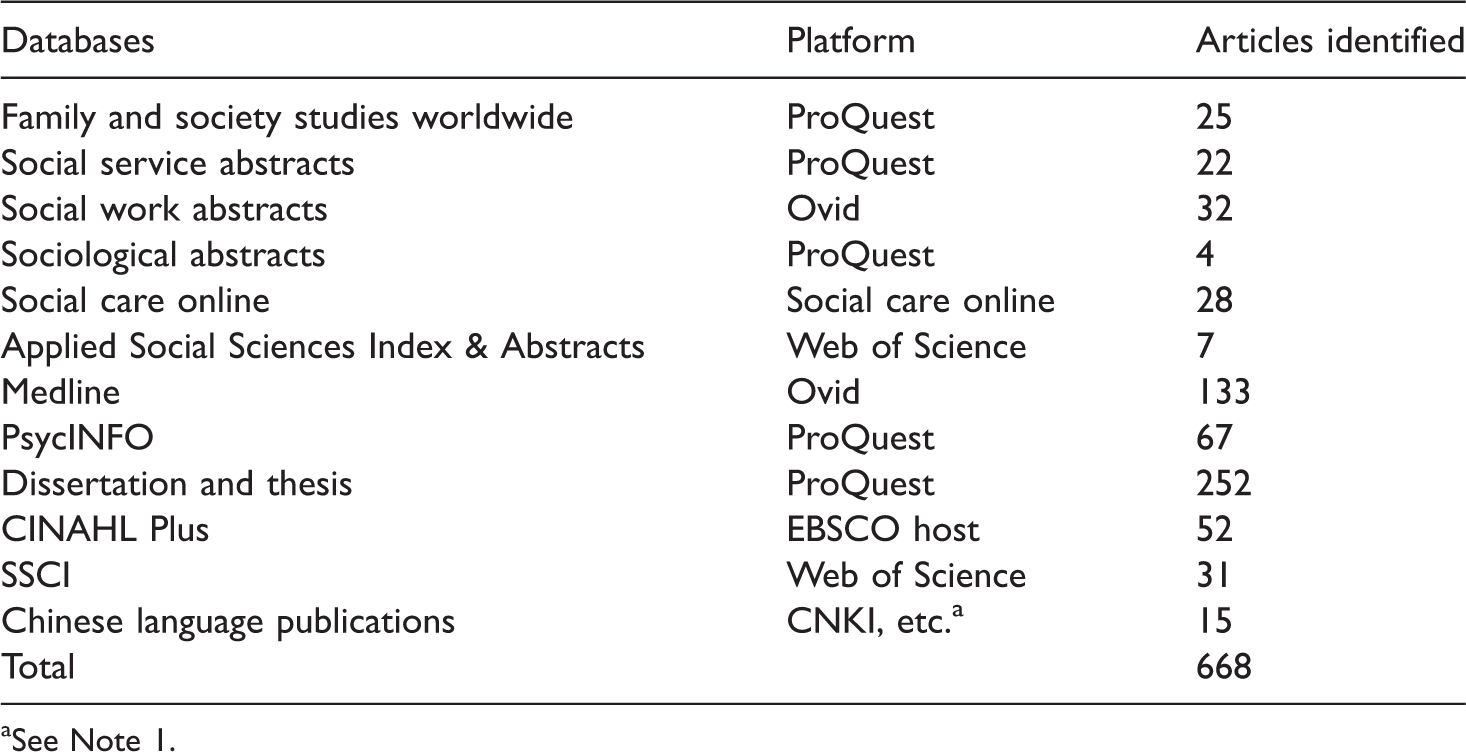
aSee Note 1.
Search strategy
Following Taylor et al.’s (2007) search strategy, this study adopted a three-stage search formula that included (1) creating concept groups, (2) refining each group, and (3) adding search filters. The research question was divided into three parts, namely, “salary,” “turnover intention,” and “social worker.” This review utilized the widely applied PICO search structure (Booth, O’Rourke, & Ford, 2000) in which the P (population), I (intervention), and O (outcome) were, respectively, conceptualized as social worker, salary, and turnover intention, while C (comparison intervention) was not relevant. Such an operationalization is similar to other systematic studies in social service (Taylor et al., 2007).
The following facets and search terms were used:
Activity facet: turnover* OR leave* OR quit* OR retent* OR retain* OR remain* OR stay* Location facet: salar* OR income OR pay OR money OR benefit* OR reward Population facet: “social work”
The search strategy was in the order of (“Activity facet”) AND (“Location facet”) AND (“Population facet”) as follows: (“turnover* OR leave* OR quit* OR retent* OR retain* OR remain* OR stay*”) AND (“salar* OR income OR pay OR money OR benefit* OR reward”) AND (“social work”)
Whenever possible, the “Activity facet,” “Location facet,” and the “Population facet” were applied to abstracts and titles during the searching process. Appendix shows an example of how we searched the literature in Medline via the platform of Ovid.
Screening process
The database searches produced 668 articles. In strict accordance with criteria formulated beforehand, all potentially relevant articles were identified and irrelevant articles were excluded by one reviewer. To ensure the reliability of our screening decisions, all exclusions at the stage of full-text screening were double screened by another independent reviewer. Few disagreements occurred and when it occurred, it was mainly concerned with the type of study sample. For instance, although we employed “social work” to refine our literature search, occupations similar to social work such as direct care workers, home care workers, and community health advisors and the like 2 were also detected. These issues were discussed by the reviewers until agreements were reached. Two specific issues are worth noting.
One issue concerns turnover. First, in our review, we only included studies that measured the turnover intentions and thus studies using actual turnover as the outcome variable were excluded. In so doing, studies comparing employees who remained with those who had left were excluded (Benton, 2010; Cahalane & Sites, 2008; Scannapieco & Connell-Corrick, 2003, 2007). Second, turnover can be interpreted as both leaving a certain organization and as leaving the field or the profession. In order to define a clear boundary, this study only included studies that measured the intentions to leave the organizations instead of exit from the field or the profession.
Another issue concerns salary. First, other forms of income were excluded. For instance, a study that subtracted salary from total household income to derive a measure of nonwork income and tested its relationship with turnover intentions was excluded (Weaver, Chang, Clark, & Rhee, 2007). Second, studies were excluded when they measured satisfaction with nonfinancial rewards (Cahalane & Sites, 2008) or measured the perception of fairness regarding the processes in evaluating performance (Nissly, 2004). Third, satisfaction with pay or fringe benefits was typically used as a measure of salary, but studies that defined this dimension widely were also excluded.
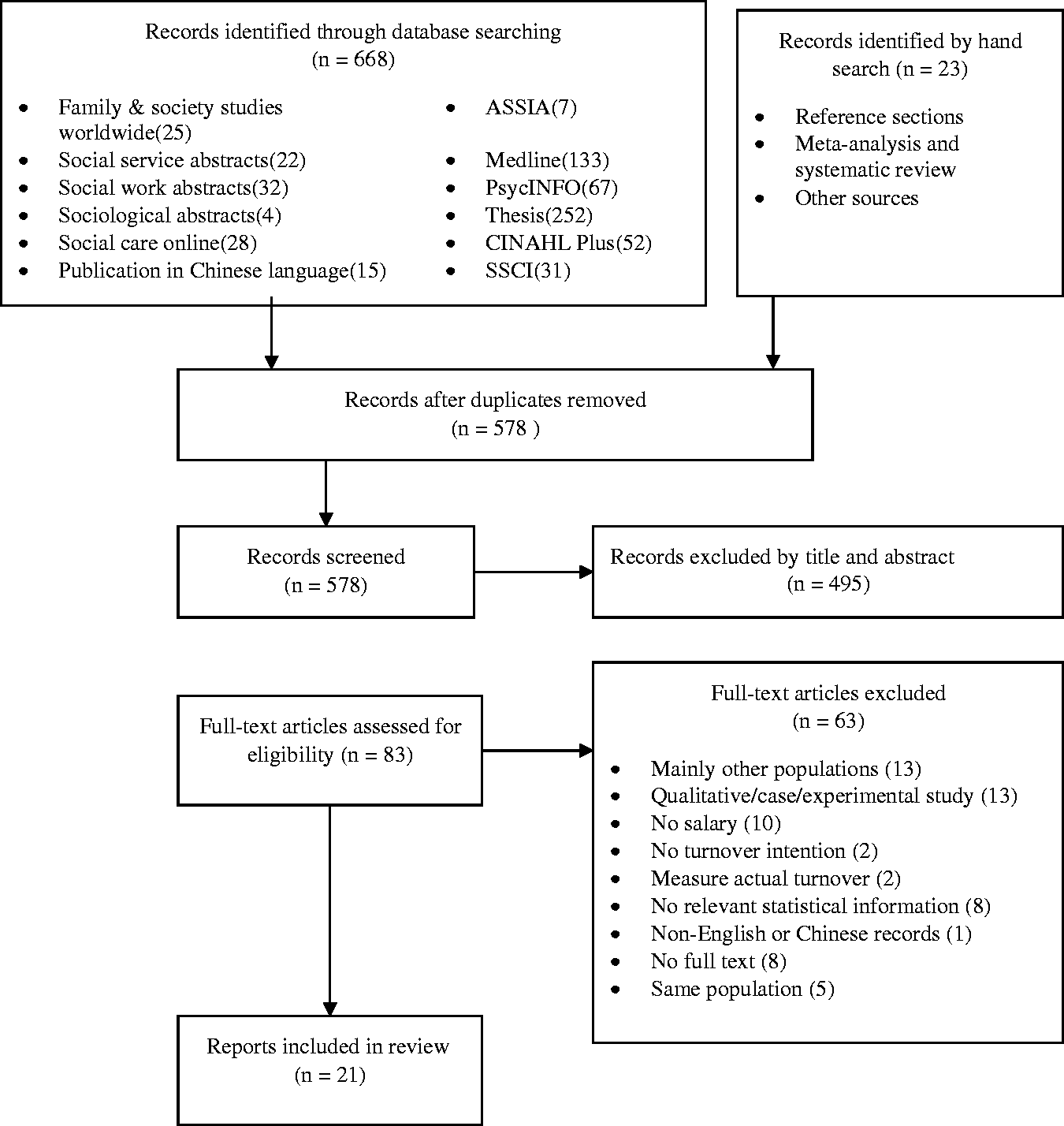
Diagram for systematic search and screening process.
Data extraction and coding of studies
For each report, we coded the following information: publication type and publication year. For each independent study, we recorded various information: country in which the data were collected, type of research design, type of data collection method, type of setting, percentage of female respondents, mean age, percentage of White respondents, percentage of married respondents, percentage of different educational attainment levels, average qualified years in the service field, tenure in the current agency or organization, and sample size.
We also recorded measures of salary and of turnover and reliability of measures of salary and turnover intention. Apart from the above information, correlations 3 or other statistics (e.g., t-value, beta coefficient, etc.) that could be transferred to correlations between salary and turnover intention were also recorded (Lipsey & Wilson, 2001; Peterson & Brown, 2005). Whenever necessary, the correlations were reversed so that a negative correlation indicated a higher level of salary associated with a lower intention to leave the organization.
To ensure the reliability of the coding decisions, a 40% sub-sample of all reports was re-coded by another independent rater. Articles were randomly selected by the second rater and coded independently. No disagreements appeared in terms of any factual information such as the year of publication, the research design, and the data collection method.
Data analysis
Effect size defines the direction and magnitude of association between two variables (Card, 2015). Three common indices for representing the effect sizes are r (Pearson correlation coefficient), g (one form of standardized mean difference), and o (odds ratio). The current study reports the first type of effect size (r). Hunter and Schmidt’s approach was used to conduct the meta-analysis (Schmidt & Hunter, 2014). Rather than using a fixed effect model, we decided to fit a random effect model, treating our studies as a sample from a wide population. The random effect model assumes the existence of both a mean population effect size and the variability in effect size due to the population effects. More specifically, variability between effect size is due to sampling error and the variability in the population of effects, whereas the fixed effects model assumes that there is one true population effect and all the variability is due to sampling error (Lipsey & Wilson, 2001).
All the measurement errors in the independent and dependent variables were corrected. We divided individual effect sizes by the square root of the corresponding reliability statistics between the measures of salary and turnover intentions. The reliability statistics used in this study were the internal consistency coefficients reported by each study. Where reliabilities were not reported, the missing information was replaced by an average reliability derived from all other studies. For any single-item measurement scale, following prior practice (Kim & Kao, 2014), we corrected for unreliability by inputting the alpha coefficients. When salary was measured by actual salary, it was inputted as 1 because of its relatively objective nature. We reported on both effect sizes that were and were not corrected for the reliabilities of the measurement scales used.
In meta-analysis, credibility intervals are more critical than confidence intervals (CIs). We therefore calculated both the 95% CIs and 80% credibility intervals as suggested by Schmidt and Hunter (2014). The distinction between these two intervals is important. CIs express the likely amount of error in the estimated correlation due to sampling error, whereas credibility intervals refer to the distribution of parameter values. The former is based on the standard error and the latter is based on the standard deviation.
The heterogeneity of effect size across studies is also examined using the frequently calculated Q statistic. It tests whether it is reasonable to assume that all effect sizes are estimating the same population mean. A statistically significant Q estimate indicates the existence of heterogeneity and can conclude that the effect sizes are not all estimates of a single population (Lipsey & Wilson, 2001). Thus, the heterogeneous effect sizes could also partly justify the moderator analysis. However, moderator analysis requires a large number of studies. Given the small number of studies included in our study, the present study did not test the publication bias either. The present study used the metafor package (Viechtbauer, 2010) within the R statistical computing environment (R Core Team, 2013).
Results
This section reports on four parts: the basic description of the dataset, the characteristics of the respondents, the type of measures of salary and turnover intentions, and the size and direction of the correlation between salary and turnover intentions.
Description of dataset
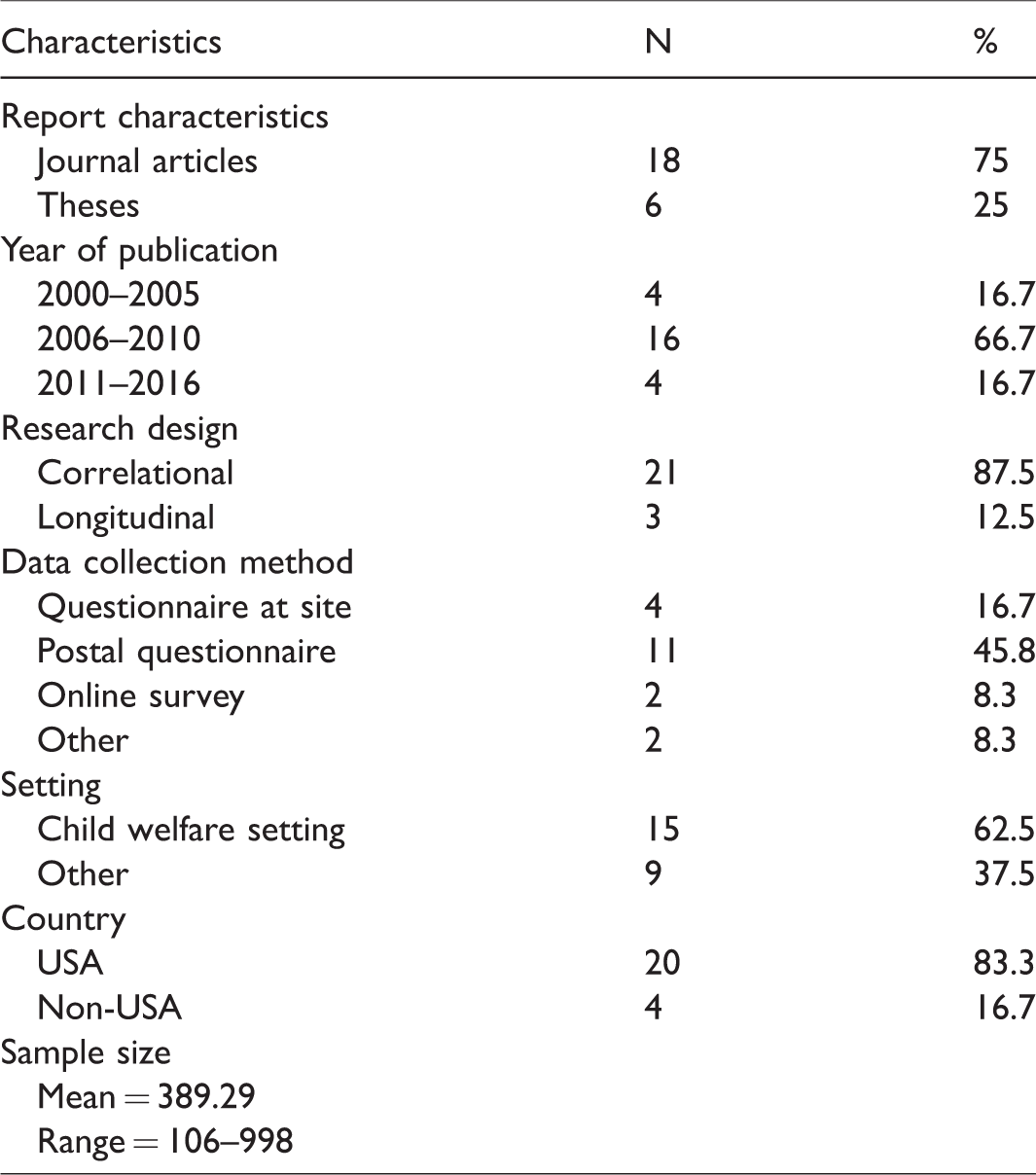
In total, we obtained 21 reports that included 24 independent samples in our meta-analysis. Table 2 shows the characteristics of the 24 studies. Regarding the type of reports, 75% were peer-reviewed articles and 25% were theses, which to some degree reduced any potential publication bias. In terms of the year of publication, the majority of samples (67%) were published between 2006 and 2010. Eighty-seven percent of the studies employed a correlation design and 13% longitudinal design. 4 Forty-six percent of the studies collected data by postal method, 17% and 8%, respectively, employed on-site and online questionnaires. Sixty-three percent of the studies involved employees in public or private child welfare settings, while 37% involved other settings such as integrate family and service centers. It is important to note that most studies were carried out in the USA, with only a few studies conducted in China, Canada, United Kingdom, and Israel and that these studies were varied in their environment, target population, and scope. Thus, while this approach allowed us to open up a broad dialogue on the role of salary in social workers’ turnover behavior, the small number of independent samples (n = 24) would not allow this study to conduct the moderator analyses to make country-level comparisons and thus the results of the current review would apply more to North America than to other parts of the world. The mean sample size was 389, ranging from 106 to 998.
Characteristics of the sample.
Description of respondents
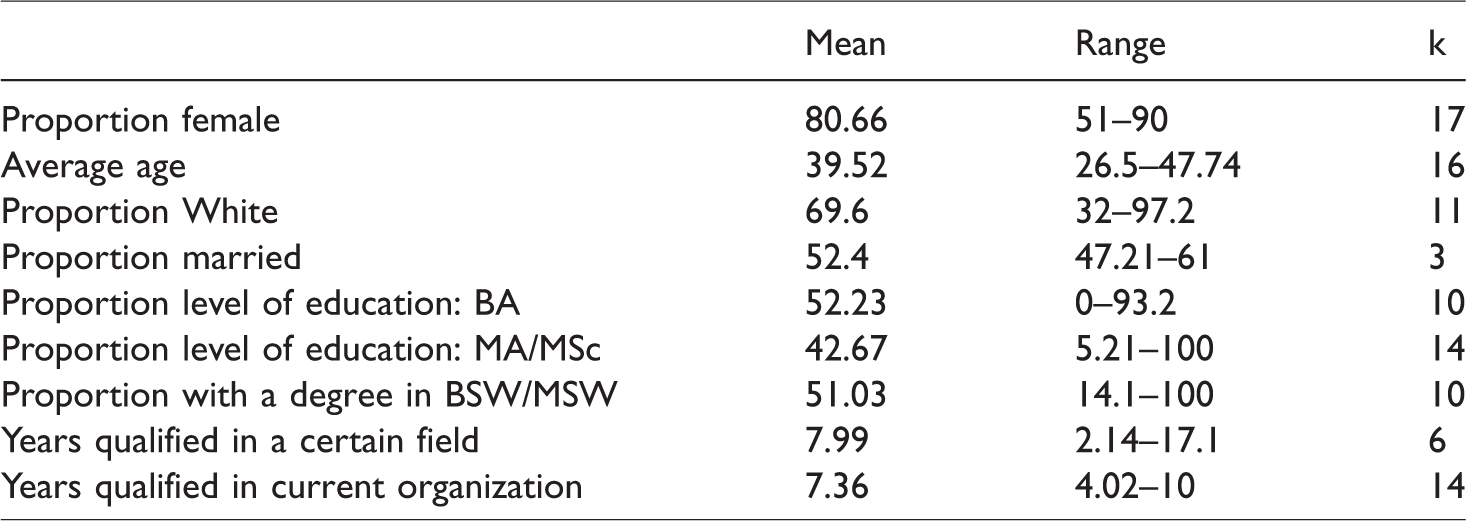
Table 3 shows the characteristics of the participants. Eighty-one percent of the participants were female. The mean age was 40, and the youngest age of 26.5 was in China. Seventy percent of the respondents were White. The study carried out in the social services department of the United Kingdom has the highest proportion of White respondents (97%) (Evans & Huxley, 2009). Three studies reported the proportion of married employees with a mean of 52%. In terms of the educational attainment level, 52% of the employees had a Bachelor’s degree and 43% had a Master’s degree in Arts or Science. Respondents with a degree in social work, either BSW or MSW, accounted for 51%. Regarding work experience, the average qualified years in a certain field was eight years and the average years qualified in the current organizations was seven years.
Participant characteristics.
Measures of salary and turnover intention
Because of different measures of salary identified in the studies, salary was categorized into one of the two dimensions, actual salary and satisfaction with pay or benefits, to permit the meta-analytic combination of these studies. The second measure is satisfaction with pay and/or benefits, assessing one’s degree of satisfaction with pay, remuneration, or monetary benefits, or satisfaction with the fairness of the allocation of rewards and compensation. Thirteen reports that involved 16 independent studies used this measure (Abu-Bader, 2000; Auerbach et al., 2010; Barak, Levin, Nissly, & Lane, 2006; Chen et al., 2012; Evans & Huxley, 2009; Harrington et al., 2001; Lambert et al., 2012; Little, 2010; McGowan et al., 2010; Strolin-Goltzman, 2008; Strolin-Goltzman et al., 2007; Weaver et al., 2007; Weikel-Morrison, 2002). Eight studies used actual salary to test its relationship with turnover intentions among social workers (Dickinson, 2002; Fakunmoju, et al., 2010; Hopkins, Cohen-Callow, Kim, & Hwang, 2010; Hwang, 2012; Jayaratne & Faller, 2009; Kim, 2008; Luo, 2016; Shim, 2009).
Two types of turnover were identified: intention to leave the organizations and intention to remain employed. However, due to the fact that only two samples among the 24 samples used the second measure, we decided not to follow the practice of Kim and Kao (2014) who analyzed those two types both separately and combined. Instead, we treated the intention to remain employed as the same measure as the turnover intentions given the direct opposite relationship between them. Corresponding reverses were made so that a higher value was indicative of a higher intention to leave the organizations.
Size and direction of the correlation between salary and turnover intention
Before calculating the effect size, there is one further issue that needs to be noted. Some studies employed more than one measure to assess turnover. For example, one study reported two correlations of fairness of compensation, procedural justice and distributive justice, with turnover intentions (Barak, Levin, Nissly, & Lane, 2006). However, the effect-level analysis suffered from the nonindependence issue since several correlates between salary and turnover intentions were often reported for a single sample. Therefore, it is necessary to choose a single effect. These correlation effect sizes were thus aggregated to achieve one salary measure reflective of turnover intentions. The aggregated correlation effect sizes were calculated by averaging correlation coefficients. For example, Hopkins et al. (2010) assessed turnover intentions with four measures: work withdrawal, job withdrawal, job search behavior, and quit. As the present study only included current employees in our samples, the measurement of actual turnover (quit) was not used. The former three measurement types of turnover were then aggregated to generate one value representing the intention to leave the organization. Therefore, from the 21 reports, we coded a total of 24 independent effects.
Table 4 provides details of the correlation effect sizes between salary and turnover intentions. As for the effect level, the mean size of the correlation between salary and turnover intention was −.18, with a 95% confidence level (CI) from −.23 to −.12. The narrow width of this interval increased our confidence that salary was correlated with employees’ intention to leave the organizations. The heterogeneity test that indicated the extent to which the correlation effect size varied was significant (QE = 186.29, df = 23, p < .001). In addition, the statistical value of I2, representing the proportion of total heterogeneity of total variability, was 86.95%, indicating that the variability in effect size was substantial. Corresponding results for the 24 correlations after correcting for reliability were stronger (ρ = −.21, 95% CI [−.27, −.14], QE = 183.25, p < .001, I2 = 86.59%). The 80% credibility interval for ρ ranges from to −.37 to −.05.
Effect size by type of salary measure.
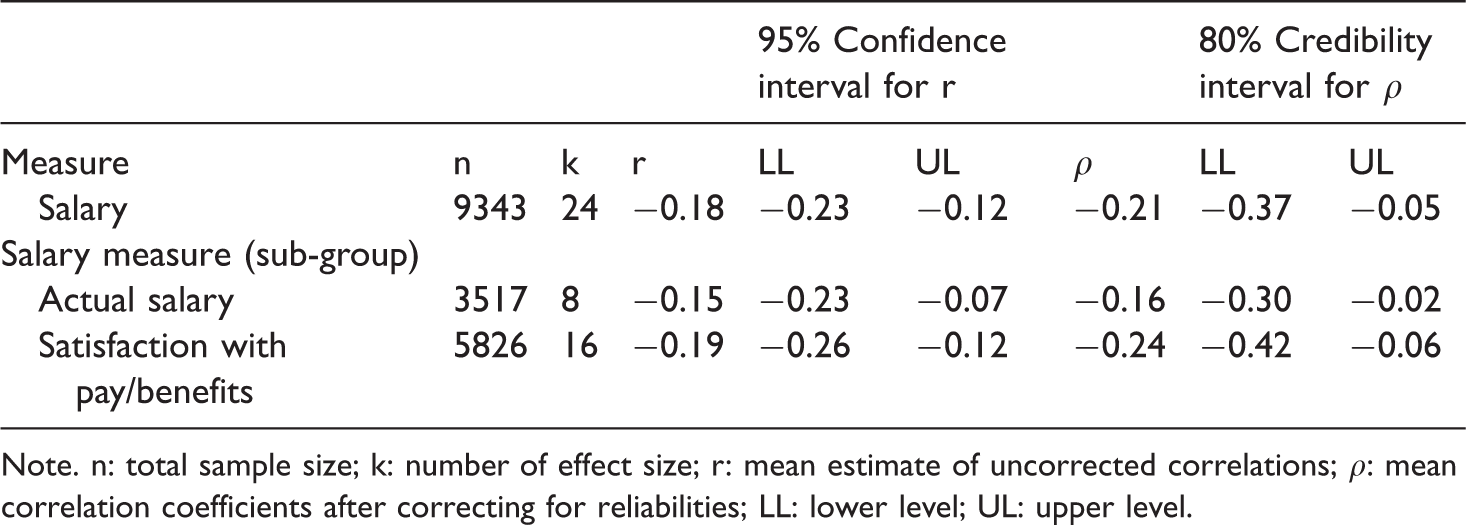
Note. n: total sample size; k: number of effect size; r: mean estimate of uncorrected correlations; ρ: mean correlation coefficients after correcting for reliabilities; LL: lower level; UL: upper level.
Table 4 also reports sub-group analyses of the estimated correlations for the salary measures, including estimates both based on the raw correlations and based on corrected correlations for reliability. Both of the effects measured by actual salary used in eight studies and satisfaction with pay or benefits used in sixteen studies were negative and the corresponding 95% CI for each measure did not include zero, indicating that those two types of effects were significantly different from zero. The effect size for satisfaction with pay or benefits (r = −.19, ρ = −.24) was relatively larger than that for the actual salary (r = −.15, ρ = −.16). These negative results indicate that turnover intentions among social workers were impacted by both individual employee’s actual salary and their satisfaction with their pay and benefits in certain organizations.
In summary, all effect sizes were statistically significant, and all p values were less than .001. Therefore, there was a significant negative relationship between salary and turnover intentions. However, the existence of considerable heterogeneity among studies is worthy of notice.
Discussion
Our meta-analysis of 24 studies examined how salary relates to social workers’ intentions to leave organizations. Overall, the results showed that salary was significantly related, negatively and statistically, to employees’ turnover intentions. The average magnitude of the salary effect was −.18, and after the measure was adjusted for reliability, the corresponding magnitude of the effect changed to −.21.
The relationship between salary and turnover
First, as predicted, both types of salary measures, the actual salary and the employees’ satisfaction with their salary, correlated significantly with turnover intentions. The respective magnitudes of that effect for each were −.16 and −.24. Even though the small number of studies available may harm the reliability of moderator analysis, our results show that there was no significant difference among the ways in which salary was measured. Thus, both the actual salary earned by social workers and their satisfaction with their pay and benefits are important. This finding is critical in that originally, most social work studies revealed a significant relationship between satisfaction with salary and turnover intentions but failed to reach the same result for the relationship between actual salary and turnover intentions. In addition, our results suggest that future researchers should include both measurements of salary in their studies. However, a large number of studies are needed for any further examinations.
Second, our meta-analysis supports the argument made by Barth (2001, p. 17), who found that “a standard model of earnings appears to fit social workers.” On the basis of statistical analysis, he denies the notion that social workers’ earnings are different from those of other professions in the workforce market. Meanwhile, Barth also exhorts us to remember the fact that social workers earn roughly 11% less than do individuals working in all other occupations, which led him to the conclusion that social workers’ salary is not as “responsive” to the labor market as expected. That is to say, even in a tight social work labor market with a high demand for social workers, the expected increase in wages has not taken place. Thus, we should examine why such a situation exists.
Appropriate salary is needed
As Dominelli (1996) pointed out, the fact that social workers often make “life and death” decisions means that the profession is seriously undervalued, as is reflected in their low pay. Criticisms still exist that view the pursuit of economic reward as elitist. Urgent reconsideration is thus needed, because although those criticisms, which Freidson (2001) terms “shibboleths,” are mostly empty rhetoric, they do increase the public suspicion of the profession and impede the profession’s efforts in achieving an appropriate level of material interest. Should this trend continue and be subject to no strong countervailing forces, it is likely that even though social workers can achieve a certain level of material interest, they may accept it with guilt because they feel that pecuniary reward is bad and is at odds with their professional calling (Healy & Meagher, 2004).
In their paper, “A salary is not important here: The professionalisation of social work in contemporary Russia,” Iarskaia‐Smirnova and Romanov (2002) observed that because of low pay, many graduates would not work at social work agencies and instead would apply for other, higher paid, non-social work jobs. The authors therefore summarized that people who are doing social work are not doing it because of the pay; in fact, in contrast, “among social service employees, it is difficult to find anyone satisfied with their salary” (Iarskaia‐Smirnova & Romanov, 2002, p. 135). People become social workers largely because they view the work as a way to self-realization and, more importantly, because it is helpful to the public. Therefore, if someone enters this profession to make a difference, and does not intend to make millions, why do they not deserve better? Similar expressions can be found in other works. Aldridge (1996, p. 182) argues that market advantage is better understood as an outcome of the “professional project” than as a deliberate collective strategy. He thus concludes that “if an occupation can be so tenacious, why can it not be more successful,” because only after financial security is achieved can social workers focus more on their “real work.”
In addition, Freidson (2001) has made an insightful distinction between “practice ethics” and “institutional ethics.” Practice ethics deal with the ethical dilemmas faced by individual practitioners, whereas institutional ethics involve ethical issues created by the social, financial, and political environments. The way that the practice is financed, administered, and controlled is one example of institutional ethics. However, institutional ethics have been criticized much more consistently than have practice ethics. Criticisms on institutional ethics have seriously undermined the logic of professionalism. Freidson (2001) further declares that “profit itself is not unethical, it is the maximisation of profit that is antithetical to the profession” (p. 218). Thus, we should remain aware that appropriate personal gain does not come at the expense of the obligation to do good work. To galvanize the beleaguered profession, appropriate financial compensation is necessary.
Towards a new professionalism
In this century, increasing attention has been directed towards the possibilities for integrating institutionalization and professionalization (Muzio, Brock, & Suddaby, 2013; Suddaby & Viale, 2011). The blurring of boundaries between professions and organizations has led to the emergence of a neo-institutionalist approach towards professionalization. By reviewing the two existing approaches in the sociology of the professions––the functionalist and conflict-based approaches––Muzio et al. (2013) further articulate an institutionalist perspective in professional work that connects professionalization and institutionalization. They point out that the traditional logic of ethics and public service, as manifested particularly in the functionalist model, in which professionals are held to offer a service outside the logic of market and altruistic values are placed at the center, is gradually being displaced. By contrast, under the current environment, professions are increasingly being framed around the logic of efficiency and commerce. Against this background, a third model of professionalization has emerged.
This new model of professionalization, known as “new professionalism” (Bresnen, 2013), underpins the professionals’ role as agents rather than their passive role in institutions (Scott, 2008). The theorists of this school advocate adopting the neo-institutional lens to understand professions under the current environment in which growing bureaucratization and rationalization surround the working environment of professions. The essence of the neo-institutional model of professions lies in professions being one institution that is struggling for survival in an ecological domain (Brock & Saks, 2016; Suddaby & Muzio, 2015). Nonetheless, it is also true that in recent years social workers have suffered from hardnosed performance management, which demanded that social workers, who have been turned into “people-processors,” must face the struggles brought on by standardization and monitoring (White, 2009, p. 129).
Despite this fact, a recent systematic review on business-like nonprofit organizations (NPOs) revealed that no conclusive evidence could be found to show that NPOs functioning as service providers have diminished. Instead, evidence supports the fact that “diversified funding may prevent mission drift and varied commercial activities may promote mission attainment” (Maier, Meyer, & Steinbereithner, 2016, p. 12). Therefore, although in the past, we tended to treat professionalism, managerialism, and entrepreneurship as opposing forces, with the rise of one causing the demise of another, recent literature has shown the possibility for these forces to coexist (Adler, Kwon, & Heckscher, 2008). In particular, the recent institutional model of professions reveals a large potential for the “co-existence, co-penetration, sedimentation, and hybridisation of different institutional, managerial, occupational and organisational logics to produce new types of professionalism” (Muzio et al., 2013, p. 703). Thus, it is possible that the social work profession could forge effective strategies for collaborating with other forces.
Limitations and future directions
The first limitation of our meta-analysis concerns the small number of studies analyzed. Our study only included 24 studies, with a combined sample of 9343 respondents. Given the fact that there are only a small number of social work studies available for inclusion in meta-analysis, that relatively small number led to a limited ability to generalize our findings. For instance, the fact that 83% of the studies included in our analysis were carried out in the USA limited the possibility of testing the moderators at the country level (e.g., economic conditions and cultural values), which would have informed us with regard to whether, and to what extent, different societal characteristics affect the relative importance of salary. We therefore encourage future researchers, especially those from countries other than the USA, to carry out additional studies in social work labor markets and to pay more attention to the financial rewards of social work employees.
As we previously noted, 63% of the employees in our analysis were from public or private child welfare settings. Although our results indirectly support the findings that “child welfare is a significant entry route for social work practice” (Whitaker, 2012, p. 5), the dearth of research on social workers from other work environments limits our findings about the relationship between salary and turnover. In addition, social workers in different work settings (“social work-dominated settings” vs. “other profession-dominated settings,” otherwise known, respectively, as “primary” and “secondary” settings) may display varied relationships between salary and turnover intentions. Studies of other social work workplaces will not only shed additional light on diversified social work settings, they also may gradually establish mutual understanding that, in turn, could provide a basis for less fragmentation and more coherence within the professional community.
The third clear weakness of our study is that we only considered turnover intentions in our meta-analysis, whereas many additional organizational outcomes could be considered. Such outcomes as job satisfaction, organizational commitment, and professional identity would enrich our research findings. Follow-up research involving other important working outcomes is therefore needed.
Conclusion
The recruitment and retention have long been two of the most challenging issues in the social work labor market. The role of material interest is ambiguous, both ideologically and empirically. Ideologically, despite historically being one of the critical standards for differentiating profession from nonprofessions, the social work profession tends to downplay the role of material interest in its later development. Two competing discourses, professionalization and de-professionalization, facilitate this “downplaying” process. On one hand, the professionalization discourse highlights the profession’s general interest in the whole community and the professionals’ distinct work ethic towards their calling, which emphasizes the professionals’ devotion to their work and their disinterest in material interest. On the other hand, de-professionalization discourse directly discourages professionals’ efforts in promoting their material interest. Both discourses reduce the role of material interest within the profession. The fact that social workers themselves are ambivalent about social status and economic rewards, “viewing them as unrelated to, if not opposed to, quality of service,” and the idea that social workers have accepted their “lack of recognition and poor economic reward” as an inevitable feature of social work (Healy & Meagher, 2004, p. 248), have greatly discouraged social workers’ efforts in developing the profession and promoting the material interest.
Empirically, few empirical studies directly treat material interest as a key explanatory variable in explaining such organizational outcomes as job satisfaction, organizational burnout, and turnover intentions. At most, material interest serves as a control variable. For the few empirical studies that take material interest into account, the effects of material interest are mixed, with some studies finding a significant relationship between material interest and employee’s intentions to leave organizations (Dickinson & Perry, 2002; Fakunmoju et al., 2010; Kim & Stoner, 2008) and some failing to reach the same result (Cohen-Callow et al., 2009; Hopkins et al., 2010).
Despite its mixed nature, this study attempted to further explore the role that material interest plays in social work turnover. It utilized a meta-analysis to investigate the relationship between material interest and turnover intentions of social workers on 24 studies with a combined sample of 9343 social workers. The results showed that salary was negatively related to social workers’ intentions to leave organizations (r = −.18, ρ = −.21). Both social workers’ actual salary and their satisfaction with pay and benefits were negatively associated with individual employees’ turnover intentions. This research also supported Barth’s argument that social workers are not so different from other professions in the workforce market despite that their earnings are “unresponsive” to the labor market. It appears therefore that one key to address the shortage of social workers is to increase social worker’s monetary compensation.
Footnotes
Ethics
No ethics board considerations were necessary for this meta-analysis of previously published materials.
Funding
The authors received no financial support for the research, authorship, and/or publication of this article.
Acknowledgements
We would like to thank all the reviewers for their detailed comments and suggestions for this article.