



Abstract
Summary
Since the mid-1980s, social work has been recognised as an empowering profession. This article proposes that two more concepts, namely, participation and a strengths perspective, must be taken into account to strengthen and advance the empowerment approach. An integrated intervention model linking empowerment, participation and a strengths perspective, called the EPS model, is developed.
Applications
As the EPS model incorporates the principles of the World Health Organization age-friendly cities initiative, it is suited to the implementation of a community project in Hong Kong aimed at enhancing the age-friendliness of the city’s transport system. This case study illustrates how the EPS model was applied and how the outcomes resulted in empowerment of the participants and realised benefits for older people in Hong Kong.
Keywords
Introduction
A new global definition of social work released by the International Federation of Social Workers (IFSW) and the International Association of Schools of Social Work (IASSW) in 2014 states that social work is a practice-based profession and an academic discipline that promotes social change and development, social cohesion, and the empowerment and liberation of people (IFSW & IASSW, 2014). The concept of empowerment in this new definition continues its longstanding and wide endorsement in social work practice. It has been central to editions of social work texts published over the last three decades such as Adams (1990, 2008) and DuBois and Miley (1992, 2014). The concept has been specifically applied to working with older people, for example by Thompson and Thompson (2001) and Kam (2002, 2003).
Over time however, critics have noted that social work practice may generate disempowering effects rather than empower service users and that recent trends associated with professionalisation have shifted goals away from achieving empowerment of service users (Ferguson, 2008; Kam, 2002, 2014). The potential for such negative outcomes poses challenges for social work to prove its effectiveness in both established and newly emerging fields of practice.
Against this background, this article has two aims. The first is to review the concept of empowerment and the criticisms that have been raised and advance an intervention model that counters these criticisms by integrating empowerment with two more concepts, namely, participation and a strengths perspective. The presentation of this model, labelled the empowerment–participation–strengths (EPS) model, aims to show the ways in which the three concepts interact to produce positive outcomes in work with service users.
The second aim of the article is to demonstrate the application of the model in social work practice through an account of a case study of an age-friendly cities project in Hong Kong. The EPS model accords closely with the calls made by the World Health Organization (WHO) in its Global Age-Friendly Cities: A Guide for environments in which policies, services, settings and structures support and enable people to age actively by: recognizing the wide range of capacities and resources among older people; anticipating and responding flexibly to ageing-related needs and preferences; respecting their decisions and lifestyle choices; protecting those who are most vulnerable; and promoting their inclusion in and contribution to all areas of community life. (WHO, 2007, p. 5)
The concept of empowerment, its critics and limits
Social work has long been identified as an empowering profession (DuBois & Miley, 2014). Writing about race relations in the US over 40 years ago, Solomon (1976) specified that empowerment was a process of reducing the sense of powerlessness that resulted from discrimination because disempowered groups are stereotyped as a stigmatised collective group. Empowerment focuses on helping disempowered groups to eliminate power blocks, whether they are indirect, by way of internal negative self-valuations held by the powerless groups, or direct, by way of oppressive social structures, unjust social policies, barriers, restriction, and discrimination in society faced by disempowered people (Solomon, 1976).
Narrowing the focus to service users, Pinderhughes (1983) referred to empowerment as an ability to gain, control, or develop power. He extended the definition to include the capacity to constructively handle the forces that undermine and hinder coping, and help service users to gain control over their destiny. These early formulations have since been advanced by Kam (2002) and Rubin and Rubin (2008), and importantly, in different societies and at different scales ranging from concern for specific groups such as older people to macro-level social structures.
Over the same time, four sets of factors have been recognised as having potential and actual effects of shifting the goals of social work practice away from empowerment. The first is the relationship between clients and professionals. Early on, Hugman (1991) described this relationship as “a power relationship, in which professionals have considerable power over the potential clients through knowledge of the criteria and the rules by which they are applied” (p. 118).
A second shift in the goals of social work has been identified by post-structural and post-modern theorists who, following the work of Foucault (1986), have commented that the concept of empowerment focuses excessively on power issues concerning sovereignty, state control, political structures, or public order, instead of holding the view that power is not in the hands of any one group and should not be concentrated in one locality, but rather circulated at the lower levels of social structures (Peace, 2002). Rather than being concentrated on the regulated and legitimated forms of power at the central or state level, the focus in social work must be shifted to power relationships and issues relating to domination and subordination at the lowest level of social institutions and daily social experiences of powerless groups (Fitzsimons et al., 2011).
Extending this view to helping vulnerable or socially disadvantaged groups to gain empowerment, attention must be directed to the social relationship of power embedded in professional practices (Guo & Tsui, 2010; Peace, 2002). In his analysis of the operation of different forms of power, Tew (2006) suggested that professional power can be both damaging and productive. While recognising that social workers tend to deploy protective and cooperative power to work with service users, he further argued that social workers, particularly those practising in less inclusive and more authoritarian working environments, may exhibit oppressive and collusive power to control and police the potential deviance of marginalised social groups.
Feminists also point out that to help women to become empowered, problems of unequal power relationship between social workers and service users should be addressed (Leung, 2005; Parpart et al., 2002). A similar claim can be made when older people are at risk of marginalisation due to tightening control of the state and growing managerialism in the social welfare sector that creates unfavourable bureaucratic structures which in turn can produce or reinforce disempowering professional practices (Kam, 2002).
Third, professionalising social work has induced the desire for higher social recognition and legitimisation, driving aspirations to have similar or comparable social status as other professionals, such as doctors, clinical psychologists, or psychiatrists (Popple & Leighninger, 2008). This criticism has been taken up by Kam (2014), Ferguson (2008) and Olson (2007) who have argued that professionalising social work has ‘therapeutised’ the profession, with practitioners becoming more committed to learning and applying clinical and therapeutic approaches to achieve individual change. Kam (2002) and Ferguson (2008) have gone so far as to conclude that such behaviour not only fails to empower service users but may disempower them.
Critics also posit that professionalisation has meant neglect of the social nature of practice and the failure to use structural or macro intervention methods to assist service users in realising empowerment and to advocate for social change and justice (Olson, 2007; Smith, 2008). Danso (2016) has pointed out that social work’s quest to achieve professional status and recognition as a science resulted in the profession’s inadequate and diminishing concern with the issues related to migrants and refugees. The migration content in the training of social workers has also become peripheral to mainstream curriculum in social work. The tensions between these countervailing trends become evident in practice involving groups of service users at the community level rather than practice with individuals, and have promoted scrutiny of the adequacy and effectiveness of existing practice models for attaining empowerment.
Integration of empowerment with either participation or a strengths perspective has been proposed previously to overcome these criticisms. Beresford and Croft (2001) were among the first to see integration of participation and empowerment as a means of advancing service users’ knowledge. Their view has been endorsed more recently by several proponents working in different fields and in different countries and settings: for example, Fitzsimons et al. (2011) in youth work, Mullender et al. (2013) in group work setting in the UK, and Kvarnstrom et al. (2012) in user participation in Sweden. This integration focuses on service users, proposing that empowerment can only be achieved through participation as it helps them become increasingly aware that they are the subject in the empowerment process and that they can genuinely experience personal change and empowerment.
In contrast, integration of the strengths perspective and empowerment has focused on social workers themselves. Miley et al. (2013) have argued that this integration can achieve the aim of increasing social workers’ confidence and motivation to engage in interventions to empower service users in generalist practice. Anuradha (2004) has expressed a similar view with reference to practice in mental health. These writers see a strengths perspective as reducing social workers’ negative and stereotyped images of service users, and reminding them to build an egalitarian and partnership relationship in the empowerment process.
The outcomes of such partial integration however remain limited. The drawback of integrating only participation with empowerment is that social workers may lack confidence in the capabilities of service users and become anxious about the possibilities of mobilising them to initiate their involvement in the empowerment process (Kam, 2009). Integrating only the strength perspective with empowerment cannot provide service users with the confidence to lower their dependency on social workers and fully understand and develop their own strengths. This integration also lacks clear guidelines and methods to help service users advance their empowerment levels.
The EPS model proposed here aims to bridge these theoretical and practice gaps by affirming that the concepts of empowerment, participation and the strengths perspective are interrelated and equally important and must be applied simultaneously. By paying more attention to the strengths perspective and participation, professionals will become more alert to the disempowering nature of their practice and the negative impacts of professionalisation, especially those associated with the advent of neo-liberalism and the growth of managerialism.
Development of the EPS model
The limits of empowerment models alone, and the criticisms of the concept, call for the development of an alternative practice model if the disempowering nature of much professional practice is to be counteracted and if social work in particular is to be an empowering profession that can influence other practice. To this end, the concepts of participation and a strengths perspective are suggested to be explicitly and strongly integrated with empowerment to achieve an effective model of practice. The three basic principles of the EPS model are first, that the main goal of social work practice is to not only provide people with services and help them to solve problems but also help them to empower themselves. Second, the means to help people to become empowered is by promoting participation; through participation, people’s strengths can be developed and the empowerment goal can be realised. Third, social workers should maintain a positive attitude toward service users; they should strongly believe that people have strengths and abilities and uphold the strengths perspective in their practice (Kam, 2016).
E – Empowerment as the goal
In the EPS model, empowerment is regarded as the major goal of practice. As Miley et al. (2013) have argued, empowerment is seen as an outcome and not just a process, with outcomes realised at three levels or dimensions. At the personal level, empowerment helps individuals to gain a sense of competence, mastery, strength, and ability to effect change. The second dimension of interpersonal empowerment refers to people’s ability to influence others. The third level of structural empowerment involves people’s relationships to social structures. Its achievement gives disempowered groups the confidence to stand up for structural changes and join hands to fight for outcomes of equitable redistribution of resources and increased access to societal resources, thus eliminating societal barriers and creating new policy and system changes. The duality of process and outcomes can also be seen in Payne’s view of empowerment as helping the disempowered groups to reduce, eliminate, combat, and reverse their internal negative valuations, that is, a process, to realise the outcomes of regaining a feeling of self-worth, self-competency, and self-control (Payne, 2014).
Drawing on the concept of empowerment, the EPS model guides practitioners to counteract the internal negative valuation of disempowered groups and to assist them to develop their on-going capacity, competence, and right to act independently for achieving substantial control over their lives and purpose. Empowerment is regarded as an internal transformation that helps disempowered groups to transform from a state of powerlessness to that of self-efficacy, self-worth, and self-esteem (Kam, 2002). Through this process, disempowered groups realise that they have the right to contest unjust conditions and feel confident and competent to confront social structures or institutions that are oppressing and disempowering them (Rubin & Rubin, 2008). In the EPS model, the empowerment goal should not be perceived as giving or returning power to the disempowered groups. Instead, it concerns assisting disempowered groups to seek power as well as discover their own considerable power (Saleebey, 2013).
P – Participation as the means
The second concept of the model, participation, refers to the means to achieve empowerment. Cox and Parsons (1994) recognised that it was through participation that older service users learned to share power with social workers, a view supported by Kam (2002). The EPS model affirms that the best approach to achieving empowerment is promoting the proactive participation of service users; it must be voluntary and through a bottom-up process. The important parameters of participation in this model suggest that participation should not be limited to just service users’ uptake of services but also their involvement in giving opinions, engaging in service planning, implementation and decision making as well as influencing structural and policy changes.
When service users participate, they should not be treated as the followers who only assist and help implement the tasks assigned by social workers, but they should be involved in the planning process. Expanding on their earlier work, Beresford and Croft (2001, 2004) contend that social workers need to base their approach to participation on the service users’ personal situations and experiences to help them advance their level of engagement in the decision making process and secure a greater control and say in what goes on in their lives. As service users must be offered more choices because making choices manifests a sense of power, the EPS model requires social workers to build an egalitarian relationship in which they work as partners, and help service users to move to or stand at the forefront (Dodd & Gutierrez, 1990; Kam, 2002). Participation should be arranged such that the strengths of service users are utilised and their positive image is uplifted (Miley et al., 2009).
Further, in the EPS model, meaningful and extensive participation is expected so that it is not merely symbolic. Professional power and authority must be set aside to genuinely listen to the voices of service users and to provide suitable channels and platforms for participation as a right (Barnes & Cotterell, 2012; Barnes & Walker, 1996). Effective participation functions at several levels. Most immediately, it can reduce service users’ dependency and reliance on professionals, and thus weaken their misconceptions of professional authority (Kam, 2009). Active participation can then mobilize service users’ abilities, potentials, strengths, and resources to face and solve their own problems. It can also educate service users to see that they are not only service recipients or consumers but can be service producers or providers (Toffler, 1980). Even more generally, participation works to protect service users’ rights and make services responsive to their needs and can help them take part in managing and influencing service implementation (Beresford, 2010; Martin, 2012).
S – Strengths perspective as the base
The final concept is a strengths perspective which refers to the basic attitude and mind-set of professionals toward service users. Essentially, it signifies the belief that people’s potentials continuously grow (Saleebey, 2013), so that concentrating on abilities and strengths switches the focus away from pathology and limitations of service users. Adopting a strengths perspective is a reminder that service users not only bring problems but also resources; they can become highly motivated to change if intervention is based on fostering their strengths and they are seen as the experts when their strengths are identified and developed. This perspective reminds practitioners not to start with what is lacking but with what is present and to use the asset or strengths lens rather than the problem or need lens in order to understand service users (Walker, 2006).
Miley et al. (2009) noted that the strengths perspective prompts social workers to view problems as life challenges, to shift the focus to service users’ strengths rather than their weaknesses, and to motivate them to look forward and create a brighter future instead of ruminating their miserable past history. Adopting this perspective, Kam (2014) argued that service users are viewed as assets and resources rather than sources of social problems and liabilities in the community, and that social workers are thereby encouraged to contest their own negative stereotyping and have the confidence to promote service users’ participation and achieve empowerment.
Integrating the three concepts
The integration of the concepts of empowerment, participation and a strengths perspective is the main feature of the EPS model. The model links the three concepts by proposing that practice should be based on a strengths perspective and use participation as the method to achieve the goal of empowerment, as shown in Figure 1. These links mean the EPS model can address a number of limitations of working only with an empowerment model by widening the view that social workers adopt in their practice.
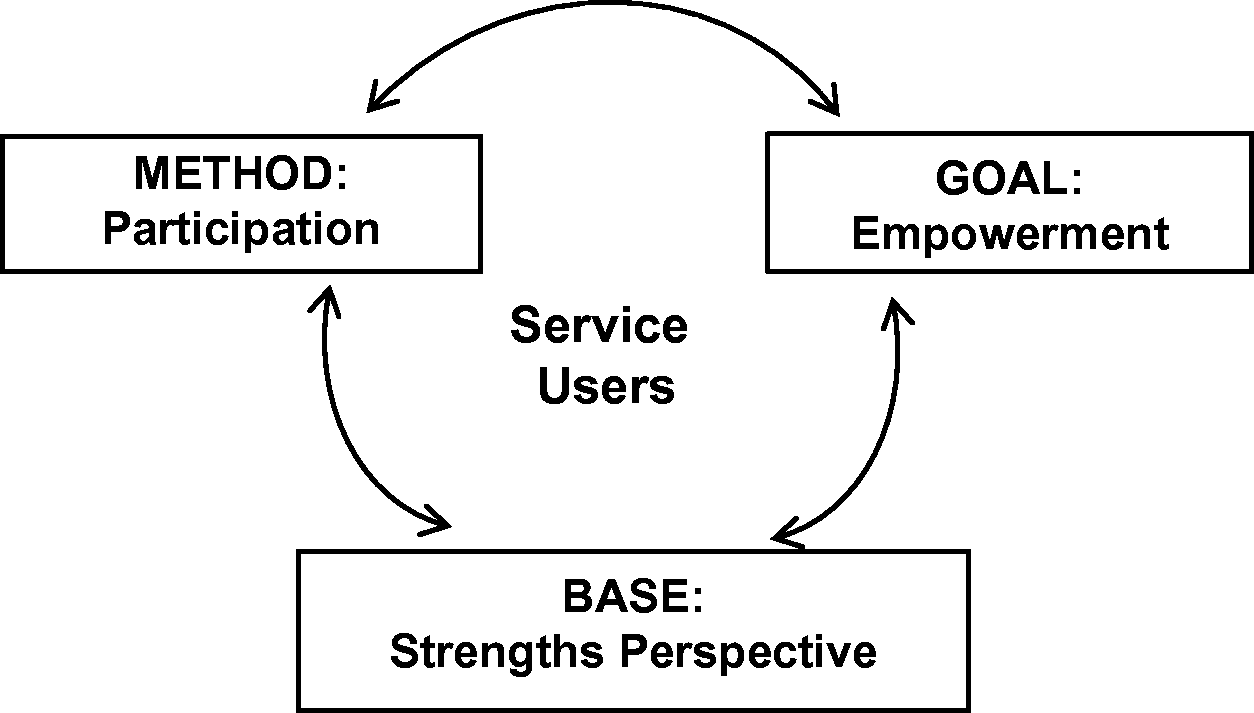
EPS model integrating empowerment, participation and strengths perspective.
First, the EPS model can help resolve the ‘paradox of empowerment’ (Adams, 2003; Lam & Kwong, 2014; Miley et al., 2013). By prompting social workers to realise that they are not the source of empowerment and cannot bestow or give power to service users, the EPS model can encourage them to see that they only have to provide assistance to enable service users to recover or develop power and so empower themselves.
The second limitation that the EPS model can address is a possible over-concern on the part of social workers with helping service users gain power and protecting their rights. Social work practice that neglects participation can have the effect of disempowering service users (Kam, 2002, 2014), and the EPS model reduces this risk by presenting service users as involved actors instead of passive recipients.
Third, social workers working within a narrow empowerment model may see service users as powerless and easily classify them as incompetent and having low self-efficacy, self-image, self-esteem, and self-worth. When such negatives drive social workers to rely on their professional knowledge to find effective empowerment, service users may discount their own abilities, strengths, potentials, and assets (Guo & Tsui, 2010). The strengths approach in the EPS model is a reminder to social workers that they must be sensitive to their own negative perceptions of service users. It can prompt them instead to develop a positive attitude towards service users’ strengths and potentials, and understand the importance of participation of vulnerable and deprived groups (Kam, 2002).
Rather than focusing only on empowerment, the broader EPS model alerts social workers to the importance of the interrelationships among the three concepts and to pay attention to the positive effects of the co-existence and interplay of empowerment, participation and a strengths approach. The processes and outcomes of integrating the three concepts in practice are summarised in Table 1. Each cell of this matrix demonstrates the interaction effects that yield gains beyond the single approach, realising changes in both social workers’ and service users’ understanding and behaviours.
Gains from integration of empowerment, participation and strengths perspective.
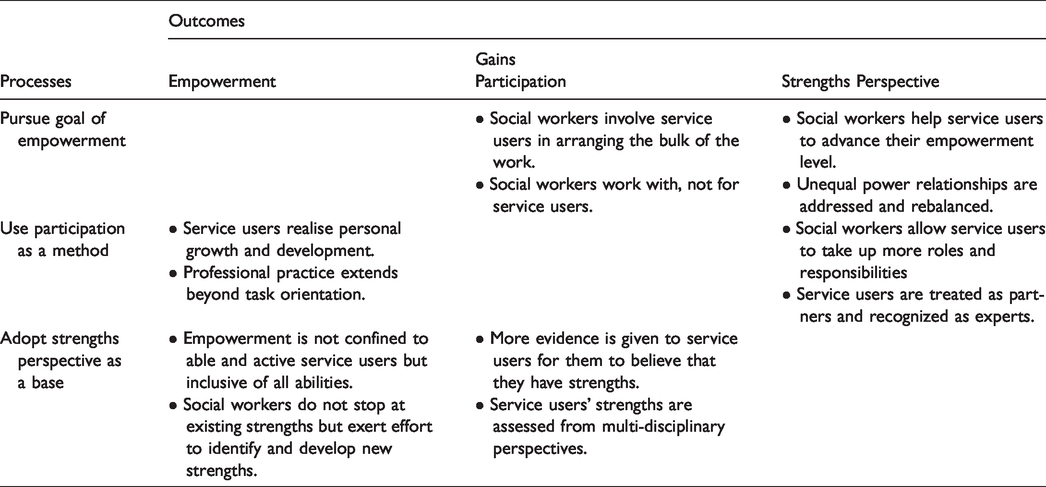
For example, when the empowerment goal is given more emphasis in the participation process, social workers are less directive and focus on working with but not working for service users (Fitzsimons et al., 2011). When more emphasis is placed on a strong belief in service users’ strengths during the empowerment process, social workers are more highly motivated and gain more confidence in helping service users empower themselves (Anuradha, 2004; Miley et al., 2013). Service users are also more energised to participate when their strengths are more fully recognised and as a result, they have more chances to uplift their empowerment levels. When social workers affirm service users’ strengths and more readily set aside their professional power, they can become an ally of service users who in turn are enabled to develop more of their strengths and are more willing to participate actively (Kam, 2009).
When participation is used as the method to achieve empowerment, social workers pay more attention to service users’ personal growth and development, and social work practice extends beyond task orientation (Adams, 2008). Approaching participation from a strengths perspective achieves gains in allowing service users to take up more roles and responsibilities and treating service users not as passive followers but as partners and experts (Kam, 2002).
When social workers uphold a strengths perspective in the empowerment process, empowerment is not limited to able and active service users. Instead of stopping at the existing strengths, social workers work with service users in an effort to identify and develop new strengths. Similarly, interaction between the strengths perspective and participation results in social workers giving service users more evidence to believe in their own strengths which social workers also assess from multi-disciplinary perspectives. Providing service users with more opportunities to participate and letting them identify their own personal changes and growth leads to an increase in their confidence to break through self-imposed limitations and change their low self-image (DuBois & Miley, 2014).
To apply the EPS model effectively, social workers need to pay attention to three sets of intervention principles. First and foremost, they must work to develop a culture of participation in the service unit; they must be sensitive to the strengths of service users and start with what is present. Second, in approaching task assignment to increase participation, the work has to be broken down into different tasks that interest service users and are within their capability, starting from small tasks that allow them to gain successful and rewarding experiences. Social workers must fully support and encourage service users to perform tasks and work in partnership with them to create meaningful experiences. Third, social workers have to teach and engage service users, identify their specific training needs and pay close attention to helping service users to explore, reflect, and consolidate their learning and personal development.
Applying the EPS model to an age-friendly community project in Hong Kong
The promotion of an age-friendly community project in Hong Kong provides a case study that illustrates an application of the EPS model. The age-friendly concept comes from the Global Age-friendly Cities: A Guide, based on a research study conducted by WHO in 33 cities around the world (WHO, 2007). According to the Guide, an age-friendly city encourages active ageing by optimising opportunities for health, participation, and security in order to enhance quality of life as people age, and adapts its structures and services to be accessible to and inclusive of older people with varying needs and capacities. A checklist of the core features of an age-friendly city is proposed and developed in the following eight areas of city living: (1) transportation, (2) housing, (3) social participation, (4) respect and social inclusion, (5) civic participation and employment, (6) communication and information, (7) community support and health services, and (8) outdoor spaces and buildings.
Applying the EPS model as the method of the case study makes three particular contributions to the age-friendly movement. First, it is particularly relevant to the Hong Kong context and cities in other countries where social work practice is facing rapid social and political change and in which the concepts of empowerment, participation and strengths are still relatively novel compared to their long standing in western societies.
Second, this case study provides more evidence to support the claim by Phillipson and Ray (2016) that social work practice can make a significant contribution to the age-friendly approach. In this instance, the EPS model is used as a tool in co-designing an age-friendly environment, one of the areas identified by Buffel and Phillipson (2018) as central to advancing the age-friendly movement.
Finally, it adds support to the call made by Sun et al. (2017) to balance views of globalisation of age-friendly policies and planning derived from the dominance of developments in western countries with ‘glocalisation’ to take account of local policy networks, modes of local governance and stakeholder networks in non-western contexts.
The Hong Kong context and project
Hong Kong is experiencing rapid population ageing; the proportion of the resident population aged 65 and over grew from 12.5% to 15.9% over the decade 2006–2016, and is projected to reach 23% over the coming decade to 2026 (Census and Statistics Department, The Government of the Hong Kong Special Administrative Region, 2017a, 2017b). The demographic experience of the Hong Kong Special Administrative Region is similar to other cities in China and other cities of east Asia, but like most of them (the exceptions being Shanghai in China and Tokyo and Himeji in Japan), Hong Kong did not participate in the initial WHO study.
Since then, as Phillips et al. (2018) report, non-governmental organisations have taken the lead in adoption of the concepts of age-friendliness and implementation of practical initiatives, it was not until 2016 that the Hong Kong government gave express endorsement to ‘building an age friendly community’. In the interim, when public facilities and services were examined, many were found not to be age-friendly and to pose many challenges to older people leading a productive life. The reasons for this situation include government officials and service planners relying on the views of professionals or experts when designing facilities or services. As well as being insensitive to the specific needs of older service users, they have seldom encouraged older people to participate in commenting on the design or testing the suitability and feasibility of facilities and services.
These reasons stand in contrast to the three principles of the WHO Guide. The first principle is to make facilities and services age-friendly by not completely relying on professional views but also to consider the opinions of older people. The second is to recognize that older people have specific needs; thus, creating an age-friendly city should encompass meeting these specific needs. The final principle is to involve older people’s participation; without fully involving older people, it remains uncertain whether the age-friendly ideas or designs actually fit their real needs. As these principles accord closely with the EPS model, the model was applied in a project in Hong Kong which focused on identifying and overcoming the obstacles faced by older people in the public transport system, one of the eight areas proposed in the Guide as necessary for a city to be age-friendly.
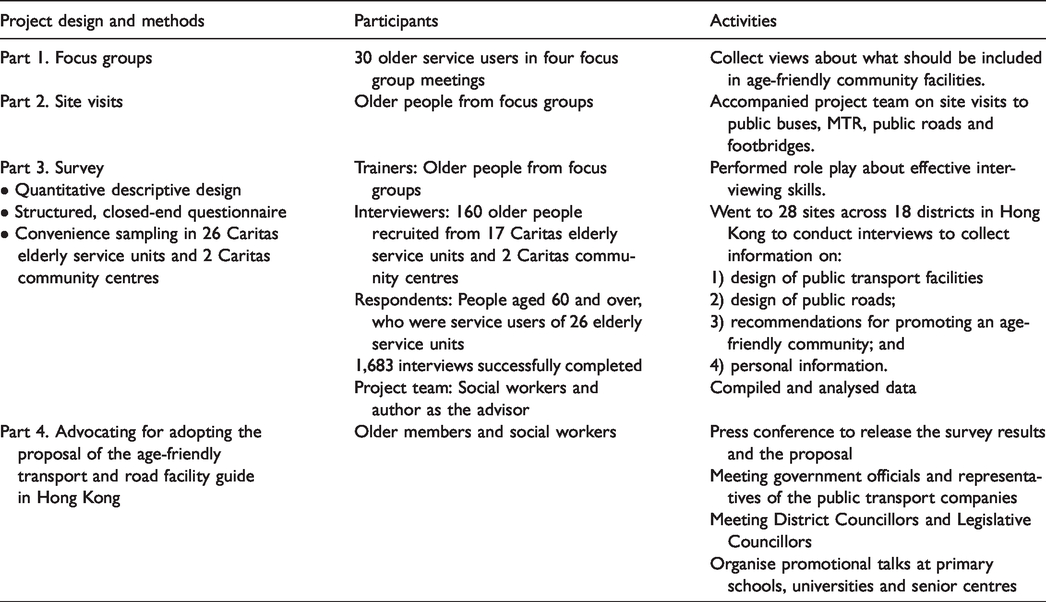
The Age-Friendly Transport and Road Facility Project was a joint effort of the major non-government organisation Caritas Hong Kong Elderly Service and Youth and Community Service, and the Department of Applied Social Studies, City University of Hong Kong which jointly authored a report published in Chinese (see Caritas Hong Kong Elderly Service and Youth and Community Service & Department of Applied Social Studies, City University of Hong Kong, 2011). The author served as an unpaid advisor to help social workers of Caritas in organising and promoting this age-friendly community initiative. A range of other professionals were involved in the later stages and especially in assessing and acting on the results. The aim of the project was to make public buses, the underground Mass Transit Railway (MTR) and public roads more age-friendly. The project was designed in four parts using different methods and involving older people in different ways, as summarised in Table 2.
Hong Kong age-friendly transport and road facility project: Design and methods, participants and activities.
Working from a strengths perspective
Throughout the project, the team members shared the beliefs that older people:
know more than social workers in identifying problems and barriers to an age-friendly city; have many concrete ideas about how to improve the existing facilities and make them age-friendly; are willing and motivated to express their specific needs for age-friendly facilities; and can help convince others of their case by their involvement in presenting the problems and expressing their recommendations.
Working from the strengths perspective as a base, the first part of the project drew on older people’s experience to identifying priority issues of interest. The social workers did not plan and decide on which areas of key concern by themselves. Rather, the focus group meetings greatly helped to understand their perspectives and generate suitable and relevant areas for improvement. Older people expressed the view that transportation was the area of greatest concern because improvements in transportation services could significantly help them to lead a productive and active life in the community. On the basis of their views, transportation and road facilities were selected as the focus of the project.
The second part of the project continued the strengths based approach with older people accompanying the team on site visits where they shared the problems they faced and recommended effective means for improvement. While Hong Kong is a compact and densely built city, its steep topography and islands mean that access to the underground MTR or bus routes on elevated roads is often not at pavement level but requires using over-passes or under-passes that can pose major barriers for older people.
The third part of the project was a survey conducted to learn about the older people’s views on how to make the existing transport and road facilities more age-friendly. The survey was developed by the social workers and the older members, with advice from the author, and to avoid relying on professional knowledge to plan and implement the survey, older service users were involved from the start. Through discussions with these older people, the main theme for research and sub-topics were identified and the questionnaire was drafted, taking account of suggestions on amending the wording to make it easily comprehended by older people.
The fourth part of the project was to work with participating older members to advocate for adopting the recommended proposal of Age-friendly Transport and Road Facility Guide in Hong Kong. The survey resulted in numerous specific and very practical proposals for improving design, access and communication of bus services and the MTR, and generated wider guidelines for age-friendly transport and road facilities. Proposals for design changes were for buses to have a low floor facility, handrails at the door that reached the floor and that were continuous from the door to the seating area, and all seats to face the front, while bus stops needed to be covered. Communications needed to be improved through installation of audio-visual destination displays, bus-stop bells at more points within buses and clear and larger signage. Age-friendly access would be achieved by locating priority seats for older people near the bus door, in a different colour, having wider space and movable handrails, and providing priority seats for older people at bus stops, with more bus stops at the places frequently visited by older people.
Regarding the MTR, design proposals were for handrails to be provided in staircases and ramps in stations. Access improvements went beyond the provision of priority seats for older people in MTR carriages to making environments more age-friendly by installation of escalators or lifts in all station entrances, provision of a movable ramp to cover the platform gap, priority seats for older people on the platforms and for all MTR stations to have toilets. The final proposal for age-friendly access was a standardised Fare Reduction Scheme for older people in all public transport, with a set fare at HK$2 on Wednesdays and weekends.
Proposals for the Age-Friendly Road Facility Guide recommended improved environmental design through installation of handrails and yellow warning strips at all ramps and staircases, provision of escalators or lifts at major footbridges, and pedestrian crossing lights with count-down display. The proposed guidelines helped to identify many areas that were neglected or ignored in the past and in need of necessary and proper improvements. Being based on older people’s views meant that the guidelines were more comprehensive, useful, and concrete than those based on professional views. Through older people’s reminders and suggestions, the professionals involved in the project increased their awareness of the specific needs of older people and became more sensitive to the difficulties impeding older people’s daily life.
Promoting participation throughout the project
Older people participated actively in all stages of the project, from the initial focus groups to presentation of results at the end. The strengths they demonstrated in front of the project team were impressive. As they gained more confidence, they offered many opportunities and channels for other older people to participate in organising the project as it proceeded. During the entire organising process, older people were not treated as followers but were actively involved in planning and decision making, demonstrating their different strengths and capacity to take on all of the many tasks and roles through the project.
Early participation in the focus group meetings was very important in identifying the issues and selecting the intervention area of highest priority for older people. Their participation during site visits made the project team realise that older people are the experts on their problems. Without their involvement in the visits, the extent of negative effects of unfriendly designs on older people’s access to these facilities would not have been fully understood or appreciated.
To further promote older people’s participation, service users were encouraged to take up the role of interviewers in conducting the survey. The project team helped the participants to understand and believe that not only young people can act as interviewers and that they are also suited to the role. Throughout the interviews, these older people were actually more motivated and active than young ones in approaching and engaging the respondents for interviews. Their performance was remarkable, and their involvement in these tasks helped to enhance their confidence and motivation to publicise and promote the age-friendly concepts.
On the basis of these experiences, the project team planned to advance older people’s participation levels even further in the later stage of the project. The team has become more alert to standing back and encouraging older people to stay at the forefront to represent themselves and express their views. With more support and training, older people treasured the opportunities of taking up more organising roles; they gave their support and understood that they should act as the chairperson and speakers at meetings, and spokesmen during the press conference to release the survey result and guidelines instead of the project team taking these roles. With only limited help from the project team, they acted in street dramas and became chairpersons and spokesmen in public forums with officials of government departments and public transport companies and in lobbying meetings with district and legislative councillors. Participation in all these avenues proceeded from a strengths perspective and realised cumulative gains.
Empowerment at personal, interpersonal and structural levels
Empowerment was realised at personal, interpersonal and structural levels. Individual older people gave positive feedback about their participation and shared accounts of the personal changes they gained from the project. These changes did not happen all at once but came about as the project progressed, and not all older people had similar levels of change and growth. At the beginning, older people tended to rely on the guidance of social workers and did not show much confidence in implementing the project. However after they had been involved in the focus group meetings, they became more willing and able to share their views on selecting of the main issue for the focus of the project. Leading the social workers on the site visits, the older people discovered the importance and values of their roles in shaping in the project.
The large number of older people who were involved in developing the survey and interviewing reported satisfaction at demonstrating their abilities and enhanced self-image. Their active involvement in conducting the survey was a breakthrough for them as this experience helped them find new capabilities. Following on from these achievements, many older people had become more willing and confident in taking up different roles of organising the press conference and meeting representatives of public transport companies, district and legislative councillors. At the later stage of the project, those older people who had higher level of involvement were able to realise and acknowledge their personal strengths, and social workers witnessed many personal changes and growth among them.
Older people’s comments showed that the project was very meaningful to them and that they were pleased with the opportunity to join hands to make a change. Most commented that in working with the project team and fellow older peers, they had uncovered their capabilities and gained a sense of self-worth and self-competency. They had demonstrated a sense of contribution and regained the sense of continuously making contribution to the society. As one said ‘I feel very happy and fulfilled since I am provided with the chance to contribute my efforts’.
Those who actively assumed organising roles and tasks told the project team that the project helped them to identify their own strengths and power, gave them the opportunity to manifest their power as seniors, and made them feel that they have become the masters of the action. They reported that ‘This project can allow older people to utilise their strengths and manifest their power’ and ‘I can further experience older people’s ability. I am the master throughout the process. I now find that I am able to express our real needs and what I really want to say’.
Many of the older people said that the most valuable things they gained from the project was helping older people to develop a positive self-image, make them aware of their rights, strengthen their sense of ability to learn new things, and provide them with a chance for new development. Participants said ‘Though we have only a low education level and are regarded as weak, we do not give up easily since we know this is our right to participate’ and ‘I have learnt many new things. What I have gained most is the experience to work for our well-being and have deeper understanding of the age-friendly concept’.
In addition to their personal changes, older people became more confident and competent to present the age-friendly concept to others. They became more willing and motivated to encourage others to get involved in the promotion of an age-friendly city. Their most significant achievement in this project was that they became very active in sharing their views and experiences with different sectors of the community; they helped organise various promotional talks in the community, including talks at primary schools, universities, and senior centres.
Structural empowerment came through engagement with government officials, public transport companies, and the district and legislative councillors who responded positively and enjoyed listening to the older people’s views. Representatives of the MTR and bus companies attended meetings with the older people to discuss their requests and similarly, the older people were invited to district council meetings to present their suggestions. Legislative councillors agreed to place their requests on the agenda of the Legislative Council. After all these meetings, the MTR and bus companies made improvements in response to the requests made; some of the individual changes may seem minor, but together they have had a substantial effect on access to public transport. The MTR agreed to provide priority seats for older people and make improvements in escalators and toilets, and public bus facilities showed improvements as well. Most significantly, the government launched new policies to meet older people’s specific needs by introducing a new fare reduction scheme which entitled them to pay only HK$2 for all public transport on every day of the week (more than just the three days sought), and announced the installation of an escalator or lift on all footbridges. All these positive responses helped the older people to become more aware of the importance of collectivity and senior power.
The improvements that resulted directly from the actions of older people involved in the project have made Hong Kong’s transport system much more age-friendly not only for all older people but for the whole population. These outcomes are all the more significant as they were achieved in advance of and go beyond the ways of maintaining mobility of older people through improvements to transport set out in the World Report on Health and Ageing (WHO, 2015).
Conclusions, limitations and further development
The development and application of the EPS model has generated a number of conclusions for theory and practice. As this article presents an initial formulation and application of the EPS model, a number of limitations and avenues for further development also have to be noted.
The main conclusions from a theoretical perspective are that by integrating the concepts of empowerment, participation and strengths, the EPS model has bridged gaps in previous models and thereby addressed many of the criticisms of the concept of empowerment. The EPS model gains considerable strength through recognising and making explicit the interactions between the three concepts.
From a practice perspective, it is evident that without the framework of the EPS model, the applied project would have been much less likely to achieve such sound outcomes for the older participants themselves and in making Hong Kong’s transport system more age-friendly. If the project team had not started from the base of the strengths perspective, older people would not have been so fully encouraged and supported to play an active role and go through many new experiences. If the whole project had been done by professionals without such extensive participation of older people, many important areas for improvements would have been neglected. Most importantly, policy makers were arguably more responsive to the requests and suggestions made, and more committed to changing policies and improving facilities, when the project was presented to them by the older participants instead of by professionals.
This project demonstrated that a strong belief in older people’s strengths and their high participation realised more empowerment. If the empowerment goal had not been emphasised, many older people, particularly the less able and less confident, might not have as easily gained a sense of personal development or interpersonal skills, let alone achieved the scale of structural change they did. The project reported here has shown that adoption of the EPS model offers a framework through which social workers and other professionals can work together in multidisciplinary teams to achieve these outcomes.
More generally, application of the EPS model generated wider and deeper outcomes than were realised in survey-based study in Taipei City (Shiau & Huang, 2014). While the visible outcomes in design and information were similar to those in Hong Kong, the Taipei study did not achieve changes in empowerment or participation to equip older people for engagement in future age-friendly or other initiatives.
A subsequent study of the on-going promotion of age-friendly initiatives in Taiwan pointed to the need for ‘glocalisation’ of the age-friendly framework when working with older people in East Asia (Chao & Huang, 2016). The authors made a call for an oriental paradigm that recognises cultural differences that affected advocacy processes and likely different meanings of empowerment of older people to advocacy workers and to older people themselves. The EPS model has the capacity to recognise these differences and draw on the strengths they offer as well as addressing the barriers they pose to the well-being of older people, including the marginalisation of older people in the face of changing social norms.
Finally, Hong Kong has yet to formally join the WHO Age-Friendly Cities Network, but the development of an age-friendly Hong Kong presents a wide canvass for action across many aspects of urban living and intergenerational relations. The older people involved in the case study project have been empowered to take a lead in further action to this end not only through their NGOs and university partner but to collaborate with other age groups and other agencies to achieve this goal.
Turning to limitations and avenues for further development, the EPS model offers a framework to guide social workers’ thinking that aims to prompt them to develop practical ways of bringing together the concepts of empowerment, participation and strengths approaches. While lacking in detail as to how it is to be implemented, the model is intended to be a general tool which social workers can adopt and adapt to suit the particular settings in which they work. In providing a developmental framework, it offers a means by which social workers can review and reflect on their practice and gain cumulative insights from what might otherwise remain separate exercises that lack a strong conceptual underpinning.
Such further development can address three limitations of the present study. First, the outcomes of the case study are recognised as being short-term and possibly superficial rather than necessarily realising deeper transformations in empowerment, participation and strengths of older people. Social workers can however use the model in their on-going practice to check the extent to which outcomes have been sustained in each element and work on persisting gaps. Rather than repeatedly beginning at the same starting point, they can build on the outcomes that have been achieved and proceed to further empower older people. Indeed, adopting the model in other initiatives could itself reinforce outcomes that might otherwise dissipate over time.
Second, the single case study benefited from specific conditions that might not be so readily found in other settings, notably the collaboration of a major NGO, Caritas, with the author who brought academic knowledge and research skills to the project. At the same time, the model provided a common ground for understanding how the project was to be conducted and especially for mobilising older people themselves to undertake research and advocacy tasks that might otherwise have to be taken by outsiders. These features of the project design can be adopted in other situations by providing a basis for social workers in NGOs to approach academic researchers, or vice versa, and possibly form continuing relationships to enable older people to take action in other areas that concern them.
The third limitation concerns the extent to which the experience of the Hong Kong case study is transferrable to other cities that are seeking to become more age-friendly in line with the WHO initiative. It is recognised that potential for transferability lies mainly in other high density cities in the countries of East Asia that are undergoing rapid economic and social change as the 21st century advances and are diverging from long-established western cities. In many ways, Hong Kong can be seen as a precursor of the rapid urbanisation and industrialisation that has since occurred and continues in many cities of China as well as Korea and Taiwan, and extending to Vietnam and Malaysia. Further development of the EPS model can reduce the risk that older people will be left behind by the pace of social and cultural change. As well as similarities in urban development, there are social and cultural similarities in the development of the social work profession in these countries. The EPS model will nonetheless have to be contextualised for local application, and it is anticipated that much more modification will be required to make it applicable in cities in yet other countries with markedly different patterns of social and economic development.
Footnotes
Ethics
No ethical approval was required for this non-empirical study.
Funding
The author received no financial support for the research, authorship, and/or publication of this article.
Acknowledgements
The author is grateful to Dr Anna Howe for her valuable comments and suggestions on the earlier drafts of the article. The author thanks Caritas Hong Kong Elderly Service and Youth and Community Service for the invitation to collaborate in the age-friendly project and for permission to report the findings of the survey and other aspects of the project in this article.
