



Abstract
The internal dynamics and politics of international organizations influence how international policy agendas are set and how effectively they are pursued. International organizations are open systems which respond and adapt to the external policy environment in order to remain relevant to global policymaking. Through an analysis of the internal politics of the World Bank and International Labour Organization, the leading global agenda-setters for pension reform, this article shows that internal political battles and restructuring have a decisive influence on global pensions policy. Appointment of key personnel and internal reorganization can help make certain policy ideas prominent over others. Scholars should pay greater attention to processes of change within international organizations in order to better understand the international agenda setting process.
Introduction
During the 1990s, the World Bank positioned itself as the dominant global actor in pension policy. It led a coalition of transnational actors in a campaign to persuade countries to partially privatize their public pension systems. 1 Drawing on reform experiences in Latin America, it was successful in convincing a number of countries, particularly in Central and Eastern Europe, to carve out a private pension pillar from their public systems (Brooks, 2005; Madrid, 2003; Müller, 1999; Orenstein, 2008; Weyland, 2005). This entailed diverting funds from the public pension system into individually funded accounts. Following the publication in 1994 of its seminal document on pension systems, Averting the Old Age Crisis: Policies to Protect the Old and Promote Growth, (Averting hereafter), official publications from the Bank promoted an almost uniform message on the virtues of a multi-pillar pension system (Beattie and McGillivray, 1995; Orenstein, 2008). The success of the campaign was in no small part down to this internal coherency and ideological consistency that came out of the Bank for a decade following. However, in many countries, these reforms were short-lived. At the onset of the global economic crisis, most countries that had adopted pension privatization reforms either halted them, drastically reduced the private element, or completely abandoned them (Arza, 2012; Drahokoupil and Domonkos, 2012; Naczyk and Domonkos, 2016; Orenstein, 2013; Sokhey, 2017). These events signaled a retreat by the World Bank in its promotion of the partial privatization of public pension pillars and damaged its reputation in pensions expertise.
The World Bank-led campaign had met with substantial opposition. A rival coalition led by the International Labour Organization (ILO) had opposed the retrenchment of public pension systems. Yet, despite global pension policy traditionally being the domain of the ILO (Deacon et al., 1997; Holzmann, 2012, 2013; Orenstein, 2003), it was unable to use its authority to stem the tide of successive countries adopting the World Bank’s proposed pension model. In the years that followed the entry of the World Bank into the pension reform arena, the ILO found itself in a subordinate position in global pension debates. The global economic crisis in 2008 would mark a turning point in the prominence of the ILO. Its advocacy for national social protection floors found sympathetic ears in global governance circles. In a political and economic climate shaped by market volatility, the virtues of public expenditure on social protection, particularly as stabilizers in an economic downturn, were at the forefront of national policy makers’ minds.
In a marked contrast to the late 1990s, the World Bank and ILO now work much more closely on pensions and social protection policy. The World Bank has adopted the ILO’s language on national social protection floors and both organizations are working collaboratively to develop a new ‘Global Partnership for Universal Social Protection’, announced during the UN General Assembly week in September 2016 (ILO, 2016). Social protection floors have been recognized as part of the UN Sustainable Development Goals. The first goal of ending poverty everywhere has its third target to ‘implement nationally appropriate social protection systems and measures for all, including floors, and by 2030 achieve substantial coverage of the poor and the vulnerable’ (United Nations, 2015).
The success of the ILO in re-asserting itself as a prominent actor in these debates was not solely down to an enabling external environment. In the years prior to the crisis, the ILO’s social security department had been engaged in a protracted debate over its social protection stance. Eventually, the organization came to an agreed position, culminating in the organization’s International Labour Committee (ILC) passing Recommendation 202 on National Social Protection Floors. From this moment onwards, the ILO has benefited from a unified and coherent approach to social protection, which enabled the organization to play a more dominant role in global debates.
This article focuses on internal policy debates of the World Bank and ILO to examine what role these have had in setting global pension policy. We focus on these two organizations because they are the only two that have dominated, at one time or another, global pension policy agendas – the rise of PAYG pension systems worldwide in the case of the ILO and the rise of pension privatization in the case of the World Bank. We demonstrate that a unified and coherent policy stance internally has enabled these international organizations to project global social policy agendas externally. We compare three different periods, one in which the World Bank was dominant, an interim period, and one in which the ILO renewed its influential position. In both instances where one organization was dominant, internal restructuring and the appointment of key personnel gave it the upper hand, while its rival organization was characterized by internal fragmentation and lack of a coherent message. In both cases, internal shifts predated major changes in the global pension policy. Yet internal debates within international organizations are often overlooked in debates on global social policy, despite the pioneering work of Bob Deacon and others in this area (Deacon, 2001, 2007, 2013; Deacon and Stubbs, 2007). Scholars more often have analyzed debates between international organizations than within them (Ervik, 2005; Mesa-Lago, 1996; Queisser, 2000).
International organizations and policy ideas
Global social policy has been portrayed as an arena in which international organizations and transnational actors compete to influence the welfare reform trajectories of national governments (Charlton and McKinnon, 2002; Deacon et al., 1997; Fergusson and Yeates, 2014; Orenstein, 2008). Deacon (2007) described this contestation as something a ‘war of position’ between those agencies and actors within them who have argued for a more selective, residual role for the state with a larger role for private actors in health, social protection and education provision and those who take the opposite view. (p. 171)
In their seminal work in the field, Deacon et al. (1997) painted a picture of Central and Eastern Europe as a battleground, with the International Monetary Fund (IMF) and World Bank on one side arguing for a liberal approach to social policy, against the corporatist approach favored by the ILO and European Union (EU). Kaasch (2013) has challenged this approach to global social policy as an arena solely characterized by contestation. In the field of health policy, there is not one dominant model for international organizations to promote as a beacon for others to aspire to. In addition, international organizations are pressured to justify their own activities in the field. There are therefore better incentives for cooperation rather than competing for the exclusive right to shape policy. The policy environment portrayed in this paper demonstrates evidence of both conflict and cooperation within and between organizations.
Similarly, global social policy scholars have drawn on contrasting traditions in international relations to explain how international organizations set their agendas. Some argue, together with international relations realists, that international organizations are simply the agents of states (Hawkins et al., 2006). Within global social policy, a realist position often stresses the influence of the United States over the governance of the two Washington based international organizations, the World Bank and the IMF. It views these institutions as key advocates of an economically liberal direction (Wade, 2002). The ILO, on the other hand, with its headquarters in Europe and its tripartite governance structure, is thought to be much closer to France and Germany.
In contrast, constructivists have emphasized the autonomy of international organizations and their source of power as actors in their own right. Barnett and Finnemore (2004) have argued that international organizations have different sources of authority: delegated (from states), expert and moral. While delegated authority reflects a realist worldview, the latter two sources are associated with the constructivist perspective. International organizations may gain power and autonomy through expertise or moral suasion. Expertise may enable them to derive power through classifying the world, ordering information so that it is known and interpreted in a certain way. This power to construct reality can orient action from domestic policy makers. Similarly, Dostal (2004) shows that international organizations may create and deploy ‘organizational discourses’ to ‘represent their organization’s point of view repeatedly and in a broad variety of contexts while convincing other institutions to adopt them incrementally’ (p. 445). These discourses may be shaped by an organization’s internal value system and cognitive frameworks.
In a development of this constructivist position, Béland and Orenstein (2013) have argued that the characterization of international actors as being aligned on predictable political axes is problematic. Rather, they propose a model of international organizations as open systems, which respond and adapt to the external environment.
This article builds on this position by opening the black box on international organizations. It draws on 25 elite interviews conducted with past and present staff at the World Bank and ILO from late-2016 to mid-2018, alongside an analysis of key policy documents. 2 It focuses on internal political battles and debates within the two organizations over pensions and social protection policy. We describe how these organizations have responded to changes in the external environment and show that internal restructuring and personnel changes can have a substantial impact on international policy agendas. The assumption of fixed policy positions of the World Bank and ILO will be shown to be partially true, but also problematic. Personnel changes and the role restructuring can alter the stance of the entire organization in specific policy areas and make it more or less effective. Global social policy scholars therefore should follow Deacon’s (2013) lead in paying closer attention to the internal dynamics of international organizations, as well as their ideological predispositions and other contextual factors.
A constructivist position in relation to the power of international organizations aligns itself with an ideational or discursive approach to policy and politics. A growing number of scholars have begun to focus on ideas as explanatory variables in the process of institutional development and change (Béland, 2005; Béland and Cox, 2011; Blyth, 2002; Hall, 1993; Hay, 2008). These scholars have stressed that change is not driven (solely) by material conditions and fixed preferences, but rather by how actors interpret their material conditions. From a constructivist perspective, international organizations act as purveyors of policy ideas. Through their power of classification, they can influence how actors interpret their surroundings and what social problems and solutions make it onto the political agenda (Kingdon, 2014). Blyth (2002) argued that ideas act as blueprints for change under uncertainty. However, with a multitude of ideas on the menu of policy options, the reasoning behind which ideas are selected was left under-explored. If those with superior resources are able to push their ideas onto the agenda, then ideas become redundant as an explanatory variable, and material resources become the most important factor. The analysis in this paper shows that internal coherency and organization, alongside an enabling zeitgeist, can supersede resources. This does not negate resources as an important variable in explaining how some ideas gain prominence over others, but rather argues that resources are not the only factor.
The external policy environment in the 1990s
The end of the Cold War and post-socialist transitions influenced the global social policy environment in the 1990s. Countries in Central and Eastern Europe were undergoing the twin transformation from one-party authoritarianism to democracy, and from state socialism to market-based capitalism, accompanied by integration into the global economy. The scale of this transformation had never been undertaken before and a desperate need for foreign capital made the region dependent on the expertise and funds of international financial institutions (IFIs; Roaf et al., 2014). As a result, post-socialist countries of Central and Eastern Europe were uniquely susceptible to neoliberal policy advice. Countries in the region engaged in a process of ‘competitive signaling’ for international capital, in which they adopted radical neoliberal policies to signal to international investors they were friendly places to do business (Appel and Orenstein, 2018).
In contrast to the traditional client base of the World Bank, post-socialist Central and Eastern European countries had some of the highest pension spending in the world (The World Bank, 1994: 263). In addition, the region also had a high incidence of pensioner poverty due to a history of inadequate indexing of pension benefits (Müller, 1999). These systems required large employer contributions, which encouraged tax evasion and undermined the stability and robustness of the system. The region had a rapidly aging population and a low retirement age. To add to the burden, during the early period of the transformation, the pensions system was used as de facto unemployment benefit to ease the impact of transition on older workers. Vanhuysse (2006) argues that the use of early retirement in Poland and disability pensions in Hungary were tools of protest avoidance. The sudden emergence of mass unemployment in both countries, as a result of entire sectors being made redundant in the transition to capitalism, ripened the conditions for social disorder (Piven and Cloward, 1977). In effort to avoid this, policymakers encouraged early retirement. This separated the interests of the senior members of the workforce, who were more likely to engage in industrial action, from younger members less embedded in trade union networks. As Vanhuysse (2006) shows, the level of strike activity was remarkably low, given the level of societal transformation being undertaken and its deep economic consequences. However, the result was a dramatic increase in pension expenditure.
Organizing for pensions policy impact in a post-socialist world
The World Bank: 1994–2000
The collapse of the communist system represented favorable conditions for the World Bank. It was a time when neoliberal policy prescriptions were at their zenith. Many Central and Eastern European governments were keen to signal their market-oriented fervor or willingness to go along with market reforms. Countries engaged in a process of ‘competitive signaling’ in order to attract needed foreign investment and not be left behind. This signaling included enacting not only the Washington consensus policy reforms, but also what Appel and Orenstein (2018) have labeled ‘avant-garde’ neoliberal policies. These are policies that are more neoliberal than those implemented across the developed world (e.g. flat tax systems and pension privatization), and intended to stimulate foreign investment. However, this enabling external environment was not enough to guarantee the success of the World Bank’s influence on pension policy; it also required a well-organized internal structure and approach.
The World Bank had to organize itself to respond to the needs of the transition economies in pension reform (interview with Robert Palacios, World Bank, January 2017). These new clients for the Bank had very different concerns and capacities compared to its traditional client base of developing countries. In the transition countries, the Bank found itself addressing the needs of industrial countries in Europe whose expenditure on pension provision was substantially higher than in the developing countries who traditionally used Bank assistance. For this reason, the Bank concluded it needed a formal document and position on pension policy.
The publication of Averting represented the Bank’s formal response to the new post-socialist landscape it found itself operating in. Averting initiated significant internal debate (Armeanu, 2018; Brooks, 2005; Holzmann, 2000; Müller, 1999; Orenstein, 2008, 2013; Singh, 1996; Weyland, 2005). Averting was commissioned by the Chief Economist Larry Summers. Director of Research Nancy Birdsall appointed Estelle James, an academic economist, to lead the publication. The research was carried out under the supervision of Michael Bruno, Vice President of Development Economics, who signed the foreword at the beginning of the document. The Development Economics Vice Presidency came into conflict with work by Bank Staff and consultants in the Bank’s Eastern Europe operations division, together with outside academics, who favored parametric reforms to the existing system (Deacon et al., 1997). At the same time as the publication of Averting, a rival document with a more cautious approach to pension privatization was published from this division. It argued for parametric reforms to the pension system and a focus on poverty relief (Barr, 1994). An internal political battle ensued. However, the rival visions for Central and Eastern European pension systems did not have equal resources. Averting had a US$250,000 marketing budget. The alternative proposals had no publicity budget. In addition, Averting drew support from the financial market and development sector of the Bank. It offered the promise of not only financial sustainability in the pension system, but also the chance to develop nascent capital markets in Central and Eastern Europe (Interview with Nicholas Barr, World Bank Consultant, December 2016).
Soon after this internal battle, a unified and coherent message came out from the Bank. Averting is a document with a degree of different interpretations. Its core message is that in the context of aging populations, public pension systems are not sustainable. It also argues that private pension provision has additional economic benefits. It therefore calls for a multi-pillar pension system. For some, it simply stresses the advantages of risk diversification in a multi-pillar pensions system. For others, it advocates a Chilean style pension system across the globe. Those who drew this hard interpretation, such as Estelle James, were more likely to vehemently pursue reforms and were the most passionate in arguing for the benefits of a Chilean style reform. In the years that followed, Robert Holzmann was appointed as Director of the newly created Social Protection and Labor Department in 1997. The main bulk of pension reform technical advice and publications would now come from one department. In contrast to James, Holzmann was more pragmatic than ideological (interview with Emily Andrews, World Bank, August 2017). The Bank continued to support multi-pillar pension reform, while also acknowledging its drawbacks (Holzmann and Hinz, 2005).
In sum, a coherent pension policy stance came from the Bank for a sustained period of time. The campaign for multi-pillar pension reforms won out internally due to the superior resources available to the team behind Averting, the institutional backing of other powerful elements of the Bank, like the financial markets personnel and the establishment of a supportive department active in pensions, the Social Protection and Labor Department. This internal consistency and coherency was necessary to enable the Bank to take its message to the rest of the world with a unified approach.
The ILO: 1994–2000
The ILO opened up a Budapest Office in 1992, specifically tasked to offer technical assistance and to influence the post-socialist transition process. However, on pensions, it found itself in an unaccommodating policy environment when the World Bank launched its campaign for pension privatization. Central and Eastern Europe represented an ideal-type for the World Bank’s critique of public pension systems. The ILO found itself trying to defend a pension system demonstrably failing, in a region with politicians unsympathetic to the public sector and a public suspicious of the government’s commitment to honor pension promises (Fultz, 2012).
The Social Security Department of the ILO had been deeply opposed to the message of Averting. However, its initial response to Averting was low-key, coming in the form of a journal article in collaboration with the International Social Security Association (ISSA) (Beattie and McGillivray, 1995). Here, the authors argued that replacing public pension systems with mandatory private savings placed an unacceptably high degree of risk on workers and pensioners. In addition, they argued, it would make old-age pensions more expensive and that the transition would impose a substantial fiscal burden on current and future workers. They proposed parametric reforms to old age pension systems, such as raising the retirement age or increasing the contribution rates, to keep systems in balance.
However, the internal structure of the ILO precluded the development of a more significant alternative to Averting (Baccaro and Mele, 2012). The ILO has a tripartite governance structure of employer, trade union and country representatives. A formal position developed by the ILO’s bureaucracy (the International Labour Office), must have the support of all of these constituents. While the Social Security Department vehemently opposed Averting, not all constituents did. In particular, some of the employers’ representatives supported the idea of funded pension systems, partially as a result of lobbying from representatives of the FIAP – International Federation of Pension Funds Administrators (interview with Krzysztof Hagemejer, ILO, February 2018). The Latin American bloc of government representatives also tended to favor funded pensions, given their recent reform experience (interview with Emmanuel Reynaud, ILO, April 2018). When the ILO finally developed a response to Averting, it produced a document broadly in line with the message of Averting. Specifically, the ILO recognized a role for both defined benefit and defined contribution pensions, alongside a role for the private sector in pension provision (Gillion, 2000).
The campaign for national social protection floors
The next stage of global pension policy breakdown and the emergence of a new form of consensus was established over a long period of time. This section will outline the developments before the global economic crisis. For the ILO, it went from a fragmented position in the aftermath of Averting to a unified stance. In contrast, the World Bank’s unified and coherent position would break down as a result of continued internal debate. The onset of the global economic crisis would lead to a complete breakdown of the World Bank’s three-pillar pension model, while initiating favorable conditions for the ILO. A brief outline of the global external environment will follow this section, before a final section on the internal politics and debates of both organizations.
The ILO: 2000–2007
Averting had damaged the confidence of the ILO in exerting influence in the global policy process in one of its key areas of social policy expertise. In the words of one of its branch directors at the time, ‘the ILO had lost the battle and so needed to find a new battlefield’ (interview with Emmanuel Reynaud, ILO, April 2018). It was partly for this reason that the ILO began to focus on extending the coverage of social protection (including pensions) in developing countries. It was also a functional response to a growing policy problem. The ILO had traditionally championed wage-related social security in the formal sector as the best way to develop a comprehensive social security system. It had envisaged the formal sector growing in parallel with economic development. However, this had not happened and there was substantial evidence of the informal sector continuing to grow. The ILO estimated that only 20% of the world’s population had adequate social protection (Reynaud, 2002). It therefore needed to develop a new policy to expand coverage to the informal sector. A campaign was initiated by the ILO as an attempt to place extending coverage onto the international agenda. The theme of its 2001 International Labour Conference was ‘extending social security to all’. The main conclusion from the session was ‘highest priority should go to policies and initiatives to extend social security to those who have none’ (ILO, 2001: v).
The new focus for the ILO in the area of social security developed at a time of internal disorganization. The Director General of the ILO, Juan Somavia, had undertaken a considerable reorganization of the ILO hierarchy. This entailed a flattening of the managerial structure. As a consequence, the Social Security Department lost its director when Colin Gillion retired. The two branches of the department (one dealing with social security policy design and standards, the other with social security financing and quantitative policy analysis) joined the new Social Protection Sector, one of four technical sectors of the International Labour Office. The new social protection sector also had a small team working on socio-economic security. The two branches of the previous Social Security Department and the socioeconomic security project each effectively became their own silos, competing with separate visions for social security (as interpreted by Deacon, 2013). The more dominant unit was Social Security Policy and Development (SOC/POL). It was headed by Emmanuel Reynaud and was seeking to develop micro insurance as one of the ways to expand coverage (see Reynaud, 2006).
Another unit was the Social Security, Financial, Actuarial and Statistical Services (SOC/FAS). It had more involvement in the field. Its team supported the development of social insurance schemes in developing countries by offering technical assistance. At the same time, it was searching for policy solutions to enable the extension of coverage beyond those in formal employment. The leader of this smaller branch, Michael Cichon and his team were much more involved than other units in criticizing the World Bank pension reform stance, using its economic, financial and actuarial knowledge capacity to challenge Bank models and assumptions. They were also skeptical about micro insurance. Cichon and his team were part of an emerging global coalition of actors who were seeking to promote the concept of a floor. It first entered the global discourse as a ‘global social floor’ during the ILO’s (2004) contribution to debates on a social dimension of globalization. However, at this point, it had no institutional support and remained one of several policy ideas in the primeval soup. The idea was kept alive by Cichon and a small group in international policy circles (Deacon, 2013). A smaller branch, headed by Guy Standing, the InFocus Program on Socioeconomic Security (IFP/SES), championed a more radical citizen’s income (Maier-Rigaud, 2009). Therefore, despite having a unified objective of extending social security provision, substantial disagreement on the means to achieve it meant that stasis was a feature of the ILO’s social policy stance (interview with Krzysztof Hagemejer, ILO, February 2018).
This stasis lasted for around 5 years. In 2005, Juan Somavia reverted back to a structure similar to the one he had reformed. The two branches of the Social Security Department were once again subsumed into one department. Michael Cichon was appointed director and began to move the stance of the department in line with his vision for the extension of social security. Cichon came from the development tradition in the ILO. He framed social protection in the language of social rights (Cichon and Hagemejer, 2007). This represented a break from the tripartite heritage of the organization. A departure of this nature would inevitably be met with considerable opposition from within the department. For many in the department, a focus on minimum protection posed a threat to the adequacy of social insurance benefits and ceded too much ground to those, such as the World Bank, who advocated a residual, social safety net policy (Interview with Elaine Fultz, ILO, May 2017). Cichon would therefore have to convince his department, as well as the governments, trade unions, and employer associations that ultimately determine ILO policy, and then the world.
Internally, Cichon was able to convince the department of the utility of social protection floors by framing them in the traditions of the ILO. He argued that the concept built upon two previous ILO Recommendations: No. 67 on universal income security and No. 69 on universal medical care. It was also an accompaniment to the ILO Convention 102 on minimum standards. In addition, the social protection floors strategy was to be two-pronged: a horizontal dimension focused on a universal minimum, and a vertical dimension, committed to extending social protection beyond a minimum in the traditional contributory way of the past (Deacon, 2013).
The campaign for social protection floors was both an internal one, within the ILO, and a wider global campaign. More detail on the internal campaign will be outlined in the next section on the ILO below. The external campaign began before the social floor was official ILO policy. In 2007, Cichon convened a meeting with representatives from United Nations Department of Social and Economic Affairs (UNDESA), United Nations Children’s Fund (UNICEF) and Help Age International. The meeting formalized the Coalition for a Global Social Floor (2007). It sought to be a steering committee to bring together a movement for social protection floors under the UN umbrella. It was established in the context of debates around a fairer globalization and global inequalities. In addition, these debates were taking place in parallel with the positive experiences of modern forms of universal social policy in the global south, such as the conditional cash transfer programs being rolled out in Latin America (Huyse et al., 2017). As it will be shown below, the campaign would be given further impetus in the response to the global economic crisis, with the ILO’s role in policy debates substantially enhanced and formalized. However, it is important to note that the ILO’s reorganization took place prior to the onset of the global financial crisis.
The World Bank: 1999–2009
While the ILO was shifting to a new consensus on social protection, the World Bank was undergoing substantial internal debate on its promotion of a multi-pillar pension model. Opposition to Averting was first brought into the spotlight at the end of the 1990s with a provocative paper coauthored by its Chief Economist titled: Rethinking pension reform: Ten myths about social security systems (Orszag and Stiglitz, 1999). Here, the authors attacked many of the assumptions of Averting, critiquing its microeconomic, macroeconomic and political economy assumptions. While the paper proved controversial, it did not immediately affect policy change, not least because it had been undertaken without consulting the Social Protection and Labor Department (interview with Emily Andrews, World Bank, August 2017). More criticism from inside the Bank came in the form of a report in 2005 titled Keeping the Promise of Social Security in Latin America (Gill et al., 2005). The main criticism here was the disappointing coverage across the region. This assessment was not universally accepted within the Bank. Some were critical that the project did not consult industry or policy makers in the region (interview with Robert Holzmann, World Bank, December 2016). The report remains untranslated into Spanish.
When Nick Stern became Chief Economist at the World Bank, he initiated an update to Averting. This new volume would be a joint cross-sectoral report by the World Bank to explain to the rest of its staff, and the world, its position on pensions (Holzmann and Hinz, 2005). While it largely reasserted the case for a multi-pillar framework of public and private provision, as a way to diversify risk, it acknowledged that more needed to be done on poverty alleviation and coverage. The report was reviewed by five external experts, including prominent critics of Averting, Nicholas Barr and Peter Diamond. While in Washington, DC to give feedback on the Holzmann and Hinz (2005) volume, Barr and Diamond agreed that it would be a good idea for the World Bank to conduct a formal evaluation of its pension work as a whole, in contrast with earlier evaluations which were on a project-by-project basis. Peter Diamond took this suggestion to Nick Stern and the idea for a formal evaluation was born (interview with Nicholas Barr, former World Bank Consultant, December 2016). The Independent Evaluation Group was led by Emily Andrews who was approaching mandatory retirement at the Bank. Her report argued that some of the benefits of multi-pillar reform had been oversold by the Bank. It called for greater attention to parametric pension reforms and echoed the findings on the Latin American report that of multi-pillar reform had been disappointing in its promise to extend coverage of pension provision. It argued that much greater attention needed to be paid to initial conditions before advocating multi-pillar reform (Independent Evaluation Group, 2006). Alongside a critique of multi-pillar pension systems, the World Bank was also beginning to shift its focus toward coverage. Holzmann and Hinz (2005) recognized this as an area where the Bank had more work to do. In 2009, this was expressed more explicitly in Closing the Coverage Gap, which focused on the role of non-contributory pensions and minimum pension guarantees (Deacon, 2013; Holzmann et al., 2009).
The 2008 global economic crisis
As the ILO moved toward a policy consensus in the mid to late 2000s, and the World Bank drifted toward dissensus, the global economic crisis would crystalize these positions. At the onset of the downturn it represented a crisis of the global economic structure; justifying a large-scale intervention of the state in the management of the economy. In an effort to offset the impact of the downturn, governments around the world used an active fiscal policy to stimulate aggregate demand or to rescue insolvent banks. Much of this action was coordinated at the global level through the G20. It was also supported by the IMF (IMF, 2008a). In addition, the role of social security was recast. The dominant message from the World Bank on the sustainability of pension systems, and the virtues of private provision, were drowned out in a context of market volatility and economic contraction. In the immediate crisis era, the role of social security as an automatic stabilizer in the economy was emphasized (IILS, 2011). In light of this, the ILO found itself invited to the top table of global governance to report how social security could be deepened to embed its role as an automatic stabilizer in the global economy (Deacon, 2013).
The role of international cooperation during the crisis would have a significant impact upon embedding the social protection floor in global policy discourse. The crisis prompted the UN to develop a series of coordinated responses to foster a recovery and better protect the world’s population against future economic downturns (Deacon, 2013). The UN Chief Executives Board (UNCEB) established the Social Protection Floor Initiative (SPF-I) to coordinate development efforts and improve its assistance to countries wishing to expand social protection. This was to be chaired by the ILO and World Health Organization (WHO). In effect, this meant that social protection floors went from being a campaign of disparate groups (mentioned above), to official UN policy. The SPF-I would have a significant impact in August 2010 by inviting the former President of Chile, Michelle Bachelet to chair an advisory group on social protection floors. The 2011 publication coincided with the French Presidency of the G20 and French President, Nicolas Sarkozy, was fortuitously sympathetic to the idea of a social protection floor (Deacon, 2013). The Bachelet Report called for more inter-agency collaboration on social protection. It argued that coordination was often lacking between ministries, UN agencies and IFIs. It advocated the establishment of a mechanism for collaboration and coordination of experts from all the relevant experts from UN agencies, program funds, regional commissions and IFIs (ILO, 2011).
The recommendation from the Bachelet Report was acted upon when the G20 Development Working Group set up a Social Protection Inter-Agency Cooperation Board (SPIAC-B). It recommended that the ‘World Bank and ILO, in consultation with other relevant international organizations, develop a mechanism to improve inter-agency coordination’ (G20 DWP, 2011: paragraph 55). The mandate of the SPIAC-B is to complement existing collaborations, such as the SPF-I. It is chaired by the World Bank and ILO and meets bi-annually. The board is attended by all relevant international organizations, bilateral donors and relevant non-governmental organizations (NGOs). The initial division of labor between the two global governance mechanisms was determined at the first meeting of the SPIAC-B. It concluded that SPF-I would focus its efforts on the horizontal dimension of social protection coverage, while the SPIAC-B (2012) would provide a broader and more inclusive mechanism for sharing information and coordination between partners, addressing the system as a whole, the vertical dimension ILO.
The crisis therefore provided the momentum for the social protection floor campaign and formalized the role of the ILO in inter-agency boards. The ILO emerged from the crisis with an enhanced reputation and an enhanced role in global social protection policy. The crisis would also be an important backdrop in the passing of Recommendation 202 at the ILC in 2012.
Meanwhile, the enabling environment had become adverse for the World Bank’s multi-pillar pension model. Farnsworth and Irving (2011) argue that the global economic crisis is not one, but a series of separate, interrelated crises (see also Starke et al., 2013). Beginning with the credit crunch in 2007, the first crisis was one of financial markets starved of liquidity. This then led to a crisis in the real economy, as the growth rate for the world economy turned negative in 2009. The impact on pension funds was almost immediate as stock markets recorded huge losses. The Organisation for Economic Co-operation and Development (OECD) estimates US$5 trillion dollars was wiped off pension assets during the crisis (Keeley and Love, 2010).
The adverse effect on pension returns after the crisis exacerbated the already weak performing private pension pillars in Central and Eastern Europe. Indeed, as Table 1 shows, in every country apart from Poland, Croatia and Romania, the pension contributions would have made a superior return in the first pillar than their investment in the second pillar, as economic growth rates were higher than market returns.
Performance of the second pension pillar in Central and Eastern Europe.
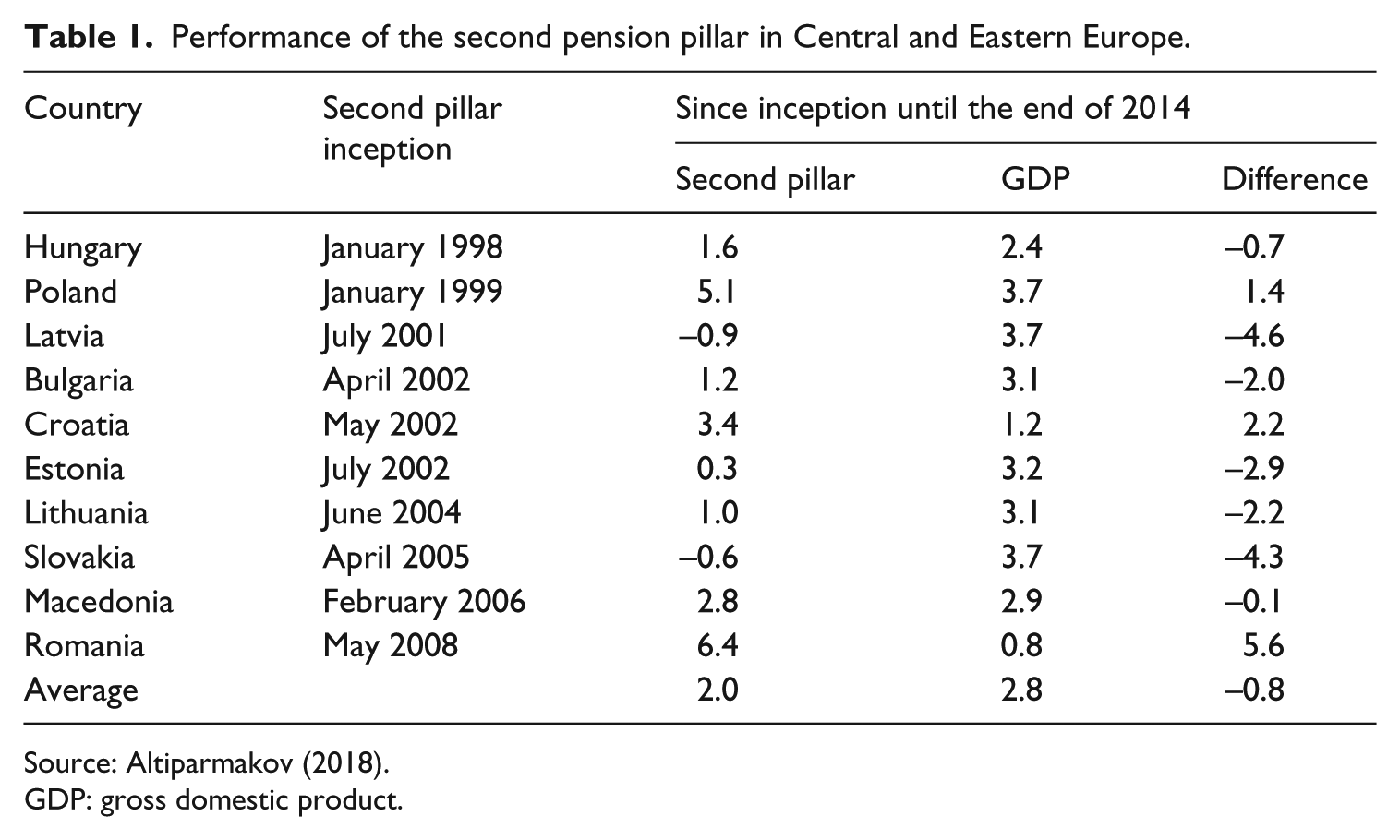
Source: Altiparmakov (2018).
GDP: gross domestic product.
Next came a fiscal crisis, which threatened the stability of the Eurozone, as markets turned on the debt levels of Southern Europe. The state activism of the early crisis period was replaced by an era of austerity. Balanced budgets became an important signal of economic stability, rather than the enactment of avant-garde neoliberal reforms. A renewed emphasis on balancing budgets helped to make the case for overturning pension privatization. In privatized pension systems, a proportion of the contributions to the public pension system were diverted into individually funded accounts. However, the pensions of those already retired still needed to be paid. This created a shortfall in pension revenues needed to finance the payment of pensions that was financed by government debt. This borrowing cost as much as 1.9% of gross domestic product (GDP) each year (Drahokoupil and Domonkos, 2012). At the same time, accession to the EU required abiding by Maastricht Criteria on the budget deficit and national debt, which stipulates that member states cannot run a budget deficit larger than 3% of GDP or a national debt larger than 60% of GDP. Suspending, scaling down, or completely reversing the multi-pillar pension model to meet these requirements became a tempting option for all countries in the region.
Suspending the multi-pillar model meant that contributions diverted into funded accounts could be temporarily redirected into the state coffers to ease a budgetary crisis. This option was undertaken by the Baltic states in the immediate crisis period (Drahokoupil and Domonkos, 2012). Scaling down did the same thing, to a smaller degree, but on a permanent basis. Slovakia chose this option (Drahokoupil and Domonkos, 2012). Completely abandoning the multi-pillar system permanently diverted the contribution back into general tax revenues. It also gave the state access to the accumulated pension funds that had built up during the funded period. This option was undertaken by Kazakhstan, Hungary, and to a lesser extent, Poland (Naczyk and Domonkos, 2016). Alongside the reform reversals in Central and Eastern Europe, Latin American countries such as Argentina and Bolivia renationalized their funded pension pillars (Naczyk and Domonkos, 2016). Table 2 summarizes the pension reform reversals in Central and Eastern Europe.
Pension reform reversals in Central and Eastern Europe.

Source: Bielawska et al. (2016).
In addition to the message that such a large number of reversals to the World Bank’s pension model sent to the global policy community, the World Bank had also lost its leverage in Central and Eastern Europe. In the early transition period, the Bank had used its lending capacity to influence finance ministers across the region (Appel and Orenstein, 2018; Müller, 1999). However, as the region became more integrated into the global economy and the EU, it had other sources of finances. For example, as the European Bank for Reconstruction and Development (EBRD) became a much more important source of finance, this significantly diminished the influence of the Bank in the region (Interview with Jacek Rostowsky, Finance Minister of Poland 2007–2013, July 2017).
As Starke et al. (2013) note, overall the international climate with regard to the role of social policy in mitigating the effect of financial crisis was consensual (p. 133). The global economic crisis had the dual impact of propelling the ILO back to the forefront of policy making in social protection while creating the conditions for many countries to abandon their World Bank–inspired multi-pillar pension models. This was particularly true in Central and Eastern Europe, but also the case in Latin America where Argentina and Bolivia where the economic climate forced them into a pension renationalization. The reputation of the World Bank in pension expertise was damaged at the same time its influence in middle-income countries was diminishing. Internal developments within both organizations had set the stage for these results in the years before the crisis.
A new global consensus on social protection?
The convergence of both organizations around the issue of coverage prior to the crisis opened up an opportunity for increased dialogue and cooperation in the years that followed. This was partially a consequence of the internal dynamics of both organizations. The World Bank would cease to vigorously campaign for multi-pillar pension reform. The ILO, on the other hand, ceased to solely champion wage-related social protection and developed a coherent policy stance with Recommendation 202 on National Social Protection Floors. This section outlines these developments and offers some concluding thoughts on the new era of collaboration between the two organizations.
The World Bank from 2008 onwards
In 2009, Robert Holzmann reached a mandatory service cap and was replaced as Director of the Social Protection and Labor Department. His successor, Arup Banerji, did not have a background in pensions, and so the momentum of a director focused on pensions ended. Under Banerji, the department took a broader focus on social protection. The Social Protection and Labor Strategy, published in 2012, outlined the role social protection can play in managing risk. It focused on three core principles: Resilience, Equity and Opportunity. It argued that social protection offers resilience against the new social risks, equity in reducing poverty and opportunity through human capital investment. Importantly, the strategy made extensive references to the ILO Social Protection Floor and spoke of an ‘emerging global consensus’ (The World Bank, 2012: 14).
The shifting away from pensions by the Social Protection and Labor Department came at a tumultuous time for the organization at large. In 2012, the World Bank formally elected Jim Yong Kim to serve as its president. Upon assuming office, Kim initiated a restructuring of the Bank that proved highly controversial. It was noted above, how the region of Central and Eastern Europe had become less dependent on the Bank’s finance. This was also true of the many of the world’s emerging economies. In order to remain relevant, Kim sought to breakdown the regional silos that, he argued, discouraged the sharing of best practice (Lowrey, 2014). His reorganization consisted of abandoning the geographical structure of the Bank to replace it with global practices, with technical expertise in specific policy areas. It was believed this would keep the Bank’s lending channels alive to emerging markets for specific projects, alongside lending to those locked out of international capital markets (Financial Times, 2014). The reorganization was conducted over two years and was unpopular with World Bank staff. Alongside concerns about losing the local expertise necessary for policy implementation, it coincided with a high turnover of senior departures. To illustrate the level of dissatisfaction, in an emergency town hall style meeting with the President, 8000 out of 10,000 staff were present, including 5000 tuning in online from across the globe (Birdsall, 2014).
As a consequence of this controversial restructuring, the World Bank was inward looking at a time when one of its flagship pension schemes was being abandoned across the globe. In 2008, the World Bank issued guidance on the crisis and funded pillars. At this point, only Argentina had closed down its second pillar and the Bank was (correctly) fearful of more countries doing the same. It cautioned against dramatic systemic responses to short-term shocks (Dorfman et al., 2008). However, this was when Holzmann was still the director. When countries did begin to carry out reform reversals in Central and Eastern Europe, no response came from the Social Protection and Labor Department and the Bank took no formal view on the developments. A somewhat informal response came from Mamta Murthi (2014), the Bank’s regional director for Central Europe and the Baltics, in the form of a blog post. Here, she gave an overview of pension developments in the region and suggested why countries had opted to scale down or close their second pillars but stopped short of criticizing them. Another candid assessment came from outside the Bank by its former Social Protection and Labor Director. Writing in a personal capacity, his position paper acknowledged many of the challenges for multi-pillar pension reforms such as market volatility, exorbitant fees and the possibility of a new permanent low in returns on assets (Holzmann, 2012).
In sum, as a result of personnel changes, internal disruption and an unaccommodating external environment, the World Bank’s promotion of multi-pillar pension reform broke down. In addition, the client base of the Bank was now primarily developing countries, where the establishment of social pensions or the so-called zero pillar was the priority. This sharpened the focus on coverage and systems development to administer non-contributory benefits.
The ILO from 2008 onwards
Once the Social Security Department had reached a unified position on social protection floors, it was able to move the campaign to the next stage. The campaign for social protection floors had three dimensions (interview with Krzysztof Hagemejer, ILO, February 2018). First, it needed to convince all interested parties about the affordability of a social protection floor for low income countries. Here, the department developed sophisticated modeling exercises to demonstrate that social protection floors were not out of reach for even the world’s poorest countries (Pal et al., 2005).
The next stage in the campaign was to convince the rest of the ILO of the importance of social protection. The social protection department is much smaller than other ILO departments and does not carry the same authority as employment and labor rights (Huyse et al., 2017). Cichon was able to raise the status of social protection by aligning his agenda with the wider Decent Work agenda promoted by the Director-General Juan Somavia. The Decent Work Agenda has four pillars: full and productive employment, rights at work, social protection and the promotion of social dialogue (ILO, 2012: 9). Cichon campaigned to give social protection the equal weight as the other four pillars.
Finally, the task was to convince the constituents of the ILO in order to adopt a recommendation at the ILC in 2012. Cichon demonstrated pragmatism in this process. He abandoned the campaign for a singular concept of a social protection floor, to the plural concept of national social protection floors. The concept of a social protection floor was also refined from a set of benefits to a set of guarantees that could be delivered in a variety of ways (Deacon, 2013). This diluted the concept as it allows national governments to interpret minimum standards. However, it shielded the ILO from criticism from the global south that it was a tool of the global north to impose protectionist standards. In the event, these tradeoffs resulted in the ILO Recommendation 202 being unanimously adopted by the ILC in 2012. The ILO had a unified position on social protection, which had been endorsed internationally all of the ILO’s member states.
Shortly after the passing of Recommendation 202, Cichon retired as Director of Social Security. However, unlike in the instance of the World Bank where retirement stalled the policy development, his replacement, Isabel Ortiz was something of a continuity candidate with the ILO’s stance on social protection floors. In her previous roles at UNDESA and UNICEF, she had been part of the Coalition for a Global Social Floor. The Department of Social Security was renamed the Department for Social Protection (SOCPRO) to bring its name in line with the terminology used in global policy documents. In addition, the department shifted focus slightly from technical assistance to global advocacy. This was done by reorienting existing capacity away from highly specialized technical positions to a larger number of junior profiles to support global advocacy campaigns (Huyse et al., 2017).
The outcome of the increased resources dedicated to global advocacy has been effective for the ILO. It was successful in its efforts to influence the UN Sustainable Development Agenda. This agenda will largely determine the orientation of development-related resources both globally and nationally. After lobbying from the ILO, social protection was integrated into 5 of the 17 sustainable development goals. This means that social protection is now a key focus of the development agenda for many years to come. Notably, goal 1.3 explicitly mentions social protection floors. As a response, the ILO, in collaboration with the World Bank, launched the Global Partnership for Universal Social Protection. This will be one of the main mechanisms for delivering the Sustainable Development Goals on social protection, with the ILO as a lead actor. It brings together a large number of international organizations and development partners, presenting itself as a follow up to earlier global universalism initiatives on universal education and universal health coverage.
A new partnership or old rivalries?
The Global Partnership is symbolic of the development of the relationship between the ILO and World Bank. At one time, the two organizations were in heated opposition in their visions for pension policy. The evolution of positions in both organizations has paved the way for a much more collaborative relationship over the past decade. However, while both organizations use similar discourse on universal social protection and social protection floors, differences remain. A key difference is the interpretation of ‘universal’. For the World Bank, universal means everyone having some form of coverage, for the ILO it means everyone having the same coverage. This brings the role of means testing into sharp focus. In a recent report, the World Bank (2018) argued that means testing was more effective at reducing poverty in old age social pensions (p. 83). For now, the rolling out of coverage to those who have none fosters close collaboration between the two organizations, since both are primarily focused on creating coverage. However, these differences in interpretation and orientation may have implications for activities in the field and the technical advice given, particularly in the years to come as the vertical dimension of social protection takes precedent.
Conclusion
The internal dynamics of international organizations can be instrumental in setting global policy agendas. At critical moments in global political economy, actors within the World Bank and ILO were instrumental in shaping debates and orienting action. When ideas align with the prevailing paradigm, a coherent, organized message can supersede rival ideas. This analysis has shown how the World Bank gained superiority in global pension debates during the 1990s. These ideas aligned with the dominance of neoliberal ideas across the globe. However, they were also dependent upon an organized internal campaign within the Bank and an accommodating internal structure. The ILO, which was frozen out during the World Bank’s campaign for pension privatization, realigned its priorities and organized for impact with the restructuring of its Social Security Department. The global economic crisis gave the social protection floor the impetus it needed both within and outside of the ILO. However, this would not have been possible without the promotion and ascendancy of Michael Cichon and his team, who prepared the ground for the idea to take off. As Deacon (2013) argued in his final work, the biographies of actors can be instrumental in the global social policy process. This article has developed this argument through the framework of an interaction between features of the external environment and the internal dynamics of international organizations.
Footnotes
Acknowledgements
We greatly appreciate the participation of participants in this research project. Not only did they give up precious time for interview, but also further clarifications and other requests for assistance were generously responded to. Finally, we would like to thank the reviewers whose helpful comments enhanced the final version of this article.
Funding
This collaboration was funded by the United Kingdom’s Economic and Social Research Council’s (ESRC) Overseas Institutional Visit Scheme. In addition, overseas fieldwork was funded by the ESRC Overseas Fieldwork Expenses Fund. Both have award number ES/J500215/1.
