



Abstract
International organizations play a central role in disseminating social investment ideas, which serve to legitimize forms of public spending by stressing their future contribution to human capital and economic growth. However, the transition from a neoliberal to a social investment state is conditioned on national policymakers’ will to embrace a post-neoliberal macroeconomic philosophy and governance. Although such change lies in the professional purview of economist-technocrats, there is little empirical research on their role as national translators of social investment ideas. This article examines economists’ role in the translation of social investment ideas in Israel. By embedding specific social investment ideas within entrenched economic world views – including principles of ‘responsible’ macroeconomic governance – camps of Israeli economists articulate varying and sometimes competing social investment policy agendas. Lessons from Israel suggest that economists are non-negligible actors in the translation of social investment ideas. By advancing different social investment strategies, economists may assume different roles in the policymaking and politics of social investment.
Keywords
Introduction
Transcending neoliberal philosophy, in which social spending is conceived as encumbering economic prosperity, social investment (SI) is becoming a leading international policy perspective for ‘rethinking the relations between economic progress and social policy: from tradeoffs to mutual reinforcement’ (Hemerijck, 2012: 50). SI includes a variety of new ideas that legitimize forms of public spending as investments, which are measured according to their projected contributions to human capital development and economic growth (Hemerijck, 2012; Jenson, 2010). Ample research shows international organizations (IOs) such as the Organisation for Economic Co-operation and Development (OECD), the European Commission, the World Bank, and the International Monetary Fund (IMF) are central in the dissemination of SI ideas (Deeming and Smyth, 2018; Jenson, 2013; Leibetseder, 2018; Mahon, 2009, 2010), yet relatively little is known about national-level processes of translation. This article examines how national policymakers translate international SI ideas to advance national SI agendas, taking a particular interest in the role of economist-technocrats (economists hereafter) in central state units.
According to Hemerijck, economists are expected to play a significant role in the adoption of SI. Shifting from the neoliberal to the social investment state necessitates significant changes to neoliberal ‘institutional governance’ (Hemerijck, 2018: 821): the macroeconomic rules and arrangements that enabled and supported the implementation of neoliberal policies (e.g. fiscal rules, centralized budgeting offices). A shift toward the social investment state is conditioned on national policymakers’ will to embrace a post-neoliberal macroeconomic philosophy, including loosening fiscal restraints and increasing taxation (Hemerijck, 2012). Although such shift in a state’s macroeconomic governance lies in the professional purview of economists, there is almost no empirical research on their role as national translators of SI ideas.
This article sets to study economists’ role in either enabling or obstructing the transition toward the social investment state via the case of Israel. The article focuses on two central macroeconomic state units: the Ministry of Finance (MoF) and the Bank of Israel (BoI). Israeli economists’ conspicuous ‘front-stage’ involvement in social policymaking in recent decades (e.g. Asiskovitch, 2010; Cohen, 2013; Maron and Helman, 2017) provides a promising opportunity to explore dynamics that according to Hemerijck (2012) transpire elsewhere yet are less available for empirical scrutiny (see also Jenson, 2012). Israeli economists enjoy a broad and continuous government mandate, which is further enhanced by the country’s prolonged political instability and geopolitical circumstances. As prominent actors in sustaining neoliberal rules and arrangements during recent decades (Maman and Rosenhek, 2011; Mandelkern, 2015; Maron and Shalev, 2017), economists in the MoF and the BoI are positioned as ‘gatekeepers’ who are expected to have a marked effect on the translation of SI ideas.
The article explores how, by combining international SI ideas with distinct macroeconomic philosophies and principles of governance, economists articulated different SI agendas. These agendas offer competing views of the transition from the neoliberal to the SI state. The article uses two recent episodes of SI-oriented policymaking to demonstrate economists’ varying roles in SI policymaking and politics, and illuminate their ambivalent contribution to the transition from the neoliberal state to the social investment state in Israel. The analysis draws on interviews with 15 senior economists, who held key positions in central state units such as the MoF, the BoI, and the National Economic Council. In addition, the analysis draws on sources such as policy documents, protocols of official committees’ meetings, published interviews, and related media items.
The article opens by discussing economists’ role as national translators of SI ideas. Then, it introduces central economic actors responsible for translating SI ideas in Israel. Analysis of two policy episodes next – advancing the economic inclusion of excluded minority groups and the promotion of child-centered investment – demonstrate the ways international SI ideas were made manifest in national SI policymaking. The concluding section discusses the relevance of findings for economists’ role in the translation of SI ideas elsewhere.
Economists as national translators of social investment
Economists have been acknowledged as playing a central role in SI puzzling and policymaking (Jenson, 2012). Within IOs, economists have been significant in the articulation of SI ideas (Deeming and Smyth, 2018; Jenson, 2013; Mahon, 2009, 2010). Although IOs may influence national policies directly (Béland and Orenstein, 2013), in order to understand SI ideas’ effect on national policymaking we need to explore how they are borrowed and used by economists in national contexts. Based on their membership in transnational professional networks and ongoing interaction with IOs, national economists are primary agents in the dissemination and translation of international economic policy ideas (Ban, 2016; Chwieroth, 2007). By mediating domestic and international policy fields, economists in central state units are able to effect economic and social policymaking (Helman and Maron, 2019; Maman and Rosenhek, 2008).
To advance the social investment state, economists in central state institutions need to incorporate SI ideas to develop new ‘macroeconomic thinking’ to supersede previous Keynesian and neoliberal paradigms. When Keynesianism dominated, public spending was deemed a solution for ‘market failure’ by creating aggregate demand. Under neoliberalism, public spending was reframed as the problem and thus curtailed in the name of economic progress (Hemerijck, 2012). SI ideas involve new conceptions of economic growth, requiring economists to move beyond the neoliberal dogma of tax-cuts as the economy’s panacea – to acknowledge some forms of social spending as capable engines powering future economic growth. In order to facilitate the shift to SI, economists (particularly within central budgeting offices) must revise their macroeconomic beliefs toward a ‘new regime of public finance’ that considers some public spending as investment rather than consumption. This includes the incorporation of new policy practices, including evaluating social policy’s economic returns and changes in social budgets’ allocation (Hemerijck, 2012: 54).
How innovative SI ideas influence economists’ entrenched macroeconomic ideas? Existing macroeconomic ideas may reject – or be replaced by – SI ideas. It is more likely, however, that SI ideas will be grafted with existing ideas to form unharmonious policy agendas. When traveling across boundaries and sites, international policy ideas are not fixed blueprints, nor sealed packages of meaning (Lendvai and Stubbs, 2009). Economists participate in processes of interpretation and translation, whereby social actors adjust and modify foreign ideas to suit local circumstances, which include policy experiences and institutional arrangements. Via translation, foreign SI ideas may take on new local meanings and become associated with particular national policy legacies (Ban, 2016; Helman and Maron, 2019; Lendvai and Stubbs, 2009). The polysemic nature of SI ideas leaves ample room for interpretation and translation into actual policy proposals and agendas (Jenson, 2010).
Economists positioned in different governmental units and other policy organizations may develop distinct macroeconomic orientations beyond their shared disciplinary background. Some economists in government may prove more committed than others to upholding neoliberal beliefs and institutions, and obstruct the institutional shifts required to pursue an SI agenda (Haffert and Mehrtens, 2015; Heins and de la Porte, 2015: 24). As a result, transition processes may prove highly contested, as the adoption of new SI policy rationales may ‘inspire political discord with prevailing governance structures and institutional actors . . .’ (Hemerijck, 2018: 819). Conflicts among economists and their institutions may arise that halt change (e.g. Chwieroth, 2007) or lead to the advancement of competing trajectories of change. The next section explores just such a scenario of competing trajectories as it introduces the economic actors engaged in post-neoliberal agenda-setting struggles in Israel.
Macroeconomic principles and the translation of social investment
In the 1980s, Israel’s political economy adopted neoliberal modes of macroeconomic governance. The Ministry of Finance (MoF) and the Bank of Israel (BoI) were prominent in the restructuration of Israel’s developmental state and in the introduction and maintenance of fiscal and monetary neoliberal policies (Maman and Rosenhek, 2011; Mandelkern, 2015; Maron and Shalev, 2017). Since the late 1980s, MoF economists became highly involved in social policymaking in various domains, advancing market-oriented reforms, public spending cutbacks, and new forms of market governance (Asiskovitch, 2010; Cohen, 2013; Maron and Helman, 2017). Via centralized and effective institutions of fiscal constraint, Israel has maintained a particularly low level of social spending since the early 2000s (about 16% of gross domestic product [GDP], among the lowest in the OECD). The Israeli welfare state regime, previously characterized as conservative and dualist, gradually adopted features of a liberal, market-oriented residual regime, with high levels of poverty and inequality, yet certain illiberal features of the political economy proved resilient (Maron and Shalev, 2017; Rosenhek, 2007; Shafir and Peled, 2002).
Following the 2007/2008 global financial crisis and the social protests in the summer of 2011 (mass unprecedented popular protests against neoliberalism’s economic effects), attempts to reconfigure social policy became politically salient. In this context, SI ideas entered national policy circles. Economists have advanced SI ideas and policy proposals to adjust social policy in the face of new challenges. Below, I review the main proponents of SI ideas in Israel, underscoring differences in the ideas they borrowed and more significantly in the macroeconomic thinking in which SI ideas became embedded.
MoF
Since the 1980s, the MoF has been a central state actor in maintaining conservative fiscal policies in Israel. Led by its proactive Budgetary Division (BD), the MoF upheld a persistent stance on disciplinary cutbacks in public spending, privatization, and centralized budgeting and spending authorities inside the government (Mandelkern, 2015; Maron and Shalev, 2017). Beginning in 2009, SI ideas gradually entered the BD’s rhetoric, its policy documents, and proposals. 1 Selecting from the internationally available SI spectrum, the BD adopted inclusive growth (IG) ideas. Compared with other SI policy approaches, IG focuses on sustained economic progress, wherein social policy is used instrumentally to reinforce economic growth (Deeming and Smyth, 2018; Jenson, 2013). IG is a policy perspective that supersedes neoliberal thinking by regarding inequality as a central impediment to sustainable economic growth. In this perspective, economic growth only becomes resilient and sustainable when most people share its fruits. The inclusion of less advantaged groups in the labor market – often disregarding the terms of such inclusion – is perceived as a key for attaining greater economic equity and long-term growth (Deeming and Smyth, 2018: 19).
Leading IOs promote distinct IG approaches. The World Bank’s IG recommendations focus on the broad-based inclusion of able adults in the labor market, with less concern for the human and social facets of economic inequality. For the World Bank, ‘productive employment, rather than income distribution per se’, as well as equal ‘access to markets, resources and [an] unbiased regulatory environment for businesses and individuals’, is at the core of IG (Deeming and Smyth, 2018: 20). According to the IMF, such policies as ‘better-targeted subsidies, improvements in economic opportunities for the poor, and active labor market policies that promote employment’ can support ‘longer growth spells’ without distorting growth incentives (Ostry and Berg, 2011: 3). In contrast, the European Commission and the OECD’s IG approach additionally emphasize non-economic aims, including societal welfare and individual wellbeing (Deeming and Smyth, 2018: 21; Jenson, 2013).
The IG approach developed by Israel’s BD resonates largely with ideas developed and spread by the IMF and the World Bank. According to a former BD head during the relevant period, the BD took the IMF as an important reference and ideational source. 2 IMF professional executive teams held regular meetings with MoF officials, which included consultations and discussions on Israeli macroeconomic policies. The IMF then provided concrete, formal IG recommendations following discussions held in 2013. 3 After praising Israel’s ‘sound macroeconomic’ performance and adherence to ‘financial fundamentals’, which had guaranteed its stability during the global financial crisis, the IMF recommended that Israel address its growing social imbalances and inequality in order to sustain economic growth. In its report, IMF executives go on to argue that for Israel ‘[g]rowth is not inclusive, and does not trickle down to the middle class in full . . . [F]ormidable challenges related to the inclusion of groups that are weakly attached to the labor market lie ahead . . .’ 4 To address this problem, the IMF recommended a structural reform to address significant gaps in employment rates and productivity between the general Jewish population and the Arab and the Ultraorthodox (Haredi) Jewish communities. Leading Israeli government officials ‘agreed on the need for more concerted efforts aimed at integrating Arab-Israeli and Haredi communities in economic activity’. 5
Nonetheless, as we shall see below, the BD translated IG ideas by integrating them with existing institutional principles of prudent macroeconomic governance. During interviews, senior BD economist-technocrats appeared to echo IG’s basic premise on the need to reduce inequalities to support economic growth. One former head of the BD explained, Our goal is achieving economic growth while reducing the gaps, since gap reduction also leads to growth . . . Not so long ago, the leading approach was that growth would trickle down . . . Now, a new notion prevails, namely, the importance of reducing social gaps and inequality not only for its own sake but as something that effects growth . . . (Former head, Budget Division, Ministry of Finance; 28 May 2015)
Notoriously known as the main proponent of neoliberalism in government, the BD listing as goals the reduction of social gaps and inequality is far from trivial. However, the BD’s adoption of IG did not change one of its core principles: maintaining fiscal consolidation by opposing attempts to increase public spending. The BD did not view SI goals as any different from other social policy goals and was unwilling to appropriate distinct budgetary sources for them. As a result, spending for SI was subordinated to fiscal discipline according to the Total Spending fiscal rule. To refrain from breaching the total spending framework, the BD argued that newly conceived policy goals must replace old and outdated goals. 6 This rather conservative approach serves to curb the state’s role as a principle social investor. Sustaining a neoclassic economic growth model, BD economists continued to maintain that tax reduction is ultimately the best way to encourage growth, rather than consider SI as an alternative engine for growth.
The BD’s residual outlook affected its translation of IG inequality reduction goals into policy programs, maintaining that fighting inequality is to be achieved by targeting the most disadvantaged groups who economically ‘lag behind’, rather than undertaking a more systemic approach to the reduction of inequality. The BD regards targeting, or differentially allocating resources, as the most efficient form of SI: [T]o maximize both growth and the reduction of social gaps for every Shekel [Israel currency] spent, you must invest it differentially by targeting disadvantaged populations . . . [For example,] consider the economic value of investing in the public transportation of an Arab municipality isolated from employment opportunities . . . (Former head, Budget Division, Ministry of Finance; 25 June 2018).
BD economists prefer to allocate for social spending as targeted investments, permitting maximal marginal utility: directing investment toward excluded and deprived populations, where public money generates greater economic value than if invested in wealthier populations.
Throughout the translation of IG ideas, the BD maintained its long-standing mandate as the central budgeting office, responsible for fiscal consolidation, cost-efficient resource allocation, and public sector productivity. Distrusting public sector employees, often conceived as politicized, ‘rent-seeking’, and ineffective, the BD was concerned that SI would be wasted through the typically weak or inefficient performance of public organizations. 7 As the guardian of public moneys, the BD was not only concerned with reallocating spending from consumption to investment (Hemerijck, 2012: 54), it would only do so if it could (1) maintain the public spending ceiling intact and (2) monitor SIs to guarantee the efficient use of funds.
BoI
Responsible for Israel’s strict commitment to neoliberal anti-inflationary policies since the mid-1980s, the BoI is another pillar of Israel’s neoliberal institutional architecture (Maman and Rosenhek, 2011). In 2004, the BoI was the first to stress the need to systemically reformulate Israel’s passive social policy to support a competitive globalized economy (Klein, 2004). Since the global financial crisis and the 2011 protest, the BoI has adopted SI ideas and developed an explicit approach that strives to improve equality of opportunity and the economic integration of excluded populations via differential allocation of resources in education and promoting the lifelong acquisition of marketable skills. 8
The BoI’s post-neoliberal SI orientation is primarily influenced by the OECD. In a focus group interview, BoI economists pointed to the OECD as a major ideational source and resource, further reflected in BoI publications and officials’ vast reliance on OECD data and publications (especially following Israel’s enrollment in the OECD in 2010). This allegiance helps explain BoI’s persistent focus on education and marketable skill formation (Argov, 2016a, 2016b; Flug, 2018). 9
Drawing on its recently sharpened research competency in educational inequalities, rigorous econometric studies, and strategic comparison of Israel to OECD standards and recommendations, the BoI illuminates relations among educational achievements, workers’ skills, labor market participation, productivity, and sustainable economic growth (Argov, 2016a; Flug, 2018; Tzur, 2016). During the last decade, particularly since 2013, the BoI established a policy position in opposition to the MoF, recommending investing greater resources in early childhood, primary, and secondary education, and skill development (Argov, 2016b; Flug, 2018). In all levels of education, from early childhood to post-secondary, the BoI recommends targeting disadvantaged populations, namely, those groups who achieve the lowest scores on standardized tests, including Arab and underprivileged Jewish populations. While BoI economists prefer to invest in the most disadvantaged areas in order to maximize public spending’s marginal utility, they intermittently support universally provisioned education services, early childhood education in particular, in order to prevent advantaged parents from increasing social gaps by utilizing higher quality private services. Furthermore, universal provisioning creates a positive ‘Peer Effect’ whereby disadvantaged children benefit from the presence of advantaged children. 10
The justification for spending is purely economic. Meticulous research and data have demonstrated that investment in education furnishes an engine for economic growth, as it enables individuals to acquire employable skills, which leads to higher overall productivity and individual and national incomes. Focusing on the outputs from investment, the head of macroeconomics at the BoI’s Research Division argues that improved overall educational achievement is paramount for fostering IG that encompasses all citizens (Argov, 2016b).
Similar to the BD, the BoI maintains an instrumental perspective on inequality as an impediment to economic growth. BoI researchers have expressed their discomfort with ‘normative and ideological’ views on inequality, preferring to focus on its role in hindering economic growth. 11 Inequality is thereby economized. However, in contrast to the MoF, BoI’s embrace of SI ideas runs deeper than simple economization to challenge some fundamental neoclassical creeds of economic growth, reaching beyond the neoliberal supply-side dogma of tax-cutting as the optimal incentive for growth.
For BoI, making public services more efficient is important, yet new forms of SI also require overall increases of public spending (Argov, 2016b). The BoI Chancellor has publicly contested the MoF on this issue (Flug, 2018; Udasin, 2017), by calling for increasing revenues. The state could thus finance new SI without breaching the public spending caps enforced by Israel’s Total Spending fiscal rule. A new theorization of growth and its engines fuels this revised view of taxes: [M]ainstream economists still believe more tax reduction is the only way to encourage growth . . . [However,] it is important to research what type of public spending contributes to growth, and unlike the short-term effect of tax cuts, this is hard to demonstrate [in empirical tests] because these are long-term processes . . . (Focus group interview, Macro Economics and Policy Division, Research Department, Bank of Israel; 8 January 2017)
According to BoI, the state should pursue a rational, research-based approach to social spending, which can warrant increasing taxes. Particularly, increased spending on education is expected to generate inclusive economic growth in the intermediate future.
Academics in government-appointed positions
A few committed academics appointed to influential public positions have also played an important role in translating SI ideas and advancing SI-oriented policy proposals. 12 Here I focus on the public career and perspective of Manuel Trajtenberg who, via a series of government-appointed positions and a short excursion into politics, was highly influential in Israel’s translation of SI. Beginning in the early 2000s, Tel-Aviv University economics professor Trajtenberg (PhD Harvard) was appointed to several senior positions in government. He served as the first chairman of the National Economic Council (2006–2009) and headed the Planning and Budgeting Committee at the Council of Higher Education (2009–2014). While holding this last position, he was also appointed by Prime Minister (PM) Netanyahu to chair the Committee for Economic and Social Change (CESC; also named the ‘Trajtenberg Committee’), established in response to the 2011 social protests. In 2015, Trajtenberg launched a brief political career, running for office as the Labor party candidate for Finance Minister and serving as Member of the Knesset (in the opposition) until 2017.
Trajtenberg used these central and influential positions as platforms for spreading SI ideas, formulating policy programs, and developing a public SI agenda. The most comprehensive SI program was developed during his work on the CESC, which attempted to address the 2011 political turmoil and received intensive public scrutiny. Trajtenberg was central in proposing a universal child-centered SI agenda, focusing on early childhood education and care (ECEC). The CESC justified this policy in its final report: [I]ndividuals’ ability to find quality jobs – and indeed any job – depends on the flexibility of their skills and ability to adjust to changing circumstances, which in turn depends on early age acquisition of a broad and solid set of capacities, skills and knowledge . . . [U]nlike educated and knowledgeable parents, parents who lack resources will underinvest in their children and marginalize them. This will create inequality and also decrease the pool of effective human capital for the national economy . . . (CESC final report; 2011: 47)
Linking requirements for the ‘knowledge economy’, national economic prosperity, and the provisioning of high-quality ECEC to young children, this report draws directly on the international child-centered SI agenda promoted by leading IOs such as the OECD. SI policy is depicted as providing universal opportunities in the form of access to high-quality early age services to all children (Jenson, 2010; Mahon, 2010). Unlike the BoI’s emphasis on later stages of education and skill formation, this strategy for bettering the workforce’s quality requires a greater investment to reap returns at a much later time (Hemerijck, 2012: 53).
Following a partial implementation of the CESC’s recommendations, Trajtenberg continued to promote his SI agenda as a Knesset Member. He was appointed to the Knesset’s Budget Committee and served as co-chair of the Knesset’s Early Age Education Forum. Trajtenberg led the enactment of the Council of Early Age Policy Law (2017), a policy initiative with three goals: (1) integrate all related policy matters in government; (2) enact a long-term optimal investment policy in early age development; and (3) promote a shift inside government away from the prevailing perceptions of early childhood services as ‘daycare’ or ‘babysitting’, a perspective upheld by the Ministry of Economy, which oversees daycare policy in line with its long-standing commitment to women’s employment. 13
The Early Age Education Council’s founding document refers to European Council and OECD documents that emphasize the positive effects of ECEC for individuals and society. It quotes the European Council’s recommendations to establish a ‘generalized equitable access to high quality ECEC’ for all children as important for achieving the Europe 2020 strategy. Although investment in ECEC yields high returns from investments in disadvantaged children, the European Council recommends it for all children. 14
This variant of SI in young children follows from a strong scientific argumentation associated with James Heckman’s internationally renowned work. An economist from the University of Chicago and a Noble laureate, Heckman is clearly the leading global proponent of investment in high-quality early age education as key for accumulating human capital and advancing social mobility (Hemerijck, 2012: 53). A member of the Early Childhood Interventions (ECI) network, an international endeavor organized by Heckman, Trajtenberg is the leading advocate of Heckman’s ideas in Israel. 15 In 2017, Heckman provided a keynote speech on ‘Policies to Promote Social Mobility’ as part of a conference on ‘Educational Inequality in Israel: From Cradle to University’ at the Taub Center for Social Policy Studies in Jerusalem. 16 Shortly after resigning from the Knesset, Trajtenberg introduced Heckman as the ‘great master’ of early childhood education. Promoting his SI agenda, Trajtenberg stressed the grave importance of investing in ECEC, the least budgeted service in the Israeli education system, claiming it a matter of national urgency. 17
Trajtenberg’s translation of the European Council’s and Heckman’s child-centered SI ideas integrates them with his previously established technocratic view on responsible macroeconomic management. While being chairman of the National Economic Council, Trajtenberg had been responsible for designing the Total Spending fiscal rule. While he has argued that Israel’s fiscal consolidation is too rigid and fails to take the economic growth of recent years into account, he continues to embrace many neoliberal principles such as the need to de-politicize macroeconomic management. However, he breaks from neoliberalism in his support for increasing public spending relative to GDP and increasing taxes for SI. He is nevertheless explicit on keeping macroeconomic discipline intact and warns the public away from unbridled, populist, and irresponsible politicians. For Trajtenberg, a technocrat-politician is the preferred manager of national finance. 18
From competing social investment agendas to mixed policy outcomes
In the previous section, I outline how different camps of Israeli economists drew upon specific international SI ideas to articulate national SI agendas. While various actors clearly incorporated new ideas in their policy agendas, it is also clear that they did not fully relinquish old macroeconomic philosophies. Economic actors’ SI strategies were essentially amalgamations combining newly diffused SI ideas and entrenched ideas and principles of macroeconomic governance. Importantly, economists may also advance their SI agendas and partake in political struggles between competing visions of the social investment state. This section explores these struggles, emphasizing economists’ different roles in SI politics and policymaking. The section proceeds to analyze two episodes in which competing economic agendas and ad hoc policy coalitions supported different SI strategies that led to national policy consequences. The discussion begins with the chronologically advanced case (2015–2017) in which a coalition of economic actors promoted a cohesive policy agenda. The next case (2011) explores economists’ complex roles as both proponents and opponents of SI policy agendas.
Economically excluded minority groups as a ‘lost engine’ of growth
Between 2015 and 2017, the Israeli government inaugurated several programs targeting minority, non-Jewish groups including Arab, Druze, Bedouin, and Circassian. Government Decision 922 (30 December 2015) represented a concentrated effort to encourage growth by reducing inequality via the economic inclusion of historically excluded minority groups. Decision 922 aims to increase employment and economic entrepreneurship via investment in employment-enabling infrastructure (public transportation, active employment services, and services and incentives for small- and medium-sized businesses), research and development, and secondary and higher education. Government Decision 922 was without precedence in its scope, authorizing the appropriation of 12 billion NIS for 5 years: 2016 through 2020. 19 New budget allocations are typically channeled via relevant government ministries. However, in order to amend the historical discrimination against non-Jewish populations, the program also adjusted ministries’ budgeting formulas to effect a more balanced ongoing distribution of resources following the completion of the program’s implementation.
Signed by a radical right wing government, Decision 922 represents an interesting development. First, the Netanyahu-led government regularly supports only a limited and conditional inclusion of non-Jews in the polity. Second, led by the BD within the MoF, this government generally supports capped social spending. Given this context, we can observe how an SI rationale played a pivotal role in legitimizing and authorizing this program (Zehavi and Breznitz, 2018). For one, IG ideas played an important role in redefining the goals of senior BD economists, illuminating the economic potential of some public investment to support growth, or at least to reduce future social spending increases. Second, with its embrace of IG ideas, the BD was able to successfully leverage them to persuade resistant political actors, emphasizing macro-level economic benefits while sidestepping arguments of social citizenship rights and redistributive justice.
Two main actors are due credit for advancing this program inside the government: the BD and the Authority for Economic Development of Minorities (AEDM) within the PM’s Office (later moved to the Ministry for Social Equality). The National Economic Council actively supported the advancement of the program, and the BoI also gave its approval. 20 AEDM was formed in 2008 and, until 2015, was responsible for small-scale 1-year programs. Also led by economists, AEDM was in direct, ongoing communication with BD economists. A breakthrough occurred in 2014 when the heads of the BD and AEDM decided to launch a multi-year program, more comprehensive and ambitious than previous programs, and legitimize it using IG ideas and discourse. Ongoing, close collaboration of AEDM with the BD was essential for pushing the program through the government, ultimately leading to Decision 922. 21
The BD and the AEDM framed the program using IG ideas, emphasizing national economic gains, rather than the development of individuals’ skills and capacities. Government discussions prior to the enactment of Decision 922 were contested with a few Likud (ruling right wing party) ministers vocally opposing it (Basok and Heruti-Sever, 2015). In an attempt to change their minds, the BD head gave a presentation to the cabinet, in which he demonstrated how such an investment would generate vast future benefits to Israel’s economy, including a 60% increase in GDP per capita. He also underscored the alternative scenario: the economic damage expected in the absence of such an investment, including a steep expected rise of 100% (from 70% to 170%) in the debt–product ratio by the year 2057. 22 Minority groups were presented as an untapped, raw potential for economic growth that the state must activate via targeted investment. They also argued that economic inclusion is vital for decreasing social gaps, which in turn contributes to growth. Increasing employment rates, among Arab women in particular, was defined as a strategic instrument for improving the welfare of the Arab society, decreasing inequality, and maximizing Israel’s economic growth potential. 23
Prior to the program’s enactment, the head of AEDM drew upon the international professional and political capital of the OECD to reinforce its policy advice and promote Decision 922. Primarily following Israel’s OECD enrollment, its professionals and officials met with the AEDM during formal visits. These meetings involved knowledge exchange as OECD representatives partook in official excursions to Arab cities and municipalities and also gave formal speeches before the PM and senior ministries at AEDM annual conferences. Adapting the IG discourse, the AEDM took heavy advantage of the OECD’s interest and involvement to reinforce the message that the government must advance policy change by strategically inviting – and sponsoring – OECD research and recommendations on inequality in education, skills acquisition, and employment among the Arab minority. 24
The lion’s share of the resources authorized by Decision 922 is to be invested in economic-enabling infrastructure and employment, while education was allocated relatively little funds. Within education, most attention was given to higher education, the upper grades of secondary education (for language and math skills), and informal afterhours educational activities. The discourse justifying ECEC was completely absent from this program. Increasing the availability of daycare services for infants was included as part of investment in employment as a means for encouraging mothers to work. This lack of attention to ECEC stands in sharp contrast to another policy initiative which unfolded during the same period. The next section explores this contested initiative, focusing on economists and their ideas.
Leveraging Israel’s mass social protest to promote child-centered investment
A central event in the advance of SI policy goals in Israel took place in response to the mass popular protests of summer 2011 with the establishment of the CESC. Trajtenberg, and the other committed academics who served as committee members, harnessed and leveraged the protest to advance a distinct set of SI goals, focusing attention on the importance of universal, high-quality, early age, child-centered services. While they succeeded in affecting policy change, it was partial and with mixed results.
Popular demonstrations erupted for some 3 months in summer 2011, during which hundreds of thousands of protesters occupied public spaces and held mass demonstrations, demanding ‘social justice’ from the government. The majority of demonstrators were young adults, educated and middle-class, who protested the retreat of the welfare state, the gradual depletion of their income, and the burdensome rise of living costs. Growing out-of-pocket spending for ECEC was a key issue they raised. In order to examine the protest’s demands and provide the government with policy recommendations, PM Netanyahu established the CESC. The committee translated protests’ claims in ways to advance SI ideas, centering attention on early childhood education (Shevchenko and Helman, 2017). The committee recommended the provision of free public education for all preschool children (ages 3–4), 25 longer school days for all elementary school children (ages 5–9), a significant expansion of state-regulated care services for infants, and the integration of all policy matters related to early childhood education under a new national authority (CESC report: 47–48; 111–121).
While some of its recommendations were subsequently adopted by the government, the CESC’s report yielded mixed policy outcomes overall. While in the case of Decision 922 a consensus was formed around the economic inclusion of minority groups as a means to support the state’s economic growth, the proposal to advance ECEC was highly contested, with BD economists leading the resistance. Differences of opinion among economic actors stemmed from their entrenched ideas regarding responsible macroeconomic governance.
Senior BD economists who served as CESC committee members opposed the formal child-centered recommendations produced by their committee. BD economists argued that the recommendations were populist and did not take into account their true cost–benefit ratio in the context of scarce public resources. The BD’s opposition followed from its adherence to neoliberal ideas and principles of responsible fiscal governance – public spending constraints, reducing progressive taxation, and maintaining cost-efficient management of public spending. This resistance was apparent in the Committee’s deliberations. 26
First, the BD representative at the CESC resisted a proposal to increase public spending and increase taxation to meet the cost. BD economists insisted that in order to introduce new programs less valuable programs must be canceled and budgets shifted within current allocations without breaching total spending limits nor raising taxes. 27 This stance shifted attention from aggregate demands for increasing taxes and wealth redistribution toward improving the cost efficiency and priority setting of the Ministry of Education, which previously had limited budgetary discretion as most allocations were inflexible (i.e. teachers’ salaries).
Second, the BD economists challenged the universal design of new ECEC programs. They regarded universal eligibility for public education for 3- to 4-year-old children, which would include middle-class families capable of purchasing the service in the market, as counter to IG goals, calling it costly and ‘economically wrong’ for undermining the goal of ‘encouraging growth while decreasing social gaps’ 28 due to the expected ‘Matthew Effect’. Mourning the wastefulness of expending budgets on the middle class, BD economists persisted in supporting targeted and differential SI. 29
Third, while the CESC final report advocates a substantial shift in the orientation of policy instruments for ECEC, the BD opposed the attempt to re-envision daycare services for birth to 2-year-olds (shifting from ‘babysitting’ to a high-quality pedagogic service, on par with Heckman’s ideas and the European Council’s recommendations): [F]rom ‘day care’ which provides basic supervision to enable a dual-earner model, to ‘an understanding, following scientific developments, that ages 0-2 are acute for the development of cognitive and emotional capacities with the most critical influence on the development and ability of children to acquire knowledge and skills during their lifetime. Moreover, potential for irreversible cognitive damage as a result of inadequate care is enormous in this age group . . . Hence, day care is not about providing solutions for working parents: it is a critical educational-developmental concern . . .’ (CESC final report; 2011: 47–48)
Throughout the Committee’s deliberations, the BD delegation resisted Trajtenberg’s agenda and struggled to maintain the historical role of daycare as a means for enabling parents’ employment. It joined the Ministry of Economy in challenging the universal approach by advocating for conditioned eligibility that would encourage mothers’ employment. 30 Eligibility for subsidized daycare in Israel was historically conditioned on mothers’ employment in the formal labor market (for most Israeli children; Moshell, 2015: 29). These policymakers were concerned that universal eligibility could actually reduce motivation for seeking employment, particularly among Arabs and Ultraorthodox Jews. They considered it a misuse of public funds, better spent on increasing the number of children in daycare in order to directly increase the number of working mothers. 31
Following some of the CESC recommendations, Government Decision 4088 in 2012 expanded the provisioning of public education to ages 3 and 4, and ultimately established universal access across the country. The government invested more than 7 billion ILS in the construction of thousands of new classrooms and the hiring of thousand new preschool teachers. However, despite the CESC’s concern with quality education, emphasis was placed on increasing enrollments. The government failed to implement most of its pedagogic recommendations, including small class size, high teaching quality, teacher training standards, and measuring improvements in children’s skills (Moshell, 2015: 44–46; State Comptroller Report 65c, 2015).
Regarding changes in the coverage, orientation, and purpose of early care services for infants, CESC’s success was very limited. The conflicting goals of parents’ employment and high-quality early age education as a future economic investment materialized in intra-government struggles between the Ministry of Economy (responsible for promoting employment) and the Ministry of Education. Empowered by the CESC’s recommendations, the latter used OECD publications to justify an attempt to wrest control over early education from the former. 32 In his brief political career, Trajtenberg formed a coalition with other Knesset Members and succeeded in passing into law (in 2017) the establishment of a National Council for Early Age Policy to centralize policy authority under the Ministry of Education.
The view advocating quality ECEC was spearheaded by Trajtenberg and committed academics on the Committee, and supported by the BoI deputy governor and senior bureaucrats at the Ministry of Education. Trajtenberg and the BoI also advocated for increased taxation to enable increased public spending in order to make possible a comprehensive child-centered SI. Importantly, like the BD these actors maintained a responsible approach to fiscal governance, insisting that the Total Spending fiscal rule would not be breached. However, they diverged from the BD on classic growth theory by maintaining that SI, and not only tax-cuts, encourages economic growth. 33 Adhering to a distinct set of SI and macroeconomic governance ideas, Trajtenberg and the BoI presented an alternative post-neoliberal agenda in which tax-cuts are not the sole growth engine, rather increased taxation for research-directed SI can produce even more, and more sustainable, growth.
Conclusion
Within IOs, economists play a central role in the development and articulation of SI ideas. This article illuminates economists’ role as national translators of SI ideas and, respectively, as non-negligible actors in the consolidation and promotion of national social investment agendas and strategies. As agents of translation, economists act within formal organizations governed by different institutional logics that inform their selection of specific SI ideas from the variety of ideas produced by IOs. Borrowing specific SI ideas is an important stage, yet only a preliminary one, as borrowed ideas are soon integrated with specific modes of ‘macroeconomic thinking’ to create distinct SI agendas (see Table 1).
Comparing social investment agendas in Israel.
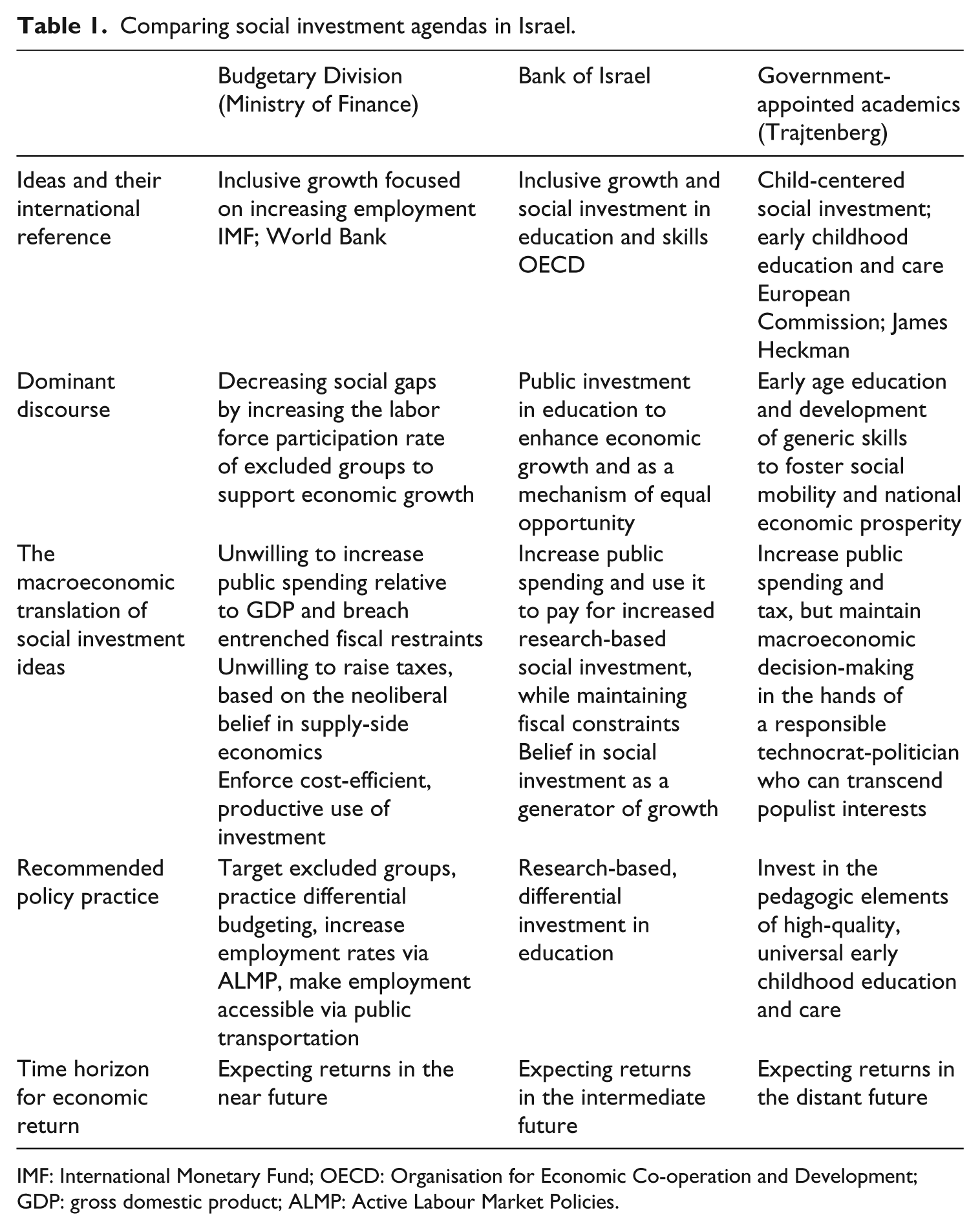
IMF: International Monetary Fund; OECD: Organisation for Economic Co-operation and Development; GDP: gross domestic product; ALMP: Active Labour Market Policies.
In order to enable and support a SI policy regime, economists must forgo the neoliberal creed and embrace a new macroeconomic philosophy. Given their persistent role as the technocratic guardians of the state’s macroeconomic affairs and the indecisive messages they receive from IOs since the 2007/2008 crisis – to both advance SI and maintain fiscal constraints – abandoning neoliberalism is not easy. Research shows how entrenched neoliberal institutions may seriously undermine the implementation of SI initiatives (Haffert and Mehrtens, 2015; Heins and de la Porte, 2015: 24). This article extends this research by providing a first empirical examination and elaboration of Hemerijck’s (2012, 2018) claim that economists’ ideas and practices regarding economic growth, policy design, and public management are crucial in facilitating – or obstructing – the shift from a neoliberal to a social investment state. Although SI ideas and discourses are frequently characterized as post-neoliberal (Jenson, 2010), this article demonstrates how the institutional and ideational contexts of translation affect SI ideas’ ability to transcend neoliberal institutions.
Lessons from Israel reveal that economists may assume different roles in SI policymaking and politics, so to have an ambivalent influence on the shift toward an SI policy regime. Economists may serve as proponents of one SI agenda and simultaneously act as the opponents of another, competing agenda. Israeli economists from different camps constructed two competing SI agendas that each sought political support and limited budgetary resources. Led by the MoF and the AEDM, the first agenda advanced an IG approach focusing on the economic inclusion of minorities via the labor market, concerned with short-term macroeconomic gains, such as increasing employment rates, and maintaining a conservative macroeconomic approach. Led by Trajtenberg and the BoI, other economists advocated a second agenda in line with more flexible fiscal approaches and a relinquishment of supply-side economics. This agenda promoted significant child-centered investment as well as a new macroeconomic philosophy, wherein tax increases for research-based social spending would eventually produce greater and more sustainable growth. This second agenda took an intermediate and long-term economic view, regarding SI implemented today as leading to a better economic future. However, Trajtenberg and the BoI’s progressive SI agenda alienated the BD, which resisted its universal design and especially its macroeconomic philosophy of increasing taxes and public spending. Inability to muster the support of a sufficiently broad coalition undermined full implementation of the high-quality child-centered SI agenda.
The institutionalization of translated ideas depends on establishing supportive networks and coalitions (Helman and Maron, 2019). This proves profoundly challenging for SI policies which, unlike postwar welfare state policies, often fail to attract and establish supportive alliances. The article points to the importance of supportive coalitions and networks among national camps of economists in the translation of SI. The mixed policy outcomes reviewed here derived from an incomplete coalition-building process and lack of steadfast political leadership. Future research should examine economists’ diverse roles in SI politics and policymaking, including collaboration or competition between economists’ formal policy organizations. Such research should pay particular attention to economists’ ideational and institutional power in molding the shift from a neoliberal to a social investment state.
Footnotes
Acknowledgements
The author wishes to thank the organizers and participants of the ‘World Politics of Social Investment’ (WoPSI) international workshop in LIEPP, Sciences-Po Paris during 9–11 March 2017, for encouraging first thoughts on social investment in Israel. The author also wishes to thank Sharon Gilad, Sa’ar Alon-Barkat, and Omer Magal-Shamir for sharing their interview transcripts.
Funding
The author(s) received no financial support for the research, authorship, and/or publication of this article.
