




Abstract
Why do some sending states encourage continued emigrant involvement whereas others do not? And to what extent does sending-state transnationalism lead to a redefinition of borders? Although research on sending-state transnationalism is flourishing, so far it only covers the positive cases and remains silent on states inactive in this respect. This article addresses this lacuna by comparing transnational costs, benefits and strategies of two radically different sending states, Surinam and Turkey, including one that never reached out to its emigrants. The two sending states have very different ideologies of nationhood: one based on ‘unity in diversity’ on one territory (Surinam), the other based on ethnic nationalism (Turkey). Homeland ideologies of nationhood, this article argues, play a significant role in including or excluding emigrants and their descendants. In this way sending states reinforce rather than deterritorialize their national borders.
Introduction
Why do some sending states encourage continued emigrant involvement despite their permanent settlement abroad whereas others do not? A growing body of literature concentrates on the first part of this question and points to a variety of political and economic factors. A debate related to this question is whether, and to what extent, sending states redefine their borders as result of transnationalism. Despite the useful insights of this scholarship, its empirical focus is exclusively on sending states that (are at least willing to) engage in transnationalism. But without examining negative cases we cannot fully grasp the deeper motivations for sending-state transnationalism and how the latter changes the relationship between the nation and the state. This problem echoes a more general critique on transnational scholarship that ‘samples on the dependent variable’: scholars look for transnationalism and find it (Vertovec, 2009: 17), especially because ‘comparative studies are few and far between’ (Waldinger, 2012).
By comparing two radically different sending states, this article tests one of the dominant explanations of sending-state involvement: the cost–benefit analysis. In the cost–benefit line of reasoning sending states for which remittances are a vital source of income – such as developing countries – are more likely to facilitate involvement of emigrants and their offspring than countries that are economically independent. However, this article shows that Turkey, much less dependent on emigrants’ economic contributions than Surinam, actively intervenes in migrant transnationalism. In contrast, the Surinamese state – which stands to gain much from the involvement of its former citizens and their descendants – has always remained uninvolved. Instead of economic explanations, ideologies of nationhood are decisive for understanding how sending states include or exclude emigrants and their descendants. Both cases highlight that sending states’ position vis-à-vis their population abroad reinforces – rather than deterritorializes – their borders.
The next section outlines the theoretical debates on sending-state involvement in transnationalism and the role of the nation state. This is followed by a sketch of the economic situation of Surinam and Turkey and the out-migration both countries have experienced. To assess the extent to which the cost–benefit explanations hold, the subsequent section explores the economic benefits from remittances, in particular from the Netherlands, to Turkey and Surinam and presents the measures both countries have or have not taken to regulate those financial flows. The final sections examine how ideologies of nationhood have developed in the two sending states, and how Surinamese and Turkish repertoires towards their former overseas citizens have evolved over time.
Understanding and conceptualizing the sending nation-state
Over the past decade scholars have shown how sending states have set up institutions and have developed policies to reach out to their emigrants abroad in order to stimulate and regulate emigrants’ economic, social or political input (see among others Brand, 2006; Gamlen, 2008; Lafleur, 2011; Laurence, 2012; Mügge, 2012a; Østergaard-Nielsen, 2003; Ragazzi, 2009; Sives, 2012; Smith, 2008;). This scholarship indicates that sending-state involvement does not necessarily stay constant as migrant transnationalism evolves: sending states are actors whose policies and measures respond to other actors, such as migrant groups, and political realities (Mügge, 2012b).
Taken together, the literature identifies three instrumental reasons for sending states to become active transnational actors in terms of three benefits: human capital upgrading, political lobbying of receiving-country governments and remittances (Bauböck, 2003: 709). Human capital upgrading is potentially relevant for countries whose emigrants may be highly skilled, such as India, the Philippines and Mexico (Lowell and Findlay, 2001). In the latter case, governmental efforts to bring back Mexicans who had completed degrees abroad had little effect (Fitzgerald, 2009: 58). In contrast to human capital upgrading, the encouragement of political lobbying on behalf of the country of origin does not require return but permanent settlement in the destination country (Fitzgerald, 2009: 172).
Remittances have received growing attention both from countries of origin and those of settlement. Historically, governments of developing countries have actively encouraged emigration, seeing it as a principal instrument to promote domestic development (De Haas, 2007: 3). Migrants’ remittances to developing countries have risen from $101.6 billion in 1995 to $317.7 billion in 2007 (World Bank, 2008: 17). They far exceed and are more sustainable than official development assistance (Brinkerhoff, 2012; Maimbo and Ratha, 2005). Since the turn of the millennium, the migration–development nexus has regained the interest of multilateral agencies, intergovernmental bodies, national governments and development agencies (De Haas, 2006). When migrants’ transnational ties weaken, sending states may undertake special efforts to sustain the economic benefits: Governments are seeking to preserve the loyalty of the expatriates and to increase and channel their remittances, investments, and charitable contributions. The significance of these official initiatives may be seen in the fact that almost every sending country government has undertaken them: from Mexico to Turkey; from Colombia to Eritrea; and from the Dominican Republic to the Philippines. (Portes et al., 2007: 253)
However, the types of official policies and measures sending states may adopt to benefit from emigration differ and may include: 1) ministerial or consular reforms; 2) investment policies which seek to attract or channel migrant remittances; 3) extension of political rights in the form of dual citizenship or nationality, the right to vote, or the right to run for public office; 4) the extension of state protections or services to nationals abroad that go beyond traditional consular services; and 5) the implementation of symbolic policies designed to reinforce emigrants’ sense of enduring membership. (Levitt and De La Dehesa, 2003: 589–90)
Levitt and De La Dehesa (2003: 601–5) point to economic and political cost–benefit calculations in explaining why particular states adopt particular policy packages and reject others. Comparing Mexico, Brazil, Haiti and the Dominican Republic the authors found that while in all countries dual citizenship and external voting were debated, only Brazil implemented both measures. This, they argue, is because the costs for Brazil compared to the other countries are considerably lower given the large budget and small number of immigrants involved. Overall, they found that Brazil and Mexico have extended much more state services to emigrants than Haiti and the Dominican Republic given their greater economic capacity to do so. In Haiti, which heavily relies on remittances, effective extension of almost any policy has been hindered by financial limitations combined with political instability. Similarly, Portes et al. (2007) found that the Colombian and Dominican state seldom transcend the realm of the symbolic because they are ‘too weak and too poor to implement large-scale programs providing concrete benefits to their expatriates or re-organizing and giving new direction to their transnational initiatives’ (2007: 277).
Regarding the political cost–benefit calculation, Levitt and De La Dehesa (2003) refer to institutionalizing the vote abroad in particular. This is a high-stake gamble for countries with large and politically active emigrant communities such as Mexico and the Dominican Republic. Hence, it is relatively likely to be opposed or pushed by political lobbies even if at the time the vote abroad was a politically and economically ‘low cost policy’ given that few people were affected.
As states reach out to migrants through various policies – or at least discuss them – Levitt and De La Dehesa expect these states to re-invent their role ‘outside of territorial boundaries and in this way reconfiguring traditional understandings of sovereignty, nation and citizenship’ (2003: 606). Pioneers in transnational migration scholarship have argued that nation states have become ‘deterritorialized’ by redefining their boundaries to include those living outside them, even if formal citizenship rights are withheld (Basch et al., 1994). Building on Anderson (1992a, 1992b, 1994) – who originally applied the concept to groups without formal opportunities to participate in homeland politics – Glick Schiller and Fouron (2001) define such ‘long-distance nationalism’ as a set of ideas about belonging that link people living in various geographic locations providing a justification for governments to reconfigure themselves as transnational nation states. Long-distance nationalism, they argue, binds together immigrants, their descendants and those who have remained in their homeland into a single transborder citizenry, meaning that ‘citizens residing within the territorial homeland view emigrants and their descendants as part of the nation, whatever legal citizenship the émigrés may have’ (Glick Schiller and Fouron, 2001: 20).
Indeed, a variety of sending states such as Haiti, Ireland and Portugal have national self-concepts based on blood ties linking residents around the world to their respective homelands (Brettell, 2003). Drawing on a comparative study of interactions between German, Polish and Turkish migrant organizations and their sending states in the Netherlands from 1880–2005, Lucassen and Penninx (2009) argue that sending states’ attempts – whether symbolic or not – to bind ‘their’ citizens is a continuous characteristic of the nation state that developed from the early nineteenth century onwards. In this reading, sending states’ reaching out is not new and does not imply a redefinition of the state.
The question at the core of this debate is how the relationship between the nation and the state should be conceptualized if sending states try to incorporate ‘their citizens’ abroad and institutional and territorial borders do not necessarily overlap with those of the imagined nation. Fitzgerald (2009: 170–4) points to two distinct analytical meanings of the nation: (1) a shared language, history, region or culture; (2) a political unit of citizens of the state. Studies of nationalism and citizenship (e.g. Brubaker, 1992, 1995; Weil, 2008), however, do not suffice to understand how sending-state governments frame the nation as extending beyond the state’s territorial borders without trying to change state borders. Fitzgerald (2009) distinguishes two aspects of the state in understanding state-framed nationhood: (1) government agencies; and (2) the territory controlled by those agencies. In his words: Governments claim that the nation extends beyond the state’s territory to encompass a population in another country, believing that such a frame reinforces the government’s capacity to realize its economic and political projects within the existing borders of the Westphalian system. (2009: 171)
Whatever position scholars take on the causes and consequences of sending-state transnationalism and how they conceptualize the relationship between the nation and the state, they all study states which have actively reached out – or have at least been willing to do so – to a population abroad. Since so far analyses on sending states that never promoted transnationalism are lacking, the challenge to understand why sending states do what they do is not yet fully addressed. The remainder of this article has two aims. First, it studies to what extent the cost–benefit calculation holds for one sending state (Turkey), which includes emigrants and their descendants and one where the opposite pattern can be found (Surinam). 1 Second, it examines if, and how, sending nation states have redefined themselves to include or exclude those living outside their traditional borders through nationalism. Before engaging in this task, the next section first sketches the history of emigration to the Netherlands of the two sending states under study.
Emigration from Surinam and Turkey
Migrants from Surinam and Turkey in the Netherlands by generation, 2010.

Source: Central Bureau of Statistics (2010).
Population and emigrant stock.

Sources: Central Bureau of Statistics (2010); World Bank (2010a, 2010b).
In addition to huge differences in emigrant stock of the sending-state population, the cases vary in migration history (postcolonial versus labour migration) and the socioeconomic context of the sending country.
Mass emigration from Surinam took place prior to and after its independence in 1975. Post-independence emigration has been characterized by political migration in the aftermath of the 1980 coup d’état, economic migration and family reunification. Though emigration was not believed by the Surinamese government or the migrants themselves to be permanent, relatively small numbers returned. Because of its postcolonial history the Netherlands remains the main destination for Surinamese emigrants.
Significant migration from Turkey began a decade later than that from Surinam. In the ‘First Five Year Development Plan’ (1962–67) Turkey delineated the ‘export of surplus labour’ as an ingredient of its development strategy (Içduygu, 2009: 3–4). It was expected to secure cash inflow via remittances, to reduce high unemployment and to provide an economic buffer against crises in the Turkish economy (Sayarı, 1986: 91–2). To promote this policy, Turkey signed several bilateral labour recruitment agreements with western European countries, including the Netherlands (Akgündüz, 2008). Although official labour recruitment stopped after the oil crisis in 1973, immigration from Turkey to the Netherlands continued as a result of family reunification, marriage migration and political refugees from the 1971 and 1980 coups d’état in Turkey.
Sending-state economic development and remittances
Estimates suggest that, in 2008, 70 percent of the Surinamese population lived below the poverty line; in Turkey this was a little more than 17 percent.
2
In the early 1980s, gross national income (GNI) per capita in Surinam was higher than that in Turkey (see Figure 1), but since then, the countries’ fortunes have clearly diverged. By 2008, GNI per capita is more than twice as high in Turkey as in Surinam. How do remittances fit into this picture?
Economic development and remittances, Surinam and Turkey 1980–2008.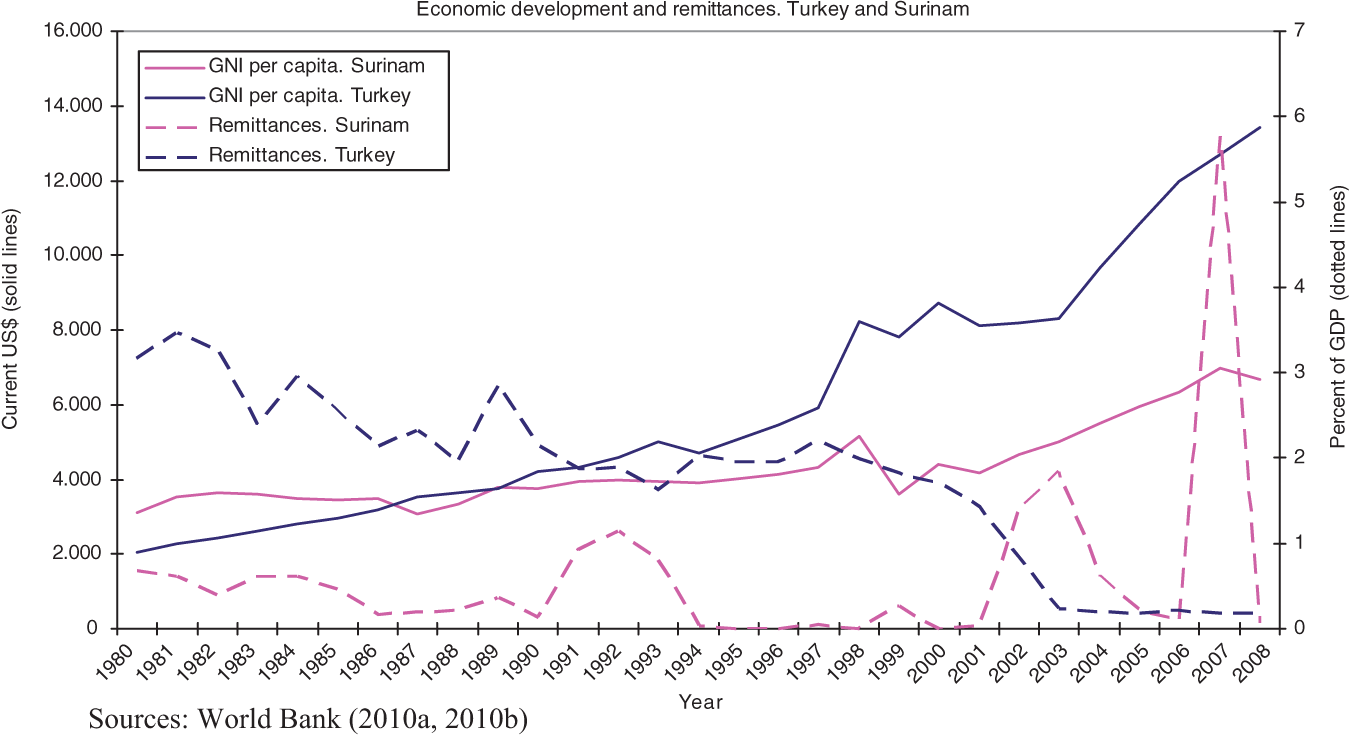
In the Turkish case, remittances clearly declined after the massive out-migration in the 1970s. In 1980 remittances still stood at 3.2 percent of gross domestic product (GDP) compared to 0.2 percent in 2008. Remittances especially declined after the turn of the millennium. Içduygu (2009) argues that this decline can be explained by three overlapping factors: permanent settlement in the host countries; an increasing usage of informal remittance channels; and changing calculations of remittances of the national budget.
Compared to Turkey, Surinamese remittances seem less significant – in spite of the relatively high number of emigrants compared to the population residing in the home country. Save two surges of remittances in the early 1990s and around 2003, the contribution to GDP has been negligible. 3 That said, according to Gowricharn (2004) officially registered Surinamese economic development is not in line with actual consumption because of Surinam’s huge informal sector, which is not covered in official statistics. According to estimates, the Surinamese informal economy could be almost half as large as the formal economy. In light of this, scholars have suggested that the amount of informal and hence unregistered remittances might well equal that of formal remittances (Unger and Siegel, 2006: 25, 118).
Numbers on remittances thus should be taken as estimates rather than precise indications. Data provided by the World Bank are based on official monetary flows and excludes remittances that are sent informally. In comparing remittances sent to different Africa, Caribbean and Pacific (ACP) countries Pieke et al. (2005) find that such so-called ‘top-down data’ on ‘official’ recorded flows remain incomplete, ‘while well-researched bottom-up estimates are only available for few countries’ (2005: 14). Still, official flows show the historical importance of remittances for the Turkish economy compared to other sources of capital inflows, such as foreign direct investment, portfolio investment and development assistance (see Figures 2 and 3). In Turkey, remittances far exceeded all such sources of income until the millennium.
Surinam economic inflows, 1974–2007. Turkey economic inflows, 1974–2007.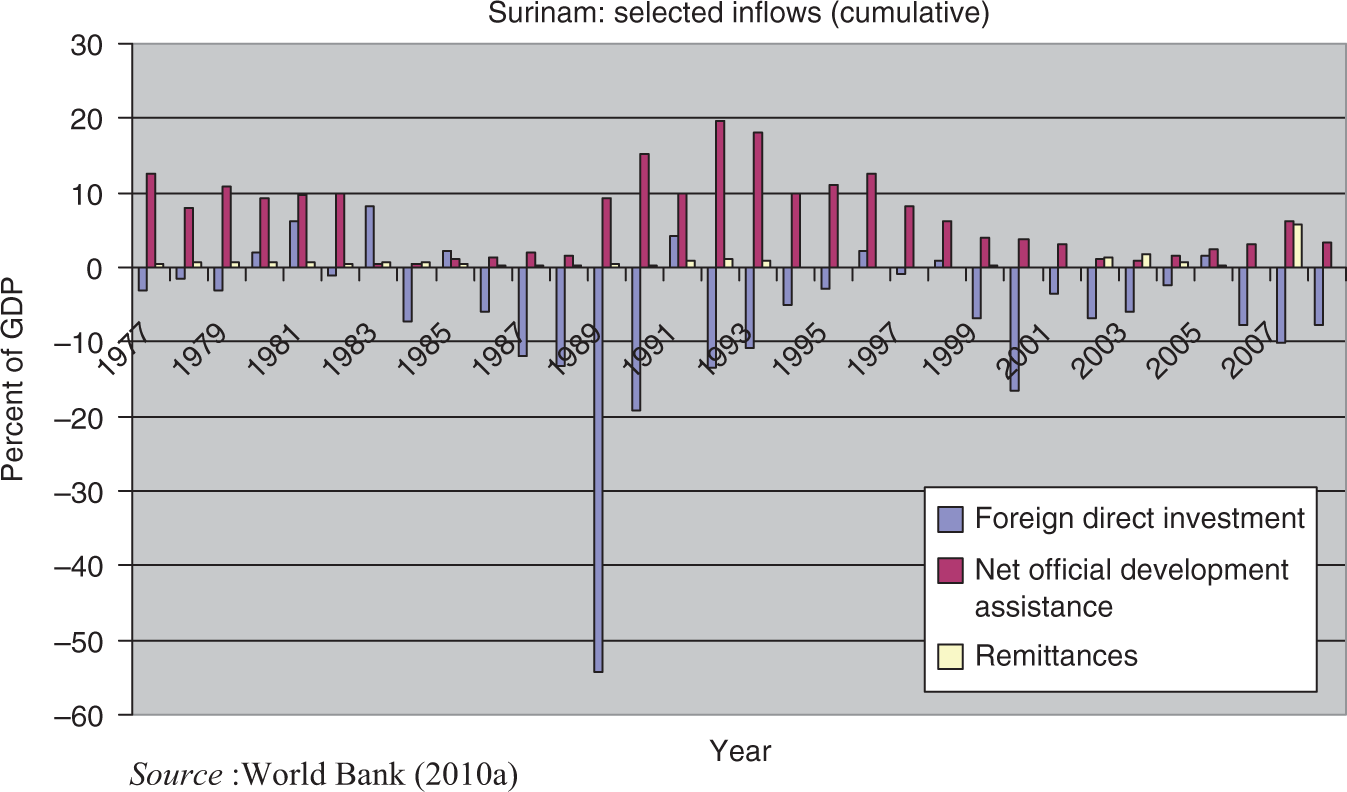
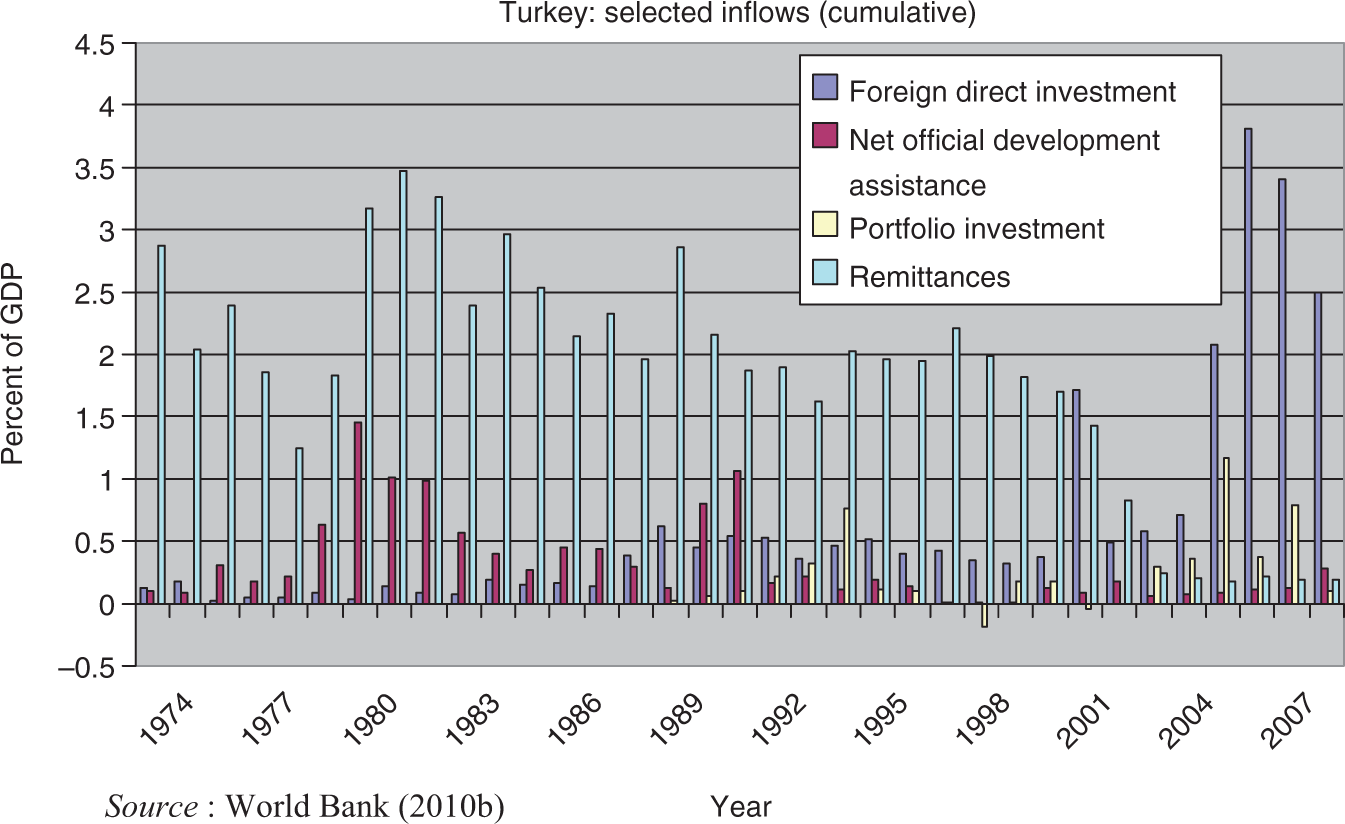
According to World Bank figures, Surinam’s most important source of inflows is development aid, mostly from the Netherlands. After its independence the Netherlands reserved 3.5 billion Dutch guilders (1.6 billion euros) for this end. Nevertheless, Surinam’s economy has deteriorated since 1975. In times of crisis, relatives in the Netherlands are more inclined to support their relatives in Surinam (Bijnaar, 2007; Van Niekerk, 2005), but overall development aid to Surinam failed. The Dutch government points to a lack of local expertise, corruption and an ethnically divided political system as key factors. The Surinamese government in turn accuses the Netherlands of paternalism and unreliability (Kruijt and Maks, 2003). In response, the Dutch government has pleaded for a more business-like relation with Surinam, including a move away from unconditional development aid (BIZA, 2004) – a trend observable throughout Europe (Holland, 2002).
Remittances from the Netherlands to Surinam and Turkey, 2007.

Source: Carabain (2009: 13).
For the Netherlands, Carabain (2008: 45) found that, in general, first-generation migrants are more likely to send material and goods to the country of origin whereas the second generation often donates via formal (Dutch) charity foundations. Other research has shown that 38 percent of the Turks transfer money formally through banks, while 25 percent carry funds personally. In the Surinamese case 49 percent of transfers take place formally via a bank or money transfer (Consumentenbond, 2005: 41–42). The overwhelming majority of remittances go to family members (Carabain, 2008; Içduygu, 2009).
Although remittances are spent mainly on consumption they have proven to considerably increase the welfare of families. The 1996 Turkish International Migration Survey showed that 12 per cent of the households in Turkey receive some kind of remittances. Money accounted for 54 percent, 18 percent was in goods and the rest a combination of these two (Koç and Onan, 2004: 101). In Surinam, it is estimated that half of the population receive material remittances, which are sent by 63.9 percent of the Surinamese in the Netherlands (Unger and Siegel, 2006: 120). According to Kruijt and Maks (2003) remittances are one of the most stable sources of income for poverty relief on the household level in Surinam.
Regulating emigrants’ remittances from above
The combined characteristics of Surinam, economic malaise, dependence on remittances of its inhabitants and the total stock of immigrants in the population would suggest that the Surinamese state would be eager to secure this cash flow through policies and institutions. In the case of Turkey, as growing economic power with a relatively small proportion of migrants one would expect the opposite. Surprisingly, the cases over a period of roughly 50 years show the contrary.
Despite the strong relations between Surinamese families in the Netherlands and Surinam and the earlier described formal and informal remittances, the Surinamese state never appealed to the expertise of Surinamese in the Netherlands for development projects or facilitating remittances of any kind. On the one hand, the population abroad continuously expressed its readiness to contribute in various forms to the development of the country. On the other hand, funds from the Dutch government could have been used to formalize remittances. However, from the Surinamese side, mixed feelings towards the Surinamese in the Netherlands hinder active cooperation (Kruijt and Maks, 2003: 64; Unger and Siegel, 2006: 105). Surinamese in the Netherlands present an arrogant image and act as though they have superior knowledge. This often leads to clashes between Surinamese state officials and Surinamese organizations in the Netherlands and returnees with ambitions to contribute to the development of their country with the skills and networks from the Netherlands (Nell, 2008).
The first and only sign of interest in regulating remittances has been noted recently when the Acting Permanent Secretary Ministry of Planning and Development Cooperation of Surinam expressed her concern that remittances are likely to decrease over the coming years. Therefore she was ‘looking for possibilities to make remittances productive instead of using them in consumption, [as has happened] up till now. [Ideas include] the set up of a “friend and family fund” for entrepreneurs’ (Iris, 2009). This episode is most remarkable, however, as the exception to the rule of scepticism, if not hostility, vis-à-vis the attempts of emigrants to play a role in Surinamese development.
This case highlights a factor in homeland development that goes beyond the emphasis on state capacity commonly highlighted in the literature. The combination of postcolonial history and a perceived arrogance on the part of emigrants obstructs outside attempts to aid development. In short, states have not only to be capable of accommodating and steering incoming remittances and development-oriented initiatives – they also must be willing to do so. The Surinamese case underscores that this cannot be readily taken for granted, even if economic realities would seem to present a clear-cut case in favour of accepting outside support.
The disinterest of the Surinamese state stands in stark contrast to the Turkish introduction of measures to channel remittances back into the Turkish economy (Abadan-Unat, 1997). Turkish banks are the most important channel for the transfer of remittances. They are estimated to account for more than half of all remittance transactions to Turkey (Köksal, 2006: 7). The Central Bank of the Republic of Turkey plays a unique role worldwide, as it allows Turkish residents abroad to open savings accounts. For medium- and long-term savings accounts from which direct withdrawals are only possible within Turkey, the Central Bank offers higher interest rates than the Turkish commercial banks (Köksal, 2006: 15). Through these provisions, the Central Bank has tried to channel remittances into savings and investment in Turkey. The aim of the large-scale establishment of Turkish banks was not solely to profit from the migrants’ money through transaction fees, but also to facilitate the entry of foreign currency into Turkey through low transfer costs (Köksal, 2006: 16).
Over 40 years of out-migration the Turkish state has implemented the following measures and policies to enhance the development impact of remittances: (a) stimulating transfers through formal channels via foreign currency accounts, premium interest rate accounts, and remittance bonds, (b) contributing to migrants’ collectives or associations via matched funding, public–private ventures, and competitive bidding for development projects, (c) setting up particular banks, (d) securing future remittances via promoted continued migration, promoting transnationalism, diaspora management. (Içduygu, 2006: 6–7)
Many of the Turkish measures have failed, however (Içduygu, 2006; Koç and Onan, 2004; Köksal, 2006). Currently there is no proactive attempt from the Turkish government to stimulate the continuity of remittances and their sustainability (Içduygu, 2006: 6–7). However, the Turkish state remains proactive in other ways going beyond the economic realm, in their attempts to tie its former citizens and their descendants to the nation, whereas the Surinamese state does not. Economic benefits or state capacity do thus not fully explain why Turkey is so eager to tie its former citizens and their descendants – of which the overwhelming majority permanent resides in Europe – to the state, whereas Surinam does not. The next section examines how nationalism in the two sending states emerged historically and how this is reflected in their attitude towards emigrants.
Sending-state ideologies of nationhood
The core difference between Surinamese and Turkish official ideologies of nationhood is grounded in history: Surinam’s colonial past versus the Turkish Republic with its roots in an imperial superpower. Whereas in Surinam ethnic differences are promoted by the state through the concept of ‘unity in diversity’, the over 45 ethnic groups (Andrews, 1989) in Turkey are ignored as everyone is officially a Turk. Surinam’s postcolonial legacy led to a type of nationalism that positioned itself against the colonial policy of assimilation, whereas Turkish nationalism was a means to assimilate different ethnic groups.
Central in Turkish nationalism is Mustafa Kemal Atatürk. Atatürk is omnipresent in public buildings and spaces in even the smallest East Anatolian or Black Sea Region village, not only in portraits and statues (Navaro-Yashin, 2002), but also in people’s daily lives through the political, juridical and school systems (Pope and Pope, 1997). National holidays commemorate the independence war, the foundation of the Republic, and Atatürk’s death. Atatürk is the ‘father of the Turks’, a national hero.
The national symbols one sees in Turkish daily life are completely different from those one witnesses in Surinam. Instead of emphasizing a particular ethnicity, Surinam presents itself as an exotic melting pot. Souvenir stands sell postcards of attractive young men and women in traditional clothing from the country of their ancestors, whether they be Maroons (descendants of runaway slaves), Amer-Indians, African slaves or indentured labourers from India, China or Java. Many national holidays refer to Surinam’s colonial history and ethnic diversity. World Religion Day, the Hindu New Year Holi and several other Hindu holidays, days for emigration from India, China and Java, and days for Amer-Indians, Keti koti (the end of slavery) and Independence Day are all celebrated.
To understand current Turkish and Surinamese ideologies of nationhood and how those matter transnationally, we need to consider how these countries emerged as sovereign states. Turkey was founded in 1923 following a three-year struggle by the Independence movement led by Atatürk against the Treaty of Sèvres imposed on the Ottoman Empire. Zeydanlıoğlu (2008) argues that in the absence of direct western colonialism, Atatürk’s reforms functioned as a civilizing mission directed at a supposedly backward Anatolian society enslaved by Islam. The Turkish Republic was imagined through the familiar and familial image of the Father State (Devlet Baba) (Delaney, 1995); the Kemalist elite saw itself as the rightful teachers of Islamic, ethnic and tribal former Ottoman citizens remaining outside the sphere of western modernity (Zeydanlıoğlu, 2008). The new civil code was of Swiss inspiration, while the new constitution was based on that of France (Mango, 2002; Zürcher, 2004[1993]). Atatürk replaced Arabic script with the Latin alphabet and introduced strict grammar rules for the Turkish language, which became a central tool for establishing national unity (Saracoglu, 2009).
The Turkish Republic’s most significant break with the Ottoman Empire (which was based on Islamic law) was the separation of religion and state. French conceptions of laïcité and republicanism greatly influenced intellectuals and politicians in the late Ottoman Empire, and remained foundational principles in the Republic (Gökariksel and Mitchell, 2005: 148). Islam was the cohesive element within Ottoman society; its main institution, the Caliphate, was replaced by the State Directorate of Religious Affairs, Diyanet. Founded in 1924, Diyanet remains Turkey’s highest religious authority; it promotes interpretations of Islam ‘that help to create a “modern” republican subject and develop the modern state’ (Gökariksel and Mitchell, 2005: 148). The unifying role of Islam was thus replaced by a program of Turkification; forced assimilation, it was hoped, would guarantee citizens’ loyalty to the nation state and prevent ethnic separatism (Maksudyan, 2005; Zeydanlıoğlu, 2008). Similarly, the Turkish state established a dense network of Diyanet institutions in western Europe in the 1980s in order to preserve emigrants’ national identity and loyalty in accordance with Diyanet’s official Islam (Yükleyen and Yurdakul, 2011).
Since the founding of the Republic, military officers have been the most ardent guardians of the Turkish state’s secular foundations. The military’s interventions (in 1960–61, 1971–73 and 1980–83) had the stated purpose of safeguarding the secular–democratic state. The military’s role in government is formalized through the National Security Council (MGK) made up of the president, the prime minister, ministers of defence, internal affairs and foreign affairs, general chief of staff, commanders of the army, navy, air force and of the gendarmerie. According to the 1982 constitution, the Council of Ministers must defer to the MGK’s recommendations. 5 The military’s prerogatives remain largely undiluted; it continues to use the MGK to influence government policy in matters considered critical for the internal and external security of the country (Heper and Güney, 2000; Momayezi, 1998; Sakallioğlu, 1997; Tachau, 2002). The army has an important place in the political system (Altinay, 2004), not only in domestic politics, but also in politics geared at Turks living abroad – e.g. in the formulation of policy. Additionally, all men with Turkish nationality have to complete 15 months of military service before their 40th birthday. Up until very recently, Turkish emigrants with a Turkish passport were obliged to complete a shorter programme in the motherland (Doomernik and Cillessen, 2008)
Taken together, the Kemalist reforms – which employed the central institutions of the state including the educational system and the army – were a conscious attempt to inculcate Turkish nationalism as the focus of political loyalty for all citizens. Since the implementation of Turkish citizenship law in 1928, citizenship has been based on the jus sanguinis principle. Children of Turkish mothers or fathers acquire Turkish citizenship automatically irrespective of whether or not they are born in Turkey (Kadırbeyoğlu, 2007). With Islam relegated to the private sphere, Turkish nationalism has a strong ‘ethnic’ component (Poulton, 1997) and therefore also includes citizens abroad.
In Surinam, nationalism developed quite differently, not least because the country became independent only in 1975. Colonial unity and citizenship was shaped by the spread of the Dutch language and school system. Compulsory education was introduced in 1876, 24 years earlier than in the motherland (Bosma, 2009; Eersel, 2002). Dutch is still the official language of Surinam.
The first Surinamese nationalists, Anton de Kom and Otto Huiswoud, were Afro-Surinamese communists who advocated independence and the emancipation of black people in the 1930s (De Kom, 2001[1934]). It was during their stay abroad that their ideas were influenced by international decolonization and socialist movements. Though they had some influence on the trade union movement in Surinam, they had a larger impact on Afro-Surinamese organizations in the Netherlands – not least as the colonial authorities placed them on a ship bound for the Netherlands upon their return to Surinam (Woortman and Boots, 2010).
Later nationalists were also mainly black communists who had spent at least a part of their formative years in the Netherlands (Van Stipriaan, 2006). The 1950s and 1960s witnessed a growing number of Surinamese students in the Netherlands who shared with each other their experience of living abroad. Leaving Surinam with the idea that they were Dutch, they soon realized they were different: ‘As a rule the Dutch did not approach Surinamese as fellow-countrymen. Instead they were regarded as foreigners and expected to have a culture of their own’ (Meel, 1990: 266). This induced Surinamese in the Netherlands to search for their own identity and to make political and cultural sense out of their alienation. At the same time, international decolonization movements and socialist ideology inspired them to criticize Surinam’s relations with the colonizer.
Surinamese students in the Netherlands campaigned for Surinamese independence and Sranantongo, the Surinamese vernacular, as the country’s lingua franca. Returning to Surinam in the 1960s and 1970s with their new ideas, the former students were met with suspicion: Surinamese politicians saw them as a ‘communist threat’. The returnees thus had to establish their own small political parties. Though Afro-Surinamese nationalists were fragmented in numerous small groups, large strikes in the early 1970s initiated by a charismatic returnee led to rapid decolonization (Bosma, 2009). Since independence citizenship has been granted on the basis of jus soli. In response to a decade of heavy army influence, including coups in 1980 and 1990, obligatory military service was abolished in 1991 (Thorndike, 1990).
After independence, Surinamese anti-colonial nationalism turned into territorial nationalism infused with the ongoing fight against neo-colonialism (Meel, 1998). Dutch influence, however, remains omnipresent in Surinamese daily life, through television, newspapers, the presence of thousands of Dutch students on traineeship in schools and hospitals, and the ‘invasion’ of Surinamese-Dutch visiting their relatives during the Dutch holidays.
Surinam lacks a national hero like Turkey: its first national myth is that of the mamio, the patchwork quilt, a symbol of the country’s unique variety of population groups and cultures; its second myth is that of the unfulfilled promise, the paradise all have glimpsed but none have encountered in full bloom (Meel, 1998: 269–70; Tjon Sie Fat, 2009). These myths do not have the unifying strength of ‘the father of the Turks’.
Apart from the previously described attempts to regulate remittances, Turkey has, ever since mass emigration to Europe, implemented several institutions to maintain emigrants’ loyalty and identification with the state. These institutions – educational, religious, military and juridical (i.e. regarding citizenship) – are the same ethnic nationalist tools employed on Turkish territory. Within official Turkish nationalism all Turks by blood are related to the nation; Turkey is not only the ‘father’ of those Turks living within the state’s territorial borders. This came clearly to the fore in speeches held by the Turkish Prime Minister Erdoğan in Germany in 2008 and 2011 in which he addressed ‘his citizens’ during speeches in front of 10,000 people of Turkish descent in Germany. 6 Like his predecessors, Erdoğan stressed the importance of Turkish culture, language and religion and rejected assimilation in the countries of destination. Turkish nationalism, moreover, fiercely combats any overtures opposing the foundations of the Turkish state, foremost among them ‘radical’ (especially political Islamic) or ‘ethnic’ counter-movements, such as the Kurds.
The systematic exclusion of Surinamese migrants and their descendants from the Surinamese nation can be seen as a way to safeguard the territorial sovereignty of the independent republic. State actors, including ministers, fear that welcoming emigrants will result in inequalities in the labour market, in housing and in other domains. They fear a takeover of the country by people who are more highly educated, wealthier and enjoy greater social security because of their Dutch nationality. Rather than economic explanations, the Surinamese state’s reluctance to involve emigrants is because of the Surinamese brand of territorial nationalism, which seeks to fight ‘Dutch’ neo-colonial influence.
Conclusion
This article raised two questions: why do some sending states reach out to their population abroad when others do not? And to what extent do sending states redefine their borders by embracing their ‘citizens’ who are not living within the territorial borders of the state? Regarding the first question, the burgeoning research on sending-state transnationalism generally agrees that diverse forms of this can be explained by a variety of economic and political cost–benefit calculations. Concerning the second question there is no such consensus. Pioneers in transnationalism studies believed that sending states redefine their borders and thereby deterritoralize (e.g. Basch et al., 1994; Glick Schiller and Fouron, 2001); more recent critics argue that sending states actually reinforce their borders (Fitzgerald, 2009; Lucassen and Penninx, 2009). These studies have in common that they ‘sampled on the dependent variable’ in the sense that they only studied sending states that have been actively engaged – or have at least been willing to – in transnationalism. By comparing two radically different sending states, including one (Surinam) that never reached out to its people abroad, this article addressed this lacuna.
The analysis has shown that the differences between the Turkish and Surinamese approaches to their (former) overseas citizens are largely because of their different ideologies of nationhood. Since the formation of the Republic, successive Turkish governments have advocated the creation of a singular Turkish identity above any ethnic differences. This includes Turks who live outside Turkish territory as well as those who have naturalized elsewhere. The official nationalism of the Republic of Surinam – while ‘territorial’ – has explicitly ‘anti-colonial’ roots. Out of fear that Surinamese from abroad will ‘take over’ the country, the anti-colonial elements within Surinamese nationalism are mobilized to reduce foreign influence. Dutch-Surinamese are thus not included in their definition of ‘the nation’.
The position of sending states cannot purely be explained by heightened globalization or economic benefits and sending-state capacity alone. For the sending states studied here, ideologies of nationhood included or excluded those living outside their territories. The Turkish state maintains contacts with emigrants through formal institutions, thereby attempting to limit the creation and growth of oppositional groups. The nationalist character of the Turkish state has made it proactive regarding the political activities of Turkish emigrants, particularly when these are of a transnational character. In contrast, the Surinamese government has been more reactive, acting in its own interests only when migrants returned with threatening new ideas. The historical perspective taken suggests that national structures pervaded by postcolonial history and nation-building processes carry more weight than scholars on transnationalism have so far acknowledged. Sending-state ideologies of nationhood largely determine forms of transnational strategies. More importantly, it is crucial to understanding why emigrants and their descendants are still considered part of the nation or not. As such, sending-state transnationalism, in the negative as well as in the positive cases, indeed reinforces state borders. This underlines that the transnational cannot be properly understood without studying the national.
Footnotes
Acknowledgements
Earlier versions of this paper have been presented at the CRONEM Annual Conference, Surrey, UK (2011), the NWO/ICSSR International Seminar ‘Global Relationships in Indian Perspective’, Bangalore, India (2010) and the Association of Studies of Nationalities World Convention, New York, USA (2009). I thank the Ethnicities reviewers for their constructive feedback and the Minda de Gunzberg Center for European Studies, Harvard Univeristy, for hosting me as a visiting scholar in the first half of 2012.