




Abstract
This paper explores top-down, enacted, institutional pushbacks to supermobility and superdiversity in the under-examined arena of academia using emerging frameworks in political economy and the geography of mobility. Zooming in on the discoursal framings of a recent year of job advertisements on a popular, open-source forum for linguists supplemented with qualitatively and quantitatively sourced data from international, national, and local institutional contexts, the paper examines how macrocontextual pushes toward political populism combined with a synchronous tightening of job markets in academia have enacted a plethora of labels for temporary work in lieu of permanent academic positions—now, increasingly the only option for job seekers in a hypercompetitive academic market. In this manufacturing of euphemization discourse, we witness the invention of novel, microlinguistically rendered lexicalizations of semiotic redundancy in academic capitalism’s own obfuscation of profit margins, and a concomitant manufacturing of a new discourse of rationality in which floating semiotic signifiers at multiple scales deploy nationality-criteria to justify ethnic exclusion and/or entry into academic space. More crucially, in these commonsensical framings, we encounter both causation and consequence of newly enacted barriers to transnational mobility. In challenging the myth of porous borders for mobile professionals in the post-global moment, these emerging linguistic signifiers point to the ascendancy of a new public affectivity on display in intellectual spheres and a saturation of sentiment toward illiberality.
Keywords
Protectionism, populism, and academic capitalism
This paper investigates the effects of political populism on post-globalism’s myth of porous or so-called open borders in the under-examined arena of academia. The paper explores key instigators in the macro-contextual market of academia and resultant effects on microlinguistically enacted barriers aimed at curbing mobility in the post-crisis era of populism. While a number of emerging frameworks have designated the rise of a so-called “positive populism” (Hilton, 2018), this paper adopts a more traditional orientation toward the term—one increasingly conflated with rage and race politics and the ascendancy of anti-immigrant sentiment generally and illiberal fervor specifically (Giridharadas, 2018). This affective rendition of fear spreading across global north regions has unleashed roll-back policies on open entry, which increasingly now see substitutes in the form of rationally coded prohibitions on entry enacted via what some have characterized as “zones of exception constructed on racialized hierarchies of citizenship” (Allan and McElhinny, 2017: 86). Of itself this is not a new phenomenon. What this paper zooms in on is the somewhat surprising saturation of such populist sentiment in what might safely be characterized as the more traditionally immune, liberal echelons of society—academia.
Increasingly apparent in the post-global moment (Pandey, 2016) is the emergence of re-territorialization—indeed the (re)-rise of real borders in the Andersonian idea of the nation (Zick et al., 2011) and, it is contested, a hastening in this post-globalist era of Brexit and Trumpian-inspired protectionism—populist-derived sentiments of exclusion. Simulating recently instituted economic trade barriers and tariff-wars, in the arena of actual mobility, we are witnessing parallel fractal recursivity—indeed, an obvious curtailment of movement trajectories, and a concomitant rise in codified discourses pertinent to passports of so-called legalized entry into hub-space. Hub-space is here used to describe zones of in-migration usually located in global north zones of production (Frödin and Kjellberg, 2018; Pandey, 2016). Even in borderless Euro-zones, we are witnessing the re-rise of fences—real and metaphoric—in countries rich and poor alike, whether Switzerland or the Czech Republic. At the time of writing, externalization of blame on easy targets—migrants—has led to a firestorm of populist-derived parties in power across the globe. In academia—not immune from such political pressures—we are witnessing this illiberal streak coloring more of our discourse.
Emerging sociolinguistic frameworks on migration acknowledge that, “mobility is a form of boundary management” (Canagarajah, 2017: 4); that, “hierarchies and boundaries are obdurate social facts” (15), and furthermore that, “intensified forms of mobility are generating intensified resistance in the form of increased policies and regulations for border control, boundary making and sovereign spaces” (22). Also apparent is that, in these acts of languaging (evidenced in this study in the plethora of new euphemizations and floating semiotic signifiers), we encounter socially situated practices inclusive of both macrocontextual and microlinguistic trends. What has been under-studied is how the macro-context of academia, which in itself is premised on increased tertiarization, “downsizing” and concomitant labor “casualization” (Allan and McElhinny, 2017: 83) is witness to the “emergence of new words” (84) for exclusionary practices and eventually, the entextualization of exclusion.
In this era of supermobility (Valentine, 2013) movement trajectories into so-called de-territorialized space emerge no longer open, per se, but rather, “authorized.” This paper examines particular triggers and consequences of this trending at both the macro- and micro-institutional scales using quantitative and qualitative sourced data from six interrelated scalar levels in academia to include investigations of: the macro-context for the scramble for international students; causal effects on current oversaturated job-markets at the national and local institutional level; exclusionary language framings in job-advertisements in one specific sub-discipline in academia; “discourse rationalizations” (Salö, 2015: 528) in memo-driven enregistrements of exclusionary practice at the local, university level; fractal recursivity in stratificational labor arrangements in international scales of academic production; and lastly, the entextualization of exclusionary configurations in and through academic publishing conduits—the life-line of academia.
At the macro contextual scale, we encounter novel linguistic manifestations of “regulated openness” (Meissner, 2018: 294) toward skilled labor in particular. Some have drawn a clear distinction between the differential receptions of welcome-ness versus unwelcome-ness accorded so-called desirable, voluntary elite mobiles on the one hand, versus on the other, the often designated undesirable involuntary, displaced/destitute migrants (May, 2017). As we see in the analysis which follows, the opposite may in fact be true—that, as in the case of the so-called “supermaids” and “servants of globalization” (Allan and McElhinny, 2017: 91), there may in fact be restricted entry into hub-space for all. In a fascinating study of “mobility restrictions” (Meissner, 2018: 289) in the UK in 2008, which saw the emergence of a complex, “new point-based visa” system for mobile transnationals which has since morphed into a staggering number of approximately 32 sub-categories for “a singular migration channel” [namely] work), we encounter the complexification of an ever-evolving semiotically rich repertoire of descriptors emerging for differently tiered immigration classification-schemes in Britain.
Regulations aimed at curbing immigration flows to Britain in 2006 now simulate policy practices of its cousin nation—America—when it comes to, for example, the acquisition of citizenship. Thus in Britain, unlike in prior decades, newly conceived policies of so-called integration now mandate: “learning English as a formal requirement for attaining citizenship” in addition to passing a “citizenship test/ceremony” (Valentine et al., 2015: 575). In Britain, as in Australia, “the multicultural middle class,” “the largest component of Australian immigration over the past several decades,” and “constituting two-thirds of the planned settler intake” (Colic-Peisker and Hlavac, 2014: 350) is witnessing a recalibration of terminologies of permissible entry. Interestingly, such discoursal framings of entry are increasingly situated within integrationist (as opposed to assimilationist semiotic) complexions (Allan and McElhinny, 2017) and serve as yet another exemplar of euphemization attempts designed to obfuscate caring capitalism’s inequities in access for different types of immigrant groups in host nations.
These complex categorizations in Britain especially serve as an effective gate-keeping device in a recently re-territorialized nation’s attempt at matching its “rational of ordering” (Meissner, 2018: 302) with its equally opaquely delineated list of “conditionalities of entry.” Here, we witness how entry eligibility criteria versus so-called “parameters of presence”—what Meissner (2018) defines as the “saliency” of different manifestations of legally required parameters, in particular social spheres—emerge seamlessly conflated with single-utterance microlinguistic acts of exclusion. Enacted using ad-hoc and seemingly innocuous criteria of linguistic fluency—in this case, proficiency capital in English, we grasp how linguistic proficiency and citizenship criteria emerge seamlessly conflated as assumed entry-level credentials for any job application in these hub-spaces. Meissner’s (2018: 299) survey of the taxonomy of 32 eligible work categories spanning the gamut of titular complexity from Tier 1—Entrepreneurs to Tier 5—Domestic Workers in Private Households demonstrates in yet another sphere how “free market fundamentalism” (Piller and Cho, 2015: 163) engages in the very same overproduction of semiotic redundancy at different scalar levels. This is but one instance of mobility’s effect in re-shaping sociolinguistic practice. The post-crisis rhetoric of populism, it is contested, has further instigated linguistic enactments of euphemization and exclusion, now not just toward destitute migrants, but, toward skilled mobile intellectuals.
Theoretical frameworks and methodology
Utilizing frameworks in scale theory (Prinsloo, 2017), complexity theory (Blommaert et al., 2017), and spatial theory (Higgins, 2017; Leitner and Miller, 2007; Massey, 2005), this paper proposes a processual deployment of emerging spatially pertinent heuristics in migration studies such as superdiversity and supermobility (Valentine et al., 2015) to analyze the nuanced manifestations of asymmetry and barred entry of mobile scholars into academic spheres now witnessing the contraction of employment opportunities for resident denizens. Additional frameworks of pertinence to the current study include emerging frameworks in political economy, critical discourse analysis (Bunce et al., 2016; Chun, 2017; Ricento, 2015), the sociolinguistics of migration (Canagarajah, 2017; Vertovec, 2009) and affectivity-oriented frameworks grounded in populist rhetoric (Giridharadas, 2018; Hilton, 2018).
In exploring the manner in which a new discourse of rationality has instigated the deployment of a plethora of floating signifiers premised on nationality criteria to justify exclusion and barred entry of so-called “outsider” academics into academic space, the paper adopts a mixed-method approach incorporative of both quantitative and qualitatively sourced data. The paper investigates six interrelated scales of linguistic encounter in academia. First, the paper explores how the macro-context of oversaturated markets in academia has been created. This is supported in, and through, a detailed literature review of current hiring trends in the sub-discipline of applied linguistics. Next, the paper examines microlinguistically enacted data from the actual job market in academia using two data inputs: a one-year discursive analysis of job advertisements posted on an open-sourced job-board supplemented by a quantitative analyses of origination sources of actual applications elicited for a tenure-track position in an institution in the United States. These sources of data are then supplemented with a qualitative analysis of salient discoursal features embedded in both nationally oriented job advertisements, and local, institutionally derived memos—both of which are coded for linguistic patterns using frameworks embedded in critical discourse analysis (Chun, 2017; Miles and Huberman, 1994; Sung, 2018). A review of other ancillary areas in higher education pertinent to a re-rise of national borders in the service of exclusionary practices, whether in terms of labor export or the control of academic publishing—two basic tenets of the academic enterprise—bookend the discussion.
While the paper is structured to ensure a smooth flow between all six explored areas, to enhance readability, the following sections do not follow a traditional, watertight data collection, methodology, analysis, and discussion organizational structure per se, but rather unfold with pertinent methodologies discussed in each section devoted to investigating the “discursive microhabitats” (Salö, 2015: 522) of academia now subject to the macro-logic of populist and protectionist affectivities. This organizational style, it is felt, provides for a more complex and nuanced analysis of convergences of cause and effect in the “collectivization” and “discourse rationalization” of “the discursive nexus of nationality–nativeness–naturalness” (Salö, 2015: 522) scripts seamlessly synergizing asymmetries in various scales of academic production.
Triggers for the tightening of academic markets
In exploring the crisis facing higher education enrollment specifically, and the concomitant credentialization and massification of education in the so-called “hub,” English (2012: 134) notes what he describes to be “an overabundance of PhDs in Western Europe and North America and an acute shortage in many countries of South and East Asia’ (xii). This serves as his clarion call for the need to grow the field so to speak and seek “other” sites, and geoscapes for what this paper deems academic capitalism’s expansion—an enterprise whose sociopolitical arrangements emerge dually imbricated in symbolic and real economic pursuits (Slaughter and Rhoades, 2004).
The effects of such “academic capitalism” (Cantwell and Kauppinen, 2014: 2) in the so-called center’s “scramble for international students, researchers, and recognition,” and consequent control and access to “mobile international education consumers” (English, 2012: 65) forms a core trigger in the current oversaturated job-market in academia. This study utilizes emerging frameworks in the sociolinguistics of mobility and political economy to examine the effects of such Friedmanian “free” market boom-bust capitalism on the current overproduction of doctorate holders and makes a case for the sociolinguistic effects of a novel form of supermobility (Valentine, 2013) at work—one whose stark stratificational manifestations of access and entry, particularly for mobile academic classes, across the spectrum of global north institutions of higher education is revelatory of a more invisible form of “discrete discriminatory” practice at play (Behtoui and Leivestad, 2018: 11) and emerges framed in tandem with other metapragmatic moves of exclusionary discourse.
The scramble for international students
Doctoral-level study is a 12th century European invention with PhD degree conferment, a 19th century Prussian invention (Cuthbert and Molla, 2015: 36). Doctorates were first awarded in the US at Yale in 1861, and much later across the Atlantic in 1917 at Oxford (36). More recently, “knowledge economy optimism” (34) coupled with relentless recruiting efforts, which now extend beyond the “traditional” space of national spheres has led to a scramble for new markets for soft power export (Kidman and Chu, 2017). Latest figures of the two largest importers of international students, the US and the UK respectively, demonstrate impressive economic outcomes. Banks (2017: 1) reports that in the US, international enrollments contributed $36.9 billion to the economy, while the economic windfall of this educational industry in the UK— constituting 19% of the entire student body—“generated £25.8 billion in gross output” (Kaur, 2017: 2). These are impressive rates of return of over 60%—and signal more than a doubling of profits in a decade. The UK figures, based on 2014 data, far exceed the number reported in 2003 of: £10.2 billion (Vertovec, 2006: 14). In the same timeframe, in the US, profits have climbed by 65% (Welch, 2018). A little over a decade ago, this number was at $12.87 billion. Even the stock market could not hope to rival such impressive returns. With such remarkable monetary returns, it makes market sense to apply frameworks in “processual understandings of political economy” (Del Percio et al., 2017: 57) in any analysis of so-called, non-profit premised arenas in higher education where increasingly as in other spheres of soft power production, profit drives policy, and as we see, hiring practices.
We are seeing some of the effects of such free-market capitalism in the most populous regions of the world such as China, which has not merely implemented proficiency capital investments—the earlier learning of English—in elementary schooling that is, but has also succeeded in pushing toward higher credentialing of its faculty (English, 2012). This buttressing of state-driven, soft-power investment in the global universities rankings game (Espeland and Sauder, 2007) in China alone has resulted in two of its universities (as early as in 2011)—Tsinghua and Peking Universities—emerging in the coveted listing of the “top 100 club” (English, 2012: 10). In 2018, it was revealed that China, “has 45 universities in the Shanghai top 500 (a key global league ranker),” and furthermore, is now “the only country other than Britain or America to have two universities in The Times Higher Education’s top 30 list” (The Economist, 2018: 56). In framing this “rankings race” (56) in national versus supranational terms, rival countries remain eager to advertise key, country-based comparisons. In this same 2018 survey of university rankings, for example, Britain’s The Economist, eagerly underscored another salient detail namely that, “Europe’s poor performance was particularly galling for Germany, home of the modern research university” (The Economist, 2018: 55).
What these seemingly innocuous listings are revelatory of is that traditional hubs of academia in the US and Europe are witnessing challenges from other supranational spaces. After all, “Education is one of Australia’s top exports (generating over 15 billion dollars a year)” (Cuthbert and Molla, 2015: 47). Countries such as Canada are keenly reconfiguring university requirements in their own elite institutions in a bid to accommodate international students from East Asia (Allan and McElhinny, 2017: 88). Such late arrivals to this industry are in turn having a considerable impact as we see below on the global flows of intellectuals into an already oversaturated job market. While profit margins in academia seem to be healthy, job hiring by contrast is on a steep decline. The effects of this diminishing of opportunities, so to speak, are further exacerbated by fierce competition from expanding markets. Thus, while merely a decade ago, job advertisements were mainly targeted at national audiences, in the post-global moment, advertisements now stand poised to reach the entire populated globe. This, coupled with the attrition of the tenure system in the US, which in itself never quite recovered from the global financial meltdown of 2008 (Chun, 2017), has created an especially bleak job market for recent doctoral candidates.
Zooming in on the job market in academia: The case of applied linguistics
The crisis narrative plaguing doctoral education—with its attendant attributes of inefficiency, deficiency, and excess (Cuthbert and Molla, 2015: 35)—remain confirmed in a number of studies. Over a decade ago, in 2005, 68% of academics in the US were “outside the tenure stream” (English, 2012: 61). More crucially, with tenured or tenurable positions eroding away at a rate of about 1% per year since the 1990s’ (66), we encounter fierce competition for permanent jobs now both from the so-called home front as well as elsewhere. Viewed within the macro-context of frameworks in political economy, this makes market sense. As Del Percio et al. (2017: 58) note, “The saturation of national markets,” for all products has only led to a stronger push for “an increased transnational circulation of capital, commodities, and labor.” Academia, as we see, is not immune from such market conditions. If anything, the job market in academia lays bare “the precarization of the working conditions of the actors involved.” This situation is emerging ever more tenuous and makes overt linguistic enactments of a new form of euphemization at work—one aimed at further obfuscating the profit-driven enterprise on which academia is premised.
There are plenty of shocking statistics regarding the specifics of what can only be characterized as a 21st century academic abattoir of sorts. June (2013) reports a mind-blowing statistic. In fields such as Political Science, the odds of landing a tenure-track position in some searches that year were as high as “600 to one” (para. 1). For academicians who have been on the coveted side of hiring, the competition is relentlessly ruthless—best characterized as a blood sport of sorts involving, “classmate versus classmate, colleague versus colleague, and seasoned professor versus graduate student,” with in some cases even pitting, “adviser versus advisee” (June, 2013: para. 1). In a spotlight on jobs in applied linguistics that same year, we are told, “71 scholars vied for a spot in the linguistics department at the University of Florida.” One other figure stands out in this Chronicle of Higher Education report—namely that, “Nearly 20% of the candidates had been educated at universities in other countries.” This trajectory of movement of expertise from the “Global South to the Global North” (English, 2012: 81) is also seeing further competition from former Eastern Bloc countries such as Poland, where in 2012, over half of the approximately 100 enrolled students in the PhD program “were doing linguistics degrees” (82).
In a longitudinal study (1996–2013) of 1600 doctoral holders graduating from 16 humanities programs at Penn State University—to include applied linguistics—Welch and Long (2014: para. 9) in yet another Chronicle of Higher Education report described as “probably one of the largest and most comprehensive sets of longitudinal PhD-placement studies in higher education,” corroborate these abysmal trends in low job placement. In the humanities, they report, “only 27% of the 2008–2013 group landed tenure-track jobs immediately after graduation.” This means that approximately three-quarters of the pool was either under- or unemployed. For jobs at coveted research universities, the figure remains mind-blowingly low—a mere “6%.” Placement in non-R1 institutions fared only slightly better at “21%.”
Welch and Long (2014: para. 17) take especial care to note: “Most worrisome [is that], in almost all of our humanities departments, there has been a surge in the proportion of PhD’s working in non-tenure-track appointments on annual or multiyear contracts.” If figures are any proof, “It is estimated that the level of contingent faculty, defined as part-time and full-time, non-tenure-track faculty has now reached 79% of all college and university teaching staff” (Chun, 2017: 134). It is hard to fathom that over three-quarters of academics in the US are on temporary labor contracts. Viewed within the prism of political economy however, this makes market sense. This is after all how configurations in the “contemporary cosmology of capitalism” (Appadurai, 2015: 229) work. What are the consequences of such macrocontextual shifts in opportunity? One emerging trend worth further study is the effect of exported labor in so-called de-territorialized space. Specifically, what are the effects of this tightening of options on the plethora of labor classifications emerging in academia—an underexplored area, and one propelling new prohibitions on entry into so-called porous space.
Newly minted re-semiotizations of temporary labor in the academic market
To investigate this, the current study surveyed one year of job advertisements posted on an open-source job-advertising board in the sub-discipline of linguistics. Job-openings in linguistics in the US span low season—April—to peak season—October. This whole year of job ads was coded for linguistic patterns. Advertisements were first classified into two categories: permanent tenure-track openings versus temporary positions. In surveying job postings consisting of approximately 44 pages of advertisements on Indiana University’s well-frequented, open-source job board, The Linguist List (https://linguistlist.org), in this period, only 90 tenure-track positions were available across hundreds of American universities. To make matters even more competitive, of these permanent jobs posted during this period, approximately 40 were for jobs in theoretical linguistics (to include jobs in language specialty linguistics, e.g. Arabic, Chinese, German, Japanese, Korean, Spanish/Hispanic languages/Native American, or area-specific linguistic specializations, respectively). What this means is that, for applied linguists specifically, there were roughly only about 50 tenure-track positions available for competition that year across the US. These openings spanned the gamut (to use the Carnegie classification scheme), from job postings in exclusive, R1 universities at one end of the spectrum (with featured advertisements for jobs in large, state-funded institutions), to at the other end of the continuum, advertisements for openings in small, teaching-focused state, and/or private-funded institutions.
To say that the market in academia is tight is an understatement. This is perhaps most poignantly evoked in the hypercompetitive job market currently on tap for permanent tenure-track positions. Why is this important? For doctorate holders in fields such as linguistics specifically, “the most common career outcome is a position in Higher Education” (Reed, 2017: 7). With on average, close to 250 doctorate holders with specializations in various subfields in linguistics graduating per annum in the US alone (Reed, 2017: 21), the situation is dire to say the least. When we consider that from 2011 to 2016, approximately 1377 doctoral degrees were awarded in linguistics-based fields (2017: 16), we are reaching a breaking point when it comes to job placements as each impending year, more and more job seekers are merely added to this already oversaturated pool.
Unsurprisingly, in the same one-year period surveyed in this study, approximately 100 jobs for temporal work were available to applied linguists. This is approximately a doubling of temporary labor opportunities available for newly minted scholars. Stated differently, for every permanent position posted, there were approximately two or more temporary positions available. Using frameworks in critical discourse analysis (Sung, 2018), descriptions for job-openings were coded for how patterns of “temporary work” were linguistically enacted. For job seekers navigating this sphere, one is likely to encounter a plethora of labor descriptors for temporary work, and even more exploitatively coded lexicalizations for transitory linguistic work. A list of such employment terms were collected and analyzed. Approximately 25 of such variegated morphings for impermanent work—euphemizations for transient academic work were recorded. A representative sample in alphabetized form of some of such job-descriptors is furnished below.
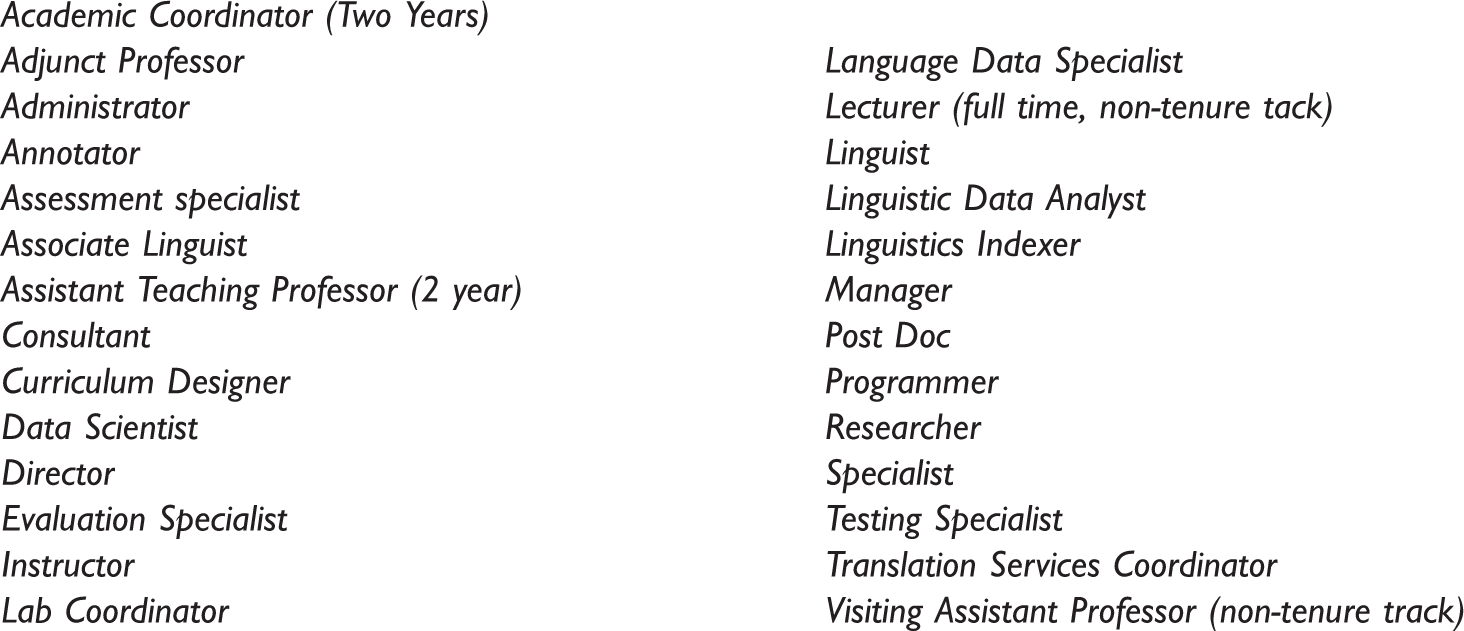
A discursive analysis of euphemizations in academic labor classifications
A detailed analysis of these job descriptions is revelatory of consistent strategies of euphemization. One extreme example in the current study emerged in the form of a vague oxymoron—phrased as a “full time position for six months.” In outlining some of the economic realities facing most citizens after the 2008 financial meltdown, Chun (2017: 47) lists several, one of which unsurprisingly, and directly, pertains to academia, which he describes as exhibiting a trending toward: The growth of part time jobs at the expense of full-time work across all work sectors including tertiary education, which has seen the rise of what is called the “adjunctification” of the faculty in which 75% of all university faculty in the United States are now part-time adjunct (i.e. temporary, non-full time instructors).
To lend further credence for these observed trends, we zoom in on the discursive framings of two prototypical exemplars of the euphemization of temporary labor in academia. The first example is a fascinatingly worded West Coast invention. Evoked in the form of a curiously phrased acronym—a parentheticized initialism—“Lecturer (LPSOE)”—this lengthy, post-nominal description was then explained via a spelling-out so to speak of this wordy acronym in the form of: “Lecturer with the Potential of Security of Employment.” This detailed description appeared in the opening line of the advertisement. Succeeding details informed interested applicants that the position was analogous to the tenure-track system, but different. How different? In its fine print details, there was a vague outlining of an eight-year probationary term. Most tenure-track cycles span probationary terms in the range of four to six years. Now, we see the difference.
In his extensive analysis of the hegemonic discourse of capitalism among everyday citizens, Chun (2017: 113) identifies the workings of what he deems “analogical common-sense making”—a strategy increasingly noted to be at play in everyday discourses of academic capitalism. In this specific instance, we encounter a risker position emerging ever more euphemized. The high vulnerability embedded in such positions for faculty who might be denied permanency after putting in arduous academic work for eight long years is keenly apparent. This “informalization” of labor conditions—also noted to be on the ascendancy in in-migration countries, such as Sweden, particularly for under-employed, low-skilled work has its desired effect. As in academia, such choices “generate a very uneven balance of power” and create “a precariat distinguished by both uncertainty and dependency” (Frödin and Kjellberg, 2018: 82)—academic capitalism’s classic new enactment.
Simulating the semiotic redundancy rampant in classification schemes designed to sub-designate legal entry requirements for non-resident, mobile skilled intellectuals (Meissner, 2018), we encounter fractal recursivity in labels for temporary work now at the university level—one of the highest rungs of a society’s social order. In this overcrowded field, product distinction remains key. As the advertisement below explains, we encounter the promise of permanency—evoked in the form of a shift of acronyms (from LPSOE to LSOE), and explained at length as seen below in a job posting advertised on The Linguist List: Job Rank: Lecturer; Lecturer with Potential Security of Employment Specialty Areas: Applied Linguistics; TESOL The successful candidate will be appointed at the rank of Lecturer with Potential Security of Employment (LPSOE). The L(P)SOE series is a University_________-wide designation for academic senate faculty whose primary responsibilities include administration and teaching, with secondary responsibilities in research. Like Assistant Professors, LPSOE are evaluated for reappointment and merit salary increases every two years and within eight years (or fewer) are evaluated for promotion to Lecturer with Security of Employment (LSOE), which has the permanence of a tenured position. Promotion from LPSOE to Lecturer with Security of Employment (LSOE; the equivalent of tenure) requires, in addition to excellent teaching and service, that the candidate make outstanding and recognized contributions to the development of their discipline and/or of pedagogy (18 October 2017, Issue 28).
Complicating this scenario even further has been the growing turf incursion—cutting into the market shares of state-funded institutions on the part of R1 and other top-tier, Ivy League institutions—eager to boost their own flailing student enrollments. As recently showcased on America’s news-magazine/TV show, 60 minutes, more universities, such as Yale, eager to advertise their attempts at socioeconomic “diversification” and inclusion are quietly witnessing the emergence of a two-track system whose advertised divarication into research-focused versus teaching-centered job streams separately on offer to future faculty portends a furthering of in-built hierarchizations in labor valuation in academia (and of immediate impact to current scholars). Interesting to note is that top-tier universities in their scramble to attract students are now cutting into the markets of teaching-oriented universities, and now also seem to be offering tenure-track positions labeled variously as “Assistant Teaching Professor positions” where a lighter “research” load in favor of more teaching seems to be on offer. In such examples, we see product differentiation manifesting even finer distinctions. To lend some credence for this claim, consider the following position description recently featured on The Linguist List: The Assistant Teaching Professor (LPSOE) series parallels that of the research-focused series, but with emphasis upon excellence in teaching and other instruction-related activities. Individuals in the position are expected to provide outstanding teaching, as well as to engage in professional activity and service related to the pedagogical mission of the department and university. This appointment confers membership in the Academic Senate, and, contingent upon promotion, tenure-paralleling security of employment (9 October 2017, Issue 28).
This is not the end of it. Several job openings now openly engage in exclusionary practices framed in the form of carefully qualified statements such as: “must have authorization to work in the United States”—an analysis of which we examine below. What might be triggers for such extextualization of exclusion? A survey of findings from an academic job search point to a possible context for this trending.
Snapshots from American institutions
In a recent search conducted for a tenure-track position in applied linguistics in a mid-sized American university, results demonstrate important shifts at work specifically as they pertain to global flows in intellectual capital. Ever more interestingly, as in other hyperstratified spheres of late modernist arrangements, we encounter a globally spanning job market which is “simultaneously inviting and repelling, open and closed” (Thurlow and Jaworski, 2017: 546). Most interesting in the data examined are possible explanations as to why tenure-track positions in fields such as Applied Linguistics are emerging ever more competitive. Contrary to claims made by English (2012) that “the market for entry-level faculty positions is still by and large a local one” (72), we are in fact encountering an opposite trajectory at work. The market for entry-level faculty positions is now full-blown global in scale. This fractal recursivity which a mere decade ago manifested itself in the mass export of blue collar jobs to deterritorialized spaces is now seeing slow saturating effects at the very apex of the cultural sphere, indeed, in the hallowed halls of white-collared faculty positions (Valentine, 2013). To lend credence to this, Vertovec (2006), in his first foray into the effects of superdiversity in Britain, noted the closed employment opportunities for most non-white migrants to Britain in what he deemed, high-paying sectors. That was in 2003. By contrast, in low-paying jobs such as the service industries, he noted the following pertinent statistics namely, that “60% of London’s immigrants worked in the ‘hotel and restaurant sector’; that, ‘nurses from sixty-eight different countries could be found in a single London Trust,’ and furthermore that, a combined total of ‘42,000 foreign nurses (were reported to be) working in the National Health Service” (19). Decades later, this job scenario is slowly changing as new visa restrictions now grant entry only to the highly skilled (Bunnell et al., 2018; Fernando and Cohen, 2016; Kim, 2017; Meissner, 2018; Warriner, 2013).
On average, even in teaching-centric universities, tenure-track openings continue to garner upwards of 90 applications for a single job-listing with competition ratios minimally at 1:80. Job searches remain highly confidential enterprises. As a consequence, data presented in this study are presented in metadata-oriented terms. Percentages, rather than exact figures are utilized in a bid to ensure that institutional privacy guidelines are not violated. This strategy ensures that scholars in the field have access to an understanding of crucial trends—both qualitative and quantitative—at work in this salient, under-researched domain. A number of studies have had to rely on open-sourced quantitative data (survey/database generated; Colic-Peisker and Hlavac, 2014) or anecdotally/ethnographically elicited interview data (Bayliss, 2010; Kidman and Chu, 2017), or both (Behtoui and Leivestad, 2018). All of these sources of data, while immensely useful, it is contended, offer somewhat distal and secondary accounts of this crucial, underreported sphere in academia.
In data examined for one recently posted tenure-track position, 79% of the applicant pool possessed credentials derived from American institutions with 21% of the pool trained in institutions outside the US. A closer examination of the data, however, revealed a more complex picture—four different global flows in close competition:
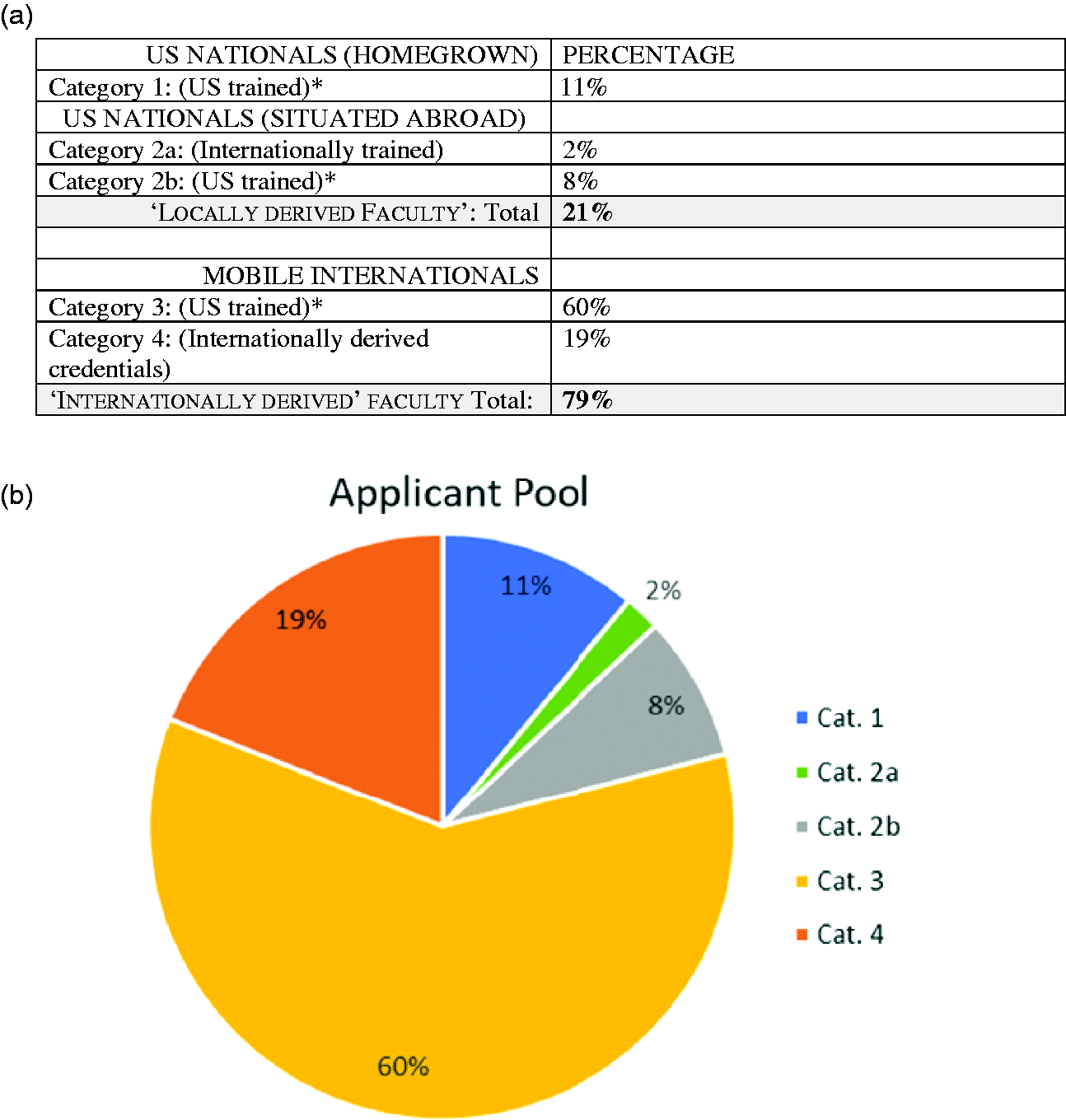
Mobility streams in academia.
In the data examined, the following breakdown of national versus transnational applications as based on the four mobility streams identified above emerged.
Most striking in the applicant pool examined in this study was that 79% of the applications were submitted by transnational mobile scholars. In this specific data set, we witness an interesting numeric coincidence. A total of 79% of the pool was also US trained. Stated differently, over three-quarters of the job seekers in this specific pool were elicited from transnational applicants (over three-quarters of whom were also trained in the US). Even more interesting in the data was the diversity of countries represented in the applicant pool. Applications came from all corners of the globe with 33 different countries represented (listed in Figure 2).
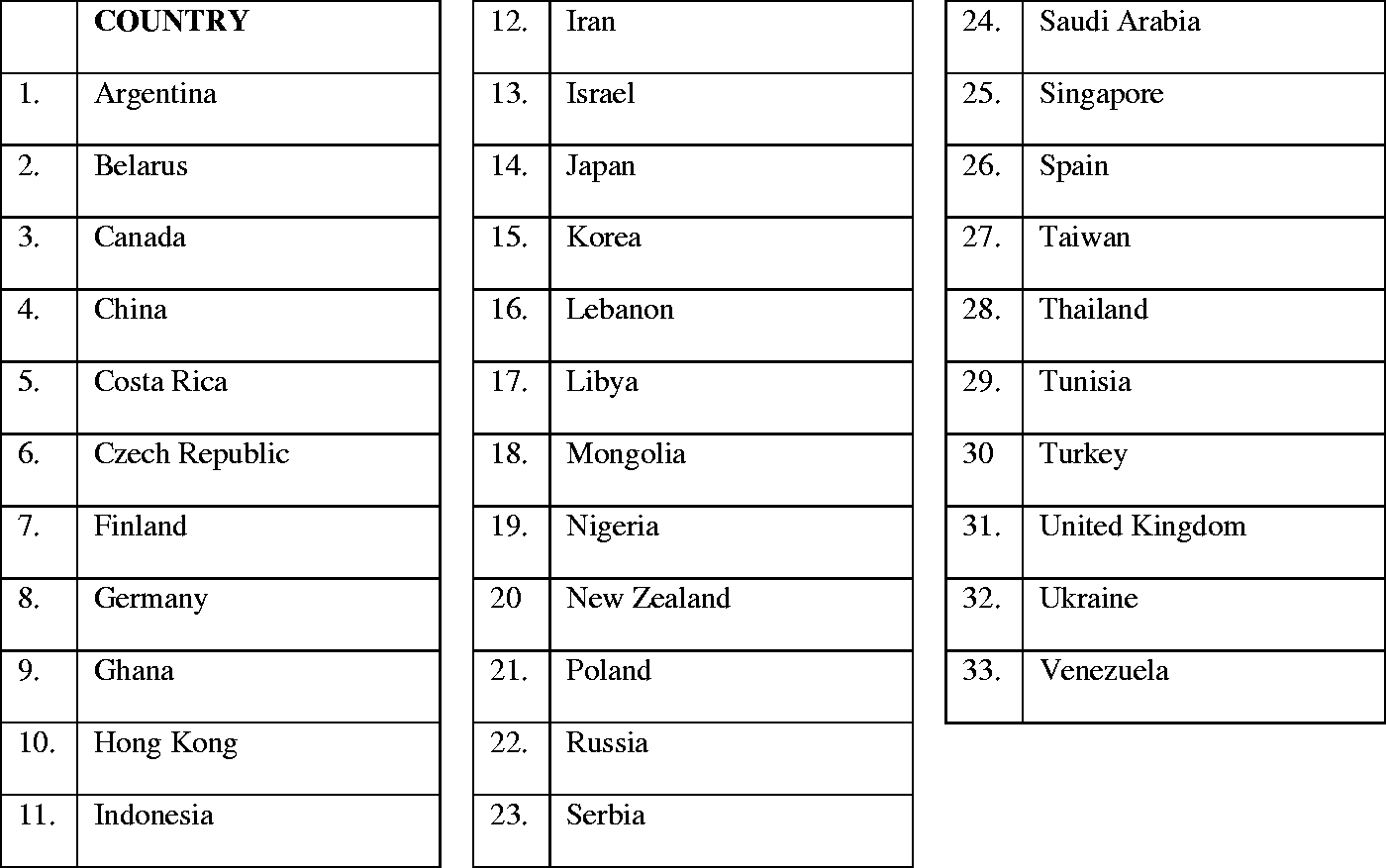
Countries of origination of scholars.
The above chart further exemplifies causal connections between current oversaturated job-markets and the internationalization of university campuses (in the US in particular). This situation is further exacerbated by a decades-long scramble for foreign students. It is this macro-context that has to causally be implicated in any understanding of the new rationalities of entry now being enacted to “frame” resistance to job opportunities in the field from certain quarters—a discursive analysis to which we turn.
“Authorized to work in the US”—Populism’s new linguistic manifestation
For a nation premised on immigration—attracting if you will—the best and the brightest—such illiberally framed embargoes on entry seem to be in direct conflict with legally established laws prohibiting any form of discrimination, especially, laws based on national origin. This key phrasing in fact forms a cornerstone of Title VII of The Civil Rights Act of the United States Constitution. We examine a number of recent advertisements for applied linguists on The Linguist List (a well-known online forum of pertinence to practitioners in the field) in making the case for how macro-economic contexts, as examined above, debunk the myth of border porosity—a trend fueled by tightening job markets in academia and made ever more combustible in the current climate of protectionism. One version of this exclusionary framing in 2017 was stated in the following terms: At the time of appointment, the successful candidate, if not a US citizen, must have authorization from the Bureau of Citizenship and Immigration Services to work in the United States. (26 October 2017, Issue 28) The LINGUIST List strongly encourages employers to use non-discriminatory standards in hiring policy. In particular, we urge that employers do not discriminate on the grounds of race, ethnicity, nationality, age, religion, gender, or sexual orientation. However, we have no means of enforcing these standards. (7 December 2007, Issue 18) Job seekers should pay special attention to language in ads regarding employment requirements and are encouraged to consult our international employment page at http://linguistlist.org/jobs/jobnet.html. This page has been set up so that people can report on the employment standards of various countries. Must be authorized to work in the United States for the duration of employment without assistance from the institution. (9 October 2018, Issue 29) All qualified candidates are encouraged to apply; however, Canadian citizens and permanent residents will be given priority. (3 January 2019, Issue 30)
Thus, as in other super-elite spheres, we encounter manifestations of the self-same paradoxes of permeable openness and impermeable restrictiveness which emerge as in this instance, carefully lexicalized in a “constantly maintained appearance of ubiquity, [and] inclusivity” (Thurlow and Jaworski, 2017: 535). In an astute analysis of the etymology of prejudice in countries in the EU, Valentine et al. (2015) make a potent case for different manifestations of both distal and proximal manifestations of prejudice whose causation emerges situated within “material inequalities” (576), and emotionally charged “responses to socio-economic conditions” (578) when “majority privilege [is] implicitly seen to be under threat” (578). Sufficient evidence has been furnished in support of the case that tightening job opportunities for home-grown citizens, in particular, serves as a causal trigger for the normalization of such exclusionary discursive enactments.
Another advertisement appearing on The Linguist List in 2018 read: In accordance with Canadian immigration requirements, priority will be given to Canadian citizens and permanent residents. (28 September 2018, Issue 29)
In her analysis of the framing of job opportunities in “the Canadian context,” Vigouroux (2017b: 322) examines how overt conflations of “civic” responsibility in tandem with covert iterations of linguistic discrimination ensure the persistence of exploitative, racio-linguistically coded work opportunities for certain migrants, and furthermore, emerges configured in asymmetrical arrangements designed to perpetually ensure that “race and ethnicity” emerge as “axis of inequality” (322). A similar precarization and ethnicization of labor conditions designated as “unfree labor” (Frödin and Kjellberg, 2018: 67) has been reported for low-skilled, de-unionized jobs available to underemployed asylum seekers in Sweden.
What is perplexing, however, is that global markets have been doing very well. So, why this manifestation of illiberality? As we soon see, markets in academia by contrast are struggling (Cantwell and Kauppinen, 2014). In obfuscating profit margins, appeals to citizen priority make market sense. Perhaps this is yet another example of “the re-emergence of hierarchies in competitive settings” (Schulze-Cleven et al., 2017: 798). Consequently, even in a nation premised on immigration, especially in the private sphere, more jobs in applied linguistics emerge conflated within such prohibitory language. One temporary job for an “Annotator” based in the tech-sector's, Silicon Valley in 2018 took especial care to underscore to potential applicants that, “This position is available for people who live in and can legally work in the US” (March 15, The Linguist List: Issue 29). Here, we encounter a fascinating re-write of spatial passports of access which emerge paradoxically rendered, perhaps even redundant in a post-global era of electronically enhanced connectivity, and where no real borders will, in fact, need to be crossed for such virtually situated work.
Rationalizing pushbacks toward mobility: Institutional mandates
We next examine how such entextualizations of exclusion remain entrenched at the local, institutional level. In investigating this, we survey the discursive framing of subtly enacted push-backs to foreign hires circulated in the form of an all-campus memo disbursed to faculty in a North American university. This example is selected both for its potential in exemplifying “meta-discursive debate” (Salö, 2018: 549)—in this case, reminding faculty of the “social responsibility of modern universities” (550), while simultaneously serving as a reminder of how “retrenchments” in status-quoism—remain ingrained at the local scale. In the interests of space, lengthy discussion of all the many facets and required documentation for entry into US academic space on the part of mobile scholars is not possible. However, it has to be underscored that, particularly in the US, obtaining paperwork for the authorization of work for mobile, internationally sourced professionals is increasingly emerging to be too expensive a burden to bear for universities. For those who might be unaware, institutions often have had to “resort” to fakely convened searches conducted to satisfy macro-imperatives aimed at prioritizing the hiring of so-called, home-grown applicants. In a bid to restrict the hiring of international faculty, increasingly conservative laws framed within the political context of populist, “America first” trickle-down sentiments (Pandey, 2017) have managed to set up bureaucratic roadblocks aimed at “discouraging” the hiring, if you will, of transnational scholars in favor of so-called “home-grown” intellectuals.
Just recently, an internal memorandum circulated to all members of the faculty in an institution urged the Faculty Senate to “look into” the matter of international hires. Circulated as a sub-committee-authored institutional report, the memo (said to be based on “extensive” interviews with faculty, but with no evidence furnished thereof) was electronically disbursed to faculty in-boxes. Recommendations emerged in the form of an astutely framed and widely circulated pushback “Memo” originating from this formally convened, Faculty Senate endorsed sub-committee. In the memo, a case was laid out for rolling back prior conceived liberal and inclusive policies aimed at hiring “foreign faculty” on the part of a conservative fringe faculty. Excerpts, cited below, made the case for why this was an important matter in the very opening paragraphs: We found that poor visa handling procedures caused significant undue stress on many people, including the faculty and their families who suffered from concerns about their status in the US, faculty who reported that they believed they were asked to compromise their own ethics by serving on alleged “fake” or “superficial” search committees, and faculty who identified persons who we failed to onboard due to visa problems that turned off our new hires and caused them to withdraw their acceptances. The first issues are a matter of human concern as we caused unnecessary stress and concern to our colleagues and their family; the last issues are poor business practices that wasted taxpayers’ money. Those of us blessed with citizenship by birth might ignore or overlook the pressure, angst, and concerns faced by a parent and spouse who elects to bring his or her family to another nation, enroll children in our schools, and to prepare for a journey leading to citizenship.
Such astutely framed appeals to sedimented histories—chronotopes of care—urging faculty in this state-funded institution, in this case, “Those of us blessed with citizenship by birth,” to save foreign faculty from any further, “pressure and angst” and perhaps most crucially, the saving of the institution any further wasted monies in the form of carefully characterized, “poor business practices that wasted taxpayers’ money,” typify the potent use of memo-driven enregisterments of empathy-driven language to sway opinion while dually mobilize discourse in service of “necessary” push-back to such “foreign” hirings. We are, in this instance, encountering macro-level effects of superdiversity in academia—defined here not just as complexity per se, but as a hierarchized complexity. This term, while recently critiqued (Mufwene, 2017) is utilized here not in its traditional descriptive, product-sense of “an extremely complex manifestation of the diversification of diversity” (Spotti and Blommaert, 2017: 169) per se, but rather, as a term with an in-built processual-orientation and, implying as Blackledge and Creese (2017: 2) underscore, the exposition of “increasingly stratified and multiple processes and effects of migration leading to heightened complexity.” In this sphere, we encounter a harbinger of what Valentine (2013: 6) portends in her use of the term supermobility—a hierarchization of stance in which: The more insecure and fearful groups are about maintaining their own economic position and cultural values the greater their “justifications” (e.g. unfairness, injustice) for defensively solidifying the boundaries of their communities and for undertaking preemptive action to stall perceived threats and to defend communities and culture/identities.
But, this is not the only “creative” way in which national borders are seeing reterritorialization especially is the post-Trumpian era of legal embargos of nationals from seven Muslim-majority nations (which at the time of writing this article), the US Supreme Court, the highest court in the land, with its conservative majority upheld. Trump’s banned entry of mobiles (professional/non-professional) from seven Muslim majority nations—a ruling ratified in June 2018 is yet another instance of a new norm on the horizon—one designed to keep out certain types of migrants. As we see, this decision emerges not in a contextual vacuum per se. After all, in a survey of the top 10 countries of origin of immigrants to Sweden in 2017, highest migration routes—seven of the 10 top countries (70% of its accepted refugees/immigrants) originated from Muslim-majority countries (Frödin and Kjellberg, 2018: 76).
We end with one final example of the reinvention of exclusionary entextualizations in job advertisements. In this specific instance, a rare permanent-position—a tenure-track posting—advertised in 2017 on The Linguist List for an applied linguist (right after Trump’s victory) added rarely before encountered conditionalities of entry in the seeming secular space of academia. The ad deployed the following known language at its outset: The Department of English at ______ College invites applications for a full-time, tenure-track faculty appointment in Linguistics. Pending final administrative approval, the appointment will begin August 2018. (emphasis added) The English Department seeks a candidate with a PhD in Linguistics with a concentration in ESL, and who demonstrates a capacity to contribute to a growing linguistics major. Expertise in sociolinguistics, English grammar, and/or child language acquisition are desirable additional specializations. A candidate should have outstanding promise as a classroom teacher, a record of an active program of scholarship, and a dedication to the integration of Christian faith and the study and teaching of linguistics [emphasis added].
Faith and Educational Commitment
A faculty member of ______ College commits (1) to the Christian faith and to the integration of faith, learning, and student development; and (2) to the educational mission of _______ College as a Christian liberal arts college affiliated with the Christian Reformed Church. Diversity Commitment A faculty member of ______ College commits to establish relationships and positive communication across multiple dimensions of diversity, including, but not limited to, race, gender, physical limitations, class, or religious perspectives. (14 September 2017, Issue 28)
The Equal Employment Commission’s website (https://www.eeoc.gov/laws/types/religion.cfm)—an Office of The Civil Rights enforcement arm in its very own description of “Religious Discrimination and Employment Policies/Practices”—makes abundantly clear that, “An employee cannot be forced to participate (or not participate) in a religious activity as a condition of employment” (EEOC: para. 8). As we see, we are entering a new era as to what might be acceptable. For any institution which is a recipient of federal funding (whether in the form of student loans or external discretionary funding), such disqualifying statements remain in legally grey zones especially as these pertain to federally enacted anti-discrimination laws prohibiting discrimination on grounds of national origin or religion. Unlike 2008, there was no preamble to this advertisement. This language, it might be underscored, saw a re-appearance in a spring 2019 advertisement—also for a rare, highly coveted tenure-track posting.
Expanding market shares via product differentiation: New mobility trajectories?
The last two sections of this paper examine extextualizations of exclusion in two other academic arenas: labor exports to “elsewhere” and configurations of control in the publishing sector—two production zones where emerging frameworks in spatiality theorizations (Higgins, 2017) have direct impact. In these instances, we encounter how territoriality and nation-state criteria once again foster asymmetrical arrangements, and accord perpetual advantage to particular hub-recipients in lieu of ethnicized labor classes. In an ironic twist of center-faculty resisting the so-called periphery’s territorial encroachment, we witness how in a quest for product differentiation—realized in the form of “global production networks,”—Cantwell and Kauppinen (2014: 153) report on the long, drawn-out “contest at Yale University between faculty and administration over Yale’s partnership with the National University of Singapore” in this Ivy-league institution’s astute attempt at expanding market spheres after experiencing alarming drops in student enrollment.
Even less well known, however, are capitalism’s castrating effects on universities in the so-called periphery which, in South Korea’s own global race to reach the top of the rankings game, has seen soft-power exportation of a new form of an ethnolinguistically derived unidirectionalism—one whose effect has slowly, yet successfully managed to erode and render defunct, historically derived open-access, social mobility-oriented admission policies in some of South Korea’s most venerated elite universities, such as the nationally funded, Korea Advanced Institute of Science and Technology. Realized in the form of an “imported” university President, we witness in these examples, newly formulated trajectories of mobility at work in the world of academia. In this instance, we encounter a “Nobel-Laureate physicist from Stanford University”—widely advertised as “the first foreigner ever to head a Korean university”—assuming an administrative post which insider details reveal, was further incentivized in the form of a compensation package widely reputed to be “too good to refuse” (Piller and Cho, 2015: 171). This administrator’s naively conceived structural changes included above all, a move to an all-English medium instructional format. This top-down enacted programmatic initiative launched an avalanche of intended effects not least of which was the denial of tenure to many experienced Korean-speaking academics at that university, and even more troublingly, “high suicide rates at that institution” (162).
We encounter in this specific instance, resonances of higher suicide rates as experienced for example in other outsourced zones of economic production such as the infamous cases of overworked Apple Corporation workers flinging themselves to death in the high-rises of the tech industry in “far-flung” China. Succeeded by another center-exported President, “Nam Pyo Suh, a Korean–American professor emeritus at MIT” (Piller and Cho, 2015:172), we encounter in Korea an interesting tropicalization of ivy-league locativity—palimpsests of soft-power co-optation as witnessed for instance in other culture industries (Pandey, 2016), and evidence of what Valentine (2013: 5) dubs “supermobility”—racialized hyperstartificational arrangements whose metapragmatic and semiotic effects point to retrenchments of prior-realized racialized cultural hierarchies. These examples raise one final point—the re-rise of territoriality in the current era—and serve as credence for what May (2017: 162) describes as, “the overstated assumption that the nation-state model is somehow in permanent decline.” We end with two final examples to buttress the claim of the continuing presence of the nation-state in a seemingly deterritorialized post-global space; and one, where nationality-criteria see resurgence as both rationalization strategy, and as a new distinguishing diacritic deployed in service of either permission or prohibition of entry of particular ethnicities.
Market economics, superdiversity, and peripheral ethnicities
In this section, we examine how hierarchizations in labor configurations in academia stand poised to ensure perpetual advantages to a select few. Not clearly acknowledged in the literature is the historical tendency for high-capital nations to consistently engage in parallel stratificational arrangements wherever they set up shop so to speak. This is after all how commonsensical notions of value—real and symbolic—in market-based economies work (Chun, 2017). Inevitably, the differential valuation of resources and labor remains at the heart of the late capitalist enterprise (Del Percio et al., 2017: 55). Testament for the differential weighting of labor worth emerges in current manifestations of superdiversity in the so-called global south which, unsurprisingly, manifests similar fractal recursivity in stratificational arrangement as witnessed, for example, in the global north. Such asymmetries are especially exacerbated by late-arrival rushes toward “transition from a Third world to First world economy” (McKay, 2013: 3) on the part of several rising nation-states. We briefly examine three such countries.
In their study of the commodification of multilingual skills in Nepal’s private schools and tourist spheres, Sharma and Phyak (2017: 235) report that Nepal’s post-1990s’ quest to join the neoliberal race has not only “valorized the commodity value of English” (see the earlier example in Korea), but has additionally unleashed as elsewhere, a hierarchization of linguistic value in which “minoritized languages like Newari remain at the bottom” (235). The ramifications of this in creating an elite, English-speaking class and its consequences on labor asymmetries in this particular local context are more than obvious. We encounter a similar manifestation of superdiversity in China where mobile African students in shifting trajectories toward new loci of aspirational geographies (Appadurai, 2016)—realized in the form of newly configured academic migratory channels—has led “African migrants eastward, especially to cities in China,” where in spite of being speakers of “fluent Mandarin,” they remain subject to the same damaging effects of “social prejudice” (Bunnell et al., 2018: 43), as their African counterparts fluent in other so-called big languages such as French for instance, in hub metropoles of better resourced nations of the global north (Vigouroux, 2017a). In this instance, we once again witness nationality rationalizations serving as linguistic proxy for ethnicized exclusion.
While exhaustive research has documented the monetization of proficiency and access to English (Bunce et al., 2016; Ricento, 2015), we encounter in these instances of fractal recursivity a novel emergence of indexical order (Silverstein, 2003), and one pertinent to so-called dysfluency in other “big” languages such as French or Mandarin. Thus, superdiversity in Paris sees similar hierarchization (Planchenault, 2015) in capitalism’s successful “linguistic construction of otherness” (5). Here, as elsewhere, superdiversity’s manifestation emerges in similar racialized and spatialized form. Via mimetically oriented media portrayals of linguistic diversity in Paris—the machinery of soft power replication and enregisterment ensures that “the suburban vernacular [emerges] still very much stigmatized” (11). No surprise here. What is surprising, however, is how similarly “justified” ethnic exclusion emerges—framed within a rationalized discourse in which spotlighting of so-called mitigated fluency—proficiency capital in French serves as stand-in for ethnic exclusion. Similar configurations of exclusion (based on proficiency capital in either English or Mandarin) remain ascribed to African migrants in Canada (Vigouroux, 2017b) and China, respectively.
In an analysis of the transnational status of mobile populations in Singapore, a rising supranational site of power, and a nation-state recently playing host to the unprecedented Trumpian-instigated, US–North Korea denuclearization talks—we witness similar manifestations of superdiversity and supermobility fiercely at work. Singapore recently described as an oasis of modernity by a newscaster, boasts “one of the largest percentages of foreign-born workers in the world”—at a whopping “44 percent of its population” (McKay, 2013: 3). In peeling back demographic details in this small nation-state, however, we encounter how troublingly similar replications of superdiversity emerge relative to arrangements found in so-called center-based economies of the global north. In this labor zone, an entrenched “dual policy” (3) premised on an embedded hierarchization of value between an elite-class of imported “foreign talent” (4)—constituting a mere “15% of the mobile force” (3), in contrast to a so-called “foreign worker class” (4) constituting the bulk of the imported blue-collar labor force—we encounter the trappings of an entrenched ethnicized labor hierarchy. This so-called heads-versus-hands distinction emerges inextricably conflated with a recognizable economic and racialized hierarchy in which, “the highly skilled executive, managerial and professional group comprising expatriates from various Western countries enjoy certain privileges and the prospect of future residency” (4) while also non-coincidentally, occupying “the highest rungs of influence” (4). In stark contrast, “85 percent of the foreign worker group” exists in a perpetually precarious state—socially marginalized in “living conditions” described as “overcrowded squalid and unsafe” built in the form of premises simulating “inmate like dormitories,” and which furthermore, it has to be underscored, emerge topographically peripherized—relegated in real space to shantytowns “located on the edge of Singapore’s built up area” (4). But this is not the end of it. Even more interesting is the fractal recursivity at work within these so-called bands of social privilege. Here, we encounter an internalized vertical hierarchy—a supermobility of stance emerging within the elite class itself which non-coincidentally mirrors a racially entrenched hierarchy in which European-expatriates occupy the highest spheres of influence while, by contrast, Korean mobile professionals remain relegated to the lowest rungs of power (Park, 2014).
Interestingly, and beyond the scope of this paper, is the multi-perspective approach to such scenarios which research increasingly exposes as instantiations of racialized asymmetry—or what Kim (2017) characterizes as “golden handcuffs” (991) shackling foreign faculty in their career trajectories in nationscapes of Japan and Korea. These examples typify the stagnating effects of an “exclusive ethno-nationalism” (991) at work, and one in which we repeatedly encounter academic scenarios in which “foreigners are kept in their place,” via a discourse of rationalization framed in “national” terms—rather than as ethnic exclusion. If anything, these examples point to a re-rise of a recoded racialized territoriality in the post-global era as witnessed in other culture industries (Pandey, 2016). Once again then, we have to concede with May (2017: 162) that “nation-states—for all their limitations, […] still remain the primary social, political and linguistic frame of reference for our everyday public lives.”
In their research on the Swedish academy, Behtoui and Leivestad (2018) note a parallel supermobility at work (similar stultifying stratifications and racialized hierarchies entrenched among faculty such as, for example, as encountered in other zones of academia) in southern hemisphere locales such as New Zealand, where via an entrenched policy of “whitestreaming”—“ethnicized” commonsensical notions of “scholar outsiders” versus academic “insiders,” perpetuate and (re)-circulate “structures of academia [which] protect and maintain Anglo-European privilege” (Kidman and Chu, 2017: 8). In Singapore, as in Bahrain, Dubai, and Saudi Arabia (Appadurai, 2016), elite worker ostracism has another continuum—the persistent peripherization of mobile workers to the lowest rungs of the social scale where they remain characterized in the larger national imagination with “the three Ds”—dirty, difficult, and dangerous (McKay, 2013: 4)—and worse yet, self-fulfillingly, fall victim to overt marginalization campaigns self-justified on their part as an internalized self-loathing regarding their own lack of social access as a consequence of a perceived paucity of proficiency capital—in this specific case, “a lack of fluency in English” (McKay, 2013: 8). Via such linguistically framed marginalization strategies carefully conflated within a discourse of citizenship and belonging, certain ethnic groups are continually kept in their place so to speak.
The nexus of national space: Academic hierarchies and profitability
We conclude with a final example of the enregisterment of exclusion in academia once again evoked in, and through, spatialized hierarchizations implicating notions of nationhood. Parallel processes of iconization and valuation saturate all areas of academia whether manifesting as entrenched hierarchies underpinning global university rankings systems (Espeland and Sauder, 2007; The Economist, 2018)—recognition heuristics which in turn fuel other soft-power oriented academic capitalistic endeavors—or further yet, realized as the ability of universities to fill institutional coffers by successfully recruiting full-fee paying international students, or better yet, control prestigious publishing outlets (Thompson, 2005). In this latter sphere, exciting research is laying bare challenges to open-sourced hyperstratifications underpinning the commodification of knowledge which, at this point, is currently entirely owned and head-officed in center-located publishing houses. In this instance, we encounter a corporatist formula designed to ensure perpetual and “inherent advantages” (Soler and Cooper, 2017: 4) to scholars at the very apex of the academic hierarchy who also unsurprisingly are located in center spaces (Flowerdew, 2007; Thompson, 2005), with, it might be underscored, consumption markets increasingly imbricating peripheral spaces. This rise of “academic oligarchies” (Schulze-Cleven et al., 2017: 798) only serves to further strengthen the hegemony of the most successful of universities—in a re-looping and predictable pattern of winner-take-all configurations (Giridharadas, 2018) while replicating asymmetrical structural arrangements found to be undergirding other prestige industries (Pandey, 2016). In countries such as Korea, university rankings remain tied not just to academic success per se, but emerge inextricably linked to other crucial, culturally pertinent institutions such as, for example, “marriage prospects” (Piller and Cho, 2015: 175). Increasingly, we are being told, “research and publication” in these peripheral locales serve as indices of success both in the professional and private spheres of scholar-lives.
For scholars at the periphery, or at the bottom rungs of the academic hierarchy, the cost of so-called open-source access remains tilted to advantage the very apex—a term whose market-sense contradictions remain baffling to those who cannot afford the high membership fees of this exclusive club—an entry fee ranging from “$500.00 to $5000.00 for single article publishing in so-called open-journals” (Maldonado-Maldonado, 2014: 202). The consequence of such paradoxically framed superdiverse social arrangements is that marginally located academic voices and ideas continue to be peripherized in the face of the loudest and most prolific of academic voices featured in exclusive, widely circulated, open-source sites whose “academic branding” (Allan and McElhinny, 2017) via recognizable diacritics of “quality” and “national notoriety” are further funneled as leverage in “nationally-framed” and widely-advertised university rankings and “league-tables” as—denizens of “American” or “British” universities, respectively. Unsurprisingly in 2018, “America had three of the top five slots and Britain two”—with both nations occupying the pinnacle of the top five listings of best universities world-wide. This is how monopolies in the “academic precariat” (The Economist, 2018: 56) are ensured. Even more crucially, these market forces provide a glimpse into just how entrenched “increased stratification and inequality among higher education organizations” (Cantwell and Kauppinen, 2014: 156) remain at the national, transnational, and supranational levels. Increased “global production networks” simulating the multisited locativity of “multinational corporations” (158) now show no intention of either easing, or in any way altering “access inequalities” (156) at the heart of the academic enterprise today. This is how the logic of academic capitalism ensures both its relevancy and its perpetual monopoly.
Unsurprisingly, the machinery of valuation is turning its full wheels on blacklisting emerging periphery-originating models of academic capitalism based on a different economic model. Consistently framed in the form of negative semiotic labels and keywordings such as “parasite” or “predatory publishing” (Soler and Cooper, 2017: 1–2), we can safely predict that these “pay to publish” models emerging on the horizon, might, in fact, see co-optation by venerated high-impact journals in the future if this makes market sense. Many readers can recall similar resistance and devaluation of so-called online journals when print-based publishing enterprises faced a similar sunseting of profit margins, and which have since witnessed mainstream cooption by the latter.
Beyond the scope of this paper is an interesting recycling of alarmist and fear-driven tropes derivative of everyday battles in environmental ecology whose affective “enforcement of excludability” (Maldonado-Maldonado, 2014: 192) persist in maintaining the end goal: a monopoly on revenue generated. A few parting figures make clear just how profitable academia continues to be for some players in the game. In 2013, the “world’s biggest journal publisher,” which was “Elsevier, a Dutch firm” reported a profit margin of “38% on revenues of $3.2 billion.” Its rival, “Springer, a German firm,” reported a close profit margin of “36% on sales of $1.1 billion” (Maldonado-Maldonado, 2014: 192).
Even more interestingly, in the hard sciences—the barometer of the global rankings ladder in the academic precariat—we encounter in 2018, a noticeable trend namely that, “22% of papers were internationally co-authored” (The Economist, 2018: 56). In exploring the contradictory market logic of sites of production versus consumption—increasingly conflated with the center and the periphery, respectively—we encounter yet another interesting dynamic at work namely, how “free” knowledge submitted by academics to publishing houses emerges maximally monetized in the well-known formula of paid subscriptions for “freely” acquired work, and which now especially remains carefully conflated with “high-impact” metrics—in an economic enterprise whose very own parasitic structure remains opaquely obscured behind commonsensical keywordings of “quality.” This is but one final example of yet another deployed floating signifier whose fractal recursivity mirrors rationalized deployments of “Authorized to work in the US” chronotopes as surveyed in this study.
Conclusion: A new norm?
The re-rise of territorialism in the post-global moment is yet another exemplar of why frameworks in political economy need to underscore any analysis of migration or mobility trajectories in studies in applied linguistics. Acknowledging that, in our politically correct era, “it is not acceptable to be openly prejudiced,” (Valentine et al., 2015: 578), we witness in this causally delineated chain of the enregisterment of exclusion, rationalizations whose origins in the scramble for international students, and consequent effects on oversaturated job markets posits the need for newly enacted and discursively framed exclusionary practices—whether these are realized in the form of euphemized prohibitions against mobility based on “nationality-criteria” in job advertisements; the emergence of hierarchized and ethnicized labor configurations at the local or global level; or realized as the re-territorialization of market controls in a knowledge economy tilted to advantage a mere few at the expense of all. In these surveyed examples, we witness how seemingly liberal institutions of democracies—universities—now emerge complicit in the very same populist impulses as can be seen to be slowly eroding sociopolitical processes in democracies everywhere.
The ability of academia to create conditions of entry framed in what Darling (2010: 134) has termed a “(re)assertion of a national logic of territorialized prioritization and concern,” is perhaps what intellectuals might need to be most concerned about especially if we aim to guard against the ascendancy of populist sentiment slowly saturating the most progressive of our societal institutions. In framing the discourse of prejudice in the form of a top-down—indeed, a distal—“national redefinition of who ‘has the right to belong’” (Valentine et al., 2015: 69), such microlinguistically enacted acts of exclusion on a more pernicious and proximal level stand poised to serve as the new normal. To say that it is exactly these kinds of commonsensically framed conditionalities of entry that we as intellectuals should be especially vigilant of, perhaps even wary of, is an understatement— particularly for citizens in nations premised on immigration.
Footnotes
Declaration of conflicting interests
The author(s) declared no potential conflicts of interest with respect to the research, authorship, and/or publication of this article.
Funding
The author(s) received no financial support for the research, authorship, and/or publication of this article.