




Abstract
Linguistic racism explores the varied ideologies that may generate and endorse monolingual, native, and normative language practices, while reinforcing the discrimination and injustice directed towards language users whose language and communicative repertoires are not necessarily perceived as standard and normal. This article, thus, investigates linguistic racism, as a form of existing, but newly defined, racism against unconventional ethnic language practices experienced by Eastern-European immigrant women in the Australian workplace. Our ethnographic study shows that, once these women directly or subtly exhibit their non-nativism, through a limited encounter with local expressions, non-native language skills, and ethnic accents, they become victims of covert and overt linguistic racism in the form of social exclusion, mockery, mimicking, and malicious sarcasm in the hierarchical power environment of the workplace. As a result, these migrants can suffer from long-lasting psychological trauma and distress, emotional hurdles, loss of credibility, and language-based inferiority complexes. We, as researchers, need to highlight the importance of combatting workplace linguistic racism and revealing language realities of underprivileged communities. In that way, we can assist them in adapting to host societies and help them regain some degree of power equality in their institutional environments.
Keywords
Introduction
To make people work together, give them a common enemy. This conclusion, part of Muzafer Sherif’s (1958) work on realistic conflict theory, seems not to have stood the test of time. In the era of a global pandemic, as humanity puts its energies into fighting a mutual enemy, violence, racism, and xenophobia continue to prosper. The recent deaths of Breonna Taylor, George Floyd, and numerous other victims of police brutality (BBC News, 2020a, 2020b), were ‘the final drop’ which created a wave of public criticism and backlash under the banner of Black Lives Matter. The movement went global because abuse based on skin colour or land of origin is not limited to the United States alone. In Australia, the hate was also given a voice: ‘go home yellow dog’ (ABC news, 2020); ‘learn to speak English when you come here to this country’ (news.com.au, 2020). This voice, underpinned by the historical preferences of ‘mainstream’ Anglo-Australian society, isolated all those whose sociolinguistic, cultural, ethno-racial, and linguistic backgrounds do not fit the bill. It continues the racist traditions of the past, continuously evolving into often more subtle forms.
Racism may be caused by ignorance, prejudice, stereotype, but also by the society ‘which needs an ideology to keep in place a system of discrimination’ (Campani, 2002). One of the most encompassing definitions of racism, which possibly represents the core of all discrimination and inequalities, is the one by Grosfoguel (2016: 10): Racism is a global hierarchy of superiority and inferiority along the line of the human that have been politically, culturally and economically produced and reproduced for centuries by the institutions of the ‘capitalist/patriarchal western-centric/Christian-centric modern/colonial world-system. (Grosfoguel, 2011)
This study, thus, investigates linguistic racism (De Costa, 2020; Dovchin, 2019a, 2019b, 2020a), as a form of existing, but newly defined, racism against unconventional language practices experienced by Eastern-European immigrant women in the Australian workplace. The workplace setting presents its importance in research through several different factors, such as being an institutional, formal, government-policy-following, and hierarchical power environment. For many people, the workplace ‘provides the most important social setting’ (Fenclau et al., 2013: 78). Minorities based on ethno-racial, socio-cultural, and language background may often be at a disadvantage in an institutional environment if they come across communicative barriers (Kell et al., 2007). Therefore, research on linguistic racism in the workplace context not only expands the literature on racism but also helps government agencies in establishing new workplace-related policies and protective laws against such employee-directed linguistic racism, as workplace laws are significant in forming workplace norms (Harthill, 2013).
While expanding the linguistic racism and ethnicities literature through the institutional setting, the article also seeks to differentiate between two ways of expressing linguistic racism. It does so by illustrating direct racism, as well as uncovering indirect racism experienced by women of Eastern-European background in Australia, both of which bring to focus its long-lasting psychological consequences for the victims (Dovchin, 2020b; Radliff, 2013). We, therefore, ask three main questions in this study: In what ways do an individual’s language and communicative practices provoke linguistic racism from the dominant host society? To what extent and in what ways can linguistic racism be expressed? What are the psychological and emotional effects of linguistic racism?
Linguistic racism as a new racism
The definition of linguistic racism builds on Barker’s (1981) concept of ‘new racism’ in the British context – discrimination which expands from biology-based inequity to encompass prejudice and discrimination of people based also on their cultural (and linguistic) diversities. New racism is a theory of human nature which presupposes that human beings want to share a group membership with those like them (Gordon and Klug, 1985) – ‘one’s own people (Us)’ and ‘distinct immigrant presence (the Other)’ – and, as such, it developed because of ubiquitous discrimination against diverse migrant communities in Britain (Irish, Germans, Italians, African backgrounds, etc.) (Miles and Small, 1999: 144). However, before deconstructing the notion of new racisms to individual cultural features, which bring people together (or keep them apart), it is important to clarify an expanded definition of race. May and Sleeter (2010: 8), building on Guinier and Torres’ (2002) work, hinted at such expansion by explaining how the notion ‘political race’ reframes race: …as a concept that denotes both social location and political commitment and is also used as a basis for building inclusive agendas that begin with the issues and concerns of communities of color, but which are also expanded, at least potentially, to address class, gender, and other inequalities.
‘Linguistic racism’, as a form of linguistic discrimination, represents a ‘new racism’, one which is primarily based on one’s language background, communicative repertoires, and language practices (Dovchin, 2019a, 2020a). It also simultaneously discriminates against minorities on the basis of their ethno-racial and sociocultural backgrounds because one cannot separate language-based discrimination from one’s ethnic, racial, and national background, as these aspects seem to be deeply embedded within one another and co-construct their characteristics. Linguistic racism perpetuates language-based Anglo ‘Whiteness’ as ‘a form of hegemony that allows one group to use its power to dominate a group in a position of lesser power’ (Yee and Dumbrill, 2003: 102). ‘Whiteness’, in this sense, represents a ‘default standard … [f]rom this color standard, racial/ethnic minorities are evaluated, judged and often found to be lacking, inferior, deviant or abnormal’ (Sue, 2006: 15). Unlike established and new racisms based exclusively on one’s skin colour, ethnicity, nationality, culture, and religion (Eliassi, 2017; Hall et al., 2010; Phillips, 2011; Pon, 2009; Sue et al., 2007), linguistic racism stems from the type of language that one uses, the way such language is spoken (Piller, 2016), as well as all types of verbal or written abuse against someone’s racial, ethnic, cultural, and linguistic background (Mahboob and Szenes, 2010), implying the unequal power relations among people as determined by an individual’s use of language (Skutnabb-Kangas, 2015). Linguistic racism thus explores the varied ideologies that may generate and endorse monolingual, native, and normative language practices, while reinforcing the discrimination and injustice directed towards certain groups of language users – in particular, towards groups and individuals whose language and communicative repertoires are not necessarily perceived as standard and normal (Dovchin, 2019a).
Standard and normal language rules prescribed by the dominant native-speaking society, in the context of linguistic racism, remind us of Silverstein’s (1996: 301) ‘monoglot Standard’ perceived as a ‘cultural emblem in our society’, which complexifies the nature of the problem that we are dealing with, and which is not only of a linguistic nature. Rather, the nature of the problem becomes the stratified features of the ‘orders of indexicality’, set and valued by dominant nation/states, which is then a matter of sociocultural power and inequality (Blommaert, 2010). The foundation of linguistic racism could be understood in terms of Silverstein’s (2003: 535) standardisation and stratification model in which ‘top-and-center folks can look downward-and-outward, as it were, toward peripheries at various degrees of negatively valued deviation from their imagined full-time, default, or unmarked identity’. Linguistic racism, then, becomes stronger once the multilingual speaker directly or subtly exhibits their linguistic non-nativism (De Costa, 2020), which deviates from a default standard form of the dominant centre language through a limited encounter with local expressions, non-native language skills, and ethnic accents.
Some of the hegemonic ideologies embedded within linguistic racism stigmatize the victims as being less capable in various areas of life, leading to the common assumption that ‘poor’ knowledge of the dominant language entails the language inadequacy in one’s native language, hence indicating overall low levels in the social and professional hierarchy (Dobinson and Mercieca, 2020). Terms which exhibit the extent to which language is acquired or learned, such as ‘proficiency,’ ‘fluency,’ and ‘native ability’ (Bonfiglio, 2010), become analogous with ‘signs of deviance and foreignness which construe particular populations and practices as illegitimate and out of place’ (Rosa, 2016a: 165). This is why, due to non-native language use, as well as a limited encounter with a local way of speaking, such (often bi/multilingual) speakers may often be constructed as less intelligent and slower when compared to the local society (Clément and Gardner, 2001; Lippi-Green, 2011), as well as considered as having deficiencies and communication problems. Both often delimit their perceived ‘suitability’ for higher-level job positions (Rosa, 2016a; Smith, 2005). Such speakers are also often accused of their lack of acculturation to mainstream Anglo society since their adaptation is assumed to depend on their knowledge of English – lack of native-like use of English is seen to entail reluctance to assimilate in this context (Rodriguez et al., 2002).
Linguistic racism also becomes amplified once the centre-based ideologies come into contact with a non-standard accent, which differs from its standard counterpart. An accent accounts for one’s social identity and ‘status and competence’ (De Klerk and Bosch, 1995: 18), which may result in even fluent and clear accents evoking negative feelings from the dominant population with hegemonic ideologies (Lippi-Green, 2011). A CALD migrant’s lack of a dominant, normative English accent may lead to a negative judgement of the speaker and perhaps evoke negative attitudes from the dominant society (De Souza et al., 2016). The challenges and issues surrounding one’s ‘biographical’ (Blommaert, 2009), ‘ethnic’ (Dovchin, 2020b), ‘foreign’ or ‘immigrant’ accent – mainly embodied by racialised subjects – seem to dominate the literature in linguistic racism. ‘Ethnic accent’ may shape perceptions of one’s English knowledge, which does not seem to elicit the same treatment as standardised English accents such as British, Australian, American, Canadian (and so on) (Dovchin, 2020b). Standardised English accents often indicate higher social hierarchy and academic competence, where native speakers of English are often ‘warmly regarded, and people are predisposed to think highly of them’ (De Klerk and Bosch, 1995: 18). Meanwhile, ethnically identified English, spoken by non-native English speakers, often becomes a point of ridicule and mockery, while also being highlighted simultaneously as an example of ‘imperfect’ English (Ono and Pham, 2009). Studies have hinted that native speakers of English tend to judge ethnic accents as less prestigious than standardised accents (Munro et al., 2006). In particular, Asian accents seem to be inherently located in the hazard zone of global English accents (Blommaert, 2009). They are often subjected to language shaming – ‘peripheral speakers [seen] as incomprehensible or as ridiculous impostors’ (Piller, 2016: 197), and victimised in the popular discourse of mockery, aggravated by the prejudice of people towards non-native speakers of English (Hanish and Guerra, 2000). As Munro et al. (2006: 71) note, ‘individuals with a foreign accent may be perceived negatively because of the stereotypes or prejudices that accent can evoke in a listener’. Hence, their accent becomes a less powerful feature for establishing their identity (Tankosić, 2020) and a decisive factor in unfavorability, providing grounds for disentitlement in employment or complete participation in society, while standard English becomes an important asset for success (May, 2014).
(C)overt linguistic racism
Linguistic racism, as a ‘socially and discursively constructed’ (Dovchin, 2020a: 774) form of language-based racism, often includes different types of ‘micro-aggressions’ and ‘microinequities’ (Fox and Stallworth, 2005 – refer to Pierce, 1970; Rowe, 1990) directed at one’s language and communicative repertoire, which can result in distress and offence to the victim. The power imbalance, as an emergent feature of linguistic racism, is important to acknowledge as it puts the disadvantaged group behind the privileged local society, leading to conscious or unconscious unfavourable behaviour directed at its supposedly inferior members (Einarsen et al., 2003; Fox and Stallworth, 2005). Such difference in the explicitness of unfavourable behaviours urges us to make a distinction between linguistic racism which is veiled, subtle, and hidden (covert) and the one which is unveiled, obvious, and direct (overt) (De Costa, 2020). Both covert and overt linguistic racism can occur on different hierarchical levels in any given language-dominant society – in this case, English-language-dominant Australia. Both also depend on different power relations amplified by the ‘politicized identities, of ethnolinguistic nationalism and of national chauvinism’ (Blommaert, 2010: 3) in these societies.
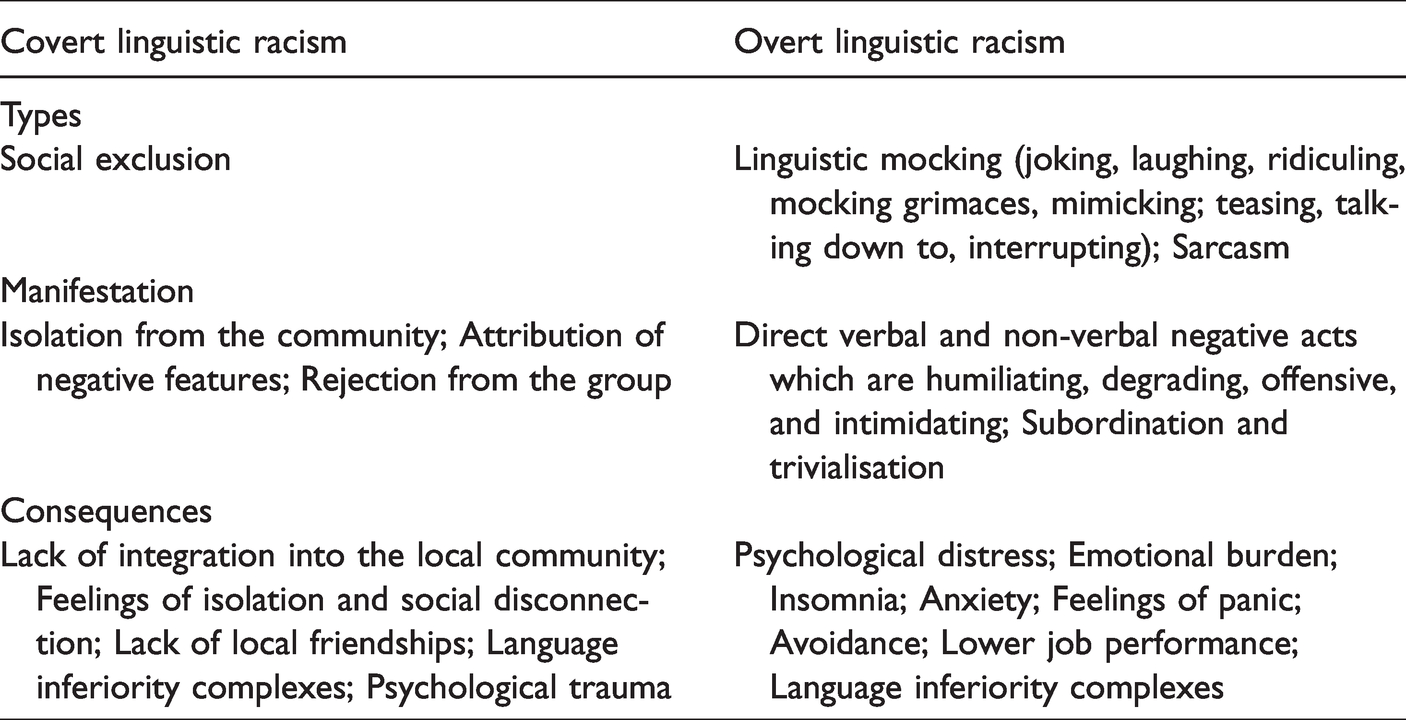
Covert linguistic racism refers to a ‘symbolic violence’ (Bourdieu, 1999), which represents an imposed hegemonic ideology, which leads to indirect subordination of minorities and reproduces social inequalities internalised by marginalised groups to work as self-victimisation. It may appear in the form of ‘social exclusion’ – the act of rejecting someone from interpersonal and institutional interactions, being left out of things on purpose, excluded from peer interaction, or completely shunned (Field, 2013) due to their ethnic language and communicative repertoires. Social exclusion aims to isolate one from participating in the community and also attributes negative features and values, hence affecting their role and success in the society. Despite the seeming harmlessness of the social exclusion on the surface, its seriousness should not be overlooked. In their essence, humans are social creatures, therefore, to be socially excluded and rejected from the group would be analogous to a ‘death sentence’ – ‘left alone without food, shelter, and vulnerable to outside attack, the life of a social outcast would have been brutal and brief’ (Kipling et al., 2005: 2) – because without the acceptance by the wider society, and hence social interaction, humans are subject to the lowest levels of the social hierarchy. Sometimes, social exclusion is caused by one person who tries to manipulate others to follow them in the victimisation of the target (Kolbert et al., 2013). Even though covert linguistic racism is not direct, physical, or verbal, and sometimes not even intentional, prior research indicates that social exclusion is becoming a commonality in the modern world (Canagarajah, 2017; Fox and Stallworth, 2005). It prevents the victims from integrating into the local community, causing feelings of isolation and social disconnection, as well as a lack of local friendships (Khvorostianov and Remennick, 2017). Language-based social exclusion represents linguistic racism as rejection of particular ethnic language users by the local community may indicate that an individual’s linguistic attributes and features are not perceived as preferable and desirable by the host society (Hogg, 2016; Tajfel, 2001; Tajfel and Turner, 1986), which may consequently make them a social outcast.
While covert linguistic racism is expressed through passive-aggressive and indirect acts of social exclusion, overt linguistic racism, on the other hand, refers to more direct verbal and non-verbal acts, which may appear in more explicit forms of mocking, joking, sarcasm, laughing, disdainful grimaces, teasing, ridiculing, talking down to, and interrupting (Khiat, 2012; Lipinski and Crothers, 2013; Lipinski et al., 2013). Overt linguistic racism is a social action practised through direct frontal attacks (De Costa, 2020) which aim to harm another person because of their ethnic accent, ‘deviant’ language skills, or lack of understanding of the local expressions, as well as all other language features which are different from the monoglot standard. It entails a negative behaviour towards a victim that is humiliating, degrading, offensive, and intimidating, and it can happen between different power scales in society. Linguistic mocking (Chun, 2009; Hill, 2008; Rosa, 2016b), as a common type of overt linguistic racism, usually involves ridiculing and mimicking one’s accent, as well as non-verbal cues, such as intentional grimacing and laughing. It often aims to subordinate and trivialise certain individuals or groups. Sarcasm is another form of overt linguistic racism, which represents a derogatory verbal attack directed at a victim (Lee and Katz, 1998). It often designates ridicule of an individual or a group by using harsh and contemptuous words for hostile purposes. Linguistic racism may also be expressed in the form of name-calling, using insulting or demeaning labels (Sue et al., 2007), initiated by the language-based features – for example, a Mongolian girl who is using an ethnic Russian Mongolian English accent is called a ‘naughty Russian hooker’ (Dovchin, 2019a: 92). Similarly, the ‘accent’ of Melania, current wife of Donald Trump, and a native of Slovenia, was pathologized through xenophobic and sexist rhetoric by online users for sounding like a ‘hooker’, ‘bitch’, and ‘prostitute’ (Lee, 2018: 48).
Regardless of the explicitness of linguistic racism (be it overt or covert), it may have serious consequences, negatively affect many aspects of victims’ lives, and play a part in a culture of maltreatment of societies from diverse backgrounds (Byrd, 2014b). Linguistic racism, particularly in the institutional context of the workplace, may cause a negative emotional and psychological effect on the victims, leading to long-lasting psychological trauma and distress (Radliff, 2013), affecting job performance (Höel et al., 2003), satisfaction (Hauge et al., 2007), and ability to continue working for a specific company (Namie and Namie, 2000). Covert linguistic racism, such as interpersonal rejections in the form of social exclusion, can potentially ‘constitute some of the most distressing and consequential events in people’s lives’ (Leary, 2015: 435). Being socially excluded in casual encounters has myriad emotional and psychological consequences, because people may ‘react strongly when they perceive that others have rejected them’ (Leary, 2015: 435). Regarding overt linguistic racism, a study of randomly assigned participants revealed that laughter directed at someone causes emotional pain, since exclusionary laughter evokes feelings of being verbally and emotionally attacked (Klages and Wirth, 2014). Overt linguistic racism in the form of malicious teasing may also lead to serious long-term psychological consequences, as victims have reported psychological disorders such as depression, suicidal intentions, insomnia, anxiety, and trauma (Dovchin, 2020b). Lastly, both overt and covert linguistic racism can potentially lead to the development of language inferiority complexes, as victims become sensitive and self-conscious of their assumedly ‘poor’ dominant-language skills. Developing inferiority complexes in terms of one’s language practice represents a psychological barrier, where non-native speakers of English often develop feelings of speaking ‘terrible’, ‘nonstandard’, and ‘unaccepted’ English (Dovchin, 2020b). For example, Japanese people are often apologetic when it comes to their English skills, because they developed language inferiority complexes from wanting (but failing) to speak/write English and behave like its native speakers, hence causing internal feelings of shame (Hiramoto, 2013). The summary of (c)overt linguistic racism types, manifestations, and consequences is presented in Table 1.
(C)overt linguistic racism summary.
Using the linguistic ethnography qualitative research framework, this study will, therefore, illustrate different instances of covert and overt linguistic racism as experienced by immigrant women of Eastern-European backgrounds in the Australian workplace setting, as well as the effects of such experiences on their psychological and emotional health and well-being.
Theorising emotionality
In this study we draw on findings from Ladegaard’s (2013, 2014, 2015) studies on trauma events of migrant women to contextualise the emotional responses of our participants. The narratives of our participants are marked by emotional reactions. Their storytelling is often characterised by ‘broken narrative’ as an ‘open and fluid concept, emphasizing problematic, precarious, and damaged narratives told by people who in one way or another have trouble telling their story’ (Brockmeier, 2008: 10). Broken narrative refers to voids and breaks that interrupt the flow of the story, and it appears as a result of a gap between ‘ordinary language’, used to talk about a negative experience and the actual experience as it was lived. Ladegaard (2015) argues that crying represents a language that bridges this gap. Crying is ‘a language that transcends words’ as it can explain victims’ emotionality in instances when speech fails to do so (Kottler, 1996: 49). It represents ‘a discharge phenomenon, a means of tension release […] a symbolic purification […] affective reintegration […] a mode of defensive regression […] a mechanism for social bonding [and] a direct medium of communion’ (Frijda, 2001: xv).
While crying is a paralinguistic feature that is most often expressed in emotional storytelling, laughter is also used repeatedly as a coping mechanism to moderate negative life experiences (Ladegaard, 2013). Laughter may serve to show bravery and hide true emotions. Such laughter is humourless and is not meant to be requited (Ladegaard, 2013). It moderates emotional impacts of negative life events. Conversational emotions, like crying and laughing, are thus often used to express a need for compassion and being understood, particularly in a space where one belongs to a minority group. They become a way in which victims of linguistic racism relate to someone else. In storytelling, they often serve as a form of catharsis, as they may reduce negative emotions and allow victims to feel self-sympathy, as well as share their experience with others (Ladegaard, 2014).
The emotionality of the victims of linguistic racism, induced by a ‘reawaken[ing] of traumatic memories… along with their accompanying affect’ (Labott, 2001: 214) becomes the first step toward their empowerment (Duvall and Béres, 2007). This means that they are traversing their bad experiences, releasing the emotion that has been silenced, and obtaining a sense of control over life (Ladegaard, 2015). Labott et al. (1992) showed that emotionality is expressed because victims had a significant amount of unexpressed emotions from previous experiences; they accumulated stress and anxiety in the present; they felt safe with the person they shared their story with; and they accessed memories and feelings they have not properly dealt with before. Such emotionality is experienced by participants in this current study as they relive their stories of (c)overt linguistic racism in Australia.
Linguistic ethnography
The research methodology employed in this study, linguistic ethnography (LE), is a type of qualitative research which refers to on-site observations of behaviours and activities of people within their own environment (Baszanger and Dodier, 2004; Singer, 2009) as well as their ethnolinguistic and social realities (Blommaert and Dong, 2010; Blommaert and Rampton, 2011; Dovchin, 2018; Rampton et al., 2014). LE encompasses both language and ethnographic perspectives to provide a better insight into relations between the ethnolinguistic practices of marginalised communities and their socio-cultural context, and yield a powerful perspective on ‘activity and ideology’ (Blommaert and Rampton, 2011: 1). Linguistic ethnographers base their observations on humans, their interpersonal contact, sociocultural and ethnic backgrounds (Shagrir, 2017), and language practices. They also have a certain flexibility in their data collection, which allows them to relay sensory experiences from their investigations (Copland and Creese, 2015). This enables them to immerse themselves in the lives of diverse people and to discover new research questions and paradigms (Shah, 2017). Recent studies focusing on linguistic racism have also found that LE may provide a better interpretation of sociocultural and ethnolinguistic realities of less privileged communities (Dobinson and Mercieca, 2020; Dovchin, 2019a, 2019b).
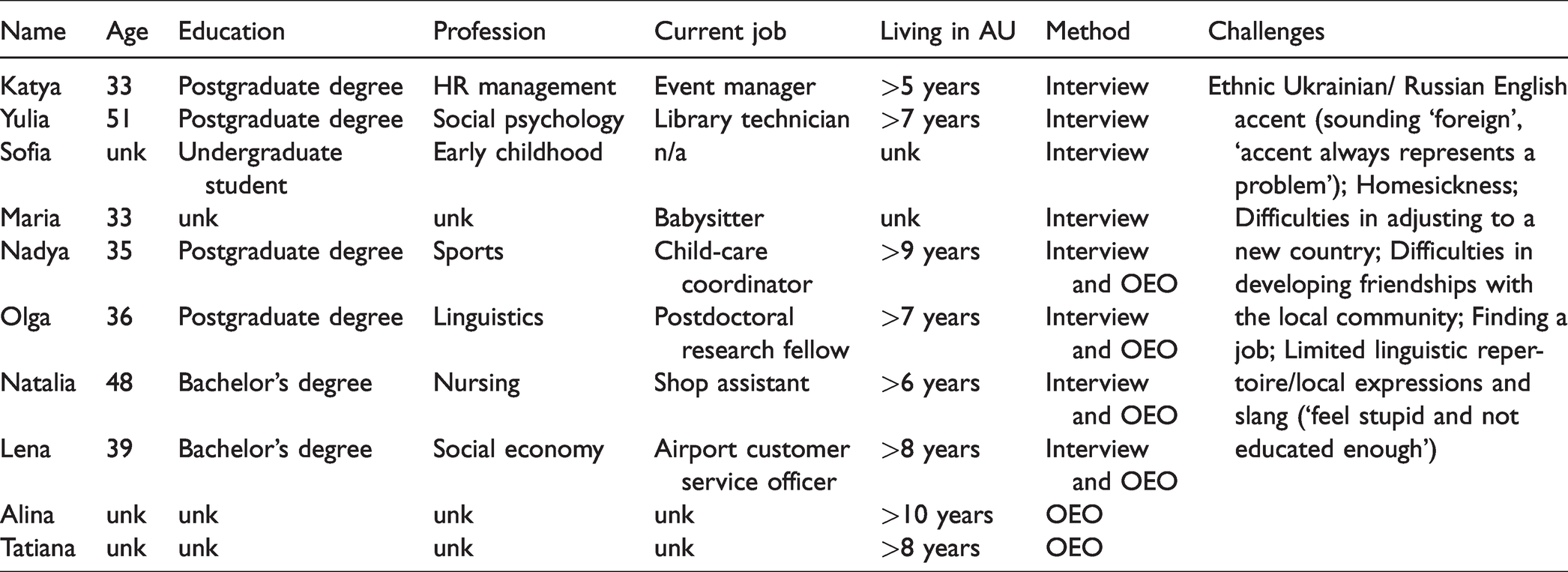
Data in this study were collected through the integration of two LE methods of open ethnographic observation (OEO) and semi-structured interview (Copland and Creese, 2015). These methods were used to fully grasp the social background, linguistic repertoires, linguistic practices, and experiences of covert and overt linguistic racism of 10 Eastern-European background immigrant women in Australia. This study, however, represents only a portion of a larger ethnographic study which investigates almost 100 migrants in Australia from diverse ethnolinguistic, racial, cultural, and religious backgrounds. Open ethnographic observation (OEO) was used first to understand the ethnolinguistic practices and realities of immigrant women in Australia. It also enabled informal interviews with them (Copland and Creese, 2015) which provided a deeper insight into those women’s perspectives, thoughts, and actions, making the interpretation more valid. Data were reflexively documented through field journals (Copland and Creese, 2015), as a source of perceptive and interpretative information, which resulted from the structured observation of the field site.
The specific group presented in this study – six of the 10 immigrants of Ukrainian/Russian background living in Australia – has been shadowed in the period from April 2019 until the present. The researchers met three of these women between two and five times in various places, such as a university campus, café, and library, and the remaining three women at a Ukrainian cultural event (February 29, 2020), which is organised every three months in the premises of a Ukrainian church in Australia. Shadowing them has given us a sense of understanding the difficulties and challenges they faced after coming to a new environment with initially limited knowledge of the local language. It showed us that these migrant women feel comfortable spending time with each other as they regain a sense of belonging and their ‘lost’ credibility through communicating in their native language.
After OEO, eight of the 10 Ukrainian/Russian background women participated in a more flexible and natural semi-structured interview, which allowed us to understand their experiences in a new country from their own personal perspectives. They were interviewed on a one-to-one basis in English, and their interviews were audio-recorded using an Olympus VN-541PC recording device. The interviews enabled them to share their story, as well as offer their own opinions (Copland and Creese, 2015) on matters they experienced, such as linguistic racism and power inequalities in the Australian labour market. Interview data helped us understand what covert and overt linguistic racism in the workplace looked like to these women, what led to it, what made it significant, and what the consequences were of such linguistic racism. All women have been living in Australia for at least five years, and are fluent in English, as well as Ukrainian and/or Russian. All participants’ demographic information is presented in Table 2, with pseudonyms to ensure anonymity.
Participants’ demographic information.
Thematic analysis was applied to identify some major questions, themes, and meaning patterns which emerged from the interviews with the study participants. Data analysis in this paper followed Braun and Clarke’s (2013) set of seven steps, such as transcription, familiarisation and coding, generating themes, reviewing and defining themes, and finalising through a written description. Interview data were transcribed using the online certified Trint software which ensures data security management. Trint allows users to upload the audio file in English and automatically transcribes it using artificial intelligence. Data were then coded by modifying Ladegaard’s (2014) transcription conventions. 1 Participants’ real-life experiences and first-person narratives were considered a priority in the analysis of the interviews as they appeared to be the main actors in their own realities. It was not only their story, and what they told us (content) that was analysed, but also how they told us their story – their paralinguistic features (Dovchin, 2019b) – that had a particularly significant role in the description of their experiences. Lastly, extensive research of the previous literature showed that our theme of covert and overt linguistic racism in the context of the Australian workplace significantly expands the critical discussions of linguistic racism and presents the new context and forms of linguistic racism to the literature on CALD migrants.
To account for the study’s trustworthiness, we followed Lincoln and Guba’s (1985) alternative quality criteria such as credibility, transferability, dependability, confirmability, and reflexivity (in Korstjens and Moser, 2018: 121). Given the sensitivity of disclosed information in the interview, as well as interviewees’ apprehension and human error (Copland and Creese, 2015), we looked at the interview as a discursive practice and the meaningful interactional process between us as researchers and the participants (Garton and Copland, 2010). Both researchers are themselves CALD migrants residing in Australia, therefore the interview and OEO data were also supported by a reflexive field journal, which was used to acknowledge self-awareness of our biases and roles in the process of data collection, analysis, and interpretation (Korstjens and Moser, 2018). We both come from post-communist countries and speak a language in the Slavic family of languages to which Ukrainian and Russian belong, which represented a good foundation for developing a friendly relationship with study participants. Our backgrounds have also given us a better personal insight and understanding of linguistic racism in the Australian context, and they made the participants feel more comfortable and safe while sharing their stories.
Covert linguistic racism
In this section, we present examples of covert linguistic racism as practised through social exclusion. In Extract 1, we illustrate how an encounter with the local Australian way of speaking English as a non-English ethnic speaker causes difficulties with understanding local English, and how it may lead to social exclusion in the workplace setting. Such social exclusion is shown eventually to cause the internalisation of negative feelings of being ‘less intelligent’. In Extract 2, we present how workplace social exclusion, based on one’s ‘foreign-sounding’ ethnic accent, can lead to a lack of support from co-workers, which eventually leads to long-lasting psychological trauma and inferiority complexes.
Social exclusion: Encounter with local ‘English’ and the feeling of being less intelligent
Nadya (35), a Ukrainian woman, who arrived in Australia in 2011 with her now ex-husband, was quite satisfied and confident with her English when she first landed in Australia. She had already learned English at school in Ukraine, and later, prepared for the International English Language Testing System (IELTS), which was her Australian visa requirement. However, she started having doubts about her English as soon as she started communicating with local Australians. Nadya reported having difficulties when communicating with banks tellers or local services over the phone because she still struggles with the local Australian accent and local Australian English expressions.
In Extract 1, Nadya reports covert linguistic racism in the form of social exclusion at her workplace, where the majority of her colleagues, who happen to be local Australian women, take a lunch break, sit together, and chat, while purposefully excluding her from lunch conversations.
Nadya: And yeah at work, when I started to work, umm, I would, umm(2.0)I probably don’t notice it much now. I think I don’t[…]maybe I don’t bother[…]but before, for example, there would be lunch time at childcare. All girls would have like, lunch at the kitchen and lunch area and then they would Researcher: Australian girls? Nadya: umm[…] For some reason, I always think if people think that my English is not my first language, that’s mean that I’m stupid.↑ Because, they are not really(1.0)// Researcher. Friends. Nadya. Yeah, they do not include you. It’s like, it’s like, it’s like they have like around themselves like it doesn’t work because, especially when they talk in their slangs.↑ Researcher. Yeah. Yeah. Or inside jokes. Right? Nadya. Yeah. There’s like[…]and I really like[…]Oh, should I ask what is, what was that about.↑
As Nadya describes, ‘All girls would have like, lunch at the kitchen and lunch area and then they would talk with each other’ (lines 3–4); ‘I would be never included in the conversation’ (line 6); ‘It's like they have like around themselves like gates’ (lines 10–11). Nadya believes that one of the main reasons for being excluded from lunch conversations was the fact that English is not her first language (line 7). In other parts of the interview, Nadya also noted some communication barriers in the workplace, such as the interruption of conversation flows due to the slower responses on her part. Nadya’s English language education at school in Ukraine possibly failed to prepare her for a real-life setting in an English-speaking country. Her school knowledge of grammar and vocabulary may not have been enough to equip her with standardised speakerism and local ways of speaking. Therefore, she was not able to fully and meaningfully participate in conversations with Australian women at her workplace, which often heavily involved local language and communicative resources, such as Australian accents, inside jokes, slang, dialects, and expressions that are not fully comprehensible to someone like Nadya, who has not been necessarily exposed to this type of very particular local way of speaking (see lines 11–13). Such language barriers, then, become a basis for social barriers as well, and make Nadya self-conscious about her ‘lack’ of English knowledge – she notes, ‘should I ask what is, what was that about’ (line 14), referring to local ‘slangs’ (line 12), and ‘inside jokes’ (line 13). In fact, all Russian/Ukrainian background participants in this study have reported that they have, more or less, experienced a similar problem to Nadya’s, where they often struggle to understand the local Australian way of speaking English; this seriously hinders them from participating in interpersonal interactions with locals.
However, being a speaker of ethnic Ukrainian English did not stop Nadya, or any other woman in this study, from shying away from conversations. Nadya maintained a strong desire to be included in the peer interaction, putting effort to contribute to the conversation – ‘And even if you try to talk it just like [them] it doesn’t work because especially when they talk in their slangs’ (lines 11–12). This line hints at Nadya’s effort in spending a significant amount of time practising her English on her own, ‘purifying’ her accent, and adapting it to the ‘Australian way’, which was mentioned a few times during her interview. Like many other immigrants who try to abandon their ethnic accents to be accepted by the local society (Dovchin, 2019b), Nadya also tries to become more ‘Australian’, as it would potentially lead to her social inclusion. Her effort, in fact, challenges the common pre-existing assumption about migrants’ intentional reluctance to assimilate into the host society due to their lack of English knowledge (Rodriguez et al., 2002). ‘In a quest for uniformity and homogeneity’, Nadya instead portrays an ‘image of the regimented subject, someone who can face the challenges of postmodern, globalized existence provided he/she submits to the process of purification and, consequently, sacrifices his/her individual agency’ (Blommaert, 2009: 253). Unfortunately, Nadya’s effort in trying to talk like her colleagues often failed, because they would introduce more complex slangs and inside jokes (lines 12–13), and she would be left in a perpetual struggle to ‘catch up’, which is overlooked by her Australian colleagues. Psychologists warn that the essential pillars of interpersonal interaction require constant care, inclusion, and nurture (Adams and Blieszner, 1992). Blocking ears and putting on blinders do not just complicate everything, but they also lay the foundation for the destruction of the collegial bond in the workplace (Dovchin, 2019b). Unfortunately, in Nadya’s case, her co-workers did not seem to put their collegial efforts into including Nadya, but rather pointedly excluded Nadya’s communicative recognition in peer interactions.
Unable to feel confident to match the language knowledge and complexity in the interaction of the dominant group in the workplace, Nadya developed an insecurity to ask for the meaning of slang words and inside jokes (line 14), because that would, perhaps, interrupt the flow of the conversation, and assumedly give others the opportunity to ‘think’ of her as less intelligent: ‘Oh, should I ask what is, what was that about’ (line 14). Nadya developed negative psychological effects of feeling ‘stupid’ (line 8), questioning her own intelligibility and competence. This fact reminds us of the examples of many of our other research participants, who have expressed the same ethos of feeling ‘less intelligent’ throughout the ethnographic studies: Sofia noted her feeling of being less ‘cool’, ‘I felt like I was so uncool and unpopular among locals sometimes. Like a second citizen’ (Informal Discussion); Yulia (51) reported her feeling of being ‘stupid’, ‘because you can’t represent yourself because of language, people can think that you’re stupid, you’re silly, you don’t deserve good treatment’ (Interview with Yulia); Natalia (48) has noted being treated as ‘stupid’ and ‘uneducated’, ‘sometimes people treat you, if you [are] not good [at] language, they, I feel they treat you like you let’s say, stupid, not educated enough’ (Interview with Natalia).
Social exclusion: Ethnic accent and the psychological trauma
Another research participant, Yulia (51), a Ukrainian immigrant woman, who arrived in Australia in 2013, has spoken of covert linguistic racism in the form of social exclusion and an ‘uncomfortable air’ at her workplace, due to her ethnic Ukrainian English accent and the psychological trauma she has experienced because of that (Extract 2). Yulia came to Australia to live with her Australian husband whom she met at the conference. She believes she has a good educational background, as she graduated as a teacher of history and obtained a postgraduate degree in social psychology. When she first landed in Australia, she had no particular knowledge of Australian English and was not prepared for the new communicative environment.
Yulia: I can.(3.0) good enough, in the *** library – public library. I did not xx, it’s very, very hard field to enter because not many jobs around. The stance that I don’t know, it was like language racism or pro- probably like lack of culture of people or people just didn’t want them.↑And, I feeling like no one supports you. It’s new job and you’re in new country. Yes, your language. English isn’t first language. You have problems with answering phones sometimes. But probably I have different that. And, I decided to talk to library manager. I just said him, ‘look, I really like, love my job, but for some reason I feel uncomfortable, psychologically uncomfortable here’. Because he’s my manager. And he said, ‘Yulia, do you know that no one sa-said that there is no And it was(1.0)for me, it was like a slap at my face↑, instead of say, ‘look what do you mean’, like, he said ‘it’s the *** Australia, what do you expect?’↑ Like something like that. And, of course, I just worked there for three months and I decided, no, no, any job this sort. Some [referring to her colleagues] treat you like that because of your accent. Researcher: Yeah. So, basically it happened at the workplace. Yulia: Yes. And again, I don’t see it’s racist or[…]↑Again, the problem is they just didn’t want to see me there, because they have different plans for different people. I don’t know. It’s just like I can[…]I’m to see want to give any interpretation from myself. Because I know that I am subjective, very subjective.
Yulia recalls social exclusion at the local library where she worked, having no support from her co-workers and a manager, ‘You have that feeling like no one supports you’ (lines 5–6), ‘people just didn’t want stranger betwee-between them’ (lines 4–5), ‘they just didn’t want to see [her] there’ (lines 17–18), and as if she, in a way, changed their plans – ‘they have different plans for different people’ (line 18). These statements indicate her isolation in the workplace, finding no support from co-workers in some basic tasks, such as answering phone calls (line 7).
The feeling of isolation and no support in the workplace, according to Yulia, is correlated to her strong ethnic Ukrainian English accent, ‘Some [referring to her colleagues] treat you like that because of your accent’ (lines 14–15). Even though she can speak English fluently, her language insecurity makes her feel ashamed of her accent, which reminds us of the internal feelings of shame of Japanese non-native English speakers (Hiramoto, 2013). Yulia’s apologetic nature in terms of her ethnic accent possibly stems from her belief that good grammar and pronunciation are the most important features of speaking a language well.
Even though linguistic, cultural, ethno-racial, and social diversities are continuously exoticised and are yet to be normalised (Dovchin and Lee, 2019), linguistic racism is slowly being perceived as a normal occurrence in modern society. After Yulia reached out to her manager to express her feeling of isolation and non-support from her co-workers (lines 9–10), her manager, unfortunately, normalised her feeling of exclusion by warning her that racism is normal in Australia, ‘do you know that no one sa-said that there is no racism in Australia […] it’s the *** Australia, what do you expect’ (lines 11–13). The manager’s statement seemed to give grounds for favouring his own Anglo-Australian group, ‘making it seemingly rational on the grounds that a particular language competence is necessary for becoming a bona fide citizen, [and] for performing well in the job’ (Ng, 2007: 108). Negative attitudes towards Yulia’s English and her accent, then, became a normal event as it was her ‘responsibility’ to learn how to speak standardised Australian English. Covert linguistic racism, in this context, was routinised by Yulia’s local Australian manager.
Covert accent-based linguistic racism, expressed in the form of social isolation, caused Yulia to suffer long-lasting psychological trauma. Feelings of shame based on her ethnic Ukrainian English accent, as well as the normalisation of linguistic racism by her manager, made it a self-reported traumatic experience for Yulia. Such experiences result in low self-esteem, confidence issues, and additional stress (Lipinski et al., 2013), which are also reflected in Yulia’s emotional reaction – crying (line 1). Similar to Ladegaard’s (2014) immigrant’s narratives, crying, which was probably evoked by previously unexpressed emotions and a long-lasting psychological trauma (Labott et al., 1992), left a mark in Yulia’s broken narrative (line 1). Her experience resulted in the development of language-based inferiority complexes – ‘I feel uncomfortable, psychologically uncomfortable’ (line 10); ‘I would be really happy if one day I could speak [English] beautifully’ (Interview with Yulia). Inferiority complexes, associated with the lack of standardised English accent, the institutionalised social inequality, and feelings of foreignness (‘stranger’ – line 4) led to her language subordination (Piller, 2016). Yulia reports how people in power (her manager) used her weakness to make her feel worthless, which consequently makes her normalise the linguistic racism, and doubt her own judgements – ‘I don't see it’s racist or…’ (line 17), ‘I’m very…very, very subjective here’ (line 19). Lastly, Yulia’s self-consciousness, a product of the long-lasting psychological trauma, makes her always question her accent and prevents her from making small talk in English (reported in the interview). As a victim of the covert linguistic racism in the workplace, Yulia sees standard language skills and standardised accent as factors which lead to success in life.
Overt linguistic racism
In this section, we introduce the examples of overt linguistic racism as practised through mocking, mimicking and malicious sarcasm. In Extract 3, we show how the ethnic accent of the participant Nadya becomes a point of mockery, which leads to her psychological distress, including stress and insomnia. Extract 4 presents sarcastic remarks based on the ‘non-standardised English’ of participant Lena. We show how Lena, as the victim of overt linguistic racism in the form of sarcasm, feels humiliated. Consequently, she uses coping mechanisms as well as therapy with a psychologist to overcome her long-lasting psychological and emotional burdens (Extract 5).
Mocking and mimicking: Ethnic accent and insomnia
While Yulia in Extract 2 has reported experiencing covert linguistic racism in the form of social exclusion based on her accent, another participant, Nadya (35), in Extract 3, speaks of overt linguistic racism in the form of mocking and mimicking her Ukrainian English accent in the workplace.
Nadya: Yeah, you know, actually, I had a few times also when, even months ago, I[…]because as a coordinator, I can work sometimes in different services in child-care, I can go from one place to another. And sometimes when I go to other centre, I went actually, when on one service. And there[…]there were↑ lots of young girls – Australian girls. I will say when I work with more older women(1.0)//It’s a different situation. But I worked with younger girls, it’s a little bit, ugh(1.0)So, when I went there and as a co-ordinator, sometimes I have to point on the stuff that is… it’s not turned around and I saw they were making faces about my accent↑ just like [facial demonstration]. I just turned around↑ because, like, at work I got used to look everywhere because of the children stuff. I have to like(1.0)//Like, multitask, and while I was talking, I turned around, and they behind me were just like making fun of the accent. But I even had it long time ago that… that while I was talking to actually, making Researcher: How do they make fun of accents? Nadya: They(1.0)they were just saying, like, all like [facial demonstration] like [facial demonstration]. That funny face, then(1.0)//And, and, also like they were actually like copying my words↑, and the way how I say↑. Researcher: Mocking. Yeah? Nadya: Yeah. So, they were like copying the words and obviously, I when[…] when they have this face expression and plus like making those words like how Obviously it doesn’t[…]I caught it few times. And as[…]I was really like[…]I was really upset. I actually refused to go to, as even as my job, to go to that centre. I have to go sometimes to check what they do, but I’ve refused to go there. Researcher: Did you complain? Nadya: Umm(1.0)no, I didn’t complain. I just(2.0)I
As a coordinator in the child-care centre, Nadya’s responsibility was to monitor her co-workers and correct their mistakes. However, Nadya started experiencing overt linguistic racism, as she recalls having her accent mimicked and mocked by her Australian female co-workers, ‘I turned around, and I saw they were making faces about my accent’ (lines 7–8). She recalls positive experiences working with older women (line 5), as opposed to younger women (ca. age 19) whose immature behaviour, perhaps, resulted in mockery. Overt linguistic racism by younger women may be caused by feelings of suspiciousness and social comparison (Zurriaga et al., 2018). In another incident, Nadya loses her authority when her Ukrainian English accent becomes a point of mockery by her local assistants, ‘they were standing in front of me looking at me, and they were actually, making jokes about my accent’ (lines 12–13) and ‘they were actually like copying my words, and the way how I say’ (lines 16–17). As accent is often connected to the concept of credibility (Lee, 2018), Nadya’s credibility is questioned because of her foreign-accented speech. She eventually experiences the loss of credibility because her ‘lower’ status of an immigrant in society begins to overpower her ‘higher’ position in the workplace. She recalls how words lose meaning when she self-reportedly mispronounces them, so people laugh at her instead of helping correct her pronunciation. Perhaps unintentionally, Nadya begins to justify the mocking by her assistants, ‘obviously, I do have strong accent’ (line 19), which illustrates the victim’s justification and normalisation of racism, and shows how overt linguistic racism affects one’s psychological well-being.
The aggressive and direct nature of the overt linguistic racism may lead to serious consequences for one’s psychological strength (McClanahan et al., 2015). Particularly, in the institutional setting, such as the workplace, overt linguistic racism may affect job performance (Höel et al., 2003) and satisfaction (Hauge et al., 2007), and possibly even generate an inability to continue working in the same workplace (Namie and Namie, 2000). This was similar for Nadya, who felt disturbed after being mocked by her co-workers/assistants, ‘I was really upset’ (line 21), so she refused to work at the centre where the incidents happened – ‘I actually refused to go to, as even as my job, to go to that centre’ (lines 21–22). As a result, she experienced substantial stress and frustration, which affected her psychological well-being. Victims of linguistic racism in the workplace usually develop physical symptoms due to substantial stress, such as anxiety and depression (Hauge et al., 2010), as well as insomnia (Namie, 2003), and carry these problems to their home environment. Nadya’s experience further supports such findings, as she reported experiencing insomnia because of the incident at the child-care centre, while also developing feelings of guilt for not confronting her co-workers and standing up for herself, ‘Umm…no, I didn’t complain. I just…I know I didn’t complain’ (line 25). Further in her interview, Nadya explained that, even after sharing the information about being mocked with her husband and friends, the frustration about the event prevented her from sleeping at night as she constantly thought about the incident and was still significantly bothered by it.
Sarcasm: Non-standardised English and psychological distress
Our research participant, Lena (39), a Russian woman, who arrived in Australia in 2012, has reported experiencing overt linguistic racism mostly because of her overall English language knowledge. Despite attending English language courses in the United Kingdom and Australia for several months, when she landed in Australia Lena experienced difficulties with English. For example, she lost her first job as a secretary in an accounting company due to problems with understanding phone calls. Lena also reports having difficulties when communicating with local Australians as she fails to understand slang and local expressions.
After losing her first job due to having communication problems in English, Lena started working on developing and improving her English. She was content with the level she had achieved in her English knowledge, as she notes, ‘like at that time, my language got much better’ (Interview with Lena). However, Lena still encountered problems at her next job – the mining site, where her English practice faced scrutiny (and sarcasm) from her supervisor (Extract 4).
Researcher: How did they bully you, or harass you? Lena: (6.0)Like, I had a supervisor in the kitchen who was very she try to//She tried to give me tasks like(1.0)I felt like(3.0)she was avoiding me. No, never like normal talk↑, like very[…]I think now she was a bit, I wouldn't say intimidated, but education, like, you know. But I was good with, with chefs. And one of the chefs said, like, ‘oh, you know what’, her name was Amy, yeah, she said like, ‘do you know what Amy and her friend(1.0)think about you?’ ‘Yeah, like tell me, please’. She said they think you are un-und-[…]It was like a TV show, something undercovered or Researcher: Undercover boss. Yeah. Lena: She said, ‘you are undercover boss. You are pretending that you don't understand English very well’. Researcher: Oh, wow. Lena: ‘And(2.0)you just play with them’. I said, ‘well, it sounds[…]↑Thank you’↑.
Lena’s supervisor would avoid talking to her, ‘I had a supervisor in the kitchen who was very annoyed with me all the time’ (line 2), ‘she was avoiding me. No, never like normal talk’ (lines 3–4), ‘she even didn’t call my name. She just, with me like a horse’ [click click] (Interview with Lena). Overt linguistic racism, in this context, might have originated from the internal jealousy towards Lena’s personal values (Zurriaga et al., 2018), as she says that her supervisor ‘was a bit…I wouldn’t say intimidated, but young. No education, like, you know’ (lines 4–5).
Some workplace environments set up grounds for competition between employees where they become rivals for ‘attention, validation, power, and resources’ (Field, 2013: 185), which often leads, in turn, to jealousy and negative behaviours. In one incident, Lena’s supervisor expressed her annoyance through sarcasm (Greek ‘sarcazein’ which means ‘to speak bitterly, sneer’ – Online Etymology Dictionary), ‘you are undercover boss. You are pretending that you don’t understand English very well’ (lines 10–11). ‘Undercover boss Australia’ is a TV show which premiered in 2010. The concept of the show included a high-level executive or the owner of a corporation who went undercover as the lowest-level worker to investigate the efficiency and efficacy of their employees. The undercover boss takes an alias, changes their physical appearance, and tries to remain unrecognised by their employees. Being bitterly called ‘undercover boss’ by one’s colleague could be interpreted as sarcastic linguistic racism. On the one hand, Lena is endowed as a ‘boss’ even though everyone knows she is not a boss. On the other hand, Lena is bullied as disguising her ‘bossness’ through her English, hinting that her ethnic Russian English is poor. Lena’s physical characteristics – looking ‘Australian’ – are potentially making her ‘privileged’, perhaps, as a ‘boss’ who is only pretending to speak ‘poor’ English. However, ‘privilege’ fails as Lena still suffers from sarcastic mockery of her English skills.
Sometimes, victims of a direct confrontation develop a coping mechanism to help them traverse their stressful experiences. Coping refers to sensible and flexible ways of thinking, which serve to overcome barriers and reduce stress by using coping devices, such as ‘self-control, humor, crying, swearing, weeping, boasting, talking it out, thinking through, and working off energy’ (Folkman and Lazarus, 1984: 119). Victims of bullying, in many cases, feel humiliated, but for Lena, coping devices such as self-control and humour helped her overcome the negative consequences of being ridiculed. Self-control and humour made ‘an undercover boss’ sound ‘rewarding’ for Lena, as she said, ‘well, it sounds…Thank you’ (line 13). Lena’s coping mechanism is also shown in Extract 5, where she explains how self-control and supressing her emotions helped her move forward. Nevertheless, Extract 5 also shows that CALD migrants’ psychological health remain in question, as they block their emotional responses in order to find ways to support themselves financially.
Researcher: How did you[…]How did you feel when they said you should leave? Lena: (7.0)Well, Researcher: It’s alright. Lena: The only one thing was that I have to different people react(1.0)// Researcher: Differently. Lena: Differently. So, I[…]I wasn’t[…]I cried like[…]my, probably the first emotions. It’s[…]it’s not a pleasure. Then I said, okay, well, there’s no time for panicking. Let’s cr-cry later. Now I’ll have to find another job. Quickly, like, my friend helped me too. Find to go to the interview.
Meanwhile, Lena was asked to leave her workplace after being a victim of linguistic racism multiple times, and when asked about her feelings in the interview, she started crying (lines 2–3). Lena’s case reminds us of Yulia (Extract 2), as both victims revisited their experiences with linguistic racism, which left a long-lasting emotional and psychological burden. Lena, in fact, shows a significant amount of anxiety during her interview, presenting broken narratives and long pauses, ‘I felt like well, panicking because…that time I was…Sorry. Divorced al-already and…’ (line 3). Being sarcastically ridiculed because of her assumedly limited English skills resulted in Lena’s low self-confidence, and decreased productivity at her latest job at the airport, ‘when you do the boarding, you have to do announcements’, ‘I was scared to death to do it’ (Interview with Lena). The psychological damage of linguistic racism appears to be a complex and serious issue, as victims usually report severe symptoms of depression, such as suicidal intentions and anxiety, over speaking English (Dovchin, 2020b). Ultimately, Lena’s fear of speaking English in public meant that she was advised by her ex-husband to get professional help, as she showed signs of anxiety and feelings of panic. She met with a psychologist once a month over a period of two and a half years. She was able to talk to him in Russian as he had a Russian background and an Australian degree. Lena found these therapy sessions very helpful as she felt comfortable explaining her feelings to the psychologist. Lena’s current situation in Australia seems to have improved as she regained her psychological strength, ‘The only one thing was that I have to survive’ (line 5), and as she refocused on her everyday life responsibilities.
Conclusion
Drawing on data examples retrieved from Eastern-European (Russian/Ukrainian) background immigrant women living in Australia, this study seeks to expand the concept of linguistic racism in the institutional setting. It does this by drawing a clear line between more subtle covert linguistic racism, such as social exclusion, and more direct, overt linguistic racism, which appears in the form of mocking, mimicking, and malicious sarcasm. Both are based on one’s ethnic ‘foreign-sounding’ accent, limited encounters with local expressions, and non-native English skills, and have psychological and emotional consequences for one’s psychological well-being.
‘Linguistic racism’ is a form of ‘new racism’, which represents discrimination based on one’s language background, communicative repertoires, and language practices. While one’s phenotypical features such as skin colour may often trigger racism, language may also play a sizeable role in racism and power inequality. As our study presents, when all these women of Eastern-European background participate in more specific contexts, such as the workplace, they seem to experience linguistic racism because of the ‘colour of their English’ (Creese and Kambere, 2003), a type of non-standardised ‘Russian-sounding’ English accent, use, and practice, which reflects one’s ethnic, sociocultural, and linguistic identity. Their race does not make them privileged or protect them in a new environment, because there is the factor of a new language which places all immigrants on a similar lower level of the power hierarchy in the institutionalised setting of the (Anglo) host society. Workplace environments particularly represent a grey area for human rights, as they may be a platform for subtle but also direct forms of linguistic racism. The ‘real problem’ of foreign language practice is often masked with ‘false’ reasons for one’s educational and practical unsuitability for the job. Therefore, this study represents both covert and overt linguistic racism – subtle and direct abuse aimed at one’s ethnolinguistic background.
Covert linguistic racism appears as an indirect passive-aggressive mistreatment based on one’s non-native English language skills, ethnic accent, and linguistic repertoire. It most often appears in the form of social exclusion initiated by negative attitudes towards one’s limited access to local expressions and slang, as well as an ethnic accent which consequently hinders immigrants’ adaptability to a new institutional context in the host society. Overt linguistic racism, on the other hand, reflects a more direct form of abuse which appeared in the form of mocking, mimicking, malicious sarcasm, joking, and laughing geared towards one’s ethnic accent and English language practice.
Victims of linguistic racism in this study were verbally and non-verbally harassed and humiliated solely because of their language ‘foreignness’. They became both a focus of laughter and the victims of malicious sarcasm and social exclusion by the local Australians in their workplace. Our study further shows that these forms of linguistic racism may have serious consequences for the psychological and emotional well-being of the victims. As ‘English became the measure of intelligence’ and the determinant of progress (Thiong’o, 1994: 438), lack of success in developing standardised knowledge in its use and accent may lead to development of inferiority complexes, such as self-doubt about one’s ethnolinguistic confidence and ability (Piller, 2016). After becoming victims of linguistic racism in the workplace, our participants developed pessimistic self-perceptions of being ‘less intelligent’, and having related self-confidence issues, low self-esteem, psychological trauma and distress, shame, humiliation, stress, insomnia, and depression. Overall, due to the perceived language induced ‘incapability’ emerging from the ideologies of linguistic racism, immigrant communities often find it difficult to psychologically and emotionally adjust to the labour market in host societies.
In the face of Australian multilingualism, there is still a gap in academic work on immigrants’ linguistic adaptability to a new environment, while the language disparities that they face in many aspects of their lives still need to be addressed (Dovchin, 2019b). Unaddressed workplace linguistic racism, first and foremost, creates a toxic climate between employees which causes distressing consequences for targeted employees but also causes workplace dissatisfaction, as well as multilevel organisational issues including significant economic losses (Lutgen-Sandvik and Arsht, 2013). What is necessary, then, for a positive workplace relationship, including acceptance and inclusion by colleagues, is a set of what Smith (2007: 181), in a different context, calls ‘strategic manoeuvres designed to achieve, manage and maintain collective peer group status in the conflict‐ridden environment’. Strategic manoeuvres for CALD migrants in the workplace would entail normalising diversities and refocusing from the preference for sociolinguistic and ethnic homogeneity to advocating for its heterogeneity. Such strategies decrease the risk of exclusion, of being pigeon-holed as other and different, and being excluded by the prevailing culture (Smith, 2007: 181). Relatedly, we need to highlight the importance of developing and enforcing a language-based antiracist policy for the labour market (Radliff, 2013) as a future step in fighting workplace linguistic racism. Lastly, we need to continue to reveal the ethnolinguistic realities of underprivileged communities, assist them in adapting to their host societies, and help them regain some degree of power equality in their institutional environments with respect to their language use and wider racialised positioning.
Footnotes
Acknowledgements
We want to thank our research participants for lending us their voices. We thank the Special Issue Editor, Professor Stephen May, for his understanding and patience. Our thanks also go to the anonymous peer reviewers, who meticulously reviewed this paper. We wish to acknowledge Stephanie Dryden’s work on copy editing this paper. This paper is dedicated to the loving memory of our dear colleague Professor Jan Blommaert.
Declaration of conflicting interests
The author(s) declared no potential conflicts of interest with respect to the research, authorship, and/or publication of this article.
Funding
The author(s) disclosed receipt of the following financial support for the research, authorship, and/or publication of this article: This research was funded by the Australian Research Council (ARC) (grant number DE180100118) and by Curtin University of Technology (AU) CIPRS and Research Stipend Scholarship (RES-58667).
