



Abstract
Since the turn of the twentieth century, the Kurds in Iran have faced various forms of linguistic exclusion. As part of a genealogical project, this article aims to track the lineages of this exclusion. The linguistic exclusions are inscribed in a field of discursivity, which, tracking one of its lineages, turns our attention to the orientalist interventions. The article discusses two complementary projects: the authentication of the Persian language and the othering of the Kurdish language. These projects were made possible by the hegemony of territorial and linguistic discourses over orientalist studies in Iran. Orientalists proposed a periodization of Iranian languages, dividing them into old, middle, and modern eras, with Persian represented as the sole language that has ever existed throughout history, based on their decoding of ancient manuscripts. Meanwhile, the Kurdish language was completely marginalized, and Persian was represented as the essence of all Iranian languages and, consequently, as the language of all Iranians. As a result, an ontological and epistemic horizon emerged, on which all subsequent instances of othering of the Kurds became possible. Finally, the article also examines the ways in which the Kurds have resisted the linguistic exclusions.
Introduction
First, in a confidential letter addressed to the Education Offices of all cities, the General Education and Training Office of Kermanshah Province announces the following: ‘With due respect, in order to enhance the proficiency of the standard language, uphold the official language of the country, and protect the rights of non-native students in the classrooms, it is advised that all colleagues be instructed to use Persian for teaching and conversation within the educational environment, while refraining from employing any regional dialects’ (December 2012 Appendix No. 1).
Second, in an official letter addressed to the General Director of the Ministry of Culture and Islamic Guidance of Fars Province, the Public Facilities Supervision Office of the General Command of the Law Enforcement of Fars Province requests a review and consideration regarding the issuance of a license to use the word ‘Jina’ for naming a bed set guild unit. Eventually, the letter is forwarded to the appropriate expert, stating, ‘The Facilities Supervision Office should be informed that the use of this word is not possible as it is of
Third, regarding the recent achievement of a Kurdish mathematician, who changed his name from Fereydoun Derakhshani (Persian) to Caucher Birkar (Kurdish), the Vice President for Science and Technology of Iran, Sourena Sattari, acknowledges that ‘whether or not he wishes, Caucher Birkar is Feridun Derakhshani, who is and will be an inspiration for many young people in the country’. 1
Fourth: On August 19, 2021, coinciding with the Day of Ashura, a group of Persian students removed all Kurdish words from the official boards of Kurdistan University. 2
‘How were our voices silenced?’ is the question that may have arisen among Kurds living in Iran, closely related to the four facts mentioned above. The first document explicitly prohibits the use of Kurdish, the native language of Kermanshah, in the school environment. The second document represents Kurdish as a non-Iranian language, leading to its exclusion from the public sphere. The third fact also signifies how the Kurdish elements are represented as external in the hegemonic discourse. After winning the Fields Medal, Caucher Birkar dedicated his award to the Kurds and changed his name to a Kurdish one, which sparked reactions in Iran. More often than not, changing one’s name from Persian to Kurdish is seen as separatist behavior and a betrayal of the homeland. The mathematician is expected to have an authentic identity tied to the Persian culture and language, and any disconnection, even in favor of the mother culture (Kurdish), is viewed as a form of betrayal. Finally, the fourth fact clearly illustrates the intolerance of the hegemonic discourse toward the presence of the Kurdish language in formal and public spheres. Generally, Kurdish, its orthography, and all its distinct components are seen as separatist elements in the discourse of ‘Iran’ (also see Soleimani and Mohammadpour, 2019: 929–930).
Such facts are highly evident in present-day Iranian society, constantly reminding us of the question raised by Alireza Asgharzadeh in Iran and the Challenge of Diversity, which has yet to meet a proper answer: Why is Kurdish, along with non-Iranian languages like Turkish, Turkmen and Arabic, subjected to exclusion despite being considered Iranian according to common linguistic definitions? (Asgharzadeh, 2007: 99, 161, 186). The question would be best answered in the context of the history of Persian nationalism. Drawing on Žižek’s Hegelian conceptualization of ideology (Žižek, 1994: 9), we can provide a historical account of the emergence of Persian nationalism in three forms: as the doctrine (a complex of ideas), as the ritual or the ideological state apparatuses, and in the spontaneous’ (self-) experience of subjects. It is believed that Persian nationalism can be traced back to the mid-19th century when Persian intellectuals began proposing nationalistic ideas (Vaziri, 2013: 163–165; Mara’shi, 2008: 57; Mohammadpour and Soleimani, 2022: 186). During this period, the Qajar dynasty was witnessing the rise of some forms of intellectuals’ shame of the country’s unsatisfactory condition (for example, see Kermani, 1986: 164, 165; Maraghe’ei, 1894: 67). The condition had been problematized for intellectuals because of traumatic events such as territorial loses due to Russo-Persian wars (Mohammadpour and Soleimani, 2022: 186), economic crisis leading to population migration to other countries, rumors about Iranian women being sold into forced prostitution (Kermani, 1967: 225; also see, Najmabadi, 1998) and, as Zia-Ebrahimi (2016b) has stated, “the traumatic discovery of the European Other” (pp. 19–27). These events prompted intellectuals to questions such as ‘why was the glorious past lost?’, and ‘how have European countries gotten the upper hand over us?’
In addressing the problem, intellectuals such as Jalal od-Din Mirza (1832–71), Mirza Aqa Khan Kermani (1854–1896), and Mirza Fatali Akhondzadeh (1812–1878) advocated for the resurrection of glorious ancient Persia and raised the idea of an imagined nation based on the Persian language (see Seidel, 2019: 334; Kia, 1998). This was an articulation of Persian nationalism as a doctrine, about which Cole (1996) has argued that ‘Iranian national identity was not prevalent, hence it was not needed to be symbolized, but an idea yet to be realized’ (p 37). However, it was through a series of events that Persian nationalism was materialized and its institutions and subjects were gradually constituted. As first-hand accounts indicate, it was around the Constitutional Revolution that a nationalistic slogan, i.e., ‘Long Live the Nation of Iran,’ was heard from a group of Persians in Tehran for the first time (Kermani, 1967: 124; also see, Abrahamian, 1979: 405). The Constitutional Revolution was followed by the establishment of national institutions, such as ‘the National Consultative Assembly’ and, a few decades later, the ‘modern-national state,’ which both universalized the Persian elements and excluded non-Persian ones (Bazafkan and Rezaei, 2020: 12). Vali (2011) argues that ‘although the Constitution of 1906 did not contain an ethnic definition of the conditions of citizenship, the exclusion of ethnic difference from the political process amounted to the denial of ethnic identity’ (p. 4). At the same time as the constitution of a modern state by the Pahlavi dynasty, Persian nationalism became hegemonic. Mohammadpour and Soleimani (2020) have explained how Persian nationalism was materialized: “Reza Shah’s accession to power with the motto, ‘One Nation, One Language, and One Country’ paved the political ground for materializing what Iranian intelligentsia had dreamed for decades” (p. 3). Despite claims by the ruling elites after the Islamic revolution that non-Persian ethnicities would not face nationalistic exclusion under an Islamist order, the state ideology remained nationalist (Elling, 2013: 4; also see Mohammadpour, 2023: 5). Indeed, the Pahlavis’ nationalist discourse had become so sedimented that hardly could be dislocated.
What is important to us is that Persian Nationalism and its ethnic exclusions became possible in the context of Iranologist discourses, at the heart of which were the projects of ‘the authentication of the Persian language’ and ‘the othering of non-Persian languages.’ This is the moment on which we shall focus, so that we can shed light on the linguistic othering of the Kurds.
‘How the Kurds were othered?’ A short glimpse
The issue of how the Kurds became marginalized is complex and multifaceted, and it is beyond the scope of this study to fully explore. However, it can be traced back to Naser al-Din Shah Qajar’s (1831–1896) remarks on the Kurds following Sheikh Ubeydullah’s revolt. At the same time as the problematization of the situation for Persian intellectuals, the revolt spread from Turkey to Iran, causing for the government and intellectuals about the potential separation of Kurdistan from Iran. 3 In response to the above-mentioned unsatisfactory status quo of the country, some regions of Kurdistan joined the uprising instead of seeking refuge in other countries. Naser al-Din Shah Qajar expressed surprise at the situation, claiming: ‘I never thought that the western Iranian Kurds, who have historically guarded the western borders, would do this. The Kurds have a long history of civility. I never expected the Kurds to act like the Turkmens in eastern Iran’ (October 11, 1988, as quoted by Mirza Aziz, 2000: 14). 4 Right at this moment, the indications of othering of the Kurds could be observed, in which the signifier ‘Kurd’ was related to other signifiers such as ’insurgent,’ ‘heretic,’ ‘Yazidi,’ ‘barbaric,’ ‘rebellious,’ and ‘uncivilized’ (Afshar, 2008: 45, 104, 105). After the suppression of Sheikh Ubeydullah’s revolt, Kurdistan was represented as a threat to state security. 5 This perception persisted even after the Persian Constitutional Revolution (1905-2906), leading to the the neglect of The Kurds’ demands in the Constitution and eroding their trust in the new order (see Azari-e Shahrezaei, 2006: 69, 127, 128, 232). In 1907, the Kurds opposed the Constitutional movement by supporting Salar al-Dawla (Mardukh Kurdistani, 1973: 283), and continued to struggle against the ethnic exclusion inscribed in Persian nationalism until the foundation of the modern state. All of these were used as justifications for demonizing the Kurds. 6 As the modern state took shape, linguistic assimilation became a strategy employed by Persian rulers and intellectuals to address the Kurdish problem, with an aim to eradicate Kurdish language and assimilate it into Persian. This national plan was implemented by the Pahlavi dynasty to ‘eradicate all languages besides Farsi by criminalizing their use and by destroying the minorities’ language schools’ (Mohammadpour, 2023: 186). Even after the 1979 Revolution, Kurdish ethnic and cultural distinctions were viewed as a threat to national security, resulting in restrictions on the use of Kurdish in official contexts (Mohammadpour and Soleymani, 2022: 193).
It is important to acknowledge that the Kurds have faced multidimensional exclusion, overdetermined by various factors such as ethnicity, language, religion and geography. However, one common aspect that all Kurds have experienced is linguistic exclusion, which its lineages can be traced back to Orientalist interventions.
Orientalism, Iranology and the linguistic othering of the Kurds
The systematic Orientalist studies appeared in the aftermath of the presence of Orientalists in the East during the colonial era, and were specifically influenced by the Aryan race superiority theory. The term ‘Aryan’ was borrowed by Anquetil-Duperron from Sanskrit and Avestan texts to refer to the people who had written the Avesta. However, the birth of the Aryan myth is attributed to Sir William Jones’ discovery in 1786, which claimed that Greek, Latin, Sanskrit, and Old Persian languages all shared common roots (Renfrew, 1989: 9; Vaziri, 2013: 219; Zia-Ebrahimi, 2016a: 108, 109). In 1813, Thomas Young coined the term ‘Indo-European’ to describe a group of related languages (Zia-Ebrahimi, 2016b: 11). These two signifier, ‘Aryan’ and ‘Indo-European’, became the nodal points of the Aryan discourse for the later Orientalists.
Initially, the ideas about the relationship between the Aryan race and the Indo-European languages were fictional and based on the correspondence between race and language. However, they later gained acceptance as scientific facts due to the intervention of Orientalists. 8 During this this time, history witnessed the emergence of discourses attempting to fill the empty signifier ‘Aryan’ by articulating different nodal points and constructing a single identity for different groups of people by setting them in a chain of equivalences. Therefore, the focus of racial studies shifted to the study of languages, particularly in search of the ancient roots of the similarities between Indo-European languages and original homeland of the Aryans (Renfrew, 1989: 13-14). Orientalists such as Duperron, Jones, and Herder believed that Iran was the original homeland (Rezaei-e Baghbidi, 2014: 28; Renfrew, 1989: 15; Zia-Ebrahimi, 2016a: 112). As a result, many excavations and studies were conducted by archaeologists in Iran to uncover signs of this original homeland and proto-language.
The approach of Iranologists, who were primarily focused on Iran rather than the broader Orient, differed significantly from that of Orientalists. Iranologists viewed the language, literature, and other aspects of Iranian culture as evidence of the advanced civilization of the Aryan race in the Eastern region, rather than considering them as inferior elements. The archaeological studies conducted during this time were aimed at providing scientific evidence for the Aryan myth. This process can be described as the “sciencization of myths,” which involved the interplay between Aryan mythology, linguistics, and archaeology (See,(Ansari, 2012): 8-12).
During the Qajar era, France and England competed for permission to conduct archaeological excavations in Iran. As Abdi has extensively discussed, each country had periods of dominance (Abdi, 2001: 51–76). In 1895, Nasser Eddin Shah granted exclusive excavation rights throughout Persia to French archaeologists. Prior to this, orientalists such as De Sacy from France, Baron Th. A. de Bode from Russia, and Austin H. Layard and Henry C. Rawlinson from England, as well as G. F. Grotefend from Germany, had conducted significant archaeological and linguistic studies on Iran’s history (Abdi, 2001: 53-54; also see Mohammadpour and Soleimani, 2022: 188). French monopoly over excavation continued until 1931 when American archaeologists caught the attention of Reza Shah, a few years after Arthur Upham Pope’s speech at the Society of National Heritage in Tehran. According to Mohammadpour, ‘Western archaeologists and Iranologists such as Pope, Herzfeld, Richard Frye, and Goddard, among others, having established close relationships with the Iranian authorities, molded archaeological records to fit the narrative of the “unified Iranian identity’” (Mohammadpour and Soleimani, 2022: 188). Thus, there was a state-sponsored archeology being raised in which the Pahlavi state hired European and American archeologists to Provide evidence and epistemological legitimacy for the Persianization of Iran’s past...voice or silence the past selectively in favor of the state nationalist discourse, and excavate specific sites and translate all cultural and archaeological values into “the heritage” of the sovereign ethnie (i.e., Persians) (Mohammadpour and Soleimani, 2022: 185-186).
This trend continued into the second Pahlavi era, during which Mohammad Reza Shah hired a group of Iranologists to write a Persian nationalistic book titled The Legacy of Persia (1953). The book focused on reducing all of Iran’s legacy to Persian language and culture. This action can be seen as similar to the colonial encounter described by Soliman as “a ‘process’ during which the cultural diversity and heterogeneity of indigenous cultures are systematically and deliberately eliminated or silenced, imposing a single and univocal cultural identity” (as quoted by Mohammadpour and Soleimani, 2022: 187). The articulation between “Persian language” and “the idea of Iran” became possible through the hegemony of two archaeological discourses that had emerged as a result of orientalists’ interventions in previous decades. The first discourse drew references from Sassanid tablets to construct the idea of Iran, allowing its articulation in a territorial discourse. In the second discourse, there was a linguistic connection between ‘Iran’ and ‘Persian’ signifiers. These two archeological moments facilitated the initial traces of the othering of the Kurds in the discourse of Iran.
The territorial discourse of Iran
In the discussion on the discovery of the signifier Iran in the Sassanid texts and its articulation in the Aryanism discourse, it is important to acknowledge that during the age of Persian Empire, there was no unified and comprehensive identity in Persia (Nategh, 1989). However, De Stacy’s interpretation of the Sassanid inscriptions presented a different perspective. He proposed an understanding of Iran implied a cohesive and all-encompassing identity for the empire’s inhabitants. While western travelers had been recording the Sassanid inscriptions since the 17th century, it was De Sacy who successfully deciphered these texts for the first time between 1787 and 1791. His findings were published in Memoirs on Various Antiquities of Persia (1793) (Gignoux, 2007: 1206). 9 Through his analysis of the Naqsh-e Rostam, Persepolis, and Kermanshah inscriptions, De Sacy interpreted the phrase ‘Malcān Malcā ērān ud anērān’ as ‘the king of kings of Iran and Turan’. In his understanding, Turan was not seen as a specific country but rather a geographical area comprising non-Iranian lands, similar to Berber for the Greeks and Ajam for the Arabs (De Sacy, 1793: 183). 10
De Sacy’s interpretation, which clearly had racial and territorial implication, gained popularity as it aligned with the discourse of Aryanism. This territorial signification of Iran was articulated in reference to the nodal point ‘Aryan’ through the interventions of De Sacy and his students. Their works formed a powerful current of archaeological and historical research based on the authenticity of the signifier ‘Iran’. Later, Gherardo Gnoli made a significant contribution to this field by tracing the history of the signifier ‘Iran’ in the Zoroastrian texts. He claimed that the word Arya ‘distinguishes the Zoroastrian lands and people from the non-Zoroastrians’ (As quoted by Shahbazi, 2005: 101). According to Gnoli, the word Arya and its derivatives, such as Iranwej, had a completely religious connotation specific to Zoroastrians. It was during the Sassanid era that the word Erānšahr became the official name for the Zoroastrian Empire and its territory, designated by Ardeshir Babakan. For Gnoli (1989: 129–137), the word ‘Eran’, was not simply an accidental repetition of Aryan derivatives but signified an ideological and national naming, marking the birth of the idea of Iran. In the territorial discourse, the signifier Iran gained political significance due to its association with signifiers such as ‘empire’, ‘nation’, ‘king of kings’, ‘unity’, ‘nobility’, ‘complexity’, and ‘civilization’.
The linguistic discourse of ‘Iran’
In the second discourse, a linguistic turn can be observed in relation to the deciphering of ancient texts by Henry Rawlinson and his precise proposal of the Iranian language family. Rawlinson’s work (1835–1846) enabled the decipherment of ancient languages and the interpretation of their related texts, ultimately led to the articulation of the signifier Iran in a linguistic discourse. 11 Unlike the territorial discourse, which suggested that the empire was always referred to as Iran and later replaced by the term Persia/Pars due to the influence of Western traditions (such as Classical and Hebrew) (Gnoli, 1989: 156), Rawlinson had evidence indicating that there was no cohesive political entity in the ancient Iran. Instead, there were various countries ruled by different empires at different periods. 12 Consequently, Rawlinson could no longer support the idea of a united Iran based on territory. Therefore, he focused on the unity of Iranian languages as a family, stating that ‘It is admitted generally, not only that the Persians were of the same stock with the Medes, but that they formed, together with the Medes … a special branch of the Indo-European family’ (Rawlinson, 1867: 103). 13 This led to a disruption in the territorial discourse, which Iranologists had to address. As a result, previous hypotheses regarding linguistic similarities among Aryan people were reorganized. This time, they were based on archaeological data and referenced to seemingly scientific field of 19th-century ethnology. Efforts were concentrated on identifying similarities among a group of languages and categorizing them as Iranian languages. However, the main issue was the reliance of this discourse on the authentication project of the Persian language, which will be further discussed.
The authentication of the Persian language and the exclusion of Kurdish
According to the linguistic discourse, the process of ‘Iranization of Iran’ began Indo-European languages arrived and the exclusion of non-Iranian languages of the natives were excluded. 14 This discourse highlighted the cultural cohesion of Indo-European languages, assuming that these languages had an essence that had remained intact throughout history. As a result, the project to authenticate the Persian language was developed around the nodal point ‘linguistic authenticity’. This project aimed to conceal two types of gaps: first, the gaps between the three stages of old, middle, and new languages, 15 and second, the gaps within each period’s languages.
The result of this model was the introduction of the periodization of Iranian languages, according to which Persian was the only language that had existed throughout the Old, Middle, and New Periods (Korn, 2019: 240). 16 At first glance, this claim may seem natural and reflective of historical reality. However, upon further examination of historical facts, several holes and contradictions emerge, revealing that the claim of the “permanent presence of the Persian language” is more of an imaginary myth than a historical fact. This issue will be explored further by focusing on two central fallacies: the naming fallacy and the appropriation fallacy. In examining the first fallacy, I will explore how Iranologists attributed the ‘Persian’ name to various languages that were not historically referred to as such. The second fallacy is focused on the reduction of linguistic contents of Old Iranian languages, despite their significant differences, to a single category, ‘Persian.’
The Naming Fallacy
The naming fallacy can be examined through Rawlinson’s arguments regarding the ancient Persian language. Only a few texts, Known as ‘Old Persian’ by Orientalists, have been preserved, with the most well-known being Bisotun Inscription (Cook, 1985: 208). The issue lies in the fact that while Darius had referred to his language as ‘Aryan’ and not ‘Persian’ (Cook, 1985: 208; Schwartz, 1985: 648; Oranski, 2000: 60), Rawlinson insisted on using the term ‘Old Persian’ (Rawlinson, 1867: 107). To understand the fallacious nature of this naming, it is important to notice that the phrase ‘Old Persian’ was popularized before the decoding of ancient texts, based on the speculative assumptions of early orientalists like Jones and Sir John Malcolm. Furthermore, while Iranologists acknowledge the existence of multiple languages in the region during ancient times, they insist on categorizing them all under a single label of Persian. 17
The same issue arises with the naming of Middle Persian. During this period, we encounter various languages that cannot be reduced to a single language or exclusively linked to one of the modern Iranian languages (Figure 1). In general, two prominent language groups existed during this time, each consisting of several distinct languages: the Arsacid Pahlavi and the Sassanian Pahlavi. Arsacid, Parthian Pahlavi, or Pahlavani are all names for one of the Mid-northwestern Iranian languages, with its orthography referred to as Pahlawānīg in a Manichaean text (Boyce, 1968: 40). In indigenous Arabic and later Persian historical texts, the common language before Islam is referred to as ‘Pahlavi’. (Oranski, 2000: 159; Boyce, 1968: 32). However, Iranologists chose to use the term ‘Middle Persian’ as the equivalent for the Arsacid Pahlavi and Sassanian Pahlavi languages, as well as all other languages of the period, in order to construct an imaginary narrative of the historical continuity of Persian as the essence of Iranian languages.
18
Dissemination of modern Iranic languages.
The appropriation fallacy
Comparison of Persian words with old Iranian languages.
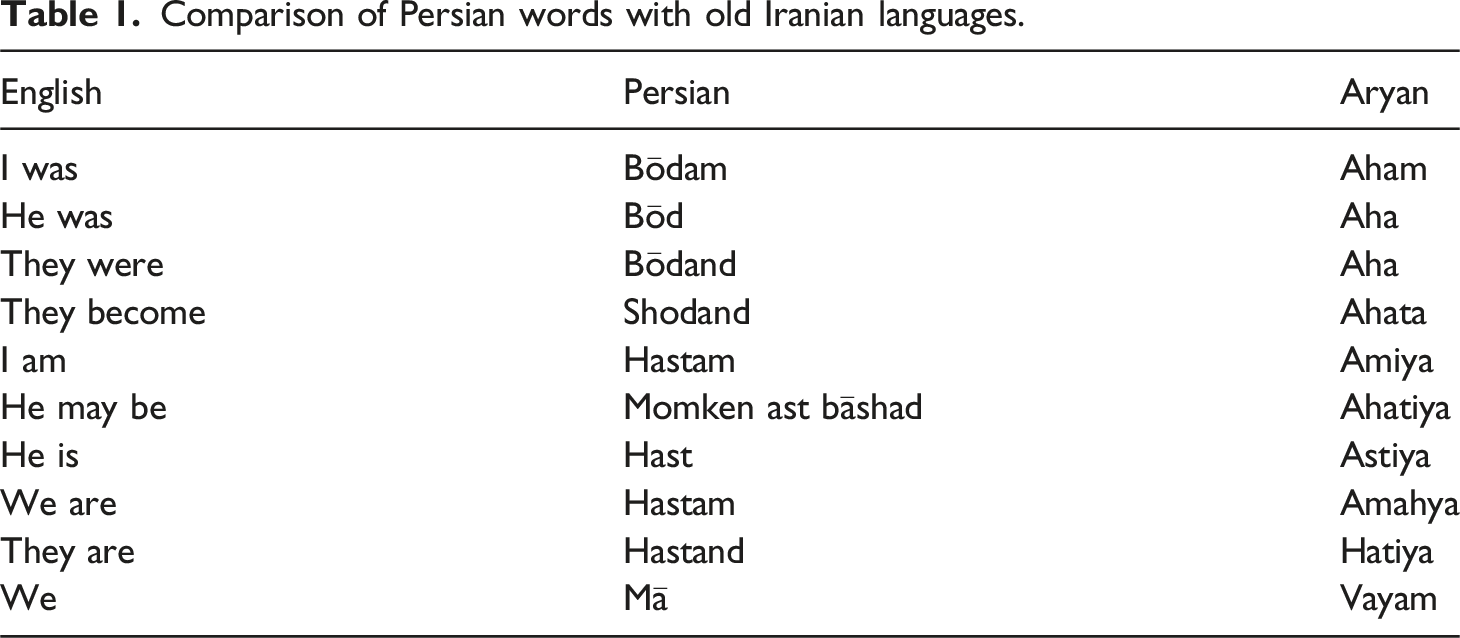
Such differences are much more fundamental in terms of grammar and syntax than just the words themselves, making it difficult to imagine any continuity between these two languages. This is why most researchers who have conducted serious comparative studies on the relationship between the Achaemenid language and Persian have explicitly acknowledged significant discrepancies between the two. For instance, Cole (1996: 38) asserts that The grammar of New Persian is greatly simplified from the near- Sanskrit of Old Persian and even from Pahlavi or Middle Persian. Moreover, over fifty percent of the vocabulary of modem Persian is Arabic in origin, so that it greatly differs, lexicographically, semantically and grammatically, from the languages spoken in Achaemenid times.
The disparities between Aryan and Persian are so notable that even Iranologists acknowledge that ‘Some details in historical phonetics and the system of pronouns demonstrate that Middle Persian is not a direct continuation of the dialect in which Old Persian was written’ (Oranski, 1999: 78).
However, the signifier “Persian” gradually became the nodal point of the linguistic discourse of Iran due to its repeated use by Iranologists. A nodal point that was projected from ‘now’ into ‘then’, shaping the narrative of Iran’s linguistic history (See Figure 2). In Figure 2, it is evident that there is no mention of a language called ‘Persian’ in antiquity. Instead, languages such as Median, Aryan, and Avestan, belonging to the Indo-Iranian family, coexisted with other languages like Elamite and Aramaic. As part of the effort to authenticate the Persian language, the signifier ‘Persian’ replaced ‘Aryan’ (third row of Figure 2) and was then articulated in differential relations with other signifiers ‘Avestan’ and ‘Median’ (second row of Figure 2). Finally, as it is evident in the upper part of the figure, the signifier ‘Persian’ was equated with all the other signifiers. Despite the scarcity of available texts in these languages, this plan was represented as a historical-scientific fact. The position of ‘Persian’ as the nodal point of linguistic discourse.
The main problem is what happened to the signifier ‘Kurdish’ in the process of authentication of Persian. Therefore, to comprehend this process, we must analyze it within a contingent logic, alongside the ‘othering of the Kurdish language’. Following the contingent logic, the process of the ‘authentication of the Persian language’ was just one possibility among several that could have persisted, but were closed off during a historical process. Thus, in addition to exploring the connection between Persian and the Old languages, it is imperative to investigate the Kurdish possibility, allowing us to trace one of the lineages of othering of the Kurdish language.
It is important to note that there are significant differences between the Aryan language and the modern Iranian languages, to the point where the Aryan language could be considered a dead language. However, some phrases in the Bisotun inscription bear more resemblance to Kurdish than Persian. For example, in the inscription, Darius has used phrase such as ‘iyam mada’, ‘iyam parsa’ when referring to representatives of different countries (Oranski, 2000: 122). These phrases are more similar to the southern dialect of Kurdish, specifically ‘iya mada’, ‘iya parsa’, than any other language. Additionally, certain components of the Aryan language can only be found in Kurdish and not in Persian. One such example is the gender difference, both in pronouns and verbs, which is a feature of the Aryan language that exists only in Kurdish (Kurmanji and Zazaki dialects) and has no traces in Persian (Korn, 2019: 256). This is why Ely Bannister Soane (1909a, 895) argues that the Kurdish language (the Kurmanji dialect) ‘appears as a well-preserved old Persian tongue’.
Comparison of Kurdish and Persian with old Iranian languages. 20
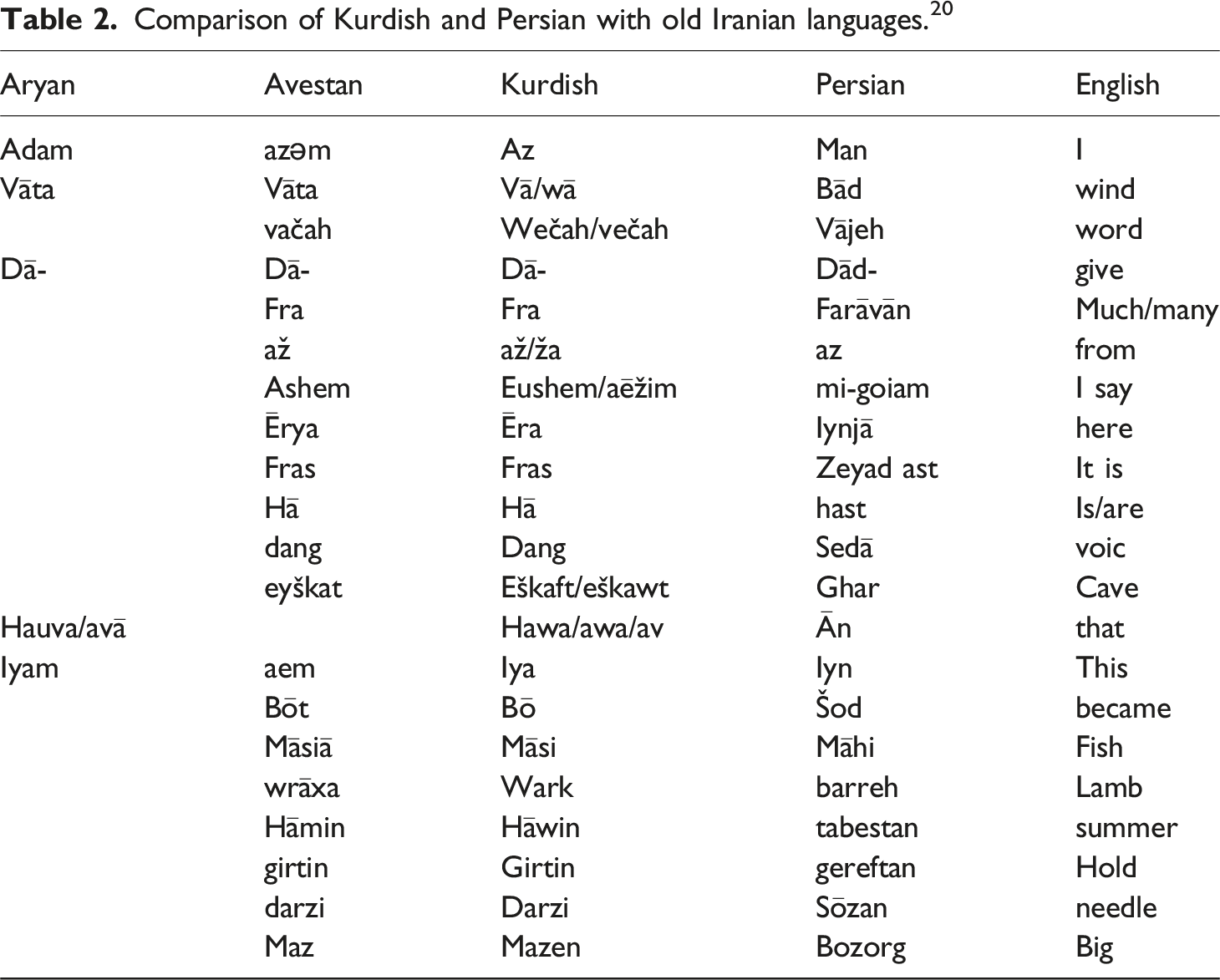
In addition to the evident divide between the Old and Middle Stages, there is also a notable rupture during the transition from the Middle Stage to the New languages that remained unresolved, despite the efforts of Iranologists. The fact is that the Arsacid Pahlavi and Sassanian Pahlavi languages differ significantly in content from modern Persian, to the extent that they cannot be regarded as a single language. Figure 3 illustrate how the Iranian languages of the Middle Stage were reduced to a single category related to the signifier ‘Persian’.
Figure 3 demonstrates how ‘Persian’ became a signifier for all Middle Iranian languages through a two-step process. Firstly, the signifier ‘Persian’, being in a differential relation with ‘Pahlavi’ which signified the Arsacid Pahlavi language, replaced the signifier ‘Sassanian Pahlavi’ (second row of the Figure). Then, secondly, all the Arsacid Pahlavi texts were also represented as manifestations of the ‘Persian’ language, so that the signifier ‘Pahlavi’ was substituted with ‘Persian’ (upper row of the Figure). This process resulted in the exclusion of other possibilities, such as the prominence of the Kurdish language as a significant Middle Iranian legacy. However, as indicated in Table 3, the Pahlavi language has left many words in the various dialects of Kurdish, while there are no traces of this words in Persian.
21
In terms of phonology, many phonemes found in Pahlavi and other ancient languages are still present in Kurdish but not in Persian (See Keyvan, 1966). The articulation of middle Iranian languages around the nodal point ‘Persian’. Comparison of Kurdish and Persian words with the Pahlavi language.
22


As mentioned earlier, Arsacid Pahlavi’s texts were also associated with the ‘Persian’ nodal point. For instance, the Assyrian Tree and the Goat, despite being significantly different from the Sassanian Pahlavi texts, has always been considered a manifestation of the Persian language (Boyce, 1968: 55; Oranski, 2000: 171). However, as Osoulian (2019: 7) argues, the Assyrian Tree and the Goat is actually consistent with modern Kurdish, and Iranologists’ attempts to interpret it based on Persian have often led to misunderstandings.
There are words in the text that have equivalents in Kurdish, but interpreters have chosen incorrect equivalents due to their unfamiliarity with Kurdish and their insistence on Persian. 23 It should be noted that whenever the interpreters encountered a word that did not fit with the Persian language, they would remove it from the text and replace it with a Persian word. The Middle-Stage texts had certain features that allowed for interpretation not just through deciphering but also through reconstruction of the writing format. This made them susceptible to distortion, resulting in manipulation and distortion of the original texts based on Persian words. 24 For example, the interpreters used Persian words like ‘Khuk’ (pig), ‘Hasteh’ (core), and ‘Sokhan’ (speech) instead of the Kurdish words ‘waraz’, ‘Dan’, and ‘Qesah’ found in the text (Osoulian, 2019: 32). With such distortions, the Assyrian Tree and the Goat, which is most closely related to Kurdish today, was falsely represented as evidence of the presence of the Persian language in the Middle Stage.
Therefore, the representation of Persian as the essence of all Iranian languages, and the exclusion of similarities between Kurdish and the Old and Middle Iranian languages were based on two fallacies: naming and appropriation. The article does not aim to prove the authenticity of the Kurdish language instead of Persian, but rather to illustrate the contingency of the authenticity of the Persian language by exploring alternative possibilities that were disregarded in practice. It is important to note that Orientalists approached the Persian-speaking and Kurdish-speaking people within a dualistic and distinct logical framework. The Persians were represented based on an Iranological logic, while the Kurds were portrayed through an Orientalist logic. Persian, as the language of power, was recognized as the true inheritor of Aryan languages, whereas Kurdish was considered an insignificant dialect with little value for examination. Despite having a reach literary heritage, Kurdish failed to attract Orientalists attention due to its lack of political power and the tribal and nomadic nature of Kurdish society. 25 Orientalists represented Kurdish people with reference to characteristics such as savagery, banditry, looting and primitiveness (For example, see Grant, 1841: 21–24), without any attention to Kurdish language and its highly diverse dialects. They either regarded it as a dialect of Persian or deemed it unworthy of study (For example, see Soane, 1909b). Even the few articles on Kurdish and its authenticity published by Kurdologists were marginalized and did not contribute to the emergence of an alternative nodal point for the re-articulation of Iranology discourse. Consequently, the signifier ‘Persian’, supported by political power and influential movements, was articulated as the nodal point of various hegemonic discourses, while alternatives associated with Kurdish failed to attain a similar position. This led to the creation of the myth of Persian language authenticity. Iranologists attributed all the linguistic and literary heritage of the Iranian plateau to Persian, considering it the only authentic language (Bailey, 1953). As a result of this dual position, where Iranologist emphasized Persian and Orientalists disregarded Kurdish, Persian language dominance as the sole valid language of all Iranians.
Conclusion
Due to the sedimentation of nationalist and linguistic significations in the signifier ‘Iran,’ the field of discursivity was organized in a way that subsequent events became meaningful in its context, and the challenge of alternative discourses was how to articulate its elements. As a result of the articulation of nodal points ‘Iran’ and ‘Persian’, the non-Persian languages such as Kurdish and Luri were marginalized and there appeared a historical silence around Kurdish. The signifier ‘Kurdish’ was also marginalized by the Orientalist discourse, being articulated with signifiers such as militancy, savagery, brutality, and primitiveness (see Karimi, 2017). Under the hegemony of the myth of Persian authenticity, any insistence on Kurdish particularity, including Kurdish orthography or names, were considered deviation from Iranianness, and even the betrayal of the homeland. This can be observed in actions such as banning the use of Kurdish in schools, prohibiting the choice of Kurdish names for business units, and even the destruction of Kurdish boards in Kurdistan University (See the aforementioned facts at the beginning of this article).
Generally, in contemporary Iran, Persian nationalism has remained dominant and is closely intertwined with Shiite religious tradition. The hegemony of this discourse has resulted in the ethnic-religious exclusion of the Kurds. It is important to note that more than half of the Kurdish people in Iran belong religious minorities, such as Sunni and Ahl-e Hagh. Therefore, they have been experiencing a kind of ‘double exclusion’ due to being under the governance of Persian nationalism.
In addition, the Kurds’ voices are still being silenced, making it difficult for them to write their own history and live their lives according to the Kurdish identity. For instance, limitations on archaeological excavations at Kurdistan sites further restrict their ability to explore their heritage. In recent decades, as Mohammadpour and Soleimani (2022) have argued, the Iranian state has prohibited excavations that challenge the Aryan-Persian narrative of history (pp. 193–196). Additionally, the Kurds are denied their right to education in their own language and face restrictions on naming their children, geographical places, and trade units in Kurdish.
However, as Foucault pointed out, “where there is power, there is resistance” (95). So, where does the resistance of the Kurds lie? Alongside the historical movements led by Kurdish leaders such as Simko (1918–1829) and Qazi Mohammad, there are various forms of linguistic resistance that exist in the everyday lives of Kurds. Despite the challenges faced by Kurds in Iran, there are NGOs like Nozhin that unofficially teach Kurdish, Journals and presses that publish Kurdish literature, parents who choose Kurdish names for their children, and children who adopt unofficial secondary Kurdish names when their parents face difficulties due to unwritten laws (see Mohammadpour and Soleimani, 2020: 15). The latter example can be seen as a form of resistance that can be referred to as ‘the war on naming’, where two competing discourses vie to define the rules of ‘good naming’ and ‘bad naming’. According to the discourse of Iran, ‘good naming’ entails selecting Persian names over ‘bad’ non-Persian ones. However, in the discourse of resistance, the dichotomy of good/bad itself is challenged and replaced with plural democratic principles of ‘naming’. In other words, naming should be viewed as a context-based process where names are chosen from the native languages of ethnic minorities rather than the Persian language. This ‘war on naming’, as a part of the lives and resistance of non-Persian peoples in Iran, can shed light on an aspect of recent ‘Jina’ movement.
‘Jina’ was one of those children who chose a secondary, unofficial Kurdish name for herself instead of the Persian name ‘Mahsa’ that her parents had given her (also see Mohammadpour, 2023: 2). Her death became a symbol for a movement against various forms of oppression including sexism, classism, ethnic discrimination, racism, and religious intolerance. This movement truly represented subalterns, but it was also tainted by elements of ‘subalterns’ fascism’, which threatened to divert the movement from its democratic objectives. Consequently, the movement became a battleground between two antagonistic camps vying to name ‘the girl’ and appropriate the movement’s nodal points. On one side, there was the resistance camp that named the girl in her own language, ‘Jina’, and appropriate the nodal points in Kurdish: ‘Jin’ [woman], ‘Jiyan’ [Life], ‘Azadi’ [Freedom]. On the other side, there was the Iranian camp that insisted on using the Persian name ‘Mahsa’ and the Persian equivalents of the nodal points: ‘Zan, Zendegi, Azadi’. The former camp emerged through the construction of an equivalent chain between various groups, including ethnic minorities like Kurds, Balochs, Gilaks, Arabs, and Turks, non-Persian women, religious minorities, and some Persian leftists. What united these groups was the shared desire to disarticulate the patriarchal, Persian nationalism. In response to this position, the Iranian camp was formed, consisting of Persian people, a few assimilated ethnic peoples, monarchists, and Persian feminists. What brought these groups together was the fear of various forms of separatism, which led to the resurgence of patriarchal Persian nationalism. As a result, this camp emphasized the conservative nodal points, namely ‘Man, Homeland, Prosperity’, instead of the revolutionary ones, ‘Woman, Life, Freedom’.
While the Mahsa camp seeks to reproduce Persian nationalism in a monarchical form and, in a Lacanian word, essentially desires a new master. On the other side, the resistance Jina camp, inspired by the Kurdish motto ‘Woman, Life, Freedom,’ aims to reject all forms of master/slave relations. This rejection is also reflected in the Baloch people’s slogan: ‘although there are many dangers in freedom, we prefer [it] to slavery’. That is why Slavoj Žižek has pointed out to all Iranians that ‘Without freedom for the Kurdish people, the majority of Iranians will not be free.’ However, we must ask, free from what? It is crucial to understand that the signifier freedom gains its meaning in opposition to Persian, patriarchal, nationalism, which has perpetuated itself in various forms since the Constitutional revolution. Therefore, true freedom can only be achieved through the agnostic deconstruction of this form of nationalism.
Footnotes
Acknowledgements
I wish to thank Mohammad Rezaei, Behrouz Chamanara, Marouf Cabi, Hamid Nikravesh and Sohrab Abdi for their valuable comments.
Author’s note
Mohammad Bazafkan is a PhD graduate in political sociology from Tarbiat Modares University. His published articles include The Representation of Kurdish Language in Iranian Broadcasting (Media and Culture ISSN: 2383-062X) and Othering the Ethnic Groups: A Meta-Analysis of Iranian Identity Studies (International Journal of Diverse Identities ISSN: 2327-8560). Currently, he is working on ethnic and racial studies, specifically on the Kurdish problem, based on a radical democratic project inspired by Laclau and Mouffe’s discourse theory, genealogy, and Lacanian psychoanalysis.
Declaration of conflicting interests
The author(s) declared no potential conflicts of interest with respect to the research, authorship, and/or publication of this article.
Funding
The author(s) received no financial support for the research, authorship, and/or publication of this article.

Notes
Appendix No. 1
A Letter from the General Education and Training Office of Kermanshah Province Addressed to the Education Offices of All Cities within the Province.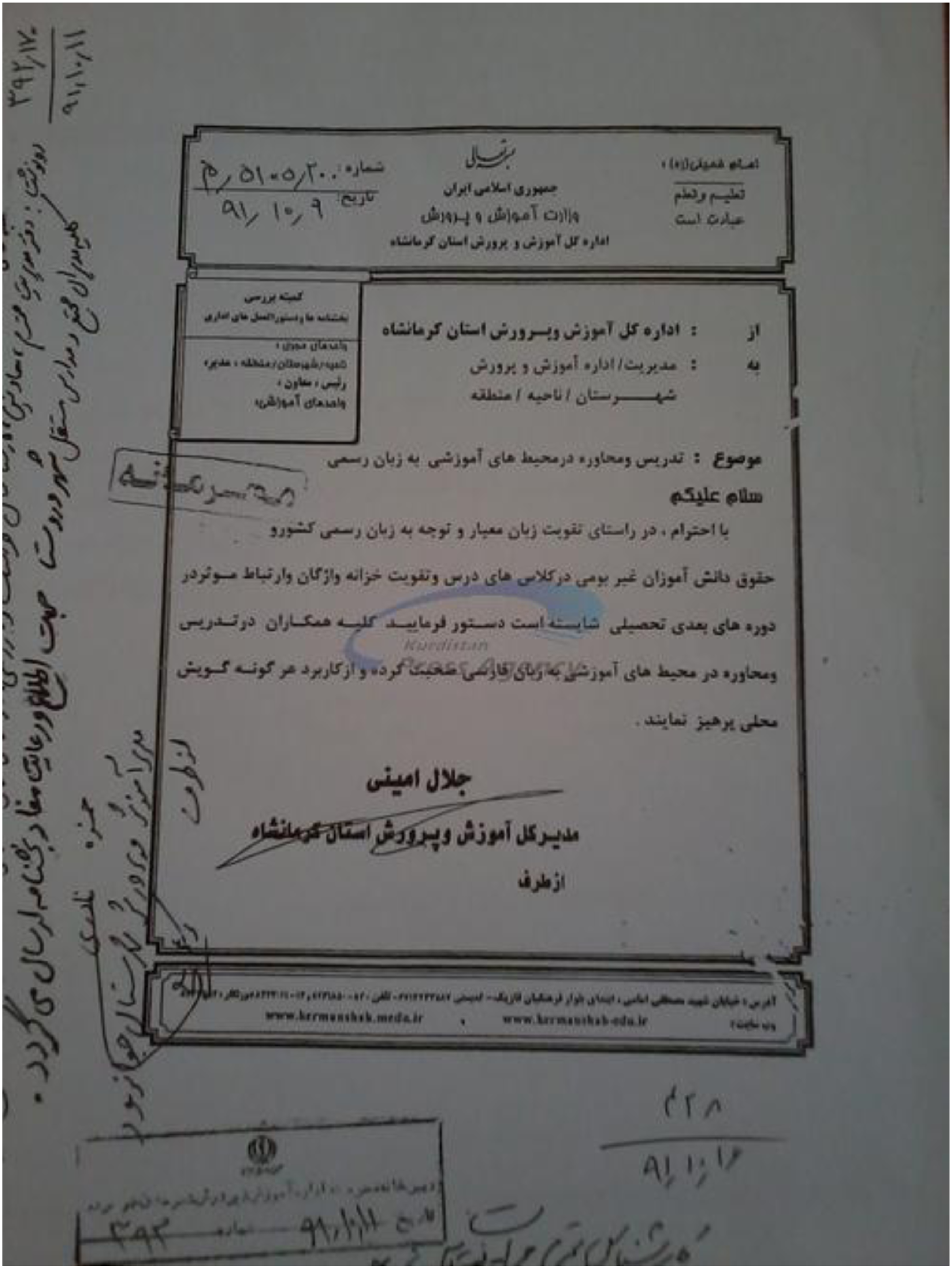
Appendix No. 2
The Request for License Issuance to Use the Term 'Jina' for Naming a Guilt Unit.