



Abstract
The present study originates in an interest in toddlers' spontaneous literacy activities and Swedish preschool practice. The curriculum for Swedish preschool (National Agency for Education, 2011b) clearly states that preschools should work on the basis of a holistic view of the child and that activities should be both enjoyable and based on toddlers' experiences, play and desire to learn. Because the curriculum can be interpreted in a number of different ways, it is important to highlight how tasks in preschool, specifically those directed at written language, are realized in practice. Hence, the aim of this article is to explore educators' talk about their work with written language within an early childhood literacy frame. The study is seen from a social constructionist perspective, and the analysis is based on focus group interviews with ten preschool educator teams on two separate occasions for each. Two themes are identified as being clearly displayed in the educators’ talk about toddlers' literacy: The first theme is doing literacy: toddlers' bodily and material manifestations. The second theme covers the educators' educational manner and the educators' construction of literacy: a playful and material approach based on values and traditions. Finally, these themes are discussed in relation to the educators' professional language, concrete and contextual literacy events, material aspects and a view of toddlers as literate persons in their own right. Hence, the study contributes to a wider discussion about toddlers' everyday activities and interest in written language. In addition, the study makes the suggestion that, in order for work with literacy among toddlers to be based on the child, professional language which highlights toddlers' ways of expression from a broad perspective of what it is to be literate, is needed.
Keywords
Introduction and aim
Toddlers grow, play and interact surrounded by a textual landscape that is characterized by a vast flow of information. In Sweden, 80% of children aged from one to three go to preschool (National Agency for Education, 2011a). This represents a didactic challenge for preschool educators, especially from a literacy perspective. Preschool in Sweden is a separate, government regulated form of school that has democratic values as its base. It is primarily taught by preschool teachers with a first university degree. The educational starting point in the holistic Swedish curriculum for preschool proceeds (National Agency for Education, 2011b) from children's own experiences, interests, views and desire to learn. For example, children's spontaneous involvement in activities related to written language is emphasized and developed further by the educators. The curriculum points out that children's interest and curiosity should always stand in the foreground of educational challenges. These formulations indicate that early childhood education should be different from primary and formal education (Broström, 2012; National Agency for Education, 2010). However, early childhood education is also under pressure from economic and political interests, pressure which may lead to the holistic approach becoming narrowed and ‘schoolified’ (Broström, 2012).
Toddlers construct ideas and share meanings with a high level of modality, using the whole body and multimodal expressions such as gestures, gaze and body movements (Kress, 1997; Kress, 2003; Lancaster, 2001; Løkken, 2009). If these forms of communication and expression are valued in their own right and understood as messages containing content, then the whole range of toddlers' various types of expression can be viewed as language, rather than understood as mere expressions which precede ‘real’ language or as an early stage that comes before a more developed stage. Furthermore, the fact that toddlers' relation to written language goes beyond the technical and formal aspects of reading and writing and an articulated understanding of print does not mean that they are unaware of it (Lancaster, 2003).
A strong tradition and characteristic feature of Swedish preschool is its linking of education, care and nurturing with a holistic pedagogy that is seen as an ‘unquestionable right for children and families’ (Lenz Taguchi and Munkhammar, 2003: 27). All children, regardless of age, are entitled to research-based practice, including early literacy, in an everyday setting in preschool. There are high expectations for preschool educators to engage in ‘good’ pedagogical practice and to construct an open, attractive environment enriched by the content of written language. The concept of written language relates historically to schooling, formal reading, writing and children's readiness for writing. In a sociocultural view of literacy, toddlers' engagement with print is elucidated as ways of being literate. The focus is on children's construction of meaning, how they inspire each other, act, interact and participate in literacy activities together (Björklund, 2008). This can be linked to Lancaster's study (2001, 2003), which shows in detail how a two-year-old child is engaged in mark-making as a symbolic representation of meaning. This ideological view of literacy considers social practice as a frame for toddlers' interactions and meaning-making in relation to print. Further, this view emphasizes multimodal approaches to print (Gee, 2008; Larson and Peterson, 2003).
Children's opportunities to be involved in print-based practice in preschool are determined to a great extent by educators' knowledge and beliefs about early literacy. These can either limit or expand the choice of resources that are offered to children (Dahlberg et al., 1999; Ure and Raban, 2001). In light of the above reasoning, the aim of this paper is to explore educators' talk about their work with literacy within an early childhood literacy frame.
Traditions of literacy in Swedish preschool
In order to understand preschool educators' talk about their work with literacy in toddler groups, it is necessary to understand the traditions of literacy in the Swedish preschool setting. The historic tradition of storytelling, reading aloud and the use of books is strong in Swedish preschools (Gustafsson and Mellgren, 2005). The grounds and advice for literacy in the first work plans for Swedish preschool (SOU, 1972; SOU, 1978) were related to reading and storytelling from a developmental and cognitive view based on the work of Erikson (1951/1995) and Piaget et al. (1980). The developmental aspects of language and cognition were central, and children's individual verbal language development was seen as the foundation for reading and writing. Thus, children were not expected to be engaged in print-related activities until they had attained the appropriate mental age and readiness (Gillen and Hall, 2003).
Piaget et al. (1968) argue that: ‘Until seven years of age children scarcely know how to have discussions among themselves and confine themselves to making contradictory affirmations’ (Piaget et al., 1968: 20). The practical consequence of this view in preschools for toddlers was to read aloud and do rhymes. Compared to the current curriculum (National Agency for Education, 2011b), previous work plans for preschool offered different guidelines for working with children of different ages. For toddlers, they were more focused on caretaking than learning (Sandels and Moberg, 1945; SOU, 1978; SOU, 1979).
The Swedish national curriculum for preschool (National Agency for Education, 1998) applies to all children in preschool, regardless of age. It has a humanistic, child-centred approach based on a social, child-centred understanding of early childhood. The view of learning is theoretically grounded in sociocultural and constructionist perspectives (Broström, 2012; National Agency for Education, 2011b; Pramling and Pramling Samuelsson, 2011). The curriculum states that preschool should ensure that all children develop a rich spoken language and the ability to communicate and should emphasize and encourage children's interest in written language. Children's language and literacy development are seen as constantly ongoing, interactional and relational processes that are inseparably linked with the development of personal identity and learning in various subject areas (Pramling and Pramling Samuelsson, 2011; Taguma et al., 2013). Furthermore, the curriculum states that the language environment in preschool should be tolerant, creative and varied, offering children opportunities to use a variety of expressions such as pictures, music, song, film, dance and movement (National Agency for Education, 2010). These guidelines are considered goals to strive for; there is no recommendation to evaluate individual children's performance.
The view of learning in the curriculum sees toddlers as co-constructors of knowledge of identity and culture (Dahlberg et al., 1999). It gives them a role as agents that was not made explicit in previous documents. From this interactive perspective, children are seen as connected to other children and adults. The child, according to Dahlberg et al. (1999) and Olsson (2009), is strong and powerful, a problem solver, and ‘presumed to have a desire and capability to learn and is encouraged to ask questions, resolve and seek answers’ (Olsson, 2009: 36).
Previous research on toddlers' literacy in preschools
Written language as an activity in context is a part of the research area of literacy. Earlier research traditionally focused mainly on phonological awareness (Razfar and Gutiérrez, 2003). A focus on preschool as a literacy practice for toddlers is an unexplored research area. Lancaster (2003) sees this lack of research as being a consequence of the influence of the developmental view of learning in which children's ability to cope with the meaning of reading and writing is seen as dependent on developmental stages and readiness. Most research on early literacy practices for toddlers is focused on toddlers' literacy-related activities in the home, together with their parents (Barton, 2007; Makin, 2005; Ninio and Bruner, 1978). There have been studies of preschool teachers' beliefs about their work, but these focused primarily on older preschoolers. These studies show that preschool educators have concerns and a great deal of uncertainty related to their knowledge about children's written language development. The results show that teachers distinguish between literacy as a skill and literacy as a social practice (Lynch, 2009; Ure and Raban, 2001). In the Nordic countries, children traditionally attend preschool from an early age, so it is possible to carry out research in preschools about toddlers' literacy practice in everyday life.
Nordic research concerning toddlers in preschools has focused on, for example, experience and learning, ethics and morality, the social style and construction of the toddler in early childhood pedagogy, literacy, creation of meaning, and interaction and communication (Björklund, 2007; Björklund, 2008; Björk-Willén, 2006; Engdahl, 2011; Johansson, 2006; Lindahl, 1995; Løkken, 2009). Björklund's (2008) study concerns how young children conquer and express literacy in their everyday life in preschool. She concludes that while children are engaged in literacy, they are participating and interacting with each other. They both verbalize and embody themselves as readers and writers through everyday activities and routines. For example, in relation to book reading, they turn the pages of a book and close it when they have finished ‘reading’ (see also Björk-Willén and Cromdal, 2009). The present study focuses on educators' work with toddlers' literacy and, more specifically, how they talk about their work.
Theoretical framework
The study adopts a social constructionist perspective that views meaning as constructed through interaction and communication between people within a social practice (Burr, 2003). A further aspect of this theoretical framework is the relation between language and action; specifically, educators' talk is treated as an action, not as something which is ‘true or false’ or something ‘describing and reporting’ an external context (Austin et al., 1976). In the analysis, the social constructionist framework is considered in relation to how educators talk about their work with toddlers' literacy. In line with this theoretical framework, the present study lies within the area of early childhood literacy. The area of early childhood literacy focuses on children's experimentation and actions related to print, rather than on paths to formal reading and writing or becoming literate, as in the broader field of emergent literacy (Barton, 2007; Björklund, 2008; Gillen and Hall, 2003). In early childhood literacy, children's meaning-making and communication through various forms of expression are permitted ways of being literate (Gillen and Hall, 2003). With regard to meaning-making among toddlers, Løkken (2009) says that toddlers use common bodily routines as different, meaningful forms of expression. One example is the ‘heia heia routine’ in which they use their bodies, space and the vocal expression ‘heia heia’ to communicate something and share meaning (Løkken, 2009). This can be related to Lancaster's (2001) study of young children's interpretation of symbolic forms, which shows that children under two years of age are engaged in the symbolic representation of meaning when they use pen and paper. They are further able to develop their own system of coding by making marks that are significant to them. Their marks represent meanings that they are quite clear about.
The process of collecting and analysing data
The present study is part of a larger research project entitled Preschool as children's language environment (Björck-Åkesson et al., 2009), which is a comprehensive study that aims to investigate general aspects of the language environment in 60 preschools equally distributed across three areas in Sweden. As part of this project, a number of focus group interviews with preschool educators were conducted. This paper is based on interviews with ten teams of educators who work with toddlers in groups, with children aged one to three. The teams of educators were interviewed on two separate occasions, which means that the data for the present study consist of 20 focus group interviews. On each occasion, one moderator, one observer and two to five educators participated, i.e. the team consisted of preschool teachers and child-minders with two years of vocational education at the upper-secondary level working together in everyday practice. Hence, the interviewed participants knew each other well. The fact that the educators knew each other well and that the questions were open-ended and included follow-up questions meant that there were good opportunities for the educators jointly to reflect more deeply and take a critical stance towards their ‘taken for granted’ everyday practices (Gergen, 2001). An interview guide concerning the whole language environment and prepared by the research team gave structure to the conversations. This guide contained open-ended questions. Because the flow of the participants' conversation was of great importance, the guide functioned more as a guidance tool than as a blueprint strictly to direct the conversation. The participants were informed of ethical aspects and the aim of the research project. On each first interview occasion, activities related to written language were rarely discussed. Therefore, on the second occasion, the research team expanded the interview guide with direct questions related to written language. The interviews were then transcribed and analysed with respect to the educators’ talk – verbal expressions – about activities related to written language with toddlers. Viewing knowledge, language and conversation as a process of meaning-making that emerges between the participants has informed the analysis process. The task was not to describe a truth beyond or make a map of the educators talk as the reality ‘out there’. Rather, the ambition was to highlight and present relatively similar lines that emerged from the educators' talk (Barbour and Schostak, 2005; Burr, 2003; Dahlberg et al., 1999; Wetherell, 1998).
In the first step of the analysis, the transcriptions were read with the aim of identifying recurrent patterns within the educators' talk, patterns which concerned early childhood literacy under its broader meaning. This identification was based on a theoretical understanding of early childhood literacy as including multimodal approaches (Björklund, 2008; Kress, 2010; Lancaster, 2003). Identified, more specifically, were areas that concerned letters, signs, shapes and texts, as well as multimodal approaches to texts. This means that all talk about children's communication and narratives connected to, for example, dramatizing, play and construction, was marked in this first step. Two main themes emerged early on from these areas. These concerned the educators' talk about their concrete observations of toddlers' actions related to written language and the educators' manner in their own educational work with written language in their preschool practice.
An excerpt from two educators' talk about toddlers' reading.
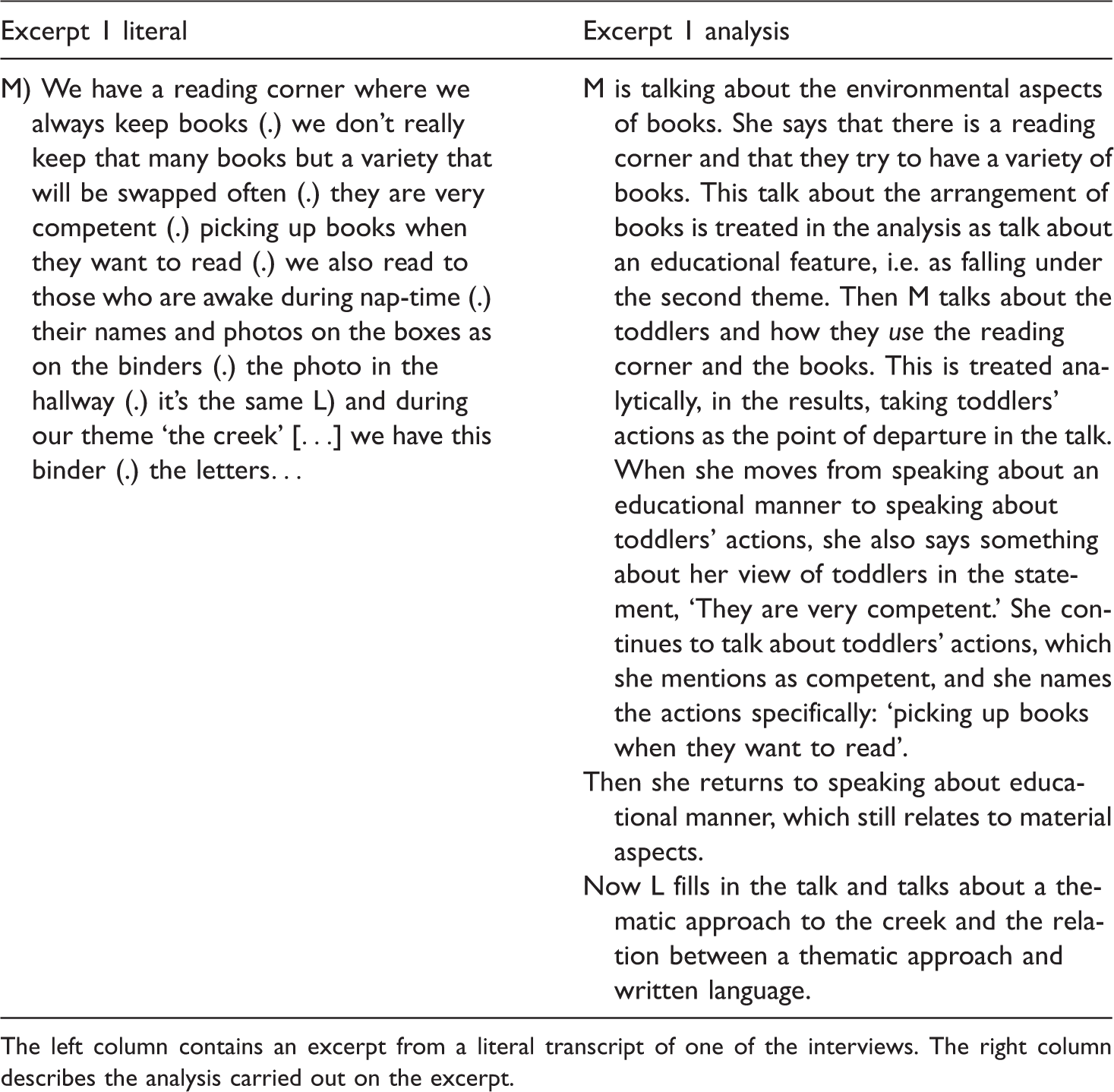
The left column contains an excerpt from a literal transcript of one of the interviews. The right column describes the analysis carried out on the excerpt.
In the third and final step, the material collected from the focus group interviews showed that an excerpt concerning toddlers' bodily actions also concerned material aspects and verbal expressions. With respect to the fact that there were no clear limits within the educators' talk about different aspects of their work with literacy, the results are finally presented with the two themes that emerged in the first step. This final presentation can be linked to Law's ideas of the world as ‘fluid’ and the role of the researcher as a perspectival puzzle layer (Law, 2004). The researcher has a responsibility to transform the collected material, to identify and show patterns within its complexity, i.e. to relate to and not avoid complexity. In this study, the themes identified are based on patterns and then connected to the toddlers' own engagement with literacy and the educators' educational manner. The way in which this is done is shown in the following excerpt from an interview.
Findings
The results are presented in two sections that represent how the educators' talk moved between narration about toddlers' own engagement, which is termed doing literacy: a bodily and material manifestation, and talk about their own educational manner, educators' construction of literacy: a playful and material approach based on values and traditions. Quotations from the interviews are critically analysed and related to previous research. The two sections are then concluded with summaries.
The educators talked about toddlers' literacy on a situated and concrete ‘doing literacy’ level. It should be observed that in the interviews there was a constant dialogue between the talk about children's literacy and the educators' educational manner; therefore, the themes should be understood as intertwined, or as standing in constant relation to one another, and they should be viewed in the context of the educators' everyday work experience in preschool.
Doing literacy: Toddlers' bodily and material manifestations
I write flower (Maria)
During the interviews, the educators were initially reflective. However, they gradually discussed and jointly exemplified their work in different ways. One way was to talk about the children's literacy as manifested action, as something that toddlers do. Their descriptions of children's literacy derived from observations of toddlers' spontaneous activities related to letters of various kinds. When the educators described the children's bodily and verbal expressions, they did so using virtual voices (Wibeck, 2010), i.e. they used the children's voices and gestures within their talk. The educators expressed that the children call some of their actions writing, as in the quote above in which a child says ‘I write flower’ while she is actually drawing a flower. Furthermore, they explain that, for the children, drawing and writing do not seem to differ. The shape of a flower can be called writing, and circles in a row can represent letters as ‘small fine circular rings’ (Lena). The action of making circle signs is an example of visual signs that can be understood as both drawing and writing, according to the preschool teachers. These actions are described as everyday, spontaneous actions that seem natural for the children. The name children give to their action depends on the material they have been offered. Whereas a thin felt pen and a pencil announce writing, a crayon announces drawing or colouring. This can be exemplified by a quote from Camilla. She states that the educators offer the toddlers opportunities to write or colour in a notebook. She then chooses to connect the words crayon and colouring: ‘…and somebody took a crayon and coloured’.
When Zara and Karin speak about toddlers' literacy, Karin initially laughs and says, ‘We are not good at that…’ After some follow-up questions about children's writing, Zara, however, gives an example of Olle's activity in the sandbox. She says, ‘But for example, like Olle, he recognizes his O (.) so he draws it in the sandbox.’ When Sara expresses that Olle recognizes his name, it is based on her observation of Olle's activity – drawing circles in the sandbox with a stick. These connections between various materials and doing letters often occur in the interviews. The transformation of the first letter in a name can be linked to Burnett et al. (2012), who highlight the materiality of personal meanings and that materiality plays a part in literacy, as in the example above, where Olle uses the stick as an object to represent the first letter of his name. Further, this can be understood as a very young child's producing signs. This can be linked to Lancaster's (2001) view that children are aware of and share meaning through the use of different forms of expression for sign- making long before they talk about it.
Another example of how toddlers use their bodies to make connections with letters in the surrounding environment is when Gunilla gives an example of three children, all with names beginning with O, standing in front of a printed alphabet on the wall: ‘All three can stand there […] all of them start at the same letter O.’ This example highlights how a connection with a letter is manifested through a nonverbal bodily action, where the children, in cooperation with each other and the material environment, are doing literacy. The children's connections to written language are talked about as spontaneous actions during everyday situations in preschool. The examples were based on the educators' observations of how both children and teachers referred to children's reading and writing as actions. This refers to how the children could accomplish literacy activities by themselves, in joint action with peers, together with the teachers and, not least important, together with the materials that the preschool environment offers them. The children could, for example, transform a stick into a pencil and use it for ‘writing’. The teams also exemplified how toddlers displayed their interest in books nonverbally, using gestures such as pointing or nodding, or by picking a book and giving it to the teacher. Notably, the surrounding material aspects are not talked about as tools for writing or reading. This can be linked to Hultman's thesis, which examines how materiality plays a part in human interaction (Hultman, 2011). She stresses that materials and the environment ‘whisper’ to children and suggest to them, ‘You can do this with me’ or ‘Try me this way.’ Vygotsky (1967) mentions that Lewin, a member of his research group, also expresses similar thoughts about material aspects when he states that, for young children, a door demands to be opened and closed, and stairs demand to be run on.
In summary, the educators jointly constructed literacy events in their talk. These events were considered to be actions, and this understanding of actions as literacy events went beyond the common meaning of literacy. According to Rosenquest (2002: 241), we must ‘go beyond using print to decorate classrooms and using finger plays and nursery rhymes to sensitize a child's ear for language’ (p.241). This is what the educators mainly do in their everyday practice. The problem is that they have not articulated it as children's literacy. Educators' talk about toddlers' literacy shows that they regard it as events that toddlers do together with other toddlers or educators, and it is always connected with materials. Notably, the body of the toddler is mentioned as a natural aspect within the events. Perhaps this bodily aspect of toddlers' literacy manifestations is so natural or inherent that it is forgotten. More attention needs to be paid to the fact that literacy events proceed from toddlers' own experiences, interests, views and desire to learn.
Educators' construction of literacy: A playful and material approach based on values and traditions
‘…only in play, because it's not like we sit with them’ (Anna)
This area is based on educators' talk and joint construction of the meaning of working with written language. Their statements were based on preschool tradition and history, as well as their views of childhood, language and the child. The educators clearly displayed a distance from formal teaching practice. They focused instead on the sensitive space between children's own literacy manifestations and an educational approach. They stressed the fact that they do not use a specific instructive or teaching method. Rather, they ‘educate’ in situ, providing words to support the children's own reading activities.
As mentioned above, it seemed that asking the educators direct questions about how they work with literacy provoked the teams to put words to a field they were not used to talking about. It led to an awkward or hesitant start to the interviews. One teacher, for example, joked and said that they used to give the children the National Encyclopaedia to read. However, after further talk, the educators began to give examples from their everyday observations of how they respond to children's engagement with literacy. They displayed uncertainty about how to educate or provide holistic forms of schooling for toddlers' literacy in, as they said, the ‘right’ way. Johannesen et al. (2009) point to these hesitating moments as a positive force for preschool educators to shape and reshape their understanding of issues concerning toddlers' understanding of themselves and others.
There was agreement in all the focus groups that they do not work with an instructional approach. Rather, they take the child's perspective when putting the children's activities into words, encouraging their literacy-related activities. During the interviews, the educators commented on this. Jessica said, ‘Maybe we encourage this more than we think, after all, though we haven't thought about it that way.’ The interviewer's directed questions about learning placed the teams in a dilemma. They were searching for ways to talk about their work with toddlers' writing without giving up their holistic views of learning, play and care. These values worked as a filter that the teams needed to pass through before they could articulate their work with reading activities – and especially children's literacy – in words. Preschool educators' talk about and values concerning toddlers' learning in subject areas have been shown to be related to conflicts in other studies (Berthelsen and Brownlee, 2007; Emilson, 2008). These conflicts may have grown out of historical and cultural understanding and can, according to Berthelsen and Brownlee (2007), be linked to preschool educators' views and knowledge about the preschool's mission and theories of learning.
The situations that are mentioned as literacy events by the educators are reading aloud and various forms of storytelling. It is common to dramatize books by using concrete material such as dolls, dollhouse furniture and animals and to act out the book using these props. Teachers also talk about how they dramatize books by playing different roles from a book's story and acting out the story in front of the children. The purpose of this dramatizing, according to the educators, is to give the children opportunities to retell and shape the content of the book in a nonverbal way. Cecilia and Anne describe this as follows: Cecilia: But just this (.) that they come when we mention a cat (.) have you seen a cat outdoors? so they only nod (.) we do not get more from them because they have not come that far … Anne: Then it is like a retelling if they nod (.) they have in a way confirmed it.
Responding to children's engagement with written language seems to be an important task for educators. The most common way to respond to children is to put their actions into words. One team commented that they encourage the children to read by themselves and in their own way: ‘If you have read the book many times you can say that now you can read it (.) you can read it now, can't you? So they read in their own way’ (Gunilla). Listening is another aspect of the teachers' way of encouraging toddlers' interest in written language. The teams talked about how they listen to what the children say they are doing and then rephrase the child's words to show recognition: ‘Sometimes they can say that ‘I write mummy here’ (.) ‘Yes, you write (.) Yes, it says mummy there’ (Annika).
In summary, the concepts in the heading of this section – Educators' construction of literacy: a playful and material approach based on values and traditions – illustrate lines in a composed network of the work with toddlers' literacy in preschool. These lines could be separated and elucidated independently, but with respect to the educators' talk, the nature of these concepts is to talk about them as connected and as starting points for work with toddlers' literacy.
Discussion
Toddlers' everyday setting in preschool is formed by a network of different aspects, for example, curriculum outlines, preschool educators' experiences and knowledge, environmental and material aspects, preschool traditions, and the participating children, their families and their literacies (Callon, 1986/2012; Hultman, 2011). With this in mind, there are three areas that will be discussed and considered in relation to the educators' talk about the content and meaning of toddlers' literacy and how this is formed in a preschool setting.
Beyond a traditional view – creating new concepts to understand the competent toddler
This study shows that the everyday concepts that preschool educators use to describe their work do not reflect, refer to or display their work with toddlers from a literacy perspective. It seems that, initially, a traditional view of ‘how to teach’ literacy stands in the way of the educators' talk about toddlers' literacy and their work with literacy in toddler groups. This can be considered in relation to the influence of the interviewer and the educators, who tended to be surprised by direct questions about their work with toddlers' literacy. This does not mean that a way of working with toddlers' literacy does not exist. However, in the interviews, creative activities that enabled the construction of joint meaning in various ways were not referred to as literacy events until the educators had reflected more deeply.
There are questions to be raised about how toddlers' bodily expressions, and events consisting of different forms of expression such as singing, building blocks, dramatic or sand play, can be used for work with literacy using children's own creation of meaning as a starting point. This could be linked to the identity term of ‘being a reader’ in Jensen's study (2012), for example, which explores a holistic, inclusive approach to literacy. He points out different understandings of ‘being a reader’ and elucidates the identity term of ‘being the reader’. He argues that when children act like readers, they exhibit comprehension of the reading act. Within this act, there are different aspects to learn and be familiar with that are connected more to identification and imitative acts than to cognitive aspects of pre-reading, for example, holding a book, attracting the attention of peers with voice and gaze, and simultaneously responding to a narrative (Björklund, 2008; Jensen, 2012). Linking those aspects to Heath's (1983) literacy events, it seems to be important to accept that whenever toddlers' literacy events happen, these situations simultaneously exhibit aspects of baby talk, of building relations and of using toddler styles to share meaning (Björklund, 2008; Løkken, 2009). Whenever toddlers are engaged in activities with content or narration, the task for the educator is to follow the child using experience and knowledge of early literacy from a broad, multimodal perspective, to understand the activity as a literacy event. This could be linked to Kress (1997), who says that ‘children start as pictographers: they have an idea – loosely speaking – and they look for some concrete, physical form of expression’ (p.83). Toddlers' concrete activities could then be seen to a greater extent as building blocks to writing. The following excerpt from a conversation between Maja and Gunilla raises questions about this and highlights the possibilities for preschool educators, together with literacy researchers, to go beyond a superficial understanding of toddler literacy and create new concepts of literacy among toddlers. Maja: then you learn the language by using the body, thus rhythm and movement games, so that the body gets it Gunilla: construction, building, children's natural way is to express their thoughts in many different ways (.) both by talking, building and drawing and yes (.) constructing (.) if they have the opportunity and feel safe (.) they inspire each other positively (.) they develop each other very, very much (.) and you should be permissive as a teacher to give them the opportunity to use different ways to get around with the language in that way Maja: yes, both individually and together with others (.) language is indeed a communication with other people
Toddlers as competent writers and readers
When educators talk about and describe observations connected to literacy from their everyday activities, they do so in term of literacy events that are concrete and contextual. When children are engaged in literacy events, such as turning the pages in a book, they obviously communicate and show that they are a part of the reader and writer community (Björklund, 2008; Meek, 1991; Smith, 1978). According to educators, toddlers understand themselves as readers and writers, and educators share this understanding. Educators, with few exceptions, naturally respond to and encourage children's activities, such as reading and writing. For example, they express how they ask the children to read for dolls, for each other and to ‘write’ their names. It should be pointed out that educators talk about toddlers' literacy from a perspective of ‘doing’ or ‘making’ literacy. Literacy events are ‘hands on’ and are created whenever they happen (Barton, 2007; Björklund, 2007). Björklund's study shows that the toddlers interact enthusiastically when they are involved in literacy events without educators. Even though the educators in my study initially hesitated when they talked about toddlers' literacy and written language, they clearly recognize a literacy event and respond to the toddlers' own ways of doing literacy. From that perspective, their teaching is very situated and is ‘created in particular cultural settings’ (Larson and Peterson, 2003: 302). A lack of theoretical awareness could contribute to a prevalence of opinions built on traditions, exemplified by quotes such as, ‘they are too young […] thus I don't teach’ (Monica), or ‘those children can't narrate (.) it’s their age’ (Zara). On the other hand, the study also shows the opposite, such as when Annika speaks about what she calls toddlers' attempts to understand letters in terms of squiggles: ‘we believe in this; even if you are young (.) you understand that this (squiggles) is something important’.
Artefacts as signs
The connections with material aspects are clearly displayed within the educators' talk about toddlers' literacy. Hultman (2011) points to the environment and materials as ‘whispering’ to toddlers about how to use it. Materiality also helped the educators to give examples and remember; it helped them to visualize the observations and situations they spoke about in the interviews. With this in mind, we could return to the observation about the stick. The stick does not signal write with me to the educator until the child transforms it into something to make an O. The educators needed to talk about the event for a while before they mentioned this event as a literacy event. Kress (1997) describes spontaneous activities in which children happily engage as meaning-making. He says that these activities are based on children's own interests and the motivating nature of the sign, here, for example, the stick. Artefacts can be described as signs derived from personal, technical and socially constructed experiences and having different meanings (Barton, 2007; Kress, 1997; Lancaster, 2001). Lancaster (2001) further argues that signs have different, personal meanings for children. This is an important aspect to keep in mind when discussing the practice for toddlers who do not talk yet. In order to encourage children to participate in transformation processes, it is important to consider the transparency of artefacts and thus offer children a range of materials that is not primarily understood as literacy material. The transformation processes with objects and the pictographic writing that children engage in are, according to Kress (1997), processes of meaning construction in which they express their ideas in a logical a system similar to a formal writing system.
Finally, the educator teams' talk constructs a view of toddlers as literate persons in their own right, with few exceptions. The fact that the educators did not refer to their work as connected to literacy points to a need to go beyond their first understanding of literacy in toddlers. Toddlers' relation to the textual landscape, broadly interpreted, needs to be framed within some general, theoretical foundation. Within an early childhood literacy frame, professional language which highlights toddlers' ways of expression from a broad perspective of what it is to be literate is needed in preschool education.
Footnotes
Acknowledgements
This research has been supported by The Swedish Research Council, the Committe for Educational sciences (721-2008.5565) and The Regional Center for School Based Research, RUC/Jönköping in the project “Preschool as childrens' language environment”. The project was implemented through collaboration between Jönköping University, School of Education and Communication, Linköping University and Mälardalen University.