



Abstract
The literature on infant and toddler screen time has been built on two traditions—cognitive models of learning and sociocultural models of learning. Cognitive studies have cautioned against the use of screen time for young children because clinical research has not shown children can learn as effectively from screens as they do from human interaction and might delay children’s cognitive development. Conversely, qualitative research has described the social ways children learn and use digital technology through social interactions with other people in their homes. This paper reports on an autoethnographic study of how digital tools were embedded in the everyday ways of life in my home during my son’s first 18 months of life. I present a first-hand account of the tensions I experienced as I grappled with the American Academy of Pediatrics’ recommendation of no, ‘digital media use (except video-chatting) in children younger than 18–24 months’ (p. 3). I juxtapose screen time recommendations with the everyday realities of my life as a first-time mother in the 21st century. Throughout the study, I was enmeshed in two roles—researcher and mother—and drew on phenomenology to describe my infant son and my lived experiences using digital technology in our home. My researcher persona was influenced by the traditions and perspectives of sociocultural theories and new literacy studies and the positive learning that can occur while using digital technology. I noted how digital tools were ingrained in daily moments and ways of life, particularly those which used the TV and smartphones, and could not be removed. Yet, my mother persona felt guilty about our use of digital technology and I struggled with the messages I received from news and social media that warned against screen time for infants and toddlers.
Negotiating screen time: A mother’s struggle over ‘no screen time’ with her infant son
The opening race scene of Cars 3 was playing on Netflix. My son picked up his red Lightning McQueen metal toy car and his green Brick Yardley metal toy car and began driving the cars around the top of our oval coffee table. As in the movie, McQueen was in the lead. My son paused this play to watch the action on the screen, however, he held the McQueen toy in his hand. Approximately seven minutes later, on screen, McQueen revved his engine in an attempt to catch race leader, Jackson Storm. My son stood next to the coffee table and held his McQueen car high above his head and waited. On screen, McQueen sailed into the air—my son rolled and tumbled his toy car in synchronization to the on-screen action.
The above vignette will not surprise parents of young children or those who work with them. It is well documented that young children are ‘active meaning makers’ (Marsh, 2004: 56) when interacting with screens and that much of this play occurs simultaneously as children watch on-screen programming (e.g. McPake et al., 2013; Plowman and McPake, 2013).Children borrow characters and storylines from favoured TV, movie and online programmes while engaging in play activities (Carrington and Dowdall, 2013; Dyson, 2003; Huh, 2015; Wohlwend, 2013).
The ubiquity of digital technology in modern western societies has influenced what it means to be literate and now includes digital literacy. Digital literacy skills are being developed in very young children as, in many homes, these children access and use digital technology daily (Gillen et al., 2018; Marsh et al., 2017; Rideout, 2017).
This proliferation of young children’s digital engagement has led to concerns about the amount of time young children spend watching screens. The American Academy of Pediatrics (AAP) has led the call for limited screen time and issued a series of policy statements on children and media. For almost two decades, the AAP has called for no screen time for children under the age of two years. Libraries, preschools and childcare centres promote these recommendations in their programmes, and yet, qualitative researchers have documented beneficial uses of digital technology by children in their homes and with their families (Marsh et al., 2015, 2017; McPake et al., 2013; Plowman et al., 2008; Wong, 2015). My lived experiences described in this paper personify the tension between the two camps of scholarly research on infants and toddlers using digital technology. I became a mother as I completed data collection for my doctoral studies and was well versed in the literature that both supports and aims to reduce the inclusion of digital technology in the early years. This background knowledge impacted on the ways I took up digital technology with my son as it was in my new role as a mother that I began to note the disconnect between the AAP’s screen time statements and my everyday way of life. Tensions for me arose as I attempted to reconcile my researcher beliefs (e.g. support the inclusion of digital technology in the early years, see Teichert, 2014) with the reading I was doing about motherhood and parenting, particularly news media reporting research cautioning the use of digital screens with infants and toddlers. In this paper I juxtapose my observations of my family life and my beliefs shaped by the literature with the AAP’s screen time recommendations for infants and toddlers.
The AAP and screen media
Since 1999, the AAP has published recommendations on young children, media and screen time (e.g. 1999, 2001, 2011, 2013, 2016). The AAP expressed concern about this digital consumption and issued recommendations for paediatricians in an attempt to limit the negative effects of TV and screen media on adolescents and young children. From 1999 until 2013, the AAP expressly urged parents to ‘avoid television [and later screens] for children under 2 years’ (1999: 342). The underlying rationale for the AAP’s recommendations stemmed from a belief that time spent with screen media ‘may displace other more active and meaningful pursuits, such as reading, exercising, or playing with friends’ (2001: 423) and that ‘unstructured play time is more valuable for the developing brain than any electronic media exposure’ (2011: 4). Also, the AAP expressed concerns that media use does not promote language skills; media distract parents and decrease parent–child interactions; and TV watching reduces the amount of time in creative play and time spent interacting with parents and siblings. Other concerns regarding children’s health, such as obesity, sleep issues, and aggressive behaviours, and language delays were also cited.
Although the AAP relaxed their recommendations on screen time for children two years of age and younger in 2016, the organization did not particularly encourage it either. Changes to their recommendations acknowledged language development from interactive screen media can begin at 15 months of age, citing, for example, ‘toddlers can learn novel words from touchscreens in laboratory-based studies’ (p. 2), but noted these children had ‘trouble transferring this knowledge to the 3-dimensional world’ (p. 2) and that ‘these experiments used specially designed apps that are not commercially available’ (p. 2). Video-chatting was highlighted as another way young children could develop language skills, however, the AAP cautioned this required parental support in order for infants and toddlers to understand and learn. Instead, they emphasized young children’s need for ‘hands-on exploration and social interaction with trusted caregivers to develop their cognitive, language, motor, and social-emotional skills’ (p. 1). The AAP cautions against digital engagement for those under two years, saying, due to their ‘immature symbolic, memory, and attentional skills, infants and toddlers cannot learn from traditional digital media as they do from interactions with caregivers, and they have difficulty transferring that knowledge to their 3-dimensional experience’ (p. 1), and expresses concerns about children’s cognitive language delays, social–emotional delays, poorer family functioning and parents’ media use.
The AAP made these recommendations in the hope of guiding parents and caregivers back to interactions that research has shown to be beneficial to children’s learning and development, including face to face play, reading and singing. The next section will highlight some of the clinical research related to concerns about infants’ and toddlers’ use of screens, as well as qualitative studies describing the social and cultural ways children learn about and use digital technologies in their homes.
Research on young children’s screen time
Despite the AAP’s recommendations, young children increasingly access and use digital technology and do so at much younger ages. The most recent Common Sense Media survey reported mobile media use among participants (N = 1,454 parents) was nearly universal; with 98% of American families with children zero to eight years having at least one mobile device in the home (Rideout, 2017). Children spend, on average, 48 minutes per day on a mobile device, an increase from 15 minutes per day in 2013 (however, overall media use has remained the same) (Rideout, 2017). It is this increasing use of digital technology among children that has caused concern among some paediatricians, educators and other key stakeholders in early childhood (e.g. National Association for the Education of Young Children (NAEYC)). Their concerns have centred on physiological heath, cognitive development and learning.
Concerns
Screen time has been linked to negative physiological effects in young children, such as increased childhood obesity levels in North America (e.g. Canadian Obesity Foundation, 2015; Center for Disease Control and Prevention, 2018; Hernández-Cordero et al., 2017). Screen time has also been cited for its possible negative effects on young children’s sleep habits and sleep quality. Although research shows a correlation with screen time use and reduced sleep, causation has yet to be determined (Hale and Guan, 2015). Other physical health concerns related to screen time include worries about eye health and exposure to electromagnetic fields and radiation from exposure to mobile phones (e.g. NAEYC, 2012).
The most frequently used argument for limiting screen time stems from the potential for digital technology to impede children’s cognitive development and children’s abilities to learn from screen media. A substantial body of behaviour and neuroimaging research has examined whether screen media before two years of age are linked to attention deficits (e.g. Christakis et al., 2004; Geist and Gibson, 2000; Miller et al., 2007; Stevens and Muslow, 2006), yet there is little compelling evidence to support infant and toddler video viewing causing significant attention deficits (Courage, 2017). There are, however, some reports that indicate a relation between early screen exposure and poorer executive functioning (see Courage, 2017 for a detailed analysis). Executive functions manage self-regulation. However, causation has yet to be determined as researchers cannot determine whether young children with more challenging temperaments watch screen media as a calming mechanism, or if it is the screens that create these temperaments (Courage, 2017).
In relation to young children’s learning, the AAP (2016) claimed young children have difficulty transferring knowledge attained from screen media to their three-dimensional experiences and therefore recommended no screen time for children under two years of age. The policy statement relied heavily on Barr’s (2013) literature review on memory and ‘transfer deficit’ (p. 206). In her literature review, Barr noted that infant learning from two-dimensional objects (i.e. drawings or TV screens) was cognitively complex and not easily transferred to three-dimensional objects of the same word (i.e. a giraffe on TV was not easily transferred to understanding the same animal at the zoo).
While children can imitate what they see on screen (Radesky and Zuckerman, 2017), there is a strong belief that infant and toddlers cannot learn from digital technology in the same way they learn with parents or caregivers.
However, research on transfer deficit is not conclusive as some infants and toddlers can transfer learning from two-dimensional spaces to three-dimensional spaces. In their clinical study of toddlers aged 23.5–36 months, Kirkorkian et al. (2016) found the youngest children in their study could transfer information from screens to real objects, albeit this was limited to a simple word learning test. Zack and Barr (2016) investigated whether 15-month-old children could transfer their understanding of how a button on a three-dimensional toy worked to a similar button on a touchscreen. They found 64% of their 50 participants could transfer their three-dimensional knowledge to the touchscreen and vice versa. However, the participants’ ability to accomplish this increased if the infant’s interactions with their mother included high-quality instruction. Zack and Barr (2016) argued that it is the interactional quality between parent and infant that allowed infants to learn effectively from a screen.
Infant and toddler digital literacy practices in the home
Despite these concerns and published screen time recommendations, to reiterate, many infants and toddlers access and use digital technology. Interestingly, one oft cited concern about young children’s digital engagement is the apprehension that screen time will impede children’s engagement in activities which are perceived to be more valuable to their development, such as reading physical books and outdoor play. However, over the last decade, research has documented the opposite: children continue to be interested in non-digital activities, as well as digital ones (e.g. Kucirkova, Littleton and Kyparissiadis, 2018; Rideout, 2017; Stephen et al., 2008; Teichert and Anderson, 2014). Many of these studies have been situated in sociocultural perspectives of learning and development, which posits that young children are socialized into the social and cultural practices of their communities by engaging with relevant tools from their communities. In the 21st century, young children are socialized into social and cultural digital literacy practices of their communities, which necessitates the use of digital tools (Säljö, 2017). For example, research has shown children implicitly learn to use the digital tools available in their homes and that they often mirror the actions of their parents (Chaudron, 2015; Chaudron et al., 2018).
Yet, many of the data concerning infants’ and toddlers’ access to and use of digital devices have been reported by parents through survey data. Very little research has documented infants’ and toddlers’ engagement with digital devices in naturalistic settings. To remedy this lack of research, qualitative researchers have begun documenting the role of digital technology in the lives of children under the age of three years. The studies focusing on children under three years have described the productive reasons children access and use digital technology. For example, Harrison and McTavish (2018) found that 22-month-old Ally could independently interacted with iDevices. She had developed a number of operational skills, for example she could locate the camera function, open it and take photographs or videos on an iPhone; locate the cameral roll app and view photographs and locate favourite apps (e.g. YouTube). Harrison and McTavish also found that Ally’s use of digital media was building her emergent literacy skills, most notably, Ally was learning to count, English songs and rhymes, the English alphabet and word vocabulary through applications her mother had downloaded onto the iPhone for Ally. Ally’s interactions with devices were not isolated, individual experiences, rather, Ally and her mother often accessed and used the iPhone together, making it a ‘shared activity [and] inherently social’ (p. 22).
Gillen et al. (2018) described how digital technology informed children aged birth to three years’ daily lives by documenting the digital literacy skills and competencies the infants and toddlers developed as they engaged with the tools. They found digital technology was used in a variety of ways and integrated into ‘the rhythm of the day’ (p. 5). The frequency of use differed among the 11 families, but all families used digital technology with their young children. Low-level use involved ‘just watching TV/YouTube’ (p. 5) while higher level use included ‘games or apps on tablets or smartphones’ (p. 5) or Skype calls with relatives. The authors found children learned technical skills (i.e. how to operate the device) while developing literacy skills and discovering content they enjoyed. As with access, families varied with respect to whether digital devices were for entertainment, education or both.
Previous survey data research has noted the mismatch between families’ lived experiences and the AAP’s screen time recommendations (Lauricella et al., 2015). The current study follows in the footsteps of other researchers documenting their own child’s literacy development (e.g. Baghban, 1984; Bissex, 1980; Crago and Crago, 1983; Lass, 1982).
In sum, the literature on infant and toddler screen time has been built on two traditions – cognitive models of learning and sociocultural models of learning. Cognitive studies have cautioned against the use of screen time for young children because clinical research has not shown children can learn as effectively from screens as they do from human interaction and it may elay children’s cognitive development. The qualitative studies reported on in this paper describe the social ways children learn to use digital technology through social interactions with the other people in their homes. Next, I present my first-hand account of the tensions I experienced with my infant son as I grappled with the AAP’s recommendation of “Avoid digital media use (except video-chatting) in children younger than 18 to 24 months” (p. 3). I juxtaposed those recommendations with the everyday realities of my life as a first-time mother in the 21st century.
Methodology
Theoretical frame
In order to examine my lived experience, I drew from sociocultural theory. Sociocultural theory best explains my approach to learning and development because of the emphasis on the role of social contexts (Hassett, 2006). Language use changes according to context (Bakhtin, 1986), and the relationship between language use and power (Bourdieu, 1991). Children learn through social interactions with adults and more competent peers from their local communities in their everyday lives. New knowledge is based on previous experiences and socially rooted attitudes and values. Adults, therefore, do not transmit knowledge to children; rather, children acquire ‘valid and meaningful knowledge if they are able to transform the information offered to them into something personal’ (Kuiper and Volman, 2008: 244). Signs, symbols and cultural artefacts and tools mediate activity. Children internalize sign systems while tools are external ‘conductors of human influence on the object of activity’ (Vygotsky, 1978: 55), and all are interconnected by the culture of the community. Different generations alter and repurpose tools to suit their particular purposes (Razfar and Yang, 2010), but these alterations are based on prior knowledge and experiences learned from within their local communities. By observing and imitating adults and more competent peers, children learn to use tools appropriately to solve problems, participate in social activities and engage in ‘embodied meaning making’ (Razfar and Yang, 2010: 114). However, the ways in which different communities use cultural tools and teach children how to use them vary (Heath, 1983; Rogoff, 2003).
Tenets from ‘literacy as a social practice’ also informed my beliefs. This framework conceptualizes that the study of children’s early literacy development is best understood ‘in relation to the contexts in which those practices are culturally, historically, and ideologically situated’ (Razfar and Gutiérrez, 2003: 35). It allows researchers to consider the social situations in which individuals come to literacy. Since forms of literacy are embedded within ideologies, the focus should be on ‘identifying the specific social practices of reading and writing and recognizing the ideologically and culturally embedded nature of these practices’ (Street, 1984: 2). Literacy is understood as a set of social practices, which can be inferred from events mediated by texts (Barton and Hamilton, 2000). In the 21st century, texts are no longer limited to printed texts, such as novels, magazines or newspapers, but are broadened to include websites, e-books, Twitter and so forth. I understand practices as ‘the “doings,” “sayings” and “relatings”’ (Merchant, 2012: 772) that constitute the social actions of everyday life. Practices are the ways people interact with or incorporate objects and actions into their everyday life and are influenced by social and cultural worldviews. Literacy practices are purposeful and are embedded in broader social goals and cultural practices. More generally, literacy practices are the cultural ways in which people use written language, either through print or digital texts, in their everyday lives. Literacy events are descriptive and, without knowledge of the literacy practice, are difficult to derive meaning from. Print-centric notions of literacy events and literacy practice are transferable to examinations of children’s digital engagement, whereby digital events are observable interactions and digital practices may be inferred based on children’s and adults’ attitudes, beliefs and values towards digital tools and digital media. Marsh (2004) uses the term ‘techno-literacies’ to describe literacy practices and events that are ‘mediated by new technologies’ (p. 52), as well as practices and events that are affixed to older technologies that are continuously updated, such as the TV. In this context, a digital literacy event may include a person reading Twitter while riding on the bus or viewing a recipe on a tablet while cooking in the kitchen. I understand digital literacy as being bound by social, cultural and ideological contexts. People become digitally literate by interacting with other members of their community and using relevant digital devices (or digital tools) within digital networks. Operational skills are necessary in order to successfully use a variety of digital tools (e.g. computer, iPad, streaming TV or smartphone), navigate networked screens (e.g. Cloud technologies) and use social media (e.g. Facebook). Digital literacy encompasses more than a list of skills associated with operating technology; it includes a mindset to negotiate meaning from a variety of digital contexts and use a variety of digital devices. For example, a digitally literate person may be able to log in and access Facebook (i.e. operational skill), but also understand the social context of their voice within this particular social media space (i.e. a personal, business or professional page).
Emergent digital literacy
Young children routinely encounter digital media and live in a world full of digital media and new technologies (Kabali et al., 2015; Wohlwend and Rowsell, 2017). An emergent digital literacy perspective follows from the print-centric notion of concepts about print (Clay, 1989, 1993) and recognizes the budding digital behaviours of young children as well as the conceptual aspects of digital technology children will need to learn. The advent of touchscreen media produced new digital skills, such as swipe and voice control, which require new understandings and dispositions towards literacy. Merchant (2014, 2015) acknowledges that touchscreen technology constitute a ‘nexus of activity’ (2014: 137) with traditional print-based texts and suggestes ‘touchscreens may integrate into existing social practices or transform them’ (2014: 136). It can be argued that technological developments have made it easy for children to use technology and, perhaps, advance children’s literacy development. Wohlwend (2017) describes these new digital skills as ‘concepts beyond print’ (Wohlwend, 2017: 65), and argues that reading practices now include non-print ways of reading. She offers as an example children’s interactions with tablets, stating, ‘as children handle tablets, they learn that finger taps, pinches, and stretches on touchscreens activate icons that symbolize literate action’ (p. 65).
Sociocultural theories of learning and development and new literacy studies shaped the data collection and analysis of my research. Constructs from sociocultural theories shaped the ways I described the social interactions between my son and me while new literacy studies influenced my definitions of literacy and provided a frame from which to consider my digital literacy practices.
Purpose of the study
The purpose of this study was to document my experiences as a first-time mother using digital tools with my infant son. My aim was to create thick descriptions of my son’s early interactions with technology and digital media and to juxtapose my observations of my family life and my beliefs shaped from the literature with the AAP’s recommendations on screen media for children under two years of age. Phenomenology reflected my approach to the research as I described my ‘lived experience’ (Gallagher and Zahavi, 2012; Randles, 2012; Schwandt, 2000) and sought to understand how ‘social reality, everyday life [was] constituted’ (Schwandt, 2000: 192) with digital technology. Phenomenology aims to deeply understand and gain plausible insights into the nature of everyday experiences through systematic retrospection (Schwandt, 2000; van Manen, 1997). Given the focus of the study was myself and my family, I also drew on autoethnography (Ellis and Bochner, 2000) in order to frame my ‘dual identities of academic and personal selves’ (p. 740). The aim of personal ethnography is to describe the ‘practical contexts of everyday life’ (Ellis and Bochner, 2000: 760) and to share a story that, in this case, may resonate with other parents navigating digital childhoods. I followed Ellis and Bochner (2000) and began with the researcher’s personal life, whereby the researcher pays attention to ‘physical feelings, thoughts, and emotions’ (p. 737) and documents the ‘moment-to-moment details of a life’ (p. 737). I focused on my digital literacy practices in my home and how they influenced my son’s experiences with digital technology.
I brought the perspectives of phenomenology and autoethnography together as a means of zooming out to a larger cultural landscape (e.g. parenting in the 21st century) and zooming in as I gathered ‘concrete everyday details’ (Ellis and Bochner, 2000: 761) from my own life as a way to describe the larger phenomenon from a localized context (e.g. my parenting in the 21st century). I developed the following research questions in order to guide the study:
What were my son’s digital technology experiences before the age of two? Do these experiences align with the AAP’s recommendations? If not, why?
My observations and interactions were enmeshed in the two roles I performed: mother and researcher, and the multivocality (Mizzi, 2010) of these voices within me as I collected data for this study.
Data collection
Husserl uses epoché as a technical term in phenomenology for the ‘suspension of our natural realistic inclination’ (Gallagher and Zahavi, 2012: 25). In epoché, the aim is to suspend a ‘certain dogmatic attitude towards reality thereby allowing us to focus more narrowly and directly on reality just as it is given’ (Gallagher and Zahavi, 2012: 25). In order for me to embark on a phenomenological investigation of my son’s screen time, I had to dismiss my apprehensions towards screen time in his infancy, and focus on describing the reality in which he was engaging with digital technology. The phenomenon in question was my son’s screen time experiences throughout his infancy until 18 months of age. His first direct experience with screens (i.e. digital technology used for his benefit) came at seven months of age, when he watched his first TV programme, Sesame Street, while at his grandparents’ house. This moment prompted me to document all the digital devices/screens available in my home and to distinguish which devices my son had observed being used, for example whether he watched me turn on the PS3 game console to access Netflix and view the TV screen. I also reflected upon my and my husband’s digital literacy practices before our son was born and recorded those reflections as fieldnotes.
I created fieldnotes by documenting my son’s fleeting interactions with digital devices as they naturally occurred (e.g. I noted how he picked up my iPhone as it lay on the couch). I recorded my observations in a fieldnote book at the end of the day once he had gone to sleep. I focused my fieldnote recordings on observations I made of my son when he attempted to use or used a digital device. For example, I recorded when he watched a TV programme or tried to turn my iPhone on. Observations and fieldnotes were not made at regularly scheduled moments but were a collection of my observations and photographs over his first 18 months of life.
Data analysis
Data analysis began once I consciously started documenting my son’s experiences with digital technology. My roles of mother and researcher informed aspects of data analysis, albeit through different lenses. As I wrote fieldnotes, it was impossible to remove the ‘mother’ voices from within me, the one who grappled with whether I was making the right decision in allowing my son to engage with digital technology. In following epoché, I wrote fieldnotes using a researcher lens: what was used, how was it used and with whom. Yet, I allowed my mother lens to respond by describing the feelings I held towards his use – the tensions I felt.
Qualitative research uses ‘emerging insights, hunches, and tentative hypotheses’ (Merriam, 1998: 151) to inform the next phase of data collection and refine research questions. In considering my home digital literacy practices, my hunch suggested I was not creating a digital home environment in accordance with the AAP’s screen time recommendations. I analysed my fieldnotes and photographs – evidence of our lived experience – and generated descriptive categories which arose from my research questions.
Generation of data analysis codes. To reiterate, my research questions focused on (i) what my son’s digital technology experiences were before the age of 2 and (ii) did my son’s experiences align with the AAP’s recommendations on screen time? I developed analytic codes that were informed by sociocultural theory and categorized the data into the following categories: (a) types of screens, (b) onscreen content and (c) parent mediation. Table 1 provides an example of this analysis.
My son’s digital technology experiences.

These codes allowed me to consider the digital experiences my son was having and who was participating with him in those moments. I also used analytic strategies to generate codes from the AAP’s (2016) most recent recommendations on screen time. I then analysed my data in relation to these recommendations and created two categories: followed recommendations and unfollowed recommendations. These codes allowed me to answer my second research question (do these experiences align with the AAP’s recommendations). Table 2 provides an example of this analysis.
Data categorization by American Academy of Pediatrics (AAP) recommendations.
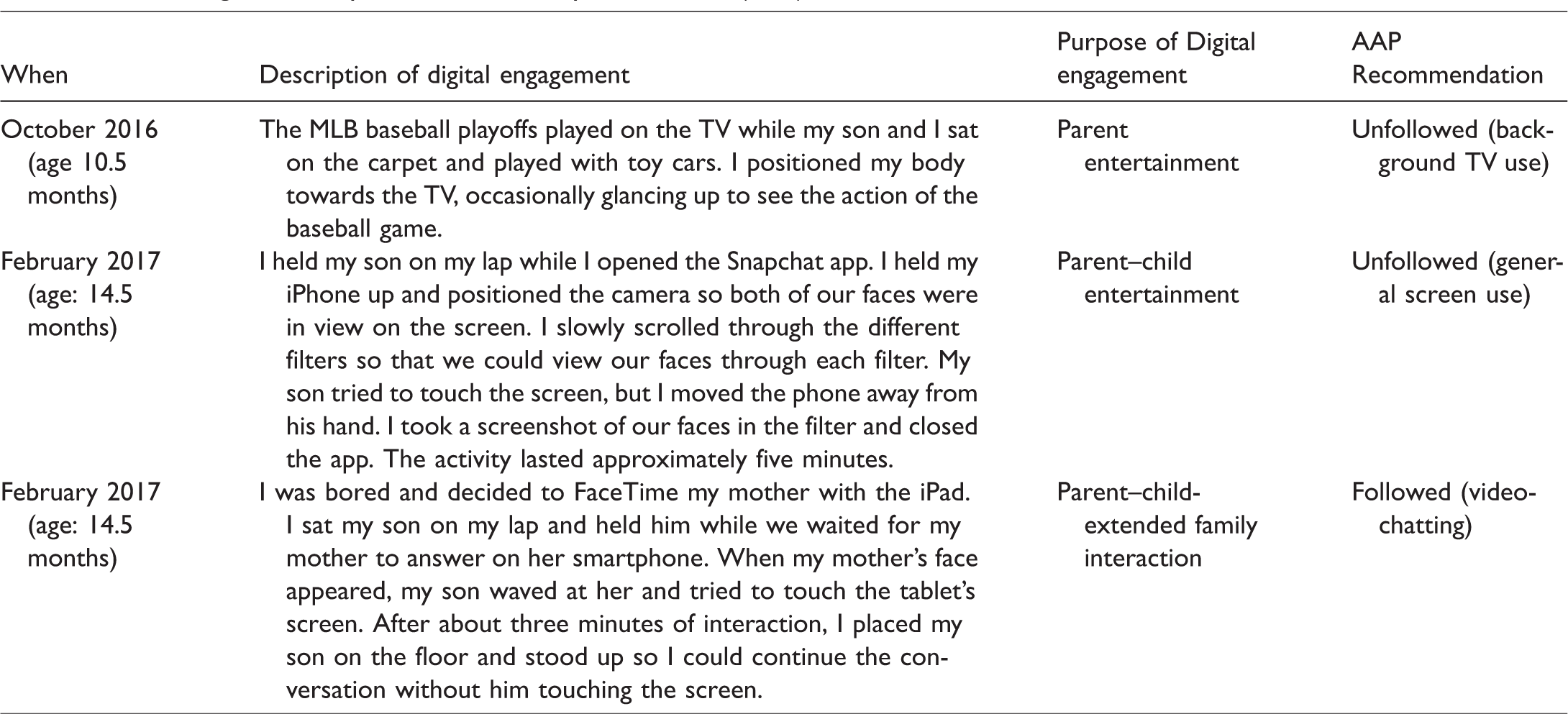
Next, I contextualize the data in relation to the AAP’s recommendations.
Findings
The home: Our lived experience
Given the emphasis placed on lived experience, I documented the digital technology in our home. My home is ‘high technology’ (Plowman et al., 2010), as my husband and I were frequent users of digital technology. I recorded the following digital devices in my home: two laptops, two smartphones (containing multiple applications, or ‘apps’), an iPad, Netflix, cable TV, two iPods and a PS3 game console. My husband and I engaged in numerous social activities mediated by digital devices. This meant that before our son was born, we had established communicative practices that relied heavily on digital technology. We read newspapers online, watched TV daily, communicated with friends and family via text message and social media (e.g. Facebook, Snapchat), we direct messaged (DM) each other twitter posts that were relevant to one another and discussed these face-to-face when we were both in our home. We maintained these practices after our son entered the world.
Before the age of two years, my son engaged with a number of digital tools in our home. He regularly used Skype or FaceTime on the iPad to interact with grandparents living on the other side of the country. The iPad app Google Play was used to play music for my son and me to sing and dance along to. At seven months he watched his first TV programme, Sesame Street, with his maternal grandmother. She enjoyed watching this programme with her children when they were young and wanted a similar experience with her grandson. He was familiar with smartphones and that they could be used for communication and to take photographs. My husband and I frequently photographed or videoed our son in order to share his growth and development with family and friends living outside the province.
However, despite the availability of digital technology in our home, my husband’s and my approach to digital engagement for our son was guarded (Plowman et al., 2012), so he was not allowed unfettered access to screen media. I was also very resistant to images of my son being posted on social media. I did not post images of him on Facebook and requested his grandmother remove videos she shared on her Facebook page. My husband occasionally posted images, but no videos, onto his personal Facebook page. Neither of us tweeted images of our son through our personal Twitter handles.
I internalized the AAP recommendations and, given my background as an Early Literacy Specialist, I was aware of the need for interactive, face-to-face time between parent and child, particularly for language development. I worried about the negative ramifications of digital technology on infants and therefore used board books (i.e. books intended for infants), crayons and paper, stuffed animals and other traditional activities and toys to entertain and engage with my son. As I reflected on these moments I realized my dual roles of mother and researcher were at odds with one another. In my research and teaching I argued for the inclusion of digital technology in early years education (e.g. Teichert, 2014). Yet, I was resistant to providing my son the same access I often argued for. Despite my hesitancy to allow him to use digital technology, I was still not following all the recommendations as set by the AAP.
Followed recommendations
Although my son interacted with screens before the age of two, I did follow some of the AAP recommendations (albeit, those intended for older toddlers). When my son watched TV or videos I chose ‘high-quality programming’ (AAP, 2016: 3) and we always watched together. In addition to Sesame Street, we watched Daniel Tiger’s Neighborhood on our local PBS channel and attempted to engage with these programmes in a similar way to how I engaged in board book reading. I pointed out characters, colours or other features of the programme and made connections to other similar experiences. I avoided ‘fast-paced programmes’ and ‘violent content’ (AAP, 2016: 4). Also, the TV was generally turned off when no one was actively watching a programme. Screen media were not kept in his bedroom and mealtimes were screen-free, family time spent around the kitchen table. Laptops and the iPad were adult tools my son used solely to Skype or FaceTime with grandparents.
Unfollowed recommendations
The AAP (2016) recommends parents ‘avoid digital media use (except video-chatting) in children younger than 18-24 months’ (p. 3) and my son accessed digital media daily before the age of 24 months. The TV was the most frequently used digital device. As already noted, I co-viewed children’s programming, such as Daniel Tiger’s Neighborhood, most days with my son. Watching sporting events was a favoured pastime for my husband and me and we continued to support our favourite east coast teams. Since we lived on the west coast, this meant our teams’ games aired live in the afternoon, before my son’s bedtime (e.g. basketball games typically began at 5 pm Pacific Standard Time). Although I played games and read stories with my son, the TV played sports games in the background, which the AAP(2016) cited as a concern because it ‘distracts from parent-child interactions and child play’ (p. 3). As an extension to cable TV, Netflix was a valuable resource during the sleepless nights of my son’s newborn and early infancy stages and thus became a habit. After my son’s first birthday we extended his viewing content privileges to include children’s movies (e.g. Sing) and TV programming found on Netflix, such as Thomas & Friends and Paw Patrol. I made an effort to limit his total viewing time and to break TV time up by engaging in more traditional childhood activities, such as going outside to the park or reading board books together.
Smartphones were the most frequently used device by the adults in my home. They were the life-line to the outside world; I talked, texted and used social media apps to stay connected to family and friends living afar. I accessed Twitter through my iPhone and used the app as a news media curator. I read online editions of local and national newspapers to stay informed about current events. I also used Twitter to stay up-to-date on sports results, trades and other sports-related news stories. Although my son did not use these apps, there is no doubt he observed my regular use of my iPhone and through observation was learning about the cultural value of this device in our home. An example of his burgeoning understanding of the smartphone’s purposes can be seen in this fieldnote My son played independently in the community sandbox. Another resident had discarded a Fischer-Price plastic telephone. The toy had a large base with a rotating dial and a red plastic headset for the user to speak into. My son held the headset to his ear and I asked him who he was calling. I offered, ‘Are you calling Nana?’ He replied, ‘No, text daddy’.
Smartphones were predominately an adult device but that did not mean my son never engaged with the device. He interacted almost daily with the camera app as we took photographs of ourselves together (i.e. ‘selfies’). I held the iPhone and pressed the button to take pictures, however, by one year he understood which button to press in order to snap the photograph and would often reach for the button while sitting on my lap. Together we also used SnapChat, a social media app that allows users to take photographs and/or videos and disseminate them to friends. The app gained in popularity because images are erased after a number of seconds and therefore images would not be stored on friends’ accounts unless captured by screen shot. My son and I used the app together much like a mirror. He sat on my lap and I held the iPhone so that he could see the screen. By accessing the filters (icons that allow users to change facial or vocal features) we playfully engaged with the app by taking photographs and videos of ourselves together. Figure 1 provides an example of my son using a Snapchat filter. However, I did not disseminate these moments through the app and deleted most images immediately after our play.

Snapchat filter image of my son.
I occasionally used my iPhone as a calming mechanism to settle my son. Granted, the AAP (2016) recommends ‘avoid using media as the only way to calm your child’ (p. 4), and I followed this recommendation since it was not the only tool I used to help my son calm down. But, at age one year and three months, for a four-month period he was given the device during majority of his nappy changes as a way to more efficiently complete that task. The practice began because he would not lie still and I became desperate in my attempts to quickly complete this task. Knowing he was curious about the iPhone I began handing him an old iPhone which was no longer connected with a mobile carrier service and was not connected to WiFi.. This meant he was unable to send or receive text messages, make phone calls or accidentally send any other material electronically via social media or email. He also could not access Internet-based apps, such as YouTube. During this four-month period, I discovered my son knew how to locate the camera app and take photographs. I was aware he knew the device allowed photographs and that he knew which button snapped the picture since we had engaged in this behaviour together; however, I had always located, opened and held the device during these playful moments. By allowing my son independence in exploring the device, even for short periods of time, he learned to locate the camera and take photographs. His images were haphazard and often showcased the ceiling or parts of me, as shown in Figure 2, however, he was learning to properly operate one app of a valued digital tool in his home.

My son learning to use the Camera app.
Beyond nappy changes, my son was also given the old iPhone in order to distract him while my husband cut his hair, a task he thoroughly hated. He was also given my iPhone when he was fussing while we were out completing errands in the community, such as queueing at the post office or at the front desk of our local community centre.
Discussion
As described earlier, my purpose for this study was to document my experiences as a first-time mother using digital tools with my infant son. I described our lived experience and juxtaposed our family life and beliefs, as shaped by the literature, with the AAP’s screen time recommendations. Chiefly, I described how, in my home, some recommendations were followed, but many were not.
As a mother, I struggle with how much screen time my son consumes and how to balance the normal digital literacy practices in my home. Despite recent changes in recommendations, policy statements still reflect a desire to disallow our youngest children from engaging with the relevant cultural tools of their communities. Competing narratives can confuse parents on how to best raise their children in digital societies. Organizations like the AAP and Canadian Paediatric Society (2017) recommend no screen time before the age of two years. News and media outlets contribute to the tensions by citing research suggesting prolonged exposure to screens impedes young children’s development (Madigan et al., 2019), but have also reported Britain’s Royal College of Paediatrics and Child Health’s (RCPCH) (2019) The health impacts of screen time: a guide for clinicians and parents which acknowledged that not enough evidence showed that ‘screen time is in itself harmful to child health at any age’ (n.p.). These competing statements can create confusion and tension for parents attempting to navigate and ‘do right’ for their children.
I drew from sociocultural theories to consider why I followed some AAP recommendations while disregarding others in our home. My home digital practices and the way my family’s ‘life is done’ do not align with the AAP’s recommendations. Sociocultural theories emphasize the language, culture and tools neophytes are socialized into within their communities. In the 21st century, digital devices are among the social and cultural tools used in western societies. As Razfar and Yang (2010) noted, digital devices are semiotic tools children use to mediate their participation, negotiation and interaction in socially and culturally relevant ways. In my home, digital devices are used to communicate in multiple ways beyond just ‘video-chatting’ (AAP, 2016: 3) with friends and family living in other parts of the country. My son and I playfully engage with screens as a natural part of our daily routine and I consider our time spent viewing photographs and co-viewing TV programming as opportunities to bond over a shared interest. I balance his engagement with digital tools with opportunities to explore the world around him in non-digital ways, such as going outside or using non-digital toys in our home.
In my family, our lived experience requires digital tools. They are embedded in the everyday ways my husband and I ‘do life’. Many of these practices, particularly those using the TV and smartphones, cannot be removed. The shift by the AAP to listening and guiding families’ media use is beneficial, but still ignores the fact that many of these practices begin at birth (not just video chatting). As well, there are ambiguities about what constitutes ‘high-quality’ or ‘educational’ or what, specifically is ‘screen time’. Lack of clarification for parents about what constitutes screen time just amplifies the tension for families and how they use digital tools in natural ways in their homes. For example, when my son sits on my lap and I quickly text message his father an update of our day or a reminder to complete an errand — is that ‘screen time’ as outlined by the AAP? Clearer definitions about what constitutes screen time, as well as guidelines outlining ‘educational’ and ‘high-quality’ digital content, in conjunction with listening to families, may help more families follow recommendations and feel confident about the digital choices they are making for their infants and toddlers.
Clinical research is concerned about the effects of screen time on young children’s cognitive development and how that will impede learning. But I suggest my son and my playful use of digital technology, like using SnapChat filters or taking photographs, was learning. We talked, we laughed and we engaged in a shared activity. We re-enacted movie scenes with toy cars and stuffed animals. I talked about what I noticed on the TV screen in similar ways to how practitioners encourage parents to read with their babies. Yet, I felt guilty when I left the TV on too long or I limited our SnapChat play because, in the back of my mind, I felt maybe we should do something more productive together. Maybe I should not give him the phone to survive another nappy change. Although it cannot be generalized by this study, the number of media articles and reports (e.g. Psychology Today; CTV News; Fortune; Babycenter.com) discussing young children’s increased screen time suggests parents beyond me are not abiding by screen time recommendations. Further research examining parents’ and caregivers’ understanding of screen time guidelines and digital literacy practices would help to explain why that is.
Conclusion
For 16 years the AAP recommended no screen time for children two years of age and younger. This recommendation strongly influenced the fields of paediatric neurology, psychology and early childhood education. Institutions and organizations emphasizing the negative effects of technology and digital media use on young children often cited the AAP’s policy statements. For example, in 2012 the NAEYC re-issued their policy statement on young children’s access to digital media, and closely aligned their position to that of AAPs, a retreat from an earlier statement advocating for the use of technology in early childhood classrooms (NAEYC, 1996). These larger organizations also influence children’s librarians, early childhood educators and early years practitioners’ ‘best practices’ policies at the local level. The message that children under two years of age should not view screens will not change overnight and will continue to be used in ‘the here and now’ for the foreseeable future. For example, a personal communication from a children’s librarian at the Vancouver Public Library revealed the library promoted ‘media mentorship’, however she acknowledged ‘it is controversial because some librarians don’t like it. It has been an ongoing struggle’ (T. Prendergast, 2017, personal communication). As such, parents will continue to feel tension about their digital choices for their children and struggle to balance their pre-baby typical digital technology uses with post-baby uses, particularly in light of AAP and other organizations’ mismatched recommendations. It is my hope that this small study of my lived experiences highlights the tensions between the AAP recommendations and the realities of everyday life in the home.
Footnotes
Acknowledgements
I want to thank Dr. Nicola Friedrich for her insights and assistance during the revision process. I also want to thank the anonymous reviewers for their valuable comments. This paper is much stronger because of them.
Funding
The author(s) received no financial support for the research, authorship, and/or publication of this article.
