




Abstract
Black Art in various forms has long been used by people in the African Diaspora to promote Black joy and Pro-Blackness yet it is often not included in language and literacy early childhood pedagogies to uplift Black children in North American schools. Likewise, many anti-racist early childhood research studies focus on the challenges faced by Black people with little emphasis on Black joy and Pro-Black narratives and the ways they are central to our psychic preservation and survival in the fight against anti-Black racism (Dunn D and Love B, 2020; Ladson-Billings, 2019b). As a child, Nina Simone’s Young Gifted and Black song lyrics rang true as the source of my Black joy was knowing the brilliance of Black people and being proud of our resistance to anti-Black racism. Growing up in the Jamaican context I heard the reggae version of her song rendered by Reggae artistes Marcia Griffiths and Bob Marley also Pro-Black advocates who contributed to my racial pride. Contemporary Jamaican Reggae artists like Chronixx with his song Black is Beautiful continue to promote these racial affirming messages. In this article, I focus on ways teachers can learn to promote Black Joy and Pro-Blackness in the early years as I introduce the notion of an African Diaspora Racial Literacy pedagogy that celebrates and fosters racial pride using Black music and poetry. By coining African Diaspora Racial Literacy, I refer to an instructional approach that draws from positive affirming racial messages from the African Diaspora to promote Black joy and racial pride, raise children’s critical consciousness, and prepare children to be able to take action against anti-Black racism. Through the lenses of Pro-Black Jamaican Intellectual Thought, critical race, Black Feminist, and decolonizing perspectives, I explore Jamaican Black Art literacies (e.g. song and poetry) and provide recommendations for teachers of children of African descent that center Black joy and Pro-Blackness as resistance to anti-Black racism in early childhood pedagogy and practice.
Keywords
They never told us that black is beautiful They never told us, black is beauty They never told us that black is beautiful […] This is a song for the children Who was never told about where their race is from They never hear it in dem favourite songs
Anti-Black racism is connected to a long history of withholding freedoms and knowledge from Black people needed for their well-being, healing, and empowerment (Baines et al., 2018; Boutte and Bryan, 2021; Dei and Jajj, 2018; Johnson et al., 2019b; Lewis, 2018). In 2021, United States President Joe Biden declared June 19th - Juneteenth - to be a federal holiday to commemorate the day in 1865 when African Americans in Texas learned that enslaved Africans had been free since Lincoln’s Emancipation Proclamation 2 years earlier (Jeffries, 2004). This is but one example of the white supremacist historical and current practice of withholding information and freedoms from Black people, or not fully or inaccurately informing Black people about policies and laws that could serve them well. This practice exists today around rights such as those regarding housing, health care, hiring practices, and education. In early childhood education, typical curricula regularly withhold or misrepresent Black histories, literacies, literature, and languages, a violent act that continues when curricula remain eurocentric, critical race theory and anti-racist teaching are attacked, and inequities and dehumanizing practices persist such as Black children disproportionately disciplined, over-referred to special education, and under-referred to gifted programs (Johnson et al., 2019b; Lopez and Jean-Marie, 2021; Pearman and McGee, 2022).
Overt examples of anti-Black violence in schools are pervasive in the news. For instance, in 2016, a six-year-old Black girl was arrested at her school in Ontario, Canada, an incident the school claimed was due to the child’s misconduct. Likewise in Orlando, Florida six-year-old Kaia Rolle was arrested at her school in 2019 for the same reason. In Jamaica, a five-year-old girl was denied access to a school because she wore locks. Her parents were told that she had to remove her locks before she could be admitted to grade one. These, in addition to normalized white-dominated curricula, are a few of the dehumanizing practices that point to the urgent need for pedagogical activism to reclaim the dignity of Black children. Thus, through the title and focus of this article, inspired by Jamaican Reggae artist Chronixx’s (2017) song lyric “They never told us black is beautiful,” I seek to challenge the withholding of Pro-Blackness narratives in early childhood curricula that deprives Black children of knowledge of their history and liberatory and joyous experiences in many classrooms. Thus, by sharing the impact of Pro-Black narratives from my Jamaican childhood experiences, I aim to help teachers understand and envision the need for Pro-Black pedagogies in early childhood literacy education.
To begin, I would like to clarify that, by Pro-Blackness I refer to “an unapologetic, positive perspective regarding Blackness and Black people” (Boutte et al., 2021: 232) that I witnessed in conscious Reggae music and poems as a young child. Chronixx’s (2017) song is one example, addressed to children of African descent as a counternarrative to deficit definitions of their identity and history. In this song, Chronixx follows the traditions of using Reggae music to raise our critical consciousness and encourage resistance to eurocentric narratives. This aligns with my goals in this article and that of anti-colonial Caribbean thought to support and promote “educational practices consonant with the goals of childhood decolonization [involving] a critique of the knowledge systems that inform pedagogical practice, learning, and teaching processes, as well as the curriculum utilized in early learning classrooms” (Escayg and Kinkead-Clark, 2018: 241).
Black peoples’ embracement of the Juneteenth celebration in the U.S. mentioned at the opening of this paper, like Emancipation Day in Jamaica commemorating the end of slavery on 1 August 1834, reveals that Black joy includes hearing affirming messages that remind us that Blackness is beautiful and has a powerful, resilient history. Recognizing that this typically does not happen in schools, in this paper I chronicle Pro-Blackness narratives (song and poetry) that helped develop my racial pride and critical awareness. To communicate those experiences and their impact, I use poetry as a form of representation and a way to capture the emotion and the power of anti- and Pro-Blackness as I contend that Black children’s access to Black joy and Pro-Blackness narratives about their identities, experiences, and abilities is crucial for their empowerment. Consequently, I emphasize that teachers and teacher educators must position themselves as learners of Black people’s histories, community narratives, resistance, resilience, and Black joy experiences so they can affirm Black children and engage in anti-racist, Pro-Black teaching. I conclude the article with recommendations for teachers and teacher educators in the interest of constructing practices that promote Pro-Blackness and Black joy.
In sum, as my reflective poem below indicates, Black children often hear competing narratives about their Blackness and their worth in society. To prevent deficit perspectives from impacting their well-being, early childhood teachers must normalize Pro-Black pedagogies in early childhood classrooms (Boutte, 2016; Love, 2019).
Growing up Black
On the intersection of competing narratives about my Blackness I learned to believe the ones that made me feel worthy daily my childhood ears heard, “anything too Black nuh good” my people called, “Black and ugly” dark-skinned individuals described as “jet Black” big lips, big nose, coarse hair, picky picky head were all playground jeers we Black children hurled at each other we were surrounded by images of white Jesus and made to feel like Black devils I was made to feel ashamed of my African features and through colorism made to feel lucky for being light-skinned. Mom helped me to reject this she did not want me to drink Black hate to become the poison that breeds anti-Blackness I light-skinned my little sister dark-skinned both Black girls made to feel that all of us were not enough I wanted to yell no, my skin is not pretty because it is “light” no, my little sister’s hair is not pretty because its “long and smooth” I learned to tune my ears to other words… upliftment narratives mainly in my home and community I ate them with my ears “I am beautiful just the way I am” “I am an African princess” “I belong to a rich history” “I am enough” These words seeped into my consciousness Pushing away the anti-Black lies I believed them I tasted them I digested them they made me feel light and happy like I am skipping at recess frolicking and laughing at the clouds
In this article I offer educational research that is largely missing from early literacy and anti-racist research and pedagogy as I emphasize a Black/Afro-Caribbean faculty woman’s (a) voice on Pro-Blackness and Black Joy in early childhood, (b) counternarratives on educating Black children, and (c) critical reflection on Black childhood experiences and journey to critical consciousness and antiracist teaching. Focusing on early childhood classrooms and the preparation of early childhood teachers, I reflect on ways that particular narratives from my childhood fostered my critical consciousness around Black joy and pride in my Black identity and can inform the work of teachers and teacher educators. In this regard, my discussion is guided by the following questions: 1) What Pro-Blackness narratives and sources of Black joy did I experience as a Black child? How did the narratives impact my self-esteem and worldview as a Black child? 2) What insights can I gain from critically reflecting on my Black childhood experiences to help prepare early childhood teachers for Pro-Blackness pedagogies?
Method
To explore these questions, data were collected from family photos, conversations with my parents, Reggae and gospel song lyrics, heritage poems, and my reflective poems. In analyzing the data, I focused on the oral tradition I was exposed to as a Black girl and critically examined the narratives that stand out in my memory as sources of my empowerment. Reggae music, gospel songs, and poetry as part of Jamaica’s oral tradition were significant areas that I found useful in countering deficit perspectives about my Black identity. Thus, in this article, I examined these childhood narratives to shed light on powerful Pro-Blackness strategies for uplifting and educating Black children. I specifically focused on the song lyrics of Bob Marley’s Redemption Song and Get Up Stand Up, Chronixx’s Black is Beautiful, and Miss Louise Bennett’s poem Fi Mi Language. I argue that these Pro-Blackness Jamaican community counternarratives will help early childhood teachers of children of African descent including Black immigrant children to disrupt anti-Black racism in schools.
Theoretical frame: intersecting Pro-Black Jamaican Intellectual Thought, Black Feminist, decolonizing and critical race methodologies
Let's recall some great men, who've been fighting for our rights Let's recall some great men, who've been fighting for our rights […] Recall Paul Bogel, recall Marcus Garvey, recall Nelson Mandela Let's recall some great men, who've been fighting for our rights Let's recall some great men, who've been fighting for our rights (Burning Spear, 1996)
Recalling great men who fought for Black people as in the lyrics from Jamaican Reggae artist, Burning Spear was often emphasized during my childhood in conscious Reggae music and other Pro-Blackness narratives to help us remember our history. In many of these Pro-Black narratives, Marcus Garvey was often honored for his advocacy and promotion of Black pride. For instance, I learned the words of Jamaica’s Forward United Heroes song in primary school and sang it every year as part of my school’s National Heroes and Independence Day celebrations. All of the country’s nine heroes were hailed for their courage and contribution to our freedom from enslavement. The lines of the song helped many of us memorize what each hero did to challenge colonialism and the enslavement of our ancestors. For example, the song lyrics highlight the significant difference Marcus Mosiah Garvey made in our liberation. He was an activist, Pan Africanist, and founder of the Universal Negro Improvement Association (UNIA) in 1914. His work extends beyond St Ann, Jamaica where he was born, to the U.S. and other parts of the African Diaspora. He believed in education as integral to our liberation as Black people and argued that we must “emancipate ourselves from mental slavery” a phrase included in Bob Marley’s Redemption Song. What stood out then and now is the way he fought for Black people’s rights and dignity.
The unapologetic Pro-Blackness stance reflected in Marley’s song is also reflective of the Jamaican Intellectual Thought that guided this study and that was a source of my Black joy as I learned from reciting poems and songs about the importance of fighting for my human rights and using our art forms for uplifting Black people (Hill and Bair, 1987; Otieno, 2019). The photo in Figure 1 of my parents’ turntable stereo is part of my vivid childhood memory, of hearing Pro-Black narratives, experiencing Black joy, and listening to the song lyrics of Jamaican Reggae artists. Though I did not fully understand all the narratives, I heard significant themes surrounding freedom and standing up for my right that provided opportunities to grow in critical awareness. My parents’ turntable in my Jamaican childhood home.
In conducting this study, I used Pro-Black Jamaican Intellectual Thought as reflected in music and poetry, along with “Black Feminist autoethnography” (Griffin, 2012: 138) and decolonizing methodologies (Smith, 2012) viewed through a critical race lens to examine and share my experiences.
Black Feminist autoethnography was important to this study because it allowed me to disrupt the too often missing narratives of Black women in academia and requires engagement in critical race reflexivity to illuminate the ways our identities and experiences shape our work (Boylorn, 2011; Griffin, 2012). This is in keeping with the notion that “the purpose of autoethnography…is not only to tell personal stories. It intends to expand the understanding of social realities through the lens of the researcher’s personal experiences” (Chang, 2013: 108).
Drawing from Solórzano and Yosso's (2002) work on counterstorytelling and critical race methodology in this study, I employed critical race methodology to (a) ground race and racism in this research, (b) challenge the traditional research practice of silencing Black voices and experiences, (c) focus on critical Jamaican Black art forms (select Reggae song lyrics and poetry) as sources of Black joy and Pro-Blackness narratives for empowering children of African descent, (d) focus on the intersections of race, gender, and ethnicity in Black experiences, and (e) draw from the interdisciplinary knowledge of Black Feminism, Jamaican Intellectual Thought and decolonization to include nuanced Black childhood experiences and ways of challenging anti-Black racism in the early childhood. Figure 2 illustrates ways I drew from all four perspectives to discuss Pro-Blackness pedagogies. Interdisciplinary theoretical construct: Challenging oppression through centering oppressed voices and experiences.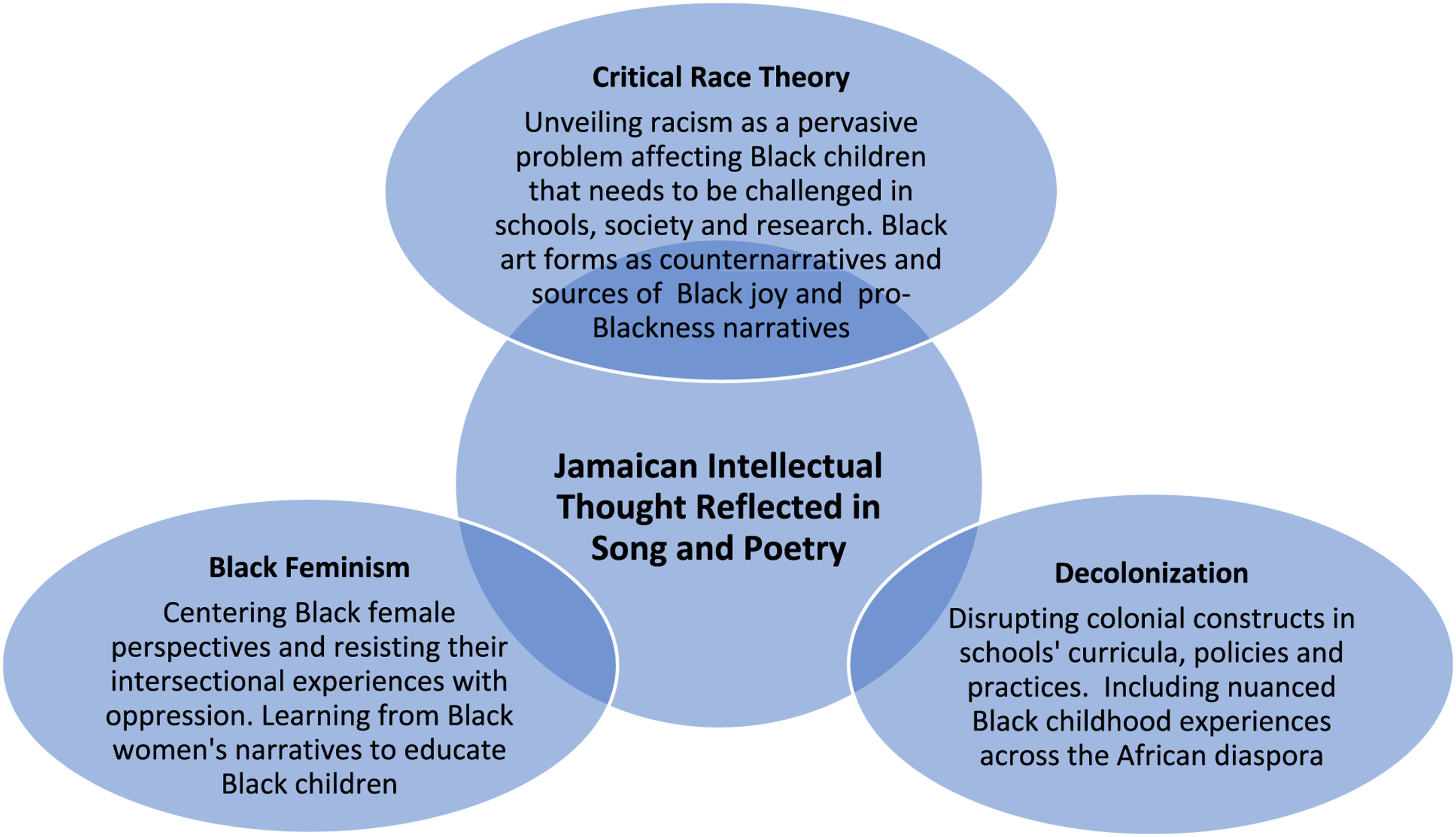
Grounded in Jamaican Intellectual Thought, decolonizing, Black Feminist, and critical race perspectives, in this article I explore Jamaican Black artists’ contributions to the development of my African Diaspora Racial Literacy as a child, a term I conceptualize and define in the Implications section of this article. And I outline how critical Black art literacies still provide me with insights as a teacher educator on ways of supporting teachers and preservice teachers in developing their skills in Pro-Blackness pedagogies to promote African Diaspora Racial Literacy for the young children in their classrooms.
Findings: I am enough
In this section, I share findings from my examination of the impact of three Pro-Blackness narratives in my childhood, specifically, Chronixx and Bob Marley’s Reggae song lyrics and Louise Bennett’s poem Fi mi Language. These findings are followed by implications for classroom teachers and teacher educators as they can learn from and draw on these narratives and my experiences to make Pro-Blackness teaching foundational in their early childhood and teacher education classrooms.
Early childhood loving and teaching “the children of Africa”: Chronixx
We love the children of Africa Teaching the children
The preceding lines from Chronixx’s song reveal a belief that love is integral to teaching children of African descent. This revolutionary love (Johnson et al., 2019b: 46; Wynter-Hoyte et al., 2022) must lead teachers to disrupt the dishonoring of Black identities, knowledge, and experiences by centering their voices and experiences. Focusing only on the struggles and pain experienced by Black people will limit opportunities to foster their well-being and academic excellence through positive and uplifting narratives about their racial identities. Therefore, revolutionary love as part of Pro-Blackness pedagogies, “should help Black children embrace and build on authentic and liberatory love which works against the self-hate and miseducation that often begins in schools” (Johnson et al., 2019b: 56).
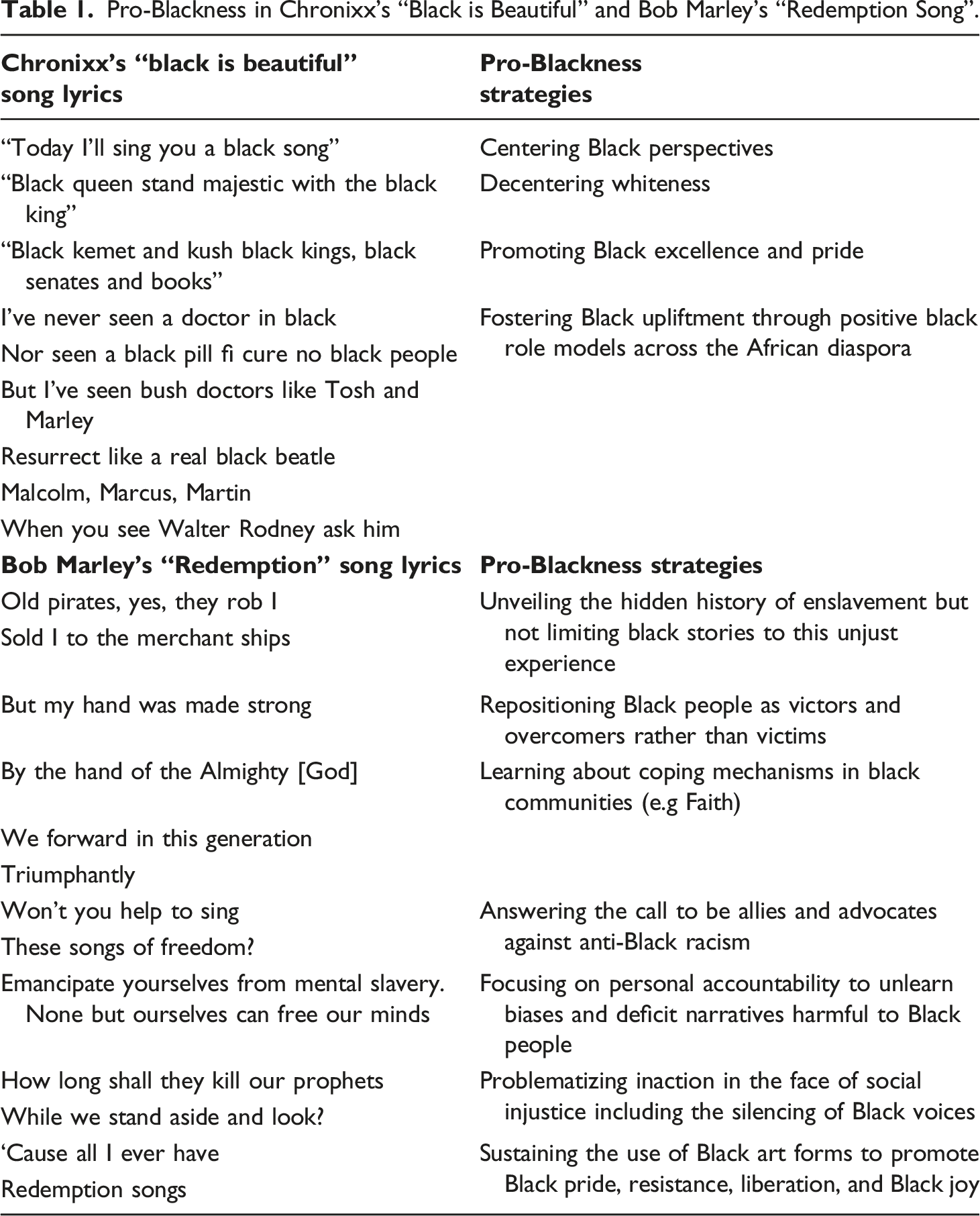
Critical Black art forms such as Chronixx’s song, as Pro-Blackness tools, offered me rich opportunities for empowerment through positive narratives and experiences. For instance, Chronixx’s Pro-Blackness messages focused on: 1) centering Black perspectives; 2) decentering whiteness; 3) promoting Black excellence, and 4) fostering Black upliftment through the healing work of their ancestors. His declaration that “Today I’ll sing you a black song” reveals the intentionality needed in early childhood education to center Pro-Blackness messages and Black lives in the classroom. By referring to “Black Kemet and Kush” he pointed to Black history that extends beyond the enslavement of Black people and unveils the contributions and brilliance of our African ancestors. Black students’ upliftment, as demonstrated in the song lyrics, comes through learning stories about the excellence of their ancestors and their contributions. The activism of Black people like Malcolm X, Marcus Mosiah Garvey, Martin Luther King, and Walter Rodney mentioned in the song lyrics encouraged me to speak back and use my voice to bring about change. His references to “Black queen stand majestic with the Black king” and “Black book” provided insights on the need for Black people to see themselves positively represented in the texts they read. He also drew attention to the healing that will occur from Black students’ exposure to ancestral counternarratives that challenge stereotypical representations of Black people.
According to Cooper (1995) “The reggae songwriter’s art is a dynamic process in which words, music, and dance are organically integrated within an Afrocentric aesthetic” (p.117). This includes the rhythm, movement, and song lyrics that celebrate Blackness and Africa as our motherland. Hence, Chronixx’s (2017) Pro-Blackness Reggae song lyrics form part of this aesthetic that calls for the celebration of Black experiences, identities, and knowledge. Challenging anti-Black racism, Chronixx (2017) interrogates deficit narratives about Blackness useful for disrupting this problem in the early childhood classroom. His creative action is to write a song so children can hear about “beautiful black things.” Through his song, I learned to see “beautiful black things” in my home, community, and the wider society in ways that countered the deficit stereotypes about my racial identity.
Pro-Blackness and Black joy as action: Bob Marley
And now you see the light You stand up for your right Get up, stand up Stand up for your right Get up, stand up Don't give up the fight Get up, stand up Stand up for your right Get up, stand up Don't give up the fight
The focus on critical consciousness that leads to action is a recurring theme in Bob Marley’s songs. In this sense, critical literacy and Pro-Blackness are presented as integral to taking action against oppression and dangerous anti-Black ideologies. The decolonizing narratives of “seeing the light” and standing up for my right in Bob Marley’s preceding song is one that I grew up hearing as a young child. Though I did not understand all the words of the song lyrics, I began to learn about the themes of freedom and resistance. They were also helpful in activating my critical thinking as they helped to begin several conversations with my parents about what it means to stand up for our rights and why this is important. Bob Marley’s argument that “You can fool some people sometimes. But you can’t fool all the people all the time,” reveals a view that holders of power are intent on spreading lies and withholding knowledge thus requiring a rejection of false narratives harmful to Black people. This call to action against this injustice is also echoed in his Redemption Song, a song that I learned in my early childhood years as this was a regular staple in my house every Sunday evening as my father played music on the family turntable.
Pro-Blackness in Chronixx’s “Black is Beautiful” and Bob Marley’s “Redemption Song”.
Jamaican Patois and poetry as sources of Black Joy and Pro-Blackness: Louise Bennett
“Tek kin teet kibba heart bun” (Jamaican Proverb)
Similar to Reggae music, Jamaican critical poems are rich sources of Pro-Blackness narratives and Black joy. Reflecting on my early childhood, Louise Bennett’s poems stand out as an unapologetic celebration of Jamaican Patois and rejection of linguistic discrimination. The preceding Jamaican proverb reminds me of her use of satire to challenge the oppressor. It refers to the use of laughter as a means of coping with pain. It is understood as not a denial that the pain exists but a choice to create an alternate experience that provides a pathway to healing. Louise Bennett, who was a Jamaican poet and advocate for the valuing of Jamaican Patois demonstrated this through her work. In her following interview with Jamaican poet, Dennis Scott she draws a connection between Patois, Black joy, and resistance: We can laugh at ourselves…The nature of the Jamaican dialect is the nature of comedy, I feel. As it is used by the people to express their feelings, the dialect is very adaptable. You can twist it, you can express yourself so much more strongly and vividly than in standard English. Maybe I feel this because I think in the dialect…my business of believing in laughter forces me to look for the medium through which I can express that attitude. And the greatest medium I can find is the Jamaican dialect-the dialect I know, I feel; the dialect that I understand; the language, the comedy that I understand… I can portray the tragic side of things or the serious side of things; but immediately the comedy of it comes to mind and that’s what I want to express (Bennett and Scott, 1968: 97).
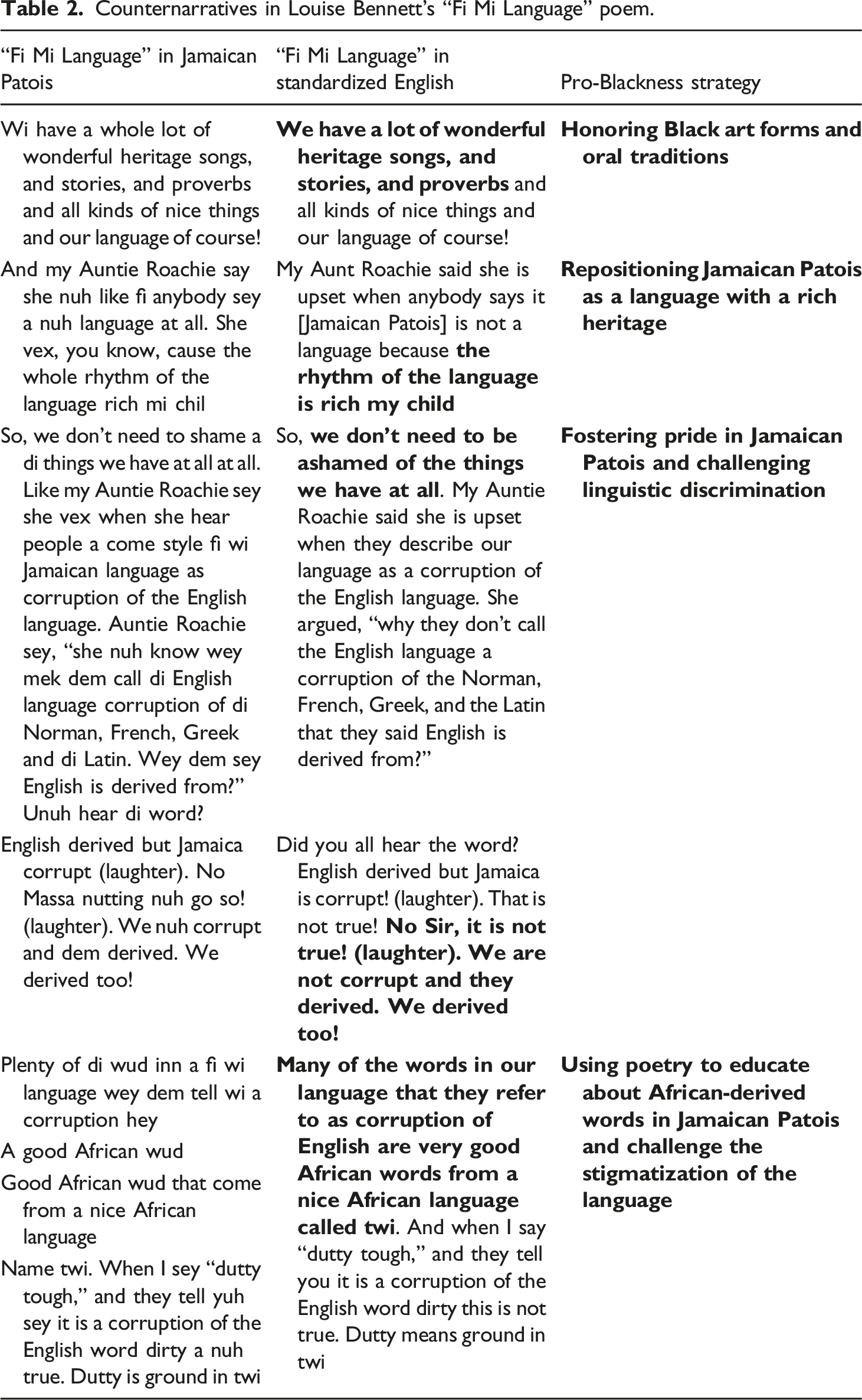
Louise Bennett’s concept of Black joy points to a refusal to always focus on the tragedy of Black experiences and choosing instead to celebrate our ability to use our creativity to construct countertexts and experiences that center our joy. Her emphasis on Black joy is not a failure to act against oppression as her performative poems are often satirical interrogations of white supremacy and linguistic discrimination. She used satire to present counternarratives about Jamaica Patois and to educate her audience about the African retentions in our language which add to its richness. Through a Pro-Black stance, she provided the historical context of contact between European and African languages during slavery resulting in Jamaican Patois. In the process, she challenged the oppressor’s claim that Patois is a corruption of English and fostered Black joy by using this very language to poke fun at the oppressor. Through constant references to her Auntie Roachie, she revealed the power of Jamaican women’s storytelling and counternarratives in helping Black children unlearn deficit perspectives about their heritage language and identities.
Counternarratives in Louise Bennett’s “Fi Mi Language” poem.
Understanding Black Joy as a nuanced term
A summation of findings from this study must include a focus on the importance of understanding Black joy as a nuanced term requiring teachers and teacher educators to understand Black joy as complex and fluid, nuanced by Black people. As a child, Black joy and pride were fostered in me through critical Black art forms, narratives, and experiences that inscribed positive messages on my heart and mind that I am enough. This became clear as I examined texts from my childhood and their impact on my thinking. I found that Black joy, as I experienced it, manifested in multiple ways. As a result, I define it as a state of psychic contentment, an enduring feeling of “enoughness,” and an experience of racial pride despite deficit narratives about Black identities. In this vein, I found that Black joy should be defined by self-love and loving my people and their brilliance, artistry, resistance, and contributions. It is not blind euphoria. It is not a denial or dismissal of Black struggles but a refusal to be defined and limited by them.
Consequently, I offer my reflective poem on Black joy as a way to pull together findings from this study. It is nuanced by my childhood memories of being free as a Black child to celebrate and love my Blackness. Woven in the poetic lines are family interactions and the creativity and courage of Black artists and freedom fighters who were part of my ethnic-racial socializing home and community counternarratives. I added the poetic lines of seeing me in art laughing, being seen in art laughing, laughing not always hurting to underscore the need for students of African descent to see Black joy represented in classrooms and everyday life as a pathway to self-love, hope, racial pride, and freedom. Black joy is… Ms. Loiuse Bennett’s belly laughing Patois poetry- mi love fi mi language Mummy’s storytelling freedom fighters coming alive inna fi her tongue Me reciting the Ballad of Sixty-Five poem in 2nd grade learning about Paul Bogle, a Jamaican national hero singing Forward Forever United national heroes song with Queen Nanny of the Maroons a Black woman centered in the fight! rocking to Bob Marley’s One Love, Get Up Stand Up for Your Right, and Redemption song Daddy playing on the turntable every Sunday Reggae and Black Soul music teaching me Black love worshiping at church singing negro spirituals-Swing low, sweet chariot coming for to carry me home Black drama on the Jamaican stage satirical and cathartic musical pantomimes speaking back crafting and retelling Anansi stories to the delight of my younger siblings hand clapping, jump roping, dandy shandy aka dodge balling seeing me in art laughing being seen in art laughing laughing not always hurting telling the truth about the struggles but giving me the tools for holding on to joy…
Implications: African diaspora racial literacy in the early childhood classroom
You need to hear about beautiful black things 'cause Most time we hear about black, we hear about black magic and black witches Black list, black book, black market Black Friday
What information and freedoms are being withheld from Black children in our schools? What are they told about who they are; what Black people have accomplished; and the beauty and brilliance of our people, our languages, and our communities? Too often Black children are not told they are beautiful and that they come from brilliance; instead, they are labeled as problems, and their histories of accomplishment, resistance, and resilience are kept from them (Boutte and Bryan, 2021; Johnson et al., 2019b). In this article, I have argued for addressing this kind of anti-Black racism by using a radical teaching approach in early childhood classrooms that promotes Black joy and Pro-Blackness informed by my examination of the impact of Pro-Black narratives in my childhood. Consequently, I propose that early childhood educators ensure Pro-Blackness by embracing what I call African Diaspora Racial Literacy as foundational to their classrooms. Drawing from Black art forms in multiple contexts, teachers can provide counternarratives that name the realities of racism and foster Black joy by positioning Black children as brilliant, critical thinkers, talented and beautiful. Specific elements of African Diaspora Racial Literacy are outlined in the following sections as implications from this study for teachers and teacher educators starting with understanding African Diaspora Racial Literacy and its importance, then become woke teachers; followed by focusing on Black joy, accomplishment, resistance, and resilience; and using Black music and poetry; and taking responsibility as teacher educators. This implications section closes with a compilation of strategies for engaging in Pro-Blackness pedagogies.
Understand African Diaspora Racial Literacy
African Diaspora Racial Literacy is a term I am coining to refer to racial socializing literacies and practices in the African Diaspora that help to raise the critical consciousness of children of African descent about their racial identity, history, legacies, contributions, and brilliance locally and globally in ways that fosters Black joy. African Diaspora Racial Literacy is a nuanced exploration of the ways people of African descent foster Black joy, promote Pro-Blackness, share their narratives and counternarratives, and challenge anti-Black racism through multimodal means including critical Black Art. This includes developing nuanced critical awareness of historical and contemporary experiences in the fight against anti-Black racism and the ethnic-racial socialization of Black children in the different contexts of the African Diaspora. Therefore, I maintain that “Caribbean intellectual tradition, although negatively impacted by the legacies of colonialism, nevertheless has offered counter-narratives and discourses that consistently have sought to challenge and reconfigure the (post)colonial order” (Heron and Hume, 2012: 25). African Diaspora Racial Literacy builds on King’s (1992) work on Diaspora literacy and current work on African Diaspora Literacy as “a source of healing” (Johnson et al., 2019a: 10). It extends this work with a nuanced focus on ways literacies (e.g. narratives and art forms) can be used by early childhood teachers to teach through Pro-Blackness lenses.
Become woke early childhood teachers
Teacher is teaching Where did he get his degree? Now it is no mystery who taught us black history Ease up
These lines from Chronixx’s (2017) Black is Beautiful song serve as an interrogation of many schools’ failure to teach Black history. The implications of the line “Now it is no mystery who taught us Black history” is that it is often taught outside academic spaces by critical Black artists, activists, and community members. Thus, I argue that Pro-Blackness pedagogies that move beyond tokenism, must be embraced in schools to address the absence of Black history in the early childhood curricula. Teaching Pro-Blackness requires that early childhood teachers must become woke teachers. According to the Urban Dictionary, being “woke” means being critically aware of social injustice. I use the term woke teachers to point to the need for teachers to be intentional and proactive in seeking out information that will help them to be educated about racialized experiences. Critical awareness is required to engage in humane teaching as uncritical teachers will fail to recognize and honor students' humanity (Johnson et al., 2019b). Teachers can achieve this by first being truthful about the problem of racism and the ways it deprives racialized students of equitable education.
Woke teachers must be watchful and ready to challenge harmful school practices and policies. Vulnerability and honesty are important areas for positioning themselves for antiracist action. Knowing their own histories and how those histories shape their teaching lenses is crucial for unlearning implicit biases that will keep them complicit with the hegemonic ideologies operating in many schools. Along these lines, I argue that teachers must do the work needed to become critically conscious of the ways racism negatively impacts students so they can help to challenge this problem. Their first step against racism must be to critically reflect on implicit biases that prevent them from seeing the value of Black students and providing equitable education for their students. Teachers come to the classroom with identities, intersectionalities, and positionalities that influence their instructional perspectives and decisions. When their ideologies are aligned to eurocentric ideologies, they must be disrupted and replaced with critical pedagogical approaches so they can learn to see, listen to, respect, and uplift their Black students.
Engaging in critical reflection will prepare teachers for employing Pro-Blackness pedagogies as an action against anti-Black racism. Some important critical reflective questions for teachers must include: What experiences and narratives influence the way I view my students and their ability to achieve? What were the missing voices in my K-12 school experiences and beyond and how can I learn to listen to them as an educator? What eurocentric instructional practices from my childhood have I held on to and how must I work to disrupt them? What Pro-Blackness narratives was I exposed to as a child? If present, how did they impact my life and lenses?
Choosing to be “neutral” on the issue of race is choosing to take a stance against antiracist work as there is no middle ground. Those who claim to be non-racist often hold onto the notion of neutrality while helping to reproduce the status quo (Kendi, 2019). When early childhood teachers understand that Black is beautiful, this will be demonstrated in their teaching. In such a Pro-Blackness classroom atmosphere, critical conversations are fostered, students' voices are welcomed and action against racism is deemed urgent. The reality is many teachers are failing to disrupt racism and instead are reproducing this problem by teaching with unaddressed implicit biases. Stereotypes and deficit perspectives about Black students keep them blind to the assets these students bring to school and prevent them from doing the antiracist work needed to make the classroom safe for them.
Focus on black joy, contribution, and resistance
My findings indicate that Pro-Blackness pedagogies must focus on positive aspects of Black students’ lives to celebrate their experiences of joy and foster their well-being in the face of daily anti-Black racism. Hence, “centering Black joy within antiracist pedagogies allows Black people to be more than their struggles and setbacks, and to see Black folx creativity, imagination, healing, and ingenuity as a vital part of antiracism” (Dunn and Love, 2020: 191). Black joy must be seen as resistance against anti-Black racism in the early childhood classroom and as part of Black students’ healing. Black joy is sustained happiness not sporadic or occasional. It demands critical pedagogies that foster and sustain it beginning with the early years of students’ lives. Because Black children begin internalizing, experiencing, and or observing racism early in their lives (Boutte, 2016), classroom narratives must address this problem by normalizing positive images of Blackness including Black history that is not limited to slavery but focuses on the brilliance of Black people (Boutte et al., 2019). Black joy can be fostered and sustained by drawing from Pro-Blackness narratives existing in children’s lives as illustrated in my description of the impact of Black music and poetry in the following section.
Disrupt tokenism through critical use of Black music and poetry
What can the arts do?.. power comes to all of us who are able to make definition about ourselves on our own terms and to proceed to action on the basis of such definitions. The artist when creating is involved in a form of action… that provides a zone of comfort in which to renew oneself without denial to the continuity of action (Nettleford, 2009: 40).
Drawing from Nettleford’s (2009) notion of art as action, I contend that Pro-Blackness pedagogies should use critical Black art including Jamaican Reggae music and poems as action against anti-Black racism in the early childhood classroom. Grounding this work in decolonizing perspectives, I embrace the view that “the past, our stories local and global, the present, our communities, cultures, languages and social practices – all may be spaces of marginalization, but they have also become spaces of resistance and hope” (Smith, 2012: 4). In this regard, decolonizing the classroom requires an acknowledgment of ways the classroom has been oppressive to Black students through practices and policies that do not foster their well-being and academic success (Johnson et al., 2019b: Wynter-Hoyte et al., 2022). Educators must come to recognize their roles and responsibilities in challenging white supremacy and embracing Pro-Blackness pedagogies as subverting “the current educational system can liberate young minds through the power of ideas, and political practice…rearranging the current existing social order, and fighting to include new educational futures (Dei and Jajj, 2018: 1). Moving early childhood teachers from being non-racist to antiracist (Kendi, 2019) requires exposing them to authentic Pro-Blackness assets and tools within Black communities. Jamaican critical Black art forms are examples of ways the voices of Black community leaders, artists, and members should be used to empower Black children.
The themes of critical Black music, though not all age-appropriate, can help guide early childhood teachers in planning Pro-Blackness lessons focused on positive narratives and role models from the Black community. Excerpts from the songs can begin conversations about race, racism, being fair, and standing against injustice. Though children will not fully understand the counternarratives in some of these Black art forms, teachers can focus on extracting specific themes useful for beginning to raise children’s critical awareness at an age-appropriate level. Black early childhood teachers can find upliftment and inspiration from Pro-Blackness narratives in these Reggae songs as they engage in antiracist work.
Take responsibility for Pro-Black pedagogies in teacher education programs
The question “Where did he get his degree?” from Chronixx’s (2017) Black is Beautiful song, cited earlier, draws attention to the responsibility of teacher preparation programs to address this problem. Harm to Black children in the form of anti-Blackness - through omission, marginalization, and misrepresentation - in Teacher preparation programs is a pervasive problem worldwide (Brown and Brown, 2021; Wynter-Hoyte et al., 2022). Thus, a radical shift is needed from policies and pedagogies that train new teachers to replicate practices that result in racial traumas and violence faced by Black children in early childhood programs (Boutte and Bryan, 2021). In this article, I, therefore, join the call for Teacher Preparation Programs to focus on developing teachers’ ability to engage in Pro-Blackness pedagogies that uplift, educate, empower, and affirm Black children. I argue that taking this critical stance and learning from the experiences of Black people, will help to educate future early childhood teachers so they will be able to create equitable classroom spaces that foster Black joy and academic excellence.
Ways to engage in Pro-Black pedagogies
A guide for engaging in Pro-Blackness pedagogies and promoting black joy.

Conclusion
Weaving together critical race and decolonizing theories, Black Feminism, and Pro-Black Jamaican Intellectual Thought as this study’s interdisciplinary theoretical construct helped me understand and unveil ways Pro-Blackness pedagogies must be nuanced by Black experiences across the African Diaspora to provide students of African descent wider access to the assets and contributions of Black people locally and globally. Drawing from CRT, I argued that majoritarian stories about Black children and their families are problematic (Solórzano and Yosso, 2002) Black joy killers and white supremacist ideologies and practices, that must be challenged in the classroom. Through this lens, I join the call for the “deconstruction of oppressive structures and discourses, reconstruction of human agency, and construction of equitable and socially just relations of power” (Ladson-Billings, 2009a: 19). This includes challenging color blindness and the silence about racism in schools to center Black experiences, foster Black joy, and develop students’ critical awareness.
As I have demonstrated from my childhood experiences, Jamaican critical Black art forms challenge anti-Black racism and provide upliftment for Black people. Employing them as Pro-Blackness tools in the early childhood classroom will disrupt the withholding of freedoms and information from Black children needed for their wellbeing. By learning about and centering critical Black art forms from the African Diaspora in their Pro-Blackness lessons early childhood teachers can help Black children experience joy and racial pride from learning that Black is beautiful and brilliant.
Footnotes
Declaration of conflicting interests
The author(s) declared no potential conflicts of interest with respect to the research, authorship, and/or publication of this article.
Funding
The author(s) received no financial support for the research, authorship, and/or publication of this article.