



Abstract
The concept of reverse teaching, considered by some as the education model of the future due to increasing technological availability in the classroom, has received great attention in education research lately. However, the focus of these studies has mainly been on the understanding of reverse teaching in terms of its application rather than exploring the students’ perceptions of reverse teaching itself. This study explores the students’ perceptions of reverse teaching. Based on 28 in-depth interviews, this study submits a conceptualization of reverse teaching from the students’ point-of-view. The concept of reverse teaching constitutes three dimensions, expanding our knowledge of the construct. The study posits a crucial link between preparation, interaction, outcomes, and the understanding of reverse teaching. Guidelines are proposed for reverse teaching, extending existing literatures, with insights and implications for educators.
Keywords
Reverse (or “flip”) teaching
Reverse teaching is also called flip teaching, backwards classroom, reverse instruction, and the inverted classroom (e.g. Alvarez, 2012). It is a teaching practice that “flips” or reverses the traditional teaching model so that students learn new content at home, and class time is used for “homework,” that is, working on problems (Anderson, 2012). In the classroom, the teacher’s interaction with students is more personalized and guidance-oriented instead of lecturing. As a concept that is receiving greater attention due to the increased technological availability (Thompson, 2012), further investigation is needed as to what students’ perceptions are toward this teaching approach.
The vision of a reverse classroom includes discussion and problem-based activities with a convenient backchannel (Stannard, 2012; Steel and Hudson, 2001). A backchannel is a communications platform for students to post comments and ask questions. Lage et al. (2000) note that the benefit of reverse teaching is that it engages more students due to the availability of the teacher. This means that reverse teaching also changes the allocation of teacher time. Traditionally, the teacher engages with the students who ask questions in class, which are often only a few. But as noted by Rosenberg (2013), those who do not ask tend to need the most attention. These “silent failers” can be targeted more effectively with flipped teaching and teachers are able to attend to those who need the most help rather than the most confident. Flipping thus changes teachers from “sage on the stage” to “guide on the side,” allowing them to work with individuals or groups of students throughout the session (King, 1993; Rosenberg, 2013).
The use of reverse teaching has attracted a growing range of studies, as researchers explore the usefulness of this approach (e.g. Henning, 2009). Specifically, researchers call for a careful consideration in areas such as independent preparation and online use of materials (McCartan, 2000; Issroff and Scanlon, 2002). Reverse teaching is a prevalent theme in different streams of education literature, including high school, universities, and corporate training (e.g. Nail, 2012), and has been researched in the areas of physics (Rundquist, 2012), swimming (Sherman and Rushall, 1993), writing (Kagan and Provenzano, 2007), and coaching (Cantrell, 2008). Today, a university’s focus on reverse teaching is more than just a necessity; it is an increasingly important differentiator between universities (Shimamoto, 2012).
Reverse teaching is considered a prerequisite for improving future education models (Finch et al., 2013; Nail, 2012) and subsequently acts as an important approach for future classrooms (Faig, 2011). Researchers suggest that reverse teaching is a form of blended learning which encompasses any use of Internet technology to leverage the learning in a classroom, so a teacher, instead of lecturing, can spend more time interacting with students (Barseghian, 2011). Blended learning refers to a formal education program in which a student learns through delivery of content and instruction via digital and online media with some element of student control over time, place, path, or pace (e.g. Friesen, 2012). This is achieved, as the teacher creates videos (or uses other media for the same purpose) that students view outside of class time, reversing traditional lecturing classes and enabling more interaction (e.g. Alvarez, 2012).
For example, the traditional pattern of education has been classroom lectures, where the teacher explains a topic, followed by homework that includes student exercises. In flip teaching, the students first study the topic by themselves (Tsai and Tsai, 2003), typically using video lessons created by the instructor or shared by another educator, such as those provided by the Khan Academy (Young, 2010), Coursera, or edX. The watch-at-home content can include recorded lectures, demonstration videos, adaptive quizzes, or anything in between (e.g. Brown, 2012; Faig, 2011). In the classroom, the student then tries to apply the knowledge by solving problems and doing practical work. According to Brown (2012), when reverse teaching is used, the classroom becomes more inter-active and the teacher has ample opportunity to provide individualized guidance when it is most needed. The role of the classroom teacher is then to tutor the student when they become stuck, rather than to impart the initial lesson. This allows time inside the class to be used for additional learning-based activities, including use of differentiated instruction and project-based learning (Jonassen and Rohrer-Murphy, 1999). Flip teaching allows more hands-on time with the instructor guiding the students, allowing them to assist the students when they are assimilating information and creating new ideas. Students learn by asking questions and doing, and they can also help each other, which benefit both the advanced and less advanced learners (Rosenberg, 2013).
In the early 1990s, King (1993) published “From Sage on the Stage to Guide on the Side,” which laid the foundation for reverse teaching by encouraging the teacher’s role to be less that of transmitting knowledge but more of facilitating learning in less directive ways, promoting active and cooperative learning. Later, Mazur’s (1997) work on peer instruction found that computer-aided instruction allowed him to coach instead of lecture. Researchers then began to present their studies on inverting the classroom (Lage et al., 2000) and using web courses with the classroom flip (Baker, 2000). When Khan began to record teaching videos and made them available for everyone with an Internet connection, reverse teaching gained increased interest and was hailed as the future education model. Today, Khan Academy videos are used as part of some educators’ flipped teaching strategy (Thompson, 2012).
Reverse teaching remains an under-researched area. However, there is evidence that teachers are employing the technique (Finch et al., 2013). For example, McDougall (2013) reveals that classes hold abundant potential for conducting reverse teaching classes. He notes that, on one hand, when the classes have clear objectives, they are very effective. On the other hand, problems are evidenced once the initial “fun” impression is over, and in later weeks, students may perceive the reverse teaching as over-structured. This finding is consistent with other teaching models, suggesting that continuous innovation is needed, such as the experiential learning model (Li et al., 2007) and zero-based model (Borin et al., 2007), both of which aim to foster innovation in teaching. While several solutions are present, scholars suggest that maintaining consistent reverse teaching effectiveness may require the inclusion of appropriate (and different) teachers for each topic that holds real-world applications and projects (Albers-Miller et al., 2001). The reverse teacher’s role is, thus, to act as a “consultant,” who allows the students to teach themselves (McDougall, 2013). Interestingly, using many teachers raises questions of the practicality of the method, if it is to be so heavy in staffing demands. McDougall (2013) acknowledges that while one teacher may be versatile enough to cover several topics on a general basis, for specialized topics, the inclusion of teachers with such specialized knowledge is preferred. This is especially true for certain contexts, such as marketing classes, which have diverse topics such as segmentation, statistics, or data management, to mention a few.
Based on the above review, the study describes reverse teaching as the successful execution of a teaching approach grounded in students’ perceptions of value. This approach is built on engagement and innovation in order to create satisfying learning outcomes by delivering beneficial outcomes for students and teachers alike. Although existing literature presents aspects of reverse teaching and its application, there is little discussion of those approaches grounded in students’ perspectives (Nail, 2012). Little attention has been given to the concept of reverse teaching and the teaching approaches focusing on reverse teaching (e.g. Nail, 2012). The purpose of our article is twofold: (1) to explore marketing students’ perceptions of reverse teaching, in order to (2) identify what constitutes desirable practices for the reverse teaching concept among this group.
Methodology
In all, 28 in-depth interviews were conducted following an open-ended format (with non-directive open-ended questions), in accordance with the exploratory nature of the research (Corbin and Strauss, 1990). Appendix 1 shows the interview protocol in detail. All of the interviews were conducted face-to-face by a member of the research team, and in some cases, follow-up email enquiries were used. The interviews were carried out in March–April 2013 toward the end of the teaching module.
The employed research technique was action research (Denzin and Lincoln, 1998). That is, to ensure that students had appropriate exposure to reverse teaching, two sessions of undergraduate classes were executed as reverse teaching. Topics for these two sessions were “Customer Relationship Management” and “Segmentation,” respectively. Activities included both short test questions and more in-depth discussion–based essay questions, for example: “(1) Does mass marketing have any role in the Interactive Era? If so, what? How might branding be used, and what benefits could it yield for the customer-centric enterprise? (2) List and describe the seven characteristics of genuine business relationships. (3) What strategy would you suggest for a company dealing with high customer churn (and assumedly low customer loyalty), taking into account both attitudinal and behavioral definitions of loyalty? How would you characterize the core problem? How might a loyalty program help?” Table 1 shows the proceedings of the sessions, each lasting 60 minutes. The class consisted of second and final year marketing students.
Reverse teaching proceedings.
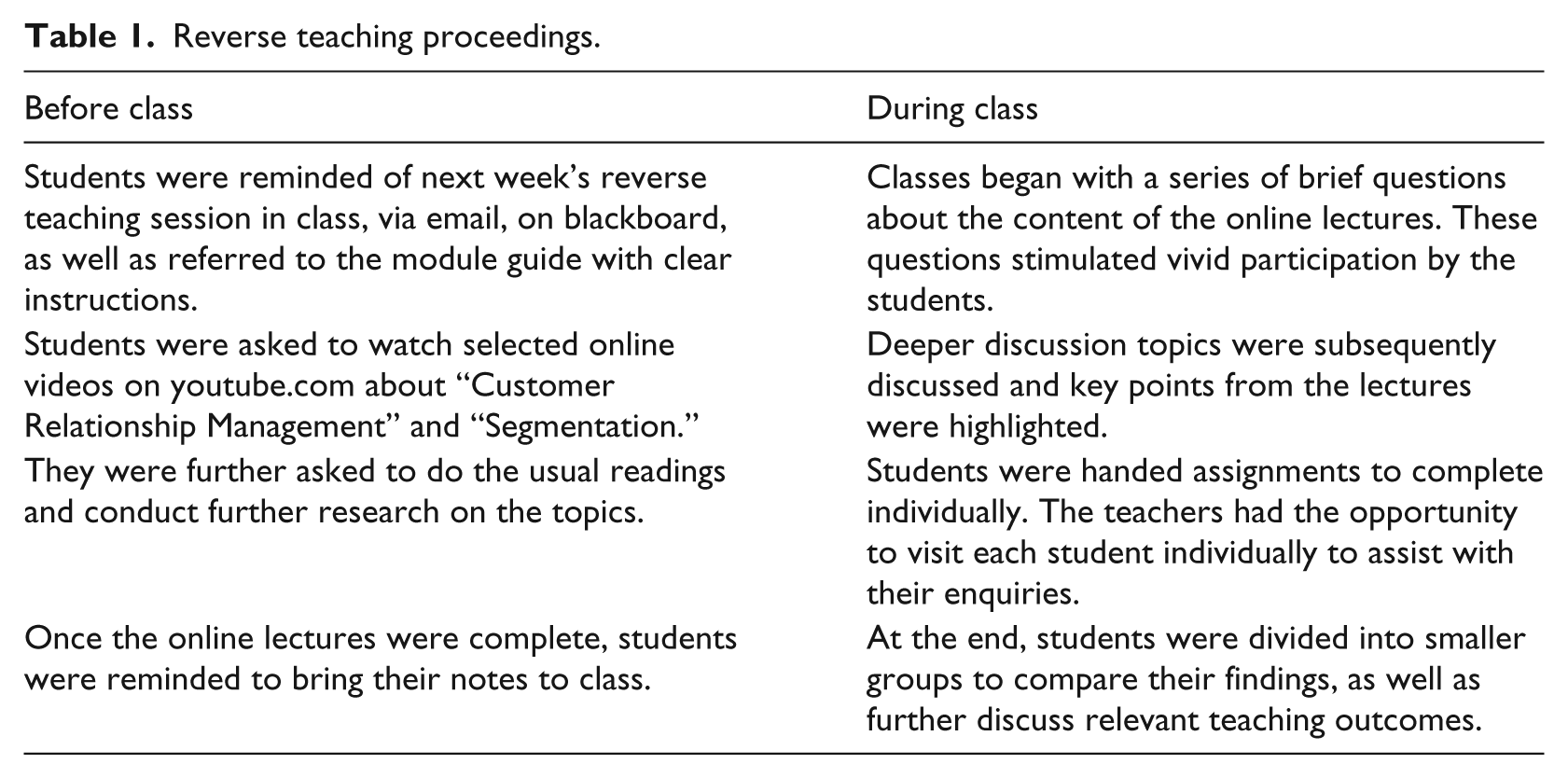
After each of the two sessions, 14 students were randomly asked to be interviewed. Interested students were selected, and they were asked directly whether they were able to answer questions about the teaching method. They all agreed to participate. The sampling approach was a purposive technique, whereby the sample met a predetermined criterion (Bryman, 2006). The purpose of only exploring the students’ perceptions (and not tutors’) was to obtain a homogeneous group. Homogeneous sampling is used when the goal of the research is to understand and describe a particular group in depth. The interviews were ended after conducting in-depth interviews with 28 respondents (Glaser and Strauss, 1967). Out of a class size of 89 students, the decision to interview 28 was to get varied responses and to achieve data saturation. Respondents were marketing students; they were aged between 18 and 20 years, urban, and the majority female (57.1%), residing in the United Kingdom.
After data collection, the interviews were transcribed and the data were coded using NVivo, enabling the generation of key themes and comparison of the data (Clisbee, 2003). Following a grounded theory approach, a systematic coding process took place, analyzed in part by comparing frequencies of responses. The grounded theory approach incorporates a systematic, constant line-by-line comparison, exploring repetitions, similarities, and differences, thus ensuring that all data were observed thoroughly and all the dimensions explored (Glaser and Strauss, 1967). The analysis of the content highlighted consistencies and meanings about reverse teaching. Through interpretation, reflections were made about the data in order to enrich the understanding of reverse teaching.
Ethical considerations were discussed with all the interviewees in advance, with information about the study in order to ensure transparency and clarity. The interviewer ensured that the participants were informed about confidentiality, stating that the data collected were for research purposes only and that the research was voluntary, so they could opt out at any time and pass on any question they found inappropriate (Bryman, 2006).
Findings
The data analysis produced three main dimensions representing the construct of reverse teaching, as shown in Figure 1. The data supported the categorization of reverse teaching as a process, consisting of these three phases, as explained next.
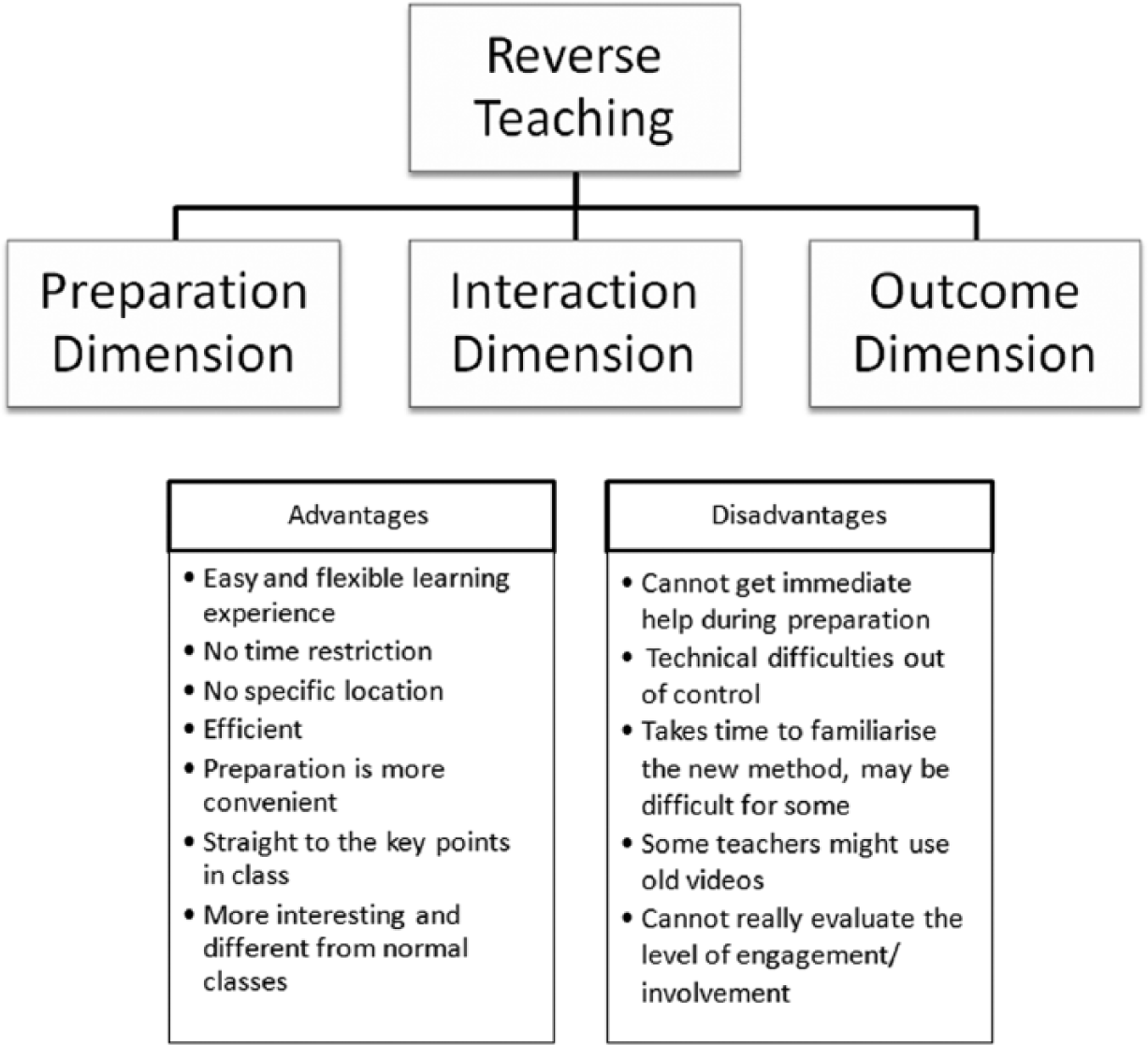
Reverse teaching conceptualization.
Preparation dimension
The preparation dimension describes the process of preparing for the upcoming classes, which included online videos and readings. The preparation dimension describes an essential part of reverse teaching, which is that students should understand the links with independent learning. To achieve successful reverse teaching, it is necessary that students can see the value of self-preparation. The data analysis identifies a link between students’ (negative or positive) perception of reverse teaching and increased homework. This finding suggests that students associate reverse teaching with independent work and, in some cases, more work. Some respondents found it strange that all the work was done from home and also suggested that if they had already understood the concepts, it would not be necessary to come to class. For example, “I think it is flexible, but what if I don’t have any questions, do I still need to come to the lecture?” Another respondent noted that “I enjoy watching the videos online. I can do it whenever/wherever I want, and can take breaks or multitask anytime.” One student highlighted the videos’ quality: “If the videos are good, with good quality, I prefer this over a normal lecture.”
To make reverse teaching work successfully, it is vital that students understand the necessity to prepare and to show up to the classes for the activities. The respondents noted that it was important to ensure that students found the classes useful and complementary to the self-preparation so that students do not feel that things are being repeated. A respondent further noted that “It is good to know that if you have any questions (during preparation), you know that there will be a session coming up to address it.”
With the increasing use of social media and the Internet, there are many opportunities to develop an effective technological backchannel to communicate with the students. Some of the respondents noted this sentiment: “As I was watching the online lecture, I could also chat with my friend at the same time, of course about its content”; “A good idea would be to create a Facebook page, so that questions can be posted. I think this would help the preparation and interactivity.”
Interaction dimension
The interaction dimension describes the exchange relationship and dialogue between the teacher and student in the classroom. This dimension is an important reverse teaching element as it distinguishes the method from the traditional lecture-homework teaching method. Interaction and engagement, with increased individual attention from the teacher, are strongly identified to be important for the students in defining reverse teaching. For example, once prepared, the students come to class to apply the concepts. A respondent elaborates on the reverse teaching approach as being similar to “seminars,” in which he did not learn much from. A student explained, “I’m very skeptical about this approach. Best example is seminars. I dislike the idea that we often sit in groups and discuss, or other things which I do not benefit from.” In this case, the student thought that reverse teaching was the same as “seminars” and had carried over the dislike of seminars into the experience of “reverse teaching”; however, it was clear that the student had not fully absorbed the meaning of reverse teaching, perhaps due to the limited experience over 2 weeks or for other reasons. Reverse teaching is a broader concept than seminars, and seminars are only one aspect of reverse teaching, depending on the execution. As revealed by other students, there was a range of opinions, and the majority of respondents were also positive about the activities, as they saw the reason why the reverse teaching approach may become more popular. A series of verbatim quotes illustrate this: “Don’t mind if they (classes) are interesting and useful; That is fine for me, as I can come and ask questions instead of asking in the lecture hall”; “I am OK as long as it is voluntary to participate in the discussions. Sometimes, I just want to observe”; “I personally like this model that allows me more flexibility in many ways.”
One important sentiment, expressed by several respondents, was that in the normal lecturing, the teacher engages only with the students who ask questions and not those who don’t ask. In reverse teaching, the teacher can get around to everyone and guide better, which is more beneficial. For example, “I sometimes have questions, but never ask [in the lecture]. However, when the teacher is helping me with a specific question [next to me], I don’t mind it so much”; “I can see this work, as there won’t be as much homework, since it’s done in class”; “In the class, I got more done, since I can ask the tutor or my classmates.”
Outcome dimension
The outcome dimension identifies students’ learning outcome perceptions of reverse teaching practices. Key ingredients of the outcome dimension include feedback and good student–teacher relationships, both of which can generate improved learning and engagement. There was a common belief among students that getting improved results was desired, although some respondents felt that it was not emphasized enough. They felt that the teacher should give lectures, as this is what they were used to and has worked well in the past. Respondents highlighted concerns toward the relationship between teachers and engagement as a potential issue within reverse teaching classes. For example, “This is a good idea, but it depends on the teacher. If s/he is not good at engaging everyone, it won’t work”; “I like lectures, but I can see how this might work, because the help from the teacher is there when you need it the most.”
While some students noted that “It was difficult for everyone (students) to participate in the exercise, that is, discussions,” most found the approach interesting, “because help was at hand when you got stuck.” Overall, the data reveal that positives were mostly evident. The clear benefit was both the teachers’ individual and group treatment of enquiries. For example,
While it was difficult for students individually to raise questions during the video session, they can always ask the seminar tutor during seminar/workshop sessions at the uni. In the end, you feel that the teacher is readily available to help you pass the course.
Discussion
The study reveals features of reverse teaching and how it is driven by cases of preparation, interaction, and outcomes. The data indicate that students perceive dialogue and engagement as good practices (Chickering and Gamson, 1987). Moreover, students perceive well-crafted online videos, exciting in-class activities, flexibility, convenience, and availability of teacher for questioning as effective reverse teaching. These benefits are consistent with studies, emphasizing the use of online materials (Dowell and Small, 2011), thus forming an important part of the blended learning experience (Friesen, 2012).
Unprepared students and lack of motivation to come to class are not desirable for successful reverse teaching. It seems that students staying away from the classes may not be such a serious problem as initially put forward, that is, until students perceive these classes as ineffective (McDougall, 2013); hence, teachers need to consider how their in-class activities can be more engaging. The data highlight some examples where students stay away because they did not find value in attending classes; however, it appears that they had carried their dislike of seminars over to the reverse teaching classes. Thus, in the initial transition when implementing the flipped classroom, some clear guidance will be needed. A major positive relates to students referring to the online context, where they enjoy more ways to learn, multitask, and learn more conveniently and flexibly. Such benefits may be highlighted in the initial reverse teaching classes. With increasing use of social media and online platforms, more interaction can potentially be used between teachers and students (Nail, 2012). Teachers must learn the best available platform where students will find the learning to be more engaging, for example, Facebook or Twitter (Cantrell, 2008). Continuous innovation is needed in order to retain value in reverse teaching. This is a new finding that extends existing literature (Li et al., 2007).
The findings indicate that the level of shared understanding among the interviewed respondents of reverse teaching is high. For instance, “dialogue” and “convenience” outcomes are two traits that can illustrate reverse teaching. This is consistent with studies, which emphasize the need to include interaction and flexibility in reverse teaching (Smeby, 1998). Consequently, findings reveal that reverse teaching may be defined by various key concepts. As the findings reveal, reverse teaching must focus on concepts such as flexibility, relationships, transparent dialogue, and individual help. These key concepts permeate all the three dimensions. In other words, there is a need to focus on factors that underpin a good relationship between teacher and student. This is the first step toward implementing improved approaches to reverse teaching. Suggested outcomes are improved teacher–student relationships, better learning, and increased engagement (Trowler and Trowler, 2010).
While the study makes contributions to existing research in education and teaching innovations, several limitations should be acknowledged. First, it was not possible to deliver the whole module as reverse teaching. Therefore, future studies are recommended to investigate whether the student feedback would be more or less positive if the entire module was delivered as reverse teaching. Second, while the study investigated student perceptions and their sub-conscious motives from a single module, it is not certain that the students fully absorbed the true meaning of reverse teaching. Thus, it is recognized that the findings may be suggestive rather than conclusive, and further research is encouraged to validate our framework. Third, the research was conducted in an advanced marketing class. It cannot be guaranteed that the results can be generalized to other contexts and types of students. However, it would be interesting if the study could be replicated into different educational levels and multiple subjects. Such cross-validation would enhance the generalizability of the model. Finally, it is noted that the study is limited to the students’ perspectives and calls for expansive research to grasp the reverse teaching concept from other groups, including professors and unprepared students, who engaged in the classes without preparation.
This study investigates students’ perceptions of reverse teaching practices in an advanced marketing class. The resulting reverse teaching conceptualization is based upon a discussion of issues on interaction, convenience, flexibility, and innovation. The findings extend theories related to reverse teaching on both the three dimensions and the best practices. Classes, focusing on the activities described, for example, simulations, activities, and group discussions (Eastman and Swift, 2001), are not atypical of any discipline. The findings suggest that students find the reverse teaching methods to complement this. Online video lectures are the first step toward discovering the future of marketing classes (Thompson, 2012). It is suggested that teachers should actively manage students’ perceptions using tools that are considered favorable. This builds and creates interactive and engaging classes (Smart and Cappel, 2006). For instance, a teacher should employ tools such as online videos, social media, in-class activities, support sessions, and other deep learning instruments (Iniesta-Bonillo et al., 2010). Another example is to ask students to follow online courses (decided by the teacher) from Coursera, edX, or other free course platforms, where both videos and learning materials are offered for free (with complemented certificates). Then, class time can be used to discuss and work on problems arising from these courses.
Whichever approach is used in the preparation and interaction phases, the study demonstrates the importance of follow-up on students in order to sustain a rewarding learning relationship. To achieve positive student perceptions, elements such as flexibility, convenience, interaction, and engagement must be managed more systematically. Teachers thus need to (1) recognize the importance of the three reverse teaching dimensions, (2) acknowledge students’ differential perceptions across the dimensions (including the advantages and disadvantages), and (3) incorporate continuous innovation with appropriate tools, namely, online videos and individual interaction (online and offline) into their strategies and tactics.
Based on the findings and discussion, the study proposes a definition of reverse teaching as a teaching strategy execution aimed at stimulating and manifesting students’ perceptions of deep learning. Reverse teaching achieves this through creating mutually satisfying relationships online and offline using innovation and technology and by delivering acceptable outcomes such as flexibility and transparency for students and teachers over the three main dimensions: labeled preparation, interaction, and outcomes. Overall, we hope that our study encourages more awareness toward empirical research into this interesting area. With increasing technological availability and innovative teaching channels, such as social media, the potential of flip teaching is greater than ever.
Footnotes
Appendix 1
Declaration of Conflicting Interests
The author(s) declared no potential conflicts of interest with respect to the research, authorship, and/or publication of this article.
Funding
The author(s) received no financial support for the research, authorship, and/or publication of this article.