




Abstract
The flipped classroom offers a new approach to student-centred teaching and learning by moving the lecture out of the classroom. Research on the topic reveals that the flexibility of viewing the recorded lectures at a time and speed that is convenient to the student is what students appreciate mostly in the flipped classroom. This article examines the viewing pattern of students regarding recorded lectures in a course that has been flipped. The findings reveal a decline in the number of students who view the recordings over the duration of the course semester. Furthermore, the findings support earlier research results revealing that women and older students rely more on recorded lectures than other students. In addition, the study shows that there is a positive correlation between viewing the recorded material and the final grade of students in the course. It is thus surmised that even if in-class activity is very important for the flipped classroom to work, the recordings do have additional value, which is reflected by higher final course grades for students who view them. The flexibility of viewing recordings more than once and at the most relevant and convenient time seems to increase students’ understanding, and is regarded an important asset of flipped classroom teaching.
Keywords
Active learning through the flipped classroom
In recent years there has been a call for change in academic teaching (e.g. Biggs and Tang, 2011; Laurillard, 2013). Much of the discussion has revolved around two concepts, namely, that of teacher versus student-centred teaching (Laurillard, 2013; Prosser and Trigwell, 2014; Trowler, 2010) and students’ approaches to learning (Marton and Säljö, 1976). In the former, the focus is on the context and teacher–learner interrelations, while the latter is about individual learning styles, where a deep approach to learning is considered to be the more desirable outcome. In an empirical setting, however, learning styles cannot be isolated from the learning environment, and it is thus important to discuss both. Elen et al. (2007) have also argued that these two approaches do in fact coexist. An increased emphasis on students taking an active role in learning environment does not necessarily mean a diminished role for the instructor.
Despite extensive literature on the student-centred approach to teaching and learning there does not yet seem to be consensus on what a student-centred approach entails (Baeten et al., 2010). The focus appears to be on reversing a passive learning environment of lecturing (Prince, 2004) into creating a learning environment that best supports students in a deep approach to learning. The focus is thus on the learning environment. In a review of the literature on learning environments Abualrub et al. (2013) define three perspectives: the learning environment as a pedagogical setting, with an emphasis on the learning process and students’ approaches to learning, the learning environment as organizational responsibility and the learning environment as network activity, where diversity in the student group is increasingly taken into account. Although they distinguish between these three focus points, they do not claim that these categories are distinct but rather that they enhance each other. The majority of the literature falls into the first category focusing on the student, while Abualrub et al. (2013) feel that more attention should be paid to the role of the instructors responsible for the organization of the learning environment. Distinguishing between an emphasis on students’ approaches to learning and the environment of the learning might thus be counterproductive.
In light of this, Baeten et al. (2010) suggested that students’ preference for a certain teaching method might influence how well they adapt to the method. Parpala et al. (2013) established that there is a link between deep approached learning and a positive perception towards the learning environment. Examining students’ attitudes towards the learning environment is thus an important aspect of designing a successful learning environment. Lea et al. (2003) found that even when students were quite in favour of taking a more active role in the learning environment, they were unwilling to be left without support from the instructor. This result indicates the importance of structuring the learning environment.
One such learning environment is the inquiry-based flipped classroom. Inquiry-based learning revolves around active learning, with students being involved in a problem or question driven activity that extends beyond listening to direct instructions (Aditomo et al., 2013). Stefanou et al. (2013) found that project-based learning, with its complex and open-ended projects, pushed students further in elaboration and critical thinking, which are important aspects of deep learning. However, in a study of problem-based learning, Struyven et al. (2006) showed that too much insecurity as to how to approach the learning targets might push students towards a surface approach to learning. Chung et al. (2004) found that limited previous experience with problem-based learning led to uncertainty among students, which could, however, be eliminated by designing courses in such a way that the students felt in control of the learning process. Students perception of the learning environment is thus of great importance in constructing an inquiry-based learning environment which supports a deep approach to learning. The question, however, still remains as to how much control instructors have over students’ perception of the learning environment. In a study on an instructional development programme for academic instructors, the students’ perception did not change according to whether the instructors had participated in the programme, at least not in the short term (Stes et al., 2012). Therefore, the efforts made by the instructors in changing the learning environment, based on their newly acquired knowledge, did not seem to have any effect. They hypothesized that this might be due to the instructors’ attempt to create an environment for a deep learning approach, which then backfired. Furthermore, students’ approaches to learning might also not only be related to the learning environment but also to personality aspects (Von Stumm and Furnham, 2012). Whether or not instructors can influence the approaches to learning through learning environments, it is important to better understand students’ attitudes towards the learning environment. This is in particular true for new forms of learning environments inspired by the web and social media.
New technical platforms offer alternative modes of presenting learning material to students. With these changes, the attraction of the flipped classroom has increased. In the flipped classroom, technology is used to cover the passive aspects of the learning environment, whereas the time the lecturers spend with students is used for interactive learning. Student attitude influences how students adapt to a blended learning environment, where online activities are combined with face-to-face time with instructors (Ellis, 2016). Students who approach learning in a deep way find it easier to navigate between a traditional learning environment and online tasks. In the blended learning environment, it is thus important to understand both the students’ approaches to learning as well as the course design (Bernard et al., 2014).
The aim is thus to design a structured environment in which students do not feel lost, but rather have a positive attitude towards the content and approach they are learning in an active way. The flipped classroom, where the traditional design is reversed, where the lecture is moved out of the classroom and the more open-ended project work moved into the classroom, offers one way of doing this. Here, the instructor can offer direct support during the students’ project work, which traditionally has been considered homework. The transition from the traditional classroom to the flipped classroom creates a substantial alteration to the learning environment, and does not only change the course design but also the physical learning environment. Allowing students themselves to select the environment in which they watch the lectures increases the possibility for a good fit between the student and environment (Choi et al., 2014). Moreover, the flipped classroom creates more opportunities for interaction between the instructor and students than the traditional passive lecture approach. Students who have watched the recorded lecture before coming to the class session can put their newly acquired factual knowledge into practice in a controlled classroom environment, and as a result, students are more likely to be able to retrieve this knowledge on a long-term basis and make it their own (Merrill, 2015). It is argued that the instructor’s presence as well as the clarity of the instructions are very important to students in a flipped classroom (Kim et al., 2014). They concluded that how the flipped classroom is designed is thus of crucial importance to its success.
Although the theoretical basis for validating the flipped classroom has been well established through extensive literature on student-centred learning (Merrill, 2015), it has also been acknowledged that studies on the effectiveness of flipped classroom teaching are still sparse (Bishop and Verleger, 2013; Merrill, 2015). Because most of the research is conducted in real learning environments, the ability to experiment with variables is restricted. However, some comparative research has been conducted, with findings ranging from a worse outcome (Moffett and Mill, 2014), to no difference (Braun et al., 2014), to a mainly positive outcome to better results (Foldnes, 2016). Therefore, it is important to understand in detail how the flipped classroom model can be designed and implemented more effectively.
There are two basic components to flipped teaching: the out-of-class and the in-class learning experience. The latter is seen as the critical part of flipped classroom teaching (Merrill, 2015). Active in-class discussions have indeed been shown to enhance active learning (Jamaludin and Osman, 2014), whereas Braun et al. (2014) found that students’ motivation also played a crucial role in making the flipped classroom a success. The focus here is thus on the student’s attitude towards the flipped classroom, as this is instrumental to successful implementation of this method. Moffett and Mill (2014) found that even if the flipped classroom approach did not show significantly better grade outcomes, students preferred flipped teaching over traditional teaching methods. From a student perspective, it seems to be the out-of-class instruction, accompanied by a large amount of flexibility, which is the most attractive component of the flipped classroom. Online video tutorials allow students to take the material in at their own speed and in their own time (Nguyen et al., 2016), thereby enhancing the students’ feelings of control over the learning process (Braun et al., 2014).
However, students’ views of the flipped classroom are by no means uniform. Braun et al. (2014) found that student perspective varies between years and classes, with students who have progressed further in their studies favouring the flipped classroom (Cavalli et al., 2014). Furthermore, Kurtz et al. (2014) found that older students and women were more content with the flipped classroom design than younger students. The researchers suggest that this might also be a measure of the need to balance academic and family life, which causes students with families to appreciate the flexibility of the flipped classroom to a higher extent. This notion is supported by the findings of Chen et al. (2015) who discovered that female students were happier with the flipped classroom than male students; however, their research was aimed at younger students studying mathematics in high school. The suggested explanation for this gender difference diverges therefore from that of Kurtz et al. (2014); Chen et al. (2015) argue that the flipped classroom approach protects female students from feelings of insecurity towards mathematics. In both these settings, it could be argued that the flexibility that the flipped classroom offers students to learn in their own time and at their own speed give students more control over the learning process.
Although Merrill (2015) emphasizes that the in-class learning experience is the critical part of flipped classroom teaching, Bergmann and Sams (2012) have argued that the flipped classroom is not about the online tutorials but about acquiring knowledge and content experience in a student-centred learning environment. Although it is acknowledged that the in-class experience is important, there is a need to further explore the out-of-class component of flipped classroom teaching in order to obtain better insight into the relevance of this type of instruction in the flipped classroom model. Watching recorded videos at home, without in-class support, led to results comparable to those of traditional teaching, whereas a flipped classroom method with in-class reflections and assignments and recorded lectures watched at home leads to higher student performance (Foldnes, 2016) and this is worthy of further exploration.
Altogether, there is a need to focus on the relevance of out-of-class instruction within the flipped classroom approach; what has so far not been examined is whether, when and how often students watch the course recordings and how this behaviour relates to how successful they are in the course, as reflected by their final course grade. In this way, this sheds further light on the implementation of the flipped classroom approach. This study adds to the existing literature in several ways. First, very few studies have provided detailed insight into the watching behaviour of students or into what recordings matter most. Second, by obtaining a better understanding of the viewing patterns in the flipped classroom approach, suggestions can be offered as to how students might use the recordings to control the learning process in a student-centred learning environment.
Research method
Participants
Data were collected in the autumn of 2015 during a graduate research method course taught in the Faculty of Business Administration at the University of Iceland. The 120 students who completed the course in 2015 had different study backgrounds and were enrolled in different master programmes within the Faculty of Business Administration; 43 students were studying Human Resource Management, 33 were studying Strategic Management, 25 were studying Marketing and International Business and 19 were involved in other study areas. There were 29 men (24%) and 91 women (76%) registered in the course, and the age distribution ranged from 23 to 58 years, with a mean just below 34 and a mode of 26. The age distribution was positively skewed (skewness 0.755, kurtosis −0.048).
Design and procedure
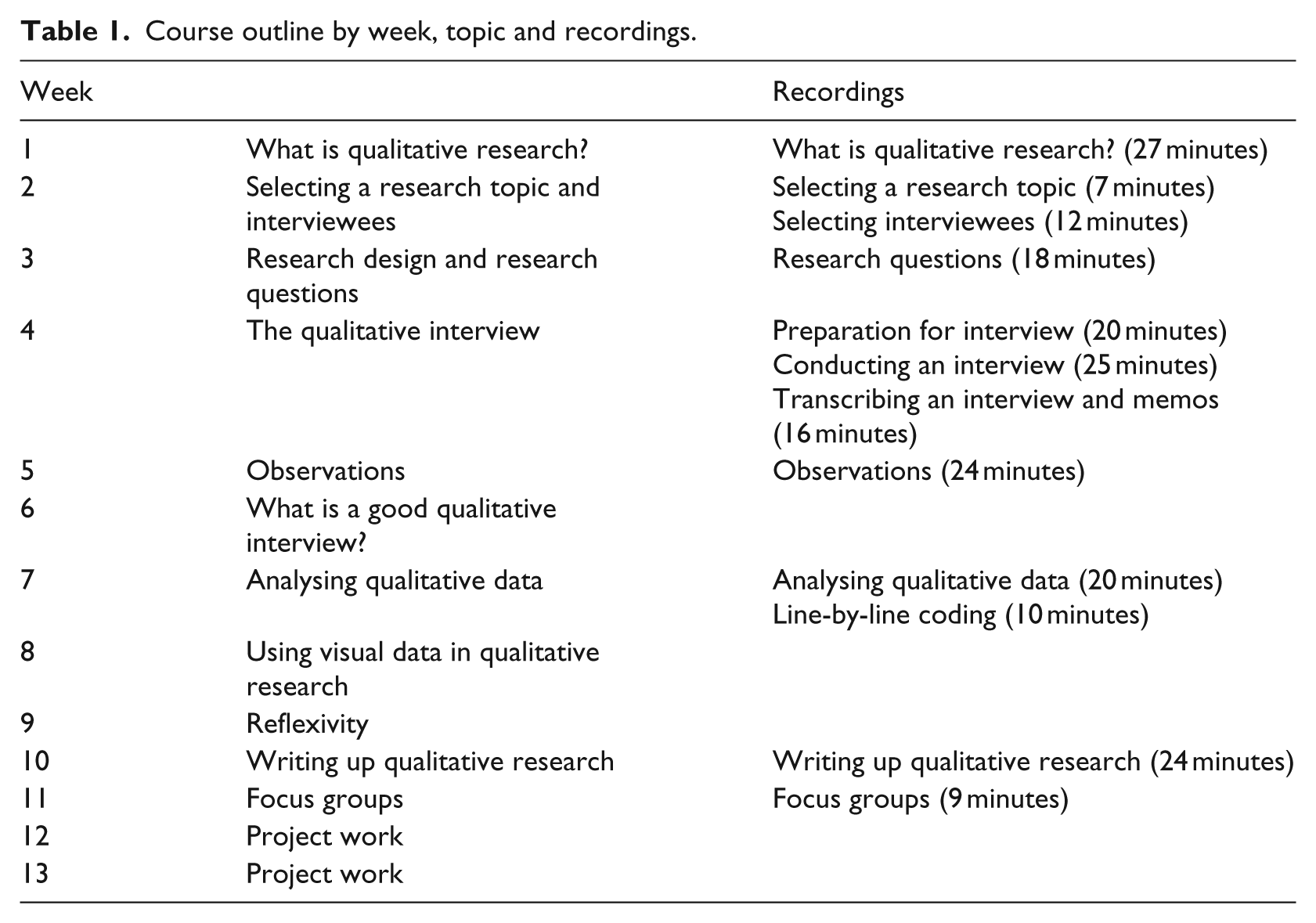
The research method course is taught according to the flipped classroom approach, and it consists of online recordings and in-class sessions. The course outline and recordings were presented to the students in the Moodle online learning environment. Twelve course recordings were taped through the ‘Explain Everything’ program and posted online in the Panopto recording platform and from there linked to Moodle. The recordings differ in terms of length as well as emphasis, ranging from conceptual to practical descriptions of the various aspects of qualitative research. Table 1 provides an overview of the course recordings per week. All recordings were made available at the start of the course semester to registered course students, and the bulk of recordings were linked to the first weeks of the course to prepare students for the qualitative research project that they would do during the semester.
Course outline by week, topic and recordings.
The course was organized in such a way that the weekly topic roughly corresponded to the students’ progress in their research project. Students were encouraged to follow this time frame as to optimally benefit from the in-class sessions. The students were encouraged to use the online learning space in Moodle between classes, as a venue for questions about the course material. They were further required to post brief assignments online, and comment on fellow student’s assignments. Their online participation contributed towards 20% of their final grade. Another 20% was allocated to an individual review of an interview transcript. The largest part of the final grade (60%) was, however, based on a research project that students carried out in pairs.
For their research project, students had to rely on semi-structured interviews that they conducted and transcribed. Students were given a rough time plan stating that they should aim to have conducted and transcribed their first two interviews by Week 5, in order to be able to start analyzing their data in Week 7, and to subsequently be ready to start writing their research report in Week 10. However, apart from a deadline in Week 8, when students were providing comments/feedback on their partner’s first interview transcript, students were given the flexibility to plan their interviews and time frame as they saw best. The other deadline was at the end of the semester when the final report was due.
The in-class sessions either revolved around the students’ projects or consisted of group work designed to enhance the students’ understanding of the curriculum. Examples of in-class assignments were writing a research question for a number of given scenarios and then reviewing and discussing the quality of the research questions, viewings parts of recorded interviews and analyzing what was happening and reading different presentations of qualitative research and analyzing them; and participating in a focus group. The students were generally motivated and actively participated during the sessions.
Data
The data collected from the Panopto recording platform provide information on the time and date registered students access the online recordings, including how often a student watched the recording and how long each student spent watching each recording. The total amount of recording time comprised of 212 minutes (3 hours and 9 minutes), Table 1 provides further information on the length and topic of each individual recording.
Analysis and variables
In January 2016, when the course had finished, data were collected from the Panopto recording platform programme on each of the 12 recordings. The data allow lecturers to monitor their students’ recording–watching–behaviour and contain information on the time and date students accessed the online recordings, the frequency, and how long each student spent watching each recording.
For the data analysis, the Panopto data for each of the 12 recordings were saved as an Excel file and transferred into the statistical computer program SPSS, Version 24. To examine a possible relationship between recording–watching–behaviour and success in the course, the final course grade for each student was manually related to the Panopto data by means of their email address and added to the SPSS data set. To ensure the protection of students’ details, only one researcher was involved in this process, and immediately after merging the data sets, the email addresses were removed from the data set.
The analysis of the data is now presented in two phases. In the first phase, the students’ online recording viewing behaviour was explored and the effect of four background variables on the total amount of time students spent watching these recordings was then examined. The first background variable utilized here is sex as measured by the categories ‘man’ and ‘woman.’ The second background variable was the age of the students measured in years. This variable was measured on an interval scale; however, to perform a one-way ANOVA analysis, the variable was also made into a categorical variable composed of three categories: younger than 30 years of age, between 30 and 39 years of age and 40 years of age or older. The third background variable was called course group and consists of the four groups that the students were divided into at the beginning of the semester. Finally, the background variable study programme was a categorical variable indicating what master’s programme each student is involved in: Human Resources, Strategic Management, Marketing and International Business or another study area.
The dependent variable in the first phase of this study was viewing time, which revolves around the total amount of time that students spent watching the 12 online recordings. This interval variable was measured in minutes.
In the second phase of the study, the focus was changed and it examined the relationships among the four background variables and students’ final course grades (measured on an interval scale from 1 to 10), between total viewing time and final course grade, and between time spent viewing individual recordings and final course grade. This entailed using the previously dependent variable viewing time as an independent variable, and the dependent variable becomes the students’ final course grades.
The data in Phase 1 were analysed by means of descriptive statistics, an independent t test, one-way ANOVA analyses, and Tukey’s post hoc tests. The data analysis in Phase 2 consisted of descriptive statistics and Pearson’s R correlations. The level of significance was set at 0.05.
Findings
Viewing time
The mean number of minutes that students spent watching the total of 12 recordings – 187 minutes (3 hours 7 minutes) – was lower than the total amount of recording time available (212 minutes). The standard deviation is 104 minutes (1 hour 44 minutes) with a range of 470 minutes, indicating that while some students did not watch any of the recordings (0 minutes), others watched more than twice the amount of total recording time, 470 minutes (7 hours 50 min).
Figure 1 shows that the percentage of students who did not watch the recordings increased as the semester progressed. Whereas 13% failed to watch the Week 1 recording, this percentage increased to 35% in Week 5 and to 49% in Week 11. This means that the material discussed in the recording of Week 11 barely reached half of the course students.
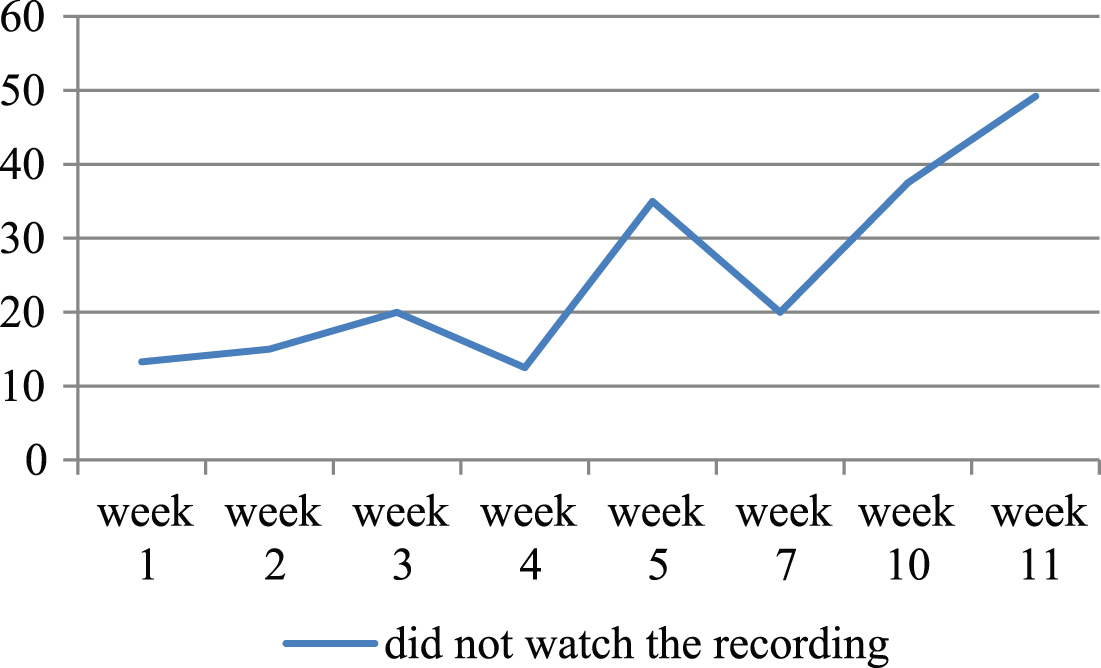
The percentage of students who did not watch the recording(s) for that particular week.
When focusing on the group of students who did watch the recording(s), around 85% watched the recording either in the week before the class session or during the same week that the session took place. However, there were exceptions, with only 64% of the students who watched the recording on transcribing an interview and memos (Week 4) in the week before or during the class session, and of all the students who watched the recording on how to write up qualitative research (Week 10), only 45% watched it before or during the week of the class session.
Furthermore, there was an apparent trend towards a greater observable variation in the timing of the recordings over the duration of the course. That is, whereas the recordings of the first 3 weeks were only watched within a 3-week time span from the actual class session, either just before or after the class session takes place, this time period increased from Week 4 onwards, when the recordings start to revolve around hands-on or analytical work such as the transcription of interviews, thematic data analysis, and the writing of the final report. It seems plausible that students decided to watch these recordings when they were actually working on these course assignments, rather than when the topic was on the course agenda for that week. This may explain the larger variation in the variable timing when the course progressed. To further support this argument, it was also observed that the recordings about qualitative analysis, line-by-line coding, and how to write up qualitative research peaked in views at the beginning of December, when class sessions were over but before the final report due date.
There is also a noticeable difference in how far the course had progressed and in how long the recordings were able to attract the students’ attention. Up until Week 3, the majority of students watched the full length of the recording. However, a turning point was visible in Week 4, when more students did not watch the recordings or failed to complete watching the full recordings. Although this trend continued throughout the course, Figure 2 does show an upswing in Week 11, during which 47% of the students watched at least the full recording. This recording was only 9 minutes long, whereas the recording for the previous week was 25 minutes long (Week 10).
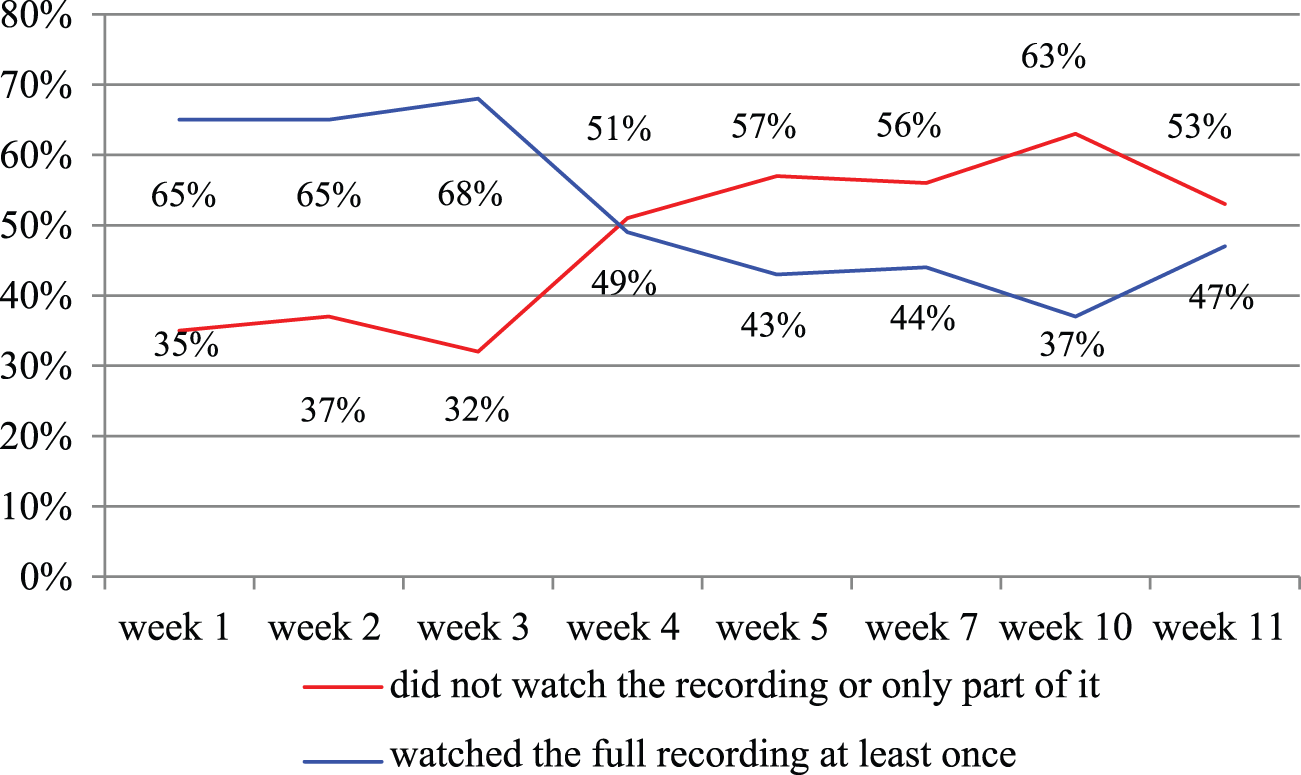
Percentage of students who watched the recordings by week.
When taking the background variables into account, an independent t test reveals that there was a significant difference between the amount of time male and female students spent watching the recordings. Male students watched on average 145 minutes (SD 98 minutes), which is significantly less than the 200 minutes (SD 102) that female students watched on average.
Furthermore, when taking the other background variables into account, the one-way ANOVA analyses reveal that neither course group nor study programme had a significant effect on the variable viewing time, or the time students spent watching the course recordings. However, the analysis does reveal a significant positive relationship between the variable age and viewing time. Whereas students younger than 30 years of age watched on average of 145 minutes, students between 30 and 39 years of age watched on average 188 minutes, and students in the age category 40 years and older watched on average 243 minutes. Tukey’s post hoc test reveals that students in the oldest age group spent significantly more time watching the online course recordings than students aged younger than 30 years (mean difference −8.39, std error 23.37, p < 0.05) or students who are aged between 30 and 39 years of age (mean difference −5.18, std error 22.55 p < 0.05). From this analysis, it is concluded that the background variables sex and age had a significant effect on viewing time.
Final course grade
In the second phase of the analysis, the relationships among the individual recordings, the total amount of time spent watching the course recordings, and the final grade of students at the end of the course was examined. Measures of central tendency reveal a mean final course grade of 7.7 and a mode of 8.0. The final grades varied between 5.5 and 9.0 and were slightly negatively skewed (–0.370).
Although none of the background variables, namely sex, age, group or study area, showed a significant direct correlation to the final grade variable, there was a significant moderate positive relationship (r = 0.257, p < 0.05) between viewing time and final course grades. This relationship indicated that the more minutes students invested in watching the recordings, the higher their final course grade. The b coefficient of a linear regression analysis reveals that for every additional minute that students spent watching the recordings, their final grade increased by 0.002 points on average (p < 0.05). This means that for every additional 100 minutes that students invested in watching the online recordings, their final course grade rose by 0.2 points. Given that the total recording time was 212 minutes, these findings indicate that students should at least watch every recording twice (424 minutes) in order for their final grade to go up by almost a full point (0.9) on average. R2 in turn shows that viewing time explains 6.6% of the variability within the students’ final grade.
If we look more closely at individual recordings, there were significant moderate positive correlations apparent between the recordings presented in Week 1 (What are qualitative research methods?; r = 0.257, p < 0.05), Week 2 (selecting interviewees; r = 0.235, p < 0.05), Week 2 (choosing a research topic; r = 0.312, p < 0.05), Week 3 (the research question; r = 0.258, p < 0.05) and the recording in Week 4 on how to take an interview (r = 0.277, p < 0.05). It therefore appears that spending time watching recordings that deal with the core conceptual aspects of qualitative research related positively to students’ final course grades, whereas recordings on more marginal topics – such as focus groups and participant observation – were not significantly related to the final course grades. Nevertheless, there is a clear exception to this pattern with the two recordings on analysing qualitative data (Week 7), also a core topic within the course, not being significantly related to students’ final course grades. A multiple regression analysis consisting of these five recordings that were positively correlated to the students’ final course grade shows an adjusted R2 value of 0.104, which indicates that the amount of time students spent watching these five recordings explained just over 10% of the variation in the variable final course grade. However, although the F test comes out significant, F(5, 108) = 3.635, p < 0.05, the coefficients reveal that none of the individual recordings reach significance for the 95% level, which means that none of the individual recordings had enough strength to influence the final course grade by itself.
Discussion
The aim of this study was to shed light on what has been labelled the passive aspect of teaching or the less critical part of flipped classroom teaching, that is, out-of-class instruction by online recordings. Although we fully acknowledge the importance of the in-class experience within the flipped classroom model and agree that this is the most critical aspect of flipped classroom teaching, the study revealed that viewing recordings outside the classroom was responsible for approximately 10% of the variation within the students’ final course grade. This percentage is substantial enough to not dismiss it from the discussion on flipped classroom teaching.
The findings demonstrate that the effort that is put into the out-of-class instruction is important for the students’ final course grade. This might be self-explanatory, but students who put in the most effort gain the most. However, it is interesting that it apparently is not enough to watch each recording just once. Phase 1 of the study revealed that both age and sex can influence the time students spend on watching the online recordings, and Phase 2 revealed that this latter variable is related to students’ final course grade. The findings reveal that students would need to watch every recording twice for their final course grade to go up by 0.9 points on average. This finding runs parallel to the notion that, for a higher grade, students need to apply a deep approach to learning, and in order to do this, students may need to watch the recordings multiple times. Thus, the flipped classroom has a clear advantage over the traditional classroom; the availability of the recordings online allows students to view the recordings multiple times, pause to take notes, rewind if anything is unclear the first time around and view the recordings at a time that is relevant to their own pace of studying. The ability to watch the recordings more than once further increases the control the students have in the course.
The study also examined whether, when and how often students watch the course recordings. The findings reveal that women and older students were more likely to watch the recordings repeatedly, which is in line with the results of Chen et al. (2015), as well as those of Kurtz et al. (2014). Because much of the literature on the flipped classroom deals with courses that are more formalized, it is interesting to see the same pattern (older students and women gaining more from the flipped format) emerge in a course of qualitative research, where definitions and processes are more dependent upon situations. From the in-class sessions, the teachers’ first impression was that not all students were viewing the recordings; however, the dropout over the semester was much larger than had been anticipated.
The findings show that students seemed keener on watching the recordings at the start of the term, and to some extent, at the end of term when they were finalizing their research projects. The dropout during the semester, and especially towards the end of the semester, remains unexplained, but it may be related to some form of fatigue, as workload and time pressures generally increase during the semester. We therefore argue that it may be worthwhile for instructors to consider what their most crucial recordings are and whether it matters at what time they appear in the course. It may be possible to place the most crucial recordings at the start of the course and less crucial recordings more towards the end. However, at the same time, we are aware that many courses progress over the semester, discussing more complex material later in the course, which means that this comment may not be applicable to all.
Nevertheless, for courses such as qualitative research methods, timing of the recordings may have a positive influence on students’ learning approach. The finding that the viewing picked up again towards the end of the course, when students were working towards a deadline on their class project, further supports the notion that recordings do offer support for students when they are uncertain in the learning process by allowing them to review the recordings again when they need to deepen their understanding of the content. In addition, it was found that students were more likely to watch shorter recordings than longer ones, which points towards the importance of breaking the content of recordings down into shorter segments. However, this is not always an easy task, and it may be easier for instructional than conceptual recordings. Nevertheless, this complication further strengthens the notion that it is important to tackle the conceptual aspects early on in the semester before fatigue sets in.
Although Moffett and Mill (2014) did not find evidence that the flipped classroom approach resulted in better grade outcomes, the results from the study described in this article do show a positive, significant relationship between the total recording viewing time and the final course grade of students. This finding therefore supports the idea that a deep learning approach and better overall results are more likely obtained when students put more effort and time into the learning process.
Nevertheless, certain caution is needed in interpreting the results because the effects are modest; thus far, similar results have not been confirmed by other studies. This study is not without limitations. The correlation is modest, and the findings are based on data from one course during one semester only. It was carried out only in one discipline (business and management) and one country, the sample size was very small, and it comprised only graduates (not undergraduates), Future work is therefore needed within different disciplines and from different contexts, both in terms of not only the level/year of the students but also their cultural/country background, as these may vary from one to another. There may be other psychological variables that are important to address in future studies (e.g. course self-efficacy, time management skills), and studies are also needed on the efficacy on learning outcomes of the flipped classroom where the bulk of the material is not delivered within the first few weeks of a course, as was the case in the study described here. There is also a need to further explore the possible reasons for the decline in viewing responses over time, as it may be that aside from the normal, usual reasons, such as tiredness as any course progresses, perhaps students did not consider the recordings provided at the end to be as valuable/important to their projects compared with the earlier ones. Also, perhaps students relied on other sources of information for the week’s topics, such as text books, other students previously taking the course and other types of online sources, particularly as these were graduate students and thus are expected to behave more independently than undergraduates. It is also possible that important variables were excluded from the analysis, and that information about other factors, such as whether students watched recordings together or sped up the viewing speed, were not available. For instance, it will be interesting to examine in more detail the differences in viewing patterns between male and female students. Is this difference rooted in different confidence levels of the sexes? And if so, can we increase the participation of male students?
This study can play an important role in encouraging further research on this topic. However, it is encouraging to know that the online recordings seem to be adding to the understanding of the students and leading to higher final grades. This finding can therefore be utilized to motivate students to spend time viewing the recordings and inspire instructors to continue to improve their recordings.
Footnotes
Funding
The author(s) received no financial support for the research, authorship, and/or publication of this article.