



Abstract
Our study explores the differences in the experiences and attitudes of students assigned to student teams in online courses versus face-to-face courses. The study was administered to 320 students in 14 sections (eight online and six face-to-face) of a graduate-level course. The results demonstrate that student ratings of team trust, team satisfaction, and team identity as assessed mid-semester are lower in online courses than face-to-face courses. As the semester progressed, these course modality differences in student perceptions of team trust and satisfaction diminished. However, feelings of team identity remained lower in online courses than in face-to-face courses through to the end of the semester. Implications for online instruction and recommendations for future research are offered.
Introduction
Virtual delivery of course content has become increasingly prevalent in higher education for a wide variety of reasons. From a practical perspective, students need to be able to function successfully in a progressively virtual and globally connected workplace. The proliferation of personal devices and widespread network access has created an expectation that many forms of social exchange that historically required physical presence should now be accessible virtually. As a result, prospective university students are seeking more flexible modes of coursework causing institutions of higher education to offer more and more classes either fully only or as a blend of face-to-face and online instruction (Prestridge and Cox, 2021). Other more pragmatic reasons for the shift to online instruction include the need to ameliorate class scheduling issues and to reach a larger number of students (Black, 2002).
A second prevalent trend that has occurred over the past decade in colleges and universities is the incorporation of team-based activities in the classroom. The use of student teams is partly in response to demands placed by prospective employers, who structure work processes around teams, and are seeking graduates that have the necessary skills to work effectively in a team. Similar to online education, there are several pragmatic reasons for using teams, such as allowing the instructor to better handle increasing class sizes and to manage grading demands (O’Connor et al., 2021). With many classes moving toward online course delivery, it is important to determine whether the experiences students have working within online teams are substantively different than those experienced by face-to-face teams and if the choice of modality affects students’ attitudes toward teamwork and their ability to meet the learning objectives of the course. The interactions and dynamics occurring among students in an online context differ from those in a face-to-face context and this has implications for course design and the role of the instructor (Prestridge and Cox, 2021). The present study seeks to understand these differences in group dynamics by examining the perceptions of students working in student teams in online courses compared to face-to-face courses. Specifically, the study explores whether team trust, satisfaction, and identity differ for student teams in a virtual environment from the same emotional states of students in face-to-face teams and whether these differences change over time. Based on our findings, we suggest that when instructors use teams in their online classes, incorporating key activities that facilitate successful team development will result in more positive learning outcomes.
Literature review and hypothesis development
With the increasing use of technology and online instruction, students are completing more course assignments in virtual student teams. Educators recognize that collaborative learning helps enrich the learning experience for students (Mitra, 2022), and they therefore assign team-oriented tasks in their online courses to increase peer interaction and student engagement. A number of studies have found that collaborative, team-based activities can increase satisfaction with distance education programs as student interaction increases and feelings of isolation decreases (e.g. Gabriel and MacDonald, 2002). For example, Wells (1990) found that collaborative group work increased motivation, satisfaction, and performance. Similarly, Lipman (1991) noted the importance of community in education and emphasized that student contact should not be absent from distance education. Another catalyst for the use of teams in online education is that developing teamwork skills has been an objective of many business programs and an area that the Association to Advance Collegiate Schools of Business has emphasized for skill development (Association to Advance Collegiate Schools of Business [AACSB], 2018).
However, not all the consequences of virtual teams are positive. The logistics of coordinating timetables, meeting times, workloads, and managing technology pose challenges to students (Lou et al., 1996). Students in virtual teams are less identifiable than in face-to-face teams and thus may be more prone to social loafing (Karau and Hart, 1998). Evidence suggests that students generally prefer working in teams in a face-to-face context rather than in teams online (Goold et al., 2006). Moreover, virtual teams face greater cohesion and interaction challenges, especially in the early stages of team development (Hambley et al., 2007) or when the team consists of a diverse, multicultural membership (Stoica and Florea, 2020).
Thus, we expect team members of face-to-face teams to experience higher levels of team trust, team satisfaction, and team identity than those in virtual teams. While these emotional states are generally studied as predictor or moderating variables with respect to various team outcomes such as performance or innovation (e.g. DeOrtentiis et al., 2013; Hendarsjah et al., 2019): little research exists to determine whether the virtual nature of the team impacts the level of these variables in student teams. Moreover, as students work together and progress through their team assignments throughout the semester, we expect course modality differences in the levels of trust, satisfaction, and identity will decrease over time. We adopt a dynamic model of trust and other team constructs as suggested by Grossman and Feitosa (2018) who, focusing on team trust, suggest that trust evolves and relates to team performance in unique ways at different points in the team’s lifespan.
Trust, satisfaction, and identity in student teams
Trust between virtual team members has been studied across multiple disciplines and is thought to be a critical factor in team performance by improving communication, collaboration and coordination (Hacker et al., 2019). Team trust has been defined as a psychological state whereby team members are willing “to accept vulnerability based on positive expectations of a specific other or others” (Fulmer and Gelfand, 2012: 1174). Because teamwork necessarily involves interdependence, trust between team members is essential for effective team processes and performance (De Jong and Elfring, 2010).
When intrateam trust exists, overall team performance increases (De Jong and Elfring, 2010). Teams whose members communicate with one another in an emotionally authentic manner were found to establish higher levels of team trust and team performance (Connelly and Turel, 2016). Palanski et al. (2011) offer two explanations for this relationship: first team members who trust each other spend less time “covering their backs” and more time focusing on the task at hand; and, second, team members who trust each other are more likely to develop social relationships resulting in going beyond team expectations and higher performance. Another study suggested that as trust increases, there is more sharing of information among team members which in turn increases problem-solving and productivity (Fung, 2014).
Trust builds over time and “is assessed as reputations develop among participants who judge each other to be trustworthy, or not, based on patterns of behavior that fulfill or disappoint expectations” (Sherblom et al., 2018: 107). Thus, scholars have recognized that trust is an emergent and dynamic state as team members increasingly believe in each other’s competence and are willing to work beyond task-related issues (Feitosa et al., 2020).
To maximize learning, students need to feel they are working in a safe environment and can trust those around them (Kimble, 2011). In virtual teams, an even higher level of trust is required to perform effectively (Breuer et al., 2016; Cheng and Macaulay, 2014). Nevertheless, research demonstrates that trust is harder to establish in virtual teams compared to face to face teams (Brahm and Kunze, 2012). Trust in team members is likely to change through interactions that solidify confidence among team members; through interactions over time, we expect the uncertainty that exists in virtual teams will gradually be reduced (Sherblom et al., 2018). Thus, we hypothesize as follows:
Closely related to team trust is satisfaction with membership in a team; team trust has been found to predict team satisfaction (DeOrtentiis et al., 2013; Fung, 2014). Team satisfaction should impact student learning in both face-to-face and online student teams. These factors are thought to be closely related because higher affective evaluation of the teamwork experience results in greater teamwork effectiveness and team functioning (Stark and Bierly, 2009). Virtual teams have the capacity to achieve the same levels of team satisfaction as face-to-face teams as long as certain input variables are adequately managed (Gilson et al., 2015). The extent to which teams engage in continuous learning by seeking feedback, asking questions, and reflecting on results has also shown to improve team performance and satisfaction (Ortega et al., 2010). Powell et al. (2004) found that relationship building, perceived team cohesiveness, and the level of trust are key factors which impact the level of satisfaction when working in virtual teams. They also found that the teams that engaged in team-building exercises, establishing shared norms, and creating a clear team structure were more successful than those who did not. Sher (2009) found that student-to-student interaction is a significant contributor of student learning and student satisfaction. Zeitun et al. (2013) observed a positive relationship between team satisfaction and group performance among students in the United States. More recently, cross-cultural studies found that collaborative activities increase students’ interdisciplinary awareness—the understanding of people from other disciplines and professional backgrounds (Oswal et al., 2021; Petrovskaya and Shaposhnikov, 2020). These recent studies suggest that satisfaction is an important determinant for student learning and may be particularly relevant in virtual team settings.
Because trust and satisfaction are positively interrelated, we hypothesize that satisfaction in student teams will follow the same pattern as trust.
Differences between virtual and face-to-face teams can also be observed in terms of group identity. Based on social identity theory (Tajfel, 1978; Tajfel and Turner, 1979): group identity represents a team member’s sense of connectedness with other members of a group (Ashforth and Mael, 1989). Group identification indicates both the extent to which one perceives the self as included in the group and the sense of value derived from being a member of the group (Ellemers et al., 2013). Group interaction is thought to be influential in unifying team members into “a socially identifiable whole” and encourages members to engage in activities that benefit the group’s interests thus affecting team member identification (Litchfield et al., 2018: 353). Although there are challenges in establishing group identity in online teams, Parrish et al. (2021) found that students in online team-based courses experienced a similar sense of classroom community and connectedness as compared to students in similar face-to-face courses when appropriate strategies were implemented by instructors. Because challenges regarding cohesion and interaction are more prevalent in virtual teams, we expect that group identity in student teams will initially be higher in face-to-face classes and that this difference will diminish over time.
The moderating effect of online versus face-to-face course modality on student teams
Several studies have sought to understand the differences between virtual and face-to-face courses, also referred to as course modality, in terms of students’ experience with team-based learning. For example, students in virtual teams appear to be more concerned with maintaining effective communication channels as opposed to sharing beliefs on how to complete their assignment (Saghafian and O’Neill, 2018). Similarly, Goold et al. (2006) found that in virtual student teams, communication issues are a primary hurdle, as well as students waiting until the last minute to submit assignments. Hambley et al. (2007) found that virtual student teams who interact with each other through richer communication media, such as video conferencing, score higher on team cohesion than those teams who utilize less rich communication media, such as chat rooms. Such findings suggest that effective communication is essential to the success of student virtual teams (Cleary et al., 2019): There is evidence to suggest synchronous communication produces better collaborative results than asynchronous communication in virtual student team projects (Valente and MacMahon, 2020).
Differences between face-to-face and online students may also exist to the extent to which processes to insure student accountability exist. The phenomenon of social loafing, where individuals reduce their efforts on collective tasks relative to individual ones, is known to occur in teams (Karau and Hart, 1998). Students in virtual teams may find it easier to reduce their efforts on team assignments and simply rely more on other team members to assume greater responsibility for completing the task. Because there is more opportunity for social loafing in virtual teams, instructors will often use peer evaluations and group work contracts in those teams to help increase accountability (Brannen et al., 2021); however, the results of these are often not known until after the task is completed.
Studies of virtual teams found trust to be highly correlated with team attitudes such as satisfaction with team outcomes (Breuer et al., 2016; Schiller et al., 2014) and identification with the team (Goh and Wasko, 2012; Han and Harms, 2010). In virtual teams, where each team member’s efforts are not immediately visible and transparent, we posit that there becomes an even greater need to trust team members are taking responsibility for their share of the work. Based on these findings, we believe that course modality will moderate the relationships among our variables as follows:
Methodology
Design
To test our hypotheses, we adopted a naturally occurring quasi-experimental design utilizing a survey to measure our constructs of interest. All scales in the survey were tested and validated in previous research studies and coefficient alphas are reported as estimates of scale reliability in Table 1. Pearson correlation coefficients are reported as well in the table. The survey was administered to both online and face-to-face students twice during the semester to measure longitudinal effects. While qualitative methods would capture robust data concerning students’ attitudes toward their teams, we wanted to adopt a deductive approach and objectively test our theorized relationships between trust and the team outcome variables. The survey was designed to capture scores on each of our constructs of interest so that they could be evaluated via linear regression analysis.
Means, standard deviations, and intercorrelations.
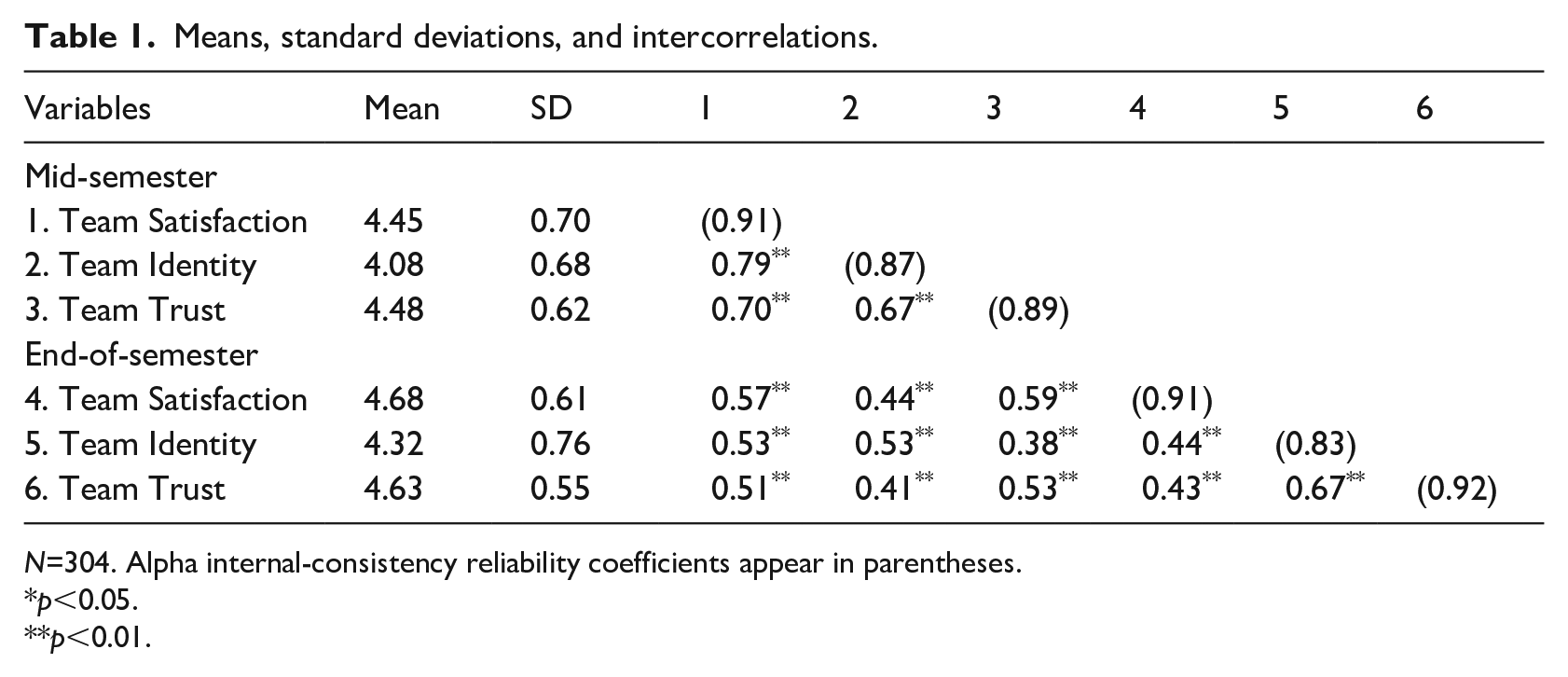
N=304. Alpha internal-consistency reliability coefficients appear in parentheses.
p<0.05.
p<0.01.
Context of the study
The context for this study was a graduate teamwork and leadership course at a large southern-central public university in the United States. This was a required course for students who were pursuing their Masters of Business Administration degree. The teamwork and leadership course was designed to increase awareness of the importance of teamwork and to help students develop effective teamwork competencies and skills required to successfully lead teams. The role of the instructor in the course was more that of facilitator and coach than lecturer. At the start of the semester, students were randomly assigned to teams and were required to interact with one other in numerous assignments intended to foster team effectiveness and yield favorable peer evaluations on a variety of specific competencies (e.g. preparedness, completing quality work, helping teammates, exchanging information with teammates, providing and accepting feedback from teammates, monitoring team member progress). For face-to-face classes, the majority of interactions took place in class and via Blackboard©, the university’s learning management system, although students often utilized other available group communication tools (e.g. text messaging, GroupMe). The assignments initially consisted of smaller projects (e.g. creating a team charter and website) and increased in complexity, culminating in a major collaborative semester project. Students in face-to-face classes met with their teams weekly (the survey data were collected pre-COVID) and worked in person with one another to complete the assignments. Students in online classes were encouraged to meet with their teams either face-to-face or via available video-conferencing technology. However, this was at the discretion of each team, and teams generally used Blackboard© or other forms of electronic communication. Over the course of the semester, the assignments grew increasingly complex, necessitating greater levels of coordination, communication, creativity, and problem solving. For example, at the beginning of the semester teams developed team charters, identifying team goals, member roles, and team ground rules. Later, teams also created their own websites, displaying a team name, motto, and photos and interesting biographical information for each team member. Throughout the semester, teams completed additional structured activities that required both individual input as well as team-level decisions (e.g. individual and team quizzes, a group consensus task, and conflict management problem-solving exercises). At the end of the semester, teams were challenged by a final semester project that required considerable creativity and coordination—the production of a “radio infomercial” for the marketing of a new business that offered a suite of products, which are purposely derived from disparate and seemingly unrelated industries.
Data collection
Multiple sections of the teamwork and leadership course were sampled over a 2-year period, during which the same professor instructed the course utilizing the same set of team-based activities and instructions to facilitate the learning process. The course was offered both in a face-to-face and an online asynchronous format. During the study period, a total of 320 students in 63 teams completed the teamwork and leadership course. One hundred twenty students took the course face-to-face, while another 200 took it online. Multiple self-assessment surveys were taken by students throughout the semester to aid in their learning and self-discovery of teamwork preferences and tendencies. The particular self-assessment used for this research study was the team evaluation survey, which was administered during week 6 and then again during week 13 (just prior to submission of the semester project) of the 15-week course. Although survey responses were collected anonymously, the typical demographic of students enrolled during the assessment period was 45% women and 55% men. Fifty percent of graduate students identified as white, 11% as Hispanic, 9% as black, and 17% as international. Fifty-one percent of the students were between 20 and 29 years old, 34% were between 30 and 39 years old, 11% were between 40 and 49 years old, and 3% were over 50 years old. Sixty-eight percent of the students were enrolled part-time. The final sample size for our analysis was 304 after 16 respondents were removed due to attrition. Data collection was approved by our Committee for Protection of Human Subjects and collected in accordance to our Institutional Review Board policies and protocols. The data that support the findings of this study are available on request from the corresponding author.
Measures
The survey instrument used for the mid-semester and end-of-semester team evaluation consisted of questions intended to assess the student’s attitude toward their team. Specifically, we assessed students’ satisfaction with their team, the extent of their identification with their team, and the level of trust they have in their team.
Team satisfaction
Team satisfaction was measured using Tesluk and Mathieu’s (1999) four-item team satisfaction scale. We replaced the word crew from each item in the original scale with team and changed the verb tense to the present, since surveys were collected while the semester was in session and students were still assigned and working in their respective teams. Sample items included “I really enjoy being part of this team,” and “I get along with the people on this team.” Each item asked the team member for his or her individual satisfaction with the team and team satisfaction was analyzed at the individual-level. Each item was anchored to a five-point scale (1=Strongly Disagree, 2=Moderately Disagree, 3=Neither Agree nor Disagree, 4=Moderately Agree, 5=Strongly Agree). Coefficient alpha for the scale was 0.91 in the mid-semester survey administration and 0.91 at the end of the semester.
Team identity
To measure team identity, we used a four-item scale adopted by Van Der Vegt et al. (2003). Sample items included “I strongly identify with other members of my work team,” and “I would like to continue working with my team.” One item that was negatively framed in the original measure, “I dislike being a member of this team” was restated in the positive, “I like being a member of this team.” Each item was anchored to a five-point scale (1=Strongly Disagree, 2=Moderately Disagree, 3=Neither Agree nor Disagree, 4=Moderately Agree, 5=Strongly Agree). Coefficient alphas for the scale were 0.87 and 0.83.
Team trust
Intrateam trust refers to the shared generalized perceptions of trust that teammates have in their fellow teammates and was measured using a five-item scale developed by De Jong and Elfring (2010). Each item was anchored to a five-point scale (1=Completely Disagree, 2=Somewhat Disagree, 3=Neither Agree nor Disagree, 4=Somewhat Agree, 5=Completely Agree). Sample items included “I trust my team members,” and “I am confident that that my team members will keep me informed about issues that concern my work.” Coefficient alphas for the scale were 0.89 and 0.92.
Data analysis
To test whether there were differences between virtual and face-to-face teams as hypothesized, we performed an independent sample t-test, both at the middle and at the end of the semester. We checked for differences in trust (our independent variable), and both team satisfaction and team identity (our dependent variables). We then further determined if there were differences between online and face-to-face sections in the importance of team trust on satisfaction and identity. To test whether the online or face-to-face course modality moderated the effect of team trust on satisfaction and identity, we performed a moderated regression analysis (Baron and Kenny, 1986) in which team satisfaction and identity were regressed onto team trust in step 1 of the regression equation, and the interaction term (team trust×modality) was added in step 2. Regressions were estimated using SPSS version 28. Prior to testing our hypotheses, Pearson correlation coefficients were calculated to confirm significant positive relationships existed between our study variables.
Results
Table 1 displays means, standard deviations, and correlations among our study variables: team satisfaction, identity, and trust. The scores on all three variables increased from the mid-semester to the end-of-semester for students in all courses. As shown in the table, our expected relationships between study variables are in the expected positive direction. We had hypothesized that team satisfaction, identity, and trust would be initially higher for face-to-face student teams than for virtual student teams. The means of each variable for online and face-to-face classes. As shown in Table 2, the initial levels of all variables from the mid-semester survey were higher for students in the face-to-face classes than for those in the online classes. The t-test was significant for team trust (t(301)=−3.16, p<0.001, d=0.611): team satisfaction (t(305)=−3.15, p<0.001, d=0.693): and team identity (t(305)=−3.67, p<0.001, d=0.670): supporting hypotheses 1a, 2a, and 3a.
Independent Sample t-test Results: Online and Face-to-Face Classes.
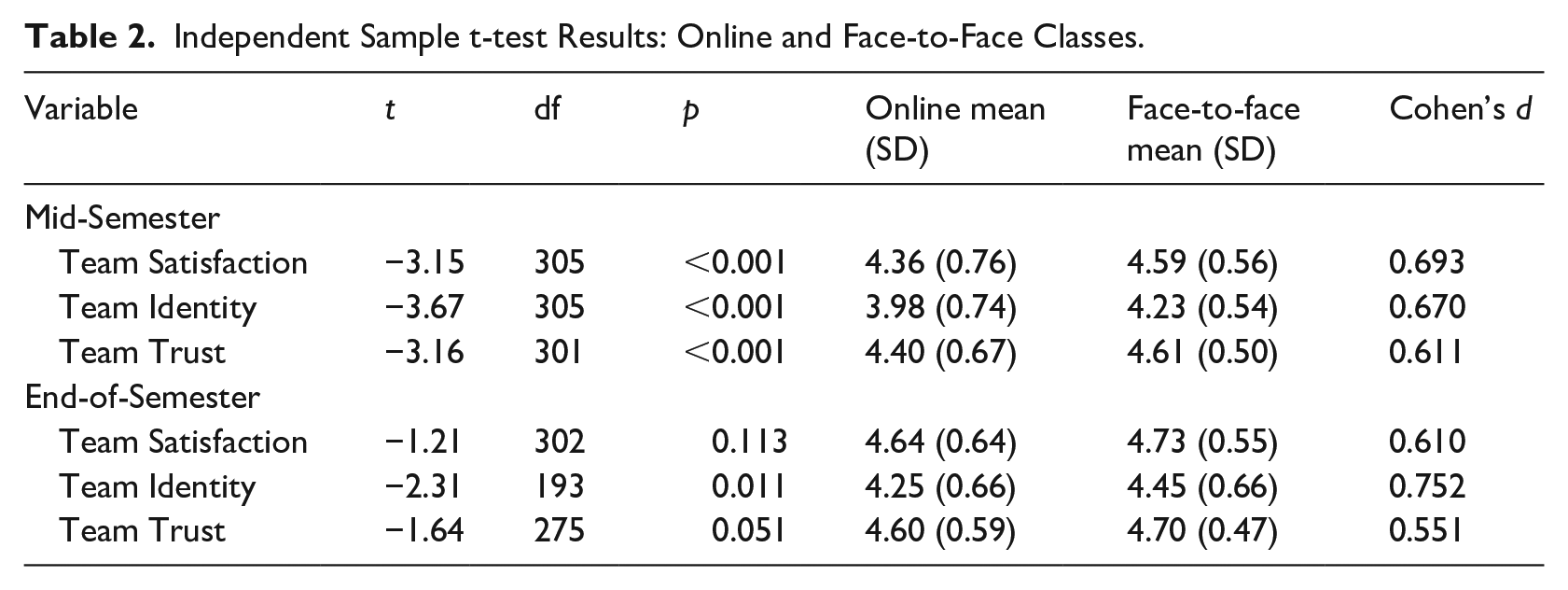
Although our expectation was met that students in face-to-face teams initially experienced higher levels of team trust, satisfaction and identity than those in online teams, we also expected these differences would dissipate over time. Table 2 presents the mid-semester and end-of-semester survey ratings by face-to-face teams as compared with online teams. As shown in the table, at mid-semester, there were significant differences between the two types of teams for all three variables; however, by the end of the semester, the differences in team trust (t(275)=−1.64, p>0.001, d=0.551) and satisfaction (t(302)=−1.21, p>0.001, d=0.610) became nonsignificant, supporting hypotheses 1b and 2b. However, at the end-of-semester students in the face-to-face classes still rated team identity significantly higher than those in the online classes (t(193)=−2.31, p<0.05, d=0.752). This suggests that students in online classes still did not feel identified with their team even by the close of the semester.
The moderating effect of course modality on the relationship between trust and both team satisfaction and identity is shown in Table 3. In Model 1, only trust significantly influenced team satisfaction (β=0.390, p<0.001). In Model 2, the addition of the interaction variable was significant (β=−0.901, p<0.05): indicating that course modality moderates the relationship between trust and team satisfaction such that the influence of trust is stronger for online classes (our interaction variable was coded as 0 for online classes and 1 for face-to-face). In Model 3, we see that trust also significantly influenced team identity (β=0.371, p<0.001). However, the addition of the interaction variable in Model 4 was not significant, suggesting that trust does not have a stronger influence on team identity for student teams in online classes. Thus hypothesis 4 is partially supported.
Moderated regression of team trust on team satisfaction and team identity.
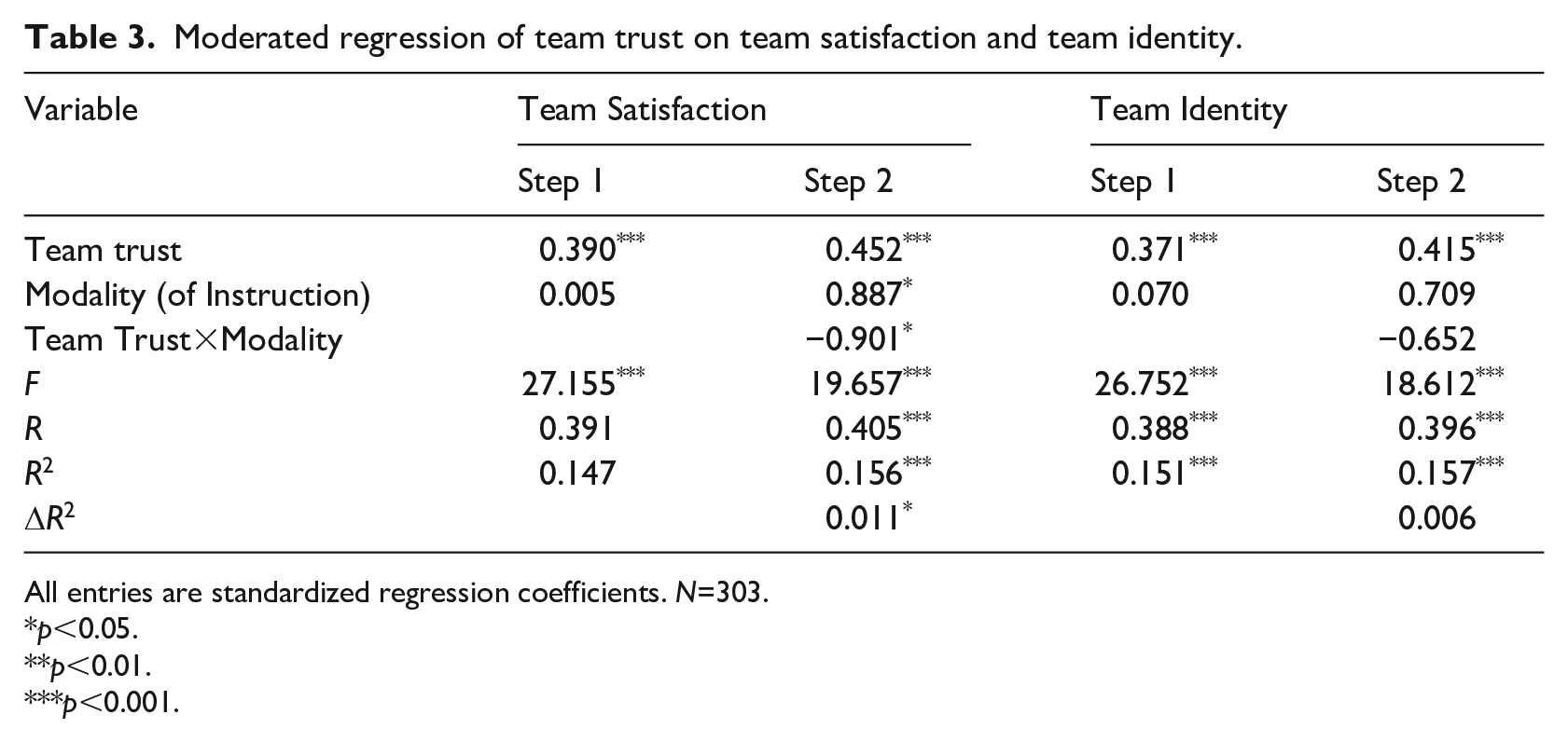
All entries are standardized regression coefficients. N=303.
p<0.05.
p<0.01.
p<0.001.
Discussion
In examining the differences that modality of instruction (online and face-to-face) has on student perceptions and attitudes toward student teams, we found that ratings of team trust, satisfaction, and identity are higher in face-to-face settings, but the differences in team trust and satisfaction diminish over time. Several explanations might be offered for this. In the early part of the semester, students in face-to-face courses may be more expeditious in working through the forming stage of team development and are able to devote more time toward becoming acquainted and establishing a rapport with one another. Conversely, students in online courses may struggle to connect with their teammates and experience challenges due to using less robust communication channels (e.g. email, discussion posts) that lack nonverbal cues and can mask feelings and emotions (Saghafian and O’Neill, 2018). When using these limited communication channels, greater frequency and more time is required for team members to develop positive work synergies (Grzeda et al., 2008). By the end of the semester, students in online courses have likely had sufficient interactions within their virtual teams to develop a level of trust and satisfaction comparable to that of face-to-face teams. The reasons for our unexpected finding that team identity continues to be rated higher by students in face-to-face teams than online teams at the end of the semester is unclear. One explanation might be that the extent of team identity a student can experience in a virtual student team does not equate to what is possible in a face-to-face team. More likely, additional time is required than what is available during a 15-week semester for comparable perceptions of team identity to form. Future research should be conducted to explore the effect that working in virtual teams has on team identity.
The significant moderating effect of course modality, whether the course was taught online or face-to-face, indicates that having trust in your teammates is more important for team satisfaction in online classes than in face-to-face classes. There may be a few reasons for this finding. In face-to-face classes, where team members are working in direct physical contact with one another synchronously, other factors (e.g. personality, attraction, nonverbal cues) may influence overall team satisfaction. Another explanation may be that in an online context the need for trust is greater because students must rely on their teammates to complete their work unobserved, and the inability to track their progress results in frustration and ultimately lower satisfaction with the team experience. In either case, we recommend that instructors in online courses develop activities specifically designed to enable team members to build trust early in the semester in order to increase team effectiveness and help improve student outcomes.
Online pedagogy requires the use of appropriate technological tools for content delivery to maintain student motivation (Montelongo, 2019). In a study of global virtual teams, critical factors found to impact success included: establishing a clear purpose, defining team roles, instituting effective decision-making processes, setting measurable goals, addressing time and distance problems, seeking instructor feedback, and recognizing leadership among team members (Kohut, 2012). Instructors should instill similar measures to help improve the ability of student teams in online classes to be successful and for students to feel satisfied and identified with their teammates. Including key team building activities at the start of the semester, such as developing a team charter, can set student teams on a positive trajectory by clarifying the expectations that they have of one another. In developing a team charter, students work together to identify the goals of the team, assign roles to team members, and agree upon a set of ground rules. In doing so, team members develop a sense of responsibility and commitment to their team and its objectives. Instructors of online courses should also consider including team-level self-assessments where team members can provide feedback to one another early in the semester. Feedback mechanisms enable students to establish more effective team processes and ultimately have a more satisfying teamwork experience (Grzeda et al., 2008). This, along with monitoring team processes and communicating feedback, helps students develop teamwork skills they will be able to carry forward into team settings in the workplace.
One limitation of the current study is that there are characteristic differences that exist between students who select online courses compared with those who choose face-to-face. Online students tend to be older than face-to-face students and are more likely to work full-time and have family and financial commitments (Dendir, 2016). As a result of these other obligations, they may be less inclined to feel a sense of identification with teams in which they are assigned as a student. Future research should examine additional student characteristics that may influence perceptions of teams in online learning environments. Another limitation of the present study is that the course in which data were collected placed a strong emphasis on developing teamwork skills. This likely resulted in restricted variance on some of our outcome variables. Future research should examine whether these study findings generalize to other online classes in which teamwork is not a primary learning objective of the course.
Conclusion
The experiences students have in virtual teams during their college years can influence their approach to teamwork in the workplace. Students who have negative experiences working in virtual student teams may cause them to feel apprehensive of teamwork. This is a concern since unfavorable experiences with teams during one’s education can negatively influence perceptions of teamwork and willingness to work in teams in the future. Greater understanding of the impact and importance teamwork experiences have on students, particularly in the increasingly more prevalent online context, may enable instructors to make the virtual team experience a more positive and instructive one.
Supplemental Material
sj-docx-1-alh-10.1177_14697874221118861 – Supplemental material for Team satisfaction, identity, and trust: a comparison of face-to-face and virtual student teams
Supplemental material, sj-docx-1-alh-10.1177_14697874221118861 for Team satisfaction, identity, and trust: a comparison of face-to-face and virtual student teams by Clifton O Mayfield and Alix Valenti in Active Learning in Higher Education
Footnotes
Declaration of conflicting interests
The author(s) declared no potential conflicts of interest with respect to the research, authorship, and/or publication of this article.
Funding
The author(s) received no financial support for the research, authorship, and/or publication of this article.

Supplemental material
Supplemental material for this article is available online.
Author biographies
References
Supplementary Material
Please find the following supplemental material available below.
For Open Access articles published under a Creative Commons License, all supplemental material carries the same license as the article it is associated with.
For non-Open Access articles published, all supplemental material carries a non-exclusive license, and permission requests for re-use of supplemental material or any part of supplemental material shall be sent directly to the copyright owner as specified in the copyright notice associated with the article.
