




Abstract
Perceived fit of students is one of the most prominent predictors of study success in higher education, but when assessed directly, it provides lots of room for interpretation for the respondents. This is also true for perceived demands-abilities fit (e.g. how do one’s abilities fit with study demands), which has particularly high associations with study success. We, therefore, investigated (1) how students combine demands and abilities when asked about their perceived demands-abilities fit and (2) which demands and abilities they have in mind when asked about their perceptions of fit in an unspecific manner. We obtained data on the perceived fit of N = 595 university students from four German-speaking countries and analyzed them using response surface analysis. The results indicate that (1) perceived demands-abilities fit does not correspond to the congruence of perceived demands and perceived abilities when the latter two are measured separately, but rather reflects a strong linear effect of the abilities. Furthermore, they show that (2) the specific demands and abilities do not influence the way how demands and abilities are combined to a fit score, but that there are differences in the amount of explained variance between the specific demands and abilities. The results speak for a new interpretation of prior findings and challenge the contemporary understanding of perceived fit. For example, perceived fit and self-efficacy might be more closely associated than previously assumed. When striving to enhance perceived fit, practitioners should thus focus on fostering individual abilities and their perceptions.
Perceived fit of students is one of the most prominent predictors of study success in higher education, but our understanding of the concept is still limited. On a most general level, perceived fit is about individual combinations of perceptions of oneself (i.e. the person) and perceptions of one’s environment. For example, higher education researchers investigate constructs such as cultural fit or habitus (Heil et al., 2019; Hutz et al., 2007), social and academic integration (Bohndick, 2020; Tinto, 1975), sense of belonging (Marksteiner et al., 2019; Winstone et al., 2022; Yorke, 2016), adjustment (Knifsend, 2020; Turki et al., 2018), needs-supplies fit (Li et al., 2013; Vahidi et al., 2016) or demands-abilities fit (Bohndick et al., 2018; Heise et al., 1997). All these constructs focus on different types of fit and include, for example, the fit to the university or the fit to the program. Despite their differences, their common base is that they refer to an integration of perceptions of the person and perceptions of the environment. However, as of now, this integration is not yet fully understood, even though a deeper understanding would benefit further practice and research alike.
Person-Environment fit (P-E fit) theory is a helpful approach to understand this integration in more detail. Figure 1 depicts the main principles of P-E fit theory 1 . Two things become apparent when examining Figure 1: First, it gives a rationale for investigating subjective fit instead of objective fit, as subjective fit is theoretically closer to outcomes such as study satisfaction (see also Cable and DeRue, 2002). The importance of subjective fit also manifests itself empirically, as there is recurring evidence that perceived fit is positively related to outcomes such as performance or satisfaction (Bohndick et al., 2022; De Cooman et al., 2019; Li et al., 2013).

A model describing the main assumptions of P-E fit theory. Solid lines indicate causal effects.
Second, Figure 1 clearly shows that there has to be something like a weighting scheme—a set of individual rules on how students put together person and environment to a single fit variable. However, we as researchers do not know which schemes or rules are applied by the students. Let us give two examples: Research on cultural fit and habitus focuses on perceived cultural fit and asks students if, for example, the values that they learned from their family are similar to the values of their fellow students (Hutz et al., 2007). It is important to note that they are not asked about their values (subjective person) and the values of their peers (subjective environment) separately, but are required to make this integration themselves. A second example comes from research on sense of belonging, in which researchers do not know what students consider to be their personal attributes (subjective person) and those attributes they would need to belong (subjective environment). Instead, students are asked directly if they feel that they belong to the university (Marksteiner et al., 2019) or if they think their abilities fit the demands at the university level (Yorke, 2016).
However, students’ weighting and combination procedures to put together their perceptions of person and environment can be extremely complex cognitive operations. An important part of the complexity is due to the fact that not only the two variables, perceived person and perceived environment, influence the perceived fit, but also the interaction between both. However, if we do not know how students generate their responses to questions regarding their perceived fit, we cannot interpret the answers as clearly as we would want to (Bohndick et al., 2018; Edwards, 1991; Kristof-Brown et al., 2005). In light of the deficit of research on the predictors of fit (De Cooman et al., 2019), this is problematic: While getting to know relevant parameters to enhance perceived fit would be a major milestone for fit research in higher education, efforts to do so are futile if we do not know how people combine person and environment to come to a perceived fit conclusion when asked directly. For example, when a university survey yields bad fit ratings, it is unclear whether policymakers should intervene by primarily focusing on the person (e.g. through fostering individual abilities), the environment (e.g. through reducing or increasing demands), or their interaction (e.g. through more tailored selection procedures at university entrance).
While this is true for all instances where person and environment are combined, in the present paper, we investigate the combination between the demands of the university and the student’s abilities. Demands-abilities fit is an important construct in higher education research, has relationships with criteria such as study success, and explains a considerable amount of variance in (self-rated) performance (Etzel and Nagy, 2016, 2021; Li et al., 2013). Furthermore, demands-abilities fit is one of the first types of fit that come to mind when thinking about academica. We often think of students as fitting well when they seem to have no problems following the courses and when they bring the abilities that the lecturers expect them to bring and build upon. In addition, from a perspective of trying to promote students’ success, demands-abilities fit seems extremely interesting. Here, there are many ideas for adjusting either demands or abilities, for example by elaborated induction processes (Edward, 2003), peer mentoring (Tsang, 2020), online self-assessments (Bohndick et al., 2020), direct entry (Barron and D’Annunzio-Green, 2009), or personalized learning offers (McQueen and McMillan, 2020). However, as outlined above, the foundations for such research are not yet laid since we do not know how students put together their perceptions of person and environment.
We address this research gap by investigating the relationship between perceived fit, demands, and abilities using response surface analyses (RSA). The results of those analyses help us understand what students mean when they say that their abilities fit the demands, which, in turn, allows us to understand our students better, identify antecedents of fit, and support adjustment processes. Furthermore, it also helps us to interpret findings from research using such assessments of perceived fit.
Fit between demands and abilities
When we look at typical items used to assess the perceived fit of students directly (e.g. “The match is very good between the demands of my schoolwork and my personal abilities”; Li et al., 2013 or “The fit between my personal skills and the requirements of my studies is very good”; Etzel and Nagy, 2021), the conceptualization of fit resulting from the model in Figure 1 is satisfied. However, two aspects stand out where students have plenty of room for interpretation: (1) the combination of demands and abilities with its corresponding weighting schemes, as well as (2) which demands and abilities to consider specifically. We will describe both aspects in more detail in the following.
Different combinations between demands and abilities
Even though we do not know how students combine their demands and abilities to come to a specific score (e.g. on a rating scale) when asked directly about their perceived fit, there are some implicit assumptions that we, as researchers, have. For example, most of the time, fit is defined as the congruence between person and environment. While this assumption is both implicitly as well as explicitly adopted in many fit investigations (Edwards et al., 2006), we cannot be sure that this is also what the students stick to when combining demands and abilities to a fit score. As a result, it is possible that perceived fit assessed by directly asking students is not in line with its definition. This might, for example, be likely when abilities exceed the academic demands, and this misfit leads to an increase in study satisfaction (Bohndick et al., 2018; Gilbreath et al., 2011). Accordingly, research from organizational psychology indicates that the perception of fit is only moderately correlated with the congruence between person and environment, which calls for further research to shed light on the combination processes and the meaning of perceived fit scores (Edwards et al., 2006).
Different demands and abilities
When assessing fit with typical broad items, study participants receive only minimal guidance regarding the specific demands and abilities. This means that students have to decide by themselves which specific demands and abilities are most important to think of when combining “demands” and “abilities” to a fit score. To give more guidance, some researchers suggest that when assessing fit, one should refer to multiple conceptualizations and content domains (Kristof-Brown et al., 2005). However, in typical studies on fit, this is seldom the case. Some research focuses on specific topics such as creativity (Nur, 2016) or demands resulting from technology-enhanced learning (Wang et al., 2020) but without investigating the relationship to broader assessments of perceived fit. Nevertheless, knowing which specific demands and abilities (e.g. cognitive abilities or regulation) students take as a basis when responding to questions on their global fit would be an important step in further understanding the concept of perceived fit.
Students might think of several possible demands and abilities when asked about their fit. A starting point to narrow these down is to focus on factors predictive of study success. Meta-analyses from higher education research found that regulation, elaboration, emotional intelligence, and cognitive abilities are especially relevant for studying successfully (Richardson et al., 2012). It is unclear if students think of these abilities when responding to questions regarding their general fit. Given their relevance for study success, however, those abilities seem to be one of the best starting points we have.
The present study
With reference to the above, the present study investigates how higher education students respond to questions regarding their demands-abilities fit. Correspondingly, the present research was driven by the following research questions:
(1) How do students combine demands and abilities to make demands-abilities fit statements? Following typical definitions of fit, we expect that demands-abilities fit corresponds to the congruence of demands and abilities, which means that people whose abilities are congruent with the demands are the ones with the highest self-reported perceived fit.
(2) What specific demands and abilities do students think of when they make general fit statements? The expectations regarding this research question can be divided into two parts following the combination process. First, abilities and demands are separate from one another. Here, we would expect relationships with medium to large effect sizes between global study abilities (resp. demands) and the abilities (resp. demands) regarding regulation, elaboration, emotional intelligence, and cognitive ability. If, contrary to our expectations, we found no corresponding relationships for a specific demand or ability, we could conclude that fit regarding this specific demand or ability is not particularly relevant to the assessment of general fit. Second, we explicitly investigate the combination process of abilities and demands for the different content specific demands and abilities. Here, the implicit assumption is that it is not relevant which contents the students have in mind specifically when assessing perceived fit as a global construct. If the assumption were true, we would see similar patterns when combining the different specific demands and the different specific abilities to explain the global perceived fit.
Method
Sample and procedure
We obtained data on the perceived fit of N = 595 university students from four German-speaking countries (Germany: n = 424, Austria: n = 81, Switzerland: n = 86, Luxembourg: n = 4; 52 different universities in total). Data collection was realized by means of an online questionnaire using the survey software “Unipark.” Completing the questionnaire took approximately 10 minutes, and participants did so using their own device (e.g. smartphone or laptop). Participants were recruited primarily in Facebook groups (e.g. the Facebook group for students studying at a specific university) and mailing lists (e.g. the mail distributor of the student association of a specific university), where they received some information about the study as well as a link to the online questionnaire. All participants were recruited anonymously, meaning that they were not specifically targeted, which is why we cannot know how many participants read the corresponding advertisements. As an incentive, they could participate in a lottery of 10 Amazon vouchers worth 50 Euros each. Participants had a mean age of 22.89 years (SD = 3.53) and n = 475 (79.57%) identified as women. To increase the generalizability of our results, no restrictions were made regarding participants’ study discipline or semester—the only inclusion criterion was that they were studying at a university in one of the four mentioned countries. This resulted in a rather heterogeneous set of participants, including both STEM and non-STEM disciplines, with students studying, on average, in their 5.21th semester (SD = 4.00). To reduce invalid participation (i.e. participants not studying at a university and participating just because of the lottery), only students with a university e-mail address were eligible for participation in the lottery (though it was also possible to participate in the study without participating in the lottery or indicating a university e-mail address, and some students did so).
The study is fully in accordance with the Declaration of Helsinki and with the APA Ethics Code (American Psychological Association, 2002). Explicit agreement to an informed consent form, which informed students about their rights, data handling, and the study purposes, was required at the beginning of the study. This was realized by means of a checkbox which had to be ticked before participants could begin with the questionnaire.
Measures
For perceived fit, we used a scale typical for assessing fit in higher education research (Etzel and Nagy, 2021; Li et al., 2013), where four broad statements regarding the fit between demands and abilities should be rated on five-point Likert scales ranging from “does not apply at all” (1) to “fully applies” (5).
Students’ perceived abilities and demands were assessed with regard to the four specific demands and abilities deduced from the literature: Regulation, elaboration, emotional intelligence, and cognitive abilities. Furthermore, to test the second research question, we also included global study abilities and demands. To test the congruence hypothesis, ensuring that the two predictor variables are measured on commensurable scales is crucial (Edwards et al., 2006; Nestler et al., 2019). For each of the aforementioned specific demands and abilities as well as for global study demands and abilities, students were therefore asked to rate, on five-point Likert scales ranging from “very low” (1) to “very high” (5), (a) the demands of their studies (using the question “What ability level is required in the following areas in your studies?” followed by the four demands specified above), and, in a similar fashion, (b) their own abilities (“What is your ability level in the following areas?”).
Sample items regarding the four areas as well as for global abilities and demands can be found in Table 1. The internal consistency of all constructs was good, with Cronbach’s alpha values ranging between α = 0.71 and α = 0.92.
Means, Standard Deviation and Cronbach’s Alpha of the Measurement Instruments.
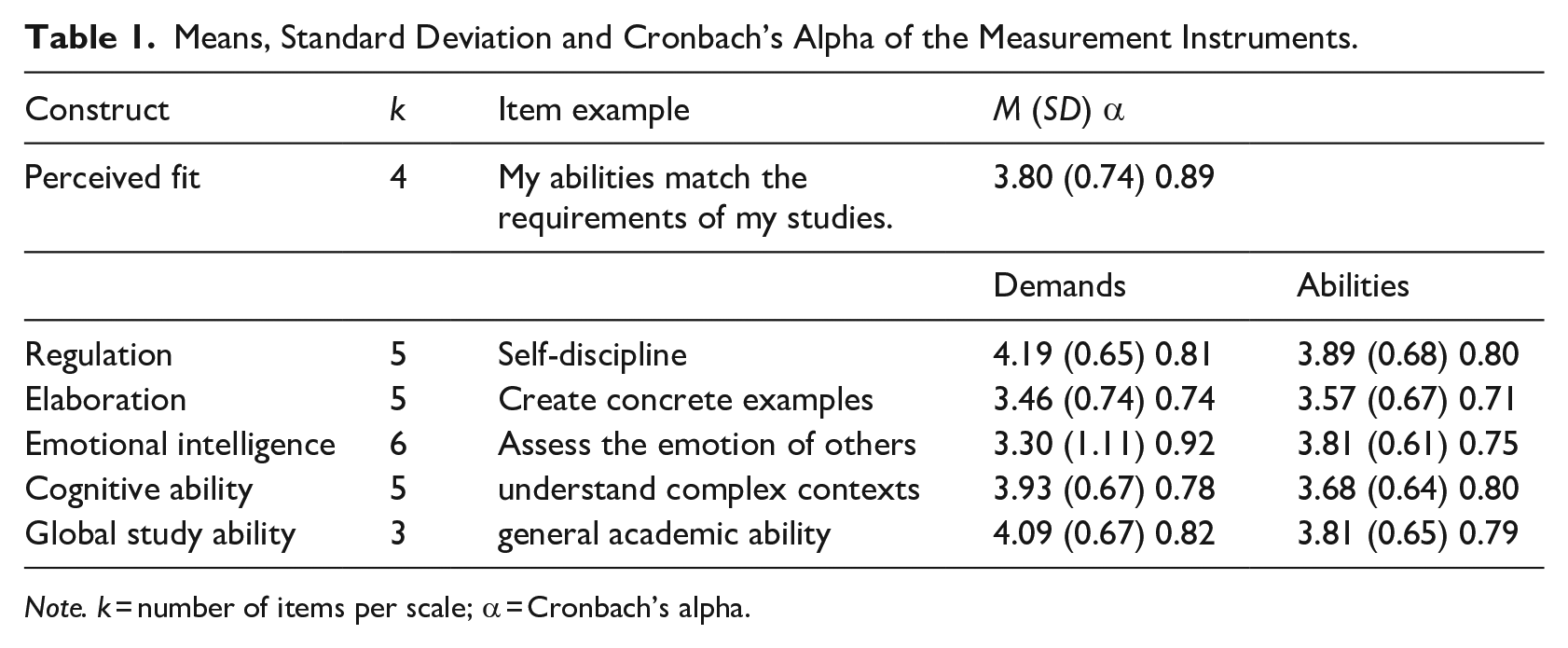
Note. k = number of items per scale; α = Cronbach’s alpha.
During data preparation for RSA, all variables should be centered on a meaningful common point (Humberg et al., 2019). We standardized the two predictor variables by centering X and Y at their grand mean and then dividing the resulting score by the grand standard deviation. Moreover, we ensured that multicollinearity between the two predictors was adequately low (Variance Inflation Factor < 2 for all dimensions).
Statistical analyses
All calculations 2 were done in R (version 4.2.0 R Core Team, 2022). To calculate the polynomial regression models, the package RSA (version 0.10.4; Schönbrodt and Humberg, 2021) was used together with Humberg et al.’s (2019) checklist. The checklist is a possibility to identify congruence effects between the two variables by comparing the values of different parameters in the regression model with the mathematical conditions for congruence.
To compare those values, it is necessary to select a model. Here, we calculated seven constrained nested models, as well as the full polynomial model, and evaluated them using the Akaike Information Criterion (see Schönbrodt, 2016). According to the Bollen and Jackman (1985) criteria, one multivariate outlier was removed. The outlier was in the regulation model, states a fit of 4.5, an ability of 4.4, and a demand of 0.00. Full polynomial models bear the risk of overfitting the data (Schönbrodt, 2016), but when compared to the nested models, the full model lay in the range of plausible models for all five dimensions.
Therefore, in the first step of our RSA, the two predictor variables (study demands and the abilities of a person), their squared terms, and their interaction terms were used to predict the perceived fit in an unconstrained polynomial second-degree regression model. Subsequently, response surface methodology was applied to determine whether the model reflects the proposed congruence hypothesis (Nestler et al., 2019).
According to Humberg et al. (2019), a response surface must satisfy at least four conditions to reflect congruence effects. First, we need to compare the line on the XY plane that contains all congruent predictor combinations Y = X (called Line of Congruence; LOC) to the line on the surface that has the maximal upward (or minimal downward) curvature (called the First Principal Axis; FPA) (Nestler et al., 2019). The first two conditions refer to the fact that it is necessary for congruence, that the FPA and LOC do not significantly differ from one another because only in this case the surface can predict the highest outcome for people with congruent predictors. For this to be the case, the intercept of the FPA (p10) must not be significantly different from 0 (condition one) and the slope of the FPA (p11) must not significantly differ from 1 (i.e. the confidence interval of p11 should include 1; condition two). If these conditions are fulfilled, we need to determine whether people with increasingly incongruent predictor combinations have significantly lower outcome values. For that, the quadratic term coefficient (a4) must be significantly negative (condition three) and the slope of the Line of Incongruence (LoI; where Y = −X) at the origin (a3) must not significantly differ from 0 (condition 4). If any of these four conditions is violated, the congruence hypothesis must be rejected (Humberg et al., 2019).
To further investigate the relationship between fit, abilities, and demands, the standardized regression coefficients from the polynomial regression model were used. b1 is the estimated regression coefficient for the abilities (X), b2 is the estimated coefficient for the demands (Y). b3 is the coefficient for the squared term of abilities (X²), b5 is the coefficient for the squared term of abilities (Y²), and b4 is the coefficient for the interaction term (XY).
Results
Research question 1
To test if the perceived fit corresponds to the congruence of demands and abilities, we evaluated the full polynomial models for regulation, elaboration, emotional intelligence, cognitive ability, and global study ability using the congruence checklist (Humberg et al., 2019). The surface parameters needed to detect congruence in a broad and strict sense can be found in Table 2.
Response surface results.
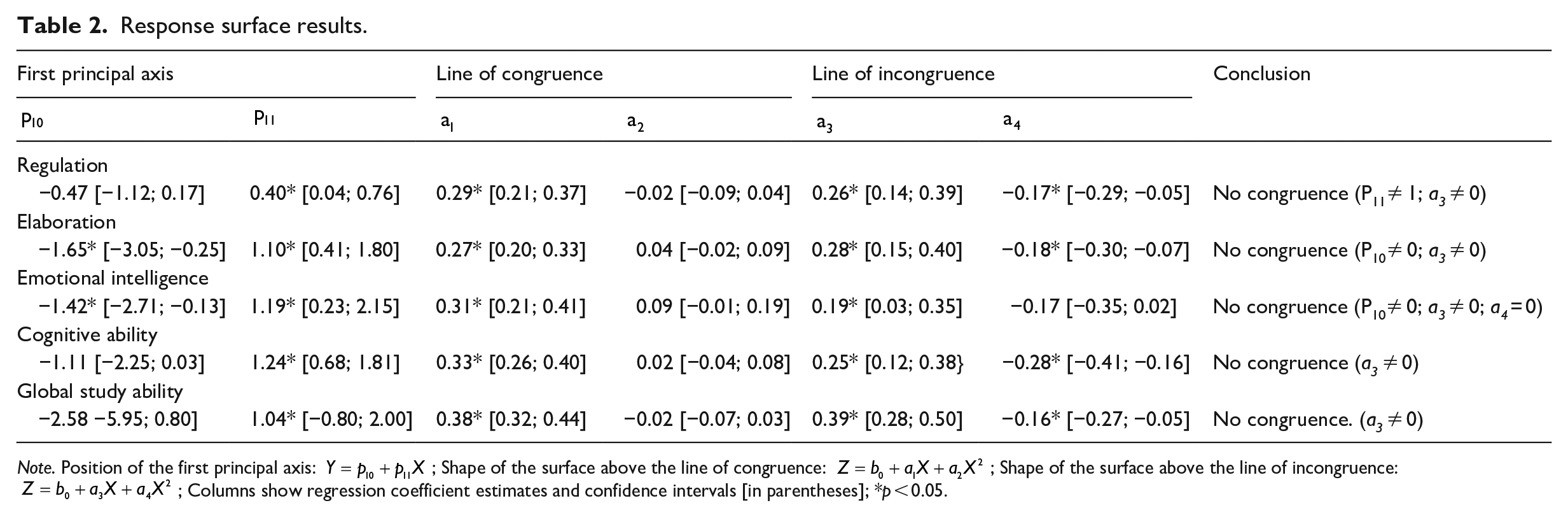
Note. Position of the first principal axis:
The RSA contradict congruence effects for all five constructs. The Line of Incongruence at the origin significantly differed from 0, indicating a violation of condition four. Additionally, condition one was violated for elaboration and emotional intelligence since the intercept of the FPA (p10) was significantly different from 0, and condition two was violated for regulation since the confidence interval for p11 did not include 1. For emotional intelligence, the quadratic term coefficients were not significantly negative (i.e. condition three is violated). Therefore, we must reject the hypothesis that people whose abilities are congruent with the demands are the ones with the highest self-reported perceived fit.
The standardized regression coefficients from the polynomial model (see Table 3) show similar results for all models 3 : medium-sized linear main effects of the abilities (b1 between 0.25 and 0.39), no linear main effects of the demands (insignificant b2), and small interaction effects (b4 between 0.07 and 0.15). Additionally, the model for regulation shows a small negative quadratic effect for demands (b5 = −0.09), whereas the cognitive ability model and the global study ability model show a small negative quadratic effect for abilities (b3_cogn = 0.08 and b3_global = 0.04).
Estimated regression models for specific and global demands and abilities.
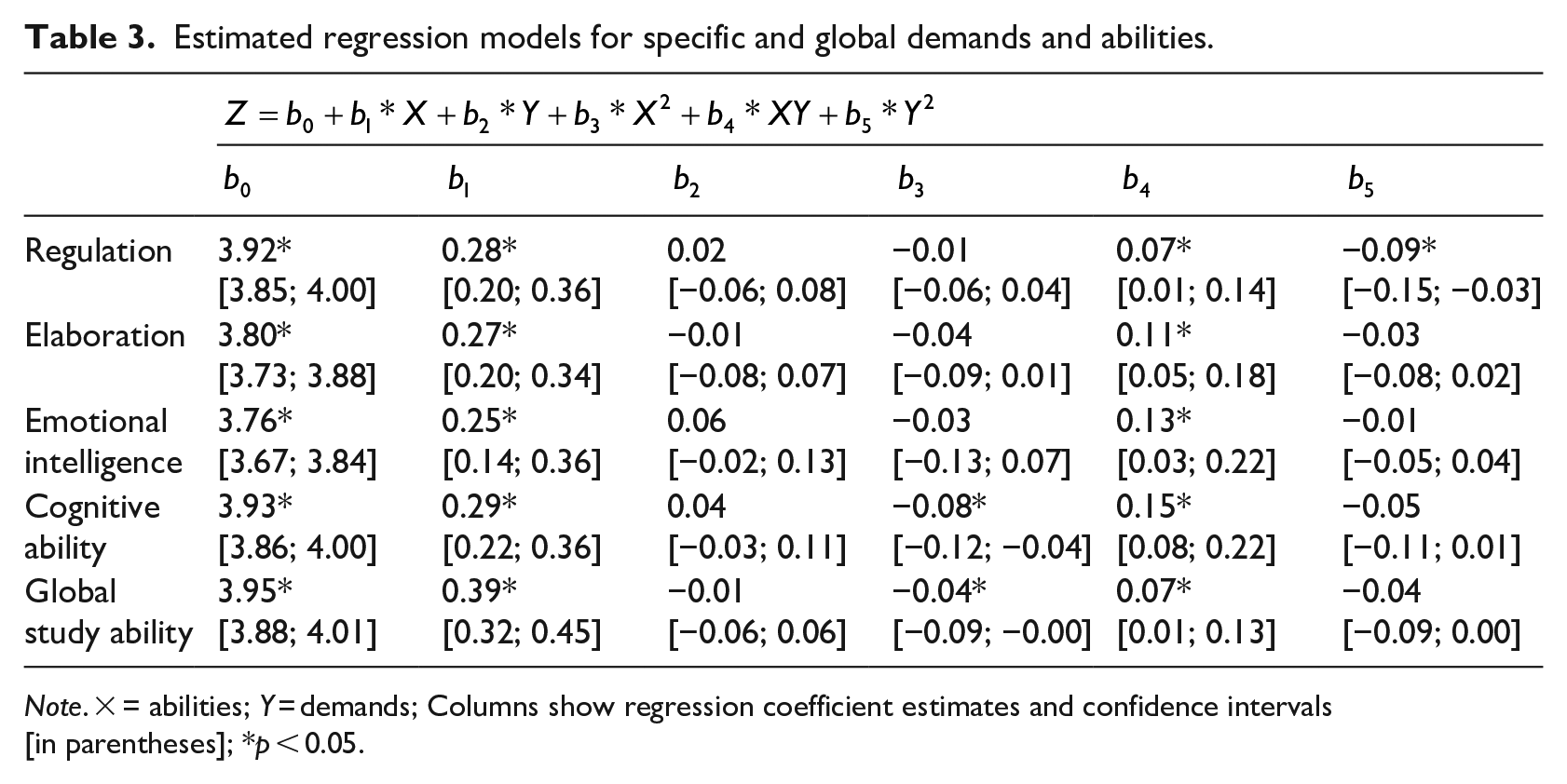
Note. × = abilities; Y = demands; Columns show regression coefficient estimates and confidence intervals [in parentheses]; *p < 0.05.
Research question 2
For research question 2, we first investigated the relationships between global demands and global abilities and the four specific demands and the specific abilities. The correlation coefficients can be found in Table 4. With one exception (r = 0.08 between global demands and emotional intelligence demands), all correlation coefficients ranged between r = 0.21 and r = 0.59, which can be interpreted as medium to large relationships (Funder and Ozer, 2019).
Correlation coefficients between global demands and specific demands and global abilities and specific abilities and specific demands with the corresponding explained variance of the RSA models.
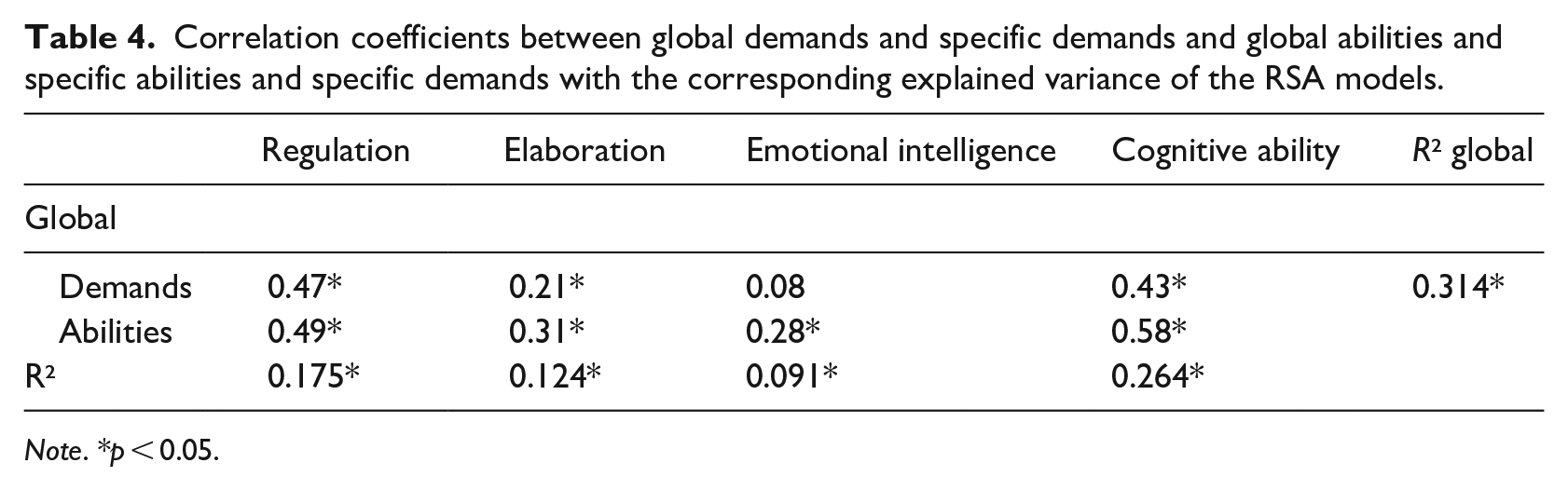
Note. *p < 0.05.
Furthermore, we investigated the regression coefficients. As can be seen in Table 3, all the models for the different specific demands and abilities had similar coefficients, except small differences in the quadratic effects of demands and abilities. However, when looking at R² in Table 4, the differences between the models seem to be higher, with explained variances between 9% (emotional intelligence) and 26% (cognitive ability).
Discussion
This paper provides an in-depth look into the meaning of perceived demands-abilities fit in higher education, thereby focusing on (1) how students combine perceived study demands and their perceived abilities when asked about their fit, and (2) what specific demands and abilities they have in mind when asked about fit in general. To do so, we conducted an online survey asking N = 595 higher education students about perceived demands and abilities in four specific areas (e.g. cognitive abilities), and with regard to fit in general. The resulting data were analyzed using RSA. Below, we first reflect on the main findings of our study, followed by a discussion of its limitations and implications for research and practice.
Main findings and practical implications
Regarding research question 1 and contrary to our theory-informed expectations, perceived fit did not correspond to the congruence between demands and abilities. Instead, we found strong effects of abilities on perceived fit, no significant effects of demands, and only small interaction effects between abilities and demands. Hence, a congruence between perceived demands and abilities was only loosely associated with perceived fit. Together with the strong effect of abilities, this means that participants do not seem to cognitively combine demands and abilities much when assessing their perceived fit, but that they weigh their ability perceptions much more strongly. In other words, students with high perceived abilities are very likely to also report a good fit, whereas students whose perceived abilities and demands are of high congruence exhibit more diverse fit ratings. In addition, from a methodological standpoint, the overall explained variance indicates that the restrictions of the RSA models (e.g. regarding symmetry) do not reflect the students’ combination process in its complexity.
For practice, that means that when we want to improve perceived fit, it is not about equalizing demands and abilities. Instead, it seems to make sense to focus on individual abilities and ability perceptions because ability perceptions are strongly associated with perceived fit. Hence, to increase perceived fit, practitioners might strive to train study-related skills, or they might foster students’ self-efficacy or self-beliefs (i.e. a person’s perception that he or she has the skill required to undertake a particular task), concepts that are closely linked to perceived abilities (Bartimote-Aufflick et al., 2016; Bohndick et al., 2018). Like fit, self-efficacy has a strong influence on study success (Bohndick et al., 2018), and, even more importantly, we know quite well how it may be enhanced. Hence, teaching strategies aiming at fostering self-efficacy, such as positive feedback or additional information on topics previous students struggled with (Bartimote-Aufflick et al., 2016) may also be suited to increase perceived fit. Furthermore, reflection tools like online self-assessments might be helpful to assist students in making more realistic assessments of their abilities and also allow them to work on those abilities (Bohndick et al., 2020).
Regarding research question 2, we investigated two aspects of how participants combined demands and abilities. First, we analyzed the relationship of a global measure for abilities (resp. demands) with the measures for specific demands and abilities. The relationships were all positive and significant, and only the relationship regarding emotional intelligence demands was, unexpectedly, not significant. The latter might indicate that students do not consider the demands regarding emotional intelligence to be related to global study demands, and, in addition, that emotional intelligence demands are not particularly relevant for their assessment of general fit. Furthermore, the relationships on the abilities side were higher than those on the demands side, which is not surprising since the above-mentioned meta-analyses focused on abilities as predictors for study success and not demands. The second part of the combination process is the combination itself. Here, the results regarding the importance of the different specific demands and abilities are ambiguous: When looking at the coefficients describing the resulting surfaces, all models seem to be rather similar, which might indicate that, for the interplay, it is not as important which specific demands and abilities are in the mind of the student when thinking about her or his fit. The differences in the explained variance, however, indicate that the specific demands and abilities the students have in mind when stating their perceived fit directly are relevant. From these findings, we would conclude that more students think of cognitive abilities when giving global fit statements compared to emotional intelligence or regulation.
Limitations
While we overcame the most common limitations in fit and congruence research by using RSA and solid congruence testing with commensurate scales and collected data from the same source, there are a number of limitations that should be considered when interpreting our results. First, RSA is a powerful tool and—to date—the best approach to investigate congruence hypotheses. However, the restriction to symmetric relations limited the explanation of the interplay between abilities and demands. Loosening the symmetry assumption would enable us to analyze whether, for example, abilities exceeding the demands lead to a better fit compared to abilities falling below the demands (Bohndick et al., 2018). Spline regression would be a method worth following here (Edwards and Parry, 1993; Humberg et al., 2019).
When thinking about the specific demands and abilities, one strong point of this study was that we did not only focus on one general conception of demands and abilities, but additionally analyzed four specific demands and abilities found to be important in prior research. What was missing, however, was the investigation of relationships between a global fit score and domain-specific fit scores. The problem here is that it is nearly impossible to develop items similar to the ones measuring perceived fit directly on a global level for those specific demands and abilities. Either they are so complicated that we cannot ensure the participants understand them, or they lead to an artificial focus on abilities or demands. Qualitative studies or studies using priming methods might be a way to analyze the relationship between global perceived fit and content-specific perceived fit.
On a more global level, a limitation of our research is that it focuses on demands-abilities fit, neglecting other aspects of person-environment fit such as needs-supplies fit. Future research might strive to replicate our findings with regard to such conceptualizations. In addition, our choice of the four specific demands and abilities (e.g. cognitive abilities) is, though based on existing research, to some extent arbitrary. Future research might investigate additional demands and abilities not analyzed in the present paper.
Implications for further research
Our results contradict the congruence hypothesis for global as well as for the specific demands and abilities, and speak against the notion that higher education students will report a higher perceived fit with increasing congruence between their perceived study abilities and the perceived study demands. Hence, if students respond that the demands of the university fit their abilities, this does not necessarily mean that they perceive the study demands and their abilities to be congruent. In fact, given our findings that subjective abilities have a strong relationship with perceived fit, it is more likely that they simply perceive themselves as having a high ability. Demands and the perceived congruence between abilities and demands, on the other hand, seem to play a minor role.
This should be considered when interpreting studies using a direct measure of perceived demands-abilities fit, as well as when designing studies on fit. There are studies analyzing the incremental value of fit over perceived abilities, but those measured demands and abilities separately and combined them ex-post (Bohndick et al., 2018). The results of the present study indicate that we cannot transfer those results to the case of the direct measurement of perceived demands-abilities fit.
Trying to generalize the results from demands-abilities fit to other domains of perceived fit, such as sense of belonging or social and academic integration, we suggest that further research also considers the possibility of a strong effect of the person. Sense of belonging, for example, is measured with items similar to those measuring perceived demands-abilities fit (e.g. “I feel I belong to my university”; Marksteiner et al., 2019 or “I doubt my ability to study at university level”; Yorke, 2016). It seems realistic that the combination process here is similar to the one investigated in this study. To advance theoretical knowledge, it would be important to analyze how person and university environment are combined in those different, albeit conceptually similar, cases. If the findings again favor the person side, this might indicate that students see the need for adjustment on their side instead of calling upon the responsibility of the system. Even though that would correspond with the predominating discourse of adjustment processes (Zepke and Leach, 2005), it would challenge our understanding of fit and corresponding concepts to a high extent.
Footnotes
Declaration of conflicting interests
The author(s) declared no potential conflicts of interest with respect to the research, authorship, and/or publication of this article.
Funding
The author(s) received no financial support for the research, authorship, and/or publication of this article.
