




Abstract
In this article, the authors advance recent discussions of atmospheres by developing an approach that builds theory in relation to methodological understandings of how and what we can we know about atmospheres. They argue that, in order to be able to understand the significance of an atmosphere empirically, a theory is needed that can account for the specificities of particular atmospheres that are generated in the context of actual research sites, the everyday contingencies in relation to which they shift and change, and the different ways in which they might be perceived. To do this, they propose that atmospheres should be understood as part of and as emerging from within environments Simultaneously, to be able to build theory thorough empirical research, an approach is needed that is capable of researching how atmospheres are made and sensed by people in mundane everyday moments, and how they are generative of sensory, affective and empathetic forms of engagement. Situating video recording, like atmospheres, as emerging from within environments, the authors show how video ethnography can enable us to build the theoretical and empirical ambitions of this field of investigation.
Introduction: Atmosphere and Environment
Scholars of atmosphere in human geography and anthropology have tended to take as a starting point Böhme’s (1993: 122) argument for understanding atmospheres as not ‘free floating’, not existing separately from things and people. According to Böhme, atmosphere ‘is the reality of the perceived as the sphere of its presence and the reality of the perceiver, insofar as in sensing the atmosphere s/he is bodily present in a certain way’ (p. 122). Earlier work in this area focused on the affective nature of atmospheres to render them ‘a kind of indeterminate affective “excess” through which intensive space-times can be created’ (Anderson, 2009: 80) and was concerned less with the sensory ways in which we engage with environments, as with ‘prepersonal or transpersonal dimensions of affective life and everyday existence’ (p. 77). Critical reflections, with which we concur, propose that this focus on affect ‘runs the risk of understanding atmospheres by proxy, translating them into another concept whereby they lose their material grounding’ (Bille et al., 2014: 5). Alternative ways of conceptualizing atmospheres, which come closer to Böhme’s original notion are more convincing: Bille et al. propose that ‘in essence it [atmosphere] must be understood as a spatial experience of being attuned in and by a material world’ (p. 5) and closer to our interests in the senses and perception, Edensor (2014: 2) suggests that ‘atmosphere folds together affect, emotion and sensation in space’. A further critical move entails shifting the emphasis in atmospheres research away from the idea that atmospheres are necessarily ‘intensive’ (Anderson, 2009: 80), or involve the production of intensities (Bille et al., 2014), towards the possibility of atmosphere as mundane and always present. Edensor (2012: 1106) has tempered the focus on intensity by proposing that ‘the capacity of atmospheres to affect bodies and emotions varies in intensity’, inviting us to ‘consider the calm atmosphere produced through meditation, the animated atmosphere of a market or rock concert, or the sombre atmosphere of a gothic church’. Taking this further, we suggest it is not the (anyway difficult to measure or compare) extent to which an atmosphere is intense that matters, and it is not the presence of atmospheres that is in question. But rather to be able to understand the significance of an atmosphere empirically, we need a theory that can account for the specificities of particular atmospheres that are generated in the context of actual research sites, and the everyday contingencies in relation to which they shift and change, as well as the different ways in which they might be perceived.
An example of how this is played out in empirical research can be demonstrated through a focus on how atmosphere is perceived in the context of the Spanish bullfight, in terms of the ‘sensations and emotions of the bullfight’ (Pink, 1997: 167) and as a multi-sensory place event (Pink, 2011b). As anthropologists of the bullfight have emphasized, an important element of the event is its ambiente (Marvin, 1994[1988]; Pink, 1997: 56), usually translated as atmosphere and described as ‘the atmosphere and excitement of the event’ (Marvin, 1994[1988]: 70) or ‘a feeling in the air and a quality of human interaction’ (Murphy, 1978, cited by Marvin 1994[1988]: 199). Ambiente has a positive connotation; saying a ‘place or situation’ had no ambiente would be a negative commentary (Marvin, 1994[1988]: 199). Ambiente is experienced as specific to each event and circumstance and is a way of evaluating how bullfights are experienced. The ambiente of a bullfight is constituted through multiple elements, including the performance, the audience and its actions, and the weather. While the performer participates in its generation, at the same time the bullfighter’s affective, emotional and sensory experience of the ambiente of the bullring is considered crucial to the performance (Pink, 2011b).
For bullfight aficionados, atmosphere as ambiente is not given but rather it emerges from the event. In local aficionado terms, ambiente can be present or absent. This shows the difference between a conceptualization of atmosphere as being constituted only when it generates a particular way of feeling or quality of being there (e.g. as for ambiente) and the idea of atmosphere as a theoretical and analytical category through which to bring together things and processes of different types and qualities (the material, the intangible, the social, the affective), which might generate a range of different feelings. The particularities of the atmosphere of an event, occasion or everyday life activity only ‘matter’ when felt within that activity, by participants who are part of it, and, as Edensor (2014) points out for football matches, who are attuned to feeling it in a particular way. Atmospheres are thus felt from inside, within, and not in analytical distance. They are, moreover, felt differently by different people. For instance, a true bullfight aficionado, a less attuned spectator and a tourist would each experience the atmosphere of the event differently (in relation to their existing biographical experiences and orientations). Some would have a sense of the ambiente; others would not comprehend the concept. Here the analytical task of the researcher is not to ask if an atmosphere was generated, but rather to ask what it meant for a certain group of people. The wider question is concerned with how people ‘feel’ through and within atmospheres, and how and why for particular people and groups of people particular sensory and emotional states are related to particular atmospheres. Returning to the question of what it means to feel ‘right’, each of the three types of bullfight spectator might tell us that the same performance felt ‘right’ to them. They would all have been participants in the making and experiencing of an atmosphere. Yet only one group would be able to authoritatively comment on its ambiente.
Bille et al. (2014: 2) have summed up that atmosphere seems to stand for ‘the very sensuous interface of people, places and things; as a vague yet anything but weak phenomenon that is staged, culturally informed, and manipulated to achieve social, political, and economic goals by tapping into people’s emotions and affects’. Atmosphere, because it is beyond representation, is indeed always something that will necessarily be difficult to pinpoint, and we agree that seeing it as the emergent outcome of what can be held on to – ‘people, places and things’ – is important. Existing theories of atmosphere do not resolve the question of the indeterminacy of atmosphere, and in fact should not as the concept needs to be sufficiently open to allow for the emergent nature (and thus always unknown qualities) of atmospheres. Such an approach precisely leads us to the contingencies of life that we are concerned with. Yet, atmosphere is not simply an outcome of those things that make it; it is also a participant in the ways that the world it is part of is made. As our example of the bullfight has shown, the bullfighter’s performance both creates and is impacted on through the ambiente of the bullring. This implies that a theory of atmosphere would benefit from situating atmosphere as not only the outcome of the relationships between the forces that are said to constitute it, but instead to explore its relationality to these in more depth, as part of a shared configuration with those things. Building on an earlier proposal to bring together a theory of atmosphere with a theory of the environment as developed by Ingold (see Pink and Leder Mackley, 2015), we propose this enables us to more clearly situate atmopsheres analytically (although does not necessarily make them easier to define). As Ingold (2011: 95) reminds us:
We are these days increasingly bombarded with information about what is known as ‘the environment’ … that we are, I think, inclined to forget that the environment is, in the first place, a world we live in, and not a world we look at. We inhabit our environment: we are part of it; and through this practice of habitation it becomes part of us too. (emphasis in original)
We suggest seeing atmosphere as likewise part of the environment – as much as we and other things and processes are. That is, it is something that we live through, as much as being something that we make. If atmospheres are conceptualized as already part of the world that we inhabit, therefore as we proposed above, the core question is not if there is an atmosphere. Instead it centres on how we might: identify empirically the contingencies that constitute particular atmospheres; understand their qualities and affordances; and use this knowledge to generate insights into mundane everyday life worlds where atmospheres, people, things and processes together constitute everyday environments.
In this article, we bring together this work about atmospheres (Anderson, 2009; Bille, 2014; Böhme, 1993; Edensor, 2014), environment (Ingold, 2000, 2011) and the use of video as a sensory-ethnographic research methodology (MacDougall, 2005; Pink, 2013, 2015). We develop this through two related themes. First, we explore how we might activate the concept of atmosphere to research how affective, sensory and material things, processes and feeling/perception come together to create a sense that things are ‘right’; that is, how are these configurations productive of forms of wellbeing? Such forms or senses of wellbeing are not simply psychological or a part of our human consciousness in isolation; rather they are achieved and produced through our sensory, emotional and affective engagements with the material, technological and intangible world. Second, we discuss how we might engage video as a technology and medium to research and engage analytically with atmospheres. In practical, tacit and theoretical ways, video is associated with the sensory, affective and empathetic forms of engagement and communication. Therefore, we argue, it offers a medium through which to pursue such investigation by supporting the ambitions of scholars in this field to engage with the non- or more than representational dimensions of how affective and sensory elements of our worlds are experienced and made. Moreover, treating atmosphere as part of what Ingold (2011) refers to as environment, is useful for our discussion of video as a technique, technology and practical activity through which to research in and through atmospheres. If we are in our environments, and as we have argued, atmosphere is experienced from the inside, video recordings are likewise made in environments, not of them (Pink, 2013).
In so doing, we advance discussions of the potential of visual media and communication for empirical research generally and specifically outline its potential for researching atmospheres empirically. To support our discussion, we draw on selected examples from a video ethnography of energy and digital media use in 20 family homes in England, undertaken within a larger interdisciplinary study with 20 family households within the Lower Effort Energy Demand Reduction (LEEDR) project from 2010–2014. 1
Atmospheres and a Sense of Wellbeing: Feeling ‘Right’
The starting point for our empirical research in UK homes was to explore how our participants created what we called at the time the sensory aesthetic of home. In retrospect, what we were seeking to find out can be usefully explored through the concept of atmosphere as defined above. That is, if atmospheres are a given element of our everyday environment, then our aim is to understand how everyday atmospheres of home are constituted and experienced, precisely at the interface between people, materiality and the sensory, emotional and affective. We were concerned empirically with what people’s homes felt like, and specifically with the question of how they made their homes ‘feel right’. We took as our starting point the assumption that one thing that humans (almost) universally seek to do (or hope for even if they never achieve it), is to make the environment around us feel ‘right’ enough for us to be able to comfortably go about our everyday business. We coined the term ‘right’ as a research category for our fieldwork; that is, we asked people to show and tell us what they needed to do to make their homes ‘feel right’, and we prompted them by following up with questions that probed, for example, if they needed to ever open their windows, put on music, care for floor surfaces or use lighting.
For example, part of our research involved asking participants to show and explain their ‘usual’ morning routines by re-enacting them while we video recorded them. We were interested empirically in how participants made the morning home ‘feel right’ and their ways of knowing, sensing and feeling it. In theoretical terms, we were exploring how the atmosphere of the morning home was constituted and experienced. In video 31 on our Energy and Digital Living website, one participant walked Kerstin through his morning routine. We invite readers to view this and other videos from our online archive (see http://energyanddigitalliving.com/video-archive/ Video 31: 0043–to end). This participant described how, as the first person to get up, he moved through the home in the morning, activating on his way the people and technologies of home, creating a morning feel, which by the time he left for work would be further established. The route he followed involved getting up himself, going into the bathroom, brushing his teeth, getting dressed, knowing that once he left the bedroom his wife would soon be watching the morning news on TV, waking/reminding his children that they would need to get up as he passed their rooms, going down to the kitchen to make tea for his wife and himself, taking the tea up for his wife, who may by then be in the bathroom, and then sitting down to drink his own tea while reading the BBC news on his iPad in the study. Here the ‘feel’ of the morning home would be constituted between the emotional ties of family, sensing what they would be experiencing/doing, the visual and haptic affordances of the iPad, the taste of a familiar cup of tea and walking attuned through a familiar material architecture, known floor surfaces and feel to the air.
Following our participant through the home while he recounted and enacted this routine on video did not create the same atmospheres or experiences of the morning home that would have emerged as an everyday occurrence. Instead, through these reenactments our participants were able to remember, reconstruct, generalize about and abstract the kinds of ways their morning home would usually be made and feel (see Pink and Leder Mackely, 2014, for a discussion of the theory and methodology of reenactment techniques). For us as researchers, either video recording or later viewing and discussing the video reenactments together offered a way in which to empathize with and imagine participants’ and fellow researchers’ experiences, the various different sensory, emotional and affective ‘feels’ the morning homes might have, and to consider the routines and contingencies through which energy was consumed during these activities.
Indeed, the atmosphere of the morning home is not exactly reconstituted every morning, but it is rather re-made each day as part of the ongoing shifting environment of home, in ways that usually sufficiently resemble how it has ‘felt’ on other mornings for it to be recognizable. Therefore we did not to seek to study an atmosphere that would have been constituted in the same way each day. Rather we wanted to understand the (also shifting) ranges of contingencies that were part of everyday morning life, through which people come to need to consume energy in order to make their homes feel sufficiently ‘right’ for everyday life to be able to continue. More broadly, our aim was to research energy use indirectly through a focus on the things people habitually do in their homes in order to develop insights into how the contingencies of everyday life were implicated in the constitution of energy demand. These contingencies bring together the materiality and technologies of home and their affordances with the affective and sensory experiences and everyday ways of making or improvisation of human subjects. They constitute (as we have argued for bedtime routines) ways of experiencing and making atmospheres of home that are affectively, emotionally and sensorially perceived and engaged with (Pink and Leder Mackley, 2015).
Feeling right is obviously a very open category and, beyond sensory experiences, our participants also told us about the ways that, for instance, they felt emotionally un/comfortable about technology being switched on or off (Pink and Leder Mackley, 2013). Indeed, atmospheres are not always of wellbeing; an atmosphere may encompass a range of emotions and embodied sensations that will be contingent on the environments they are part of and that they, in turn, constitute. The ways we feel about the environment of which we are part, and its atmosphere in regard to home vary and, as emphasized in the human geography literature, home does not always feel good – it can be a site of violence, abuse, fear and more (e.g. Blunt and Dowling, 2006). Yet as Robert Shaw (2014: 3) notes in his discussion of darkness in the home, ‘the potential for positive experience in the home does not undo or undermine the negative effects of isolation.’ Instead, Shaw suggests, ‘our experience of home tends to fluctuate between two poles; rather than being either a space of isolation or a space of protection, home is most frequently both of these, to some degree.’ While we would define isolation and protection as relationally constituted states rather than poles (and above all as culturally constituted categories used to speak about feelings), we also stress the need to recuperate the question of how homes become sites for wellbeing. Wellbeing at home is never an absolute state; our work has focused on how people work towards it, rather than achieving a feeling that home is absolutely ‘right’. Usually it is a case of things being ‘right enough’ for everyday life to continue, and feelings that it is not quite right can relate to not having the right lamps to shed light in the way that would be ‘right’ or having a draught coming in through the front door. As recent work in anthropology shows, the ways in which situations or contexts can feel, as Brian Callan (2014) puts it, ‘wrong’ is just as relevant as the idea that they might feel ‘right’. Indeed, when these terms are used as local – that is in the research context – categories, and then treated theoretically as examples of sensory and affective perception, they can (like notions of protection and isolation in the home) be understood relationally. They also take on moral connotations. For us, understanding how such shades and grades of wellbeing in homes are ‘felt’ and what people do to generate the material and sensory circumstances of such feelings underpins our analysis of the contingencies of everyday energy consumption. It also leads us to argue that there is always a potentiality for a home to feel ‘right’, even if this is not achieved, which we propose endorses the idea that the home can be a site for wellbeing and that there is a human propensity (if not a universal one) to work towards this.
If there is always atmosphere and if we consider humans to be seeking to make that atmosphere feel ‘right’ in ways that are not explicit but that are ongoing, tacit and routine, then to investigate how a sense of wellbeing is generated in homes we need to ask how people actually generate such atmospheres. With each of the family households who participated in our project, we asked to be taken on a video-recorded tour of their home. The tour was mainly concerned with developing an understanding of how the householders created a particular sensory aesthetic of home, which, as noted above, we presented to them through the question of how they experienced and sought to make their homes ‘feel right’. In the next section, we present another example from our fieldwork, which focuses on the role of digital media in the making of atmospheres of home. We were led in our tour of the Ashton family home by Barbara (40s) who had moved into this 1940s house six years earlier, with husband Martin (40s), son Alistair (12), daughter Amy (10) and the family dog. We first focus on the physical structure, materiality, sensoriality and temporality of their project of home, and then explore how mundane atmospheres of their home were ongoingly co-constituted through flows of digital media and their affordances, people and other things and processes.
Video Touring with the Ashtons
The Ashtons’ home was ongoingly designed through their intentional and continuing engagement with home improvement and DIY (Do It Yourself) activities. This process, in ways similar to other participants’ stories, lent the way they spoke of and showed the home a future orientation. Since moving in, the family had made extensive structural, spatial and sensory changes to the house. It was modernized, enlarged and ‘brightened up’. During the video tour of their home, they explained how the front door and main stairs were moved and the kitchen extended to double its size. They contracted a builder for the extension and larger works; however, the walls, flooring, tiling, skirting boards, some upholstering and décor that were all seen and recorded on video, were created through the embodied labour of DIY and Barbara’s creative and practical skills. This changed the surfaces, textures and feel of home, for instance through pulling up carpets to reveal original flooring. Yet the home was ongoing; they made sure to tell us that a separate toilet and sink unit had just been completed, and the shower room, described as ‘like a shower in a cupboard, that leaks’ would be next. Like other participants, this family positioned themselves in a processual reality in which they were transforming their home. There, the present that was encountered in the video tour of the home was only presentable to us as researchers when accompanied by accounts of the past and visions of the future and a sense of what the home would feel like in the future (see also Pink, 2004; Pink and LederMackley, 2012).
The Ashtons also created solutions that made rooms ‘feel right’ through their daily routines of use, which were designed to their own agreed tastes. For example, the large kitchen-diner (Figure 1) was at the back of the house and much of the family’s shared life was spent there.
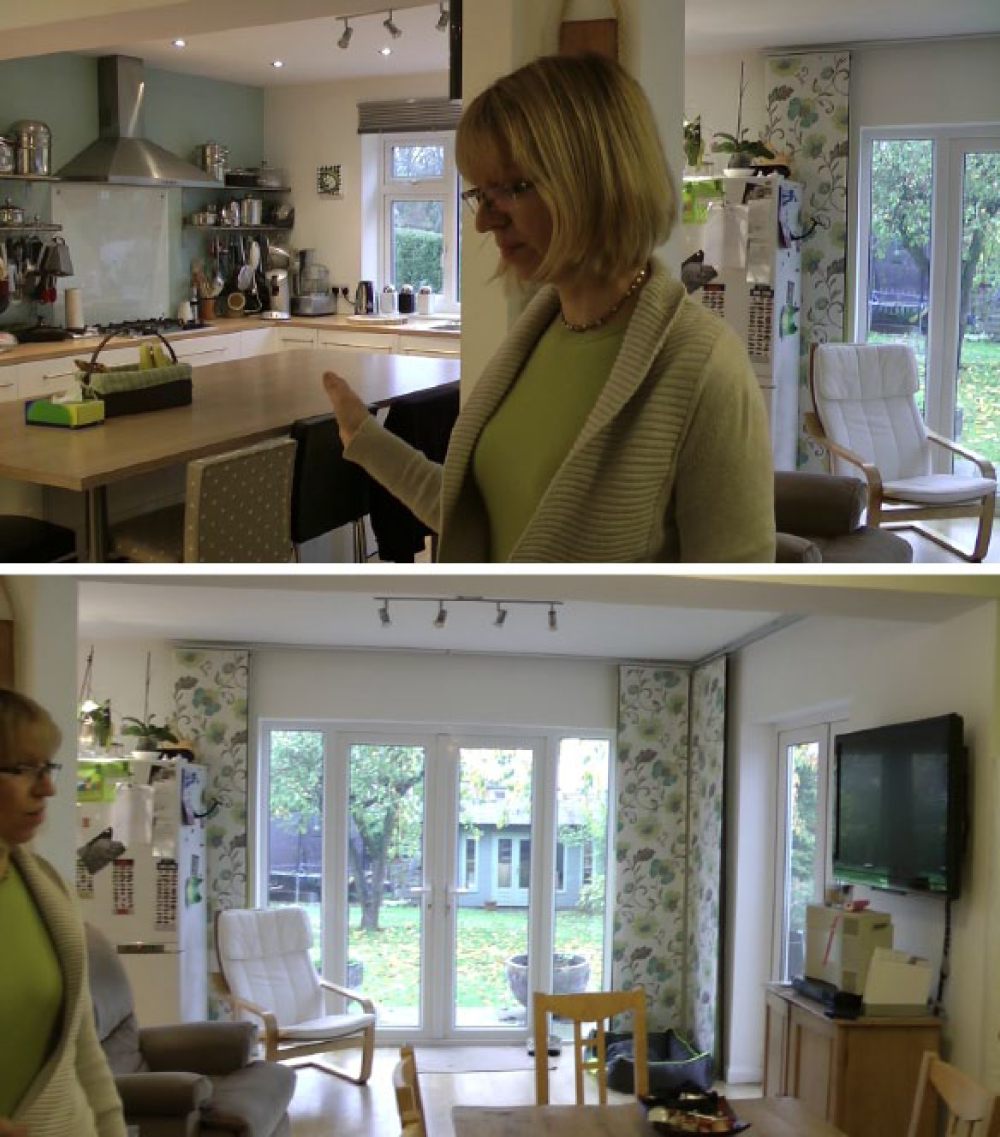
Both sides of the light kitchen diner. © The LEEDR project.
One strand of our research focused on the use of digital technologies in the home and their significance beyond their content and communication uses, thus examining how media that participated in the generation of mundane atmospheres of home was particularly pertinent for us. The atmosphere of the kitchen was constituted partly through media, as Barbara described:
In the morning, [the kitchen TV] gets switched on by my husband, because I forget, I wouldn’t turn the telly on, but he likes the news, and the children like the news, so if the telly’s on, it’s always the news … and then it gets put on when Amy plays on the Wii … And then sometimes I’ll put the TV on if I’m cooking tea … and then it will stay on all evening until we leave this room, and the kids have gone to bed.
The presence of media technologies and content also constituted an atmosphere through which Barbara, because she was attuned to the home, could sense what her children were doing and thus care for them. The children tended to move between the rooms downstairs – the kitchen, a small office, their playroom, a cloakroom, and the living room – often accompanied by digital media. These movements with media created temporal and spatial shifts in the active media ecologies – and atmosphere – of the home. The affordances and qualities of different media technologies across these rooms, as well as the lighting and other elements of home, contributed to an atmosphere, which both mapped onto and seeped into the physical layout of the home and implied specific temporalities in the day’s routine. For instance, on arriving home from school, Alistair would often sit in the playroom in front of the TV, as Barbara put it ‘for an hour, he won’t move off the sofa’, until getting up to do his homework in the brightly lit kitchen. Amy, in contrast would spend a lot of time in the study, playing an electronic keyboard, being ‘artistic’ on the computer or listening to music or streaming clips from YouTube (Figure 2).
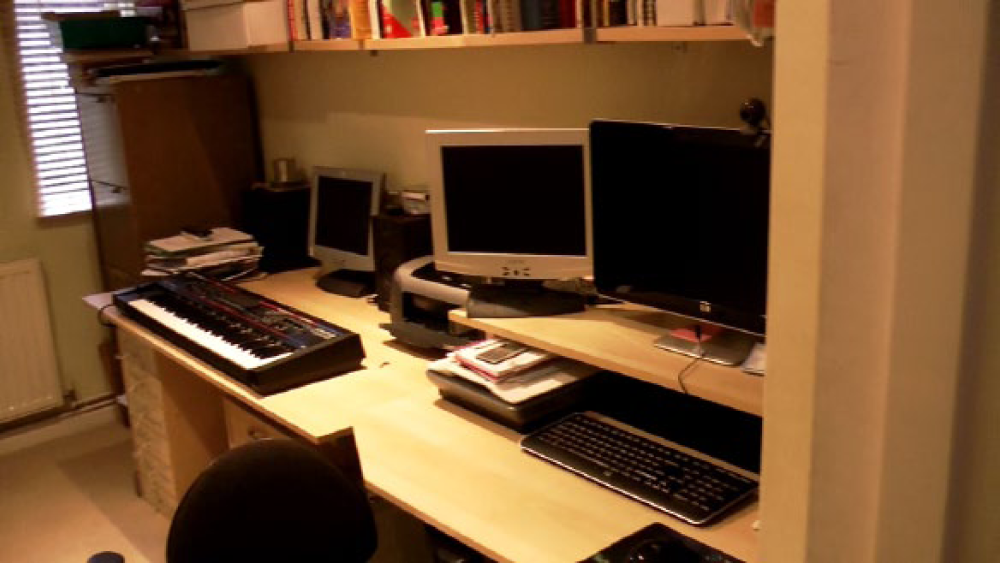
The study where Amy spent much of her time. © The LEEDR project.
These different but simultaneous uses of media contributed to the feel of an environment composed of individually produced intensities of sound that were focused in rooms but not bounded. Because the sound of the TV, or of streamed YouTube videos would spill out of the rooms where they were used, Barbara, who was likely to be in the kitchen, could follow where people were and what they were doing, which might also involve using the games connected to three of the five family TVs – the Wii in the kitchen, and a PS3, Xbox and Xbox Kinect in the two sitting rooms. Their sounds contributed to the sensory, emotional and affective elements of the atmosphere of home, which, because they followed a familiar routine, could to some extent be anticipated in ways similar to those Edensor (2014) describes for football matches, when participants are already attuned to the detail of the atmospheres they expect to encounter. Even when not actively used, the humming sounds of technologies created an auditory presence until Barbara turned them off at the end of the day. Thus there would be a particular feel to the Ashtons’ early evening home. Media were used for their content and communication but beyond this their presence constituted part of the atmosphere of home and enabled a way of knowing and caring about others. This everyday design of the home is not a prescriptive and intentional making of a knowable environment, but rather the emergent shape of everyday mundane life with media. The spatiality and temporality of home are thus felt as a sensory, emotional, affective and tacit mundane way of knowing and, for Barbara, motherly caring.
Materiality, media, sensory and emotional experience, and atmosphere again came together in Barbara’s account of the ‘cosy’ sitting room – which was constituted through carefully selected material objects, including the fireplace, carpet, fluffy rug (which also hid dirt from the fire), a large white modular sofa, the television being on, as well as the sense of being together with family. Evenings often ended in the sitting room, with the door half-closed so that the dog could move in and out while curtailing the flow of noise from the TV upstairs to the children’s bedrooms. The family sometimes redesigned the room for an evening by changing into their pyjamas, bringing down duvets and turning the sofa into a gigantic bed for everyone to lie on, watching TV with the fireplace lit, thus demonstrating the ongoingness of the atmospheres associated with this room, as the family’s mundane forms of improvisation made and remade its atmopshere replete with sensory and emotional affordances through forms of temporal and material organization.
These examples offer ways to consider how ordinary everyday uses of media enable ways of knowing, experiencing and making the home that are at once sensory and emotional, and that generate atmospheres of home. In the case of the Ashtons’ TV viewing event, an atmosphere that was homely and comfortable was made through the fireplace, furniture and props, and the central focus on the TV and Blu-ray player. Yet home is also made and experienced, in part, through mundane improvisations involving using digital media. Barbara sensed other people’s media use not necessarily for its content, but to know where they were and what they were doing, doors were opened or closed as ways to limit or enable the flows of media sound, and Barbara’s use of television as ‘background’ created an environment in which the affordances of media, rather than the specific content, worked towards making the home feel ‘right’. Yet the home never feels ‘right’ in absolute ways. Barbara also discussed her husband’s tendency to have multiple media technologies on, producing sound across the ground floor, which did not create the experience of home that she preferred. On the one hand, this shows that an atmosphere made in the ‘same’ environment will have different meanings for different people, as demonstrated above through the example of the bullfight. However, it also highlights how, rather than being perfect, everyday ‘shared’ atmospheres are likely to be felt through these concessions; Barbara was prepared to put up with her husband’s multiple sound sources because he would usually be cooking at the same time, and he sometimes turned the sound down for her.
This example has focused on how media use can be interwoven with the making of an atmosphere of home, where the sensory affordances of media and the emotional ties that are signified by it audibly flow into each other, and contribute to an atmosphere that people move through. By exploring the home itself as a kind of probe with Barbara while video recording, we invited her to show and explain how material, intangible and social elements were brought together to make her home feel a particular way. As Figures 1–3 demonstrate, this meant being in the home, that is, encountering some of the material and human elements that made the feelings of home that Barbara was remembering and evoking. We next explain the theoretical and methodological principles that guided our use of video for researching everyday mundane experience, and the relevance of this for research into atmospheres.

The Ashtons’ living room TV and sofa (screenshots). © The LEEDR project.
Video and Researching Atmospheres
There has been surprisingly little discussion about how the theoretical urge to put atmospheres at the centre of how we understand world making might be combined with research techniques to match the ambitions of approaches to reach non- or more-than-representational experiences and environments (Lorimer, 2005; Thrift, 2008). Empirical research in this field has tended to depend on conventional techniques; for example, in order to study affective atmospheres generated on public transport, Bissell (2010: 273) used ‘semistructured interviews with forty-six passengers in addition to extensive autoethnographic participatory observation on many different trains along this line and at different times during the day’, and in order to study the affective atmospheres of lighting in Danish homes, Bille (2014: xx) undertook ‘anthropological fieldwork … covering 60 recorded interviews in people’s homes, participant observation, as well as a large amount of informal interviews addressing the use of light’. While interviewing and participant observation have doubtlessly produced good research in these studies, here we suggest how more reflexive research approaches and video techniques might benefit research into atmospheres.
A reflexive stance is at the core of anthropological ethnography because the ethnographer’s own experience is at the centre of the learning through which ethnographic knowing and knowledge are produced (e.g. Clifford and Marcus, 1986; Harris, 2007; James et al., 1997; Pink, 2015). Reflexivity is likewise essential to approaches to using film and video in ethnographic practice (McDougall, 1998, 2005; Pink, 2013). Indeed, if we are to put atmosphere at the centre of our investigation, a reflexive engagement with the question of the atmosphere/environment of the research encounter/situation itself becomes all the more pertinent. Without understanding the ways in which the affective atmospheres of research itself are constituted, it would be difficult to comprehend how others experience and make the atmospheres of their everyday lives. Edensor’s (2012) reflexive autoethnographic research into atmospheres of darkness has begun this work and Shanti Sumartojo has used lifelogging to research ANZAC atmospheres (see this issue). Reflexive video methods beyond autoethnography offer further techniques for generating ways of knowing about atmospheres.
In this article, we noted a potential affinity between how atmospheres have been theorized as sensory, emotional and affective, and how the experience of film is rendered in film theory. The work of both Laura Marks and MacDougall hints at the idea that viewing film is generative of something akin to atmospheres. As Pink notes elsewhere, according to Marks (2000: 214), ‘as “a mimetic medium” cinema is capable of drawing us into sensory participation with its world to an extent that written language cannot’ and, following MacDougall (2005: 25), ‘the spectator’s involvement in film is both psychological and corporal.’ He suggests that films ‘provide us with a series of perceptual clues’ creating ‘spaces analogous to those we experience in everyday life, as we sample visual and other sensory information’ (see Pink, 2015: 172). Indeed, in tune with the critical perspectives in atmosphere studies that argue that the bringing together of sensory, emotional and affective dimensions are relatively recent (e.g. Edensor, 2014), in the theory and practice of visual anthropology, the sensory and emotional have long since been brought together in ways that comment on the constitution of shared or collective affects. The work of the anthropological filmmaker and theorist David MacDougall suggests that, because touch and vision form part of the same field of human experience, we should attend to the haptic qualities of film – that it has the ability to ‘touch’ us in ways that are empathetic, sensory and emotional. Film, he argues, has the capacity to take us to the ‘quick’, which can stand for:
… that which is tender, alive or sensitive beneath an outer protective covering; that which is most vulnerable; the exposed nerve of our emotions; that which moves or touches us; which is transient, appearing only in a flash; which renews, fertilizes or ‘quickens’ with life; which is liquescent like quicksilver: molten, bright, avoiding the touch, spilling away, changing form; that which like quicklime or quicksand; devours, dissolves and liquefies; that which has a quality of alertness or intelligence, as of a child to learn. (MacDougall, 1998: 50)
This suggests that viewing film, or video, invites us to sense what we might think of as the atmospheres of other people’s worlds, by bringing their sensory, emotional and affective qualities and affordances empathetically close. Video, following MacDougall, by taking us to the ‘quick’, might enable us to feel as if we are ‘inside’ other people’s worlds. Thus, as a medium through which to learn or communicate about atmospheres, video offers certain ways of engaging audiences, which imply that it could enable us to perceive (even if perhaps not directly) elements of the non-representational dimensions of the experience of atmosphere. However, in order to understand the potential of video as a technology for researching atmospheres, we need to first account for how atmospheres can be connected to the practice of recording video.
As noted, our first research encounter with participants set out to explore how they made their homes feel ‘right’. We left the understanding of the notion of ‘right’ quite open since we did not tell participants what we wanted to know specifically. However, underpinning this concept was the idea that, in order to feel ‘right’, the home would need to be sensorially and emotionally constituted in some way that the participants would be able to communicate to us about. Above, we argued that if atmospheres are to be understood theoretically then we need to think of them not as measurable degrees of intensity but as involving ways of feeling in and as part of environments, experienced by the people who inhabit them. This means that we were not seeking to understand how an intensity was generated, but rather how a feeling of ‘rightness’ was pursued or made within the contingencies of the life and home of that particular participant. The role of video was important in this process in two ways: first, as it enabled the researchers who were video recording, to participate in the homes and lives of the participants – that is, to place their bodies in the environments in which they lived, to imagine how it might feel to do the things they showed, described or performed, and to empathetically imagine the way home might feel; second, by sharing the video recordings, it also enabled the sharing of elements of this experience across our team of three ethnographers. As is well established in discussions of ethnographic practice (see Pink, 2015), when researching sensory, emotional or affective states. it is never possible to generate any objective form of data that will make participants’ states accessible to the researcher, nor to the other members of the research team. Neither is it possible to ever feel, sense or know the ‘same’ things as others. Yet, working with video offers us a range of different ways to engage with forms of empathetic learning that invite interpretations and embodied imaginings of what it might feel like to be in a particular situation.
Video, when used in research, is not just a medium that can ‘capture’ an evidential record of something that has happened in front of the camera. Instead, researcher-recorded video, as used in our project, can usefully be thought of as recording a trace or the route that we take through the atmosphere as we move with participants. Walking with video, moving with research participants through their homes can be said to entail ‘moving through a surface, leaving a trace of footprints, breath and scent and, more significantly, inscribing one’s route on the videotape’ and ‘it involves creating a trace through the ground and the air, which might be invisible to the eye of the next person who follows a similar route, but which is nevertheless accessible through the video record’ (Pink, 2011a). Rethinking this process through the notion of atmosphere, we can think of video recording as both making and recording traces through an atmosphere, and bringing together in that recording traces of the constituents of that atmosphere. If then ‘we can understand viewing the video as rendering previously walked lines retraceable through the use of audio- recordings and video recordings’ (Pink, 2011a), we might think of video recordings not as recordings that ‘capture’ content to be analysed but as recordings of traces through atmospheres. Returning to MacDougall’s point cited above – that video has haptic, emotional and affective qualities and affordances – video invites us to empathetically imagine, emotionally and sensorially, both the experience of the person/s shown in the video and that of the researcher holding the camera. This is where the reflexive approach we have advocated above re-emerges; when we (re)view such traces, it is not only what was in front of the camera that is important to attend to, but also the question of how we ourselves use recordings to image other people’s experiences of atmospheres.
Using video as a recording technology and the home as a probe, we have collaborated with research participants to use the very resources through which everyday mundane atmospheres are generated (i.e. the human body, senses and emotions and the materiality and intangible resources of home) to generalize about what it can feel like to be at home, the contingencies that are navigated in the making of this, and what feeling that the home is ‘right’ or working towards being ‘right’ can mean. This approach, we suggest, which puts both researcher and participant in different ways in the environment, engages researchers more closely with the question of what atmospheres can be empirically, and provides new insights into why they matter.
Conclusion
Following our proposal to make the concept of atmospheres more ‘ordinary’, we have argued that the atmospheres of everyday mundane life in the home might be usefully understood as part of the home as an environment, and as inseparable from our experience of that environment. The benefits of extending the concept of atmospheres to the mundane and routine nature of everyday life in the home is to enable us to understand how the sensory, emotional and affective are bound together in the ways people go about making their homes feel ‘right’, and what resources of home (material, human and other) are needed for this process. The applied implication of this – for instance for energy demand reduction – pivots on the question of what feeling ‘right’ might mean, how diverse constituents constitute atmospheres of ‘rightness’ and how such atmospheres can be worked towards in ways that demand less energy consumption.
Such an analysis of home, we argue, needs to be undertaken from inside. We need to think reflexively about how we might engage research methods and techniques that are sympathetic to the non-representational agendas of atmospheres research. This methodological agenda needs to go beyond interviews and autoethnography to engage with participants in the environments in which the atmospheres we are concerned with are actually generated. Video, because it can be theorized and practically mobilized towards researching and engaging its viewers empathetically in relation to sensory perception and emotional engagement, offers a medium that can therefore be thought of as being coherent with the goals and interests of researching atmospheres. Video cannot capture atmospheres, but it can be used to invoke our imaginative capacities to engage with the experiential dimensions of other people’s worlds – both as ethnographers researching ‘in the middle of it’ and as viewers invited to imagine being there. Yet, video is not the only method that is useful for such a project, and the researcher-held camera is one of a range of configurations that might be explored. To summarize, our point is not simply to advocate video recording as a way to better understand ordinary atmospheres, but rather to urge researchers of atmospheres to attend more closely and reflexively to how academic ways of knowing (about) atmospheres are constituted, and to consider how techniques and technologies beyond the interview and observation might serve this field of research and dissemination.
Footnotes
Acknowledgements
The research discussed in this article was undertaken as part of the interdisciplinary LEEDR (Lower Effort Energy Demand Reduction) project at Loughborough University. LEEDR is funded by the Engineering and Physical Sciences Research Council (EPSRC), grant number EP/I000267/1. For further information about the project, collaborating research groups and industrial partners, please visit  ; we thank all the households who have generously participated in this research. We would also like to thank Shanti Sumartojo and Tim Edensor for their invitation to contribute to this special issue, and our anonymous reviewers for their comments.
Notes
Biographical Notes
.
Address: Design Research Institute and School of Media and Communication, RMIT University, Melbourne, Victoria 3001, Australia. [email:
Address: Loughborough Design School, Loughborough University, Loughborough Loughborough LE11 3TU, UK. [
Address: as Kerstin Leder Mackley. [email: