




Abstract
This article explores how designing with illumination and darkness can contribute to atmospheres. Light and dark possess multiple qualities, extend across space, blend the representational and the non-representational, and meld sensation, affect and emotion. Though always conducive to the production of myriad atmospheric effects, new forms of lighting art and the creations devised for light festivals offer opportunities to re-enchant urban space, generating vibrant, dynamic atmospheres. Moreover, there has recently been a reappraisal of the qualities of darkness, which is also increasingly being deployed in novel ways to foster atmospheres. Firstly, the author discusses Spectra, by Ryoji Ikeda, installed in London for a week in August 2014. Secondly, he focuses on Ron Haselden’s Fête at Durham’s 2013 Lumière light festival. Thirdly, he looks at a concert staged in the dark by a blind Malian couple, Amadou and Mariam, as part of Manchester International Festival of 2011.
Introduction: Light and Atmosphere
The ways in which light transforms space are complex and multiple. We see both with and in light, and move through and inhabit many levels of daylit, illuminated, gloomy and dark space. Light conditions the ways in which we perceive – guiding what we are able to see, inflecting visible colours and informing our sense of the shape of space. Sunlight forms the everyday conditions with which we see the world before night has fallen, and the briefest consideration clarifies how the qualities of particular places, landscapes and regions are conditioned by the light that falls upon them. For instance, the thin, midwinter light of northern Finland is of an entirely different quality to the diffuse summer light of Los Angeles, and it shapes the ways in which such realms are sensorially and affectively experienced. Artificial light is facilitated by an assemblage of elements that constitute an infrastructure and, like daylight, is a property that extends across space to provide a medium or field within which objects are perceived. In this context, different kinds of lighting and the ways in which they are applied produce myriad, distinctive illuminated landscapes that solicit multiple conditions for feeling, sensing and making sense of the world after nightfall.
One way of investigating these manifold, shifting effects is to consider how light and dark are essential components in the formation and emergence of atmospheres of varying intensity. The experience of watching a football match at night under floodlights can compound the intensity of feeling as the game ebbs and flows (Edensor, 2014), with the stadium bathed in an intense glow that accentuates the green of the pitch and encloses the crowd within a space demarcated from surrounding darkness. On a different scale, office managers throughout the middle of the 20th century evenly distributed fluorescent lighting to induce a constant atmosphere of transparency and efficiency within which workers could carry out tasks under a bright illumination that rendered their work visible (Petty, 2008). Moreover, the absence of light can condition other atmospheric settings. Rob Shaw (2014: 10) discusses how the manipulation of dark in the home is multivalent, and can produce a sense of entrapment as well as intimacy: ‘the curation of a home as a space for relaxation may be predicated on the ability to have intimate relations with others in the dark.’ As these examples disclose, and as subsequent discussion will confirm, illumination produces multiple scalar effects and encloses or expands across space, from the flooding of small interiors to the lighting up of cities. Accordingly, atmospheres may similarly be constituted across expansive or confined realms, and although they may persist evenly for a time, they are always liable to be transformed. Thus, as McCormack (2014: 5) argues, ‘circumstance becomes a way of giving consistency to atmospheric things via partial enclosure or envelopment while also remaining open to the halo of forces, fluctuations, and deviations that both shape the form of this thing and remake it.’ The temporal framings of the events designed with light and dark that I discuss below are also crucial to their atmospheric potentiality, in constituting occasions freighted with an affective and sensual difference that contrasts with normative mundane experience, evincing a poignancy sharpened by their fleeting qualities.
Gernot Böhme (2010: 29) points out that the development of electric lighting has been coterminous with modern aesthetic experience, with the advent of ‘new perceptual pleasures available to people in the modern period … the technical mastery of light and sound, together with the technical shaping of … materiality’. These enchanting modern transitions have been propagated by the ways in which illumination progressively transformed the city into a phantasmagoric realm, its previously darkened nightscape studded with an array of lights: lines of streetlamps, illuminated advertising slogans and floodlit buildings and squares, with neon signs smeared across wet tarmac and flashing lights reflected in glass (McQuire, 2008). Such effects transformed perception in a way that is now difficult for the modern city-dweller to comprehend although, despite contemporary familiarity with illuminated cityscapes, views from on high of the nocturnal city still have the power to thrill. Moreover, the enduring popularity of vividly lit tourist destinations such as New York’s Times Square, Tokyo’s Shibuya Crossing and London’s Piccadilly Circus underlines how environments of congregation, leisure and consumption continue to be atmospherically charged by illumination.
Although this article explores how light and dark are deployed in the design of atmospheres, it is important to emphasize that atmospheres are not formed out of one element – light in this instance – for they continuously emerge out of an amalgam of forces, affects and happenings. In this sense, the constituents of atmospheres are distributed across space and cannot be considered as the property of any one element and, similarly, awareness of atmospheres are distributed amongst the humans and non-humans over, through and by which they circulate and are generated. It is crucial, therefore, to conceive atmospheres as relational phenomena that enrol different configurations of objects, technologies and (human and non-human) bodies in an ongoing emergence. As Kathleen Stewart (2011: 445) contends, such ‘things matter … because they have qualities, rhythms, forces, relations, and movements’.
Atmospheres then, are produced by a host of constituents: the weather, sounds, the time of day, other people, architectural forms, incidents, representations, sensations and interactions, along with light and dark. Thus the affective potentialities and capacities of atmospheres emerge as part of a distributed relationality and, rather than constituting a durable condition, atmosphere flows as a sequence of events and sensations, successively provoking immersion, engagement, distraction and attraction. And to emphasize, atmospheres are also generated by the ways in which people respond to and communicate about such effects through the affective transmission manifest through movements, gestures, voices and faces. This communicative quality is further shaped, as we will see, by the scale of the event and the space, and the numbers of people in attendance.
This latter point underscores that, as Böhme (2002) insists, atmospheres are an intermediate phenomenon and, while certain ingredients that shape atmosphere – of lighting, for instance – may pre-exist people’s entrance into the setting, their response to it is also likely to be shaped by their current mood and prior experience, and this in turn has the potential to feed back into the ongoing production of the atmosphere. As Böhme emphasizes, atmospheres ‘can come over us … [take] … possession of us like an alien power’ but as he further explains, while such an atmosphere may well attune one’s mood, ‘at the same time it is the extendedness of my mood itself’ (p. 5). This insistence ensures that atmospheres are not conceived as conditions into which people are simply plunged and to which they passively respond, in ‘mute attunement’ (Barnett, 2008; Edensor, 2012).
In addition, those entering an atmosphere are invariably informed by often contesting cultural values and habits of apprehension. Light, like other elements within the built environment and other constituents of atmosphere, is subject to evaluations and symbolic understandings. Cultural attitudes towards particular designs, colours and levels of illumination influence responses that may feed into the production of atmospheres characterized by sorrow, hostility, discomfort, excitement or conviviality. For example, in western cities, a red light in a window is associated with the sale of sex, and white illumination is symbolically linked to death in Chinese culture. Such examples underline that there is no need to detach the sensual and affective from the representational when considering the production of atmosphere, as certain non-representational accounts and those that condition their discussion by referring solely to ‘affective atmospheres’ infer.
As Margaret Wetherell (2012: 22) points out, conceptions of affect itself are not well served ‘by dividing representation from the non-representational, marking out the former as the province of consciousness and deliberation, and the latter as the province of the unconscious and the unconsidered’. Atmospheres are composed of even more heterogeneous, inseparable and dynamic ingredients and, as Anderson (2009: 80) insists, atmospheres ‘mix together narrative and signifying elements and non-narrative and asignifying elements’. Tendencies to privilege the affective over the emotional qualities of atmosphere, or the non-representational over the representational are misconceived, for atmospheres absorb these forces. And within an atmosphere, we are immersed within a flow of experience in which affects, emotions, sensations and meanings are inextricably mingled. As I have discussed elsewhere (Edensor, 2012), many of Blackpool’s popular Illuminations feature characters and motifs from popular culture that produce emotional and affective responses from visitors according to whether they regard them positively or negatively, but as forms of illumination, they also transmit qualities of sparkle, animation, colour, intensity, temperature and glow that sidestep symbolic meaning. In agreeing with Bondi and Davidson’s (2011: 595) assertion that conceptual boundaries between affect, emotion, meaning and sensation are unproductive and that, in reality, such divisions are experientially ‘amorphous and elusive’, I suggest that the qualities of atmospheres exemplify this blurring, as does light.
Despite the multiple elements that combine to endlessly recompose atmospheres, however, in this article I explore the ways in which light and darkness are particularly powerful constituents of atmospheres. Alphonso Lingis (1998) identifies how light is endlessly characterized by ever-changing levels across space and time that incessantly produce different patterns and conditions and accordingly responsive attunements to those who see and are enveloped by them. As we move through spaces in which these levels of light shift, we continuously attune ourselves to the changing circumstances in which we are situated. In the examples discussed below, light and dark work in alliance with other elements of the settings in which they are deliberately deployed, changing along with the contingencies of weather, as well as resonating variously amongst the dispositions of the people who congregate and move through illuminated and gloomy space. In multiple fields of design, Böhme (2013: 4) contends that stage production techniques set ‘the conditions in which the atmosphere appears’, creating ‘tuned’ spaces with tones, hues and shapes, and the capacity of illumination and darkness to contribute to the ongoing production of particularly intense atmospheres has long been grasped by light designers, architects and artists.
Böhme (1993: 123) exemplifies an early orchestration of atmosphere by landscape gardeners who became adept at managing the different levels of sunlight and dark that filters through woodland spaces, a form of ‘tacit knowledge’ that focused on producing differently tuned spaces. Later on, as designers became skilled at designing with artificial light, the possibilities for tuning space expanded. Khodadad (nd) contends that light itself is a form of architecture that may be utilized to provide three-dimensional forms (also see Zumthor, 2006), and perhaps the most notorious deployment of illumination to produce atmosphere aligns with this architectural praxis, namely the extraordinary cathedrals of light designed by Albert Speer for the Nazi rallies at Nuremberg. A form of Lichtarchitektur that evoked immense classical columns was fashioned by 130 giant searchlights that shone upwards into the sky, designed to house tens of thousands of precisely situated followers to arrange a spectacular mass choreography of light and sound. The impressive participatory spectacle, he contends, produced ‘mysticism, awe and reverence’ amongst the participant-spectators (Khodadad, nd: 5).
Yet this example is only one of the myriad ways in which designers have developed approaches to condition the mood and feel of space since the emergence of gas and, subsequently, electric lighting. While the widespread practical use of illumination to regulate efficient movement, consumption and policing has always been a central focus of urban light management, Wolfgang Schivelbusch (1988) contends that the late years of the 19th century to the early years of the 20th century saw a broad shift from a lighting of order to a lighting of festivity. Such festive lighting was exemplified at theme parks such as Coney Island where, as Gary Cross (2006: 635) describes, ‘Luna Park and Dreamland created a dazzling architectural fantasy of towers domes and minarets, outlined by electric lights, giving these strange oriental shapes an even more mysterious and magical air at night.’
Thus, besides the pragmatic deployment of illumination, as Laganier and Van der Pol (2011) contend, light designers have long been aware of the imperative to stage atmospheres, tuning environments with illumination. As Cochrane (2004: 12–13) discusses, ‘lighting can reveal texture, accent, spatial transition, visual cues, security and perception of security, moods, cerebral temperature and drama in the city’, radiating diverse qualities of sparkle, glow, glare, highlighting and diffusion. At dance events, light is used to stimulate various kinds of atmospheres to provoke and enhance movement, ranging from the deployment of bright, animated illumination to align with the rhythms of rapid beats, or the use of the mirror ball to add allure to ballroom dancing or to accompany the romantic strains of the last dance, to the glowing, calming lights of the chill-out room at raves as colours slowly blend into each other.
Such effects produce atmospheres devised to draw people in, spark emotional engagement and sensory immersion, yet cultural responses to the styles and attributes of illumination vary. For instance, those possessing certain cultural dispositions and tastes may experience strong glare, colour, animation or flashing effects at nocturnal urban hot spots as discomforting (Lam, 1977), some champion a more subtly illuminated environment in which shadows reign (see Tanizaki, 2001), whereas others are drawn towards festive lights and luxuriate in brightly illuminated space (Edensor and Millington, 2009).
To further investigate some of the issues raised above, I now investigate the particular qualities of two very differently illuminated atmospheres and an atmosphere that emerges through the exclusion of light.
Spectra: An Atmosphere of Meditation, Conviviality and Play
From the 4th to the 11th of August 2014, residents of London and visitors could witness an ambitious light installation that contributed to commemorations to mark the centenary of the start of hostilities in the First World War. Sited in Victoria Tower Gardens next to the Palace of Westminster, Spectra, designed by Ryoji Ikeda, was formed by a 20-metre grid containing 49 searchlights that blazed vertically from dusk to dawn. The work could be seen from far away, and from a distance seemed to constitute a single column of vivid white light, ascending some 15 miles into the firmament. Seen thus from multiple locations, it changed the nightscape in constituting an unmissable, unfamiliar point of light, supplementing the pared-down urban vista that emerges after dark: artificial light has the capacity to direct vision in a more focused way, with illuminated objects constituting a far more limited range of visible entities than are perceptible in the day-lit landscape, suffused with light and composed of a multiplicity of sights across which the gaze ranges. From a distance, Spectra defamiliarized the familiar London skyline and charged it with a sense that something was happening, something momentous.
Variations of Ikeda’s installation have appeared in several other cities and in each location, new associations and relationships are forged. Most obviously, because the symbolic commemoration of war was widely broadcast across the UK through the mass media and in schools, the powerful beam conjured up the searchlights that criss-crossed London in both World Wars, with many reviews of Spectra referring to the famous remark of Sir Edward Grey, the foreign secretary of that era: ‘The lights are going out all over Europe. We shall not see them lit again in our life-time.’ And yet the powerful beam also suggested other symbolic resemblances: to lighthouses and observation towers, the double beams installed in New York to commemorate the loss of the World Trade Center’s Twin Towers, the previously mentioned Cathedrals of Light at Nuremberg, or the searchlights that revolve around cloudy skies to attract those seeking theatrical or musical entertainment. I visited Spectra on the night of the 8th August at 11.30 pm and, as the source of the beam was neared, it interacted with, and made strange, the gothic towers of the Houses of Parliament, and the surrounding trees (see Figure 1).
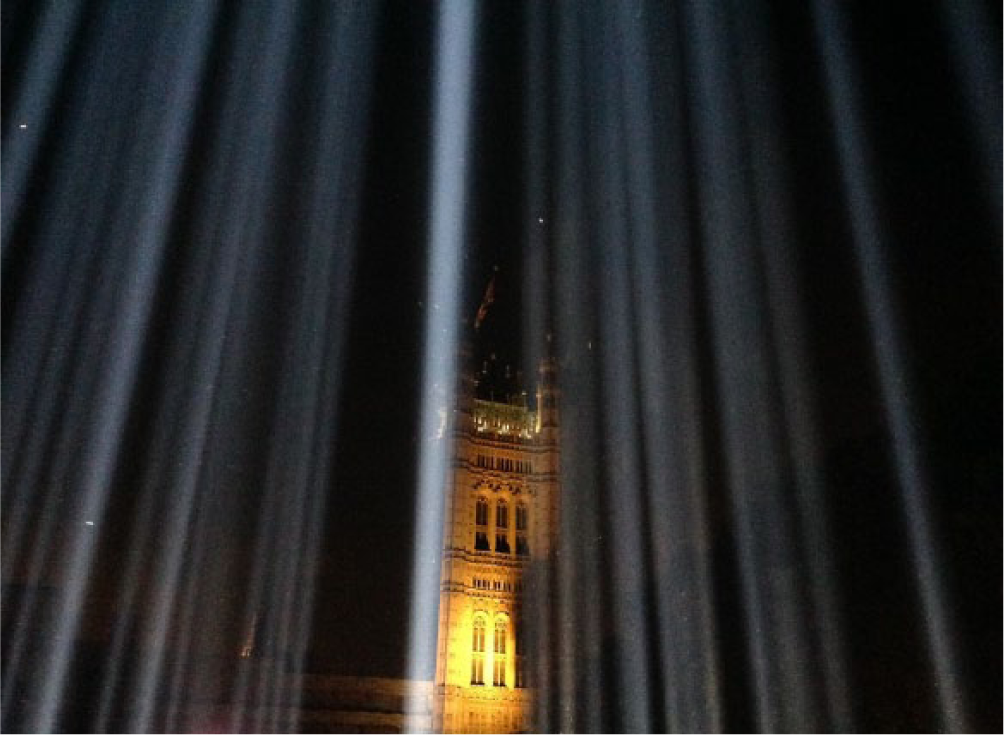
Spectra, designed by Ryoji Ikeda. © Photograph: Tim Edensor.
However, when the park was entered and all searchlights were separately visible, the work took on an entirely different aspect. For, once the installation was confronted more closely, the symbolic resonances of the piece evaporated and the more affective and sensual force of the work pressed upon experience. The sheer spectacle of light, unfamiliar at this scale and intensity, dominated the setting. As the designer of the piece, Ikeda, remarked, when experienced at close quarters,
any kind of context is suddenly gone. From a distance, it looks monumental and solid, but when you are in it, it is entirely meditative. People stare up in wonder. It causes necks to strain. The experience is so pure and direct, they can take it with them into their own life. (see O’Hagan, 2014)
Collectively, the beams reaching vertically upward in the night sky, created a horizontal sequence that framed the Palace, the trees and the moon, and constituted an almost solid, three-dimensional environment, a giant enclosing cube comprising shafts of light within which visitors could walk. The unreality of this utterly transformed space was augmented by the pulses of the minimal electronic music composed by Ikeda that drifted across the park, and the shifting moods to which this contributed were further influenced by the changing clouds and the intermittent appearance of the moon.
Remarkably, the work attracted hundreds of people, drawn by a sense that something was happening (see Figure 2). At the site of the origin of the beams and across the surrounding lawns, the sober qualities induced by the commemorative associations with the First World War were replaced by a carnivalesque, excitable frenzy of movement and chatter. People moved amongst the luminaires, waving arms or craning necks, and radiantly illuminated faces leered above the searchlights posing for photographs. Others adopted a less playful, contemplative disposition, lying on the grass, some drinking wine, staring upwards into the disappearing points of light as they converged into a single beam miles above. The illuminations fostered an excitable scene of interactivity, sparking collective playfulness, effusive discussion and lingering fascination as people shifted and stretched out through the park, becoming attuned to the unusual circumstances. Affective intensities gathered and dispersed amongst the crowds, as groups departed the scene and new clusters arrived, becoming absorbed into the rhythm of the event, producing surges of excitable behaviour, interrupted by the chimes of Big Ben and sudden appearances of the moon through the clouds.
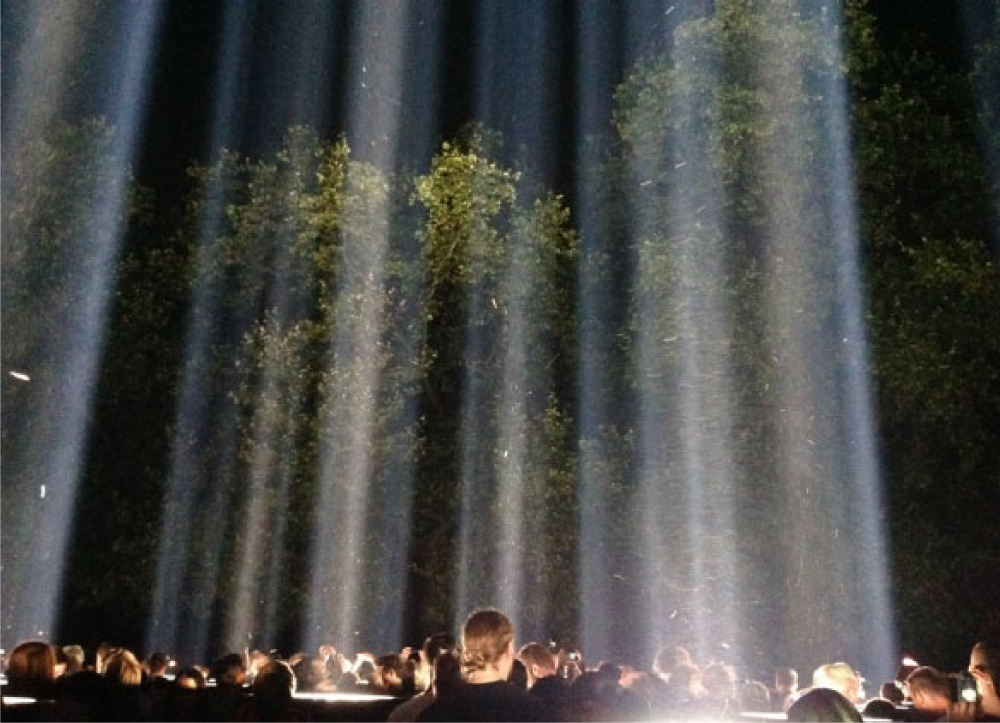
People gathering around Spectra, designed by Ryoji Ikeda. © Photograph: Tim Edensor.
In its captivating enormity, Ikeda’s installation might conjure up the spectre of the ‘society of the spectacle’ in which we passively behold seductive, extravagant displays organized by capital and the state that bedazzle us and constrain our ability to perceive the ‘real’ conditions that underlie our enslavement as workers and consumers (Debord, 1967). Here, the official meaning of the installation as a commemoration of the First World War, and its proximity to the seat of political power underlined the state-led production of the event. However, such accounts ignore the ludic dimensions of events such as these that punctuate the rhythms of everyday life, and are not necessarily experienced passively but serve as occasions for delight and fun. These pleasurable, immersed engagements are a response to the utterly changed conditions of the familiar, triggering the suspension of reserved behaviour and a turn towards a ‘prioritising of the non-cognitive and more-than-rational’ (Woodyer, 2012: 319), and a heightened sense of affective belonging. Such practices belong to those dimensions of the city that foreground the improvisational, the sensuous and the peculiar, practices that are apt to subvert the official functions and meanings of space.
The forms of carnivalesque behaviour and genial expressiveness found at Spectra chime with the responses of the throngs of people that visit an ever-expanding range of light festivals, events that restage cities as defamiliarized, even enchanted spaces. At many such festivals, with their myriad illuminated artworks, installations and projections, one key focus of designers and artists is to produce attractions that promote interactivity, encouraging willing participants to move, shout, and perform in many ways that contravene the usual norms of conduct in public space and encourage others to participate or enjoy the scene. In this way, light can be designed to transform often functional public space into realms in which playful expressiveness is not frowned upon and bodies are released from more restrained forms of comportment, so that they are able to effectively co-produce light-hearted, invigorating atmospheres. Many attractions installed at light festivals and artworks such as Spectra draw diverse crowds of people together in a shared atmospheric event that fosters conviviality, described by Koch and Latham (2012: 521) as a force ‘toward nurturing the capacity of individuals to thrive in combination with others’ in an attitude of openness to difference. Absorption within such festive, transformed atmospheres can provide ‘a socially integrative, interactive and emotionally engaging experience’ (Stevens, 2007: 3).
The light disseminated by Spectra did not just attract people. Each beam was saturated with millions of insects and moths that, with the infinite, swirling dusk particles that moved in and out of the light, revealed that the capital’s air was not some transparent substance but replete with matter and life (see Figure 3). As Ikeda asserts: ‘nature is visible all the time in the work. That is Spectra’s real power’ (O’Hagan, 2014). That other physical atmosphere, the layer of gases surrounding Earth and bound by the planet’s gravity, usually invisible and often mistakenly assumed to be somewhat empty, is here seen as replete with seething forces and shifting elements within the beam of light, and evidently, outside it as well (also see McCormack, 2014). The ways in which onlookers became mesmerized by these atmospheric elements underscores how such turbulent, partially organic, gaseous and meteorological fields intersected with the shifting tumult of affects, emotions, sensations, dramatic gestures and communicative interactions that were swirling below.
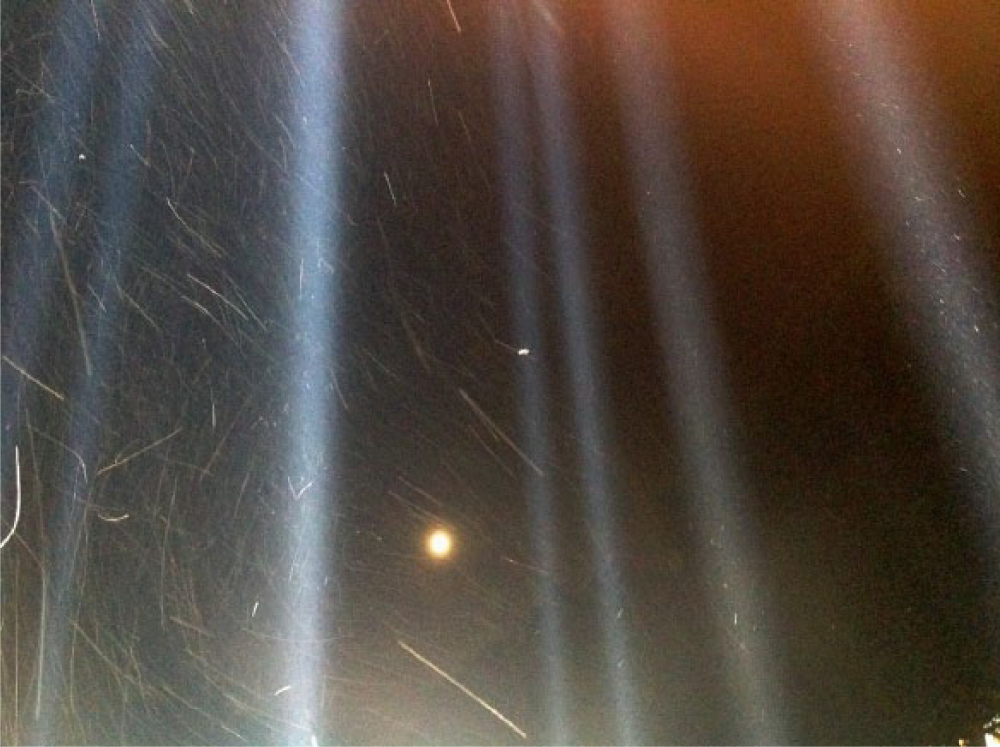
Light and dust swirl around the light beams of Spectra, designed by Ryoji Ikeda. © Photograph: Tim Edensor.
Fête: An Atmosphere of Nostalgia and Topophilia
At a global level, a profuse number of light festivals are being established, varying in scale, intention, venue and design, and ranging from showpieces for the most advanced lighting designs and spectacular techniques to stages for vernacular creativities and local identities. As occasions at which the usual uses of nocturnal space are transformed through the deployment of myriad installations, projections and designs, light festivals provide opportunities for reconfiguring the normative apprehension of familiar night-time scenes. Visitor engagements range from silent absorption while captivated by large, spectacular displays to interactive, playful and expressive engagement with installations, and public participation in the performance of light parades. Such festive events produce diverse affective and sensual forces that shift as visitors move between attractions and differently tuned environments, contributing to the ongoing formation of atmospheres by their movements, noise and somatic communication.
These festivals break up the routine enactions and normative rhythms of everyday urban life, disrupting the usually unreflexive apprehension of familiar spaces. Habitual, quotidian performances by inhabitants, businesses, government, workers, students and visitors characteristically undergird the common sense meanings feelings and functions of familiar places. Festivals of all kinds mark out a temporary departure from these usually unreflexive mundane practices and apprehensions, signifying a special time to which participants may look forward (Edensor, 2012), and designers may focus on underlining the affective qualities of the temporary lights they install in space, augmenting the already existent ephemeral and potentially enchanting qualities of quotidian urban light. Festivals occur for a temporary period during which ordinary conventions may be suspended and participants are allowed greater licence for expressive, creative and improvisational behaviour. In challenging, augmenting or revealing the overlooked capacities of space and place, light festivals offer particular opportunities for practising, representing and apprehending place in ways other than through usual habitual experience, as inventive (re)design with illumination converts local settings into another kind of space and time.
Durham’s biannual Lumière light festival, held in November over four nights, transforms the city. For the 2013 event, around 175,000 visitors were attracted by the 27 separate installations across the city. The atmospheric effects of these works depended upon the symbolic meanings, forms, scale and qualities of intensity, glow, animation and colour deployed by designers and artists, as well as the ways in which they stimulated visitor practices. They were also crucially conditioned by the spaces in which they were installed, the ways in which illuminated displays related to the symbolic meanings of sites, surrounding buildings and materialities, prevailing weather and levels of darkness. While most of the extremely varied installations were staged in central shopping areas, heritage districts and university spaces in the city, and attracted large crowds, a few were located in quieter, more marginal spaces. Here, I focus on one such work to investigate how it produced a distinctive kind of atmosphere.
Ron Haselden’s Fête was inspired by his visit to the rural Fête de Blé in Pleudehen in Brittany, France, an event that included, according to Haselden, ‘Breton dancing, parades of past farming costumes, tools, teams of horses slowly turning a vast capstan to grind the wheat … All enhanced by drinking Breton cider’ (personal communication, 2 September 2014, and all quotes thereafter). The installation was located on a rather lonely stretch of parkland adjacent to the River Wear that runs through the city. Somewhat detached from the flows of people that surged between illuminated attractions, Haselden explains that the rationale behind its location was to obtain
space and quiet away from the crush of the town centre events. It needs its own space to perform in otherwise it would become too associated with a regular fairground scenario. These festival light events are extremely popular with the public and it is difficult to think clearly when caught up in them.
A wooden fence bordering the roadside separated Fête from pedestrians but they were lured into the field by dozens of strings hung from poles and formed by carnival light bulbs that rhythmically switched on and off in regular sequence. The surrounding darkness meant that the arrangement of the strings assumed the form of a canopy, composing a welcoming form of immaterial architecture to enclose the bodies that walked beneath (see Figure 4). The alternating sequences of light were accompanied by snatches of fairground music, synchronized to match the rhythm of the animated light. As Haselden puts it: ‘the two music tracks spread out and intermingle across the space from the 48 speakers sequenced in time with the lights.’ The installation evocatively conjured up the atmosphere of an abandoned or recently finished fête or fair, a sense that what had been a vigorous and joyous communal event had now finished: the party was over. This was inflected with a sense of absence for these carnivalesque events that temporarily catalyse nocturnal spaces into realms of sound, light, excitement and activity.

Ron Haselden’s Fête, November 2013. © Photograph: Tim Edensor.
Here, the location of the site, away from the noisy throng and brighter lights of other festive attractions, compounded the sense of movement into a sphere of quiet stillness, inducing reflection and instilling silence amongst visitors to foster a meditative and rather melancholy atmosphere. Haselden notes that Fête ‘is a mood work … The canopies of chase sequence lights create the mood/arena for waltzing, dancing or wandering around, on your own, under the night sky.’ Accordingly, Fête underlines that powerful atmospheres in which light is a key component are not necessarily those in which vibrant colours, vigorous animation and other spectacular effects produce a great hubbub or demand rapt attentiveness. Yet, as with other light attractions, the atmosphere is co-produced by the visitors, on the night that I visited (14 November 2013), through their subdued conduct and quiet strolling.
The restrained sound and lightscape, and the melancholic sense that the show was over is also accompanied by a sense of the contrast with what was there before. Fairs and fêtes typically swirl with bright and flashing lights, and gaudiness – for instance, in the painted images of celebrity and glamour. They are filled with the sounds of the clanking and whirring of the rides and the shouts of stall-holders, hysterical laughter, squeals of fright and animated conversations. The particularly thick, giddy atmosphere of the fair or carnival conjures up an impression of excess, of a world teetering beyond order, although rigorous control makes sure things do not get too out of hand. Such atmospheres, partially composed of a collective affective and emotional outpouring, transform ordinary spaces of parks and commons into realms of excitement, luring many but also striking alarm amongst others, overwhelmed with the lights, the speed and the sounds. Accordingly, the nostalgia we feel at Fête is generated by a common, shared remembrance of the fairs and fêtes we have attended and the brief sense of communitas they may have fostered. This is especially pertinent at the Durham site chosen for the installation, for it is a venue at which travelling fairs continue to be staged, and it is thereby subject to the atmospheric transformations wrought by such temporary events. Thus despite the ways in which the work acts to make familiar space strange, it also potentially summons up the memory of other events for all visitors, and may specifically invoke an enhanced topophilia towards the city and this particular location for local residents (Tuan, 1974).
The use of illumination at light festivals and fairs alike has the potential to re-enchant everyday life and ordinary spaces through what Jane Bennett (2001: 5) calls encounters that render one ‘transfixed, spellbound’, not merely through being charmed and delighted but through experiencing the more uncanny sensation of ‘being disrupted or torn out of one’s default sensory-psychic-intellectual disposition’. Unlike Ikeda’s Spectra discussed above, in which light fostered a thick festive atmosphere that conjured playfulness, wonder and social interaction, as well as a profound sense of occasion, in Fête light contributes to an atmosphere that sends one to other times and places, stimulates nostalgia and ineffable, barely grasped feelings. For its creator, ‘Fête is a country piece that jerks me back into a time zone before my own time. Zola or Hardy perhaps.’
Yet like Spectra, Fête has been staged in many other venues. For Ron Haselden, the work relies very much on where it is sited and he remarks on how ‘it changes with each location’, for its interpretation and impact have varied according to the cultural and historical contexts in which it has been set, contexts that influence the formation of atmosphere. He exemplifies this site-specific quality by identifying two places at which the resonances of the work produced very different responses. When the piece was staged in Derry, he reports that locals commented that ‘the location I used was a space of past violence and this site in Moss Side was a form of helping to eradicate these memories’. A completely different atmosphere was produced by the responses of visitors to the installation when it was situated in a French lay-by. Here, according to Haselden, ‘people would pull up in their cars and waltz in it’, transforming the site into a performative and convivial setting. At this same venue, the lights were subsequently animated by their role in a larger spectacle; when they were used as ‘a backdrop to the firework display for a national anniversary’.
More broadly, and like Spectra, Fête also exemplifies how artists may work with light as a medium to transform the feeling and meaning of space, transcending the creation of solid sculptures or paintings. Together with the other multiple elements of place and the communicative expressions, embodied practices and dispositions of visitors towards such art works, this illumination may powerfully contribute to a shifting yet powerful atmosphere
Eclipse: An Atmosphere of Defamiliarized Quiescence and Release
After exploring the key role of light as an agent in producing atmospheres, I now consider how designing an event without light has the potential to foster different atmospheric effects. Besides the multiple capacities of illumination – and daylight – to contribute to the production of atmospheres, darkness is also riven with manifold atmospheric affordances. Enlightenment and modernist imperatives compounded Christian associations with darkness as primitive, sinister, inimical to progress and the acquisition of knowledge, and dangerous (Ekirch, 2005; Koslofsky, 2011). These cultural values have inculcated a persistent fear of the dark in which widespread presumptions associate the experience of darkness as suffused with danger and uncertainty. Despite these enduring connotations, in recent times, the effects of over-illumination and poor lighting, and sheer unfamiliarity with gloominess, have contributed to a reappraisal of the qualities offered by darkness. Accordingly, a recent movement to establish spaces of darkness across the western world has succeeded in designating more than 40 dark sky parks to date, with more planned. At these sites, the star-filled night sky attracts astronomers and the qualities of the gloomy nocturnal landscape are opened up to sensory and affective experience (Dunnett, 2014; Edensor, 2013). Smaller dark spaces have also been developed that offer non-visual experience of dark space. Darkness has been deployed to enhance the symbolic, affective and sensory experience of art (Edensor, 2015), drama (Welton, 2013), meditation and more ecocentric living (Vannini and Taggart, 2014). Dining in the dark experiences offered by selective restaurants promote uncertainty, fear and discomfort amongst some diners but elation, convivial rapport, enhanced non-visual sensations and intimacy amongst others (Edensor and Falconer, 2014).
Despite the persistent demonization of darkness throughout western history, there have always been alternative appropriations whereby darkness has been cherished for its demi-monde affordances, its intimacy, and its sacrality (Koslofsky, 2011), and more recent endeavours reveal that, rather than promoting only negativity, confrontations with darkness provoke multiple values and experiences. To explore the potential for darkness to be deployed in ways that contribute to the production of a somewhat ambivalent atmosphere, I look at an experimental concert, entitled Eclipse, staged as part of the Manchester International Festival in July 2011, by blind Malian couple, Amadou and Mariam. In order to foster an empathetic sense of how music might be perceived in the absence of sight, the concerts were designed to be performed in complete darkness.
A key element of nearly every concert at which popular music is performed is the light show, devised in increasingly sophisticated ways to synchronize with the rhythms of the music, accentuate particular beats and melodic tones and generally enhance the depth of the experience of the event for the audience as illumination envelops them and delineates the performance on the stage. The spreading glow of illuminated dry ice, the blast of white light that heralds a climactic moment, the pulse of strobe lighting that defamiliarizes the setting, highlighting performers with distinct colours at key musical moments, lasers that strafe the audience and pick out individuals and groups, and the projected images that augment the meanings and feelings of the music all contribute to the immersive drama. In Eclipse, all these effects were absent, as was any sight of the musicians until the culmination of the concert, after the band had played a set that lasted nearly 90 minutes.
The experience of the music was undoubtedly intensified in the absence of the distraction of sight. The crowd were able to focus intensely on the nuances of the varied sounds and, as at most popular music concerts, the high level at which it was transmitted ensured that the dense melodies and rhythms swamped the venue, creating a lush yet clear sonic environment that blocked out most other noise. As in other dark spaces, the lack of vision meant that other sensations predominated, and in this instance the sound of the music overwhelmed sensory experience, rather than the overwhelming focus on taste that predominates when eating in a dark restaurant (Edensor and Falconer, 2014) or the powerful tactilities experienced when walking through a dark landscape (Edensor, 2013).
This shared absorption in sound was supplemented by the narrative passages broadcast via the sonorous tones of Malian poet Hamadoun Tandina that were read in the interludes between songs and focused on the couple’s path towards romance, marriage, parenthood and fame. The story was accompanied by recorded sounds of crowing cocks, chirruping crickets, chattering children, running water and the engines of cars and mopeds that conjured up a sense of various animated landscapes from Mali and Senegal. These auditory affects were augmented by other, multi-sensory techniques in moments where air blew across the audience and scents of sandalwood, mosquito repellent, cloves and jasmine wafted through the pitch-black concert hall.
Although these sensory effects and the power of the music were captivating, the absence of the usual audience rituals and the sense of shared occasion that usually shapes the atmospheric qualities of live music performance was somewhat disconcerting. For the regular concert-goer, this was a quite unfamiliar experience. The atmosphere generated by the communicative affects produced by the performances on stage, and the emotions expressed and transmitted by the physical moves and facial expressions of the crowd could not be produced under these circumstances. In sharp contrast to the evidently animated crowd response that typifies most rock concerts, as people, dance, shout out and sing along to lyrics, the audience on this occasion were peculiarly quiet, polite ripples of applause greeting the end of songs. The darkness seemed to solicit this quietness, perhaps drawing the crowd into the depths of a sound world and providing none of the familiar cues for participation.
This inevitable quiescence was compounded by its contrast with the start of the event. Then, the excitement produced by the strangeness of the performance intensified as people were guided by ushers to their seats in the dark, and an air of anticipation grew and was articulated through a vibrant hubbub that saturated the hall. Yet this sense of anticipation and excitement was dissipated as the sounds of music and commentary enveloped the arena. However, as the concert drew to a close, the lights gradually rose to reveal a resplendent Amadou and Mariam and their band on stage. Suddenly, after being deprived of sight, immersed in their own responses to the music, the audience was catalysed into an intensified action at the abrupt transformation in sensory experience and affective communication (Thrift, 2009). The delight evident on faces and in the whoops of audience members was mirrored in the compulsion to dance, as people were re-attuned to the concert by the visual cues offered by the animated musicians and fellow spectators. The atmosphere was suddenly ‘cooking’.
In Eclipse, visual deprivation had served to affectively distance the audience from the event and from relating to the musicians, revealing the profoundly social and communicative dimensions of collective musical apprehension that generate the atmosphere of the concert. The pulsing rhythm urged us to dance, yet fear of bumping into other people and obstacles cultivated a caution that restricted a more involved somatic engagement with the music. Yet designing with darkness proved particularly effective at the gig’s conclusion, for there was plenteous recompense during the final ‘reveal’, in which broader sensual and social connection was re-engaged, offering a satisfying emotional climax that drew its power precisely from the earlier deprivation. Accordingly, the show revealed the ambiguity of darkness in its capacity to both heighten and restrict the sensing of space, and its propensity to foster particular atmospheres in certain contexts while suffocating the emergence of other atmospheric effects. Moreover, in contrast to Spectra and Fête, which impassively pulsed throughout the night, their atmospheres marked by the shifting responses of people and the changing circumstances that surrounded them, Eclipse took place at a different temporal scale, in stages that successively produced excited anticipation, quiescent absorption and engaged participation in the climax of the concert. In taking place in an indoor concert hall, the atmosphere was also confined, more focused than the other events.
Conclusion
Light designers and artists are increasingly expanding the meanings, sensations and affective experiences of place through their skilful, inventive use of illumination, shadow and darkness. In this article, I have provided three examples of the ways in which the deployment of light and darkness can act as a powerful agent in the production of atmosphere. The advent of modernity heralded the emergence of an ever-expanding range of techniques that use artificial light to augment and condition the feel and mood of space in myriad ways. I contend that the increasing proliferation of light festivals and the growing popularity of light as a medium for artistic creation are dramatically expanding the ways in which illumination can transform the affective and sensual qualities of experiencing place and space.
Light expands from a source and can rarely be delimited, as it fades into blackness or blends with other forms of illumination cast across space. This capacity demonstrates how it is an essential ingredient in the relational forces that compose the dynamic amalgam of atmosphere as it shifts and fluxes in intensity and in accordance with surroundings. I have identified two key installations through which artists skilfully and knowingly attempt to transform space and time with illumination. I have also insisted, however, that light is invariably assessed in accordance with cultural and historical contexts, and experiencing lighting of a particular same intensity and colour may produce widely varying responses. This foregrounds how cultural values inform sensation and affect and that light designers need to take account of this. Despite this, I have also insisted that light is always more than representational and is apt to escape symbolic readings through its effects upon bodies and the mood of place.
In discussing atmospheres, it is crucial to recognize that atmospheres are not wholly shaped by light for it is one amongst many ingredients in their ongoing formation, albeit a particularly powerful element. And bearing in mind the cultural contexts within which light is apprehended, the examples I have discussed highlight how atmospheres are co-produced by the responses of those who experience them, whether forms of illumination induce subdued, convivial, excitable, playful or mesmerized reactions.
The advent of modernity has also led to the marginalization of darkness and yet, in recent years, this condition has also been reappraised and is increasingly understood as a key element through which the atmospheric experience of space can be infused with qualities such as intimacy, non-visual sensation and mystery. The particular example I consider here reveals that the use of darkness to provide a unique concert experience produced ambivalent responses. For most of the concert, while non-visual sensation was heightened in the dark, the sense of atmospheric bonding between performers and onlookers, and within the audience, was largely absent. Nevertheless, the eventual emergence of a lighted stage acted to release the restrictions of not being able to see and catalysed a heady atmosphere of relief, excitement and energy.
The knowing arrangement of light and dark in the particular events discussed in this article perhaps heralds the emergence of an era in which light design will increasingly deploy sophisticated techniques to enhance the affective and sensory experience of space and place. This will vary in spatial and temporal scales that range from the modulation of the mood of domestic interiors to the deployment of more imaginative forms of everyday lighting (Ebbensgaard, 2014), and from site-specific subtle and inventive art installations to the extensive staging of spectacular urban festivals of illumination.
Footnotes
Funding
This research received no specific grant from any funding agency in the public, commercial, or not-for-profit sectors.
Biographical Note
Address: Geography and Environmental Management, Manchester Metropolitan University, John Dalton Building, Chester Street, Manchester M1 5GD, UK. [email: