



Abstract
This article examines the visual and verbal expressions of gender in Australian award-winning early childhood picture books. It brings together social semiotic analysis and the narratological concepts of narration and focalization to examine the extent to which one community of practice (authors, illustrators, publishers and awards council) reproduces symbolic manifestations of gender, or offers readers space to engage with alternatives. The authors’ findings suggest that, while the literary works produced by this community of practice mostly serve to reinforce hegemonic cultural attitudes of what constitutes desirable femininity and masculinity in Australia, there is ample opportunity for change.
Introduction
It is widely acknowledged that, through the process of learning to read, children are also learning about culture (McCabe et al., 2011; Styles and Arizpe, 2001; Taylor, 2003: 301; Weitzman et al., 1972: 1126). During the early years, that reading experience is usually comprised of picture books, where images are a key component of storytelling and meaning making (Doonan, 1993; Nodelman, 1988; Painter et al., 2013; Stephens, 1992: 158). Thus, the primary site of textual engagement for a (pre-verbally literate) child is with the visual. Who and what children see in picture books impacts significantly the impressions they have of the world and its shared values (Boutte et al., 2008: 943; Styles and Arizpe, 2001). Thus, picture books offer ‘a microcosm of ideologies, values, and beliefs from the dominant culture, including gender ideologies and scripts’ (Gooden and Gooden, 2001: 89; Taylor, 2003: 301). This article aims to shed light on symbolic manifestations of gender in Australian award-winning children’s picture books and to problematize the desirable subjectivity that these representations constitute.
Our focus on award-winning picture books, specifically the Children’s Book Council of Australia (CBCA) Book of the Year ‘Early Childhood’ shortlist,
1
was initially a pragmatic decision. This allowed us to start with an externally validated category for book selection and a manageable dataset for comprehensive visual and verbal analysis. A second reason for focusing on prize winners concerns their considerable reach and influence. Book awards are highly influential in establishing the canon of quality books for educators, libraries and caregivers (Hateley, 2017; Kidd and Thomas, 2017; Unsworth and Wheeler, 2002). Significantly, Hateley (2017: 47) argues that ‘book awards derive their social force precisely because their ideological content and effect is unconscious’ and that both the books and their selection are manifestations of wider social and cultural norms which may not be immediately apparent to particular authors or award judges, but which reflect and shape dominant understandings of what constitutes desirable subjectivity at a given moment in time.
Since previous international research has shown that award-winning children’s picture book characters are constructed as ‘male’ or ‘female’ through stereotypical representations of femininity and masculinity, especially in their visual representations (see review in section ‘Representations of gender in children’s picture books’), in our study, we ask two research questions:
The focus on gender stems from the results of a previous study (Caple and Tian, 2021), where visual content analysis was employed to examine the visual and verbal representations of diversity in this dataset. We found that girl and boy characters were equally represented as main characters, a finding that stands in stark contrast to most previous research, where boy characters have been found to far outnumber girl characters both in mere presentation and in the types of activities in which they participate (Gooden and Gooden, 2001; Hamilton et al., 2006; Williams et al., 1987). While previous research has focused on gender roles, we draw particular attention to gender expression, specifically the visual and verbal realization of gender representations.
In this article, we conceptualize gender as something people enact or do. Gender is a code of styles and social practices that is co-constructed through social interactions and discursive practices (Baxter, 2006: xvi; Davies, 1989: xi). As Crisp and Hiller (2011: 197) succinctly note: ‘one is not born gendered, one becomes gendered’ (emphasis added). Cameron (2005: 488) notes the post-modern view that identities are ‘not fixed and stable attributes of individuals, but are constructed in particular contexts through particular practices’. Such a view leads researchers to look locally, which entails ‘relating performances of gender to the particularities of the context’. This idea of ‘looking locally’ is closely associated with the concept of ‘community of practice’, and this is the approach that we take in this study.
We take the view that the authors, illustrators and publishers of early childhood picture books form a community of practice (CoP). Eckert and McConnell-Ginet (1999: 186) define a community of practice as: ‘an aggregate of people who, united by a common enterprise, develop and share ways of doing things, ways of talking, beliefs, and values – in short, practices’. As social semioticians, we analyse the semiotic resources that this specific community uses in producing a picture book. By semiotic resources we mean ‘the meaning potential of material resources, which developed and accumulated over time through their use in a particular community and in response to certain social requirements of that community’ (Jewitt, 2018: 84). We therefore perceive a fruitful collaboration in turning a social semiotic lens onto this community of practice through which we might come to understand how particular beliefs, values, or the social requirements of that community may shape or constrain these shared ways of doing things. 2
Our review of previous studies on prize-winning picture books has shown that gender representations conform to idealized representations of what is considered normal and desirable femininity or masculinity (cf. Hateley, 2017). These are what Cameron (2006: 9) calls ‘symbolic’ or ‘ideological’ representations of gender that are shaped by hegemonic cultural attitudes, representations and practices. In our study of Australian prize-winning picture books, we use qualitative social semiotic analytical tools not only to examine the extent to which visual and verbal expressions of gender similarly coalesce around a shared set of conventions, but also to problematize the social practices of this community of practice that serve to constrain or control gender expressions.
In the next section, we discuss research that has focused most specifically on gender constructions in prize-winning children’s literature. Most of this research is US-centric and engages only in discussion of stereotypical and binarized representations of girls/women and boys/men, often without clarifying or problematizing how they arrive at such categorization. More nuanced discussion of gender fluidity that might challenge such monoglossic productions of gender (see Francis and Paechter, 2015) are absent (cf. Crisp and Hiller, 2011).
Representations of Gender in Children’s Picture Books
Children’s literature has long been noted for reinforcing traditional and binarized gender roles. Hillman’s (1974: 86) examination of children’s literature from the 1930s and the decade of 1963 to 1973 revealed only marginal improvements in the representations of male and female characters across these two periods. 3 Not only did male characters far outnumber female characters in both periods, but the range of occupations for males was also much broader than for females. Hillman (1974: 87) notes, however, that even though women have long held prestigious positions in the workforce, such roles are rarely portrayed in children’s literature, stating ‘males were shown to be physically aggressive and competent in both periods and females retained the characteristics of affiliation/dependence and sadness’ (p. 84).
Similar results have been found in the vast body of research examining Caldecott Medal winning picture books in the US. Such research has long demonstrated the invisibility of women and girls (Czaplinski, 1972; Davis and McDaniel, 1999; Hamilton et al., 2006; Weitzman et al., 1972; Williams et al., 1987). Some studies have even suggested that girls cannot exist without men since, as Weitzman et al. (1972: 1136) explain, ‘the role of most of the girls is defined primarily in relation to that of the boys and men in their lives’ (see also Gooden and Gooden, 2001). Shifting the focus away from roles, Crisp and Hiller (2011: 199) problematize much of this body of research, suggesting that such research ‘necessarily entails relying upon normative constructions or personal understandings of what it means and looks like to be either male or female’. In their own approach, Crisp and Hiller ‘locate spaces . . . in which there are possibilities: where individual readers may be able to see mirrors of themselves or images of people who are present in their lives’ (p. 200). They identify a number of Caldecott winners (between 1938 to 2011) where such spaces for wider interpretations of gender can be read into the books. These are mainly wordless picture books, books with animal characters or books where narrator–main protagonist are conflated and are thus told from the first-person point of view. Crisp and Hiller’s interpretations, however, still rely heavily on their own cultural codes of what is possible to imagine.
In relation to our dataset, we contend that the practices of authors and illustrators are very much constrained by normative societal expectations of gender representations; thus, it is hardly surprising to find symbolically masculine or feminine character representations. That visual cues are ‘necessarily’ normative constructions, as contended by Crisp and Hiller (p. 199), is a point that we will return to in the discussion of our results.
Most of the research in this area is US-centric, and there is no equivalent extensive body of historical research examining gender expressions or roles in Australian prize-winning picture books. However, Hateley’s (2017) examination of winners and shortlisted books in three Australian national book awards for Young Adult literature (2010–2012), including the CBCA Book of the Year Award, points to ‘a sustained interest in gender as part of desirable Australian subjectivity’. Hateley notes that: ‘The collective and cumulative narratives produced by these awards . . . suggest that Australian adolescence is defined first and foremost by hegemonic masculinity’ (p. 45).
In relation to the representation of gender diversity and LGBTIQ+ issues in children’s literature, there is even less research and almost no representation in early childhood picture books (Naidoo, 2008; Sapp, 2010; Sunderland and McGlashan, 2012). Sunderland and McGlashan (2012: 190) note the paucity of both picture books depicting same-sex family relations as well as academic research on the subject. Their own analysis of picture books featuring same-sex couples found that the representations of gay women and men as parents are still shaped by rather traditional discourses of gender, by positioning women as the more natural carers of children (Sunderland and McGlashan, 2012: 202–203). Naidoo’s (2008: 30) research of the Américas Award shows that ‘gay or lesbian characters were conspicuously absent.’
The importance of researching and critiquing representations of gender in children’s literature cannot be understated, especially since research has shown that awareness and recognition of difference develop early in life (see Adam et al., 2017: 88–89 for a review). Taylor (2003: 308) suggests that gender is ‘the basic dimension through which individuals perceive the social world and their place in it’, and this may be understood by children as young as four (Cloran, 1989; Crisp and Hiller, 2011: 197; Gooden and Gooden, 2001: 91; Jacobs and Hill, 2020; Taylor, 2003: 301; cf. Painter, 1986). At this age, children are ‘just beginning to acquire self and personality at the very time they are reading these [pre-school] books . . . [and] to learn how to organize their behaviour along the patriarchal, gendered codes embedded in such books’ (Taylor, 2003: 306; see also Hill and Jacobs, 2020).
Similar arguments have been made in relation to gender diversity and sexuality, in that attitudes towards LGBTIQ+ people begin at a very young age (Sapp, 2010: 32). However, there is much stronger prejudice and resistance to engage with LGBTIQ+ literature among conservative groups. Sapp (2010) argues that all guardians can be ‘powerful role models who demonstrate that all people, regardless of their sexual orientation, deserve recognition and respect’ (p. 32) and that learning about difference must begin in early childhood (p. 33). Likewise, as Adam and Barratt-Pugh (2020: 3) note, an inclusive literature, one that promotes respect for multiple perspectives of society, can ‘contribute to, and strengthen, a child’s sense of identity and belonging and support their learning and holistic development’ (see also Hill and Jacobs, 2020).
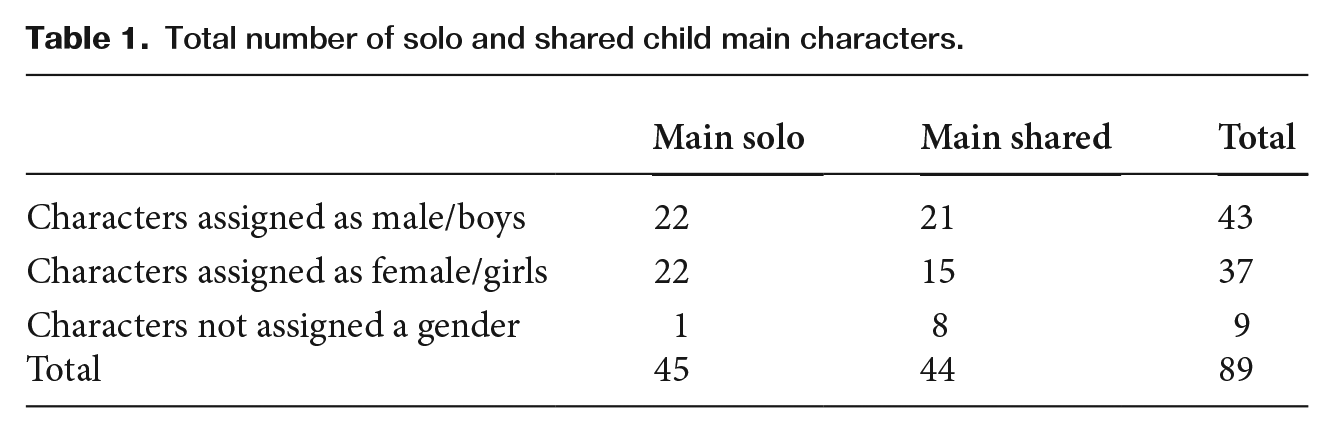
Since our dataset stands apart from much of the past research on award-winning picture books in showing girls and boys equally participating in main character roles (see Table 1), we decided to look more closely at how these characters are managed, with a particular focus on the semiotic expression of gender.
Total number of solo and shared child main characters.
Methodology
Our dataset comprises picture books that have been shortlisted for the CBCA Book of the Year: Early Childhood award category. Formed in 1945, CBCA is now a national organization that ‘exerts a profound influence on children’s books. The advocacy role played by the CBCA promotes the literary experience for children and assures the scope and vitality of children’s books’ (CBCA, 2019). The ‘Early Childhood’ category was added to the awards list in 2001. We collected all shortlisted picture books in this category from 2001 to 2020. Each year the shortlist has included six books (with the exception of 2002): 4 one Winner, two Honour books and three Shortlisted. This gave a total of 118 picture books over a period of 20 years. While the choice of this dataset was initially a pragmatic one, focusing only on award winners has allowed us to turn a social semiotic lens onto a particular community of practice and to examine how particular beliefs, values, or the social requirements of that community may shape or constrain their shared ways of representing gender. 5
Of the total of 118 books, 50 books are about animals or are told from the perspective of anthropomorphized animals, and we acknowledge that animals can most certainly be coded for gender. Two books include human adult main characters. However, our focus in this article is on how human children are coded for gender; thus, we created a sub-dataset, which is compiled of 66 books that have a child acting in the main character role, either as a solo or as a shared role (see Table 1).
The majority of books, therefore, are written and illustrated for children and the story world is largely seen through a child’s point of view. Such a strong and equal focus on the child allows us to investigate how gender codes are deployed by this particular community of practice in constructing these child main characters. Our analysis distinguishes two types of main character: solo main characters where the focus is on a single main character; and shared main characters where two or more characters equally participate in the story development. This not only allowed us to examine the extent to which children act independently, or are defined in relation to others, but also revealed family structures and the extent to which these adhere to heteronormative stereotypes of the nuclear family. Space precludes discussion of family structures in this article.
Our Analytical Tools
Modern children’s picture books are visually dominated cultural artefacts in which stories are told through the co-articulation of visual and verbal components. Therefore, we investigated the representation of gender in our dataset using a multimodal social semiotic approach (Kress and Van Leeuwen, 2006; Painter et al., 2013; Sunderland and McGlashan, 2012; Unsworth and Wheeler, 2002). We concur with scholars who note that visual and verbal elements are ‘co-present and co-operating in the communicative event’ (Bezemer and Jewitt, 2010: 184; Kress, 2010: 1; Sunderland and McGlashan, 2012: 191–192), and that meaning is made through their interactions (Unsworth and Cléirigh, 2011). Thus, in our analysis, we draw on both the visuals and attendant verbiage to assess the various representations of gender. We also see a fruitful connection between a social semiotic approach and narratology, and draw on narratological concepts that are particularly useful in the decoding of gender identity.
Two initial categories of analysis examine the extent to which constructions of gender conform to visual and verbal stereotypes. We examine the possessive attributes (e.g. clothing, hairstyles, accessories, and their colours; see Kress and Van Leeuwen, 2006) as visually construed in the illustrations of the main characters; and, in the verbal text, we examine the naming strategies used to identify characters. Naming practices, according to Pilcher (2017: 812), are important in the ‘ongoing management of gender conduct appropriate to sex’. Our verbal analysis further draws on the narratological concepts of narration and focalization (see Fludernik, 2009). 6 By narration, we mean who is telling the story (who speaks?), thus occupying the role of narrator (also glossed as voice). By focalization we mean whose perspective is being offered in the story (who sees?), thus occupying the role of focalizer (Stephens and Watson, 1994: 29) (also glossed as perspective). Sometimes, the two roles may be conflated when the narrator is a character in the story. This conflation of voice and perspective has important implications for gender analysis.
Stephens and Watson (1994: 28) note that the most usual form in picture books is the separation of narrator and focalizer; thus, picture books tend to use the third-person omniscient narrator. However, in our dataset, approximately one third of our child main characters are both narrator and focalizer. This conflation of voice and perspective usually means that the story will be told in the first person, which masks gender, thus opening up the possibility to conceal the gender of the character. As Fludernik (2009: 49–50) notes, first-person narrative may ‘leave the question of the gender of the first-person narrator open, thus deliberately confounding readers as it undermines their cultural assumptions and prejudices’. The same effect can be achieved through second-person narratives. Such masking of identity is easily achieved in purely written narratives. However, children’s picture books involve a combination of words and illustrations, in which both semiotic modes are contributing to the telling of the story. If an author/illustrator wishes to undermine cultural assumptions and prejudices about gender in a picture book, then the masking of gender would need to extend into the visual component of the story. Therefore, in the analysis that follows, we also examine the correlation between voice, perspective and the visual constructions of gender codes.
In sum, we undertake qualitative multimodal discourse analysis of the visual and verbal constructions of the child main characters in this sub-dataset. By looking at their appearance we examine the extent to which these are coded as normatively masculine or feminine, thus addressing our first research question. We attempt not to force this analysis into a binary gender distinction. Ideally, such qualitative analysis should allow us to capture moments of ambiguity where gender is irrelevant and, through this, address our second research question.
Visual and Verbal Practices that Index Normative Gendering
Given the qualitative focus of our analysis, our results focus specifically on child solo/shared main characters (n = 89), which corresponds to 43 boy characters, 37 girl characters and 9 characters who are not assigned a gender (Table 1). 7 The visual and verbal representations of the child main characters in this dataset adhere very strongly to normative representations of gender and body types. This is evidenced in the characters’ visual appearance, including physical features and dress. It is also inscribed in how they are named and addressed in the verbal text. As a community of practice, the authors and illustrators of these books make use of a very limited repertoire of gender expressions, and these expressions fall within the ‘symbolic’ or ‘ideological’ representations of gender that are shaped by the hegemonic cultural attitudes, representations and practices noted by Cameron (2006).
Appearance and Gendered Identities
Davies (1989: 14) notes that: positioning oneself as male or female is not just a conceptual process. It is also a physical process. Each child’s body takes on the knowledge of maleness or femaleness through its practices. The most obvious, and apparently superficial, form of bodily practice that distinguishes male from female is dress and hairstyle. (original emphasis)
This is true of the visual depictions of child main characters in our dataset of CBCA award-winning picture books, where such gendered stereotypical practices prevail.
In terms of possessive attributes, girl characters have pale skin (n = 35), rosy cheeks and wear their hair long (n = 28), while boys wear their hair short (n = 36) and some are brown skinned (n = 9). Only three boys have longer, shoulder-length hair, while eight girls have short hair. Girls’ hair is mostly straight, while boys are more likely to have curly hair than girls do. Hair accessories, such as headbands, ribbons and bows only feature in visuals of girl characters. Hair is thematized in at least three books in this dataset. For girl characters, unruly hair proves to be a problem that takes the whole book to resolve by finally cutting it all off, e.g. in Ella Kazoo Will Not Brush Her Hair. For boys, however, messy hair proves to be an ideal metaphor for the cycle of (heteronormative) life. A seedling growing in the boy’s hair is chopped off (along with the rest of the boy’s hair), planted and nurtured by the boy. Both the tree and the boy mature into adulthood and (for him) heteronormative family life, e.g. in Leaf. In another book, Emily’s Rapunzel Hair, the main character, Emily, is accused of looking like a boy because her hair is short on the opening page of the book (see Extract 1), and the focus of the whole book is on growing her hair long enough to have pigtails.
‘You are a funny boy,’ Lucy Brown said to Emily. ‘I’m not a boy,’ said Emily. ‘I’m a girl. I’m wearing a dress. Boys don’t wear dresses.’ ‘You’re a boy,’ said Lucy Brown, ‘because you’ve got short hair. Boys have short hair. Girls have long hair.’ Lucy Brown tossed her pigtails at Emily. Emily felt her hair with both hands. It was short. It was far too short to have pigtails like Lucy Brown.
The stereotypes introduced in this opening page of Emily’s Rapunzel Hair encapsulate the gendered stereotypes that prevail in this dataset. The girls do mostly wear dresses and have long hair. However, one boy also wears a dress, the child narrator in Look See, Look at Me, but this is only when he is playing dress-ups and mimicking adult relatives.
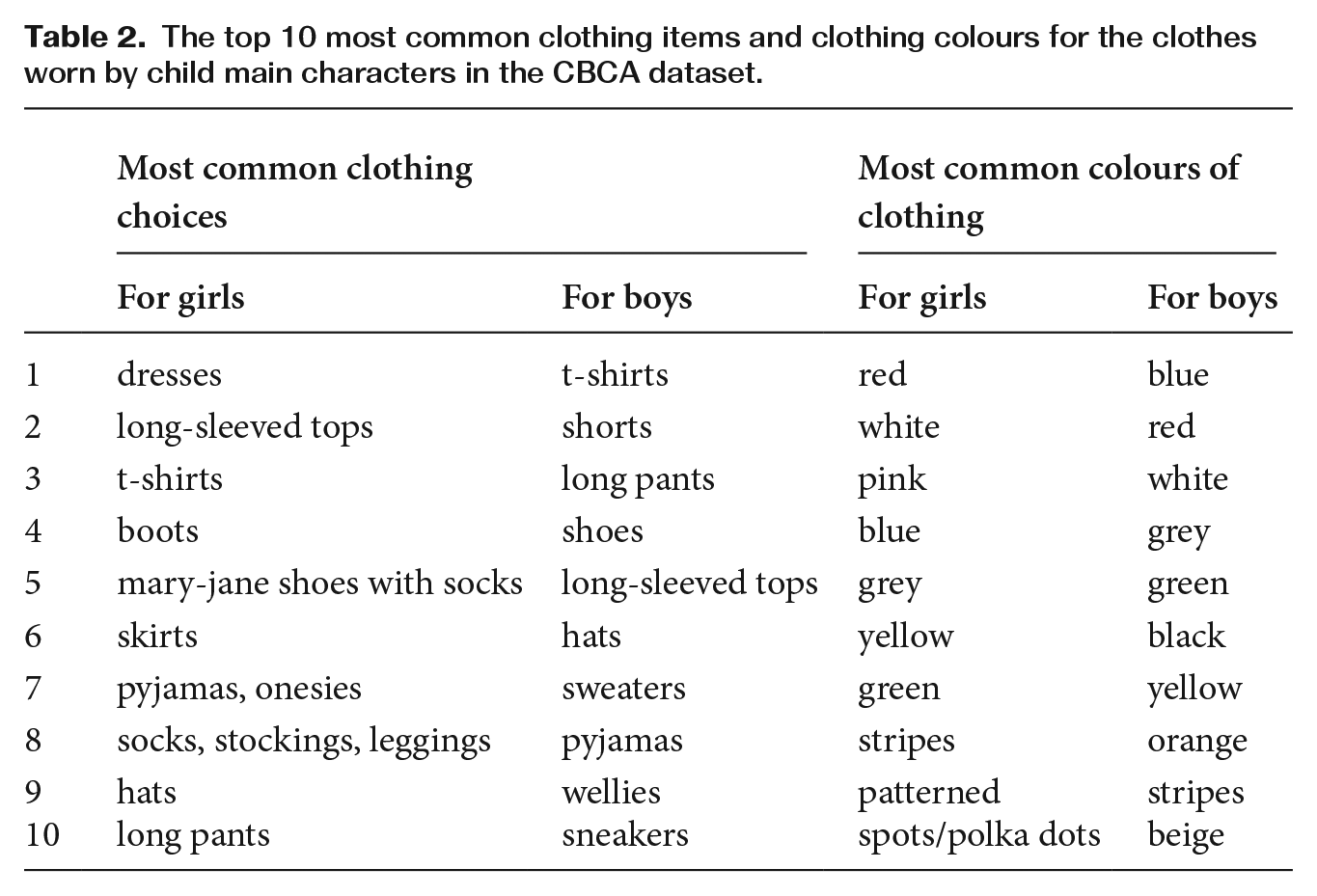
Clothing choices for the child characters largely follow the conventions of gender stereotypes, as do the colours of these clothes. Table 2 lists the top 10 most common items of clothing worn by the child main characters in our dataset. While girls wear dresses, they also wear short- or long-sleeved tops underneath their dresses (see Figure 1 for an example), and wear boots or mary-jane shoes with socks. For girls, the colour palette adheres to modern stereotypes with clothing likely to be red, white and pink.
The top 10 most common clothing items and clothing colours for the clothes worn by child main characters in the CBCA dataset.
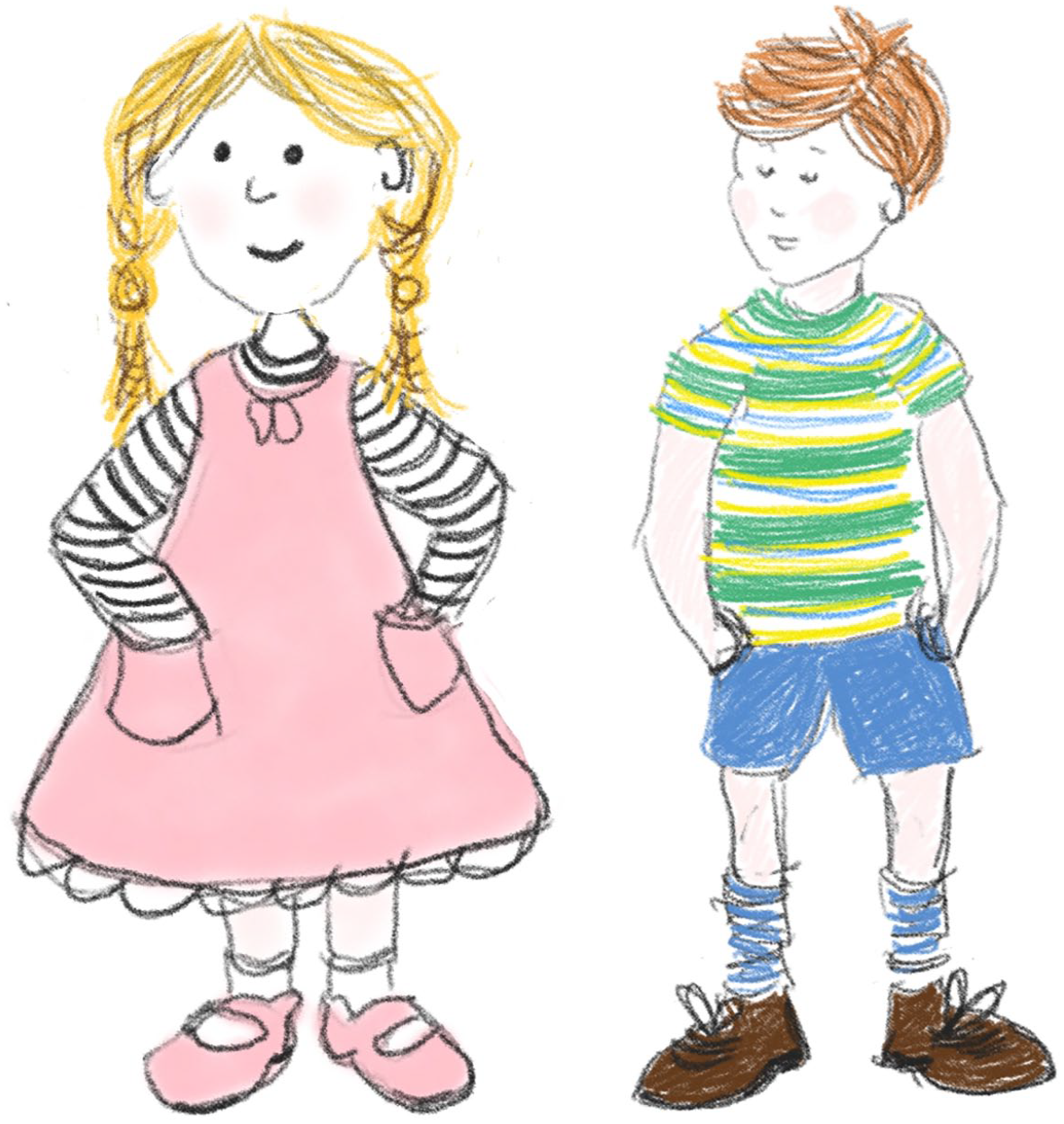
Typical clothing choices for girl and boy characters in the CBCA Early Childhood shortlist. © Caple.
Stripes, patterned dresses and polka dots/spots are also a key feature of girls’ clothing, while boys are likely to be seen in blue-and-white stripes. Boys typically wear shorts and t-shirts or long pants, long-sleeved tops and shoes, with a blue, red and white colour palette. It is interesting that both boys and girls wear a wide variety of hats. These are sometimes part of dress-up outfits as they engage in creative play (as pirates, pilots, or astronauts), but mostly they are caps and wide-brimmed summer or school hats that protect the children from the sun. Sun safety in Australia is a common, and vitally important, practice and it is not surprising to see the message of wearing a hat while outdoors coming through in this literature. The visuals also adhere to normative representations of body type. No child is overweight. Only one child is consistently depicted wearing glasses.
That the colour pink features in the top three colours for girls’ clothing (and not at all for boys) is no surprise given its modern cultural associations with femininity and its stereotypical features of softness, delicacy, childhood and innocence (Koller, 2008: 396). As Koller notes, if this association begins from an early age, it may prove persistent throughout a woman’s life (p. 411). Only one girl main character challenges the highly feminized stereotype that prevails in this dataset. This is Kate in Bob Graham’s book Let’s Get a Pup. She mainly wears long pants and t-shirts/sports jerseys, as in Figure 2(a). She and her parents all resemble each other, right down to their postures. In fact, further challenges to the feminine stereotype are present in the depiction of Kate’s mum. She has a nose ring, double studs in the ears and a tattoo (albeit of a rose). She also wears cargo pants and a singlet, thus breaking the conventional wear that we see in all other mothers in this dataset. 8
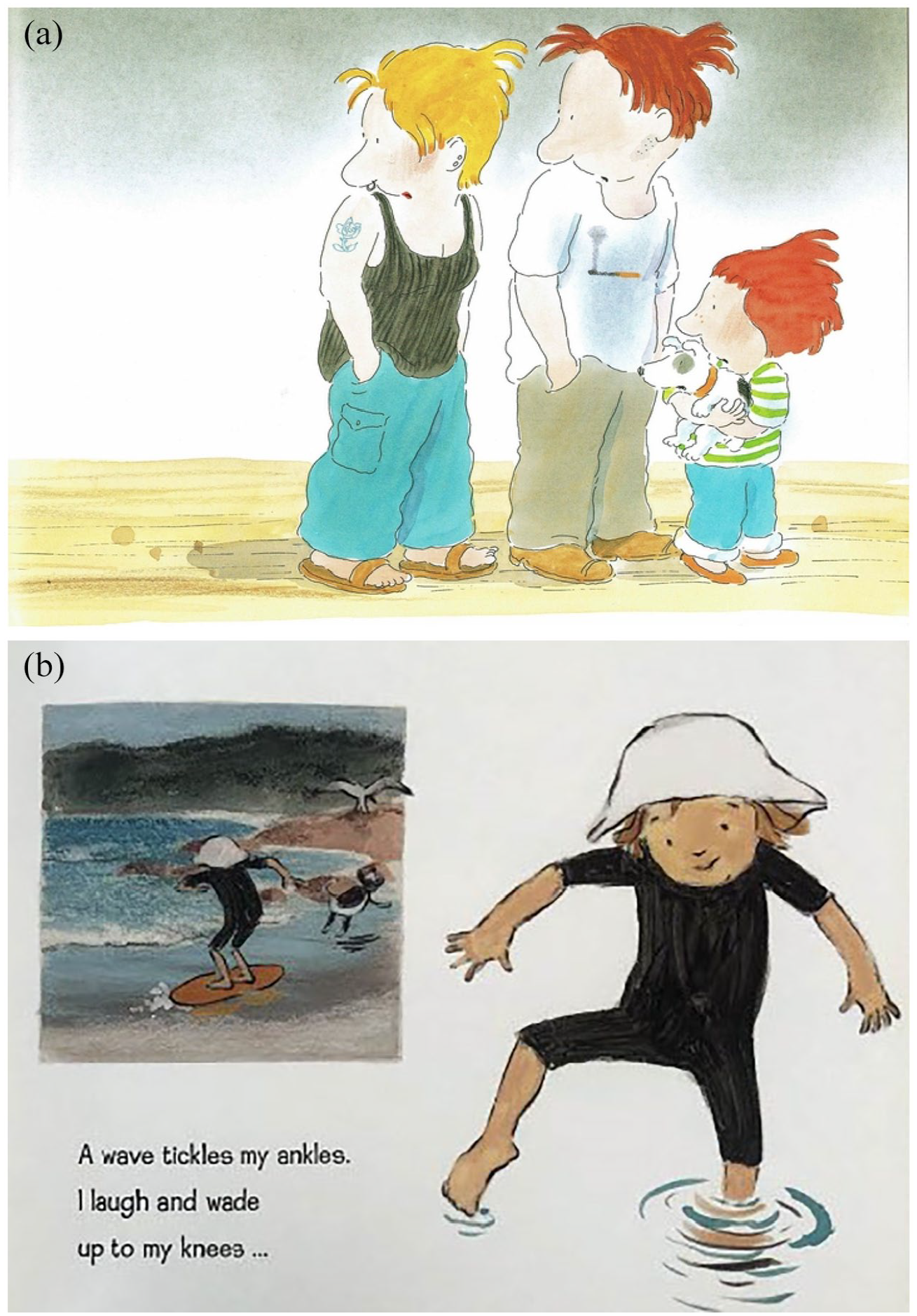
Depictions that challenge gender stereotypes in the CBCA Early Childhood shortlist: (a) Kate and her parents in Let’s Get a Pup. From LET’S GET A PUP! by Bob Graham. Copyright © 2001 Robert Graham. Reproduced by permission of Walker Books Australia Pty Ltd; (b) ‘Me’ in Granny Grommet and Me. Copyright © 2013 Karen Blair. Reproduced with permission.
In the CBCA dataset, there is only one book that depicts a child character that does not readily fit into the gender binary. This is the child narrator in Granny Grommet and Me who spends the day at the beach with their granny and her friends. The child wears a black all-in-one swimsuit and a hat in all panels (see Figure 2b), and the minimalist depiction style (see Painter et al., 2013) of the illustrations frees the child of physiological features that would allow for a reading of their ‘sex’. The child is also not named in the book, which is another means of managing gender, as will be discussed in the next section.
Naming Practices and Gendered Identities
Pilcher (2017: 812) notes the importance of proper names in the ‘ongoing management of gender conduct appropriate to sex’. Forenames and surnames, Pilcher suggests, ‘help in the embodied doing of gender’ and, therefore, as we participate in naming practices, we have ‘gendered embodied named identities’. We examined the management of gender through naming practices in relation to the main characters in our dataset, using the coding categories in Table 3, and looked not only at proper names but also at other means of addressing the characters, e.g. through kinship terms or pronouns that indicate gender. Thus, we assessed the extent to which these naming practices created gendered identities.
Coding categories used for naming analysis: explanation and examples.
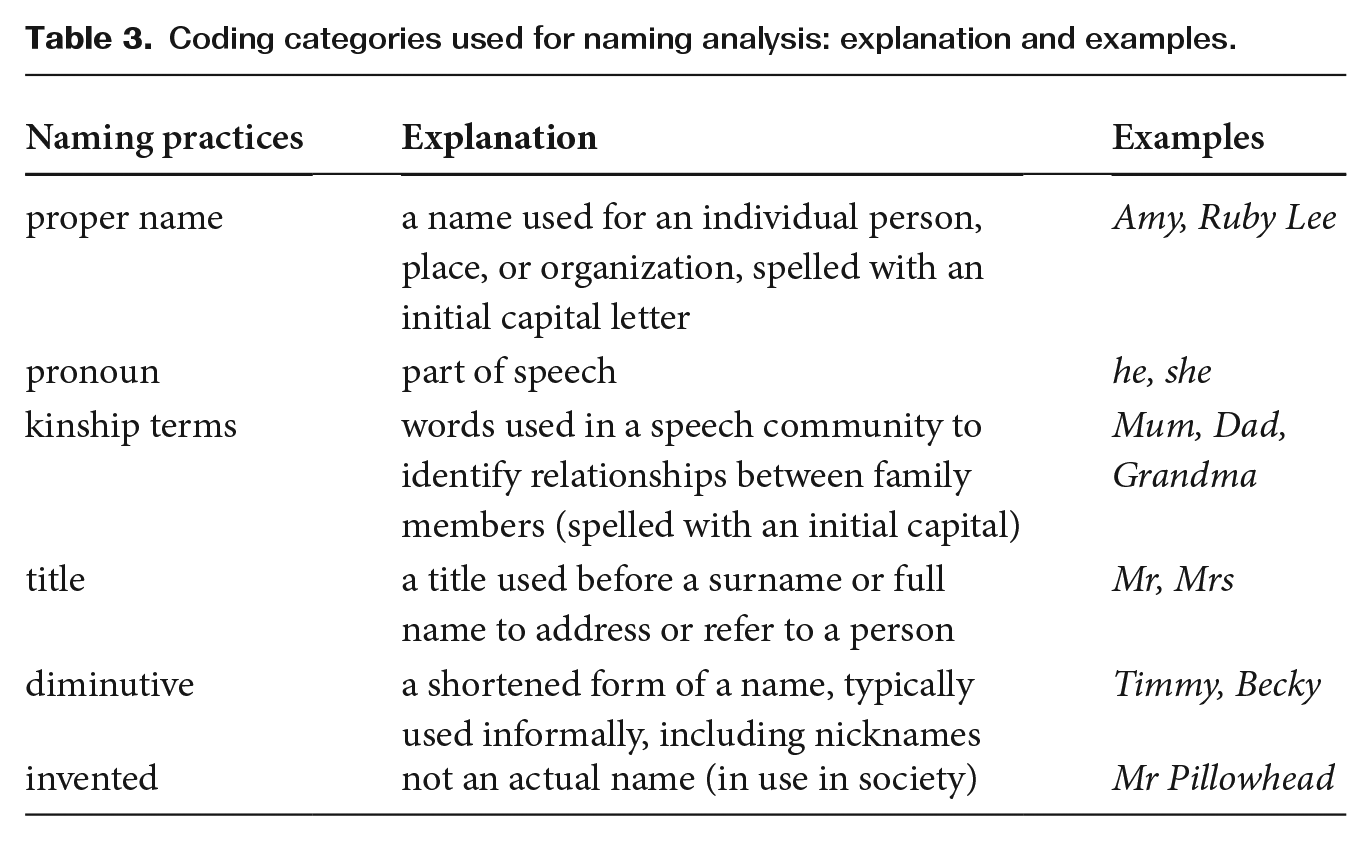
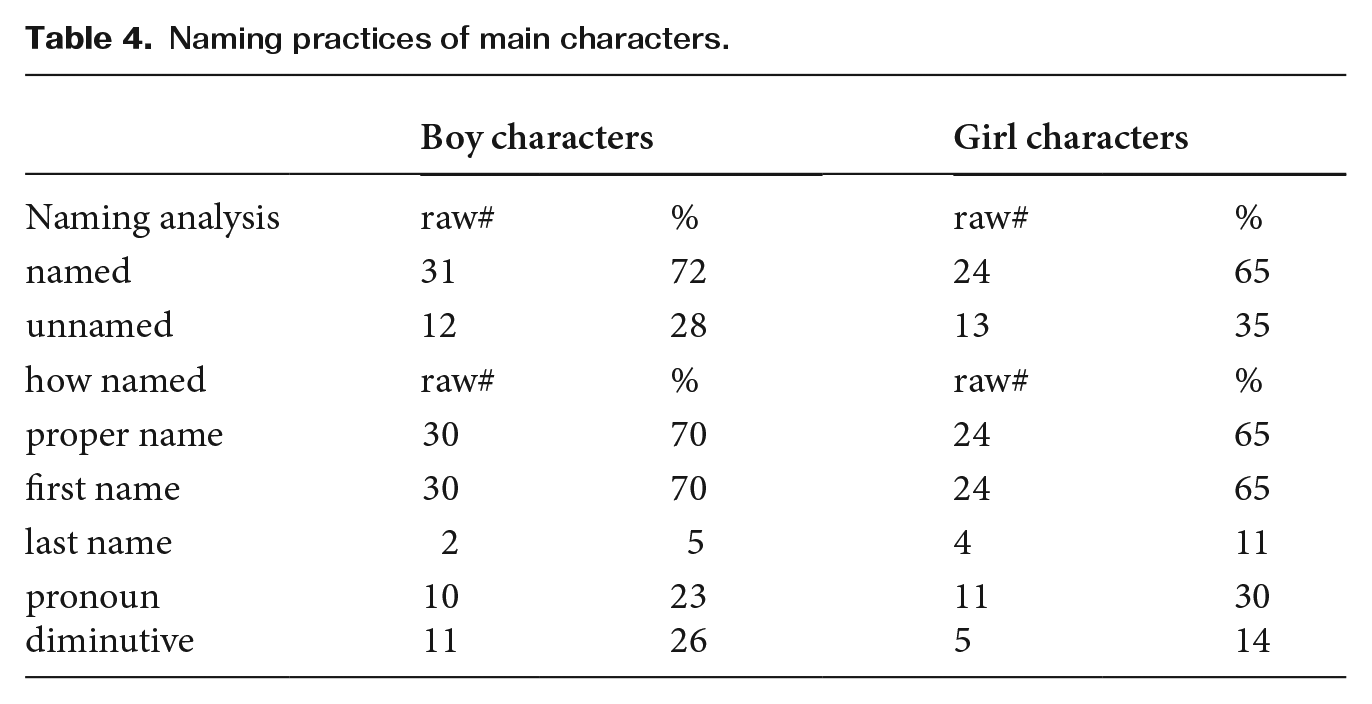
The first observation in relation to naming practices is that all of the children who are named using a proper name (n = 55) have gendered-embodied named identities (e.g. Millie, Audrey, Eric, Simon). Most are named using only first names, but four girl and two boy characters are also named using a family name (e.g. Audrey Barlow in the book It’s a Miroocool!). However, twice as many boy than girl characters (11 to 5) are named using diminutive forms (e.g. Ollie or Kev). Characters that are identified only through the use of pronouns, he and she, also conform to gendered identities. No child is identified using the gender-neutral they or using alternatives such as ze and hir. The full results for naming practices among the child main characters are presented in Table 4.
Naming practices of main characters.
In relation to our first research question, we contend that the results of our analyses very clearly demonstrate that prize-winning Australian early childhood picture books adhere very closely to symbolic/stereotypical visual and verbal expressions of gender. The books that authors and illustrators create, that publishers nominate and that the CBCA award are very constrained in their repertoire. As a body of work, these books serve to reinforce hegemonic cultural attitudes of what constitutes desirable femininity and masculinity in Australia.
However, in relation to our second research question, we do see opportunities to engage with non-binary alternatives that might introduce more flexibility in how the characters are read, even though these opportunities are very limited. Of the nine child characters who are not assigned a gender, seven are story narrators who are not visually depicted. Only two books avoid gender labelling completely. One is Alison Lester’s Kissed by the Moon, where the baby is referred to only in the second person you (see Extract 2).
May you, my baby, sleep softly at night, . . . may you wake up to birdsong. May the morning sun warm you, the evening breeze cool you, . . . . . . And may you, my baby, be kissed by the moon.
The baby (in Extract 2) undergoes a number of transformations in the book, from being a babe in arms to being able to crawl, then walk and swim, and has 17 outfit changes. However, none of these visual transformations firmly locates the child within gender stereotypes.
Another unnamed child character is the ‘me’ in Dianne Wolfer and Karen Blair’s Granny Grommet and Me (see Figure 2b). By positioning the child as narrator and focalizer, their gender is masked in the verbal text and no other character in this story uses the child’s name or refers to the child in the third person singular (see Extract 3). As already noted, both visual and verbal resources in this book are ambiguous (for gender). These two books are the only books in the dataset that truly open up space for readers to navigate their own pathways through the gendering or not of the story protagonist.
‘Come in,’ Granny calls. I shake my head. I can’t go in. There are strange things under the waves.
While many books in this dataset make similar use of the narrator/focalizer conflation, other characters in the story world close down the space for non-gendered readings by naming the main character using the gendered naming practices listed in Table 3. The two books Kissed by the Moon and Granny Grommet and Me are the only books that not only avoid gendered naming practices, but also do the additional hard work of avoiding binarized expressions of gender in the visuals. These two books represent the full extent of engagement with gender diversity in our dataset and no books include overtly LGBTIQ+ characters.
Narration and focalization are critical tools for masking gender in children’s picture books, especially when combined with visual depictions that radically depart from the highly feminized or masculinized. The semiotic landscape of award-winning children’s books is currently dominated by binarized and stereotypical expressions of gender. However, as exemplified in Kissed by the Moon and Granny Grommet and Me, semiotic choices can be made that represent human child characters in a non-stereotypical manner and, in so doing, children’s picture books come closer to reflecting the actual lived expressions of gender in society.
Conclusion
This article aimed to shed light on symbolic manifestations of gender in Australian award-winning children’s picture books and to problematize the desirable subjectivity that these representations constitute. Our analysis of the visual and verbal expressions of gender in the CBCA Early Childhood shortlisted picture books demonstrates that dualistic productions of gender remain determinedly and overtly inscribed. Ultimately, these picture books do little to deconstruct gender binaries, nor do they challenge cultural assumptions or prejudices. That these are ‘necessarily’ normative constructions relates to the very localized and restricted shared practices that have developed among this particular community of practice. It seems that authors and illustrators have developed very restricted and (stereo-)typical repertoires for the construction of boy and girl characters, which leave little to no room for other expressions of personhood. Thus, the CBCA receives a very limited range of picture books from which to choose their winners. A social semiotic analysis of the picture books that do not get nominated for prizes might further reveal how typical these practices are.
As social semioticians, we are tasked with studying social practices and should take into account how practices are taught, regulated, critiqued and changed. We hope that this analysis has opened up space for change by uncovering the opportunities in this dataset for children to access discourses where, in Davies’s (1989: 141) words: their social practice is not defined in terms of the set of genitals they happen to have . . . They need the freedom to position themselves in multiple ways, some of which will be recognizably ‘feminine’, some ‘masculine’ as we currently understand these terms, and some totally unrelated to current discursive practices.
As our analysis has shown, illustrators and authors have it within their power to construct their texts in ways that open up space for alternative readings of gender, rather than closing down representations to the point that only (stereo-)typical readings of gendered characters are possible. Within the (limited) scope of this article, we have described and discussed two books in the CBCA dataset Kissed by the Moon and Granny Grommet and Me, demonstrating how various semiotic strategies can be deployed to avoid binarized and stereotypical gender expression. A systematic illustration of these strategies should be included in social semioticians’ future research agenda so that detailed recommendations could be provided for members of the community of practice in question.
Modernizing prizing to reflect current values, especially in relation to gender expression, must be a priority, thus allowing children’s literature to continue to fulfil its role in facilitating empathy and social justice. As Bittner and Superle (2017: 85–86) note: ‘excellence must be redefined – or more accurately, defined – to appropriately reflect the literary values of a pluralistic, inclusive society.’ That this should be a society that engages respectfully with people of ‘any/every shape, size, color, orientation, and background’ and that ‘all of this can and should be accomplished through beautiful storytelling’ (p. 86) goes without saying.
Footnotes
Acknowledgements
We are sincerely grateful to Bob Graham, Walker Books and Karen Blair for permission to use their artworks in this article. We are also grateful for the useful comments made by the reviewers on a previous version of this article.
Funding
The authors received financial support for the research undertaken in this article in form of a School Research Grant (SPF02) from the School of the Arts and Media, UNSW. There is no conflict of interest.

Notes
Biographical Notes
HELEN CAPLE is Associate Professor in Journalism at the University of New South Wales, Australia. Her research interests centre on visual representation and diversity, news photography, text–image relations and discursive news values analysis. Helen has published in the area of Photojournalism and Social Semiotics. Her latest monograph with Routledge is Photojournalism Disrupted: The View from Australia (2019).
Address: University of New South Wales, 311Q Robert Webster, Sydney NSW 2052, Australia. [ email:
PING TIAN is an Honorary Associate in Linguistics at the University of Sydney, Australia. Her research interests centre on the application of Linguistics and Semiotic Theory, and analytical methods in different communicative contexts. Ping has taught and published in the areas of Multimodality, Discourse Analysis, Children’s Picture Books, Media Semiotics and Semiotics in the contexts of Business and Inter-cultural Communication.
Address: The University of Sydney, Department of Linguistics, Woolley Building, Sydney, NSW 2006, Australia. [ email: