




Abstract
This is an excerpt from Sarah Beck’s novel Currency. Created as a gift of thanks to the late Kurt Vonnegut, Currency is a humorous story about money, art, fakes and sea pirates. The novel is Sarah’s self-reflexive take on social economic exchanges both within and without the art world. Currency is an odd document – it seeks true interdisciplinarity not just between mediums but in the search for a plurality of possible ways to express and to approach artistic research. Chapter-by-chapter, the self-reflexive narrative guides the reader through musings on the experience of the creation of ephemeral artworks using colloquial language, illustrations, jokes and parables. Written as her master’s thesis, Sarah was obliged to attach an academic explanation, which she has maintained as the last part of her book. Art is a hell of a commodity, and Currency is a hell of a book. Visit sarahbeck.com for more information about Currency and her artistic practice.
Creativity makes promises it cannot keep.
The truth is, I didn’t have the money to keep my promise. I found myself hearing my Dad’s voice in my head:
‘Don’t let your mouth write cheques your ass can’t cash.’
My ass was having problems cashing cheques.
I had to switch banks when I began studying for my MFA because my previous bank was a very regional credit union. I had banked there for 20 years. Although well an adult, I needed to begin my relationship again with my new bank. I quickly learned that I had been taking access to my own money for granted.
I chose my new bank because it was the closest to my house and they offered Air Miles (TM). While registering they offered me the privilege of a student account, meaning I would pay lower fees and they would mail me credit card offers that were best suited to my lifestyle. My first transaction was depositing my federally issued student loan cheque. I would have to wait two weeks for it to clear.
Living so close to poverty meant I couldn’t wait. Having spent the past few years waiting tables my relationship with money had entirely changed. Each day I left the restaurant with money in my pocket. This money was then dumped in a shoebox when I arrived home. My shoebox looked like this:

No matter how shitty the lunch rush was, I’d bring home my $7.25 and throw it into the shoe box.
I didn’t specifically save money – I used it as I needed it. Each time I opened the box I could see, in plain sight, all the money I had in the world. If it ran low, all I saw was copper and I would pick up an extra shift. I managed to pay down a lot of debt this way.
It felt like I had more money in the shoebox days so I was surprised at tax time to discover I had earned less waiting tables than I have since then. It didn’t seem possible.
I have always lived a fiscally risky life. When I hear figures about how much money you should have stored away for emergencies (two, three months’ income?) I’ve always thought ‘I wish!’ I have never lived further than one pay cheque from homelessness and have developed creative approaches for survival. My new income, based on student loans and a TAship, was nearly the same amount I had been living on as a waitress. For some reason I no longer had the money to make do.
I examined my personal finances outside of my art practice. I had saved every receipt, no matter how small, mapping my life and needs since returning to school. I could find no place where I was being exorbitant, in fact my spending had gone down considerably. I was no longer paying down my debts, and interest was starting to win. I couldn’t find one frivolous purchase, and even failed to make many that were necessary.
My receipts were the story of the past few months. My move to the city. My poor diet. My text books. A second move after my breakup. Where had the money gone? I was certainly spending less, and my health was witness.
I decided to pore over my bank statements and there was the rub. Service charges. Charges for everything. Charges out of synch with the value of the transactions: $3.25 for the convenience of using another bank’s machine; $1.50 for the privilege of using my own. Large transactions cost as much as small transactions. These service charges went on and on, adding up to shocking debits against my account. It seemed every bit of business I did with my bank, even if a machine handled it with barely a blink, was an inconvenience to my bank that I was to be billed for. Yikes.
Using the teller incurs no fee, at least the last time I checked. This surprises me because it must cost more to maintain an employee than a machine. When you call your bank, you can’t get a hold of a person. I suspect that when I do reach a person, that person gets paid less because they live in a different country.
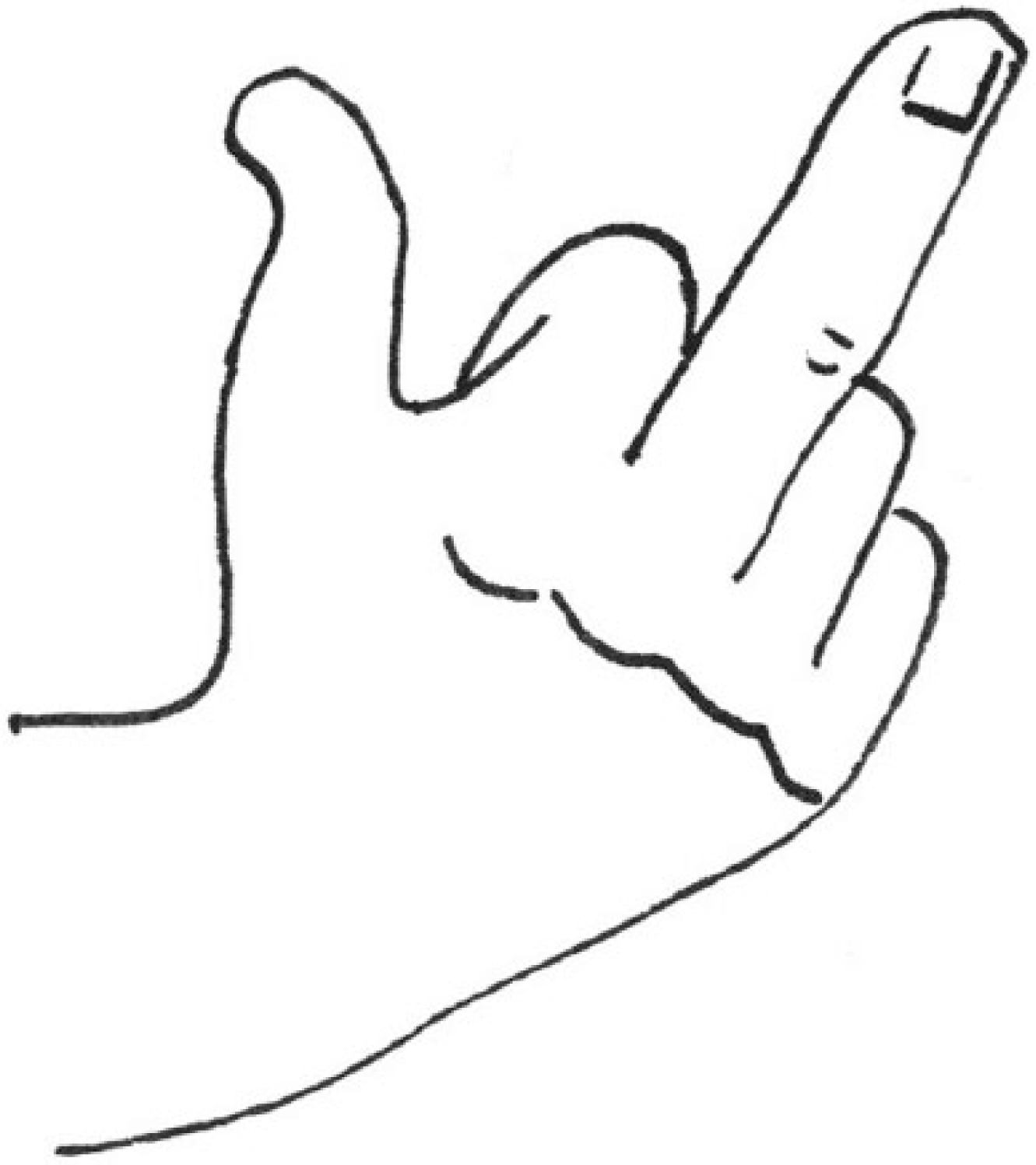
A Florida man also went into a bank to cash a cheque. He didn’t have an account at the bank, so you know they were going to give him a hard time. The bank was very demanding about security, even asking for a thumb print. The man became annoyed when he was turned away due to strict adherence to company policy. He had been born without arms, leaving him unable to give the required thumbprint. He couldn’t even give the teller the finger.
When someone gives you the finger it means ‘Fuck you!’ and it looks like this:
About a week later I was knocking off a few personal errands – you know, paying bills, laundry, and I found myself writing a large cheque.
This cheque was so large because the one before it had bounced. The one before it had bounced because it was so large. The reason it was so large was because I hadn’t paid this particular bill for some time. The reason I hadn’t paid this bill was because I didn’t have the money. I had chosen to let this bill slide because I’ve had a long-term relationship with the company whom I have found to be very understanding.
This company is Besco Storage in Saskatchewan. The bill totaled $950, a fortune for me. To illustrate, I had been living off $400 each month for the entire summer semester – things were tighter than tight. I’d hate to admit my survival strategies for such a lean budget, but I will admit that I seriously considered stripping. Fortunately I not only lacked the time, but was terrified of being a graduate school stereotype.
The $950 cheque represented five months of unpaid storage. So, I began to do some math.
Annually I pay $2,280 for storage. My student loan for this year is $8,600, well below the poverty line. However I continue to pay my storage bill at often ridiculous cost to my physical health and credit rating. I think nothing of paying this bill. I’ve been paying it for the past 9 years minus a few months here and there.
Some quick accounting determined I have already paid $18,660 in storage. The item I have in storage initially cost me $40,000. This means, as of the fall of 2015 when you are likely reading this, the value of this beast will be $71,085 and appreciating monthly. I, a young lady of modest means and origins, own a work of art worth a lot of money.
What I am storing at Besco storage is a sculpture I created. It is a life-sized military tank made of MDF. It looks like this:

This Ikea-style tank, my first major artwork, is a mammoth stacked as tightly as possible into an unreasonably small space. I have never questioned my need to save it, but have always questioned my need to keep it. I’ve tried giving it away for free, and the offer still stands.
This accounting made me curious. Next I opened the carefully maintained books for my second major artwork, also in storage, and tallied my investment to be $30,954.11.
It turns out I have invested $102,039.11 into these two works. This is also the current value, it turns out, of 807 shares of Apple Inc. Would it not have been wiser to invest in future financial gain than to run myself into incredible debt?
Previously, I had only ever considered Kurt Vonnegut’s assertion that artists and writers are the canaries in the coal mine from a reporting stance. I had never considered the implicit martyrdom involved.
Although my passion for my practice has never been in question, suddenly I found that its sustainability was. The size of my work, both physical and conceptual, does not easily lend itself to the market for emerging artists. This does not improve with an economic downturn and a premium on existing exhibition space.
Inevitably the question of labour gets raised when one begins to examine economic conditions. Notably in my accounting of both projects, labour was not a numerical value I recorded unless it was that of someone else I had hired. It turns out my ass is willing to cash cheques my mouth writes, even if it means my ass ends up broke and naked on a stripper pole. Yikes.
As an artist I feel an obligation to society. This is evidenced by my intense debt. I now have an obligation to Visa who funded my art in the first place.
As a member of a democracy I am free to be in debt. Being free to be in debt seems like an oxymoron.
Footnotes

Email: