



Abstract
This article illustrates with numerous examples that the strategic principles of advertising management – and also its concepts and frameworks – are derived more from logic (by deduction) than from empirical generalizations (by induction). As argued by Rossiter in Marketing Theory (2001b, 2002), empirical generalizations are useful only when they are translated into strategic principles, which are ‘if, do’ recommendations for managerial actions. The present article comprehensively demonstrates that advertising’s strategic principles depend either (a) entirely on logical thinking, or (b) on logical thinking about causality designed to ‘ungeneralize’ – and specifically for the brand, improve upon – general empirical findings.
Introduction
Being the principal author of several textbooks on advertising and marketing communications management (in chronological order: Rossiter and Percy, 1987, 1997; Rossiter and Bellman, 2005), I might therefore be expected to be keen to see the new findings that emerged from the 2008 Empirical Generalizations in Advertising Conference, most of which were published in a special issue of the Journal of Advertising Research (June, 2009). However, I was not keen, for two reasons. First, empirical generalizations are not sufficient for advertising management. What managers need is strategic principles – ‘if, do’ recommendations for action – not merely empirical findings (Armstrong and Schultz, 1993; Rossiter, 1994, 2001, 2002). Strategic principles are emphasized throughout my textbooks. And, unlike in other textbooks, the principles are explicitly stated and easy to find; compare Armstrong and Schultz’s (1993) study in which, in the major textbooks in marketing, they were able to locate hardly any principles, probably because the principles were too implicit. Second, strategic principles are based on logical reasoning (deduction) and are not apparent from ‘empirical generalizations’ (inductions) from experimental or survey evidence.
In this article, I review examples from my textbooks of logically derived strategic principles that are independent of empirical evidence. The necessary principles cover both advertising and media strategy, the two most important planning functions in advertising. In the lead article in the first issue of the journal Marketing Theory, I argued that three other forms of marketing knowledge – marketing concepts, structural frameworks, and research principles – are necessary in addition to strategic principles (Rossiter, 2001). The role of the first two forms of knowledge in advertising management will also be highlighted.
Empirical generalizations
Empirical generalizations (EGs) are descriptive ‘if, then’ statements about the observed correlation between two or more marketing concepts (variables). The two most common forms of EG are shown in Figure 1 (reproduced from my 2001 article). One well known empirical generalization in marketing taking the first form, ‘If A, then B’, which I used in the Rossiter and Percy textbooks (1987: 51–4, 1997: 39–40) but dropped in the Rossiter and Bellman (2005) textbook for a reason given shortly, is: ‘The order of entry of brands is proportional to their ultimate market shares’. This observation was offered, apparently independently, in 1976 by the Boston Consulting Group (a correlation of r =.5 in industrial markets) and also in 1976 by the Hendry Corporation (a correlation of r =.43 in consumer markets). The correlation involved here is expressed in the form of a ‘size ratio’ of the market share that the next brand entering can hope to attain as a ratio of the preceding brand’s market share.
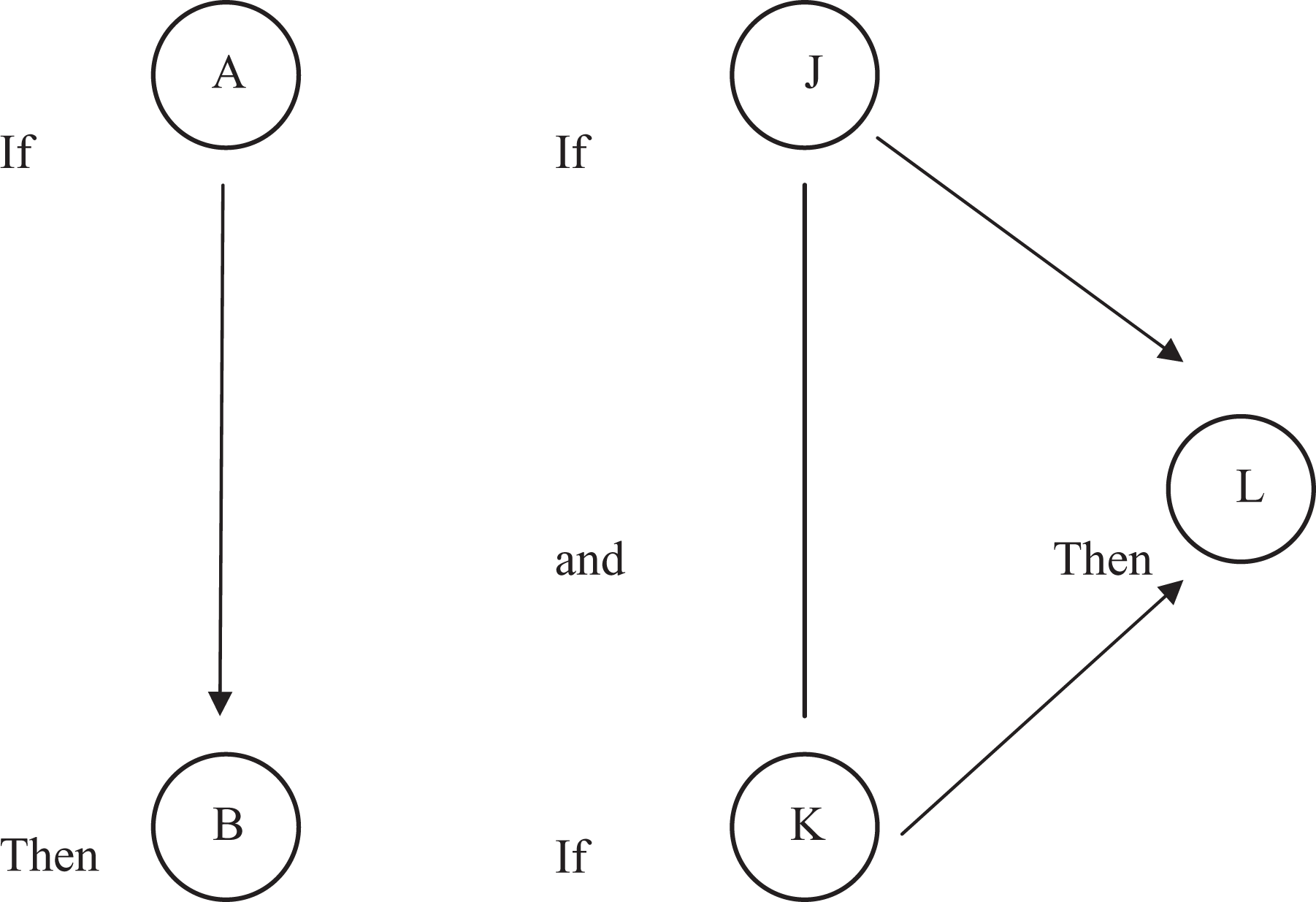
The forms of empirical generalizations (observed ‘if, then’ relationships between two or more marketing concepts)
A second well known EG, also taking the first form, which was used in my second textbook (Rossiter and Percy, 1997: 75–7) but not the third (Rossiter and Bellman, 2005) for reasons discussed later, is Ehrenberg’s ‘double jeopardy’ generalization, which, stated in positive form, is: ‘the larger the brand’s penetration (the number of people who buy the brand), the larger will be its repeat rate (the more often they will buy it)’. This EG may be extended to include a third variable which is: ‘and thus the larger will be its total sales’ (although this last relationship is logical, not empirical, because sales are the product of penetration × repeat rate). This extended EG takes the second form in Figure 1, that is, ‘If J and K, then L’ (if high penetration and high repeat, then higher sales).
Strategic principles
Strategic principles (SPs), in contrast, are prescriptive (as opposed to descriptive) statements of the causal (as opposed to correlational) relationship between a marketing situation (the first marketing concept), a managerial action (the second marketing concept), and an outcome (the third marketing concept). The basic form of strategic principles is shown in Figure 2 (again from my 2001 article). The prescription is ‘if, do’ and the full form of an SP is: ‘If the market situation is X, then do Y, because this will produce the best outcome Z’. An example from my textbooks on advertising is: ‘If product choice is low-risk (X) and brands are chosen mainly at the point-of-purchase (Y), then set as an advertising objective visual brand-pack or logo recognition (which is the correct outcome measure, Z, for this situation)’. This SP is entirely based on logic. No empirical findings are necessary to derive this principle.
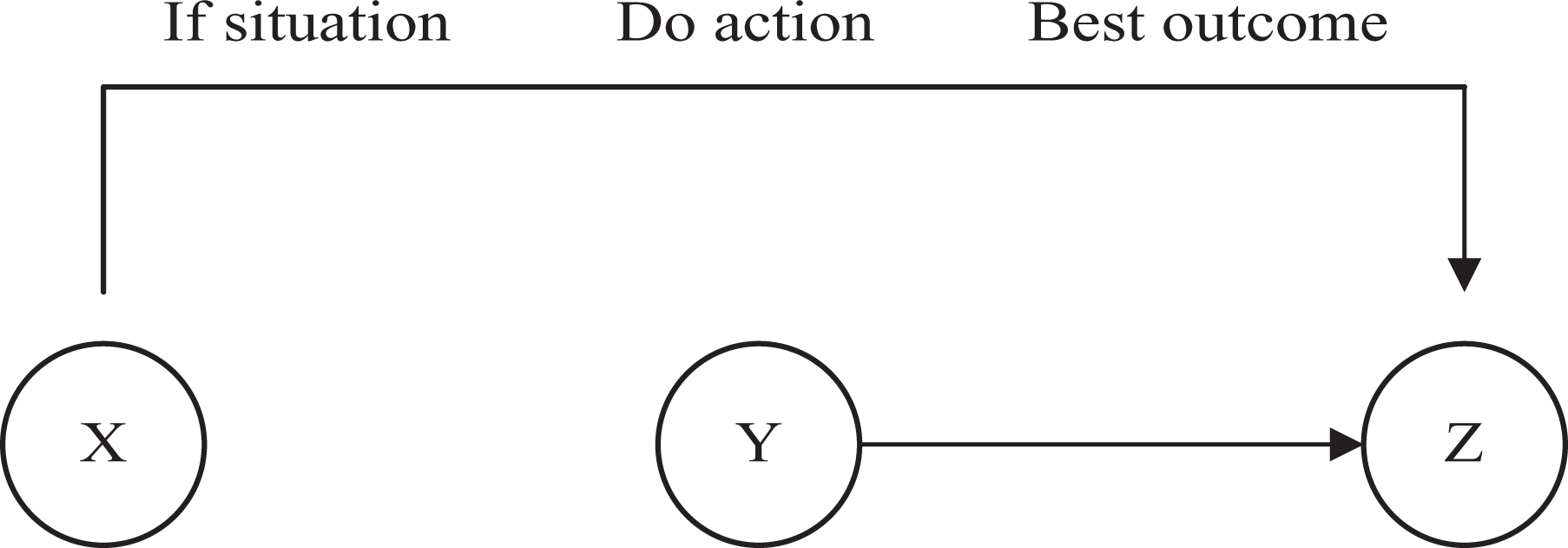
The form of strategic principles (conditional prescriptive ‘if, do’ statements of the best course of action to take in a given situation)
Converting EGs into SPs
To convert an empirical finding or generalization to a strategic principle, you need to figure out the ‘why’ (the cause or causes of the finding). In the case of the first EG above, concerning the correlation between order of entry and market share, the two causes are the ‘marketing experience curve’ (in which the firms earliest to market gain experience earlier in how to successfully sell their product) and ‘pioneering advantage’ (a complex theory in which the first brand to enter defines the ‘prototype’ of the product so that later brands are seen as successively inferior imitators, with fewer and fewer consumers willing to try them because they have diminishing demand capacity having already bought an earlier brand). The first cause, that of marketing experience, would lead to a very different principle than the obvious order-of-entry principle of ‘If you want a large market share, then enter the market early’, which is of no use to the managers of brands who are considering entering late!
A useful SP can be derived from the order-of-entry EG by knowing just the first cause, marketing experience. This SP is for companies that are not the first to enter to ‘buy in’ marketing experience by raiding marketing executives from the pioneering firm (trade paper reports show that PepsiCo, for instance, has raided Coca-Cola’s marketing executives from time to time). An alternative SP for the number-two brand for overcoming the pioneer’s advantage can be derived from a semi-EG, ‘semi’ because it applies only to consumer packed goods, or fast-moving consumer goods (FMCG) products, proposed in a study by Urban et al. (1986). This semi-EG implies that the second brand, in order to surpass the leading brand, must have 36% better (perceived) product quality, or spend 3.4 times the amount on advertising that the leading brand spends, or spend the same but with 3.4 times more effective ads, or some combination that adds up to this total ‘impact’ (see Rossiter and Percy, 1997: 51). Presumably, later brands would have to be much better – or spend much more – than this! On reflection, I thought this empirically derived SP – true as it no doubt is – much too discouraging for managers and accordingly omitted it from my 2005 textbook.
The empirical generalization about ‘double jeopardy’, which was proposed as the ‘most important EG about buyer behavior’ in the Marketing Science special issue article by Uncles et al. (1995), is similarly helpless without a ‘why’ explanation. The most likely explanation of why wider penetration leads to a higher repeat rate is the brand’s retail distribution (see Farris et al., 1989; Fader and Schmittlein, 1993). The more popular brands are available in more retail outlets where people shop whereas smaller brands are not as widely available and thus, many times, if people intend to buy them they cannot, so the brand’s repeat rate suffers. Only by knowing the ‘why’ can the double jeopardy EG be converted into the following SP: ‘If yours is a repeat-purchase brand, then get it distributed as widely as is practically possible’.
Overview
In the remaining sections of the article, I will outline the marketing concepts, structural frameworks, and strategic principles required for a reasonably complete system of advertising management. It will be seen that most of the structural frameworks and most of the strategic principles are derived by logical deduction rather than being conversions of empirical generalizations. They make use of intuitive logic (see Mautner, 2000: 323), which involves ‘hard thinking’ about the causal relationships between introspectively generated variables. Note that this is not hypothetico–deductive logic, as both Ehrenberg (1995) and Barwise (1995) wrongly mischaracterized the logical approach in a Marketing Science special issue on empirical generalizations, because a hypothesis or ‘theory’ is not required first but rather emerges as the result of logical deduction.
A structural framework is required to identify and list the main steps in advertising management. A structural framework is a form of marketing knowledge in which marketing concepts are organized as either a sequence or a grid that helps to solve a marketing problem (see Rossiter, 2001). Structural frameworks come from logic – in this case careful thinking about the sequence of steps that the advertising manager needs to take to launch an advertising campaign – and not from any empirical findings or generalizations. A six-step sequence identified in the Rossiter and Percy (1987, 1997) textbooks will serve the present purpose. The main steps in advertising management are: (1) buyer behavior objectives and target audience selection; (2) communication objectives to achieve the buyer behavior goals; (3) creative strategy to achieve the communication objectives; (4) sales promotion strategy to achieve the communication objectives; (5) media strategy to achieve the communication objectives; (6) budget determination.
1. Buyer behavior objectives and target audience selection
Buyer behavior objectives
The advertising manager first needs to set buyer behavior objectives for the brand in terms of trial numbers (if it is a new or repositioned product) and repeat-purchase rate (for any product except high-ticket, one-off durables that have either no repeat purchase or else a very long purchase cycle) that together will achieve the sales goal. The ‘double jeopardy’ empirical generalization is not very helpful here but more specific empirical findings are extremely useful. I refer to the historically observed ‘norms’ available from, for example, the IPSOS-NPD company that provide typical trial purchase incidence and (first) repeat rate for specific product and service categories. These are ‘empirical specifics’, not ‘generalizations’, because if they were general figures they would be of no use to a manager launching a brand in a specific product or service category.
The ‘double jeopardy’ EG is actually dangerous as a basis for setting trial and repeat-purchase goals, because it implies that for a given level of trial (penetration) a single fixed repeat rate will automatically follow. This implies, wrongly, that the manager has only to set a trial goal. Baldinger et al. (2002) studied sales change, dynamically, as a function of change in penetration (annual number of buyers for five successive 1-year periods) and change in repeat rate (annual household share of requirements among buyers of the brand), and showed that repeat rate does not in fact follow automatically from penetration. These researchers, the first of whom is a senior manager at IPSOS-NPD and the other two of whom are academics, produced a semi-EG for FMCG products in the form of a regression equation in which change in sales (actually change in market share) =.83 penetration +.59 SOR −.05 relative price. This semi-EG implies the strategic principle that the manager should set both a trial goal and a repeat-rate goal for the FMCG product (and not worry too much about relative price). The reason for setting two goals is that the two variables are independent causes of sales (rather than being completely correlated variables as stated in the double jeopardy EG). This semi-EG further implies another SP for the next step – communication objectives – which is that the brand’s advertising must communicate both brand awareness (even for established products, to establish retrial) and brand attitude (to stimulate trial in the first place and help maintain loyal purchasing thereafter).
Target audience selection
Target audience selection is the next managerial task in this first step of advertising management. Target audience selection requires identification of the most promising group, or groups, from within the total population of potential buyers who are most likely to try the brand and become most attitudinally loyal to it, thus buying it more often than they buy other brands. EGs cannot help with this task. Instead, a logical structural framework that separates the total potential population of buyers into (potential) new category users, other-brand loyals, other-brand switchers, favorable brand switchers, and brand loyals, is required (see Rossiter and Percy, 1987: ch. 4; Rossiter and Percy, 1997: ch. 3; Rossiter and Bellman, 2005: ch. 5). A primary and, in many cases, a secondary target audience can then be selected by applying the strategic principle of ‘leverage’ (see the preceding references) in which the size of each potential target group is multiplied by the expected per capita sales increase (in dollars) divided by the expected advertising cost (again in dollars). The SP of ‘leverage’, being an algebraic tautology, is itself logically derived.
2. Communication objectives to achieve the buyer behavior goals
There are no empirical generalizations that are in any way useful for setting communication objectives for the advertising campaign. Rather, the communication objectives have to be set by logic and introspection, that is, by thinking about what mental responses need to be put into the potential buyer’s mind and then reinforced. Rossiter and Percy (1987, and in their subsequent books) logically identified the best set of communication effects, which have been picked up by many other textbooks (I know this from ‘permission to reproduce’ requests). The necessary communication effects are: category need; brand awareness (two distinct types, brand recognition and brand recall); brand attitude; brand purchase intention; and purchase facilitation. Two of these communication effects – brand awareness and brand attitude – always become communication objectives. Category need becomes an objective only when targeting new category users, as does purchase facilitation. Brand purchase intention becomes a communication objective when the purchase decision is high risk or when using an advertised sales promotion. These SPs, each of them an ‘if, do’ recommendation, are worked out logically, not empirically.
I wish to draw attention to an important logical distinction between the two types of brand awareness, which is still overlooked by academics in forming empirical generalizations (e.g. by Wind and Sharp, 2009, in selecting their 21 ‘laws’ of advertising) and by practitioners (e.g. in the ASSESSORTM model). This distinction results in two logical SPs. The first SP is the one exemplified earlier: ‘If the brand choice is made at the point-of-purchase, then the brand awareness communication objective should be visual brand recognition’. The visual brand recognition concept is often wrongly called ‘aided awareness’ (see e.g. Laurent et al.’s article in the 1995 special issue of Marketing Science) and wrongly measured as recognition of the brand name from a verbal list rather than from visual packages or logos as encountered at the point of purchase. The counterpart SP, also logically derived, is: ‘If the brand choice or consideration set of brands is decided prior to the point of purchase, then the brand awareness objective should be category-cued verbal brand-name recall’. The latter concept is often loosely called ‘unaided awareness’ (e.g. by Laurent et al., 1995). Brand recall is measured correctly by providing the product category as the cue, but some researchers wrongly use the advertising as the cue. Again, there are no EGs that can give the manager these essential SPs.
3. Creative strategy to achieve the communication objectives
Creative strategy is the step of advertising management that has the most conspicuous (and unforgivable) lack of EGs. For example not one of the advertising-related empirical generalizations in the 1995 special issue of Marketing Science dealt with creative strategy. Two of the 21 ‘laws’ identified by Wind and Sharp (2009: 249) touched on creative strategy but neither of these was a general finding. One ‘law’, which is to always use a ‘unique selling proposition’, is contradicted by the contingency theory in the Rossiter–Percy grid (see Rossiter et al., 1991). The other ‘law’, which pertains to the repeat showing of the brand visually, obviously can apply only to TV commercials and not to ads in other media. Nor will a search of the academic literature on creative strategy (including the dedicated advertising journals such as the Journal of Advertising and the Journal of Advertising Research) and the practitioner literature (notably the American Marketing Association’s [AMA] Marketing Research journal and the UK journal, Admap) be fruitful.
Remote conveyor model
One logically derived structural framework for creativity is the remote conveyor model (Rossiter and Percy, 1997; Rossiter and Bellman, 2005). This is the only concise theoretical model of creative idea generation (and here I am excepting the multiple and vague models proposed by Goldenberg and Mazursky [2002]) that has been put forward about advertising creativity in either the academic literature or the practitioner literature. The remote conveyor model shows how to generate and pre-test a creative idea (which is the heart of any ad campaign). The creative idea must be: (1) attention-getting (necessary to break through the ‘clutter’ these days); (2) correctly ‘labeled’ by the target audience; (3) remote in meaning from the product (remoteness makes it ‘creative’); (4) effective in communicating the brand’s key benefit (the main cause of an increase in brand attitude); (5) free of salient conflicting associations. This model was derived by Ang and Rossiter (see Rossiter and Percy, 1997: 192–8, 209–10) totally from logical deduction from introspectively identified variables.
Rossiter–Percy grid
A second very useful logically derived structural framework for creative strategy is the Rossiter–Percy grid (updated slightly in the Rossiter and Bellman, 2005, book as the Rossiter–Percy–Bellman grid). As explained in the Journal of Advertising Research (JAR) article by Rossiter et al. (1991) the Rossiter–Percy grid goes beyond the well-known FCB grid (Vaughn, 1980) and also beyond the academically popular ‘elaboration likelihood’ model (Petty and Cacioppo, 1986) by including brand recognition and brand recall tactics, as well as tactics for the four types of brand attitude, and in spelling out the strategic principles for use of these tactics (i.e. the advertising situations in which each should be employed). As the principal author of the grid, I can attest that the tactics were suggested rarely from empirical studies. Rather, the grid tactics were inspired by several theories: the brand recognition and brand recall tactics came from learning theory in psychology (see Rossiter and Percy, 1997: 136, n. 30; 138, n. 43; and especially 234, n. 10); the low-involvement vs high-involvement brand attitude tactics were inspired mainly by Bauer’s (1967) theory of perceived risk; and the informational vs transformational brand attitude tactics were inspired by Wells’s (1981) theory in which he originated and exemplified these two concepts (which he later defined differently and confusingly; see Puto and Wells, 1984).
Attention tactics
There is, however, a third set of SPs for creative strategy that do come from empirical observations. These are the tactics for structuring ads most effectively (regardless of their creative content) so that they will gain maximum attention. Attention – both initial attention and sustained attention or ‘engagement’ – is the biggest problem facing advertisers at present and it is likely to get worse, as you can see and hear daily, so attention-generating SPs are very important for advertising. The attention tactics differ for ads in various media, including the new media, and thus there are no general rules but only very specific micro-SPs based on micro-EGs. (I realize that to call EGs ‘micro’ is oxymoronic in relation to the definition of EGs as ‘general across situations’, but I use the contradiction deliberately to emphasize the limitations of the ‘generalization’ notion).
The attention tactics for ads in all media are given in the Rossiter and Bellman (2005) textbook, occupying a full chapter (ch. 9), and a slightly older and less detailed set was included in Rossiter and Danaher’s (1998) media planning textbook because of their direct effect on ad unit selection in media plans. The attention tactics were derived from numerous proprietary studies (referenced in the books) of the structural elements in ads that produce different levels of ad recall for broadcast ads or different levels of ad recognition for print ads, which are the two most available proxy measures of attention to ads in the two broad classes of media.
However, there are many ‘mixed’ empirical findings about creative tactics (including attention tactics). These usually differ because different effectiveness measures are employed. This is why I included measurement principles in my (2001) catalog of marketing knowledge. As explained in my new book on social science measurement (Rossiter, 2011), measurement principles, too, are derived entirely from logic.
4. Sales promotion strategy to achieve communication objectives
Sales promotions also must be designed to achieve communication objectives because this is the only means by which sales promotions can cause purchase of the product – contrary to the claim in many textbooks that sales promotions cause purchase directly. In particular, sales promotions increase the brand purchase intention communication effect by first creating a temporarily more favorable brand attitude (see Howard’s [1977] theory of routinized response behavior, also Rossiter, 1987). The logically derived strategic principle here is: ‘If you want to increase brand purchase intention, then design a sales promotion that increases brand attitude’. Promotion offers that increase brand attitude are called consumer franchise-building (CFB) promotions.
Most of the EGs in the 1995 special issue of Marketing Science relating to sales promotion are of no help for deriving strategic principles. Consider, for example, Ehrenberg’s (1995) EG that price elasticity is a constant (namely, –1.5). This EG, like all of Ehrenberg’s EGs, is due to relentless averaging that ignores any deviations. Indeed, the constant price elasticity EG is contradicted in the same volume of Marketing Science by the semi-EG proposed by Blattberg et al. (1995), which is that higher-share brands are less (price-deal) elastic.
Moreover, all the empirical studies of price elasticity have overlooked Moran’s (1978) important conceptual distinction between ‘upside’ price elasticity and ‘downside’ price elasticity (see Rossiter and Percy, 1987: 332–4, 1997: 28–9, 45–6, 513–15, and Rossiter and Bellman, 2005: 19–20, 273, 355). This distinction forms the basis for two SPs. One is: ‘If you want to increase the brand’s upside price elasticity, then advertise the overall value delivered by its benefits’. The other is: ‘If you want to reduce its downside elasticity, then advertise the uniqueness of its benefits’. Wind and Sharp’s (2009) readers may note that Moran’s two joint principles make it contingent, not general, to use a ‘unique selling proposition’.
Moran also proposed an entirely logic-based strategic principle which he called the ‘ratchet effect’, and which is important for the timing of the brand’s sales promotions. This SP is: ‘Price promotions should immediately follow bursts of advertising in which the brand’s perceived value (benefit delivery) is “racheted up”’. In this manner, even a relatively small price cut will be perceived as good value and will lift sales more sharply than it would otherwise. Other advertising textbook writers do not do their homework and neither, of course, do most marketing managers, so they are not familiar with Moran’s brilliant ideas for advertising and sales promotion strategy. I have used Moran’s dual price-elasticity theory in numerous consulting applications – for instance, for Cussons Pty Ltd in the UK some years ago when they first started price-cutting their flagship brand, Imperial Leather soap – and it was always I who introduced Moran’s ideas to the managers. The ‘finance guys’ at Cussons persisted, by the way, and in my opinion fatally cheapened the brand.
In my textbooks, there are, however, some structural tactics for the execution of in-ad and point-of-purchase (p-o-p) sales promotions that do rely on empirical findings. As with the structural tactics for ads, these only make sense to apply, however, after you’ve worked out the sales promotion strategy for the brand from logical principles first.
5. Media strategy to achieve the communication objectives
The next task in advertising management is to formulate the media strategy (for the ads and for the advertised sales promotions). Two of the best known empirical generalizations about advertising relate to media strategy. These are Lodish et al.’s (1995; see also Lodish and Mehla, 2007) generalization about the short- and long-term effects of TV advertising ‘weight increases’ and Leone’s (1995) related generalization about the duration of advertising ‘carryover’. The negative version of Lodish et al.’s EG is that if a ‘weight’ increase doesn’t work in its first year then it will it not suddenly start to work in the next year or two after that. It is hard to believe that any manager would expect the risen-from-the-dead phenomenon, and certainly by a year later the manager would have stopped using the ineffective campaign anyway. The positive version of Lodish et al.’s EG is that ‘weight’ increases that do work in the first year have a carryover effect on sales in the following two years that is equal to the sales effect of the advertising in the first year.
However, this EG seems to be contradicted by the EG proposed by Leone (1995) which is that the average carryover duration of advertising on sales is only six to nine months. This, I believe, exposes weaknesses in the marketing concepts that are used to measure the data that go into these empirical generalizations. In the first place, as pointed out by Rossiter and Percy (1987 and subsequent) and Rossiter and Danaher (1998), the concept of ‘weight’ and the operational measure of weight as ‘gross rating points (GRPs)’ are inadequate for media strategy (and media planning) because they confound the concept of reach and the concept of average frequency. For example Lodish et al. (1995) found that the 2-year sales carryover was mainly due to an increase in the average buyer’s repeat rate of buying the brand, rather than to penetration, that is, to an increase in the number of buyers. If so, this would dictate the strategic principle for media strategy of emphasizing frequency (to increase the repeat rate) rather than reach; it would not simply mean increasing the ‘weight’. Leone’s (1995) EG, like that of Lodish et al., left unanswered the two key questions of ‘what’ carries over (communication effects) and what has to carry over (which ones) in order to cause the subsequent sales. In other words, Leone failed to provide the ‘why’ for the EG.
There is a media-related debate that has been going on for years (e.g. most noticeably in the JAR) about whether it is necessary for the brand’s advertising to be recalled – that is, to ‘carry over’ – for the advertising to influence sales. This in turn depends on how advertising recall is conceptualized (and measured). For example Millward Brown’s brand-prompted claimed ad recall measure shows a positive relationship with sales, whereas the original Burke Marketing Research day-after advertising recall measure, which is program-prompted and then ad-prompted and requires proof of recall, does not. In any event, the debate is superseded by theory (see Rossiter and Percy, 1987, and subsequent). It can be logically worked out that if brand attitude maintenance is largely dependent on the brand’s advertising (transformational advertising) then brand-cued advertising recall will be a cause of attitude and thus sales. In contrast, if the advertising mainly imparts information about the brand’s functional benefits (informational advertising, which includes price-promotion advertising) then recall of the ad will not be necessary since the information is already absorbed in the increased brand attitude communication effect.
Reach patterns
Media strategists and planners do not need empirical generalizations. What they need is good theories about media strategy (theories plural, not single and impossible-to-generalize theories such as ‘3-hit’ theory or the similarly over-generalized ‘1 OTS per fortnight’ also called ‘recency’ theory; see articles in JAR and also in Admap). The only sources that comprehensively identify alternative media strategies – called reach patterns – and, in the spirit of strategic principles, spell out when to use each reach pattern, are my aforementioned textbooks and the dedicated media planning book by Rossiter and Danaher (1998). There are eight specific reach patterns, four of which are for launching new products and four for established products. The reach patterns were thought out logically and did not come from any empirical findings.
Minimum effective frequency
Another example of the application of logic to media strategy is the formula for estimating minimum effective frequency (see Rossiter and Percy, 1987: 435–42; 1997: 457–68; Rossiter and Danaher, 1998: ch. 3; and Rossiter and Bellman, 2005: ch. 12). Minimum effective frequency for each advertising cycle must be decided before the media plan is bought. It therefore must be decided by logic because, before the media plan is executed, there are no effectiveness data on frequency on which to rely. Such data can be used later to increase or, hopefully, decrease the minimum frequency per cycle in the media plan.
6. Budget determination
Total budget
Most companies set their total annual advertising (or marketing communications) budget based on one or other simple empirical generalization. A new company starting out with no idea how much to spend on advertising, for example, could look up the widely read US news publication Advertising Age or the corresponding national trade publications in other countries and find out the advertising-to-sales (A/S) ratio that recently applies in the industry category that they are about to enter. This method, which is better than pure guesswork, is recommended in the Rossiter et al. textbooks for making an initial estimate of total adspend, and is more rational than the widely used method of assigning a constant percentage of last year’s sales revenue to this year’s advertising – which boils down to employing an arbitrary and completely idiosyncratic A/S ratio.
The best method for determining total adspend, however, is to estimate the advertising budgets for each of the specific campaigns for the year for the company’s individual products or brand items, and then to add up the total cost. This is a logicalmethod, based on arithmetic. Surprisingly, this method is hardly ever used. Instead, the CEO fixes an upper limit on the total budget, usually on the basis of one or other of the above EGs, and then brand managers have to fight for and trim what they believe are necessary budgets for their campaigns to the point where most of them will have no hope of achieving their sales goal.
Campaign budgets
To estimate the budget for a campaign, several methods are available that require the conversion of empirical generalizations into strategic principles. The simplest of these is the ‘share of voice’ (SOV) method, quite widely used, which is to set the campaign budget as the SOV (the brand’s advertising expenditure as a percentage of product category advertising expenditure) equal to the SOM (share of market, either percentage of total product category sales dollars or sometimes sales units) that the brand manager hopes to attain. The strategic principle – that ‘if you spend at the level of a particular SOV, you will achieve a corresponding SOM’ – stems from the empirical observation that, across yearly periods, there is a strong correlation between SOV and SOM across a broad range of industries, for industrial as well as consumer products (see for example the study by Simon and Sullivan, 1993). However, this empirical generalization has a spurious cause if other companies in the product category also use the SOV = SOM budget-setting method. If most companies set this year’s SOV based on last year’s SOM, then of course there will be a high correlation between SOV and SOM over annual periods if market shares do not fluctuate much (as they don’t, usually, in mature markets). A more sophisticated version of the SOV-based method is ‘Peckham’s 1.5 rule: order-of-entry’ method (the name given to it in Rossiter and Percy, 1987, 1997).
Peckham worked for many years with the A.C. Nielsen company, and his method is based on an EG derived from analyzing years of Nielsen data on advertising expenditures and market shares for fast-moving consumer goods. Peckham derived the SP that the brand should set its annual SOV (and thus its adspend) at 1.5 times the target SOM desired by the end of the brand’s next two years. Rossiter and Percy (1987, 1997) added the order-of-entry refinement to help the manager decide on a reasonable SOM target when launching a new brand into the market. An even more sophisticated method recommended in the Rossiter and Bellman (2005) book in place of Peckham’s method, and which might be more widely known because it was published in the Harvard Business Review, is Schroer’s (1990) method.
Schroer’s method involves four strategic principles which he derived from empirical observations made while he was a consumer goods strategist with the consulting firm of Booz, Allen & Hamilton. This method is too detailed to describe fully here (see Rossiter and Percy, 1997: 42–3; Rossiter and Bellman, 2005: 307–9); but it involves setting a different advertising budget for the brand in its various regional markets. Schroer’s method foreshadowed or perhaps anticipated the very important finding reported by Bronnenberg and colleagues at the 2003 Marketing Science Conference (subsequently published as Bronnenberg et al., 2007) that regional market shares for consumer product brand items vary markedly from their national market share, such that the brand item is a leader in some regions but a follower, and often a surprisingly weak follower, in other regions. Schroer’s method is a sort of ‘guerilla warfare’ approach to advertising budget setting based on the brand’s regional market status as a leader or follower and it makes a lot of sense.
The most rational method of setting a campaign budget, however, is based on theory and logic aided only slightly by empirical input. This is, of course, the task method (full name, the objective-and-task method). The objectives are always something like the buyer response steps in my textbooks, that is, exposure → ad processing → brand communication effects → brand purchase. The tasks are to design and fund advertising (and perhaps promotions) to achieve their objectives. The main difficulty is to accurately estimate – guess at for a new campaign – the quantitative ‘conversion ratio’ from one step to the next. The task method is reportedly used by just over half of the 100 leading advertisers in the US, Canada, and the UK (Hung and West, 1991) although the method is sufficiently difficult as to cast doubt on that figure and its usage could well have declined. However, all brand managers should be using the task method because it presents a far more rational case than the foregoing empirically based methods for getting the budget amount that the manager needs in order to achieve the sales goal.
Budget determination, arguably the most important decision financially in advertising management, should not therefore be based on empirical generalizations.
Conclusions
In my original article (2001) in Marketing Theory, I excluded EGs as a form of marketing knowledge. In my second article (2002) in this journal, which followed a mini-conference I organized on marketing knowledge, two colleagues at the conference (Scott Armstrong and Mark Uncles) insisted that I include EGs as a fifth form of knowledge – together with concepts, structural frameworks, strategic principles, and research principles. I’m still not happy with the inclusion because unless the empirical observations are converted into strategic principles, they are of no use to managers. In other words, a manager who ‘knows’ only empirical generalizations will not be able to manage – and that means manage anything, not just advertising. Strategic principles can be derived from empirical generalizations only by finding out the ‘why’ rather than by merely observing the ‘what’ of the empirical relationship.
In my earlier articles (1994, 2001) I also pointed out the paradox of deriving strategic principles from empirical generalizations. This paradox condemns EG-based SPs to be a starting point only. If an EG holds in a market, the manager has to figure out how to positively deviate from and ‘beat’ the average empirical result or, in other words, how to ‘ungeneralize’ the EG. The late, esteemed Andrew Ehrenberg (e.g. Ehrenberg, 1995; Uncles et al., 1995) dismissed deviations from the average as mere ‘chance’ events, yet managers live by these deviations or, rather, by the positive deviations. Readers should also look up the excellent criticisms of Ehrenberg’s pioneering EGs – with contrary data – in the article titled ‘The Jeopardy in Double Jeopardy’, by Baldinger and Rubinson (1997) and another article that has recently appeared by Bongers and Hofmeyr (2010). The reality is that the manager must formulate strategic principles that are different from those that the main competitors are using – in other words, the manager must ‘ungeneralize’ the EGs and devise strategic principles that will enable the brand to do better than the average results that the EGs predict. These idiosyncratic SPs have little likelihood of appearing in the public domain and thus contributing to marketing knowledge (Little et al., 1994).
Also, we would not have gotten very far in developing advertising theory if we had had to wait for EGs to emerge. The number of EGs about advertising is pitiful – Armstrong’s (2010) book proposes a hundred or so, but they are very, very micro and mostly conditional, not general. Moreover, the scope of EGs for covering all the steps in advertising management is demonstrably inadequate.
My books on advertising and marketing communications management demonstrate that concepts, structural frameworks, strategic principles, and also research principles are mostly not derived from empirical generalizations – or even from empirical evidence – but from hard thinking (logic) accompanied by a good deal of thoughtful introspection. You can go back to William James’s (1884) article in Mind for a fine example of introspection or read John Howard’s (1977) book for a rare, thoughtful, and totally systematic consumer behavior theory. I know from privileged discussions with him at Columbia University that his three-stage theory of consumer decision making came from his own introspection about how he made consumer decisions. I have tried to emulate Howard’s gargantuan rational contribution in the narrower field of advertising.
Hard thinking and introspective ‘mind experiments’ are undervalued as methodologies by EG theorists, who believe that data will ‘speak for themselves’ and somehow automatically suggest management guidelines. This belief will always be in the ascendancy now that we have push-button computer models to run ever-fancier statistics. However, successful marketing – and advertising – depend remarkably little on empirical data. What is needed are properly defined and measured concepts, logically derived SPs that causally (not merely correlationally) relate input concepts to output concepts, and structural frameworks such as the ‘hierarchy of effects’ or the 6-step advertising planning model that underlies this article. Most telling is that empirical generalizations are of no use without SPs that show managers how to perform better than the passive benchmarks suggested by empirical generalizations.