




Abstract
The present article alleviates the often-cited ambiguity of the value concept by proposing that value research consists of two main streams: value creation processes and value outcomes. The prior considers the parties, activities, and resources involved in value creation, whereas the latter explains the value outcomes customers perceive. Furthermore, the article investigates the value approach offered by the Service-Dominant logic, which proposes that value is co-created by firms and customers, and that beneficiaries determine the value [outcomes] (Vargo and Lusch, 2008). Finally, the article discusses how value creation processes and value outcomes might be interlinked, and creates a number of propositions to this end. It is in particular proposed that experiences offer a shared platform for investigating value creation processes and value outcomes.
Introduction
Generating superior customer value continues to be one of the primary goals of marketing and the means of attaining competitive edge (AMA, 2007; Babin and James, 2010; Drucker, 1954; Pitelis, 2009; Slater and Narver, 1994). The maximization of customer value is seen as the ultimate goal for firms, along with shareholder value (Bolton et al., 2007), not only in marketing but also in accounting and management (Brandenburger and Stuart, 1996; Ittner and Larcker, 2001; Kim and Mauborgne, 1999). The importance of value is rooted in the influence that customer value perceptions have on customers’ attitudinal loyalty and repurchase behaviour and thereby on paybacks for firms (Johnson et al., 2006; Sirdeshmukh et al., 2002). To date, marketing literature has provided several competing conceptualizations of customer value, but no consensus exists. Consequently, researchers have expressed criticism in that value is one of the most misused terms (Leszinski and Marn, 1997), and that value research remains ‘an area of continuing ambiguity … with no clear theoretical anchor’ (Woodall, 2003: 1), where there is ‘ambiguity with respect to the definition, dimensions, and measurement’ (Sánchez-Fernández and Iniesta-Bonillo, 2007: 440). Given the importance of the value concept, it is somewhat surprising that decades of research have not resulted in a common ground for value researchers. Three major issues in the state-of-the-art value literature highlight the need to research the value concept once more.
First, despite the several conceptual and empirical studies on value (e.g. Babin et al., 1994; Sánchez-Fernández and Iniesta-Bonillo, 2007; Sweeney and Soutar, 2001), customer value as a concept lacks clarity. Often, the value outcome is discussed in terms of what the customer receives versus what she or he gives, and different dimensions such as utilitarian/hedonic value. It is revealing that the previous conceptual studies on value (Khalifa, 2004; Sánchez-Fernández and Iniesta-Bonillo, 2007; Woodall, 2003) have all ended up with different types of conceptualizations. Unsurprisingly, value research has received criticism (see e.g. Wang et al., 2004). Nevertheless, understanding customer value is important, as researchers have concluded that it is the ‘concept that captures the result of service’ [and goods] (Babin and James, 2010: 471), allowing the firm to measure its competitive advantage in the eyes of the customer (DeSarbo et al., 2001). 1
The second issue justifying this study is based on the proposed shift in the logic of how value is created (compare Chandler and Vargo, 2011; Grönroos, 2008, 2011; Vargo and Lusch, 2006, 2008), which shows a divergence rather than a convergence in value creation literature. Several different views exist on who is engaged in the value creation activities and how value is generated: through firm activities (Slater and Narver, 1994), through co-creation of the firm and other parties (Håkansson and Snehota, 1989/2006; Parolini, 1999; Vargo and Lusch, 2006, 2008) or by the customer (Grönroos, 2008; Grönroos and Ravald, 2011; Heinonen et al., 2010). These diverging views are likely to exacerbate the already existent incoherence in the value literature.
Third, the interrelationship between value creation and value perceptions remains understudied, although it is logical to assume that only by linking value creation activities and value perceptions, the firm can analyse which activities are vital for the creation of a competitive edge. In fact, Webster (1994: 29) suggested that the crucial question for firms is ‘How does the customer define value and how well are we [the firm] providing it?’ thereby proposing that value outcomes and firm activities need to be inspected jointly. While the previous literature reviews have concentrated on the value outcomes (i.e. what a party perceives to be the result from exchange and/or for use), the literature review presented in this article also accounts for how this value is generated (i.e. value creation processes). Understanding value creation processes has been recognized as equally important, if less researched (Veloutsou et al., 2002).
The present article contributes to previous research by summarizing and critically investigating the research taken under the construct ‘value’, which is one way to contribute conceptually to literature (MacInnis, 2011). It advances literature through the identification and distinction between two main categories of value that emerged during the categorization of literature: value creation processes and value outcome determination. Value creation processes consider the parties, activities, and resources involved in value creation, whereas value outcome determination refers to the type of value outcomes customers (or any one party) perceive. Furthermore, the present article investigates this division against the Service-Dominant logic (S-D logic), which is one of the most influential (service) marketing theories of the 2000s. Hereby, the article responds to the need to ‘constantly evaluate mainstream definitions, categories, and concepts in relation to those offered by new theory’ (Gummesson et al., 2010: 18). It further provides propositions towards advancing value research.
The article consists of three parts. The first part presents the results from a literature review, which illustrate the state of value research and offer a categorization that distinguishes between value creation processes and value outcomes. The second part inspects S-D logic’s views on value. The third part offers propositions to advance value research in general and S-D logic in particular. The article concludes with a discussion of the theoretical contribution, future research and limitations, as well as managerial implications.
Identification of major value streams
Although the value reviews available (Khalifa, 2004; Sánchez-Fernández and Iniesta-Bonillo, 2007; Woodall, 2003) are in many ways useful, they fall short in two ways. First, they do not address value as phenomenologically determined, which is the approach to value taken by the S-D logic (Vargo and Lusch, 2008). Second, the previous reviews do not cover literature on value creation processes. In order to cover a broader set of value research, a new literature research was conducted.
Publications on value were searched for in scientific databases (e.g. EBSCO, Emerald, ProQuest, and Science Direct) and based on reference lists in the identified articles (i.e. snowball sampling). The literature analysis process started with reading the literature and screening for features that were similar and/or different. Such features included formal definitions, previous literature referred to in the article, methodology (when appropriate), and underlying assumptions about value. These features offered a useful tool for investigating articles systematically and were used to categorize the literature. The categories were scrutinized for maximal clarity and distinctions throughout the categorization process. In other words, an abductive reasoning process took place (Dubois and Gadde, 2002) with the researcher going back and forth between literature and the proposed features, constantly inspecting both. This resulted in loops of category creation and modification. The previous literature reviews served as useful comparison points.
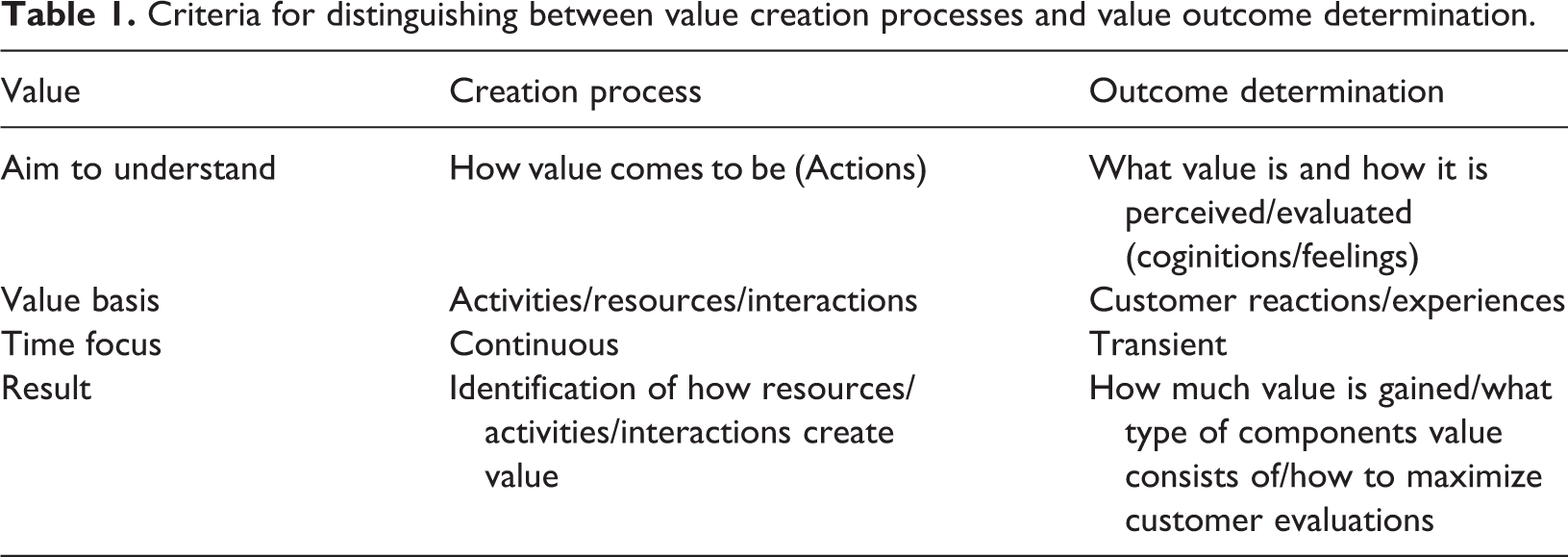
During categorization, it became clear that there are two main, high-level literature streams: value creation processes and value outcome determination. Value creation processes study activities, resources, and interactions that result in value creation, whilst value outcome determination explores how customers make value assessments and what the value outcomes are. Value creation processes tend to be continuous, whereas value outcomes tend to be tied to a specific point in time. Further support for this categorization was found from management literature: Lepak et al. (2007: 181) observed a chasm between value creation as a process and ‘the content side’, that is, ‘what is value/valuable, who values what, and where value resides. The value determination proposed here differs however from management literature in that value outcomes are viewed as subjective and result from sense-making, whereas in management literature, the concept of ‘value capture’ refers to the absolute share that a firm can take from the whole value created (Brandenburger and Stuart, 1996). The logic of the division of value into creation process and outcome determination is summarized in Table 1.
Criteria for distinguishing between value creation processes and value outcome determination.
The process logic differentiates between firm-created, co-created, and customer-created value. The outcome determination covers ‘value as means–ends’, ‘value as benefits/sacrifices’, ‘value as experience outcomes’, and ‘value as phenomenological’ – all concentrate on value as determined by the customer. The categories are further elaborated in the Appendix 1. The categorization of value literature into research streams is depicted in Figure 1.
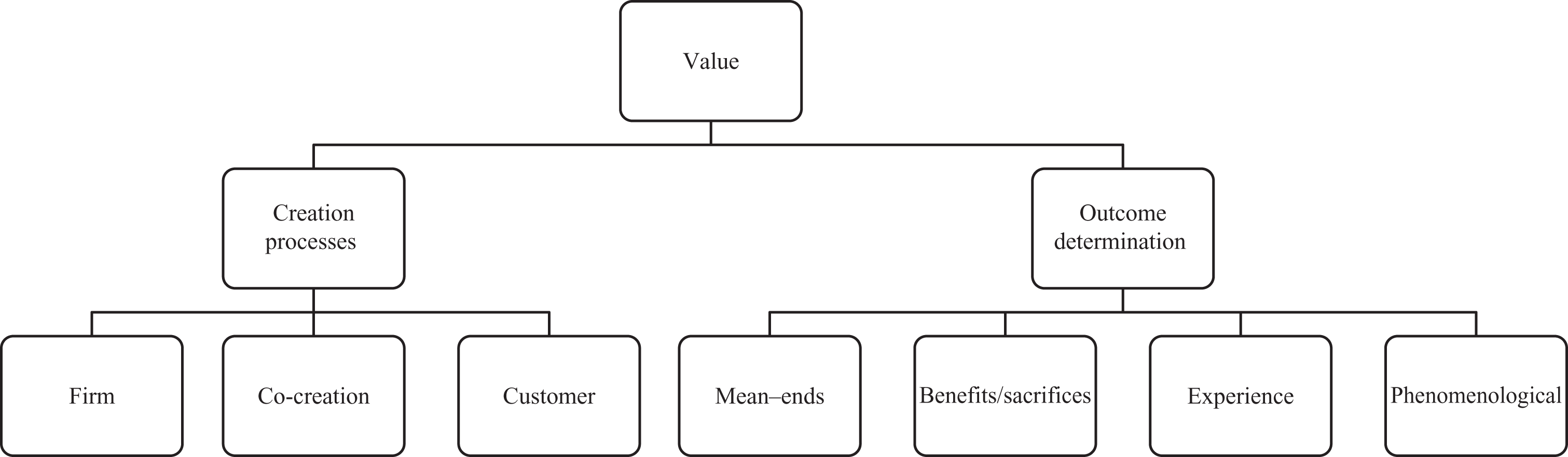
Value theory categorization.
Next, the different logics of value creation are inspected.
Value creation
Traditionally, value creation processes were placed within the firm, meaning that the firm was seen as the creator of value as it processes resources into end products (e.g. Kotler, 1972; Porter, 1985; Treacy and Wiersema, 1993). More recently, value creation literature has taken a step away from this firm-driven view. The S-D logic locates value creation processes in the interaction between a firm and a customer, as co-created (e.g. Vargo and Lusch 2006, 2008). Value co-creation has also been discussed in terms of value-creating systems (Parolini, 1999) or value constellations (Normann and Ramirez, 1994). An extremist view that places value creation in the customers’ processes or lifeworld where the customer is responsible for the value creation process has been put forth in the customer/service logic (e.g. Cova and Dalli, 2009; Grönroos, 2008; Heinonen et al., 2009, 2010; Wikström, 1996). According to customer logic, the customer lives in her or his sphere, where she or he may or may not allow the firm to enter, and where she or he engages in meaning-making on her or his own terms. Notably, all of the different approaches to value creation seem to coexist in practice, as managers rely on multiple logics in their decision-making (Brodie et al., 2006; Lindberg and Nordin, 2008). These streams are outlined below.
Firm value creation
Several frameworks address value creation at firm level, and explain how firms achieve a sustainable competitive advantage by creating value to customers. Among these are Porter’s competitive analysis framework (Porter, 1985), resource-based view (RBV) (e.g. Barney, 1991; Wernerfelt, 1984), resource-advantage theory (Hunt and Morgan, 1995, 1996), business process view (e.g. Srivastava et al., 1999), and the less frequently discussed value shop and value network (Stabell and Fjeldstad, 1998).
Value chains depict and disintegrate different firm activities and explain how they add to value outcomes (Porter, 1985), whereas the competitive forces framework of Porter (1985) explains how industry-specific competition impacts profit potential (Day, 1994). RBV on value (e.g. Barney, 1991; Wernerfelt, 1984) suggests that the creation of sustainable competitive advantage depends largely on the rarity and value of resources used in activities, and knowledge about selecting, using, and combining these resources (Priem and Butler, 2001a, 2001b). Thus, the RBV sees value generation largely as a process of maximizing ingoing resources. In addition, capabilities, that is, ‘complex bundles of skills and accumulated knowledge’ (Day, 1994: 38) help to utilise the firm’s resources to the maximum. Hunt and Morgan (1995, 1996) add a dimension of market positioning as a linkage between resources and financial performance, proposing that competitive advantage stems from a combination of superior customer value and relative resource costs.
Some authors identify specific core business processes that are proposed to lead to customer value creation. Srivastava et al. (1999) identified product development, supply chain management, and relationship management as key processes, which seem to be in line with Treacy and Wiersema’s (1993) product leadership, operational excellence, and customer intimacy. Stabell and Fjeldstad (1998), who had noticed the unsuitability of the value chain approach to service firms, proposed two additional value configurations: value shop and value network. The value shop model adapts the used resources and activities to the problem at hand. According to the value creation logic of value shops, value relates to problem solving, shifting a customer from ‘an existing to a more desired state’ (Stabell and Fjeldstad, 1998: 421). Value shops are the appropriate value creation logic when information asymmetry between the customer and the firm is large. The process is iterative and activities include problem finding, problem solving (identification of possible solutions), selecting the appropriate solution to the problem, and finally execution and control/evaluation. Value networks in turn refer to offering a networking service to customers and thereby enabling interlinkages between customers. The primary activities include network promotion and contract management, service provisioning, and network infrastructure operation. (Stabell and Fjeldstad, 1998) Although value shop and value network models acknowledge the role of customer/customers in value creation and view value creation more interlinked with other actors than the RBV, they nevertheless centre on how companies create value through their activities (by arranging these) and see customers as relatively passive actors.
Value co-creation
Value co-creation has been offered as an alternative to ‘firm–value creation’ and particularly the value chain, based on the argument that ‘no business is an island’ (Håkansson and Snehota, 1989/2006) and that the focus should be on the interface between the organization and its environment instead of the firm’s internal processes. This shift has been explained by industry-specific characteristics and more cooperative practices between firms (see Parolini, 1999; Peppard and Rylander, 2006) or firms and customers (Nambisan, 2002). Furthermore, Normann’s ‘service logic’ (Normann and Ramirez, 1993, 1994, Normann, 2001) and the S-D logic (Vargo and Lusch, 2006, 2008) propose that value is co-created by the customer and the firm (see also Prahalad and Ramaswamy, 2000, 2004a, 2004b). The underlying original assumption was that greater customer involvement would lead to increased productivity (Lovelock and Young, 1979), referring specifically to re-specified task allocation. Later, however, customer participation in service production has been found to benefit also customers (Lengnick-Hall et al., 2000). Consequently, in value co-creation literature, customer is seen as a major contributor and beneficiary. This is also reflected in S-D logic that offers a dual role for the customer as a co-creator: that of an active contributor and that of an interpreter of experiences.
Customers (as well as firms) are, according to S-D logic, resource integrators (Arnould et al., 2006; Vargo and Lusch, 2006, 2008), when they employ resources to ‘determine and enhance their own consumption experiences’ (Baron and Harris, 2008: 115). The resources may be operant (knowledge and skills) or operand (goods and materials). The customer resources have been divided into physical, social, or cultural resources, where physical resources involve energy, emotion, and strength, social resources include family relationships, communities, and commercial relationships, and cultural resources capture specialized knowledge and skills, history, and imagination (Arnould et al., 2006). Furthermore, the customer may function as a resource for the firm by providing information about needs and preferences, but also as a co-creator, who takes part in firm activities (Nambisan, 2002).
Value co-creation has also been discussed within collaborative b-to-b relationships (Anderson, 1995), where both parties are suggested to aim at mutual value creation and to share the outcomes received this way. In co-creation literature, it is typical to assume that both parties benefit from the co-creation activities (e.g Nambisan, 2002) and that co-creation is collaborative (Vargo and Lusch, 2008). At the same time, the advancement of firms’ goals of profit making may not be a key motivator for at least private customers, nor are these necessarily capable of taking an active role in value creation. They may also share value with other customers for free (Cova and Dalli, 2009). Taking a critical view on customer value creation/co-creation, Cova and Dalli suspected that, although customers add cultural and affective value to firm offerings, they do not necessarily enjoy the outcomes of this value creation.
Customer value creation
Customer value creation concentrates on what the customer does with services and products in his or her life sphere. It takes into account the activities of other parties only indirectly, as interpreted by the customer, whereas co-creation looks at activities within a network. The idea of the customer-creating value is not quite as new as might be expected. Indeed, Toffler (1980) suggested that consumers may produce goods or services for their own use, thereby becoming ‘prosumers’. He referred to the physical activities that consumers undertake to receive rewards for their own work (instead of engaging in market exchanges) and that those rewards stem from using the produced outcomes. Wikström (1996) in turn advocated that this type of logic would apply even to consumption of firm-produced goods: ‘When consumption is seen as a productive process, the consumers themselves perform the final and crucial activities in the value-creating process’ (Wikström 1996: 362). Thus, her perspective is related to seeing consumption itself as value creating. Essentially, taking a customer value creation approach means focusing on what customers do with services (Heinonen et al., 2010). Two main ways of viewing customer value creation proposed here are processes (e.g. Grönroos, 2004; Payne et al., 2008; Wikström, 1996) and practices (Korkman, 2006; Schau et al., 2009).
In customer processes, customers create value in ‘a series of activities performed by the customer to achieve a particular goal’ (Payne et al. 2008: 86). Grönroos (2006) expresses this view ‘the customers do it [create value] in their value-creating processes, in other words, in their daily activities when products are needed by them for them to perform activities’. This type of behaviour would seem to be goal-oriented and instrumental, assuming that humans are rational goal-seekers. The definitions may, however, be somewhat misguiding, as Payne et al. (2008) continue to discuss customer processes in terms of relationship experiences that constitute of emotions, cognition, and behaviour, and suggesting that customer value creation processes are often non-linear and unconscious. Within this research stream, firms are proposed to ‘support the customers’ processes with a set of resources’ (Grönroos, 2006: 360). The customer is seen as empowered, as it is the customer who constructs his or her activities: she or he may decide to produce his or her own resources instead of acquiring them through exchange (e.g. in-house production and growing one’s own food), to arrange competing activity (e.g. putting up a subsidiary and farming cooperatives), or to skip the process altogether.
Practices in turn refer to the ‘more or less routinized actions, which are orchestrated by tools, know-how, images, physical space, and a subject who is carrying out the practice’ (Korkman, 2006: 27). Value practices are based on social practice theory (Bourdieu, 1977/1985; Schatzki, 2005), which holds that human life is inherently and inseparably embedded in a context of intelligibility (Schatzki, 2005). Thus, the central characteristic of social practices is the interpretational frame, ‘the site’ (Schatzki, 2005) or clearing (Heidegger, 1978 in Schatzki, 2005). All human actions, mental states, or even identities are interpreted within this frame, or lens (Reckwitz, 2002), which depicts the meanings of phenomena. Practices hold that as opposed to being valuable per se, actions become valuable through interaction with their context (Korkman, 2006).
Value practices extend marketing to life spheres, which have been earlier explicitly excluded from marketing’s domain. Kotler (1972: 49) maintained a strong view of this: ‘Marketing does not apply when a person is engaged in an activity in reference to a thing or himself. Eating, driving, and manufacturing are not marketing activities, as they involve the person in an interactive relationship primarily with things’. Interactive relationships that entail interaction with the consumer himself or herself were also excluded. Nevertheless, more recent research has pointed out the importance of mundane, everyday activities of consumption (Carù and Cova, 2003; Epp and Price, 2008; Holttinen, 2010). Within consumer research, Holt (1995) has investigated consumption activities as creating value for individuals, whereas Schau et al. (2009) looked at how shared community practices create value. The basic argument of Schau et al. (2009: 40) is that ‘value underlies all practices and that engagement in practices is an act of value creation’. In other words, practices are the unit of analysis, rather than the outcomes of these practices. Practices do not typically question customers about their value perception, since it is assumed that customers’ ‘voluntary participation in the practice is an explicit sign of its value creation’ (Holttinen, 2010: 104): they are repeatedly performed in the past (Whittington, 2002). This underlying assumption may also be considered as a constraint in practice theory, because consumers may engage voluntarily in practices that do not create value for them. For example, customers may engage in practices because of inertia or habit. Furthermore, practices may create value for not the person engaging in it, but for somebody else: an example of this type of situation is when a parent has to cook dinner for the children, but may perceive it of little personal value.
Value outcomes
The value outcome logics concern how an actor determines the value outcome. Three of the four categories of value outcome determination logics, that is, value as means–ends, value as benefits/sacrifices, and value as experience outcomes, are consistent with the previously conducted reviews on customer value literature (Sánchez-Fernández and Iniesta-Bonillo, 2007; Woodall, 2003). The fourth category, value outcome as phenomenological, was identified from the S-D logic literature. Notably, literature beyond marketing employs value somewhat differently. In accounting, for example, value is often considered in monetary terms, for example, market value of a firm (e.g. Lev and Sougiannis, 1996). Also marketing discusses the value of customers (e.g. Kumar et al., 2006), but this discussion is beyond the scope of this study. It may be noted, however, that the value perceived by the customer is proposed to influence the value of the customer to the firm (Persson and Ryals, 2010). Next, value as means–ends, as benefits/sacrifices, and as experience outcomes will be discussed (value as phenomenological is elaborated upon in chapter 2.3 in the context of S-D logic).
Value as means–ends
The first approach, value in accordance with mean–end theories inspects product evaluations as chains from the object characteristics to use consequences (Botchen et al., 1999; Woodruff, 1997). According to this view, value can be appreciated at different levels of abstraction, with product attributes at the lowest, attribute performances at the middle, and goals and purposes at the highest level (Woodruff, 1997). After learning which outcomes are desirable and which are not, consumers are expected to adjust their behaviour accordingly (Gutman, 1982), that is, acting rationally. More recently, Grunert and Grunert (1995) proposed that mean–end chains can be primed either from the bottom (attributes–performances–goals) or from the top (goals–performances–attributes). The bottom–top priming leads to the cognitive processing of firm offerings, whilst the top–bottom priming leads to goal-directed actions (Brunsø et al., 2004). Although means–ends chains were originally proposed to be hierarchical, van Rekom and Wierenga (2007) concluded that the relationships between the concepts are symmetrical and therefore mapping concept networks rather than means–ends hierarchies would be appropriate. This has nevertheless not been reflected in value as means–ends literature (see e.g. Laukkanen, 2007).
The means–end chain approach was conceived when researchers began to combine consumers’ values (Gutman 1982; Vinson et al., 1977) to the benefit chains that described how a product leads to various benefits, for example, functional, practical, and emotional (Young and Feigin, 1975). According to this view, consumers are expected to hold values that guide their evaluations and choices (Vinson et al., 1977). The underlying values also dictate what kind of messages and activities are possible from a marketing perspective. Petit and Zakon (1962) exemplified this reasoning while discussing the role of advertising in relation to consumer values, pointing out that ‘it [advertising] must relate product characteristics and consumer benefits to values the customer has already learned’ (p. 15–16). Thus, they pointed out that marketing-related activities are conditioned by the surrounding social world. The roots of the means–end approach may be further traced back to Alderson (1957) and Dichter (1947). Alderson (1957) proposed that consumers purchase products because they serve as means to desired end states such as self-esteem or physical contentment, whereas Dichter (1947) advocated studying ‘what needs and innermost wishes the consumer expects to see fulfilled by a type of a product’ (1947: 434). Furthermore, Dichter pointed out that people tend to rationalize their activities and beliefs, and consequently would justify their choices with moral and logical reasons. It has also been pointed out that many motives are unconscious and unrecognized. People have difficulties recognizing these hidden motives, because they are such deeply held customs, conventions, and mores that are culturally and socially inbred (Black, 1956), which may limit the usefulness of means–ends theory. Originally, Reynolds and Olson (1988) suggested that means–end analysis is one way to evaluate objects (e.g. brands, products, and advertising). Nevertheless, it is unique in that it takes use consequences into account and allows the consumer freely discuss attributes, consequences, and values. Simultaneously, this flexibility has led to critique: because the assessment criteria for value are so broad, it is difficult to develop operational definitions of value that would allow its measurement (Parasuraman, 1997).
Value as benefits/sacrifices
This research stream views value as a cognitive judgment of utility (Bolton and Drew, 1991; Grewal et al., 1998; Zeithaml, 1988) made by a customer based on inputs (benefits) and outputs (sacrifices). In its simplest form, it is a ratio between service quality (benefit) and costs (sacrifice) (Brady et al. 2005) or even an assessment of a product being a good buy (Dodds et al., 1991). The benefits may include several quality dimensions (Patterson and Spreng, 1997) but also relationships (Ravald and Grönroos, 1996), time-to-market, know-how, and social benefits (Ulaga, 2003). Sacrifices range from monetary to non-monetary (see Woodall, 2003). This view can be applied to both products (Dodds et al. 1991; Zeithaml, 1988) and services (Brady et al., 2005; Patterson and Spreng, 1997).
The research stream builds upon Zeithaml’s (1988) seminal article on value as interpreted by customers. Although Zeithaml originally employed means–end chains as a theoretical base, her study identified ‘give’ and ‘get’ components that have been later investigated without a means–end approach. In Zeithaml’s study, when customers were asked what value meant in a pre-purchase situation for them, she discovered three price-laden views on value and one view emphasizing benefits. The price-laden views included ‘value as low prices’, ‘value as quality/price ratio’, and ‘value as get/give ratio’ (Zeithaml, 1988). The two first are rather straightforward, and the third one, value as get/give ratio, ‘what I get for what I give’ includes answers where customers referred to gallons for price or single portions to avoid waste, that is, it measures efficiency. The last benefit-laden view point, ‘value as whatever I want in a product’, revealed facets of the product that customers appreciate (benefits). Thus, the identified conceptualizations focused on utility and seemed to include a careful evaluation of benefits and sacrifices. It must be pointed out, however, that the study was limited to beverages that are short-term consumables. Consequently, the extensive emphasis placed on price and the lack of references to emotional, experience-embedded value perceptions may be due to the study setting.
Within this research stream, value is often studied together with service quality and satisfaction and is modelled to lead to behavioural intentions (e.g. Brady et al. 2005; Cronin et al., 2000; Zeithaml et al., 1996). Johnson et al. (2006) have added that value is a comparative judgment, in that it ‘encompasses perceptions of quality given price and inputs versus outputs relative to the competition’ (Johnson et al., 2006: 123, italics added). Furthermore, researchers have differentiated value in relation to acquisition, transaction, in-use, and redemption (Grewal et al. 1998; Monroe and Chapman, 1987; Parasuraman and Grewal, 2000).
Value as benefit/sacrifice ratio has received criticism, because it sees value as the result of consumers’ cognitive information processing (Holbrook and Hirschman, 1982; Payne et al. 2008). The criticism is based on the notion that customers do not rationally continuously calculate costs and benefits, but that consumption emotions also play a role in consumer experiences. All in all, it seems that the benefit/sacrifice approach is closely related to the neoclassical theory (of perfect competition), where consumers are expected to have similar tastes and preferences for product features, to have free access to information required to make perfect decisions, and to aim to maximize utility (Hunt and Morgan, 1996). Another issue in the benefits/sacrifices approach is the lack of benefit and sacrifice stability across consumption situations: Wendel and Dellaert (2005) found that variations in context impacted the relevance of benefits (which in fact would speak for means–ends theory or value as experience outcomes). Nevertheless, the benefit/sacrifice ratio is proposed as ‘the most popular conceptualization in marketing’ (Patterson and Spreng, 1997: 416) and continues to be used (e.g. Hume and Sullivan Mort, 2008; Moliner, 2009; Sirdeshmukh et al., 2002).
The third research stream, value as experience outcomes reflects the versatility of value experiences in consumption.
Value as experience outcomes
Value as experience outcomes aims to supplement and enrich the view of customers as logical decision makers by seeing humans as emotional sensation-seekers and is based on the seminal articles by Hirschman and Holbrook (Hirschman and Holbrook, 1982; Holbrook and Hirschman, 1982). ‘Value as experience outcomes’ combines affect and cognition of a consumer and proposes that events and ideas could also be researched. Holbrook (1994: 27) defined value as an ‘interactive, relativistic preference experience’, meaning that value is an experience based on interaction between a subject and an object as well as relative. The relativism refers to three aspects of value: value is comparative (varying between objects for a certain person), personal assessment (what is valuable for one person need not be that to another), and situational, that is, context specific. Thus, the value of an object is dependent on the context in which the judgment occurs.
Although the original work of Holbrook and Hirschman called for a phenomenological approach to value, the studies within this stream focus on value outcomes of consumer experiences, rather than holistic experiences as advocated in phenomenology (see Goulding, 1999). Consequently, the research within this streams focuses on identifying hedonic and utilitarian values (e.g. Babin et al., 1994; Batra and Ahtola, 1990; Sweeney and Soutar, 2001). Recent research has showed that the hedonic and utilitarian value categories are interrelated, but not necessarily additive. In a research project on product functionalities, Gill (2008) found that adding hedonic aspects to utilitarian base products was more effective than adding utilitarian aspects to hedonically oriented products and suggested that the hedonic image of a product may be diluted because of utilitarian additions.
In addition to hedonic and utilitarian values, categories of social, epistemic, and conditional values have been proposed (Sheth et al. 1991a, 1991b). Park et al. (1986) proposed a further dimension of symbolic benefits that refers to fulfilment of internally generated needs associated with self-image or role. Holbrook (1994) further suggested a typology of eight different types of value, of which politics, esteem, morality, and spirituality differ from Sheth et al. (1991a, 1991b). It has, however, been noted that the moral and spiritual aspects are evasive and difficult to adopt in research (Sánchez-Fernández et al. 2009).
According to Holbrook (1994), value has three dimensions: (a) extrinsic versus intrinsic value, (b) self-oriented versus other-oriented value, and (c) active versus reactive value. The first, extrinsic versus intrinsic dimension refers to the distinction between an object being a means to achieving some other objects (extrinsic value) or whether it is of value for its own sake (intrinsic). The second dimension refers in a sense to the motivational locus of value. Self-oriented value is driven by self-interest, whereas other-oriented value refers to value sought for ‘the other’, be it based on the reactions of others, the effect on others, or ‘other’ beyond the mere self-interest (e.g. the universe and one’s subconscious). The third dimension refers to a distinction between active and reactive value. ‘Active’ here means that the subject is acting upon an object or an experience and that this activity results in value. ‘Reactive’ in turn refers to an individual being more passive in the sense that he does not engage in manipulative actions, but rather lets the object or experience have its effect on him or her. (Holbrook, 1994)
This research stream is characterized by little attention being given to sacrifices, since value is typically seen as a holistic assessment. When monetary value is included as a value category (e.g. Sweeney and Soutar, 2001), no trade-off between the categories is suggested. For instance, Chandon et al. (2000) found six distinctive benefits customers may experience from sales promotion: saving, quality, convenience, value expression (feeling smart), exploration, and entertainment benefits. Sparks et al. (2008) in turn showed that timeshare industry customers enjoyed several benefits, including relaxation, gift-giving, status, and new experiences. As an ultimate example of this case, Brakus et al. (2009) abandoned the value concept and instead concentrated on measuring brand experience in terms of sensory, affective, behavioural, and intellectual dimensions. Thus, although the experiential view originally emphasized experiences, research has focused on benefits (Chandon et al., 2000) or value types (e.g. Sánchez-Fernández et al. 2009) of product/service use. In contrast to value as benefits/sacrifices, this stream does not assume that a customer would constantly calculate trade-offs between benefits and sacrifices.
The next section discusses S-D logic, and includes ‘value as phenomenological’.
S-D Logic
S-D logic addresses both value creation processes and outcomes (in terms of value-in-use), and thereby may enable combining the two. However, the relationship between processes and outcomes is not explicitly addressed by S-D logic. First, as Vargo and Lusch admit, the original focus of S-D logic (Vargo and Lusch, 2004) was on the connections between actors, not on ‘the specifics of how value is uniquely and contextually interpreted’ (2008: 4). Therefore, it is proposed that an exploration of this aspect will bring a more in-depth understanding of value literature in general and will advance S-D logic in particular. Second, Vargo and Lusch (2004, 2006, 2008) do not explicitly distinguish between value creation processes and value outcome determination. Some cues can be found, though. Lusch et al. (2007: 7) contend that ‘value is always co-created with and determined by the customer (value-in-use)’. The revised foundational premises (FPs) of S-D logic provide more information: FP6 proposes that ‘customer is always a co-creator of value’, and FP10 posits that ‘Value is always uniquely and phenomenologically determined by the beneficiary (Vargo and Lusch, 2008: 7). In addition, Vargo and Lusch explain that ‘[value co-creation] always involves a unique combination of resources and an idiosyncratic determination of value’ (2008a: 8). Thus, there seem to be two parallel activities taking place: co-creation (through resource integration) and determination as phenomenological. Cova and Salle (2008: 271) propose that value determination may reside partially within co-creation: ‘by co-creating the function as well as the meaning of its experience, the customer co-constructs value for himself’.
S-D logic gives some indication as to what the phenomenologically determined value outcomes might be. Vargo and Lusch (2008: 150) suggest that the value is created when the customer’s ‘well-being has somehow been improved’ and exemplify this with a customer feeling relieved because the service has fulfilled its value proposition and has been integrated in the customer’s life. Overall, the emphasis is on value-in-use (Vargo and Lusch, 2008) and it seems close to value as experiential (see ‘Value as experience outcomes’ section). However, the task of interpreting the S-D logic’s view on value outcomes is challenging, because the S-D logic does not reveal to which phenomenological approach it ascribes. Looking at the characteristics of phenomenology, Goulding (2005: 303) points out, based on Stern, that phenomenologists’ hope to ‘discover the deeper meaning of the ‘lived’ experience in terms of the individual’s relationship with time, space, and personal history. This is in stark contrast to the studies classified under ‘value as experiential’, which mainly wish to establish and/or quantify benefit or value categories.
To clarify the relationship between value co-creation processes and value outcomes in S-D logic, these are inspected from three angles: (1) actors (multiple vs. single), (2) activities (resource integration/interaction vs. determination by experience), and (3) context (network vs. embeddedness in lifeworld). Each is discussed in turn below.
Actors
The actors engaged in value creation processes versus determination of outcomes differ. In co-creation processes, several parties are involved in the activities through the integration of resources. As Vargo and Lusch (2008: 5) put it ‘value creation takes place within and between systems at various levels of aggregation’. Outcome determination, on the other hand, is proposed to be done by a single actor, as outcomes are ‘uniquely determined’. This asymmetry is important, as it means that the perspective shifts between multiple and one: in co-creation processes, the perspective is that of a network, whereas in outcome determination, it is that of an individual.
When several actors engage in value co-creation processes, but one actor determines the value outcome, one party interprets the goodness of the activities of multiple parties based on one’s individual perspective, that is, his or her subjective interpretation. A question arises whether not all of the actors would get to determine value from their own perspective (it is possible that this is the meaning of Vargo and Lusch, 2008). Accordingly, multiple actors engage in co-creation processes, create experiences and thereby determine value. This approach would bring on a par the actors of creation processes and outcomes.
Activities
According to S-D logic, parties share their operant (knowledge and skills) and operand (goods and materials) resources (Vargo and Lusch, 2008). Outcome determination is phenomenological and experiential, referring to a beneficiary’s feeling, thinking, wanting, sensing, imagining, and acting (an interpretation made based on Thompson et al., 1989, who discussed existential–phenomenological consumption). A phenomenological experience in turn is a dynamic process during which some events stand out, whilst others remain in the background (Thompson et al., 1989). These figural events are those the customer pays attention to.
First, if ‘value creation is interactional’ (Vargo and Lusch, 2008: 7) and thus takes place between the customer and network actors (co-creation/exchange of resources), the interaction would be a figural event (standing out) in the customers’ experience world, that is, the customer assumedly would pay attention to. This does not seem necessary. Instead, it would be more logical to view the interaction as one element in the customer’s lifeworld, where the interaction may be more or less figural and that the customers may also create value without engaging in network activities. Accordingly, many consumption activities exist beyond the marketing sphere (Carù and Cova, 2003) and the customer can create value for himself or herself with or without interaction with a firm (Grönroos, 2008).
Second, provided value outcomes are accepted as phenomenological (i.e. experience-based), it would seem unlikely that customers (as determiners of value) would distinguish between activities directed at value creation and lived experiences (on which value outcomes are based). It may be that some value outcomes emerge since consumption is based on directed behaviour, whilst for other tasks, outcomes only become evident when customers reflect on the activity, if even then. The phenomenological approach assumes that the customers engage in unreflected processes, which may become reflected, for instance, when customers are probed to narrate them and may attach valence on the outcomes (i.e. the customer understands his or her behaviour when she or he reflects on it; Thompson et al., 1989).
Context
As mentioned, value creation processes take place at network level (Vargo and Lusch, 2004, 2006, 2008), whereas determination of value outcomes takes place in an individual’s lifeworld. Within these life contexts, consumption related activities may include acquisition, consumption, and disposition (Jacoby, 1978) but also owning or appreciation (Ravald, 2001; Holbrook and Corfman, 1985).
Network as a context assumes that firm–customer relationships are embedded in a broader context of society and life (Gummesson, 2006), which implies a macro perspective. Vargo (2008) proposed that understanding value creation would require ‘zooming out’ to view the whole network. According to this perspective, ‘customer is just another node in the larger ecosystem and the actor-to-actor transaction serves as a platform for further value creation in that larger context’ (Vargo, 2009: 377). Furthermore, Vargo (2009) proposed that firm–customer distinction could be abolished, and all actors could be viewed as nodes, which would also denote distance from individual actors. Regarding value outcomes, the perspective is inevitably one of ‘zooming in’, since determination of value outcomes is based on individual experiences (Vargo and Lusch, 2008). As discussed, individual context is that of a lifeworld, and phenomenological experiences are embedded in it. According to the existential–phenomenological view (Thompson et al., 1989), the focus is on a first-person view based on a lived experience. Mick and Buhl (1992) have shown how individuals’ sense-making is dependent on their life themes and projects, and that the meanings that consumers attach to marketing activities may differ even between family members.
Propositions for advancing value research
In this section, a set of propositions are presented in order to enrich value outcome determination as well as value creation literature.
Proposition 1a: Multiple perspectives on value outcomes coexist: all actors (firms, customers, and other stakeholders) determine outcomes
Proposition 1b: The multiple perspectives on value outcomes may be negative and/or asymmetric
Recent advancements of the S-D logic propose that multiple uniquely determined value-in-uses coexist (Vargo et al., 2008) for separate service systems. The service systems that Vargo et al. (2008) use as examples refer to a firm (service system 1) and a customer (service system 2), and propose that both actors can be outlined as resource integrators that determine value-in-use. Consequently, I propose that value outcome (or value-in-use) perceptions are multiple (proposition 1a), an issue that is currently implicitly embedded in the foundational premises of S-D logic (see Vargo and Lusch, 2008).
A presupposition that is also implicitly built in the S-D logic is the positive nature of value co-creation, which is evident in the embedded vocabulary, in particular, the word ‘beneficiary’ that refers to any actor who determines value (see e.g. Vargo, 2008; Vargo and Lusch, 2008). Given that value outcomes are not automatically generated but rather depend on the subjective determination of value, the connotation of the word is misleading; for example, when a service fails to fulfil its purpose, it would be unlikely that the person evaluating it would state it had value-in-use. In addition, the multiple value outcomes need not be symmetrical across parties: a positive value outcome from one point of view can be coupled with a negative value outcome from another point of view; leading to proposition 1b. As a direct consequence of the above discussion, the word beneficiary used in S-D logic should be replaced, because it implies an actor enjoying a positive value outcome. To summarize, as value outcomes are subjective, they require an anchoring point, a reference to the subject from whose point the value outcome is evaluated.
Proposition 2a: Value creation processes may be individual (creation) or shared (co-creation)
Proposition 2b: Value co-creation processes may be interconnected and/or asymmetric
Proposition 2a is based on the reasoning that in a typical consumption context, value is not co-created in the sense that two parties would act to reach a common goal. Rather, in many instances, individuals perform activities without firm participation. In these cases, customers often use firm resources to create value, but this is not the same as co-creation. This may seem like a petty difference, but in fact it is not. A mindset where value ‘can not be created unilaterally’ (Vargo and Lusch 2008:8) is dangerous, because it may spur the illusion that firms cohabit the lifeworld of customers – a vision which is mere wishful thinking. Along the same line of reasoning, it is here emphasized that the firm may create value for itself by, for example, improving its internal processes. Thus, it is believed that multiple value creation logics may coexist and not necessarily clash. In many cases, customers and firms (i.e. employees or service systems) do co-create value. Consequently, value may be created by the customer (firm) alone in his or her activities, or together with a provider or other customers. As pointed out by Gummesson et al. (2010: 13), ‘they [customers] create for themselves and they co-create with others’.
These ideas are in line with Grönroos (2008, 2009), who has distinguished between suppliers’ production processes, customers’ value generation processes, and joint value co-generation and emphasized that co-creation takes place when a customer and a supplier interact to co-create value. Consequently, it seems clear that different subjects have their own value generation processes that sometimes overlap: Grönroos (2006) has illustrated this with his definition of the role of marketing as a supporter of value generation in the firms’, customers’, and other stakeholders’ processes. This means that one should be aware of eventual differences in these processes, as they may be distinct or overlapping (Grönroos, 2009). In some cases, the parties may strive for positive outcomes for both, but even the best of intentions do not necessarily develop towards a positive direction for all parties.
Proposition 2b builds on the notion that value creation processes may clash between customers, firms, and other stakeholders, because the actions of the different parties need not be aligned. This is in line with Edvardsson et al. (2010) who contend that the relationship between parties may be asymmetric, and that any of the parties may behave opportunistically. Processes may also have negative, unintended consequences. In a recent study, Chan et al. (2010) found that customer participation in value creation is not necessarily positive from employees’ point of view: although employees reportedly experienced customer–employee interaction as more positive under greater customer participation, they also experienced heightened levels of stress and lower levels of job satisfaction.
Proposition 3: Experience is the missing link and the common denominator of value creation processes and value outcomes
I propose that the service experience creates the linkage between value creation/co-creation processes and value outcomes. This inference is based on two basic assumptions: (1) customers provide the frame for interpreting creation/co-creation activities (e.g. Cova and Dalli, 2009; Peñaloza and Venkatesh, 2006; Rowley et al., 2007) and (2) when customers engage in creation/co-creation activities, service experiences are created (Prahalad and Ramaswamy, 2004a, 2004b) as customers act, sense, and think during these events. The relationships between the concepts are depicted in Figure 2, with arrows implying shifts.

Unifying value co-creation processes and value outcomes.
This proposition is also in line with the view that ‘the value of consumption comes from the consumer’s experience, both for the company and the consumer’ (Addis and Podestà, 2005), where ‘experience is the core of consumption … for one simple reason: experience is the decomposition of the individual’s life’ (Addis and Podestà, 2005: 404). Similarly, Helkkula and Kelleher (2010) proposed that customer service experience and customer perceived value are circular, in that experiences impact perceived value, which in turn impacts subsequent experiences.
Conclusion
This article has reviewed literature and put forth two main research areas of value, namely value creation processes and outcomes. It has also opened up the logics behind different literature streams that investigate value. The literature review emphasizes that value research involves a number of research streams whose results and underlying ideologies are not necessarily comparable or compatible. By providing a categorization of value research, the categorization provided helps researchers to both interpret and design studies on value. The choice of the research stream applied is partially a question of how the researcher believes the human mind functions, partially of the research question one is seeking to solve. The categorization and the propositions put forth in the present article have a number of implications for theory development and future research.
Theoretical implications and further research
The theoretical implications of this research are fourfold. First, instead of seeing the value created as absolute and objective, it is here proposed that there might coexist multiple different perceptions on what value is, how much of it has been created, and how much of it the different parties receive. Thus, in contrary to management theory, which proposes studying value capture as the share of total (monetary and objective) value that any one party receives (e.g. Brandenburger and Stuart, 1996; Lepak et al., 2007); this article suggests that the value is subjective, and that the different parties may have diverging perceptions of the value created and shared. This also makes perceptions of fairness important, since the parties may not share the same view on who is benefiting from value creation.
Second, when multiple actors are involved in value creation processes and outcome determination, the perspective needs to be anchored to a certain actor, for example, firm, customer, other stakeholders, and network (multiple). Given that value outcomes may also be negative, a less value-laden word than that of beneficiary used in S-D logic to implicate the value determiner should be chosen instead, for example, commercial versus private actors, which would also denote the perspective taken. It is further acknowledged that the different parties’ perceptions may also be interdependent and influence subjective value determination. In a family context, Epp and Price (2008) proposed that family identities involve individual, relational, and collective identity practices that family members try to manage while consuming. Similarly, in business contexts, individuals may need to take into account all actors within their network and to manage multiple group associations while making sense of value outcomes – in other words, they may have to try to inspect value determination from different actors’ diverging perspectives. The multiplicity of perspectives also means that future research should investigate to what degree firm and customer value outcome determination collides and/or diverges, for instance, how firms make sense of customer sense making, and what firms think customers value versus what customers in fact experience as valuable. This way, the perceptions of different parties can be studied and eventual discrepancies diminished. For example, service marketing advocates a similar approach for understanding how well the firm succeeds in meeting customer expectations (see Zeithaml et al., 1993). Linked to the multiplicity of actors, it is further proposed that any value creation logic can prove useful. For example, a firm may inspect its own processes to improve them (using firm value creation logic), have collaborative co-operations for value co-creation (using value co-creation logic), or investigate customer value creation processes to understand the role of the firm offering in them (using value creation logic). Conceptual clarity is however important, and therefore it is proposed that co-creation takes place when the parties (a) all benefit, (b) willingly participate in the activities, and (c) acknowledge their and the other parties’ roles as contributors.
Third, the existence of multiple levels of analysis should be recognized. At a network level, there are many actors and activities required to realize certain outcomes, but their role is necessarily not acknowledged or even understood by the party (parties) determining the value. Thus, the degree to which the value determiner interprets the role of the other parties in value creation and attributes final outcomes to them is crucial. Moreover, value creation processes can be investigated in comparison with outcome determination to identify which activities are experienced as positive and which as negative, how they influence value outcomes (as customers may not realize their impact) or investigate patterns for value creation processes in general. This may be done in terms of reflected experiences, or practices to identify the activities and resources involved in experience construction. Customer processes and practices are an interesting unit of analysis, in that they offer insight into the kind of behaviours customers engage in, what they do with services, and what types of resources they use. Further studies should investigate value creation processes and value outcomes to shed light on whether the two can offer complementary knowledge about value from the customer point of view.
Fourth, the role of experiences as the common denominator for value creation processes and value outcomes should be investigated further. The nature of the links between the different phases (activities–experience–reflected experience–interpretation/determination of value) requires further research. The same issues that restrict free will in consumer choice exist in consumer experiences – consumers ‘may have less knowledge, ability, and time’ (Mick, 2008: 18), and thus the experiences easily remain unreflected. If and when unreflected experiences become reflected, the customer comes to make sense of the experience in a new way and to determine value outcomes by scrutinizing the experience. The important question is how unreflected experiences become reflected. One example mentioned in previous research is when a customer is questioned about his or her behaviour, and comes to interpret this behaviour (Thompson et al., 1989), but other factors are bound to exist. Finally, as this article and the propositions presented in it are based on conceptual evidence, any ideas put forward need to be subjected to empirical investigation.
Managerial implications
The division of value into creation and outcome determination offers managers a more systematic view on value, and acknowledgement of the number of actors encourages them to approach value from multiple perspectives: from the firm’s, from the customers’, and from the other stakeholders’ perspectives. Previously, for example, Normann and Ramírez (1993) suggested that the focus should be placed on the entire value-creating system and its optimization. Optimal value would be one that maximizes the additive outcomes of all parties involved. However, it is here argued that value is subjective rather than objective, meaning that no sharable objective net outcome exists, but rather subjective perceptions of value. Furthermore, some parties may simply be losing, rather than benefiting from network activities. Consequently, it may be difficult or even impossible to define system-specific value, although network perspective may help understand the interdependencies between actors. The firm can thus aim at improving the value outcome for itself and for the other parties (i.e. sees as key actors), handling each as a separate entity.
Managers also need to acknowledge the interdependencies between actors. For example, one customer might feel that the participation of another customer undermines the whole experience; for instance, a customer uses a brand to signal his or her identity, whereas another customer shuns the brand because the person–brand association is perceived as negative. A reversed situation takes place when a number of other customers are necessary for value creation, for instance, in social networks, where the value grows as the number of users grow (see Stabell and Fjeldstad, 1998). In consumer markets, these phenomena may be particularly valid for objects (products or services) that are used to classify their consumers, or for shared experiences/use (Holt, 1995; Levy, 1959). The same logic also applies to industrial co-operation, where collaboration may create more value as the parties are able to develop complimentary offerings, and where establishing relationships with some parties may lead to disruptions of other relations.
It is further proposed that it is useful to view the firm as a visitor in the customer’s life sphere (Gouillart and Sturdivant, 1994; Grönroos, 2006), and that customer experiences can be studied with a number of approaches. The task for the company is to identify where its inputs are welcomed – Normann and Ramirez (1993) propose that firms can co-create value by either relieving or enabling. Relieving means assigning activities that customers previously took care of themselves, enabling means that customers may do things that they could not do previously, or can do these things better. By inspecting customers’ current practices, marketers may discover inefficiencies, and plan appropriate marketing activities accordingly. It is simultaneously important to focus on future solutions and shaping the market conditions, that is, future value creation. Furthermore, customer value perceptions should be linked to the firm, but this depends on the degree to which they attribute the value co-creation to themselves or to the firm. Therefore, it is important to consider strategies that help the customer acknowledge the role of the firm in value creation. Customers may also be encouraged to contribute beyond their role as purchasers and users: Nambisan and Baron (2007) found that consumers may co-create value through product ideation, design and development, testing, and product support. Other possibilities involve content creation and word of mouth.
It is also proposed that firms can benefit from understanding customer life themes, because these are likely to reveal general aspects of what customers perceive as important. An important underpinning is the logic that the firm applies in making sense of customer value creation processes and outcome determination, and the ways in which the firm researches these. The different value determination logics help managers to make more informed decisions whilst studying customer perceptions of the firm offering. With the help of investigating value as means–ends, firms may inspect the role of their offerings in relation to customer values, whereas value as benefits/sacrifices sheds light on the trade-offs customers are willing/have to make. Value as experiential and value as phenomenological put more emphasis on the perceptual world of customer experiences. Value may further be inspected in terms of pre-purchase, use, and redemption value to analyse eventual improvement opportunities in firm activities at the different stages.
The firm’s task is defined as making a contribution to the consumers’ own value creation (as well as streamlining the firm’s and the network’s activities), in which the firm offering may be a vital ingredient. Thus, also targeting could be based on consumer–firm offering fit, where those customers who can benefit from the firm offering, or can create value for the other customers/the firm/the network are seen as the most attractive ones. In essence, marketers’ task is not only to look at what customers want from a firm, but to see what customers do in their life sphere, what their daily life is like, what are their resources and capabilities, what kind of mundane problems they have, and what kind of aspirations or spiritual needs they have. By taking a multifaceted view on the customer’s lifeworld, a marketer can get an in-depth understanding of customer realities and thus assure long-term competitive edge.
Footnotes
: Value categorization
| Approach | Research question/aim | Value conceptualization | Authors | Theoretical assumptions | View on customer | Value locus |
|---|---|---|---|---|---|---|
| Value creation process logics | ||||||
| Firm creation | How firms gain competitive advantage through their activities/resources | Value stems from firm resources and capabilities by (1) application of these on specific markets, (2) through problem solving, and/or (3) creating networks | Hunt and Morgan (1995), Porter (1985), Stabell and Fjeldstad (1998) | Multiple logics, for example, value chains, core business processes, resource-based view (RBV), value shops, value networks | Consumers as external to the firm (RBV), as the starting point (shops), as resources (networks) | Value creation of firms |
| Co-creation | How operand and operant resources are applied in co-creation | The interactional nature of value as value is co-created | Vargo and Lusch (2004, 2008) | ‘Value results from the beneficial application of operant resources sometimes transmitted through operand resources’ (Vargo and Lusch, 2004: 7) | Customer as co-creator (2008) and an operant resource (i.e. knowledge and skills, 2004) | Co-creation |
| Customer value creation | ‘to develop understanding of how value merges according to the practice-theoretical stance’ (Korkman, 2006: 162), that is, how value is formed | Customer value is a ‘sociological phenomenon that is constructed in the combination of people, people and material, and culturally embedded rules, images, etc.’ (Korkman, 2006: 167) | Korkman (2006), Schau et al. (2009) | Customer value embedded in practices, it is neither objective nor subjective, it is formed in practice, is enhanced through intervention (Korkman, 2006:47) | Customer as a holistic being, living his or her life | Identification of customer practices, for example, social networking, community engagement, brand use, and impression management (Schau et al. 2009) |
| Value outcome determination logics | ||||||
| Value as benefits/sacrifices | How customers perceive sacrifices versus benefits? Which sacrifices/benefits are relevant? | Benefits/sacrifices ratio | Bolton and Drew (1991), Patterson and Spreng (1997), Voss et al. (1998), Zeithaml (1988) | Perceived value results from perceived quality, perceived sacrifice, extrinsic/intrinsic attributes, and high-level abstractions | Information-processing, value maximizing | Perceived quality, extrinsic and intrinsic attributes and high-level abstractions weighted against perceived sacrifices |
| Value as means–ends | ‘How a product or service selection facilitates the achievement of desired end states’ (Gutman 1982: 60) | Consequences can be physiological, psychological, or sociological | Gutman (1982), Woodruff (1997), Woodruff and Gardial (1996) | (1) Values (desirable end-states of existence) guide choices (2) Customers group products into sets or classes to reduce complexity | Information-processing, seeking desired consequences and minimizing undesired consequences | Direct consequences from the consumed thing or from the consumption act. Irndirect consequences when others react to consumer due to the consumption behaviour |
| Value as experience | What types of value customer receives through product use? | Several value types, for example, hedonic (emotional), utilitarian (functional, monetary, convenience), social value | Holbrook and Hirschman (1982), Sheth et al. (1991a, 1991b), Sweeney and Soutar (2001) | Environmental and consumer inputs interact when the customer responses to inputs with cognition, affect, and behaviour. | A consumer-customer who is fantasizing, feeling, and seeking for fun, as a supplement to information processing perspective | Fun or pleasure derived from product consumption (in addition to eventual utility value), based on subject–object interaction |
| Value as phenomenological | ‘Value is always uniquely and phenomenologically determined by the beneficiary’ (Vargo and Lusch, 2008: 7) | Value is idiosyncratic, experiential, contextual, and meaning laden | Vargo and Lusch (2004, 2008), Helkkula and Kelleher (2010) | Value is phenomenological/experiential | Customer as experiencing and determining value | Value connected to individual subjective experiences |

Acknowledgements
The author is grateful for the financial support provided by the Waldemar von Frenckells stiftelse foundation. The valuable comments of the three reviewers as well as the feedback on earlier versions from Veronica Liljander, Christian Grönroos and Annukka Viitanen have greatly helped improve the article.