



Abstract
Non-commercial exchanges including social and political ones have become an accepted marketing explanandum since the broadening debate of marketing of the 1970s. In order to build a theory of political marketing, a rigorous understanding of the nature of the political exchange needs to be developed beyond the simplistic assumption of being synonymous with commercial exchange. The service characteristics of the political offering only make full sense if understood as being triadic interactions rather than dyadic exchanges. Thus, the presumptive effect of political services only comes to the fore if the interaction between candidates and voters (in the electoral market) is seen as interdependent with interactions between the candidates in the legislative assembly (in the parliamentary market) and between legislators and citizens (in the governmental market) as part of a wider political exchange system. This triadic structure of the political exchange nuances the current research focus by embedding the electoral interaction within a wider interaction system. Our article thus provides an initial attempt to develop a broadened concept on which further theory building as well as empirical analysis in political marketing can be based.
Introduction
Marketing theory is conceptually grounded in an understanding of exchanges and interactions between actors. With the broadening of the marketing concept into non-profit areas in the late 1960s and 1970s (e.g. Kotler, 1975; Levy and Kotler, 1969), non-traditional and social exchanges have joined commercial exchanges as being essential to the understanding of marketing as a research area and organisational practice. The underlying rationale for an exchange, irrespective of context, is the concept of reciprocated value, and social exchange theory is generally assumed to be fundamental to understanding this feature of marketing (Blau, 1964; Homans, 1961). Therefore, it is important for marketing theory to understand and incorporate the relevant underlying exchange structures and the corresponding aspects of value, power, and (inter-) dependency in research and explanations of marketing phenomena. This is irrespective of whether the actors involved operate in the commercial or non-profit market.
Arguably one of the more unconventional arenas in which exchanges take place is the political marketplace. The characteristics of interactions between actors have been identified as one reason why the application of marketing theory to the sphere of politics, whilst legitimised by marketing scholars more than 30 years ago (e.g. Kotler, 1975), remains difficult, complex, and unresolved (Henneberg, 2002; Lock and Harris, 1996; O’Shaughnessy, 2002). The aim of this article is to demonstrate that exchanges as we know them from the commercial marketing literature do occur in the political marketplace, but that a successful political exchange is dependent on the result of three dyadic interactions that enable value to be reciprocated. This article is therefore motivated by a desire to contribute to the wider marketing literature and goes some way to resolving some of the problems associated with the application of commercial marketing theory to the political marketing context (Lock and Harris, 1996).
This article begins with a discussion of the exchange concept in marketing theory, which provides the conceptual grounding for our subsequent argument. After this, we compare the characteristics of a commercial exchange to the specific characteristics of the political marketing exchange. We then propose a new conceptualisation of a marketing exchange that is developed with the political context in mind, consisting of a triadic constellation of three dyadic interactions. This redefines the exchange in the political marketing context by introducing interaction structures, which together constitute the basic exchange model of political marketing. Finally, we discuss the implications of the triadic interaction model of political marketing exchange.
The exchange concept in marketing theory
It has been argued that marketing is fundamentally an ‘exchange’ theory, grounded in and derived from Social Exchange Theory (Blau, 1964; Homans, 1961), more specifically the (inter-) dependence theory of exchange (Emerson, 1972; Molm, 1994) and the reciprocal theory of exchange (Emerson, 1981). As Kotler and Levy famously put it: ‘the crux of marketing lies in a general idea of exchange rather than the narrower thesis of market transactions’ (1969a: 57). Exchange became a central tenet during the 1950s in what Wilkie and Moore (2003) have described as the transition from the traditional approach of marketing to the modern school, with the work of Alderson (1957, 1965) being the catalyst for this transition (Easton and Araujo, 1994; Shaw and Jones, 2005). Business exchanges (or ‘market transvections’; Alderson and Martin, 1965) were generally understood to be a subgroup of generic or social exchanges (Bagozzi, 1975; Shaw and Jones, 2005), enabling ideas from (individualist) Social Exchange Theory (Blau, 1964; Homans, 1961) and social embeddedness concepts to contribute to marketing theory (Granovetter, 1985; Polanyi, 1957). Consequently, second-level constructs of marketing were derived, for example, goal-seeking behaviour of the involved parties based on intended needs satisfaction (Bagozzi, 1975; Houston and Gassenheimer, 1987) and ‘mutual value’ as a foundation for exchanges to occur (Bagozzi, 1978; Kotler, 1972). More recently, discussions surrounding ‘value co-creation’ (Prahalad and Ramaswamy, 2004) and the service-dominant logic of marketing (Vargo and Lusch, 2004) have questioned the role of the consumer in the production of value (Arvidsson, 2011; Cova et al., 2011; Grönroos, 2011), especially in the information age (Ritzer and Jurgenson, 2010).
In Hunt’s (1976) ‘liberalized thesis of marketing’, any interaction of at least two actors, each possessing something of value to the other actor and who are capable of exchanging and are able to either accept or reject such an exchange, can be the focus of marketing research. Such an exchange structure could potentially encompass most if not all human activities (Houston and Gassenheimer, 1987). Indeed, attempts have been made to apply marketing to essentially social exchanges (e.g. heterosexual partner-seeking behaviour; Murgolo-Poore et al., 2003). However, Bagozzi (1975, 1978) attempted to develop a more circumspect general exchange theory as underlying marketing, based on social actors, their interactions, and situational variables. This was subsequently criticised as a mere conceptual framework (Ferrell and Parrachione, 1980) and the conceptual broadening of marketing was considered to have had a greater impact on marketing practice than on theoretical developments (Arndt, 1979). Building on Bagozzi’s work, Hunt defined the explanation of exchange relationships as the crucial aspect of marketing theory and consequently as being a behavioural science. Specifically, an exchange can be described by the following dependent variables of what Hunt calls ‘fundamental explananda’ (1983: 13): the behaviour of the exchange partners, the exchange environment in which the interactions take place, and the environmental consequences of the exchanges. However, these elements have been criticised recently by Hyman (2004) for pedagogic and practical reasons.
The exchange concept in marketing theory has also not been without criticism. Houston and Gassenheimer (1987) observe that it is still unclear whether or not marketing and exchange theory are one and the same, whether they are parallel theories, or whether one is a subset of the other (and if so, which is which?) (Foxall, 1984; White, 1986). Furthermore, whilst marketing as exchange is based on individual agency, that is, two or more individual actors that are nevertheless bound together via interdependencies (Ford and Håkansson, 2006), this micro-view has been opposed for being insufficient to analyse exchange structures, that is, macro-phenomena. An institutional political economy paradigm has been proposed (Arndt, 1983) and implemented (Pandya and Dholakia, 1992) to complement the micro-perspective of marketing. Another argument relates to the fact that marketing focuses on exchange outcomes, whilst economic exchange theories also take inputs into account as part of the production process (Ferrell and Perrachione, 1980; Houston and Gassenheimer, 1987). However, as Shaw and Jones (2005: 267) state in a recent review of marketing schools, exchange theory as a generic concept underpinning marketing ‘is now largely taken for granted, an accepted and powerful idea among students of marketing thought’, although one may wonder whether it has fundamentally influenced mainstream marketing writing (Easton and Araujo, 1994; Levy, 2002).
The exchange concept in political marketing research
Political marketing uses the conceptual foundation of marketing theory applied to non-profit political exchanges (Henneberg, 2002). Political marketing is part of the broadened scope of marketing introduced in the 1970s and 1980s that incorporated non-profit and social exchange phenomena in the marketing domain (Hunt, 1983; Kotler, 1972; Kotler and Levy, 1969a, 1969b). This also encompasses social marketing, that is, the use of concepts and tools from commercial marketing theory and practice to further social idea(l)s (Kotler and Zaltman, 1971; Levy and Kotler, 1969). Therefore, the conceptual existence of political marketing as a marketing phenomenon is directly linked to the theoretical treatment of exchange phenomena by marketing theory (Kotler, 2005).
In order for marketing science to provide a rigorous conceptual framework in the political sphere, political marketing needs to be based on an understanding of the unique nature of political exchanges and especially on their differences from commercial exchanges, which inform on traditional marketing theory (Lock and Harris, 1996). At least one marketing theorist has argued that the political sphere should be excluded from the marketing domain because no value-exchange exists (Carman, 1973). However, Kotler (1972) and Hunt (1976) explicitly include political exchanges to illustrate the scope of marketing, and Sheth (in Newman, 1994) argues that a core marketing concept, that of market orientation, is a de facto element of modern political practice.
It is worthy of note that non-profit and social marketing seem to be almost exclusively defined in terms of service exchanges; thus, a substitution under services marketing was also suggested (Arndt, 1982; Butler and Harris, 2009). Non-profit and social marketing exchanges are arguably more complex as they are structurally different to the basic buyer–seller dyad that underpins commercial exchanges, irrespective of whether these exchanges are between organisations or between organisations and consumers. Such differences have implications for the non-profit marketing management activities that are appropriate or even possible, as well as implications for the applicability of marketing concepts (Baines et al., 2003; Cornelissen, 2002). In the political marketplace, the successful reciprocation of electoral support for sound government between voter and candidate is reliant on three elements. First, that the aggregated result of the election enables the candidate to represent the voter in the parliament. Second, that the successful conclusion of negotiations in the parliament with other elected representatives provides support for the offering. Finally, that the environmental conditions allow governments to enact legislation to reciprocate the value linked to the initial electoral support.
Having identified the exchange as the underlying construct of marketing theory, when developing a specific theory of political marketing, it is necessary to compare the similarities (or dissimilarities) of exchanges in the commercial and political domains. The often implied equivalence of these exchanges, or at least the accepted adaptability of marketing concepts based on commercial exchanges (Reid, 1988; Ormrod and Henneberg, 2010), represents an underexposed aspect of contemporary political marketing thought (Scammell, 1999; for an overview of historical origins of the ‘political market’ analogy see Schwartzkopf, 2011). Analysing the political exchange situation and discussing its implications for marketing activities in the political sphere provides, using Enis’ (1973) terminology, a ‘deepening’ of the concept of political marketing. This means not so much a focus on the content of the exchange/exchanges, although this is also of importance, but primarily on the structure or description of the exchanges, that is, the morphology of the political market.
The dangers of a ‘one-to-one’ transfer of commercial marketing theory and tools to application in politics have long and often been noted, the best example being the misleading notion of ‘selling politics like soap’ (Baines et al., 2003; Collins and Butler, 2002; Kotler, 1975; Lock and Harris, 1996). Bagozzi (1975) demonstrated the importance of understanding the qualitative difference between commercial exchanges and non-commercial exchanges in his example of social policy issues for the underlying marketing management activities. On the other hand, Egan (1999) has argued that exchanges that occur in political campaigns are more similar to traditional commercial exchanges than normally acknowledged in the literature. Whilst research generally agrees that there is a difference (Baines et al., 2003; Collins and Butler, 2002; Dermody and Scullion, 2001; Lock and Harris, 1996), very little theoretical work has been forthcoming that explicitly analyses the exchanges in the political context and describes the implications for political marketing theory and the practice of political marketing management (Henneberg, 2008). Too often, the political exchange is sidelined from discussions in political marketing research.
Nevertheless, several authors have put forward interpretations (often implicitly) of political exchanges. In general, political marketing or the ‘political market’ is defined exclusively in relation to exchange processes that are related to electoral competition, that is, campaign activities (Baines et al., 2002; Butler and Harris, 2009; Kavanagh, 1995; Maarek, 1995; O’Cass, 2009; Scammell, 1995, 1999; Wring, 1999, 2005); an exception is Hughes and Dann (2009). This is very much in line with Schumpeter’s theory of the political entrepreneur (Bartle, 2002) and other micro-economic market and rational choice-related models (Butler and Collins, 1996; Downs, 1957). Although a wide range of stakeholders have been identified as relevant actors in the political marketplace (e.g. Dean and Croft, 2001; Henneberg, 2002; Kotler and Kotler, 1999; Newman, 1994; Ormrod, 2005), the most common application of political marketing research is in the context of a campaign.
Kotler (1972) describes the exchange between political candidates and the voting public as characterised by an offering of ‘honest government’ in exchange for votes. In a further development, Kotler and Kotler (1999) analyse the political marketplace, but restrict themselves to candidate-centred exchange situations with multiple stakeholders (voters, media, party organisations, party contributors, and other interest groups). However, the continuation of ‘campaign-like’ exchanges as part of governing has been noted under the construct of the ‘permanent campaign’ (Blumenthal, 1980; Steger, 1999), but this is normally seen as a type of aberration, for example, in an assessment of Clinton’s presidential years (Nimmo, 1999). As part of the electoral or campaign focus of political marketing exchanges, it is common to emphasise the ‘service-characteristics’ of the exchange process and the offering (Butler and Collins, 1999; Butler and Harris, 2009; O’Shaughnessy and Henneberg, 2002; Scammell, 1999).
Exceptions to this exclusive focus on elections do however exist. Harrop (1990: 279) describes the political offering as ‘governing’ and makes a link with the ‘monopoly franchise’ of one government as the single service provider at a particular time. Similarly, Butler and Collins (1999) describe some structural aspects of the wider political exchange, such as offering characteristics, the ‘market’ structures, or value elements, although they do not characterise the exchange itself. Butler and Collins (1999) focus primarily on campaigns; however, they allude to the fact that ‘implementation’ and value delivery is an additional aspect. On the other hand, O’Cass (2009) considers value delivery to be a more central element in discussions of political marketing. Henneberg (2002) provides a structural model of political exchange, linking different political exchange spheres. Three different political exchange ‘markets’ and their interactions within the context of political marketing are analysed: an ‘electoral market’, a ‘governmental market’, and a ‘political activism market’. Media and donors are seen as links between these three sub-markets whose players, nevertheless, also have direct exchange relationships between each other. However, Henneberg (2002) acknowledges that this analysis remains party- and candidate-centred in its orientation towards political marketing management.
In summary, research on political marketing, whilst concerned with exchange phenomena, does not take into account the complex linkages and interdependencies between actors and structures in political exchanges. The problems of the adaptability of marketing concepts in politics manifest themselves in an almost exclusive research focus on interactions during political campaigns, leading to an understanding of these events as consisting of exchanges rather than discrete interactions in a wider political exchange. In other words, whilst commercial exchanges are characterised by a closed dyadic system between sellers and buyers, we argue that political exchanges are open and characterised by interlocking dyadic interaction structures. The existing research on political marketing is therefore of only limited conceptual rigour with regard to its ability to provide an underlying exchange construct for political marketing. In the following, we discuss the relevant political interactions in the context of political marketing, using an interdependence view of interactions and the exchange that focuses on actors, activities, and resources (Ford and Håkansson, 2006).
Electoral, parliamentary, and governmental interactions
Commercial exchanges compared to political exchanges
Current political marketing research is characterised by an assumption that interactions in the electoral market (between candidates or parties on the one hand and voters on the other) are synonymous with the political exchange and are complex and difficult to get to grips with (Hasitschka, 1995). In addition to this, instrumental or mix analyses of political marketing focus mainly on the electoral interaction (e.g. Baines and Egan, 2001; Niffenegger, 1989) and from this derive implicit assumptions about the wider political exchange (Henneberg and O’Shaughnessy, 2009). This is unsurprising given that the electoral interaction is the most visible interaction: elections are high-profile events with obvious long-term consequences. It is only if a candidate or party can successfully gain the support of a majority of voters that the candidate or party can be in a position to be represented in parliament (the parliamentary market) or in government (the governmental market). Thus, the electoral interaction can be considered to be the initial ‘proto-interaction’ in a democratic context, irrespective of whether this represents the first time a new candidate or party stands for election or the first election in a newly democratised nation.
Commercial exchanges may depend to some extent on other direct and indirect exchanges or interactions (Anderson et al., 1994; Ford and Håkansson, 2006) but are not essentially linked to them. However, political exchanges are fundamentally different to commercial exchanges in that the former only make sense as part of a wider political exchange system. Thus, interactions in the electoral market are directly dependent on interactions in the parliamentary and governmental markets (after the proto-interaction). In addition to this, the electoral interaction does not resemble most commercial buyer–seller exchanges as it is characterised by complexity, openness, opaqueness, and the involvement of many and varied actors. The electoral interaction does not itself allow for a direct transformation of support (votes) into ‘sound government’, the exchange that underlies the political marketing concept (Baines et al., 2003). This was hinted at in Bauer et al. (1995) who stated that the political exchange is in fact a systems-exchange. Therefore, a representation as a dyadic concept (analogously to buyers and sellers) does not fully capture the overarching political exchange, and therefore does not provide a rigorous theoretical underpinning of theories of political marketing.
Thus, the political exchange is not ‘closed’ (or ‘restricted’; Bagozzi, 1975; Ekeh, 1974) after the electoral interaction; a closed exchange would imply a balanced reciprocity situation. Direct benefits for the voters are instead ‘deferred’ (except for more emotional benefits like having done a ‘civic duty’ by voting or having voted for a ‘winner’) and the political exchange is said to be ‘open’. The concept of open exchanges mirrors Bagozzi’s (1975) construct of generalised exchange, that is, those characterised by univocal reciprocity between at least three actors in a ring chain of interactions. Wortmann (1989) acknowledged that political exchanges also encompass the spheres of parliamentary negotiations, for example, between coalition partners, and of the interactions between governments and citizens.
Furthermore, any future reciprocity is ‘risky’ as the provider (the party or candidate in government) is not bound by their promises. In fact, once elected, most systems in a representative democracy allow parliamentarians to decide according to their free will, that is, independently of what they promised or what voters want them to do (Henneberg et al., 2009). Thus, the indirect and deferred nature of political exchanges can become unstable. For political exchanges to work in equilibrium, all exchange partners need to accept the underlying mechanism (Houston and Gassenheimer, 1987), in this case referring to the legitimacy of the government, parliament and the democratic system itself through the eyes of citizens. Consequently, we propose a triadic interaction structure of generalised exchange (Bagozzi, 1975), consisting of three interlocking dyads representing the electoral interaction, the parliamentary interaction and the governmental interaction (see Figure 1).

Triadic exchange model of political marketing management (Circular Complex Exchange).
In the commercial sphere, buyers and sellers are negotiating and later exchanging well defined ‘private goods’, which become the exclusive property of the exchange partner as part of the commercial exchange process. The characteristics of any offering in the political exchange process are conversely represented by ‘public good’ characteristics. If implemented, the political offering relates to all citizens; none is excluded from the offering but also none can exclude themselves from it bar the rather extreme action of emigrating (Lock and Harris, 1996). The offering becomes ‘general’, that is, it determines the political exchange in one specific form for every citizen. In addition to this, there can be a considerable time lag between the electoral interaction and the reciprocation of value via the implementation of the offering as part of the governmental interaction (Wortmann, 1989).
However, it can be argued that voters offer not only their votes but also their involvement in political discourse, word of mouth, and ‘public opinion’, and, in a material sense, their donations and volunteer help to political organisations/actors (Farrell and Wortmann, 1987; Hasitschka, 1995) and that therefore the exchange is closed (by being directly reciprocated). Nevertheless, if the political exchange in a narrow sense is about the realisation of political ideas and stands on issues, and the exchanged value consists of cultural guidance, social order, and realisation of interests via policies (Hasitschka, 1995), then this constitutes a systemic phenomenon beyond electoral interactions. Therefore, to understand the outcome of political exchanges, it is necessary to adopt a systemic view, embedding the dyadic electoral interaction within parliamentary and governmental interactions.
Electoral, parliamentary, and governmental interactions
Electoral interactions are between political actors on the one hand and voters on the other. Political actors can be the parties that are represented by candidates or ‘lists’ of candidates, or individual candidates that are embedded in a wider campaign-specific organisation. Irrespective of whether the organisation consists of active party members or campaign volunteers, the resource endowment and the agenda-setting function in the electoral interaction is skewed towards the political actor: voters are ‘reactive’ vis-à-vis candidates or parties. Whilst this is in common with most business-to-consumer exchanges, it must be noted that business-to-business exchanges are embedded in complex value-creating systems, that is, networks of business-to-business exchanges that facilitate (and ultimately determine) offerings and therefore exchanges (Parolini, 1999). These business-to-business exchanges show collaborative and cooperative exchange structures between theoretically symmetrical exchange partners (Anderson et al., 1994). Such auxiliary exchange networks between symmetrical actors (in terms of resources, power position, activity prerogative, etc.) are largely missing from the electoral interaction dyad of the political exchange.
Electoral interactions are also asymmetric with regard to what is exchanged between the parties. In commercial exchanges, reciprocity exists based on value: both parties, that is, buyers and sellers, receive something they perceive to be valuable in the context of satisfying their underlying needs and wants; primarily this value is embedded in the benefits of an offering for the buyer and a reciprocal cash flow for the seller. With the exchange, the transaction is closed. Such exchanges are known as balanced reciprocity and imply intermediate levels of social distance of exchange partners. In such exchanges transactions are immediate, as is value exchange (Houston and Gassenheimer, 1987). Electoral interactions are different in that whilst voters provide direct benefits for the party or candidate by voting for them, this is not reciprocated as the parties/candidates only offer general promises of future activities (policies and governmental actions).
As a result of this, the ‘competition’ regarding offerings in the political sphere draws essentially on Schumpeterian (1943) thoughts: it is about promises or ideas (Thurber, 1995) and ‘truthful’ representation according to some principles (Farrell and Wortmann, 1987; Harrop, 1990). As such, politicians sell ‘hope’ (O’Shaughnessy, 1990) and voters invest ‘hope’ (Dermody and Scullion, 2001). It is therefore unsurprising that the electoral ‘promise’ is often conceptualised as a multifaceted offering construct in the political marketing literature. Political promises manifest themselves through party image or ideology, perceived candidate characteristics, and specific policy stands (e.g. exemplified in a manifesto) (Wring, 2002). It has been argued that this offering construct can also be considered a ‘brand’ (Smith, 2001; Smith and French, 2009) which re-aggregates the different offering components into a bundle (Lock and Harris, 1996). However, all these interaction elements can be interpreted as being constructed via cultural signs and are therefore symbolic (and social) exchanges (Axford and Huggins, 2002). For politicians and candidates, this symbolism is an element of the political offering, whilst for the electorate, such symbolism represents the meaning attached by each voter to the act of voting for a particular party, candidate, or cause (Dermody and Scullion, 2001; Moufahim and Lim, 2009).
Whilst commercial exchanges are concerned with obtaining offerings through individual decision making, electoral interactions are based on ‘cumulative’ decision making. Buyers’ decisions are made individually or by a limited group (e.g. a family or a ‘buying centre’), whereas political decisions are made by the entirety of voters that take part in an election. The cumulative decisions of voters are transformed (depending on the system-specific vote distribution algorithm) into an initial outcome, that is, seats in parliament. As such, the electoral interaction provides a mechanism for the transformation of the entirety of votes in an election into parliamentary power, expressed by a mandate allocated to a specific individual candidate or to a party. However, this may or may not allow a government to come into existence. Especially in party systems with a proportional representation-based voting system, governments are again the outcome of the interactions between parties and/or members of parliaments that are aimed at reciprocating the value provided by voters (support) in the electoral interaction.
As a consequence of this, the result of the electoral interaction of the political exchange may be ambiguous and needs clarification through further interactions in parliament. Coalition negotiations, embedded in compromises a propos political issue and horse-trading regarding government posts are the result. Members of the legislative assembly provide support for the policy positions of their political leadership in return for following a certain ideology or specific issue-stands (in the case of the governing parties), or a check-and-balance system for governmental information (in the case of the opposition parties). Both aspects provide the government as well as the policies that are to be implemented with legitimate powers by a majority of elected parliamentarians. Thus, the parliamentary interaction of the political exchange can dramatically qualify the electoral outcome, for example, in the case of the 2005 German General Election when the electorates’ least favoured outcome was a grand coalition of the two largest parties, the Social Democrats and Christian Democrats. However, this is exactly what the parliamentary interaction resulted in, based on the limited (perceived) option set that was available to the parties because of the electoral outcome.
The ability to participate in the governmental interaction element of the political exchange (the enactment of legislation to fulfil the promise offered in the electoral interaction) is dependent on success in both the electoral interaction (leading to participation in the legislative assembly) and the parliamentary interaction (leading to participation in government, either through a majority or by a negotiated solution in the case of minority governments). As Lock and Harris observe: ‘… we cannot treat government as a disinterested or exogenous component in an exchange perspective on political marketing…’ (1996: 20). Whilst the parliamentary interaction brings government into existence, such government has the remit (policy proposals) as well as the power (legitimacy as well as executive resources) to implement the service promises, which are the substance of the political sphere: that is, enacted politics (Buurma, 2001). This completes the political exchange of value with the voters who supported the candidate or party (but also includes all other citizens).
Whilst the value which is derived from the candidate’s or party’s offering is now reciprocated with a majority of voters, the governmental interaction (and thus the political exchange) permeates every social, cultural, economic, and legal aspect of the life of citizens. As such, the governmental interaction is distinct from both the electoral and parliamentary interactions, lending support to Harrop’s (1990) conceptualisation of the political exchange as a monopoly franchise. However, the governmental interaction can only be completed by involving citizens. As any service offering, the ‘customer’ is part of the offering characteristics. As such, these aspects of governmental interactions have a low social distance, that is, exhibit ‘generalised reciprocity’, in which in extreme cases, an exchange can be between a perpetual ‘giver’ and ‘taker’ (an extreme like the mother/child relationships) (Houston and Gassenheimer, 1987). However, the citizenry/electorate reciprocates directly (through fees for specific usage of executive services like toll roads) or indirectly (by providing tax revenue that is not bound specifically to spending intentions but provides the general resource generation function for governments) (Henneberg and O’Shaughnessy, 2009).
The political exchange and political marketing research and practice
The electoral, parliamentary, and governmental interactions are embedded within an overall structure of generalised political exchange, consisting of limited mutually reciprocal interactions within a systemic closed chain (Ekeh, 1974; Levy-Strauss, 1969). As such, no dyadic interaction is independent of the other interactions; they inform each other and form an interdependent exchange system (Bagozzi, 1974) that can only be fully understood in its entirety. The limited mutual reciprocity of the dyads (i.e. the fact that within each dyad only a certain amount of reciprocity exists) is framed by a dominant, unidirectional exchange logic (Ekeh, 1974) that links the electoral with the parliamentary and, subsequently, the governmental interactions, before flowing back into the electoral political sphere (clockwise circularity in Figure 1). This does not prevent each individual dyad showing some aspect of reciprocity, although it is insufficient to provide a ‘balanced’ exchange that, in itself, is closed.
The triadic structure of the political exchange provides a more rigorous construct underlying political marketing theory with regard to understanding the ‘political market’ and its constituting interactions than what the political market metaphor of ‘buyers’ and ‘sellers’ implies. A link between such a structural analysis and political marketing activities needs to be established. This is done by employing a structural or system typology (Layder, 1998) of political exchange interactions. Such a typology is based on the underlying structure of the social relations that make up both the dyadic interactions and, conversely, the basis of action. This is achieved from the managerial viewpoint of the party/candidates (and its flipside, the elected executive government) as the main actors of political marketing management.
By utilising a categorisation system developed by Biggart and Delbridge (2004), one can distinguish the following managerial logic (basis of action): an instrumental rationality (means-orientation) or a substantive rationality (ends-orientation) (Weber, 1922/2005). It can be argued that the managerial activities facilitating electoral interactions are guided by an instrumental rationality (achieving votes to further ones chances of getting into a position in which one has the means – a majority of mandates – to implement one’s policies). However, parliamentary marketing (between parties/candidates and government) is primarily characterised by a substantive rationality, directed towards negotiations about policies themselves. This is similar to governmental marketing that shows an orientation towards the end (substantive rationality) by facilitating the enactment of offerings (policy implementation).
This actor-oriented logic can be juxtaposed within the typology by introducing a structural dimension. This refers to the embedding ‘market constellation’, that is, the social relations in which any dyadic exchange (in the political exchange, the dyadic interactions), and therefore the individual orientation, is played out (Granovetter, 1985). The structures of the social relations can refer to particularistic ones, that is, aimed (or ‘targeted’) at specific interests, or universalistic ones, that is, aimed at a community as a whole. Particularistic structures are visible in the electoral interaction (specifically in political marketing activities towards aligned voters, i.e. the party loyalists), and in parliamentary interactions where party or candidate stances are safeguarded in negotiations. A universalistic structure of social relations is visible in electoral interactions with floating or unaligned voters (i.e. those that are not bound to the party ideology) as well as in governmental interactions. Thus, the use of the Biggart and Delbridge (2004) typology provides an overview of differences of the three dyadic components of the political exchange (see Table 1). Each of the dyadic interactions exhibits a specific and qualitatively distinct logic with associated norms, actor expectations, and organisational structures.
Typology of political exchange.
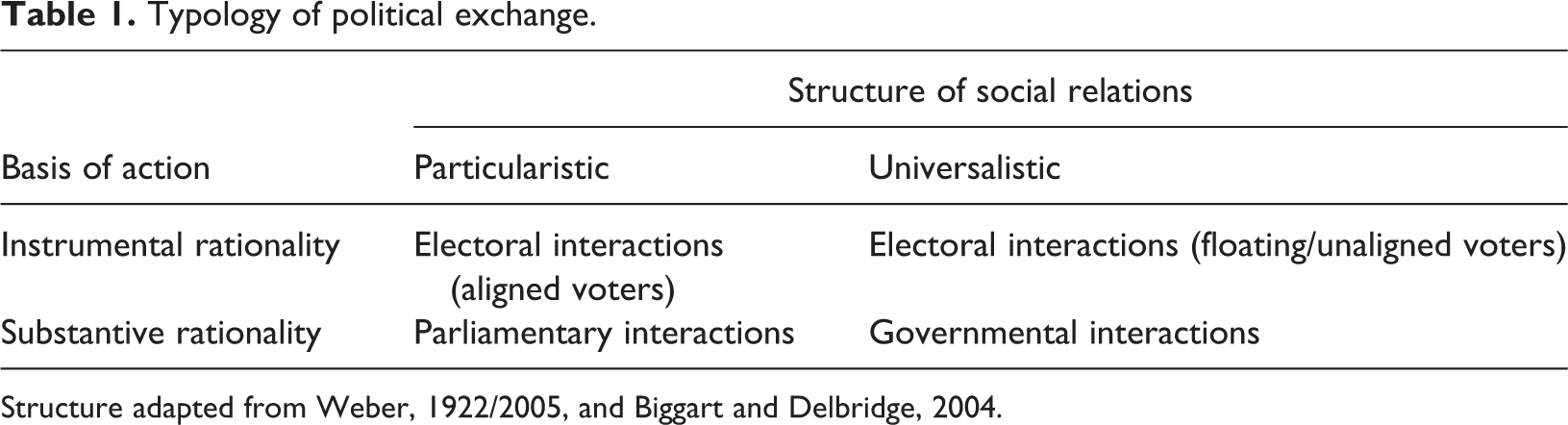
Structure adapted from Weber, 1922/2005, and Biggart and Delbridge, 2004.
Thus, the theoretical challenge of a theory of political marketing is to align itself with the underlying structural characteristics of the political exchange within which political marketing management is enacted. As has been shown above, whilst current research on political marketing focuses primarily on electoral phenomena, this causes a myopic view of the manifold and linked aspects of interactions in the political market. Due to the complexity of the underlying political exchange, political marketing needs to be based on a qualitatively different foundation than that of striving towards a ‘mutually beneficial exchange’ (White, 1986). Accepting that the political exchange is not synonymous with commercial buyer–seller exchanges but instead possesses a deferred and circular interaction structure has wide-ranging implication for political marketing research and practice.
Implications for research in political marketing
As outlined, current research in political marketing has its primary focus on the electoral interactions. However, focusing research in such a way does not cover the exchange requirements of candidates and parties, and the strategic political marketing activities subsumed within the parliamentary and governmental interaction dyads. Whilst the three interaction dyads are distinct, they nevertheless depend on each other in order to facilitate the political exchange of value, that is, support for sound government. As such, for a research agenda in political marketing, they need to be understood in context, taking network and system effects into account (Henneberg, 2008). Therefore, research into election campaigns needs to recognise that governmental and parliamentary interactions play a decisive role in determining the nature and result of electoral interactions, and that discussions focusing on electoral exchanges need to be explicitly linked to the parliamentary and governmental interactions, be they on the conceptual or on the empirical plane of analysis. In this context, all three political marketing-related interactions should be seen as an integrated system of symbolic actions (Dermody and Scullion, 2001). This has direct implications for aspects of political marketing management, for example, it could broaden the use of theories from commercial marketing, such as the resource-based view of the firm (O’Cass, 2009) or service-dominant logic (Butler and Harris, 2009), within a wider political marketing arena.
A triadic, interdependence-based view of political marketing exchange will also allow for the unravelling of certain areas of political marketing that have hitherto been critically discussed when analysed in isolation. For example, Foxall (1984) argues that a marketing orientation is unlikely to exist in a genuine and lasting way for governments (and in his view also for parties). He considers the example of government–citizen exchanges and comes to the conclusion that this is not a marketing exchange as the customer (citizen) is not independent in its actions (e.g. cannot withhold taxes). However, when conceptualising the government–citizen relationship as an interaction integrated within a wider exchange system rather than as an isolated and closed dyadic exchange, therefore linking the governmental interaction to the parliamentary and electoral interactions, it becomes clear that the direct (negative) feedback mechanism for citizens is not within the dyadic structure of the governmental exchange, but in the linked one of the electoral interaction. Citizens, in their capacity as voters, do react to the governmental offerings by electoral consequences, that is, their voting behaviour. In this context, more phenomenological approaches regarding how voters understand (and make sense of) the political exchange system in its different facets could provide interesting juxtapositions of research based in political marketing theory with traditional political science research (Dermody and Scullion, 2001; Henneberg, 2009). Only such an understanding will allow the application of a ‘critical turn’ to political marketing research (Moufahim and Lim, 2009)
The extremely important issue of implementation, which is at the forefront of services marketing thinking, needs clearer analysis (Henneberg and O’Shaughnessy, 2009). Policy promises in the electoral interaction need to be converted into policy implementation in the governmental interaction via ‘inter-organisational’ parliamentary interactions based on negotiations which, to date, have not been analysed using political marketing constructs. This is arguably a central topic in future political marketing research given that the implementation of promises provides the overall exchange rationale for the political system (i.e. ultimately delivering ‘value’ to the citizens).
The interaction structures, their characteristics, and place in a triadic interaction model of political exchange enables research in political marketing to embrace a more holistic picture of political marketing management activities and the relationship of these activities to the wider society (Henneberg et al., 2009). Adopting an interaction-based approach can be a step towards facilitating more reliable construct development by explicitly connecting systemic structures with research concepts that are derived from marketing theory and social exchange theory. Research on political marketing without a clear link between electoral, governmental, and parliamentary marketing issues falls short of a rigorous application of exchange theory and therefore cannot constitute a conceptual system for the development of state-of-the-art political marketing theory.
Conclusion
Many marketing theorists are used to explanatory concepts that have been developed with dyadic and directly reciprocated exchange relationships in mind. Therefore, one is tempted to superimpose these on other, related exchanges (Egan, 1999). However, marketing theory has also adopted more complex, systemic orientations, for example, in the network approach of business-to-business marketing (Anderson et al., 1994). Based on the exchange construct, non-commercial exchanges including social and political ones have become an accepted marketing explanandum since the broadening debate of marketing of the 1970s. Therefore, in order to build a theory of political marketing, a rigorous understanding of the nature of the political exchange needs to be developed beyond the simplistic assumption of being synonymous with the commercial exchange or using metaphorical constructs like the ‘political market’ (Lock and Harris, 1996).
Certain aspects of the marketing analogies, for example, the service characteristics of the political offering, only make full sense if understood as being triadic interactions rather than dyadic exchanges. Thus, the aspect of the presumptive effect of political services (Baines et al., 2003) only comes to the fore if the electoral interaction is not seen in isolation but as part of a wider political exchange system. The triadic interaction structure of the political exchange provides an initial attempt to develop a broadened concept on which further theory building as well as empirical analysis in political marketing can be based. As such, many of the uncertainties regarding political marketing with regard to its fit with commercial marketing theory can be resolved by focusing on a broadened understanding of the specific exchange situation of politics.