



Abstract
A central aim of consumer behaviour analysis has been to delineate the place of cognitive explanation in consumer research and marketing. The strategy has involved first the exhaustion of noncognitive, behaviourist explanation in order to elucidate the necessary role of cognitive explanation. Behaviour analysis has proved relevant to a wide range of consumer behaviours, but its limitations include an inability to account for behavioural continuity and to deal with the personal level of explanation and an inability to delimit the behavioural interpretation of choices that are not amenable to an experimental or quasi-experimental analysis. For these purposes, an intentional explanation is necessary and this article is one of a series devoted to the development of a strategy for the responsible ascription of intentionality to the explanation of consumer choice. This article is specifically concerned with the relevance of Searle’s concept of collective intentionality in the refinement and definition of symbolic reinforcement. The consequences of incorporating collective intentionality into the explanation of consumer behaviour for the philosophy of science underlying consumer behaviour analysis are discussed.
Keywords
Introduction
Consumer behaviour analysis is the integration of behavioural economics and behavioural psychology in the study of consumer choice in marketing-oriented economies (Foxall, 2001). It is principally concerned with human behaviour, in naturally occurring settings, subject to marketing influence (Foxall, 2002). 1 This essay expands the theoretical basis of consumer behaviour analysis by proposing how ‘intentional’ language contributes to the interpretation of choice within the market place and the role of intentionality within the consumer behaviour analysis research programme. ‘Intentional language’ means sentences that embody terms that refer to or represent entities other than themselves. A person does not just believe: he or she believes that something or other is the case. No-one simply desires: they desire that such and such will become the prevailing state of affairs. It is the fact that these expressions point to something else, their ‘aboutness’, that makes them intentional in this restricted sense. The verbs in these expression, ‘believes’ and ‘desires’, are known as attitudes by philosophers; the phrases beginning with ‘that’, as propositions. Intentional language, and thus intentional explanation, makes use of propositional attitudes, as expressions like these are known, to explain behaviour (Russell, 1912). 2
The reason for this discussion of intentionality in the context of consumer behaviour analysis is to address the nature of symbolism in the study of consumer choice. Renfrew (1994: 5) refers to a symbol as ‘something that stands for or represents something else’ and outlines three forms that it might take: X might be juxtaposed with Y, X might represent Y, or X might be metaphorically equated with Y (see also Renfrew, 2007; Renfrew and Zubrow, 1994). The capacity to engage symbolically with the world in these ways is often understood as uniquely human especially in the context of dealing with abstractions in such a way that it is possible to contemplate a future even after one’s demise and a past even before one’s birth (Deacon, 1997). Human behaviour is pervasively symbolic, so much so that Cassirer (1944) refers to man as the animal symbolicum. Humans’ interactions with symbols are nowhere more apparent than in the sphere of conduct with which marketing theory is intimately concerned, that of the economic and social transaction. The structure of the article is as follows. First the nature of theoretical discourse is described and the way in which language is used to delineate extensional and intentional explanations of human behaviour is discussed. This is followed by an exposition of the Behavioural Perspective Model (BPM) as an extensional device and a summary of its contribution to understanding such aspects of consumer behaviour as brand and product choice. The limitations of this extensional approach are noted and the concept of collective intentionality as proposed by Searle is advanced as a route to an interpretation of consumer behaviour in terms of intentionality which is explored in the context of symbolic reinforcement (SymbR). Finally, the implications of this for the methodology of consumer research are examined.
Consumer behaviour analysis
Central to the consumer behaviour analysis research programme is the extensional BPM of purchase and consumption, that is, a model that avoids the approach to explanation that employs terms such as ‘believes’, ‘desires’, and ‘feels’, all of which are mainstays of intentional explanation. The rationale for this research strategy envisages the starting point for ascertaining the role of intentional explanation in consumer research as the building and exhaustive testing of a model that does not rely on intentional explanation. The point of this is to reveal both those facets of consumer behaviour that can be explained adequately and appropriately by the use of this non-intentional (i.e. ‘extensional’) model and the limitations of this approach, which must be addressed by the use of intentional language. Consumers in Context (Foxall, 1996) dealt in depth with the use of the extensional model as an interpretive device; The Behavioural Economics of Consumer Brand Choice (Foxall et al., 2007) described in some detail the empirical research programme, which derived from the model’s application; and Explaining Consumer Choice (Foxall, 2007a), took stock of the contribution of the extensional model and proposed a theoretical development of the BPM based on the ascription of intentionality to consumer behaviour in order to aid the explanation of those aspects of consumer choice that the extensional model, founded on radical behaviourism, 3 apparently could not address comprehensively. The current work is concerned to show how the framework expounded in that book, intentional behaviourism, can be more precisely applied to consumer choice.
The extensional BPM was devised to overcome the drawbacks of a social cognitive portrayal of choice. To this end, it examined the possibility that an account of consumer choice devoid of unobservables could be constructed and employed in the interpretation of purchase and consumption (Foxall, 1997a). Two outcomes of the testing of this model ‘to destruction’ were possible. Either an entirely non-intentional approach would be shown adequate for the explanation of consumer behaviour or, more probably, the necessity of employing intentional terminology and therefore intentional explanation would become evident. These founding objectives guided the BPM research programme since its inception (Foxall, 1988). The BPM was employed initially solely as an interpretive device, a means of recasting familiar themes in consumer research in behavioural terms. The outcome was the demonstration that this portrayal could account for the empirical data at least as well as did cognitive theories and hence the suggestion of an alternative avenue for research beyond the then-prevailing social cognitive paradigm. Attitude–behaviour relationships, consumer innovativeness, ‘green’ purchasing and consumption, as well as general purchasing, consumption, and saving behaviours were re-examined from this antithetical perspective (Foxall, 1996) and, a little later, the nature of the marketing firm (Foxall, 1999c). At that point, little more was expected of the BPM approach than its contribution to the growth of knowledge through the confrontation of competing interpretations (Feyerabend, 1975). Although, as will become apparent, the research programme has in fact acquired a lively empirical research component since then, this article revisits the central interpretive device embodied in the model, the idea of the consumer situation.
By ‘consumer situation’ is meant the way in which consumer behaviour is located, initially in space and time by the extensional model (Foxall, 1997a, 1997b, Chapter 6), and subsequently, as this article reveals, in the complex of representation and meaning which an intentional construal of consumer choice supplies. In the extensional model, the consumer situation comprises stimuli which prefigure the outcomes of behaviour including ‘informational’ reward which embraces the social consequences of purchase and consumption. Informational reward refers to benefits derived from consumer behaviour over and above the utilitarian or functional outcomes. While utilitarian benefit can be specified fairly objectively – any coat has the function of keeping its wearer warm – informational reward is relative to the social group which confers it – a designer-label coat is highly esteemed by some people leading to higher social status for the wearer. Hence, the meaning conveyed by informational reward inheres in the particular value system that characterizes the social context in which consumption takes place. The consumer situation, which is the immediate antecedent of consumer behaviour, contains stimuli that set the occasion for rewards of these kinds contingent upon the performance of particular behaviours. A prestige store logo with which the consumer is familiar sets the occasion for obtaining warm clothing and social status contingent on his or her entering the store, making a choice and paying the appropriate price. The logo is an important stimulus among the physical and social surroundings that, together with the consumer’s experience of similar consumption settings in the past, compose the current consumer situation. The situation also includes social rules that specify the rewarding and punishing consequences that will follow particular instances of consumer choice in the circumstances. Throughout this basic depiction of the BPM, the language in which stimuli, behaviour, and behavioural consequences are described is unremittingly extensional, lacking reference to beliefs, desires, or other intentional attitudes.
The necessity of employing intentional language to address certain aspects of consumer behaviour has been suggested by recent methodological analyses (Foxall, 2007a, 2007b, 2007c). Building on this, Foxall (2011) developed an intentional account in terms of consumers’ emotional responses; the present article addresses it from the broader viewpoint of Searle’s (1996, 2010) analysis of the role of collective intentionality in the construction of social reality. 4 Searle’s overall mission is to understand how we can speak of consciousness in a physical world, which he characterizes as ‘the single overriding question in contemporary philosophy’ (Searle, 2010: 3). One part of his answer to this conundrum, namely his idea of collective intentionality, the view that the performance of many human behaviours relies on a collective acknowledgement of a particular social status, was proposed as a means of comprehending consumer choice by Foxall (2010a). Collective intentionality requires that there be a sharing not only of actions but of the beliefs, desires, and attitudes that make both the assignation of status function and the performance of the behaviour in question possible. Hence, a couple is only married (and entitled to the legal benefits and obligations of marriage) because society invests them with this status. The pieces of paper in my wallet will only function as money because they are generally accepted as a means of the settlement of financial obligations. In this article, the aim is to integrate the idea of collective intentionality more closely with the quest to establish the limits of an extensional consumer research and the foundations of an intentional consumer research. More specifically, the aim is to present a model of consumer situation in which collective intentionality and its ramifications take the place of simple stimuli as the elements of the consumer’s physical and social environments that make some behaviours more probable than others on the basis of their likely outcomes. Searle’s framework thereby suggests the structure of the consumer situation in an intentional construal of the BPM. Informational reward is replaced in this version of the model by symbolic reinforcement.
Languages of explanation
The everyday folk psychology that we use to make sense of and predict the behaviour of other people involves attributing desires and beliefs to them on the basis of how we perceive their circumstances and opportunities. The difficulty with using language of this kind in behavioural science stems from the ease with which apparent explanation of almost any behaviour can be adduced by inferring goals and dispositions from the very behaviour they are used to explain. Cognitive psychology is much more circumspect than folk psychology in its use of intentional terms of course, but there remains the difficulty of knowing when to ascribe unobservables such as wants, attitudes, and preferences in a scientific manner. One approach assumed in the research programme described in this article is to confine scientific discourse to extensional language, avoiding terms that refer to cognitive and affective processes, to test the resulting theories to destruction, and to ascertain where intentional language is necessary by observing the inadequacies of the extensional stance. It is time to state more formally what extensional and intentional languages entail.
Extensional language consists in sentences that avoid intentional language. A stimulus is therefore a part of the environment which is consistently followed by a response: the definitions of stimulus and response do not require any accompanying statement about what the organism expects or believes or desires. Language of this kind has certain features, one of which is its referential transparency. This means that in extensional sentences synonymous terms (terms with the same extension or referent) can be substituted for one another without detriment to the truth value of the sentence. In the sentence, ‘That planet is Mars’, ‘Mars’ can be substituted by ‘the fourth planet from the sun’ without altering the veracity of the statement. Intentional language, by contrast, is referentially opaque: it is not possible to make a substitution of this kind without changing the meaning of the sentence. In the sentence, ‘John believes that this planet is Mars’, ‘Mars’ cannot be substituted by ‘the fourth planet from the sun’ because John might not know that Mars and the fourth planet are one and the same. This simple property of intentional sentences means that they offer not simply an alternative form of words but, as will become clearer, an alternative mode of explanation. But in order to achieve this, intentional language requires a rather more sophisticated treatment than it is accorded in everyday folk psychology (Chisholm, 1957; Dennett, 1969; Quine, 1960).
A second characteristic of intentional language is intensional inexistence: that is, the fact that an entity is referred to in an intentional sentence does not imply either its existence or non-existence. An extensional sentence such as ‘George bought a Mercedes’ requires for its truth value the actual existence of such a car. But an intentional sentence such as ‘George believes that the streets of London are paved with gold’ does not imply that there are actually golden pavements to be found in the capital. The final characteristic of intentional language that makes explanations couched in it quite distinct from those of extensional language is the impossibility of translating intentional into extensional sentences. (Brentano, 1874/1973).
Several schemes have been suggested by philosophers to justify the ascription of intentional language in the explanation of behaviour, some of which I have discussed elsewhere (Foxall, 2007a, 2007b, 2007c, 2008). In line with the linguistic understanding of the nature of intentionality pursued in this article, it is appropriate to say only that the justification for employing intentional language in seeking to explain behaviour is that extensional language no longer suffices. Before coming to the criteria that justify the ascription of intentionality, however, it is necessary to discuss the way in which extensional explanation is apportioned since this gives the clue to the kind of explanation that intentionality offers. The principal criterion for the employment of extensional explanation is the identification of controlling stimuli of which the response in question is demonstrably a function. The means by which this extensional explanation is demonstrated is experimental method. When this demonstration can no longer be made, it is neither scientifically legitimate nor intellectually honest to use extensional language by positing ‘action at a distance’ or, in the case of complex human behaviour, assuming or inventing a learning history that will bear the necessary explanatory weight. In these instances, an explanation of behaviour that maintains scientific integrity relies, faute de mieux, on the use of intentional language. Intentionality does not provide the same kind of explanation as an extensional account. It is not empirically verifiable through the prediction and control of its subject matter, for instance; but neither can an extensional explanation based on empirically unavailable entities contribute to reliable understanding (Searle, 1983).
The necessity of using intentional language arises in three situations: accounts of behaviour that seek to comprehend its continuity or discontinuity, constructing a personal level of explanation for behaviour, and delimiting behavioural interpretations more generally (Foxall, 2004). The language of explanation consists, as a result, of sentences that embody propositional attitudes. The identification of instances in which the use of intentional language is required does not, however, determine either the structure or the content of the propositional attitudes in terms of which explanation should proceed. Behaviourists have rightly condemned the invention of traits, be they of anger, enthusiasm, or desire, to which explanatory functions are attached despite their derivation from and re-description of the observed behaviour to be explained. Something other than an arbitrary adoption of intentionality for the sake of a quick and easy ‘explanation’ is required and it is here that the account relies on neuroscience and behavioural science in order to justify the content of propositional statements. 5
BPM-E: the extensional construal
In the extensionally conceived model (Figure 1), consumer behaviour is portrayed as the outcome of functional relationships between a consumer situation and a response. The consumer situation is, in this depiction, the intersection of a consumer behaviour setting and a learning history of reinforcement and punishment by utilitarian and informational consequences. It amounts to consumer behaviour setting scope. The consumer situation, insofar as it contains the consequences of behaviour that have formed the individual’s learning history, can thus be said to be the ‘cause’ of consumer behaviour, in the sense that the behaviour is a function of the stimuli that compose consumer behaviour setting scope. 6 That is, the scope of the setting derives from the interaction of the stimuli that compose it (discriminative stimuli and motivating operations) and the consumer’s learning history. The take away message of the extensional model is that consumer situation is understood solely in terms of the scope of the consumer behaviour setting. 7

BPM-E: The Extensional Model. In BPM-E, the variables are extensionally defined. The consumer situation is the interaction of the consumer behaviour setting and the learning history. It amounts to the scope of the setting. The consumer behaviour setting consists of motivating operations), discriminative stimuli and rules (tracks, plys, and augmentals). The pattern of reinforcement comprises the combination of utilitarian reinforcement (UtilR) and informational reinforcement (InfR). Consumer behaviour is a response to stimuli and is defined in terms of pattern of reinforment: Accomplishment, Hedonism, Accumulation, and Maintenance. For a more complete exposition, see Foxall (2010b). BPM: Behavioural Perspective Model.
An extensional model incorporates causal influences but does not employ intentional idioms or reasoning to explain its dependent variable/variables. As such, the BPM locates consumer choice at the intersection of the consumer’s learning history and the current consumer behaviour setting, that is, where the experience of consumption meets an opportunity to consume anew. This intersection of time and space forms the consumer situation, the immediate shaper of approach – avoidance responses involved in purchase and consumption. We have already seen that in line with a theory that takes the prediction and control of behaviour as its raison d"être, the extensionally defined consumer situation is coterminous with the scope of the consumer behaviour setting. The consumer situation is defined in terms of the range of options available to the consumer as determined by the stimulus antecedents of feasible behaviours, some of which will have been present on earlier consumption occasions; in the presence of the individual’s learning history, these initially neutral stimuli are transformed into the discriminative stimuli and motivating operations that set the occasion for current choice.
The consumer’s consumption history invests the initially neutral stimuli with a kind of meaning, which consists in no more than the capacity to generate specific kinds of approach and or avoidance behaviours that produce consequences to regulate the rate of recurrence of the behaviours that produced them. Thus, both consumer behaviour setting and consumer situation simply set the occasion for three types of behavioural consequence: utilitarian reinforcement (UtilR), which consists in the functional outcomes of behaviour, informational reinforcement (InfR), which stems from the symbolic outcomes, principally performance feedback, and aversive/punishing consequences, the costs of purchase and consumption. Such aversive outcomes can themselves be subdivided into those that are utilitarian in nature and those that are symbolic. The components of the model are operationally defined, specified in terms of the functional relationships that stem from their observable impacts upon behaviour. Hence, an operant response is defined tout court as one which operates on the environment to produce the consequences that demonstrably govern its subsequent rate of emission; a reinforcer is post-behavioural stimulus that in experimental and other closed settings is shown to increase the rate of the behaviour that produces it; and a discriminative stimulus is a pre-behavioural stimulus that increases the probability of the emission of a response after pairing with a reinforcer (Smith, 1994; see also Foxall, 1999b). The language of radical behaviourism is very precise here. Hence, a discriminative stimulus does not ‘signal’, ‘refer to’, or ‘represent’ the utilitarian and informational reinforcers or punishers likely to be contingent on the performance of particular responses: it simply ‘sets the occasion’ for these consequences.
The rationale for building a model of consumer behaviour in these terms derives not from the conventional wisdom of hypothetico-deductive scientific methodology but from the need to examine whether a theory of choice can avoid the intentional language of beliefs and desires, that is, statements that do not permit the substitutability of co-extensives. The key motivation for this is the finding that both cognitive and behaviourist accounts of consumer choice are equally supported by the empirical evidence on attitudinal–behavioural correspondence (Foxall, 1997b, 2005): to favour the former whilst ignoring the latter represents not only a slavish adherence of an applied field to the prevailing paradigm of the disciplines from which it derives, in this case cognitive psychology, but an intellectually closed perspective which will not conceive of explanation in terms not belonging to this framework of conceptualization and analysis. As we have seen, the central fact in the delineation of radical behaviourism is its conceptual avoidance of propositional content. This eschewal of the intentional stance sets it apart not only from cognitivism but from other neo-behaviourisms. Indeed, the defining characteristic of radical behaviourism is not that it avoids mediating processes per se but that it sets out to account for behaviour without recourse to propositional attitudes. Based rather on the contextual stance, it provides definitions of contingency-shaped, rule-governed, verbal and private behaviours which are non-intentional. For reasons of disinterested curiosity, therefore, as well as the more pragmatic search for a general explanation of choice, a research programme based on the development and evaluation of an extensional model of consumer choice becomes inevitable. 8
Limits of extensional explanation
The import of this work is that explanation of behaviour in purely extensional terms (i.e. in language which avoids intentionality, displaying referential transparency via the substitutability of co-extensive terms) has proved invaluable for the prediction and control of certain behaviours whose stimulus environments are observable and manipulable. However, when the stimuli that would normally account for such behaviour cannot be identified, it is necessary to resort to the language of intentionality. 9 It is not always possible, for instance, to point to the particular stimuli required to account for the continuity of behaviour or to describe plausibly the learning history that explains current behaviour. In such instances, we have no option but to speak of the actor’s beliefs and desires in order to deal with his or her choices. I have also suggested that the responsible use of intentional terms requires a more thorough grounding in the philosophy of psychology than it usually receives in consumer and marketing research. The proposed theorization has two stages: first, the establishment of rules for the use of intentional language such as beliefs and desires and, since emotions are also intentional, feelings; second, the establishment of rules for the use of the language of cognition in order to explain decision making. The first stage deals with the use of beliefs and desires to provide an account of behaviour for which the stimulus conditions are not empirically available. I have recently suggested how this initial stage can be accomplished by considering the use of emotional terms to explain consumer behaviour, an operation that relies on the establishment of patterns of behaviour related to its environmental determinants (the rewarding and punishing consequences to which it gives rise) and the neurophysiological basis of the behaviour (Foxall, 2011; Foxall et al., 2012). The intentional terms employed also perform the function of placeholders for a more comprehensive cognitive theory of behaviour. Hence, the second stage involves consideration of how behavioural and neurophysiological (particularly neuroeconomic) can enter into a cognitive theory of behaviour.
The principal reason for requiring intentionality in these instances is intellectual honesty – where we cannot identify stimuli, discriminative or consequential, with satisfactory specificity (e.g. to enable prediction and control of our subject matter), we should put down a marker to indicate that extensional language is not feasible in this instance. For all we can know, this state of affairs may prove temporary if stimuli later come under experimental control. But it is important, from the viewpoint of scientific integrity, to acknowledge the need of a placeholder, expressed in intentional idioms, for further theoretical elaboration if and when empirical means permit. But we may also infer sometimes that in having to resort to intentional language, we are recognizing that a very different level of explanation is an enduring facet of our scientific explanation. This may occur when the necessary stimulus is likely to prove elusive in the long-term just by virtue of the kind of question we are asking of our subject matter. Establishing the necessity of an intentional account of behaviour is, however, not enough: it is also necessary to establish how intentional language can be employed in the interpretation of consumer choice without merely redescribing the functional relationships in which an extensional account consists.
Verbal behaviour
Behaviourist explanation rested for many years on the view that behaviour was a function of its observable, measurable consequences. Even recognition of the importance of language was met with an analysis of ‘verbal behaviour’ in terms of the reinforcing stimuli on which it was contingent. However, while the behaviour of nonhuman animals continues to be analysed as ‘contingency-shaped’, that is, moulded by direct contact with its reinforcing and punishing outcomes, human behaviour is often explained by reference to verbal control. In this case, the stimuli that influence behaviour are not encountered directly but through being specified in a verbal statement (Skinner, 1969). Technical skills are generally learned via the provision of instructions rather than by ‘trial and error’, which would be far less efficient and possibly hazardous to health and well-being. Verbal behaviour is social: Skinner (1957) actually defined verbal behaviour as behaviour that is reinforced via other persons. In other words, the controlling consequences of such behaviour are to be found in its social milieu rather than in the physical environment. 10
As a result of our learning in childhood, which is what the others (parents and teachers) say is reliably connected to the consequences of behaving in a particular way, we are more likely to act on their instructions and the instructions of other adults. Such instructed or rule-governed behaviour – that which stems from the verbal activity of a speaker – can be understood as a response to a verbal discriminative stimulus which, through training, has come to take the place of the contingencies themselves. The rule states the elements of the three-term contingency in verbal form. For example, an advertisement might declare: using Brand X toothpaste (the response to a discriminative stimulus in the form of the brand name) will make your teeth whiter (the reinforcer). In this case, the entire message can be seen as a complex discriminative stimulus that sets the occasion for the recommended purchase use of the toothpaste in question. Another view is that verbal rules are motivating operations that enhance the value of a reinforcer; for example, an advertisement might contain a phrase such as ‘Can’t you just taste the difference?!’, which has the effect of making the whole three-term contingency it employs that much more salient to the consumer.
Three broad kinds of rules have been proposed based on the functions they perform in influencing behaviour (Zettle and Hayes, 1982). The first is pliance, which is rule-governed behaviour controlled by consequences that the speaker controls (or claims to control). The rule, known as a ply, presents the interpersonal consequences of compliance or noncompliance. A partygoer might be informed that their partner will disapprove if they fail to stay sober for the evening: the spoken or understood instruction ‘Don’t over-indulge or I’ll be angry’ is a ply. Advertisements frequently incorporate plys that suggest that social approval is contingent on buying or using certain goods such as a high-status car. The second kind of rule-governed behaviour is tracking, which is an instructed behaviour that comes under the control of the physical environment. A track is, therefore, a rule that denotes how the physical environment is arranged. So, in answer to a query, I might be told, ‘Turn left at the next intersection, then left again at the bank, and finally make a right at the lights. You’ll see the supermarket right in front of you’. By tracking the physical environment according to this rule, I’ll arrive where I plan to be; the tacking is part of the verbal behaviour of the listener because it is under the control of verbal stimuli. The third kind of rule is the augmental, a strongly motivating observation that emphatically describes how a behaviour will be reinforced or avoid punishment. A message in the mail that reminds us that if we book ‘just one more trip’ with our favourite airline, we will be eligible for a free night in a luxurious destination constitutes an augmental.
Two lessons are apparent from this discussion. First, instructed behaviour is always subject to two sets of contingencies: the social consequences that maintain the rule following and the natural contingencies that eventually take over if the instruction is effective. This is especially evident in the case of pliance: when a parent instructs her son to cross the road with care, she implies that his doing so will result in her personal approval which is a social reinforcer. The careful behaviour also has the consequence that an accident is avoided, however, which is a physical reinforcer. The behaviour is rule-governed on the basis of the interpersonal regard shown by the parent and contingency-shaped in that it comes under the control of road layout, signals, and traffic. Second, what radical behaviourists call ‘private events’ may assume a role in formulating and responding to rules. Contrary to popular belief, radical behaviourism actually embraces thinking and feeling as part of its subject matter. An individual may reflect on the contingencies in operation (as in the experiment mentioned above where it is necessary to choose between two sources of a reward) and conclude that the way to proceed is by enacting this or that behaviour. A consumer may make his or her own rules based on a personal interpretation of their experience and the information and instructions provided by elements the promotions mix. Ultimately, the actual contingencies of reinforcement in operation tend to ‘win out’ over inaccuracies that emerge through private consideration of the circumstances under which rewards are forthcoming but there is always scope for ‘self-rules’ to intervene.
The inclusion of private events and rule-governance into a science of behaviour brings it into line with the personal experience of most of us and the course which psychology as a whole has taken in embracing cognitive and affective influences on behaviour. However, the difficulty of accurately identifying the rules that govern behaviour and the ways in which they might have been amended, construed, and misconstrued, in the course of the individual’s consideration of the meaning of their experience as a consumer does nothing to advance an extensional account of consumer choice. The very analysis that has led to the incorporation of these conceptual tools indicates that consumers’ capacity to peruse the likely outcomes of behaving in a particular way and act in a highly subjective manner places some aspects of consumer behaviour beyond the reach of extensional language. We can posit realistically that the continuity of behaviour is influenced by the verbal behaviour of both listener and speaker, that is, consumer and marketer, but we cannot ascertain with any certainty what the rules actually are in any given instance of consumption or subject rules and their influence to an experimental analysis. Positing rules of behaviour supplies a convenient means of accounting for it when its reinforcing and punishing outcomes are small, remote, and delayed (Malott, 1989). This ploy suggests the route to an account of behavioural continuity, for instance, but it does not contribute directly to an extensional science of behaviour. Like private events, rules are a useful placeholder for a deeper analysis that employs a model of exposition that goes beyond the extensional.
Collective intentionality
The task now is to show how intentional terms may be implemented in the model. That is, the components of the model must be intentionally construed and coherently related to form an appropriate explanation of consumer choice that transcends the limitations of extensional behavioural science. Searle’s theory of human social reality comprises six components – denoted (i) to (vi) below.
The essence of his understanding of the collective intentionality (i) that was briefly described in the Introduction section is that humans can impose a status function (ii) on an object or a person over and above the physical capabilities of the object or person (Searle, 2010: 7). The object or person can perform this function only by virtue of its being endowed with a status that is collectively invested in it by a verbal community. A piece of moulded and stitched leather can thus become a brief case, a piece of sharpened metal embodied in a wooden handle can become a chisel, and a woman who has fulfilled certain socially imposed rules and regulations (including standing for office, being elected, swearing an oath of loyalty to the Head of State) can be regarded as the Prime Minister of the United Kingdom. Searle argues that this capacity of objects and people to be socially invested with a collective recognition of their status is such that it forms the essence of social reality in human communities. Moreover, absent collective assent to the investment of the appropriate status function in an individual, absent the capacity or authority of that person to undertake or perform it. Once an individual is willingly ascribed a status function, he is entitled to certain considerations; however, his continuing in the office granted him relies on his fulfilling prescribed tasks; that is, status functions carry deontic powers (iii), ‘rights, obligations, requirements, permissions, entitlements, and so on’ (Searle, 2010: 8–9). A positive deontic right is live in the United States if one has a green card; a negative deontic right is the consequent necessity of filing an annual tax return. Deontic rights confer or impose reasons for my acting in a particular way that are independent of my desires; hence, I may recognize the legally conferred property rights of another person even though I would like to take his new sports car for the trip of its life. These ‘desire-independent reasons for action’ (iv), as Searle refers to them, are closely allied to the next component of his system, constitutive rules (v).
Searle distinguishes two types of rules. Having to drive on the left in the United Kingdom does not create a new behaviour – one could drive even if this rule did not exist. Having to park your car only in a designated parking space is another example: you can park your car even without this rule. Regulative rules of this kind, neither of which it is worth repeating creates a new behaviour, typically take the form ‘Do this… or these sanctions will follow’: that is, they are tracks or plys. By contrast, rules that lay down how to play tennis actually create the behaviours known as playing tennis. Tennis only exists because of the rules. Constitutive rules of this kind take the form ‘X counts as Y in C’. The final component, institutional facts (vi), refers to the collectively derived social reality on which the whole system depends and which marks it off from the physical reality which is the mainstay of nonhuman animal reality. The ‘brute facts’ that inhere in both human and nonhuman experience exist independently of human institutions. The facts that this K2 is a mountain, grass is green, and mammals suckle their young are examples of brute facts. Brute facts are known by their physical consequences as in the paradigm case of Dr Johnson’s ‘refuting’ idealism by resolutely kicking a large rock. Institutional facts, however, exist only because of human acceptance or approval; hence, the fact that this person is a minister of the church depends on certain people’s agreement that she is, as does her being married and having a joint bank account. All are institutional facts because they are real on by virtue of interpersonal fiat.
BPM-I: the intensional construal
Several intensional construals of the BPM are possible depending on whether they emphasise the role of desires, beliefs, or feelings in the explanation and interpretation of consumer choice. 11 That presented here is primarily concerned to show the role of collective intentionality in the transformation of the InfR of the extensional model to the symbolic reinforcement that characterizes the intentional model (Figure 2). This transformation also modifies the concept of the consumer situation, which is portrayed in this depiction of the intentional construal in terms of the beliefs and desires in terms of which behaviour is to be interpreted.
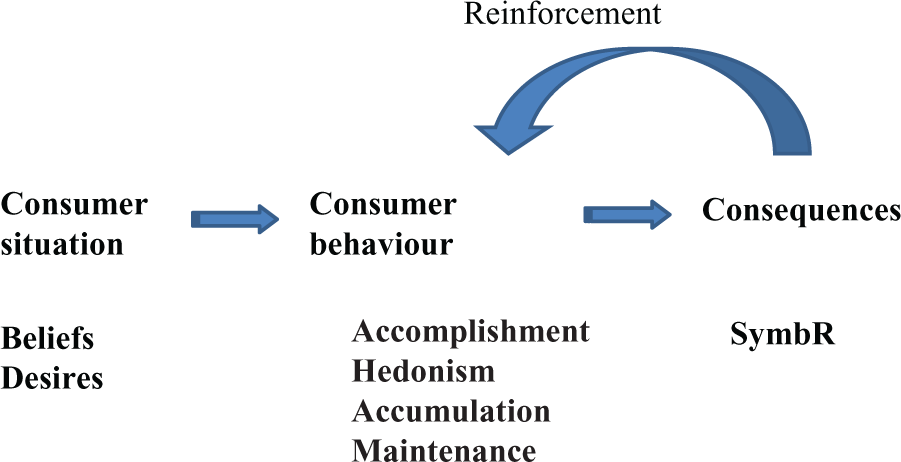
BPM-I: The Intentional Model showing symbolic reinforcement. The central explanatory component of the BPM, the consumer situation, must be redefined in the context of BPM-I. Whereas in the extensional model, we could delineate the consumer situation only as the interaction of the consumer behaviour setting and the learning history, a construction that avoids intentionality, it is now possible to portray consumer situations in terms of a nexus of beliefs and desires that reflects the collective intentionality of the consumption experience. Consumer behaviour is transformed from reactive responses to externally presented stimuli into goal-directed action: still characterized as Accomplishment, Hedonism, Accumulation, and Maintenance, it is now defined via symbolic reinforcement. BPM: Behavioural Perspective Model.
We can combine Searle’s pattern of rule following with that of Zettle and Hayes (1982), which was discussed above Tracking, pliance, and augmenting can each be conceived as either regulative or constitutive rules and analysed accordingly (Table 1).
Bases and outcomes of utilitarian, informational, and symbolic reinforcement.
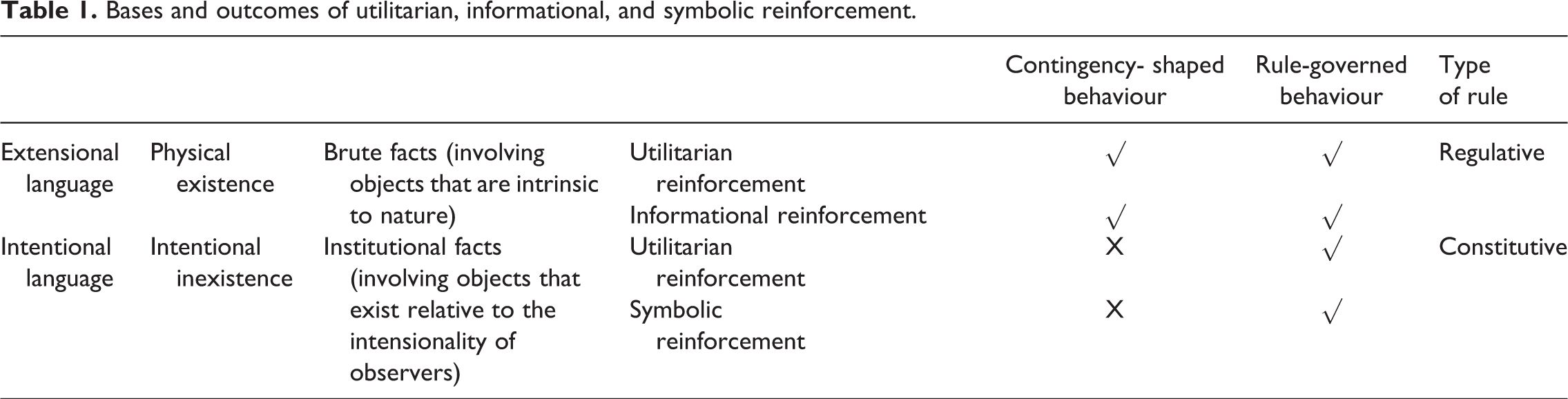
It is because the X in the rule ‘X counts as Y in C’ is invested with symbolic significance (standing for Y) and can act, in the appropriate C, as a reinforcer of the behaviour that brings it about. It is thus a discriminative stimulus for that behaviour. Paying one’s debts with officially sanctioned pieces of article reinforces that behaviour because they have the status ‘money’ and money is defined as whatever is acceptable in fulfilment of a debt. Y defines the symbolic significance of X by establishing an institutional fact. Brute facts define other functions of these articles – that they burn when a lighted match is applied to them, that they can be written on with a pen, and so on. Each of these brute facts defines how the behaviour that brings them about will be reinforced or punished (UtilR). But it is the institutional facts we are interested in here; those that embody SymbR.
Hitherto, ‘utilitarian reinforcement’ has been used synonymously with ‘functional reinforcement’. This identity remains. ‘Informational reinforcement’ has sometimes been used synonymously with ‘symbolic reinforcement’ but it is now necessary to refine this usage. InfR belongs still to the area in which the outcomes of UtilR are marked by physical stimuli that represent them and which are a form of performance feedback. Its import and effect on behaviour inhere in its physical characteristics. InfR, which inheres in physical discriminative and reinforcing stimuli that govern the rate of emission of behaviour, participates in the continuity of both contingency-shaped and rule-governed behaviour by virtue of their being physical stimuli that regulate the performance of behaviour. Although it is separable from UtilR, it derives its power to reinforce ultimately from the delivery of UtilR. Both rely on brute facts to reinforce behaviour, on actually existing behavioural outcomes.
We can now clarify the definition of utilitarian reinforcement (UtilR) by noting that it is mediated by the product or other aspect of the physical world and described in extensional language that refers to physical objects/services. In short, UtilR is embodied in rewards that can perform physical services for the actor. UtilR is fundamentally primary reinforcement. We define informational reinforcement (InfR) as is mediated by person/persons and described in extensional language that refers to substitutes for utilitarian reinforcers. InfR consists fundamentally in secondary reinforcement. Finally, we can distinguish symbolic reinforcement (SymbR) by noting that it is mediated by thoughts and feelings and described in intensional language. SymbR is intensional reinforcement. Moreover, it is because SymbR is derived from what the individual thinks, believes, desires, or feels to be the case that it influences the way in which tracking, pliance, and augmenting are ascribed in the interpretation of complex behaviour (understood as behaviour that is not amenable to an experimental analysis) when these are conceived as constitutive rules that require the ascription of intensionality.
As noted above, two sets of contingencies enter into rule-governed behaviour: the non-verbal relationships that govern the contingency-shaped aspects of the behaviour and the verbal relationships that govern its rule-governed aspects. Recognition of the intensionality of choice raises the possibility of an even more involved complex of contingencies stemming from the contemporaneous operation of utilitarian, informational and SymbR. Searle points out that the same item may be described in terms of brute facts or institutional facts. One the one hand, there is an object in front of me that I may describe as an intricate assemblage of pieces of metals and hydrocarbons; on the other hand, I may describe it as a television set. The first description comprises brute facts – it is about physical things that amount to objects that inhere in nature. The second is relative to the intentionality of humans. Tracking, pliance, and augmenting are behaviours that can be described in two ways: as responses to physical and social stimuli and as actions that are explicable in terms of intentional idioms. The first depiction is consistent with the extensional account that is the aim of radical behaviourism; the second goes beyond radical behaviourism to provide a more detailed interpretation of the behaviour at the personal level of explanation.
We have to remember that in understanding behaviour as rule-governed, it is sometimes difficult to disentangle the possible effects of the contingencies at work, difficult to be sure that this or that behaviour is an instance of tracking or pliance or augmenting. This task becomes even more complicated when we find that we must include intensionality as a set of explanatory variables. There is a further complexity. We are not making ontological pronouncements here. It is not the fact that some behaviours can be described in their entirety as extensional, contingency-shaped, based on brute facts while other behaviours are intensional, rule-governed, and based on institutional facts. We may wish to describe any behaviour in either mode depending on whether our aim is to predict and control it or explain it at the personal level. Either mode has its limitations. The extensional approach encounters difficulties, as we have seen, accounting for behavioural continuity, the personal level and delimiting its interpretations of behaviour. But the intensional approach is limited when it comes to predicting and influencing the behaviour. The recurring question raised by our investigation is that of how we use language to make sense of behaviour. Hence, tracking is not something that a person does: it is a way of referring to what a person is observed doing that makes it more intelligible to the observer. Pliance and augmenting are similarly not instances of rule-governed behaviour that exist in the world; they are styles of deploying words so that we can understand better what is apparently happening in behavioural space.
Tracking
On this basis, some rule-governed behaviour is concerned with responding to brute facts, for instance with following the contours of the physical environment in order to reach a specified destination. The example given above was of getting to the supermarket on the basis of instructions provided by a rule giver. At the extensional level, such behaviour may be described as tracking since it involve following signs posted along the way; note that the interpretation it is being given in an extensional account is that the rule follower is simply responding to stimuli given a particular learning history. There is no reason why the sounds issued by a way-shower should not influence the subsequent behaviour of the rule follower just as would any other physical stimulus. The instructions received by the rule follower are mediated by another person but not the consequence of following the rules. Tracking may be viewed as predominantly contingency-shaped behaviour, therefore, subject to the brute facts and UtilR. It is the result of the stimuli which Searle has in mind when he enquires how it is that acoustic blasts have remarkable consequences. Viewed this way, the behaviour of the rule follower is social and verbal but not symbolic, since no effort is being made in its interpretation by the behavioural scientist to invoke intentional idioms. Its verbal nature rests on its being mediated by the verbal behaviour of another (and presumably a learning history of following the rules of similar persons in similar situations) and resulting in the behaviour pattern shown by the rule follower. Note that any InfR resulting from the rule follower’s reaching his destination as a result of arriving at the destination is self-conferred, however. No other person is involved in proffering InfR. If our aim is to predict and control behaviour, this may be sufficient. The consumer situation he or she is enmeshed in is a simple interaction of the current stimuli defining the setting and the individual’s learning history. We can predict that the rule follower (the person who asked directions) will reach their destination if they have the appropriate learning history (they have found places before, sometimes by following directions) and respond to the physical sounds of words (Turn left at the traffic lights) as though they were discriminative stimuli. We can control this behaviour by making the sounds involved in the rules we provide this person more appropriate to his learning history (instead of saying Turn left at the traffic lights we can say, if necessary, Turn left at the traffic lights outside the pharmacy). The extent to which we can predict and influence the rule followers’ behaviour by these means is an empirical question. We can refine the layout of the environment, the teaching of English sounds in relation to places, the signage of the shopping district, and so on. But the extensional approach is limited: there are several things we cannot accomplish in this way. We cannot, for instance, account for the continuity of the rule follower’s behaviour when confronted by a new situation in which a destination is to be reached. We need a theory of perception and probably also a theory of beliefs and desires here; emotion feelings may also enter our theoretical framework in order to account for the personal level of explanation. And in order to interpret the behaviour of a stranger whom we are observing as he walks, map in hand, around our town, we need to incorporate the delimiting role of all of these intentional influences. That is, our account’s use of extensional language has become exhausted; we turn to intentional idioms. 12
Pliance
Pliance draws upon an involved concatenation of contingencies: the behaviour of the child instructed by a parent to put on boots before going out to play is governed by the deleterious consequences of getting wet when he does not comply (contingency-shaping) and the punishment meted out by the parent as a result. All of this, which constitutes an extensional interpretation of behaviour, may help to predict and control the child’s activities but it is an incomplete explanation of them. We rely, for such prediction and control, on the brute observable facts and, as long as these are available and the behaviour can be predicted and controlled by the analysis and manipulation of these stimuli, we can provide an extensional account. For an intensional account, however, we must reconstruct behaviour at the personal level which takes account of the child’s perception of what its parent is saying, the import thereof in terms of punishment, what the child has been led to believe on the basis of its experience of similar situations, and what it desires. It is only by positing these intentional idioms that we can have any honest account of the behaviour, that is, one that does not invent a learning history and a stimulus setting in order to answer the problems posed by the imperatives of intentionality. There is a place for interpretation and we must make it as scientific as possible without yielding to the scientism, which claims to see causation that gives rise to the use of extensional language where such causation is not demonstrable. The use of symbolic language requires, however, that we have grounds for the child’s being able to form a conceptual framework in which the words of the parent correspond to a state of affairs (consisting in punishment) that has existed prior to the present and to project a similar state in the future contingent upon the performance of a particular form of behaviour. The discriminations that we must attribute to the child in order to make this interpretation can only be made in intensional language.
Augmenting
Symbolism is at the heart of augmenting since it is a means of verbally enhancing a reinforcer and such embellishment relies on promising additional reward if the required behaviour is performed. Augmentals thus amount to motivating operations and are properly considered part of the consumer situation.
Revisiting the consumer situation
In the course of devising an intentional model of consumer choice, the idea of the consumer situation has undergone transformation. In the extensional construal, it reflected the interaction of the consumer’s experience of purchasing and consuming in settings resembling that currently facing her. This concatenation of consumption history and the discriminative stimuli and motivating operations that compose the current consumer behaviour setting determine the scope of the setting, its relative openness or closure. It is this scope, the extent to which the setting encourages or inhibits particular behaviours, that comprises the consumer situation in this construal. The language in which the consumer situation and its influence are described is scrupulously extensional: the scope of the setting allows the researcher to predict the behaviour of the consumer but there is no suggestion in this that the consumer believes or desires that a specific outcome will be the case if she buys or consumes this or that product or service. The extensional model (BPM-E) consists, in essence, of the consumer situation defined in terms of scope and consumer behaviour: the consequences of consumption shown on the right hand side of Figure 1 actually refer to past behaviour and their implications for future consumption are embedded in the stimuli of which the consumer situation is composed. Hence, if the consumer’s learning history was fully available, her behaviour would, in principle, be predictable from the stimuli composing the current consumer behaviour setting. The absence of a comprehensive learning history for an individual and the fact that such histories would in any case vary substantially from consumer to consumer argues for the kind of non-experimental research that has been described in order to test the extensional BPM (see also Foxall, 1998). The larger question is that of how the interpretation of behaviour is to proceed given the extension of the purview of the model.
The methodology of preference among behaviour analysts rests heavily upon experimentation within the closed setting of the laboratory and the evaluation of results has traditionally involved the visual inspection of data produced by sequential presentation and withdrawal of an independent variable rather than the standard statistical method found in economics and other social sciences based on the comparison of mean differences between matched samples. There have always been deviations from this norm, and statistical method is often found allied to the explication of experimental results. But experimental method is not suitable to capture the subtleties displayed by human consumer choice in naturally occurring settings.
The great advantage of the use of experimental method in a closed setting is the confidence it can provide in the establishment of the functional relationships on which behaviour analysis relies so heavily. There is no doubt that the animal laboratory can provide evidence of relationships between environmental control and behaviour that is more convincing than that arising from the employment of alternative techniques. Experimentation does not ultimately produce evidence of causation, only of coexistence but the subtle use of experimental design can provide the necessary confidence of functional relationships (Taper and Lele, 2004; Thompson, 2007). A more serious qualification is that experimental method is inherently limited to the elucidation of behaviour in laboratory settings: the extent to which the results of this method can be generalized beyond the laboratory must always be open to question. The great advantage of experimentation is the control it allows of one’s subject matter and the consequent feasibility of being able to offer law-like generalizations of one’s results. The great limitation is the restriction of the method to relatively simple patterns of behaviour–environment relationship. The question is how to apply maximum rigour to one’s scientific working within the limitations imposed by a non-experimental technique.
Rules and rule-governed behaviour are capable of contributing to two kinds of explanation of behaviour. An extensional explanation must regard verbal rules simply in terms of the sounds uttered or marks written or printed by a rule giver, stimuli which through a process of higher-order conditioning come to have similar effects on behaviour as non-verbal contingencies. In this sense, the rule is simply a discriminative stimulus or motivating operation that can be shown experimentally to aid the prediction and control of behaviour as does any other antecedent stimulus. However, it is also the case that a rule may be regarded as a verbal representation of the three-term contingency, usually expressed in the language of instructions, promises, threats, and so on, and one that points to the various social and physical sets of contingencies which influence behaviour. The very aboutness of these expressions evidences their intentionality (Foxall and Oliveira-Castro, 2009).
‘Informational reinforcement’ has been understood as reinforcement that is socially mediated and the term has been used interchangeably with ‘symbolic reinforcement’. InfR has, moreover, been understood as having a basis in verbal responding. The present analysis clarifies these usages and leads to a finer distinction. The resulting proposal is that ‘informational reinforcement’ be reserved for reinforcers that are publicly available and at least in principle amenable to an experimental analysis. It refers to a detectable stimulus provided by at least one person. This need not be a person other than the actor: just as Skinner (1957) understood that the listener in a verbal relationship might also be the speaker, so we can envisage that the person whose behaviour is reinforced informationally may also be the provider of the InfR in question. Less appropriate, however, is Skinner’s liberal interpretation of verbal behaviour which includes not only the use of language but other social interaction such as gesturing. This formulation runs the risk of making all social behaviour verbal – for Skinner, verbal behaviour is that which reinforced by another – the inclusiveness of which blurs distinctions that facilitate the interpretation of behaviour. ‘symbolic reinforcement’ refers to abstract reinforcement that takes the form of the private representation of stimuli and responses. Such reinforcement must be ascribed to an individual’s behaviour in order to make it intelligible.
SymbR is necessary to account for novel behaviours such as use-innovativeness/use-initiation, which involves the deployment of an existing product in a new function – for example, the use of remoulded vinyl records as plant pot holders. It is a form of inventiveness that has not been trained (reinforced) but which comes about as a result of the consumer’s private representation of a future state of affairs. All forms of inventiveness rely for their interpretation on the assumption of such symbolic processes. The symbol, private behaviour, reinforces the prior behaviours of deliberation that led to it and acts as discriminative stimuli or motivating operations for the use-innovative behaviour that follows. Recall of the private symbol may reinforce the entire process.
This formulation does not entail any alteration of ontological position. It is not that there are two kinds of matter in the universe or even two sources of behavioural causation, one ‘informational’, the other ‘symbolic’; rather, that our explanation or interpretation of behaviour requires this distinction in the functions that can be attributed to the consequences of behaviour in order to account for its continuity. We are talking about two levels of explanation of a single ontological entity. Because of its amenableness to an experimental analysis, InfR contributes to the explanation of behaviour. SymbR, because it is not amenable to such procedures of verification/falsification, contributes to its interpretation. InfR belongs, moreover, to an extensional mode of discourse, while SymbR is expressed in intentional language and for this reason also must be construed as interpretive rather than explanatory.

BPM-I: with emotional reinforcement. BPM: Behavioural Perspective Model; UtilR: utilitarian reinforcement; InfR: informational reinforcement.
Footnotes
Acknowledgements
The author is grateful to Jean Foxall, Professors A.L. Minkes, P. Hackett and J.O’Shaughnessy and Drs Helen Hancocks and Ji Yan for their comments on earlier drafts.