



Abstract
Markets have been argued to be of central concern in marketing theory; nevertheless, the representations that depict what a market is, and how it works, remain understudied. To remedy the gap, this paper takes a qualitative in-depth approach to observe the representational objects that market research practitioners privilege when describing a market to their clients. The organizing of representational objects into market representations is studied through Latourian translations and assemblages. Four distinct dimensions of market representations are identified: frame, content, purpose, and approach. Tensions arise within those dimensions when managers privilege representational objects regarding: the frame of the market (exchange or nonexchange), what to include in the content of the representation (actors or practices), what purpose will be accomplished (ostensive or performative), and how to approach what is assembled (internal or external perspectives). This paper disentangles assemblages so that market representations can be qualified.
Keywords
Introduction
The concept of “markets” is fundamental for marketing theory. Alderson (1965: 23) argued that the purpose of marketing, as a distinctive scholarly discipline, is to explain how markets work. However, even though the market concept is intuitively appealing, references to markets are often fuzzy. Even in marketing scholarly work, “the term market has not been employed with much seriousness or rigor” (Venkatesh et al., 2006: 253). The market concept is unclear because multiple facets are used to simplify a complex social reality, for instance: knowledge structures grouping similar products (e.g. Rosa et al., 1999), calculations enabling the exchange of commodities (Araujo, 2007), and the forces shaping a competitive environment (Porter, 2008). Multiple facets exist because the market concept is used in both academia and everyday life. The familiarity of the term obscures that markets are no longer limited to a physical place where buyers and sellers trade (i.e. marketplace), instead, markets are heterogeneous associations among humans, materials, and signs whose purpose is to provision society (Callon, 1998; Diaz Ruiz, 2012).
For academic and practical purposes the market concept is multifaceted, and then, one step for a clearer understanding of markets is to identify how practitioners view markets. The purpose of this paper is to categorize the representational objects used to assemble market representations. Toward this purpose, market representations, representational objects, and representational practices need further clarification. Market representations are arrangements of coherent yet simplified views of what a market is, either now or in an alternative future version. Practitioners use market representations because understanding the environment requires assumptions and simplification of complex elements (Deshpande and Zaltman, 1982). Representational objects are the constituents of a representation, such as observations and experiences, which are sorted and selected to form a view of a market. Representational practices are the various ways and forms in which representational objects are routinely put together.
Adopting a qualitative in-depth approach, the study classifies the representational objects that market researchers arrange to represent markets for their clients. There are three reasons for observing market research: first, market research is widely used in marketing (Malhotra and Birks, 2007: 6) and general management (ESOMAR, 2007: 5). Second, the work of market research is commissioned by many industries with revenues estimated at US$29 billion yearly in Europe alone (ESOMAR, 2010). Third, the roots of market research can be traced not only to marketing practice but also to motivation research (Tadajewski, 2006) and German institutional economics (Arvidsson, 2004).
The theoretical motivation of this paper resonates with the stream of market practices (Araujo et al., 2010; Kjellberg et al., 2012). Market practices provide a framework for exploring markets by reconnecting them to marketing. Marketing requires a better understanding of markets, because marketing scholars often approach markets normatively (Vargo, 2007). The absence of markets in marketing theory is elegantly summarized by Venkatesh et al. (2006) when they argue, “Paradoxically, the term market is everywhere and nowhere in our literature” (252). Recently, scholars have begun to reconnect marketing and markets developing understandings of practices (Araujo et al., 2008), institutions (Araujo, 2007), and identity construction (Ellis et al., 2010).
Three contributions can be drafted: first, an articulation of representational objects elucidates the ideas that are put together to form a coherent view of a market. Second, an assessment of market representations separates objectified representations from interpretations. Third, a conceptualization unlocks new perspectives for firms to understand their markets through the use of commissioned research.
To accomplish this, the rest of the paper is structured in the following way: after this introduction, the paper turns to clarifying representations, interpretations, and translations focusing on the Latourian concepts of translations and assemblages. The section explores the layers of interpretations that not only complicate market representations but also give them meaning. What follows is an outline of the method detailing techniques used for collecting and analyzing data. Then, a device for assembling market representations is presented, and the paper concludes the argument with a discussion.
Assembling representations through translations
This section introduces market representations and the concept of translations (Latour, 2005). Furthermore, the choice of describing the arrangement of market representations as assemblages is discussed.
This paper proposes the representation of a market as unit of analysis. In general, a market representation includes the representational objects (what) and the practices in which objects are put together (how), in order to privilege a view of a market (what for). In particular, this paper conceptualizes the representational objects used to assemble market representations. Representations, in the broader social sciences, are questioned because of their (lack of) correspondence with reality (Stern, 1998). Academic traditions have debated whether representations correspond with reality strongly, weakly, or at all. On the one hand, commentators argued that a representation needs a correspondence between symbols and real-world objects (e.g. Mitchell, 1995), because of the importance of objectivity (Harvey, 1989). On the other hand, scholars disputed the form in which knowledge is produced, and therefore, question the existence of definite truths (e.g. Rosaldo, 1993), which was seen as liberating from ideologies (Lyotard, 1984).Moreover, in marketing, scholars question the use of representations, if representations result from a cascade of interpretations (Brown, 1998; Stern, 1998).
The justification for focusing on representations is that marketers commission market representations daily presuming a strong correspondence with reality. In fact, the legitimacy of market research comes from the claim of discovering markets on behalf of a client. Thorpe (2003) observed that a strong correspondence between market research and markets is assumed because market researchers are paid to solve a client’s problem by bringing markets into the managerial room. Nevertheless, since a strong correspondence with reality cannot be taken for granted, closer inspection of the form in which market representations are assembled becomes relevant. Thus, market representations are defined as follows: a market representation results from translations detailing what a market is and how it works, whether situated in reality or in a future imaginary form.
The previous definition of market representations relies on translations (Latour, 2005). Translations are conceived in terms of the operations enabled because, in a Latourian sense, translations are multifaceted negotiations that problematize how an actor responds to an action. Translations allow objects to be disentangled from actors; this means that translations are observed separately from the intentions of the interpreter. An assemblage is the result of the translations separating the intentions of the actor from the new object so that an assemblage can be qualified on its own.
The reference to assemblages is a consequence of tracing translations. In Reassembling the Social, Latour (2005: 1) warns against making superfluous assumptions about the nature of what is put together. Latour proposes assemblages as a safeguard against assuming that social constructs are already stabilized, because assemblages thoroughly scrutinize the content of what is put together. Although Latour’s work has been criticized (e.g. McLean and Hassard, 2004; Walsham, 1997), the use of assemblages is justified because two new operations can be introduced: Assemblages reveal the sorting of representational objects. Representational objects are defined as the constituents of market representations that are assumed to have strong correspondence with real markets. The privileging of representational objects as part of market representations can be identified. Underlying sorting and privileging practices made while assembling market representations can be deduced from the final arrangements whether representational objects are present.
In review, this section showed how market representations may correspond with reality either strongly or weakly. The study of market representations was justified, because commercial researchers pragmatically design and sell representations without questioning a strong link with reality. The concept of translations was introduced as a tool to scrutinize the representational objects used to organize a market representation. Finally, the process of sorting and privileging market representations was anchored in the study of assemblages, a Latourian concept. The following section describes the method of the study.
Research design and data gathering
The study was designed around open narratives of what can be said about a market. Experienced market researchers were asked what would be, in their practice, the domain of the market. For instance, when a manager wants to hear about her market, what can be said? This section provides a list of empirical definitions, considerations for data gathering and analysis.
This study takes a qualitative in-depth approach in the context of market research. “Market research (…) is the systematic gathering and interpretation of information about individuals or organizations using the statistical and analytical methods and techniques of the applied social sciences to gain insight or support decision making” (ESOMAR, 2007: 5). An experienced practitioner is understood as an owner, a member of top management, or an analyst with more than 5 years experience in a market research firm. A market research firm here means an organization belonging to a national and/or regional market research association. 1 Companies from English-speaking or Spanish-speaking countries were selected, because of the language proficiency of the author. The organization should offer not only fieldwork services but also analysis and reporting. Constraints on fieldwork and analysis excluded management consultants, fieldwork outsourcers, and freelancers.
The target population was prescreened in a two-step process: prescreening institutional Web sites and prescreening professional social networks (e.g. linkedin.com). The contact information was cross-referenced on each company Web site according to the following protocol: (a) register that the company is an operating market research firm; (b) confirm that the offering includes fieldwork and reporting; (c) update the founder/senior manager’s e-mail address; and (d) confirm affiliations. Then, the contact information of the company was confirmed on professional social networks. Missing contact information was updated and expanded with qualified respondents. For example, an experienced analyst might be listed only on a social network and not on the company’s web page. The resulting database yielded 664 qualified leads. A qualified lead was an individual matching the criteria of an experienced practitioner, with valid contact information. Two or more qualified leads, though, could be affiliated with the same company and in that case, responses were attributed to only one qualified lead.
The qualified leads were contacted via an e-mail referencing their name and affiliation and disclosing the researcher’s identity and contact information. On the Web site, two open-ended questions were asked: What does the concept “market” mean for the professional services of your agency? What can a market research report tell about a market? These questions were asked to identify the representational objects to which a correspondence with markets was attributed. Questions were open-ended, because this format allows the respondent to use her own words and provide her own definitions. Geer (1991) explains that open-ended questions can avoid biases in precoding when the concept is ill-defined or has multiple meanings. This can derive richer insights by contrasting unique wordings. In addition, the respondents are busy people, hence, a short instrument.
The exercise yielded answers from 52 respondents in four countries: the United Kingdom (17), the United States (16), Canada (14), and Mexico (4). The data yielded 5525 words, about 10 pages of single-spaced text or seven sentences for each informant. This means that the respondents presented answers in an elaborate form. The vast majority of the respondents wrote in English, but five were in Spanish, or about 9% of the final group of respondents.
Analysis
The analytic path followed content analysis (Krippendorff, 2004) and experiential reflexivity (Bettany and Woodruffe-Burton, 2009). Content analysis is a family of techniques designed for summarizing unstructured data into categories (Krippendorff, 2004). The analysis used the seven operations proposed by Spiggle (1994): categorization, abstraction, comparison, dimensionalization, integration, iteration, and refutation. The analysis protocol included the following steps: first, comments were probed by reading them repeatedly to achieve immersion. Second, answers were explored in more detail, word by word, to derive codes by highlighting specific meanings. Finally, categories were compared to create different versions of categorizations based on peer feedback.
During the analysis, critical words such as customers, products, businesses, consumers, firms, industries, or countries were identified. However, the analysis could not be easily reduced to word counts, because codes would not capture underlying meanings; a limitation of judgment-based codification (Perreault and Leigh, 1989). Meanings were not clearly classifiable, because while some narratives referred to definite elements (e.g. firms or persons), others made indefinite references (e.g. whatever the client writes in the brief). Some emphasized descriptions (e.g. we help them understand), while others emphasized acting (e.g. so that the client can act). Clearly, markets were not represented always in the same way or for the same purpose.
To conceptualize results better, in the second level of analysis the author relied on his own autobiographical experience vis-à-vis the data collected. In this case, the author relied on previous professional experience in the role of a market researcher and the role of a manager commissioning market representations. The author spent 5 years as a market researcher and 2 years as a manager commissioning and using market research. Bettany and Woodruffe-Burton (2009) call the process of reflecting about data in terms of previous experience “experiential reflexivity.” In this kind of reflexivity, the researcher’s and respondent’s shared experiences are used as common ground. A consequence is that the researcher’s experience becomes entangled with the research outcome as the author reflects on his own experiences to understand the phenomenon more fully (Bettany and Woodruffe-Burton, 2009: 669). The result is a conceptualization that situates the data in the three translations described below.
Situating results in the appropriate translations
This section situates the results in three translations identified as (a) sorting representational objects; (b) privileging representational objects into market representations (i.e. a representational practice); and (c) understanding a market representation in light of a certain context. Table 1 provides a summary of the translations identified, and the following section explains the translations further.
Layers of translations in market representations in market research.
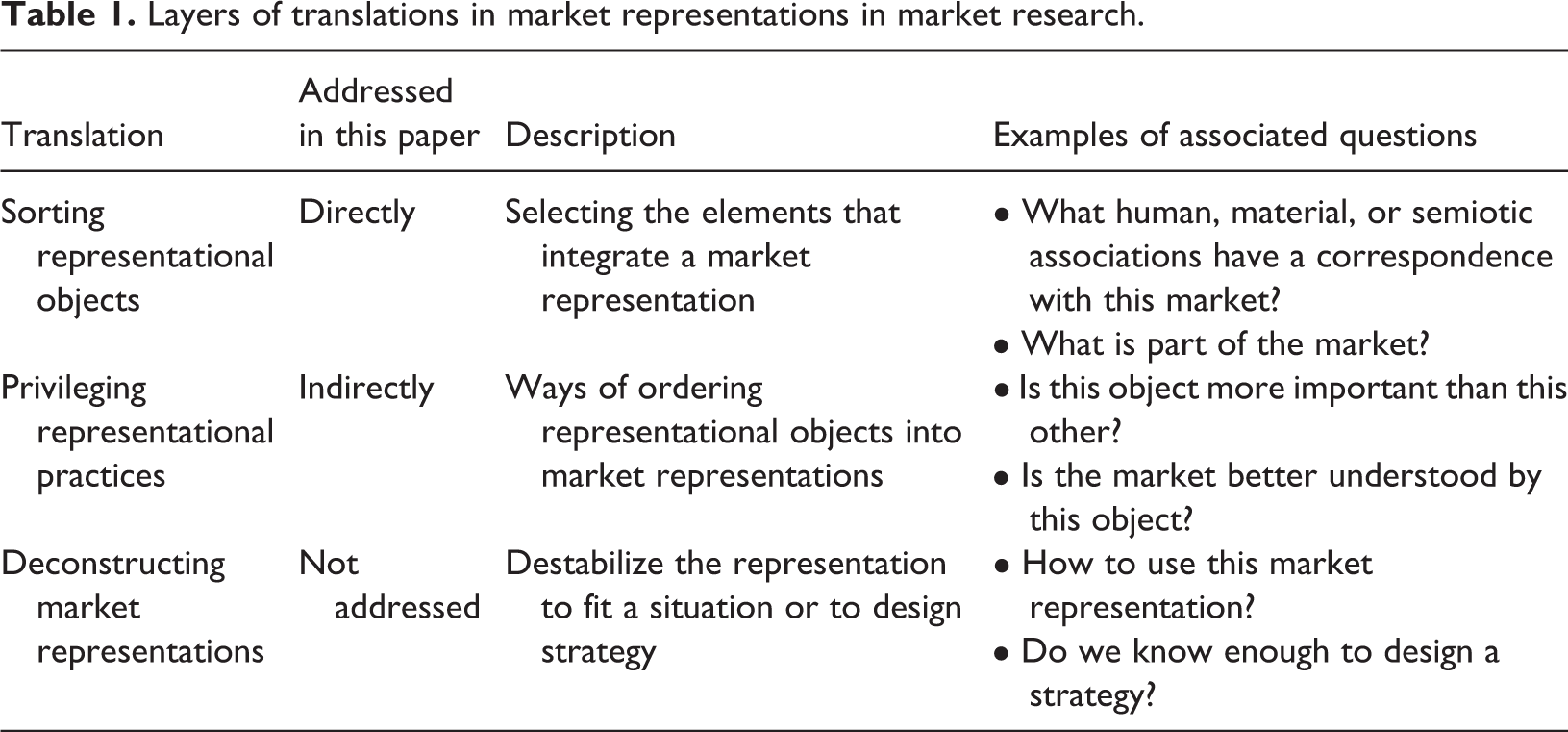
The first translation is the sorting of the representational objects attributed to some correspondence with a specific market. Sorting means categorizing representational objects assumed to have a link with real or future markets. Literature reviews have summarized how markets are described through different representational objects in academic disciplines (e.g. Diaz Ruiz, 2012; Venkatesh and Peñaloza, 2006). For instance, economists highlight supply, demand, and competition; sociologists focus on networks, power, and legitimacy; and marketers focus on consumers, needs, and wants. Sorting representational objects is relevant for marketing not only in the literature but also in practice (Cayla and Peñaloza, 2012). For instance, Sunderland and Denny (2012) reported the complexities of matching market representations, based on behavioral data, and those based on demographics. The study here is primarily situated in this translation, because data conceptualizes the representational objects that commercial researchers privilege when describing what a market is to their clients. In the results below, representational objects are divided into dimensions.
The second translation is the privileging of representational objects into market representations. Privileging means that representational objects are highlighted or neglected to form different market representations. The data revealed that markets were not represented always in the same way, or for the same purpose, perhaps because market representations are commissioned. However, the data in this paper provide only indirect insights into this translation, because data are obtained from asking, what is a market? Practitioners arranged representational objects into a view of a market, but it is unclear how and why market researchers do so.
The third translation refers to the way in which market representations are deconstructed. This means that managers infer from market representations elements that fit the context. This translation is important because the way in which market representations are used has a constructive dimension for framing new markets (Harrison and Kjellberg, 2010). Stubbart (1989) argued for a cognitive aspect in which managers determine strategy by what is brought to their attention. In marketing, Day and Nedungadi (1994) argued that managers simplify environmental uncertainty to make decisions through a coherent structure of knowledge. Ottesen and Grønhaug (2002) explored how managers often interpret concepts substantially differently from their intended meanings. Empirical data here, however, do not contribute to the deconstruction of market representations. Still open for research is the form in which managers use market representations, which may be ignored.
In review, the data in this paper are situated directly in selecting representational objects, and indirectly in the representational practices privileging the arrangement of market representations.
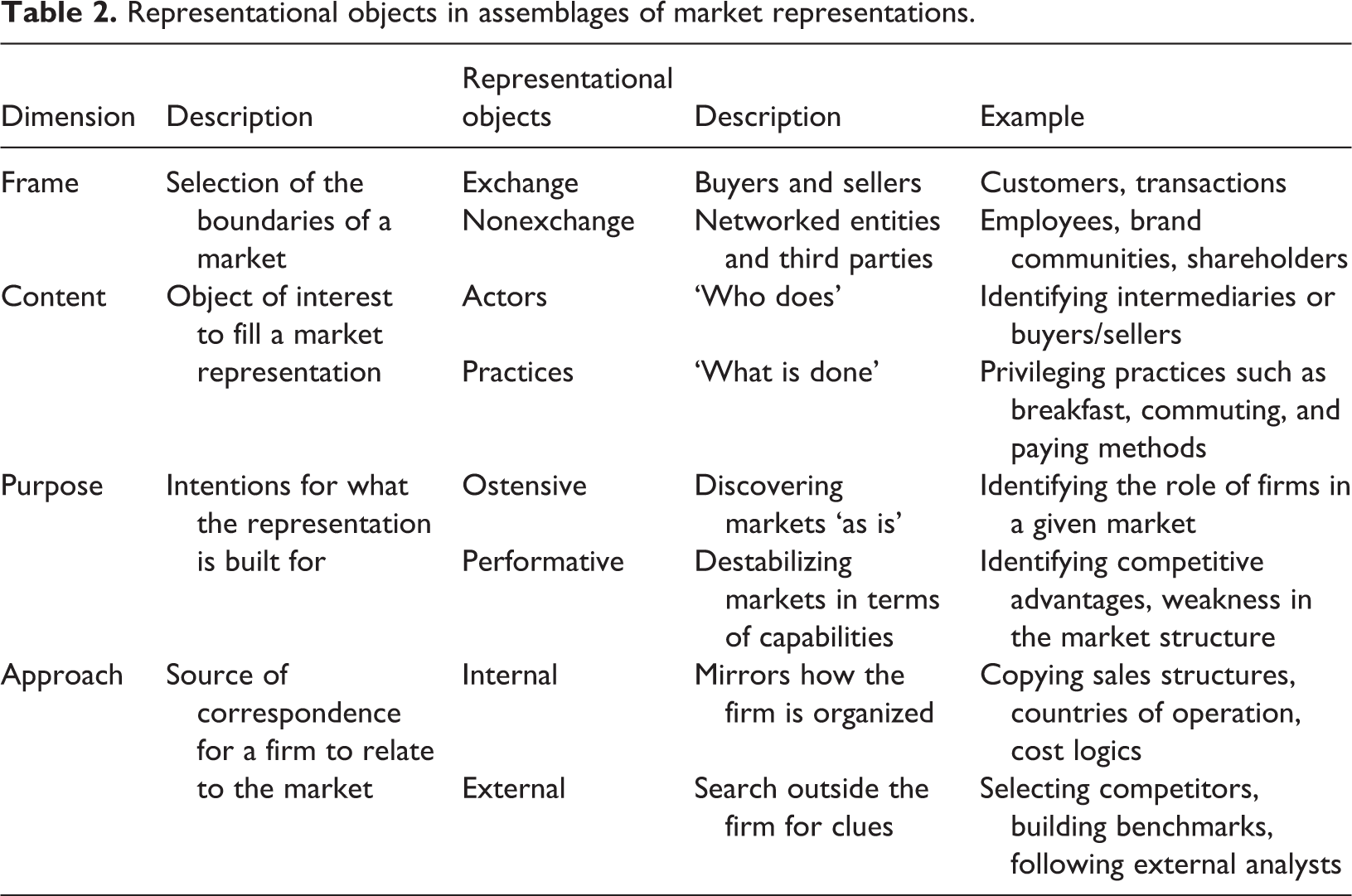
Representational objects in assemblages of market representations.
Conceptual development
Representational objects are categorized into four dimensions. Within each dimension, a tension privileges which representational object is highlighted. Table 2 offers a summary.
Frame: underlying tension between exchange and nonexchange
A frame implies boundaries in an allegory for a structure admitting or enclosing something, because if everything is a market, then nothing is. Frame is named after Callon’s ideas of framing and overflowing (Callon, 1998). In Callon’s work, framing establishes the limits that guide the ways of acting, while overflowing challenges the limits imposed by frames. The frame of a market representation limits what will be part of a market.
The representational objects included in the frame are either exchange or nonexchange. On
the one hand, markets are framed through exchange when attention is centered on trade
(Varey, 2010). On the other
hand, markets are framed as nonexchange when attention is centered in forces that may
influence trade but are not bound to price-setting mechanisms. Baron (1995) identifies the social, political, and
legal arrangements that nominally are not drafted as part of the market structure, but
still influence markets. Nonexchange objects differ from exchange objects because of
characteristics such as majority rule, due process, or publicness. Nonexchange objects can
include pressure groups, brand communities, employees, shareholders, and public opinion.
The underlying tension responds to the extent to which nonexchange objects are drafted as
an integral part of a market. For a marketer, a market frame that includes nonexchange
elements is often necessary because marketers often operate on the fringes of cultural and
economic domains (Slater,
2012), for example, a manager focuses on exchange when introduces a price reduction
but expands to nonexchange when publishes a corporate social responsibility report. The
market researchers interviewed reflected about the extent to which exchange is a central
feature of their market representations: The word ‘market’ in the research business seems to be used interchangeably with
‘consumer’. The fact that ‘consumer’ can be replaced by ‘market’ suggests that it
differs from social or political research in that it has a commercial connotation at
some level. (Principal, independent RA based in the UK) Although the patient ultimately pays and uses the product, we tend to focus more on
private insurance companies (whose premiums are typically paid by employers),
government insurance services (the elderly and the poor, but also for products used in
a hospital setting), and mainly the physician who is the primary decision-maker
(within the economic constraints set by the payers: patients, insurance companies and
governments). (Research Analyst, independent RA based in the UK) We hear the voice of customers. But also of those who can become customers. Some are
the market, the others are potential markets. (Experienced analyst, part of a
multinational RA based in the USA) We are always very cautious when our clients speak about their “market,” sometimes
they mean a specific group of people, but other times, they mean pretty much anything
outside their organization. (Founder, independent RA based in Canada)
Content: underlying tension between actors and practices
Content refers to the constituents of a market representation. The dimension “content” contrasts market practices with ideas of what markets are (Kjellberg et al., 2012). Early commentators introduced the idea that markets can be structured in terms of interactions between actors (Myers and Tauber, 1977). The dimension content distinguishes between ways of doing things (i.e. practices), independently of who does it (i.e. actors). When the content of a market representation is composed of actors, “who does” is privileged over “what is done.”
For the market researchers in this study, the identification of actors in a market is
part of the content of market representations. The identification of actors is consistent
with the existing literature since it is not always clear how actors are recognized (Andersson et al., 2008). The
segmentation of actors into similar groups is a well-known procedure in market research;
however, the literature has reported the difficulties correlating practices with actors,
for instance, Sunderland and Denny
(2012) showed how actor-based segmentation collided with actual purchasing
behavior. Market researchers here refer to actors that can be grouped together under
specific criteria: We speak of target markets, and for companies, markets are people or companies which
can be grouped together for some reason. (Research Director, part of a multinational
RA based in the USA) Take a breakfast for example. We create a ‘stomach share’ for some of our clients. We
want our clients to have as much share of the stomach during breakfast as possible.
This means that a cereal brand does not compete against other cereal brands, but
against eggs, bread, and butter. We want to know about eating habits; breakfast,
dinner, and snacks are our markets. (Research Director, part of a multinational RA
based in the USA) We sometimes find new markets. Seeing how people use products we can find, for
example, that vinegar is used to clean stains in fabrics, instead of using it in salad
dressings. Marketing people could use that as a new market. (Research analyst,
independent RA based in Mexico)
Purpose: underlying tension between ostensive and performative
Purpose explores the reasons a market representation is assembled. A market representation can have many intentions; for instance, a representation can be assembled to explain how a market operates or to enable action by pointing out competitors’ weaknesses. The representational objects in the purpose dimension are labeled after linguistic definitions of ostensive (Wittgenstein, 1953/2001) and performative (Austin, 1975). An ostensive definition conveys meanings by exhibiting instances of the term defined (e.g. that is the color sepia). An ostensive definition provides concise, stable, and orderly explanations. Explanations are normally detached, and the object of interest is pacified, which means that it is ought not to change. Performative definitions, in contrast, are not indicative, but instead, aim to change the (social) reality described (e.g. this event begins now). The actor and the object of interest are related and influence each other; hence, performative definitions cannot be qualified as true or false. In the case of markets, a market representation highlights aspects of the market in either an indicative manner (i.e. ostensive) or action oriented (i.e. performative). 2
The tension in the purpose of a market representation is the extent to which a representation can show either stability or destabilizing opportunities. On the one hand, when the market is ostensive it is recognized as is (e.g. this is how the market works, and cannot be changed). On the other hand, when performative, a market representation identifies the potential for change (e.g. this is how the market works now, but these actions can capture resources, eliminate competition, and change the rules).
The market researchers interviewed often described ostensibly the identifiable
characteristics of markets. Markets were described in terms that may seem disassociated
from the capabilities of what their clients can accomplish (e.g. this is how travel agents
are supposed to act in the tourism market). A market researcher would select
representational objects that uniquely identify a market, for example, business
traditions, maps of relationships, and categorizations for offerings. In the following
quote, a market researcher explains how, because of his expertise in financial markets, he
is able to disentangle the complexity of that market to their clients: We work in financial markets. We help firms understand the market because [while
financial markets] are generally thought of as stock markets, students of finance will
recognize that financial markets are tremendously complex, encompassing markets where
almost anything [or derivatives of almost anything] can be bought and sold. (Founder,
independent RA based in the UK) We provide relevant insights so that managers can think strategically. We believe
that a factor analysis for segmenting customers can be really illustrative, but it is
useless unless we can transform that into something that the client can implement with
resources available. (Owner, independent RA based in Mexico)
Approach: underlying tension between internal or external
Approach refers to the form in which a firm is thought to relate to its market. Representational objects in the approach dimension can be grounded internally or externally in relation to the firm. In other words, a market representation can be assembled using a logic that could mirror either how the firm itself is organized or draws from outside sources.
Market researchers described market representations that often respond to already
existing firm structures and patterns, for instance, distribution areas, sales structures,
or internal product categorizations. An internal logic could reflect corporate structures
such as organizational hierarchies, production lines, or the structure of the sales
department. If mirroring how a sales department is organized, the market researcher will
have to assemble a market representation according to how the company works (e.g. the
“U.S.” market would be compared with the “Rest of the world” market). In the following
quote, a market representation assembled from internal representational objects responds
more to firm structures, rather than by external considerations: Markets can be really anything, but I guess that many times it just copies how
companies work: internet vs traditional. KAMs [Key Account Managers] vs marketing, and
so on (Partner, independent RA based in the UK). Sometimes the main work is re-defining the market. For example: does a vacuum cleaner
manufacturer operate in the vacuum cleaner market or in the home care market?
(Research Analyst, independent RA based in Canada). The market is whatever the client writes in the RFP (request for proposal) (Research
Analyst, multinational RA based in USA). Voters, consumers, competitors, or their own employees: anything. Our clients
sometimes want to sell a product, but sometimes, want to sell an idea unrelated to
what they normally sell. The market is whatever our clients write in the “brief.”
(Partner, independent RA based in the USA)
Discussion
This paper conceptualizes market representations in terms of assemblages of representational objects. Four dimensions are identified: frame, content, purpose, and approach. Within each dimension, because certain representational objects are either present or not, the study elucidates implicit tensions in sorting and privileging representational objects. The following section discusses the contribution of the paper in light of the theoretical processes enabled and the implications for market studies, marketing theory, and managers.
Kjellberg and Helgesson (2006, 2007) theorized that markets result from translations between three types of practices: normalizing, exchange, and representational. Closer inspection of representational practices was called for because of the constructive dimension of re-representations of markets. A constructive dimension means that market representations can establish preferable directions for a firm to act and inform rules. Although Kjellberg and Helgesson (2007: 148–149) called for market representations to be studied in terms other than those of reflections of markets, it was not clear how to do so. This paper articulates in more detail the translations that are part of representational practices. Market representations are interrogated in terms their constructive dimension of what a market is and implicit translations overlooked previously. Overlooked translations elucidate the sorting and ordering of the objects that integrate the representation.
The conceptualization of representational objects is in line with Finch and Geiger (2010). Their work explored boundaries of markets by distinguishing types of objects available in markets. Market objects were differentiated in terms of whether an object is subject to calculation. If an object can be disentangled from its owner and valuated independently, then the object became a market object. Although the importance of valuation is acknowledged, this paper argues that a market representation can challenge the boundaries of markets in terms other than calculation. Boundaries of markets are (de-) stabilized simply by arranging the kind of objects that will be depicted as part of a market that can include noncalculative and nonmarket objects. As shown here, the arrangement of representational objects is an integral part of the reproduction and transformation of market structures in the multiple understandings of what a market is.
Multiple understandings of markets constitute one of the four major research avenues in market studies (Kjellberg et al., 2012: 220). This paper shows that privileging representational objects results in converted understandings of what a market is. Scholars can approach the multiplicity of market representations through the taxonomy presented here. The categorization is not meant to be exhaustive; neither explains the reasons representational objects are privileged in the way they are. Further research is needed to identify the representational practices that marketers use to privilege market representations into certain assemblages. However, identifying representational objects advances the marketing literature because doing so enables understanding of ways in which firms relate to markets.
The question of how firms relate to markets is a fundamental issue that remains unanswered in the marketing theory (Day and Montgomery, 1999). Several attempts to identify how firms interact with markets have been made (compare Coviello et al., 2002). However, a limitation is the exclusive focus on the interaction of firms with customers. It has been argued here that the focus on customers is but one of the representational objects that can be used to represent markets. In the 1990s, scholars argued that the firms interact with markets in many ways (Myers and Tauber, 1977: 2): (a) with other firms; (b) with products; (c) people’s perception of firms; (d) people to people; and (e) people to products. Moreover, this paper suggests that the fundamental question of how firms relate to markets remains. Deeper understanding of the interactions between firms and markets can be achieved by new understandings of marketing work.
One last contribution elucidates the use of commissioned research. It is a managerial paradox that commissioned research, as costly as it is, is neglected or misunderstood (Deshpande and Zaltman, 1982). Explanations regarding why managers do not use commissioned research focused on the capabilities of the manager or methods for gathering information (e.g. Ottesen et al., 2002). Explanations imply that since commercial research discovers markets, it is the managers’ fault of not understanding commissioned research, or perhaps, the commercial researcher did not use correct techniques. However, results in this study indicate that the form in which the market representation is assembled matters, because market representations provide ways to simplify reality. Representations which do not fit the existing view of how markets work are disregarded often, because ideas of markets are expectation confirming and knowledge consistent (Alba and Hasher, 1983: 203).
Both, commercial researchers and managers, can benefit from the understanding that knowledge about markets is representational, and hence, interpretative. A consequence of acknowledging representational practices is elucidating what market research actually does. At the core, a market researcher assembling a market representation for a client is privileging a certain ways to disentangle reality and ideas of markets. When commissioned research does not fit managerial experience, research does not need to be considered faulty; instead, research can be qualified in terms of integrating potentialities and identifying new ways to relate to markets. On the other hand, a manager cannot simply neglect the process of commissioned research as discovery, because the final arrangement privileges views which may not be expectation confirming. This work equips managers to identify the aspects of their markets that have been neglected, and therefore, not well understood. For instance, a critical analysis of what a firm knows already permits the identification of areas that may not be well-known because of the way in which market representations were commissioned.
Conclusions
This study articulated the ideas that are put together to form a coherent view of a market. Four dimensions are presented regarding the representational objects used to assemble market representations, and propose that each dimension results from the negotiation of internal tensions. Tensions arise out of privileging which representational objects are included in terms of frame (exchange or nonexchange), what to include in the content (actors or practices), what purpose will be accomplished (ostensive or performative), and how to approach the market (internal or external perspectives). This conceptualization enables an assessment of market representations for elucidating potentialities of how firms can relate to markets, for instance, on the use of commissioned research. Findings in this paper open the following avenues for further research: researchers can observe the practices of how and why market representations are assembled in the way they do. Also, researchers can study whether the form in which a market representation is assembled has an effect on the marketing strategy.
Footnotes
Funding
This work was supported by the KATAJA Finnish Graduate School of Service and Relationship Management [nr0027], and Liikesivistysrahasto Finnish Foundation for Economic Education.