



Abstract
Value co-destruction is emerging as an important way to conceptualize non-positive outcomes from actor-to-actor interactions. However, current research in this area neither offers a clear way to understand how value co-destruction manifests nor does it consider the role of actor engagement behaviors. Drawing on a case study in the aerospace industry, the present study begins by identifying and describing two ways in which actor perceptions of value co-destruction form: goal prevention and net deficits. Next, the study identifies and describes nine actor engagement behaviors that moderate actor experiences of value co-destruction. The study also unpacks these concepts at both the actor-to-actor and service ecosystem levels. The article concludes with implications for marketing theory and practice.
Introduction
Economic exchange involves actor-to-actor interaction (Lusch and Vargo, 2014; Vargo and Lusch, 2015). For example, the purchase of an automobile involves the customer deciding to seek purchase options, to conduct inspections, to decide on the purchase, and to drive away. For the supplier, providing information about the purchase, negotiating with the customer, and arranging delivery all involve a series of customer-supporting activities. In this example, actor-to-actor interactions involve collaborative efforts to realize complementary benefits. The customer receives an automobile that suits their requirements; the supplier receives financial compensation. Previous studies describe this as “value co-creation” since there is an exchange of activities (not products exclusively) that allow both customer and supplier to realize perceived benefits in excess of perceived costs that may not have been possible otherwise (Lusch and Vargo, 2014; Payne et al., 2008). However, these processes do not always create positive outcomes.
An emerging concept in the study of buyer–supplier exchange is value co-destruction. This concept has been defined as “… an interactional process between service systems that results in a decline in … the service system’s well-being (which … can be individual or organizational)” (Plé and Chumpitaz Cáceres, 2010: 431). What separates value co-destruction from service failure and product harm (i.e. value destruction) is that it focuses on collaborations between actors rather than a one-way delivery of the supplier’s product to the customer: value co-destruction is interactional and value destruction is unilateral. This collaborative emphasis suggests that each actor plays an important role in value co-destruction processes. However, not all actors participate equally. Actors face limitations in time, information, and resource availability, thus amounting to a bounded rationality (Simon, 1991). Indeed, actor-bounded rationalities are evident in supplier firm representatives (Prior, 2016; Singh, 2000) as well as in customers (McColl-Kennedy et al., 2012; van Doorn et al., 2010). To manage bounded rationalities, actors often adopt stylistic behaviors due to the relatively lower burden this places on decision-making. This involves employing relatively consistent behaviors across situations with similar attributes (McColl-Kennedy et al., 2012; Prior, in press). Despite recognition of this, there has been little consideration of how these stylistic behaviors influence actor perception and engagement, particularly in transactions with negative outcomes.
Thus, this study has two main goals. First, it considers how value co-destruction relates to actor perception. The study develops two conceptual structures: goal prevention and net deficits. These provide a means to understand the ways in which negative perceptions form. This extends the notion of subjective value in service-dominant logic (SD-logic) and value co-creation (Lusch and Vargo, 2014; Payne et al., 2008) to now include negative customer experiences. This addresses calls for research in this area (Echeverri and Skalen, 2011). Second, the study identifies a suite of nine actor engagement styles that influence the ways in which actors receive information. Since these engagement behaviors influence the manner of actor collaboration, the study suggests that these are important moderators of actor experiences. Previous studies focus on stylistic behaviors as applicable in service delivery contexts, with little consideration of the relationship between perception and behavior (Marinova et al., 2008; Prior, 2016; Singh, 2000). Therefore, this appears to be a new way of looking at actor engagement behaviors. This is important since it allows a more in-depth understanding of how actor behaviors influence perceptions in value co-destruction contexts. The findings of the study draw on a case of a buyer–supplier dyad in the aerospace industry. By focusing on a business-to-business market context, the study also considers the interaction between both actor-to-actor and service ecosystem perspectives. This extends emerging SD-logic research into the role of institutions in value-related processes by providing a multilevel view of value co-destruction (Vargo and Lusch, 2015).
Conceptual background
This study draws on SD-logic as a conceptual basis. Several of the axioms contained in SD-logic focus on actor interpretations of value as well as actor behaviors. However, they tend to emphasize positive outcomes (Plé and Chumpitaz Cáceres, 2010). For example, SD-logic centers on terms such as “value” and “co-creation”, both of which imply an optimistic view. As such, the ability of SD-logic to explain exchange outcomes that are not positive is limited. The value co-destruction concept represents an attempt to address this issue. Current research in this area centers on the misalignment or misuse of resources (Plé and Chumpitaz Cáceres, 2010; Smith, 2013) and/or practices (Echeverri and Skalen, 2011) with a desirable outcome. While previous studies provide valuable insights into the processes underpinning value co-destruction, there is considerable scope for development. Importantly, few studies consider how value co-destruction involves actors. This is surprising given the emphasis on “service” and “activity” in SD-logic (an exception being Echeverri and Skalen, 2011).
The current study centers on the role of actors in value co-destruction. Two roles have been highlighted as important for actors under SD-logic. First, actors are the recipients of value. Foundational premise ten (FP10) 1 highlights the role of actor perceptions (Lusch and Vargo, 2014; Vargo and Lusch, 2015). This suggests that the perceptions of value depend on the information available to the actor and their appraisal of that information. Second, actors are the co-creators of value. FP10 also implies that actors choose how they deal with phenomena during the exchange process. This basic sentiment is also evident in FP6 2 and FP7 3 (Lusch and Vargo, 2014; Vargo and Lusch, 2015). FP6 suggests that multiple actors co-create value and FP7 suggests that actors participate in the creation and offering of value propositions. While actors have at least two roles under SD-logic, few studies consider how these apply to negative interactions. Studying these issues is important to understand how engagement processes that usually begin with positive intentions result in negative outcomes. Therefore, the present study has three primary questions: firstly, how do actor perceptions of value co-destruction form? Secondly, how do actor engagement styles influence value co-destruction perceptions? Thirdly, how do service ecosystems influence value co-destruction perceptions?
How do actor perceptions of value co-destruction form?
Existing studies suggest that an underlying process shapes actor perceptions (Woodruff, 1997). In the first instance, an actor (usually a customer) receives information about a purchase. In a narrow sense, this includes the pricing and product-related information that is the subject of exchange. More broadly, this information relates to a purchase experience in general terms. Using the automobile example from above, the properties of the vehicle itself and its price are the primary subjects of exchange. The customer experience elements include the visual appeal of the sales facility, the presentation and approach of the sales person, and after-sales service (Brakus et al., 2009; Havlena and Holbrook, 1986). The type of information, the communications media, and the ability of the actor to receive this information all influence their perceptions. Following the receipt of information, the actor interprets the information. This involves decisions as to what information is valuable, an understanding of the message, and how the message (given the way in which it has been delivered) relates to information already held by the actor (such as memories of past experiences). Lastly, the actor evaluates the information according to a set of preexisting criteria. This process involves matching information against a set of expectations or standards.
Given the notion of “perceived value” as described here, it is likely value co-destruction emerges when the result of actor evaluations of interaction experiences is negative or when they rest on incomplete or misinterpreted information. Value co-destruction studies suggest a “decline in a customer’s well-being” as its primary result (Echeverri and Skålén, 2011; Plé and Chumpitaz Cáceres, 2010). However, this is not a particularly clear way of expressing value co-destruction outcomes. Smith (2013) suggests that resource loss is a key indicator of value co-destruction and this contributes to negative emotional states (Smith, 2013). While this provides more specificity, the two primary concepts here (resources and emotional states) also lack clarity. Despite progress in understanding the nature of value co-destruction, considerable scope exists for refinement. The present study contributes to this by describing how actors develop negative appraisals. By focusing on this aspect, the study hopes to clarify actor experiences from value co-destruction.
How do actor engagement styles influence value co-destruction perceptions?
SD-logic emphasizes actor-to-actor collaboration as the means to co-create value. However, refinements to this notion suggest collaboration differs depending on contextual factors, particularly since value co-creation occurs during a specific episode (i.e. a specific set of interactions that focus on a specific outcome) (Payne et al., 2008). Chief among these considerations are timing, location, and content (Crowther et al., 2011). The discrete nature of value co-creation episodes constrains the possible set of actor experiences available while also limiting their participation options. The constraints endemic in specific value co-creation episodes is also relevant in value co-destruction. In considering a specific example of public transport, Echeverri and Skalen (2011) show that value co-destruction emerges where activities and actor requirements do not align. While several other branches of research consider the effects of contextual limitations on actors, SD-logic does not currently address this well.
The constraints actors face amount to a bounded rationality. This has important implications for actor co-creation behaviors. First, it means that they can only access a certain amount of information at a time and, of the information they have, they can only dedicate a certain amount of time to information analysis. Second, they tend to face multiple demands. For example, both supervisors and customers place demands on frontline personnel, which these individuals must balance (Zablah et al., 2012). Third, they can only complete a finite set of activities in a given time frame. These tensions mean that actors have to choose ways to reconcile between multiple demands while managing a plethora of constraints. These tensions can place actors under considerable stress (Zablah et al., 2012). To cope with this, actors tend to adopt consistent behaviors across similar situations over time since this reduces the burden associated with making new behavior choices on each occasion. Selecting consistent behaviors also allows predictability, so actors are more able to anticipate likely outcomes by adopting stylized approaches (Gary and Wood, 2011; Reger and Palmer, 1996).
Stylistic behaviors are evident in several important types of actor. From a supplier perspective, studies have shown relatively consistent customer-facing behaviors in customer service and sales personnel (DiMascio, 2010; Prior, in press). From a customer perspective, stylistic behaviors are also evident (McColl-Kennedy et al., 2012; van Doorn et al., 2010). These studies suggest that stylistic behavior choices influence actor perceptions. For example, DiMascio (2010) suggests adopting a service style that reflects a desire for “win–win” outcomes is likely to create better actor perceptions than a “win–lose” approach. McColl-Kennedy et al. (2012) show that health-care patients are likely to have different service experiences depending on the stylistic ways in which they engage with health-care professionals. This is consistent with the notion that customers are the creators of their own value and that it is their own choices that determine their perceived outcomes (Grönroos, 2011; Grönroos and Voima, 2013).
Stylistic behaviors influence perceptions since they determine actor information access and information processing. In effect, they become a form of lens through which an actor understands the world. This study concentrates on actors’ stylistic behaviors, as they relate to value co-creation episodes. Several studies describe these as “actor engagement styles,” which are defined as the typical behaviors that actors adopt across similar value co-creation episodes with an expectation that they will experience benefits (McColl-Kennedy et al., 2012; van Doorn et al., 2010). Actor engagement styles are likely to shape the actor experience by determining how and when they engage in interactions. Therefore, they are likely to contribute to value co-destruction outcomes by creating opportunities for misalignment or misuse of resources and/or practices. The specific nature of these influences and the ways in which they shape perceptions are currently unclear. Therefore, the present study addresses this issue by identifying the nature of actor engagement styles as these relate to value co-destruction and suggests their likely impacts on actor perceptions.
How do service ecosystems influence value co-destruction perceptions?
SD-logic research tends to delineate between two levels of aggregation (Lusch and Vargo, 2014; Vargo and Lusch, 2015). At the actor-to-actor level, specific individuals are the primary basis for analysis. They engage with other actors to create mutually beneficial outcomes. However, actors do not exist in isolation. At the service ecosystem level, multiple actors interact as an aggregate social entity. It is unlikely that all members of the service ecosystem have completely complementary requirements. This provides a basis for conflict. This is evident at the actor-to-actor level (Laamanen and Skålén, 2015; Mele, 2011), but it can also drive political activities which disadvantage some actors in the service ecosystem (Corvellec and Hultman, 2014). While SD-logic recognizes the importance of networks and institutions, there is little consideration as to how service ecosystem dynamics shape value co-destruction. This is particularly concerning for business market contexts due to the dual emphasis on individuals and firms. Providing a greater understanding of service ecosystem influences on value co-destruction is the third goal for the present study.
Methodology
Research design
The three research questions outlined above focus on descriptive and explanatory outcomes. This suggests an inductive, qualitative approach is appropriate (Lincoln and Guba, 1985; Patton, 2002), thus we adopted a qualitative approach for this study. The study began with an attempt to understand value co-creation in terms of actor perceptions and engagement styles. During the course of fieldwork however, our observations revealed a substantial number of actor interactions that were experienced as negative. This led us to conclude that the case provided a good opportunity to explore value co-destruction. The unit of analysis for this study is an exchange episode. This has been the primary unit of analysis in both value co-creation (Payne et al., 2008) and value co-destruction (Echeverri and Skalen, 2011) research. Exchange episodes include the set of actor-to-actor interactions that create outcomes.
Three additional theoretical criteria informed case selection (Yin, 2009). First, previous exchange episode studies tend to concentrate on consumer market contexts and, while value co-creation is applicable to business markets, most studies in this setting focus on relationships rather than episodes (some notable exceptions include Brady et al., 2005 and Powell and Swart, 2010). This informed the selection of business markets as a context of interest. Second, many exchange episodes could be described as “transactional” in that they do not necessarily involve long-term relationships. Developing long-term relationships during an exchange episode has become essential in more complex product deliveries (Tuli et al., 2007). Therefore, a lengthy, complex exchange process was the second selection criteria. Third, a buyer–supplier dyad can involve interactions between a relatively narrow set of actors. However, this does not necessarily highlight differences in behavioral styles. Therefore, the third selection criterion was diversity in actor-to-actor relationships.
The UK aerospace industry was the context of interest. As of 2010, this industry employed more than 100,000 individuals and had revenues totaling about UK pounds £21.08 billion. 4 This makes it the second largest aerospace industry in the world (after the United States). This industry provides a basis to understand exchange episodes in a business market context and involves complex product and service exchanges. Despite its significant footprint, most of the transactions involve buyer–supplier relationships between a narrow set of firms, many of which are complex, lengthy, and involve actor-to-actor relationships at multiple levels. This narrowed the possible options available for study. Due to the focus on a specific episode, this constrained the options further to those projects just about to commence. The final case was selected based on its ability to meet the criteria above while also allowing access for the research team to observe an entire exchange episode.
The case is based on the relationship between a large aircraft systems integrator and one of its key suppliers. At the firm level, this relationship had developed productively for about 30 years prior to data gathering. Both firms had recently begun a long-term partnership to develop and deliver civil and military aircraft systems. As part of the partnership, the buyer firm transferred some of its manufacturing capabilities and resources to the supplier in exchange for an investment of about US dollars $250 million. The relationship dynamics shifted during the course of program developments, with the supplier adopting a broader role than previously. This shift involved a greater focus on design and the manufacture of a broader set of subcomponents rather than confinement to discrete, design-related transactions only. Top management across the two firms regarded the relationship as vital for the success of both organizations and the agreed programs. Despite several indicators of a positive initial relationship (e.g. longevity, trust, commitment, mutual goal sharing), managers now describe their relationships with the counterpart firm as “short-termistic,” “transactional,” a “struggle,” and “deteriorating.”
Data gathering approach
Data gathering occurred over a 3-year period (2009–2012). The study began after a request for help by senior managers from the supplier firm. These individuals sought insights that could help inform their relationship management practices with the buyer firm. Once members from both buyer and supplier firms had consented, the data gathering process began. Various methods of data collection were used including focus groups, interviews, and the analysis of documents and archival data. We were most interested in the viewpoints of individuals who could accurately describe relationship dynamics from both the customer and supplier. Thus, respondents primarily held senior management roles with significant responsibility for managing interactions with the buyer/supplier. 5 Two focus groups were used during the study (see Table 1 for a profile of respondents). 6 The purpose of these focus groups was to identify the strengths and weaknesses of the working relationship and to discuss the nature of the interfaces between individuals. We asked participants to map the history of the relationship (Musson, 2004: 42). Participants were probed for significant relationship events and distinctive relationship phases (Baba, 1988). The outcomes of the focus groups included initial descriptions of actor perceptions while also providing some early guidance on engagement styles.
Roles of interviewees involved in the study.
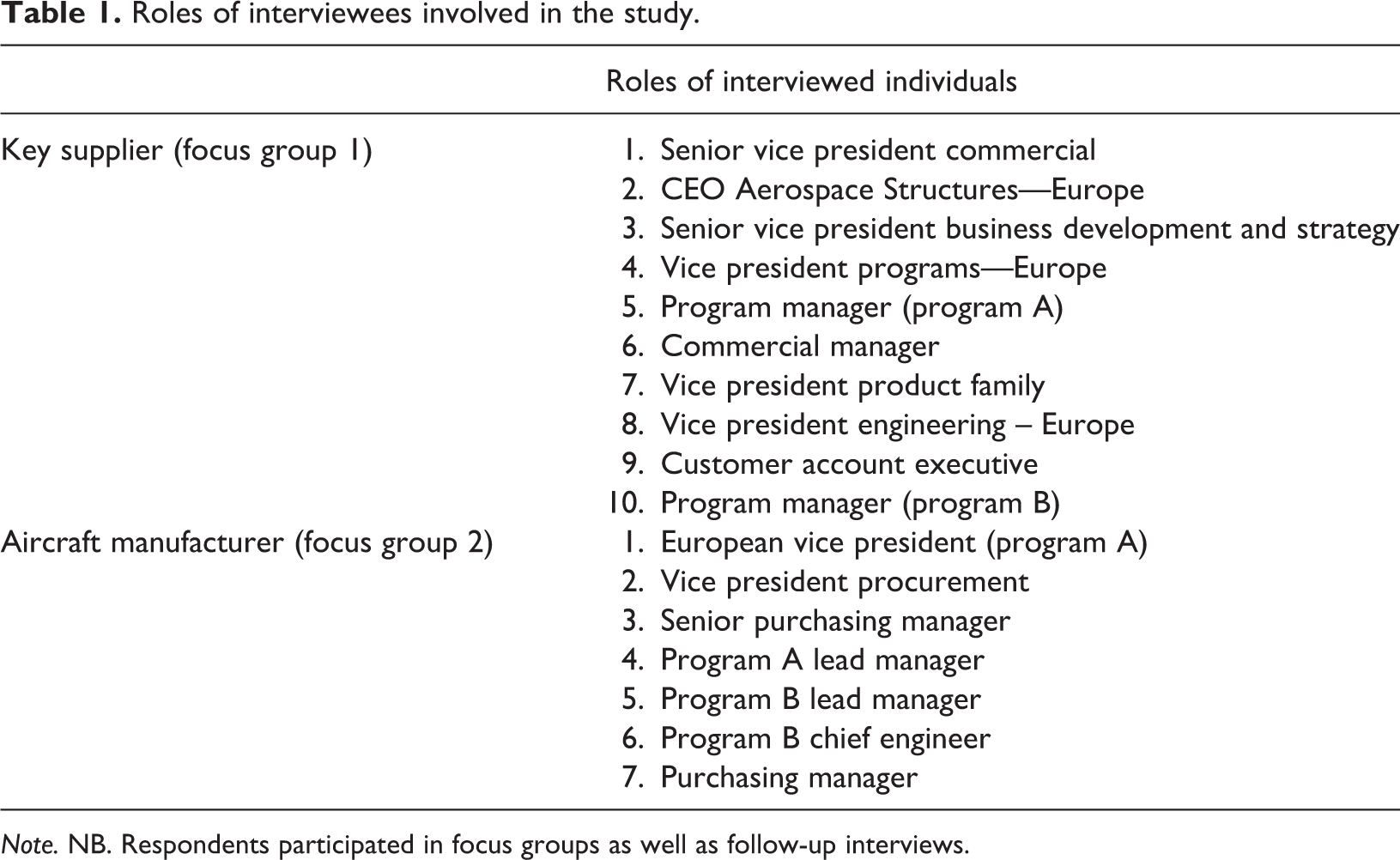
Note. NB. Respondents participated in focus groups as well as follow-up interviews.
Following the focus groups, participants were interviewed separately. Since the focus group data revealed some strong perceptions of negative dynamics, we chose to probe these further. We continued to build on the explanations of critical incidents by asking for detailed descriptions of actor perceptions. Specifically, we asked about respondent roles and responsibilities during the course of each incident, how they might have contributed to the outcomes of the incident, how they saw other actors contribute, and the nature of the outcomes. We conducted the interviews using a standard and common protocol. However, as we approached new interviews, we probed emergent issues further to gather deeper insights and to establish bases for triangulation. We used a systematic combining process to achieve this, as discussed in the next section (Dubois and Gadde, 2002, 2014). The duration of each interview was 75 minutes on average. We faced some constraints when recording and transcribing these data given the sensitive content of many of the comments. To manage this, several precautions were necessary. First, we assured respondents of complete anonymity. We overcame the close proximity between respondents by refusing to discuss the study outside of the research team. We also ensured data were kept in a password-protected file and hard copies of notes were kept in a locked filing cabinet accessible only by the research team. The findings are presented in as close to aggregate form as possible. Second, we ensured we received permission from respondents to record information before conducting the research. The supplier firm agreed to audio recording and this allowed us to transcribe their contents verbatim. However, the customer firm did not consent to audio recordings, so we used two researchers to conduct these interviews: one to conduct the interview and one to record direct quotes and to take extensive notes. We asked individual respondents to verify transcripts and field notes to check their accuracy. The informants from the customer confirmed the accuracy of our field notes. Through these provisions, we were confident that we had struck a suitable balance between obtaining specific details and maintaining confidentiality and adhering to strict research procedures.
We also used documentary evidence in the form of company reports, meeting agendas and minutes, presentations, and planning documents, in addition to other records and written artefacts. Content analysis was used to identify major passages of text that communicated buyer/supplier requirements, the nature and context of interactions, the nature of perceptions, and the ways in which actors had engaged with counterparts in the buyer/supplier firm. These provided an important basis for triangulation (Eisenhardt, 1989; Patton, 2002; Yin, 2009) as well as direction and redirection (Dubois and Gadde, 2002), which was particularly important given the dynamic nature of the case.
Data analysis and quality
The analytical approach involved “systematic combining,” which is an abductive approach to case analysis (Dubois and Gadde, 2002, 2014). This included loosely drawing on the SD-logic, value co-creation, and value co-destruction literatures without a deliberate attempt to form a priori views about value co-destruction. Next, we attempted to match the established theory with the phenomenon we observed during the course of fieldwork. Due to the multiple interactions across the episode, we attempted to juxtapose this evidence with descriptions in the literature. When we found differences, we engaged in subsequent data analysis. We continued this process in an iterative fashion throughout the development of the research.
Data analysis involved a detailed coding process, which first involved identifying the major themes that address the research objectives of the study. Selective coding then followed to provide rich descriptions of the focal phenomena and their interrelationships. This process uncovered two major ways in which actors perceive value co-destruction, which we label “goal prevention” and “net deficits.” These reflect the ontological structure of the actor perception process. The coding process also revealed two major categories that describe the type of actor engagement, which capture goal explicitness and the passivity of actor behaviors. We describe these in the findings below. Lastly, we split the comments and observations we identified from the previous steps into (i) those who refer to an actor-to-actor perspective and (ii) those who refer to elements of the service ecosystem. This provided a basis for a multilevel analysis.
Findings
Actor perceptions of value co-destruction
Our study uncovered two primary forms of actor perceptions as these relate to value co-destruction (see Table 2). First, goal prevention involves the actor’s belief that they are unable to achieve their desired outcomes from engaging in a collaborative process with other actors. Since most actors engage in these processes in good faith, value co-destruction for them amounts to a failure to meet expectations from a collaborative episode. This is often due to resources and/or practice misalignment. Alternatively, there is an absence of relevant resources and/or practices. These would otherwise have contributed to value co-creation efforts. We witnessed this form of value co-destruction in our case study when the customer specified their work requirements. This document typically stipulates the scope and details of the engineering solution sought. During the course of the development of aircraft programs, however, the requirements regarding weight limits and technical tolerances change. This change affects the suppliers’ ability to deliver a fit-for-purpose solution under short timescales.
Value co-destruction conceptual structures.
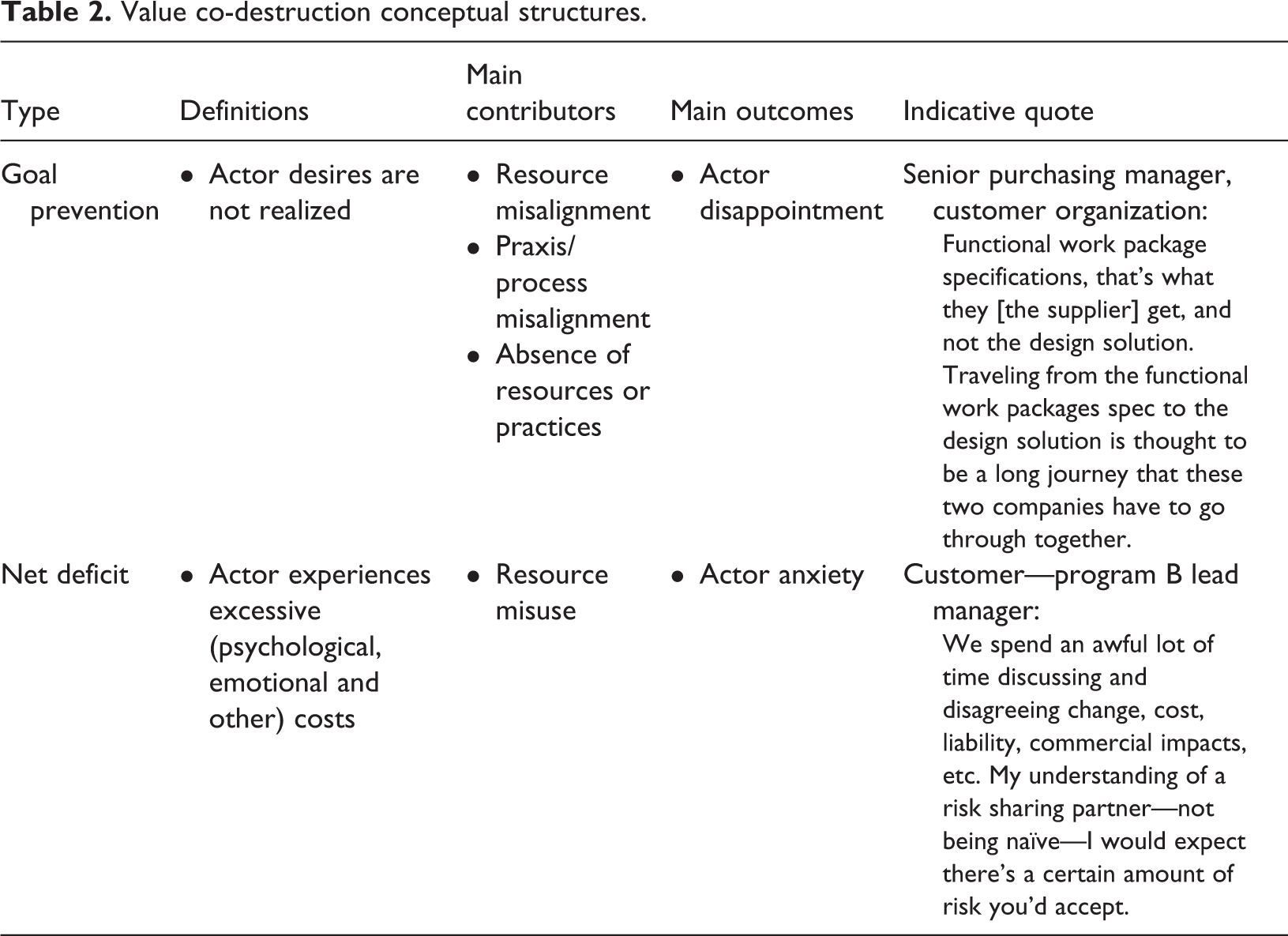
Second, actors may experience a net deficit between their perceived benefits and perceived costs from collaboration. Our data suggest that both costs and benefits involve positive and negative emotional/psychological states. These emerge through interpretations of the symbols and dynamics that emerge through the exchange process. We studied how net deficits materialize in our case study. Here, the customer appraises the purchasing experience before (through the process of supplier and proposal evaluation) and during the course of purchase (when negotiating final terms and conditions) leading to a perception of value when a satisfactory agreement is achieved. However, this positive perception of value mutates when the agreed original desired service package becomes less relevant because of necessary changes. In this case, the focus of the appraisal of value moves from the agreed product-service package toward the relationship. When relationship efforts required to persuade the supplier to continue delivering a valuable offering are high, these result in perceived sacrifices (for instance, time spent with the supplier unnecessarily that could be spent internally) that can supersede the benefits, thus accruing to net deficits.
The coding outcomes suggest that both sorts of actor perceptions are reasonably distinct. The underlying dynamics shaping the formation of both types of value co-destruction appear to differ, depending on the nature of actor requirements. Goal prevention is much more likely where an actor has a clear sense of their requirements, whereas a net deficit suggests a more unexpected or implicit set of outcomes.
Customer engagement behaviors and value co-destruction
The case study data suggested nine possible actor engagement styles that influence the actor’s experience of value co-destruction (see Table 3). To uncover these, the data analysis process focused on three major elements. Firstly, the explicitness of the purchase goals relates to how clearly and deliberately the actor articulates their desires to other actors (in this case, we focus on supplier representatives). We categorize these in terms of “explicit” (when the actor is very clear and deliberate), “hybrid” (when the actor is sometimes clear and sometimes not), and “implicit” (where the actor is not deliberate or clear). Secondly, we divide the actor engagement behavior in terms of whether they actively participate (i.e. significant dedicated effort expended in actor-to-actor interaction) in the value co-creation process (we label this “active”), whether they participate in some circumstances but not others (hybrid), and when they choose not to participate (passive; i.e. little dedicated effort expended in actor-to-actor interaction). This is similar to van Doorn et al.’s (2010) notion of “mode,” which focuses on the overall style of behavior. Thirdly, we suggest the ways the customer is likely to experience value co-destruction (either “goal prevention” or “net deficits”).
Goal explicitness, customer engagement behavior and value co-destruction experience.
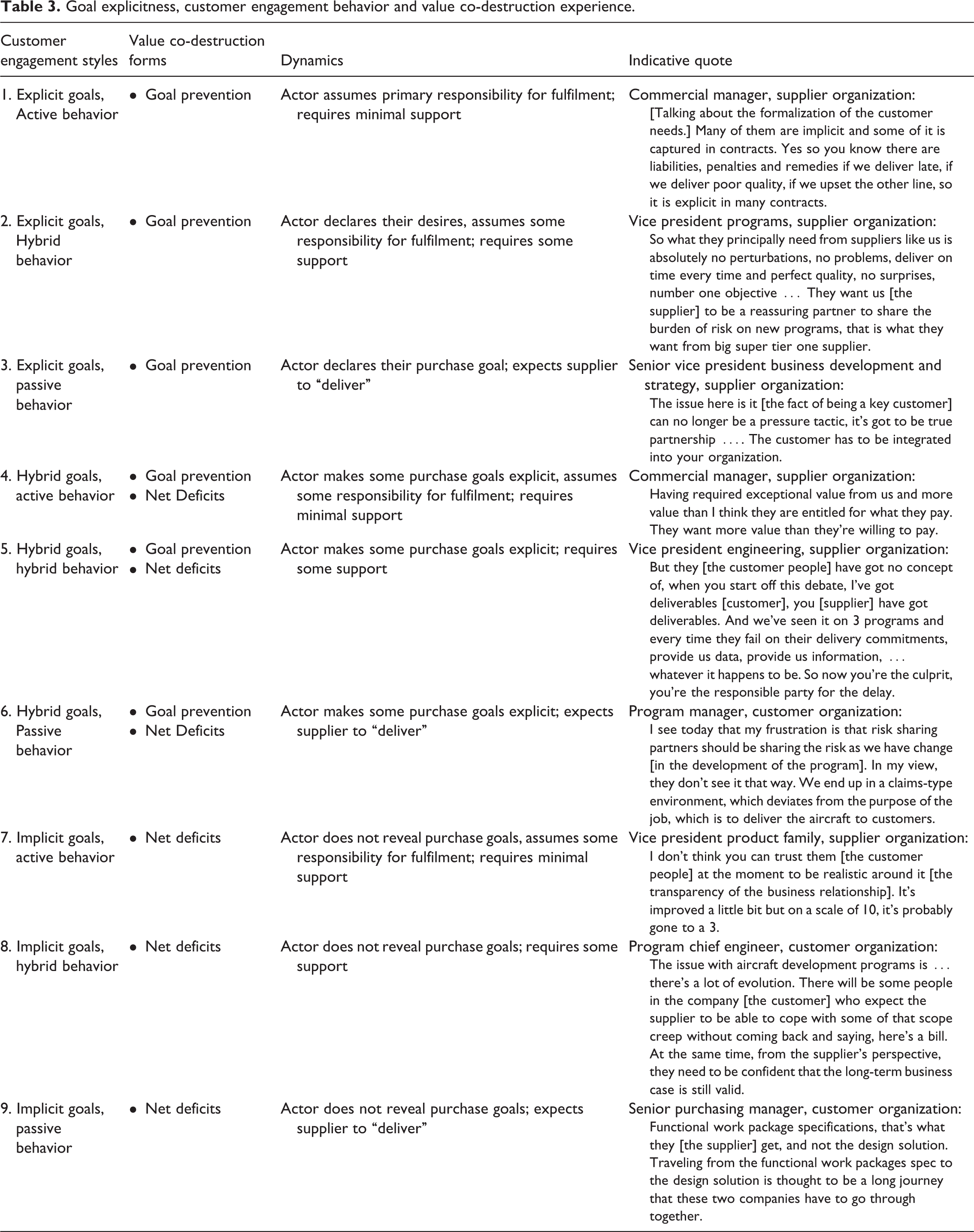
We also use a fourth element to describe the scenarios. This we label “dynamics.” In this, we expand on the third and fourth columns in Table 3 by considering how actors that are members of a supplier firm may experience actor engagement behaviors when these actors are customers. In this, we suggest that actors vary in terms of how likely they are to declare their desires to other actors. We also consider the onus for value creation in terms of actor beliefs. We rely on the service locus of control concept to assess this (Bűttgen et al., 2012). The primary dimension of this concept is the beneficiary’s belief as to who has the primary responsibility for “delivering value” during an exchange process. Overall, actor engagement behaviors appear to moderate their value co-destruction experiences.
Actor and service ecosystem perspectives
The value co-destruction perceptions and actor engagement styles relate primarily to direct actor-to-actor interactions. However, the findings suggest that a suite of contextual factors also have an influence. A key claim in SD-logic is that actor-to-actor collaboration involves “normalizing processes” (Lusch and Vargo, 2014). These involve establishing and reinforcing a series of social norms that apply to the exchange process. These act as rules that govern actor activities and, consequently, they form a basis for evaluations of their behaviors. This is a key tenet of social constructionist theory, where the perceptions of individual actors form partially with reference to their own background and partially from their interactions with a social system (Berger and Luckmann, 1967; Gergen, 1994).
The case data highlighted an instance of value co-destruction emerging through (i) a failure to genuinely negotiate an agreement and (ii) cultural inconsistencies between buyer and supplier firms. This was apparent during a discussion of “compression plans.” Compression plans are tactical work plans to accelerate design and production processes. These typically involve additional short-term efforts to recuperate delays. While agreement of the need for compression plans was usually straightforward, agreements on implementation and cost bearing were often not forthcoming. Following, two quotes from both the supplier and from the customer illustrate this point. You know we had a 3 hour session on Tuesday of this week you know where we talked about how we can compress 22 weeks down to 12, which I really don’t believe that this is gonna happen […] every time we have tried to do this function it has gone wrong somewhere. (Program A lead manager—customer) And we’ve seen it on three programs and every time they [the customer] fail their delivery commitments, provide us data, provide us information […] and then they compress the time you have to do your job. So now you’re the culprit, you’re the responsible party for the delay. The fact that you said “I told you it was going to be 28 months and I need your data at day 1 and you’re 14 months late. It doesn’t mean I can do what I have to do in 14 months. It means it takes 28 months to do that. But they don’t accept that and what we get into is this continual spiral of trying to compress because lack efficiency there. (Senior vice president business development and strategy, supplier) P1: Normalizing process failures lead to value co-destruction through the misalignment of actor requirements and actor activities
Exchange process stage
Since the case study focuses on a specific project between two firms, it highlights exchange process-specific causes of value co-destruction. A major cause of value co-destruction at the project level was a desired value shift (Flint et al., 2011, 2002). Since projects are inherently dynamic and the case focuses on a complex aerospace solution, there is considerable scope for changes in requirements. These may arise due to changes in technology, competitive pressures, and/or regulatory changes, among other causes. While the influence of external forces is one contributor to value shifts, we suggest that the dynamics that characterize implementation processes require further attention.
Desired value shifts reflect key differences in actor roles throughout the exchange process due to their occupation and their position. For example, individuals with design and engineering skills are more important at the earlier stages of implementation. Their specialist skills were necessary to ensure that there were designs for product components and entire systems that achieved relative quality standards within time and budgetary constraints. As the implementation process continued, their involvement reduced. This led to some heated encounters between engineering personnel and members of implementation team in the wake of product alterations. This meant that the initial budget and time allocations required reconsideration. The shift in involvement over time saw the likelihood of value co-destruction for engineering staff increase due to their lower importance and other and firm-level priorities becoming more critical. These later stages are often where compromises are necessary to enable each actor to achieve their outcomes. In the case data, the nature of the dialogues and content of discussions would evolve from a focus on the product to a focus on the commercials, as the commercial manager of the supplier recognized: … operational level first of all in terms of our product … our performance of delivering of what we say we will deliver in terms of programs and products, I have a regiment, a business process review mechanism whereby each month we look at our performance […] to ensure that we’re delivering on time, on quality. […] then if we have got commercial issues it is being resolved appropriately and there is an escalation opportunity for the team if they need support to overcome a particular (commercial) issue. P2: Exchange process stage moderates actor experiences of value co-destruction since it influences their relative involvement
Relationship stage
The firms in the case had a 30-year relationship. This may have been a cause for high supplier firm confidence. In deciding to expand their offering and involvement with the customer firm, they adopted a new role. A primary motivation for this was the opportunity to increase profit margins. However, it appears their confidence was actually hubris. Rather than experiencing value co-creation, the customer firm increasingly was subject to value co-destruction. During the course of close interfirm relationships, many firms begin with substantial investments. As the relationship develops, they attempt to shift to less investment and higher profitability (Terawatanavong, 2007). This shift in relationship emphasis can contribute to value co-destruction for the customer firm. By altering the basis for actor-to-actor engagement, there is a shift in normalizing processes, which means that actors do not necessarily perform at high standards consistently. Thus, we stipulate that: P3: Relationship stage moderates actor experiences of value co-destruction by influencing the basis for normalizing processes
Relative power
Within a service ecosystem, each actor pursues valuable outcomes for themselves. In many cases, these are complementary. In many others, they are either benign or detrimental to other actors receiving their own valuable outcomes. As a result, there is scope for considerable rivalries to emerge. The case data suggest that actors experience value co-destruction in part because of their relative power within the service ecosystem. High-power actors are less likely to experience value co-destruction due to their ability to influence events and circumstances. The opposite is true for low-power actors. This was evident in the case. Originally, the customer and his/her senior executives had greater perceived power. Following the transfer of manufacturing capabilities and resources to the supplier, however, the supplier and his/her representatives gained more power, which led to more balance. As the commercial manager of the supplier firm describes: “We are very much dependent upon each other.” This enabled the supplier to pursue his/her goals more vigorously, which related more to extracting commercial outcomes. The customer firm’s chief engineer said: They’re [the supplier] capable, technical guys and they know what they’re doing and I respect the fact that they are trying to secure their long-term profitability. I have no issue with that, however, my personal perception is that the transparency isn’t great and I—and many other people—have a view that the supplier’s primary objective is money and short-term gain over long-term strategic relationships.
This allows us to postulate that: P4: Relative power moderates actor experiences of value co-destruction
Figure 1 is a conceptual model of the findings of the study. It shows how actor perceptions, actor engagement styles, and the influences of normalizing processes as these relate to value co-destruction.
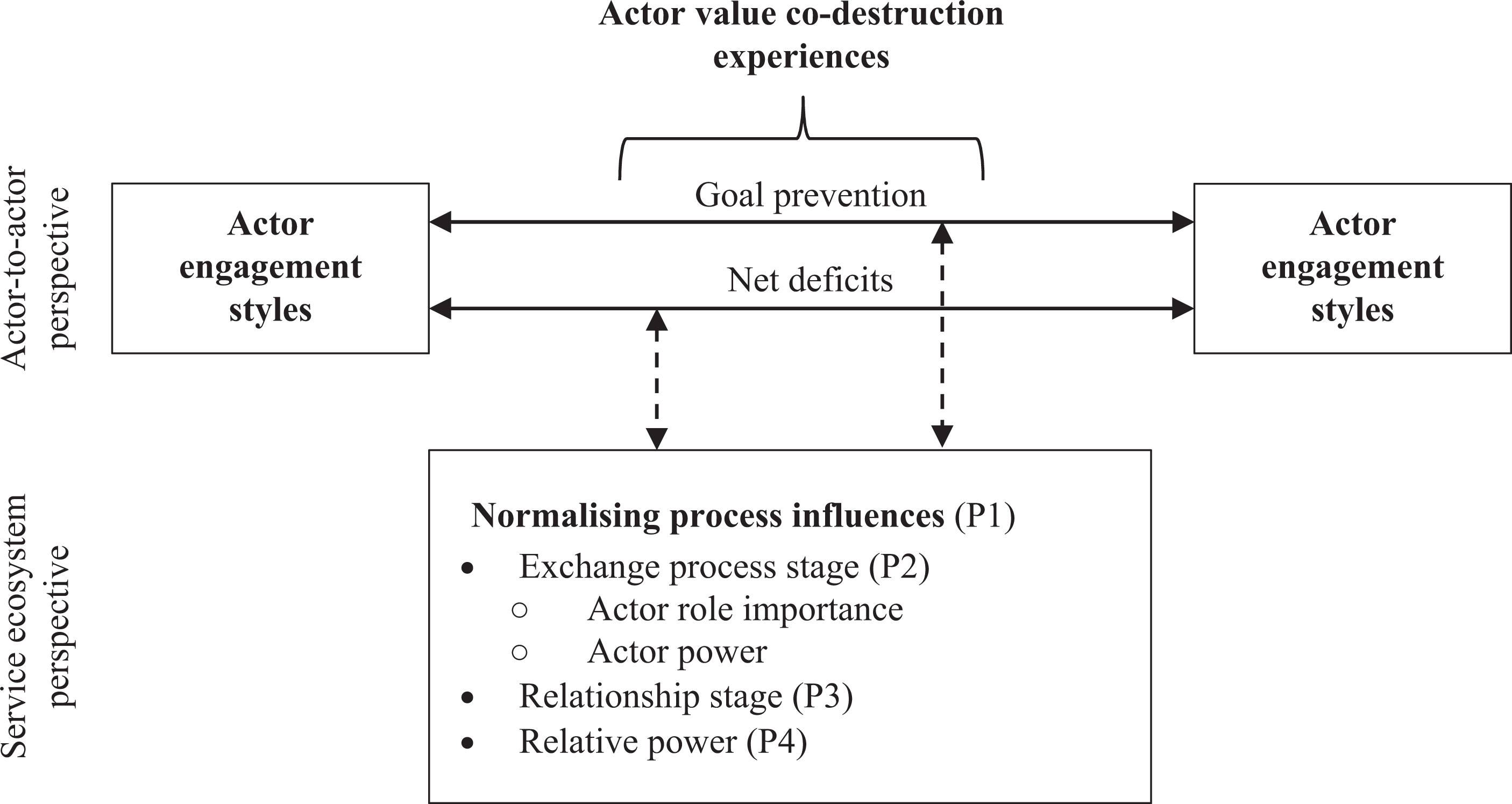
Value co-destruction, actor experiences, and actor engagement styles.
General discussion
Theoretical implications
This study attempts to address the role of actor subjectivity in value co-destruction. As such, it responds to Echeverri and Skålén’s (2011) calls for research in these areas. The study shows that actor perceptions of value co-destruction take the form of goal prevention and/or net deficits. This addresses an important gap in the value co-destruction debate. The focus on subjectivity of appraisals suggests that value co-destruction is not simply an opposite to value co-creation. Instead, value co-destruction accounts for instances of neutral and negative value creation, so amounts to at least two additional possibilities since related actors’ activities always incur costs in terms of time and opportunity costs. In addition, the interpretation of value co-destruction that emerged from the case data suggests that value is not a zero-sum game: if value co-creation occurs, this does not preclude value co-destruction. This possibility arises due to two characteristics of lengthy and complex actor-to-actor relationships across a service ecosystem. First, there is always a need for trade-offs. For any given action, there is a need to balance possible benefits against opportunity costs, meaning that for any set of interactions, there is always scope for the coexistence of both value co-creation and value co-destruction. Second, actor goals are not always consistent. This suggests that each actor has different priorities from the service experience. This heterogeneity leads to value co-creation only when goals are complementary, as shown by previous studies (Echeverri and Skalen, 2011; Plé and Chumpitaz Cáceres, 2010). This gives rise to the possibility that value co-destruction is far more likely for most actors from a given exchange, particularly when normalizing processes are not egalitarian.
The study also reveals nine major types of actor engagement behaviors. This idea builds on earlier value co-destruction research that focuses on ineffective practices (Echeverri and Skalen, 2011). By drawing on customer engagement behavior (van Doorn et al., 2010) and value co-creation practice styles (McColl-Kennedy et al., 2012) research, the present study adds more detail to the ways in which behavioral styles influence actor value co-destruction. This study conceptualizes actors as genuine participants in the exchange process rather than as simple recipients of outcomes, a step that goes some way to addressing van Doorn et al.’s (2010) call for understanding the scope for customer segmentation based on engagement behaviors. In addition, the case data show that differences are present in actor engagement behaviors. This is important since it implies that it is possible to calibrate actor engagement behaviors according to desired outcomes. These observations address McColl-Kennedy et al.’s (2012) calls to understand the relevance of customer co-creation practice styles beyond health-care settings as well as the personal dimensions that shape customer engagement choices.
The present study also offers a multilevel perspective of value co-destruction. Earlier views of value co-destruction tend to focus on the engagement between an individual customer in a consumer market context and a service system. Current value co-destruction studies also consider specific actor-to-actor interactions and/or customer-to-resource interactions. However, value co-creation research also addresses interfirm, network, and supply chain contexts (Cova and Salle, 2008; Jaakkola and Hakanen, 2013; Yazdanparast et al., 2010). Our study complements earlier value co-destruction studies by considering both actor-to-actor and service ecosystem perspectives, which also addresses calls for research in these areas by Lusch and Vargo (2014) and Vargo and Lusch (2015). The case data suggest multiple influences on normalizing processes, including those that relate to exchange process stage, relationship stage, and power relations between actors. These issues are of particular relevance to business market contexts.
Managerial implications
For managers, we believe the concept of value co-destruction now has more practical relevance. A key challenge for managers, particularly when dealing with complex products and services, is empathizing with the customer. Indeed, managers may deploy considerable time and resources to achieve positive customer outcomes while still not receiving benefits (Chan et al., 2010; Homburg et al., 2011). Customers may choose not to remain loyal or they may not understand the value that they receive. The interpretation of value co-destruction in this study offers a way to understand how customers experience negative outcomes despite being engaged in close working relationships. This insight has the potential to inform the way decisions shape the procurement and deployment of service system elements as well as the use conditions of these. Moreover, managers may be able to anticipate value co-destruction outcomes when involved in supplier–customer relationships similar to those of the firms we studied.
This research contributes to practice by highlighting sources of value co-destruction. For managers, this is relevant since it allows a greater focus on either eliminating or reducing the impact of the sources of value co-destruction. Depending on the manager’s role, they may have direct influences over one or more of the sources of value co-destruction. Through an understanding of the nature of actor requirements and the nuances that shape the value space, managers could introduce a suite of measures to manage the interaction process. Some of these could include refined and targeted incentive systems, refinements of existing processes, new relationship governance systems, the development of new capabilities and training programs for relationship managers, account representatives, and for buyer and supplier managers. To address the causes of value co-destruction, managers can develop a series of improvement programs. Prior to undertaking these steps, however, conducting some form of cost-benefit analysis is necessary. These analyses should allow managers to make educated decisions as to which customers to retain and which to eliminate.
Limitations and future research
While this study contributes to the value co-destruction debate, it also faces limitations. These primarily relate to the single case design. While the purpose of this study was to highlight an exemplar of value co-destruction, this approach may lead to an overemphasis of the negative elements of actor-to-actor interaction. With this in mind, future research could make some important contributions to the value co-destruction debate. Value co-destruction research still lacks a multi-industry, comparative study. While the present study is among the first to consider a business market context and an intensive business-to-business relationship in the aerospace industry in particular, further research is necessary to establish the value co-destruction construct in other sectors. This is particularly urgent given the questions that still remain regarding the clarity of the value, value co-creation, and value co-destruction constructs (Grönroos, 2011; Grönroos and Voima, 2013). Also, investigating a supplier perspective of value co-destruction may prove fruitful. At present, there appears to be an emphasis on customer interpretation of value co-destruction outcomes. Understanding supplier perspectives of this collaborative process are essential. The single case focus employed in this study suggests that future research would benefit from a broader empirical base. Further investigation into the contextual influences of value co-destruction experience would prove fruitful, particularly as this relates to normalizing processes. The degree of relatedness between actor engagement styles was hard to determine from the available data. Broader comparisons across different contexts could help reveal the instances of actor engagement styles as well as their validity as distinct across contexts. Lastly, the present study only identifies several aspects of normalizing processes. Further research could examine additional influences on normalizing processes as well as the role of integrating processes.
Conclusion
Overall, this study contributes to furthering the conceptualization of value co-destruction. The study finds that goal prevention and net deficits are two important ways actors perceive value co-destruction outcomes. In addition, the study suggests that actors adopt one of nine possible engagement styles. Actor engagement styles influence their perceptions of value co-destruction. Actor-to-actor engagements also occur within a service ecosystem context. The study reveals that these give rise to normalizing processes. The forces that shape normalizing processes include exchange process stage, relationship stage, and the relative power of the actor. The study offers new insights into value co-destruction and thus contributes to the debate and the development of this theme in marketing theory.
Footnotes
Acknowledgement
The empirical work for this study was conducted while the second author was employed at Cranfield University, UK.
Declaration of Conflicting Interests
The author(s) declared no potential conflicts of interest with respect to the research, authorship, and/or publication of this article.
Funding
The author(s) received no financial support for the research, authorship, and/or publication of this article.