



Abstract
The purpose of this article is to elaborate conceptually on the user–market relationship. Existing research reports a limited user–market relationship, which simultaneously exaggerates and underplays user influence on markets. Assuming a constructivist market studies (CMS) perspective, we argue that the scope of the user–market relationship is broader than developing offers and uses. We conceptualize market shaping as five interrelated subprocesses in which users may be involved as agents: qualifying goods, fashioning modes of exchange, configuring actors, establishing market norms and generating market representations. The extent of user influence in these subprocesses is likely to vary both within a specific market and across markets. By identifying conditions conducive to user involvement in each subprocess, we lay the foundation for empirical research into how users shape markets.
Introduction
Users are recognized as an important category of actors in several market-related contexts, including new product development (NPD) and value co-creation. But how do users contribute to shape markets? Consider the following brief illustrations:
In 2003, a set of Internet activists linked to the Swedish lobby group The Pirate Bureau established ‘The Pirate Bay’, which became the world’s largest file-sharing site. The group criticized the limitations imposed by copyright laws on media goods in existing markets. 1 They openly promoted file sharing as an alternative and made available a platform allowing other users to engage in alternative (non-market) exchanges. In 2005, the group formed the Pirate Party as part of their campaign against an impending change in Swedish copyright law (Miegel and Olsson, 2008). While industry representatives argued against file sharing, claiming ‘the market works’, 2 politicians were less inclined to do so. Proponents suggested that technical advances had made current legislation obsolete and that file sharing was growing because there were no viable commercial alternatives. 3 Despite court cases 4 and other attempts to close The Pirate Bay, 5 it has remained online except for short periods. 6
A less contentious user-driven development is the establishment of car sharing. The first contemporary schemes began in Europe in the mid-1980s. In 2013, there were over 1,000 cities around the world with car share schemes, 7 ranging from informal community arrangements to large-scale commercial services covering multiple urban areas. 8 These have contributed to establish an alternative qualification of cars based on the service derived from car access rather than car ownership. Moreover, car rental companies and car manufacturers have also started various projects, such as BMW’s ‘DriveNow’ scheme. Companies and analysts alike are increasingly describing these exchanges as taking place on ‘the market for car sharing’. 9
These examples hint at how users contribute not only to product/service design and evaluation but also to other aspects of market shaping, such as generating market images or influencing market norms. The starting point for this article is that while existing literature reports a limited user–market relationship, the involvement of users in the process of shaping markets is not systematically explored. As such, our purpose is to conceptually elaborate on the user–market relationship.
The science and technology studies (STS)-informed co-construction of users and technology tradition (Akrich, 1992, 1995; Oudshoorn and Pinch, 2003a, b, 2009; Woolgar, 1991), the user-innovation literature (Franke and Shah, 2003; von Hippel, 1986, 2005, 2007) and research on value co-creation in marketing (Vargo and Lusch, 2004, 2008; Cova et al., 2011) provide support for our basic contention that users are involved in shaping markets. However, these literatures typically centre upon how users contribute to the development of new technologies and new market creation (e.g. Rose and Blume, 2003; von Hippel, 2005). This is mirrored in marketing, where the active role of users in product and use development is highlighted (e.g. Alam, 2002; Cova and Cova, 2002; Vargo and Lusch, 2004). Once again, little attention is paid to other market processes.
Hence, while existing research suggests a limited user–market relationship, it tends to both exaggerate and underplay its scope. It exaggerates by assuming that users are synonymous with buyers (cf. Mowery and Rosenberg, 1979), thus making users a proxy for demand. Yet even when users are viewed as market agents, they are neither identical to buyers/customers, nor ‘ready-made’ and pre-equipped with agential capacity (Callon, 2013). Moreover, existing research underplays user contribution by relying on a relatively crude conception of market shaping; this involves more than developing objects of exchange and uses to which new products are put. In other words, despite the recognition that innovation processes in general have both a technology and a market dimension (Abernathy and Clark, 1985), the focus in current user research tends to be on the former.
In this article, we use constructivist market studies (CMS) to explore the user–market relationship. Based on previous research about market organizing, we conceptualize market shaping as made up of five interrelated subprocesses and then elaborate on and identify conditions likely to affect the extent of user involvement in each of these. We assert that user influence in the five subprocesses is likely to differ within and across markets.
The article proceeds as follows. Next, we review existing research traditions that address the role of users. We then propose CMS as a perspective for exploring further the user–market relationship and outline a model of market shaping as consisting of five subprocesses. Finally, we discuss the implications of our conceptualization for how users might shape markets. Establishing the precise character and importance of user influence, however, requires further empirical studies.
The relation between users and markets: Both exaggerated and underplayed
Our reading of the marketing, STS and user-innovation literatures suggests a limited user–market relationship. 10 This is twofold: (i) users actively participate in developing offers/objects in their capacities as co-developers, prosumers and so on; and (ii) users influence the uses to which new products or services are put, alongside how they are evaluated by prospective buyers. Arguably, there is little discussion of other market processes.
The marketing literature has emphasized the central role of active users both in NPD processes and for value creation (e.g. Normann and Ramirez, 1993; Payne et al., 2009; Vargo and Lusch, 2004, 2008). 11 The participation of users – be they consumers, customer firms or service beneficiaries – in development processes is widely reported as one key to successful new offerings (e.g. Gouthier and Schmid, 2003).
The STS and user-innovation literatures focus on user–technology relationships. 12 Here, user influence is observed directly during product development and commercialization and indirectly by influencing the interpretative frames used to assess the product (Biemans, 1991; Håkansson, 1987; Håkansson and Waluszewski, 2002, 2007; Håkansson, 1987; Håkansson and Waluszewski, 2002, 2007; Laage-Hellman et al., 2014; Lundvall, 1988; Rosenberg, 1982; Rothwell et al., 1974; Shaw, 1985; von Hippel, 1988, 2007; Öberg, 2010). The STS tradition discusses the representation of users in the design and testing stages of product development. Both users and uses are configured (Woolgar, 1991) and ‘materialised in the technology’s design’ (Hardon, 2006: 616) via predictions as to what future users require. Representations are generated either explicitly or implicitly and serve as inputs to product design (Akrich, 1992, 1995; Akrich et al., 2002a, b; Schot and de la Bruheze, 2003). Alignment processes between suppliers and users are dynamic, in particular if users are ‘unwilling’ (Rose and Blume, 2003) or ‘resistant’ (Kline, 2003).
There are three central issues concerning how these literatures handle the user–market relationship. First, they focus more or less exclusively on demand. Second, they emphasize value-in-use over exchange value. Third, despite a wealth of user labels, they tend to conflate users and customers. We elaborate on each issue below.
Demand focus
From a market perspective, the emphasis on user involvement in developing offers implies an assumed link between improved offers and increased demand. That is, if the value of a given product is ultimately determined in use, then improving offers for known uses or developing new uses should positively influence market demand. This reasoning assumes a robust link between value-in-use and exchange value; any change in the potential value-in-use of an offer will be reflected in a corresponding change in buyers’ willingness to pay. It also suggests that a market is already in place or that it will form more or less automatically.
This resonates well with the established conception of ‘the market’ as synonymous to customers/demand in much of the innovation literature (e.g. Czepiel, 1975; Mowery and Rosenberg, 1979; Rogers, 1962; Tidd et al., 2005). For example, Schot and de la Bruheze (2003) argue that both product characteristics and user requirements are mutually articulated during the market introduction process. In this process, users can assist innovators in demonstrating the existence and character of demand (Akrich et al., 2002a).
The demand theme is also prominent in the user-innovation literature with its assumption about lead users facing needs before the general market (von Hippel, 1986: 796). Despite linking users to (future) markets, the reasoning does not require users to assume an active role in shaping those markets. Here, the most in-depth study of user involvement in market shaping suggests a four-phase model of market development (Baldwin et al., 2006). However, the focus is on industry development (the supply side), and there is little discussion of how conditions for economic exchange are created (see Araujo et al., 2010a; Callon and Muniesa, 2005).
Value-in-use focus
The emphasis on value-in-use and value co-creation (Vargo and Lusch, 2004, 2008) highlights the continuous influence that users may exert on markets, beyond the initial development and introduction of an offer (e.g. Ballantyne and Varey, 2006). Emphasizing value-in-use closely associates customers with users: An offer or resource integration promise (Storbacka and Nenonen, 2011) has to be used in order for value to be created (Ballantyne and Varey, 2006: 342). While important, this focus on value-in-use tends to downplay (market) exchange value and any role of users therein.
The conceptualization of the customer as a value co-creator remains contested 13 but implies several roles for the supplier in orchestrating user involvement (Grönroos, 2008, 2011; Grönroos and Voima, 2013; Wiersema, 2013). In the most supplier-centric version, the supplier configures roles in NPD projects and determines how to benefit from involvement in user communities (see Prahalad and Ramaswamy, 2002; Stern, 2011). There are parallels here to the STS discussion of how suppliers can configure both users and uses (Woolgar, 1991; Akrich, 1992, 1995).
A more customer-centric perspective (e.g. Heinonen et al., 2010) stresses user influence by defining value as value-in-use within the customer’s ‘lifeworld’. The challenge for the supplier is to become involved in ongoing consumption patterns. 14 In other words, the market is somewhat bypassed and the objective for suppliers is to gain access to day-to-day use situations. In this connection, the user-innovation literature has highlighted innovations occurring without supplier firm involvement (e.g. Flowers, 2008; Schulz and Wagner, 2008; von Hippel, 2007). This blurred distinction between production and consumption, as well as the altered power dynamics that result from increasingly active users, raises concerns about user exploitation (Cova and Dalli, 2009; Cova et al., 2011; Zwick et al., 2008) and creates challenges for suppliers in terms of monetizing user efforts (Arvidsson, 2011).
User labels and roles
The term ‘users’ is variously interpreted as consumers, employees, user firms, customers, prosumers, co-creators, technology designers, individual innovators, patients and citizens, depending on the context (Flowers, 2008; Rose and Blume, 2003; Weiner, 2010). While ‘users’ are typically treated as equivalent to customers or consumers within marketing, a similarly bewildering plethora of terms is used (Cova et al., 2011).
The STS and user-innovation literatures offer considerable support for the role of users in the design of innovations, for example, as idea generators (see Biemans, 1991; Oudshoorn and Pinch, 2003a, b; Urban and von Hippel, 1988). A few contributions also stress the role of users during commercialization of new products, for example, in marketing or technical support (see Baldwin et al., 2006). 15 Users are thus recognized as capable of assuming multiple roles, and the development of uses is also considered to be dynamic.
In terms of the user–market relation, the majority of these labels imply a role for users in, again, developing offers and uses. By treating users either as proxies for demand (direct substitutes for ‘buyers’) or as a special category of experts on use, or as potential product developers involved in modifying supply, the market process is significantly truncated. Only in a few instances are users recognized in intermediating roles such as ‘technical support provider’ during commercialization (e.g. Cova and Cova, 2002; Lindsay, 2003; Pinch, 2003; von Hippel, 2007).
Overall, we argue that existing literatures provide support for a limited user–market relationship, yet run the risk of both exaggerating and underplaying the contribution of users. The risk of exaggeration is due to the implicit assumption of a strong link between users and buyers (cf. Mowery and Rosenberg, 1979). But users are not necessarily identical to buyers or customers, even when they do hold an agential role in market exchange. In some instances, it might make sense to assume correspondence but presupposing this seems overly simplified. For example, user involvement seems less motivated if a supplier is interested in preferred ways of acquiring a product. Moreover, underlying this is a view of actor categories as pre-existing, already agenced, and independent of how they are treated by others (Tryggestad et al., 2013). In other words, users are assumed to be pre-equipped with agential capacity (Callon, 2013).
The risk of underplaying the potential scope of user involvement is due to the relatively crude conception of market-shaping processes. In the STS and user-innovation literatures, user–market influence occurs primarily during product development and commercialization. Only a few STS studies explicitly attend to a broader user–market link (e.g. Pinch, 2003). In the marketing literature, while the production–consumption interface has been blurred (e.g. Beckett and Nayak, 2008; Firat et al., 1995; Holbrook, 1987; Peppers and Rogers, 1993), studies of the active participation of users have centred upon product development and use/consumption. This has resulted in a lack of systematic attention to user influence on market exchange as such.
To further elaborate on the user–market relationship, an alternative conception of market-shaping processes is required. To this end, we draw on CMS, as outlined below.
Using CMS to model market shaping
CMS is an emerging interdisciplinary research field that investigates the practical workings of markets. 16 Inspired by ideas from STS (Callon, 1998c), particularly actor–network theory (e.g. Latour, 1987, 1996), the starting point is to view markets as emerging outcomes best understood by following the process of their practical realization (Çaliskan and Callon, 2009). Research in this tradition encourages detailed empirical investigations of how specific markets are being constituted. More specifically, CMS involves a shift from an ostensive to a performative definition of markets (Andersson et al., 2008; Latour, 1987). The former asserts that it is possible in principle, but practically difficult, to list the central properties of markets; the latter inverts this reasoning and asserts that it is impossible in principle to compile such a list of properties, but that actors involved in realizing a particular market typically are able to identify the most relevant ones.
Thus, CMS emphasizes heterogeneity in economic coordination not by contrasting ideal types but by investigating the multiple forms of ‘really existing markets’ (Boyer, 1997). 17 This shift underscores the idea of markets as plastic entities that are continously ‘in the making’ (cf. Latour, 1987). Nenonen et al. (2014: 4) define markets as ‘on-going socio-material enactments that organize economized exchanges’. Callon and Muniesa (2005) suggest that this organizing of ‘economized exchanges’ involves three tasks: making goods calculable, forming distributed calculative agencies and arranging for calculated encounters between such agencies and goods. Kjellberg and Helgesson (2007a) emphasize that the organizing of markets extends beyond individual economic exchanges and propose two additional practices – producing normative objectives and representations of markets.
One central theme in CMS is the interest in how economic theories at large influence economic reality (Callon, 1998b, 2007). Efforts to shape markets include those that seek to realize particular types of markets, such as the ‘ideal’, perfectly competitive market (Kjellberg and Helgesson, 2006; Olsen, 2012; Reverdy, 2010). Several empirical studies have investigated such shaping efforts and the performative effects they give rise to, that is, the extent to which economics and other social scientific disciplines contribute to constitute the markets they seek to describe (see MacKenzie and Millo, 2003; MacKenzie, 2006a, b; MacKenzie et al., 2007; Mason et al., 2015). For example, performative effects have been noted in the formation of regulatory frameworks (e.g. Christophers, 2013; Helgesson, 1999; Johansson Krafve, 2014). Moreover, these effects are not limited to formal theories but apply to all bodies of expertise mobilized to constitute markets (Araujo, 2007), including instances of theorizing in the wild by various ‘self-interested theorists’ (Rinallo and Golfetto, 2006).
Second, CMS highlights the role of technology, material arrangements and devices in shaping markets (Callon et al., 2007). This extends previous theorizing on markets as social constructions (Geiger et al., 2012) beyond the embeddedness of economic action in interpersonal networks (Granovetter, 1985), the formation of sociocognitive structures (Rosa et al., 1999) and the political moves of powerful groups (Fligstein, 1996). Rather than representing a return to technological determinism, however, CMS insists on a symmetrical treatment of material and social forces (cf. Callon, 1986). The material dimension is prominent in the qualification of goods (Callon et al., 2002) but also contributes to shape, for example, the calculations performed by economic agents (Cochoy, 2008).
We want to emphasize three key points concerning how CMS can illuminate the user–market relationship. First, by conceptualizing markets as continuous enactments rather than ready-made, CMS goes beyond simplistic stage models of market emergence, for example, formation–stability–change–dissolution. It stresses that markets are continuously shaped both by explicit efforts to create new markets or change existing ones, and by the everyday activities of buyers and sellers (cf. Alderson and Cox, 1948). This allows us to explore how users exert influence over markets beyond the initial commercialization of an offering.
Second, by emphasizing the potential import of economic theories on working markets, CMS invites us to consider how user perspectives may influence the ongoing production of markets. This reflexive stance makes CMS well suited for inquiries into the consequences of explicit efforts to include users as a result of, for example, the spread of normative models on co-creation (Prahalad and Ramaswamy, 2002).
Lastly, by viewing market agencies as outcomes rather than as already agenced entities (Callon, 2013), CMS allows us to inquire into the very constitution of users as an agential category. This includes how users are provided with agential capacities during market-shaping processes and thus why their role may differ across markets. It also allows us to turn the assumed close relation between users and customers (noted above) into a topic for empirical inquiry.
Modelling market shaping
To elaborate on ‘how users shape markets’, we draw on the CMS literature to model market shaping as made up of five intertwined subprocesses (see Figure 1). Specifically, we combine the conceptual works of Callon and Muniesa (2005) and Kjellberg and Helgesson (2006, 2007a) to provide a comprehensive yet parsimonious framework.

Market shaping conceptualized as five intertwined subprocesses.
As the five subprocesses are interrelated, changes resulting from any one of them are likely to affect, and sometimes create tensions in relation to, how the others unfold. They are also likely to become entangled as part of ongoing market practice, particularly if substantial changes are being produced within one or more of them (Kjellberg and Helgesson, 2006). This means that activities do not inherently ‘belong to’ a particular subprocess; rather, any given activity could contribute to each subprocess depending on the context within which it is performed (Kjellberg and Helgesson, 2007a). However, previous research suggests that the subprocesses are sufficiently different in terms of what they produce to warrant conceptual distinction.
As illustrated in Figure 1, three of the subprocesses are more closely intertwined – qualifying exchange objects, fashioning modes of exchange and configuring exchange agents – in that they all contribute directly to how economic exchanges are realized (Callon and Muniesa, 2005). The remaining two subprocesses are complementary and inspired by the model of markets constituted by practice (Kjellberg and Helgesson, 2007a). These highlight that the formation of markets depends on the production of images of certain economic exchanges as taking place in a market (cf. Anand and Peterson, 2000) as well as on the establishment of normative objectives for that market (cf. Fligstein, 1996).
The qualifying exchange objects subprocess is about determining the qualities of a good (Callon et al., 2002; Mallard, 2012). Any such quality is always both intrinsic (dependent on the offer being qualified) and extrinsic (dependent on how and by whom it is probed). This suggests two types of practices are involved. One concerns the literal modification of the offer in order to change its performance in some dimension. These practices revolve around specific activities that are capable of bringing about such modifications (e.g. product development). One important precondition is to gain access to the internal constitution of the offer. The other type of object qualification practice concerns the development of specific metrologies that can be used to probe products/services (Beuscart and Mellet, 2013; Reijonen and Tryggestad, 2012). Access to the inside of the object could be useful but is not necessarily a precondition. Activities here could involve identifying and working with customers in developing, testing and commercializing goods.
The second subprocess, fashioning modes of exchange, concerns organizing the encounter and subsequent economic exchange of a good (Callon and Muniesa, 2005; Kjellberg and Helgesson, 2007b). There are two complementary facets, the first of which revolves around creating a transactional infrastructure for conducting economic exchanges (e.g. Cochoy, 2008, 2010; Hagberg, 2010). This is systemic; the various components of such infrastructures make up wholes. The other is to establish interaction routines for the exchange parties (e.g. Håkansson and Snehota, 1995). This is bilateral; it involves scripting an interactive sequence that consummates an economic exchange. Specific practices include company initiatives to establish modes of exchange for different customers and promoting these within and across organizations (e.g. sales networks). This involves the application of specialized competences, for example, in market research, merchandizing (cf. Barrey et al., 2000).
Third, configuring exchange agents is about assembling the heterogeneous collectives that act in market situations (Andersson et al., 2008; Cochoy, 2008; MacKenzie, 2009). Successful enactment of an exchange sequence requires actors capable of performing the scripted actions and responding to the other party. This typically includes configuring buyers/customers and sellers/suppliers. The subprocess thus overlaps with the extrinsic facet of qualifying goods, which depends on the experiences, sensitivities and skills of the assessing actor. It further relates to the establishment of interaction routines when fashioning a mode of exchange. Assembling a collective requires combining elements into entities capable of performing specific actions, for example, educating actors, organizing supply chains, adding knowledge about product uses and so on. Well-known examples of elements that contribute here include CRM tools and loyalty cards. The process comprises the scripting of actions (Akrich, 1992) and the literal putting together of elements, that is, efforts to ensure that acting entities incorporate particular pieces of information, knowledge or devices. Since most elements can be used in more than one agential configuration (Andersson et al., 2008), a central challenge is to ensure that a specific configuration is realized in a given exchange situation.
Establishing market norms shapes normative objectives for how a market should be organized according to some actor(s) (Kjellberg and Helgesson, 2007a). This includes reform efforts and market de-/re-regulations (Johansson Krafve, 2014; Reverdy, 2010) as well as company-specific efforts to establish objectives for their market engagements, for example, in the form of business models (Doganova and Eyquem-Renault, 2009; Mason and Spring, 2011). Generally, the subprocess concerns what values should guide actors in a particular market, making it highly political (cf. Fligstein, 1996). These values may directly relate to each of the other subprocesses. For example, characteristics that market actors should have (e.g. in terms of size or capabilities) or ways in which the market is best depicted (concentration, price levels, etc.). The practices include establishing or changing formally approved rules, informal norms and shared understandings about markets (e.g. Azimont and Araujo, 2014; Beunza and Garud, 2007). The design of market regulations typically engages policymakers and authorities, but other stakeholders may also seek to influence such processes.
Lastly, generating market representations produces images of a market and/or how it works based on some aggregation of exchanges (Azimont and Araujo, 2007; Harrison and Kjellberg, 2010; Rinallo and Golfetto, 2006). The images will depend on the exchanges being aggregated (and hence on the outcomes of the first three subprocesses) and on how these are brought together and represented. The process also depends on the established market norms; these will suggest what is important to depict. One example is conducting market analysis, which involves the use of specific methods of measurement and instruments to generate representations of exchanges, for example analyses of point-of-sales data. Efforts to promote/disseminate market images are also central. These activities could involve sales, marketing and product management staff debating ‘what our customers want’ (Dubuisson-Quellier, 2010) or specialized market analysts proffering their views (Beunza and Garud, 2007).
We argue that these five intertwined subprocesses constitute a comprehensive framework. While alternative conceptualizations are possible, it offers a consistent and much richer conception of market-shaping processes than those found in the user literatures. Notably, it takes us beyond a product (development) focus while still recognizing its import via the qualification of goods, and hence addresses the noted tendency to underplay the user–market relation. By positing that agential capacities are enacted during market shaping, the framework is also well suited to address the converse issue of exaggerating the import of users on markets by equating them with customers.
Conceptual elaboration of user involvement in market shaping
We now elaborate on the user–market relationship, providing empirical illustrations based on previous research (where available) and developments in markets that should be generally familiar (see Table 1 for a summary).
User involvement in market subprocesses.
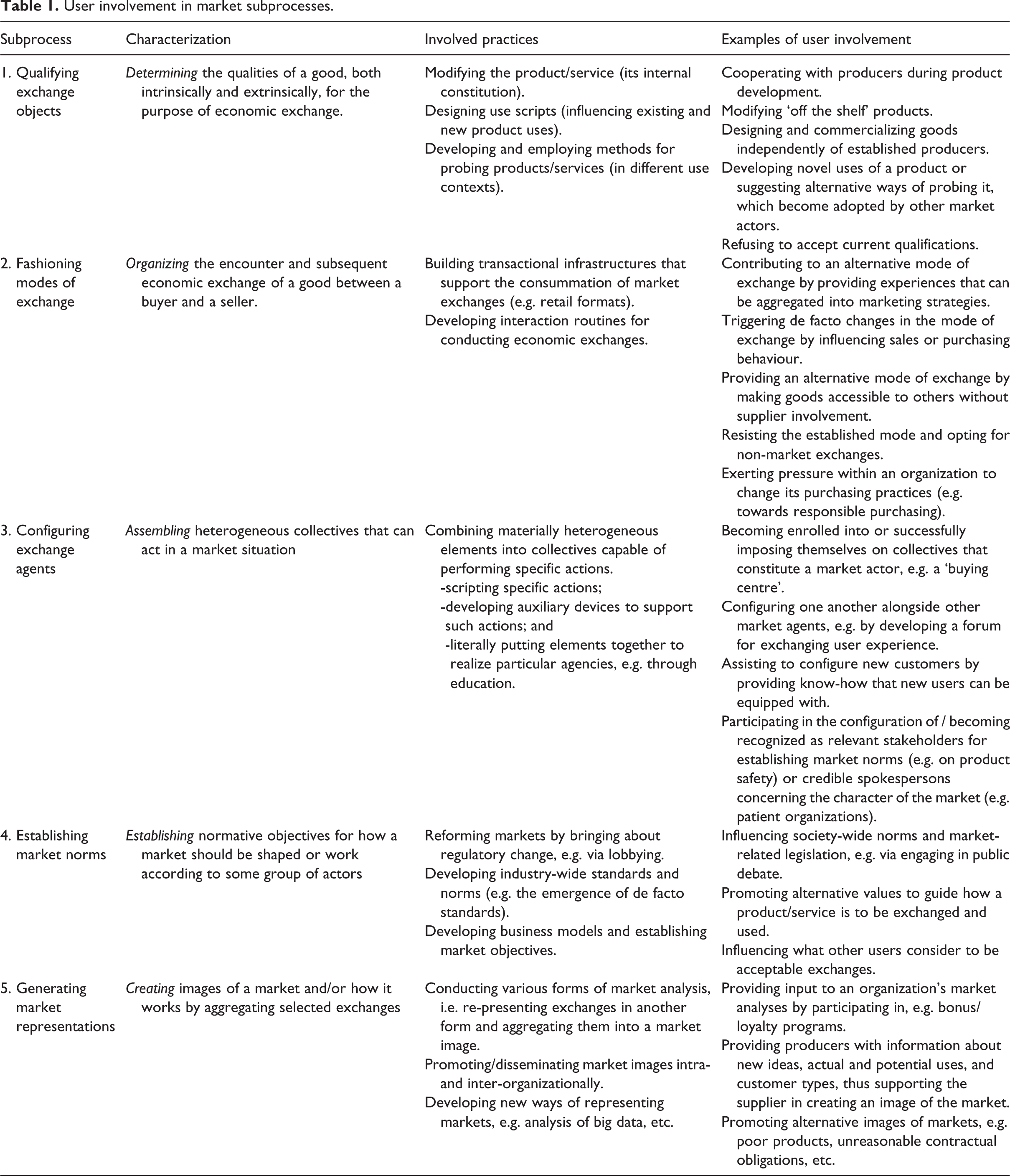
Qualifying exchange objects
Here our framework highlights two types of practices in which users may become involved. First, users may take part in the literal modification of exchange objects. Empirical studies reviewed above suggest users can shift from passively accepting the proposed qualification of a good to actively modifying it. User involvement is sometimes actively sought by producers, for example, by allowing access to the internal constitution of their products via tool kits (Franke and von Hippel, 2003; Jeppesen, 2005), or actively soliciting input from users in NPD processes (as suggested in the co-creation literature). However, there are dimensions for qualifying a good that do not relate directly to use (e.g. environmental consequences) or that stay within the realm of intended uses (e.g. prescribed behaviour). The role of users in modifying exchange objects in these dimensions is less clear.
An alternative form of user involvement occurs when resistant users engage in designing and commercializing alternative goods as user entrepreneurs/producers (Baldwin et al., 2006). For example, user communities centred on online gaming, with or without the involvement of a supplier (e.g. Humphreys et al., 2005). Such agents are likely to be correlated with user perceptions of inferior performance of available goods.
Second, users may contribute to develop specific metrologies to probe products. They may do so directly, by suggesting new criteria for qualifying goods, or indirectly, by developing applications that direct attention to new aspects of existing products. One example is how early users of a new scientific instrument developed applications that came to guide the producer’s continued development activities (Harrison and Waluszewski, 2008).
Hence, the first subprocess acknowledges the established user–technology relation but adds nuance to this by highlighting the dual role of users in the qualification of exchange objects. The extent of user involvement in a specific market is likely to depend on the relative importance of dimensions whereby user experience and skills are considered relevant. It is also likely to vary with the degree of user access to the internal constitution of the object. Finally, we expect variation depending on the extent to which current uses are reflected in the qualification of exchange objects.
Fashioning modes of exchange
User involvement is also traceable by analyzing how market exchanges are organized. Specifically, our framework highlights the importance of mediating between production and consumption (Schot and de la Bruheze, 2003) by creating transactional infrastructures and establishing interaction routines. While users may not intuitively be expected to take part in such matters, there are numerous examples to the contrary. One explanation is that ‘resistant users’ can disagree with the way in which market exchanges are organized, rather than with the qualification of the exchange object. As a result, they might select non-market exchanges or establish alternative ways of making goods accessible as illustrated by our introductory examples. Users can also resist specific modes of exchange by refusing to follow the script provided. 18 Depending on the responsiveness of the other party, such situations may escalate into public campaigns or other efforts to alter the mode of exchange.
In general, the degree to which the economic exchange of an object is distinct from its use is likely to influence inversely the extent of user involvement in fashioning the mode of exchange. Markets for ‘classic’ services that directly involve the customer qua user, for example, hairdressing, would increase the likelihood of user involvement as compared to markets for services that are mediated by physical products (cf. Vargo and Lusch, 2004). In the latter, the subsequent use of an object can be seen as largely independent of how it was exchanged, thus providing less incentives for users to engage directly. However, exchange objects can be requalified so that the service derived from them becomes the object of exchange. This would then increase the likelihood of user involvement by linking use and users more closely to exchange (as in our car-sharing example).
Configuring exchange agents
Here, one aspect of user involvement concerns the extent of direct participation in consummating economic exchanges. It is possible to recognize users as either an agential category in their own right or one of the elements making up another category, for example, ‘customers’. So far, we have assumed users are recognizable as a distinct agential category that can be explicitly included in the exchange process. This is not always the case. In many markets, particularly consumer markets, the configurations of users and customers overlap to such an extent that these are treated as one and the same, thus blurring user involvement. By emphasizing the combination of elements and the associated challenge of ensuring that a specific agential configuration is realized in a given situation, CMS allows a more fine-grained understanding.
The exchange and subsequent use of a good can overlap so that ‘customer’ and ‘user’ coincides, for example, when getting a haircut. Yet even here, they could be distinct – think ‘parent taking child to get haircut’. Moreover, a significant overlap between the elements that make up ‘the customer’ and ‘the user’, such as when they involve the same ‘human body’, is not enough to ensure user participation in exchange. An individual may lack previous user experience or fail to use it when consummating the exchange. Actual user involvement is thus a matter of the extent to which user considerations are incorporated into the agential configuration of the buyer or customer. This relates back to the extrinsic facet of qualifying exchange objects and the devices used to probe an object.
Variation across markets is likely, both in terms of the form and extent of user participation and in terms of user proactivity. In some instances, users have gained power by passively being enrolled into the collectives that constitute customers. This may be part of a seller’s marketing strategy, as in the case of frequent flyer programs in the market for air travel (Araujo and Kjellberg, 2015). From a more proactive standpoint, users may refuse to accept or initiate changes in existing actor configurations. For example, inserting themselves into organizational purchasing processes to influence buying behaviour (cf. Ulkuniemi et al., 2015). Irrespective of how such changes are initiated, they are likely to re-configure power relations in the market (e.g. Akaka and Chandler, 2011; Cova et al., 2011).
Users may also influence the assembling of collectives by configuring one another alongside current market agents, for example, via devices that allow users to engage as a collective. Lindsay’s (2003) study of the TSR-80 computer provides one example of a user community influencing the very idea of the computer user. Devices used by companies to collect and disseminate user feedback and configure customers as collectives (e.g. TripAdvisor) are another example. Early users may also influence sales processes/devices to the extent that they aid the supplier in configuring later customers as illustrated by the use of early user experiences of the Minimoog synthesizer in its further commercialization (Pinch, 2003).
Further users can contribute to configure market shaping agents that are not directly involved in economic exchange. For instance, the successful creation of a user community may be a basis for engaging in establishing market norms. Similarly, user communities may be instrumental in disseminating alternative images of a market. These may in turn influence the consummation of economic exchanges in that market. In some instances, suppliers also actively support such user communities, for example, pharmaceutical companies sponsoring patient organizations.
In sum, user participation in configuring exchange agents can be both direct and indirect and extend beyond the exchange situation. The extent to which users participate in economic exchanges is likely to vary across markets, as is the degree to which they engage in attempts to configure the agents that do participate. Being recognized as a distinct agential category by other market actors will increase the likelihood of user influence, but it is neither a necessary nor a sufficient condition for it.
Establishing market norms
Users might contribute here by promoting alternative values and ideas regarding acceptable exchanges as well as by influencing behavioural norms (see our Pirate Bay illustration). User communities provide an example of how users can attain influential roles in informal normalizing processes in markets. In more formalized settings, consumer organizations sometimes obtain seats on expert committees investigating legislative changes and so on (van de Bovenkamp and Trappenburg, 2011).
User engagement in and influence over normalization will probably vary depending on what the norm concerns. It is likely to be stronger for norms regarding the qualification of exchange objects than for those relating to modes of exchange, unless the market exhibits a strong direct link between exchange and use. Similarly, user involvement in establishing norms about the constitution of exchange agents would depend on the extent to which users consider (participation in) exchange activities important. Finally, user involvement would depend on whether users consider current market indicators to be relevant. In short, the extent of user participation is likely to vary even within one market, depending on what is being normalized.
In all cases, successful user participation in establishing market norms hinges on users becoming recognized as relevant. As such, there is a close link to the configuration of market agents. While users are not typically the most powerful group in this respect, there are markets in which they have considerable ‘clout’, for example, health care. The increasing possibilities for user community formation offered by digital technologies are likely to positively influence user participation.
Generating market representations
User involvement here ranges from the efforts of highly involved user activists, via user panels and other forums for user input, to the passive contributions of consumers leaving traces of their behaviour. User involvement is further intertwined with the formation of user communities/organizations that can provide alternative images of the consequences of specific market arrangements.
Efforts to disseminate alternative market images may be combined with explicit attempts to alter market norms. For example, in the market for car-sharing, users both advocated alternative market images and promoted an alternative mode of exchange. Less proactively, users can contribute to generate market representations by providing input into market analyses, for example, via participation in user panels, or simply by accepting cookies in their browsers.
User influence over this subprocess is again likely to vary across markets. It depends on the extent to which current methods of representing the market recognize and employ user-related indicators. It also hinges on the extent to which (groups of) users are equipped to produce and disseminate market images to relevant others. Most importantly, this requires an ability to collect and aggregate user-related data into market images.
Discussion
This article has conceptually elaborated on the user–market relationship. We outlined the user–market relationship in the marketing, STS and user-innovation literatures, and argued that these literatures both exaggerate and underplay user influence. Adopting a CMS perspective allowed us to systematically explore user involvement beyond the qualification of goods and development of uses. By conceiving markets as ongoing enactments shaped by five interrelated subprocesses, we identified and illustrated how users may contribute to shape the mode of exchange in markets, the configuration of market actors, the norms that govern markets, the images produced of them as well as the goods exchanged. In other words, we contend that users should be conceived as potential market agents, whose involvement is empirically observable in all five subprocesses of market shaping.
This suggests a significantly wider scope for user participation in markets than currently recognized. Due to the conceptual nature of our work, it is difficult to make strong claims as to the relative importance of user involvement in and across the subprocesses. However, we have identified conditions likely to affect the extent of user influence in each subprocess. This allows us to assert that user influence is likely to differ between markets along with variations in these conditions. Establishing the precise character of user influence in specific markets, however, requires empirical examination.
Based on our conceptual discussion, comparative static and cross-sectional research could generate knowledge about the extent, character and variation of user involvement over time and across markets. Such studies could investigate variation in user involvement across subprocesses within specific markets and/or search for similarities and differences in user involvement across markets. For example, what makes users important in certain markets and less so in others? How does user proactivity vary across different market subprocesses? Are there systematic differences in user participation in different subprocesses within one market, between markets in different stages/phases of realization, and across markets that are organized differently? Here, our conceptualization of market shaping and the identified circumstances favouring user involvement offers useful starting points for both study design and data collection.
However, it is problematic to address questions invoking dynamics, such as how users are constituted as market agents and how their capacities as agents emerge over time, through static cross-sectional studies. Longitudinal case studies of specific markets are thus crucial for generating knowledge that can help explain user involvement. How (and why) does user involvement vary within and across the subprocesses over time? How is user involvement interrelated across the five subprocesses within an ongoing market change process? Are there distinct patterns of user involvement in the subprocesses over time? Here, our conceptual work offers a frame of reference for systematically tracing user influence beyond product development.
In particular, our elaboration of the user–market relationship adds three things. First, it expands the scope of how users can shape markets by including five subprocesses, and not only emphasizing one, which allows us to discuss an expanded user–market relationship. The conditions identified as conducive to user involvement above offer concrete support to empirical study design. These conditions revolve around the enactment of users as agents in specific market situations, either by linking use more closely to the consummation of economic exchange or by recognizing users as relevant stakeholders. As an example, a comparative study of markets for goods that vary in terms of their separation of exchange from use would be suitable for investigating user involvement in fashioning modes of exchange. Similarly, an empirical study of how users influence market norms should seek to capture the ways and extent to which users are recognized as relevant stakeholders.
Second, by conceiving the very constitution of market actors as part of market shaping, our model endogenizes the emergence of specific user versions with particular agential capacities. That is, the market-shaping roles of users are not predefined; in a specific market, users can be enacted in many ways, including the possibility of acting as stand-ins for customers. However, the range of possible user roles is much wider, which complicates a reliance on ‘user influence’ to explain the emergence of specific market forms, since users are no longer existing ‘prior to’ the market. Endogenizing the emergence of users also allows us to question the consequences of invoking specific user versions, both as part of the market shaping subprocesses discussed above and as part of particular market configurations (Storbacka and Nenonen, 2011). Here, we can pose new questions about user influence that go beyond simplistic user conceptions, possibly also raising questions about users of markets.
Third, and related, working markets incorporate a variety of actors engaging in continuous efforts to put in place conditions for exchange (Araujo et al., 2010a; Callon, 1998a; Callon et al., 2007). This may include efforts to configure ‘who the user is’ and award users more or less passive roles (e.g. Lindsay, 2003). Moreover, selling organizations engage in efforts to award specific roles to users, notably in NPD, which may channel user influence in certain directions rather than others. This raises questions concerning their efforts to involve users in market organizing and configure user roles to their benefit. Supplier initiatives towards value co-creation (e.g. Grönroos, 2008), for example, creating devices to empower users, and persuading users to assume more or less active roles, can also be employed. Of course, suppliers must be aware that users may seek to exclude them from their activities (e.g. Flowers, 2008) and that users/user communities could alter, break or circumvent their efforts (cf. Kline, 2003; Wyatt, 2003). In this respect, our work injects some perhaps healthy doubt as to the effects of user involvement, and in particular the co-optation of users for commercial purposes.
To conclude, our discussion has relevance both for the user literatures, in which a more elaborate conception of markets is motivated, and for CMS, in which a more systematic attention to users can be called for. While users may be expected to assume more prominent positions in certain areas of market shaping than in others, we hope to have shown that user influence across all of the five subprocesses cannot be disregarded simply as a matter of course. Conversely, while other groups of actors implicated in the shaping of markets may be expected to assume central roles in such processes (buyers, sellers, regulators, etc.), we hope to have shown that user influence can indeed be important. Our conceptualization of markets as constituted via five interrelated market-shaping subprocesses also underscores that there are few conceptual obstacles against empirically investigating user influence on markets.
Footnotes
Declaration of Conflicting Interests
The author(s) declared no potential conflicts of interest with respect to the research, authorship, and/or publication of this article.
Funding
The author(s) received no financial support for the research, authorship, and/or publication of this article.