




Abstract
The function of marketplace ideology to provide a framework that guides individuals’ conduct as consumers is well recognized, though less is known about how individuals address, resist or reconcile themselves to such ideology. Drawing upon ‘lifeway alibis’, assembled from a life course reading of de Certeauean tactics, this article deepens our understanding of how the ideology of nutritionism is renegotiated in the context of dietary health to better accommodate individuals’ life events, circumstances and timing in lives. Based on the interpretations of interview data, we argue that biographical matrices must be observed as principal facilitators for critical reflexivity beyond antagonistic and politico-collective motivations. Here, we consider critically reflexive behaviour – or unruly bricolage – to be organized around dynamic life experiences and circumstances rather than statically against marketplace ideology itself. This outlook prompts us to recognize biography as a catalyst for circumventing certain ideological mandates while the overall ideology remains perpetuated throughout circumvention.
Introduction
Regardless of how much access individuals are given to ‘expert’ and ‘official’ guidelines on health and well-being, the responsibilized consumer has the freedom to find authority in personal experience and, quite simply, do his or her own thing (Batat, 2016; Kristensen et al., 2013). As outlined by Thompson (2005: 236), today’s populations are counselled by experts across a range of fields but are simultaneously expected to choose for themselves when it comes to matters of personal responsibility thus creating a ‘postmodern hedge’, which ‘gives consumers greater cultural license to consider alternative viewpoints’. To contend with this postmodern hedge, marketing theory has drawn liberally from Michel de Certeau’s (1984) theorization of the tactical social subject and has explored how consumers can reflexively defy the programmatic influence of technocrats, expert guidelines or a dominant ordering (Dobscha, 1998; Holt, 2002; Moisio and Askegaard, 2002; Ozanne and Murray, 1995; Roux et al., 2018). However, much of this work has focused extensively on mapping the identity-oriented, socially motivated or counter-culturally informed aspects of defiance rather than anatomizing the more personal and intimate bases for reflexivity (Nixon and Gabriel, 2016).
In this article, we emphasize the interplay between ideological structures and individuals’ unique biographical conditions as an important theoretical site for understanding personal reflexivity. We argue that health is inherently ideological whereby ideology shapes and moulds what and how individuals desire, what is important or tenable to them and hence their health-oriented objectives and goals (Conrad, 1992; Vitus, 2017). In the words of Dey and Lehner (2017: 755–756) ‘ideology works primarily to shape the way people conduct themselves by suggesting particular normative orientations of what it means to lead a “good life”’ and ‘ideology has a fantasmatic dimension, whose primary function is to make a given reality palatable’.
While dietary health is concerned with making choices about how we use food to maintain and promote bodily health, the dominant ideology that supplies the normative orientations for such choices has been labelled ‘nutritionism’ (Scrinis, 2008). Nutritionism is characterized by thinking about eating primarily in terms of nutrient intake while undermining and displacing other less calculative ways of understanding food such as how it is produced or its cultural and ecological properties. Examples of nutritionism in operation include: marketing claims that concern the addition or subtraction of specific nutrients (e.g. vitamin D fortified milk and fat-reduced butter), structured (and often marketized) courses of eating where nutrients are isolated for approach or avoidance (e.g. the Atkins diet’s limitation of carbohydrates) and nutrient-by-nutrient accountability through personal logs and biometric data applications (e.g. FatSecret, MyFitnessPal). Nutritionism is characterized by discourses of precision, control and intervention and encourages normative adoption of mechanisms linked to nutritional isolation and calculation such as the glycemic index, front-of-pack nutrition labelling, and recommended dietary allowance. The fantasmatic (i.e. fantasy-based) dimension of nutritionism centres on the allure of achieving optimal health, a long life and even happiness through exercising personal control and being mindful of nutrients above all else.
In this article, we account for the reflexive pretexts that people draw upon to justify and reconcile their personal approaches to dietary health with the prescriptions, expectations and fantasy appeals of nutritionism. We explore not so much how consumers reject nutritionism but rather how they adjust it to fit their lives. In doing so, we seek to address the following research questions: (1) How do consumers find ways of ‘making do’ with the mandates of a dominant ideology? and (2) How does personal biography become invoked in addressing, resisting or reconciling oneself to that ideology? To address these questions, we supplement de Certeauean theory with insights from the life course perspective (Devine, 2005; Hockey et al., 2014; Moschis, 2007). Together these theories are used to support an analysis of narrative interviews with consumers who discuss and reframe dietary health as having less to do with a reductive focus on nutri-biochemical guidelines and more with carefully interspacing these guidelines with the biographical matrices that food, for them, has historically been located within. Here, we are concerned with how the idiosyncratic knowledge, events, transitions and turning points that individuals experience over their lives (i.e. biography) can serve as pretexts for contesting ideological structures as well as altering and approximating them to better fit with their life conditions. We refer to these pretexts as ‘lifeway alibis’.
We provide several theoretical contributions. First, our conceptualization of lifeway alibis situates biography at the heart of reflexive behaviour and identifies critical reflexivity as conducive rather than antithetical to the operation of a dominant marketplace ideology. We emphasize that ideology is perpetuated by the degree of freedom that subjects construct for themselves through lifeway alibis. Consumers can maintain a critical distance to the strictest mandates of ideology, while still orientating their lives according to approximations of its fantasy appeals. Second, our work departs from identity-based and political convictions as explanations for resistant or defiant consumer behaviour (see also Heath et al., 2017; Nixon and Gabriel, 2016). Rather than being based squarely on anti-establishmentarianism or collectivized non-commitance, we situate concepts such as reflexive doubt (Thompson, 2005) and unruly bricolage (Holt, 2002) within the logic of consumers simply being ‘discoverers of their own paths’ (de Certeau, 1984: xviii). This implies critically reflexive acts must be recognized as more than signifiers of antagonism and opposition and appreciated as symptoms of timing in life, past and current dispositions and real or imagined life-history events.
Theoretical underpinnings
The ideology of nutritionism and the resisting consumer
No marketplace can operate in an ideological vacuum; rather, all are subject to ‘a set of institutions, actors, practices and discourses’, which impose structure on how those acting within and upon them read (and misread) their activities, norms, objectives and even tastes and appeals (Batat, 2016; Sandikci and Ger, 2010: 32). Many markets have been directly or indirectly structured by one particular body of institutions and practices described as medicalization whereby ‘nonmedical problems become defined and treated as medical problems’ (Conrad, 1992: 209). It is from attempts to medicalize the food marketplace – to treat food as a site for addressing medical problems – that the ideology of nutritionism can be identified. Nutritionism encourages us to ‘think about foods in terms of their nutrient composition, to make the connection between particular nutrients and bodily health, and to construct “nutritionally balanced” diets on this basis’ (Scrinis, 2008: 39).
Importantly, nutritionism like any ideology operates by interpellating (or addressing) people as ‘subjects’, such that subjectivity and ideology are to some extent jointly constituted (Dey and Lehner, 2017). Scrinis suggests nutritionism interpellates what he calls ‘the nutricentric person’, a consumer who must think about food in terms of nutrients above all else. Interpellation in and through a nutritionally reductive approach to food hinges on consumers’ inability to determine the ‘healthiness’ of food products for themselves and the trust they must place in producers’ disclosure of standard medico-scientific measurements, that is, nutrients (e.g. calories, carbohydrates, vitamins etc.). Here, Scrinis (2008: 41) suggests ‘the assumption is that a calorie is a calorie, a vitamin a vitamin, and a protein a protein, regardless of the particular food it comes packaged in’, making the subject especially susceptible to food marketing strategies (e.g. ‘low fat’, ‘high in protein’). Nutritionism thereby mutates into a kind of ‘marketized’ nutritionism, defined here as the prioritization of nutritional thinking in both the development and promotion of mass-market products and experiences.
Although marketplace ideologies strive to mete out an idealized framework for consuming, individuals have the agency to resist ideology, to work within it to bridge their own gaps and to manipulate the ‘official’ instructions if even the slightest incompatibility exists between themselves and it (Batat, 2016; Kristensen et al., 2011). The internalization of ideologies such as nutritionism – or even medicalization more broadly – therefore never fully succeeds, rather ‘there is always a residue, a leftover, a stain of traumatic irrationality and senselessness sticking to it, and that this leftover, far from hindering the full submission of the subject to the ideological command, is the very condition of it’ (Žižek, 1989: 43; original emphasis).
There is a kind of compensatory exchange between ideology and subject whereby the subject is not expected to identify with all of the ideology’s mandates and prescriptions so long as he/she consumes loosely according to its ideals or fantasies.
In terms of medicalizing ideologies, the compensatory exchange is tied to what Fox and Ward (2006) suggest separates the medicalized ‘expert patient’ – a citizen they define as someone who generally commits to the dominant and technocratic structures of health and illness – from the ‘resisting consumer’ ‘who fabricates a health identity around lay experiential models of health and the body’ (p. 461). Fox and Ward suggest resisting consumers will exercise a conscious distance between themselves and the technocrats’ prescriptions but ultimately still aim towards the ideological fantasy of ‘good’ health, producing a multiplicity of appealing counterhegemonic identities and communities along the way. Instead of opting out of arenas like health (or dietary health) completely, it is more likely that consumers make alternative, resourceful and even subversive choices within them. Here, they circumvent the mechanisms that they dis-identify with and replace them with solutions more befitting to themselves.
Thompson (2005) speaks of communities of ‘reflexive doubt’ where pockets of consumers unite under shared distrust of the recommendations by sanctioned experts to create alternative, more palatable health solutions for themselves. In a vein similar to Fox and Ward (2006), Thompson (2005: 246) suggests that reflexive doubt helps serve a collective ‘antiestablishment identity project’ – for (resisting) consumers. Such explanations, however, tend to privilege what Nixon and Gabriel (2016: 41) call ‘outward protest’ or ‘antagonistic’ assumptions of defiance. Such assumptions are useful but tell us less about how individual consumers – not just those united and socialized within expressive, identity-driven and politically oriented communities – justify and make legitimate their reflexive acts in their personal lives. This brings us to consider de Certeauean theory in marketing and the role of the life course in ‘unruly bricolage’.
Unruly bricolage and the life course: Towards a theorization of ‘lifeway alibis’
The influence of Michel de Certeau’s thinking on marketing theory is best encapsulated in Peñaloza and Price’s (1993: 123) suggestion that, in response to marketing’s ideologizing ‘structures of domination’, we must appreciate that consumers can seek out ‘moments of production, active re-creation and dispersed, tactical and make-shift resistance’. According to de Certeau (1984), market-based society can be analysed according to strategies, which are the technocratic procedures and (idealized) orderings of market spaces by institutions and prevailing ideologies, and tactics, which are the actual lived consumption practices that people participate in within these spaces. Tactics are not subordinate to a strategy but are, for de Certeau, ways of adapting to it or even distorting it.
De Certeau’s position has advanced the perspective that not only can individuals discount marketplace rubric and actively renegotiate and transform marketplace resources and conditions as ‘reflexively defiant consumers’ (Ozanne and Murray, 1995) or ‘unruly bricoleurs’ (Holt, 2002) but by matching their tactics with like-minded others they can form loose participatory units of sense-making, knowledge exchange and interpretation such as ‘reflexive communities’ (Kristensen et al., 2011) or ‘cultures of unruly bricolage’ (Brownlie and Hewer, 2009). Here, terms such as bricoleur, bricolent and bricolage signify the manipulation and improvization of the resources, meanings and conditions around oneself, while unruly and reflexive suggest the self-realized circumvention of the rules to allow for this.
Altogether, reflexive–unruly bricolage is not about countervailing or rejecting, but rather it occurs through what de Certeau (1984: xii) calls ‘poiesis’, the means of reconfiguring, diverting and making-do with the information and objects that are given. There is, however, a peculiar gap in understanding what informs and helps substantiate poiesis on a pragmatic level or, rather, what the personal and practical lived foundations are for engaging in poietic displays of unruliness. Diverting established rules or circumventing legitimate best practice within markets where there are high risks for choosing to do so (e.g. health consequences, death) could be criticized as personally irresponsible, reckless or even perilous (Kristensen et al., 2013; Ulver-Sneistrup et al., 2011). While these markets are often characterized by panopticism and surveillance to ensure conformity, it is plausible that the bricolent consumer may likely try to insulate himself or herself from criticism and dissonance by harbouring personal excuses and justifications.
Keinan et al. (2016), for example, recently drew attention to the importance of justification for consumers when engaging in behaviours contrary to economic best practice and rationality. Importantly, the authors use the term ‘alibi’ in conceptualizing how consumers justify the seemingly wasteful or irrational purchase of luxury products by pointing to the utilitarian features of their indulgences. We share with Keinan and colleagues the term alibi to explore justification for reflexive unruliness, but we adopt a very different meaning. Rather than being operationalized at product level, we view alibis as justifications at a behavioural level and anchored to the particularities of time and space in consumers’ lives.
To help us theorize our time-space contextualization of alibis for tactical–reflexive behaviour, we look to the life course perspective (LCP) that has emerged as an organizing framework for understanding the instability and flux of people’s life projects and themes and how this impacts how they behave and adapt (Moschis, 2007). The LCP considers the influence of interpersonal and socio-ecological factors such as built and social environments, macro institutions, social networks and families on the patterns of people’s consumption as they unfold over time (Devine et al., 2000). Thus, the LCP may lend a way of enriching and deepening de Certeauean theory by providing the biographical background for one’s tactical manipulation of the ideologies that try to guide them. If we consider de Certeau’s tactics to be those ‘clever tricks, knowing how to get away with things’ (1984: xix), then the LCP provides the accumulation of conditions and events that provoke the inspiration and technical knowledge to actually facilitate and justify these tricks.
While the LCP has been criticized as linear in terms of its assumption of stability over the fixed stages of life course trajectories (Hockey et al., 2014), such an assumption overlooks integration with consumers’ unruly bricolage which is conceivably impacted by and impacts upon their temporal and spatial pathways. Thus, by recognizing poststructural, tactical manoeuvres of consumers via ‘“wandering lines” (“lignes d’erre”)’ or ‘“indirect” or “errant” trajectories obeying their own logic’ (de Certeau, 1984: xviii), past events can be acknowledged for their value in shaping and rationalizing present tactics while current circumstances are acknowledged for their impact on interpreting and retrospectively defending past tactics.
By integrating de Certeauean theory with the temporal and spatial narratives of the LCP, we aim to develop the concept of ‘lifeway alibis’, which we tentatively define as individuals’ subjective reading of real or imagined personal, sociocultural and historical life conditions to justify the tactical disruption, deflection and reconfiguration of ideologies’ structuring influence over them. Within the scope of the current study, we capture how reflexive food consumers draw upon biographical bases to justify their tactical manipulation and distortion of the technocratic mandates of the dominant ideology shaping dietary health (nutritionism).
Methods
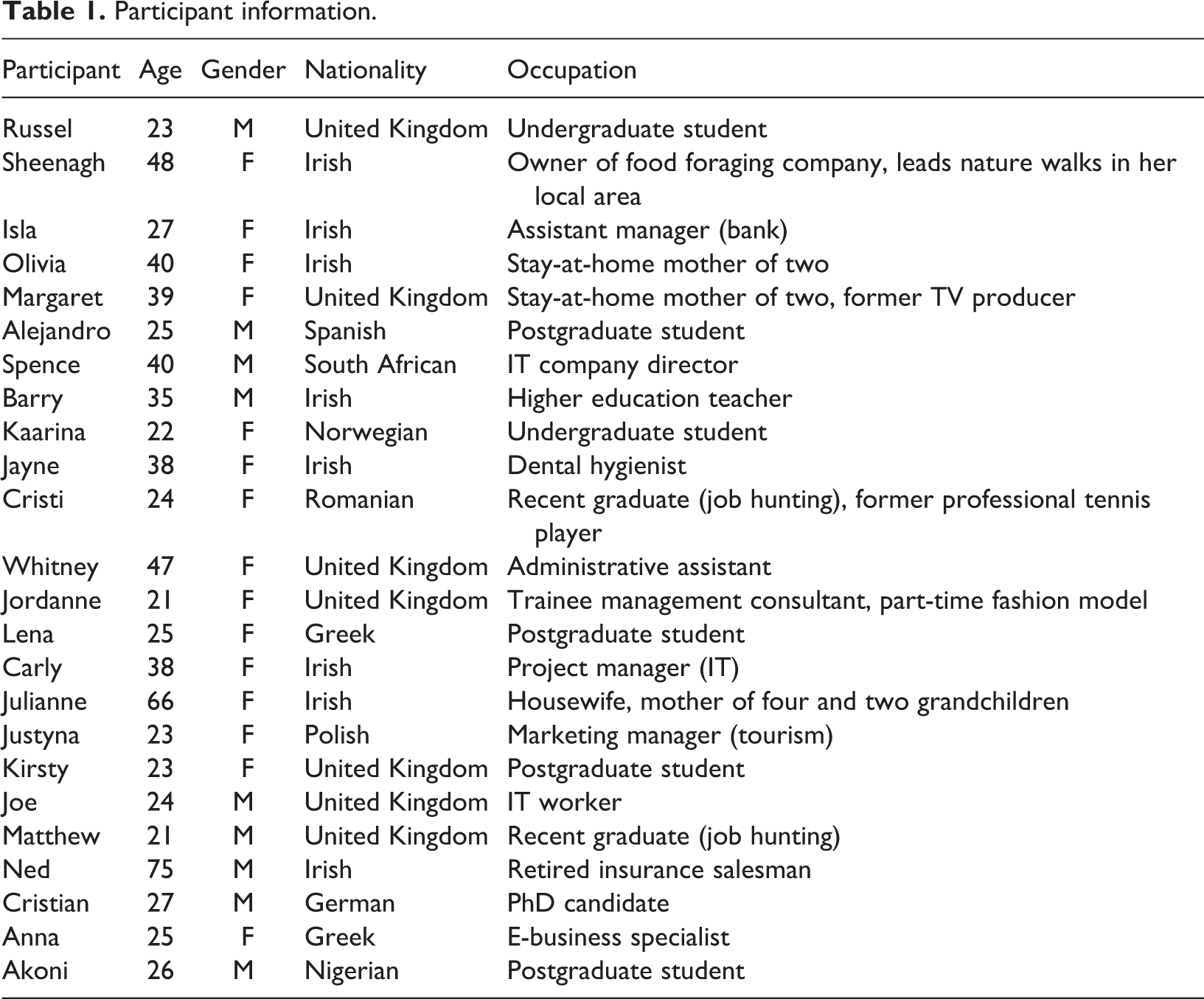
Our empirical material was collected as part of a wider interpretive investigation into the impact of life patterns on consumption whereby we interviewed 24 informants who spoke at length about their food choices and lay perceptions of dietary health. Unlike recent work in the area of the life course and food consumption, we adopted an open-eligibility criterion for informant participation instead of restrictions based on issues related to body weight or diagnosis with a diet-related illness (c.f. Cronin et al., 2015). Our sampling message simply required that informants could speak candidly about their personal understandings of dietary health, their opinions on how it is promoted and how they eat (see also Furst et al., 1996). From this, we recruited informants from Ireland and England through flyers posted at public spaces and snowball referrals over the course of 2015–2016. By not limiting our analysis to a specific problem, label or control, a mixed informant sample afforded us the opportunity to explore a range of LCPs that varied in terms of age, upbringing, life stage transitions, living locations, personal regimes, social-role demands, work or study engagements, friendship networks, family constellations and nationality (see Table 1).
Participant information.
The interviews began with general grand tour questions about informants’ social and familial backgrounds, work lives and personal relationships, which set the scene for follow-up prompts and probes. We queried whether and how informants conformed to dietary standards or deviated from them and what the reasons for their conformity or circumvention were. Importantly, the interviews were not constrained by a rigid, economic view of the life course wherein time is analysed as a unidirectional linear flow (Hockey et al., 2014). We were mindful of the complexities by which informants account for their life course trajectories and the malleability by which they might draw upon real or imagined past events to justify the present or use present events to vindicate the past.
The LCP is similar in some ways to an existential–phenomenological approach in that our course of dialogue with informants was designed to allow them to freely elucidate first-person accounts of their lived experiences. To focus the interviews, our discussions centred on specific temporal, social and historical contexts where ‘life stories’ could emerge (Devine, 2005). That being said, we were mindful of the critiques of ‘individualist’ interview techniques which centre on the prioritization of the individual subject while underrepresenting the cultural and structural complexity of social action (Moisander et al., 2009). We do not contest these limitations, though we argue that the LCP ameliorates some of these issues as it seeks to capture and probe not just personal accounts from participants as they are lived but also the manner and extent to which these accounts have been influenced by and are situated within changing social, cultural, relational and physical settings over time. The LCP places emphases not just on personal choices but also on how ‘timing and context’ systemically shape and anchor choices and the way in which individuals relate to choice contexts (Devine, 2005: 125).
Each interview was recorded following the consent of informants. Interviews lasted between 45 minutes and 90 minutes, were transcribed verbatim and pseudonyms were applied. Analyses of the interviews were conducted in an iterative ‘part to whole’ approach using techniques adapted from the constant comparative method and hermeneutic protocols (Spiggle, 1994). The overall development of themes and interpretations involved ongoing engagement and comparison with the literature. In keeping with the LCP and its emphasis on depth and idiosyncrasy, we present only the perspectives of a limited few individuals to illustrate each alibi (Devine et al., 2000).
Lifeway alibis: An analysis
For the purposes of theory building, we represent our biographical data across four emergent themes which each signal a separate but interrelated lifeway alibi. These inductively derived alibis help theorize how consumers can establish ‘a degree of plurality and creativity’ from an ideology which they have no choice but to face (de Certeau, 1984: 30). We explore how lifeway alibis provide license for variety and versatility within nutri-centric thinking and for engaging in something quite different from what nutritional technocrats likely intended. Here, our informants’ depth of personal reflection, rationalization and defence for what they do contra to or in relation to nutritionism ironically demonstrates how reflexivity becomes critical to the operation of ideology. Rather than representing resistance or dissent, the four alibis are symptomatic of how nutritionism has firmly established itself as the reality within which one must consume.
Cynical distance: The metacognitive alibi
Our findings reveal a lifeway alibi emerging from ‘the power of knowledge’ (de Certeau, 1984: 36) or rather, the ability to learn from one’s personal history to navigate current spaces. Here, we explore how consumers’ memories are invoked to inform a keen sense of cynicism when navigating nutritionism and seeking to ‘provide oneself with one’s own place’ within it (de Certeau, 1984: 36). Nutritionism, for instance, is mapped heavily through marketing (Scrinis, 2008), and most conversations with our informants signalled a learned mistrust towards the idea of marketers operating as custodians for their personal dietary health.
This acquired cynicism conforms with Wright (2002: 677) who suggests ‘marketplace metacognition refers to everyday individuals’ thinking about market-related thinking’, while thinking about marketers’ guileful opportunism and persuasion attempts is ‘developmentally’ and, to some extent, ‘historically contingent’ (Friestad and Wright, 1994: 1). Such thinking, which develops over the life course, rather than incubated within resistant social formations, facilitates consumers’ reflexive and critical distancing from marketers’ discourses, thus working as one possible alibi to behave with relative agency within an ideological framework.
First, let us examine Russel (male, 23), an undergraduate business student and yoga enthusiast who recently diagnosed himself as gluten intolerant. By identifying a nutritional problem – gluten – and modelling his eating around this, Russel conforms to the primacy of healthism and reductionism that underpin marketized nutritionism. Despite such ideological consistency, Russel maintains cynical distance to the marketers and marketing attached to nutri-centric thinking. Russel suggests that his choice to go gluten-free is not based on any kind of market influence, even if this belies heavy marketing efforts around gluten-free products at the time of this research. Rather, choosing a gluten-free diet for Russel is ironically based on his knowledge of other ‘more’ marketized diets failing those around him. Russel suggests childhood memories of seeing his mother pour money into ‘mainstream’ diets tied to fat-free/fat-reduced claims instilled in him the belief that marketers manipulate information for reasons of self-interest and so consumers should always be somewhat critical and choose more niche solutions.
Russel grew up noticing there were always ‘brands of diet [foods] and stuff’ and ‘various [diet] books that my mum had picked up over the years’, but he does not recall any tangible benefits of such items on his mother’s dietary health – ‘it’s just something that didn’t really work out for her’. Here, personal memories ‘whose attainments are indissociable from the time of their acquisition and bear the marks of its particularities’ (de Certeau, 1984: 82) are used as a tactic to act on the current and dominant field. Instead of blindly following his mother’s compliance with market-driven education before him, Russel tries to ‘make do’ with nutritionism by drawing critically upon his memories and educational background: Since I’ve started Uni, and stuff like that, I hate going back home because I have such different choices, like, what I would buy compared to my mum (…) In terms of what I see on TV, whether it’s on a show or an advert, I think that’s when my, kind of, like, scrutiny comes into it. You know, if you listen to the way that things are worded, everything’s called ‘lighter’. I really love that, because usually it just means they’ve scooped the top off it. You know, you need that active-mindedness not to assume that something’s perfect just because it’s different or it’s marketed in a certain way [sic]. (…) It’s a weird part of branding, again. We can use all these scientific things. You know, they just praise this, kind of, ‘magic’ ingredient, and I’m always a bit, like, ‘well, I don’t care what computer graphics you’ve used. It’s not really stood out for me’. I would like to think that I eat healthily, but I’m one of those people that’s very, into, like, ‘cheat day’ or whatever, or, you know, ‘cheat hour’. As long as I’ve got my protein and my meats, and then fruit and veg…I look at the ingredients and see, like, ‘Right, well as much as it’s got’, you know, ‘X grams of protein, you’ve also shoved in, like, five cups of sugar’. You know, it counterbalances it, so I’ve always looked in there…calories are a useful kind of generic indicator, I’m aware that it’s not the be all and end all of what it means.
Elsewhere, Margaret, (female, 39) a suburban stay-at-home mother of two, shares Russel’s cynicism towards nutrient-fortified processed foods and ‘nutri-washing’. Margaret suggests that her domestic life situation, its accompanying responsibilities and her preference for artisanship, provide pretexts for not being a passive recipient to pre-packaged nutritional completeness: I think that’s all a load of marketing rubbish. It actually makes me really angry because it makes me think that people who make those products don’t actually care about the people eating their food, which is a completely different emotion I get than when I think about a farmer, an artisan bread maker or a cake maker. I think what they’re doing is they’re jumping on the bandwagon. They’re going, ‘Oh, we know that people want this. We’ll put it in. We don’t actually know whether it works by putting it in that way’. I think a lot of the time, when they add things in, your body can’t absorb them. (…) Things like [functional food brand], again, it’s rubbish. I think we should eat butter. I think the whole ‘cholesterol’ thing is a myth. I think the whole low-fat milk is a myth. If they just left milk as it was, you could absorb all the vitamins from it anyway, but because they’ve made it low-fat, there’s not enough fat to transport the vitamins and your body can’t absorb the vitamins (…) I think marketers are incredibly good at going, ‘What are people worried about? Let’s twist the knife. Let’s get in there’. When I had kids, that really changed my relationship to food. As soon as I had children, I just felt they were so vulnerable that I just really wanted to know what I was putting in their bodies. I feel almost stupid about it now, because when I look back, I think, ‘How did I not know that this stuff was probably not good for my body?’ I think you grow up. I was a child of the 1970s. I remember my mum and I talking about this. When I was 9 or 10 [years of age] and Crispy Pancakes came out, and French bread pizzas and this, that and the other, it was seen as this golden age. ‘Oh, you can get low-calorie biscuits and you can get low-cal yoghurts’. It just seemed like it was really portrayed, particularly to women, I think, as the answer to everything. ‘You can have what you like, but you won’t get fat’. I never even thought about how they replaced the fat or what they replaced the sugar with.
Hybrid fatalism: The holistic alibi
Another alibi that informants drew upon to justify tactical agency within the strictures of nutritionism was linked to fatalistic beliefs which fall under de Certeau’s (1984: 185) ‘act of believing’, or rather the belief in something ‘that is assumed to be invariable’. While there is a deterministic aspect to ideologies like nutritionism whereby social subjects turn control of their reality over to industry- or policy-defined experts, a number of our informants appeared to work from a deeper fatalistic alibi that ideologically imposed technocrats cannot ever have such control over one’s life. Rather, for them, reality is crafted and guided by something ineffable. As outlined by Fischer et al. (2007: 435), ‘Fatalism rejects a purely scientific cause-and-effect explanation of the world and presupposes the existence of an established, timeless order’. By placing dietary health beyond the mastery of technocratic strategists, a defence is laid for more ‘holistic’ forms of bricolage. Here, fate and nutritionism become reconciled together to ‘reciprocally define each other’ (de Certeau, 1984: 185) leading to a hybrid, tactical form of fatalism where some control is possible – by the individual, but never the technocrat – and only if conducted under recognition of some larger spiritual order.
Cristi (female, 24), a Romanian national who used to play professional tennis and recently completed her third-level education in the United Kingdom, largely eschews nutri-centric thinking and nutritionally fortified food products with the raison d’être that mastery over nature is impossible and life in general must be accepted as having a high level of sustained uncertainty. As part of this, Cristi justifies her dietary regime as contingent upon parascientific superstitions such as the energies that surround and invade her food while she is cooking: When I cook, I usually put on some nice music, or I talk to my mum or my boyfriend, just to get me, kind of, in a very positive mood. I never cook when I’m angry, because I think that my energy just transpires into the food, and then this negativity goes back in me. I prepare my meal, and then I have, kind of, a small ritual that when I sit down with a meal, I just look at it for, like, a minute, make sure that, you know, the ingredients are fine, and my food is nice, and I’m not going to sit down eating very annoyed, or in a hurry, or in a very negative mood. It all started many years ago, five, six years ago. I used to be a professional sportsperson, and then I suffered from diastematomyelia on my spine, so I was paralysed. They said that I’d probably never be able to jump, run, bla bla bla. No one’s given any chances, so I said, “Okay, something has to change here, in my mind.” (…) I started changing my attitude towards absolutely everything: Food, friends, the way I sleep, if I exercise, if I do anything that my body needs to. I started listening to my body, what it says. Does it hurt? Do I sleep well? Am I in a good mood? I actually realised that food affects you so much (…) That’s, kind of, how I developed this idea of you have to be very careful what you put in yourself, because what you put in yourself, you ultimately get out of there. you need protein, let’s say, to recover and to build your muscle, or your organs, or whatever, but I wouldn’t say, “You have to eat 120 grams of protein because that’s what worked for me.” No, we spend, let’s say, a month figuring out what works for you, and then you start from there. I would never ever say to anyone, “Follow a diet that someone’s written about.” Get the principles, learn from it, ponder it, and get your own conclusions about it. Don’t just be a follower of what everyone says.
Elsewhere, Justyna (female, 23), a Polish graduate who works with a small UK tourism service, experienced various food allergies and digestive problems over her life course but has recently come to position her ailments as fated. As her digestive problems worsened in the past 3 years, Justyna became interested in the ancient Indian protoscience, Ayurveda. Linked to the Karmic cycle, Ayurveda is based on the need for balance within one’s environment, body, mind and spirit wherein fate is listed as one source of disease or illness. Drawing on this ‘science of living’, Justyna defends her approach to consumption by pointing to the predetermined constitution of each person: Ayurveda takes into account not just the body but also the mind. There are three constitution types, which means that there are different – well, put it another way: you have all the different elements, so fire, water, air, earth, and ether. Everything made in the universe is constructed of these, so each of them has a different combination of those elements and each human is constructed of a different balance of these constitutions. What that means is that every person has a different way; different types of food serve them well. (…) When you’re born, you have the different levels of these constitutions unique to you. Whenever something is out of balance, you need to eat or consume things in your life that are the opposite so that you go back to the stage of equilibrium. (…) In the science of living, calories are not talked about.
Tribal aesthetics: The social alibi
A third alibi centres on de Certeau’s (1984: xvii) recognition that ‘strategic deployments, when acting on different relationships of force, do not produce identical effects’ and his subsequent recognition that ideological strategies are tactically approximated according to consumers’ specific social situations and relationships. Due to the ‘fragmentation of the social fabric today’ (de Certeau, 1984: xxiv), many consumers consider themselves part of disparate communities which each sketch out ‘the ruses of different interests and desires’ (p. 34) such as specific aesthetic interests. This leads to variegated approaches to following the ideology of nutritionism.
Over the past 5 years, Jordanne (female, 21), a trainee management consultant and part-time fashion model, has adapted how she eats according to ‘the look’ of a friendship network rooted to the aesthetics of fashion, photography and beauty regimes. Throughout the course of her life trajectory, Jordanne has held senior positions within her Alma mater’s student modelling society and worked a number of short-term internships with major cosmetics brands during her university studies. Working within an accumulated system of tribal attitudes, norms and beliefs from work colleagues and friends who equate their social currency with the attainment of female beauty ideals, Jordanne speaks zealously about managing her food consumption in terms of achieving specific tribal aesthetics. Specifically, food’s conduciveness to the ‘legitimate’ phenotype of her social milieu is core to Jordanne’s current lifeworld, which enables her to appropriate nutritionism not for achieving the intended goal of health but for bodily aesthetics instead: I read a blog on Cosmopolitan and it was basically saying what Victoria’s Secret models eat before they go to bed on the night of the shoot – they don’t eat bread, they don’t drink milk and they would eat salmon just for dinner. Then, they wake up with that ‘glowy effect’ (…) They don’t eat certain types of food at certain times of the day. They said bread isn’t meant to be good in the afternoon because it makes you puffy the [next] morning. So you’re meant to have bread for breakfast or lunch but not for dinner. (…) the bread, because it’s for longer term, means [the body] stores the sugars and then because you don’t use them straight away, it will either store them as fat or it will store them as a water bloatedness, and that’s what makes you look off or non-shiny in the morning.
A tribal alibi was also elicited by some of our male informants who participate in and are particularly enthused by gym-going. For this tribe of ‘gymmers’, dietary health is refracted through the interrelated pursuits of muscularity and the male banter that constitutes that tribe. For instance, Matthew (male, 21), who recently transitioned into bodybuilding as a hobby and sources food from a specialist website called ‘MuscleFood’, considers a large and robust body aesthetic as an important staple within his circle of friends. When asked about his awareness of any dietary health guidelines, Matthew demonstrated fluency in the language of nutritionism but was keen to argue that his lifestyle and the life events leading to his interest in bodybuilding keep him exempt from recommended daily calorie intakes and the other mechanics of nutritionism. This corresponds with Shaw’s (2002: 291) suggestion that ‘“popular” health beliefs are linked to “common-sense” knowledge’ though there is also often a ‘strong interaction between this and expert systems of knowledge’. Matthew argues: Saying 2,500 calories for men as a standard, while it is an average, it doesn’t really mean anything. If I’m going to the gym every day, I’m going to be burning a lot more calories than that and 2,500 calories isn’t going to be good for me. The same with saturated fat: saturated fat has been generalised, so you have poly and mono – those two – and they’re all different, especially from the sources they come from as well, and the impact that that has. (…) my dinner yesterday was literally just meat…I am more aware of protein and what foods have got higher protein content because that is essential for building muscle.
Externalism: The extra-corporeal alibi
The final dimension of our analysis centres on informants’ approximations of nutritionism based upon the demands of other people’s bodies, places and things beyond one’s own corporeality. Here, extracorporeal alibis were forged from sensitivity to the broader environs, responsibilities and objectives that one’s life is situated and assimilated within, or what de Certeau describes as the relationships that a subject must manage with its ‘exteriority’ (1984: 123).
The requirements for properly fulfilling previous or current relational roles – beyond fulfilling one’s own body – stand out as a major justification for unruly bricolage within nutritionism. Here, Moschis (2007: 296) suggests ‘social demands across the life course define typical life events and social roles in the person’s life that serve as turning points’. Spence (male, 40), a South African national and director of a start-up company in the United Kingdom, discusses being thrust into the role of parent to a child with autism as one such turning point. For Spence, thinking about food comes with special parental externalities that require him to problematize and see past the ideological ‘myth of nutritional precision’ (Scrinis, 2008: 42). Spence views nutritionism as a platform that he can start from, but ultimately as something that he must make ‘function in another register’ (de Certeau, 1984: 32) or tactically distort for it to be better attuned to his daughter’s needs: You look at things like the traffic light system, which, frankly, I think is a load of crap (…) Personally, my philosophy is, “Buy the best raw materials you can,” so we will always try to buy free range or organic meat. We’re very lucky here, at [local food market], we can buy organic vegetables at the same price as normal kind of stuff. We adopt a gluten-free diet now because of Elizabeth [daughter], but for everyone in the family we do that. It seems to help us all. We don’t buy any processed foods, really. (…) We were probably carbohydrate-free for six months. You know, we made cauliflower rice and all that kind of thing. You do really miss bread and you really miss roast potatoes, or rice, or just nice stews, Basmati rice. I mean, for us it wasn’t sustainable as a family, but it was a good thing to go through, and I think it was good for Elizabeth’s general health (…) I think when you have kids it changes a bit, because you want to make sure you’re feeding them well.
Ethical issues in the wider food system are also invoked by Spence as externalities that influence how he defines health. To him, dietary health must be refracted through the health of the environment and ‘eating well’ cannot purely be a matter of nutrients but also of ecology, leading him to place trust in eco-food campaigners rather than scientific or industry-appointed experts: …he’s [Hugh Fearnley-Whittingstall] probably one of my favourite guys in terms of looking up to someone as a hero, or a good chef. The whole battery chicken thing, the whole way that people think that, actually, £4 is a fair price for a big, bloated, antibiotic, sort of, cruelty fest of chicken. Also, free range, and then you can buy organic. The biggest gap is between battery chickens and free range. I crunch the bones a bit, but if you didn’t have any teeth, you could make some dents in a battery chicken’s leg bone.
Sheenagh (female, 48), a mother of three, who leads nature walks and foraging expeditions in her local area, emphasizes the importance of considering dietary health as less of an isolated consumable and more as a relationship with externalities such as the environment, ecology and those she brings on her walks. Having grown up and currently living on the rural west coast of Ireland, Sheenagh foraged for seaweed on her local beach as a child but her interest in the practice grew more serious after studying horticulture as a mature student and becoming awakened to the natural beauty of her homeland. With age, eating for Sheenagh became less of a corporal and more of a pastoral act. She believes those who join her on her foraging expeditions will make better informed and sustainable choices based not simply on nutrition, but in terms of the entire ecological exteriority which food interacts with: It’s also become an absolute desire for people to know where their food is coming from and they’re sick of these ‘food miles’ and [they’re] doing their bit for the planet and local [area] and they want to learn about local food and what’s out there. (…) It’s learning a sustainable new skill…because you have to use the scissors, because you can only cut so much of the seaweed. (…) So it’s filling their desire to kind of go back, I think, and retrace and reconnect, but it’s also a way of looking to the future and having that new skill and feeding yourself. Because there are times of the month for seaweed, it’s natural – like a new moon or a full moon – when the tide is really low and then I give them the thing about that being about a spring tide; ‘it’s actually springing off the water’. (…) you’re connecting with the water and you’re getting your feet dirty and you’re pulling this incredible food out of the water. It really is a huge experience. (…) And it’s the wow factor. People are like, ‘Wow’. And then the colours down there and scenery and someone said it’s a completely immersive experience. Yes, you come away feeling very well after it.
Discussion
In a marketplace shaped and influenced by ideology, we have identified four lifeway alibis based upon cynicism, fatalism, tribalism and externalism that ‘are tactical in character’ and enable consumers ‘to make do’ and ‘to get away with things’ (de Certeau, 1984: xix). Through these alibis, we demonstrated how biographical matrices are invoked by subjects to reflexively excuse themselves from subjugation to the finer details of nutritionally entrenched ideology while still aiming for ‘good health’ loosely within its fantasmatic framework. This provides important insights into how subjects’ reflexivity plays a role in the operation of ideology. For de Certeau (1984: 183), ‘ideology and doctrine have an importance that is not given to them by those in power’, rather it is those who are subject to their power that grant them importance. We observed how consumers query the validity and truth of identifying as a ‘nutricentric person’ but still end up thinking about nutrients in their daily lives, justifying their position in relation to nutrients, and legitimating nutritionism at a level deeper than simply identifying with it uncritically. Elsewhere, this position is reinforced by Žižek (1989: 24–25) who argues that ‘the ruling ideology is not meant to be taken seriously or literally’ and that ‘ideology’s dominant mode of functioning is cynical’. It is within this understanding that the emergence of biographically informed ‘alibis’ provides us with several theoretical contributions for marketing theory.
First, understanding lifeway alibis as pretexts to unruliness within rather than outside of ideology helps to clarify that critical reflexivity does not equate simply with (or result in) wholesale defiance. Specifically, we submit that the presence of reflexivity confirms the operation of ideology rather than denies it. In dealing with the ideological apparatuses of nutritionism, our informants ‘subverted them from within – not by rejecting them or by transforming them (though that occurred as well), but by many different ways of using them’ (italics added) (de Certeau, 1984: 32). Where Thompson (2005: 246) suggests communities of reflexive doubt serve ‘as an ideological antithesis’ to the dominant structures in the marketplace and Ozanne and Murray (1995: 523) imply ‘reflexively defiant consumption takes place in subcultures acting as insurgent movements’, we identify less of a united antithetical stance against dominant structures and more of a loose body of bricolent reactions closer to the original de Certeauean position. Critical reflexivity should not be automatically understood in terms of collectivized ideological antitheses, but perhaps might also be thought of as ideological polymorphism (or specifically, ‘polymorphic simulations’ of the one ideology – de Certeau, 1984: xix). Marketplace ideology represents an amorphous fantasy that individuals co-construct, approximate and make do with in their lives rather than a single imposed form that most will collectively and militantly try to reject. This requires us to depart from the assumption held by much of the previous de Certeau-inspired work in marketing theory that anti-establishment identity projects and antagonistic, liberatory or even radical reform is at the heart of reflexively defiant behaviour (Dobscha, 1998; Holt, 2002; Thompson, 2005). Instead, we situate reflexivity alongside rather than counter to the aforementioned establishment and follow Ulver-Sneistrup et al’s. (2011: 221) calls to reimagine the marketplace and its ideologizing structures ‘as ubiquitous and as a prerequisite even for market antagonists’.
Second, our work demonstrates how critical reflexivity may not always be organized against defined marketplace activities but towards broader life experiences and circumstances. Beyond even the personal and idiosyncratic subtleties of ‘everyday acts of resistance to marketing’ (see Heath et al., 2017: 1282), our analysis suggests consumers’ reflexivity does not always neatly target marketing activity alone. We suggest reflexive action is often oriented towards subjective reifications of what an individual might believe threatens or disrupts his/her way of living at a particular time and place. Our informants, as ‘discoverers of their own paths’ (de Certeau, 1984: xviii), used their critical reflexivity to query sometimes marketers, products or promotional techniques, but other times policy or public health, the ideological mechanisms of nutritionism more generally, and even the present and future conditions that they feel they must consume within. Here, the targets for critical reflexivity vary depending on the conditions and circumstances one finds oneself in over the life course. This helps to articulate and extend our understanding of how deviations from mainstream approaches to consumption have ties to individuals’ dynamic lifeworlds and ‘personal motivations’ more so than political or intellectualized arguments against the market itself (Nixon and Gabriel, 2016: 41).
However, in contrast to Nixon and Gabriel (2016) who make the claim that personal or non-politicized motivations for challenging the dominant consumerist logic are rooted in ‘psychological origins’, we submit the importance of biographical origins. We contribute here with the addition that beyond psychodynamic or even psychosomatic urges to resist hegemonic notions of consumption, emphasis must be placed on de Certeau’s (1984: xviii) ‘wandering lines’ – or what we call biographical matrices (idiosyncratic life events, circumstances, trajectories, development and timing in lives) also. We emphasize that in response to ideological structures, no tactic by a consumer can ever ‘secure independence with respect to [its] circumstances’ (1984: xix), rather ‘a tactic depends on time’ (1984: xix). Here, we do not seek to privilege temporal aspects of the life course over psychological, social and structural forces but rather we call for greater appreciation of the connections between them in unpacking unruly bricolage and its reflexive underpinnings.
Lastly, there is a final point of importance. Despite our efforts to capture a mixed informant sample, our data pool reflects those who are quite knowledgeable about dietary guidelines and have access to various foods. Future research might sample differently based on level of knowledge, affluence or access and focus on how knowledge barriers and economic privileges intersect and interact with personal reflexivity to further complicate the relationships that subjects have with marketplace ideologies. Future researchers might also explore how the concept of lifeway alibis – which has been developed in relation to a prescriptive and reductionist ideology (nutritionism) – might be invoked differently when subjects come to interface with less prescriptive structures.
Footnotes
Acknowledgements
The authors would like to thank the participants of the 2016 Macromarketing Conference who provided helpful comments on an earlier draft of this article, and the three anonymous reviewers for their thoughtful suggestions on the current draft. They would also like to extend their gratitude to Maria Botsa for her contribution to the data collection process.
Declaration of Conflicting Interests
The author(s) declared no potential conflicts of interest with respect to the research, authorship, and/or publication of this article.
Funding
The author(s) received no financial support for the research, authorship, and/or publication of this article.
