




Abstract
In a culture of experiential consumption, themed consumer experiences have become highly marketable commodities, giving birth to new types of experiences. In this research, we explore these new forms of experiences that try to escape from commodification through syncretism. We conduct an ethnography of a highly themed festival, Hellfest in France. We identify that this festival offers an experience based on cognitive, sensory, and praxeological syncretism which aims to re-enchant as well as disorient consumers. Since syncretic experiences are perceived as several sub-experiences in one, we also show how these new types of experiences are rooted in a new conception of space-time in which consumers want productively to collect memorable experiences.
For contemporary consumers, the desire to immerse in experiences (Chaney et al., 2018) and to live unusual and novel consumption adventures (Keinan and Kivetz, 2011) to escape from the everyday life and from disenchantment (Scott et al., 2017) has grown. Extraordinary experiences help consumers transcend the monotony of daily life (Cohen and Taylor, 1976) aggravated by a linear rationality (Ritzer, 2004). To escape from everyday routines, previous literature has shown that consumers can immerse themselves in extreme sport experiences (Arnould and Price, 1993; Celsi et al., 1993), natural experiences (Canniford and Shankar, 2013), physical experiences including painful ones (Scott et al., 2017), or pure entertaining experiences (Bigné et al., 2005; Kozinets et al., 2002).
The use of theming to frame extraordinary experiences has long been shown in the literature (e.g. Fırat and Ulusoy, 2011; Gottdiener, 1997). Theming, defined as “the patterning of space, activity or event to symbolize experiences and/or senses from a special or a specific past, present, or future place, activity or event as currently imagined” (Fırat and Ulusoy, 2011: 195), promises more comprehensive and memorable experiences and, thus, escape from commodification (Carù and Cova, 2003; Weaver, 2011). In a culture of experiential consumption (Pine and Gilmore, 1999), many experiences have been shown to be themed: flagship stores (Kozinets et al., 2002), cruises (Weaver, 2011), restaurants (Chen et al., 2014), pubs (Brown and Patterson, 2000), or theme parks (Bigné et al., 2005).
In contemporary times as we are witnessing epochal cultural transformations described as liquid modernity (Bauman, 2000) or postmodernity (Fırat and Dholakia, 2006). Together with industrialization and the acceleration of the pace of life (Gross, 1987), such transformations have led consumers to try to use their leisure time more efficiently by collecting extraordinary experiences (Keinan and Kivetz, 2011). Since themed environments are supposed to tell a consistent story line (Lukas, 2007; Yaeger, 1996), previous experiential literature usually focuses on single-themed experiences. However, we argue that some experiences tend to mix contradictory and inharmonious elements in one place, thus leading consumers to use their free time even more productively. Building on the syncretism literature (Bast, 2009; Galvan and Sil, 2007), we argue that syncretism is the foundation of these experiences. Syncretism is used here as the attempt at reconciling, juxtaposing, or joining of aspects that are originally oppositional but that are (re)presented in new and original combinations, thus disorienting consumers.
Since syncretic experiences remain understudied in the literature, this article aims to explore the characteristics of such experiences. For this purpose, we conduct an ethnography in a highly themed music festival: Hellfest in France. Results show that this festival offers an experience based on cognitive, sensory, and praxeological syncretism which aims to re-enchant as well as disorient consumers. The article contributes to the literature in two ways. First, while the notion of theming suggests the use of a single and coherent idea, our results demonstrate that consumer experiences use thematization in a syncretic way. We demonstrate how syncretic experiences provide a relief for the contemporary individual through its three dimensions. Second, we show how these new types of experiences are rooted in a new conception of space-time in which consumers want productively to collect experiences. Syncretic experiences give the impression of living several experiences at the same time. We begin by introducing literature that has focused on thematization, syncretism, and consumers’ experiences in space and time and then present our ethnography at Hellfest. Finally, we present our findings and their implications.
Literature
Toward syncretic consumer experiences
For Weber (1904), capitalism affects all social actions which become rationalized. The decline of religion, once ubiquitous, has led to a disenchanted world, in which individuals have regained control of their lives (Gauchet, 1999). Conversely, the progress of science, denying any possibility of supernatural explanations, limits the emphasis on the dream and the human imagination, and therefore creates some suffering. Based on Weber’s work, Ritzer (2004) has analyzed the disenchantment of the consumer society by using the example of McDonald’s and the extreme rationalization that characterizes it. Four principles govern the model of McDonald’s: efficiency (search of productivity, performance, and efficiency), calculability (willingness to calculate and measure everything), predictability (need to plan product quality and customer actions and reactions), and control (control of employees, consumers, and processes). Ritzer (2004) coins the term McDonaldization of society as he applies these principles to modern society: a secure society responding to the need of individuals for reinsurance. While it is supposed to simplify the task of individuals and reassure them by avoiding any unpleasant surprises, this rationalization has also led to the elimination of any surprise and spontaneity in consumption, and thus a form of disenchantment. According to Ritzer (2005), such disenchantments and McDonaldization have inspired individuals’ motivations for re-enchantment. Re-enchantment of consumption substitutes religions and ideologies that are eroding. Previous literature has addressed how the marketplace has responded to consumers’ motivations for re-enchantment through cathedrals of consumption (Thompson, 2006). Cathedrals of consumption are fantastic, magical, and enchanted environments designed to elicit strong emotions in individuals (Belk et al., 1989). Individuals need to immerse themselves in spectacular experiences enabling them to escape from their everyday lives which, they often feel, are predetermined by forces outside their control (Scott et al., 2017).
The spectacularization of life has been observed by scholars of contemporary culture for some time (Debord, 1967). A greater cultural focus on hedonism, consumerism, enjoyment of the moment, and also materialism has contributed to growing prominence of the spectacle in contemporary culture (Llosa, 2015). For Debord (1967), “the spectacle is not a collection of images, but a social relation among people, mediated by images” (para. 4), and “It is not a supplement to the real world, an additional decoration. It is the heart of the unrealism of the real society” (para. 6). The implications of these statements are that a spectacle is contingent and contextual, that the same images—or to generalize, all signs that impress upon the senses—may be spectacular at one time and place and not so in another, and that the spectacle is no longer separate from everyday human experience, but that it has become an essence of everyday experience. Yet, the concept of the spectacle still carries with it a sense that it is something that is especially striking or impressive (Llosa, 2015), that it creates a heightened sense of wonder or excitement. In a postmodern world of consumer society where each object of consumption requires to be presented as extraordinary and sensational, extra, constant stimulation of the senses seems necessary (Gotham, 2002). Consumption themes are similarly spectacularized for such cultural reasons. Theming refers to “the use of an overarching theme […] to create a holistic and integrated spatial organization of a consumer venue” (Lukas, 2007: 296). Schmitt (2000) argues that consumer experiences can be conceptualized around three main dimensions: a cognitive dimension (the story told to consumers), a sensory dimension (how to make the story tangible in a given setting), and behavior and action-oriented dimensions (the actions and roles played by consumers). These are key elements that provide consumers access to the textuality, that is, the level of richness of the narratives and messages contained in the signs that surround the participant (Ulusoy and Fırat, 2015). Theming can be defined as “clothing institutions or objects in a narrative that is largely unrelated to the institution or object to which it is applied” (Bryman, 1999: 2). According to Gottdiener (1997), we have been living in themed environments for most of human history. One of the key points in the theming literature relates to the consistency of the theme. For Yaeger (1996), themed spaces must be coherent to be convincing. Because they are imagined and scripted by businesses for a specific purpose (Fırat and Ulusoy, 2011), themed environments are supposed to tell a consistent story line (Lukas, 2007). Yet, to the contrary, some authors suggest that the increasing complexity of the world requires being syncretic (Bast, 2009).
Syncretic experiences in time and space
Originally, the term syncretism refers the act or system of blending, combining, or reconciling inharmonious elements (Chisholm, 1911). As the process through which a pure endogenous form might be exposed to contamination by imported symbols (Stewart and Shaw, 1994), syncretism has long been associated in the literature as a destructive process dealing with impurity and unauthenticity. Compared to an initial entity that would be seen as a given, any external element integrated into this entity will be perceived as “ambiguous” or “deviant” (Droogers, 1989). The syncretic impulse has always brought together what is unfamiliar, proscribed, or alien, and nonlinear structures of belief and thought (Ascott, 2009). But the development of postmodern anthropology has adopted a more positive view, considering syncretism as an “inventive and creative process” (Balme, 1999: 8). According to Bentley (1993), syncretism has helped to create cultural compromise by engaging different cultural traditions. While syncretism refers to non-familiarity (Ascott, 2009), this non-familiarity has turned into something positive. In a variable reality in which the enchantment–disenchantment–re-enchantment dynamic is an endless cycle, consumers are always searching for new re-enchanting experiences. Syncretic spectacles provide an appropriate response to this need (Bast, 2009; Said, 1993), because on the one hand, the mixture of counter-posed dimensions to create something new tends to create irony and ambiguity (Fırat and Venkatesh, 1995), but on the other hand this novel “imprecision […] is exciting, even liberating” (Wilson, 1989: 208). The notion of syncretism goes further than the oft-used concept of juxtaposition, where elements from two or more cultures co-exist and are exhibited side-by-side, because in syncretism their combination gives rise to something new (Stewart, 2015). As explained by Law et al. (2014), it is a question of finding coherence in non-coherence. The integration of the concept of syncretism into the consumer experience literature implies that some experiences can be strongly thematized but at the same time mix multiple influences to give birth to a new kind of experience that provides an answer to time concerns in modern Western societies.
Time has long been a key concern within consumer research (Gross, 1987). With the acceleration of the pace of life and the increased productivity at work accompanying industrialization, time has become the ultimate scarcity (Gross, 1987; Harvey, 1989). Time is now a valuable resource that consumers try to protect (Gleick, 2000). Bellezza et al. (2016) argue that time has even become a status symbol. Indeed, the lack of leisure time and the way to use this time can be seen as a form of conspicuous consumption which signals that consumers have a full-fledged life. As a result, consumers seek to use their free time productively by multiplying experiences in various places (Keinan and Kivetz, 2011). According to Cova et al. (2018), consumers can immerse themselves in three types of places: Turnerian places, restorative places, and mundane places. Turnerian places, coming from Turner’s (1969) work, refer to extraordinary places that consumers use to escape from the daily life. Examples include Kozinets’ (2002) study of Burning Man, Arnould and Price’s (1993) investigation of river rafting, and Tumbat and Belk’s (2010) ethnography of climbing the Everest. Restorative places are third places between work places and home places that consumers perceive as refuges. For instance, Skandalis et al. (2018) study the place-dependent identity investments that consumers do with regard to Primavera Sound Festival, while Rosenbaum (2006) describes how places like diners and coffee shops satisfy consumers’ needs for companionship and emotional support. Finally, mundane places comprise everyday places that consumers appropriate and use to escape. Roux et al. (2018) argue for instance that the sidewalk can be considered as a space of compensation for the pitfalls of the consumer society in which consumers place items they do not want anymore. While previous research has found that consumers collect experiences in many places to use their free time efficiently, we argue that syncretic experiences can enable consumers to live several experiences in one single space, thus leading to a higher level of productivity. However, the characteristics of such an experience remain unstudied in the literature.
Method
Research site
To study the phenomenon of interest, we chose to investigate festivals. Falassi (1987) defined festival as a social phenomenon encountered in virtually all human cultures. Historically, they were temporary and out of the ordinary occurrences, and they ordinarily still are. Yet, many observers of contemporary culture have argued that with postmodernity the festival mode is increasingly becoming the ordinary way of engagement with everyday life (Bauman, 2000). In a festival, artists often perform in an exceptional location, offering rare and unique performances, reinforcing its extraordinary properties (Troisi et al., 2019). Because of their exceptional nature, festivals offer many benefits, including economic, social, cultural, and place marketing consequences. These multiple benefits contribute to an increase in new festivals and thus a strong competition that lead organizers to escape from commodification and try to differentiate from each other. While some festivals have tried to differentiate themselves through unique programming, others have tried to use spectacular thematization to offer experiences beyond the sole artistic offering of the regular theme. Brown and Sharpley (2019) show that the two factors that contribute the most to the festival experience are the entertainment and the added value that the festival is able to create compared to competitors. We study this new kind of festival.
More specifically, we investigate Hellfest. Hellfest is located in Clisson, France, near the city of Nantes. The festival has been very successful growing from an audience of 45,000 in 2008 to 200,000 (including 30% of foreigners) in 2018, becoming one of the largest heavy metal festivals in the world. It takes place over 3 days every June and attracts artists like Iron Maiden, Guns N’ Roses, Korn, Rob Zombie, or Cradle of Filth. Hellfest is highly recognized for its musical and atmosphere creating qualities. At the Festivals Awards, Hellfest has been named best major festival of France three times and festival with the best atmosphere one time (http://festivals-awards.fr).
Research design
Studying the complex experience proposed by Hellfest required a “hybrid ethnographic approach” (O’Sullivan, 2016: 8), which combined participant and nonparticipant observation (Stewart, 1998), visual ethnography (Pink, 2006), and informal conversations (Lofland and Lofland, 1995) in a longitudinal approach. The data collection process thus involved the first author attending Hellfest six consecutive years. During these six periods of complete immersion within the festival, the first author had the opportunity to gain a deep understanding of the experience but also to build relationships with some festivalgoers, thus facilitating informal conversations. Overall, this ethnographic approach yielded 98 pages of field notes and 712 photographs.
We took multiple approaches in our analysis. First, the first author of this article wrote an ethnographic account to transform his observation, participation, and photographs into data for analysis (Peñaloza, 1998). Each photograph taken was identified by a note made stating as precisely as possible its context (when and where the photograph was taken but also the subjectivities through which the image is viewed), a description of the scene and the feelings and thoughts of the moment, and the materiality and agency of the picture (Pink, 2006). The ethnographic account was reworked 6 months after the experience to create a distance from the first author’s personal feelings. Second, a first-order coding was performed, sorting all data around major themes on the basis of its coherent meaning. Themes of death, fun, or transgression appeared at this stage. Third, these first-order themes were grouped into second-order dimensions using axial coding (Strauss and Corbin, 1998). These second-order dimensions all referred to contradictions (e.g. life and death) and were identified by referring to the literature. Through this iterative process of constant back and forth between data and the literature, we explored the theoretical significance of these contradictions through the lens of syncretism (Spiggle, 1994). Fourth, we moved to the final level of abstraction by grouping and ordering the second-order dimensions into aggregate constructs: syncretism in the interpretations and thoughts about the experience, syncretism in the feelings and sensations related to the experience, and syncretism in the behaviors consumers adopt during the experience.
Findings
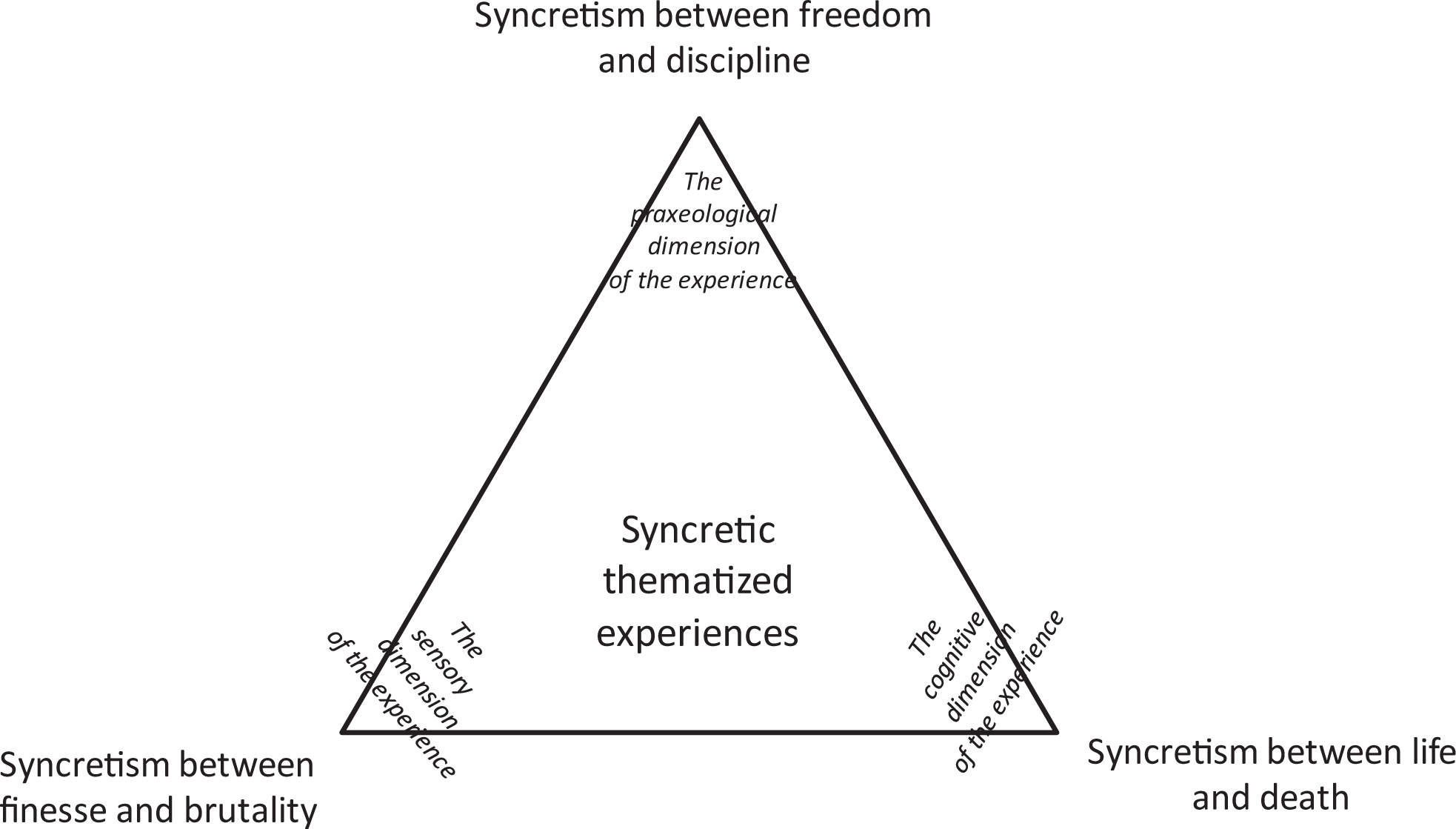
We find that the offering proposed by Hellfest is highly thematized to make the experience successful in a culture of spectacles (Debord, 1967). The spectacle is reinforced by the use of cognitive, sensory, and praxeological syncretism (see Figure 1) as we shall illustrate in the following sections.
The three dimensions of syncretic thematized experiences at Hellfest Festival.
Between life and death: A cognitive syncretism
The cognitive dimension of the experience refers to the thoughts and reflexive processes performed by visitors to interpret their experiences during and after (Carù and Cova, 2003; Schmitt, 2000). These cognitive processes are going to help visitors to make sense of the experience. As explained by Roederer (2012), this dimension has two facets since it manifests itself both in the form of different meanings that an object, a place, or a practice can carry, but also in the form of the overall meaning of the story that the experience tells. Our analysis reveals here a first syncretism.
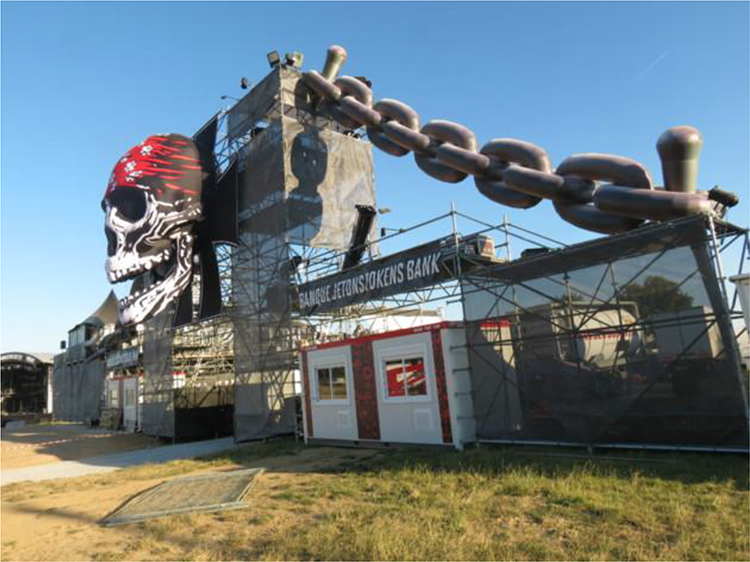
Visitors are immersed in the theme of the festival as soon as they enter Hellfest. This theme is clearly about what Podoshen et al. (2018) term a “death-oriented consumption.” The visitor is immersed in a dark, gothic, and violent atmosphere that is carried by the general environment of the festival; the bands that play during the festival present music and visuals that are morbid, and the way festivalgoers are dressed mostly reinforce this morbid atmosphere. Visitors perfectly perceive this bleak dimension of the experience and interpret it as a way to explore a darker side of their emotions. In its effort to highlight a dark aesthetic, the festival meets the need individuals to experience the symbolism of ultimate demise and associated notions (Berger, 1967). Due to medicalization and privatization, death has been repressed and life expectancies are extended in contemporary society (Podoshen et al., 2014). Yet, death remains an unavoidable characteristic of the human condition that individuals have to address (Berger, 1967). In addition, death, darkness, and violence enable some individuals to have delight because consuming violence empowers them to overcome the fear of such notions (Podoshen et al., 2014). At Hellfest, individuals are put in touch with the dark side of being human. As the name of the festival suggests, Hellfest seems to wish to transport the visitor to hell, that is, to a post-death moment. Directly linked to the dark and violent concept of the festival, many references are made to Satanism with the use of symbols such as “666,” the number traditionally attributed to the devil, the pentagram, the typical sign of Satanism or skulls (see Figure 2):
Giant skull.
You’re not at Disneyland here! If you want to hear love songs, if you want beautiful stories that end up well, you’re in the wrong place! Here we speak of death, rebellion, war, fire. But it is also life. Everything is not rosy and wonderful in life isn’t it? (Corentin, male, 20s)
However, if Hellfest is seen as a festival of death, our data suggest multiple syncretisms in the way the story is presented to the visitors. Alongside death is life. The name, Hellfest, is itself syncretic with “hell” clearly referring to the central story of the festival centered around dark aesthetics, violence, and death, while “fest” has a festive connotation. Hellfest develops this syncretism repeatedly and thus proposes an experience that is perceived as a dark experience but also as an experience of a festive engagement with life as well as a joyful acceptance of death. It is particularly striking to observe that despite the symbolism of death present everywhere on the site, festivalgoers are definitely there to have a good time and to enjoy life. Death, usually a constant source of fear, the unknown, and denial in contemporary culture, is made palpable and thus possible to live with in this festival. Darkness is symbolized in all the constant references to death and violence while life is symbolized by references to a festive place full of fun and light, with the presence of a big Ferris wheel or fireworks. Through the festival engagement with life, Hellfest is also perceived as a place where everything is possible, a magical place to some extent. There is, thus, a kind of infantalization of the visitor (Belk, 2000). As in Las Vegas, Hellfest “fosters a willing suspension of cognitive, rational, adult control and a welcome succumbing to a dream world of possibilities. This triumph of fun and magical belief over purposive cognition and rationality is precisely the spirit associated” (Belk, 2000: 116) with the festival. We observe that to their great astonishment, visitors, once more like children, will marvel at this extraordinary experience. Hellfest encourages instant gratification, impulsiveness, and play, as these childish qualities are more for being amazed than for the adult characteristics of deliberation, responsibility, and reason (Barber, 2007). For consumers, this syncretism is at the core of the experience offered by Hellfest: This is oddly symbolic of the festival, I think. On one side one can see metal structures, people with black and provocative clothes…in short, a true metal festival! And on the other side, a big wheel and lot of love! I love this offset. Somehow, that’s what makes the festival so rich. One can attend concerts of the most morbid bands of the world and 10 minutes later have fun at the top of a big wheel! This is amazing! (Max, male, 30s)
Between finesse and brutality: A sensory syncretism
This second dimension of the experience includes all the aspects of the experience that engage visitors’ senses: vision, audition, touch, and to a lesser extent smell and taste (Joy and Sherry, 2003; Schmitt, 2000). This sensory dimension refers to the tangibility of the experience and here physically materializes the theme. Our observations also indicate a syncretism between the finesse of the sensory experience on the one hand and its brutality on the other hand.
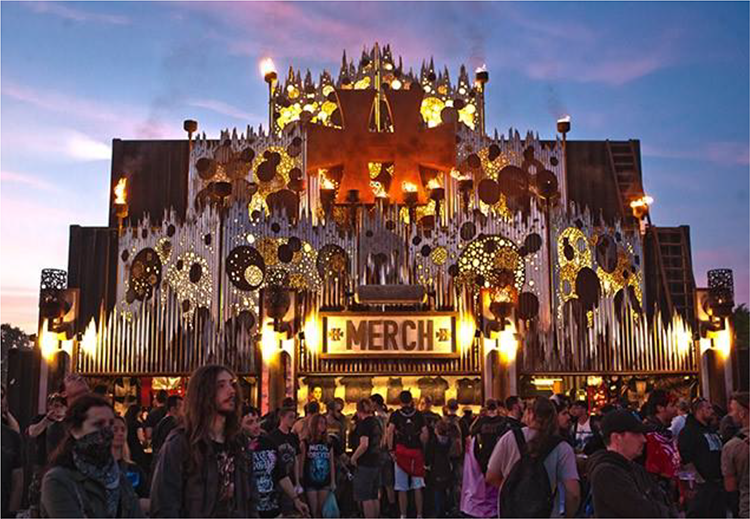
As open-air events, Hellfest takes place in a natural environment carefully selected for its beauty. Hellfest is in the small town of Clisson, a medieval city located at the heart of the “vignoble nantais,” a famous French vineyard. Hellfest thus begins from natural environments to build its theme and is organized as follows. The festival offers two side-by-side spaces: one where the different scenes in which artists perform are located and a second space dedicated to life outside the concerts. These two areas are in natural surroundings through scenographic techniques. At Hellfest, the area dedicated to life outside the concerts has camping, sanitary rooms, and various commercial and information booths that are located in the middle of grapevines, giving the place a bucolic and peaceful dimension. In addition to the beauty of the natural environment, Hellfest pays strong attention to the décor of the festival and overwhelmingly uses simulation in its thematization. With simulacra (Baudrillard, 1981), which imitate things that are real, but that become realer than what they imitate, Hellfest presents a virtual reality that gives meaning and life to the plot, a kind of hyperreality (Fırat and Venkatesh, 1995). In the manner of spectacle (Debord, 1967), this hyperreal presents an “unreal” that is “realer than real” for the visitors. By making the imagined plot a sensory experience, the festival highlights, beyond the sound, the importance of vision and appearance. Hellfest uses artificial objects to engage the senses to move the visitors into a fuller and aesthetic experience. As a festival participant, the first author is surprised at the visual quality of the sets that accompany the whole experience. All drinks and merchandising stands of the festival are sculptures made in iron to be consistent with the gothic universe (see Figure 3). The general decor of the festival uses replicas of crows, typical dark bird of ill omen, but also skulls and other dark artifacts. At night, bonfires are built in several areas to recall once again the shared vision of hell with a lot of finesse:
Gothic sculptures.
The decoration is a strong point of Hellfest. It stands out from many festivals in this way. This is not just a music festival in the middle of nature. There is particular attention paid to the decor. Some find it incongruous to find a giant raven in the middle of nowhere like that. But I think it’s fun. A little bit disappointed but fun. (Aline, female, 30s)
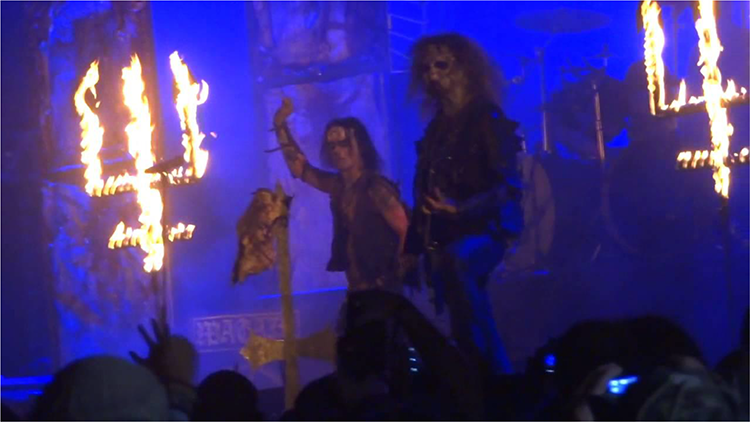
However, from this sensory perspective, our data suggest that alongside the finesse of the experience is the brutal engagement of the senses. In the middle of a natural setting and a meticulous décor, we see visitors immersed in a dark environment supported by a soundtrack of extreme and brutal music and where the color black is predominant. The festival has six different scenes, at least two of which feature concerts that take place simultaneously. A boom of sound of heavy metal music constantly envelops visitors aggressively from 10:00 a.m. to 2:00 p.m. Moreover, while the decorations of the festival are all particularly neat, they all refer to an aesthetic of death and violence, creating again a unique mix: This is my first time at Hellfest. And I discovered all that [the décors] with great surprise. In fact I did not expect so much attention to decoration from an extreme music festival! From a classical music festival why not, but from a festival as extreme as the Hellfest, not at all! Honestly, I’m stunned. As I was entering the festival site, I was pretty reserved on all that. I found that it did not fit with the extreme and underground side of the music. And then, finally, I got used to it. It’s like we’re in two different places at the same time! (Anne, female, 40s)
Brutal aesthetics.
Between freedom and discipline: A praxeological syncretism
The praxeological dimension of the experience refers to all the actions of visitors during the experience (Schmitt, 2000). The visitor, as an actor of his/her own experience, performs a number of actions and activities in connection both with the environment in which he/she is immersed and with other individuals (Roederer, 2012). In this domain of action, our observations reveal a tension between transgression (visitors feel they can act freely) and discipline (visitors have to respect some rules).
Unpleasant life experiences put people in need of living extraordinary experiences. They attempt to transcend their normal existence and to live cathartic experiences (Ritzer, 2005). To meet visitors’ need for surprise and challenge in the context of commodified festivals, Hellfest tries to give visitors an impression of not following any rules. Thus, the festival is experienced almost like a carnival: the carnivalesque breaks down social norms in a festive context (Bakhtin, 1984 [1965]). According to Bakhtin (1984 [1965]), the carnivalesque is characterized by a strong liberating power through the breaking of rules which results in a temporary but total release of emotions in festive euphoria. The visitor encounters the events in a seemingly unplanned manner (Jamieson, 2004). We find several evidences of this in our data. First, to the rhythm of heavy metal, people go wild without any apparent limits; they dance, shout, jump, drink. At Hellfest, most of the visitors wear black clothes, gothic makeup, piercings, and other jewelries and eccentric accessories such as studded belts and bracelets to recall the dark and gothic universe of the festival. From this point of view, visitors are indeed the actors of the story created by the festival and they wear the stage costumes (Chaney and Goulding, 2016). Visitors seem to experience a total freedom in the way they behave: Hellfest is definitely the place to be. I come here three days to clear my mind. And live it 200%. Here I am in another world, with other people. There is no limit, no one to judge my behavior, no one to judge my appearance. The Hellfest is a perfect place for that: everything is done for you to live 3 days of complete madness. (Arnaud, male, 30s)
Although Hellfest provides a sense of spontaneity, extraordinariness, and agency, liberating visitors from tensions of daily life, paradoxically our data suggest that this happens in a pre-orchestrated experience through theming. During his participation in the festival, the first author realizes that, even if the festival offers a timeless moment when people let go much more than their daily lives, the festival develops its own rules that everyone ceremoniously respects. Behaviors are largely codified, thus creating a syncretism between freedom of transgression and discipline. Since theming has been carefully imagined and scripted (Fırat and Ulusoy, 2011), the structure of the environs encourages visitors to practice discipline. During this journey, visitors don’t experience a regular sense of time, they experience the time of the festival and live according to the festival’s rhythm. While the festival creates the impression that participants enjoy total freedom, the theming of the experience and carefully engineered architecture drive behaviors. Presence of a syncretism of creating the new and reproducing the norm is palpable in the festival experience. The festival makes strong references to the marketplace commodifying the experience, contradicting the desire to escape the norms of society and break down the rules (Bakhtin, 1984 [1965]). Hellfest has many spaces allocated to commercial transactions, similar to Kozinets’ (2002) observations at the Burning Man Festival where individuals are unable to escape the market. Even in out-of-time experiences at Hellfest, supposedly distant from consumer society, visitors have to rely on the market. Here, within the theme, the festival creates an alternative society that is unreal but concrete (Cohen, 1985). In Hellfest, visitors experience a living area called Hell City Square. This is an alternative and structured city as it is explained by a visitor who is experiencing Hellfest for the second time: In the end, it looks a lot like real life. You have your schedule of groups that you respect as you respect your agenda, you do your shopping as in everyday life, you eat at the restaurant. Everyday stuff. Except that you have it all in the middle of nowhere, in the fields, with heavy metal music everywhere! (Lionel, male, 30s)
Even when visitors seem to enjoy total freedom, behaviors are actually very predictable. At Hellfest, visitors pogo-dance during concerts. Pogo-dancing is an extremely physical and violent dance where people knock each other in apparent disorder. Yet in reality, this dance is very codified and everyone knows how to behave, how someone who falls to the ground during the dance should be helped, and so on. It is also interesting to note that while participants may have the feeling to have great latitude in wearing eccentric clothes during the festival, they are in reality very similar. Transgression and respect combine and intertwine to create a syncretic experience.
Discussion
Literature shows that theming avoids disenchantment (Fırat and Ulusoy, 2011), but increasing competition and growing expectations of consumers have also increased commodification of thematized experiences, which in the first place contributed to disenchantment. To try and escape from this circumstance, managers explore new forms of experiences to create new ways for re-enchantment. Syncretism in thematization is an illustration of this trend. Through the investigation of a syncretic experience, this article makes two contributions to the literature.
Syncretism and the dimensions of syncretic experiences
This study contributes to the literature on consumption experiences by identifying dimensions of syncretic consumer experiences. Consumers are encouraged to immerse in a complex experience guided by preset architectures, experience the simulacra in the natural, and be exposed to the themes they are interested in within an environment that also elicits each theme’s opposite. We find that syncretism constitutes an effective means of offering re-enchanted spectacles.
Syncretism tends to make visitors feel surprised (Balme, 1999) and lose anchors to reality, thereby more prone to suspend disbelief. In a complex reality in which consumer needs for re-enchantment are endless, syncretism as a creative process of cultural mixing seems to provide a solution (Balme, 1999; Bast, 2009). Mixing heterogeneous features creates an imagined reality, which acts as a source of re-enchantment (Ritzer, 2005). As argued by Fırat and Venkatesh (1995: 255), there is “a tolerance for juxtaposition of anything with anything else,” but with syncretism tolerance graduates to appreciation. Boorstin (1964) explains that with the experience of our increasing wealth, technology, and progress, individuals believe anything and everything is possible, including “the contradictory and the impossible” (4). These syncretisms produce novel experiences and thus capture and hold, in effect, titillate and enthrall visitors. Syncretism based on creatively utilized multiple sources of cultural inspiration (Droogers, 1989) produces successful spectacles. This is an artful use of what Said (1993: xxv) observed, that “all cultures are involved in one another; none is simple and pure, all are hybrid, heterogeneous, extraordinarily differentiated, and unmonolithic.” As explained by Stewart (2015), syncretism has both an outside and an inside. The outside refers to the contexts, in this case, to the experiences where consumers are going to meet and live something together. The inside refers to the introduction of new ideas and concepts into a preexisting system. Syncretism thus gives rise to something new. By mixing heterogeneous elements, contemporary and extraordinary consumer experiences do not just accumulate complexities, they create a new form of re-enchanted experience. Boundaries are blurred and consumers find themselves surprised and disconcerted in confronting this new, syncretic experience (Hannerz, 2002).
More precisely, three dimensions of syncretism observed at Hellfest respond to the consequences of McDonaldization discussed earlier in following ways. The praxeological dimension, the tensions between freedom and discipline, provides a relief through a feeling of shedding the self-discipline otherwise required in society. The visitors experience the impression that immersing in the experience frees them from following rules and gives them the license for limitless “misbehavior.” Judgment, being judged is suspended as our informants expressed. Yet, there is also the recognition that a new form of discipline is required to be totally immersed in this new experience, thus there is not a complete loss of control, and the fears related to risk are alleviated through feelings of safety on the festival grounds.
The cognitive dimension of syncretism we detected at Hellfest, the tension between life and death, helps individuals to confront the risk of death they encounter as a result of what Bauman (1997) calls “creative destruction” and Giddens (1991) names “manufactured risk.” Both Bauman and Giddens are arguing that the creative successes of scientific technologies are on the other hand causing almost insurmountable problems, both in terms of destruction of the environment and of resources needed for life, and in terms of risks of annihilation of humanity due to nuclear weapons and other technologies of destructive energy. These circumstances cause further anxiety for contemporary individuals who are relieved to encounter playful in their morbidity, thus life-affirming experiences presented by syncretism.
Finally, the sensory dimension of syncretism that presents a tension between finesse and brutality creates the atmosphere that takes the individual out of her/his everyday reality and routines and immerses her/him into a different “reality” to allow the other two dimensions to work. Due to these characteristics, syncretism at Hellfest seems to currently provide a gratifying thematic experience for the visitors. In different contexts, syncretism may construct different dimensions that respond to the anxieties and uncertainties of contemporary life in different ways.
Time, productivity, and syncretic consumer experiences
Previous research has shown that many contemporary consumers share a desire of collecting experiences (Keinan and Kivetz, 2011; Mardon and Belk, 2018). In this desire to multiply the experiences, consumers tend to look for extraordinary, extreme, and original experiences, from skydiving (Celsi et al., 1993) and river rafting (Arnould and Price, 1993) to the grueling adventure challenge Tough Mudder (Scott et al., 2017) or they participate in the Burning Man Festival (Kozinets, 2002). Consumers may even be attracted by experiences that are predicted to be less pleasurable, such as freezing ice hotels and eating bacon ice cream, just to live new and original experiences (Keinan and Kivetz, 2011) or by experiences in mundane and restorative places (Cova et al., 2018). Our study shows that in the same vein consumers are attracted by the complexity and shock that syncretic experiences offer.
With increasing pressure for professional success and therefore less and less leisure time, time has become a scarce resource (Gross, 1987). This lack of free time has therefore become a status signal that demonstrates how busy consumers’ lives are (Bellezza et al., 2016). The management of this free time thus becomes crucial and has therefore led consumers to use this free time efficiently. Keinan and Kivetz (2011: 935) point to “consumers’ continual striving to use time productively, make progress, and reach accomplishments.” While this logic of productivity may imply multiplying experiences in different places, this article adds to the literature by showing that consumers can also live several experiences in one, simultaneously. By mixing different stories, different sensations, and different behaviors in one place, syncretic experiences allow consumers to use time even more productively (Keinan and Kivetz, 2011).
This productive behavior is rooted in a renewed conception of space-time (Harvey, 1989). Postmodernity has indeed created a constant pressure to speed up the time in relation to the social average and therefore to promote a social trend of faster cycles. This compression of time that affects production, consumption, and exchanges results in a high volatility and ephemerality of fashions, products, and production techniques. Harvey (1989: 157) concludes that “the need to accelerate turnover time in consumption has led to a shift of emphasis from production of goods (most of which, like knives and forks, have a substantial lifetime) to the production of events (such as spectacles that have an almost instantaneous turnover time).” This implies transience and a sensory overload (Harvey, 1989). To escape disenchantment arising from the marketization and commodification of consumption, we show that temporary, intense, and unbridled spectacles are sought by people and offered by new forms of experiences. Consumers want to experience strong and liberating emotions and then quickly move to something else, to something new. Syncretic experiences provide an effective response to this need because they represent both ephemerality, escapism and productivity.
Conclusion
Syncretism presents a powerful conceptualization because it helps us understand how the blending of contrary elements gives rise to an original and re-enchanting experience sought by the contemporary individuals who want to use their time productively. Paradoxical juxtaposition of opposites to create something new, a growing condition in late modernity (Fırat and Venkatesh, 1995), is actualized and advanced in syncretism, due to its force to disorient and to offer multi-dimensioned experiences at the same time. The presence of the familiar provides for the consumer the feeling of security to remain immersed in the spectacle as its fantastic and disorienting qualities disquiet the nerves and the senses as they transport consumers into an unknown land.
Some managerial implications can be drawn from this study. It suggests to practitioners that offering a syncretic experience mixing diverse and disparate influences are valued by consumers who are experiencing stress or the monotony of everyday life. Syncretic experiences not only allow them to escape from their daily life, but also to have the feeling of using their leisure time more effectively. More specifically, our research suggests that the construction of a syncretic experience is based on the mix of influences into three dimensions: the cognitive dimension, the sensory dimension, and the praxeological dimension of the experience. Regarding the cognitive dimension, managers must try to make consumers interpret the experience in disparate ways by engaging them in several stories during the experience. Studying the Hillside Festival, Sharpe (2008) has for instance shown that this festival is based on a syncretism between pleasure and politics. On the sensory dimension, experienced producers must try to stimulate the senses of consumers in opposing directions: ultra-stimulation versus weak stimulation, stimulation of a specific sense then stimulation of another sense, stimulation of a particular meaning versus stimulation of all the senses, and so on. Finally, on the praxeological dimension, it emerges from our study that it is necessary to require consumers, who are actors of their experience, to perform different roles and actions involving different meanings in order for a certain degree of confuse to arise.
Several limitations of this study point to avenues for further research. First, this research studies syncretism in a single context, namely a music festival. Further research in different contexts can produce additional insights about the effects of syncretic thematization. Second, this study initiated understanding of some key components of syncretic experiences. Future studies can expand on the consequences of such an experience, such as the benefits consumers derive from such experience, and how such experiences may benefit the brand. Third, it will be fruitful to look at how far a brand can go in implementing syncretism. It may indeed be that mixing too many influences could cause syncretism to become too overwhelming producing too great a disorientation for consumers to have an entertaining experience and obtain an impression of spending their time effectively.
More generally, our study suggests conducting a deeper discussion on the dialectic between enchantment and disenchantment (Thompson, 2006). From this point of view, Ostergaard et al. (2013) argue for a moderated vision of the dialectic. According to them, while modern capitalism and extreme rationalization have led to disenchantment, it is an enchanted disenchantment because of the arguable benefits of standardization in consumer culture. These benefits, including low prices and convenience, and have opened ways for mass-market participation. In the same vein, the result of firms’ strategies to re-enchant individuals can also be examined in two ways (Ostergaard et al., 2013). The re-enchantment created here is potentially a disenchanted re-enchantment. The fact that individuals can be aware of the mechanisms and techniques of re-enchantment used by companies can potentially disenchant them as much as they are enchanted by their effects. On the one hand, consumers are re-enchanted by highly themed experiences. On the other hand, the fact that consumers are aware of the techniques and the underlying goals of re-enchantment creates a new form of rationalization and standardization, thus giving rise to a new form of disenchantment. While syncretic experiences can re-enchant consumers by providing them with a disorienting spectacle that combines several sub-experiences into one, such experiences can also be commodified in the future, thus leading consumers to search new kinds of experience. The enchantment–disenchantment–re-enchantment dynamic could be an endless cycle that future studies need to better understand and articulate.
Footnotes
Declaration of conflicting interests
The author(s) declared no potential conflicts of interest with respect to the research, authorship, and/or publication of this article.
Funding
The author(s) received no financial support for the research, authorship, and/or publication of this article.
