




Abstract
This work develops a vision for purposively using pronoun-poetry in qualitative consumer research. While debates regarding knowledge hierarchies continue, poetic inquiry remains underexplored as a means to advance theorisation in this area. Drawing upon our own research experiences, we discuss how these methods can stimulate new ways of thinking, feeling, analysing, and amplifying consumer voices. We contribute to these conversations by developing pronoun-poetry practice, building on Voice-Centred Relational Method (VCRM) derived I-poems and unpacking a few of the many ways that different pronouns can be combined with other concepts (e.g., emotions) to create new pronoun-emotion variants. We also reinvigorate VCRM through what we term Voice-Centred Relational Poetry, a vision for using pronoun-poetry across all VCRM reading stages. These contributions significantly progress alternative methods through creative experimentation and originality, counterbalancing knowledge hierarchies and generating novel, co-created insights, and modes of representation about consumers’ socio-affective experiences and power struggles in the marketplace.
Keywords
Introduction
In this work, we develop a vision for the purposive use of pronoun-poetry in qualitative consumer research. Qualitative methods have flourished in the marketing discipline through consumer culture research (Arnould and Thompson, 2005, 2007; Sherry, 1991). In this field, there has been significant debate regarding the use of philosophical traditions that broadly align with interpretive and critical perspectives (e.g., Hirschman, 1986; Igwe et al., 2022; Kravets and Varman, 2022; Sherry, 1991; Thompson, 2002), and increased use of alternative qualitative methodologies (Pradhan et al., 2024). However, scant discussion exists about the affordances and challenges of specific alternative methods that can help advance theorisation in consumer research.
Poetic inquiry is an alternative qualitative method recognised as emergent in social research (Hesse-Biber and Leavy, 2006). It is a part of a nascent body of alternative research approaches that aim to produce “enlightening, unpredictable and novel depictions of consumer culture, as well as powerful methods of reflexivity [that] offer flexible ways to produce and interpret data” (Canniford, 2012: 392).
Poetry has featured in consumer culture theory (CCT) research for some time (Stern, 1998), and in its early days was considered an unorthodox practice (Sherry and Schouten, 2002; Wijland, 2011). In their review of 20 years of CCT research, Arnould and Thompson (2005: 870) reflect on Sherry and Schouten’s (2002) use of poetry, arguing that it is an outlet for “creative expression, voyeurism, entertaining esoterica and sonorous introspection”, with questionable relevance to wider society. Nevertheless, they note that such “controversial experimental moments […] serve an important function within the CCT tradition by periodically testing its epistemic boundaries” (Arnould and Thompson, 2005: 870).
In the last two decades since these reflections, poetry has become more prominent within CCT research. It has earned its own sessions at CCT annual conferences and now features regularly in the Journal of Customer Behaviour (e.g., Sherry, 2022; Timke et al., 2025; Wijiland, 2024). In fact, poetry is well-established in CCT precisely because of its unconventionality (Brown, 2014). Its possibilities are infinite and its value to the field is significant, as it magnifies the essence of our human existence and makes the invisible visible (Lahman et al., 2019).
Poetry advances our ways of relating with our participants, our data, our collaborators, our writing and the world around us, enabling us to “see the limitations of well-established concepts” (Rojas-Gaviria, 2022: 186). Poetry can also help us embrace our experiences and active participation in the processes of research and knowledge creation, enabling us to witness the constellations of objects, affects and forces involved in our fieldwork and daily life (Canniford, 2012). Furthermore, poetic inquiry can enable “vivid and visceral representations” of research data (Rojas-Gaviria, 2016: 85), and diverse ways of knowing and representing research to non-academic audiences (Lahman et al., 2019). Poetry, therefore, can help us reclaim our scholarly joie de vivre (Brown and Ponsonby-McCabe, 2022). By ‘slowing down’ through the process of poetic inquiry (and other arts-based endeavours) and bracketing the need for efficiency in our academic lives, we are also “actively decolonising time” (Shahjahan, 2015, in Rojas-Gaviria, 2022: 189), and our research process.
In consumer research, poetry has been used prolifically to give voice to experiences of palliative care (Rojas-Gaviria, 2020), to articulate challenging experiences of consumer vulnerability (Downey, 2016), to explore lived experience of pre-natal screening (Takhar, 2024), to access and interrogate intimate, unseen, everyday consumption practices (Tonner, 2019), to reflect and capture researcher-poet voices in difficult circumstances (Downey, 2022), and to articulate a poetising philosophy about identity-related “moments of humble vulnerability when we wonder about life circumstances that we do not control” (Rojas-Gaviria, 2021: 463).
Yet, despite the recent ‘poetic turn’ in consumer research, few works adopt pronoun-poetry purposively. This is not to suggest that existing works have not used pronouns in their poetry or that existing consumer research poetry is significantly distant from the pronoun-poetry craft. Indeed, research in this area is already creating poems based on interviews and researcher reflections, drawing on many evocative pronoun-emotionality connections. For example, Rojas-Gaviria (2016) created poetry for each of her phenomenological interviews to capture and creatively express the meanings and emotions that emerged in participants’ stories. The poems are a beautiful, artistic and reflexive means to interpret key interview insights and to generate additional conversations with participants.
Nevertheless, such poems are not necessarily created from interview transcript sentences. When revisiting her own work, Rojas-Gaviria (2022: 178) discusses the evolution of her evocative poems through their rewriting over time, which pushed the author into ever-more creative, artistic, and “unknown territories”. In this process, she “deviat[ed] from the participants’ words or metaphors” (Rojas-Gaviria, 2022: 186), which enabled her to “let go and let the poetics carry [her] to places [she is] still ignorant about” and to question well-established concepts in consumer research (Rojas-Gaviria, 2022: 178).
What we offer in this paper are complementary possibilities for poetic inquiry by focusing on the specificities of pronoun-poems in that they are created from sentences in interview transcripts by focusing purposively on pronouns. For example, I-poems are poems that emphasise first-person transcript statements in concise, reflexively constructed poetic form, which uncover an individual’s subjectivity. I-poems are gaining legitimacy in qualitative research. As a form of pronoun-poetry, their power and uniqueness lie in combining creativity with rigorous, valuable and substantive analytical and representational strategies. What pronoun-poetry can do that no other method can, is allow the researcher to document a participant’s inner world and their phenomenological experiences relationally, using pronoun-led transcribed lines from participants’ interviews in an evocative and artful manner (Zambo and Zambo, 2013). By balancing creativity with analytical rigour, pronoun-poetry enables access to layers of meaning, affect, and relational positioning that remain obscured in more conventional forms of qualitative analysis, offering a depth of insight that emerges only when imaginative expression and systematic interpretation work in tandem.
I-poems, specifically, have had considerable uptake in the fields of psychology and sociology, particularly in medical research and research into experiences of vulnerability (Balan, 2005; Edwards and Weller, 2012; Koelsch, 2015). However, few consumer researchers have adopted I-poems or other pronoun-poetry in their works. Notable examples include Hutton and Lystor’s (2021) and Brown et al.’s (2021) use of I-poems and pronoun-poetry, respectively, in research projects addressing sensitive topics through the Voice-Centred Relational Method (VCRM).
In this work, we advance these important methodological conversations by asking the following research question: how can I-poems and, more broadly, pronoun-poetry be used purposively to generate original insights in consumer research? We address this research question by exploring I-poems as an innovative method that can be used and developed further in consumer research, examining their established form and proposing new variations, alongside a vision for pronoun-poetry that aligns with, and extends, VCRM. We outline the origins, methodologies, and affordances of these poetic inquiry approaches. Drawing on our own, previously published qualitative research on consumer debt, we discuss how pronoun-poetry has provided novel insights and creative alternatives for analysing and representing consumer research.
Here, we do not intend to be ‘prescriptive’ or offer a ‘how to guide’ for pronoun-poetry, as there is a significant degree of experimentation, originality, and indeed failure involved in any poetry making and the making of the researcher through the poetic process. Instead, we acknowledge the importance of keeping a “poemish” spirit in the process of crafting alternative research representations from our non-expert, researcher-poet positions, as we attempt to fuse the aesthetic features of poetry with social science research (Lahman et al., 2019: 215). Accordingly, we offer an entry point into poetic methods in order to make them more accessible, as well as ideas about how the practice of pronoun-poetry can be further developed into the future. In doing so, we acknowledge that future works will need to find their own way around these methods and embrace the vulnerability and uncertainty involved in poetic inquiry.
We contribute to consumer research in three ways. First, we further develop the practice of pronoun-poetry by building on established I-poem literature and clarifying the diverse ways that I-poems can be constructed from transcript sentences. In doing so, we demonstrate full and sparse variants and propose where analysis points can happen within the process. Second, we unpack a few of the many ways that different pronouns can be combined to develop original pronoun-poetry, for example, by using I and They pronouns together, which can help uniquely illuminate relational encounters, experiential tensions, as well as the agency and power issues that participants experience in the marketplace. We also establish that pronouns can be further intersected with other concepts including (but not limited to) emotions and feelings, to create emotion-poems, which can amplify specific insights emerging from the data and illuminate consumers’ socio-affective experiences in consumer culture. Third, and building on the previous contributions, we reinvigorate VCRM by establishing what we term Voice-Centred Relational Poetry; that is, an imagining or a vision for the purposive use of pronoun-poetry in future qualitative consumer research. Our work builds on Hutton and Lystor’s (2021) development of the Voice-Centred Relational Method (VCRM), particularly their focus on how multiple voices and relational dynamics shape lived experience. While they demonstrate the value of listening for different voices across the four VCRM readings, we extend their contribution significantly by showing how pronoun-poetry can be used within and across these reading stages. In doing so, we offer an expanded approach called Voice-Centred Relational Poetry that strengthens VCRM’s ability to surface relational, emotional, and marginalised voices in new ways. These contributions are significant in that they progress the capaciousness of alternative methods through experimentation and originality, counterbalancing existing hierarchies of knowledge (Hutton and Cappellini, 2022; Kravets and Varman, 2022).
Poetry in Consumer Research
As a creative research method using structured or free-form verses, poetry seeks to express and evoke intense feelings and concepts. It serves as a transgressive tool for collecting, analysing, and representing qualitative data (Ollis et al., 2025). This is because poetry enables researchers and consumers to challenge established norms in consumer research by moving our thinking and affectivities away from dominant ways of understanding and representation (Brown and Wijland, 2015; Canniford, 2012; Hutton and Cappellini, 2022; Rojas-Gaviria, 2021).
Poetry can access consumers’ lived experiences more deeply than prose (Furman, 2006), and its evocative power has been described as “the clarification and magnification of being” (Hirschfield, 1997: 5). In this way, poetry supports that alternative forms of data can evoke emotional responses in human research (Denzin, 1997; Furman, 2006), including in relation to consumer culture. Thus, poetry aligns with an expressive research agenda (Willis, 2002), helping to explore and understand the hidden, relational, and affective intensities experienced by researchers and consumers in the marketplace.
However, poetry’s use in consumer research is diverse and challenging to evaluate, contributing to its appeal and sceptics’ unease. There are no hard rules for its application, resulting in a ‘melting pot’ feel to the approach. Indeed, poetic inquiry has an aura of ambiguousness about its appropriateness in research, and questions emerge about whether to use structured or unstructured forms, the poetic voice involved, and the order in which to use and/or analyse the poem once it exists.
The value of poetic inquiry in consumer research
There is no definitive answer for when to use poetry in research, as existing literature offers diverse perspectives. Often, this decision relates to whether a study aims to explore emotional states or affective consumer experiences. As Sherry and Schouten (2002: 230) argue, “where the topic under consideration is an individual’s emotional or spiritual understanding of consumption objects, his or her grasping of the thing-in-the-thing, poetry may be the most appropriate method of both investigation and expression”.
Several compelling reasons support the value of using poetry in interpretive consumer research. First, poetic inquiry can be particularly suitable for investigating sensitive topics. For example, poetry has been applied in studies addressing experiences of cancer (Kayser et al., 2007), domestic abuse (Breckenridge, 2016), unlabelled sexual activity (Koelsch, 2015), depression (Gallardo et al., 2009), homelessness (Clarke et al., 2005), racial hostility towards immigrants (Takhar, 2020), and death (Schouten, 2009).
Second, poetic approaches amplify the voices of often-unheard consumers, particularly those in vulnerable states and/or lacking the ability, or confidence, to give themselves voice, aiding representation and ethical engagement with sensitive issues. Hutton and Cappellini (2022: 155) discuss the lack of epistemic agency that marginalised voices possess, “due to their disciplining, neglect and subjugation as knowers through testimonial and hermeneutical injustice”. In contrast, in co-operative inquiry, poetry has been used to highlight and validate the knowledge and lived experiences of people who have been dehumanised (Downey, 2022; Hill et al., 2016). For instance, research has explored the vulnerability of women in workplace transitions (Balan, 2005), adolescents (Edwards and Weller, 2012; Woodcock, 2005), and individuals experiencing mental health issues (Clarke et al., 2005).
Third, poetry can help explore the affective and relational dimensions of consumption-related phenomena. It has been used to explore the affective dimensions of identity (e.g., Edwards and Weller, 2012; Koelsch, 2015; Rojas-Gaviria, 2021), and the relationship between the self and the marketplace in the context of personal indebtedness (Brown et al., 2021).
Fourth, the use of poetry answers the call for innovative methodologies and modes of representation in CCT (Canniford, 2012). Therefore, it is important to examine how poetry can enrich consumer research further.
Poetic inquiry approaches
We argue that, as an alternative method, poetic inquiry can offer researchers limitless possibilities. For parsimony, we highlight three main approaches to poetic inquiry that are used in social sciences research. The first approach, literature-voiced poem (vox theoria), is written by researchers in response to their literature review and theories in their research field (Prendergast, 2009). The second, researcher-voiced poem (vox autobiography/autoethnographic), reflects researchers’ experiences and is based on fieldnotes, reports, and reflections (Furman et al., 2006; Prendergast, 2009). The third, participant-voiced poem (vox participate), is developed from interview transcripts or directly by participants, focusing on the participant’s voice (Prendergast, 2009).
In consumer culture research, an example of literature-voiced poems is Takhar’s (2024) exploration of a bioethicist’s experiences of pre-natal screening and reproduction technologies using personal essays and articles to inform the poem. Researcher-voiced poetry is aligned with autoethnographic poetry traditions and is the outcome of the researcher-experiencer. Examples include Gallardo et al. (2009), Schouten (1990), Takhar (2020), and Moraes (2024), who used her autoethnographic reflections to construct I-poems.
However, we argue that the third approach of participant-voiced poetry remains underutilised in consumer research. Few studies give participants poetic freedom, likely due to the daunting nature of writing poetry for those unfamiliar with the form. While Wijland (2011: 128) and Tonner (2019) enlisted recognised poets to create poetry, it is more common for researchers to construct the poems themselves. Richardson (1994) first suggested that building poetry from data can inspire new insights, and Furman et al. (2006) refer to this as research poems. Such poems are created by the researcher using the words of their participants, and are also known as found poetry, data poems, poetised verse, or poetic transcription (Breckenridge, 2016; Canniford, 2012; Willis, 2002). Further, we argue that pronoun-poetry adds a unique spin on participant-voiced poetry, as it uses pronoun-led transcribed lines from participants’ interviews in an expressive and artful manner, which has the power to foreground key relational aspects of participants lived experiences and the affective intensities of their inner worlds. For these reasons, pronoun-poetry has the power to engender empathy toward, and deep understanding of, the vulnerabilities our research participants experience in daily life.
Pronoun-poetry also actively disrupts conventional hierarchies of knowledge by shifting interpretive authority away from the researcher and toward participants’ own linguistic, affective, and relational expressions. Because the poems are constructed directly from participants’ pronoun-led transcript lines, they preserve the cadence, tensions, and emerging self-positionings embedded in their original speech. This approach resists the researcher’s tendency to abstract, categorise, and/or sanitise lived experience, instead elevating participants’ embodied ways of knowing as analytically generative in their own right. By allowing participants’ voices, subjectivities, and relational orientations to structure the poetic form, pronoun-poetry unsettles top-down epistemic arrangements and opens space for co-created insights that foreground the experiential expertise of those whose lives are being studied.
Concerns with legitimacy, quality, and form
Poetry can feel daunting for those inexperienced in the craft, and questions of legitimacy and quality often arise for those of us who wrestle with our poet-impostor daemons. At this point, it is helpful to recall Lahman et al.’s (2019) distinction between literary and research poets. Literary poets enjoy an assumed prestige that comes with a literary education involving poetry writing, whereas research poets may lack formal training and often feel the need to explain their poetic inquiry procedures and meanings. The latter’s vulnerable position, in turn, raises questions about what constitutes quality in research poetry (Lahman et al., 2019). Faulkner (2016, in Lahman et al., 2019) offers us a useful orientation in this respect, highlighting the need to connect with the human condition, the need for courage, the ability to convey authenticity and ineffability, among other qualities.
It is also important to continuously develop one’s researcher-poet craft and become aware of relevant poetic techniques (Lahman et al., 2019). For example, debate continues over the merits of free verse versus poetic form in qualitative poetic inquiry with little consensus (Prendergast, 2009). Some argue that using fixed structures like sonnets or haikus can restrict participants’ original voices (Breckenridge, 2016), while others believe structure can encourage word economy to get to the essence of experiences (Furman, 2006).
Poetic forms in qualitative research include free verse (Pithouse-Morgan and Le, 2026), tanka (Breckenridge, 2016; Furman, 2006; Pithouse-Morgan and Le, 2026), haiku (Brown and Wijland, 2015; Pithouse-Morgan and Le, 2026), lantern (Pithouse-Morgan and Samaras, 2019), and pantoum (Furman, 2006). I-poems (Gilligan et al., 2003) are a specific structure, constructed by researchers using the ‘I’ statements from interview transcripts. They make a distinct type of research poem that emphasises the voice of ‘I’ in participant discussions (Edwards and Weller, 2012; Gilligan et al., 2003).
Nevertheless, we argue that holding onto the idea or essence of what Lahman et al. (2019: 216) term “poemish” is important here, as novice research poets need to “be allowed a space to create good enough research poetry”, including good enough pronoun-poetry.
The origins and poetic voice of the I- and pronoun-poems in research
In the 1980s, psychologists developed a systematic, feminist method for analysing qualitative interview data that could respect culture and gender (Brown et al., 1989; Koelsch, 2015), to offer an alternative to the positivist methods used in psychology (Gilligan, 2015). Initially called the reading guide (Brown et al., 1989), it was later renamed by Gilligan (2015) as the listening guide in 1990 and then redefined by Mauthner and Doucet (1998) as voice-centred relational method (VCRM).
VCRM seeks to “attend to silenced voices [and] pay attention to the multiplicity of a single voice” (Koelsch, 2016: 170; also see Hutton, 2019; Hutton and Lystor, 2021). It draws on voice, resonance, and relationship as a point of entry into the inner world of a person (Gilligan et al., 2003), and into the relationship between this inner world and culture. This multi-layered approach helps researchers interpret complex interview data to understand how participants make sense of their social worlds (Brown et al., 1989; Woodcock, 2005).
VCRM involves reading qualitative interview transcripts at least four times to identify the plot in participants’ stories, the voice of ‘I’, the relationships with others, and the social and cultural context (Gilligan, 2015). I-poems emerged as a way of presenting and analysing the voice of ‘I’, which is the second reading of VCRM.
The voice of ‘I' in I-poems
In the second reading of VCRM, researchers focus on the personal pronoun ‘I’, which reveals how participants present themselves and highlights emotional or intellectual struggles (Doucet and Mauthner, 2008). I-poems were developed to clarify the voice of ‘I’ (Brown and Gilligan, 1992; Debold, 1990; Gilligan et al., 2003). They “pick up on an associative stream that flows through the narrative, running underneath the structure of sentences” (Gilligan, 2015: 71). I-poems take the form of concisely constructed poems. They are constructed from a close reading of transcript data and designed by breaking down first-person sentences to create new, evocative flows of meaning.
I-poems centre on how participants talk about their ‘self’ when trying to make sense of their lived experiences. I-poems enable us to unpack relational processes of ‘selfing’, that is, the ongoing project of being and constructing the self (Goffman, 1974), by focusing on “the participant’s sense of herself within the[ir] story” (Koelsch, 2015: 98). The emphasis on the I pronoun reveals an individual’s subjectivity, capturing how they understand and speak about themselves and their inner worlds.
Uniquely, I-poems can reveal hidden, deep-seated meanings or capture streams of consciousness. They can strikingly convey the essence of participants’ voices (Brown et al., 2021), in ways that are intimate, close, deep and highly affective. They can create a personal connection with the reader and foster empathy. Accordingly, I-poems offer more than just data management: they provide access to participants’ emotions, inner worlds and lived experiences, enhancing understanding. Unlike traditional thematic analyses where the researcher ‘gazes at’ the subject, analyses using I-poems enable the researcher to stand alongside participants to prioritise the exploration of self-meaning and relationality over analytical themes (Edwards and Weller, 2012).
I-poems can also help the researcher to engage reflexively with research participants and their social realities (Edwards and Weller, 2012). This engagement reflects the interconnections between the knower and the known, as the researcher bears poetic witness through performing and (re)presenting research (Canniford, 2012).
The complementary voices of pronoun-poetry
Alternative pronouns can complement the narrated self, enabling the creation of We-poems, They-poems and more, depending on the dataset and research questions (Kara, 2015). For example, Kayser et al. (2007) used We-poems to explore coping with cancer from a relational perspective, which deepened understanding of the vulnerabilities that cancer patients experience as a ‘we’ (i.e., shared) kind of vulnerability involving themselves as well as their partners. As another example, Bekaert (2014) crafted a ‘sister’ poem based on a participant’s references to the eight-year-old sister she lost to circumcision, highlighting powerful emotions and generating deep empathy predominantly with ‘she’ statements. Also, Williams (2011) examined emotive responses to Labiaplasty by incorporating pronouns like she, he, and they, which broadened interpretive possibilities. This approach, thus, allows researchers to unpack relational dynamics evocatively, in ways that engender significant empathy and deep understandings of lived experiences of vulnerability, aligning with the third and fourth readings of VCRM.
Pronoun-poetry can also enable the examination of relationships in socio-cultural contexts. It reflects how research participants express their feelings, emotions, and connections, but also the gaze of the researcher in relation to such socio-affectivities. As such, pronoun-poetry enables an experimental, original, fragile, and potentially vulnerable form of representation of difficult-to-convey socio-affectivities in sensitive research contexts.
We also note that pronoun-poetry aligns with phenomenological perspectives in its capacity to powerfully convey embodied, relational affectivities and emotions in unique ways that are not possible with other methods. Phenomenology foregrounds the body and the totality of embodied senses and perception as essential to understanding lived experience and related affectivities (Preece et al., 2026; Rojas-Gaviria and Canniford, 2022). Phenomenology understands mind and body as one; as necessarily already involved in the world pre-consciously (Merleau-Ponty, 1962). Indeed, central to our work is phenomenology’s notion of self-givenness, a pre-reflective self-consciousness about the way an experience ‘self-gives’ or unfolds to itself as it occurs in that moment; another important concept is that of first-personal givenness, that is, a pre-reflective self-consciousness that an experience is uniquely one’s own, as it unfolds, before all reflection (Gallagher, 2025). These are in contrast with something we may experience self-consciously, as self-consciousness necessarily involves reflection (Gallagher, 2025). Importantly, phenomenology posits that self-consciousness is inevitably shaped by others and what we learn from them (Gallagher, 2025). We use pronouns to bridge pre-reflective and reflective self-consciousness and to articulate (and eventually understand) the relational intersubjectivity between the I and the You/He/She/We/Them, including its tensions and how it affects self-consciousness and one’s perception of embodied agency in society. This makes pronouns a ‘category in emergence’.
Pronouns therefore do not simply describe an existing self or one’s unique experiences but rather are actively involved in the generative emergence of that self and their relational experiences as they become expressible. Accordingly, pronouns also bridge embodied experience and political expression, for example, the historical dominance of the masculinised he, the distancing effects of they, the intimacy or vulnerability of you (Baron, 2016; Curzan, 2009). The poetic re-arrangement of pronouns exposes how participants position themselves and others before they have fully articulated those positions. This makes visible the relationality between self and other that quietly structures lived experience: the oscillation between the asserting I, being shaped by you, resisting or absorbing them, and navigating the social worlds these pronouns summon. Pronoun-poetry therefore uniquely reveals layers of relationality and embodied agency that remain hidden in conventional analytic prose, allowing researchers to trace how the world emerges through and between pronouns.
For these reasons, pronoun-poetry is an apt and unique alternative method for qualitative inquiries involving difficult-to-research issues, sensitive topics and/or experiences of vulnerability that demand empathetic understanding, such as research projects involving lived experiences of poverty (Moraes et al., 2024) or personal indebtedness, which is what we focus on here. The following section outlines the poetic methods used by the first author in her prior publications to enrich qualitative research insights into consumer debt.
Methods
We draw upon our experiences of using I- and pronoun-poetry to demonstrate its application in analysing and representing interpretive qualitative research on consumer financial indebtedness (Brown, 2018, 2024; Brown et al., 2021). Our aim is to show how I- and pronoun-poetry illuminates the subjective, lived experiences and feelings of individual consumers, bringing the researchers and the readers of research closer to these experiences than would have been possible with a sole focus on thematic analyses.
As discussed in Brown (2018) and Brown et al. (2021), data collection started with in-depth interviews that generated rich discussions about lived experiences of indebtedness, how consumers navigated the credit and debt landscape and which credit products they had used. Ten indebted consumers were interviewed in the first research stage, and two more at a second stage. Discussions lasted between 40 minutes and 2.5 hours.
The lead author conducted follow-up interviews with participants to continue those conversations, to clarify points, to perform a lived experience mapping exercise (see Brown and Farquhar, 2024), and to discuss new topics that had emerged with other participants. In the first research stage, seven participants completed follow-up interviews, with four returning for a second round of follow-up conversations. In the second research stage, only one follow-up interview occurred. Follow-up interviews lasted between 30 and 60 minutes.
Each interview was transcribed verbatim with follow-up transcripts added to the original interviews to consolidate the participant’s data into a single document for creating the poems. These transcripts were read multiple times, following VCRM stages of reading: the plot, the voice of ‘I’, the relationships, and the socio-cultural context of participants (Gilligan, 2015). Once the lead researcher was familiar with the interview content, the process of reading for the ‘I’ voice and creating the I-poems began.
Participant checking, or member validation (Seale, 1999), is often advocated to ensure accurate data interpretation and respectful representation of participants’ experiences (Koelsch, 2013; Lincoln and Guba, 1985). Traditional methods include returning verbatim transcripts to participants (Carlson, 2010), reinterviewing participants (Doyle, 2007), discussing the interpretation of their specific interview data (Koelsch, 2013), or discussing the overall themes emerging across all interviews (Harvey, 2015). However, participant checking has attracted criticism as a validation technique (Birt et al., 2016; Motulsky, 2021).
We used an alternative approach, offering participant’s the opportunity to review their poems (Brown et al., 2021). This was not solely a verification step, but part of an ethical commitment to collaborative meaning-making. It allowed participants to engage with how their experiences were interpreted and creatively rendered, reinforcing principles of transparency, mutual respect, and care, allowing the researcher to respect their agency and voice. Participants were invited to review their poem and reassured that feedback was welcome but not obligatory. Checks were completed face-to-face, online, by telephone, and via email. While online or telephone checks may lack rapport, they still facilitate meaningful discussions free from researcher coercion (Birt et al., 2016).
Not all participants provided feedback, and those that did predominantly offered emotional or interpretive responses rather than corrections. For example, during a telephone check, a participant who had experienced financial abuse found her I-poem a powerful summary of her ordeal. Although it brought back painful memories, she thought the interview itself had been cathartic and felt relief in having her experience documented, enabling her to step away from it more definitively. Corrections were about factual items in the discussion, such as an interest rate that might have been incorrect during the discussion. In one case, a participant suggested a change in phrasing to better reflect their intent, which was incorporated into the final poem version. This means that participant checking can be a means to co-create meaning and affirm the participant’s voice rather than just a quest for accuracy. Although the process helps with quality assurance, it is an opportunity to deepen the relational aspect of the research with empathy and shared interpretation.
The lead researcher also sought permission to share anonymised poems with other participants to gain further insights. Most participants agreed quite readily to this request, perhaps due to the anonymisation of the poems and the isolation they felt as indebted and stigmatised consumers. In most cases, participants were curious and eager to engage with others’ experiences and share their thoughts on the poems and analyses. Despite the sombre nature of the topic, the checks fostered empathetic and even enthusiastic responses, similar to what occurred in Rojas-Gaviria’s (2016) research.
This co-collaborative process helped reposition our gaze and analyses to better align them with participants’ perspectives, thus foregrounding and emphasising emic viewpoints, essential in qualitative consumer research (Thompson et al., 1989). Clear communication about the method, openness to participants’ responses, and a flexible approach to amendments can enhance the trustworthiness and resonance of poetic representations. Researchers should also be mindful that participants may respond affectively or feel distanced from the poem, and both reactions are valid and informative.
Developing I-poems and pronoun-poetry to analyse issues of consumer financial indebtedness
In this section, we reflect on how I-poems can be constructed in qualitative consumer research projects, pointing out where the method provides rich interpretive affordances and the creative pronoun alternatives that encourage new, different, and refreshing ways of thinking, feeling, analysing, and representing consumer research.
Constructing an I-poem and pushing our analysis further
Typically, I-poems are constructed in two stages. The first involves highlighting sentences that express the voice of ‘I’, including any relevant supplementary text for understanding participants’ sense of self (Edwards and Weller, 2012), and for addressing the research question(s) at hand. The second stage entails gathering these highlighted sentences and arranging them sequentially “like the lines of a poem” (Edwards and Weller, 2012: 205). We illustrate these two stages in the first column of Figure 1 and represent the second stage in the middle and last columns. Example of I-poem formation using participant Ian’s transcript.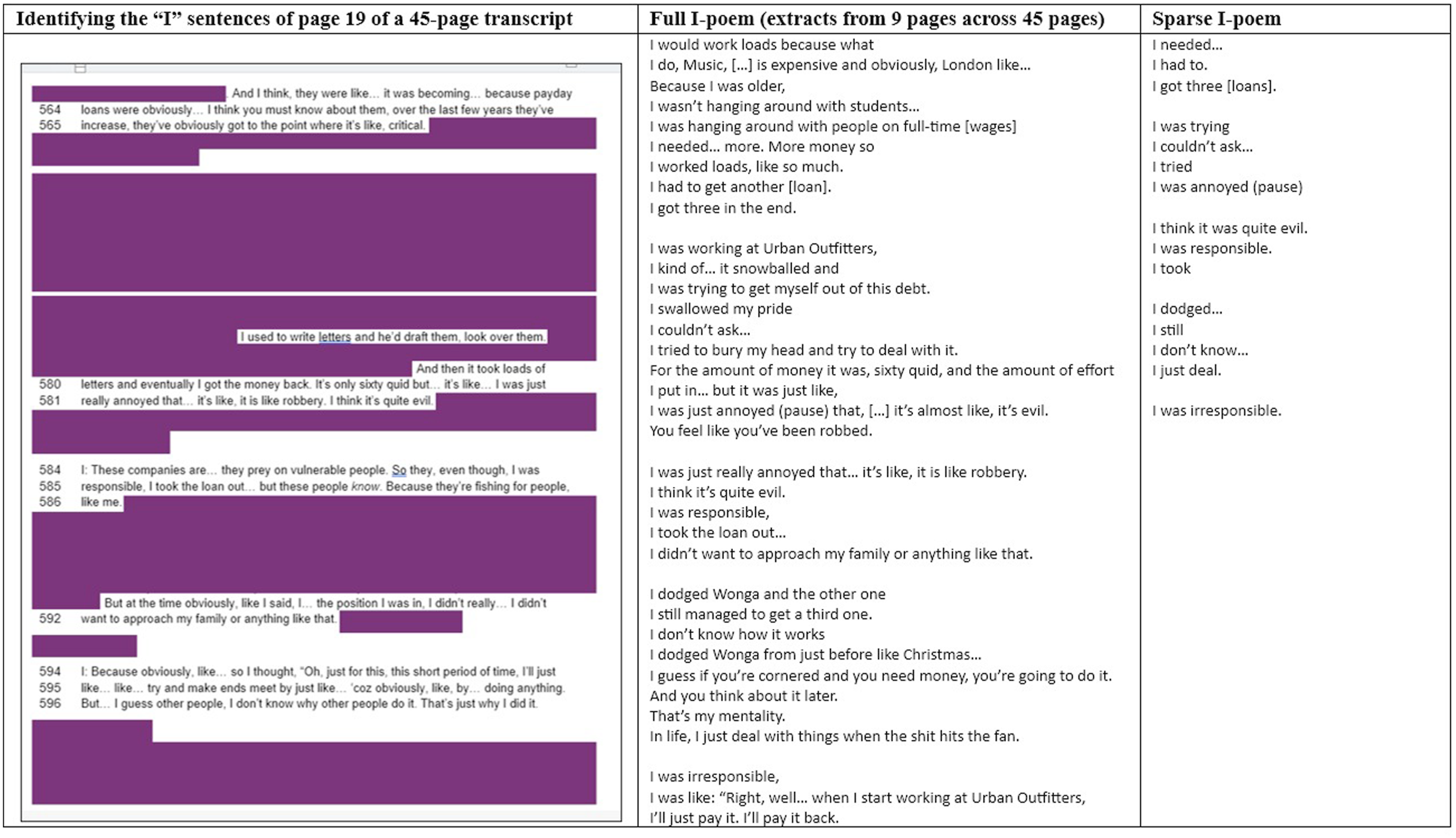
To stay close to the participant’s voice, VCRM suggests it is important to maintain the original order of sentences unless a different arrangement enhances evocative power. As interview discussions are rarely linear, presenting the I-pronoun lines in their original order can capture the chaos of a non-linear conversation, in the emergent order created by the participant. When reviewing transcripts, we suggest removing all or most sentences that do not reference the participant’s ‘I’ to amplify the self-related text. This editing step helps focus on the remaining ‘I’ sentences, allowing for scrutiny against set pronoun criteria and the research question(s) guiding a specific project (Brown et al., 2021). This process makes transcripts more manageable, amplifying participants’ voices and helping uncover participants’ core meanings, feelings and emotions within their lived experiences. The process might begin in a way which requires us to ‘remove the noise’ and which resembles data management. However, the researcher is then required to make exploratory, creative decisions about what to include and exclude, and what to foreground and what to keep in the background, to evoke closeness and intense affectivities through I-poems.
Full versus sparse I-poems
The form of an I-poem can vary considerably. In Figure 1, we use the middle and last columns to illustrate different I-poem forms using the same participant’s transcript. The middle column presents a ‘full’ I-poem, which some researchers advocate as it keeps more of the interview text within the I-lines for context. Examples of this longer format can be found in Balan’s (2005) and Zambo and Zambo’s (2013) works. The benefits of keeping contextual detail in full I-poems include creating a wide frame of reference while amplifying the participant’s voice by cutting across the transcript, yielding powerful insights.
While refining the interview transcript to really ‘hear’ the participant’s voice, we were struck by the evocative depth of these poems, which blend the participant’s internal voice with situations, characters and cultural tropes, and create a vivid, multifaceted and empathy-eliciting story (Brown et al., 2021). By incorporating interview details, full I-poems can be analysed using thematic approaches (Braun and Clarke, 2006; Braun et al., 2022; King and Brooks, 2018). The inclusion of these data provides strong insights into participants’ worlds, which a traditional thematic analysis of the full interview transcript alone cannot achieve.
In Figure 1, for example, the full I-poem suggests an uncomfortable, emergent tension between Ian’s need to ‘fit in’ with his peers, but inability to afford to do so, including the tactics he employs to manage this discomfort and stay afloat of rapidly spiralling debt. We can also start to understand the relationship he has with his parents, his desire to manage his situation by himself and the annoyance he feels towards the lender for creating larger problems than needed from what started as a relatively small loan. Overall, this poetic arrangement exposes the intersubjectivity of how Ian positions himself and others as those positions emerge. There is a duality evidenced between Ian’s need to maintain a normative existence and ‘be responsible’ versus his sense of being overwhelmed in managing his spiralling struggle to afford to do so and ‘being irresponsible’.
However, full I-poems have been criticised for straying “from the original intent and structure of I poetry” (Koelsch, 2016: 171), as their long lines shift attention away from the ‘I-voice’ to plot details (Gilligan et al., 2003; Koelsch, 2016). Some researchers suggest trimming narratives to the selected pronoun plus the next one or two words, usually including a verb (Gilligan et al., 2003; Koelsch, 2015; Woodcock, 2005). Koelsch (2015) calls these sparse I-poems, which can convey a clearer voice than their more detailed counterparts. By reducing the content of the I-poem, researchers can create a beautiful, evocative representation of a participant’s internal voice, as illustrated in the last column of Figure 1.
Sparse I-poems can be analysed using the I-poem voice approach (Edwards and Weller, 2012). The approach involves listening to the participant’s voice and considers the researcher’s position relative to that voice. This approach can be useful for “discerning patterns in the way the I moves, as for example when statements of assertion (e.g., I know, I want) are regularly followed by statements of negation (e.g., I don’t know, I don’t want)” (Gilligan, 2015: 72). This approach can be helpful in addressing research questions that seek to illuminate issues related to consumer agency or the lack thereof. In analysing Ian’s sparse I-poem in Figure 1 and following the I-poem voice approach, Ian’s voices of need, want, desperation and frustration regarding indebtedness are evidenced through an almost frantic, visceral panic. Arguably, the essence leans towards distress, with the poem amplifying the spiral of helplessness despite Ian’s attempts to negate his predicament.
Different I-poem forms illuminate different facets of the consumer experience. Sparse I-poems, as Edwards and Weller (2012: 204) note, focus narrowly on the self, the meanings that emerge from the participant’s own voice(s) and are best analysed with the traditional I-poem voice approach. By contrast, full I-poems are rich in contextualised detail, lending themselves to a variety of qualitative analysis methods which capture socio-cultural influences, but which sometimes dilute the emergent immediacy of the self-voice. Full I-poems may read more like extended quotations than poetry and can be less evocative than their sparse counterparts. Nevertheless, as consumer research often aims to unpack the socio-cultural backdrop of market-mediated phenomena, full I-poems can be more revealing in those contexts. Ultimately, both forms and respective analytic techniques are valid ways to listen to different dimensions of the participant’s I voice(s).
Identifying ‘other self’ dialogues
Including variations like ‘me’, ‘my’ and ‘myself’ in the I-poems can illuminate diverse speech patterns and provide deep insights into how the participant speaks of their self (Balan, 2005), as Figure 2 illustrates. An I-poem illustrating diverse speech patterns in relation to the self.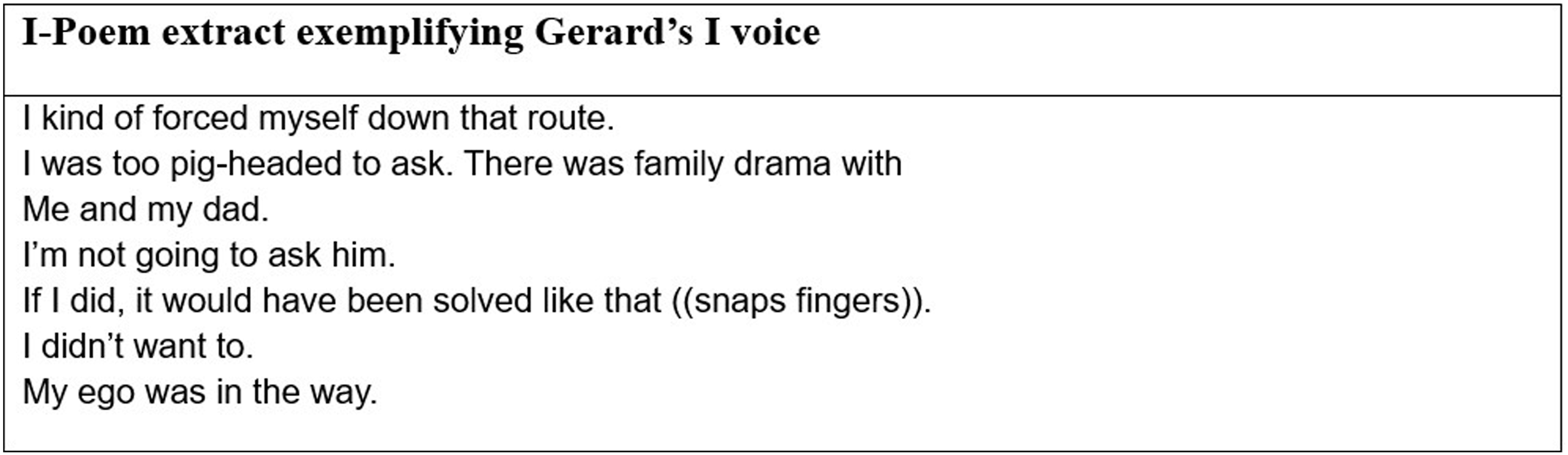
Brown (2018) stresses the importance of identifying ‘other self’ dialogues in transcripts, as participants may shift between the ‘I’ and other pronouns. For example, the author notes that men in her study used ‘I’ less freely than women, complicating identification of the self-voice when men discussed their lived experiences (Brown, 2018).
Similarly, an awareness of local grammar is useful. For example, in the Northeast of England, it is common for participants to say ‘iz’ (pronounced ‘iz’ or ‘us’) rather than ‘me’, which reflects a common feature of spoken Geordie idiom. Figure 3 shows an I-poem that captures a Geordie participant’s mixed use of singular and plural pronouns when discussing how her colleagues talk about her payday loan usage. An I-poem illustrating a participant’s mixed use of singular and plural pronoun forms.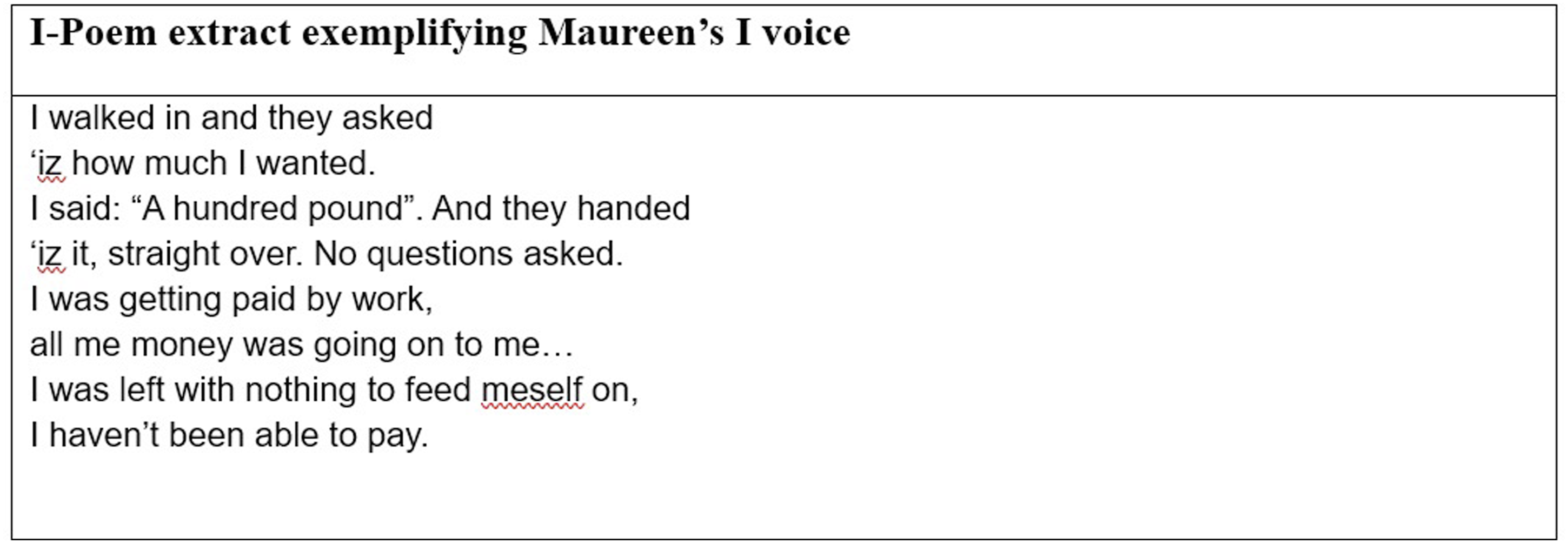
A key aspect of constructing I-poems is deciding how to edit pronoun sentences to clarify participants’ intended meanings. We argue that leaving pronoun sentences as intact as possible helps capture the nuances of participants’ experiences, even if this makes the poems look less tidy than a pure I-poem. This is not to suggest that this is a straightforward data management process. Rather, many exploratory, creative manoeuvres must be made at this point, paying attention to evocative power and the poetic form that the researcher-poet and the participant wish to convey.
As a bricoleur (Denzin and Lincoln, 2008; Lévi-Strauss, 1966), the researcher-poet should consider and justify what works best for their research. By the end of this process, the researcher-poet should have a document featuring lines about the participant’s self, usually in the order presented in the transcript. The remaining data is then scrutinised to delete plot-hindering text or excessive repetition, where appropriate.
Combining diverse pronouns to develop pronoun-poetry
Both ‘I’ and ‘They’ statements are “powerful speech acts embedded in everyday talk” (Parsons and Pettinger, 2017: 173), which help researchers explore phenomenological intersubjectivities in participants’ lived experiences. By contrasting the ‘I’ with other pronouns, it is possible to illuminate differences in perspectives, interconnections between an individual and others (e.g., interconnections with friends, family and colleagues through ‘We’, ‘Us/Our’, ‘He/Him’, ‘She/Her’, ‘They/Them’ pronouns), how individuals understand and interact with others in the socio-cultural context involving consumption and the power issues that emerge within the marketplace (see for example Parsons et al., 2023).
Brown et al. (2021) used pronoun-poetry to explore indebted consumer’s lived experiences with payday loans. During the interviews, the researchers uncovered a thread of self-blame. To reflect this emotion and capture the self-givenness and first-personal givenness of participants’ experiences (Gallagher, 2025), the team created I-poems. They also noted that participants discussed blame in relation to the lender, prompting the purposive introduction of a distancing ‘They’ pronoun as well as the ‘I’ pronoun. ‘They’ was the term participants used for lenders, as Figure 4 exemplifies. Combining I- and They-pronouns (from Brown et al., 2021: 527).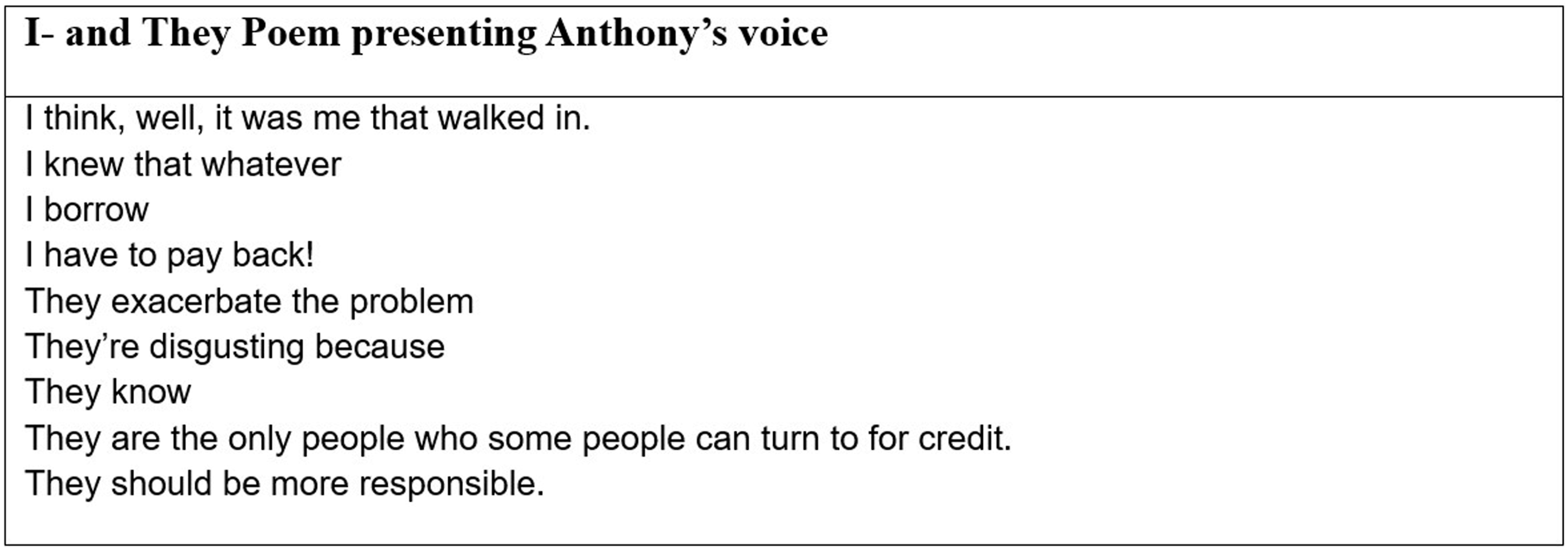
This comparison of ‘I’ and ‘They’ pronouns enabled Brown et al. (2021) to hear participants’ internalised perspectives through the use of ‘I’ (self), and to listen to their external, relational perspectives through the use of ‘They’ (other). This approach united VCRM stages of reading for the ‘I’ voice and reading for interpersonal relationships (Mauthner and Doucet, 1998). Often, ‘I’ and ‘They’ were both used by participants, almost in the same breath, when discussing blame and offering a point of entry into the inner world of a person (Gilligan et al., 2003). Frequently, lenders were referred to as ‘They’, representing an authority figure rather than being named. This significant finding drew attention to how this disembodied character influenced participants’ lives, reflecting complex intersubjectivities and power dynamics in the context of consumers’ personal financial indebtedness.
In Brown et al.’s (2021) study, the use of two pronouns revealed that blame was dynamic and bi-directional, directed at both the borrower (‘I’, self-blame) and the lender (‘they’, other-blame). This ongoing blame made it difficult for borrowers to learn from their experiences, increasing the likelihood of repeating risky borrowing practices. This dynamic, bi-directional blame, also revealed how consumers internalise responsibility for neoliberal marketing practices that should be regulated more aptly to prevent consumer harm. By progressing an understanding of blame, the findings illuminated a type of dynamics of consumer responsibilisation that is transferable to various consumer research contexts.
Further intersections: Creating pronoun-emotion poems
When using an interview technique appropriate for eliciting lived experiences, such as in-depth interviews, discussions are often ‘I’ oriented, generating reflective conversations about participants’ feelings especially if the research topic is sensitive. Following the analytical process for selecting pronouns and poem form for a particular project, we suggest applying additional concept filters to create further variations in pronoun-poetry.
For example, it is possible to focus on the highly emotive aspects of an interview, or specific emotions as they unfold, such as anger, annoyance, happiness, or contentment, to develop what we term pronoun-emotion poems. Figure 5 shows a poem developed by creating an I-poem and then focusing on how debt affected a participant’s physical and mental health. In reading for the voice of ‘I', Maureen uses ‘I’ and ‘You’ pronouns to discuss her own lived experience, swapping to ‘you’ in a dissociative act to illustrate painful feelings of anxiety, loneliness and isolation. An Emotive-Pronoun-Poem focusing on the ‘I’ voice, intersected with the physical and mental health effects of debt.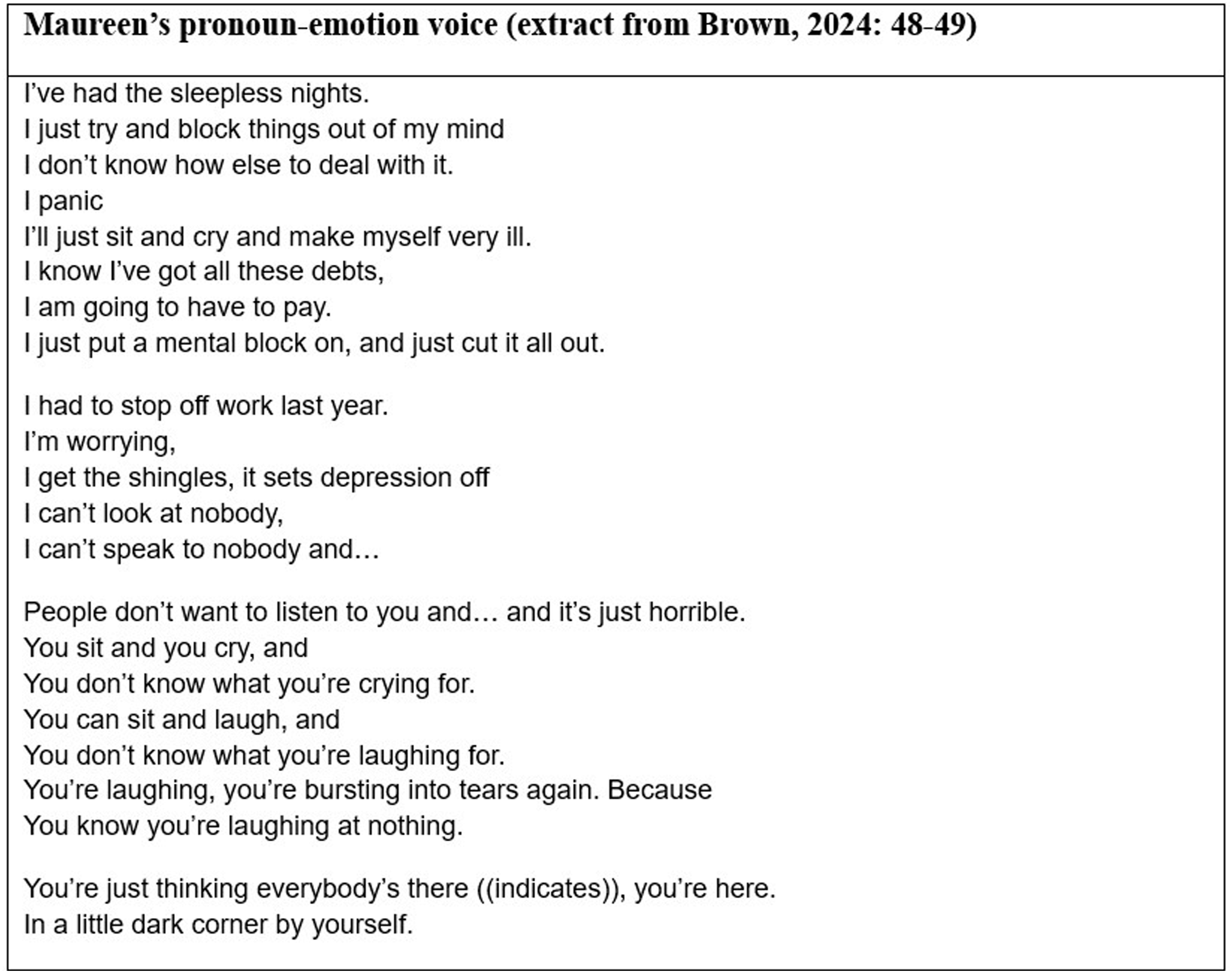
These pronoun filtering strategies help researchers focus on the intersection of pronouns and emotions. In the lead author’s research (Brown et al., 2021), emotions were a key theme throughout the interviews and resulting poems. She identified emotive language and its implications, highlighting particular emotions as sensitising concepts. However, in that article, the poems had not yet been conceptualised as pronoun-emotion poems, which is what we do here.
For example, for participants like Annie (Figure 6), whose responses were more factual than emotional, the poem initially seemed emotionally ‘dry’. In this instance, the lead author re-read her full transcript to better hear the emotive language. This process revealed nearly 50 emotive sentences in Annie’s transcript, despite her I-poem expressing fewer emotions than others. When intersected with emotions, the internalised perspective of the pronoun-poem can still be felt, but this perspective would likely have been missed by the researcher-poet if she had searched for or focused on pronouns alone. The process involved in identifying Annie’s emotive sentences. Note: extracts are shown in Figure 6 with the transcript sentence numbering alongside sentences for comparison.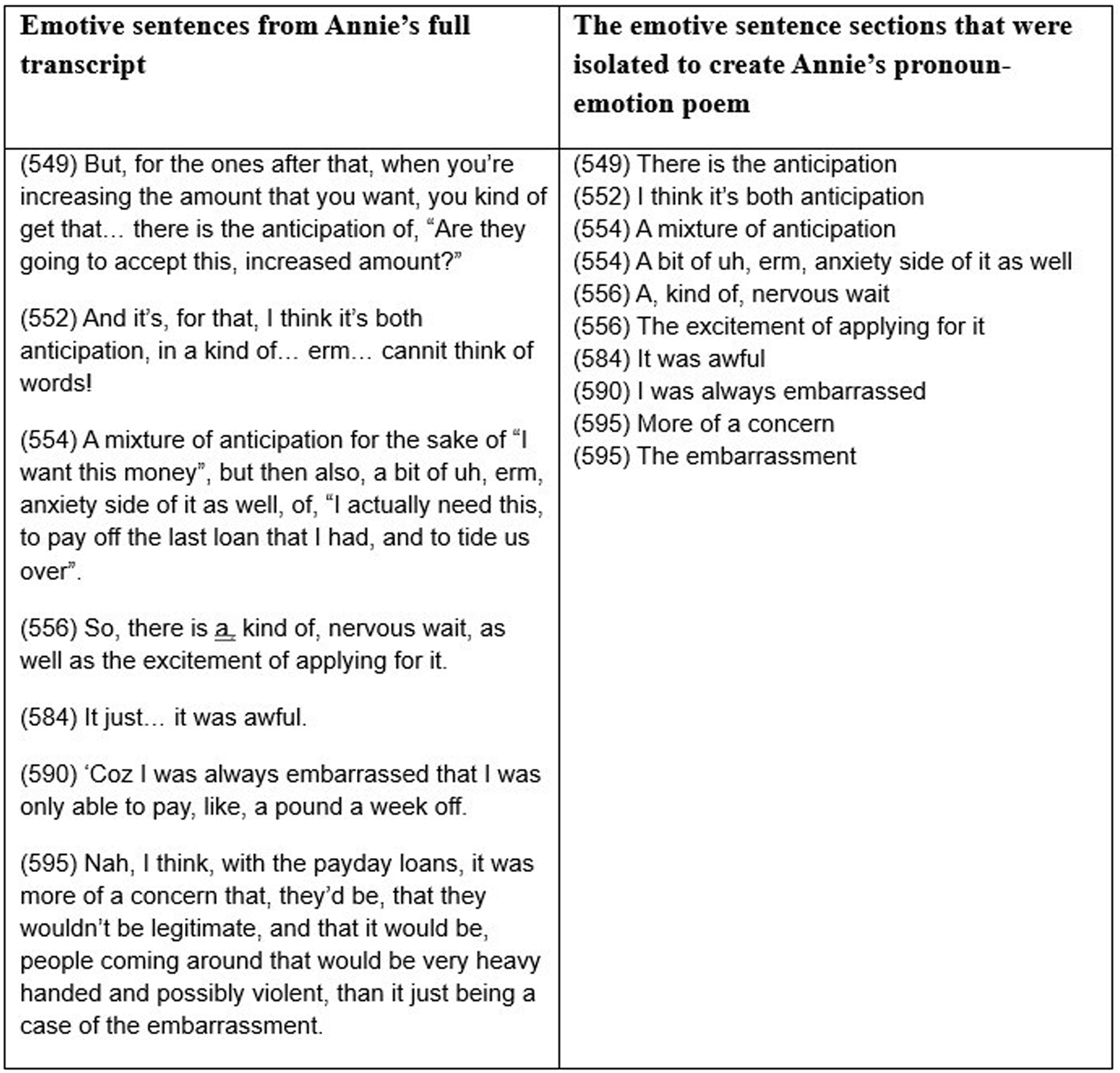
As Figure 6 shows, relevant sections from Annie’s full transcript were selected to evoke affective intensities (e.g., anticipation, anxiety, nervousness, excitement, awfulness, concern, and embarrassment) through her pronoun-emotion poem. This process has a poetic element, but also acknowledges emotive words that support poem analysis, sensitising the researcher to participants’ socio-affective experiences.
In Annie’s pronoun-emotion poem, excitement and anticipation at loan approval, followed by embarrassment and concern at repayment, map closely onto the classic ‘pain of paying’ framework (Zellermayer, 1996). In this example, we show that spending triggers an intrinsic negative affect: people feel a psychological ‘pain’ when giving up money (Zellermayer, 1996). Initial borrowing (loan approval) engenders positive arousal (the pleasure of new funds), while subsequent repayment revives that original pain as a salient loss. In fact, consumers often temporally decouple these affects (Relja et al., 2025): they enjoy the immediate gratification of credit (hence feeling excitement at approval) and defer the ‘pain’ until later. Relja et al. (2025) find that, in Buy-Now-Pay-Later schemes, the pleasure of instant consumption is often separated from the discomfort of eventual payment. This finding mirrors Annie’s emotive voice in her pronoun-emotion poem: the thrill of obtaining credit is followed by the anxiety of repayment.
It is important to note that intersecting pronouns with emotions to create pronoun-emotion poems requires full pronoun-poems, as more detail about participants’ feelings and context is needed than can be conveyed through sparse forms. These could then be edited down creatively, depending on what the researcher-poet sees in front of them. Some poems will need to be fuller for context and subsequent analysis, whereas others will be suitable for the sparse form where the more traditional I-poem analysis approach can be employed.
Potential points of analysis
We suggest that pronoun-poetry allows for multiple analyses of small or moderately sized datasets, yielding depth of insight through extensive layers of interpretive analysis. This process enriches the dataset by producing poems that capture consumer voices creatively and experimentally but also rigorously. Figure 7 outlines our vision for this process, including several options for analysis points. Dataset types, compatible analytical approaches, and potential points of analysis.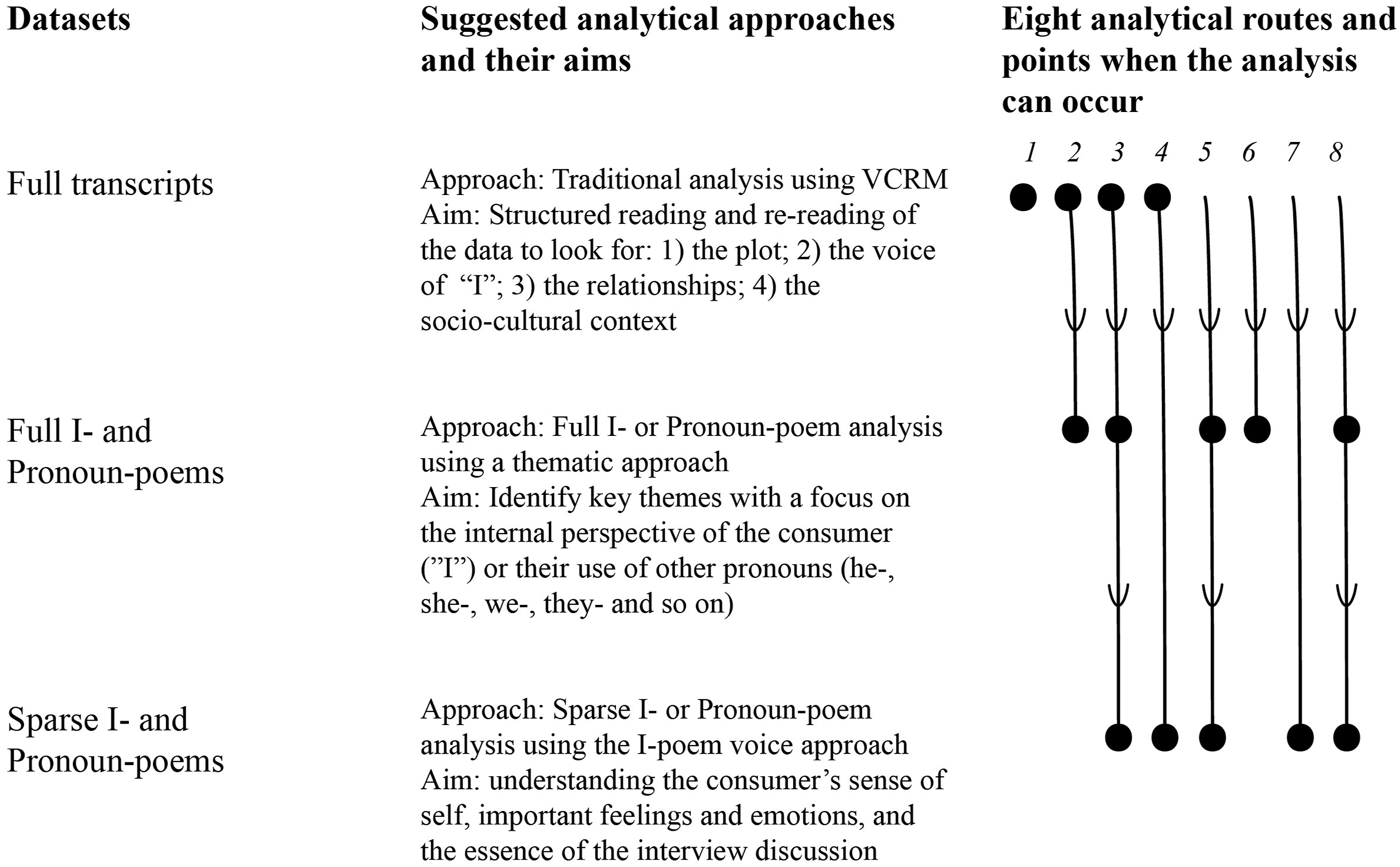
As Figure 7 illustrates, route 1 begins with the transcript(s) as the initial analysis point, which is common in qualitative research. However, with pronoun-poetry, we propose multiple analysis routes for the datasets created by the various forms of poems (see routes 2-8 in Figure 7). For example, a transcript can be analysed thematically, and once full I-poems are created, they can also be analysed thematically in their own right, acknowledging that the resulting themes are intrinsically linked to the internal perspective of participants (route 2). Similarly, researchers can analyse a transcript thematically and then develop a sparse I-poem, which can be analysed using the I-poem voice approach (route 4). This method gives the researcher-poet freedom to choose which aspects of the data to analyse and how to approach the various datasets.
In Figure 7, we suggest analytical approaches that have been effective for us and others, such as the I-poem Voice Approach for analysing sparse poems (Edwards and Weller, 2012). However, these approaches are not exhaustive, and we encourage researchers to explore various qualitative data analysis methods to find the best suited to their research questions and datasets.
Discussion
Pronoun-poetry offers a distinctive extension of participant-voiced poetic methods by drawing directly on pronoun-led lines from interview transcripts to create evocative, artful representations of, and ethical engagement with, participants’ narratives. By foregrounding the relational textures of lived experience and the affective intensities that shape participants’ inner worlds, this method enables researchers to surface dynamics that are often difficult to capture through conventional analytic techniques. In doing so, pronoun-poetry provides a participant-centred means of illuminating phenomenological experiences of vulnerability and relational complexity, allowing these to be communicated in ways that resonate emotionally as well as analytically. This method therefore supports a more empathetic and nuanced understanding of participants’ lives, offering an evocative route for unpacking relational dynamics and deepening insight into the conditions and vulnerabilities that structure everyday experience.
In this work, we develop pronoun-poetry practice by proposing a vision for pronoun-poetry, arguing for the intentional and purposive use of ‘I’, ‘You’, ‘We’, and other pronouns as well as further intersections to pronoun-poetry, for example, what we term pronoun-emotion poems. This is to create specific focal points that can help researcher-poets listen more clearly, closely and intimately to potentially hidden, evocative and intersubjective layers in any text-based data. By treating pronouns and/or pronoun plus intersections as the heart of a poem, researcher-poets can hear the details of consumers’ lived experiences more viscerally (and uniquely) than might be possible through traditional qualitative analyses of whole transcript data. For us, the poetic form pushes our analysis and understanding in unanticipated ways and is evocative precisely because it is close to participants’ own voices; because it shuts out language that participants use to mask or sooth difficult-to-bear feelings, emotions and precarious social circumstances that are a challenge to grasp in any other way. This is what makes pronoun-poetry richer, deeper and more powerful than any mode of thematic analysis.
Our vision for the purposive use of pronouns in poetic enquiry and for further intersecting pronoun poetry with emotions through pronoun-emotion poetry is to capture the essence of that which might otherwise go unheard or overlooked in the middle of complex, lengthy and emotive research conversations with participants. Pronoun-poems can be constructed and presented in a variety of ways and our humble intention is to provide only a few worked examples – or a small glimpse into – how this poetic enquiry can be developed further, which hopefully will entice the reader’s imagination and willingness to ‘play’ with this method.
Further, our vision for pronoun-poetry, especially pronoun-emotion poetic forms, is for it to enable a renewed grasp of existing poetic works in the field. Pronoun-poetry offers us the possibility to see existing consumer research works under a new light, providing a refreshing way to represent lived experience, while enabling an intentional, purposive acknowledgement of pronouns as entry points into nuanced layers of intense socio-affectivities.
For example, in considering the stories of migrants from Latin America who live in Belgium, Rojas-Gaviria (2016: 83) “draws the reader’s attention to how certain experiences of consumption, which occur in special micro-places, during exceptional times, play an essential role in the processes of shaping a unique family history in a world of strangers”. If we consider the participants’ quotes within the paper with an explicit focus on personal pronouns, notions of migrants’ agency (“I can go”, “I could”), their frustrations (“I could not”, “I cannot do”), the erasure of identity (“My house does not have anything [national], nor one flag, nor a silleta”, “My house is neutral”), efforts to remember past identity and/or build new identities (“I can remember”, “I read the Argentinian press”, “We know more [about home] than when we lived there”, “I want him to feel Belgian”), and the barriers participants face around belonging in wider society (“They will never see me as Belgian”, “I am different”, “I have an accent”) emerge.
These voices evoke clear tensions in negotiating presence and absence, with identity and belonging struggles that are both intimate and relationally positioned within a socio-cultural context. In addition to the original narrative, where freedom is spoken of through metaphors and transformations, the foregrounding of voices through a pronoun-poem highlights how each ‘I’, ‘they’, or ‘my’ carves out personal, emotive possibilities or social restrictions. In this reworked example, these pronoun snapshots enable researcher-poets to more sharply attend to the rhythms of agency and structure, as well as those of resistance and belonging as embedded in migrants’ experiences. It is important to note that we only looked at quotes available in the paper, rather than a full dataset.
Likewise, Lahman et al. (2019: 216) blend poetic aesthetics with social scientific inquiry so that the final text feels poem-like or “poemish”. By focusing on the pronouns in their researcher poetry and practicing poet examples, one can highlight how each ‘I’, ‘you’, or ‘we’ carries intention; marking a speaker’s agency, drawing in a reader’s perspective or building an evocative shared narrative. In following the pronoun-poetry ‘spirit’ for identifying and listening carefully to key pronoun moments in research data, researcher-poets can listen to what participants do in context, shape short poetic stanzas and open up fresh ways to present, understand, and theorise consumers’ lived experiences.
An additional aspect of our vision for pronoun-poetry is that it can help researcher-poets challenge established norms in consumer research. It moves our thinking and affectivities beyond dominant ways of understanding and representing (Brown and Wijland, 2015; Canniford, 2012; Rojas-Gaviria, 2021), towards more empathetic, delicate, and uncertain understandings of affective intensities and even the unfathomable. This is possible because pronoun-poetry stays true to the participant’s words (and embodied worlds), while offering researcher-poets the artistic licence and space for fragile experimentation (and failure) with poetic styles and form. Pronoun-poetry retains key elements of creativity and vulnerability, balancing the fragility of the creative process with the rigour of qualitative research. Thus, pronoun-poetry offers a form of insight that no other qualitative technique can: by holding creativity and rigour in productive tension, it reveals relational and affective dimensions of phenomenological experience that remain inaccessible through more conventional analytic approaches or other forms of poetry which do not attend as purposefully as pronoun-poetry to the bridging of, and tensions between, pre-reflective and reflective self-consciousness (Gallagher, 2025), and to relational intersubjectivities as they emerge.
At the same time, pronoun-poems also present challenges for qualitative research. The method demands considerable effort and artistic judgement within structured parameters. Researcher-poets must interpret and represent participant’s words with confidence and honesty. Acceptance of this method in marketing journals may be difficult, as alternative approaches still face resistance (Hackley, 2016; Petrescu and Lauer, 2017; Pradhan et al., 2024). Yet, through a systematic process of developing, interpreting, and checking the poems with participants, it is possible to address some of the criticisms directed at alternative methodologies. This is not to suggest that poetic inquiry only works when adjusted to more well-established methodological approaches in consumer research. Rather, much like Lahman et al. (2019), we kindly (and reluctantly) acknowledge that, in our field, researcher-poets are still judged more by research quality criteria such as transparency, credibility and honest representation (to name a few) than by literary prowess.
Pratt et al. (2020) advocate for an inductive approach to transparency, which they claim is closely linked to trustworthiness. While this approach suits pronoun-poetry, it may require adaptation for sensitive research contexts. For instance, researcher-poets must protect participants’ circumstances (even when anonymised), ensure interview protocols are flexible and sensitive to vulnerabilities, and account for the poetic development process.
Thus, transparency is indeed crucial for demonstrating quality and trustworthiness in qualitative research (Lincoln and Guba, 1985), and pronoun-poetry can offer it. However, it requires researcher-poets to trace their unique pathways through the data (Grodal et al., 2021), including their analytical and representational process (Golden-Biddle and Locke, 2006), and their reflexive approach to “what I did, how I did it, why I did it” (Tuval-Mashiach, 2017: 126) to achieve rigour.
Ultimately, pronoun-poetry can foster a more participatory approach in consumer research, allowing participants to guide and influence the analytical process and outcomes. This is important for preventing power imbalances in the relationships between researcher-poets and participants. Additionally, many leading journals still require large qualitative datasets to demonstrate rigour (Pradhan et al., 2024). Our vision of multiple analytic entry points for pronoun-poetry emerging from small or moderately sized datasets enables additional layers of interpretive analysis and consequently an extension of the dataset, in line with Rojas-Gaviria’s (2016) argument.
We show the power of pronoun poetry by offering reinvigorated ways of ‘hearing’ the consumer’s voice in nuanced and relational ways that are at once tentative and rigorous, fragile and robust. This vision extends the foreground/background metaphor in Thompson et al.’s (1989) work, where researchers consider the entire dataset and interpret which elements sit in the foreground, middle ground or background of a consumer’s viewpoint. For example, the full pronoun-poem emphasises the middle ground, incorporating the participant’s voice along with context and narrative details, while sparse pronoun-poems draw attention towards the foreground, amplifying the centrality of a participant’s voice.
Furthermore, in our vision, we extend the ways that VCRM itself can be used as a springboard to gain new insights into consumers’ lived experiences. In doing so, we extend Hutton and Lystor’s (2021) contribution by advancing VCRM beyond its original focus on listening for multiple voices, showing how pronoun-poetry can enhance and expand each reading stage to surface new relational and socio-cultural insights. In our vision, we offer varied ways to design I-poems for different analytical purposes. While these are traditionally developed through the second VCRM reading stage, we also encourage the use of other pronouns and pronoun intersections to ‘see’ consumers’ self, relationalities and socio-cultural situatedness in new ways and ‘in emergence’. By cross-referencing pronouns and creating further intersections with heightened emotions and even additional concepts, different insights can be gained in a joined-up manner.
For example, additional concepts that could be intersected with pronouns for the creation of pronoun-concept-poetry in research on personal finance include agency, risk, empowerment, time, morality, perceived deviance and even marketing-specific concepts such a particular brand, product, or service experience. For instance, a brand-I-poem could be created to better hear how a participant understands their personal relationship with a particular named brand. Alternatively, a risk-we-poem could amplify voices on how indebted couples weigh up risk in their joint financial decision-making process.
On reflection, by purposefully extending pronoun-poems in these ways, we have developed an innovative means to represent the third and fourth VCRM reading stages, which look to unpack the participant’s relationships with others and broader socio-cultural phenomena. As an extension of the VCRM readings, we propose that additional, purposive poetic assemblages can be created (see Figure 8). A vision for developing VCR poetry in consumer research.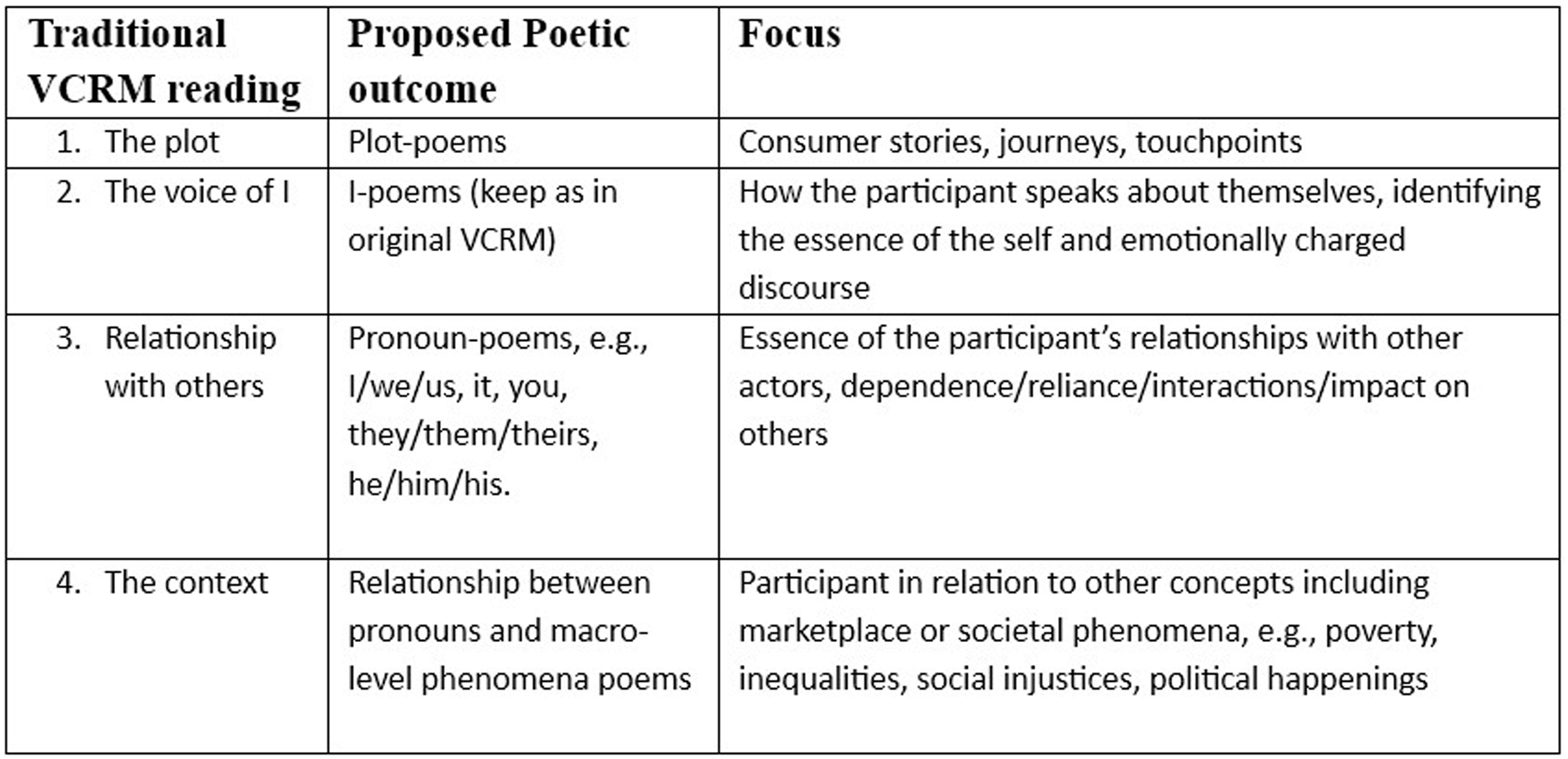
For example, reading one could be used to develop plot-poems apt at highlighting consumer journeys around, say, particular service ecosystems. Similarly, the focus of reading four is the wider context of the interview conversations with research participants. Therefore, the researcher-poet can identify the lines in a transcribed discussion that focus on the socio-cultural context, to foreground those aspects of the discussion and really lean into hearing their most evocative aspects. Together, these additional, interrelated layers of pronoun-poetry-making informed by VCRM are what we term Voice-Centred Relational (VCR) Poetry.
Voice-Centred Relational (VCR) Poetry is an innovative extension of VCRM, which connects the micro (the ‘I’), the meso (the ‘us’) and the macro (socio-cultural context or phenomena), offering researcher-poets infinite possibilities for exploring, creating, listening to, and thinking and feeling with consumers in the fragile process of gaining alternative understandings in consumer research. It offers a process and representational mode for evocative, vulnerable and empathetic discovery in future research, which can bring novel insights into existing or new research topics. These poems can be further intersected with additional concepts as proposed earlier, to reveal more specific insights, for example, poverty-we-poems, savings-I-poems, emotive-brand-poems, to name a few of the possibilities depending on the research question and the availability of transcript data to support it.
Conclusion
This work develops a vision for the purposive use of pronoun-poetry in qualitative consumer research, which is informed by VCRM. We contribute to advancing alternative methods in qualitative consumer research in three main ways.
First, we further develop the practice of pronoun-poetry by highlighting its alignment with phenomenological perspectives, building on established I-poem literature and clarifying a few of the diverse ways that I-poems can be creatively constructed from transcript sentences. In doing so, we demonstrate full and sparse variants and propose where analysis points can happen within the process. This contribution matters because specific types of pronoun-poetry offer qualitative researcher-poets distinct benefits, including revealing different facets of the data (Coffey and Atkinson, 1996). By creating a poem from a transcript, researcher-poets become close to the data and capable of listening clearly to the voice(s) of the participant, whether that be through the essence of the voice as espoused by a sparse form or with contextual cues through a full form poem.
While traditional qualitative approaches suggest familiarity with transcripts though repeated reading to strengthen the analytical procedure, the hands-on process of constructing pronoun-poetry fosters a deep connection with the data. Reflective engagement with the data enhances interpretation, helping researcher-poets identify noteworthy themes, underlying voices and emotionality. Indeed, the method allows researcher-poets to focus on the nuances of individual voices within the transcript, reducing the ‘noise’ found in other approaches, making large datasets more manageable and allowing for exploration and fragility in the pronoun-poetry crafting process.
Importantly, pronoun-poetry introduces creativity in representing qualitative data, as LeCompte (2000) and Eakin and Gladstone (2020) advocate, without requiring advanced literary skills from participants or researcher-poets. Although ‘creativity’ may raise concerns among positivist-leaning researchers, it is important to recognise that the method is indeed grounded in a robust process that centres the analysis on participants’ voices and socio-cultural contexts.
Using participants’ existing words to create poems offers a non-intrusive, alternative way to develop creative artefacts, unlike photos or collages, which may feel overwhelming or burdensome for participants who may lack confidence or time to create such outputs. Using the existing transcript to craft a poem offers an accessible way to co-generate data, minimising the need for artistic skills (Brown and Farquhar, 2024).
A second contribution of this work is that it unpacks a few of the many ways that different pronouns can be combined to develop original pronoun-poetry, for example, by bringing I- and They-pronouns together, which can help illuminate relational encounters, experiential tensions, as well as the agency and power dynamics that participants experience in the marketplace.
The benefits of pronoun-poetry for generating novel insight in consumer research are becoming clear, as scholars increasingly adopt and refine the method. However, researcher-poets must acknowledge existing protocols for constructing pronoun-poetry from data (rather than based on data) and understand how arguments for advancing theory may be supported through this method without losing site of the necessary experimentation, originality, creativity and fragility involved in any poetic inquiry.
In this work, we also establish that pronouns can be further intersected with other concepts including (but not limited to) emotions and feelings, to create pronoun-emotion poems, which can amplify specific insights emerging from the data and illuminate various aspects of consumers’ socio-affective experiences in consumer culture. Using the example of combining emotions and the ‘I’ pronoun, an I-pronoun-emotion poem can help researcher-poets listen more closely to how socio-affective experiences impact introverted self-discussions, as demonstrated in Figure 6.
This second contribution is significant in that it enables feelings and emotions, and their interconnections with market-mediated culture, to be sensitively foregrounded rather than elided or objectified as ‘things that can be measured’. Thus, the method generates novel insights and modes of representation that progress alternative ways of knowing. It can help generate insights that are ‘pro-consumers’ rather than pro-business, helping understand people outside privileged groups in their own terms and amplifying the plurality of methodological perspectives that are seen as valuable and valid in consumer research.
Finally, this work also contributes to advancing alternative methods in qualitative consumer research by reinvigorating VCRM. It does so by establishing what we term Voice-Centred Relational Poetry (VCRP), which is a vision for the purposive use of pronoun-poetry in qualitative consumer research. In this work, we extend VCRM through pronoun-poem creation across all its reading stages. Similar to the second VCRM stage of reading for the voice of ‘I’, creating pronoun-poems in relation to the focal points of the other reading stages will allow researcher-poets to read, listen to, and represent consumer voices on a range of topics in an artful, original and engaging way; in a way that foregrounds, middle-grounds and backgrounds other elements of participants’ discussions to help amplify, empathetically, specific aspects and voices from within transcripts.
This third set of contributions is significant in progressing alternative methods through creative experimentation and originality, counterbalancing existing hierarchies of knowledge (Hutton and Cappellini, 2022; Kravets and Varman, 2022), and generating novel, co-created insights and modes of representation about consumers’ socio-affective experiences and power struggles in the marketplace. By grounding analysis in participants’ own pronoun-led expressions, pronoun-poetry redistributes epistemic authority and challenges researcher-centred interpretations. In doing so, it disrupts established hierarchies of knowledge by positioning participants’ lived, relational, and affective insights at the centre of epistemic work.
We hope this paper inspires researcher-poets to use pronoun-poetry to gain deeper insights into the complexities of our social worlds, and to understand how consumers relate to each other and to the marketplace. By extending established I-poem conversations into pronoun-poetry and VCRP in particular, we demonstrate creative options that researcher-poets can further develop to unpack previously unheard voices and deeply affective experiences, including their relational dynamics and issues of consumer agency within marketplace structures. In this way, pronoun-poetry serves as a valuable analytical and representational method which is both creative and rigorous, and which can progress future consumer research.
Footnotes

Ethical consideration
This research received ethical approval from the lead author’s institution.
Consent to participate
All research participants received participant information sheets and signed informed consent statements.
Author contributions
The data for this manuscript were collected as part of the first author’s PhD research. The first author was fully involved in research design, data collection, data analysis, literature review, theorisation, manuscript preparation, write up and all revisions. The second author was fully involved in the literature review, theorisation, manuscript preparation, write up, and all revisions. The third author was involved in manuscript preparation.
Funding
The authors received no financial support for the research, authorship, and/or publication of this article.
Declaration of conflicting interests
The authors declared no potential conflicts of interest with respect to the research, authorship, and/or publication of this article.