




Abstract
Prioritarianism is a moral view that ranks outcomes according to the sum of a strictly increasing and strictly concave transformation of individual well-being. Prioritarianism is ‘welfarist’ (namely, it satisfies axioms of Pareto Indifference, Strong Pareto, and Anonymity) as well as satisfying three further axioms: Pigou–Dalton (formalizing the property of giving greater weight to those who are worse off), Separability, and Continuity. Philosophical discussion of prioritarianism was galvanized by Derek Parfit’s 1991 Lindley Lecture. Since then, and notwithstanding Parfit’s support, a variety of criticisms of prioritarianism have been advanced: by utilitarians (such as John Broome and Hilary Greaves), egalitarians (such as Lara Buchak; Michael Otsuka and Alex Voorhoeve; Ingmar Persson; and Larry Temkin), and sufficientists (Roger Crisp).
In previous work, we have each endorsed prioritarianism. This article sets forth a renewed defense, in the light of the accumulated criticisms. We clarify the concept of a prioritarian moral view (here addressing work by David McCarthy), discuss the application of prioritarianism under uncertainty (herein of ‘ex post’ and ‘ex ante’ prioritarianism), distinguish between person-affecting and impersonal justifications, and provide a person-affecting case for prioritarianism. We then describe the various challenges mounted against prioritarianism – utilitarian, egalitarian, and sufficientist – and seek to counter each of them.
Keywords
Introduction
Prioritarianism has been energetically defended but also strongly criticized, especially in recent years. Here, we review and address the major criticisms. 1
Our focus is outcome prioritarianism: prioritarianism as a rule that, for any given set of outcomes, generates a moral ranking of the outcomes, comparing them to each other as morally better, worse, or equally good. Prioritarianism thus understood can be embedded in various moral views such as act consequentialism, rule consequentialism, or hybrid views that mix considerations of good consequences with deontological constraints. Each such view gives some moral role to the outcome ranking. We take no position here on what exactly that role is and instead train our attention on those critics who accept that the outcome ranking has some moral role, but deny that this ranking is prioritarian. 2
The prioritarian outcome ranking, as we’ll see, is welfarist. 3 So it can be faulted in two ways: by (1) denying welfarism or (2) accepting welfarism (wholeheartedly or at least arguendo), but disputing the prioritarian version of welfarism. The first type of criticism is – to be sure – a criticism of prioritarianism, but it is undifferentiated. It is equally well a challenge to competing welfarist rules for the outcome ranking, such as utilitarianism, egalitarian welfarism, sufficientism, or leximin. The critical literature regarding prioritarianism, over the last two decades, has offered challenges of the second type: challenges that seek to undercut prioritarianism as opposed to some competing welfarist outcome-ranking rule. 4 Our effort, here, will be to describe and counter this second type of challenge.
A welfarist might justify her particular outcome-ranking rule in two different ways: either in a person-affecting fashion or in a non-person-affecting fashion (for short, ‘impersonal’ fashion). The distinction between these approaches to justification is a significant theme in the philosophical literature. We endorse prioritarianism on person-affecting grounds.
The article is organized as follows. The first part lays out the key concepts that will structure our analysis (welfarism, prioritarianism, the difference between person-affecting and impersonal justifications), summarizes the person-affecting case for prioritarianism, and reviews the application of the prioritarian outcome-ranking rule under uncertainty. The major critics of prioritarianism have either been utilitarians (covered in the second part of the article) or egalitarians (the third part). The last part describes further criticisms.
Key concepts
Welfarism
We assume that the moral ranking of outcomes is transitive and complete. Larry Temkin (2012) has called into question transitivity, but the dominant approach in both philosophy and economics is to endorse it. Completeness is a simplifying premise. More plausibly, two outcomes can be incomparable with respect to moral betterness. However, the critics of prioritarianism haven’t specifically complained about its implications with respect to incomparability, and to simplify the analysis we assume completeness.
We assume a fixed population of individuals with at least one member. 5 How welfarism should be extended to a variable population is, of course, a topic of major importance. But most of the criticisms of prioritarianism have claimed that it fails even in the simpler, fixed-population case. So that’s what we’ll address here.
We assume that the members of the population are all human persons, as opposed to nonhuman animals that possess a well-being but are not persons; nonhuman animals (if there are any) that are persons; and humans who are not persons or are at the margins of personhood. How welfarism and, specifically, prioritarianism should be extended to reflect the interests of beings other than human persons is – again – a question of major importance (Holtug, 2007). But, once more, the criticisms of prioritarianism have generally claimed that it fails even as a framework for taking account of the interests of human persons. We aim here to rebut that criticism and leave for another day the topic of prioritarianism and other beings. We refer to members of the population as ‘persons’ or ‘individuals’, which is our shorthand for ‘human persons’. 6
Welfarism might be understood in lifetime terms, in sublifetime terms, or in a hybrid way. 7 It seems that many non-prioritarian welfarists take the lifetime approach – so utilitarians tend to be lifetime utilitarians, egalitarians are lifetime egalitarians, sufficientists are lifetime sufficientists, and so on. But this isn’t universally true. However, to keep the discussion tractable, we presuppose lifetime welfarism. 8
We assume that (lifetime) well-being is both interpersonally and intrapersonally comparable and measurable on a cardinal scale. 9 The measurability assumption is a simplification: it precludes any incompleteness in well-being comparisons. But this simplification has generally been adopted in the critical literature. 10
Many philosophers (including not only prioritarians but most critics of prioritarianism), and virtually all economists, endorse the Strong Pareto principle: if outcome x is better than outcome y for at least one person, and at least as good for everyone, x is morally better than y. 11
By ‘welfarism’, we mean the combination of the Strong Pareto principle with two additional principles: (1) Pareto Indifference: if each person is just as well off in x as in y, the two outcomes are equally good and (2) welfare anonymity (‘Anonymity’): if the pattern of well-being levels in x is a permutation of the pattern in y, the two outcomes are equally good. 12 An outcome ranking is ‘welfarist’, in our terminology, iff it satisfies the conjunction of Strong Pareto, Pareto Indifference, and Anonymity. Pareto Indifference expresses the thought that it takes a welfare difference to make a moral difference. Anonymity expresses, in welfare terms, the requirement that the outcome ranking be impartial. 13
Prioritarianism and alternatives
By ‘prioritarianism’, we mean the ranking of outcomes according to the sum of a strictly increasing and strictly concave transformation of individual well-being numbers. It is the ranking given by ∑g(wi ), with wi the well-being level of individual i and g(·) a strictly increasing and strictly concave function. Such a ranking is welfarist: it satisfies Strong Pareto, Pareto Indifference, and Anonymity. But it also conforms to three further axioms: the Pigou–Dalton principle, Person Separability (which we will generally refer to, simply, as ‘Separability’), and a technical axiom of Continuity. 14
Not only does the ranking by ∑g(wi ) satisfy the welfarist axioms plus the three further axioms of Pigou–Dalton, Separability, and Continuity. The converse is true: Any rule for ranking outcomes that satisfies all these axioms is identical (in the ranking produced) to the formula ∑g(wi ), for some strictly increasing and strictly concave function g(·). 16
Non-prioritarian versions of welfarism violate one or more of this trio of further axioms. The utilitarian moral ordering is the simple sum of well-being, ∑wi . This satisfies Separability and Continuity but not Pigou–Dalton.
Egalitarians believe that the relation between individual well-being levels, in each outcome – how each person would fare, relative to the others, were that outcome to obtain – has moral relevance with respect to the outcome ranking. Thus it is natural to suppose that egalitarian welfarists reject Separability. 17
Consider any two outcomes x and y. Let’s say that an ‘affected’ individual is one whose well-being level in x is not equal to her well-being level in y and that an ‘unaffected’ individual is one whose well-being levels in the two outcomes are the same. Let w 1, w 2,…, wM denote the well-being levels of the unaffected individuals (M in total). Now imagine two new outcomes, x′ and y′, identical, respectively, to x and y, except that the well-being levels of the unaffected individuals are w 1′, w 2′,…, wM ′, with w 1 ≠ w 1′, w 2 ≠ w 2′, and so forth (each unaffected individual is at a different well-being level in the second pair of outcomes than she is in the first). Separability requires that the second pair of outcomes be ranked the same way as the first. But note that the pairwise relations in x between the well-being level of each affected person and the well-being level of each unaffected person are different from those pairwise relations in x′. And the same is true of y as compared to y′. So it is very hard to see how an egalitarian would agree that the x/y ranking must be the same as the x′/y′ ranking.
We therefore assume that a rule for ranking outcomes is not egalitarian unless it violates Separability. This is not to say that every such rule is egalitarian. A rule is egalitarian if it ranks outcomes in a non-separable manner and prefers a more equal to a less equal distribution of well-being. How to make precise this latter condition is not critical, here. What matters, for our purposes, is that Separability cleaves between prioritarianism and egalitarian welfarism. The prioritarian outcome-ranking rule satisfies Separability, while an egalitarian rule does not.
Every other non-prioritarian rule will also violate one or more of the trio Pigou–Dalton, Separability, and Continuity. For example, sufficientism satisfies Separability but violates Pigou–Dalton and Continuity. Leximin satisfies Separability and Pigou–Dalton but violates Continuity.
Person-affecting and non-person-affecting justifications
A ‘justification’ for an outcome-ranking rule, as we use that term, is a defense of that rule – an argument in its favor. It purports to identify considerations that support the rule.
We’ll distinguish between person-affecting and non-person-affecting (impersonal) justifications. These differ structurally, in what they take to be the appropriate format for justification – in what they see as the considerations supporting the conclusion that one outcome is morally better than a second, and how they see these considerations as interacting to justify that conclusion.
A person-affecting justification is structured as follows. Consider any two outcomes, x and y. Recall that we are assuming a fixed population of individuals, N in total, N > 0. Each individual is better off in x than y, better off in y than x, or equally well off in the two outcomes. The fact that an individual is better off in x counts in favor of x being morally better than y – it is a factor that weighs in favor of that conclusion – while the fact that an individual is better off in y counts in favor of y being morally better than x. Assume that M individuals are better off in x than y, M* individuals better off in y than x, and M** equally well off. Then there are M considerations in favor of x, and M* in favor of y. If both M and M* are nonzero, then the M considerations in favor of x must be weighed against the M* in favor of y to determine the comparative moral goodness of x versus y. 18
In short, a person-affecting justification sees gains and losses to individuals as the sole grounding for the moral-betterness relation between pairs of outcomes. 19
We’ll define ‘impersonal’ by negation: a justification is ‘impersonal’ iff it is not person-affecting. Impersonal justifications are, therefore, heterogeneous in their structure: there are a variety of ways to defend an outcome ranking other than by appeal to individuals’ gains and losses.
Consider, by way of illustration, an impersonal justification for the utilitarian outcome-ranking rule that runs as follows. There is a single fundamental moral value, overall well-being. Outcomes are morally better to the extent they more fully realize this value. The measure of this value is ∑wi , the sum total of the numbers measuring individual well-being levels. Thus we have that x is better than y iff the sum total of the well-being numbers in x – the measure of the degree to which the value of overall well-being is realized in x – is greater than the sum total of the well-being numbers in y.
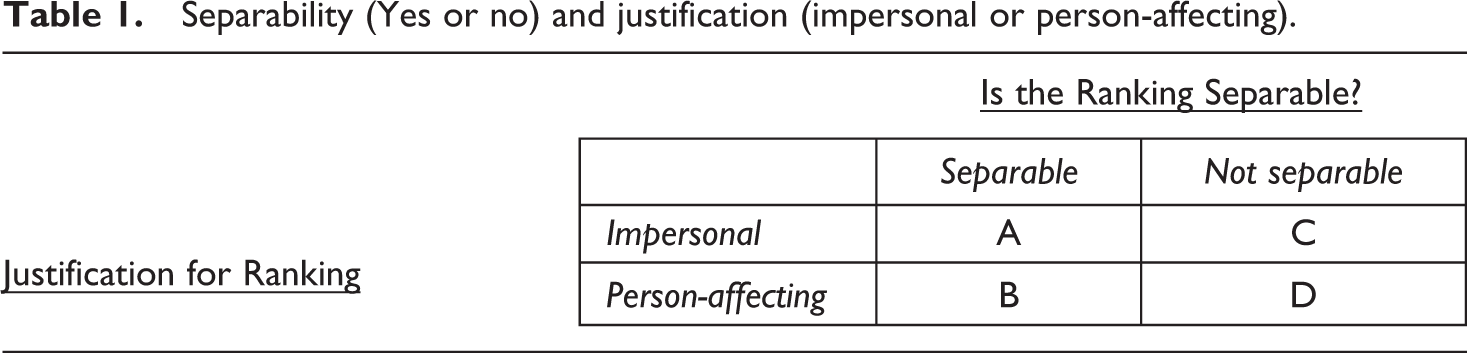
There is no logical connection between the mode of justification of an outcome ranking (person-affecting versus impersonal) and whether the ranking satisfies the Separability axiom. All four cells in the matrix in Table 1 are logically possible. The defense of utilitarianism put forward in the previous paragraph illustrates cell A: an impersonal justification for a separable ranking. The defense of prioritarianism that we will offer below is a person-affecting defense of a separable ranking (cell B). An egalitarian view that we’ll discuss below, Temkin-style egalitarian welfarism, sets forth an impersonal defense for a non-separable ranking (cell C).
Separability (Yes or no) and justification (impersonal or person-affecting).
Cell D is, at first glance, quite puzzling. How is it possible to argue that the only moral factors bearing upon the comparative moral goodness of two outcomes x and y are the losses and gains of affected individuals (the person-affecting mode of justification), and yet also to suppose that this ranking is not invariant to the well-being levels of unaffected persons (non-separability)?
The answer is that the weight of any individual’s gain or loss may be seen to depend, in part, on how her well-being level compares to others’. To illustrate, assume that the well-being levels of Abe, Betty, and Cam in x are (4, 10, 20), while their well-being levels in y are (6, 7, 20). So Abe is better off in y as compared to x, while Betty is worse off. Cam is unaffected. In assigning a moral weight to Abe’s well-being gain, the person-affecting egalitarian will take account of the relation between the well-being levels of Abe and others in the population (Betty and Cam), in each outcome. Similarly, in assigning a moral weight to Betty’s well-being loss, the person-affecting egalitarian will take account of the relation between the well-being levels of Betty and others in the population (Abe and Cam) in each outcome. Note that Cam’s well-being level is one of the relata in these comparisons, even though Cam is unaffected. Thus a change in that level can produce a change in the ranking of otherwise-identical outcomes, in violation of Separability. For example, consider x′ such that the well-being levels of Abe, Betty, and Cam are (4, 10, 1) and y′ such that their levels are (6, 7, 1). The person-affecting egalitarian might rank y better than x but x′ over y′. She reasons: Abe’s gain from 4 to 6 has extra moral weight when Abe is the worst off. So that gain outweighs Betty’s loss in the x/y comparison but not in the x′/y′ comparison – where it is now Cam who is worst off.
The existing literature often discusses the Person-Affecting Principle (PAP), a constraint on the ranking of outcomes. 20 What exactly is the connection between person-affecting justifications and the PAP?
Consider these two versions of the PAP. (1) All-things-considered PAP: Unless some person is better off in x than y, x is not all-things-considered morally better than y. (2) Pro tanto PAP: Unless some person is better off in x than y, x is not even pro tanto morally better than y – it is not better than y in any respect. 21
The all-things-considered PAP is implied by the Pareto principles 22 (the combination of Strong Pareto and Pareto Indifference). Anyone who embraces the Pareto principles must accept the all-things-considered PAP, whether she justifies her chosen outcome ranking in a person-affecting or impersonal manner.
The pro tanto PAP doesn’t follow from the Pareto principles. Temkin-style egalitarian welfarism (see ‘Egalitarian critiques of prioritarianism’ below) sees moral value in ‘levelling down’ and rejects the pro tanto PAP.
The person-affecting mode of justification is a sufficient condition for the pro tanto PAP. To endorse the person-affecting approach is just to endorse the following: the only fact about two outcomes, x and y, weighing in favor of the conclusion that x is morally better than y is the fact that some individual stands to benefit from x as compared to y. If someone is better off in x than y, x is pro tanto better than y. If some are better off in x than y, and others better off in y, then the all-things-considered moral comparison of the two outcomes depends upon the balance of these pro tanto considerations. If none are better off in x than y, then x is not even pro tanto (let alone all-things-considered) morally better than y.
However, the person-affecting mode of justification is not a necessary condition for the pro tanto PAP. Whether an impersonal framework of justification implies the pro tanto PAP depends upon the specifics of that framework: on the moral considerations that it recognizes, and how these considerations are structured. While Temkin-style egalitarian welfarism rejects the pro tanto PAP, the impersonal utilitarian view set forth earlier accepts it. The putative impersonal value, overall well-being, measured by ∑wi , depends upon individual well-being levels in a manner that implies the pro tanto PAP.
Person-affecting defense of the prioritarian rule
We find the person-affecting mode of justification to be very attractive, for the following reasons. (a) The person-affecting approach embodies a respect for the separateness of persons. 23 (b) It explains the justificatory primacy of the Strong Pareto principle. The Strong Pareto principle is not merely an axiom that an outcome-ranking rule happens to satisfy. Rather, it is a deliberative constraint on any proposed outcome-ranking rule. We (and many others, we think) take a violation of Strong Pareto as potent, indeed conclusive grounds for rejecting a proposed rule. The person-affecting account of justification implies this deliberative constraint; an impersonal approach does not. 24 (c) The person-affecting account shows a deep unity between two ethical ideas that many have separately asserted – namely efficiency (Strong Pareto) and equity (specifically in the form of Pigou–Dalton – see immediately below). In this way, it has much explanatory power with respect to the substantive content of morality. 25
To be sure, adopting the person-affecting justificatory framework does not itself make the case for prioritarianism, as opposed to utilitarianism, egalitarianism, sufficientism, leximin, or some other non-prioritarian outcome-ranking rule. There is no logical inconsistency in adopting that approach, yet rejecting any one of the three axioms that collectively define the prioritarian rule (Pigou–Dalton, Separability, and Continuity). However, if that framework is adopted, a strong case can be mounted for each of these principles – or so we believe. 26
The case for Pigou–Dalton is especially powerful. Imagine that two outcomes x and y are as supposed by the Pigou–Dalton principle. One individual (‘Lower’) is worse off than a second (‘Higher’) in outcome x, and either worse off than Higher or equally well off in outcome y; Lower is better off in y than x, by amount Δw, and Higher is worse off in y, by the very same amount; everyone else is unaffected. The Pigou–Dalton principle applies and requires that y be ranked better than x.
Consider how the y/x comparison looks from a person-affecting perspective. There is one pro tanto moral consideration in favor of y, namely that Lower is better off in y, and one pro tanto consideration in favor of x, namely that Higher is better off in x. What are the moral weights of these two, competing, considerations? (a) We might believe that the weight of an individual’s well-being gain is just a function of the size of the gain. If so, the weights are equal in the case at hand. But this approach seems both unfair to those who are worse off and quite extreme. 27 If I am worse off than you, then shouldn’t this fact about our well-being levels have some relevance, at least ceteris paribus, to the moral weighting of our gains and losses? (b) Alternatively, we might suppose that the individuals’ well-being levels and the magnitude of their gains both function to determine the weight of those gains. If so, we should conclude that y is better than x. This is true regardless of the precise manner in which levels and gains interact to determine the moral weight of gains. The magnitudes of the gains, here, are equal. So this factor drops away. All that is left to adjudicate between the two competing pro tanto considerations is the fact that Lower is worse off in at least one of the outcomes and no better off in either. That fact tips the balance to Lower – or so it is very plausible to think.
The case for Separability is also powerful. Earlier, we clarified that a person-affecting defense of a non-separable outcome-ranking rule is possible. Some are better off in y than x, others better off in x than y, and still others unaffected. It is possible that the moral weights of the well-being gains for the affected persons depend not only on (a) what each such person stands to gain and (b) her well-being levels in x and y, but also (c) how her well-being level in each outcome compares to the well-being levels of others in the population, unaffected as well as affected. 28
However, we see no affirmative reason to believe (c), and good reason not to do so.
Why not believe that the moral weight of a well-being gain is just a function of the individual’s well-being levels in the two outcomes, and what she gains? Why add (c) to the mix? Don’t make the mistake of thinking that only a non-separable outcome-ranking rule can embody a preference for equalizing well-being. This is not true. Any outcome-ranking rule that satisfies Pigou–Dalton, whether separable or non-separable, will prefer a perfectly equal distribution of well-being to an unequal distribution of the same total amount. So a moral preference for equalizing well-being is not a basis for believing (c). 29
Conversely, (c) has a seriously counterintuitive upshot. Assume that the only individuals affected by a pair of outcomes are ‘proximate’ to each other in some sense (be it spatially; or temporally, that is, the individuals exist during the same or close stretches of calendar time; or socially, that is, the individuals are part of the same society; or in some other sense). If Separability is rejected, then the comparative moral goodness of the outcomes will depend upon the well-being levels of everyone in the moral universe, however remote from the affected ones. 30 Imagine that the current city council of Eugene, Oregon is deciding whether to use public lands for a park (leading to the ‘park’ outcome) or a housing development (the ‘housing’ outcome). Whatever the precise impact of the park and housing outcomes on the residents of Eugene, which outcome obtains doesn’t affect (we can very plausibly assume) the well-being of the ancient Romans, of Californians who will exist in the 25th century, and of the current residents of Siberia. But, if the outcome ranking is non-separable, which outcome is morally better depends upon the well-being levels of the ancient Romans, the future Californians, and the Siberians. We find this very counterintuitive.
We also find Continuity to be intuitively attractive. Assume that x is morally better than y. Then M > 0 individuals are better off in x than y. Let M* ≥ 0 be the number of individuals who are worse off in x than y. On a person-affecting view, the cumulative moral weight of the gains to the M individuals (from x over y) is larger than the cumulative moral weight of the losses to the M* individuals. Continuity now says that this balance remains true for sufficiently small (perhaps very small) changes to the M gains and M* losses. This seems plausible to us.
Indeed, most philosophical critics of prioritarianism have not focused their challenge on Continuity. The main critics (see below) have either been utilitarians or egalitarians. Utilitarianism, too, satisfies Continuity. Egalitarian outcome-ranking rules (as we have defined them) do not necessarily satisfy Continuity, but they can. Indeed, the Gini rule, 31 the dominant formal statement of egalitarianism, satisfies Continuity. And egalitarian critics of prioritarianism have not, in fact, challenged this feature of prioritarianism.
The leading example of a philosophical challenge to prioritarianism that calls into question Continuity is the sufficientist challenge (sufficientism being an outcome-ranking rule that is neither prioritarian, nor utilitarian, nor egalitarian). This will be considered in the ‘Other critiques’ part of the article.
Uncertainty
There is now a large literature on prioritarianism under risk/uncertainty. See Adler (2012, Ch. 7; forthcoming), Bovens (2015), McCarthy (2006, 2008), Otsuka (2012), Otsuka and Voorhoeve (2009, 2018), Rabinowicz (2001), and Holtug (2018) and sources cited therein. We prefer to use the term ‘uncertainty’ rather than ‘risk’. The problem, as we see it, is this: what guidance does prioritarianism provide to a decision maker who is uncertain about which outcome would result from each of the various choices available to her?
In line with much of the literature on prioritarianism and a much larger literature in economics and decision theory (Gilboa, 2009: Chs. 10–12), we conceptualize the problem of prioritarianism under uncertainty using the notion of a ‘prospect’. For any given choice situation, there is a set of possible ‘states of nature’ (for short, ‘states’). Each state is assigned an epistemic probability. 32 A ‘prospect’ associates an outcome with each state. More compactly, a ‘prospect’ is an array of state-conditional outcomes. A particular choice available to the decision maker, then, is just a specific prospect. 33

The problem of applying prioritarianism under uncertainty becomes the problem of identifying an acceptable rule for ranking prospects. We assume throughout that any such rule, like the outcome-ranking rule, is complete and transitive.
Note that each prospect is also a prospect for well-being, for each person in the population. Assume that π(s) is the probability of state s, π(s′) of state s′, and so forth. Prospect P produces outcome x in state s, outcome x* in state s′, and so on. Thus each person in the population, with P, faces a state-conditional assignment of well-being levels. Sara, with P, has a probability π(s) of outcome x and thus of the well-being level she attains in x; a probability π(s′) of outcome x* and thus of the well-being level she attains in x*; and so forth.
The so-called Bernoulli premise stipulates the following: the numerical indicator of well-being that is plugged into the prioritarian outcome-ranking formula, ∑g(wi ), is also an expectational measure of how prospects compare for any given person’s well-being. Prospect P is better for the well-being of individual i than prospect P* iff the expected w(·) value of i with P is greater than the expected w(·) value of i with P*.
Debates about prioritarianism, and debates about Bernoulli, are distinct debates. The former concerns how outcomes should be ranked in the light of their well-being patterns, while the debate about Bernoulli concerns whether the measure w(·) that indicates well-being levels and differences, and that thereby provides a numerical representation of the well-being pattern in each outcome, also has a nice expectational property under uncertainty.
For reasons discussed elsewhere, Adler (2016) finds Bernoulli to be quite plausible and Holtug conditionally accepts it for the purposes of this article. 34 Thus, we assume it in what follows unless otherwise noted. But these reasons have nothing to do with the person-affecting argument we presented earlier for the axioms Pigou–Dalton, Continuity, and Separability, or equivalently the formula ∑g(wi ). We would be inclined to adopt Bernoulli whatever the welfarist outcome-ranking rule. Conversely, we are open to the possibility of a non-Bernoulli prioritarianism that uses ∑g(wi ) to morally rank outcomes but rejects Bernoulli.
Let’s return to the main topic of this section. What rule should the prioritarian adopt for ranking prospects?
There are a range of possibilities here. We’ll say that a prospect-ranking rule counts as ‘prioritarian’ as long as the following is true: it ranks ‘degenerate’ prospects (prospects yielding the very same outcome in each state) according to the outcome-ranking formula ∑g(wi ). The literature has identified a variety of prioritarian prospect-ranking rules. Three prominent possibilities are ‘ex post prioritarianism’, ‘ex ante prioritarianism’, and ‘expected equally distributed equivalent’ (EEDE) prioritarianism. 35 Out of the class of prospect-ranking rules that count as prioritarian, which is best?
The authors disagree about the answer to this question. Holtug’s (2018) answer is factualist. Unlike ex ante, ex post, and EEDE prioritarianism, factualist prioritarianism is not sensitive to probabilities at the most basic level of justice. Thus, it ranks choices according to the prioritarian values of the outcomes to which they will in fact lead. This, according to factualist prioritarianism, is what determines goodness and rightness. It may be objected that factualism lacks relevance, because we often need to make choices in cases that involve uncertainty but this, according to factualists, would be to conflate criteria of goodness and rightness with decision procedures. Thus, factualists usually hold that the former criteria need to be supplemented with a decision procedure, which is a heuristic device to be used in various nonideal circumstances, for example, when confronting uncertainty. And it is selected on the basis of the extent to which it promotes the aim set out in the former criteria.
However, the bulk of the literature assumes that prioritarianism, as a basic-level principle of morality, should be sensitive to probabilities in cases that involve uncertainty. Indeed, Adler agrees with this approach. So we will here proceed on the assumption (which Holtug disputes) that it is part of the task of such a principle to directly guide us in ranking prospects.
It seems compelling that a prospect-ranking rule should satisfy an axiom of statewise dominance. If the outcome of prospect P, in every state, is better than the outcome of prospect P*, P is better than P*.
Statewise dominance has powerful implications for the prioritarian ranking of prospects. In particular, it rules out ex ante prioritarianism. 36
Instead, Adler endorses and Holtug conditionally endorses ex post prioritarianism. The moral value of a prospect is just the sum of the ∑g(wi ) values in each state, discounted by the state’s probability. Ex post prioritarianism satisfies statewise dominance. It also satisfies a Separability axiom concerning prospects. Assume that some individuals are sure to be unaffected as between prospect P and prospect P*. Each such individual’s level of well-being is the same, in each state of nature, regardless of which state obtains and regardless of whether P or P* obtains. Then the P/P* ranking is independent of those levels. For short, call this ‘prospect separability’. The very same considerations that argue for Separability at the outcome level also argue for prospect separability. (EEDE prioritarianism satisfies statewise dominance but not prospect separability.) 37
Is the correct definition of prioritarianism risk-free? McCarthy’s challenge
David McCarthy (2013, 2017) disputes the definition of ‘prioritarianism’ we have offered here: as a rule for ranking outcomes that uses the formula ∑g(wi ) or, equivalently, satisfies the welfarist axioms plus the three further axioms Pigou–Dalton, Separability, and Continuity. More generally, McCarthy argues against any ‘risk-free’ definition of prioritarianism. McCarthy provides a formal analysis of risk using the concept of a lottery: a probability distribution across outcomes. He then defines prioritarianism as a combination of three axioms regarding the ranking of lotteries, which he terms ‘Anteriority’, ‘Two-Stage Anonymity’, and ‘the Priority Principle’.
We use the term ‘uncertainty’ rather than ‘risk’ and conceptualize uncertainty in terms of prospects rather than lotteries. But these are relatively small differences between our approach and McCarthy’s. The larger difference is that we define prioritarianism as a particular type of outcome ranking, ∑g(wi ), in turn associated with a variety of prospect-ranking rules, all of which are prioritarian (by our definition) because all rank degenerate prospects according to the formula ∑g(wi ). These rules include, most notably, ex post prioritarianism, ex ante prioritarianism, and EEDE prioritarianism. By contrast, McCarthy’s proposal to define prioritarianism as the combination of Anteriority, Two-Stage Anonymity, and the Priority Principle would categorize many of these rules as non-prioritarian. In particular, on McCarthy’s account, neither ex ante prioritarianism nor EEDE prioritarianism is actually prioritarian.
McCarthy supposes that the correct definition of prioritarianism is the definition which best fits all of the prioritarian ‘platitudes’ (the propositions regarding prioritarianism that philosophers generally take to be true). Perhaps, McCarthy’s risk-based definition meets this test, on balance. But it fails at least one major ‘platitude’, namely that prioritarianism can be defined without reference to risk or uncertainty! Parfit’s (2000) seminal presentation of prioritarianism makes no mention of risk or uncertainty, and many since Parfit have (1) followed his lead in thinking that prioritarianism can be defined as a type of outcome ranking and (2) categorized ex ante prioritarianism (pace McCarthy) as one version of prioritarianism.
Conversely, if one aims to define prioritarianism so as to satisfy the platitude that its definition makes no reference to risk or uncertainty, then the axiom cluster welfarism plus the further trio, or equivalently the formula ∑g(wi ), is – we believe – a good definition. 38 McCarthy here demurs, arguing that this definition of prioritarianism is problematic because it uses the Pigou–Dalton axiom. (Pigou–Dalton is not adopted in his axiomatization; it is no explicit part of Anteriority, Two-Stage Anonymity, or the Priority Principle.) McCarthy objects to Pigou–Dalton as an axiom because it is not ‘transparently plausible’ (McCarthy, 2017: 8–9). But the task at hand, here, is simply to define a welfarist outcome ranking that is not utilitarian (as well as being distinct from egalitarianism, sufficientism, and leximin). Pigou–Dalton cleanly differentiates between the prioritarian and utilitarian ranking and cleanly expresses the ‘platitude’ that prioritarianism gives greater moral weight to the worse off. The substantive plausibility of Pigou–Dalton should not be conflated with the prior, taxonomic, question about what distinguishes utilitarianism from prioritarianism. That difference, we propose, is just the difference between the formula ∑wi and the formula ∑g(wi ).
Utilitarian critiques of prioritarianism
Broome: Can we differentiate between the goodness of a life for well-being and its moral goodness?
John Broome has raised the following objection (Broome, 2015, 1991: Ch. 10). Prioritarianism assumes that we can distinguish two kinds of individual goodness, each with its own numerical indicator. Consider the prioritarian formula for the value of outcome x, namely, ∑g(wi (x)). Individual i here is assigned two different numbers. First, there is wi (x). Then there is the compound number g(wi (x)). But what is the difference between the goodness in individual i’s life the quantity of which is indicated by wi (x), and the distinct type of goodness in individual i’s life the quantity of which is indicated by g(wi (x))?
Broome’s challenge is a utilitarian challenge, since the utilitarian formula, ∑wi (x), doesn’t appear to involve multiple kinds of goodness.
The prioritarian can answer Broome’s challenge by accepting (and happily so) that there are two kinds of goodness associated with persons’ lives. First, there is well-being value: the goodness of a life for the individual living it. The w-numbers measure goodness in this sense. We construct a numerical function w(·) that assigns the w-numbers by deliberating about the substantive features of well-being (for example, whether well-being depends upon individual happiness, preference-satisfaction, or objective goods) and its formal properties.
A cross-cutting debate concerns the comparative moral goodness of outcomes. If we are welfarists, this debate becomes: how do outcomes compare morally in light of the pattern of individual well-being in them (whatever well-being consists in, and however it is measured)? The moral goodness value of a particular life is the contribution that this life makes to the moral value of the outcome in which the life occurs. If we are prioritarians, ranking outcomes with the formula ∑g(wi ), the moral goodness value of individual i’s life in x is indicated by the compound number g(wi (x)). It is the summation of these compound values that yields the prioritarian moral value of x, ∑g(wi (x)).
Utilitarianism, best understood, does not deny the distinction between the well-being goodness of a life and its moral goodness. Since both academic philosophers and laypersons discuss the nature of well-being independently of moral debates, denying this distinction would be very problematic. Rather, the utilitarian should concede the distinction but argue on substantive moral grounds for the formula ∑wi . 39 According to this formula, the moral goodness value of individual i’s life in x is wi (x), since the summation of these values yields the utilitarian moral value of x, ∑wi (x). And the well-being value of individual i’s life in x is also wi (x). But what we have here are two types of value, moral and well-being, that coincide numerically. Broome’s objection fails – since there are these two types of value – and the utilitarian formula shouldn’t be read to suggest otherwise.
Greaves: Bernoulli prioritarianism is no more plausible than antiprioritarianism
In order to give content to his theory, the prioritarian must specify the measure w(·) of well-being. A standard way to do so is to assume that w(·) satisfies the Bernoulli premise. Let’s call this ‘Bernoulli prioritarianism’. 40
We’ll use the symbol w(·) to indicate the general class of well-being measures – both those that satisfy Bernoulli and those that don’t. And we’ll use v(·) to denote what Hilary Greaves (2015) terms a ‘vNM’ indicator, one that expectationally represents the well-being ranking of prospects. 41 Another way of stating the Bernoulli premise is just that w(·) = v(·). So Bernoulli prioritarians rank outcomes using the formula ∑g(vi ), with g(·) strictly increasing and strictly concave.
Greaves (2015) levels a two-pronged attack against Bernoulli prioritarianism. First: whatever the intuitions that support the notion of ‘priority to the worse off’ in terms of a generic measure of well-being, those intuitions don’t retain their force when w(·) is specified as v(·). The indicator v(·) is a ‘technical’ one: it has certain, abstruse, representational properties, namely expectationally representing the well-being ranking of individual prospects. Who has intuitions about ‘priority for the worse off’ (Pigou–Dalton) in terms of this technical notion of well-being?
Second, a no less plausible route to specifying the generic measure w(·) of well-being is to adopt the ‘Debreu’ premise: that wi (x) measures the contribution of i’s life in x to the moral goodness of x. Let’s use d(·) to denote a well-being measure that satisfies Debreu. Assume now that we reject Bernoulli and instead are ‘cautious’ when facing uncertainty about an individual’s well-being. We adopt a technical definition of ‘Caution’, namely, risk aversion with respect to well-being itself: the well-being ranking of prospects is represented not by the expectation of w(·) but by the expectation of a concave function of w(·). Combing Caution with the Debreu measure of well-being, we arrive at what Greaves calls ‘Technical Cautionism’. The ranking of outcomes is represented by ∑f(vi ), with f(·) a strictly increasing and strictly convex function. 42 Technical Cautionism is antiprioritarian in terms of the vNM values. It satisfies a reverse Pigou–Dalton principle, giving priority to those who are better off. Greaves’ aim is not to defend Technical Cautionism, but rather to criticize Bernoulli prioritarianism by arguing that it is no more plausible than Technical Cautionism.
As mentioned earlier, we support Bernoulli prioritarianism (albeit Holtug conditionally). This is because (1) we are persuaded by the arguments (specifically, person-affecting arguments) for the trio of axioms Pigou–Dalton, Separability, and Continuity, formulated in terms of a generic measure of well-being w(·), and thus for the generic prioritarian formula ∑g(wi ); and (2) by virtue of separate arguments, concerning the nature of well-being, we find it plausible that the correct measure of well-being satisfies Bernoulli. We reject Greaves’ supposition that ∑g(vi ) lacks justification unless the intuitions supporting the generic formula ∑g(wi ) remain equally powerful when ∑g(wi ) is specified as ∑g(vi ). This supposition overlooks the possibility of a division of labor in justifying ∑g(vi ). There can be (and indeed are) strong moral arguments, eliciting powerful intuitions, that support the generic formula ∑g(wi ), but don’t take a position about the nature of well-being. These intuitions shouldn’t be expected to directly support the abstruse formula ∑g(vi ), since the proposition that w(·) = v(·) is settled not by moral argument but via separate deliberation about the content and measurement of goodness for individuals (well-being) – specifically, about whether the goodness-for ranking of individual prospects is risk-averse, risk-neutral (Bernoulli), or risk-seeking with respect to the measure w(·) that tracks well-being levels and differences.
We also deny that the proponent of Bernoulli prioritarianism, ∑g(vi ), has no basis for finding it more plausible than the Technical Cautionist and antiprioritarian view, ∑f(vi ). The Debreu premise, that w(·) = d(·), is true only if the moral ranking of outcomes is utilitarian! d(·) is such that the moral value of outcome x equals ∑di (x). If w(·) = d(·), then we have that the moral value of outcome x is ∑wi (x). But the prioritarian, if persuaded by the arguments for Pigou–Dalton, rejects the ∑wi formula for ranking outcomes; instead, she finds more plausible the formula ∑g(wi ). That formula might be combined with Bernoulli, yielding ∑g(vi ); or it might be combined with Caution, yielding a more complicated formula 43 ; but neither route brings us to the antiprioritarian ∑f(vi ). 44
Prioritarianism under uncertainty and the ex ante Pareto axioms
An important strand in philosophical scholarship, pioneered by Broome in Weighing Goods (1991) and continuing with work by McCarthy (2008; see also Greaves, 2015), relies upon the ex ante Pareto principles to argue in favor of utilitarianism and against nonutilitarian versions of welfarism – including prioritarianism. 45
The Pareto axioms discussed earlier are outcome axioms: conditions governing the moral ranking of outcomes. By contrast, the ex ante Pareto axioms factor in uncertainty. Expressed in terms of prospects, the ex ante Pareto principles state the following.
The great economist John Harsanyi, with his so-called ‘aggregation theorem’, was the first to leverage the ex ante Pareto principles into an argument for utilitarianism, and this theorem is a key component of Weighing Goods. (On the aggregation theorem, see generally Weymark, 1991.) Harsanyi’s theorem can be adapted to demonstrate the following (Adler, 2012: 526–27). Assume that the ranking of outcomes is welfarist. If, further, (1) Bernoulli is true, (2) the ranking of prospects satisfies the ex ante Pareto axioms, and (3) the ranking of prospects conforms to expected utility theory, 46 then the ranking of outcomes is utilitarian.
Marc Fleurbaey has proved an amazing theorem (Fleurbaey, 2010; theorem 4) that extends Harsanyi’s theorem in major ways. Let’s say that the comparison of two prospects, P and P*, presents a ‘heartland case’ for the ex ante Pareto principles 47 if the following holds true: (a) some number of individuals (meaning zero or more) are sure to be unaffected by the P/P* choice and (b) all other individuals are equally situated (each such individual has the very same state-conditional well-being level as every other). And let’s use the term ‘heartland ex ante Pareto principles’ to mean weaker versions of the ex ante Pareto Indifference and Strong Pareto axioms above – requiring only that these be satisfied in heartland cases. 48
Fleurbaey’s theorem shows this. Assume that the ranking of outcomes is welfarist. If (1) Bernoulli is true, (2) the ranking of prospects satisfies the heartland ex ante Pareto principles, and (3) the ranking of prospects satisfies statewise dominance, then the ranking of outcomes must be either utilitarian, or a quasi-utilitarian approach that conforms to utilitarianism in comparing outcomes with different total sums of well-being and departs from utilitarianism only in comparing outcomes with the same total sums. Note that Fleurbaey’s theorem extends Harsanyi’s theorem by requiring only that the ex ante Pareto principles be satisfied in heartland cases, and by replacing conformity with expected utility theory with the much more general constraint of statewise dominance.
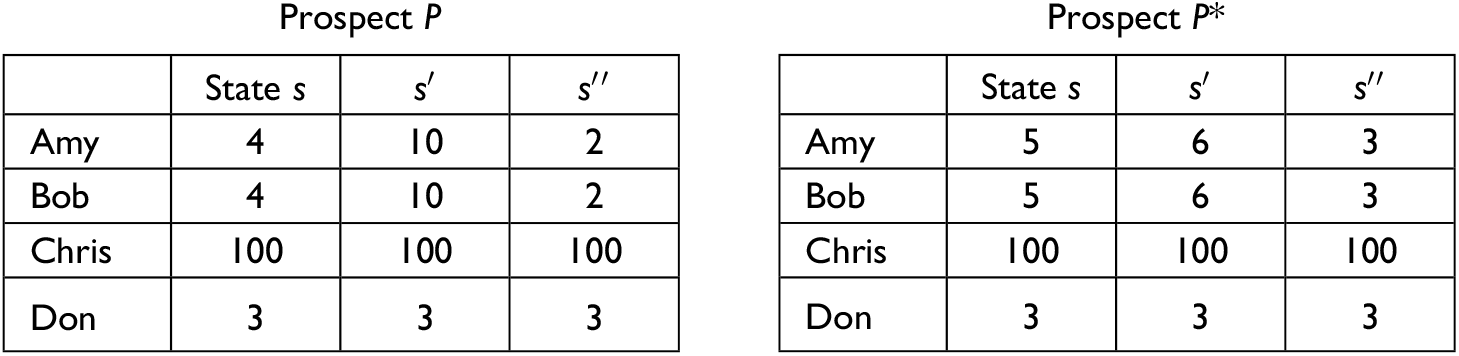
Explanation: Amy and Bob are equally situated (same well-being in each state with the two prospects), while Chris and Don are each sure to be unaffected
The prioritarian conflict between statewise dominance and heartland ex ante Pareto.

Note: To understand this table, note that the prioritarian rule ranks (40, 40) above (50, 30) and (20, 20) above (10, 30). By Continuity, there is some ε > 0 such that the rule ranks (40−ε, 40−ε) above (50 + ε, 30) and ranks (20−ε, 20−ε) above (10 + ε, 30). Assume that our prospect-ranking rule satisfies statewise dominance. If so, P ++ must be ranked better than P +. Suppose now that the ex ante Strong Pareto principle is satisfied in heartland cases. If so, this requires that P be ranked better than P ++, and that P + be ranked better than P. By transitivity, P + must be ranked better than P ++. But this contradicts statewise dominance. Ex post prioritarianism and EEDE prioritarianism prefer P++ to P+ , satisfying statewise dominance but violating heartland ex ante Strong Pareto (and hence ex ante Strong Pareto). Ex ante prioritarianism satisfies ex ante Strong Pareto and thus prefers P+ to P and P to P++ , hence P+ to P++ , in violation of statewise dominance. Setting ε = 0 illustrates the same conflicts and implications with respect to ex ante Pareto Indifference rather than ex ante Strong Pareto. This table is based upon Fleurbaey (2010, table 4).
Dropping Bernoulli allows the prioritarian to circumvent the implications of Harsanyi’s and Fleurbaey’s theorems, but only if she makes a strong assumption (‘Coincidence’): that the very same function g(·) captures both the degree to which the ranking of prospects for individual well-being is risk averse in well-being, and the degree of moral priority for the worse off. 50 While dropping Bernoulli (without more) has some plausibility, we find Coincidence to be implausible, and thus in what follows will continue to assume Bernoulli.
Harsanyi’s theorem and Fleurbaey’s theorem clearly force the prioritarian to make some tough trade-offs in selecting a prospect-ranking rule. But in what sense do these theorems go further? In what way are they an argument against prioritarianism and for utilitarianism? The argument runs as follows.
One of us (Holtug) would prefer to respond to this argument in a ‘factualist’ fashion. A prospect is a formal representation of a decision maker’s uncertainty. But prioritarianism doesn’t in itself inform the decision maker how to rank prospects. It doesn’t give us the sort of prospect-ranking rule being discussed in this article, namely one that takes account of the probabilities of the various states. A decision procedure may do so, but such a procedure should not be conflated with a factualist criterion of goodness or rightness. Therefore, the pleasant or unpleasant properties of various prospect-ranking rules can’t provide a moral argument to the effect that prioritarianism should or should not be accepted.
The other of us (Adler) believes that our criterion of moral goodness does include an uncertainty component – and since we are assuming as much for purposes of this article, a different response to the argument needs to be given. Here is one. The moral deliberator should conform to the following principle (‘Insulation’) in reasoning about the outcome ranking. In comparing candidate outcome-ranking rules, she should consider how the rules fare with respect to outcome axioms, or other relevant data, but she should not consider how the various prospect-ranking rules associated with each given outcome-ranking rule fare with respect to prospect axioms (such as ex ante Pareto, heartland ex ante Pareto, statewise dominance, expected utility theory, etc.). Prospect axioms are relevant only at a later stage of moral deliberation – where the deliberator, having chosen an outcome-ranking rule, is now selecting among the associated prospect-ranking rules.
Assume that the deliberator, in reasoning about the outcome ranking, is initially persuaded to endorse the Pigou–Dalton axiom on top of welfarism, Separability, and Continuity and thus to reject utilitarianism in favor of prioritarianism. If Insulation is true, it would be a mistake for this deliberator – upon learning that no prioritarian prospect ranking can satisfy both the prospect axiom of ex ante Pareto and the prospect axioms of statewise dominance or expected utility – to reconsider her earlier verdict and now to reject Pigou–Dalton.
Insulation is a methodological principle, regarding the process of moral deliberation. Why believe this principle? We can argue for Insulation by appealing to the normative force of full information. The following maxim (‘Maxim’) seems plausible: an imperfectly informed deliberator should follow what she believes to be the reasoning pattern of a fully informed and rational (‘idealized’) deliberator, unless doing so is infeasible (given the deliberator’s limited information), or unless departing from the idealized reasoning pattern is needed to avoid mistakes or reduce deliberation costs.
Note now that an idealized deliberator would reason about the outcome ranking in conformity with Insulation. The only prospects that she (the idealized deliberator) needs to rank are 0–1 prospects: prospects such that one state has probability 1, and all others probability 0. And the only reasonable rule for ranking 0–1 prospects is the trivial rule: P is at least as good as P* iff the outcome of P in the probability 1 state is at least as good as the outcome of P* in the probability 1 state. Any prospect axiom that the idealized deliberator might find plausible (ex ante Pareto, statewise dominance, heartland ex ante Pareto, expected utility theory, etc.) is either automatically satisfied by the trivial rule, or expressible as an outcome axiom. 52 Thus the idealized deliberator will satisfy Insulation: she will deliberate about outcome-ranking rules, in the light of whatever outcome axioms she finds plausible, and other data, but without considering prospect axioms. In particular, the idealized deliberator will never find herself in a position of endorsing the welfarism axioms, Separability, and Continuity and also provisionally endorsing the Pigou–Dalton principle, but then rejecting Pigou–Dalton and therewith the prioritarian outcome-ranking rule because of a conflict with ex ante Pareto.
By the argument in the previous paragraph, the imperfectly informed deliberator can infer that an idealized deliberator would conform to Insulation. Thus, by Maxim, the imperfectly informed deliberator should herself conform to Insulation. For the imperfectly informed deliberator, reasoning about the outcome ranking without reference to prospect axioms is feasible; nor does departure from this reasoning pattern seem needed to avoid mistakes about the application and plausibility of the outcome axioms, or to reduce deliberation costs. 53
This is not a knockdown case for Insulation, and the reader may reject it. Suppose she does. Without Insulation, does she have grounds for resisting the utilitarian challenge? Yes. If Insulation is rejected, the deliberative task is now this: to compare various composite clusters of mutually consistent axioms, each such cluster now including both outcome axioms and prospect axioms. The most plausible utilitarian prospect-ranking rule 54 satisfies expected utility theory and the ex ante Pareto principles. Ex post prioritarianism, which we take to be the most plausible prioritarian prospect-ranking rule, satisfies expected utility theory but fails even the heartland ex ante Pareto axioms. So we are comparing a utilitarian composite axiom cluster and a prioritarian composite axiom cluster, differing in that the first violates Pigou–Dalton but satisfies the ex ante Pareto principles, while the latter satisfies Pigou–Dalton but violates the ex ante Pareto principles (even in heartland cases). We believe that the person-affecting case for the Pigou–Dalton axiom is stronger than the person-affecting case for the ex ante Pareto principles (even just in heartland cases), and so on balance endorse the second cluster. 55
Egalitarian critiques of prioritarianism
Otsuka/Voorhoeve: Prioritarianism doesn’t respect the separateness of persons
In widely discussed work, Michael Otsuka and Alex Voorhoeve (2009; see also Otsuka, 2012; Otsuka and Voorhoeve, 2018) have challenged prioritarianism for failing to respect the separateness of persons. Prioritarianism, they claim, doesn’t appropriately distinguish between interpersonal and intrapersonal trade-offs. Their challenge focuses on prioritarianism’s implications for choice under uncertainty. More specifically – if prospects are used as the device for representing uncertainty – the Otsuka/Voorhoeve challenge becomes a critique of the prioritarian prospect ranking. Otsuka and Voorhoeve present this challenge, not in the service of utilitarianism, but rather in the defense of egalitarianism (albeit an egalitarian view that is not fully specified).
In short, we take the Otsuka/Voorhoeve argument to be this: given the unwelcome features of prioritarian prospect-ranking rules (with respect to interpersonal and intrapersonal trade-offs), the prioritarian outcome ranking should be rejected in favor of an egalitarian outcome ranking. 56
There are two, quick, responses to this challenge. The first is factualist: prioritarianism doesn’t in itself inform the decision maker how to rank prospects, and therefore the unwelcome features of prospect rankings can’t be used to demonstrate the implausibility of prioritarianism. The second quick response rests upon the Insulation principle defended earlier: the comparison of the prioritarian and egalitarian outcome rankings should be undertaken without considering their associated prospect-ranking rules, since this is how a fully informed and rational deliberator would make the comparison.
Let’s now bracket these responses. We are inclined to find at least one of them persuasive (Holtug the first, 57 Adler the second), but the reader may disagree. What, then, are the unwelcome features of the prioritarian prospect ranking that Otsuka and Voorhoeve bring to light?
There are various different strands in the Otsuka/Voorhoeve critique. All of these strands can be illustrated by the following examples, involving one or two individuals (Amy alone in case C, Amy and Bob in the other cases) and three well-being levels 4, 5, and 7. Assume that the prioritarian transformation function is such that g(5) + g(5) > g(4) + g(7). The states are equiprobable. The prioritarian prospect-ranking rule, we’ll assume, is ex post prioritarianism.
In cases A, B, D, E, and F, Amy and Bob are the only individuals who exist in the universe. In case C, Amy is the only individual who exists in the universe. In thinking about the Otsuka/Voorhoeve objection, and how prioritarianism and egalitarianism differ in their ranking of prospects, it’s very important – we believe – to have population-wise-complete prospects, which describe the state-contingent well-being of everyone in the population. (The alternative strategy, of using population-wise-truncated prospects, which describe the state-contingent well-being of merely a subset of the population, is misleading. What happens to the others? Either they are unaffected, in which event the truncated case is nothing other than case E, or they are not, in which event dropping them from the prospect is yet more misleading.)
Obviously, the supposition of only two or one individuals existing in the whole universe is unrealistic! But it makes the tables easier to read, without loss of generality. Every objection to prioritarianism suggested by Otsuka/Voorhoeve that would hold in an N person universe, N > 2, is equally applicable if we suppose the universe to have either one or two individuals, and thus is illustrated in these tables.






Ex post prioritarianism ranks P over P* in case A (interpersonal conflict with no uncertainty) and case B (inverse correlation). These are cases of interpersonal trade-offs, and Otsuka and Voorhoeve do not object to the preference for P in these cases. 58
The thrust of Otsuka and Voorhoeve’s criticism is that ex post prioritarianism, by virtue of the inequality g(5) + g(5) > g(4) + g(7), yields the wrong ranking in cases C (one person case), D (perfect correlation), and E (one unaffected). These are cases in which the trade-offs are only intrapersonal, and yet ex post prioritarianism also prefers P to P* in these cases – just as in cases A and B. Further, in case F (risking a loss for one to benefit another), ex post prioritarianism is indifferent between P** and P*, dispreferring both to P. But P* is a case of an interpersonal trade-off relative to P (a risk of loss is imposed on Amy so as to give Bob a chance of gain), while P** is an intrapersonal trade-off (Amy runs a risk of loss for the chance of her own gain), and so in fact the ranking should be P** preferred to P preferred to P*.
Let’s take these cases one at a time. Case F can be easily disposed of. A very plausible axiom for ranking prospects is statewise indifference. If, in each state, the outcome of one prospect is equally good as the outcome of another, then the two prospects are equally good. 59 Statewise indifference combined with any welfarist outcome ranking – be it egalitarian, prioritarian, or any other – requires that P* and P** be ranked equal. So case F can’t be used to argue in favor of egalitarian welfarism, as against prioritarianism.
What about case C (one person case)? Otsuka and Voorhoeve assume that the prioritarian is committed to ranking P over P*. Shlomi Segall says the same: Egalitarians…keep silent on intrapersonal dilemmas. And for a good reason. Theirs is a comparative view, and therefore need say nothing about dilemmas involving one single person. But prioritarians do not have that privilege. By giving up on egalitarianism’s comparative dimension, prioritarians have closed the door on restricting their view to interpersonal cases. Recall Parfit’s analogy to altitude sickness. It is more valuable to benefit Smith at level L than it is to benefit that same person if she were at level L+1. Since prioritarianism is non-comparative (or, if you prefer, committed to Separability) it must apply intrapersonally. (Segall, 2016: 158)
60
A variation on C is a case of necessarily perfect correlation: there are multiple individuals in the universe, but their interests are necessarily perfectly aligned; in every possible outcome, they all have the same well-being level. Here, too, since interpersonal conflict of interests is impossible, morality doesn’t come into play and the ranking of prospects conforms to the individuals’ identical ex ante interests. (By contrast, case D, perfect correlation, is a case in which the two individuals’ well-being is perfectly correlated in the two prospects but not in every possible outcome and thus not in every possible prospect.)
Case E (one unaffected) is a case where the only person’s risk is Amy’s. Bob is sure to be unaffected whether P or P* is chosen. Since Amy’s expected interests favor P*, that is (intuitively) the better prospect, and yet ex post prioritarianism favors P.
It is critical to see that case E is a ‘heartland’ case, in which individuals are either identically situated or sure to be unaffected. Egalitarian and prioritarian welfarists alike who endorse statewise dominance will violate the ex ante Pareto principles in some heartland cases – this is the upshot of the Fleurbaey theorem discussed earlier in the ‘Prioritarianism under uncertainty and the ex ante Pareto axioms’ section.
Parenthetically, here, we should address the natural thought that a heartland case (such as case E) can be handled by ranking the prospects in light of the expected well-being of the affected individuals. The Fleurbaey theorem implies that such an approach, if used by a nonutilitarian welfarist who endorses statewise dominance, will inevitably lead to an intransitivity. The following examples illustrate this. In these examples, the two states are equiprobable.
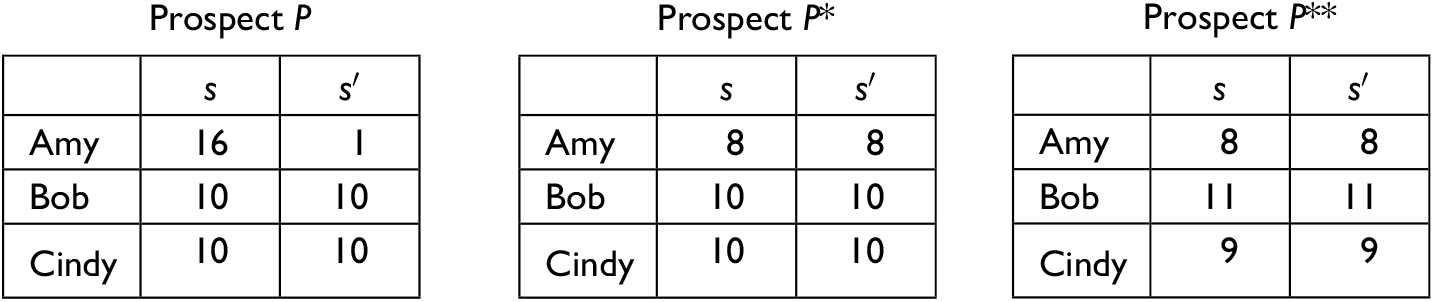
Assume that prospects are generally compared using the expected Gini/rank-weighted value of outcomes (integer weights, with 3 the weight for the lowest well-being, 2 the second lowest, and 1 the highest in this three person population). This is a kind of egalitarian welfarism that drops Separability. However, ‘heartland’ cases are dealt with by maximizing the expected well-being of the (identically situated) affected individuals. If this approach is adopted with the immediately above prospects, we have that prospect P is preferred to P* is preferred to P** is preferred to P.

The immediately above prospects illustrate the same problem for an ex post prioritarian approach. Assume that we use the square root as the transformation function, and thus generally assign prospects the expected sum of the square root of individual well-being. However, using the proposed rule for heartland cases, prospect P is preferred to P*. Then we have P preferred to P* preferred to P** preferred to P.
To reiterate: prioritarians will (sometimes) reach the intuitively wrong result of violating ex ante Pareto in cases such as E, but this is just as true of egalitarians.
Otsuka and Voorhoeve suggest that egalitarians who choose P in case E will have a rationale for doing so, a rationale that prioritarians lack. The rationale is that egalitarians care about the state-conditional pattern of well-being – they care about how Amy does, relative to Bob – while prioritarians do not. 62
In considering this suggestion, we should be careful to differentiate between impersonal and person-affecting egalitarianism. Impersonal egalitarianism does have the just-stated rationale for choosing P in case E – but impersonal egalitarianism is vulnerable to other difficulties, which will be discussed below (in addressing Temkin).
Although this isn’t fully clear, Otsuka and Voorhoeve appear to espouse the person-affecting version of egalitarianism, wherein the ethical weight of an individual’s gains and losses is a function of the person’s relation to others. 63 What’s important to see is that the person-affecting egalitarian should be just as troubled by choosing P over P* in case E as the person-affecting prioritarian. Why? From a person-affecting perspective, case E looks as follows: whatever the state of nature, the interests of affected individuals will be perfectly aligned. (Here, there is just one such individual, Amy.) So we can be sure that there will be no conflict among affected individuals. Appeals to relational considerations to decide the comparative strength of their conflicting interests should, intuitively, be unnecessary; instead, the expected well-being of the affected individuals should be decisive. But Fleurbaey’s theorem rules this out.
In short, choosing P over P* in case E is a ‘demerit’ for both person-affecting prioritarians and person-affecting egalitarians, as compared to utilitarians. The Otsuka/Voorhoeve critique, in appealing to case E, provides no rationale for shifting from prioritarianism to egalitarianism.
Finally, what about case D, perfect correlation? This is a special type of heartland case in which all individuals are identically situated. Here, too, it is especially intuitive that the ex ante Pareto principle be respected (favoring P*), and yet ex post prioritarianism reaches the wrong result (favoring P).
It turns out that nonutilitarian welfarists who endorse statewise dominance can rank P* over P in case D (a heartland case with all identically situated), without violating transitivity. This is true for an egalitarian outcome ranking: there is an associated prospect-ranking rule that prefers P* over P. 64 But it is also true for a prioritarian outcome ranking. While ex post prioritarianism favors P, a different prioritarian prospect-ranking rule – EEDE prioritarianism – favors P* in case D. This rule was mentioned earlier. Like ex post prioritarianism, it satisfies expected utility theory, hence statewise dominance; unlike ex post prioritarianism, EEDE prioritarianism violates prospect separability.
We ourselves endorse ex post prioritarianism, not EEDE prioritarianism. But this is an intramural debate among prioritarians. The question on the table, now, is whether case D provides an argument for egalitarianism against prioritarianism. The answer (as with all the other cases) is no. While egalitarians can design their prospect ranking to favor P*, so can prioritarians. 65
Temkin: Comparative fairness
Larry Temkin has long presented an impersonal defense of egalitarianism (see, for example, Temkin, 1993, 2003a, 2003b). On his account, there are a plurality of intrinsic moral values, including the value of equality.
66
My version of egalitarianism is an example of what Derek Parfit has called telic egalitarianism, which is concerned with inequality’s impact on the goodness, or desirability, of outcomes…. My version of egalitarianism is also an example of non-instrumental egalitarianism. On this view, equality, understood as comparative fairness, is intrinsically valuable, in the sense that it is sometimes valuable in itself, over and above the extent to which it promotes other ideals [i.e., values]…[E]quality [on this view] is a distinct moral ideal with independent normative significance. (Temkin, 2003b: 62) [I endorse] a version of egalitarianism that might be called equality as comparative fairness.…[Concern] about equality is a portion of our concern about fairness that focuses on how people fare relative to others. So, our concern for equality is not separable from our concern for a certain aspect of fairness; they are part and parcel of a single concern. (Temkin, 2003b: 62)
67
Is Temkin a welfarist? No. He would deny that the moral ranking of outcomes must respect Pareto Indifference, Strong Pareto, and Anonymity. Temkin has explicitly expressed doubts about Strong Pareto. Further, he has embraced the axiological relevance of non-welfare considerations, namely, desert and ‘fault’.
However, for purposes of our analysis – considering challenges to prioritarianism within welfarism – it’s useful to consider how a Temkin-style moral view would play out within welfarism. Call this ‘Temkin egalitarian welfarism’ or, more compactly, ‘Temkin welfarism’. Temkin welfarism adopts an impersonal mode of justification: the fundamental moral considerations driving the comparative goodness of outcomes are not individual gains and losses, but rather the value of equality (specifically, for Temkin, the value of comparative fairness), the value of overall well-being as measured by ∑wi , and perhaps other values. The all-values-considered moral ranking of outcomes is non-separable. The Strong Pareto axiom is respected: if some are better off in x than y, while none are worse off, the sum total of individual well-being ∑wi is necessarily larger in x, and any decrease in equality is more than counterbalanced by this increase in overall well-being. (Thus, Temkin egalitarianism welfarism is a ‘moderate’ egalitarianism, to use Parfit’s terms.)
While Temkin egalitarian welfarism, by construction, is welfarist and therefore satisfies the all-things-considered PAP, it does not satisfy the pro tanto PAP. Assume that some are better off in x than y, and none worse off; but well-being is perfectly equally distributed in y, while unequally distributed in x. Then y is better than x in one respect, namely with respect to the value of equality, even though no individual is better off in y than x. This, of course, is a ‘leveling down’ case: the disparities between well-being levels that exist in x are removed in y (thereby increasing the degree of equality) by lowering the well-being levels of the better-off individuals. Because it allows that a leveling-down improvement in the degree of equality is a pro tanto moral improvement, Temkin welfarism rejects the pro tanto PAP. (In fact Temkin explicitly and happily acknowledges that his brand of egalitarianism sees an improvement in equality by ‘leveling down’ to be a pro tanto moral improvement.)
The flip side of Temkin welfarism is a critique of person-affecting prioritarianism (our view). Indeed, Temkin has been a vigorous critic of both prioritarianism and the person-affecting mode of justification. 68 There are two closely related aspects to this critique, methodological and substantive. The methodological critique is that a person-affecting mode of justification is blind to all moral considerations other than individual gains and losses. 69 The substantive critique is that a prioritarian outcome ranking, by ignoring the intrinsic value of equality, reaches incorrect verdicts about the comparative moral goodness of outcomes.
Let’s first answer the methodological critique. It’s true that the person-affecting mode of justification is restrictive, precluding anything but individuals’ gains and losses from serving as the grounding for the outcome ranking, while the impersonal mode is permissive. The latter thus coheres better with the wide range of moral intuitions in favor of various putative pro tanto considerations other than gains and losses. But the impersonal mode has a countervailing vice, one we alluded to earlier. Consider the following principle for deliberating about the outcome ranking, ‘Justificatory Priority’:
We believe that many would accept Justificatory Priority. But Justificatory Priority is in deep tension with an impersonal mode of justification. What grounds would someone who is prepared to accept moral considerations other than individuals’ gains and losses have for insisting that these impersonal considerations must be such as to support the Strong Pareto principle?
This challenge to impersonal justification has extra force against the Temkin egalitarian welfarist. She brings on board at least one value, namely equality, which is structured so as to conflict with the Strong Pareto principle. The ranking of outcomes with respect to the intrinsic value of equality violates the Strong Pareto principle. And yet the all-values-considered ranking of outcomes satisfies the Strong Pareto principle: she is ‘moderate’. This is possible, but what justifies her moderation? Why is leveling down a pro tanto moral improvement but never an all-things-considered moral improvement? 70
The Temkin welfarist might press her methodological case by arguing that the intuitions in favor of the intrinsic moral weight of equality are too powerful to ignore. The person-affecting mode of justification is undercut by even one pro tanto moral consideration other than individuals’ gains and losses – and there is at least one such consideration with strong intuitive force, namely, equality (comparative fairness). But the person-affecting prioritarian can question the strength of such intuitions. Many have intuitions about the moral importance of equalizing inputs to well-being, such as material resources. Some also have intuitions about the moral importance of equalizing well-being itself. The person-affecting prioritarian can accommodate such intuitions. Because it satisfies the Pigou–Dalton principle (the upweighting of the interests of those who are worse off), the prioritarian outcome ranking (however justified) always prefers an equalization of a given sum total of well-being. What the person-affecting prioritarian can’t accommodate are intuitions about the intrinsic moral importance of equalizing well-being. But it isn’t actually clear how widespread these intuitions are.
Shlomi Segall’s work suggests a different way in which the Temkin welfarist might respond to the methodological critique. Prioritarianism, Segall argues, violates the PAP for prospects: ‘[O]ne prospect cannot be better than another if there is no one for whom it is expectedly better’. (Segall, 2016: 165). Because prioritarianism, in this regard, is itself not person-affecting, it’s not entitled to criticize the impersonal justification when offered in defense of egalitarianism.
We agree with Segall that prioritarianism, best understood, violates the PAP for prospects. As already discussed, a prioritarian ranking of prospects that satisfies statewise dominance will violate ex ante Pareto Indifference; this immediately implies a violation of PAP for prospects. 71 See Table 3. As this table illustrates, the prioritarian grounds for violating PAP for prospects is the logic of rankings: it is a logical implication of statewise dominance that P* be preferred to P, in violation of PAP for prospects. It hardly follows that the prioritarian must also abandon the person-affecting justification of the outcome ranking itself. Indeed, our basis for thinking (50, 50) a better outcome than either (10, 90) or (90, 10), as per the Pigou–Dalton principle, is person-affecting: the gain to the worse-off one (from 10 to 50) is exactly equal to the loss for the better-off one (from 90 to 50); hence if well-being level has any effect on the moral weight of gains and losses, it must be that the moral weight of the gain to the worse-off one is greater than the moral weight of the loss to the better-off one.
The prioritarian conflict between statewise dominance and the Person-Affecting Principle (PAP) for prospects.
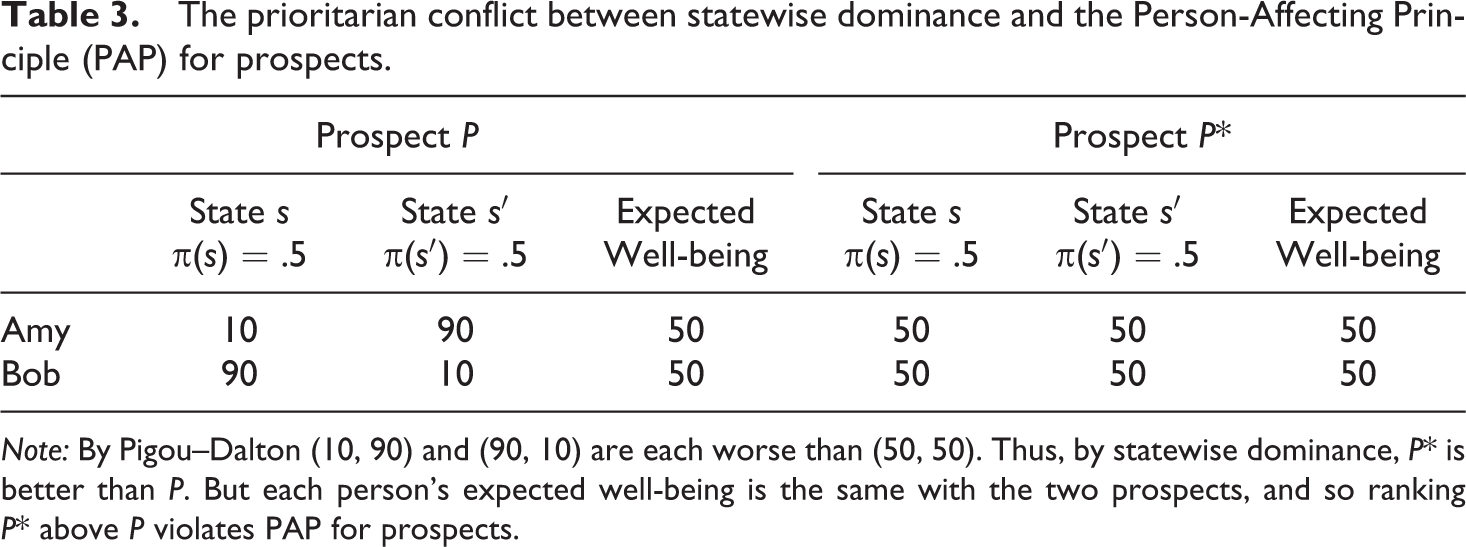
Note: By Pigou–Dalton (10, 90) and (90, 10) are each worse than (50, 50). Thus, by statewise dominance, P* is better than P. But each person’s expected well-being is the same with the two prospects, and so ranking P* above P violates PAP for prospects.
Thus we have that, in each possible state (s and s′), the outcome of P is worse (on person-affecting grounds) than the outcome of P*. Pace Segall, our rejection of the PAP for prospects does not force us to abandon a person-affecting justification of the goodness of outcomes (or to refrain from criticizing impersonal approaches). Just the opposite: we embrace the Pigou–Dalton principle for outcomes in virtue of a person-affecting mode of justification, and it is precisely the verdict that (90, 10) and (10, 90) are worse than (50, 50) which forces us to reject PAP for prospects.
Let’s turn now to the substantive critique that Temkin welfarists can level against prioritarianism. They can argue that the prioritarian outcome ranking, because it ignores relational considerations – because it is separable – ends up with mistaken verdicts about comparative moral betterness. Thus, Temkin (2003b: 69–70) presents two cases of a space traveler who, at some sacrifice to himself, can divert a mineral-rich asteroid to a planet below – allowing its population to use the minerals to increase their welfare. In case 1, the inhabitants of this planet are much better off than everyone on other planets. In case 2, they are much worse off than everyone on other planets. Furthermore, the inhabitants’ welfare level in case 1 equals their level in case 2. Temkin argues that the space traveler should sacrifice more of his own well-being to divert the asteroid in case 2 than case 1, while prioritarianism implies that the warranted sacrifice is the same in both cases. Note that what we have here is indeed a challenge to Separability: Temkin’s claim is that the moral weight of the traveler’s loss and planet-dwellers’ gains depends upon the well-being levels of everyone else, who are unaffected by what the traveler does.
We don’t share Temkin’s intuition in the asteroid case (or similar such cases he presents). We do acknowledge that, if the space traveler diverts the asteroid in case 1, this may be accompanied by a sense of regret that is not present in case 2, namely that of not being able to divert it to a planet that needs it more. But the regret of not being able to do something better should not impact one’s judgment about the goodness of doing what one is able to do.
Persson: Prioritarians have impersonal value commitments (and problematic ones)
The prioritarian formula for measuring the moral goodness of outcomes is ∑g(wi ). Consider now two individuals, Jane and Kate, the first better off than the second (w Jane > w Kate). If we increase Jane’s well-being by an increment Δw, the moral gain from doing so is g(w Jane + Δw) – g(w Jane). If we increase Kate’s well-being by the same increment, the moral gain from doing so is g(w Kate + Δw) – g(w Kate). Because the g(·) function is strictly concave, the first moral gain is smaller than the second. (Thus the familiar prioritarian slogan that well-being has declining marginal moral weight.)
Ingmar Persson (2008) leverages this feature of prioritarianism into a challenge. Assume that Amy is better off in x than y; everyone else is unaffected. The moral gain from benefiting Amy in x (equivalently, the moral weight of a benefit to Amy) is less than the moral gain from benefitting Amy in y. Since everyone else’s well-being levels are unchanged, we have that the average moral weight of benefits is lower in x than in y. 72
But this shows, says Persson, that prioritarians are actually committed to recognizing an impersonal consideration: the average moral weight of benefits. So ‘person-affecting’ prioritarianism is a nonstarter. Further, just like egalitarianism, prioritarianism is vulnerable to the leveling down objection, because lowering the welfare of some and holding everyone else constant increases the average moral weight of benefits, and so leveling down is in one respect better. Finally, prioritarianism has the absurd implication that benefiting someone is always worse in one respect, because doing so decreases the average moral weight of benefits.
73
Persson writes: [W]henever someone is benefitted, without anyone being harmed, it will be the case that the benefits received in the end state have on average less moral weight than the benefits received in the start state had, since the recipients are now absolutely better off. So in one respect benefitting will always be for the worse…. This is absurd. (Persson, 2008: 301)
74
Buchak: The veil of ignorance justifies a ‘relative prioritarianism’ that violates separability
Lara Buchak (2017) has recently defended the ranking of outcomes according to the Gini family of social welfare functions. 76 Like the prioritarian ranking ∑g(w i), the Gini ranking is welfarist, satisfies the Pigou–Dalton principle, and is continuous. However, the Gini ranking violates Separability (as Buchak recognizes and endorses).
Buchak uses the term ‘relative prioritarianism’ to describe her defense of the Gini ranking. According to the terminology used in this article, the Gini ranking is a kind of egalitarian welfarism. Of course, this difference is merely semantic – the important issue is whether Buchak has presented persuasive arguments in favor of the Gini ranking rather than the person-separable ∑g(wi ) rule.
Buchak argues for the Gini ranking by invoking the veil-of-ignorance. In doing so, she both builds upon, yet departs from, John Harsanyi’s veil-of-ignorance argument for utilitarianism. 77 Harsanyi argues as follows. Assume that each individual morally ranks outcomes by conceptualizing an outcome as an equiprobability lottery over the N individuals who exist in the outcome – giving a 1/N probability of her (the individual doing the moral ranking) achieving the well-being of each of the N individuals. Then, if the individual orders these equiprobability lotteries by maximizing her expected utility, with utility in turn linear in well-being, she ranks outcomes according to the utilitarian rule. Buchak agrees with Harsanyi that outcomes are to be conceptualized as equiprobability lotteries over individual positions and assumes (as does he) that outcomes are reducible to patterns of interpersonally comparable well-being numbers. But – building upon her philosophical work in decision theory (Buchak, 2013) – she argues that individuals morally rank outcomes by using a different decision rule behind the veil of ignorance: risk-weighted expected utility (REU) maximization. This yields the Gini ranking, not utilitarianism or prioritarianism.
An interesting question is whether Buchak’s argument for egalitarianism (‘relative prioritarianism’, by her terminology) is impersonal or person-affecting. It seems the latter. She writes: The key claim of relative prioritarianism as distinct from philosophical egalitarianism [grounded in the value of equality] is about why the rank of each individual matters. It is not because we want to reduce inequality in itself, as if equality were some value over and above the well-being of each individual. Nor is it because individuals care about what other individuals have – they are not motivated by envy. Rather, it is because the claims of those who are relatively worse off take priority over the claims of those who are relatively better off. The key claim of relative prioritarianism as distinct from prioritarianism is that it is relative standing, rather than absolute standing, that determines priority. (Buchak, 2017: 624)
Buchak’s work is a major scholarly contribution to debates between utilitarians, prioritarians, and egalitarians. That said, we are not persuaded by her critique of prioritarianism. That critique hinges on two premises, both of which we reject: (1) that REU maximization, rather than expected utility maximization, is a normatively acceptable posture for choice under uncertainty and (2) that the veil of ignorance is the appropriate device for selecting between competing welfarist outcome rankings.
The merits of REU maximization as a normative account of choice under uncertainty is not a topic that can be addressed within the space constraints of this article; we’ll leave it to the reader to reach her own conclusions about (1). But, the reader may ask, if expected utility maximization is indeed the correct account of rational choice, how are we to rebut Harsanyi’s veil-of-ignorance argument for utilitarianism? We do so by rejecting (2). The person-affecting welfarist is surely not committed to using the veil-of-ignorance device as the mechanism for determining the comparative moral weight of individuals’ gains and losses. A different device (for example, Adler’s notion of ‘claims across outcomes’) can lead us instead to prioritarianism. 78
Other critiques
Crisp and sufficientism
Roger Crisp (2003) defends ‘sufficientism’, an outcome-ranking rule that is neither utilitarian, nor prioritarian, nor egalitarian. Crisp argues that while the poor should have priority over the rich, the rich should not have priority over the superrich. According to Crisp, there is a certain threshold level of well-being above which the prioritarian formula ∑g(wi ) no longer applies. Below the threshold, this formula applies; and as regards conflicts between benefits below and above the threshold, (nontrivial) benefits below have lexical priority. 79 Note that this rule preserves Separability, hence is not egalitarian; indeed, nothing in Crisp’s critique of utilitarianism and prioritarianism calls into question Separability.
We believe that sufficientism faces various difficulties (see Casal, 2007; Holtug, 2010: 226–35; Temkin, 2003a). For the moment, we focus on conflicts above the threshold, although we believe that sufficientism also faces difficulties as regards conflicts across the threshold, and as regards setting the threshold itself. Crisp suggests that interpersonal conflicts above the threshold should be settled on the basis of a utilitarian function, where equal benefits are weighted equally. This ensures that the Strong Pareto principle is satisfied. However, sufficientism violates the Pigou–Dalton principle above the threshold.
To assess the plausibility of Pigou–Dalton violations above the threshold, consider the following case (which is a variation of a case discussed in Holtug, 2010: 233–35, in a critical appraisal of Crisp’s sufficientism). Suppose that, in a well-off society in which everyone is above the sufficiency threshold, a pill is developed that can double the average life-length, say by decreasing the pace at which cells deteriorate. There are not enough pills available so that everyone can receive one and hence obtain the full effect of the pill. However, by cutting the pills in half, we can ensure that everyone receives half a pill. This would mean that instead of living 80 years extra, people would live 40 years extra. Assume also, for simplicity, that everyone is equally deserving, that each extra year contributes an equal (and high) amount of welfare, that the contribution is the same for everyone, and that people will end up equally well off if the pills are shared equally. Finally, assume that there will be no effects for anyone other than these people whose lives may be extended. It seems plausible to claim the pills should be shared equally, everything else being equal, as implied by the Pigou–Dalton principle. The utilitarian principle suggested by Crisp, on the other hand, would be indifferent between the two available options.
A possible response to this objection is to claim that the threshold level is not absolute but sensitive to, say, the overall level of well-being in society (see, for example, Huseby, 2010: 182–84). Thus, the threshold level will reflect the relative deprivation of the worse off. On this basis, it may be argued that increasing the overall level of well-being, as in the case imagined, increases the level of the threshold. And suppose, for the sake of argument, that the new threshold is above the level people will have if they do not receive any share of the pills. In that case, sufficientism prefers an equal distribution of the pills to a distribution in which only half have access. Nevertheless, we see two problems with this approach (again, focusing on conflicts above the threshold). First, it still violates the Pigou–Dalton principle. Suppose that, to reach the new threshold, people would need to have a quarter of a pill. Then sufficientism is indifferent between an outcome in which people share the pills equally, and so everyone gets 40 years extra, and an outcome in which half get 60 and the other half 20 extra years. Given that everyone is equally deserving, this seems unfair. Second, a sufficientism that has such a sliding threshold not only violates the Pigou–Dalton principle but would violate Separability. It violates Separability because it renders individual contributions to outcome value dependent on the overall level of well-being and so on other people’s levels. And we have argued that Separability is a reasonable requirement to impose on the outcome ranking.
Aggregation (and Brown’s solution)
The prioritarian outcome-ranking rule has an aggregative feature, one criticized by Crisp: a large loss to a worse-off person is outweighed by small gains to each of a group of better-off persons – regardless of how large the loss, how small the gains to the better-off ones, and how much better off they are – if the number of better-off individuals is sufficiently large. Call this ‘Numbers Win’.
Numbers Win is troublesome. How can it be avoided? One might ask whether there are plausible egalitarian rules that lack this property. This is an interesting question, but not one we will pursue here. Since we endorse Separability, we rather ask: what are the separable welfarist rules that lack the Numbers Win property?
Continuity now emerges as the culprit. The following can be shown: if a welfarist outcome-ranking rule satisfies Separability and Continuity, then it must have the Numbers Win property. 80 This is true of utilitarianism, prioritarianism, and every other variant of person-separable, continuous welfarism.
By including a threshold in the sufficientist rule, Crisp was able to avoid Numbers Win. If the worse-off individual is below the threshold, and the better-off ones are above, no gains to the better-off ones (however numerous) will counterbalance a loss to the worse-off individual. However, sufficientism violates Pigou–Dalton above the threshold, and this is problematic – as we argued in the previous section. We take there to be strong person-affecting grounds for the Pigou–Dalton principle without restriction, at all levels.
The leximin rule is separable, satisfies Pigou–Dalton unrestrictedly, and avoids Numbers Win. But it is very counterintuitive, giving absolute priority to the worst off. If one person is worse off than a group of better-off individuals (however small the gap in their well-being), then leximin prefers avoiding a loss to the worse-off one (however small) to providing gains for the better-off ones (however large the gains and numerous the group).
Campbell Brown (2005) has introduced an innovative rule, prioritarianism with a lexical threshold (PLT). Like sufficientism, this rule uses the prioritarian formula ∑g(wi ) below the threshold and gives absolute priority to those below over those above, but it is prioritarian in making trade-offs between individuals above the threshold (and thus satisfies Pigou–Dalton unrestrictedly). By virtue of the threshold, PLT lacks the Numbers Win property.
PLT has been little discussed in the philosophical literature. This is a pity – Brown is owed more credit for his invention. On balance, we are inclined to stick with prioritarianism rather than shifting to PLT. Although Numbers Win is counterintuitive, we find it yet more counterintuitive that morality includes a threshold across which absolute priority obtains. But the reader may well disagree. If so, she should give serious consideration to PLT. A powerful person-affecting case can be made for PLT (via Pigou–Dalton and Separability), just as for prioritarianism. The various critiques that utilitarians and egalitarians have advanced against prioritarianism can also be advanced, mutatis mutandis, against PLT – but PLT can meet these challenges, just as prioritarianism can. PLT is a close cousin of prioritarianism and, we believe, the most plausible welfarist alternative to it – not utilitarianism, egalitarianism, sufficientism, or leximin.
Conclusion
We have considered what we take to be the most important objections to prioritarianism and have argued that there are plausible prioritarian replies that can be made to each of them. Thus, we have responded to utilitarian critiques, which assert that one cannot differentiate between prudential well-being and its moral goodness, that Bernoulli prioritarianism is no more plausible than antiprioritarianism, and that prioritarianism violates the ex ante Pareto principles. Furthermore, we have responded to egalitarian critiques according to which prioritarianism does not respect the separateness of persons, is insensitive to comparative fairness, involves a problematic commitment to impersonal value, and should be replaced with a non-separable form of ‘relative prioritarianism’. Finally, we have responded to sufficientist critiques. We have done so on the basis of a distinctive, person-affecting approach that supports the axioms which, together, define prioritarianism: Pareto Indifference, Strong Pareto and Anonymity (the welfarist axioms) plus Pigou–Dalton, Separability, and Continuity. Notwithstanding the numerous criticisms of prioritarianism, we continue to believe – and hope to have shown here – that it remains a serious contender in moral theory.
Footnotes
Acknowledgements
We are very grateful to those who provided comments on drafts of this article: the Editor of this journal; three referees; and John Broome, Lara Buchak, Hilary Greaves, Ingmar Persson, Shlomi Segall, Orri Stefánsson, and Larry Temkin.
Declaration of Conflicting Interests
The author(s) declared no potential conflicts of interest with respect to the research, authorship, and/or publication of this article.
Funding
The author(s) received no financial support for the research, authorship, and/or publication of this article.