



Abstract
Past research has not clearly explained why the quality of leader-member exchange (LMX) is weakly related to organizational citizenship behaviour (OCB) in non-Western cultures. Hence, this study explores subordinates’ cultural value orientation and team member exchange (TMX) as boundary conditions of the effects of LMX on citizenship behaviour directed at individual organizational members (OCBI) and citizenship behaviour directed at the organization as a whole (OCBO). The research hypotheses were tested using a sample of 392 supervisor-subordinate dyads from organizations across different sectors in Ghana. The results support our theorizing that horizontal collectivism and TMX strengthen the relationship between LMX and OCBI such that the relationship is stronger for horizontal collectivists and under a high TMX context. However, the results did not support the hypothesized moderator effects of horizontal collectivism and TMX on the LMX-OCBO relationship. The theoretical contributions, managerial implications and avenues for further research are discussed.
Keywords
Introduction
A number of studies have examined the effect of dyadic relationships between supervisors and subordinates (Leader-Member Exchange) on organizational citizenship behaviour (OCB) (Anand et al., 2018; Bowler et al., 2019; Parent-Rocheleau et al., 2020; for meta-analyses see Dulebohn et al., 2012; Martin et al., 2016; Rockstuhl et al., 2012). This line of research has shown that, generally, high-quality leader-member exchange (LMX) positively influences employees’ organizational citizenship behaviour. The principle of reciprocity underlying social exchange theory (Blau, 1964; Gouldner, 1960) is often used to explain the influence of LMX on employees’ citizenship behaviour. That is, as leaders provide favourable treatment to their followers, they respond by engaging in voluntary behaviours that exceed the minimum expectations required of them (Erdogan and Bauer, 2014). However, the effect of LMX on employees’ citizenship behaviour is not uniform across cultures (Lee et al., 2014; Yu et al., 2018). More specifically, cross-cultural meta-analytic results make it clear that the LMX-OCB relationship is significantly stronger in Western contexts of individualism and low-power distance than in non-Western ones of collectivism and high-power distance (Rockstuhl et al., 2012). In view of this finding, Rockstuhl et al. (2012) conclude that national culture affects the link between LMX and employees’ citizenship behaviour.
Despite the significant progress made in advancing our understanding of the role of culture in LMX dynamics, existing knowledge is limited in at least two ways: First, there are broadly two dimensions of OCB - one directed towards individual employees (OCBI) and the other directed towards the organization (OCBO – Lee and Allen, 2002). While a substantial body of literature exists on the effects of LMX on aggregate citizenship behaviour, the differing effects of LMX on these two dimensions of OCB (i.e., OCBI and OCBO) remain less known. Second, examining LMX dynamics from a national cultural perspective assumes that people in the same society are relatively homogeneous (Lee and Choi, 2005). Contrary to this cultural same-mindedness, it has been observed that, within each society or country, there is heterogeneity of individual cultural values which can affect the relationship between LMX and work outcomes (Erdogan and Liden, 2006; Lee et al., 2014). From this perspective, cultural value orientations are regarded as individual-level traits that influence leadership outcomes in the form of shaping the perceptions, attitudes and behaviours of subordinates (Hee et al., 2020; Kirkman et al., 2009). In order to enhance understanding of LMX on work outcomes, this study draws on Triandis and colleagues’ configuration of power distance and collectivism (Erdogan and Liden, 2006; Triandis, 1995; Triandis and Gelfand, 1998) and theorizes that subordinates’ cultural value orientation influences employees’ citizenship behaviour in response to LMX quality.
The role of team-member exchange (TMX) in the leadership process has also received considerable scholarly attention in recent times (Kim et al., 2021; Lau et al., 2021). While LMX focuses on vertical dyadic relationships between leaders and their followers, TMX considers horizontal exchanges between and among subordinates. The quality of relationship among subordinates or peers in organizational settings is important for several reasons: 1) by virtue of working together in a unit, department or any other workgroup, members interact with one another on a daily basis and spend substantial time together during the working week (Love and Forret, 2008). On this basis, research has shown that TMX is as important as LMX in preventing, for example, psychological health issues among employees and providing psychological empowerment (Schermuly and Meyer, 2016); 2) team members provide a sense of identity, belonging and support for one another (Bowler and Brass, 2006); 3) the increasing use of work groups and teams to undertake organizational tasks suggests that TMX has implications for individual, group and organization outcomes (Love and Forret, 2008). TMX has been examined as a predictor of work-related outcomes such as helping behaviour towards colleagues (Kamdar and Van Dyne, 2007) and identification with peer groups (Farmer et al., 2015). However, evidence about the moderator effect of TMX on LMX and such important work outcomes as employees’ citizenship behaviour (OCBI and OCBO) remains scarce. To shed light on this under-explored area, this study argues that, in a collectivist society where people cherish relationships, exchanges among peer group members can interact with exchange quality between supervisors and subordinates to impact on work outcomes. Against this background, the motivation for our current work was to draw from the social exchange theory (Blau, 1964), reciprocity norms (Gouldner, 1960) and the cultural value framework proposed by Triandis and others (Singelis et al., 1995; Triandis, 1995; Triandis and Gelfand, 1998) to answer the following questions: a) how does LMX quality influence citizenship behaviour directed at individual organizational members (OCBI) and citizenship behaviour directed at the organization as a whole (OCBO)? b) why and under what circumstances will individually held cultural value dimensions of collectivism and the quality of exchange among co-workers affect the LMX-OCBI/OCBO relationship?
The study makes significant contributions to the LMX literature as well as cross-cultural management: First, we extend scholarship on LMX by identifying its differing effects on specific dimensions of OCB (OCBI and OCBO) instead of the overall employees’ citizenship behaviour in collectivist context. Second, building on the cultural value framework by Triandis and colleagues (Singelis et al., 1995; Triandis, 1995; Triandis and Gelfand, 1998), we offer insights about the boundary conditions of LMX theory by examining the moderating effect of subordinates’ cultural value orientation on the relationship between LMX and OCBI/OCBO. Although prior evidence indicates that cultural values affect LMX, the way in which this process occurs is complex. There have therefore been calls for deeper assessment of the role of culture in the relationships between LMX and its correlates, particularly, in non-Western contexts of collectivism and high-power distance (Pellegrini, 2015; Terpstra-Tong et al., 2020). This study contributes to filling this noticeable void in the LMX literature. Third, this study further identifies TMX as a key contextual variable that can enhance the predictive ability of LMX on important work outcomes in non-Western societies. Although attempts have been made to introduce TMX into the LMX literature (see, e.g., Banks et al., 2014; Schermuly and Meyer, 2016), evidence is lacking about the moderator role of TMX in the context of the relationship between supervisors and their subordinates in organizational settings in collectivist societies. By considering TMX, we were able to examine the differing effects of LMX quality on individual- and organization-directed citizenship behaviour in a collectivist context.
The rest of the paper is organized as follows: We first discuss the relevant theoretical frameworks and concepts underlying the study. These include the LMX theory, OCB, cultural value orientations and TMX. Next, building on prior research findings, we present the study hypotheses as well as the methods that were used to examine these hypotheses. The discussion of the study results is followed by the theoretical and practical implications of the research findings. The paper concludes with a discussion of the limitations of the present study which also provide avenues for further research.
Theoretical overview and development of hypotheses
Leader-member exchange theory
LMX is a type of relationship-based leadership approach with the core assumption that effective leadership develops through partnership between leaders and their followers (Graen and Uhl-Bien, 1995). For this reason, LMX is focused on building high-quality dyadic relationships between leaders and subordinates in an organization. While traditional leadership theories (e.g., trait and behavioural leadership theories) suggest that superiors (leaders) relate to subordinates (followers) in a uniform manner, LMX theory contends that leaders differentiate between followers in terms of the quality of relationship that is established and maintained with each member in the organization. In other words, a leader does not relate to all followers in the same way. Rather, a leader segments followers and relates to them differently (Uhl-Bien, 2006).
A basic tenet of LMX theory is that a leader establishes different quality relationships with followers. The followers are broadly categorized into two - “in-group” and “out-group” members. This “in-group” and “out-group” dichotomy characterized the initial conceptualization of the LMX literature (Dansereau et al., 1975). However, subsequent studies model the quality of the exchange between the leader and members on a continuum ranging from low-quality relationships to high-quality relationships (Erdogan and Bauer, 2014). At one end of the continuum, the relationship between a leader and followers is based on job descriptions, formal authority, rules and policies. Put differently, this relationship is based on the economic exchange of resources specified in formal employment contracts between an employer and employees (typically, payment of remuneration for tasks executed within a defined period). The organizational members in this category are the ones that the LMX foundation scholars term “out-group” members or “hired hands” (Dansereau et al., 1975). The implication here is that there is a low-quality relationship between the leader and “out-group” members, that is, the relationship is characterized by a low level of trust and interaction (Graen and Uhl-Bien, 1995).
At the other end of the continuum, the leader develops a close relationship with some organizational members. This type of relationship goes beyond an economic exchange of resources specified in contractual agreements to include the social exchange of resources. That is, leaders provide such socio-emotional resources and support as mentoring, advice, career opportunities, and social support to some of the members in the organization who report to them. For these members, the leader is more friendly, closer and more communicative (Erdogan and Bauer, 2014). The members who enjoy this high-quality relationship are the “in-group” members, otherwise referred to as “trusted assistants” (Dansereau et al., 1975). This relationship is characterized by a high level of mutual trust, interaction and both formal and informal rewards (Creary et al., 2015; Graen and Uhl-Bien, 1995). Although LMX theory has received vast research interest since it was conceived nearly five decades ago, past studies have focused largely on Western contexts of individualism and low power distance. Consequently, a lot more effort is required to understand its ramifications, especially how the cultural context of LMX impacts work outcomes in non-Western societies of collectivism and high-power distance (Terpstra-Tong et al., 2020; Anand et al., 2018).
The concept of cultural value orientation
In terms of cultural study, researchers distinguish individual-level analysis from societal or national level by referring to the former as cultural value orientation and the latter simply as cultural value (Hee et al., 2020; Kirkman et al., 2009). Cultural value is seen as a collective set of norms and beliefs that inform societal laws and morals while cultural value orientation is regarded as the beliefs held by an individual (Hee et al., 2020). There are many dimensions of culture. These several cultural dimensions have been conceptualized and labelled differently by different authors. However, there seems to be a consensus among management and organizational scholars that Hofstede’s (1980) seminal – “culture and organizations” is a ground-breaking work that brought the study of culture from the margins to assume a central role in leadership and management research (Triandis, 2004). As Triandis (2004) observed, “Hofstede’s work has become the standard against which new work on cultural difference is validated” (p. 89).
Hofstede (1980, 2011) through his study of national cultures across several countries identified some significant nuances which have been instrumental in shaping leadership and organizational studies over the years. These dimensions of national culture include: 1) individualism/collectivism; 2) power distance; 3) uncertainty avoidance; 4) masculinity/femininity; 5) long/short-term orientation and 6) indulgence/restraint. All these cultural value dimensions are interesting. However, the individualism-collectivism and power distance dimensions are commonly used in leadership studies, particularly LMX (Rockstuhl et al., 2012). This is in view of the observation that these two cultural value dimensions (individualism/collectivism and power distance) strongly predict a range of relevant work outcomes compared to the other cultural dimensions (Taras et al., 2010).
The focus of this study is on the collectivism dimension but to gain a better appreciation of this cultural dimension, it is necessary to contrast it with the individualism cultural dimension. The basic understanding behind “individualism versus collectivism” is the relation between individuals in society (Hofstede, 2011). That is, the individualism-collectivism cultural dimension refers to the extent to which individuals view themselves relative to the collective. The focus here is whether ties between an individual and others are loose or strong. At one end of the continuum, the bond between individuals in society is loose such that individuals tend to look after themselves and their immediate family. This kind of society is classified as “Individualist” and prevails in Western societies such as North America and Western Europe.
At the other end of the continuum, the bond between individuals in society is strong such that people are integrated into strong, cohesive in-groups that protect one another in exchange for unquestioning loyalty. This kind of society is classified as “Collectivist” and prevails in non-Western areas such as countries in sub-Saharan Africa. It has further been observed that cultures higher on collectivism are characterized by high power distance (Hofstede, 2011). The basic understanding behind “power distance” is the extent to which the less powerful members of society, organizations or institutions accept social stratification and unequal distributions of power (Hofstede, 2011). Although there is a level of inequality in all societies, some societies are more unequal than others in terms of power and wealth. High power distance societies tend to accept hierarchical systems without individuals requiring justification. Conversely, individuals in low power distance societies tend to be critical of inequalities in the distribution of power. In Western societies, Hofstede (2011) found a low power distance compared to non-Western societies where power distance was found to be high.
Although Hofstede’s cultural value framework is quite dominant in management and leadership literature, the conceptualisation of individualism-collectivism as opposite ends of a continuum has been criticized on the grounds that it is too limited. Further, the assumption that every person in an individualist culture is an individualist and every person in a collectivist culture is collectivist is seen as misleading (Lee and Choi, 2005). In order to address the limitations associated with Hofstede’s cultural typology, other cultural value frameworks have been proposed. A prominent taxonomy of cultural dimension is horizontal versus vertical individualism-collectivism typology (Singelis et al., 1995; Triandis, 1995; Triandis and Gelfand, 1998). Following the pioneering work of Hofstede (1980) and by integrating individualism-collectivism with power distance, Triandis and Gelfand (1998) and Triandis (1995) proposed four distinct cultural dimensions – horizontal and vertical individualism-collectivism (HV-IC). Underlying the horizontal and vertical individualism-collectivism are two sets and four kinds of selves (Gardner et al., 2009; Singelis et al., 1995; Triandis, 1995; Triandis and Gelfand, 1998).
The horizontal and vertical dimensions of individualism and collectivism.
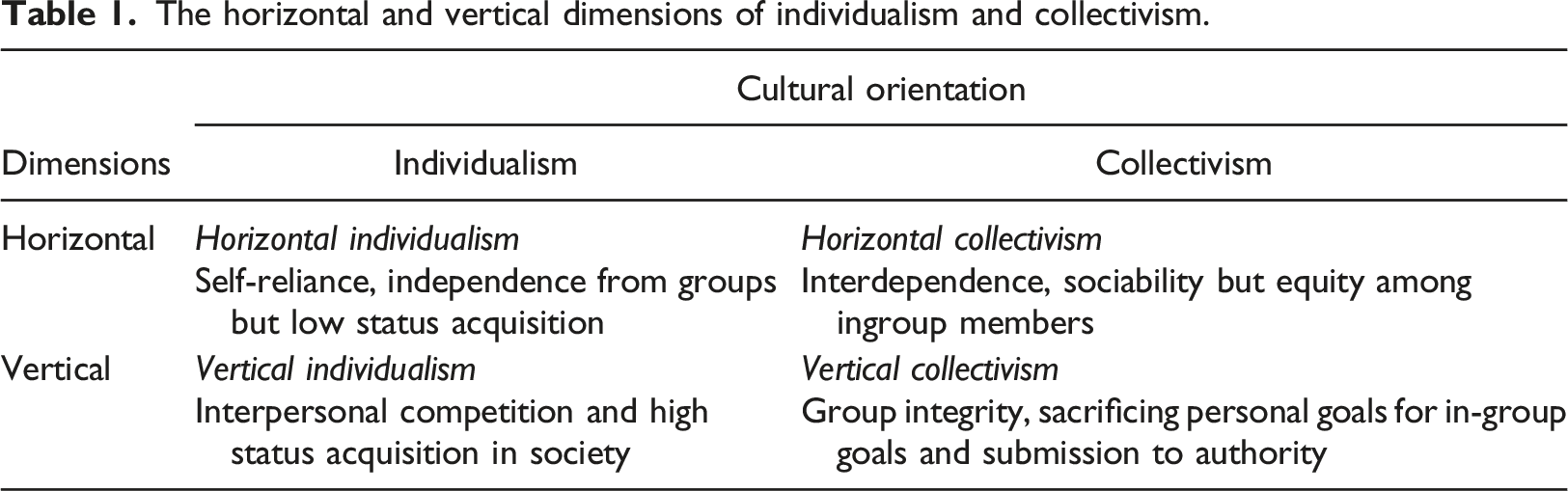
Horizontal collectivism assumes that members constituting a collective are the same in status. Thus, horizontal collectivism stresses interdependence, sociability but equity in society. Horizontal collectivists therefore see themselves as similar to others. As a result of this disposition, they do not easily submit to authority (Triandis and Gelfand, 1998). Although vertical collectivists regard themselves as part of the collective, they demonstrate a high level of acceptance of inequality in the collective, meaning, they acknowledge that some members of the collective have more status than others. Vertical collectivism therefore emphasizes hierarchy. Unlike horizontal collectivists, vertical collectivists hold greater respect for authority. In the case of horizontal individualist, equality is emphasized but the individuals put up an attitude of self-reliance rather than as an integrated member of the collective. Vertical individualism reflects an emphasis on interpersonal competition where individuals regard themselves as autonomous competing with other members in the society in order to improve their status and outperform them (Gardner et al., 2009).
The horizontal versus vertical individualism-collectivism value framework has a strong theoretical foundation, received empirical support and although theoretically aligned to Hofstede’s cultural dimension, it is regarded as the “most sophisticated conceptualization and operationalization of the two basic cultural values - individualism and collectivism - as they manifest at the individual level” (Gardner et al., 2009: p. 440). This framework also integrates two cultural dimensions proposed by Hofstede (i.e., individualism-collectivism and power distance). However, in terms of extra-role behaviour in a collectivist society, which is of interest in this study, past research has shown that horizontal collectivism plays a more pivotal role compared with vertical collectivism (see, e.g., Booysen et al., 2021; Shavitt et al., 2011). The reason is that persons with horizontal collectivism orientation are particularly driven to maintain benevolent relationships to foster sociability with in-groups (Shavitt et al., 2011; Soh and Leong, 2002). An experiment by Booysen et al. (2021) involving 133 laboratory subjects in South Africa supports the notion that horizontal collectivism is associated with greater preferences for prosocial behaviour such as altruism. In view of past research findings, this study explores horizontal collectivism as an important boundary condition that influences the effects of LMX on employees’ citizenship behaviour. The hypothesized model for the study is illustrated in Figure 1, and the following section discusses the model in detail. Hypothesized model of relationships.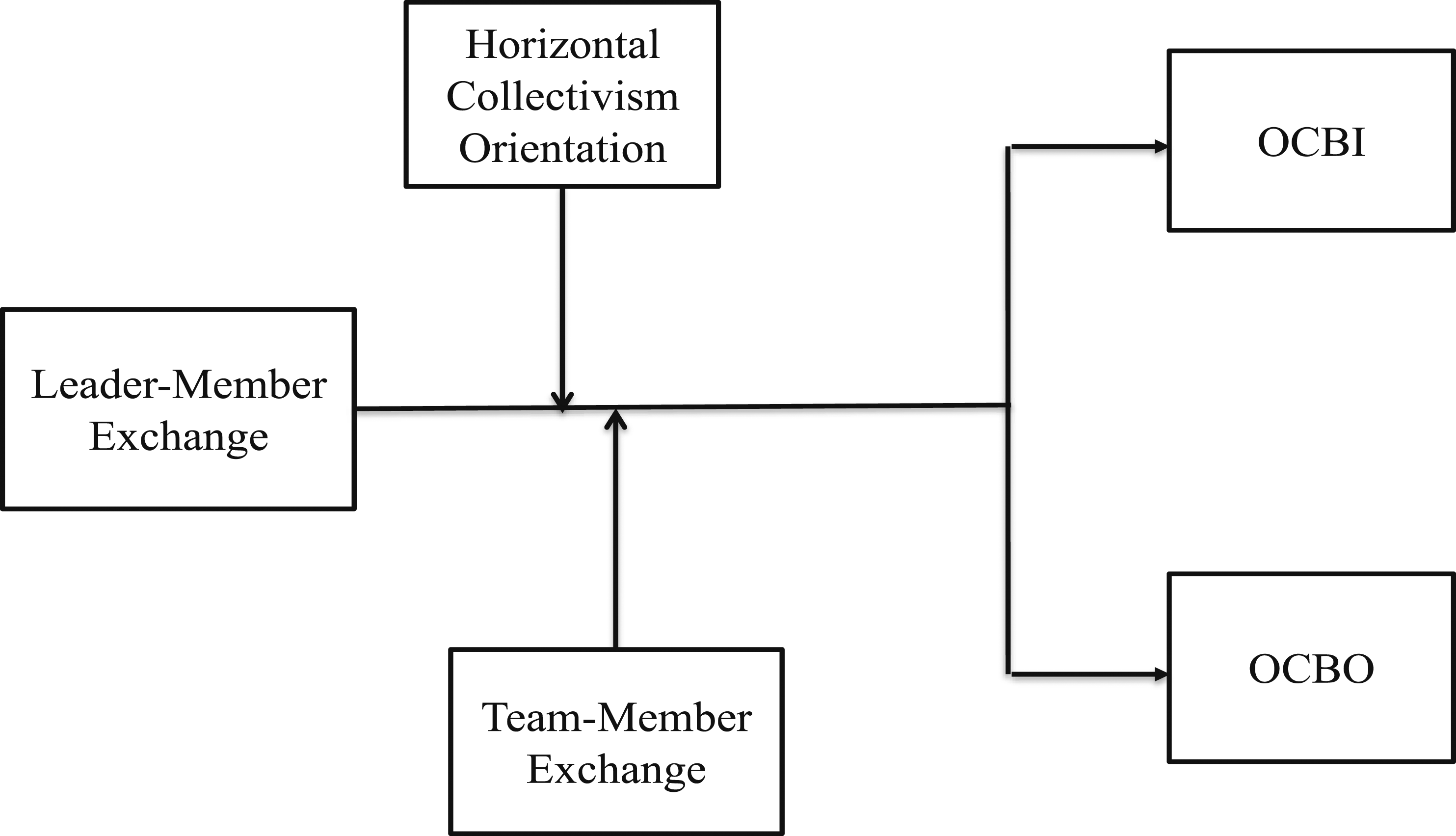
Leader-member exchange and organizational citizenship behaviour
OCB in this present study aligns with Organ’s (1997) conceptualisation as “performance that supports the social and psychological environment in which task performance takes place” (p. 95). Depending on who benefits from citizenship behaviour, two main types of OCB can be distinguished – OCBI and OCBO where the suffixes I and O refer to individual and organization, respectively. OCBI refers to the kind of helping behaviour that is directly targeted at specific individuals in the organization, for example, an employee voluntarily taking over the job of a co-worker who is absent from work. OCBO refers to employees’ helping behaviour that benefits the organization as a whole. An example of OCBO is employees complying with rules that have been instituted, albeit informally, as a way of maintaining orderliness or an employee defending the organization to outsiders. The distinction is that the OCBO is targeted at the organization in the sense that it is meant to benefit the organization directly. OCBI is targeted at individuals within the organization such that it is meant to benefit the individual although in the long run, the benefit to the individual would also inure to the benefit of the organization.
In the LMX literature, past studies have examined the effects of LMX quality on such work outcomes as OCB. These studies, synthesized by important meta-analysis, have shown that LMX is positively associated with OCB (Rockstuhl et al., 2012). Past research mainly invokes social exchange theory (Blau, 1964) as well as norms of reciprocity (Gouldner, 1960) to explain the consequences of the kind of treatment that leaders provide to subordinates. This is particularly used in the case of the outcomes of high-quality LMX in an organizational context.
The social exchange process starts when an organizational actor or a party (such as a supervisor) initiates an action towards a target individual (such as a subordinate). Depending on the kind of treatment provided by the organizational actor, the target individual would reciprocate with commensurable response. According to the logic of social exchange theory, if one party initiates positive action (e.g., providing organizational support), the other party would reciprocate with desirable behaviour (such as extra role behaviour). However, a negative initiating action (e.g., abusive supervision, incivility) would attract negative reciprocating responses such as counterproductive behaviour like employee withdrawal (Cropanzano et al., 2017).
As the parties engage in a series of positive reciprocal exchanges, an economic exchange relationship (which tends to be quid pro quo) would be transformed into a high-quality social exchange relationship (i.e., helping behaviour that goes beyond the economic sense of reciprocity to include social exchanges such as the provision of emotional support). The resultant effect of the social exchange is that the target individual becomes committed to the organization and is likely to engage in extra role behaviour (Cropanzano et al., 2017). The aspect of the principle of reciprocity in social exchange theory is regarded as a key component of LMX as it explains the intention of leaders in providing high-quality exchange to their members. The members subsequently react in the form of participating in voluntary actions that go beyond the basic expectations of them in the organizational setting (Erdogan and Bauer, 2014).
In line with the logic of social exchange theory, employees would reciprocate a leader’s treatment by putting up some attitudes and behaviours. If the supervisor treats a subordinate favourably, the subordinate would in turn reciprocate with desirable work outcomes. One such desirable work outcome is extra-role behaviour that would enable the supervisor to achieve his or her work objectives (Kamdar and Van Dyne, 2007). Some scholars, for instance, posit that since high-quality LMX is characterized by high levels of trust and respect, employees in high-quality LMX relationships interpret initiatives of their supervisors in a positive light and may go the extra mile to support them to succeed (Alfes et al., 2013). Going beyond role requirements, but in support of a supervisor’s performance targets could include employees’ providing extra support not only directly to the supervisor but also to other workgroup members (i.e., OCBI) and the organization as a whole (i.e., OCBO). However, we expect LMX to be a better predictor of OCBI than OCBO based on the following reasons: First, past research shows that LMX holds special relevance in relation to behaviours targeted at the supervisor (Kamdar and Van Dyne, 2007). This suggests that LMX has differential effects in the workplace with its effect likely to be higher for individuals, especially the immediate supervisor of a focal employee. Second, existing research further indicates that, in a collectivist society, people generally prioritize harmonious relationships with others (Erdogan and Liden, 2006; Liu et al., 2021). Hence, the tendency for employees to provide direct extra support to individual members, particularly in-group members, would be higher than the organization per se. Based on this reasoning, the following hypothesis is suggested:
LMX is positively related to (a) OCBI and (b) OCBO, but (c) the effect of LMX will be higher for OCBI than OCBO in a collectivist context.
The moderator role of subordinates’ cultural value orientation on the relationship between leader-member exchange and OCBI/OCBO
Past research suggests that the extent to which LMX relates to work outcomes differs across cultures. In their meta-analysis, Rockstuhl et al. (2012) reported that a strong correlation exists between LMX and some work outcomes in individualist cultures (e.g., USA, UK) but this is significantly weaker in collectivist cultures (e.g., China, Ghana). Specifically, the relationship between LMX and OCB was found to be stronger in Western cultures (correlation of 0.35) than the relationship between LMX and OCB in non-Western cultures (correlation of 0.28) (t = 2.36, p < .01) (Rockstuhl et al., 2012). Thus, the nature of the relationship between LMX and work outcomes varies among different cultural contexts (see also, Yu et al., 2018). These empirical findings naturally raise questions about factors accounting for the weak relationship between LMX and OCB in collectivist contexts. Based on their meta-analytic results, Rockstuhl et al. (2012) indicated that national culture affects the relationship between LMX and some of its well-known correlates such as OCB. Within LMX research, individualism and power distance have been explored as moderators of relationships between the quality of leader-member exchange relationships and work outcomes. In another important meta-analytic review, Dulebohn et al. (2012) found that individualism and power distance moderate the link between LMX quality and employee attitudes (such as leader trust in the follower).
Besides cultural values at the national level, other studies have identified employees’ cultural value orientation as a boundary condition that influences the leadership process. For instance, based on a survey of 560 followers linked to 174 leaders in China and the USA, Kirkman et al. (2009) found that followers’ power distance orientation moderated the relationship of transformational leadership with procedural justice such that the relationship was more positive when power distance orientation was lower. Further, based on matched multi-source sample data gathered from supervisors and their subordinates working in a South African multinational that operates in several African countries, Strydom (2021) established that horizontal collectivism positively moderated the relationship between ethical leadership and OCB but this relationship was negatively moderated by horizontal individualism and vertical collectivism. These results suggest that cultural value orientation matters in explaining the magnitude of the effects of LMX on OCB. However, as earlier pointed out, several studies have shown that the horizontal dimension of collectivism instead of the vertical dimensions is more effective in positively moderating the relationship between extra-role behaviours and their predictors in organizational settings (Booysen et al., 2021; Shavitt et al., 2011; Soh and Leong, 2002). This is based on the observation that vertical collectivists are driven by conformity values whereas horizontal collectivists are driven by benevolence values, meaning, individuals who subscribe to horizontal orientation are especially motivated to maintain benevolent relationships in order to ensure sociability with in-groups (Booysen et al., 2021; Shavitt et al., 2011). Despite this research finding, the existing literature has not fully explored horizontal collectivism as an important boundary condition in the link between LMX and OCB. As we argue below, horizontal collectivism explains the magnitude of the effects of LMX on employees’ citizenship behaviour in a non-Western context.
Consistent with the tenets of social exchange theory, LMX theory suggests that work-related behaviours of followers depend on a leader’s treatment towards followers (Rockstuhl et al., 2012). The logic of the norm of reciprocity underlying social exchange relationships presupposes that when a leader’s treatment towards subordinates is undesirable, the subordinates would in turn respond by putting up counterproductive work behaviour. However, empirical evidence has shown that the assumption of reciprocity underlying social exchange relationships is generally not too effective in collectivist societies as leaders’ treatment towards their members does not have a strong impact on their citizenship behaviour in the workplace (Rockstuhl et al., 2012). This is because first, in collectivist societies, people generally have the desire to maintain harmonious relationships even if the cost of the relationship outweighs the benefits derived from the relationship (Erdogan and Liden, 2006). Second, in collectivist societies, people are socialized from childhood to fulfil some social norms. Children for instance are expected to show respect and loyalty towards their parents and traditional leaders. This social role is expected to be reflected in the organizational context where subordinates are supposed to remain loyal and obedient to their supervisors (Chen et al., 2009; Jiang and Cheng, 2008). It is however noteworthy that there are dimensions to collectivism which can affect the impact of a leader’s treatment on members’ work-related behaviour. Given the tendency of a horizontal collectivist to see the self as equal to others in society, horizontal collectivists do not easily submit to authority (Gardner et al., 2009; Triandis and Gelfand, 1998). Consequently, employees who display horizontal collectivism would strongly react to the kind of treatment provided by the leader towards such employees. Based on this reasoning, the following hypothesis is suggested:
Horizontal collectivism significantly and positively moderates the relationship between (a) LMX and OCBI and (b) LMX and OCBO
The moderator role of team-member exchange on the relationship between leader-member exchange and citizenship behaviour directed at individual organizational members/citizenship behaviour directed at the organization as a whole
The study of relationship quality and its consequences in the workplace is incomplete without attention to exchanges among work group members. This is because relationships in the workplace are not only limited to the dyadic exchanges between leaders and followers but also include exchanges among the work group (Schermuly and Meyer, 2016). The theory and research examining horizontal exchange relationships have been labelled variously such as Co-worker Exchange (CWX), Member-to-Member Exchange (MMX) and Team-Member Exchange (TMX). Despite the different labels, all of these terms focus on the quality of the exchange relationship between members in a workgroup (Love and Forret, 2008). Although these three labels are essentially defined in the same way, TMX is commonly used. For this simple reason, it is this label (i.e., TMX) that is adopted for the current study.
Scholarly work on Team-Member Exchange (TMX) has particularly been influenced by Seers (1989) in which TMX is seen as an individual employee’s “perception of his or her exchange relationship with the peer group as a whole” (Seers, 1989: p. 119). Further, Seers and colleagues conceptualised TMX quality as an assessment of “the reciprocity between a member and his or her team with respect to the member’s contribution of ideas, feedback, and assistance to other members and, in turn, the member’s receipt of information, help, and recognition from other team members’ (Seers et al., 1995: p.21). Research has shown a positive and significant relationship between LMX and TMX. A meta-analytic review of team and leader social exchange found a parameter estimate of the correlation between LMX and TMX to be 0.37 (Banks et al., 2014). Although both TMX and LMX draw on the underlying assumptions of social exchange theory, they are theoretically and empirically distinct since TMX has a focus on entire work group members while LMX has a dyadic focus (Schermuly and Meyer, 2016). In spite of its conceptual closeness to LMX, until recently, TMX received far less attention in the leadership literature compared to the former. However, if we are to gain a deeper and better appreciation of LMX, especially its effects on work-related outcomes in collectivist contexts, then it is necessary to integrate LMX with TMX. It is important to note that TMX is not only applicable to self-managing teams but also applies to traditional workgroup settings (Love and Forret, 2008).
LMX theory lays greater emphasis on the prominent role of a leader in the exchange process. This is not surprising because leaders by virtue of their position wield enormous power and authority in the exchange of resources. These resources are desired by the followers but cannot be easily obtained elsewhere. However, followers have an important albeit supportive role in the exchange process. In non-Western societies where collectivism is high (Hofstede, 2011; Javidan et al., 2006), the quality of exchange relationship between leaders and followers is as crucial as the social exchange relationship among co-workers (Schmermuly and Meyer, 2016). Research, for instance, has shown that in organizations where high levels of TMX exist, there is mutual trust, a sense of belonging, community and bond, translating into the willingness of co-workers to support one another (Love and Forret, 2008).
High-quality TMX is therefore associated with psychological benefits (Schmermuly and Meyer, 2016) and socio-emotional support among peer members (Liu et al., 2011). Accordingly, some studies have identified TMX as an important boundary condition that can make OCB more impactful. For example, empirical evidence has shown that the effect of relative TMX quality on helping OCB via identification with co-workers was moderated by group average TMX such that the relationship was stronger under high rather than low group average TMX (Farmer et al., 2015). In another study, it was found that the positive effect of organizational identification on OCB was strengthened by high-quality TMX (Liu et al., 2011).
Drawing from past research, it is logical to propose that the quality of lateral exchanges in the workplace would change the magnitude of the impact of LMX on employees’ citizenship behaviours. This is based on the argument that the extent to which employees engage in OCB depends on some opportunities (Organ et al., 2006). Work team is regarded as a key context that provides opportunities for employees to engage in OCB (Farmer et al., 2015; Liu et al., 2011). As high-quality TMX is characterised by social exchange, team members have a high willingness to provide extra support to their peers which will benefit the organization. Contrarily, due to the low level of reciprocity characterising low-quality TMX, members will restrict exchanges to the standard necessary to just complete a job (Liu et al., 2011). These observations suggest that a good working relationship among co-workers could interact with the quality of LMX to increase the tendency of employees to engage in extra-role behaviour in the organizational setting. Extending this argument to the leadership process, we expect TMX quality to augment the positive influence of LMX on both individual- and organization-directed citizenship behaviour. On this basis, the following hypothesis is suggested:
TMX significantly and positively moderates the relationship between (a) LMX and OCBI and (b) LMX and OCBO.
Methodology
The study employed a quantitative cross-sectional survey involving multiple organizations selected from three major sectors of the Ghanaian economy – agricultural, industrial and services sectors. As a country located in sub-Saharan Africa, Ghana typifies a collectivist society (Hofstede, 2011) and therefore is suitable for the context, that is, horizontal collectivism, within which this study is situated. The study participants, measures (scales used) and analytical techniques are described next.
Participants and procedures
Study participants comprised employees and their immediate supervisors in the selected organizations. In addition to securing approval from the national headquarters of the selected organizations, consent of individual respondents was obtained before engaging them in the survey. A total of 445 paired questionnaires were received, constituting a final effective response rate of 67.4%. However, following preliminary analyses of the data (missing data, univariate and multivariate outliers), a total of 392 paired questionnaires were retained for hypotheses testing. Among the employees, 38% were female and the average age was 33 years. Among the supervisors, 26% were female and the average age was 47 years.
Measures
The study relied on existing scales with strong psychometric properties. All the measures were rated on a 5-point Likert-type scale ranging from 1 (strongly disagree) to 5 (strongly agree).
Leader-member exchange
We used Liden and Maslyn’s (1998) 12-item scale to measure LMX. This scale comprises four dimensions – affect, loyalty, contribution and professional respect. Sample items include “I like my supervisor very much as a person” (affect); “My supervisor would come to my defence if I were ‘attacked’ by others” (loyalty); “I do work for my supervisor that goes beyond what is specified in my job description” (contribution); “I am impressed with my supervisor’s knowledge of his/her job” (professional respect). Cronbach’s alpha was 0.87 for this scale.
Team-member exchange
We used Seers et al.’s (1995) 10-item scale to measure TMX. A sample is “I am willing to help my co-workers finish work assigned to them”. Cronbach’s alpha was 0.73 for this scale.
Horizontal collectivism
We used Singelis et al.’s (1995) 8-item scale to measure horizontal collectivism. A sample item is “It is important that I maintain harmony within a group I belong”. Cronbach’s alpha was 0.76 for this scale.
Citizenship behaviour directed at individual organizational members & citizenship behaviour directed at the organization as a whole
Supervisors rated the citizenship behaviours of each of their employees using a 16-item scale developed by Lee and Allen (2002). The scale comprises two dimensions – OCBI & OCBO. For the OCBI, a sample item is “this employee goes out of his/her way to make newer employees feel welcome in the organization”. Cronbach’s alpha was 0.89 for the OCBI sub-scale. A sample item in the OCBO sub-scale is “this employee attends organizational functions even if not compulsory”. Cronbach’s alpha was 0.76 for the OCBO sub-scale.
Analysis and results
A confirmatory factor analysis (CFA) was conducted to determine the validity of the measures. This was followed by testing the theoretical model using the default method of Maximum Likelihood in AMOS 23. The model testing was in two parts – direct effects and moderator effects. In the case of the moderator testing, three stages were involved. Following Frazier et al. (2004), the first step was to transform the predictor variable (LMX), moderator variables (HC & TMX) and outcome variables (OCBI and OCBO) by standardizing them. This was done through SPSS 23. The second step involved the creation of product term that represented the interaction between the predictor variable (LMX) and each of the moderator variables (HC & TMX). The last step involved structuring the equation to test for moderator effects through the use of AMOS 23. This can be performed through hierarchical multiple regression or structural equation model (SEM). The use of SEM to examine moderator effects has been recommended since it is able to control for unreliability in measurement (Frazier et al., 2004). The standardized predictor and moderator variables, and a multiplicative term that reflects the interaction between the predictor and moderator, were entered into the AMOS software to examine the moderator effects of HC and TMX.
Results
Descriptive statistics and correlations.
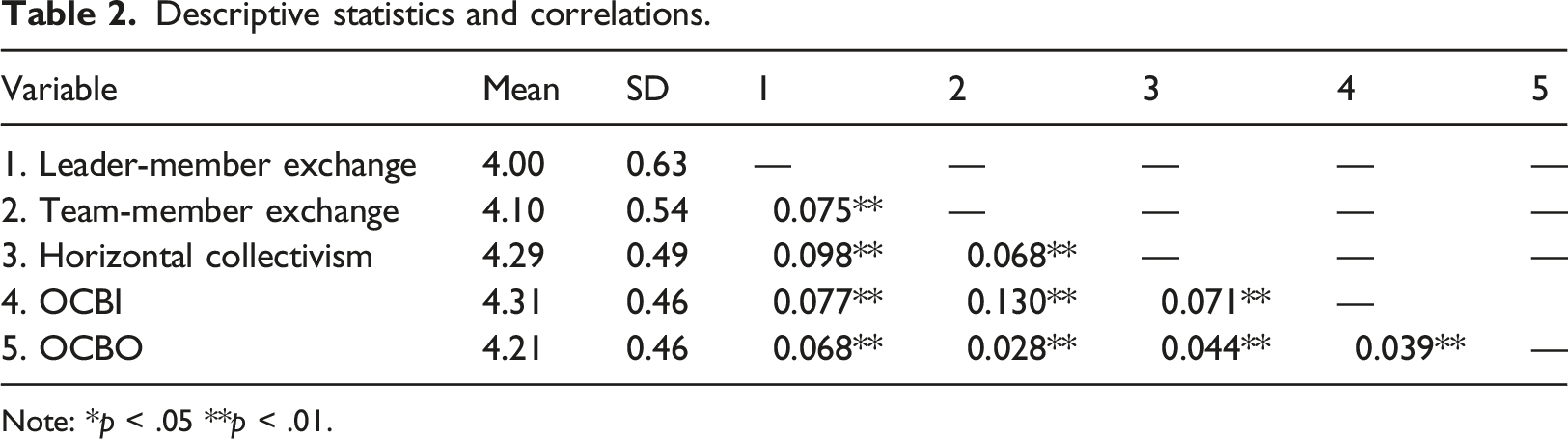
Note: *p < .05 **p < .01.
Construct reliability and validity of measures.
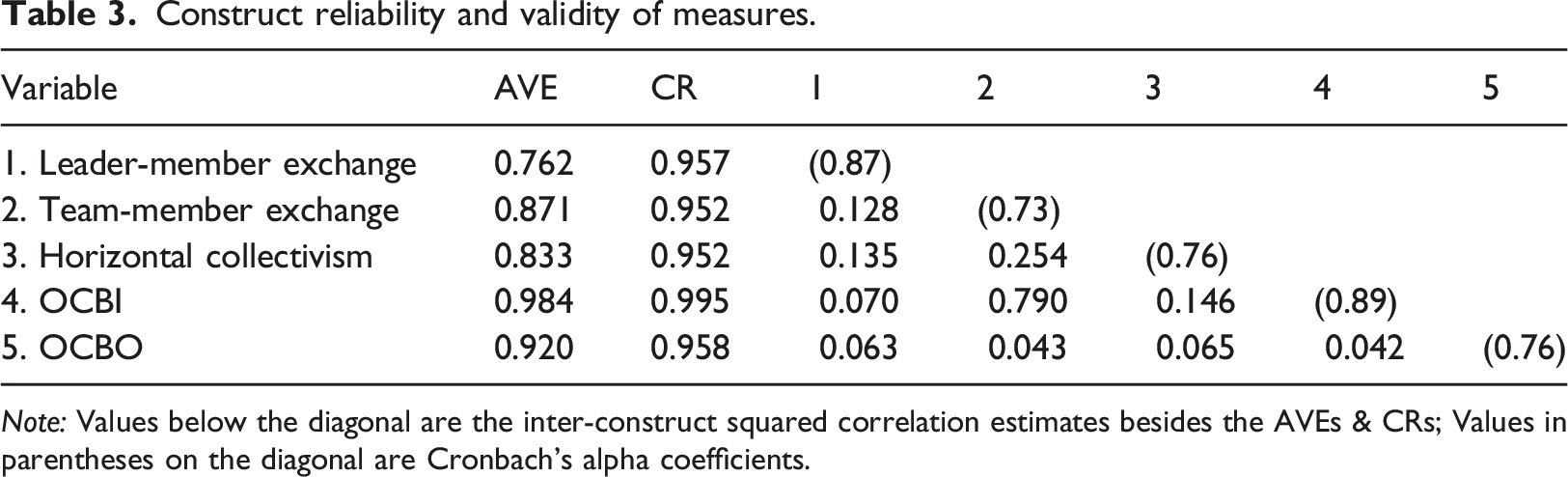
Note: Values below the diagonal are the inter-construct squared correlation estimates besides the AVEs & CRs; Values in parentheses on the diagonal are Cronbach’s alpha coefficients.
In view of the observation that LMX may suffer from endogeneity bias (Gottfredson et al., 2020), the Hausman (1978) test was performed using ‘gretl’ software. The Hausman test is based on the null hypothesis that the explanatory variables are exogenous. If the difference between the Ordinary Least Square (OLS) and Instrumental Variable (IV) estimates is significantly different from zero, then the null hypothesis is not supported (see also, Güntner et al., 2020). Thus, the guiding rule of thumb is that the p-value should exceed the traditional 0.05 level to suggest the absence of endogeneity. By regressing the endogenous variable (OCBI) on the explanatory variables, the Hausman Test yielded χ2 [2] = 5.019, p = .081. Again, by regressing the endogenous variable (OCBO) on the explanatory variables the Hausman Test yielded χ2 [2] = 0.521, p = .771. These results address the potential threat of endogeneity, hence we proceeded to test the research hypotheses by structural equation model.
Hypotheses testing
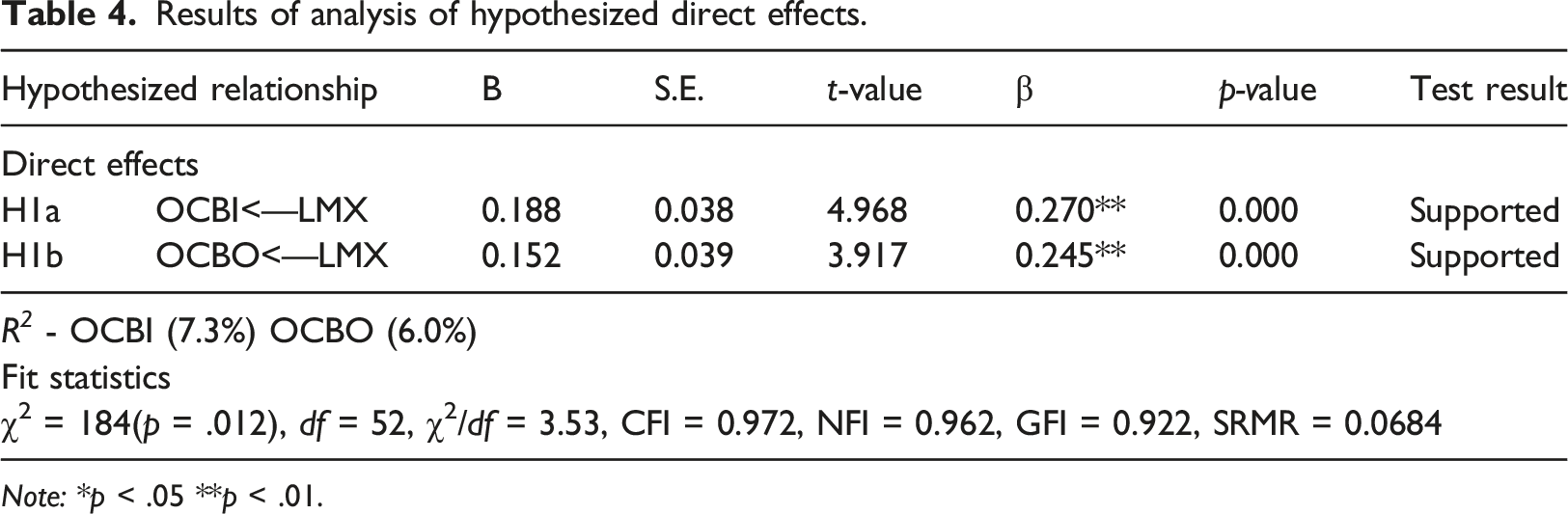
Results of analysis of hypothesized direct effects.
Note: *p < .05 **p < .01.
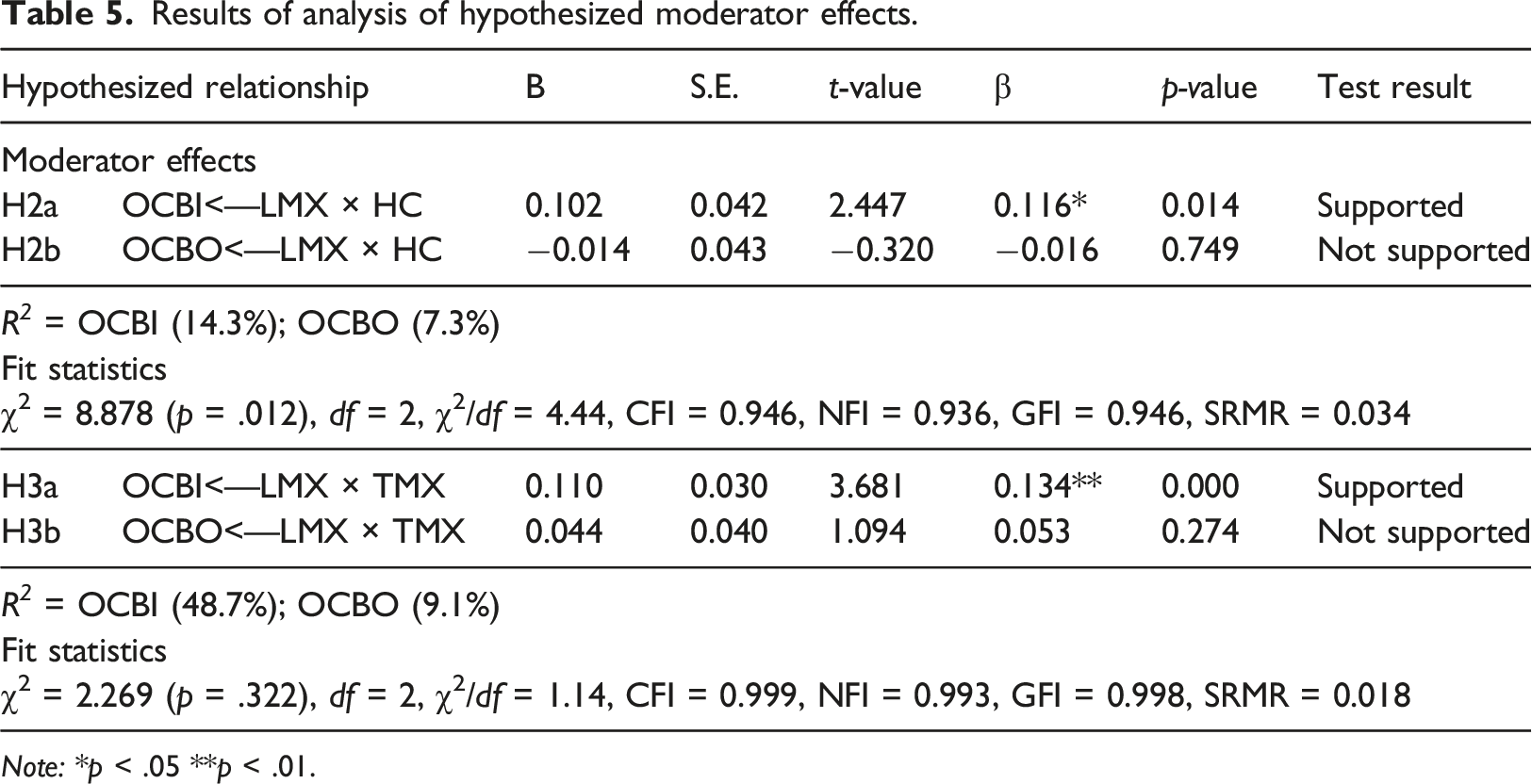
The positive relationship between LMX and OCBI/OCBO was hypothesized to be moderated by two variables – horizontal collectivism and Team-Member Exchange. These moderator variables were measured using a continuous scale. In order to maintain the true nature of these scales, the analysis of the moderator effects was based on interactive term instead of the use of cut-points or multi-group analysis. It is important to emphasize that with regard to interpreting results of moderator tests, it is recommended that the unstandardized estimates (B) are used rather than reporting the standardized estimates (β) (Frazier et al., 2004). This is because in equations that involve interaction terms, the β estimates are not properly standardized since they represent the product of already standardized variables. As a result, β estimates are considered not interpretable (Cohen et al., 2013; Frazier et al., 2004).
Results of analysis of hypothesized moderator effects.
Note: *p < .05 **p < .01.
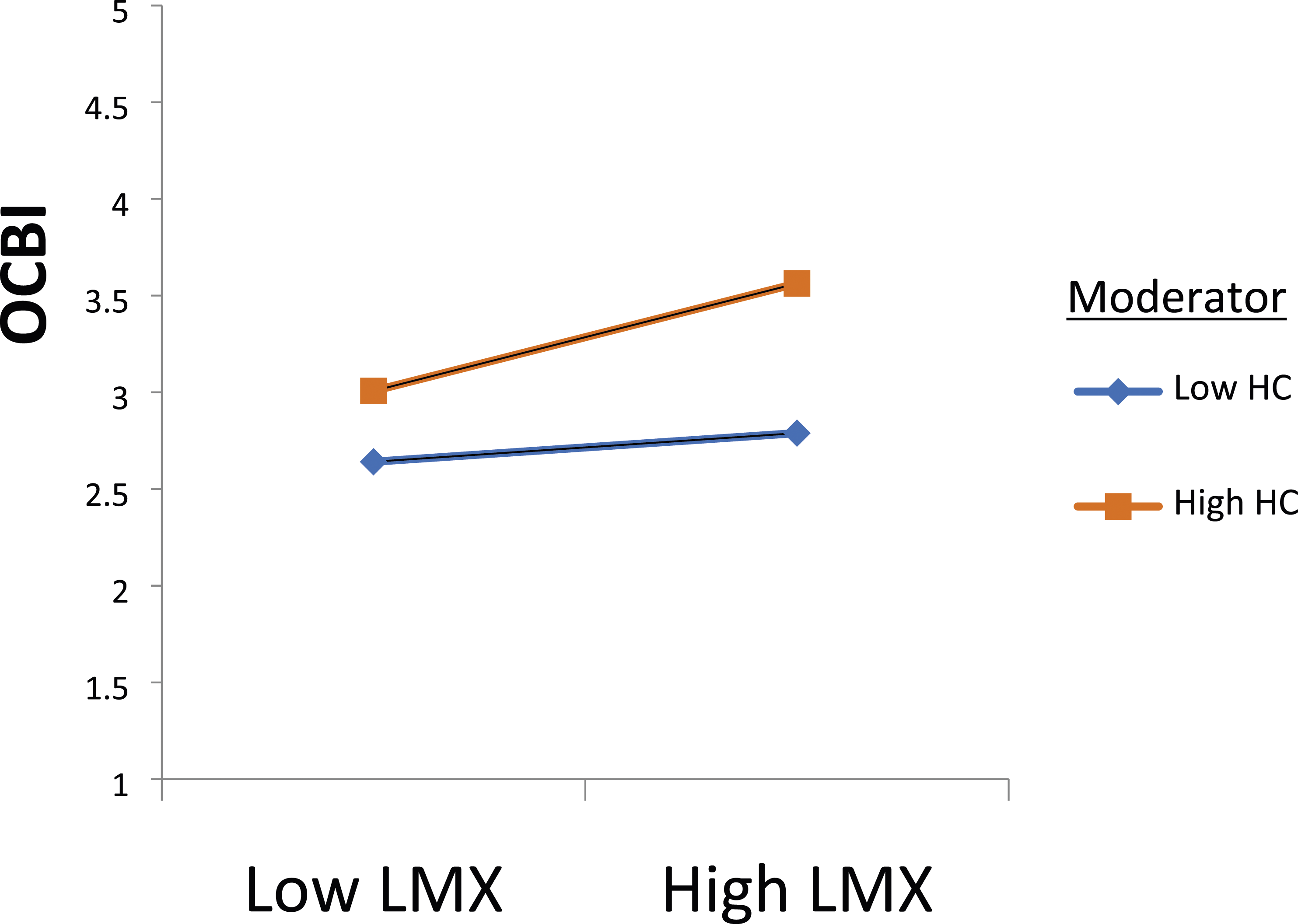
Two-way moderator effects of horizontal collectivism on LMX-OCBI relationship.
Lastly, TMX was hypothesized to moderate the positive relationship between LMX and OCBI (Hypothesis 3a) as well as LMX and OCBO (Hypothesis 3b). Although the level of analysis is at the group level, data was gathered from individual study participants. In order to justify aggregation, a measure of interrater agreement (i.e., rWG) was computed. The average rWG exceeded the 0.70 threshold suggested by James et al. (1984). This indicates that the raters for each team highly agreed on the quality of the exchanges among co-workers. Thus, aggregation of the TMX construct to the group level was considered justifiable. The results of the moderator testing of TMX showed significant moderator effect of TMX on LMX-OCBI relationship (B = 0.111; p = .000). Therefore, Hypothesis 3a was supported. However, contrary to expectation, the moderator effect of TMX on the relationship between LMX and OCBO was found to be insignificant (B = 0.044; p > .1). Hence, Hypothesis 3b was not supported (Table 5). To aid interpretation of the results, Figure 3 illustrates the moderator effects of TMX on the LMX-OCBI relationship. The graph shows that relationship of LMX quality to OCBI is stronger under high TMX context. Two-way moderator effects of TMX on LMX-OCBI relationship.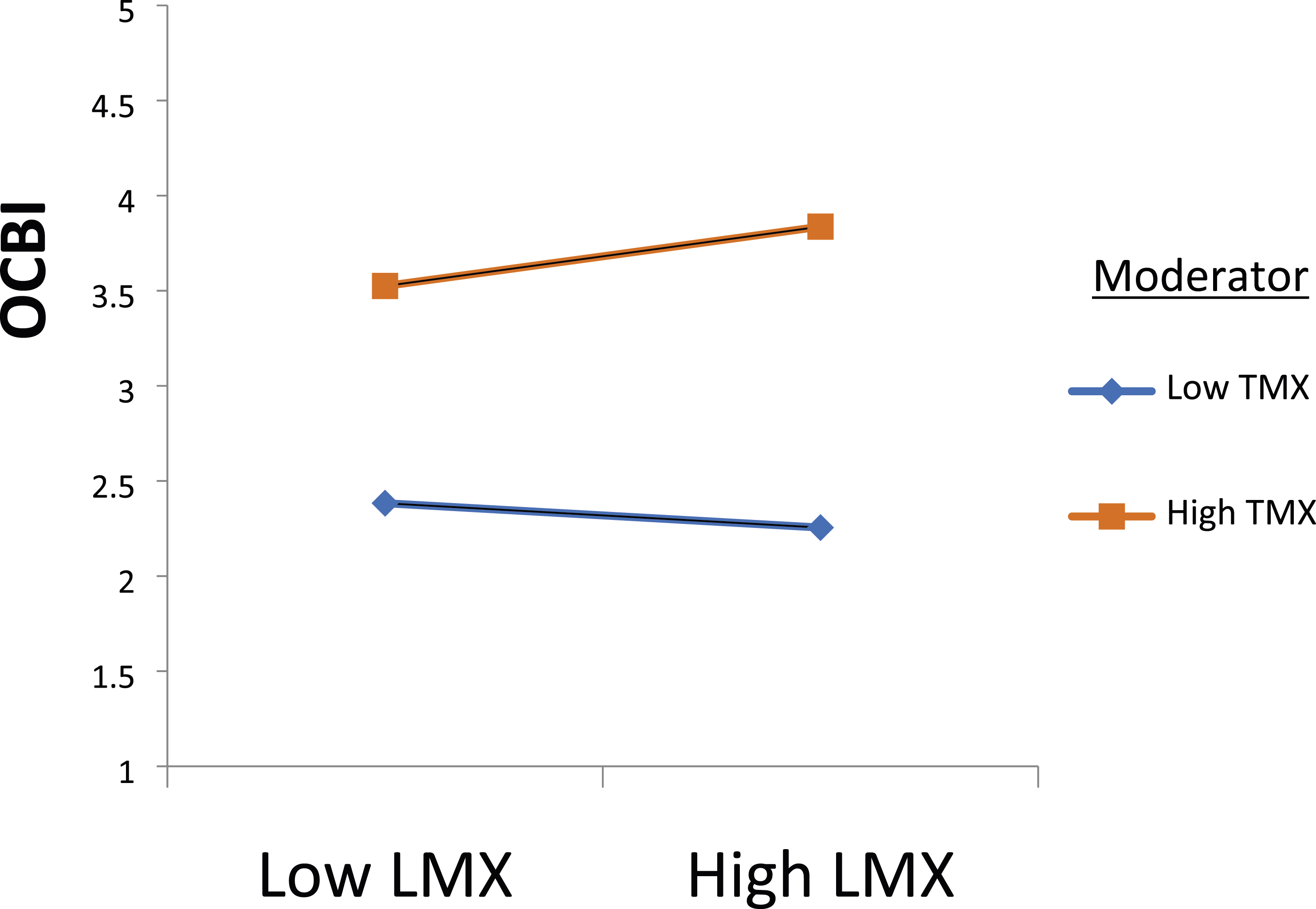
Discussion
Drawing from social exchange theory (Blau, 1964) and reciprocity norms (Gouldner, 1960), this study extends prior knowledge by examining the influence of LMX on specific dimensions of OCB (i.e., OCBI and OCBO) instead of the overall OCB which has been the focus of previous research (Martin et al., 2016; Rockstuhl et al., 2012). By disaggregating OCB into the two conceptually and empirically established distinct dimensions, it was expected that LMX would be more predictive of OCBI compared with OCBO. This was based on the argument that LMX has differential effects in organizational settings, with a higher likelihood of effect on individuals, particularly in collectivist societies where the importance of maintaining good relationships with fellow human beings is strongly emphasized (Erdogan and Liden, 2006; Liu et al., 2021). Although the standardized regression coefficient of LMX-OCBI was slightly higher than the LMX-OCBO relationship, the difference was not statistically significant. This is contrary to our expectations, but it is not too surprising. From the Perceived Organizational Support (POS) perspective (Eisenberger et al., 1986), leaders represent an important proxy for the organization, hence the support provided by the leaders may be perceived as support from the organization. The lack of significant difference between the effect of LMX on both OCBI and OCBO therefore suggests that employees prioritize citizenship behaviours directed at both individuals and the organization in response to the high-quality exchange relationships with their leaders.
Further, the study’s findings when compared with prior studies (e.g., meta-analytic results by Rockstuhl et al. (2012)) suggest that the impact of LMX on employees’ citizenship behaviour in collectivist societies is not as strong as pertains to individualist ones. The influence of LMX on both dimensions of OCB is marginal, explaining on average less than 8% of the variance in employees’ citizenship behaviours. By introducing new moderators (horizontal collectivism at the individual level and TMX at the group level) in the relationship between LMX and OCBI/OCBO, this study extends previous research by demonstrating conditions under which the LMX-OCB relationship can be magnified.
One of the most interesting findings is that horizontal collectivism moderates the relationship between LMX and OCBI. The study proposed and found support for the moderating influence of horizontal collectivism as an explanation for the attenuated relationship between LMX and employees’ citizenship behaviour in a non-Western context. The results therefore support the notion that individually held cultural value dimensions of collectivism help in enhancing understanding of the way and manner in which LMX impacts relevant outcomes in the workplace (Lee et al., 2014).
The literature has long acknowledged that non-Western societies are generally collectivist compared to Western societies which are broadly classified as individualist. This was emphasized in Hofstede’s pioneering work in the 1980s and has been supported by several subsequent studies (Hofstede, 2011; Javidan et al., 2006). This study however proceeded from the premise that there are individually held cultural values which may or may not align with the national cultural values. That is to say, there are individuals in each society whose cultural values may be higher or lower than the average national cultural value. With a focus on individual-level analysis rather than national-level analysis, the horizontal versus vertical collectivism typology proposed by Triandis and colleagues (Triandis et al., 1998; Triandis et al., 1995) was considered an appropriate framework for understanding the relevance of employees’ citizenship behaviour to LMX relationships. In view of the observation that horizontal collectivists emphasize equality (Gardner et al., 2009), it was posited that a stronger relationship exists between LMX and citizenship behaviours for individuals who subscribe to horizontal collectivism.
Whereas the moderator effect of horizontal collectivism on the LMX and OCBO relationship was not supported, the results showed a significant moderator effect of horizontal collectivism in the link between LMX and OCBI. This suggests that the extent to which individuals subscribe to horizontal collectivism moderates the LMX and OCBI relationship. This finding supports the observation that although maintaining relationships is important for horizontal collectivists, because of the tendency to see themselves as equal in status to others in society, individuals high in horizontal collectivism are sensitive to the treatment provided by their leaders in the workplace. Accordingly, the citizenship behaviour of horizontal collectivists in the workplace is contingent on the personal relationship with the supervisor (Gardner et al., 2009). Therefore, the extent to which LMX translates into citizenship behaviour in non-Western society varies as a function of employees’ cultural value orientation.
Similar to the significant moderator effect of horizontal collectivism on the LMX and OCBI relationship, another important finding is that TMX was identified as a key factor capable of enhancing the nature of the relationship between LMX and OCBI. This again suggests that the predictive ability of LMX on citizenship behaviour in non-Western societies can be enhanced by considering the quality of exchanges not only between leaders and their members (vertical exchanges) but also the quality of exchanges among co-workers (horizontal exchanges). The implication here is that TMX is beneficial in augmenting the positive impact of LMX on citizenship behaviours targeted at individuals in the organization. TMX was also expected to moderate the LMX and OCBO relationship but the results did not support the moderator effect of TMX in the link between LMX and OCBO. A plausible explanation behind the non-significant moderating effect of LMX on organizationally-referenced citizenship behaviour is that as TMX pertains to the extent of reciprocity among peers, it may hold special relevance in terms of extra-role behaviours targeted at co-workers than the organization as a whole (Kamdar and Van Dyne, 2007). The emergence of this finding suggests that further research is needed to confirm the relevance of TMX in the link between LMX and organizationally directed citizenship behaviour.
Theoretical contributions
This study makes several important contributions not only to the LMX literature but also to the broader organizational and cross-cultural management scholarship. First, the study contributes to extending the relevance of LMX theory to a non-Western context particularly in shedding light on the cultural boundaries of exchange relationships in vertical dyads. Fundamentally, researchers have little understanding about why a weak relationship exists between LMX and employees’ citizenship behaviours in non-Western societies but strong in Western societies. This study has contributed to building context into LMX theory and research by specifically examining a contextual variable (i.e., horizontal collectivism) which prevails in non-Western societies (Hofstede, 2011; Javidan et al., 2006). The study presents horizontal collectivism as an explanation of the attenuated relationship between LMX and employees’ citizenship behaviour. By providing evidence of the role of horizontal collectivism in the link between LMX and citizenship behaviour, this study draws attention to individually held cultural values as a theoretical lens to understand the influence of LMX on relevant work outcomes, particularly citizenship behaviours in non-Western societies.
Second, the study examined TMX which is an under-researched area in the LMX literature. The results of the study offer support for the prediction that the role of high-quality LMX in influencing OCBI is more salient under a high TMX context. The findings of the study therefore suggest that in a collectivist society where people place greater emphasis on maintaining harmonious relationships with one another, the quality of the exchange relationship among co-workers strengthens the predictive validity of LMX on employees’ citizenship behaviour. This research therefore extends the existing literature (Anand et al., 2018; Bowler et al., 2019; Dulebohn et al., 2012; Martin et al., 2016; Rockstuhl et al., 2012) by presenting TMX as a boundary condition of the effect of LMX on employees’ citizenship behaviour.
Third, the findings of the study add to a relatively small but growing literature on leadership in an African collectivist context. The African collectivist context is one of the under-researched areas in leadership, organizational and management scholarship. Compared to Western individualist societies, research on African collectivist societies remains scanty (Martin et al., 2016). This situation has created a knowledge gap in the extant literature. Several scholars (e.g. Pellegrini, 2015; Strydom, 2021) have therefore called for attention to the African collectivist context and the results from this study contribute to filling this knowledge gap. More specifically, the study explains differences in findings that have been observed between individualist and collectivist cultures concerning the relationship between LMX and employees’ citizenship behaviour.
Managerial implications
First, the study offers useful contributions to cross-cultural management in the form of providing managers, particularly expatriates who work in African collectivist societies, a basis to evaluate the citizenship behaviour of their employees. In today’s era of increasing globalization, many businesses have internationalized their activities. Consequently, managers often engage workforces of diverse cultural orientations. This situation requires an understanding of cultural diversity which is necessary for effective cultural diversity management. However, due to cultural differences, expatriates from Western countries working in non-Western ones often lack appreciation of nuances in the behaviours and attitudes of local employees (Abugre, 2018; Jackson, 2004). This confusion is fueled by Western-based theories that assume universal application and as such downplay important cultural boundary conditions. This study has shown that even within the same society, cultural value orientations differ, hence managers must take cues from cultural dimensions in evaluating the citizenship behaviours of employees.
Second, leaders who are familiar with past LMX research might think that their treatment towards members does not have a strong impact on the citizenship behaviour of employees in a collectivist society. However, the results of the study point to varied reactions of organizational members to the quality of exchange relationships they have with their leader. Employees who display horizontal collectivism are more sensitive to LMX quality than employees who do not. This implies that for employees who subscribe to high levels of horizontal collectivism, the supervisor can contribute to enhancing their citizenship behaviour through the show of professional respect which is a key currency in LMX relationships.
Third, the LMX theory suggests that due to time and resource constraints, leaders are unable to form high-quality exchange relationships with all members. While the leader may lack the time and resources to form high-quality vertical exchanges with each member, the present research has shown that leaders can enhance citizenship behaviour when they create an atmosphere that promotes high-quality exchanges among co-workers. This implies that leaders can enhance citizenship behaviour by focusing not only on vertical dyadic exchanges but also on the quality of horizontal exchanges in their organization. Thus, the importance of managers and supervisors promoting healthy relationships among subordinates (i.e., good quality TMX) has to be emphasized during training sessions for leaders that focus on relationship building in the workplace.
Limitations and directions for future research
Although this study has contributed to extending prior knowledge about dyadic relationships between supervisors and subordinates in several ways, there are some limitations of this research which need to be acknowledged. These limitations also point to possible areas for further research. The study was based on cross-sectional data but drawing causality from this research design is problematic. An alternative is a longitudinal survey which would make it possible to trace the pattern of quality of exchanges between leaders and members (vertical exchanges) and the quality of exchanges among co-workers (horizontal exchanges) over a period of time for the same subjects and establish their influence on employees’ citizenship behaviour. This approach is necessary to substantiate the causality in the present research model and the resulting set of hypotheses.
Second, data for the current investigation were collected from both supervisors and subordinates working together in organizations in Ghana which is classified as a collectivist society. However, the cultural value of collectivism exists in other sub-Saharan African countries besides Ghana. Hence, the model examined in this study should be re-examined in other similar sub-Saharan African contexts to establish the model’s explanatory power and generalizability of the present research findings.
Last but not least, this study was limited to citizenship behaviour as a direct consequence of LMX quality. While citizenship behaviour is a critical component of organizationally relevant outcomes, meta-analytic results have shown that the relationship between LMX and other relevant work outcomes (such as job satisfaction, justice perceptions, leader trust and turnover intentions) is stronger in Western societies than in non-Western societies (Rockstuhl et al., 2012). This suggests that cultural value orientations potentially influence the relationship between LMX and the work outcomes that were not part of this research. The logical next step forward is to include the above-mentioned outcome variables (job satisfaction, justice perceptions, leader trust and turnover intentions) in the analysis of the role of cultural value orientations in the quality of exchange relationship between leaders and their members.
Conclusion
This study set out to examine the consequences of LMX quality within the sub-Saharan African context of collectivism. The outcome variables were individually-referenced citizenship behaviour (i.e., OCBI) and organizationally-referenced citizenship behaviour (i.e., OCBO). The study further investigated the moderating role of subordinates’ horizontal collectivism and exchange quality among co-workers on the LMX-OCBI/OCBO relationships. Results of the study lead to the following conclusions: the impact of LMX on work outcomes is generally weak in a collectivist context. However, the configuration of individually held cultural value dimensions of collectivism has implications for the impact of LMX on employees’ citizenship behaviour. More specifically, the enactment of individually-referenced citizenship behaviour, as a consequence of LMX, is largely dependent on employees’ cultural value orientation. Further, the relationship between LMX and employees’ citizenship behaviour is strengthened by the quality of exchanges among co-workers. TMX therefore constitutes an important factor in enhancing the magnitude of the relationship between LMX and employees’ citizenship behaviour in collectivist societies.
Footnotes
Declaration of conflicting interests
The author(s) declared no potential conflicts of interest with respect to the research, authorship, and/or publication of this article.
Funding
The author(s) received no financial support for the research, authorship, and/or publication of this article.
