



Abstract
Laplace P-splines (LPS) combine the P-splines smoother and the Laplace approximation in a unifying framework for fast and flexible inference under the Bayesian paradigm. The Gaussian Markov random field prior assumed for penalized parameters and the Bernstein-von Mises theorem typically ensure a razor-sharp accuracy of the Laplace approximation to the posterior distribution of these quantities. This accuracy can be seriously compromised for some unpenalized parameters, especially when the information synthesized by the prior and the likelihood is sparse. Therefore, we propose a refined version of the LPS methodology by splitting the parameter space in two subsets. The first set involves parameters for which the joint posterior distribution is approached from a non-Gaussian perspective with an approximation scheme tailored to capture asymmetric patterns, while the posterior distribution for the penalized parameters in the complementary set undergoes the LPS treatment with Laplace approximations. As such, the dichotomization of the parameter space provides the necessary structure for a separate treatment of model parameters, yielding improved estimation accuracy as compared to a setting where posterior quantities are uniformly handled with Laplace. In addition, the proposed enriched version of LPS remains entirely sampling-free, so that it operates at a computing speed that is far from reach to any existing Markov chain Monte Carlo approach. The methodology is illustrated on the additive proportional odds model with an application on ordinal survey data.
Introduction
By publishing his Mémoire sur la probabilité des causes par les événements (Laplace, 1774), the young French polymath Pierre-Simon de Laplace (1749–1827) seeded an idea today known as the Laplace approximation. At that time, Laplace probably could not have imagined that almost two centuries later, his approximation technique would be resurrected (see e.g., Leonard, 1982; Tierney and Kadane, 1986; Rue et al., 2009) to play a pivotal role in the modern Bayesian literature. Essentially, the Laplace approximation is a Gaussian distribution centered at the maximum a posteriori (MAP) of the target distribution with a variance–covariance matrix that coincides with the inverse of the negative Hessian of the log-posterior target evaluated at the MAP estimate. Recently, the Laplace approximation has crossed the path of P-splines, the brainchild of Paul Eilers and Brian Marx (Eilers and Marx, 1996), to inaugurate a new approximate Bayesian methodology labelled as ‘Laplace P-splines’ (LPS) with promising applications in survival analysis (Gressani and Lambert, 2018, Gressani et al., 2022b; Lambert and Kreyenfeld, 2023), generalized additive models (Gressani and Lambert, 2021), nonparametric double additive location-scale models for censored data (Lambert, 2021) and infectious disease epidemiology (Gressani et al., 2022a,c). The sampling-free inference scheme delivered by Laplace approximations combined with the possibility of smoothing different model components with P-splines in a flexible fashion paves the way for a robust and much faster alternative to existing simulation-based methods.
Although LPS shares some methodological aspects with the popular integrated nested Laplace approximations (INLA) approach (Rue et al., 2009), there are fundamental points of divergence. First, the tools in INLA and its associated R-INLA software are originally built to compute approximate posteriors of univariate latent variables, contrary to LPS that natively delivers approximations to the (multivariate) joint posterior distribution of the latent vector. The key benefit of working with an approximate version of the joint posterior is that pointwise estimators and credible intervals for subsets of the latent vector (and functions thereof) can be straightforwardly constructed. Second, by working with closed-form expressions for the gradients and Hessians involved in the model, LPS is computationally more efficient than the numerical differentiation proposed in INLA. Third, while INLA can be combined with various techniques for smoothing nonlinear model components, LPS is entirely devoted to P-splines smoothers with the key advantage of having full control over the penalization scheme (as the approximate posterior distribution of the penalty parameter(s) is analytically available). In this regard, LPS has more in common with the work of Wood and Fasiolo (2017) than with INLA, especially in the class of (generalized) additive models (Wood, 2017).
The success of Laplace approximations in Bayesian statistics owes much to a central limit type argument. Under certain regularity conditions, the Bernstein-von Mises theorem (see e.g., Van der Vaart, 1998) ensures that posterior distributions in differentiable models converge to a Gaussian distribution under large samples. In situations involving small to medium sample sizes, the suitability of the Laplace approximation can be questioned as it does not take into account the potential skewness or kurtosis of posterior distributions (Ruli et al., 2016). Even under relatively large samples, the Laplace approximation might fail in scenarios involving binary data as the latter are poorly informative for the model parameters and can result in a flat log-likelihood function, thus complicating inference (Ferkingstad and Rue, 2015; Gressani and Lambert, 2021).
Laplace P-splines belong to the class of latent Gaussian models, where model parameters are dichotomized between a vector of latent variables
A recent technique proposed by Chiuchiolo et al. (2022) in the INLA framework consists in using a skew Gaussian copula to correct for skewness when posterior latent variables have a non-negligible deviation from Gaussianity. Our proposal in models involving P-splines consists in splitting the latent vector
A simple motivating example inspired by the infectious disease model of Gressani et al. (2022c) helps framing the problem. Let
Left panel: Count data (
) generated using a negative binomial
with
. Right panel: Histogram of a MCMC sample for
compared to Laplace (solid) and skew-
(dashed) approximations.

Left panel: Count data (
) generated using a negative binomial
with
. Right panel: Histogram of a MCMC sample for
compared to Laplace (solid) and skew-
(dashed) approximations.
Model specification
Consider a regression model describing the conditional distribution of a response
Penalties can also be combined and extended in multiple ways, see, for example, the book by Eilers and Marx (2021) for inspiring examples. More generally, we assume that the joint conditional prior for the vector

where

where
Assume that closed form expressions can be derived for the gradient and Hessian of

The conditional posterior mode
The preceding Laplace approximation can be used to approximate the marginal posterior distribution of the penalty parameters

see Tierney and Kadane (1986) for the same strategy in the approximation of a marginal distribution. One might prefer to work with

The maximization of (2.2) or of the marginal likelihood (as with ‘empirical Bayes’ methods) can be used to select a specific value for
Assume that

The conditional posterior of

where

Hence, starting from the following identity,

see Eq. (2) in Tierney et al. (1989) for a similar expression. We propose to reparametrize

The posterior dependence between the components of

Under that working independence hypothesis, each univariate marginal in the product in (2.7) is equal to its conditional with the other components set equal to an arbitrary value. Combined with (2.6), it implies that

where

with location parameter

An approximation to the marginal distribution of its

with mean and variance–covariance matrix in the first factor given in (2.4). It can be used to generate an arbitrarily large number of independent copies from the joint posterior much faster than with MCMC. This is for example particularly useful to make inference on complicated functions of the model parameters or for predictive purposes.
The additive proportional odds model for ordinal data
Denote by

with a specific intercept

is independent of

conditionally on a vector of parameters

Explicit analytical forms can be derived for the associated gradient and Hessian matrix, see Appendix 1. Assume now for simplicity a model with

Following Eilers and Marx (1996), consider now a basis of

where
Consider now an illustration of the proposed methodology on data coming from the European Social Survey (ESS Round 9, 2018) with a specific focus on the French speaking respondents from Wallonia, one of the three regions in Belgium. Each of the participants (aged at least 15) was asked to react to the following statement, Gay men and lesbians should be free to live their own life as they wish, with a positioning on a Likert scale going from 1 (= Agree strongly) to 5 (= Disagree strongly), with 3 labelled as Neither agree nor disagree (with relative frequencies 1: 54.9% ; 2: 30.4% ; 3: 8.2% ; 4: 5.4% ; 5: 1.1%). That ordinal response effectively recorded on
ESS dataset: fitted additive terms for eduyrs and age with pointwise 95% credible intervals: this suggests a growing hostility to homosexuality beyond the age of 60, while it appears that the number of completed years of education does not play a statistically significant role.

ESS dataset: fitted additive terms for eduyrs and age with pointwise 95% credible intervals: this suggests a growing hostility to homosexuality beyond the age of 60, while it appears that the number of completed years of education does not play a statistically significant role.
To compare the merits of our proposal, a MCMC algorithm was run to explore
ESS dataset: scatterplots of the MCMC samples for
and
when
.

The suggested analytical approximation to
ESS dataset: approximated marginal posterior density for
compared to MCMC samples when
.
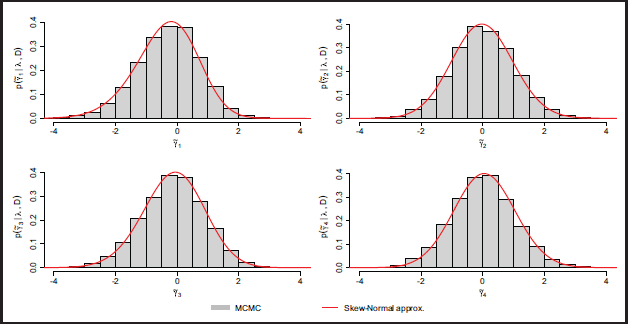
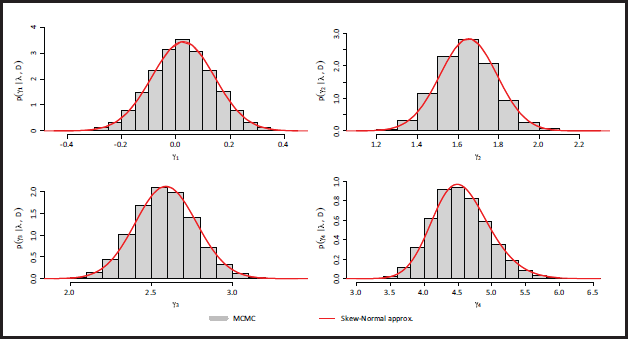
ESS dataset: approximated marginal posterior density for
compared to MCMC samples when
.
In this article, the Laplace P-spline (LPS) approach has been extended to improve the accuracy of inference in a Bayesian framework. Indeed, when information is sparse, the posterior distribution of non-penalized parameters may exhibit a non-negligible skewness that can have adverse effects on inference or predictions when ignored. The proposed approximation to the joint posterior density in (2.9) takes a simple form that can be used in a much faster way than MCMC to make predictions or inference on functions of the model parameters.
An approximation to the marginal posterior distribution of the penalty parameters
The proposed methodology diverges from the proposal made by Rue et al. (2009) and underlying INLA where the size of the latent vector
The code necessary to reproduce the results in the article can be downloaded from
This article and, more broadly, our research on smoothing methods, owe much to Brian Marx, who left us too soon. His joint work with Paul Eilers will continue to endure and shape the field for years to come.
A Gradient and Hessian in the PO model
Consider the proportional odds model defined in Section 3 and the notations therein. Let


and


Therefore, given

Footnotes
Declaration of Conflicting Interests
The authors declared no potential conflicts of interest with respect to the research, authorship and/or publication of this article.
Funding
Philippe Lambert acknowledges the support of the ARC project IMAL (grant 20/25-107) financed by the Wallonia-Brussels Federation and granted by the Académie Universitaire Louvain.