




Abstract
Regression to mother tongue is common in those with dementia. In two long-term care facilities, we explored the use of bilinguals’ two languages for five older adults with mild-moderate dementia who have begun to regress to Greek. We also examined the role of Montessori DementiAbility Methods: The Montessori Way-based English language activities in fostering conversational use of English. Over 10 sessions, participants’ vocabulary or grammatical structure in English did not improve. However, four of the five participants were able to maintain a conversation in English for longer periods of time. This study contributes to strategies for optimizing meaningful conversation for bilingual long-term care residents with dementia. Moreover, the data suggest a change in the policy and practice for dementia care so that there are more opportunities for residents to speak English in non-English mother-tongue facilities. Greater attention to the specific language needs of bilinguals in English-dominant settings would also be advisable.
Introduction
When a person with dementia loses the opportunity to communicate with others, their personhood is threatened (Fontana & Smith 1989; Ryan & Schindel Martin, 2011). Facilitating communication becomes an added challenge for resident care staff when the individual and caregiver do not speak the same language. Cultural obstacles, including language barriers, can negatively impede the fostering of personhood among people who have lost the ability to speak in English (Kitwood, 1997).
Meaningful activities can be used within long-term care (LTC) facilities to elicit positive social engagement in those with dementia. The principle of the Montessori philosophy, when adapted for persons with dementia, has been found to result in higher levels of verbal behaviour in elderly adults with dementia (Judge, Camp, & Orsulic-Jeras, 2000). However, it is not yet known if Montessori methods could be used to foster use of the non-dominant language for bilingual adults with dementia.
Most of the research on fostering communication in those with dementia involves English-speaking participants with no mention of the possibility of the participants speaking additional languages. However, bilingualism is common for older adults in North America. Bilingual elders typically experience a decline in their language abilities (Bialystok, Craik, & Ryan, 2006). Many older adults eventually begin communicating primarily in their mother tongue (the first language learned). There is little consensus on how language changes occur in bilingual older adults. However, regression to mother tongue is associated with the development of cognitive impairment and thus is most noticeable in patients with dementia (De Bot & Makoni, 2005; Hyltenstam & Stroud, 1993; Meilleur & Fombonne, 2009). In addition, language attrition at all ages is greatly influenced by sociocultural and situational factors favouring non-use (Blom & Gumperz, 1972; De Bot & Makoni, 2005; Hyltenstam & Viberg, 1993).
Given the importance of social context, environmental design is emerging as a strategy to encourage communication. This study intended to build on the current literature by investigating the influence of prepared environments on fostering the use of English language skills in Greek-speaking individuals with dementia. We aimed to develop a better understanding of the factors influencing language regression, for residents with dementia residing in two LTC facilities with contrasting primary languages and contexts. The first site was mono-cultural, with all communicative matters and activities being held in Greek. The second site, with many Greek residents, was more multi-cultural, with English being the primary language used in all communicative matters and activities. Moreover, we explored the use of Montessori-based methods in fostering English communication skills.
The following research questions were posed to guide the study: (1) How do the language choices used in each site vary? Is the language(s) used in the site impacted by (a) the social context in which the language is used, (b) the topic of conversation, (c) the emotion of the participant? and (2) Do Montessori-based activities facilitate the use of English in older adults regressing to Greek? Are some activities more promising than others?
Theoretical framework
This study was influenced by Atchley’s (1989) continuity theory, which recognized that continuity in previous activities throughout the lifespan could serve as an adaptive strategy to aging well. As communication is central to maintaining personhood for older adults with dementia, it was postulated that by giving bilingual older adults an opportunity to continue with the languages used in their past, personhood could be maintained. Use of English for older bilinguals is especially important to connect with grandchildren and to communicate with health professionals outside the facility.
Methods
Setting
The study was carried out in two LTC sites. One mono-cultural and one multi-cultural home were chosen to represent the varying social environments. Both sites served Greek clients. The majority of ethnographic observations happened in hallways and in the designated activity rooms. All individual activity sessions occurred in a boardroom. Data collection for both occurred at various times to determine whether the time of day affected conversation quality. No observations occurred at night.
Participants
Five Greek–Canadian participants experiencing language regression to Greek with mild-moderate dementia were included (three women, two men, average length of stay in LTC = 4 years; three participants in the mono-cultural site, two in the multi-cultural site). Every participant was believed by LTC staff to still be able to understand English. None of the participants had a history of impaired communication in English prior to their diagnosis of dementia and none were receiving speech therapy. Questionnaires were completed by a proxy family caregiver concerning the sociolinguistic and medical background for each participant. Knowledge of the key characteristics of participants was derived from observations and conversations with caregivers (RN, PSW) and staff (Director of Care), as well as from the questionnaires with their substitute decision makers. Written consent was obtained from substitute decision makers for residents’ participation as well as the residents’ oral consent.
Data collection
First, the researcher observed participants’ language choice and use during their daily routines. The observations were conducted at various times to capture the morning, afternoon, and evening routines of the residents, staff, and family/visitors. These observations continued until each participant spoke at least 10 times. This occurred over a three-month period from September until December. Field notes recorded descriptive, factual points about participant interactions.
Second, each participant engaged in activity sessions. Over a two-month period, the researcher met with each individual participant 10 times to facilitate modified DementiAbility Methods English-language exercises (Elliot, 2013). The length of the sessions varied due to the levels of engagement of the participant. The average session lasted 25 min (SD = 11). A personal service worker from each site was present during the activity sessions to translate any Greek dialogue. Following each session, the researcher completed a journal log on the session, including participants’ language choices, communication style (such as vocabulary switching, grammar adherence), language complexity, visible emotions, and the length of the sessions. Key dialogues were reconstructed from the log. All notes and dialogues were discussed with the personal service worker in attendance to ensure accuracy in reporting.
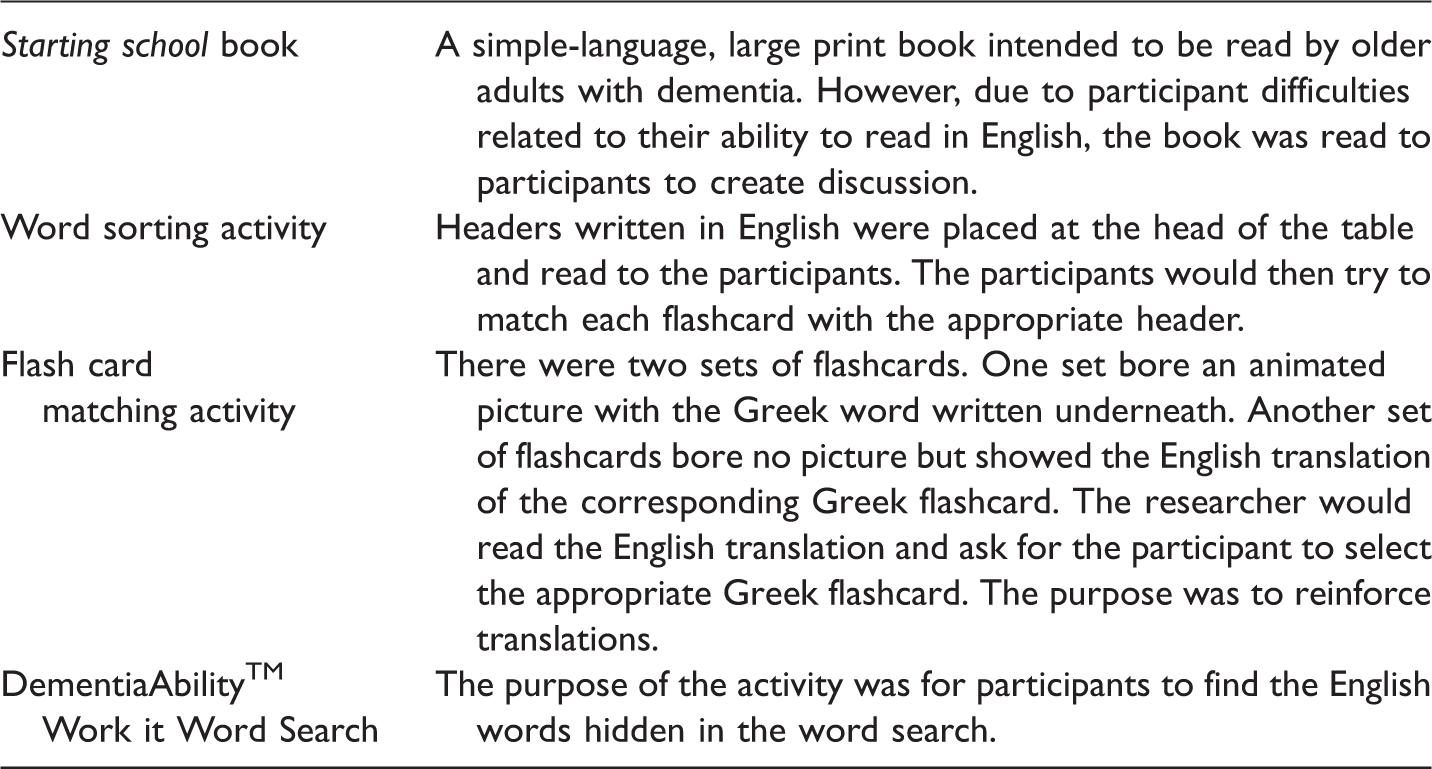
English language activities [based upon DementiAbility: the Montessori way materials].
Data analysis
For the five case examples, the researcher developed a summary of the key characteristics of the participant’s linguistic background and participation in the life of the care home based on family questionnaires and staff information. This helped not only to interpret the field observations and activity session data for the individual but also to compare data among individuals.
The recorded notes from the field observation and activity sessions were amalgamated and interpreted by the researcher in a multiple-coding process. All identifying information was removed and pseudonyms were put in place.
Findings
The linguistic context of LTC
In the mono-cultural site, Greek was used almost exclusively by residents and staff in their daily settings. Residents in this site required higher levels of care, including assistance in performing one or more activity of daily living such as dressing or eating.
In the multi-cultural site, care staff spoke consistently in English while Greek residents sought each other out to speak Greek. Recreation staff in particular would facilitate activities in English, but often turn to Greek words to engage residents when showing signs of disengagement.
In both LTC sites, participation in conversations often seemed to be by default. Since the content mainly concerned daily tasks or activities within the facility, we cannot confirm whether different conversation topics might have sparked a change in language use. In the mono-cultural site, as activities were conducted in Greek, it is not plausible to make any conclusions regarding whether residents returned to their primary language in varying social contexts or due to various emotions.
In the multi-cultural site, participants often spoke briefly in English to staff and other residents, unless frustrated, when they often would not speak at all. Residents of the same heritage usually only conversed with each other. Thus, conversations in Greek lasted significantly longer than conversations in English. Yet, when participating in the facility’s planned activities conducted in English, many residents were able to participate the entire time in English until they became bored. When participants became noticeably bored in activities or within their routine daily activities, they would often shout out in Greek. None of the residents in the mono-cultural site conversed in English during any of the observation periods, with the exception of single word instances.
The use of DementiAbility in LTC in fostering English language skills
Participation was similar during all DementiAbility Methods activities. Participants did not show significant improvements in any of the activities. However, four out of the five participants did show an increase in conversing in English. By the end of the sessions, participants were able to maintain a conversation in English for longer periods of time. Many also began to initiate conversations in English. This supports the findings of Hier, Hagenlocker, and Shindler (1985) who found that their participants did not show signs of an improvement in their language capabilities despite more frequent communication.
DementiAbility Methods activities may not be responsible for improving English communication skills with much more intensive application. Rather conversational stimulation in English was responsible for facilitating meaningful conversation in English. Specific words included in the activities are chosen specifically for their associated long-term memories. Activities prompting conversations with themes of religion, family, and education sparked the most conversation in English (based upon length of time). Hence, Montessori-based activities may be helpful in encouraging English conversation by allowing the opportunity for meaningful conversation when familiar words are incorporated into activities at the individual’s level of ability.
A second hypothesis was formed, believing that the language of the interlocutor was more important in promoting English communication than the topic or emotion of the participant. Knowing that the investigator could only converse in English is believed to have prompted the participants to introduce conversations in English rather than Greek.
Below is a brief summary of the major findings pertaining to two case study participants. Pseudonyms have been used.
Case A: Amalia
Unlike the other participants who immigrated to Canada from Greece in their teenage years, Amalia moved to Canada with her parents at the age of five. As a result, Amalia was also the most educated of the participants, having finished up to Grade 11 in English (completed at the age of 16). Prior to her diagnosis with dementia, Amalia’s family reported that she had no difficulties speaking in English and was fully fluent in both English and Greek. Her daughter reported that while English was used in the home, Amalia spoke Greek daily with her extended family. At the time of data collection, Amalia had been living in the mono-cultural LTC site for five years.
Amalia appeared to be the most fluent of the participants, characterized by clear English speech and ability during activities. However, by the end of the observation period, it was observed that she was the one who needed more coaxing to use English. Very rarely did she begin a conversation in English unless spoken to in English. Amalia was also the most overtly interactive of the group and tended to position herself where others were conversing. Often she was observed initiating conversations in Greek with other residents and verbally would greet staff in Greek as they walked by.
Encoded memories may be language specific
P.I: began to read story about starting school
When prompted, it appeared that Amalia was able to recall her experiences/memories in the language in which they were first encoded. Several studies have examined the implications and effects of language in autobiographical memory and similarly found participants’ memories to be encoded in the language within which events occurred (e.g., Marian & Neisser, 2000; Schrauf, 2003; Schrauf & Rubin, 2000).
Participant was able to introduce new topics in English
When repeating the Word Sorting Activity weeks later, the extracts show that Amalia was able to maintain and introduce new topics in English, when an activity theme encouraged her to do so.
Education may have minimal effect following language regression
Contrary to the findings by De Bot and Makoni (2005) that the effects of higher education lead to more extensive linguistic skills, with a larger vocabulary, repertoire and more ways of expressing communicative intentions, Amalia hardly showed her large repertoire despite the highest level of education amongst all the participants.
Case B: Ellis
Having immigrated to Canada at the age of 14, Ellis received no formal education in English. Instead he learned the language by socializing in the community, working in a factory, watching American television, and teaching himself to read simple books. Despite his desire to learn the language, Ellis primarily spoke in Greek at home but would use English when at work and in the community. While Ellis’ family reported that he was still able to communicate well in English, prior to his diagnosis of dementia, he would often try to change the conversation to Greek if speaking with a Greek individual. Ellis moved into the multi-cultural LTC site four years prior to data collection.
Ellis was often seen walking around the facility, incessantly “talking.” When it came to the activity sessions, Ellis would show signs of contentment, such as smiling, but spoke very little, and almost exclusively in Greek. Many sessions were cut short with Ellis due to his level of disengagement. Ellis would engage momentarily, then make it clear that he had enough by walking away and re-focusing on his explorations.
Cultural expressions may be used when no other words are available
Pause.
Oh shoot! No!
When visibly uncomfortable with an English-heavy conversation (as evident through standing up or wandering eyes), which usually happened after a few minutes, Ellis showed his ability to retain culturally used expressions when other aspects of language became difficult. Ellis used the phrase “Oh shoot” when unable to continue on the conversation in English, possibly to make lexical retrieval difficulties.
Awareness of language switching is evident
Pause
In this session, Ellis appeared to recognize when he switched languages mid-conversation (as apparent by lengthier pauses) and was able to return to English.
Discussion
This qualitative study shows the advantages of Montessori-based language exercises, in encouraging the use of English in older adults who had regressed to Greek in the presence of mild-moderate dementia. Using DementiAbility Methods, activities can lead to a responsive communication encounter between older adults with dementia and staff members. Such an approach can help cultivate relationships that affirm personhood within a supportive environment. Affirming personhood aligns with person-centered dementia care (Kitwood, 1997). Beyond LTC staff, family members may find DementiAbility Methods activities useful in trying to meaningfully connect and enjoy visits with their relatives. Orsulic-Jeras, Judge, and Camp (2000) found that Montessori-based activities were conducive to interactive family visits as they increased residents’ engagement with their family members.
Findings also revealed that there are elements in the LTC environment, as they are structured now, that are not necessarily conducive to supporting personhood or communication opportunities. There is minimal opportunity for meaningful conversations or the opportunity to maintain English communication skills, which has implication for future communication. By speaking to residents only in their native tongue, staff limit residents’ use of English, thereby contributing to language regression. However, as the activity sessions illustrate, these individuals are able to converse in English when prompted to do so. This suggests that language regression in persons with dementia may be due in large part to non-use, as language proficiency in more than one language is a skill which declines without constant use (De Bot & Makoni, 2005).
As Ryan, Meredith, MacLean, and Orange (1995) and Ryan and Schindel Martin (2011) argue, in order for meaningful conversation to occur, there needs to be a physical environment that maximizes opportunities for such communication whereby staff convey genuine regard and interest towards the conversations of the resident. Similarly, Lyon et al. (1997) note that for successful communication outcomes to occur, individuals with communication and/or cognitive impairments specifically require professional caregivers to engage them in an environment where language use is desired and necessary.
As research on bilingualism in dementia has yet to focus social constructs rather than psycholinguistic representations of language in the brain (De Bot & Makoni, 2005; Hart, 1988; Hyltenstam & Stroud, 1993; Paradis & Libben, 1987), this study raises awareness about the need to examine social influences on language regression in dementia. However, several limitations should be acknowledged. The small, purposeful sample of this study limits the generalizability of findings. The unexpected lack of variability in language use (Greek in one site, English in the other), though a major finding, limited our ability to examine how variable situations affect the use of the two languages. The primary researcher’s role as participant observer, language facilitator, interviewer, and data analyst may limit the objectivity of the findings. Lastly, there was no control group for evaluation of the increased frequency of English.
To build up a more representative picture of the effects prepared, social environment has in fostering English language skills in those with dementia, future studies should include a larger number of participants from LTC settings where both mother tongue and English are used by staff and by residents. Future research should also aim to incorporate a control group of participants who do not engage in Montessori-methods activities.
Future research may wish to focus explicitly on the type of setting used (e.g., staff-resident communication vs communication within a small group of residents with a facilitator offering prompts sometimes in English and sometimes in mother tongue). Such a study would offer further insight into the impact other individuals have in encouraging language choice. It would also be useful to assess staff perceptions of situational influences on use of English versus mother tongue and on the benefits of Montessori-based activities.
A longitudinal study design might offer insight into the developing benefits of encouraging English communication as well as how long benefits are retained after training. This is important as the aim for Montessori-methods for Dementia is to maintain and enhance the function of persons at any stage of dementia (Elliot, 2013). Using a longitudinal design could also enable a larger research team to be involved with the study so that more participants could be employed in the study.
Conclusion
Language regression to mother tongue in older adults with dementia has been recognized as threatening personhood of individuals. In our study of Greek, bilinguals experiencing language regression in dementia, DementiAbility Methods: The Montessori Way has been found to elicit an increase in English conversational opportunities for individuals with mild-moderate dementia.
This study highlights the urgent need for a change in policy, practice, and research with regard to providing opportunities for meaningful conversation in LTC facilities. Increased conversational stimulation is particularly important for residents with cognitive impairment, and those regressing to non-English mother tongue are particularly vulnerable. Naturally, attention to the language needs of bilingual residents can only be implemented with adequate support and resources, such as education on how to implement DementiAbility Methods.
Future research can identify specific activity interventions that facilitate language skills in those suffering from dementia, allowing them to continue communicating with their loves ones and ultimately, improving their chances for maintaining their personhood.
Footnotes
Declaration of Conflicts of Interest
The author(s) declared no potential conflicts of interest with respect to the research, authorship, and/or publication of this article.
Funding
The author(s) received no financial support for the research, authorship, and/or publication of this article.
 .
.