



Abstract
Gardening programmes aim to promote improved engagement and quality of life in persons with dementia. Although a substantial literature has amassed documenting the overall positive outcomes associated with therapeutic gardening and horticulture for persons with dementia, little is known about the specific aspects of the gardening process that engender these benefits, and how and why they are important. The purpose of this research was to explore, using interpretative phenomenological analysis, the experiences of therapeutic gardening for persons with dementia, and their perspectives on the senses and emotions elicited in the gardening process that promote well-being. The themes that emerged in our analysis are to varying degrees substantiated in the literature: the usefulness of activating the senses, particularly those of touch and smell; the significance of being occupied in meaningful, productive work; the importance of cultivating a sense of curiosity, wonder, and learning; the positive gains derived from socialization in a group context; the peace and hope derived from being ‘in the moment’; and the positive mental and physical well-being derived from participating in the outdoor garden. Our findings support the integration of therapeutic gardening as a valuable practice for people with dementia.
Keywords
Introduction
Dementia refers to a class of brain disorders characterized by a progressive deterioration in behaviour, thinking ability and memory (Alzheimer Society of Canada, 2010). Now the seventh leading cause of death worldwide, approximately 50 million people have dementia around the globe (World Health Organization, n.d.). Nearly 7.7 million new cases of dementia are recorded each year, making it a global public health priority (World Health Organization, 2012). According to the Canadian Study on Health and Aging in 2016, the number of Canadians living with dementia was estimated as 564,000 persons, and the cost to care for them (both out of pocket costs for individuals and health care system costs) valued as roughly $10.4 million that year, although expecting to double by 2031 (Alzheimer Society of Canada, 2016).
There has, over the past few decades, been a shift away from institutional care in favour of community and home-based care (Alzheimer Society of Canada, 2010), and as the disease progresses, many families seek the help of adult day programmes, used to not only offer respite to caregivers, but also provide a variety of activities to keep the person with dementia active and engaged (Sussman & Regehr, 2009), while helping to decrease challenging responsive behaviours (Gaugler et al., 2003).
Dementia care guidelines have been developed that emphasize the importance of individuals keeping physically fit, mentally active and socially engaged (Alzheimer Society of Canada, 2011). Engagement, the act of being occupied or involved with external stimuli (Cohen-Mansfield, Thein, Dakheel-Ali, & Marx, 2010), has been associated with decreased levels of boredom, increased alertness (Baker et al., 2001), improved positive affect (Schreiner, Yamamoto, & Shiotani, 2005), enhanced function in activities of daily living (Cohen-Mansfield, Dakheel-Ali, & Marx, 2009), and reduced agitation in people with dementia (Cohen-Mansfield, Libin, & Marx, 2007). Participation in meaningful recreation activities, for example, has been shown to improve individuals’ mental state (and reduce depression), decrease responsive behaviours, and enhance the quality of life for this population (Buettner, 2001).
The use of horticulture to calm the senses is an ancient practice dating back millennia. Its study, combining horticulture and rehabilitation disciplines, however, is relatively new (Detweiler et al., 2012). Scott (2015) defines horticulture therapy as ‘a process, either active or passive, of purposefully using plants and gardens designed to positively affect a set of defined health outcomes for individuals (e.g., improved mood, improved self-esteem, enhanced social interaction)’ (p. 1147). Horticultural therapy has been claimed as a therapeutic modality by horticultural therapy associations that recognize the importance of the professionally trained horticultural therapist in the administration of horticultural activities (see Canadian Horticultural Therapy Association, n.d.). Accordingly, the term therapeutic gardening is adopted in this article, recognizing that not all gardening programmes (similar to our study’s programme) directed to people with dementia employ trained horticultural professionals, yet still have therapeutic value for participants.
The literature is replete with positive outcomes associated with therapeutic gardening, including benefits related to providing exercise and improving stamina, decreasing agitation, and improving sleep and cognition (Lee & Kim, 2008; Murphy, Miyazaki, Detweiler, & Kim, 2010; Whear et al., 2014). Compared to traditional structured activities, gardening has also been shown to reduce falls (Detweiler, Murphy, Kim, Myers, & Ashai, 2009), enhance social interaction (Edwards, McDonnell, & Merl, 2012), and improve mood, affect, the ability to reminisce, and quality of life in individuals with dementia (Detweiler, Murphy, Myers, & Kim, 2008; Gigliotti & Jarrott, 2005). Engagement in gardening activities is also well aligned with the theory of personhood in dementia, outlined by Kitwood and Bredin (1992), which emphasizes the importance of supporting well-being in the ‘here and now’ world of the person with dementia (Gigliotti, Jarrott, & Yorgason, 2004).
Hall, Mitchell, Webber, and Johnson’s (2018) mixed-methods study found higher levels of well-being for 14 people in the early stages of dementia attending an adult day programme using therapeutic gardening in Southwest Ontario, Canada. Specifically, participants in the 10-week gardening programme showed higher scores of well-being and engagement compared to participants engaged in music and gaming programmes. Findings suggest that gardening can be beneficial whether provided through structured or unstructured activity (both carer-led or self-led). Participant engagement and well-being was sustained until programme completion (Hall et al., 2018).
Although a substantial literature base has amassed documenting the overall positive outcomes associated with therapeutic gardening and horticulture for persons with dementia (Relf & Dorn, 1995; Thelander, Wahlin, Olofsson, Heikkila, & Sonde, 2008; Wang & MacMillan, 2013), little is known about the specific aspects of the gardening process that engender these benefits, and how and why they are important. Indeed, there is a dearth of scholarship that identifies the specific aspects of the gardening experience (e.g., physical activity, being outside, the activation of sensory inputs, such as smelling, tasting, or feeling) that contribute to the improvements individuals with dementia experience in affect and quality of life. Therefore, the purpose of this research study is to explore the experiences of therapeutic gardening for persons with dementia, and their perspectives on the senses and emotions elicited in the gardening process that promote well-being. In this way, we aim to gain a better understanding of the meanings participants attach to the gardening process, and what it is that makes it such a valuable experience.
Methodology
Underpinned philosophically by phenomenology, hermeneutics, and idiography, interpretative phenomenological analysis (IPA) is an approach to qualitative inquiry used to explore how individuals make sense of their lived experiences, providing deep and rich descriptions of their meaning-making. A departure from the positivist paradigm pervasive in the 19th century, phenomenological research developed relatively recently, building upon the assumption that knowledge is acquired through subjective, inductive, and dynamic human processes involving interactions between participants and researchers (Reiners, 2012; Smith, Flowers, & Larkin, 2009). Phenomenology, concerned with the study of experience, is well suited to explorations of ‘what the experience of being human is like’ (Smith et al., 2009, p. 11), and how people make sense of their lived world. Building upon Husserl’s phenomenology, Heidegger’s hermeneutics, as well as Dilthey’s and Gadamer’s philosophical arguments regarding different types of experience (Béres, 2017; Smith et al., 2009), IPA provides a framework within which people can interpret why certain experiences are more significant than others. As such, IPA researchers engage in a double hermeneutic whereby ‘the researcher is trying to make sense of the participants trying to make sense of their world’ (Smith & Osborn, 2015, p. 41). Although, in doing so, the researcher’s sense-making is second order; she/he only has access to the participant’s experience through the participant’s own account of it (Smith et al., 2009). Moreover, IPA is said to be idiographic as it explores detailed information of a specific case, asking questions about what the experience is like for the participant, and how the participant makes sense of it. Accordingly, IPA studies tend to reflect a small sample of participants, allowing the researcher to ascertain areas of convergence and divergence in participant accounts. In this way, similarities and differences between a relatively homogenous sample of people experiencing the same life event are identified to help illuminate the meanings participants attach to the experience (Smith et al., 2009). The purpose of IPA approaches is not to generalize or develop typologies but rather, through an iterative procedure, ‘analytic induction is a method for attempting to derive theoretical explanations from a set of cases’ (Smith et al., 2009, p. 31).
The sample for this research comprised older adults living with dementia enrolled in a therapeutic gardening programme offered at an adult day centre in Southwestern Ontario, Canada. The programme, delivered over multiple waves (see Table 1), involve participants in all aspects of the gardening cycle from spring clean-up, planting, garden maintenance, harvest to clean-up in the fall. Participants work in a large outdoor garden outside the centre building, in a group of approximately 8 to 10 people. A gardening instructor walks with participants around the garden, engaging them in conversation and explaining the activities of the day. Individuals are able to wander about in the outdoor garden, and to work by themselves or with other people. The instructor invites participants to provide feedback on the vegetables, plants and flowers to be planted, the positioning of the seeds in the planters, and how best to sow, prune and harvest the produce.
Waves of the therapeutic gardening programme, 2016.

We employed purposive, homogenous sampling (Smith, 2017) to garner a sample of six participants (using the pseudonyms of Christina, John, Rebecca, Wilheim, Liam, and Bruce), all of Caucasian descent, and at the early stages of dementia. Congruent with IPA methods, we collected data using (relatively brief half-hour) semi-structured interviews with people with dementia directly following their participation in the gardening programme (to allow for more immediate recall of experiences), as well as analysed researcher field notes taken during gardening activities at the adult day centre.
With respect to recruitment, potential participants who met the inclusion/exclusion criteria were identified by recreation staff who assessed their capacity and interest. These individuals and their families were then contacted by the researcher (CB) to see if they would be interested in hearing more about the study. If they were agreeable, the researcher reviewed the study information with them, answering any questions they might have about the research, prior to garnering the informed consent (oral and written) from both the participant and their family member(s) to participate. Participants were asked if they were agreeable to participate in the participant observations (with field notes taken by the researchers during the gardening programme), semi-structured interviews and/or both research components (all participants agreed to participate in both research components, and ongoing consent was affirmed before each interview). Participants were informed that it would be difficult for the researcher to ensure complete anonymity in the research study. The instructor and/or other programme participants may have been able to ascertain which participants the researchers were observing during the gardening activities, and thus may have been able to conclude that these individuals agreed to participate in the research. Participants were advised, however, that deciding to participate or not participate in the research would not in any way affect the programming they received at the adult day programme, and they did not have to answer any question they did not wish to answer and/or they could withdraw at any time without penalty (no participants withdrew from the study). We use pseudonyms throughout to humanize our research participants and to ensure their anonymity. Ethics approval was secured at the university ethics review board prior to study commencement.
Data were collected in a series of six waves, over the various planning, planting, tending, pruning and harvesting seasons of the garden. As such, the six interview phases spanned a five-month period, from May 2016 to September 2016. Data were then analysed case by case using a systematic, qualitative analysis, and later transformed into narrative accounts reflecting the researchers’ analytic interpretation, supported with excerpt quotes from participant interviews. To help facilitate the double hermeneutic process, researchers participated in a process of personal reflection to record their thoughts, feelings, and observations before, during, and following data collection, recorded in in-depth field notes. Data were read, re-read and analysed through line-by-line descriptive coding using Qualitative Data Analysis (QDA) Miner Lite software. Immersing ourselves in the data, we conducted an iterative process of coding until data saturation was achieved; the point at which no new information emerged in the analysis. We turned to Colaizzi (1978; see also Saunders, 2003) to provide us with the tools that would ensure greater rigour in our research endeavour. The use of field notes to record the researchers’ thoughts, feelings and reflections, prolonged engagement with the data, regular opportunities for peer debriefing, and disclosing our personal orientations and context were all employed to make our findings more robust.
Personal orientations and context
We are a research team of five women. The first two authors are academics and researchers in social work at a university in Southwestern Ontario. Both have theoretical interests in social constructionist ways of engaging people, and share research synergies in the areas of critical reflection on practice, interventions to improve quality of life, and social work pedagogy, research, and practice. One author (TS-C) is focused primarily on social policy and social welfare, the other (LB) primarily on practice theory development within narrative therapy and the role of spirituality in professional practice. TS-C and LB secured ethics approval at the institutional review board, conceptualized and facilitated the research methods as outlined above, organized the peer debriefing meetings, supervised the research assistants participating on the project, conducted the data analysis, and drafted the manuscript. The third author (KJ) is the director of the dementia services facility and adult day programme and is a registered social worker by background. She participated in the peer debriefing sessions, reviewed the transcripts and assisted in editing the final manuscript. Her participation in the data analysis was limited given her role at the centre. The fourth author (CB) is a research associate with a background in sociology. She assisted with the literature review, scheduled and collected data, and edited the final manuscript. The fifth author (JH) is a research assistant with a background in nursing. She assisted in drafting the literature review, entered the corpus of data into QDA Miner Lite, analysed the data, and edited the final manuscript.
Findings
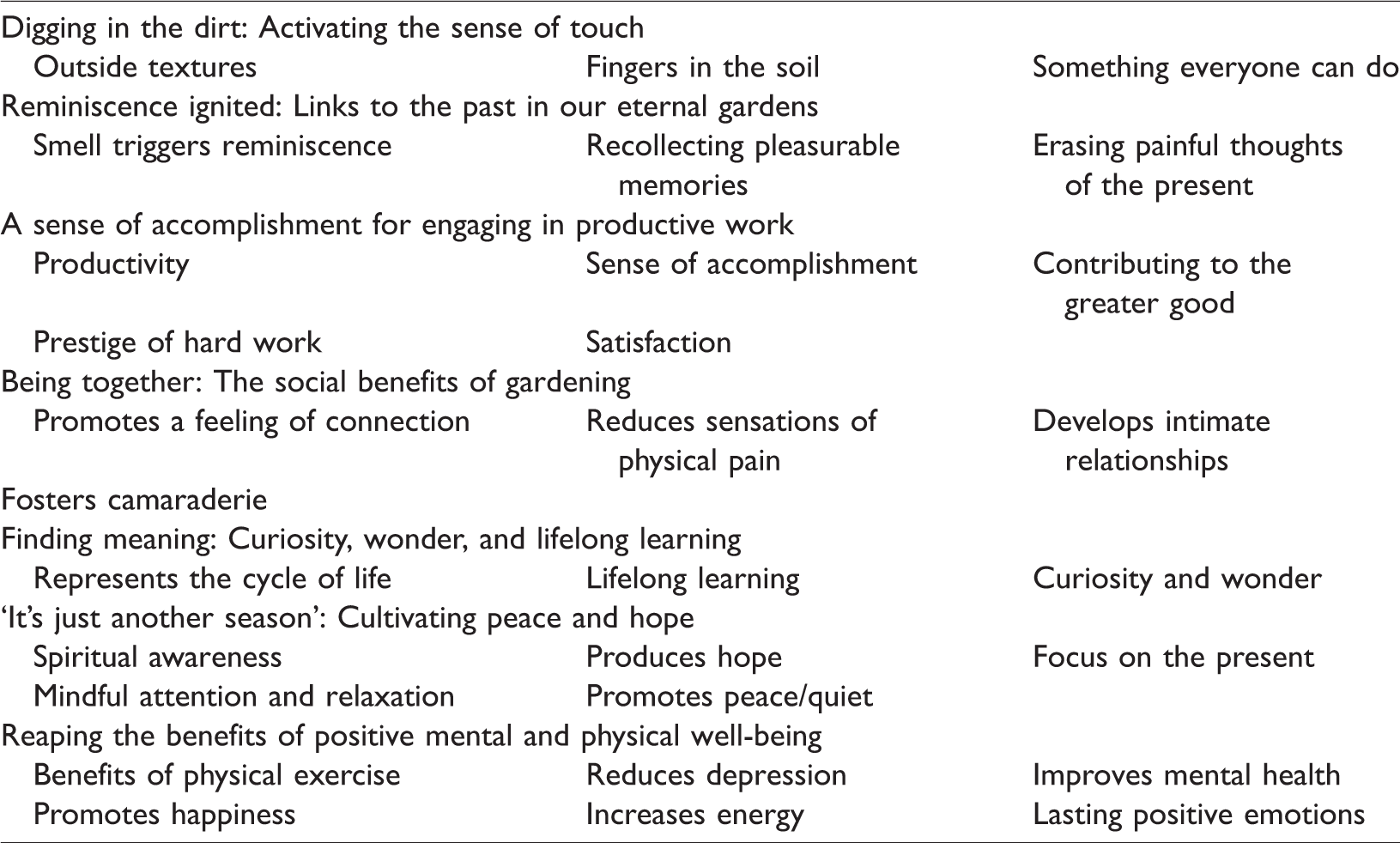
Several themes emerged in the data that demonstrated how participants characterized their experiences in the gardening programme and the meanings they attached to the gardening process. Table 2 documents the master list of themes and provides the sub-themes associated with each.
Master table of themes for the group.
Digging in the dirt: Activating the sense of touch
Participants clearly enjoyed being in the natural environment and derived much pleasure from activating their senses through gardening. Indeed, gardening was found to engage all the human senses: the mixed colours of the flowers and plants rooted in their natural habitat make it aesthetically beautiful and pleasant to the eye; it is rife with the unique sounds, chirps, and hums of birds and animals; the fresh soil, fragrant flowers, and aromatic produce rouse the olfactory system; and the feel of the earth through one’s hands, caress of a flower petal, or stroke of a leaf make it pleasant to the touch.
There was little divergence in the sample related to the belief that the totality of the gardening experience was beneficial to participants; all members indicated that ‘all of it’ (the experience of gardening) was valuable to them. However, among the activation of the five traditionally recognized senses, the sense of touch, particularly the feel of the dirt, emerged as most important. Christina (Wave 2, Planting) expressed, ‘Touch. In the beginning, it’s touch. I love the feel of dirt.’ This sentiment was also expressed by Bruce in Wave 1 (Spring Clean-up), ‘Digging in the good earth … All of it (is helpful), the whole process from start to finish, but especially digging–loosening up the soil,’ a theme he echoed in Wave 2 (Planting), ‘Getting out of the house, digging in the soil … fingers in the soil, it feels good and is fun’; and again in Wave 3 (Garden Maintenance), ‘I like digging the holes’. For people with dementia, the ability to use one’s sense of touch is significant because, as Christina explains, It’s something you can do. There isn’t a whole lot of memory needed. It’s outside and there are textures. They (people with dementia) still can touch the lamb’s ears. They can feel things you would normally not touch because it’s not poisonous. Nature is the real stuff. (Wave 5, Harvest)
Reminiscence ignited: Links to the past in our eternal gardens
All the human senses were activated in the garden, quickening minds to precious memories of days of yore. The sense of smell was especially identified as a key mechanism for cultivating reminiscence. Wilheim (Wave 2, Planting) shared, ‘Smells take us out to the past. You remember something. After this comes that. Smell connects us. Close your eyes and pictures come.’ Likewise, Liam (Wave 1, Spring Clean-up) stated, ‘(The) smell of dirt, it brings back memories of gardening. Smell of some plants, like the mustard and chives, they have strong smells.’
Many research participants recalled vividly parts of their history while discussing what they enjoyed about being in the garden. John, for example, described the Victory Garden his family cared for when he was a child. During the war years we had a Victory Garden and my folks came from a farm, so they always had a whole backyard ploughed up. That would have been in the '40s … My parents had a subsistence farm near (small city). Always had some kind of garden. It was encouraged. So, we helped in the garden when I was a kid. My father passed away when I was 12 so I had to do more. During the war, we shipped a lot of stuff overseas. Later on, I used to rent a plot. We lived in the township just on the edge of the city so there was open space … It was a block away. I could walk down a block to look after it. (Wave 3, Garden Maintenance) I like doing it because I think heavy thoughts, not bad ones. I forget about the forgetting you do and the rude comments people say about me. Alzheimer’s is a disability and I forget that I have one. (Wave 1, Spring Clean-up)
A sense of accomplishment for engaging in productive work
Gardening gave many participants an implicit sense of being productive, and as contributing to the greater good. In earlier times, as Christina reminds us, gardening was not perceived to be a favourite pastime or hobby but a job, with the prestige and status that comes with hard work. She explains, I love it. I’ve been doing this for years. I had a garden when I was a kid. We grew only vegetables in (city), there is no wealth of flowers there. We canned and froze. I came from seven kids, so it was part of dinner. Not a hobby, but food. (Wave 2, Planting)
Being together: The social benefits of gardening
Although gardening on one’s own could be enjoyable for many participants, working with others in the group derived other benefits. Wilheim explains, ‘I think you have the right people to get it going and the tools I need. And the right mixture of let’s get on with it. It’s social.’ Christina also stated, ‘Mostly being able to participate in it. I like it as a solo thing to do but I also love it as a group’ (Wave 2, Planting). The advantage of gardening in a group was articulated by Bill, who claimed that the gardening experience created a shared sense of being part of something larger than oneself. I feel productive and part of something. It’s not my garden, it’s our garden. There were people out there who were getting their hands dirty who normally wouldn’t get their hands dirty. It was good how they got in there and did it. We are part of something. (Wave 1, Spring Clean-up)
Gardening also fosters the development of intimate relationships and provides camaraderie that gives people a feeling of connection. Christina commented, I just like my time in the garden but today with Jessica, she was not too sure, she forgot how to do things, so I can help her. Like we do with everything here, her and I. We help each other. It was to bring back memories for her. I feel it’s helping her. Jessica said that it feels good. We are like sisters. We are sisters from another mother. (Wave 2, Planting) The comradeship. A nice group of people … Everybody in this group is great. It’s nice to have girlfriends, do you know what I mean? Jessica and I are pretty close. We met here. We laugh together and cry together. We get frustrated and tell each other thing(s). It’s a connection, friends, very much so. (Wave 2, Planting)
Finding meaning: Curiosity, wonder and lifelong learning
In several instances, participants used the seasons of the garden as an analogy for the circle or cycle of life. Wilheim expressed, We preserved food in Germany as a child. It was very satisfactory. As you grow up you learn to see how it all fits into a whole. A big cycle around, all the seasons. Each has its time and place. The harmony of it. It was a perfect day. (Wave 2, Planting) Just doing something and watching something grow. It is magic. It makes you wonder. It makes me wonder how some plants grow and some won’t. They are in the same place right next to each other. What’s the difference between this plant and that plant? They look the same, same fertilizer and everything but turn out different. It’s like life, I guess. There’s a cycle of life there. The kind of jobs I had makes it part of the learning. I did this in that situation in that country. This country is different so that thing doesn’t help you at all here. You learn from your mistakes, like gardening. (Wave 2, Planting)
‘It’s just another season’: Cultivating peace and hope
Gardening was meaningful for participants as it gave them a sense of hope for the future. Wilheim (Wave 2, Planting) noted, ‘You learn from your mistakes like gardening. Gardening is always an act of hope looking to the future.’ In the same interview, he went on to say, Yes, it’s a thunderstorm but the sun will come, watch and see. Nature brings things you can deal with and you have opportunity to learn something new. I didn’t expect that to happen but it did, now deal with it. I have seen worse than that, so everything will be fine. It’s just another season. Learn from it and move forward. Like seasons, you have winter sometimes with the snow a metre high or so and down there somewhere is spring being prepared. (Wave 2, Planting) I love the spiritual aspects of gardening … of nature. It keeps you present … Gardening regenerates itself all the time and is hopeful and not materialistic. How lucky we are to have this garden so we can get out of the building and create something and have fun. (Wave 3, Garden Maintenance)
Reaping the benefits of positive mental and physical well-being
Both the physical and therapeutic exercises of gardening had positive effects on participants’ mental health, reducing feelings of depression and increasing levels of happiness. Christina voiced, Gardening makes me happy … It’s always good in the garden, there is more energy there and it increases my energy. It’s exercise and exercise helps a lot, makes me feel less depressed. (Wave 3, Garden Maintenance) I miss (absent participant) today … We usually work together in the garden and it’s okay if we forget things; there is a sense of sharing even if only for an hour, and it keeps the good feeling going all day. Helps fight my fear of going into a (nursing) ‘home’ – being outside is all green. Hope that when the time comes to go into a ‘home’ it will have a garden space too. (Wave 3, Garden Maintenance) Yes, it (gardening) is wonderful and meaningful and makes you feel valuable and creative. It reduces depressive feelings and helps you feel happier and more joy in life in spite of dementia.
Discussion
The master themes identified in Table 2 are to some extent substantiated in the literature documenting the benefits of therapeutic gardening for persons with dementia. The entirety of the experience (all stages of the gardening programme) was deemed beneficial for our sample participants, although the sense of touch activated in gardening appeared most pronounced, followed up by the stimulation of the sense of smell. Aside from these first two themes capturing the usefulness of activating these two specific senses, themes also emerged related to the significance of being occupied in meaningful, productive work; the importance of cultivating a sense of curiosity, wonder, and learning; the positive gains derived from socialization in a group context; and the peace and hope derived from being ‘in the moment’ when participating in the outdoor garden programme. The culmination of these perceived benefits contributed to our sample participants’ self-reported positive appraisal of their mental and physical well-being.
Cohen-Mansfield et al. (2010) point to a gap in our understanding of engagement for persons with dementia and how the key attributes of external stimuli, concomitantly with personal attributes and environmental attributes, and the interactions between these, work together to promote the positive benefits of engagement identified in the literature. Cohen-Mansfield et al. (2009) surmise that the degree to which the stimulus has social qualities, is manipulative, and emulates a work role may impact individuals’ level of engagement. Our findings offer some confirmation of this hypothesis. Consistent with Cohen-Mansfield et al.’s (2009) supposition, gardening, in the group context of the programme, promoted social interaction and a sense of connection among participants. Gardening also activated participants’ sense of touch (i.e., digging, planting, deadheading, pruning, picking), which was determined to be the most beneficial, relative to the stimulation of the other senses.
Participation in the gardening programme was also associated with a work or occupational role. Gardening was deemed by participants to be work, with the prestige and sense of accomplishment and productivity that typically accompanies it. Furthermore, this work affirmed, for many participants, a role identity of their younger self. This included all three types of the self-identity construct identified by Cohen-Mansfield et al. (2009), including an occupational role, family role, and leisure time role. For our sample participants, gardening was not only a favourite hobby or pastime (leisure time role) but was valuable labour to ensure one’s livelihood (occupational role) and provide for one’s family (family role). Engaging specialized roles that are meaningful to the participant also allows for a continuity of interests and habits developed in earlier life (consonant with continuity theory), an identified adaptive strategy in the aging process. For persons with dementia, as Jarrott, Kwack, and Relf (2002) convincingly argue, the continuity of activities and skills may support a sense of competence and self-esteem, offering a measure of predictability to individuals at a time of considerable change. This continuity with participants’ younger roles may indeed factor into their improved affect and sense of satisfaction while participating in the various gardening activities (see Christina’s remarks about how gardening reduces her depression and makes her happy).
Therapeutic gardening may also generate a forum for re-connecting participants with dimensions of their embodied selfhood and agency, aspects not always discernably present in their day-to-day lives (Noone & Jenkins, 2018). Drawing connections to actions and behaviours demonstrated in participants’ past vocational activities (e.g., John, in his Victory Garden; Liam in his childhood vegetable patch), the garden offers a unique opportunity to express one’s personal identity, without the necessity of cognitive demands or verbal communication. Irrespective of the cognitive changes inherent within the human brain, selfhood persists, expressed through the primordial coordinating power of the body, enacted through corporeal movement, gestures, and non-reflective intentionality. Habitus, a term referring to forms of know-how enacted at the pre-reflective level of experience, below the threshold of cognition, is one avenue through which selfhood and agency are expressed (Kontos, 2004). Disentangled from categories of cognition (and the erasure of selfhood assumed therein), Kontos (2004) cogently argues that selfhood is embodied and reproduced non-discursively through concrete corporeal action and social being. For our study participants in the garden, selfhood was indeed embodied both within and outside (the traditionally assumed) cognitive pathways, incorporating intentional interactions and social presence, as well as non-reflexive actions and behaviours.
The theme in our findings documenting how the meaning of gardening was linked to a sense of wonder, curiosity, and continued learning for our sample participants (as noted by Wilheim in his comment that people continue to be ‘curious about how ... things work') is confirmed to a degree in the literature. While Jarrott et al. (2002) and McGuire (1997) find that contact with living plants can stimulate wonder and contribute to a new sense of excitement for those engaging with the natural environment, the emphasis on how horticultural contact both activates and represents life-long learning appears, to our knowledge, new; although is consistent with the educational literature that suggests that an orientation to learning is a mainstay of the human experience (Field, 2011; Schuller, 2001).
The many smells of the garden triggered the recall of pleasurable memories of the past for our sample participants. This is certainly not a novel finding, as the sense of smell has long been linked to reminiscence, evoking the recall of even older (early childhood vis-à-vis early adulthood) memories than those elicited via visual word or pictorial cues (Willander & Larsson, 2006). However, as Alves, Petrosyan, and Magalhães (2014) point out, olfactory dysfunction may even be present during the amnestic mild cognitive impairment phase of Alzheimer’s disease, particularly in relation to deficits with odour discrimination and identification (less so in relation to odour detection); difficulties that appear related to delayed memory processing. Although little is known about the specific olfactory profile of each type of dementia, symptoms related to smell appear to be a prevalent, to varying degrees, in all forms of dementia, even at the initial stages of neurological diseases (albeit evident too in half of the healthy elderly population). The prevalence of olfactory dysfunction has been estimated to be as high as 100% in Alzheimer’s disease; 96% in the frontal variant of frontotemporal dementia; 90% in Parkinson’s disease; and 15% in vascular dementia (Alves et al., 2014). The relationship of the sense of smell, and its link to reminiscence, is an interesting one given these findings. Participants in our sample clearly engaged in a process of reminiscence at all stages of the gardening programme and linked this process to the pungent aromas present in the garden. However, if our participants experienced any olfactory deficits during the study, as the aforementioned research would suggest, it is likely that the confluence of all visual, auditory, tactile, and olfactory stimuli in the garden played a role in their memory recall (as they do in emotional perception; Freiherr, Lundström, Habel, & Reetz, 2013), through the various neural processes of multi-sensory integration. As de Dieuleveult, Siemonsma, van Erp, and Brouwer (2017) argue, the temporal lobe of the brain processes multiple unisensory signals from the environment, which when combined, produce a distinctive and coherent percept. In cases where one or more senses are impaired, and the ability to effectively weigh sensory information from the environment is weakened, individuals may enlist various compensatory strategies to integrate presenting sensory cues. The mechanisms underlying reminiscence in persons with dementia remain poorly understood. For example, despite the preponderance of studies on the use of reminiscence therapy, there remains little evidence for the efficacy of this therapy (given the limited number of trials and the methodological weaknesses of these studies; Cotelli, Manenti, & Zanetti, 2012); a finding recently confirmed in a Cochrane review by O’Philbin, Woods, Farrell, Spector, and Orrell (2018). Further research is necessary to tease out the underlying mechanisms of multi-sensory integration in the brains of healthy and neurologically impaired older adults (Freiherr et al., 2013).
There is nascent literature that points to the efficacy of sensory stimulation and multi-sensory interventions (the former describing interventions that activate a singular sense modality; the latter referring to those that activate two or more senses within a given session) in increasing the quality of life and well-being of persons with dementia, while concomitantly reducing the negative behaviours elicited through the disease. Many of these studies document a suite of sensory stimulation or multi-sensory interventions directed to people with dementia, although tend to overlook therapeutic gardening as an intervention of note. For example, Sánchez, Millán-Calenti, Lorenzo-López, and Maseda’s (2012) review of the literature on multi-sensory stimulation environments (MSEs) includes a variety of studies adopting a Snoezelen approach (a trademark stimulation room that includes various objects that activate the five senses), while reporting on only one study (i.e., Collier, McPherson, Ellis-Hill, Staal, & Bucks, 2010) that explicitly adopted gardening as the activity of assessment. Strøm, Ytrehus, and Grov (2016) note that sensory gardens are included in the extant literature on multi-sensory interventions (along with Snoezelen and the Sonas programme), yet the emphasis on gardening as an important multi-sensory intervention is lacking. Collier et al. (2010), in their study on gardening as a control intervention comparable to multi-sensory stimulation, argue that MSEs as a treatment strategy have been available for the past two decades, although its value for people with dementia has not yet been established, and its efficacy demonstrated in research is thin. Yet, while there are various possibilities to modify the level of sensory stimulation in MSEs, there are fewer opportunities to do so in gardening. Given that the presence of multi-sensorial impairments is strongly associated with the risk of dementia (Brenowitz, Kaup, Lin, & Yaffe, 2018), more research is needed to ascertain how MSEs work to engage the sensory system of the brain, when vital neural pathways may be compromised. For our study participants, the stimulation of the tactile and olfactory senses was deemed tremendously helpful (affirmed so repeatedly by participants over the multiple waves of the study) even when these senses may not always have been entirely accurate. This may suggest that the human brain has a keen ability to perform compensatory operations of multi-sensory integration that create distinct perceptions helpful in triggering reminiscence.
As Behrman, Chouliaras, and Ebmeier (2014) note, given the cognitive decline associated with dementia, the importance of experiencing the world at a sensory level becomes vital, even while the ability to understand context through the integration of these sensory experiences becomes more challenging for people living with neurodegenerative diseases. Our findings support those of Detweiler et al. (2008) that suggest that engagement in an outdoor garden improves the mood, ability to reminisce and, ultimately, the quality of life of persons with dementia.
This study provides evidence for the integration of therapeutic gardening as a valuable practice for people with dementia. However, as is to be expected with an IPA study, the data collected were rich with details, making it difficult to provide a comprehensive analysis of all areas of the findings. Although literature is still emerging on the efficacy of gardening and horticultural therapy, the research in support of this intervention is promising (Whear et al., 2014).
Conclusion
We have argued for IPA as an approach to fully engage in the process of understanding how people with dementia reflect on their experiences in a therapeutic gardening programme. The themes that emerged in our analysis are to varying degrees substantiated in the literature: the usefulness of activating the senses, particularly those of touch and smell; the significance of being occupied in meaningful, productive work; the importance of cultivating a sense of curiosity, wonder, and learning; the positive gains derived from socialization in a group context; the peace and hope derived from being ‘in the moment’; and the positive mental and physical well-being derived from participating in the outdoor garden. Our plan in future papers is to focus on other elements, beginning with a more in-depth exploration of the link between spirituality and therapeutic gardening, since participants also reported loving the ‘spiritual aspects of gardening,’ saying it is like ‘magic’ to watch and participate in the circle of life.
Footnotes
Declaration of conflicting interests
The author(s) declared no potential conflicts of interest with respect to the research, authorship, and/or publication of this article.
Funding
The author(s) disclosed receipt of the following financial support for the research, authorship, and/or publication of this article: Funding for this research study was provided through an internal research grant from King’s University College.