



Abstract
In this article, we summarise the findings of the situational analysis of dementia care generated as part of the STRiDE: Strengthening responses to dementia care in developing countries project, including a desk review, a SWOT analysis and views from relevant stakeholders. In addition, the article incorporates the experience of 4 years of work within the STRiDE project of FEDMA, Mexico’s Federation of Alzheimer’s and other dementias and its allied Associations in presenting specific recommendations to optimise dementia care in the country. All the information gathered brings together a detailed understanding of the current dementia care systems of diagnosis, treatment, and support in general and what is lacking, allowing for the generation of general recommendations to enhance the isolated efforts currently available and amplify their impact, as well as strategies to generate new services currently unavailable, but urgently needed.
Introduction
Population 60 years and older in Mexico is expected to increase from 12% of the total population in 2020 (15.1 million) to 17% (24.9 million) in 2050 (Kanter Coronel, 2021; CONAPO, nd). A rapidly ageing population presents challenges related to the care of older adults worldwide. However, Mexico, faces additional challenges from an increasing prevalence of chronic diseases and risk factors, as well as sub-optimal health and social care policies and systems for older adults and for specific conditions like dementia (GBD 2019 Diseases and Injuries Collaborators, 2020; De la Cruz-Góngora et al., 2022; Rojas-Martínez et al., 2021).
Alzheimer’s and other dementias represent the fifth main cause of DALYS (disability-adjusted life-years) (Parra-Rodríguez et al., 2020) and it is estimated that there were approximately 1 626 000 persons living with dementia in Mexico in the year 2015 (De Langavant et al., 2020). Two national surveys, the Mexican Health and Aging Study, (MHAS) and the National Health and Nutrition Survey (ENSANUT), together with two dementia specific studies, the Dementia Research Group 10/66 Study the Study on Aging and Dementia in Mexico (SADEM) have documented the incidence and prevalence of dementia and cognitive impairment.
The latest reported estimates from the SADEM study of the prevalence of dementia in Mexico City are 7.8% for Alzheimer’s disease, 4.3% for vascular dementia, 2.1% for mixed dementia and a global dementia prevalence of 14% (15.3% and 12.5%, in women and men respectively) (Juarez-Cedillo, 2022). Previous studies report dementia prevalence ranges from 5.2% in 2011 using the MHAS (Mejía-Arango et al., 2011) to 7.9% in the year 2012 in the ENSANUT study (Manrique Espinoza et al., 2013). According to the 10/66 study, prevalence was 8.6% in urban and 7.4% in rural areas in 2008 (Llibre et al., 2008), showing a steady increase in prevalence from the first to the latest reported numbers.
As reported in most countries, prevalence of dementia in Mexico is higher in women than in men (Cao et al., 2020). Diabetes, hypertension, and educational attainment have been reported as the main preventable risk factors of dementia (Academia Nacional De Medicina De México, 2017). Among a nationally representative sample of Mexicans 82 years and older in 2021, odds of probable dementia increase with age, affiliation to non-employment-based health insurance (Seguro Popular now substituted by the Health Institute for Wellbeing, INSABI), and for those presenting with multiple cardiovascular conditions. In addition, living in extended households increased the odds of dementia in women, but not in men (Mejía-Arango and Aguila et al., 2020).
Ageing population and increasing dementia prevalence have significant social and economic implications in terms of health care needs, medical costs, direct and opportunity costs of unpaid family care. Studies on the association between indicators of social class and the risk of all-cause dementia have shown higher risk in individuals belonging to a disadvantaged socio-economic status or social class (Bodryzlova et al., 2022). This poses greater challenges for countries like Mexico with profound health inequities (Salinas-Rodríguez et al., 2019), and that are not prepared to adequately provide diagnosis, post-diagnosis care as well as care support at home (Ibáñez et al., 2021). Taking this into consideration, government officials, researchers, clinicians, and civil society organisations developed the National Alzheimer and Other Dementias’ Plan in 2014. The Plan’s primary objective is to promote the wellbeing of people living with dementia and their family carers by strengthening the Mexican healthcare system and the support and participation of other public institutions and Associations (Gutiérrez-Robledo and Arrieta-Cruz, 2014). No targeted budget has been allocated to date, thus, slow progress towards its implementation has been achieved through relevant but isolated efforts by public institutions and associations.
A relevant part of the progress has been the advancement of clinical, epidemiological and social dementia research (Rubio et al., 2022) through national, international and multisite projects such as the Strengthening responses to dementia care in developing countries project (STRiDE). One of the main objectives of this project was to conduct a situational analysis of dementia and dementia care and to understand the impacts of dementia in various cultural, social and economic contexts in order to support the development, financing, planning, implementation and evaluation of specific Dementia National Plans or strategies (STRiDE, 2022). The situational analysis included a desk review of current dementia care in the country, a Strengths, Weaknesses, Opportunities and Threats (SWOT) analysis for the development and implementation of specific dementia care strategies. Relevant stakeholders, including Mexico’s Federation of Alzheimer’s (FEDMA) and theirs allied Associations, clinicians, researchers and local and national level civil servants participated towards the generation of the analysis and providing specific recommendations to optimise dementia care in the country. The final report provides a comprehensive understanding of current dementia care available, what is lacking, as well as recommendations for implementing new strategies and services that are urgently needed, along with improving current isolated efforts available in order to amplify their impact.
The rest of the article is organised as follows. First, we present a summary of the main sections of the Strengthening responses to dementia in developing countries’ (STRiDE) project situational analysis describing the current state of the Mexican Health System, including dementia care. Secondly, we introduce main opportunities identified in the SWOT analysis by describing recent health system and research initiatives aimed at increasing the health system’s preparedness for dementia care in Mexico. We finally introduce specific recommendations for future actions to support optimal dementia diagnosis and care in the country.
The Mexican Health System
The Mexican Health System in Mexico is highly fragmented, with users and health services divided according to the institution that provides them. There are three main providers: social security institutions (contributory, employment-based insurance), public services offered by the Ministry of Health (covers the un- or self-employed), and the private sector. These offer different benefit and services, work independently and in parallel to each other (Dantés et al., 2011; OECD, 2016).
In 2017, IMSS and ISSSTE, the two main social security institutions for private and public sector employees, respectively, covered about 33% and 7.4% of the population. On the other hand, public services, provided by the Ministry of Health (MoH) mostly via the Seguro Popular covered 43.5% of total population. Private health insurance on the other hand, covered nearly 8% of total population in that year, mostly via out-of-pocket payments on a fee for service basis (González Block et al., 2020). All public (MoH) and social security institutions are based on a referral system (gatekeeping), where primary care units are the main point of access and care by primary care health professionals. As needed, they refer patients for laboratory or diagnostic tests. In the private sector, access is mostly through specialist doctors, responding to a specific need –either from a previous diagnosis or expected need and mostly, out-of-pocket payments.
Supply of health workers in Mexico has increased over the past decade but remains low by OECD standards (OECD, 2022), increasing pressure on the healthcare system, and endangering its potential to provide quality services. In 2017, the rate of specialist physicians was 119 per 100,000 population (Heinze-Martin et al., 2018), and 29 general practitioners per 100,000 population (Secretaría De Salud, 2017). Moreover, an unequal geographical distribution results in significantly lower density of health professionals in rural localities overall. (Lucio-García et al., 2018; Nigenda et al., 2016).
The role of the State with respect to social care, including residential and temporary care services is almost non-existent, except for the administration of a few care homes and day centres nationwide, and no publicly funded personal care services at home are in place. Consequently, long-term care is performed mostly in the private sphere of the household, through unpaid family care, with little support or training. There is a growing private sector supply covering a wide variety of services and costs that are only within the reach of few given their high costs.
The General Population and Household Census 2020 identified 1,504 care homes (50% increase from 2015), and 27 590 older adults residing there (INEGI 2020). However, this only captures part of all existing institutions, including care homes, as many are not registered with any local public agency and operate in a grey economy. On the other hand, the share of healthcare provided at home by unpaid family members has constantly increased, representing 28.7% of the total health sector GDP in 2020. This is a larger percentage than that spent in all hospital services (20.7%) and ambulatory (primary care) services (15.7%) which have decreased slightly in the past years (INEGI 2021). Approximately 37% of unpaid family health care was estimated to be provided to individuals 60 years and older in the year 2014, up from 29% in 2009 (López Ortega, 2018). It is important now to estimate the economic and social cost of the proportion of this unpaid care that is attributable to dementia care.
Dementia Care
Following the International Classification of Diseases and Related Health Problems (WHO, nd), the Mexican Health System classifies Alzheimer Disease and other dementias within the Mental, behavioural, or neurodevelopmental conditions, and as such, mental health services would officially oversee provision of all related services. Currently there are no nationwide publicly funded programs within public and social security health services that include diagnosis, treatment, and management of clinical and psychosocial symptoms of dementia (Gutiérrez-Robledo & Arrieta-Cruz, 2015) and few specialists are available nationwide. The estimated Geriatricians per 100 000 individuals aged 60 years and older is 3.2, 3.4 Psychiatrists, 2.2 Cardiologists (Heinze-Martin et al., 2018). However, no public data is available on how many of specialists in dementia-related areas such as psychiatry and neurology are dementia-specialists, although most likely the majority are not as specific training programs in the country are scarce.
At the individual level, a generalised lack of knowledge, normalisation of cognitive impairment as part of aging and stigma against dementia result in long delays in seeking care and support (Angel et al., 2021). When health care is finally sought, it is common that advanced memory and behavioural symptoms are present, and less margin is left to act with respect to management options. Individuals are faced with little or no support from the health and social security institutions given the lack of specialist physicians, referral systems, long waiting times for specialist consultations and diagnostic tests in the few cities where these are available along with tendencies to normalise cognitive impairment and higher priority of other chronic conditions in primary care (Mimenza Alvarado & Aguilar Navarro, 2014; Prince et al., 2016). In addition, while acetylcholinesterase inhibitors are included in the basic drugs approved for use in public health system institutions (Consejo De Salubridad General, 2017) they are generally not available/provided, due to the lack of specialised physicians and services.
For a very small proportion of the population that can afford and use private services (paid mostly out-of-pocket at the point of care), the usual pathway of care includes consultations with geriatricians, neurologists, or psychiatrist who may conduct additional tests to obtain a diagnosis and offer current internationally approved management medicines. Specialists concentrate on clinical aspects of illness, but seldom advise on or explain possible changes, behaviours, symptoms or refer to associations when available for support, leaving family members feeling overwhelmed not knowing what is happening or how to manage these (Prince et al., 2016; Ibañez et al., 2021).
Regarding formal care services, to our knowledge, there are less than 10 residential care institutions that provide services for people living with dementia. While most residential care caters almost exclusively to individuals who are physically independent and without cognitive impairment, with time, some residents develop dementia, and they are not prepared or equipped to provide optimal care for them (López-Ortega & Aranco, 2019). Lack of knowledge and training of staff, poor infrastructure and absence of psychosocial interventions and dementia specific care represent the main challenges in these institutional care settings (Angel et al., 2022; Mejía-Arango and López-Ortega et al., 2020). Therefore, civil society organisations like the Mexican Federation of Alzheimer’s Disease (FEDMA) and its 21 allied Associations provide most of the little support available for people living with dementia and their carers by means of support groups, information sessions and dissemination materials.
To tackle different barriers to current dementia care services, Figure 1 shows the optimal dementia care pathway for public health system services in Mexico. Ideally, primary health care centres, as first point of access, would conduct an integrated care evaluation, including cognitive performance based on the World Health Organization’s Integrated Care for Older People program (WHO, 2019). If cognitive impairment or dementia is suspected, primary care professionals should respond by referring individuals to community based mental health centres where the pathway of care would start. First, examining for dementia-like symptoms caused by other conditions and managed if needed, for all others, further diagnosis tests for dementia diagnosis and management by specialist physicians. Within this scheme, efficient referral systems for specialised diagnosis and management should be developed by connecting the few current available services in the public sector. Also, specific public-private collaborations for services in the private and non-profit sectors could be established as a way to increase support services for individuals and their family carers. Optimal path of dementia care in Mexico.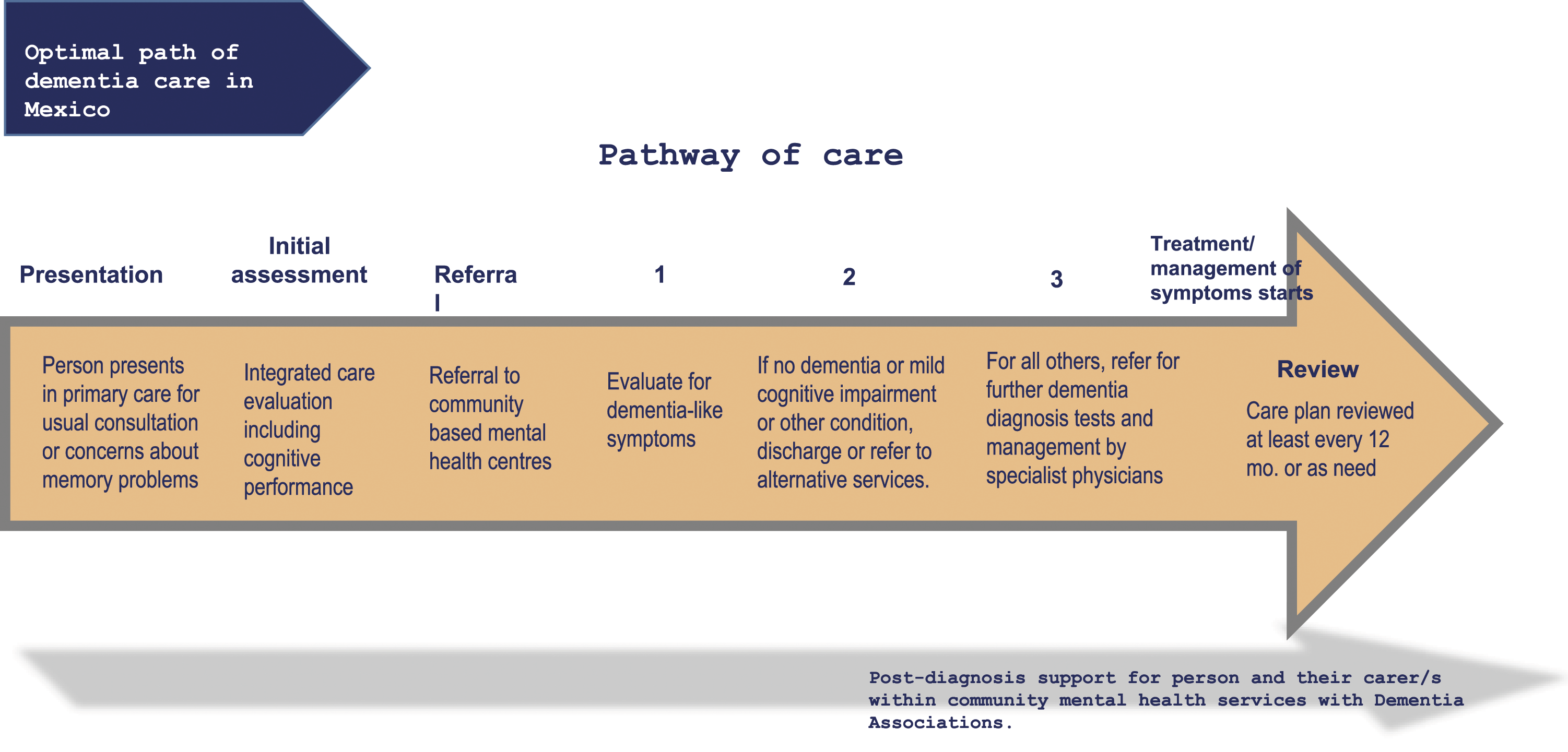
Recent Strategies That can Support Development of Dementia Care
Recent strategies promoted by the MoH and ongoing research projects open opportunities for a significant progress in dementia care in the near future. Within the MoH recent strategies to support primary care services include a widespread training program for primary care professionals in mental health (mhGAP), legislation reforms that open the way for a significant reform of mental health services that may improve screening and diagnosis of several mental health conditions including dementia, and introducing person centred integrated care for older adults (ICOPE) as part of the basic follow-up and management plan for older adults’ care.
mhGAP Initiative
In collaboration with the Pan American Health Organization, and the Psychiatric Care Services, MoH has been working since 2019 on the implementation of the Program of Action to Overcome Mental Health Gaps (mhGAPs). This program includes a subset on dementia screening and a suggested clinical pathway for its care and is an opportunity to establish a pathway for dementia diagnosis and management within primary care services. In a first phase, a situational analysis of mental health units, an analysis of the mechanisms of drug supply, the standardization of mhGAP training materials were carried out at national level. The goal is to train all primary care staff in public health services by 2024, making mental health, including dementia services, much more accessible (Sapag et al., 2021).
Reform of Mental Health Services
A reform of mental health services nationwide was enacted in May 2022 with the provision, that the State shall guarantee universal and equitable access to mental health care; shall recognise the right to access high standard mental health services without discrimination and focusing on recovery and wellbeing; and that all mental health care is provided with a community-based approach (DOF, 2022). Within dementia care, while recovery is not achieved, individual’s wellbeing through appropriate diagnosis and management should be a main objective in line with the aim of the reform of achieving universal access to high standard mental health services.
Integrated Care of Older People (ICOPE) Initiative
The Integrated Care of Older People (ICOPE) project is a program based on the measurement of “Intrinsic capacity”, defined by the WHO as “the composite of all the physical, functional, and mental capacities of an individual” (Briggs & Araujo de Carvalho, 2018). The ICOPE program includes six domains of intrinsic capacity: cognitive decline, limited mobility, malnutrition, visual impairment, hearing loss and depressive symptoms, opening the opportunity to incorporate screening for cognitive decline as part of routine primary care for older adults nationwide. In addition, including routine evaluation of depressive symptoms, could also support optimal identification and management of concurrent depression, and cognitive decline associated to depression (Agüera-Ortiz et al., 2021). Currently, the initiative is being implemented in Mexico City and Guadalajara public health services and is expected to be incrementally implemented nationwide.
DAVOS Alzheimer’s Collaborative
Launched at the World Economic Forum’s 2021 meeting, the Davos Alzheimer’s Collaborative (DAC) is a multi-stakeholder partnership committed to aligning stakeholders with a new vision for collective global response against the challenges Alzheimer’s presents to patients, carers, and healthcare systems. In 2022, the National Institute of Geriatrics is launching the flagship study for the early detection of Alzheimer’s disease in Mexico City, linking it to the ICOPE project aiming to achieve timely identification of cognitive impairment from an integrated care perspective within primary care services.
Recommendations for Future Actions
The current context of population ageing, increasing prevalence of chronic diseases and conditions such as dementia, in addition to inadequate services to address them poses great challenges for adequate dementia care and supporting for family carers. In this section, we recommend general and specific actions that may advance dementia care in Mexico in the near future. First, we build upon recommendations of a bi-national conference that examined the institutional capacities and future ability of Mexico and the United States to address the need for affordable and sustainable dementia care (Angel et al., 2022). Some recommendations included in an article summarising the conference proceedings include generating dementia care equity and financing reforms to reduce barriers to dementia health care access, establishing person-centred dementia health and social care, and establishing dementia case surveillance systems; the recommendation to increase public awareness of dementia among public officials, health professionals and the general public; and to foster public-private partnerships in collaboration with relevant Associations (Angel et al., 2022).
From the Situational Analysis diagnostics and SWOT matrix (strengths, weaknesses, opportunities, threats) generated in the context of the STRiDE-Mexico project, we identify three strategies for the short term described below. In addition, the synergy generated through the National Advisory Group (NAG) the past 4 years as part of the project can act as point of contact with high level staff in state and federal government institutions to leverage the uptake of these recommendations. The first recommendation is to take advantage of the positioning of Integrated Care for Older Adults’ Wellbeing as the main priority of the Specific Action Program on Ageing 2020–2024 (PAE for its acronym in Spanish) (Secretaría de salud, 2021). The Program identifies training of primary care health professionals, improving gerontological interventions in primary care including detection of memory problems and depression, and increasing non-pharmacological interventions for their management within its main actions. All these may now be implemented as part of the ongoing initiatives within the MoH. Early diagnosis of dementia may improve the management of risk factors associated with dementia, such as hearing loss, physical activity, depression, heart disease, and diabetes (Gutiérrez-Robledo and Arrieta Cruz, 2015). On the other hand, gerontological interventions can promote or improve social engagement which has been associated with decreased dementia risk (Penninkilampi et al., 2018).
In the past decade, an action to include cognitive evaluation as part of regular primary care consultations for older adults was enacted (Secretaría De Salud, 2002), however, limited progress has been made and many challenges remain. Among the challenges are the reliance on tests that require higher training and standardisation of health professionals with insufficient training provided, lack of mechanisms for referral to specialised services and tests, as well as lack of focus on early prevention and management of clinical and psychosocial symptoms. Therefore, the second recommendation is to support strategies to improve care for older adults at primary care, including pathways that strengthen health promotion, routine use of cognitive performance measures within primary care, and reduction of dementia risk factors. These will now be implemented as a pilot-feasibility study implementing the ICOPE program as part of the DAC initiative project within primary care services. This can later be adapted if needed after their results are analysed and scaled up to primary care units.
Even when there are no national Long-term Care policies or integrated system, there are different services in place such as day care centres and care homes for older adults that currently work in isolation. While most of these services are not dementia-specialised services, the third recommendation is for FEDMA and other Associations to strengthen collaboration networks with currently available services and provide them with training for their staff, printed and online information and dissemination resources, and recommendations on best practices regarding care settings for people with dementia. While services may still not be specialised in caring for people with dementia, these actions would generate better knowledge about dementia and improve care for people living with dementia, reduce stigma and help improve care settings for those living in institutions who do develop dementia. To advance FEDMA’s activities supporting family carers, the results of a qualitative study on the economic and social costs of dementia care within the STRiDE project in Mexico will be used to generate dissemination materials for family carers that provide information and recommendations on good practices for dementia care at home. Ideally, these actions will not only promote a closer participation within associations to create a comprehensive network of services but will ultimately support achieving the objective of “improving the well-being of older adults through the implementation of comprehensive person-centred care, which will lead to an increase in their quality of life” established in the PAE 2020–2024.
Concluding Remarks
As with most health policy implementation efforts, achieving actions implies a complex process and implementation gaps between what is planned and what may occur are a constant challenge (Buse et al., 2012). Within the most common obstacles (Buse et al., 2012), we note the capability of the system to sustain the programs following fixed term funding and technical support, as well as other major competing public health priorities such as obesity, diabetes and clearly, the health and economic effects caused by the COVID-19 pandemic in the past 2 years.
On the other hand, with these proposed recommendations and recently adopted initiatives priority has been given to the decision-making process by including relevant stakeholders, from top administrative and managerial decision makers, health professionals, academics, clinicians, as well as civil society including people living with dementia and their carers in collaboration with relevant Associations like FEDMA. In addition, current developments in training of health professionals in integrated care for older adults (ICOPE) and mental health priorities (mhGAP), the ongoing initiative to reform mental health services prioritising provision of services within primary care and the DAC flagship project lay the foundations to achieve integrated care for older adults including cognitive evaluations and establishing referral pathways for specialised diagnosis and care.
Footnotes
Declaration of Conflicting Interests
The author(s) declared no potential conflicts of interest with respect to the research, authorship, and/or publication of this article.
Funding
Part of the findings presented comes from work conducted as part of the ‘Strengthening responses to dementia in developing countries’ (STRiDE) project, supported by the UK Research and Innovation’s Global Challenges Research Fund (ES/P010938/1). The funder was not involved in the development of this manuscript at any stage.
